Introduction
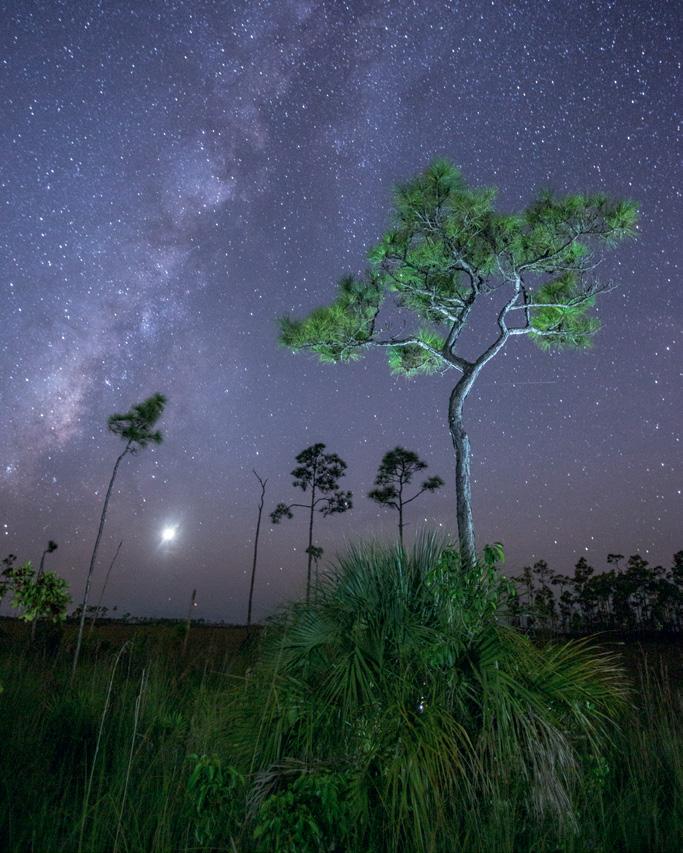
Although surrounded by large cities to the east, north and west, the interior regions of the Everglades boast some of the darkest skies east of the Mississippi.
In school, we learned about flightless cormorants, fire-red crabs, and salt-spitting iguanas on the Galápagos Islands. We were taught about glaciers scouring the Great Lakes and the slow artistry of erosion that carved the Grand Canyon. We studied Antarctica and its bounty of penguins, whales, and seals. We learned about plate tectonics and were sure that any day the San Andreas Fault might fracture, sending California drifting into the ocean. We were shown the dazzling corals and kaleidoscopic fish of the Great Barrier Reef. We learned that even the Sahara Desert grows cold at night, and we were told of the complex webs of life in the Amazon rainforest—the lungs of our planet. Throughout my early education, we took deep dives into pockets of unique life and far-flung geographies. Raised in north-central Florida, it often seemed that all the splendor of the natural world, at least the kind worth knowing, existed somewhere else.
I didn’t see any of my backyard natural areas—the freshwater springs, prairies, cypress swamps, or oak hammocks—published in the curriculum textbooks or National Geographic magazines. Yet as I learned to use my camera and follow my nose, my local wildernesses slowly began to reveal their own quiet wonders. Springs ran so clear that fish seemed to hover in midair above grassy fields. Cypress knees rose like stalagmite ramparts from tea-stained water, guarding the fluted buttresses of giant trees. Sandhill cranes’ trumpeting calls cut through dense dawn fog on wet prairies. Alligators and turtles clamored for sunny real estate on half-submerged logs. The more time I spent wandering these places, gathering photographic proof to show friends and family that something extraordinary existed right here at home, the more convinced I became of this corner of the world.
The first time I heard the phrase “American Amazon,” I was waist-deep in blackwater, slogging through a guzmania swamp in the Fakahatchee Strand of the Everglades. It is the most orchid- and bromeliad-rich place in the contiguous United States. I was searching for ghost orchids, small leafless flowers clinging to pop ash and pond apple trees. Dodging alligators and snakes, surrounded by lush epiphytic life, with crayfish nibbling at my sandaled toes and mosquitoes needling my neck, I began to understand the comparison. Standing there in that Edenic slough, it did not feel like an exaggeration.
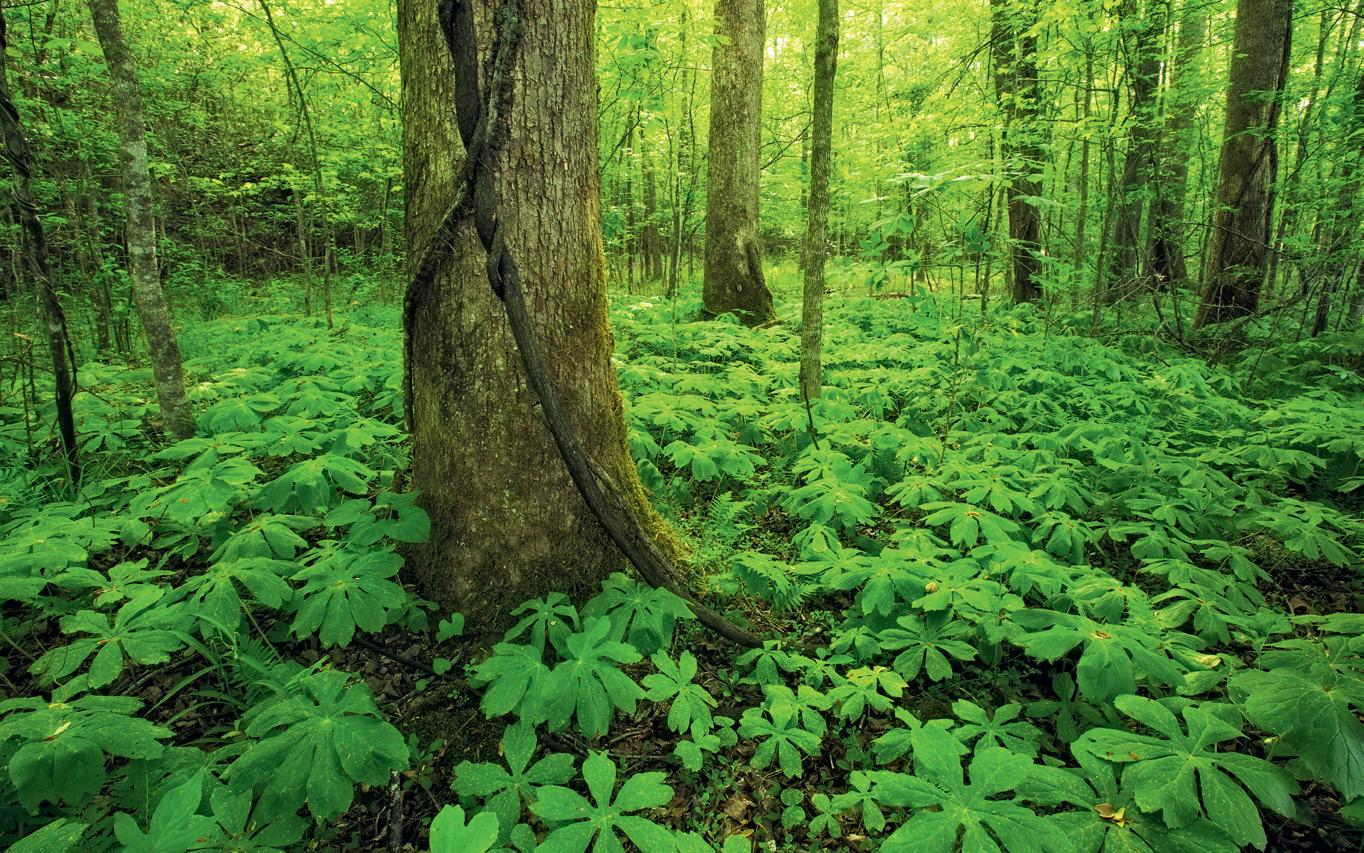
I heard the phrase again in the Okefenokee Swamp on the Georgia border, from a guide reminiscing about ancient cypress rising out of the sodden peat. A year later, and some two thousand feet higher in elevation, I was with a group of naturalists in Jones Gap State Park in South Carolina. We passed hordes of resplendent trillium and cove forests blanketed in ferns while headwaters seeped and gushed from every fissure in the mountain. The ranger told us this stretch of the Blue Ridge escarpment receives up to ninety inches of rain each
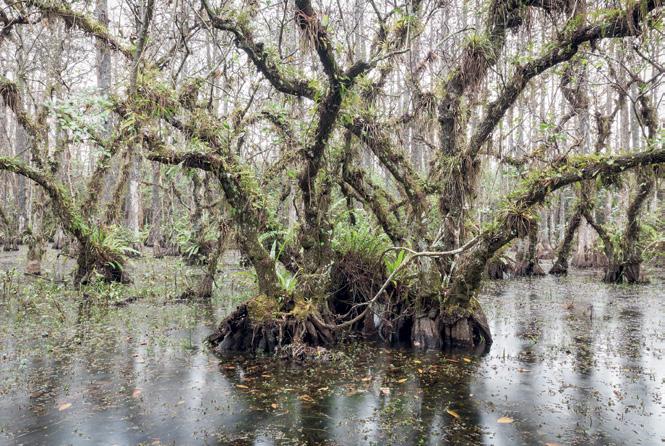
In subtropical swamps, slowmoving water and sodden soils form forested “strands,” where species like pond apple thrive in the saturated ground between deeper sloughs.
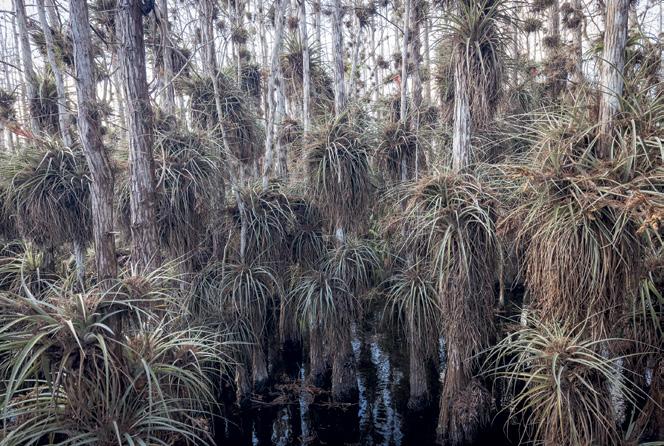
The humid microclimates of cypress domes support dozens of epiphyte species that live suspended on branches, absorbing moisture from the air and surviving without soil.
> FOLLOWING PAGES
Bacteria breaks down organic material and releases natural oils that spread across the water’s surface, creating shimmering rainbow sheens often mistaken for pollution, or in some cases a moon.
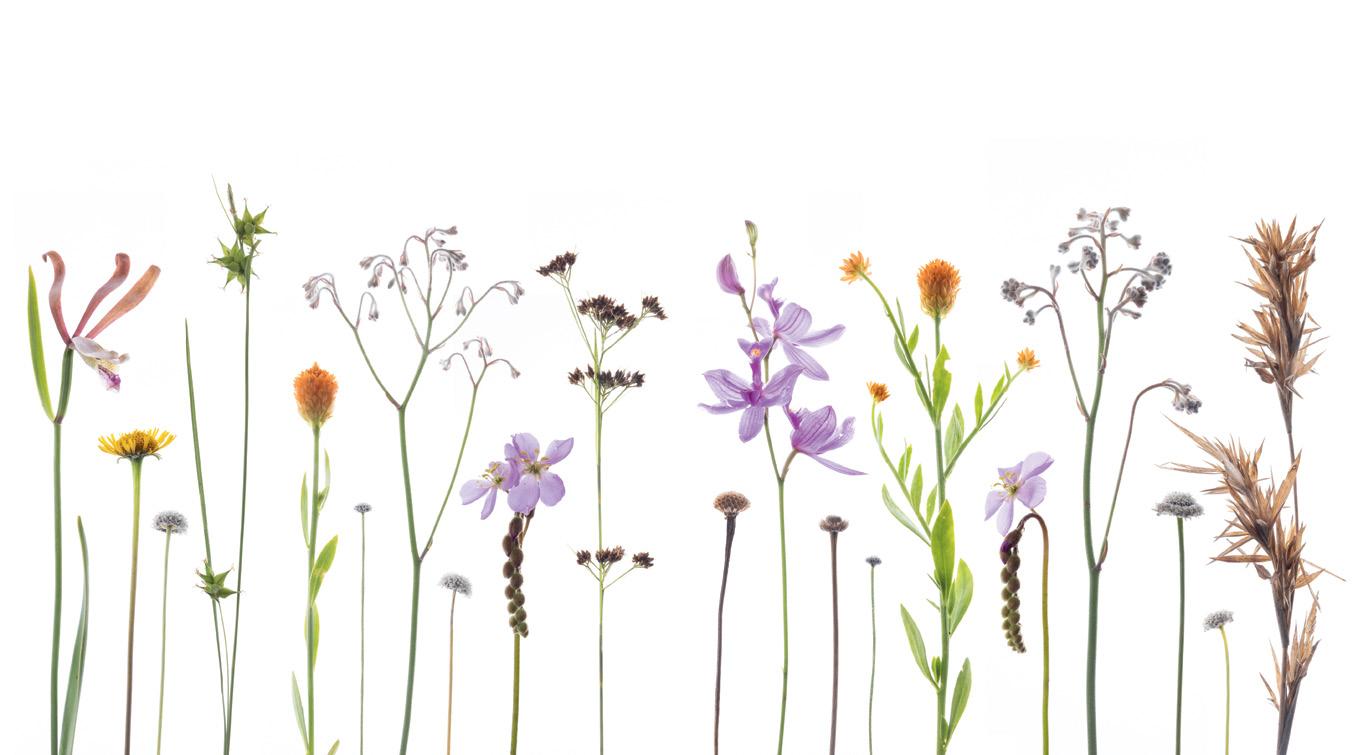
On the fringe of longleaf forests, wet prairies and bogs support extraordinary plant diversity, where dozens of species of colorful sedges, grasses, and orchids can grow together within a small patch of open, saturated ground. (20-image composite)
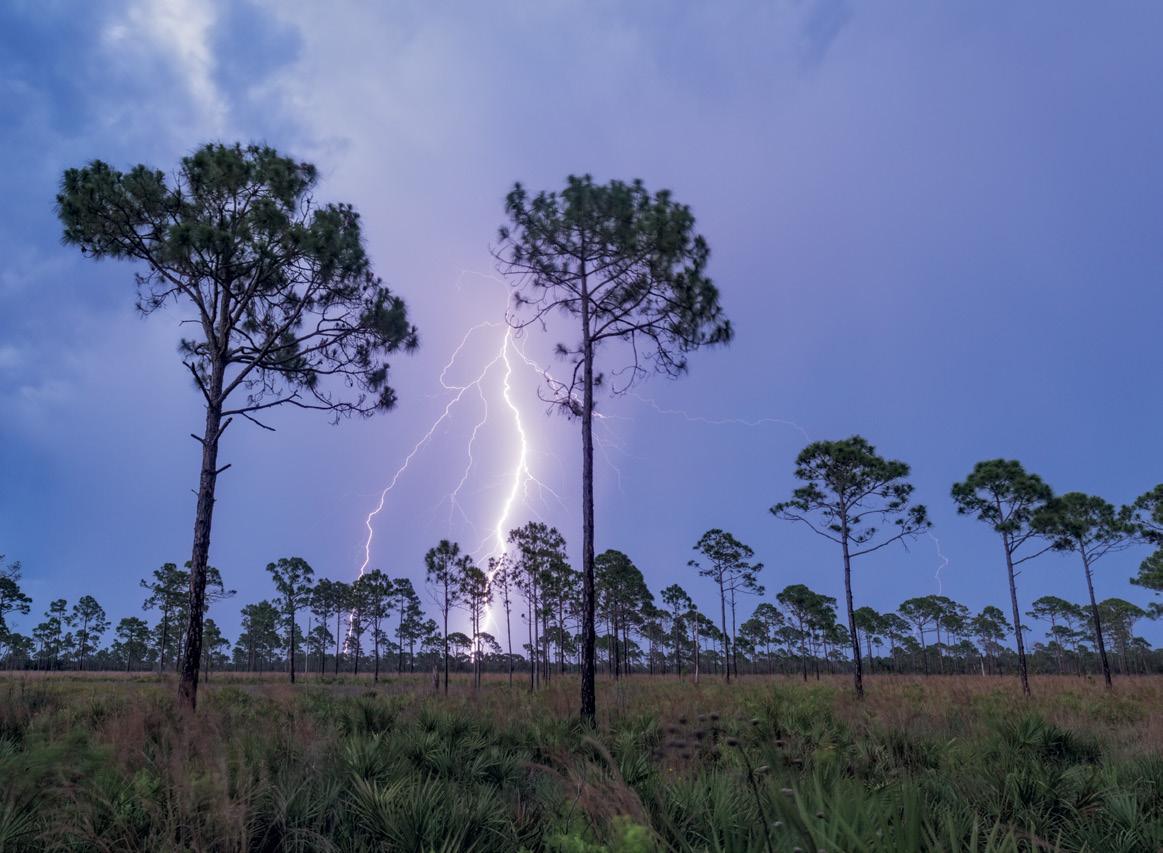
Once covering tens of millions of acres across the Southeast, longleaf and slash pine savannas were shaped by frequent lightningsparked fires that maintained open forests.
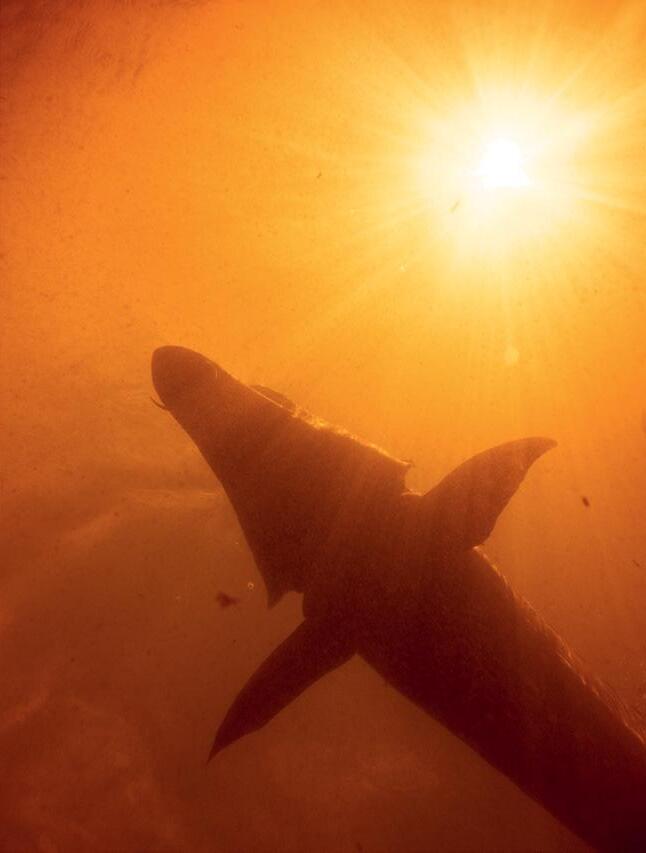
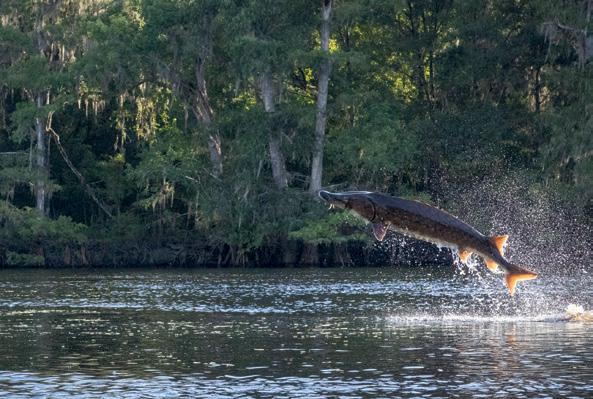
Sturgeon are famous for their explosive leaps from the water, sometimes launching several feet into the air, a behavior scientists still do not fully understand but believe may help fish communicate their presence.
> FOLLOWING PAGES
The federally threatened Gulf sturgeon is an ancient anadromous fish that migrates from the Gulf into free-flowing southern rivers each year, relying on long, undammed stretches of river to complete its life cycle.
Often called “snake birds” for the way their long necks move through the water while swimming, anhingas spread their wings to dry after diving because their feathers are not fully waterproof.
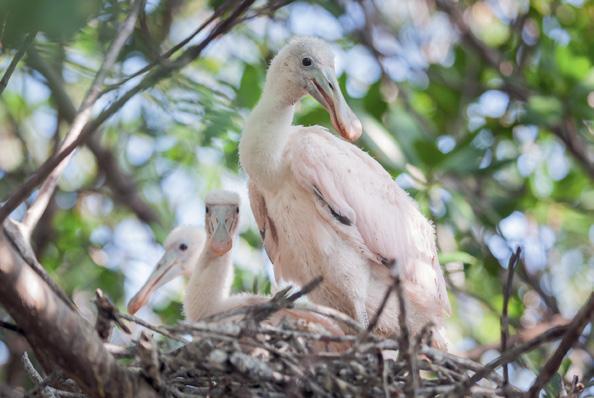
Nesting
about 30 days before fledging.
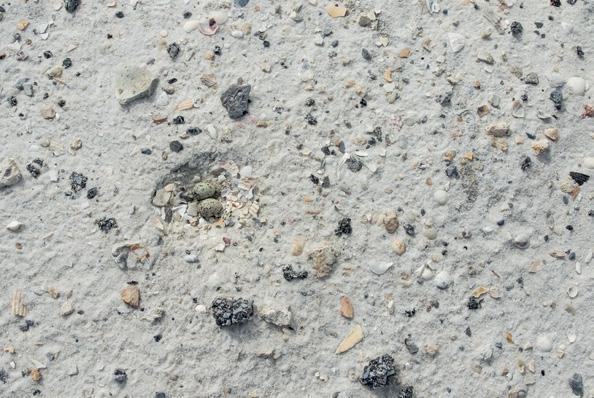
Inconspicuous and camouflaged among shells scattered along the dunes, least terns lay their eggs directly on the sand.
Dedication: In loving memory of Steve Everett, who taught generations of kids to look closer, wander farther, and care more for our local wild.
AMERICAN AMAZON MAC STONE
Photographs by Mac Stone
Introduction, Afterword and Captions by Mac Stone
Editorial Management by Nadine Weinhold, Johannes Abdullahi
Proofreading by Robin Limmeroth
Design and Layout by David Griffin
Cover Design by Marcus Taeschner
Photo Editing by Kathy Moran
Map painted by Aurise Randall and designed by David Griffin
Production by Sandra Jansen-Dorn
Color Separation and Prepress by Robert Kuhlendahl
Printed in the Czech Republic by PBtisk a.s.
Published by gestalten, Berlin 2026
ISBN 978-3-96171-753-8
1st printing, 2026
© teNeues, an Imprint of Die Gestalten Verlag GmbH & Co. KG, Berlin 2026
All rights reserved. No part of this publication may be reproduced or transmitted in any form or by any means, electronic or mechanical, including photocopy or any storage and retrieval system, without permission in writing from the publisher. No part of this book may be used or reproduced in any manner for the purpose of training artificial intelligence technologies or systems. This work is reserved from text and data mining (Article 4(3) Directive (EU) 2019/790).
Respect copyrights, encourage creativity!
For more information and to order books, please visit www.teneues.com and www.gestalten.com
Die Gestalten Verlag GmbH & Co. KG
Mariannenstrasse 9–10 10999 Berlin, Germany hello@gestalten.com
Krefeld Office
Uerdinger Str. 265 / Villa Pattberg 47800 Krefeld, Germany verlag@teneues.com
teNeues Press Department press@gestalten.com
Bibliographic information published by the Deutsche Nationalbibliothek. The Deutsche Nationalbibliothek lists this publication in the Deutsche Nationalbibliografie; detailed bibliographic data is available online at www.dnb.de