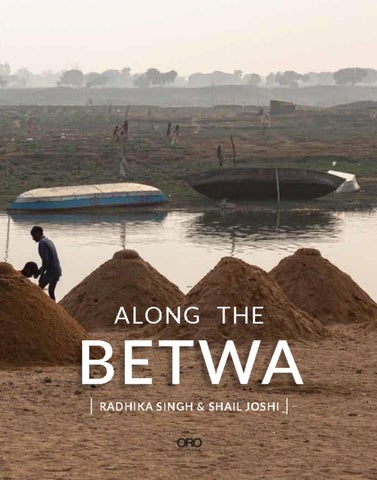
ALONG THE BETWA
ACKNOWLEDGMENTS We would like to thank Siddharth Agarwal, founder of Veditum, and Paul Salopek, of the Out of Eden Walk, who granted us the Moving Upstream Fellowship and also proved to be our source of inspiration and courage to take up this challenging task. Without the support and trust of our family members and friends this walk would have not been possible. Thank you for pushing us to document our journey. Most importantly, we would like to thank every single person we met during this walk. So many men and women willingly shared their stories and let us in their homes. Without the people of Bundelkhand this walk and the book would be meaningless.
INTRODUCTIONS Host Organizations
It is the human desire for change that makes documentation important, lest we forget where we’ve come from. Veditum India Foundation is an organization based out of Kolkata, India, that works at the intersection of environment, culture, and society. Through innovative methods in ground-level research, documentation, and use of media tools, stories about the Indian environment and people are being brought to life. The intent is to further amplify these stories, involve young Indians in this process, and push for collective action where required. Veditum’s current work is centered on Indian rivers, and life in and around these rivers. The aim is to create publicly accessible records—ecological, anthropogenic, hydrological, social, and more contextual layers—of these spaces and people. These records are not exhaustive, but rather a starting point in a process that will witness additions over time. To this end, the organization has engaged in both archival and grassroots level investigation. Through different projects, individuals and teams have walked thousands of kilometers along entire lengths of multiple Indian rivers and also executed focused work on rivers flowing within Indian cities. The fellowship program with Out of Eden Walk— part of the Moving Upstream project—supports field journeys, documentation work, and post production for individuals keen on walking along Indian rivers to document them. In the years ahead the fellowship program will be further expanded, more research walks will be undertaken along rivers, and archives will be opened up for collaborative work.
Veditum India Foundation by Siddharth Agarwal www.veditum.org
It was between 50,000 and 80,000 years ago that our forebears began a long trek from Africa across the undiscovered world. This formative experience of our species didn’t end when we reached the farthest corners of the planet—thousands of generations of adapting and learning later, the journey into our becoming continues. Today, the Out of Eden Walk Project is recreating that epic voyage of exploration the original way—on foot, without interruption, over the course of ten years and four continents. Pulitzer Prize-winning journalist Paul Salopek is using history, genetics, and archaeology as his guides as he retraces humankind’s 21,000-mile migration from Ethiopia—our evolutionary Eden—to the very tip of South America, the last continental horizon reached by our ancestors. The world walk merges the oldest form of storytelling—the wandering bard—with the newest digital technologies to create a laboratory for literary journalism online. Working with media and education partners, our mission is two-fold: To create an innovative storytelling hub that, by the end of the journey in 2023, will provide a timeless, boot-level snapshot of life on Earth at the turn of the millennium. To build along the way an enduring community of digital storytellers of all ages.
by Paul Salopek www.outofedenwalk.org
PREFACE Moving Upstream
In late 2018, Veditum, a non-profit research and media organization in Kolkata, had floated a call for applicants to the walk along the Betwa, a river that flows through northern India. Veditum undertakes various research projects in an attempt to bring awareness to aspects of environment, society, and culture that are often overlooked by mainstream media. Radhika Singh and Shail Joshi were two of the four people selected to walk along the Betwa. Their goal was to understand its importance in people’s lives. They started from Hamirpur, a city in Uttar Pradesh, where the Betwa merges with the Yamuna River. Then, they traveled onwards to Bandhouli, close to the confluence of the Betwa and Dhasan rivers. The entire journey, around 130 kilometers, was carried out on foot. Joshi and Singh depended on villages along the way for food and accommodation. The Betwa originates in the Vindhya Range in Madhya Pradesh and flows in a northeast direction before veering east and joining the Yamuna in Uttar Pradesh. This river has notable historical significance as it passes through several important cultural sites, such as the Sanchi Stupa, built in the 3rd century BCE, the cave temples of Udayagiri, and the Vishnu and Jain temples of Deogarh, Lalitpur, and Orchha, the last of which is a medieval town from the 16th century CE.1 Much of the Betwa runs through Bundelkhand, a region that stretches from Uttar Pradesh to Madhya Pradesh. Bundelkhand is one of the poorest and most drought-prone areas in the country2, with a rapidly sinking ground water level and highly variable rainfall.³ Many of its inhabitants practice agriculture, in addition to herding and fishing. Besides its historical significance, the Betwa was chosen for the river walk because it is part of a controversial river-linking project. The Ken River in Uttar Pradesh, which the government has described as having a “surplus” of water, will be linked to the Betwa, which has a “deficiency” of water, through a 231 km canal and a series of dams, including a 77-meter high dam on the Ken. This would be the beginning of an astounding 31 riverlinking projects planned throughout the country.4 One of the goals of this river-linking project is to address the water shortages of Bundelkhand, where farmers often do not have enough water to irrigate their fields. In
addition to the fact that Bundelkhand receives less rainfall than most other parts of India, it is not able to retain it. The water runs off the area’s rocky ground quickly, leaving it as dry as before.5 Other problems such as a growing population and the deforestation of lands that retain water have made the water shortage worse. A study by the National Institute of Disaster Management noted that Bundelkhand’s droughts are human-made and naturally induced.6 While climate change has led to a decrease in rainfall over the last few years, sand mining and other development activities have further dried up portions of the river.7 The necessity of the river-linking project has not been established successfully. Some experts in drought management believe that building multiple, smaller dams that aid in groundwater recharge is a better solution. Others propose using more sustainable drip irrigation methods instead of flooding whole fields to conserve water. For most of Bundelkhand’s history, people did not use river water for their irrigation purposes. Instead, they built thousands of smaller ponds and tanks to capture rainfall during the monsoon months.8 If it is carried out, the river-linking project will cause enormous environmental damage. Over 9,000 hectares of land will be submerged, of which 6,017 hectares is forest land. Much of this land is situated in the Panna Tiger Reserve where up to 23 lakh (2.3 million) mature trees will be destroyed. This will lead to a loss of breeding sites for wild animals, disconnection of wildlife corridors, and the degradation of the area’s biodiversity. Dozens of villages will be destroyed, displacing thousands of people along both the Ken and Betwa rivers.9 Despite these reservations on the part of environmentalists and social activists, an indifferent government has carried on with its work. It promises the inhabitants of Bundelkhand that the river-linking project will help provide water in drought-prone areas and revitalize agriculture. Rather than promote small-scale and cost-effective solutions that collect, conserve, and utilize water more wisely, officials claim that this Rs. 18,000 crore (approximately $235 million) project is a one-stop solution to mitigating agrarian distress in Bundelkhand.10
Yet it seems that very few people are actually talking to the residents of the region. The maps that the government is using to design the river-linking project are at least two decades old. Most people in Bundelkhand are also generally unaware of the project and what it would entail. The few newspaper articles that exist on the topic rarely go beyond detailing the agrarian distress of the region and reporting on the government’s solution. It is difficult to find people’s voices, opinions, or hopes for the future. By walking along the Betwa and talking to the residents of Bundelkhand, Radhika Singh and Shail Joshi aimed to document people’s voices, opinions, and hopes for the future. There is no doubt that Along the Betwa captures only snippets of the multitude of experiences that make up the life in the region. However, the authors hope that it will contribute to the larger conversation about Bundelkhand and foster a greater understanding of the people who live there.
Betwa River A panoramic view of the river with a lift irrigation operation visible at the far right end
Morning Scenes Animals begin to stir as daylight breaks and the village wakes up
T
he village was a spatial collage of modern and traditional houses. Most new houses were made of brick or concrete and were more durable to changes in the weather. Their design no longer followed patterns of vernacular architecture, where the courtyard is usually the epicenter of the house. Those who still had vernacular houses spent a lot of time on constant maintenance, which the adult women of the house were generally in charge of. Cow dung, used as a substitute for plaster, would have to be layered on the walls every couple of months. This would keep the interior of the house warm during cold winters and cold during scorching hot summers—something that pukka houses are not able to do. —Shail
Page 46
Page 47
Page 71
Page 72
H
e then took us upstairs to the roof of his house, where we settled down to have a chat. Agrarian distress was the main topic of our discussion. “Last season, there were two months of continuous rain,” he said. “It washed away all the soil and left us with rock. But when we need water, it does not come. I cannot get a tube well, because it will cost 5 lakhs (approximately $6,500), and even then, I do not know if water will come. Sometimes after all that effort, you only get two inches of water. With that amount can a farmer water his fields or just take a bath?”
Terrace Conversations Ravi Shukla’s father explains the current status of agriculture in his village while rolling a cigarette Page 73
Page 74
Vernacular Architecture This traditional house was made out of mud, straw, and slender bricks with cow dung used as the plastering material Page 136
Page 137