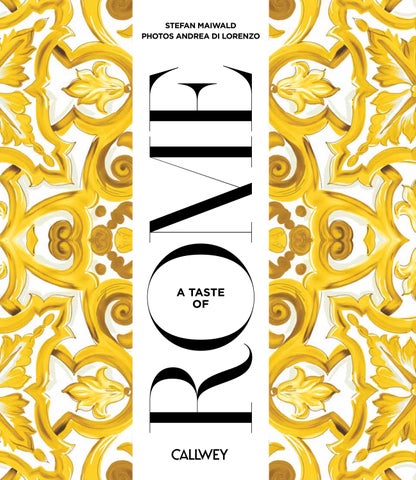
STEFAN MAIWALD PHOTOS ANDREA DI LORENZO
A TASTE OF
CON TENTS
6
148
I N T RO D U C T I O N
T R E V I F O U N TA I N & TRIDENTE
F O R E WO R D 6 RO M A N C U I S I N E 8 RO M E 1 0
D O N PA S Q UA L E 1 5 0 S A N B AY L O N 1 5 6 LU M E N C O C K TA I L S & C U I S I N E 1 6 2
14
GIANO 168 I N S I D E R T I P S & G O O D TO K N OW 1 7 4
TRASTEVERE EGGS 16 L’ A N T I D O T O 2 2 S E U P I Z Z A I L LU M I N AT I 2 8 I N S I D E R T I P S & G O O D TO K N OW 3 4
38
A RO U N D T H E VAT I C A N RO M A N È 4 0 PULEJO 46 B I A N C A T R AT T O R I A 5 2 L A P E RG O L A 5 8
178
THE SOUTH: T E S TA C C I O & S A N G I OVA N N I DOGMA 180 P I AT T O RO M A N O 1 8 6 C H E C C H I N O DA L 1 8 8 7 1 9 4 180 GR 200 SCIMA 206 S A N T O PA L AT O 2 1 2 TRECCA 218 I N S I D E R T I P S & G O O D TO K N OW 2 2 4
I N S I D E R T I P S & G O O D TO K N OW 6 4
226 68
MONTI, ESQUILINO & SAN LORENZO INEO 70 FORNO CONTI 76 I L M A R AT O N E TA 8 2
S E RV I C E C A F F È — A G R E AT S TA RT T O A BU O N G I O R N O ! 228 GOURMET SHOPPING 230 A P E R I T I V I — T H E B E S T P L AC E S F O R A GLASS OF WINE IN THE EVENING 232
MAZZO 88 I N S I D E R T I P S & G O O D TO K N OW 9 4
98
HISTORIC CENTER LA CIAMBELLA 100 CAMPOCORI 106 F R AT E L L I T R E C C A 1 1 2 C I A O A L I M E N TA R I 1 1 8 R E T RO B O T T E G A 1 2 6 T U L I PA N E 1 3 2 RO S C I O L I S A LU M E R I A 1 3 8 I N S I D E R T I P S & G O O D TO K N OW 1 4 4
234 INDEX
240 IMPRINT
CON TENTS
6
148
I N T RO D U C T I O N
T R E V I F O U N TA I N & TRIDENTE
F O R E WO R D 6 RO M A N C U I S I N E 8 RO M E 1 0
D O N PA S Q UA L E 1 5 0 S A N B AY L O N 1 5 6 LU M E N C O C K TA I L S & C U I S I N E 1 6 2
14
GIANO 168 I N S I D E R T I P S & G O O D TO K N OW 1 7 4
TRASTEVERE EGGS 16 L’ A N T I D O T O 2 2 S E U P I Z Z A I L LU M I N AT I 2 8 I N S I D E R T I P S & G O O D TO K N OW 3 4
38
A RO U N D T H E VAT I C A N RO M A N È 4 0 PULEJO 46 B I A N C A T R AT T O R I A 5 2 L A P E RG O L A 5 8
178
THE SOUTH: T E S TA C C I O & S A N G I OVA N N I DOGMA 180 P I AT T O RO M A N O 1 8 6 C H E C C H I N O DA L 1 8 8 7 1 9 4 180 GR 200 SCIMA 206 S A N T O PA L AT O 2 1 2 TRECCA 218 I N S I D E R T I P S & G O O D TO K N OW 2 2 4
I N S I D E R T I P S & G O O D TO K N OW 6 4
226 68
MONTI, ESQUILINO & SAN LORENZO INEO 70 FORNO CONTI 76 I L M A R AT O N E TA 8 2
S E RV I C E C A F F È — A G R E AT S TA RT T O A BU O N G I O R N O ! 228 GOURMET SHOPPING 230 A P E R I T I V I — T H E B E S T P L AC E S F O R A GLASS OF WINE IN THE EVENING 232
MAZZO 88 I N S I D E R T I P S & G O O D TO K N OW 9 4
98
HISTORIC CENTER LA CIAMBELLA 100 CAMPOCORI 106 F R AT E L L I T R E C C A 1 1 2 C I A O A L I M E N TA R I 1 1 8 R E T RO B O T T E G A 1 2 6 T U L I PA N E 1 3 2 RO S C I O L I S A LU M E R I A 1 3 8 I N S I D E R T I P S & G O O D TO K N OW 1 4 4
234 INDEX
240 IMPRINT
FORE WORD BY STEFAN MAIWALD
What a metropolis! Rome is breathtaking and unique, eternal and young at the same time. What city has continuously shaped a huge part of world history for two and a half millennia—first politically, then religiously? What city is the capital of three countries at once? (Italy, Vatican City and—guess what?—the Order of Malta.) “Rome is the most amazing city in the universe,” said—not Marcus Aurelius, but Asterix. Here, every single street hides a sight that other cities would tear down whole neighborhoods for and build a golden fence around. Caput mundi, capital of the world: an honorary title Rome wears with pride.— Probably no other city has shaped the modern world in so many ways. Law, science, painting, politics, architecture, philosophy, poetry, medicine—its influence was immense. Roman buildings still fascinate today, and the Catholic Church, also largely an Italian creation, is heading into the third millennium. The calendar the world uses today to count its days and years is a Roman invention by Julius Caesar. The Roman Republic, with its sophisticated balance of power, became a model for today’s nations. Many political terms derived from Latin go back to what happened in Rome: republic, president, congress, senate, representation, judiciary, executive, legislative, candidate, plebiscite and much more. Travelers in Rome are awestruck, and rightly so. Buildings like the Pantheon or the Colosseum would be hard to pull off even with modern technology. Catullus invented love poems, Gaius
Lucilius invented political satire, which Juvenal perfected. Ovid’s i nfluence on art was immeasurable. The Roman legal system was so sophisticated that by the year 500, the collected regulations were half as long as the Bible. As early as Hadrian’s reign (117–138), even slaves got certain rights—although they were still slaves. And the principle that it’s better to let a guilty person go than to punish an innocent one, still valid today, was already around in the year 223. Michelangelo created probably the most famous statue in the world with his “David” in Florence, but in Rome he made the most famous fresco in human history: the ceiling frescoes of the Sistine Chapel in St. Peter’s Basilica. Maria Montessori was the first woman allowed to study medicine in Rome (after Pope Leo XIII personally supported her) and revolutionized children’s education. The buildings coordinated from Rome—stretching from Scotland to Iraq—are possibly the biggest complex construction project in human history. Streets, palaces, fortifications, harbors, bridges, aqueducts still shape our cityscape today. Incidentally, even: Even in ancient Rome there were traffic jams and the first traffic reports. Residents in the environs were warned not to go to the capital of the empire on certain high holidays because of the expected crowds. The traffic is still thoroughly metropolitan. But because the city has grown over time, many great places are easy to reach on foot or by public transport.
6
7
FORE WORD BY STEFAN MAIWALD
What a metropolis! Rome is breathtaking and unique, eternal and young at the same time. What city has continuously shaped a huge part of world history for two and a half millennia—first politically, then religiously? What city is the capital of three countries at once? (Italy, Vatican City and—guess what?—the Order of Malta.) “Rome is the most amazing city in the universe,” said—not Marcus Aurelius, but Asterix. Here, every single street hides a sight that other cities would tear down whole neighborhoods for and build a golden fence around. Caput mundi, capital of the world: an honorary title Rome wears with pride.— Probably no other city has shaped the modern world in so many ways. Law, science, painting, politics, architecture, philosophy, poetry, medicine—its influence was immense. Roman buildings still fascinate today, and the Catholic Church, also largely an Italian creation, is heading into the third millennium. The calendar the world uses today to count its days and years is a Roman invention by Julius Caesar. The Roman Republic, with its sophisticated balance of power, became a model for today’s nations. Many political terms derived from Latin go back to what happened in Rome: republic, president, congress, senate, representation, judiciary, executive, legislative, candidate, plebiscite and much more. Travelers in Rome are awestruck, and rightly so. Buildings like the Pantheon or the Colosseum would be hard to pull off even with modern technology. Catullus invented love poems, Gaius
Lucilius invented political satire, which Juvenal perfected. Ovid’s i nfluence on art was immeasurable. The Roman legal system was so sophisticated that by the year 500, the collected regulations were half as long as the Bible. As early as Hadrian’s reign (117–138), even slaves got certain rights—although they were still slaves. And the principle that it’s better to let a guilty person go than to punish an innocent one, still valid today, was already around in the year 223. Michelangelo created probably the most famous statue in the world with his “David” in Florence, but in Rome he made the most famous fresco in human history: the ceiling frescoes of the Sistine Chapel in St. Peter’s Basilica. Maria Montessori was the first woman allowed to study medicine in Rome (after Pope Leo XIII personally supported her) and revolutionized children’s education. The buildings coordinated from Rome—stretching from Scotland to Iraq—are possibly the biggest complex construction project in human history. Streets, palaces, fortifications, harbors, bridges, aqueducts still shape our cityscape today. Incidentally, even: Even in ancient Rome there were traffic jams and the first traffic reports. Residents in the environs were warned not to go to the capital of the empire on certain high holidays because of the expected crowds. The traffic is still thoroughly metropolitan. But because the city has grown over time, many great places are easy to reach on foot or by public transport.
6
7
TRASTEVERE
R A PA K A B U C O N S A L S A D I M A N D O R L E K A B U T U R N I P I N A L M O N D S AU C E
4
FOR PEOPLE DIFFICULTY
4¼ oz (120 g) blanched almonds 8 white peppercorns Few drops of anchovy colatura (or: Asian fish sauce) 0.7 fl oz (20 ml) fermented asparagus juice (alternatively: 1 tbsp yogurt or 0.7 fl oz (20 ml) brine from fermented vegetables) 30 fresh bay leaves ⅔ cup (150 ml) grapeseed oil 4 kabu turnips with greens (or: other tender, non-fibrous turnips) A little olive oil Zest of 1 bergamot (optional: a few drops of juice) salt
1
First, prepare the almond sauce: Put the almonds in a bowl and pour boiling water over them to cover by about 1 cm. Let them soak, covered, for about 30 minutes. Meanwhile, toast the white peppercorns in a dry pan over low heat until fragrant. Set aside.
2
Put the soaked almonds with their liquid and the toasted peppercorns into a high-powered blender and blend to a smooth cream. Add the anchovy colatura and fermented asparagus juice (or substitute), plus a pinch of salt, and blend again. If the texture is too thick, add a little more water until you get a milky, delicately seasoned sauce. Pour into a container and keep at room temperature.
3
For the bay leaf oil, put the bay leaves in a heatproof blender. Heat the grapeseed oil to 80°C and carefully pour it over the leaves. Close the blender immediately and blend for 10 minutes, then strain the oil through a fine sieve or linen cloth and store it in a bottle or jar.
4
Separate the turnips from the greens. Wash the greens and remove the thick stems. Peel the turnips and cut each one into eight uniform pieces—not too small, so they don’t fall apart when steaming. Marinate the turnips and greens with a little olive oil and a pinch of salt.
5
Set the steamer to a temperature below boiling point. Steam the turnip pieces and greens for about 5 minutes, until still slightly firm. Plate up the turnips and greens, generously top with the almond sauce, drizzle with bay leaf oil, and sprinkle with freshly grated bergamot zest. Add a few drops of freshly squeezed bergamot juice if liked.
DID YOU KNOW?
The kabu turnip is a Japanese table turnip that is popular for its delicate sweetness and tender texture. Although still not well known in Europe, it is perfect for sophisticated vegetable dishes. This combination with almonds, bay leaf, and bergamot brings together delicate, spicy, and citrus-fresh flavors in perfect harmony.
24
TRASTEVERE
R A PA K A B U C O N S A L S A D I M A N D O R L E K A B U T U R N I P I N A L M O N D S AU C E
4
FOR PEOPLE DIFFICULTY
4¼ oz (120 g) blanched almonds 8 white peppercorns Few drops of anchovy colatura (or: Asian fish sauce) 0.7 fl oz (20 ml) fermented asparagus juice (alternatively: 1 tbsp yogurt or 0.7 fl oz (20 ml) brine from fermented vegetables) 30 fresh bay leaves ⅔ cup (150 ml) grapeseed oil 4 kabu turnips with greens (or: other tender, non-fibrous turnips) A little olive oil Zest of 1 bergamot (optional: a few drops of juice) salt
1
First, prepare the almond sauce: Put the almonds in a bowl and pour boiling water over them to cover by about 1 cm. Let them soak, covered, for about 30 minutes. Meanwhile, toast the white peppercorns in a dry pan over low heat until fragrant. Set aside.
2
Put the soaked almonds with their liquid and the toasted peppercorns into a high-powered blender and blend to a smooth cream. Add the anchovy colatura and fermented asparagus juice (or substitute), plus a pinch of salt, and blend again. If the texture is too thick, add a little more water until you get a milky, delicately seasoned sauce. Pour into a container and keep at room temperature.
3
For the bay leaf oil, put the bay leaves in a heatproof blender. Heat the grapeseed oil to 80°C and carefully pour it over the leaves. Close the blender immediately and blend for 10 minutes, then strain the oil through a fine sieve or linen cloth and store it in a bottle or jar.
4
Separate the turnips from the greens. Wash the greens and remove the thick stems. Peel the turnips and cut each one into eight uniform pieces—not too small, so they don’t fall apart when steaming. Marinate the turnips and greens with a little olive oil and a pinch of salt.
5
Set the steamer to a temperature below boiling point. Steam the turnip pieces and greens for about 5 minutes, until still slightly firm. Plate up the turnips and greens, generously top with the almond sauce, drizzle with bay leaf oil, and sprinkle with freshly grated bergamot zest. Add a few drops of freshly squeezed bergamot juice if liked.
DID YOU KNOW?
The kabu turnip is a Japanese table turnip that is popular for its delicate sweetness and tender texture. Although still not well known in Europe, it is perfect for sophisticated vegetable dishes. This combination with almonds, bay leaf, and bergamot brings together delicate, spicy, and citrus-fresh flavors in perfect harmony.
24
A RO U N D T H E VA T I C A N
F E T T U C C I N A A L T O RT E L L I N O T H E U P S I D E - D O W N PA S T A P O C K E T
4
FOR PEOPLE DIFFICULTY
1 lb 5 oz (600 g) fresh egg noodles (fettuccine) 2 ⁄5 cup (100 ml) strong meat broth ½ nutmeg 7 oz (200 g) mortadella, finely sliced 3½ oz (100 g) raw ham (e.g. prosciutto crudo), finely sliced 7 oz (200 g) Parmigiano Reggiano, aged 30 months, freshly grated
1
Bring plenty of water to a boil in a large pot, add salt, and cook the fresh fettuccine for about 4 minutes until al dente.
2
Meanwhile, bring the meat broth to a boil in a large pot and keep it warm. Grate about half a nutmeg directly into the broth using a fine grater, so it can fully release its aroma. Give it a quick stir and set the pot over medium heat.
3
As soon as the fettuccine are done, use tongs or a sieve to lift them straight from the cooking water into the hot broth, taking a little of the cooking water with you—that helps bind everything together. Toss the pasta in the broth for 1 minute so it can soak up the flavorful liquid.
42
4
Turn off the heat, then mix the mortadella and raw ham into the hot noodles. Now gradually stir in the freshly grated Parmigiano Reggiano until you get a creamy, slightly thick consistency. If the sauce seems too thick, you can thin it out a little with a tablespoon of pasta water.
5
Serve immediately and as hot as possible to preserve the creamy texture.
TIP FOR THE BROTH
For an authentic meat broth, simmer lean beef with celery, carrots, and onions (no salt) for at least 3 hours. Then strain through a fine sieve and reduce it until you have an intensely flavored stock.
A RO U N D T H E VA T I C A N
F E T T U C C I N A A L T O RT E L L I N O T H E U P S I D E - D O W N PA S T A P O C K E T
4
FOR PEOPLE DIFFICULTY
1 lb 5 oz (600 g) fresh egg noodles (fettuccine) 2 ⁄5 cup (100 ml) strong meat broth ½ nutmeg 7 oz (200 g) mortadella, finely sliced 3½ oz (100 g) raw ham (e.g. prosciutto crudo), finely sliced 7 oz (200 g) Parmigiano Reggiano, aged 30 months, freshly grated
1
Bring plenty of water to a boil in a large pot, add salt, and cook the fresh fettuccine for about 4 minutes until al dente.
2
Meanwhile, bring the meat broth to a boil in a large pot and keep it warm. Grate about half a nutmeg directly into the broth using a fine grater, so it can fully release its aroma. Give it a quick stir and set the pot over medium heat.
3
As soon as the fettuccine are done, use tongs or a sieve to lift them straight from the cooking water into the hot broth, taking a little of the cooking water with you—that helps bind everything together. Toss the pasta in the broth for 1 minute so it can soak up the flavorful liquid.
42
4
Turn off the heat, then mix the mortadella and raw ham into the hot noodles. Now gradually stir in the freshly grated Parmigiano Reggiano until you get a creamy, slightly thick consistency. If the sauce seems too thick, you can thin it out a little with a tablespoon of pasta water.
5
Serve immediately and as hot as possible to preserve the creamy texture.
TIP FOR THE BROTH
For an authentic meat broth, simmer lean beef with celery, carrots, and onions (no salt) for at least 3 hours. Then strain through a fine sieve and reduce it until you have an intensely flavored stock.
A RO U N D T H E VA T I C A N
C U O R E D I C A RC I O F O A RT I C H O K E H E A RT W I T H S W E E T B R E A D , A L M O N D S , A N D B L A C K T RU F F L E
4
FOR PEOPLE DIFFICULTY
1
FOR THE OXIDIZED ALMONDS
3½ oz (100 g) roasted almonds FOR THE ARTICHOKE STEMS
FOR THE ARTICHOKE HEARTS
6 small artichokes Juice of ½ lemon 1 garlic clove 13½ fl oz (400 ml) extra virgin olive oil ⅓ oz (10 g) fresh mint ⅓ oz (10 g) parsley 1 ⁄5 oz (5 g) pennyroyal mint 6¾ fl oz (200 ml) reduced white wine 6¾ fl oz (200 ml) low-fat goat’s milk FOR THE ARTICHOKE CARPACCIO ROLLS
6 violet artichokes 3⅓ fl oz (100 ml) vegetable broth ¾ fl oz (20 ml) extra virgin olive oil ¾ oz (20 g) black truffle FOR THE ARTICHOKE OIL
Approx. 3½ oz (100 g) artichoke trimmings 6¾ fl oz (200 ml) grapeseed oil FOR THE ARTICHOKE MAYONNAISE
1¾ oz (50 g) egg white 1¾ oz (50 g) plain yogurt 6¾ fl oz (200 ml) artichoke oil FOR THE SMOKED GOAT'S MILK
6¾ fl oz (200 ml) goat’s milk ⅓ fl oz (10 ml) virgin olive oil Pinch of salt Charcoal for smoking
6 artichoke stems ⅓ oz (10 g) parsley ⅓ oz (10 g) mint ¾ fl oz (20 ml) extra virgin olive oil 1 ⁄10 oz (3 g) salt FOR THE OFFAL SAUCE
2 lb 3 oz (1 kg) lamb offal (e.g., heart, liver, kidney) 1 garlic clove 1 sprig thyme 1 sprig rosemary ⅓ fl oz (10 ml) extra virgin olive oil ¾ fl oz (20 ml) white wine 11∕10 qt (1 l) veal broth 1¾ oz (50 g) carrots 2 egg whites
Clean the small artichokes, remove the tough leaves and the choke, and put them in lemon water. Roast the garlic in olive oil until golden brown, then remove it. Add mint, parsley, and pennyroyal, let it infuse, then strain. Mix with white wine and goat's milk, season to taste. Vacuum-seal the artichoke hearts with some marinade and steam at 90°C/194°F for 30 minutes. Chill the remaining marinade.
2
Clean the purple artichokes as well, but leave the inner leaves. Cook the outer leaves in broth and olive oil until soft, then puree. Cook the hearts sous-vide, slice them thinly, and roll them up alternating with truffle slices.
3
Grill the remaining artichokes, vacuum-seal with grapeseed oil (ratio 2:1), cook at 62°C/144°F for 1 hour, strain, and filter. For the mayonnaise, mix egg white and yogurt, then blend in artichoke oil until you get a stable emulsion.
4 5
Smoke half of the goat's milk for 10 minutes, strain, and mix with the unsmoked milk, olive oil, and salt.
FOR THE SWEETBREADS
2 lb 3 oz (1 kg) veal sweetbreads 10 fl oz (300 ml) milk (for marinating) 1 ⁄10 oz (3 g) salt 2 sprigs thyme 2 sprigs rosemary ¾ fl oz (20 ml) extra virgin olive oil 3⅓ fl oz (100 ml) veal stock FOR DECORATION
Blend almonds with vegetable broth, place in the oxidizer, run in “essence” mode for 4 hours, then strain. Season with olive oil, almond oil, and salt. Oxidize more almonds (1 hour), roast, and halve them.
6
Blanch the artichoke stems for 10 minutes, grill with herbs, let cool, and vacuum-seal. Before serving, trim them, cut into 3 cm cylinders, roast in oil, and season with salt.
7
Soak the offal in ice water for 24 hours, drain, sauté with garlic and herbs in oil, deglaze with white wine, add veal broth, and cook for 30 minutes. Clarify with carrots and egg white, then strain.
8
0.04 oz (1 g) black cardamom powder 0.04 oz (1 g) freeze-dried lamb heart powder 4 almond blossoms 8 edible flowers
Clean the veal sweetbreads, soak, and marinate overnight in milk. Dry, salt, and sauté with herbs in oil. Vacuum-seal and cook at 65°C/149°F for 1 hour, then glaze with veal stock.
9
Grill the artichoke hearts and place them in the center of the plate. Arrange the veal sweetbreads, truffle-artichoke rolls, puree, stem cylinders with mayonnaise, and chips around them. Decorate with cardamom powder, lamb heart powder, almond blossoms, and edible flowers. Serve the almond cream and smoked milk separately.
FOR THE ALMOND CREAM
7 oz (200 g) roasted almonds 3⅓ fl oz (100 ml) vegetable broth ¾ fl oz (20 ml) extra olive oil ¾ fl oz (20 ml) almond oil 1 ⁄5 oz (5 g) salt
60
A RO U N D T H E VA T I C A N
C U O R E D I C A RC I O F O A RT I C H O K E H E A RT W I T H S W E E T B R E A D , A L M O N D S , A N D B L A C K T RU F F L E
4
FOR PEOPLE DIFFICULTY
1
FOR THE OXIDIZED ALMONDS
3½ oz (100 g) roasted almonds FOR THE ARTICHOKE STEMS
FOR THE ARTICHOKE HEARTS
6 small artichokes Juice of ½ lemon 1 garlic clove 13½ fl oz (400 ml) extra virgin olive oil ⅓ oz (10 g) fresh mint ⅓ oz (10 g) parsley 1 ⁄5 oz (5 g) pennyroyal mint 6¾ fl oz (200 ml) reduced white wine 6¾ fl oz (200 ml) low-fat goat’s milk FOR THE ARTICHOKE CARPACCIO ROLLS
6 violet artichokes 3⅓ fl oz (100 ml) vegetable broth ¾ fl oz (20 ml) extra virgin olive oil ¾ oz (20 g) black truffle FOR THE ARTICHOKE OIL
Approx. 3½ oz (100 g) artichoke trimmings 6¾ fl oz (200 ml) grapeseed oil FOR THE ARTICHOKE MAYONNAISE
1¾ oz (50 g) egg white 1¾ oz (50 g) plain yogurt 6¾ fl oz (200 ml) artichoke oil FOR THE SMOKED GOAT'S MILK
6¾ fl oz (200 ml) goat’s milk ⅓ fl oz (10 ml) virgin olive oil Pinch of salt Charcoal for smoking
6 artichoke stems ⅓ oz (10 g) parsley ⅓ oz (10 g) mint ¾ fl oz (20 ml) extra virgin olive oil 1 ⁄10 oz (3 g) salt FOR THE OFFAL SAUCE
2 lb 3 oz (1 kg) lamb offal (e.g., heart, liver, kidney) 1 garlic clove 1 sprig thyme 1 sprig rosemary ⅓ fl oz (10 ml) extra virgin olive oil ¾ fl oz (20 ml) white wine 11∕10 qt (1 l) veal broth 1¾ oz (50 g) carrots 2 egg whites
Clean the small artichokes, remove the tough leaves and the choke, and put them in lemon water. Roast the garlic in olive oil until golden brown, then remove it. Add mint, parsley, and pennyroyal, let it infuse, then strain. Mix with white wine and goat's milk, season to taste. Vacuum-seal the artichoke hearts with some marinade and steam at 90°C/194°F for 30 minutes. Chill the remaining marinade.
2
Clean the purple artichokes as well, but leave the inner leaves. Cook the outer leaves in broth and olive oil until soft, then puree. Cook the hearts sous-vide, slice them thinly, and roll them up alternating with truffle slices.
3
Grill the remaining artichokes, vacuum-seal with grapeseed oil (ratio 2:1), cook at 62°C/144°F for 1 hour, strain, and filter. For the mayonnaise, mix egg white and yogurt, then blend in artichoke oil until you get a stable emulsion.
4 5
Smoke half of the goat's milk for 10 minutes, strain, and mix with the unsmoked milk, olive oil, and salt.
FOR THE SWEETBREADS
2 lb 3 oz (1 kg) veal sweetbreads 10 fl oz (300 ml) milk (for marinating) 1 ⁄10 oz (3 g) salt 2 sprigs thyme 2 sprigs rosemary ¾ fl oz (20 ml) extra virgin olive oil 3⅓ fl oz (100 ml) veal stock FOR DECORATION
Blend almonds with vegetable broth, place in the oxidizer, run in “essence” mode for 4 hours, then strain. Season with olive oil, almond oil, and salt. Oxidize more almonds (1 hour), roast, and halve them.
6
Blanch the artichoke stems for 10 minutes, grill with herbs, let cool, and vacuum-seal. Before serving, trim them, cut into 3 cm cylinders, roast in oil, and season with salt.
7
Soak the offal in ice water for 24 hours, drain, sauté with garlic and herbs in oil, deglaze with white wine, add veal broth, and cook for 30 minutes. Clarify with carrots and egg white, then strain.
8
0.04 oz (1 g) black cardamom powder 0.04 oz (1 g) freeze-dried lamb heart powder 4 almond blossoms 8 edible flowers
Clean the veal sweetbreads, soak, and marinate overnight in milk. Dry, salt, and sauté with herbs in oil. Vacuum-seal and cook at 65°C/149°F for 1 hour, then glaze with veal stock.
9
Grill the artichoke hearts and place them in the center of the plate. Arrange the veal sweetbreads, truffle-artichoke rolls, puree, stem cylinders with mayonnaise, and chips around them. Decorate with cardamom powder, lamb heart powder, almond blossoms, and edible flowers. Serve the almond cream and smoked milk separately.
FOR THE ALMOND CREAM
7 oz (200 g) roasted almonds 3⅓ fl oz (100 ml) vegetable broth ¾ fl oz (20 ml) extra olive oil ¾ fl oz (20 ml) almond oil 1 ⁄5 oz (5 g) salt
60
MONTI, ESQUILINO & SAN LORENZO
RU O T E PA Z Z E A L L A C A M P I D A N E S E S A R D I N I A N PA S T A W I T H S A L S I C C I A
4
FOR PEOPLE DIFFICULTY
3⅓ fl oz (100 ml) extra virgin olive oil 4 celery stalks, finely diced 4 carrots, finely diced 2 golden onions, finely chopped 1 lb 5 oz (600 g) fennel salsiccia (raw, casing removed) 5 fl oz (150 ml) dry white wine 1 lb 5 oz (600 g) peeled tomatoes (e.g., San Marzano, crushed by hand) Small pinch of saffron threads 27 fl oz (800 ml) hot vegetable broth 14 oz (400 g) ruote pazze (or other short pasta such as fusilli, rigatoni or malloreddus) 3½ oz (100 g) grated Fiore Sardo (aged sheep’s milk cheese) Salt
1
Heat the olive oil in a large pot. Sauté the celery, carrots, and onions in it over low heat until the vegetables are soft and aromatic, this can take up to 15 minutes.
2
Tear the sausage into chunks with your hands and add it to the pot. Fry it on high heat until it gets some color. Deglaze with white wine and let it reduce completely.
3
Now add the crushed tomatoes and simmer gently over medium heat for 30 minutes. About halfway through, stir in the saffron threads and a little hot vegetable broth. Add the rest of the broth gradually as needed so the sauce stays creamy but doesn’t dry out.
90
4
Meanwhile, cook the pasta in plenty of salted water until al dente (about 13 minutes). Drain and mix well with the finished sauce.
5
To serve, arrange the pasta in deep plates and generously sprinkle with grated Fiore Sardo. Serve hot right away.
MONTI, ESQUILINO & SAN LORENZO
RU O T E PA Z Z E A L L A C A M P I D A N E S E S A R D I N I A N PA S T A W I T H S A L S I C C I A
4
FOR PEOPLE DIFFICULTY
3⅓ fl oz (100 ml) extra virgin olive oil 4 celery stalks, finely diced 4 carrots, finely diced 2 golden onions, finely chopped 1 lb 5 oz (600 g) fennel salsiccia (raw, casing removed) 5 fl oz (150 ml) dry white wine 1 lb 5 oz (600 g) peeled tomatoes (e.g., San Marzano, crushed by hand) Small pinch of saffron threads 27 fl oz (800 ml) hot vegetable broth 14 oz (400 g) ruote pazze (or other short pasta such as fusilli, rigatoni or malloreddus) 3½ oz (100 g) grated Fiore Sardo (aged sheep’s milk cheese) Salt
1
Heat the olive oil in a large pot. Sauté the celery, carrots, and onions in it over low heat until the vegetables are soft and aromatic, this can take up to 15 minutes.
2
Tear the sausage into chunks with your hands and add it to the pot. Fry it on high heat until it gets some color. Deglaze with white wine and let it reduce completely.
3
Now add the crushed tomatoes and simmer gently over medium heat for 30 minutes. About halfway through, stir in the saffron threads and a little hot vegetable broth. Add the rest of the broth gradually as needed so the sauce stays creamy but doesn’t dry out.
90
4
Meanwhile, cook the pasta in plenty of salted water until al dente (about 13 minutes). Drain and mix well with the finished sauce.
5
To serve, arrange the pasta in deep plates and generously sprinkle with grated Fiore Sardo. Serve hot right away.
HISTORIC CENTER
S PA G H E T T O N I C O N P O M O D O R I N I D A T T E R I N I S PA G H E T T O N I W I T H D A T E T O M A T O E S A N D P E C O R I N O
4
FOR PEOPLE DIFFICULTY
2–3 tbsp extra virgin olive oil 2 garlic cloves 1 lb 5 oz (600 g) datterini tomatoes, halved lengthwise 1 oz (30 g) fresh basil, roughly torn 11¼ oz (320 g) spaghettoni (e.g., Pasta Mancini) 7 oz (200 g) finely grated Pecorino Romano Salt
1
Heat the olive oil in a large pan over medium heat and roast the lightly crushed garlic cloves until golden brown. Once they have taken on some color, add the halved date tomatoes and the roughly torn basil. Lightly salt and sauté over medium heat for a few minutes, until the flavors come together and the tomatoes start to soften.
2
Meanwhile, cook the spaghettoni in plenty of salted water until al dente, drain, and add straight into the hot pan. Toss well so the sauce coats the pasta evenly.
3
Turn off the heat, add the grated Pecorino Romano, and mix well until the cheese and tomatoes turn into a creamy sauce. Serve on plates, sprinkle with a little Pecorino, and garnish with a fresh basil leaf.
102
HISTORIC CENTER
S PA G H E T T O N I C O N P O M O D O R I N I D A T T E R I N I S PA G H E T T O N I W I T H D A T E T O M A T O E S A N D P E C O R I N O
4
FOR PEOPLE DIFFICULTY
2–3 tbsp extra virgin olive oil 2 garlic cloves 1 lb 5 oz (600 g) datterini tomatoes, halved lengthwise 1 oz (30 g) fresh basil, roughly torn 11¼ oz (320 g) spaghettoni (e.g., Pasta Mancini) 7 oz (200 g) finely grated Pecorino Romano Salt
1
Heat the olive oil in a large pan over medium heat and roast the lightly crushed garlic cloves until golden brown. Once they have taken on some color, add the halved date tomatoes and the roughly torn basil. Lightly salt and sauté over medium heat for a few minutes, until the flavors come together and the tomatoes start to soften.
2
Meanwhile, cook the spaghettoni in plenty of salted water until al dente, drain, and add straight into the hot pan. Toss well so the sauce coats the pasta evenly.
3
Turn off the heat, add the grated Pecorino Romano, and mix well until the cheese and tomatoes turn into a creamy sauce. Serve on plates, sprinkle with a little Pecorino, and garnish with a fresh basil leaf.
102
HISTORIC CENTER
C RO S T O N E C O N P E S T O D I FA G I O L I N I C RO S T O N E W I T H G R E E N B E A N P E S T O , S O F T C H E E S E , A N D P I C K L E D P E AC H E S
4
FOR PEOPLE DIFFICULTY
14 oz (400 g) green beans 3½ oz (100 g) blanched almonds 2¾ oz (80 g) aged sheep’s cheese, grated ½ garlic clove Extra virgin olive oil 4 slices sourdough bread 7 oz (200 g) soft cow’s milk cheese (e.g. Taleggio or Brie) 14 oz (400 g) preserved peaches, sliced Fresh thyme leaves Salt
1
Blanch the cleaned beans in lightly salted water for 1 minute, then shock them in ice water and drain well. Put almonds, beans, grated sheep’s cheese, and garlic in a tall container and use a hand blender to make a chunky pesto, gradually adding olive oil until a creamy consistency. Season with salt to taste.
2
Lightly toast the bread slices, then top them with thin slices of soft cheese. Bake in the oven at 180°C/400°F for about 8–10 minutes, until the cheese has melted.
3
Take them out of the oven, spread the green bean pesto on top, add peach slices, and garnish with fresh thyme leaves. Serve immediately, warm or lukewarm.
134
HISTORIC CENTER
C RO S T O N E C O N P E S T O D I FA G I O L I N I C RO S T O N E W I T H G R E E N B E A N P E S T O , S O F T C H E E S E , A N D P I C K L E D P E AC H E S
4
FOR PEOPLE DIFFICULTY
14 oz (400 g) green beans 3½ oz (100 g) blanched almonds 2¾ oz (80 g) aged sheep’s cheese, grated ½ garlic clove Extra virgin olive oil 4 slices sourdough bread 7 oz (200 g) soft cow’s milk cheese (e.g. Taleggio or Brie) 14 oz (400 g) preserved peaches, sliced Fresh thyme leaves Salt
1
Blanch the cleaned beans in lightly salted water for 1 minute, then shock them in ice water and drain well. Put almonds, beans, grated sheep’s cheese, and garlic in a tall container and use a hand blender to make a chunky pesto, gradually adding olive oil until a creamy consistency. Season with salt to taste.
2
Lightly toast the bread slices, then top them with thin slices of soft cheese. Bake in the oven at 180°C/400°F for about 8–10 minutes, until the cheese has melted.
3
Take them out of the oven, spread the green bean pesto on top, add peach slices, and garnish with fresh thyme leaves. Serve immediately, warm or lukewarm.
134
HISTORIC CENTER
P O L P E T T E A L L A RO M A N A RO M A N M E A T B A L L S W I T H T O M A T O S AU C E A N D G R I L L E D P O L E N TA
4
FOR PEOPLE DIFFICULTY
FOR THE MEATBALLS
Zest of ½ organic lemon 3 slices white bread, crusts removed 13½ fl oz (400 ml) whole milk 7 oz (200 g) finely chopped Mortadella Bologna 2 lb 3 oz (1 kg) ground beef (e.g., top round from Piedmontese cattle) 1 lb 2 oz (500 g) ground pork 1 lb 2 oz (500 g) ground veal 9¾ oz (280 g) finely grated Parmigiano Reggiano vacche rosse, aged 24 months ½ garlic clove, very finely chopped 2 whole eggs + 1 egg yolk 0.14 oz (4 g) freshly grated nutmeg Salt, black pepper
1
Finely grate the lemon zest—only use the yellow part. Remove the crusts from the white bread slices, soak them in milk, and after a few minutes, squeeze them out well.
4
2
For the sauce, mix the peeled tomatoes with the shallots, olive oil, and a pinch of salt while cold, then bring to a boil. Let it simmer gently for 20 minutes, then blend with a hand blender. Let it cook down for another 15 minutes until the sauce is creamy.
3
Meanwhile, with wet hands, shape meatballs of about 70 g each. Smooth the surface—the moisture is enough to seal the meatballs, no flour needed.
If you’re not using pre-ground meat: run the beef, pork, veal, and mortadella together with the garlic through a meat grinder, or chop the mortadella very finely on its own. Put all the meat, the soaked bread, cheese, lemon zest, and garlic into a large bowl. Mix everything thoroughly with your hands until you get a uniform, compact mixture. Lightly beat the eggs and yolk, then add them with salt, pepper, and nutmeg. Mix again until you have a smooth, slightly pink mixture.
5 6
Place the finished meatballs straight into the hot tomato sauce and let them gently simmer on low heat for at least 45 minutes, without stirring too much.
7
Cut the polenta into 1 cm thick slices and grill them on both sides in a grill pan or contact grill until golden brown.
8
To serve, arrange the meatballs with sauce and slices of polenta, sprinkle with a littlegrated Parmesan, and serve hot.
FOR THE TOMATO SAUCE
2 lb 3 oz (1 kg) peeled tomatoes (San Marzano or similar quality) 4 shallots, roughly chopped 3⅓ fl oz (100 ml) extra virgin olive oil salt FOR THE SIDE
14 oz (400 g) cooked polenta (e.g., from the day before) Grated Parmigiano Reggiano, for serving
142
HISTORIC CENTER
P O L P E T T E A L L A RO M A N A RO M A N M E A T B A L L S W I T H T O M A T O S AU C E A N D G R I L L E D P O L E N TA
4
FOR PEOPLE DIFFICULTY
FOR THE MEATBALLS
Zest of ½ organic lemon 3 slices white bread, crusts removed 13½ fl oz (400 ml) whole milk 7 oz (200 g) finely chopped Mortadella Bologna 2 lb 3 oz (1 kg) ground beef (e.g., top round from Piedmontese cattle) 1 lb 2 oz (500 g) ground pork 1 lb 2 oz (500 g) ground veal 9¾ oz (280 g) finely grated Parmigiano Reggiano vacche rosse, aged 24 months ½ garlic clove, very finely chopped 2 whole eggs + 1 egg yolk 0.14 oz (4 g) freshly grated nutmeg Salt, black pepper
1
Finely grate the lemon zest—only use the yellow part. Remove the crusts from the white bread slices, soak them in milk, and after a few minutes, squeeze them out well.
4
2
For the sauce, mix the peeled tomatoes with the shallots, olive oil, and a pinch of salt while cold, then bring to a boil. Let it simmer gently for 20 minutes, then blend with a hand blender. Let it cook down for another 15 minutes until the sauce is creamy.
3
Meanwhile, with wet hands, shape meatballs of about 70 g each. Smooth the surface—the moisture is enough to seal the meatballs, no flour needed.
If you’re not using pre-ground meat: run the beef, pork, veal, and mortadella together with the garlic through a meat grinder, or chop the mortadella very finely on its own. Put all the meat, the soaked bread, cheese, lemon zest, and garlic into a large bowl. Mix everything thoroughly with your hands until you get a uniform, compact mixture. Lightly beat the eggs and yolk, then add them with salt, pepper, and nutmeg. Mix again until you have a smooth, slightly pink mixture.
5 6
Place the finished meatballs straight into the hot tomato sauce and let them gently simmer on low heat for at least 45 minutes, without stirring too much.
7
Cut the polenta into 1 cm thick slices and grill them on both sides in a grill pan or contact grill until golden brown.
8
To serve, arrange the meatballs with sauce and slices of polenta, sprinkle with a littlegrated Parmesan, and serve hot.
FOR THE TOMATO SAUCE
2 lb 3 oz (1 kg) peeled tomatoes (San Marzano or similar quality) 4 shallots, roughly chopped 3⅓ fl oz (100 ml) extra virgin olive oil salt FOR THE SIDE
14 oz (400 g) cooked polenta (e.g., from the day before) Grated Parmigiano Reggiano, for serving
142
THE SOUTH
R I G A T O N I C O N L A PA J A T A R I G A T O N I W I T H V E A L I N T O M A T O S AU C E A N D P E C O R I N O
4
FOR PEOPLE DIFFICULTY
2 lb 3 oz (1 kg) pajata, veal or lamb (cleaned small intestine, pre-ordered from butcher) 1 tbsp lard 2 tbsp extra virgin olive oil 1 onion, finely chopped 1 garlic clove, finely chopped 8 cloves 5 fl oz (150 ml) dry white wine 4 lb 6½ oz (2 kg) peeled tomatoes (e.g., San Marzano) 1 tbsp tomato paste 14 oz (400 g) rigatoni or tortiglioni 14 oz (400 g) Pecorino Romano DOP (mild to semi-firm, not too salty) Salt, black pepper
1
4
Cut the pajata into pieces about 20 cm long, gently remove the outer skin, and tie them into small rings or loops. In a large pan, heat the lard with the olive oil and sear the pajata rings over high heat. Keep turning them until they’re evenly browned.
Meanwhile, cook the rigatoni in plenty of salted water until al dente, drain, and immediately return to the pot with some sauce and about half of the grated pecorino. Heat briefly while stirring constantly, until the sauce coats the pasta nicely.
Shortly before the end of searing, add onion, garlic, cloves, salt, and pepper, deglaze with white wine, and simmer with the lid on over high heat until the wine has completely evaporated. Stir regularly to prevent sticking.
To serve, put the pasta on a hot platter and arrange the braised pajata with plenty of sauce on top. Sprinkle with the remaining pecorino and serve right away.
2
3
Once the wine has reduced, add the peeled tomatoes, roughly chopped. Lower the heat, keep the pan covered, and simmer gently for about 30 minutes. Then stir in the tomato paste and simmer for another 20–30 minutes, until the pajata is tender and the sauce is creamy.
196
5
DID YOU KNOW?
La pajata is a classic of Roman cucina povera—it’s the small intestine of a milk-fed calf, cooked together with its pre-digested stomach contents. The way it’s tied during cooking creates a creamy, almost cheesy filling inside. This dish was an icon of Roman Sunday lunches for decades.
THE SOUTH
R I G A T O N I C O N L A PA J A T A R I G A T O N I W I T H V E A L I N T O M A T O S AU C E A N D P E C O R I N O
4
FOR PEOPLE DIFFICULTY
2 lb 3 oz (1 kg) pajata, veal or lamb (cleaned small intestine, pre-ordered from butcher) 1 tbsp lard 2 tbsp extra virgin olive oil 1 onion, finely chopped 1 garlic clove, finely chopped 8 cloves 5 fl oz (150 ml) dry white wine 4 lb 6½ oz (2 kg) peeled tomatoes (e.g., San Marzano) 1 tbsp tomato paste 14 oz (400 g) rigatoni or tortiglioni 14 oz (400 g) Pecorino Romano DOP (mild to semi-firm, not too salty) Salt, black pepper
1
4
Cut the pajata into pieces about 20 cm long, gently remove the outer skin, and tie them into small rings or loops. In a large pan, heat the lard with the olive oil and sear the pajata rings over high heat. Keep turning them until they’re evenly browned.
Meanwhile, cook the rigatoni in plenty of salted water until al dente, drain, and immediately return to the pot with some sauce and about half of the grated pecorino. Heat briefly while stirring constantly, until the sauce coats the pasta nicely.
Shortly before the end of searing, add onion, garlic, cloves, salt, and pepper, deglaze with white wine, and simmer with the lid on over high heat until the wine has completely evaporated. Stir regularly to prevent sticking.
To serve, put the pasta on a hot platter and arrange the braised pajata with plenty of sauce on top. Sprinkle with the remaining pecorino and serve right away.
2
3
Once the wine has reduced, add the peeled tomatoes, roughly chopped. Lower the heat, keep the pan covered, and simmer gently for about 30 minutes. Then stir in the tomato paste and simmer for another 20–30 minutes, until the pajata is tender and the sauce is creamy.
196
5
DID YOU KNOW?
La pajata is a classic of Roman cucina povera—it’s the small intestine of a milk-fed calf, cooked together with its pre-digested stomach contents. The way it’s tied during cooking creates a creamy, almost cheesy filling inside. This dish was an icon of Roman Sunday lunches for decades.
A CULINARY JOURNEY THROUGH THE ETERNAL CITY Rome isn't just a city full of history, it's also a paradise for foodies. A Taste of Rome reveals the culinary soul of the Eternal City in the Holy Year—from tiny trattorias hidden in back alleys to legendary cafés that have been around for generations. Alongside authentic recipes like cacio e pepe, carciofi alla romana, and pizza bianca, this Callwey book shares fascinating stories about Roman food culture and its roots. Detailed insider tips reveal where locals shop, eat, and enjoy their aperitivo. With stunning photos and a mix of travel guide and cookbook, this work invites you to experience Rome with all the senses—whether you're there in person or in your own kitchen. UNIQUE • Original recipes from Roman cuisine—from antipasti to dolci • Secret foodie spots— restaurants, markets, and cafés off the beaten tourist path • Exciting anecdotes— the history and traditions behind the dishes