Brauen
A SAMENESS BETWEEN US The Friendship of Charmion von Wiegand and Piet Mondrian in Letters and Memoirs
The Friendship of
arnoldsche
arnoldsche
9 783897 906068 >
in Letters and Memoirs
ISBN 978-3-89790-606-8
A SAMENESS BETWEEN US Charmion von Wiegand and Piet Mondrian
In April 1941 Charmion von Wiegand (1896—1983), an American journalist and artist, met Piet Mondrian for an interview. From this very first meeting, a deep friendship and working relationship developed; she translated Mondrian’s texts into English and edited them, discussed art and philosophy with him, and played a part in the evolution of many of the works he created up to his death in 1944. The artist’s memoirs of their encounters and their comprehensive correspondence have now been published in this volume for the very first time. The texts portray a relationship fluctuating between burning affection and distant friendship, tenderness and harsh rejection. A relationship that has left behind clear traces in Charmion von Wiegand’s life and works—far beyond Mondrian’s death.
Martin Brauen
Martin Brauen
A SAMENESS BETWEEN US The Friendship of Charmion von Wiegand and Piet Mondrian in Letters and Memoirs
Charmion von Wiegand, unknown date; text on reverse side: “radio interview on Litvinov” [Maxim Maximovich Litvinov, a Russian revolutionary], photographer Ray Lee Jackson, NBC Studios. Courtesy of the Estate of Charmion von Wiegand, Collection of Khyongla Rato
arnoldsche
Mondrian_Umbruch_final_21092020.indd 2-3
22.09.20 00:20
Charmion von Wiegand wrote a diary, Notes on Mondrian, about the time she was friends with Piet Mondrian. It is not clear whether she had any plans for publishing those texts. There are some indications that she did think about future publication—for instance, the circumstance that each page of these diary entries is numbered by hand, albeit inconsistently, with some gaps. In any case, she abandoned the idea because over the years she used passages from her diary for a range of articles. Her notes on Mondrian and the correspondence between them have been copied quite often and handed on—and for this reason they are not so unknown and inaccessible as the executors of Charmion von Wiegand’s estate have hitherto assumed. There are, for example, copies at the Getty Research Institute in Los Angeles and at the RKD— Netherlands Institute for Art History in The Hague. Moreover, some scholars engaged in research have had access to them, including Cooper/Spronk for their book Mondrian: The Transatlantic Paintings, Welsh/Joosten for Piet Mondrian: Catalogue Raisonné, and Louis Veen for an article dealing with Piet Mondrian’s autobiographical writings between 1941 and 1943. That the texts written by Charmion von Wiegand have even today not been published in their entirety is due, on the one hand, to the executors of the von Wiegand estate not promoting a publication of that kind and, on the other, probably because none of the material was in a state to be printed but had to be laboriously copied out by hand and edited. An additional problem with the correspondence between von Wiegand and Mondrian was that the material available through the estate consists of copies of carbon copies, some of which were typed over on typewriters, resulting in some passages being difficult to reconstruct. Letters Piet Mondrian had written by hand had to be transcribed; fortunately, the archives of RKD in The Hague proved a valuable resource to draw on for deciphering unclear passages because it had already transcribed most of the letters independently of the present project. Some pages seem to be missing in both the Notes on Mondrian kept by the von Wiegand estate as well as the letters. For instance, in the first letter held by the collection, which is dated May 7, 1941, Mondrian refers to a letter from Charmion von Wiegand that is not extant. There seem to be even more gaps in the correspondence because now and then reference is made to a letter that could not be found. The point at which Charmion von Wiegand planned to begin her Notes on Mondrian is not really clear: the pages reveal two different numbering systems. According to one of them, the text begins on page 1 (written by hand, top right); according to the other, this text is on page 9 (written by hand, bottom left). This first page of text bearing two different page numbers is dated April 1941. Since this is where Charmion von Wiegand begins to describe her first meeting with Mondrian, it is safe to assume that this really is the first page of the diary. Presumably, however, von Wiegand later wrote an introduction, which would explain why eight more pages eventually preceded what was seemingly
Mondrian_Umbruch_final_21092020.indd 8-9
8/9
THE FRIENDSHIP BETWEEN CHARMION VON WIEGAND AND PIET MONDRIAN IN LETTERS AND MEMOIRS
the first page. That is one reason I have decided to begin with a text by Charmion von Wiegand dated March 26, 1960 that is ideally suited to the purpose. Charmion von Wiegand added a text entitled The Calendar of the Last Days of Mondrian to her Notes on Mondrian. Although the pages of the former are not consistently numbered, the text can be chronologically fitted in because dates are mentioned in it—just a few of the entries are difficult to arrange in chronological order. I have slotted in a text between January 5 and February 10, 1944, which is very suitable in terms of content because in it von Wiegand describes her last visit to Mondrian’s studio—where she saw him working on Victory Boogie Woogie, his last picture—and briefly elucidated the genesis of the artwork: Notes dictated by Mrs. Charmion von Wiegand regarding Piet Mondrian’s Victory Boogie Woogie. The texts written by Charmion von Wiegand have been emended as little as possible with respect to grammar. To make them easier to read, however, I decided to make shorter sentences out of some long hypotactic ones—entirely in the interests of readability. Since the Notes on Mondrian are very extensive and contain numerous repetitions or things of only minor interest, I have abridged them by about twenty-five percent. The abridged passages are marked with ellipses. The year with the largest number of diary entries, all of them typewritten (twenty-five entries), is 1941. There are six entries for 1942, three for 1943, and eleven for 1944. Some fifty letters written by Charmion von Wiegand have come to light—most, with just a few exceptions, typewritten (1941: eighteen; 1942: twenty-eight; 1943: one; and 1944 two letters). About forty-five letters in Mondrian’s handwriting are extant—they are considerably shorter and more succinct than Charmion von Wiegand’s. Mondrian also wrote some twenty-five postcards, which—with one exception—have not been included here because they were almost all about deadlines and appointment dates, Mondrian’s ailments, or meetings with other people. Mondrian often failed to date his letters but always wrote the day of the week and sometimes even the time of day. Charmion von Wiegand filled in missing dates. Now and then mistakes crept in, which I have tried to correct, wherever this jarred noticeably with the content of a particular letter. Closer reading analysis of letter content revealed that some letters written by Charmion von Wiegand seem to be missing here and there, either because she wrote them by hand, and there are no copies of them in her estate papers for this reason, or because carbon copies made when letters were typed have been lost. In this introduction I do not give the exact dates of the letters and diary entries cited because I want to avoid forcing readers to jump back and forth between the introduction and the dairy or the correspondence in search of text passages. I am of the opinion that both the diary and the correspondence should—after this general introduction—be read in chronological order, hence in the right context. Readers will, I hope, encounter items of content that I particularly emphasize in my introduction as old friends.
22.09.20 00:20
INTRODUCTION
3
4
Genesis of the article Toward the True Vision of Reality 5
Mondrian_Umbruch_final_21092020.indd 12-13
This statement does not come from the texts presented here but from an interview with Charmion von Wiegand conducted by Paul Cummings: see Selected Bibliography, p. 199. It is not clear which article is concerned here; most likely the text was Nature and Spirit as Female and Male Elements because von Wiegand mentions this text in connection with a discussion she had with Mondrian on the subject of male/female. Some of the titles of the articles diverge from those given in Holtzman/James 1986.
12 / 13
made in Pure Plastic Art (1942), an article which Charmion von Wiegand helped Piet Mondrian to write for the catalogue accompanying the exhibition Masters of Abstract Art. Another vivid example of the time-consuming process of revising and editing Mondrian’s texts is an article that led after many intermediate phases to the above-mentioned text Toward the True Vision of Reality, which appeared on the occasion of Mondrian’s first solo show (1942). Charmion von Wiegand typed up the text Mondrian had written by hand, which Mondrian then again corrected, and which ultimately—from one more inter mediate stage—led to the final text (see fig. on p. 12). From the beginning Mondrian had the impression that Charmion von Wiegand understood his ideas, which may have been the reason why he trusted her and allowed her to revise and edit his texts. When von Wiegand expressed doubts to Mondrian at one of their meetings and said she didn’t really understand some aspects of his theory, Mondrian reassured her by saying “no, you understand.” In other words, he esteemed von Wiegand as a person and as the editor of his texts. He said as much once to the American writer and screenwriter Donald Ogden Steward, putting it as follows: “Oh, well, Charmion understands me best here.”3 Mondrian trusted Charmion von Wiegand, and felt close to her, something that evidently surprised him because he actually disliked journalists. But von Wiegand was, in fact, as Mondrian saw her, “a writer and an artist.” By contrast, Mondrian didn’t think so highly—at first anyway—of the translation skills demonstrated by his friend Harry Holtzman. For whatever reasons, Mondrian’s originally positive opinion of Charmion von Wiegand’s work as his translator would later change radically. Encouraged by praise from Mondrian, and increasingly enthusiastic for her part about Mondrian’s ideas, von Wiegand expressed a willingness to translate and revise more of his articles. This was convenient for Mondrian because he was planning to publish a collection of his essays. As shown in documents in the Charmion von Wiegand estate archives as well as observations in von Wiegand’s diary and the correspondence between Mondrian and herself, Charmion von Wiegand worked on quite a few Mondrian articles, including Nature of Oppositions,4 Concerning Neo-Plastic Art—A Dialogue between Mondrian, the Painter, and a Layman (1919), The Manifestation of Neo-Plasticism in Music and the Italian Futurists’ Bruiteurs (1921), The Realization of Neo-Plasticism in the Far Future and in Contemporary Architecture (1922), Realistic Art and Super Realistic Art (1930), True Value of Oppositions in Life and in Art (1934), Liberation from Oppression in Art and Life (1939–40), Toward the True Vision of Reality (1941), Pure Plastic Art (1942), and A New Realism (1942–43).5 Interminable discussions, fresh objections and corrections constantly being made by Mondrian, hours of research spent in libraries, and perpetual rewriting to produce new versions came with time to weigh heavily on the collaboration with Mondrian: he was often intransigent and insisted on his versions of texts, which led von Wiegand to write in her diary in December 1941: “His tone was so harsh and his words stung like a wasp bite. I was thunderstruck because I had worked so hard on his little piece—two nights that week and he had kept re-writing it constantly and changing it till I was frantic—always changing it into bad English. And we sat very close going over it together till I could no longer see the words—I was so tired with the work at home and in the library. But he had been so sweet
22.09.20 00:20
INTRODUCTION
Piet Mondrian, Composition No. I with Red, 1931, oil on canvas, 82.5 × 54.7 cm. Aaron I. Fleischman Collection. Courtesy of Aaron I. Fleischman. Christie’s Images/Mondrian/Holtzman Trust/Bridgeman Images; Welsh/Joosten B226. Von Wiegand called it the Tragic One
Mondrian_Umbruch_final_21092020.indd 24-25
Second exhibition of Groupe 1940, Parc des Expositions, Paris, January 15–February 1, 1932, with works by Paul Roubillotte, J. Gorin, one work by A. Calder, and two works by Mondrian: Composition No II with Yellow and Blue (Welsh/ Joosten B228) and Composition No. I with Red (Welsh/Joosten B226), the painting that Charmion von Wiegand called the Tragic One and that Piet Mondrian gave her on Christmas 1941, photographer unknown. Courtesy of the Estate of Charmion von Wiegand, Collection of Khyongla Rato
24 / 25
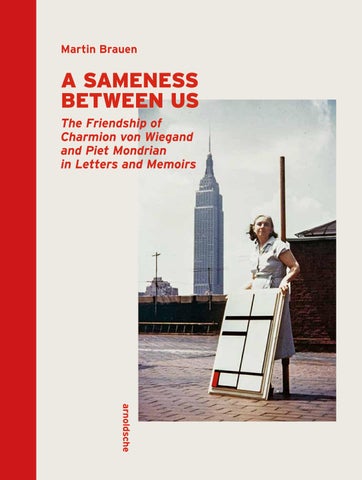
Charmion von Wiegand with Mondrian’s Composition No. 1, 1931, the Tragic One, on the roof of her apartment in New York, 1943, photographer unknown. Courtesy of the Estate of Charmion von Wiegand, Collection of Khyongla Rato
22.09.20 00:20
NOTES ON MONDRIAN
Piet Mondrian, New York City, 1942, oil on canvas, 119.3× 114.2 cm. Photo Musée National d’Art Moderne, Centre Pompidou, Paris, France, Inv. No. AM 1984-352 P. © Peter Willi / © Mondrian/Holtzman Trust/ Bridgeman Images; Welsh/Joosten B301. Von Wiegand called it the Female One and refers to the painting in her “Notes,” August 2, August 15, August 28, September 3, and September 10, 1941
58 / 59
Piet Mondrian, New York City 1 (unfinished), 1941, 119 × 115 cm. bpk, Bildagentur / Düsseldorf Kunstsammlung Nordrhein-Westfalen, Inv. No. 222; Welsh/Joosten B300. Von Wiegand called it the Male One or one of the Mummies and refers to these paintings in her “Notes,” June 5, June 12, July 7, July 10, August 2, August 28, 1941, and in her letters, July 30, 1941.
Mondrian_Umbruch_final_21092020.indd 58-59
22.09.20 00:21
NOTES ON MONDRIAN
Piet Mondrian, Composition No. III with Red, Blue, and Yellow, 1927, oil paint on canvas, 38 × 35.5 cm. Private collection. © Christie’s Images / © Mondrian/Holtzman Trust/Bridgeman Images; Welsh/Joosten B194
the same slender figures. I like the tenderness in the way the feet are placed together he said. Later he said: “For me there is no difference between these early ones and the last ones—they are all part of the same thing. I do not feel the difference between the old and the new in art as really different, but as a continuity.” He also said that he liked Valentine, who understood this, and would also show what was best, regardless of the style of expression. The little pencil sketch of the “Van Gogh”-landscape was framed hanging in the hall. “The frame is too heavy” he said. I replied: “The mat is too heavy and too close, it casts a shadow and destroys the perspective.” He did not agree but he said he would try to frame it over again lighter with only pass-partout. “You remember that you promised that sketch to me,” I said. “You deserve something better than that,” he said. “But I love it very much and really want it.” He did not answer, but I was delighted that he wants to give me something more, but I do like this little sketch very much, although it got lost in framing.56 Then we went through the pictures again—including those I had not seen last time that been unwrapped from their papers. I can’t remember them so well—there are now about 20 finished canvases. “And I wondered what you were doing all summer playing with that tape,” I said and he smiled his most charming smile. “It’s a lot of work, isn’t it?” And then he said: “I want you to look at them again and tell me how they are.” There were two with yellow squares—one 28 x 30, the Classic Yellow One with the long narrow yellow rectangle at the top and the Dynamic One with the yellow rectangle at
76 / 77
Charmion von Wiegand in her living room with Composition No. III, 1927 (above von Wiegand), and Dunes, Piers and Sea, 1909 (on the right side), photographer unknown. Courtesy of the Estate of Charmion von Wiegand, Collection of Khyongla Rato
56 Dunes, piers and sea, summer 1909/1912 [?], Welsh/Joosten B381.
Mondrian_Umbruch_final_21092020.indd 76-77
22.09.20 00:21
Dear Mr. Mondrian: This is to tell you how much I enjoyed yesterday afternoon and I hope now that the article is better than it was, because I am beginning to understand better. But I would like to put it in a more finished English, rather I would like to find newer and more concise (words) to embody the ideas. That applies to all your writing, that a new language is necessary. For philosophy proper, there is an accepted language, a sum of definitions. For aesthetics, there is a language. But for the philosophy of neo-plasticism, old words are used with new shades of meaning. Perhaps one should begin by re-defining these words or finding others or one could make a little dictionary of terms to state precisely how they are used. Do I make myself clear? As for the problem, I believe that I have moved around it at least and have obtained a more three-dimensional view. And as it becomes clearer, I can find analogies in life every where. It seems to me that the problem of creating unity through an equilibrium established through the equivalence of unequal oppositions has always been the basic problem of life and of art. But today it assumes a new and more vital importance than ever before in history—it expresses the deepest need of human being in a moment of destruction and disintegration, when the very fabric of society is being rent apart, and when the souls and bodies of men are being destroyed by violence. But the very intensity of destruction suggests an equal intensity of creation and suddenly I saw that in every field of endeavor, that people are working and struggling with the problem of a new unity—not the false and mechanical unity being imposed by Hitler on Europe (although here too the form is the same) but a unity through the integration of all creative energies in the world. So I found today that my husband is wrestling in his book with the problem of equilib rium in the human personality—the integration of the different and divided levels in each character that correspond to the schisms and divisions in society today. And tonight there came a young Swedish engineer, whose main interest in life he says is a new form of psycho-analysis, in which an effort is being made to show the relationship between bio-chemistry and psycho-analysis in the treatment of man’s neuroses. That is to reestablish a new balance of body and soul by a new scientific method. Now I am sure that if one once grasps the problem in all its implications, it will be a key to unlock many mysteries. Nature and history have always accomplished their ends by the dialectic method, but Marx put it in its first concrete terms—in the economic sphere—it was a great achievement but someday we will probably regard his approach as only the first primitive step and not as something conclusive and finished (as his disciples make it). But I don’t mean to tire you with these thoughts, only I feel we have come to a time, when man must apply the principle consciously and most of all in himself. And for this reason your work seems to me of such incalculable importance for us here in America. Because art has the possibility of solving a problem ahead of life, and even if you made me cut out the sentence that art penetrates deeper into personality than science I know it is true. For a great work of art is an eternally living deed, greater than any heroic deed on the battlefield or in the assemblies of men struggling for power or money. So when I came into your room yesterday, I felt the power of your work was stronger, that the concentration of energy was greater and more living than the energies which are engaged in raining bombs on Europe. And if I only seemed to look at the canvases in a casual way, it was because they were revealed to me in an entirely new way and I could not look straight at them for long. For when I first saw them, I felt them as beautiful design
merely and saw their relation to life as in architecture and in design. But yesterday I saw that they lived for themselves as works of art, that they are as sensuous and full of feeling as any former figurative art, that they are dynamically discharging energy, changing environment and creating a new sensibility for those who will receive it. And I think that the new canvases are more beautiful than those that were made in Europe, richer, more complex and more alive, more joyous. And so while I have watched other Europeans here grow sterile or disintegrate in their work, because they belong to that which is old and dying in Europe, your art has grown younger and stronger through its contact with the new world just because it belongs to the future. And for us you should be the focal point of contact between the great tradition in art in Europe (and it did exist for hundreds of years and is most surely dead today) and the new art here, which is not yet born. An old Bolshevik once told me how John Reed 7 came to Russia as a detached journalist and was transformed into an ardent revolutionary. And so it seems that I came as a curious critic and find myself over night a neo-plasticist.
June 6, 19418 Dear Mr. Mondrian: [...] Tonight I made the discovery that it is going to be necessary to change the language, to find new terms that more precisely convey your plastic ideas. Neither the terms of academic philosophy nor the terms of old aesthetics can be used. Nor can we use half journalism and half philosophical terms as we are doing now. I feel a disharmony. There must be analogous changes in words to correspond to your change in plastics. This is a question not for this particular article but for the future. We will have to re-define words and find the most equivalent ones for your ideas. As for the problem itself, I feel that I am moving toward a clearer understanding of it, that it is a process that develops unconsciously. […]
June 12, 1941, Samedi soir Dear Charmion von Wiegand, (I exclude the “Mrs.” and hope you will exclude “Mr.”!) I was delighted by your letter and I appreciate so much you see the living force of my work. I would have written you when you had left but my throat bothered me again and I felt just good enough to work. The “tape” pictures are well advanced. I would have written you also that I put 3 points on the backside of the little paper with the lines about Nazism and Democracy. These 3 points were the principal moving force in my development. You will have however already understood that. Yes, I put away that copy; I enclose it herewith. I shall be very glad to see you back again any time that suits you. Send me only a line; after dinner, of course, is also convenient for me. To me it is the same because I work equally at night and day. (I mean I don’t need daylight). I forgot to answer you about Malewitz [Malevich] but that can we do next time—I think he started from different point: not as a realist. He would express any state of mind. I had a big Bauhaus book of his, but must leave it in Europe. I never read it! I have two copys of my 7 8
Mondrian_Umbruch_final_21092020.indd 124-125
124 / 125
CORRESPONDENCE 1941
June 5, 1941
John Silas Reed, 1887–1920, American journalist, poet, and communist activist. Parts of this letter are more or less identical with the letter written on June 5, therefore they were excluded here.
22.09.20 00:21
CORRESPONDENCE 1941
Bauhaus book also two articles translated by a friend in German. I shall give you these—the best from Mondrian You left your pencil here. Good bye. We had no time to speak about my Neo-Plasticism with you, hope a next time. What you said about the terminology that is true but it will always be misunderstood I think when one cannot read between the lines!
July 14, 1941 Dearest Mondrian:
Piet Mondrian, The Trees, 1912, oil on canvas, 94 × 71.75 cm. Carnegie Museum of Art, Pittsburgh (Pennsylvania), Inv. No. 61.1.; Welsh/Joosten B21 This picture, Mondrian told me, was bought in the early years by a Dutchman.10 One day it appeared in Nierendorf’s Gallery for sale. Mondrian seemed very upset by this. “I wonder why he wants to sell it? Doesn’t he like it any more?” he said. It happened immediately after the Dudensing exhibition and so when I wrote my article, I got permission to have it photographed and reproduced. It was unsigned and Mondrian always intended to sign it. Once there was no ink in the gallery when he came to do it. I made a vow that I would rescue that picture, although at the time I had no means of doing it. After Mondrian’s death, it still hung in the gallery (the price was doubled), and it was included in the Mondrian Memorial Exhibition at the Museum of Modern Art. One day after the opening, I went to look at the show again and The Tree had a big gaping hole in the lower left side as if an umbrella or cane had been poked through it. It was quickly repaired and eventually returned to Nierendorf. One day on impulse, I took my total savings of $200 and went to him. He would not reduce the price and he said it was promised to Mies Van der Rohe, who was taking it as soon as he paid for his Klee collection. The upshot was that he took my down-payment and I walked out with a picture, which I had no idea how to pay for. Nierendorf went to Europe for 16 months and died a week after his return to New York. The estate was administered by the N.Y. Public Administrator and after 2 years of legal correspondence and terrific stroke of luck about money, the picture became my property.
126 / 127
This is to thank you for the little paper you gave me yesterday and which I have read at my leisure.9 Yes, I think it can be quite useful in the second article. But I enjoy it now for my own sake. Did we stay too long yesterday? I did want Joe to see the pictures, but perhaps, it was a strain on you dragging out so many things. Joe is still puzzled about the effect of energy which your work produces on one, and last night reading Da Vinci’s life, he picked out a flower drawing which he noticed closely corresponded to one you had. Do you know which one? Your ill health worries me and I am tormented that I can do nothing for you. In the summer there is no chance of selling pictures, because everyone is away and there is no social life at all now. But there must be some way to get you better glasses, as that can have an effect on your whole physical make-up. I do think that the beastly humid weather is the trouble and the adjustment to a new environment not too easy. Lots of people coming from Europe suffer from the latter, and with your sensibility, it must be very hard. Certainly the gift of your sensibility is a double-edged sword—while it makes art possible it also makes life at times intolerable. Am I right imagining that you have always had spells of illness throughout your life due to that over-sensitivity? It is for this reason that I understand your real need of solitude, which alone can heal and make whole the personality. Sometimes I feel very selfish that I have intruded in your solitude and yet the need to be in communication with you is irresistible. But I am quite happy to sit quietly without talking and I liked it very much the night you continued to work with me there. And yesterday I brought home two nice memories. One was that photograph of the spreading tree from long ago. I can’t remember any more beautiful tree in art. It had all the organic growth of the tree and the relation of the tree to the sky and wind—the upward thrust of growth and will to assert life and the yielding tenderness in the horizontal branches at the top of the tree. After all, it is not so different from your present canvases in structure and even in feeling. I love the burning cypresses of Van Gogh and I love the strong pines of Courbet in the snow—they are both aspects of that will to growth but they are not balanced by the freedom and release of the horizontal. So I like yours even better.
9 This is a two page hand-written paper by Piet Mondrian, dated July 13, 1941, starting with, “In this days many will lose the confidence in the equilibrium of life that exist in spite of the fact ...” 10 Most probably W. Beffie.
Mondrian_Umbruch_final_21092020.indd 126-127
22.09.20 00:21
CORRESPONDENCE 1942
settles down to routine again. The nicest part was being with you that short time, and I only want to tell you that I had explained myself badly about the “formula” idea—I did not understand it as an attack on abstract art when Stuart said it. But hearing it from two other painters last night, it became clear to me, that it was so—that they feel that not the form is limiting but the abstraction of it—they think what you call “multiplicity” is a sign of richness and invention. But that is usually surface only and in going deeper things become more profound. Enclosed the quotation from the book—lots more and better things are in it—but I will find them for you later. Dear one, take care of yourself and don’t smoke too much. I do hope Holty gets the drawings done for you.
January 5, 1942, Sunday night Dear Charmion, Thank you very much for your letter and copy of the Mathematic professor’s—very interesting. Tonight, after Holty’s mounting drawings I arranged the article “oppression”. Wednesday I shall show it to Holtzman and would very much like to hand it afterwards to you—perhaps you could come here Thursday or another day. In haste yours Mondrian I read your Janis-article and find it very good. Can’t you show it to Janis? I think he will publish it. The Nicholson-critic is made by the husband of the sister of his wife!!!
Piet Mondrian in his New York studio, before his first solo exhibition, photographer Arnold Newman, January 17, 1942. Courtesy of the Estate of Charmion von Wiegand, Collection of Khyongla Rato
Dear Mondrian: Here is the list of names [for the invitation to the exhibition at the Valentine Gallery], which I should have gotten to you yesterday. I copied them out of my address book, but do not know whether you want to send out so many, so I marked in red those whom I know are anxious to come. However, all the others, too, are interested in painting. If you want me to address them, please call me up tonight when you are at Holtzman’s. I will be in between 6.30 and 8.30. Certainly you should not have to do this. It is a fact that many people neglect to read the art section of the papers and therefore like to have their attention drawn to a particular exhibition. This morning when I woke up, I remembered that the exhibition is only a few days off and I felt so happy for you, that your pictures are going out into the world, and I feel confident that even if they may be only imperfectly understood, that they will have a tremendous influence and leave their impress on our life. After watching them grow and change and become more perfected through all these last months, it will be a new experience to see them hanging in a gallery quite impersonally.
Carl, whom I saw last night at a party at Richter’s28 says he will call Holtzman tonight about doing the drawings and he can probably come tomorrow. It is not going to be possible for me to come to you Saturday and stay late, as Joe is coming home, and I have not seen him for some time. I could come at 7 and stay till 10am. Or I can come any time you want on Sunday either afternoon or evening, unless you want to rest. Sunday would really be better for me. However, I can come either late tonight or tomorrow afternoon and address invitations for you. If Holtzman phones me tonight—let him phone and let me know, in any case, so I can make my own arrangements. I would not stay long and try not to bother you in your work. Kurt Seligman29 wishes to be remembered to you and wishes to say his respects to you on the opening day of the exhibition and hopes that you will honor him by accepting an invitation to dine with him and Mrs. Seligman soon etc etc. Dearest one, I must run and mail this and am paying your electric bill at the same time. Do hope you are not too worn out by the work and have had some sleep, In all devotion,
148 / 149
January 14, 1942, 2 o’clock (handwritten: sent note on 16th)
28 Hans Richter, 1888–1976, German painter, graphic artist, and experimental filmmaker. 29 Kurt Seligman, 1900–1962, Swiss-American Surrealist painter and engraver.
Mondrian_Umbruch_final_21092020.indd 148-149
22.09.20 00:21
Charmion von Wiegand in front of the Four Wheeled Chariot, 1967–68, photographer unknown. Courtesy of the Estate of Charmion von Wiegand, Collection of Khyongla Rato
CHARMION VON WIEGAND
1915 1916 1920 1922–26 1929 1932 1932–40 1941 1944 1945 1946 1947 1952–54 1967
March 4, born in Chicago Lives with her family in Florida, Arizona, and California The von Wiegands move to Berlin; Charmion attends secondary school and studies several languages, including German, Dutch, and French Attends Barnard College in New York City for one year Enrolls at Columbia University and takes classes at the School of Journalism but also studies medieval art, oriental art, and Byzantine archaeology Marries Hermann Habicht and moves to Darien, Connecticut; meets the poet Hart Crane Writes theater plays inspired, among others, by George Gurdjieff; meets Joseph Stella Divorces; takes a trip to Moscow and later returns there as a correspondent for the office of the Universal Service of Hearst Press Returns to New York City, where she marries Joseph (Joe) Freeman, the editor and co-founder of New Masses, later editor of Partisan Review Works as a journalist, reviewing exhibitions and writing articles on the art world April 23, meets Piet Mondrian for the first time After the death of Mondrian dedicates herself to painting full-time Her work is included in the group exhibition The Women at Peggy Guggenheim’s Art of This Century gallery, New York Starts becoming interested in theosophy, later in Zen Buddhism, the I-Ching, and yoga Member of American Abstract Artists (AAA); organizes several exhibitions for the Rose Fried Gallery; meets the painter Mark Tobey Becomes president of American Abstract Artists Meets the Tibetan monk Khyongla Rato Rinpoche and helps him write his biography, My Life and Lives
Mondrian_Umbruch_final_21092020.indd 194-195
Cover of exhibition leaflet Charmion von Wiegand and Her Circle, Marilyn Pearl Gallery, New York, 1981. Courtesy of the Estate of Charmion von Wiegand, Collection of Khyongla Rato
1968 1973–77 1978
1980 1982 1983
Organizes The Art of Tibet, an exhibition about Tibetan religious art Her art is exhibited in Rome, Venice, London, New York, and Paris Ce Roser interviews von Wiegand for a PBS documentary entitled The Circle of Charmion von Wiegand Elected to the American Academy of Arts and Letters First retrospective at the Bass Museum of Art, in Miami Beach June 9, dies in New York City. Upon her death, her paintings and her archive are bequeathed to Khyongla Rato Rinpoche
194 / 195
1896 1899–1911 1911
22.09.20 00:21
SELECTED BIBLIOGRAPHY Charmion von Wiegand Cummin, Paul: Oral History Interview with Charmion von Wiegand, October 9 and November 3, 1968. Archives of American Art, Smithsonian Institution Hersh, Jennifer Newton: Abstraction, Spiritualism, and Social Justice: The Art and Writing of Charmion von Wiegand. PhD dissertation, City University of New York, 1998 Rowell, Margrit: Interview with Charmion von Wiegand, June 20, 1971. In: Piet Mondrian, 1872–1944, Centennial Exhibition, pp. 77–86. New York, The Solomon R. Guggenheim Museum, 1971 von Wiegand, Charmion: The Meaning of Mondrian. The Journal of Aesthetics and Art Criticism, Vol. 2, No. 8 (Autumn, 1943), pp. 62–70 von Wiegand, Charmion: Mondrian: A Memoir of His New York Period, Arts Yearbook 4, 1961 *** Roser, Ce (producer): The Circle of Charmion von Wiegand. Video documentary, 43’, 1978; director: Mark Brownstone, music: Philip Glass
Piet Mondrian Cooper, Harry/Spronk, Ron: Mondrian: The Transatlantic Paintings. New Heaven and London, 2001 Holtzman, Harry/James, Martin S.: The New Art—The New Life: The Collected Writings of Piet Mondrian. New York, 1986 Seuphor, Michel: Piet Mondrian: Life and Work. New York, 1960 Troy, Nancy J.: The Afterlife of Piet Mondrian. Chicago and London, 2013 Welsh, Robert P./Joosten, Joop M.: Piet Mondrian: Catalogue Raisonné. Munich/New York, 1998
198 / 199
A later painting by Charmion von Wiegand, with influences from the Tibetan Buddhist cosmos and mandala symbolism, 31,7 × 24 cm, photography by Love Weber, Bern. Collection of Sonam Dolma and Martin Brauen, Bern
Mondrian_Umbruch_final_21092020.indd 198-199
22.09.20 00:21
Brauen
A SAMENESS BETWEEN US The Friendship of Charmion von Wiegand and Piet Mondrian in Letters and Memoirs
The Friendship of
arnoldsche
arnoldsche
9 783897 906068 >
in Letters and Memoirs
ISBN 978-3-89790-606-8
A SAMENESS BETWEEN US Charmion von Wiegand and Piet Mondrian
In April 1941 Charmion von Wiegand (1896—1983), an American journalist and artist, met Piet Mondrian for an interview. From this very first meeting, a deep friendship and working relationship developed; she translated Mondrian’s texts into English and edited them, discussed art and philosophy with him, and played a part in the evolution of many of the works he created up to his death in 1944. The artist’s memoirs of their encounters and their comprehensive correspondence have now been published in this volume for the very first time. The texts portray a relationship fluctuating between burning affection and distant friendship, tenderness and harsh rejection. A relationship that has left behind clear traces in Charmion von Wiegand’s life and works—far beyond Mondrian’s death.
Martin Brauen