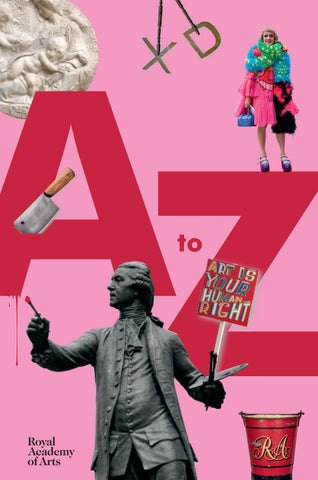
PPC Cove r (Board Hollow Spine) 110 x 165mm for 115gsm Munken Print Vol 15 (172mic) - 64 pages
‘A’ is for Academicians and anarchists, ‘B’ is for bread and beef tea, ‘C’ is for a certain cartoon by Leonardo... discover the fascinating history of the Royal Academy of Arts from A to Z. Each page brings to life a hidden RA, illustrated with artwork, letters, artefacts and sketches from the archives. Packed with quarrels, quibbles, triumphs and disasters, rivalries and resignations, this book tells the story of an institution like no other. Maurice Davies is Head of Collections Annette Wickham is Curator of Works on Paper.
£6.95
96813_RA_A to Z_v10__PPC COVER.indd 1
24/04/2018 12:05
A
A is for Academicians and Anarchists
The RA is unusual because it’s run by artists: the Royal Academicians. Around 120 painters, sculptors, printmakers and architects make every important decision about what the RA does. Their number is strictly limited – since the RA was founded in 1768, there have been fewer than 700 in total. On election, each artist receives a Diploma (right) and gives the Academy a Diploma Work (see previous page for Grayson Perry’s Red Alan). The Diploma Works form a distinctive slice of British art and an important part of the RA’s collection, selected not by curators or collectors, but by the artists themselves.
RA_AtoZ_v40.indd 6
The Academy’s founder members needed George III’s financial support and the status his support bestowed. However, some had political leanings that were anything but establishment. It wasn’t long before George became suspicious that his new Academy was filled with ‘anarchists’ who supported the French and American revolutions.
24/04/2018 11:36
RA_AtoZ_v40.indd 7
24/04/2018 11:36
RA_AtoZ_v40.indd 8
25/04/2018 13:44
RA_AtoZ_v40.indd 9
B B is for Bread and Beef Tea
Rubber was known to be good for erasing drawings as early as 1770, but students in the RA Schools preferred to use squished-up pieces of bread. It also served another purpose as a projectile for students to hurl at one another. Bread ended up being used in such large quantities it was temporarily banned for costing the Schools too much money.
During the selection and hang of the annual Summer Exhibition, the done thing is to drink beef tea. In the nineteenth century the beverage was prescribed as a cure for maladies from indigestion to fever and used by Florence Nightingale to fortify injured soldiers. These days the recipe is guarded by the Red Collars. As efficacious as it may be, one member of the Selection Committee described the concoction as ‘quite disgusting’.
25/04/2018 13:44
C C is for Cartoon and Casson
In the late 1950s the Academy was in dire financial trouble. What to do? The RA’s answer: sell its assets. One of its most valuable treasures was the Burlington House Cartoon, a large drawing by Leonardo da Vinci of the Virgin and Child with St Anne and St John the Baptist. The RA faced a barrage of criticism over the sale but eventually the work was sold and moved the short distance to the National Gallery in 1962.
RA_AtoZ_v40.indd 10
The architect and designer Sir Hugh Casson is credited with kick-starting the revival and modernisation of the RA when he became President in 1976. Loved for his charm and wit, he established the Friends – now 100,000 strong – and persuaded the great and the good to support the institution. Casson was the great enabler, whizzing around London in his bright yellow Mini.
24/04/2018 11:36
RA_AtoZ_v40.indd 11
24/04/2018 11:36
P is for Parties and Palmy Days An institution run by artists and buzzing with art students is inevitably a place of frequent parties. They can be grand and socially prestigious – like the Summer Exhibition Preview Party, a highlight of the London social scene. And they can be wild – like student parties in the Cast Corridor. This fabulous image reveals the early influence of rock n’ roll and Bill Hayley. The annual RA Christmas party for staff and Academicians brings out the most elaborate of fancy-dress costumes.
RA_AtoZ_v40.indd 36
24/04/2018 11:36
RA_AtoZ_v40.indd 37
P
Frederic, Lord Leighton, presided over an Academy at the centre of the British art world, when dealers and commercial galleries were scarce and the Summer Exhibition was the most important show in town. These were the ‘palmy days’ of the RA. This painting by William Powell Frith shows a packed gallery in 1881. The crowd includes Oscar Wilde, the actress Lily Langtry and Prime Minister William Gladstone. It is a world parodied by John Sessions in his one-man show ‘Paint Said Fred’, commissioned by the RA in 1996. The cast of characters were all played by Sessions. He played Leighton as Hugh Grant ( because, like Grant, Leighton had ‘charm to barbecue’), with a voice ‘like Arthur Scargill after Swiss finishing school’.
24/04/2018 11:36
Q Q is for Queues and Queens
The Royal Academy has hosted some of London’s most successful exhibitions. A sure sign of a blockbuster is the appearance of queues in the courtyard. Nor are determined exhibition-goers put off by a drop of rain. This photograph was taken on one of the last days of ‘Turner 1775–1851’ in 1975.
RA_AtoZ_v40.indd 38
As the name suggests, the reigning monarch is the patron of the Royal Academy. Back in the early days, George III and members of his family made a point of visiting the Annual Exhibition, giving the event great social prestige. To celebrate her ninetieth birthday in 2016, the Queen spent time meeting Royal Academicians, among them the flamboyant ceramicist and all-round national treasure Grayson Perry, who was dressed in pink frills as his alter ego Claire. After meeting Her Majesty, Perry quipped ‘I hope I look that good at 90.’
24/04/2018 11:36
RA_AtoZ_v40.indd 39
24/04/2018 11:36
RA_AtoZ_v40.indd 40
24/04/2018 11:36
RA_AtoZ_v40.indd 41
R
R is for Refusals and Red Collars Plenty of artists have refused the offer of becoming an Academician. When Edward Burra got the call telling him he had been elected an Academician in 1961, he allegedly shouted ‘Tell them to f**k off, I’m busy.’ In the 1980s Francis Bacon, Howard Hodgkin and Richard Hamilton all refused to join, but did so more politely.
You’ll always find a dapper Red Collar in the entrance hall. They combine the roles of guiding visitors and supervising security with ceremonial duties such as announcing speakers at receptions and dinners and mixing and serving beef tea during the hanging of the Summer Exhibition. On the grandest occasions they don black tails and a matching waistcoat. One thing has been dropped from the job description, however: the Red Collars no longer pose nude in the Life Room, as their predecessors did…
25/04/2018 14:51
RA_AtoZ_v40.indd 63
24/04/2018 11:37