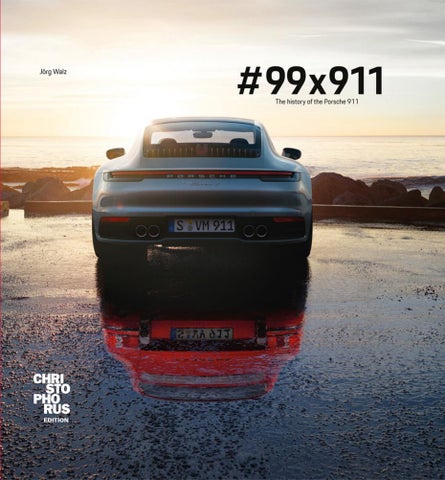
#Preface #It has arrived. The rebirth of a legend. The eighth of its kind. The new Porsche 911. Generation 992. More muscular. More powerful. More sustainable. Distinctive. It lifts the pure feeling of driving, digitalized, into a new era. A true high-performance car. The best Porsche of all time. Once again. Proof of the right path into the future; tradition and innovation going hand in hand. The 911 is ahead of its time. At the same time, it is committed to its origins. And an invitation to reflect on a few keywords.
#Generations.
#Timelessness.
#Icons. Success. Contrasts.
#Feeling.
#Commitment.
A symbol of shared origins. The passing down of genes is the basis of all life. Along the way, they learn to adapt and change. All life strives to make progress, confronting challenges and overcoming change. Children carry on the values of their parents into a new era, and yet are defiantly individual at the same time. They are given existence, after which they forge ahead as unique individuals. Yet they will always be defined by where they have come from. Every Porsche 911 is a descendant of the original. Since 1963, it has been the worthy successor of the 356, the first sports car to bear the name ‘Porsche.’ All subsequent generations, although unmistakably heirs to the throne, have also been shaped by their respective times. Thus every 911 becomes the guardian of its own history. But there is one thing common to them all: they are all carrying on the legend.
Time is marked by a beginning and end. Natural limits. Within that, there is room to act. Products are victims of nature. Myths are not. It’s hardly surprising, then, that the art of escaping the unchangeable is appreciated. One strength of the Porsche 911 is its ability to provide trailblazing solutions to the needs of the moment. It is true, however, that the individual car is at the mercy of time, although it is worth noting that more than 70% of all Porsches ever built are still being run today. And, even if they are not being driven, the memories, the feelings and stories that are attached to the 911 are always alive. They are timeless.
Images. In ancient Greek: eikón. Icons. True, convincing representations of abstract thoughts, intangible constructs and feelings. “Icon 911” — a bit over the top, some might think. Misuse of a historical cultural heritage, sleazy marketing, unabashed self-congratulation, flagrant lack of all subtlety. But what drives our customers? What leads them to spend their money on a car? Success, independence and freedom, fine engineering, striving for something better. A powerful need for forward progress, for perfection. Dissatisfaction with mediocrity. The combination of exclusivity and social acceptance, restraint and discipline. It is the contrasts that make the myth of the 911 a passion. The credo of historical mission and uncompromising progress: Icon 911.
Feeling for a car. What sounds like the beginning of a mediocre joke based on stereotypes is actually reality. Getting a feel for a car begins with how you feel inside it; driving a Porsche 911 is an escape from the outside world. Time seems to flow. Everyday drudgeries begin to fade away. The 911’s practical functionality is enhanced by its beauty and quality. It is the epitome of a sports car — a luxury product and a work of art.
Every 911 is the best in the company’s history. What may appear to be criticism of the eighth generation 911’s unquestionable resemblance to previous iterations is actually a testament to the work and skill of the car’s designers. Recognizable features from earlier models are a nod to past triumphs. The roots of success remain. When developing its vehicles, Porsche always makes the distinction between things that are time-honoured and things that are simply obsolete. Never be afraid to change and adapt, however radically.
4
But preserve what’s worth keeping. Retain what’s inspiring. This school of thought is not one of mindless conservatism; reliable and timeless technology will always manage to fend off new developments. Evolution instead of revolution. This is Zuffenhausen’s mission statement. What began in 1963 with the birth of the 911 finds — once again — its ultimate form. And yet is never finished. Dr. Josef Arweck
5
#In sequence
#A marvelous model / Preface .................................... 8
#Generation I (901 and 911) ............................................... 10 001 002 003 004 005 006 007 008 009 010 011 012 013 014 015 016 017
6
#The Erl King .................................................................. #And they’re off and running! .................................... #Green is the color of hope ........................................ #The 911 conquers the world .................................. #Sweetening the start ................................................ #Open to innovation .................................................... #Boost in performance................................................ #Let’s see what it can do ............................................ #Harmonious and well-mannered ........................... #On the way to becoming an evergreen................. #Urban outlaw................................................................ #Terrorists and the avant-garde ............................... #Can high power ever be wrong?.............................. #The small difference .................................................. #The wild ‘70s ............................................................... #Ducktails and Danube waves .................................. #One more shovelful ....................................................
12 14 16 18 20 22 24 26 28 30 32 34 36 38 40 42 44
027 028 029 030 031 032 033 034 035
#Under the skin ............................................................. #Open to the elements ............................................... #On any terrain .............................................................. #Exhibition soloist ........................................................ #Automotive feasibility study ................................... #In a rush ........................................................................ #Flat speedster ............................................................ #Shortened rear cover ................................................. #When dreams come true .........................................
70 72 74 76 78 80 82 84 86
#Generation III (964) and Panamericana .......................... 92 036 037 038 039 040 041 042 043 044
#On all fours ................................................................... 94 #Open at the top ........................................................... 96 #Prepared for a brawl .................................................. 98 #Relic of days past ..................................................... 100 #Long live sports ........................................................ 102 #Attractive horn section ........................................... 104 #Evolution of the aspirated engine ........................ 106 #Live-cell therapy for the turbo .............................. 108 #Declaration of dependence ................................... 110
#Generation II (911) and 959 ............................................... 50
#Generation IV (993) and 911 GT1................................... 116
018 019 020 021 022 023 024 025 026
045 046 047 048 049 050 051
#No fear of jostling ....................................................... #Invited guests .............................................................. #Full-fledged with wings ........................................... #Greetings from America............................................ #Italian racing nobility ................................................ #Colorful role model .................................................... #Safety and family spirit ............................................. #The finalist that wasn’t ............................................. #Evergreen .....................................................................
52 54 56 58 60 62 64 66 68
#911% fascination ..................................................... 118 #When the right hand knows what the left is doing ............................................................ 120 #The naked gun ........................................................... 122 #Series sibling of the limited edition supercar ........................................................... 124 #Thoroughbred and temperamental .................... 126 #View from the crystal ball ...................................... 128 #Special requests by the dozen .............................. 130
#A complete success ................................................ 132 #Last curtain call for the air-cooled engine ........ 134 #A wanderer between worlds ................................. 136 #Token car ..................................................................... 138
078 #For a fast lap .............................................................. 196 079 #For all occasions ....................................................... 198
#Generation V (996) .............................................................. 144
080 #A new era .................................................................... 206 081 #Tradition and future ................................................. 208 082 #Messenger of spring ................................................ 210 083 #Chronicle of a club community ............................ 212 084 #One more birthday child ......................................... 214 085 #Redefining the possibilities ................................... 216 086 #Ultimate enjoyment, diet included ...................... 218 087 #The most powerful comes last ............................. 220 088 #Purebred ..................................................................... 222 089 #Turbo for all ................................................................ 224 090 #A sustainable automobile — maybe even the most sustainable .................................................. 226 091 #Matters of course ..................................................... 228 092 #The magic of doing without .................................. 230 093 #The millionaire ........................................................... 232 094 #Lot size: one ............................................................... 234 095 #Diabolo 911 ............................................................... 236 096 #The wolf in sheep’s clothing .................................. 238 097 #Unfiltered and pure .................................................. 240 098 #Ultralight heavyweight............................................ 242
052 053 054 055
056 057 058 059 060 061 062 063 064 065 066
#Paradigm change meets resistance ................... 146 #Irish rain ...................................................................... 148 #Always sure-footed ................................................. 150 #Long live sports — on the streets as well.......... 152 #Gran Turismo par excellence ................................. 154 #Arrival in the here and now .................................... 156 #No compromises ...................................................... 158 #Under glass ................................................................ 160 #Loyal gang .................................................................. 162 #Germany’s next top model ..................................... 164 #Renaissance of the RS ............................................ 166
#Generation VI (997) ............................................................. 172 067 068 069 070 071 072 073 074 075 076 077
#With a familiar face ................................................. 174 #For every taste .......................................................... 176 #In step with the times ............................................. 178 #Big feet ........................................................................ 180 #Everything except standing still .......................... 182 #The pure doctrine .................................................... 184 #The sustainable one becomes even more sustainable.......................................................... 186 #Open to enthusiasm ................................................ 188 #Coupé or Cabriolet? Both! ...................................... 190 #Style references ...................................................... 192 #Fine individual products in series production .. 194
#Generation VII (991)............................................................ 204
#Generation VIII (992) .......................................................... 248 099 #Next generation ........................................................ 250
#Snapshot of another dimension About the author and the idea ................................. 254
7
#A marvelous model The 911 is an iconic sports car without parallel. Throughout its more than five decades, it has not merely grown along with the demands of its customers and environment — but in fact has consistently shifted the horizons and defined the limits of possibility. This has enabled the 911 to be both remarkably mature yet fresh at the same time. The Porsche 911 is the epitome of the German sports car. As such, it has been a highly prized top import from the start. It is a dream car, admired and coveted while at the same time appreciated almost without envy. A self-employed 911 owner can visit customers without sparking excessive envy. And while sports cars from other makers usually bear a grim expression, the 911 has always worn a friendly smile. Added to this is the interplay of forms, with virtually perfect proportions and desirable curves.
8
The 911 functions as a vintage antique, as a classic car, as a used car or as a new car. The price of the 6-cylinder boxer sports car ranges from that of a factorynew compact car to the price to buy a yacht or luxury property. And a 911 is more versatile than any other sports car. It copes without a murmur or complaint with the demands of daily life — and of course with „occasional use as a leisure vehicle or sports car.“
The 911 is available as a thoroughbred racing car or can range from a rather minimalist sports car to an opulently equipped luxury car. Power is supplied to the rear wheels — with plenty of traction — or to all four wheels — with even more traction. Power is always supplied by a 6-cylinder boxer engine, originally one with two liters of displacement. The volume of the combustion chamber in the most powerful 911 engine is twice this size. Its standard engine power output, intended for road traffic, ranges from 110 hp to a phenomenal 700 hp. The 911 comes with an aspirated engine or a supercharged engine. As a “turbo,” the sports car from Zuffenhausen has made turbocharging technology fashionable and brought it to maturity. It has long since become the standard for today’s environmentally friendly, efficient and low-emission combustion engines.
The 911 has a streamlined body and is contoured with curves of various widths. The body always fits like a perfectly tailored sheath. Each generation of the 911 redefines the standard of beauty. Regardless of the model line, a 911 is always attractive — visually and otherwise. And without making its predecessor suddenly look old. A 911 is always sex appeal in automotive form.
The various body versions also add to the versatility of the 911: as a Coupé, a targa or a Cabriolet. And the sports car that originated in 1963 as the sole model and meanwhile has been available in three versions — the 911 SC, targa and turbo — has long since become a model series with two dozen different model variants, not including special limited series products. At the same time, the extensive list of selectable options and the equipping of each vehicle with individual and unique details and colors offers unprecedented possibilities for customization.
As a result, the 911 can seem thoroughly contradictory. Yet it is a straightforward, uncompromising, loyal companion. And has been for more than five decades. In eight generations. More than one million units produced and coveted billions of times over. And incidentally, not only at full scale but also in miniature — as a scaled-down replica that reproduces almost every variation of the 911 theme, true to scale. In this spirit, I hope you enjoy browsing, looking at, reading about and journeying through the history of the marvelous one: the 911. Jörg Walz
9
#Generation I
(901 and 911)
Tangerine
10
11
#Generation I
(901 and 911)
Tangerine
10
11
#The Erl King #New cars can generally do everything better than their predecessors, which makes the predecessor look old from one day to the next. So it is easy to understand why car manufacturers are always careful to present their new creations to the public only when they are ready for the market and for production. And since the product creation process requires a substantial amount of time, including an extensive test phase on public roads, the industry traditionally cloaks and conceals its prototypes with bulky attachments, adhesive films and other means of camouflage. These cloaked prototypes are colloquially called “Erl Kings” by Germans. This is loosely based on the poem of the same name by Johann Wolfgang von Goethe: “Who‘s riding so late through th‘ endless wild?...” In a kind of game played between car manufacturers and car magazines, the media have for decades used drawings and computer representations to decipher photographs of camouflaged prototypes. This is usually to the annoyance of the carmakers, who still need to deliver the current predecessor model to their Porsche T8 901 “bat” prototype, 1962 Masterpiece of automotive culture; Obermembach, Bavaria 12
customers. But sometimes the situation is different, as was the case of the Erl King photos that were leaked to the media in the run-up to the IAA Frankfurt in 1963. They showed a new sports car from Stuttgart — appearing slightly out of focus and therefore authentic. They were not captured by an Erl King photographer, but instead were intentionally staged on a road between Weilimdorf and Münchingen, not far from Weissach, the future headquarters of the Porsche development center. With these photos, the Porsche press chief at the time, Fritz Huschke von Hanstein, drew attention to the successor to the aging 356, and secured prominent coverage of the car that would be one of the stars of the Frankfurt Motor Show in late summer 1963. This was a way to arouse the curiosity of potential customers. The originally white Erl King, hastily and carelessly painted over in matte green, featured an air intake on the front hood, covered side windows at the rear, a central support over the rear window, and a rear attachment spanning the fenders and hood with two large fins, which made
its profile view appear sedan-like. This hid the original contours of the eventual production vehicle from curious eyes. The two wing-like fins also gave the prototype its nickname: “bat.” This was the second of a full dozen prototypes that Porsche produced for the 901. Testing and development drives began in autumn 1962. The prototypes were continuously modified and ultimately went the way of almost every prototype: At the end of 1964, the bat was also scrapped. Series production of the new 6-cylinder sports car began at that point — after some delay. Porsche spent around 15 million marks on its development and acquired the Reutter body shop in Stuttgart for an additional 6 million marks. The considerable investments were also a cause for concern, however, as the future of the young sports car brand was riding on the success of “the newcomer.” The success of its decades-long career and millions of units sold could not be foreseen in the mid-1960s.
Olive Green
13
#And they’re off and running! #Stuttgart was already thinking about a successor to the 356 by the second half of the 1950s. But the company was small, the production numbers were still low and the costs for developing a new car were high. It would take until the end of the decade for the 901 or 911 project to take concrete shape — and at that time, there was no discussion of the 911. The projects that were to lead to a modern four-seater vehicle went by the numbers 695 and 754. In 1961, Ferry Porsche, son of design genius Ferdinand Porsche and founder of the post-war sports car brand, specified that the new model should have a wheelbase of 2.20 meters, 20 centimeters shorter than originally planned. This meant the concept of a four-seater was off the table. Twoplus-two would have to suffice. “Others can do four seats better,” Ferry Porsche is quoted as saying. A new engine with six cylinders and two cooling air blowers was being built under the project code Porsche 901/911, 1963 Minichamps; Wolfenbüttel 14
745. Starting in 1963, young engineer and Porsche grandson Ferdinand K. Piëch began helping navigate the way out of this dead end. The result was a new aircooled 2.0-liter 6-cylinder boxer with the name 821. However, because the engine was not yet finished in September 1963, the champagne yellow vehicle for the IAA exhibition was left with a gaping hole. The car for the fair was a stationary model. Yet this did not dampen visitor enthusiasm — even if the new Porsche did not meet with unanimous approval. The focus of criticism, aside from the price, was on the shape of the car. This was based on the 356 but was still completely new. “The austere shape was daring at the time, in part because many people were still attached to the shape of the 356,“ Wolfgang Porsche recalled. His father Ferry Porsche swiftly responded to the critics: “When you like something tremendously from the start, it doesn‘t last.” The lines bore the signature of Ferry’s
son Ferdinand Alexander Porsche, nicknamed “Butzi.” The design was created in 1961. In the first sales brochure, the company described the 901 as “solid workmanship of tasteful materials on a virtually handcrafted basis.” In fact, the new 6-cylinder sports car was being produced in homeopathic doses. And it was late, since pilot production first began in spring 1964. Porsche was finally able to deliver the first production car on October 27. The last of a total of 82 Porsche 901s would be completed in mid-November. The 6-cylinder-2+2 was then delivered as the 911. At the end of the calendar year, Porsche’s books showed only 232 units of the 911 had been produced. And the company was also not able to achieve the price that Porsche had mentioned at the IAA. Instead of the DM 23,900 initially announced, the price was reduced by DM 2,000 at the launch of series production. It was a rocky start.
Champagne Yellow
15
#Over the years, the Targa has developed into the elegant and versatile Gran Turismo of the 911 model range. With standard all-wheel drive and customarily generously equipped, it appealed to a different clientele than a puristic Carrera or the “sharp knives” of a GT3 and GT3 RS. The elongated roof arches, accentuated with chrome, gave the Targa its unique, characteristic roof line. The rear window, which also acted as a tailgate, was an appreciated, practical detail of the Targa. It could also be conveniently opened with the car key’s remote control. And thanks to the electric closing aid, it could be closed both effortlessly and safely. The
wind deflector on the upper windscreen frame, which automatically extended when the roof is open, was another practical detail. It enabled draft-free driving with the top down, even at higher speeds. Another new feature, at least for PDK vehicles, was a drive-off assistant that helps to start off on hills without rolling or jerking. The system simply maintained the brake pressure for two seconds and released it again when the vehicle started up after sufficient starting torque had been built up.
The tastefully luxurious character of the car was also matched by the extensive range of desired colors and comfort extras. Electrically adjustable sports seats were as much a part of this as the leather available in various extents and numerous colors. Even the individual slats of the air conditioner outlets could be covered with tanned cow skin. The leather steering wheel, covered in interior color, was more or less the normal standard. In addition, there was the possibility of adding further accents with interior elements made of wood, carbon or aluminum look. Thanks to the extensive range of products on offer, hardly any 911 was like another.
#Coupé or Cabriolet? Both! 190
Malachite Green Metallic
Porsche 911 Targa 4 (997/II), Minichamps; Siegburg Umland/Heiligendamm 191
#An impressive EUR 201,682 was charged for the Carrera Sport Classic, which would be produced in 2010 in a 250cc edition based on a 911 Carrera S with 3.8 liters. This exclusive 911 celebrated its premiere at the IAA 2009. In fashionable gray — the specific name for the special color was Sport Classic Gray — with the ducktail reminiscent of the Carrera RS 2.7, 19-inch aluminum rims in the legendary Fuchs look, a 44 mm wider rear, ceramic brake discs and, thanks to a newly developed resonance intake system of the direct fuel injection engine, an increase in performance of 23 hp to 408 hp as well as a lavishly finished interior decorated with braided leather. Another new feature was the roof over the occupants, which had additional curves — providing room for tall passengers to wear safety helmets. Porsche would bring this detail in the sportiest of all the 911s of the 991 generation to series production. After the introduction of the electrically extending rear spoiler — with the 964 — the rear spoiler was actually no longer needed for aerodynamic reasons. But love of tradition brought it back to life.
Porsche 911 Carrera Sport Classic (997/II), 2009 Schuco; Tuchenbach 192
A manageable number of units, careful handling of the company‘s tradition and a sure sense of style put the Carrera Sport Classic on the list of collectible 911 gems right from the start. Accordingly, the notable additional charge of EUR 105,791 compared to a Carrera S is also put into perspective over time. While the latter model today offers the possibility of acquiring a mature 911 at an attractive price — even with the high resale values usual for Porsche — the former model is traded at collector‘s conditions. Either way, a 911 always proves a good investment. And special specimens regularly prove to be an investment that guarantees a profit. This matches well with the fact that more than 70 percent of all Porsches ever produced are still in running order.
#Style references
Sport Classic Grey
193
#Fine
individual products in series production #Max Hoffman, a car dealer who emigrated from Austria to the USA, provided the idea for the Porsche 356 Speedster — the small, minimally equipped car that makes good money in America. After the positive experiences that the company had in the late ‘80s (911) and early ‘90s (964) with the new editions of the Speedster concept, Porsche remembered this concept once again in 2010 and began producing a special series limited to 356 units. The car was presented at the Paris Salon in October of the same year — the blue color of the exhibited car fit perfectly there. Technically, it was a 911 Carrera GTS with a shortened windscreen and two arched fairings mounted behind the two bucket seats. The 3.8-liter 6-cylinder engine with direct injection mobilized 408 hp. This puts it in the same class as the Carrera Sport Classic, and it still delivers 23 hp more than the Carrera S. The transmission is a 7-speed PDK. Porsche
Dual Clutch (PDK) was an indication that Porsche had developed this transmission technology in racing. Tight switching times without traction interruption ensured fast lap times (on the racetrack in the mid-1980s in the 962 C) and lower consumption on the road (since the facelift version of the 997 starting in 2008). Another reference to an earlier style was the classic design of the five-spoke Fuchs aluminum wheels with black spokes and polished rims. But while they were a maximum 16 inches under the well rounded fenders on the 911 of the first two generations, the sixth generation 911 bore large 19-inch wheels with rear tires in the generous 305 format. The body grew accordingly by 4.5 cm in width. The doors and front hood were made of aluminum.
without certain things in terms of suitability in bad weather. Doing without also applied to the choice of color: The 2010 Speedster was available exclusively in Carrera White or Pure Blue. They all feature a black bezel around the headlights. The weight saved in the doors and hood was balanced out with extra comforts such as a Bose sound system, telephone, navigation, parking assistant and Sport Chrono Plus package. The surcharge compared to a GTS was EUR 50,000: The price for the Speedster, which was sold out at breakneck speed, was EUR 201,682. But the increase in value of the limited two-seater has also delighted its buyers. The 911 Carrera Sport Classic had already proved a great success the year before. From that perspective, Porsche was not the only one to give itself a gift to mark the 25th anniversary of the special order specialists at Porsche Exclusive Manufaktur.
As with its recent and older predecessors, the simple Speedster roof meant doing Pure Blue
194
Porsche 911 Speedster (997/II), 2010 Atlas; New York City 195
#For a fast lap #At the time of its introduction, the GT2 RS with 620 hp was the most powerful street Porsche of all time. Its twinturbocharged 6-cylinder boxer delivered 8 hp more than the Carrera GT‘s V10, which was developed directly from racing. The rear-wheel-drive “racing” derivative intended for the road — or collector‘s garage — and generously trimmed for lightweight construction with visible carbon would be presented at the Moscow Motor Show. This was to be understood as an expression of appreciation for Russian customers who preferred the Cayenne turbo S in everyday use, which sometimes involved challenging traffic on Russia’s roads. In any case, the series, limited to 500 copies, was already sold Porsche 911 GT2 RS (997/II), 2009 Minichamps; Schloß Bensberg 196
out during the exhibition. At the unit price of EUR 237,578 and to all countries of the world. Porsche had already laid the foundation stone for the GT2 RS in 2007 when Walter Röhrl was rampaging over the Nordschleife with a lightened and slightly more powerful GT2. In Porsche engineering circles, the 560 hp development car went by the name “Lighty” and with it, the rally ace was five seconds faster from the get-go than with the “standard” GT2. The GT2 Nürburgring record lap in 2006 — which took just 7:32 minutes — was already a sensation since it was on a par with the lap of the supercar Carrera GT, which was originally designed as a racing car. New on the GT2 was the
customized Porsche Stability Management (PSM) including stability and traction control that could be deactivated at the touch of a button. The standard GT2 mobilized 530 hp from its supercharged 3.6-liter 6-cylinder engine. That was enough for 3.7 seconds (0-100 km/h) and 329 km/h. The figures for the 620 hp GT2 RS were 3.5 seconds and 330 hp — the maximum speed was electronically controlled. And the GT2 RS takes just 7:18 minutes to complete a lap on the Nürburgring’s Nordschleife...
Guards Red/Carbon
197
#Ferry Porsche summed it up: “The 911 is the only car you can drive from an African safari to Le Mans, then to the theater and finally on the streets of New York.” With the 356 in 1948, the son of designer Ferdinand Porsche laid the foundation stone for the brand that today puts more than a quarter of a million sports cars on the road every year. He set the course for the future, transforming production from a hand-built construction process to series production. When he died 50 years after the premiere of the first Porsche — the two-seater mid-engine roadster — Porsche had once again won Le Mans. And the era of the air-cooled 911 came to an end with the 450 hp all-wheel drive 911-turbo-S of the 993 generation. The success of the 911 continued, and Ferry Porsche’s statement continued to be true for the following
decades. Though the company’s founder did not live to see the 997 series turbo S, this model proved the versatility of this unique sports car more impressively than ever. With all-wheel drive, a long list of technologies for safety and comfort and a healthy dose of power output, packed in a highly functional yet attractive body shell, this 911 is also a car for all occasions. Sales of the 997 as a turbo were launched in 2006. The basic engine with a smooth 3,600 cc displacement was quite familiar. The turbo now features 480 hp and the turbo S presented in mid-2007 has a full 530 hp — just as the GT2 had prior to that.
#For all occasions Ice Blue Metallic
198
Porsche 911 turbo S (997/II), 2007 Minichamps; Barcelona 199
#Generation VI (997)
Porsche 911 Carrera (997/I), 2004
Porsche 911 Carrera S Cabriolet (997/I), 2004
Porsche 911 Carrera 4S (997/I), 2005
Porsche 911 Carrera S (997/II), 2008
Porsche 911 turbo (997/I), 2005
Porsche 911 Targa 4S (997/I), 2005
Porsche 911 GT3 RS (997/I), 2006
Porsche 911 Targa 4 (997/II), 2008
200
Porsche 911 Carrera Sport Classic (997/II), 2009
201
#Generation VI (997)
Porsche 911 turbo S (997/II), 2010
Porsche 911 Carrera 4S Cabriolet (997/II), 2008
202
Porsche 911 Carrera Speedster (997/II), 2010
Porsche 911 turbo S (997/II), 2010
203
#Generation VI (997)
Porsche 911 turbo S (997/II), 2010
Porsche 911 Carrera 4S Cabriolet (997/II), 2008
202
Porsche 911 Carrera Speedster (997/II), 2010
Porsche 911 turbo S (997/II), 2010
203
#Anniversary pieces have a long tradition at Porsche. They are highly prized by media and customers alike. They offer the media a welcome opportunity to dedicate extensive coverage to the anniversary celebrations. And buyers can usually look forward to an above-average increase in value, after a phase of using the car. Following the “30-year” 964 and “40-year” 996, a specially configured 991 played the role of the “50-year” 911. Customers had a choice of three colors: Black, Geyser Gray Metallic and Graphite Gray. The first color is self-explanatory; the other two are reminiscent of the champagne yellow of the first 901 and the slate gray Hollywood star Steve
Porsche 911 Carrera “50 Years of 911” (991/1), 2013 Atlas; Bensberg 214
Dark Grey
McQueen preferred for his Porsche 911 — in a modern interpretation, of course, and in a contemporary glimmering metallic. The Pepita fabric on the seat panels was another reminder of the classic past. The first 911s were delivered with it... The star-shaped 20-inch alloy wheels with brightly turned spokes, which are reminiscent of the two-tone Fuchs rims of the first and second generations of the 911, are also a reference to past style. Under the hood of the anniversary piece with the wide rear of the all-wheel drive Carrera is a 3.8-liter 400 hp engine. Above it there was a trunk lid with a shining chrome horizontal ventilation grille,
again reminiscent of the early 911. The 911-50 (as shown on the logo) features a further air outlet with two decorative bars where the red strip of light was mounted on the all-wheel-drive vehicle. The premiere year of 1963 also specified the number of pieces, since the special model remained limited to 1,963 units. Even the confident price does not detract from the desirability. The cost of the birthday child, capable of 300 km/h and of sprinting from a standing start to 100 km/h in 4.5 seconds, is EUR 121,119.
#One more birthday child 215