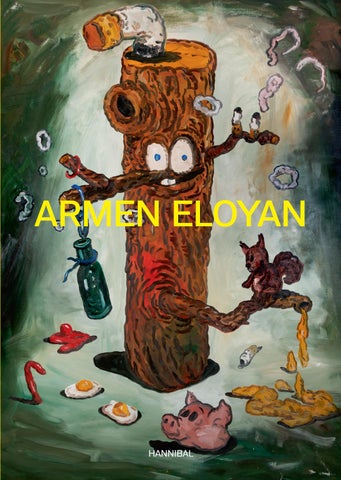
ARMEN ELOYAN
ARMEN ELOYAN
HANNIBAL
COVER.indd 1
6/05/19 14:17
During the summer of 2018, the Frac des Pays de la Loire devoted a noteworthy exhibition to Armen Eloyan. Not at all intended as a retrospective, this significant group of works—twenty-four paintings, two sculptures, and more than twenty india-ink drawings—provided, for the first time in France, a revealing look at a prolific oeuvre that started in the 1980s, with a specific focus here on work created between 2000 and 2018. Born in Armenia, Eloyan has infused his work with features inspired by American and Western European culture, evincing a particular fascination for cartoons and George Herriman’s daily comic strips, whose playful spirit he has adopted. Other influences are Philip Guston, Willem De Kooning, and especially Paul McCarthy, in his transgressive relationship to society. The darkly corrosive gaze Eloyan casts upon the world in his paintings also evokes the atmosphere of Otto Dix. And the Dracula series of ink drawings on paper takes us to Transylvania, a reference geographically closer to the artist’s place of birth. His works repeatedly draw inspiration from representations of Pinocchio, Krazy Kat and denizens of the Disney empire, in particular Donald Duck, Mickey Mouse, Minnie Mouse, Goofy, Pluto, and Snow White. Eloyan’s use of the brush ranges from an especially thick paint layer to thinner surfaces, even glazes. Whether done with pen and ink or paintbrush, the drawing places the figures with prodigious dexterity. His gestural approach, seemingly propelled by an intense ardor, gives off a remarkable energy that generates a strong emotional charge. A series of twenty oil paintings—Untitled (AR 01... AR 10...)—executed a few weeks before the Frac exhibition, attests to this in the way the artist’s arm, as if in a state of trance, produces an exhilaratingly frenzied repertoire of Disney figures that blend into the paintings’ backgrounds. Layer by layer, the sensual use of the brush bogs down in the maelstrom from which the figures emerge in front of landscapes with shrunken horizons and perspectiveless architecture, whose closed interiors form the setting for the Saga of Mickey. In this series of paintings from 2008–2009,* the image of the double predominates: two figures in dialogue within a painting constructed like a diptych. These paintings depict Mickey in regressive moods: young Mickey wearing a dress, with his onanist double; Mickey at his country house, excited, his tongue hanging out, facing a figure of undetermined gender across a table piled with giant cigarette butts. In vain do we seek a sketch sheet or preparatory drawing that might have aided the artist in working out his complex compositions. Subsequently, broad strokes of acrylic paint portray Pluto on three large sheets of paper. This triptych represents the cartoon character in an extended sequence, and the snap of his muzzle, which lacks only speech, recalls Eloyan’s interest in animated film, one of the first mediums the artist employed. Dummy texts scrawled across some of the paintings—Snow White or Alice in Wonderland (2013), the Untitled (AR 01)... series—sidestep the customary speech balloon while 19
underscoring the artist’s reference to cartoons. In the absence of meaningful words, the figures speak through their facial expressions. Is there a working drawing for Untitled (Tapestry 5) (2016), which deploys a fairy-tale landscape across a wide canvas of raw jute? Although the apparent calm emanating from the landscape might suggest such a setting (for Little Red Riding Hood or Snow White), the male-female attributes of the two trees flanking the landscape clash with storytellers’ usual intentions. In this instance, the mushrooms growing here and there rise in phallic forms to shape the dense forest environment and smother the log cabin. This fairy-tale realm thus conveys the implicit sexual discharge that Bruno Bettelheim clearly revealed in his psychoanalysis. Does the cabin door, the only potential opening, represent the “virginity of the world of childhood,” which remains sheltered from the threat of a hostile, masculinized “outside” as illustrated notably by Perrault’s Wolf? This interpretation is corroborated by the two heavy chains that suspend the landscape overhead in its dream substratum, enclosing it with the sense of psychic confinement that fairy-tales give rise to. We find this constant in Untitled (2009), which crudely depicts Pinocchio in the form of a log sawed from the base of a tree trunk; the nose, placed at groin level, becomes an erect penis brandished in his left hand. As with McCarthy, we recognize one of Mickey’s typical attributes in the red shoes Pinocchio wears. The question about preparatory sketches surprises Armen Eloyan. His chin supported on a raised arm displaying various tattoos in the manner of his drawings, his gaze turned entirely inward, he considers his answer at length before explaining his process: “I realize things in my head; everything is constructed inside. Then I draw, I paint; the images appear, take form on the surface of the canvas or the sheet without any prior formalization. Here, I began by surrounding the canvas with a sinuous line; then my hand slipped inside to draw the landscape.” * The Visitor (2008); Mickey Mouse, Youth (2009); Country House (2009).
20
Snow White or Alice in Wonderland 2013 oil on canvas 235 x 270 cm
Portrait (06) 2018 oil on canvas 60 x 50 cm
93
Portrait (02) 2018 oil on canvas 60 x 50 cm
94
Comic-Painting 2012 oil on canvas 50,5 x 50,2 cm
101
Natur und Kultur 4 2018 oil on canvas 240 x 180 cm
102
126
Untitled (Tapestry 4) 2016 acrylic on canvas 265 x 424,5 cm
127
ARMEN ELOYAN
ARMEN ELOYAN
HANNIBAL
COVER.indd 1
6/05/19 14:17