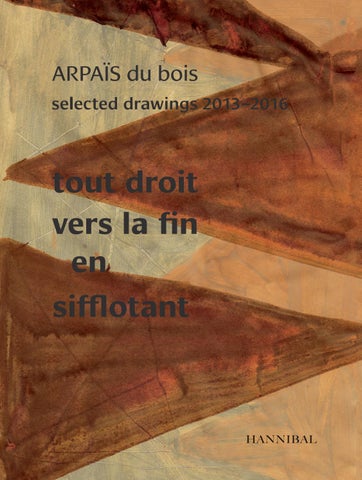
This delicately published book, introduced with essays and commentary by Damien Sausset and Lóránd Hegyi, reveals the recent work of ARPAÏS du bois through her drawings and writings. This bundle of works on paper reflects in a sharp and intense way on our society, on the world we live in, and on all of our connections and disconnections that are related to our searching for a proper positioning within the given systems. By showing all the backs of the drawings, the artist seems to guide us to the core of the making-process, simultaneously blurring our vision of the actual works and showing us how these ‘negatives’ transform themselves into the generating principle of the flow of drawings. It shows the intelligently thought out and designed relationship between content and form in a rare way. Drietalige editie Engels-Nederlands-Frans Édition trilingue anglais-néerlandais-français
selected drawings 2013–2016
24
24
46
46
114
114
168
168
188
188
200
200
218
218
282
282
302
302
324
324
384
384
426
426
466
466
538
538
568
SOUL-REFLECTING FRAGMENTS ARPAÏS du bois and her Subtle Arrangements Subtle, fragile, not subservient to any distinguishable hierarchy or traceable to any visual-graphic legitimisation system, corresponding to no structural or compositional expectations, ephemeral and unstable, temporary: these are all epithets describing the arrangements flowing from ARPAÏS du bois’s hand. They are not bound by any formal rules or any mechanical, rigid or limiting laws hindering or preventing the unforeseen, unpredictable, spontaneous emergence of the constantly self-redefining, pulsating and fluid arrangement of the respective elements in any form, in any direction, in any teleological orientation. Instead of teleology and hierarchy, instead of monumentality and clarity, what emerges is a spontaneous, concrete, unique, lively, organic and interrelated composition of small artistic elements defying all attempts of classification. This also relativizes the compositional conventions, thereby leaving room for hazard, improvisation, randomness and the spontaneous fusion of diverse elements. ARPAÏS du bois’ drawings show signs of organic shaping processes dictated by a throbbing sensuality and a latent momentum of their own, leading to arrangements which may – at least metaphorically – be seen as “settlements”. Full of an inner pulsating life, temporary, fluid, in a state of constant redefinition, fragile, floating and with the potential to dissolve into thin air at any moment, these settlements depict subtle and in many cases unexpected combinations of elements, figures, semantic fragments, textual contexts, mental and material realities, in turn creating unique and unclassifiable arrangements through their many different shapes and layers, through the absorbing connotative and open structures that suck up all chance phenomena. Yet at the same time, these fragmentary, temporary, organic arrangements are full of vitality, fluidity and openness, heterogeneity and coherence, whereby the individual, concrete relationships between the completely heterogeneous elements – between the centre and the periphery, between the organic and the inorganic, between what is found and what is shaped, between what is material and what is spiritual – are constantly changing. Her works never stand still, never suggest anything permanent. There is nothing there to give these spontaneous, successive assemblies any obvious inner order. There is no unequivocal instruction, no exclusive road pointing to a universal, unquestionable interpretational structure. The internal, secret decision-making mechanism behind all her assemblies – a mechanism guiding these varied, complex visual shaping processes – is radically relativized due to the many different, co-existing and at the same time relevant possibilities for interpreting her works.
Instead, the common denominator of these fragmentary and heterogeneous elements is the latent “atmospheric” energy of the assemblies and the spiritual, emotional and mental coherence they radiate, linking them up into unique micro-settlements. The constant relativization of the different ways of interpreting the works and the fluidity of the respective systematisation of the interpretations make it impossible to construct any one-sided perception based solely on a preferred basic sign system convention. Looking at ARPAÏS du bois’s arrangements, all elements belonging to them are of equal importance, without any hierarchy, without any rigid preferential criteria. Specifically conceived or abstract and non-representative, planned or impromptu, intellectually controlled or spontaneous, structurally planned or the result of a whim, the texts, text fragments and semantically interpretable words merge together to form new combinations of artistic imagination, whereby the text fragments appear as visual design elements, as artistic motifs, while – vice-versa – the visual-graphic arrangements in many cases gain a quasi-textual meaning. The sign systems akin to texts and the quasi-textual structures point to literary, semantic meanings, even though there are not actually any texts. Instead, we are given the chance of perceiving the complex arrangements of elements as both text and images. The respective concrete and singular micro-settlements are exactly where a specific meaning emerges, the relevance of which is inseparable from the real, concrete, unique and unrepeatable visual-graphic context. This context, emerging from the multifaceted fragmentary arrangements, is to be seen as a collection of diverse motifs and fragments, sign systems and connotations, all of which point to different things: memories, dreams, literary and historical events, personal and collective experiences. This referential richness, this emotional diversity, and this mental jungle create an enigmatic, poetical aura giving us the feeling of direct, intensive participation, of being personally present in the here and now, while at the same time imparting a feeling of distance, of a past forever gone, of absence. This in turn creates a melancholy suggesting the irrevocability of a fragmented state – not in any dramatic confrontation with perfection, but reflecting life and its material reality. The unlimited, inconceivable diversity and complexity of the various motifs, the physical formations, material processes and mental structures, signs and texts, images and logos, physical and intelligible experiences all merge together to form specific, temporary accumulations, to be interpreted as mental, metaphorical settlements of our inner reflections, values and orientations. In this sense they are the reification of our permanent – conscious and unconscious – striving to create an orientation system intended to be simultaneously participatory and reflexive. Participatory in the sense that we – via such a system – want to be part of this here and now, participating in the concrete, pulsating, real-life and not-to-be repeated processes. Reflexive in the sense that we – via poetic metaphors, via connotative, imaginary connections between various areas and language systems – yearn for an inner spiritual and mental
576
tekenisstructuur, waarbij ze nieuwe verbindingen creëert tussen diverse ervaringen en reflecties, tussen verschillende referentieniveaus en symboolvormen, tussen rationele, tekstuele, intellectuele en imaginaire, onbewuste, instinctieve visuele systemen. De fantasieën die door deze verbindingen ontstaan, leggen verbanden tussen de concrete, zintuiglijke beeldrealiteiten en andere, vitale, fundamenteel betekenisgevende realiteitsniveaus, die de onbegrensde, onbeperkte verscheidenheid van de complexe, subtiele, psychische en intellectuele processen van het innerlijke leven reflecteren, waarnemen en overbrengen. Lóránd Hegyi Directeur van het Musée d’art moderne de Saint-Etienne
LE FRAGMENTAIRE COMME CONDITION DE VIE ET DE RÉFLEXION Les constellations subtiles d’ARPAÏS du bois Les constellations subtiles, fragiles, n’étant sous-tendues par aucune hiérarchie reconnaissable, ne pouvant être rattachées à aucun système de légitimation visuelplastique identifiable, ne correspondant à aucunes attentes structurelles ni compositionnelles, fugaces et instables, provisoirement graphiques d’ARPAÏS du bois s’organisent en dehors de tout règlement formaliste, sans lois mécaniques, rigides, fermées, susceptibles de diriger le développement imprévu, incalculable, spontané du petit agencement, en redéfinition constante, fluide et vital des éléments vers une quelconque forme, direction ou orientation téléologiques. Au lieu de téléologie ou de hiérarchie, au lieu de monumentalité et de clarté, on voit se développer ici une imbrication spontanée, concrète, singulière, vivante et organique de petits éléments appartenant à un ensemble graphique rebelle à toute forme de généralisation. Cela relativise aussi les conventions de composition, laissant une marge au hasard, à l’improvisation, à l’aléatoire et aux fusions spontanées de divers éléments. Les dessins d’ARPAÏS du bois répondent à des processus organiques de création et à des compositions vitales, sensorielles, dirigées par une dynamique propre et latente, que l’on pourrait considérer, au sens métaphorique, comme des peuplements. Ces peuplements emplis d’une vie intérieure fluctuante, provisoires, fluides, plongés dans une situation de transformation permanente, fragiles et non établis, pouvant être dissous à tout moment, figurent des liaisons subtiles, partiellement inattendues, surprenantes, entre éléments, signes, fragments sémantiques, contextes textuels, réalités mentales et matérielles, qui produisent à travers la création graphique multiple, se développant sur plusieurs voies, ainsi qu’à travers une structuration absorbante, aspirant toutes les apparitions aléatoires, connotative et ouverte, des arrangements provisoires, fugaces, spontanés, uniques, dépourvus de toute prétention à quelque généralisation que ce soit. Ces arrangements fragmentaires, provisoires, organiques dégagent à la fois vitalité et fragilité, fluidité et ouverture, hétérogénéité et cohérence, de sorte que les rapports individuels, concrets entre éléments divers et totalement hétéroclites, entre centre et périphérie, entre organique et anorganique, entre ce qui a été trouvé et ce qui a été créé, entre matériel et spirituel, ne cessent de se modifier, inlassablement. Il n’y a pas de repos, qui suggérerait quelque chose de définitif. Pas d’univocité qui puisse prêter un ordre interne évident à des assemblages s’organisant de manière spontanée et successive. Pas d’indication univoque, pas de mode de lecture définitif qui révélerait une construction sémantique universelle indéniable. Le mécanisme de décision intérieur, caché, régulant toutes les configurations, apte à diriger sans conditions ces processus
This delicately published book, introduced with essays and commentary by Damien Sausset and Lóránd Hegyi, reveals the recent work of ARPAÏS du bois through her drawings and writings. This bundle of works on paper reflects in a sharp and intense way on our society, on the world we live in, and on all of our connections and disconnections that are related to our searching for a proper positioning within the given systems. By showing all the backs of the drawings, the artist seems to guide us to the core of the making-process, simultaneously blurring our vision of the actual works and showing us how these ‘negatives’ transform themselves into the generating principle of the flow of drawings. It shows the intelligently thought out and designed relationship between content and form in a rare way. Drietalige editie Engels-Nederlands-Frans Édition trilingue anglais-néerlandais-français
selected drawings 2013–2016