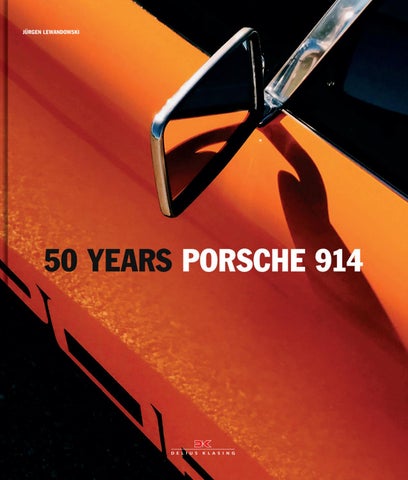
JÃœRGEN LEWANDOWSKI
50 YEARS PORSCHE 914 PORSCHE 914 PORSCHE 914/6 PORSCHE 914 S PORSCHE 916 PORSCHE 914/6 GT
DELIUS KLASING VERLAG
Introduction
It
is impossible to grasp the complicated history of the VW-Porsche 914 and its various sisters and cousins without knowing the close relationship between Volkswagen and Porsche. The life’s work of Ferdinand Porsche, born in Maffersdorf in 1875, is now part of the canon of automotive history: his work for various companies – the compressor vehicles he developed for Mercedes-Benz; his revolutionary Auto Union Grand Prix cars – were legends at the time and remain so today, while with Volkswagen he and his team created a mass means of transport that gained world renown as the Beetle. The Beetle formed the basis for the first Porsche, which his son Ferry Porsche launched in 1948 and which, as the Type 356, became the cornerstone of one of the most famous motor companies in the world.
A difficult birth
While still in its infancy, the company benefited from the Beetle because Heinrich Nordhoff, appointed General Manager of Volkswagenwerk GmbH on November 7, 1947, signed a new contract with Ferry Porsche in September 1948 that superseded the previous general contract for all VW development work. Orders were now made on a freely-negotiated, case-by-case basis and, in addition to the agreement of a non-competition clause for the use of Porsche patents, a license fee of 0.1% of the gross list price was agreed, which corresponded to DM 5 for a standard Beetle built in 1950. In December 1949, a new agreement was signed with a license fee of 1% of the gross sales price of the standard version. An additional monthly payment of DM 40,000 and an exclusive agency agreement for Volkswagen in Austria was agreed in return for collaborating with VW on the
15
further development of the VW Beetle. These contracts placed the new car company, Dr. Ing. h.c. F. Porsche KG, on a solid financial basis, and Ferry Porsche was able to establish the Austrian automotive trading company Porsche Holding together with his sister Luise Piëch in Salzburg.
T
he Volkswagen and Porsche companies were thus symbioti cally linked from day one of their existence – a connection which, following the takeover of Porsche by VW AG with a majority shareholding in Porsche SE, only led to a merger between the companies just a few years ago. Many similar projects were tackled in the intervening decades – from successful models such as the VW-Porsche 914 and 914/6 to the Porsche 924 and a number of nonseries developments, such as the 534 (1952), 555 (1953), 675 (1956) or the 728, a two-door notchback/hatchback design with 0.9 liter displacement and 26 to 32 hp, right up to the successor to the Beetle, the EA 266, an underfloor mid-engine Volkswagen. The latter was finally judged to be too complicated, leading to the eventual scrapping of the prototypes by then VW boss Rudolf Leiding after a five-year development period. Naturally there were many more designs and sketches that never saw the light of the day – ultimately there were probably about 60 orders from VW that Porsche was permitted to take care of: projects involved the development of entire vehicles, engines, transmissions and components such as heating systems. However there was only one model that bore the name of both companies – the VW-Porsche 914, which was sold with a VW four-cylinder engine under the designation 914 and with the Porsche six-cylinder engine as a 914/6.
Volkswagen and Porsche were linked in a symbiotic relationship – a situation that applies today more than ever 16
On the VW side this project was still presided over by Heinrich Nordhoff, whose contacts with Porsche had deepened in 1959, when Ernst Piëch, brother of Ferdinand Piëch and grandson of Ferdinand Porsche, married Elisabeth Nordhoff, the VW boss’ eldest daughter. For a long time there had been talk behind closed doors about an inexpensive sports car to be developed by Porsche that would give Volkswagen an acceptable sports model on the one hand, while also offering Porsche, a low-cost vehicle that could provide customers with an entry into the Porsche world. These ideas were constantly rekindled, helped by the realization that the 356 successor to the 901, first presented in 1963 (the car only received the type designation 911 at the start of production the following autumn) had become so expensive compared to its predecessor that Porsche had to quickly come up with the significantly cheaper 912, priced at DM 16,250, about DM 5,000 less than the 911. It quickly became clear, however, that the 912 had been priced too low, so that the price tag soon had to be raised to turn a reasonable profit. Hardly surprising then that after just four years, this price policy brought an end to the undisputedly successful 912.
H
ence Porsche started to think long and hard about an entry-level model that could be sold in high unit volumes – preferably with its own six-cylinder engine, so that engine production would not have come up with yet another type of engine. However, it soon became clear that Porsche had neither the money, the technical resources or the production capacity to develop a completely new model on its own. Ferry Porsche confirmed this later in an interview: “During our discussions, we constantly returned to the fundamental problem that we needed to expand our range with a cheaper model on the one hand, but that we couldn’t finance this development by ourselves.” But it was also clear that VW was the only partner worth considering – the Wolfsburg-based company was simply the most natural fit. On the other hand, VW had problems of its own: Even if the VW Beetle was to continue to be built for several years to come, it was starting to become clear that the
2
The evolution in the shape of the VW-Porsche 914
Interview with Michael Mauer on the evolution of the shape of the VW-Porsche 914
T
he idea came from Porsche. Ferry Porsche wanted an entry-level Porsche that would give younger drivers affordable access to the Porsche world. The car that was subsequently developed and that reached the market as the 914 in a cooperation between Volkswagen and Porsche almost failed. Born at a time of power struggles and disagreements between Volkswagen and Porsche, subjectively speaking the 914 is neither fish nor fowl: not a Volkswagen, but not a “genuine” Porsche either.
“The thing is just incredibly modern”
In retrospect, this does not fit with the basic principles that first inspired development. The 914 is a typical Porsche. Why? Firstly because it is innovative. Secondly, and this is the key, because the car’s beating heart is a mid-engine. Form follows function. The 914 is a typical Porsche, even if it doesn’t look like one at first glance. The first known draft design supports this argument perfectly. The design of the 914 was the work of Ferdinand Alexander Porsche and his team. The design that finally went into series production was the work of one of his most important employees, Heinrich Klie. Klie acted a confidante for Ferry Porsche’s eldest son when he took over responsibility for design at his father’s company. Even though the actual start of development was dated to August 1966, older designs can be found among the holdings at the Porsche AG Historical Archives, entitled: “914, Model 1, August 1964, Design: Klie”. Klie described the development work as an iterative process in which the management allowed the designers a largely free hand. He explained that modifications were only discussed following the presentation of the 1:5 scale models. One thing was certain for Ferdinand Alexander Porsche: “The 914 was always a completely independent design and was a success in formal terms.”
23
Type 914, Model 1, Scale 1:5, Design Klie, August 64
24
“Brand identity happens when you follow functionality.”
is incredibly modern, particularly with regard to the initial models. It’s incredibly impressive to see how the results are way ahead of anything else at the time. This wasn’t really on my radar until now. The car has almost no floor plan, but this central element is extremely consistent. To have the courage to design such a big surface without a single bead or extraneous element is genuinely awesome. I really like the rear of the car. From a modern perspective, the process in getting to this result is quite fascinating. I still have some difficulties with the car, but for me what counts is what was achieved at the time. Producing something like this is incredible. The same goes for the detailed solutions: the wide headlights
are just brilliant., as are the minimalist integrated door handles. The way F. A. Porsche and his team succeeded in introducing this pared-back modernity is something I find fascinating – just like the transition from the 356 to the 911. The more I find out about the 914, the more I realize that this is exactly what I am fighting to achieve today – this reduced, purist approach with integrated elements and not a single superfluous line. Is there a future for a 914? Or does it act as an inspiration at the very least? This a constant topic of discussion. The real issue is the question of the entry-level Porsche. I find this extremely interesting, but opinions differ on what such a car should look like. Porsche is probably the only brand that could afford to approach this issue in an unusual way. An entry-level Porsche not in terms of price, but rather in the sense of reduced design. A vehicle with almost no electrical parts, everything mechanical and minimal. I find this a really exciting idea.
The outer shape is found (top). The type and design of the headlights are the subject of lengthy discussions (right).
34
The other idea is for a car for the target group that drives an Audi TT RS or a Golf R32. A Porsche pitched just a little higher than the cars currently on offer that would also formally express the idea of a very plain and simple car, a modern 550 in the broadest sense. In terms of size, limits become quickly apparent, not least because of safety issues. Hence a certain size is automatically dictated. Sales may see things a little differently. From this perspective, a really economical entry-level Porsche would be the right choice, but that’s not what interests me. I want reduced purity -”back to our roots”. I believe that the time has come for this. This would be typical for Porsche. •••
Fake as far as the eye can see: The 914-Erlkönig photographed by HansRüdiger Etzold in the fall of 1968 featured deceptive front double headlights and a stationwagon superstructure to the rear.
“Not a single superfluous line. The more I find out about the 914, the more I realize that this is exactly what I am fighting to achieve today.” 35
3
Porsche 914 and 914/6
Despite all this confidence in the abilities of the Stuttgart-based company, Lotz, who had just arrived at Volkswagen and was anxious not to make mistakes, took his time reviewing the issue of the 914. On top of this, the sports car did not particularly interest him, as he had enough on his plate freeing Volkswagen from the constraints imposed by the monoculture of the Beetle. At this point, tempers started to flare at Porsche – Paul Frère, the legendary racing driver, motor journalist and Porsche expert, later wrote: “Apparently there were no written records to say that Porsche should be allowed to fit the same sports car with its own engine, so that the new VW boss knew nothing about this. He simply let himself be guided by the text of the printed contract, which stated that Porsche was to design and develop a car for the Volkswagen works. End of story.”
Kurt Lotz considered a takeover of Porsche by Volkswagen
I
t is interesting to read how Ferry Porsche played down this issue in two of his biographies. He wrote as follows in the book he co-authored with John Bentley in 1978 entitled Porsche – Ein Traum wird Wirklichkeit (Porsche – a dream becomes reality): “A new situation arose when Professor Lotz took over at VW as successor to Professor Nordhoff. In my first meeting with him he told me that the relationship between Porsche and Volkswagen needed to be redefined. He believed that Volkswagen’s own Development Department in Wolfsburg needed to work more independently, but also mentioned the idea of establishing a research center for the Volkswagen plant in southern Germany. During a visit to the Salzburg Festival, Kurt Lotz explained to me that he envisaged three possibilities for the future: 1. Volkswagen would take over Porsche, 2. the link would be completely severed, or 3. we should organize some sort of cooperative activity. The third solution then came to fruition in the form of a joint sales company. This company was to jointly market Porsche products together with a sports car model from VW, the 914, which Porsche had developed on behalf of Volkswagen. The share split was 50:50. When the joint sales company was formed, our own American import company was dissolved and all American import business was taken over by Volkswagen of America. I believe that the underlying idea at the time was to exploit our excellent image in America to benefit new products from the Volkswagen Group.” The joint visit to the Salzburg Festival made it abundantly clear to Ferry Porsche that Kurt Lotz would not accept the verbal agreements his predecessor had made with Ferry Porsche. This was a development that had not been foreseen by any of the parties following the death of Heinrich Nordhoff. Kurt Lotz stuck to his view of the matter. He insisted that Porsche had received a contract from VW for the design of a sports car and had submitted a bill for its services, for which it had also been paid. This meant that the rights to the construction and design of the vehicle belonged to the VW Group, so if Porsche wanted to build their
48
own variant, then it would have to buy the bodies from Karmann for a price to be defined by Volkswagen as the licensor. To make matters worse, Karmann was only prepared to supply the bodies to Porsche in a finished, painted condition – driving up the price even further, while the company’s own paint shop was left with nothing to contribute. The Technical Costing team informed the 25th meeting of the Product Range Committee in Wolfsburg on May 7, 1969 that the cost situation for the 4-cylinder version was essentially unchanged. The minutes contain the following details under “b) EA 224 – 6-cylinder version: “The pricing for this vehicle is a matter for Porsche. According to our information, difficulties remain in achieving the asking price of Domestic USA
DM 16,990 $ 4,995
Investigations are currently in progress into how the cost situation might still be influenced. Among other things, a review of Karmann’s price for the body will be decisively important.” 1968 brought a few more developments. On the one hand, Porsche had to accept that Kurt Lotz saw the 914 as a development contract with Porsche that had
People were particularly proud of the fact that the 914 could be used either as a coupĂŠ or as a cabriolet.
49
In 1974, Colonel Robert E. Hartvigsen, who was stationed with the Canadian Army in Lahr, bought the car for DM 27,500. �Brutus� was auctioned in Paris in February 2019 for almost one million euros.
Rio dolestiisin eatusam vellaudi sequam, sitiuntiis nihilia quas ex eati que porat inihil incturerent.
104
P
roject 916 slowly began to gain momentum, and official orders were issued for the preparation of a top-end version of the 914/6 based on the experience gained with “Brutus”. The decision was also influenced by the fact that the Ferrari 206 GT went into production at the end of 1968 and was being marketed by the Italians under the sub-label “Dino”, as they wanted to reserve the name Ferrari for the twelve-cylinder models. The 246 GT followed at the Geneva Motor Show in February 1969, subsequently joined by the 246 GTS as a Spider variant. These were successful models, selling more than 3,000 units by 1974. The Stuttgart crew now aimed to emulate this success with their version. Obviously only the best was to be used in this project: the 2.4-liter S engine, which had an output of 190 hp at the time, and a luxurious interior that left nothing to be desired. Details of the number of units to be sold varied widely: ten, twenty, fifty or even 100 cars were discussed – still well below the figures from Maranello, but at least it would add some money to the coffers, as well as giving the 914 a welcome revamp. On April 2, 1971, a management meeting was convened between Dr. Ferry Porsche, Ferdinand Alexander Porsche, Ferdinand Piëch, Heinz Branitzki and Dr. Michael Piëch. The agenda that Heinz Branitzki had prepared for this meeting included three items that related to the 914/6: Item 2) “There is no need for a crash test for the 914/6 produced for France. The question of whether the 914/6 can continue to be built and the engine version to be used in the new model year is to be clarified quickly with Distribution. It is now clear that a successor model with 2.4 liter engine could be deployed by October 1972 at the
105
6
S Porsche 914 S
Conscientious as always, the team prepared for the Monte Carlo Rally – but no one could have guessed that there would be more snow than ever before.
Monte Carlo was supposed to mark the sporting breakthrough for the 914/6 – but things were destined to turn out differently. Thereafter, all further development was abandoned
Björn Waldegård and Gérard Larrousse discuss their choice of tires.
Third place was not enough: the presentation ceremony in Monte Carlo in 1971.
11
Special models based on the 914
Albrecht Graf Goertz not only designed the BMW 507 and 503 models, as well as the Nissan 240 Z, but also this 914/6 variation.
This drawing by Albrecht Graf Goertz for his 914/6 design is in the collection of the Hamburg Museum of Arts and Crafts.
189
Bibliographical data of the Deutsche Nationalbibliothek (German National Library) The German National Library catalogs this publication in the German National Bibliography; detailed bibliographical information can be found on the Internet website http://dnb.ddb.de.
1st edition ISBN 978-3-667-11458-7 ISBN 978-3-667-11717-5 (limited edition) © Delius Klasing & Co. KG, Bielefeld Text: Jürgen Lewandowski, Frank Jung (Chapter 2, Chapter 8), Eckhard Schimpf (Chapter 9) Proofreading: Petra Schomburg, Hanno Vienken Cover photo: Kevin McCauley Layout: Jörg Weusthoff, Weusthoff Noël kommunikation.design, Hamburg Lithography: Mohn Media, Gütersloh Printed by: optimal media, Röbel Printed in Germany 2019 All rights reserved. Without the express permission of the publisher, this work may not be reproduced, transmitted or copied in whole or in part, for example by manual, electronic or mechanical means, including photocopying, tape recording and data storage. Delius Klasing Verlag, Siekerwall 21, D – 33602 Bielefeld Tel.: 0521/559-0, Fax: 0521/559-115 E-Mail: info@delius-klasing.de www.delius-klasing.de