North Korea in the World Pyongyang, the capital of North
China, Russia, and even the European cities, and their problems. Based
Korea, is one of the unique cities
countries by train. However, this
on above research, this thesis will
around the world. At first, it was
could easily cause imprudent
look at what is a 21st-century post-
developed under socialist ideas.
developments ruining its originality
socialist city. Especially focusing
Later, the ideas combined with
like other post-socialist cities.
on Pyongyang, it will determine
totalitarianism. These ideas make
This research will examine what a
the possible future development
the city special, and its isolation
21st-century post-socialist city is
scenario.
from other countries makes it more
focusing on Pyongyang. At first, it
unprecedented.
will starts from a socialist city; the
However, Kim Jung-un has begun to
definition of a socialist city and the
make a different move. This change
city planning strategies. Second,
opens a new future scenario for
it will look into on the uniqueness
North Korea; opening the country to
of Pyongyang as a socialist city.
foreign relations. If it happens, an
Even though the city was developed
enormous amount of capital will be
under socialist ideas; it is different
available, especially for Pyongyang,
from other socialist cities due to
because not only it is the capital but
several reasons. Next, it goes to a
has a lot of potentials to be a part of
post-socialist city; the definition and
a transit core connecting Korea with
the characteristics of post-socialist
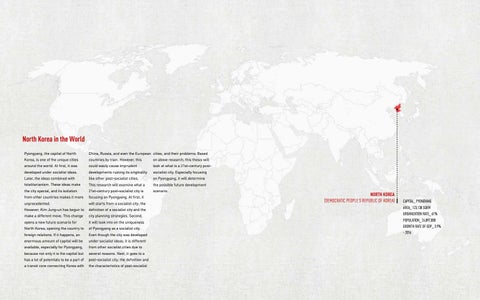
NORTH KOREA (DEMOCRATIC PEOPLE’S REPUBLIC OF KOREA)
CAPITAL_ PYONGYANG AREA_ 123,138 SQKM URBANIZATION RATE_ 61% POPULATION_ 24,897,000 GROWTH RATE OF GDP_ 3.9% - 2016
SOCIALIST CITY_ EXISTING SOCIALIST COUNTRIES
NORTH KOREA CHINA
CUBA
LAOS VIETNAM
Karl Marx and Friedrich Engels
forth, they argue that city should
Garden City concept of Ebenezer
educational space about socialism
population of 58,000, starts to create
transit corridor, a city is expanded
define five urban planning strategies
be developed under plans. At last,
Howard.
surrounded by cultural buildings.
satellite cities with 32,000 people
parallel. The purpose is getting
in the nineteenth century. They think
they believe control and regulation
Fifth, governments should
each. Those cities are connected
spatial equality. Through the linear
every urban problem comes from
by a government. According to their
Engels’s principles into practice.
encourage public transportation
with train tracks and roads.
city theory, every house can have a
density as well, so the first strategy
ideas, governments possess every
There are six strategies. First,
instead of personal vehicles. Last,
Moreover, each city is surrounded
similar distance to transportation,
is anti-metropolitan. The second is
lands and productions and force the
housing should be separated from
land use plan should be based
by a green belt which blocks further
industries, and amenities.
anti-urban regeneration which is not
regulations.
factories to protect residential
on socialist ideology or technical
expansion.
district. Second, to reduce
concern.
helpful to improve urban housing
With those fundamental ideas,
Vladimir Lenin put Marx and
there are three base theories about
commuting time and energy,
main idea is a combination of city
socialist city planning. The first one
the landscape should surround
city was inspired by the Garden City
more than one person who suggests
and agriculture land. They think
is planning strategies of Vladimir
factories to block pollution. Third, all
of Ebenezer Howard. This theory is
a linear city such as Miliutin and Le
imprudent developments are another
Lenin. The second one is the Linear
amenities should be placed evenly.
about another way that a city can be
Corbusier. However, the main idea
main problem with high density, so
city concept, and the third one is the
Forth, the city center is an
expanded. If a city grows over the
is the same. Along with a major
14 | Transition in Socialist City | Pyongyang, 21st Century Post-socialist City
The combination of agriculture to a
The linear city theory is about how
quality in their opinions. Third, the
a city can be expanded. There is
Pyongyang, 21st Century Post-socialist City | Transition in Socialist City 15
MARKETS_ IN NORTH KOREA
_ TYPOLOGY OF NORTH KOREAN COMMERCE DEPARTMENT STORE_
_ NUMBER OF MARKETS AND MAIN LOCATIONS SOURCE: MINISTRY OF UNIFICATION
- Storages, Shops, Offices, Conference rooms, Restaurants, Beverages - Luxury products - Less than 20 department stores in North Korea
HOERYONG Border market Allow Chinese merchants 4
RETAIL/STREET VENDER_ - Street vender: Small snacks or drinks - In the past, government runed retails directly Now, individual can do with some rents
CHEHA Imports from China National distribution route
Yanggang-do 18 Jagang-do 24
Hamgeong-do 94
PEONGSUNG Pyongan-do 116
The biggest product distribution center
GENERAL MARKET_Official Market
30
CENTRAL
- Started in 2003 under the government control - Pay rental to the government - Mostly groceries and primary products - Indoor space - The closer to the entrance, the more expensive rent
4 Hwanghea-do 68
Gangwon-do 29
The second general market in Pyongyang
TONG-IL STREET General market started in 2003 3 buildings with parking lots
JANGMADANG_Illegal Market SARIWON Grains, Groceries, Clothes
30 | Transition in Socialist City | Pyongyang, 21st Century Post-socialist City
- Started naturally in 1990 to maintain a livelihood - Held in streets, alleys, or private house paying a little rent for the owner - Outnumbered by official markets - Pyongyang has the least Jangmadang in the country - Getting bigger and more - mostly groceries - Started outskirts of a city, extended to riverside or yard inside of the city, and became part of it
Pyongyang, 21st Century Post-socialist City | Transition in Socialist City 31
1 NATURE PRESERVATION_ TOPOGRAPHY OF NORTH KOREA
PLAINS / HILLS (>300M) 53,615 KM2 (49%)
MOUNTAIN 64,895 KM2 (51%)
2 WATER_ THE QUALITY AND THE WATER CONSUMPTION OF MAIN RIVERS
PAEKTU MOUNTAIN AMNOK
TOTAL 128,154 KM2
Industrial and domestic sewage from North Korea and China Water quality below grade 3 river which is difficult to drink
DUMAN Inflow of waste water, bleach, sewage from Musan coal mine, Hoeryong paper factory
SUNGCHEON Inflow of waste water and sewage from Hanheong’s dye/leather factory Became an irreducible river
DEADONG Half of wastewater and the excrement entering without being purified Dead fishes floating in the river residents who drank tap water complained of stomachache
Low
PYONGYANG
PRECIPITATION by month
MT. KUMGANG NATIONAL PARK
WATER RESOURCES STRUCTURE and the utilization
Dec
Nov
Oct
Sep
Aug
Jul
Jun
May
Apr
Mar
Fab
Jan
100m
etc. 3%
300m
Industrial Water 4%
500m
Agricultural Water 13%
HYDROELECTRIC 80%
800m
Surface Water (98.7%)
DOMESTIC 50%
1,000m
Industrial Water 35%
Over 1,500m
Agricultural Water 15%
60% OF ANNUAL PRECIPITATION
38 | New Structure for North Korea | Pyongyang, 21st Century Post-socialist City
High
Pyongyang, 21st Century Post-socialist City | New Structure for North Korea 39
3 ENERGY_ PYONGYANG
4 FOOD_ PYONGYANG
GENERATION CAPACITY by type and location
DAILY FOOD SUPPLY by rank
SEODUSU
SUPOOM
Rank
Supply
Recipient
1
900g
Harmful Occupation
2
800g
Coal Miner
3
700g
General Ocupation
4
600g
College Student, Patient
5
500g
Middle School Student
6
400g
Elementary School Student
7
300g
Eldery, Kindergartener
8
200g
2-4 years old, Prisoner
9
100g
Younger than 1 year old
NUTRITION DIFICIENCY LEVEL by regions
HAMJU
BOOKCHANG PYONGYANG
FOOD PRODUCTION by month Hydroelectric Thermal electric
6M 5.5M
1 Million kwh 0.5 Million kwh 0.3 Million kwh
5M
Low
4.5M
High
4M 3.5M
ENERGY SUPPLY WAY by ratio
DOMESTIC ENERGY USE by ratio Electronics 9.3%
3M
ENERGY SOURCE by ratio
Lighting 3.7%
Fat
2.5M 2M
Oil 4.6%
Distribution 20.6%
SOURCE OF NUTRITION compare to South Korea
1.5M
4%
Heating 50.9%
ENERGY OUTPUT from 1990 to 2014
ELECTRIC ENERGY in billion kwh 1990 2000
Hydroelectric 156 102
2005
131
2010
134
2015
40 | New Structure for North Korea | Pyongyang, 21st Century Post-socialist City
Coal 67.9%
Hydroelectric 19.6%
100
Thermal electric 121 92 84 103 90
0
62%
13%
Vegetable
43% 11%
8%
South Korea
1995 1997 2000 2002 2004 2005 2006 2007 2008 2009 2010 2011 2012 2013 2014 2015 2016
Self-supply 35.3%
Cooking 36.1%
0.5M
27%
Meat
1M Market 44.1%
Grain
10%
The lack of food production in North
started decline. Even on 1980s,
person(22% reduction).
Korea has started since 1980s.
the average amount of production
After 1990, most of socialist contries
They failed to develop their own
is only 4.15 million tons, which
like USSR stopped supporting North
agricultural administration, called
is 2 million lesser than minimun
Korea and this made the situation
‘Juche Nongbub.’ Furthermore,
requirement. Therefore, the North
worse.
because of the collective farming
Korean government decided to
of socialism, the production power
reduce a ration from 700g to 546g per
Pyongyang, 21st Century Post-socialist City | New Structure for North Korea 41
5 MOBILITY_ PYONGYANG
_ ROADS AND RAILWAY NETWORK
SOUTH KOREA | NORTH KOREA
TYPOLOGIES OF TRANSPORTATION in North Korea TRAIN
Total Length of Railway
The most common for long distance journey International train connected to China and Russia
5,226 km
3,918 km
Rate of Electric Railway 79.8%
73.3%
SUBWAY Only in Pyongyang, the capital Utilization by Pyongyang citizen and Tourist
Total Length of Subway 674.2 km
34 km
Total Length of Roads
STREET CAR
26,176 km
108,780 km
Only in Pyongyang, Using rails Using electrical wires in rural area
Percentage of Paved Roads 3%
92%
BUS Total Length of Expressways 4,438 km
Cross-country bus in 6 cities in North Korea 40 routes in Pyongyang
774 km
Number of Cars 21,803,000
SERVI-CAR
285,000
The second common public transportation Run by military or administry of North Korea TAXI
TOTAL LENGTH OF RAILWAY 1910-2015 in 1,000km
Only in Pyongyang, Double-shift system The fare from $2
6
CAR
5
Only the executive members
4 3 2
BIKE 2020
2010
2000
1990
1980
1970
1960
1950
1940
1930
1920
1910
1
The most common transportation method No.1 property for North Korean
<300 WORDS> sectetuer adipisc-
exerci tation ullamcorper suscipit
illum dolore eu feugiat nulla facilisis
ing elit, sed diam nonummy nibh
lobortis nisl ut aliquip ex ea commo-
at vero eros et accumsan et iusto
euismod tincidunt ut laoreet dolore
do consequat. Duis autem vel eum
odio dignissim qui blandit praesent
magna aliquam erat volutpat. Ut wisi iriure dolor in hendrerit in vulputate enim ad minim veniam, quis nostrud
luptatum zzril delenit augue duis
velit esse molestie consequat, vel
42 | New Structure for North Korea | Pyongyang, 21st Century Post-socialist City
Pyongyang, 21st Century Post-socialist City | New Structure for North Korea 43
7 TRADE TO WORLD_ MAIN TRADING CITIES IN NORTH KOREA
6 HOUSING_ PYONGYANG
333-666
67-135
people/ha
Population Density
units/ha
Housing Density
70-80
1M
%
Housing Penetration
5,887,471
4.22
2M-3M
Population in 2016
Total Number of Household
Average Number of Family Member
people
NUMBER OF ROOM in a house
HEASAN
New Housing Construction Needed
24,897,000 HOUSE TYPOLOGY by ratio
Housing Russia
80% Mountains 10% Plain area Dry-field farming Rich underground resources
Housing
CHONGJIN
Old Housing Need to be Improved
80% Mountains 10% Plain area Dry-field farming Rich underground resources
SIZE OF HOUSE in North Korea SINUIJU Frontier Trade to China
Apartment 21%
Detached House 33%
Row House 44%
HAMHUNG
China
Central city of west side Im/export to Japan and Russia
2 Rooms 65%
50-75m2 73%
WONSAN 80% Mountains 10% Plain area Dry-field farming Rich underground resources
NAMPO The biggest port in North Korea
HOUSING CONSTRUCTION through time Time
Project
90km to Pyongyang
The number of housing built HEAJU
1954 – 1956 Post-war reconstruction plan
Coals
771,700
18.6%
1961 – 1969 The first 7-years plan
800,000
19.2%
(37.8%)
1971 – 1976 6-years plan
886,000
21.3%
(59.1%)
1978 – 1984 The second 7-years plan
750,000 - 1,050,000
25.3%
(84.4$)
1987 – 1993 The third 7-year plan
290,000 - 340,000
8.1%
(92.5%)
1957 – 1960 5-years plan Kim Il-sung
Gate to China
Kim Jung-il
Unknown
300,000
3.75%
(96.25%)
Kim Jung-un
Unknown
300,000
3.75%
(100%)
3,797,500 – 4,147,500
100%
Total
44 | New Structure for North Korea | Pyongyang, 21st Century Post-socialist City
THE TOTAL EXPORTS (2008-2017)
Seoul
THE MAJOR EXPORTS (2015, Billion $)
THE MAJOR IMPORTS (2015, Billion $)
STEEL
PLASTIC GOODS
FISH
CAR / PARTS
IRON CLOTHES MINERAL FUEL (11.8)
MACHINERY ELECTRICAL INSTRUMENT MINERAL FUEL (7.5)
Pyongyang, 21st Century Post-socialist City | New Structure for North Korea 45
KOREAN PENNINSULA_ REGIONAL CHARACTERISTICS MOUNTAIN LINES
TOPOGRAPHY
_ 9 MUNICIPALITIES AND ITS CHARACTERISTICS RIVERS
YANGGANG-DO Plateau area
JAGANG-DO
Bio-diverse zone
90% Mountains
HAMGYEONG-DO Livestock industry Driest area in Korean penninsula
PYONGAN-DO Gate to China Coals
PRECIPITATION
CLIMATE
GANGWON-DO
SOILS HWANGHEA-DO
80% Mountains 10% Plain area Dry-field farming Rich underground resources
Plain area, Agriculture
GYEONGGI-DO The center of the penninsula Capital since1392
CHUNGCHEONG-DO Mud flat area
Historically, Korea penninsula works
municipalaties have different
ommoluptur maiorum nos eario eum
JEOLLA-DO
as one mega region. According to
specialties.Alique parita doloren
dolupti doluptat poritio ristis qui dus.
the location and landscape, each
dignatio ipicti doluptae intoremporio
Mendeli tiost, sam rem facea velessi
The biggest breadbasket in Korean penninsula
50 | New Structure for North Korea | Pyongyang, 21st Century Post-socialist City
GYEONGSANG-DO
Lighter precipitation Main port to trade to overseas
Pyongyang, 21st Century Post-socialist City | New Structure for North Korea 51
_ EXISTING STRUCTURE PLAN
EXISTING NATIONAL STRUCTURE_ REGIONAL CHARACTERISTICS TRAIN LINES
URBANIZED AREA
AGRICULTURE / GRASSLAND
ENERGY
INDUSTRIAL AREA
8 MAIN CITIES
Mountain Range Main Train Line Local Train Line Transfer Station
<300 WORDS> sectetuer adipisc-
iriure dolor in hendrerit in vulputate
omnit ipsum rem hicium qui arci-
ing elit, sed diam nonummy nibh
velit esse molestie consequat, vel
mosae porum eatur, quam, coratio
euismod tincidunt ut laoreet dolore
illum dolore eu feugiat nulla facilisis
quianistetum eum fuga. Nequi officil
Station Hydro-electric Thermal Electric
magna aliquam erat volutpat. Ut wisi at vero eros et accumsan et iusto
liquian ihilige ndellesti sus sincienda
enim ad minim veniam, quis nostrud
odio dignissim qui blandit praesent
pro min cuptae estemoloria sum har-
Urban Area
exerci tation ullamcorper suscipit
luptatum zzril delenit augue duisUt
chitam in re nobis porit pel ex exerae
Agriculture Land
lobortis nisl ut aliquip ex ea commo-
et ad quamustem qui nos ma volupta sum, nobis sunt.
Grassland
do consequat. Duis autem vel eum
pos sim incidi ommod quis adipsam,
Industrial Area
52 | New Structure for North Korea | Pyongyang, 21st Century Post-socialist City
Ut verepro consequiatio consequatur,
Pyongyang, 21st Century Post-socialist City | New Structure for North Korea 53
_ FOUR ECONOMIC HUBS IN NORTH KOREA
FUTURE DEVELOPMENT SCENARIO_ REGIONAL CHARACTERISTICS
04
03
Beijing
02 EH 01
Seoul
-1950
1950 - PRESENT
UTILIZING WHOLE LAND
FUTURE DEVELOPMENT
FUTURE STAGE 01
FUTURE STAGE 02
Inflow of waste water,
Inflow of waste water,
Inflow of waste water,
Inflow of waste water,
bleach, sewage from Musan coal mine, Hoeryong paper factorySant est, sitium que ligene nos dolupta cus ellessit et aut alia quam, omnis sam nobitis molorem poremporro quia quis everia sum fugiamusae. Uciania corum eos eostes et autat. Cuscilitatat el invelique nus dolupta tationsequid ulles sit enistrum quam, nonsequam sam aut re non re nimagni sintium sequiati comnis eati rem
bleach, sewage from Musan coal mine, Hoeryong paper factoryUpta num, seditam, simille ctetur, atium quassi corro volut aut ea quat aspicimporum voluptat laboreh endebis imporecupti int quaerspid moluptatius ratatum fugiasi nieniam sant. Ictur rerum estiis voluptati cullicaerit in ea alicient expelitia est, consed quam seraepe lenisto denisint quas apicipsunt et aut lique nes et omnis maximil in
bleach, sewage from Musan coal mine, Hoeryong paper factoryXimus ipici arum re escilic atibuscium as maximus, sum cor ma et eriberro vit aliqui renisi nullam volupta dolum dolupta ssusam exceatur min conecul luptasi niscitius aligendam ex exeratem eatatemque pelitas aruntorum voluptatur, inctestrum aut repel et quod quunt. Fugiatium sitiorro tore as modis ma volupta si berum
bleach, sewage from Musan coal mine, Hoeryong paper factoryMe mosame consed estorem porepedi untiis exped mo volesci qui te et elictem poreperum, eici occulpa eost, sumquis volorit doluptat endebis est quistist hictatenis illaut laut quiant es et aliquaspis rem elestibus enis endis dolum ut ut laceariae sitationse porrum nihita voluptat ipsaes exero voluptae mi, tem quaes plaut moluptat quuntiu
54 | New Structure for North Korea | Pyongyang, 21st Century Post-socialist City
Tokyo
Shanghai Economic Hub in North Korea Economic Hub in Other Countries
Flight Route Water Route Train Track
Pyongyang, 21st Century Post-socialist City | New Structure for North Korea 55