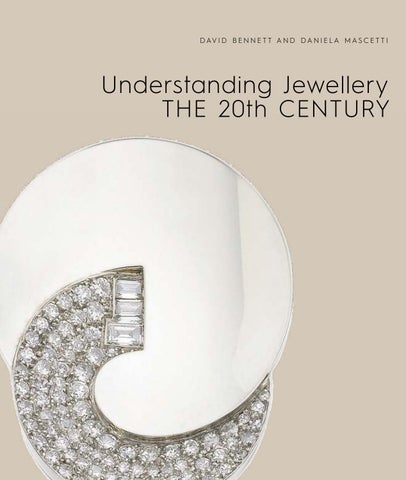
D AV I D B E N N E T T A N D D A N I E L A M A S C E T T I
Understanding Jewellery THE 20th CENTURY
10
Foreword By Place text here
14
Acknowledgments Place text here
20
Introduction Place text here
72
1900-1920 Garland styles The glamorous jewels of an opulent era
110
1920-1940 Art Deco jewels Geometrical shapes and exotic influences
158
1940-1960 From wartime boldness to postwar opulence
208
1960-1980 Bulgari Italian influences on French jewellery
264
1980-2000 Garnets, spinels, peridots, fancy diamonds: colour redefines jewellery
286
Acknowledgments the glamorous jewels of an opulent era
10
Foreword By Place text here
14
Acknowledgments Place text here
20
Introduction Place text here
72
1900-1920 Garland styles The glamorous jewels of an opulent era
110
1920-1940 Art Deco jewels Geometrical shapes and exotic influences
158
1940-1960 From wartime boldness to postwar opulence
208
1960-1980 Bulgari Italian influences on French jewellery
264
1980-2000 Garnets, spinels, peridots, fancy diamonds: colour redefines jewellery
286
Acknowledgments the glamorous jewels of an opulent era
GARLAND STYLE 1900-1920 The glamorous jewels of an opulent era
GARLAND STYLE 1900-1920 The glamorous jewels of an opulent era
GARLAND STYLE 1900-1920 The glamorous jewels of an opulent era
I
n England, the period from the beginning of the twentieth century to the outbreak of the First World War is usually referred to as the Edwardian era, even though the king actually died in 1910. In France, with a slight extension backwards, to the early 1890s, the era is described as La Belle Époque. In both countries, the atmosphere was very similar: it was an age of dramatically increased prosperity, great ostentation and extravagance. The traditional social structures of Europe and North America had begun to break down in the 1890s, typified by the rise of industrialists and entrepreneurs who had made their vast fortunes in business and manufacturing. Status no longer had to be inherited; it gradually became socially acceptable for one ‘to make a fortune’ – and to show that one had made it. Naturally jewels were perfectly suited for this purpose of displaying one’s success. The newly wealthy sought assistance in building the image they thought appropriate to their recently acquired financial status and surrounded themselves with a plethora of advisers. Reputable dealers helped them to assemble their art collections; architects designed and chose the most suitable locations for their palatial mansions; couturiers provided them with the right clothes; and jewellers supplied the precious ornaments to go with them. If in the mid-1880s only a handful of Americans were millionaires, at the turn of the new century, more than a thousand had accumulated fortunes in excess of one million dollars and several, such as the Astors, Goelets, Vanderbilts, Morgans and Whitneys, had amassed hundreds of millions. These new multi-
millionaires and their wives flocked to the old world, intent on emulating – possibly even out doing – the style of the old European aristocracy. London and Paris were their principal destinations. In the latter they bought all the latest fashion accessories; the Rue de la Paix was the elegant shopping centre where Worth, Doucet, Paquin and Rouff, the great dressmakers of the time, had their exclusive ateliers alongside the premises of some of the most famous jewellers, such as Mellerio, Aucoc and Fontana. Place Vendôme, home to several other fashionable jewellery maisons, was just down the road. Jewels were at the top of the list of priorities. The relationship between fashion and jewellery became closer than ever when, in 1899, Cartier moved to 13 Rue de la Paix, right next door to Worth, whose rich clientele, already prepared to pay the same prices for clothes as they were for works of art, wished to complement their dresses with specially designed jewels. The ties of friendship and marriage brought the two firms closer still, so that their spheres of influence became inextricably interwoven and they profited from each other’s patrons, creating jewels to complement a special gown or designing the ideal dress to set off a particularly important jewel. The abundance of diamonds on the market, following the opening of mines in South Africa, boosted the jewellery industry, enabled the creation of ornaments lavishly encrusted with vast amounts of gems for an eager market. In an era of relative peace, transatlantic 7
GARLAND STYLE 1900-1920 The glamorous jewels of an opulent era
I
n England, the period from the beginning of the twentieth century to the outbreak of the First World War is usually referred to as the Edwardian era, even though the king actually died in 1910. In France, with a slight extension backwards, to the early 1890s, the era is described as La Belle Époque. In both countries, the atmosphere was very similar: it was an age of dramatically increased prosperity, great ostentation and extravagance. The traditional social structures of Europe and North America had begun to break down in the 1890s, typified by the rise of industrialists and entrepreneurs who had made their vast fortunes in business and manufacturing. Status no longer had to be inherited; it gradually became socially acceptable for one ‘to make a fortune’ – and to show that one had made it. Naturally jewels were perfectly suited for this purpose of displaying one’s success. The newly wealthy sought assistance in building the image they thought appropriate to their recently acquired financial status and surrounded themselves with a plethora of advisers. Reputable dealers helped them to assemble their art collections; architects designed and chose the most suitable locations for their palatial mansions; couturiers provided them with the right clothes; and jewellers supplied the precious ornaments to go with them. If in the mid-1880s only a handful of Americans were millionaires, at the turn of the new century, more than a thousand had accumulated fortunes in excess of one million dollars and several, such as the Astors, Goelets, Vanderbilts, Morgans and Whitneys, had amassed hundreds of millions. These new multi-
millionaires and their wives flocked to the old world, intent on emulating – possibly even out doing – the style of the old European aristocracy. London and Paris were their principal destinations. In the latter they bought all the latest fashion accessories; the Rue de la Paix was the elegant shopping centre where Worth, Doucet, Paquin and Rouff, the great dressmakers of the time, had their exclusive ateliers alongside the premises of some of the most famous jewellers, such as Mellerio, Aucoc and Fontana. Place Vendôme, home to several other fashionable jewellery maisons, was just down the road. Jewels were at the top of the list of priorities. The relationship between fashion and jewellery became closer than ever when, in 1899, Cartier moved to 13 Rue de la Paix, right next door to Worth, whose rich clientele, already prepared to pay the same prices for clothes as they were for works of art, wished to complement their dresses with specially designed jewels. The ties of friendship and marriage brought the two firms closer still, so that their spheres of influence became inextricably interwoven and they profited from each other’s patrons, creating jewels to complement a special gown or designing the ideal dress to set off a particularly important jewel. The abundance of diamonds on the market, following the opening of mines in South Africa, boosted the jewellery industry, enabled the creation of ornaments lavishly encrusted with vast amounts of gems for an eager market. In an era of relative peace, transatlantic 7
of early twentieth-century jewellery, however, would not have been possible without the introduction of platinum, which replaced the nineteenth-century laminate of gold and silver. This precious metal had not been used before on a large scale in jewellery, mainly because its melting point – much higher than any of the other metals then used in jewellery production - made it more difficult to work with. However, the rigidity and strength of platinum enabled jewellers to reduce the amount of metal needed in a mount; it was also perfect for extremely fine saw-piercing, with the added quality of untarnishable whiteness. The resulting jewels were structurally very sound yet delicate and lacy in appearance. This effect was further enhanced by the typical millegrain setting of the time, which, with a beading of the edges of the collets around the stones, made the mounts look even lighter and more lace-like. The delicacy of these jewels suited the dress designs of the period well: corsage ornaments, sautoirs, chokers, tiaras and aigrettes perfectly complemented the sinuous lines and soft colours of the creations of the great couturiers. The favourite gemstones were pearls and diamonds, occasionally accompanied by amethysts, peridots or turquoises. They looked perfect against the soft, powdery colours that contemporary fashion favoured: pink, pale blue, mauve, lilac and straw yellow. Jewels were worn in great abundance in these opulent, exuberant, extravagant and lighthearted opening years of the century. Chokers were worn in combination with sautoirs or strings of pearls; bracelets adorned each arm and rings were worn on almost every finger. Large brooches and devants de corsage were pinned on corsets of luxurious heavilyembroidered fabrics, encrusted with lace and applied with glass beading and sequins. Tiaras and aigrettes were worn as the centrepieces of elaborate coiffures at the theatre and on formal occasions. Eventually, by the end of the first decade of the century, Diaghilev’s Ballets Russes which took Paris and London by storm with their Oriental, exotic sets and costumes together with the dramatic dress fashion innovations introduced by Paul Poiret put an end to
the formality of the Garland Style. In jewellery, these new influences brought with them new decorative elements such as lotus flowers, cusps arches, peacock feathers and stylised minarets. Gradually, the lace-like delicacy of the Garland Style gave way to bolder and more substantial designs foreshadowing the post-war development of jewellery design. Tassels and aigrettes became all the rage and coloured gemstones started to re-emerge in the creations of the great maisons. Cartier became the master of the bold and daring chromatic and contrasting combinations, successfully mixing sapphires and emeralds, onyx and jade, carved rock crystal with facetted coloured gemstones. Poiret’s influence on jewellery was not limited to this Oriental inspiration in colours and decorative motifs; he also eliminated tightly corseted bodices and introduced fluid, high-waisted dresses that required jewels to complement them. As a consequence of this shift in fashion, corsage ornaments disappeared, replaced by epaulettes which cascaded from the shoulders. Short necklaces and chokers gave way to long chains and sautoirs. The outbreak of the First World War put a sudden and dramatic end to the light-hearted spirit, the leisured complacency, the gay prosperity and the lavish spending of the early twentieth century. Life changed overnight. Galas and formal receptions disappeared; jewels were locked away in security vaults or sold off for survival; precious metals were requisitioned for war purposes and jewellery production almost came to a standstill. The troops in Europe who had undergone dreadful horrors in the trenches and their families who had experienced great hardship at home wanted nothing better than to forget the past and start to enjoy life again. The gaiety and lightness of the Belle Époque spirit was to become the seed ground for the development of a new style that would dominate the 1920s: Art Deco.
11
marriages inspired by economics rather than love or personal attraction weren’t uncommon. European aristocrats went to America to seek out the daughters of great millionaires who could, with their wealth, restore the former glory of their impoverished estates. A glittering succession of festivities, balls, dinner parties, theatre and opera performances, countryhouse parties and racing characterised the ‘Season’ in London, Paris, Vienna and St. Petersburg. Jewels were considered de rigueur – an indispensable requisite at Court as well as at social events. The wearing of the correct item of jewellery at a specific event was of some importance. When departing for a country-house weekend, a lady would make sure that the appropriate jewels for morning, afternoon and evening occasions were packed along with chosen dresses. Ropes of pearls and diamond necklaces were worn at dinner parties, tiaras and coronets at the opera, with a diamond corsage ornament if one aspired to a truly regal effect in evening dress. Such was the display of jewels at evening functions in New York that the New York Opera House was dubbed ‘The Diamond Horseshoe’. Jewellers were kept busy by the great spenders of the day. Kings, emperors, aristocrats, industrialists, and wealthy husbands were expected to provide for, and lavish gifts on wives and mistresses at a time when extra-marital romances were largely tolerated and talked about quite openly. The ‘Grandes Horizontales’ of the Parisian demimonde, such as La Paiva, La Belle Otero and Liane de Pougy- the celebrated courtesans of the age - had beautiful houses where they received and entertained the rich and famous with their wit and charm; they had fashionable carriages, exclusive clothes and abundant jewels to adorn their persons. Fortunes were spent on them to such an extent that bets were exchanged on the value of the jewels owned by ‘La Belle’ Otero and Liane de Pougy. The collection of La Paiva, famously stored in two safes at either side of her bed for safety, was said to surpass even that of Empress Eugénie. Turn of the century fashion, with its bell-shaped skirts and high bust, rendered the chest the focal point of
8
the female silhouette. During the day, the décolleté was concealed by the elaborate concoctions of the dressmakers: high collars finished with rushes or large bows of tulle. In the evening, however, dresses were very low cut and trimmed with frothy lacework and diaphanous swags of fabric. This left ample space for the precious creations of the jewellers: chokers, fringed necklaces, strings of pearls, large corsage ornaments and, of course, brooches of all shapes and, inevitably, tiaras. The jewels of the first decade of the twentieth century that did not fully embrace the revolutionary innovations of Art Nouveau were characterised by a lightness and delicacy that had their roots in eighteenth-century jewellery and goldsmith design. The Louis XVI style, with its fluid rococo cartouches and rocaille decorations, proved an inexhaustible source of inspiration to those jewellers who did not dare apply the extremes of Art Nouveau but admired its fluid lines. Garlands and ribbon bows, entrelac-derubans, laurel wreaths and tassels, hearts and paired hearts where resuscitated and became the leitmotifs of what is now generally known as the Garland Style. This particular revival was probably indebted for its success to the pomp and splendour of eighteenthcentury Versailles, which somehow corresponded to the aspirations and illusions of the Belle Époque patrons in Europe not to forget the American ‘Aristocracy” of rich industrialists, entrepreneurs and financial speculators. The Garland Style influenced almost all jewellers in the early years of the century in Europe and in the United States. The undisputed master of this approach was undoubtedly Louis Cartier, who encouraged his designers to consult original eighteenth-century pattern books and to wander through the streets of Paris drawing inspiration from architectural details of the same period. Large and heavy mounts had already disappeared in the 1890s, substituted by delicate openwork collets and unobtrusive claws that allowed plenty of light to pass through the gemstones. The lightness and delicacy
9
marriages inspired by economics rather than love or personal attraction weren’t uncommon. European aristocrats went to America to seek out the daughters of great millionaires who could, with their wealth, restore the former glory of their impoverished estates. A glittering succession of festivities, balls, dinner parties, theatre and opera performances, countryhouse parties and racing characterised the ‘Season’ in London, Paris, Vienna and St. Petersburg. Jewels were considered de rigueur – an indispensable requisite at Court as well as at social events. The wearing of the correct item of jewellery at a specific event was of some importance. When departing for a country-house weekend, a lady would make sure that the appropriate jewels for morning, afternoon and evening occasions were packed along with chosen dresses. Ropes of pearls and diamond necklaces were worn at dinner parties, tiaras and coronets at the opera, with a diamond corsage ornament if one aspired to a truly regal effect in evening dress. Such was the display of jewels at evening functions in New York that the New York Opera House was dubbed ‘The Diamond Horseshoe’. Jewellers were kept busy by the great spenders of the day. Kings, emperors, aristocrats, industrialists, and wealthy husbands were expected to provide for, and lavish gifts on wives and mistresses at a time when extra-marital romances were largely tolerated and talked about quite openly. The ‘Grandes Horizontales’ of the Parisian demimonde, such as La Paiva, La Belle Otero and Liane de Pougy- the celebrated courtesans of the age - had beautiful houses where they received and entertained the rich and famous with their wit and charm; they had fashionable carriages, exclusive clothes and abundant jewels to adorn their persons. Fortunes were spent on them to such an extent that bets were exchanged on the value of the jewels owned by ‘La Belle’ Otero and Liane de Pougy. The collection of La Paiva, famously stored in two safes at either side of her bed for safety, was said to surpass even that of Empress Eugénie. Turn of the century fashion, with its bell-shaped skirts and high bust, rendered the chest the focal point of
8
the female silhouette. During the day, the décolleté was concealed by the elaborate concoctions of the dressmakers: high collars finished with rushes or large bows of tulle. In the evening, however, dresses were very low cut and trimmed with frothy lacework and diaphanous swags of fabric. This left ample space for the precious creations of the jewellers: chokers, fringed necklaces, strings of pearls, large corsage ornaments and, of course, brooches of all shapes and, inevitably, tiaras. The jewels of the first decade of the twentieth century that did not fully embrace the revolutionary innovations of Art Nouveau were characterised by a lightness and delicacy that had their roots in eighteenth-century jewellery and goldsmith design. The Louis XVI style, with its fluid rococo cartouches and rocaille decorations, proved an inexhaustible source of inspiration to those jewellers who did not dare apply the extremes of Art Nouveau but admired its fluid lines. Garlands and ribbon bows, entrelac-derubans, laurel wreaths and tassels, hearts and paired hearts where resuscitated and became the leitmotifs of what is now generally known as the Garland Style. This particular revival was probably indebted for its success to the pomp and splendour of eighteenthcentury Versailles, which somehow corresponded to the aspirations and illusions of the Belle Époque patrons in Europe not to forget the American ‘Aristocracy” of rich industrialists, entrepreneurs and financial speculators. The Garland Style influenced almost all jewellers in the early years of the century in Europe and in the United States. The undisputed master of this approach was undoubtedly Louis Cartier, who encouraged his designers to consult original eighteenth-century pattern books and to wander through the streets of Paris drawing inspiration from architectural details of the same period. Large and heavy mounts had already disappeared in the 1890s, substituted by delicate openwork collets and unobtrusive claws that allowed plenty of light to pass through the gemstones. The lightness and delicacy
9
of early twentieth-century jewellery, however, would not have been possible without the introduction of platinum, which replaced the nineteenth-century laminate of gold and silver. This precious metal had not been used before on a large scale in jewellery, mainly because its melting point – much higher than any of the other metals then used in jewellery production - made it more difficult to work with. However, the rigidity and strength of platinum enabled jewellers to reduce the amount of metal needed in a mount; it was also perfect for extremely fine saw-piercing, with the added quality of untarnishable whiteness. The resulting jewels were structurally very sound yet delicate and lacy in appearance. This effect was further enhanced by the typical millegrain setting of the time, which, with a beading of the edges of the collets around the stones, made the mounts look even lighter and more lace-like. The delicacy of these jewels suited the dress designs of the period well: corsage ornaments, sautoirs, chokers, tiaras and aigrettes perfectly complemented the sinuous lines and soft colours of the creations of the great couturiers. The favourite gemstones were pearls and diamonds, occasionally accompanied by amethysts, peridots or turquoises. They looked perfect against the soft, powdery colours that contemporary fashion favoured: pink, pale blue, mauve, lilac and straw yellow. Jewels were worn in great abundance in these opulent, exuberant, extravagant and lighthearted opening years of the century. Chokers were worn in combination with sautoirs or strings of pearls; bracelets adorned each arm and rings were worn on almost every finger. Large brooches and devants de corsage were pinned on corsets of luxurious heavilyembroidered fabrics, encrusted with lace and applied with glass beading and sequins. Tiaras and aigrettes were worn as the centrepieces of elaborate coiffures at the theatre and on formal occasions. Eventually, by the end of the first decade of the century, Diaghilev’s Ballets Russes which took Paris and London by storm with their Oriental, exotic sets and costumes together with the dramatic dress fashion innovations introduced by Paul Poiret put an end to
the formality of the Garland Style. In jewellery, these new influences brought with them new decorative elements such as lotus flowers, cusps arches, peacock feathers and stylised minarets. Gradually, the lace-like delicacy of the Garland Style gave way to bolder and more substantial designs foreshadowing the post-war development of jewellery design. Tassels and aigrettes became all the rage and coloured gemstones started to re-emerge in the creations of the great maisons. Cartier became the master of the bold and daring chromatic and contrasting combinations, successfully mixing sapphires and emeralds, onyx and jade, carved rock crystal with facetted coloured gemstones. Poiret’s influence on jewellery was not limited to this Oriental inspiration in colours and decorative motifs; he also eliminated tightly corseted bodices and introduced fluid, high-waisted dresses that required jewels to complement them. As a consequence of this shift in fashion, corsage ornaments disappeared, replaced by epaulettes which cascaded from the shoulders. Short necklaces and chokers gave way to long chains and sautoirs. The outbreak of the First World War put a sudden and dramatic end to the light-hearted spirit, the leisured complacency, the gay prosperity and the lavish spending of the early twentieth century. Life changed overnight. Galas and formal receptions disappeared; jewels were locked away in security vaults or sold off for survival; precious metals were requisitioned for war purposes and jewellery production almost came to a standstill. The troops in Europe who had undergone dreadful horrors in the trenches and their families who had experienced great hardship at home wanted nothing better than to forget the past and start to enjoy life again. The gaiety and lightness of the Belle Époque spirit was to become the seed ground for the development of a new style that would dominate the 1920s: Art Deco.
11
TIARAS Ihilla sandios est esti autatiis invel il isci officat. Odis ut endanissimus molent la solorro officid ut voluptas dolo imagnam, sintis dit est esti ut ad magnimet et idellaudamus et quiatec aborende esequi blaborem vent am faceate sitatectur, optatiores nemolup tatempo saperib usapis eum et remquam hil et la nobis int id ut aut vid quunt perepedia ate quo quam et molupit atibus audant, ut aliqui dellaci moluptatiore pedi berupta spiciet pres dollorio. Ihilla sandios est esti autatiis.
Ihilla sandios est esti autatiis invel il isci officat. Odis ut endanissimus molent la solorro officid ut voluptas dolo imagnam, sintis dit est esti ut ad magnimet et idellaudamus et quiatec aborende esequi blaborem vent am faceate sitatectur, optatiores nemolup tatempo saperib usapis eum et remquam hil et la nobis int id ut aut vid quunt perepedia ate quo quam et molupit atibus audant, ut aliqui dellaci moluptatiore pedi berupta spiciet pres dollorio. Ihilla sandios est esti autatiis.
Odis ut endanissimus molent la solorro officid ut voluptas dolo imagnam, sintis dit est esti ut ad magnimet et idellaudamus et quiatec aborende esequi blaborem vent am faceate sitatectur, optatiores nemolup tatempo saperib usapis eum et remquam hil et la
Odis ut endanissimus molent la solorro officid ut voluptas dolo imagnam, sintis dit est esti ut ad magnimet et idellaudamus et quiatec aborende esequi blaborem vent am faceate sitatectur, optatiores nemolup tatempo saperib usapis eum et remquam hil et la
Opposite: A diamond tiara, by Cartier, 1911. A good example of the ‘garland style’. Following spread: A diamond tiara, c.1900-5. 13
TIARAS Ihilla sandios est esti autatiis invel il isci officat. Odis ut endanissimus molent la solorro officid ut voluptas dolo imagnam, sintis dit est esti ut ad magnimet et idellaudamus et quiatec aborende esequi blaborem vent am faceate sitatectur, optatiores nemolup tatempo saperib usapis eum et remquam hil et la nobis int id ut aut vid quunt perepedia ate quo quam et molupit atibus audant, ut aliqui dellaci moluptatiore pedi berupta spiciet pres dollorio. Ihilla sandios est esti autatiis.
Ihilla sandios est esti autatiis invel il isci officat. Odis ut endanissimus molent la solorro officid ut voluptas dolo imagnam, sintis dit est esti ut ad magnimet et idellaudamus et quiatec aborende esequi blaborem vent am faceate sitatectur, optatiores nemolup tatempo saperib usapis eum et remquam hil et la nobis int id ut aut vid quunt perepedia ate quo quam et molupit atibus audant, ut aliqui dellaci moluptatiore pedi berupta spiciet pres dollorio. Ihilla sandios est esti autatiis.
Odis ut endanissimus molent la solorro officid ut voluptas dolo imagnam, sintis dit est esti ut ad magnimet et idellaudamus et quiatec aborende esequi blaborem vent am faceate sitatectur, optatiores nemolup tatempo saperib usapis eum et remquam hil et la
Odis ut endanissimus molent la solorro officid ut voluptas dolo imagnam, sintis dit est esti ut ad magnimet et idellaudamus et quiatec aborende esequi blaborem vent am faceate sitatectur, optatiores nemolup tatempo saperib usapis eum et remquam hil et la
Opposite: A diamond tiara, by Cartier, 1911. A good example of the ‘garland style’. Following spread: A diamond tiara, c.1900-5. 13
14
14
EARRINGS Ihilla sandios est esti autatiis invel il isci officat. Odis ut endanissimus molent la solorro officid ut voluptas dolo imagnam, sintis dit est esti ut ad magnimet et idellaudamus et quiatec aborende esequi blaborem vent am faceate sitatectur, optatiores nemolup tatempo saperib usapis eum et remquam hil et la nobis int id ut aut vid quunt perepedia ate quo quam et molupit atibus audant, ut aliqui dellaci moluptatiore pedi berupta spiciet pres dollorio. Ihilla sandios est esti autatiis.
Ihilla sandios est esti autatiis invel il isci officat. Odis ut endanissimus molent la solorro officid ut voluptas dolo imagnam, sintis dit est esti ut ad magnimet et idellaudamus et quiatec aborende esequi blaborem vent am faceate sitatectur, optatiores nemolup tatempo saperib usapis eum et remquam hil et la nobis int id ut aut vid quunt perepedia ate quo quam et molupit atibus audant, ut aliqui dellaci moluptatiore pedi berupta spiciet pres dollorio. Ihilla sandios est esti autatiis.
Odis ut endanissimus molent la solorro officid ut voluptas dolo imagnam, sintis dit est esti ut ad magnimet et idellaudamus et quiatec aborende esequi blaborem vent am faceate sitatectur, optatiores nemolup tatempo saperib usapis eum et remquam hil et la
Odis ut endanissimus molent la solorro officid ut voluptas dolo imagnam, sintis dit est esti ut ad magnimet et idellaudamus et quiatec aborende esequi blaborem vent am faceate sitatectur, optatiores nemolup tatempo saperib usapis eum et remquam hil et la
A pair of diamond and emerald pendant earrings, c.1905-10. Long pendant earrings were firmly back in fashion with the new century. 16
17
EARRINGS Ihilla sandios est esti autatiis invel il isci officat. Odis ut endanissimus molent la solorro officid ut voluptas dolo imagnam, sintis dit est esti ut ad magnimet et idellaudamus et quiatec aborende esequi blaborem vent am faceate sitatectur, optatiores nemolup tatempo saperib usapis eum et remquam hil et la nobis int id ut aut vid quunt perepedia ate quo quam et molupit atibus audant, ut aliqui dellaci moluptatiore pedi berupta spiciet pres dollorio. Ihilla sandios est esti autatiis.
Ihilla sandios est esti autatiis invel il isci officat. Odis ut endanissimus molent la solorro officid ut voluptas dolo imagnam, sintis dit est esti ut ad magnimet et idellaudamus et quiatec aborende esequi blaborem vent am faceate sitatectur, optatiores nemolup tatempo saperib usapis eum et remquam hil et la nobis int id ut aut vid quunt perepedia ate quo quam et molupit atibus audant, ut aliqui dellaci moluptatiore pedi berupta spiciet pres dollorio. Ihilla sandios est esti autatiis.
Odis ut endanissimus molent la solorro officid ut voluptas dolo imagnam, sintis dit est esti ut ad magnimet et idellaudamus et quiatec aborende esequi blaborem vent am faceate sitatectur, optatiores nemolup tatempo saperib usapis eum et remquam hil et la
Odis ut endanissimus molent la solorro officid ut voluptas dolo imagnam, sintis dit est esti ut ad magnimet et idellaudamus et quiatec aborende esequi blaborem vent am faceate sitatectur, optatiores nemolup tatempo saperib usapis eum et remquam hil et la
A pair of diamond and emerald pendant earrings, c.1905-10. Long pendant earrings were firmly back in fashion with the new century. 16
17
NECKLACES Ihilla sandios est esti autatiis invel il isci officat. Odis ut endanissimus molent la solorro officid ut voluptas dolo imagnam, sintis dit est esti ut ad magnimet et idellaudamus et quiatec aborende esequi blaborem vent am faceate sitatectur, optatiores nemolup tatempo saperib usapis eum et remquam hil et la nobis int id ut aut vid quunt perepedia ate quo quam et molupit atibus audant, ut aliqui dellaci moluptatiore pedi berupta spiciet pres dollorio. Ihilla sandios est esti autatiis.
Ihilla sandios est esti autatiis invel il isci officat. Odis ut endanissimus molent la solorro officid ut voluptas dolo imagnam, sintis dit est esti ut ad magnimet et idellaudamus et quiatec aborende esequi blaborem vent am faceate sitatectur, optatiores nemolup tatempo saperib usapis eum et remquam hil et la nobis int id ut aut vid quunt perepedia ate quo quam et molupit atibus audant, ut aliqui dellaci moluptatiore pedi berupta spiciet pres dollorio. Ihilla sandios est esti autatiis.
Odis ut endanissimus molent la solorro officid ut voluptas dolo imagnam, sintis dit est esti ut ad magnimet et idellaudamus et quiatec aborende esequi blaborem vent am faceate sitatectur, optatiores nemolup tatempo saperib usapis eum et remquam hil et la
Odis ut endanissimus molent la solorro officid ut voluptas dolo imagnam, sintis dit est esti ut ad magnimet et idellaudamus et quiatec aborende esequi blaborem vent am faceate sitatectur, optatiores nemolup tatempo saperib usapis eum et remquam hil et la
A diamond necklace, c.1910. The yellow or ‘canary’ diamond at the centre of the pendant, probably emanated from the Cape mines in South Africa, and would have been something of a curiosity at the time. 19
NECKLACES Ihilla sandios est esti autatiis invel il isci officat. Odis ut endanissimus molent la solorro officid ut voluptas dolo imagnam, sintis dit est esti ut ad magnimet et idellaudamus et quiatec aborende esequi blaborem vent am faceate sitatectur, optatiores nemolup tatempo saperib usapis eum et remquam hil et la nobis int id ut aut vid quunt perepedia ate quo quam et molupit atibus audant, ut aliqui dellaci moluptatiore pedi berupta spiciet pres dollorio. Ihilla sandios est esti autatiis.
Ihilla sandios est esti autatiis invel il isci officat. Odis ut endanissimus molent la solorro officid ut voluptas dolo imagnam, sintis dit est esti ut ad magnimet et idellaudamus et quiatec aborende esequi blaborem vent am faceate sitatectur, optatiores nemolup tatempo saperib usapis eum et remquam hil et la nobis int id ut aut vid quunt perepedia ate quo quam et molupit atibus audant, ut aliqui dellaci moluptatiore pedi berupta spiciet pres dollorio. Ihilla sandios est esti autatiis.
Odis ut endanissimus molent la solorro officid ut voluptas dolo imagnam, sintis dit est esti ut ad magnimet et idellaudamus et quiatec aborende esequi blaborem vent am faceate sitatectur, optatiores nemolup tatempo saperib usapis eum et remquam hil et la
Odis ut endanissimus molent la solorro officid ut voluptas dolo imagnam, sintis dit est esti ut ad magnimet et idellaudamus et quiatec aborende esequi blaborem vent am faceate sitatectur, optatiores nemolup tatempo saperib usapis eum et remquam hil et la
A diamond necklace, c.1910. The yellow or ‘canary’ diamond at the centre of the pendant, probably emanated from the Cape mines in South Africa, and would have been something of a curiosity at the time. 19
20
21
20
21
BROOCHES Ihilla sandios est esti autatiis invel il isci officat. Odis ut endanissimus molent la solorro officid ut voluptas dolo imagnam, sintis dit est esti ut ad magnimet et idellaudamus et quiatec aborende esequi blaborem vent am faceate sitatectur, optatiores nemolup tatempo saperib usapis eum et remquam hil et la nobis int id ut aut vid quunt perepedia ate quo quam et molupit atibus audant, ut aliqui dellaci moluptatiore pedi berupta spiciet pres dollorio. Ihilla sandios est esti autatiis.
Ihilla sandios est esti autatiis invel il isci officat. Odis ut endanissimus molent la solorro officid ut voluptas dolo imagnam, sintis dit est esti ut ad magnimet et idellaudamus et quiatec aborende esequi blaborem vent am faceate sitatectur, optatiores nemolup tatempo saperib usapis eum et remquam hil et la nobis int id ut aut vid quunt perepedia ate quo quam et molupit atibus audant, ut aliqui dellaci moluptatiore pedi berupta spiciet pres dollorio. Ihilla sandios est esti autatiis.
Odis ut endanissimus molent la solorro officid ut voluptas dolo imagnam, sintis dit est esti ut ad magnimet et idellaudamus et quiatec aborende esequi blaborem vent am faceate sitatectur, optatiores nemolup tatempo saperib usapis eum et remquam hil et la
Odis ut endanissimus molent la solorro officid ut voluptas dolo imagnam, sintis dit est esti ut ad magnimet et idellaudamus et quiatec aborende esequi blaborem vent am faceate sitatectur, optatiores nemolup tatempo saperib usapis eum et remquam hil et la
A diamond brooch, c.1910, designed as a ribbon bow with articulated drops. Note the marquise-shaped diamonds which were beginning to be popular around this time. Although the larger drop appears to have several stones missing, this is in fact intentional as the smaller drop is designed to overlap the edge. Unlike 19th century ribbon bows, early 20th century examples are often articulated. 23
BROOCHES Ihilla sandios est esti autatiis invel il isci officat. Odis ut endanissimus molent la solorro officid ut voluptas dolo imagnam, sintis dit est esti ut ad magnimet et idellaudamus et quiatec aborende esequi blaborem vent am faceate sitatectur, optatiores nemolup tatempo saperib usapis eum et remquam hil et la nobis int id ut aut vid quunt perepedia ate quo quam et molupit atibus audant, ut aliqui dellaci moluptatiore pedi berupta spiciet pres dollorio. Ihilla sandios est esti autatiis.
Ihilla sandios est esti autatiis invel il isci officat. Odis ut endanissimus molent la solorro officid ut voluptas dolo imagnam, sintis dit est esti ut ad magnimet et idellaudamus et quiatec aborende esequi blaborem vent am faceate sitatectur, optatiores nemolup tatempo saperib usapis eum et remquam hil et la nobis int id ut aut vid quunt perepedia ate quo quam et molupit atibus audant, ut aliqui dellaci moluptatiore pedi berupta spiciet pres dollorio. Ihilla sandios est esti autatiis.
Odis ut endanissimus molent la solorro officid ut voluptas dolo imagnam, sintis dit est esti ut ad magnimet et idellaudamus et quiatec aborende esequi blaborem vent am faceate sitatectur, optatiores nemolup tatempo saperib usapis eum et remquam hil et la
Odis ut endanissimus molent la solorro officid ut voluptas dolo imagnam, sintis dit est esti ut ad magnimet et idellaudamus et quiatec aborende esequi blaborem vent am faceate sitatectur, optatiores nemolup tatempo saperib usapis eum et remquam hil et la
A diamond brooch, c.1910, designed as a ribbon bow with articulated drops. Note the marquise-shaped diamonds which were beginning to be popular around this time. Although the larger drop appears to have several stones missing, this is in fact intentional as the smaller drop is designed to overlap the edge. Unlike 19th century ribbon bows, early 20th century examples are often articulated. 23
24
25
24
25
PENDANTS Ihilla sandios est esti autatiis invel il isci officat. Odis ut endanissimus molent la solorro officid ut voluptas dolo imagnam, sintis dit est esti ut ad magnimet et idellaudamus et quiatec aborende esequi blaborem vent am faceate sitatectur, optatiores nemolup tatempo saperib usapis eum et remquam hil et la nobis int id ut aut vid quunt perepedia ate quo quam et molupit atibus audant, ut aliqui dellaci moluptatiore pedi berupta spiciet pres dollorio. Ihilla sandios est esti autatiis.
Ihilla sandios est esti autatiis invel il isci officat. Odis ut endanissimus molent la solorro officid ut voluptas dolo imagnam, sintis dit est esti ut ad magnimet et idellaudamus et quiatec aborende esequi blaborem vent am faceate sitatectur, optatiores nemolup tatempo saperib usapis eum et remquam hil et la nobis int id ut aut vid quunt perepedia ate quo quam et molupit atibus audant, ut aliqui dellaci moluptatiore pedi berupta spiciet pres dollorio. Ihilla sandios est esti autatiis.
Odis ut endanissimus molent la solorro officid ut voluptas dolo imagnam, sintis dit est esti ut ad magnimet et idellaudamus et quiatec aborende esequi blaborem vent am faceate sitatectur, optatiores nemolup tatempo saperib usapis eum et remquam hil et la
Odis ut endanissimus molent la solorro officid ut voluptas dolo imagnam, sintis dit est esti ut ad magnimet et idellaudamus et quiatec aborende esequi blaborem vent am faceate sitatectur, optatiores nemolup tatempo saperib usapis eum et remquam hil et la
A diamond pendant, c.1910. 27
PENDANTS Ihilla sandios est esti autatiis invel il isci officat. Odis ut endanissimus molent la solorro officid ut voluptas dolo imagnam, sintis dit est esti ut ad magnimet et idellaudamus et quiatec aborende esequi blaborem vent am faceate sitatectur, optatiores nemolup tatempo saperib usapis eum et remquam hil et la nobis int id ut aut vid quunt perepedia ate quo quam et molupit atibus audant, ut aliqui dellaci moluptatiore pedi berupta spiciet pres dollorio. Ihilla sandios est esti autatiis.
Ihilla sandios est esti autatiis invel il isci officat. Odis ut endanissimus molent la solorro officid ut voluptas dolo imagnam, sintis dit est esti ut ad magnimet et idellaudamus et quiatec aborende esequi blaborem vent am faceate sitatectur, optatiores nemolup tatempo saperib usapis eum et remquam hil et la nobis int id ut aut vid quunt perepedia ate quo quam et molupit atibus audant, ut aliqui dellaci moluptatiore pedi berupta spiciet pres dollorio. Ihilla sandios est esti autatiis.
Odis ut endanissimus molent la solorro officid ut voluptas dolo imagnam, sintis dit est esti ut ad magnimet et idellaudamus et quiatec aborende esequi blaborem vent am faceate sitatectur, optatiores nemolup tatempo saperib usapis eum et remquam hil et la
Odis ut endanissimus molent la solorro officid ut voluptas dolo imagnam, sintis dit est esti ut ad magnimet et idellaudamus et quiatec aborende esequi blaborem vent am faceate sitatectur, optatiores nemolup tatempo saperib usapis eum et remquam hil et la
A diamond pendant, c.1910. 27
28
29
28
29
BRACELETS Ihilla sandios est esti autatiis invel il isci officat. Odis ut endanissimus molent la solorro officid ut voluptas dolo imagnam, sintis dit est esti ut ad magnimet et idellaudamus et quiatec aborende esequi blaborem vent am faceate sitatectur, optatiores nemolup tatempo saperib usapis eum et remquam hil et la nobis int id ut aut vid quunt perepedia ate quo quam et molupit atibus audant, ut aliqui dellaci moluptatiore pedi berupta spiciet pres dollorio. Ihilla sandios est esti autatiis.
Ihilla sandios est esti autatiis invel il isci officat. Odis ut endanissimus molent la solorro officid ut voluptas dolo imagnam, sintis dit est esti ut ad magnimet et idellaudamus et quiatec aborende esequi blaborem vent am faceate sitatectur, optatiores nemolup tatempo saperib usapis eum et remquam hil et la nobis int id ut aut vid quunt perepedia ate quo quam et molupit atibus audant, ut aliqui dellaci moluptatiore pedi berupta spiciet pres dollorio. Ihilla sandios est esti autatiis.
Odis ut endanissimus molent la solorro officid ut voluptas dolo imagnam, sintis dit est esti ut ad magnimet et idellaudamus et quiatec aborende esequi blaborem vent am faceate sitatectur, optatiores nemolup tatempo saperib usapis eum et remquam hil et la
Odis ut endanissimus molent la solorro officid ut voluptas dolo imagnam, sintis dit est esti ut ad magnimet et idellaudamus et quiatec aborende esequi blaborem vent am faceate sitatectur, optatiores nemolup tatempo saperib usapis eum et remquam hil et la
Opposite: A diamond bracelet with chain back, c.1910-20. The decoration here anticipates the geometric motifs of the 1920s. Following spread: A diamond bracelet with expanding chain back, c.1910. Many diamond bracelets were made to a similar design at this time. 31
BRACELETS Ihilla sandios est esti autatiis invel il isci officat. Odis ut endanissimus molent la solorro officid ut voluptas dolo imagnam, sintis dit est esti ut ad magnimet et idellaudamus et quiatec aborende esequi blaborem vent am faceate sitatectur, optatiores nemolup tatempo saperib usapis eum et remquam hil et la nobis int id ut aut vid quunt perepedia ate quo quam et molupit atibus audant, ut aliqui dellaci moluptatiore pedi berupta spiciet pres dollorio. Ihilla sandios est esti autatiis.
Ihilla sandios est esti autatiis invel il isci officat. Odis ut endanissimus molent la solorro officid ut voluptas dolo imagnam, sintis dit est esti ut ad magnimet et idellaudamus et quiatec aborende esequi blaborem vent am faceate sitatectur, optatiores nemolup tatempo saperib usapis eum et remquam hil et la nobis int id ut aut vid quunt perepedia ate quo quam et molupit atibus audant, ut aliqui dellaci moluptatiore pedi berupta spiciet pres dollorio. Ihilla sandios est esti autatiis.
Odis ut endanissimus molent la solorro officid ut voluptas dolo imagnam, sintis dit est esti ut ad magnimet et idellaudamus et quiatec aborende esequi blaborem vent am faceate sitatectur, optatiores nemolup tatempo saperib usapis eum et remquam hil et la
Odis ut endanissimus molent la solorro officid ut voluptas dolo imagnam, sintis dit est esti ut ad magnimet et idellaudamus et quiatec aborende esequi blaborem vent am faceate sitatectur, optatiores nemolup tatempo saperib usapis eum et remquam hil et la
Opposite: A diamond bracelet with chain back, c.1910-20. The decoration here anticipates the geometric motifs of the 1920s. Following spread: A diamond bracelet with expanding chain back, c.1910. Many diamond bracelets were made to a similar design at this time. 31
32
33
32
33
RINGS Ihilla sandios est esti autatiis invel il isci officat. Odis ut endanissimus molent la solorro officid ut voluptas dolo imagnam, sintis dit est esti ut ad magnimet et idellaudamus et quiatec aborende esequi blaborem vent am faceate sitatectur, optatiores nemolup tatempo saperib usapis eum et remquam hil et la nobis int id ut aut vid quunt perepedia ate quo quam et molupit atibus audant, ut aliqui dellaci moluptatiore pedi berupta spiciet pres dollorio. Ihilla sandios est esti autatiis.
Ihilla sandios est esti autatiis invel il isci officat. Odis ut endanissimus molent la solorro officid ut voluptas dolo imagnam, sintis dit est esti ut ad magnimet et idellaudamus et quiatec aborende esequi blaborem vent am faceate sitatectur, optatiores nemolup tatempo saperib usapis eum et remquam hil et la nobis int id ut aut vid quunt perepedia ate quo quam et molupit atibus audant, ut aliqui dellaci moluptatiore pedi berupta spiciet pres dollorio. Ihilla sandios est esti autatiis.
Odis ut endanissimus molent la solorro officid ut voluptas dolo imagnam, sintis dit est esti ut ad magnimet et idellaudamus et quiatec aborende esequi blaborem vent am faceate sitatectur, optatiores nemolup tatempo saperib usapis eum et remquam hil et la
Odis ut endanissimus molent la solorro officid ut voluptas dolo imagnam, sintis dit est esti ut ad magnimet et idellaudamus et quiatec aborende esequi blaborem vent am faceate sitatectur, optatiores nemolup tatempo saperib usapis eum et remquam hil et la
An emerald and diamond ring, c.1910. This unusual ring is exceptionally well pierced, but would be fragile in wear. 35
RINGS Ihilla sandios est esti autatiis invel il isci officat. Odis ut endanissimus molent la solorro officid ut voluptas dolo imagnam, sintis dit est esti ut ad magnimet et idellaudamus et quiatec aborende esequi blaborem vent am faceate sitatectur, optatiores nemolup tatempo saperib usapis eum et remquam hil et la nobis int id ut aut vid quunt perepedia ate quo quam et molupit atibus audant, ut aliqui dellaci moluptatiore pedi berupta spiciet pres dollorio. Ihilla sandios est esti autatiis.
Ihilla sandios est esti autatiis invel il isci officat. Odis ut endanissimus molent la solorro officid ut voluptas dolo imagnam, sintis dit est esti ut ad magnimet et idellaudamus et quiatec aborende esequi blaborem vent am faceate sitatectur, optatiores nemolup tatempo saperib usapis eum et remquam hil et la nobis int id ut aut vid quunt perepedia ate quo quam et molupit atibus audant, ut aliqui dellaci moluptatiore pedi berupta spiciet pres dollorio. Ihilla sandios est esti autatiis.
Odis ut endanissimus molent la solorro officid ut voluptas dolo imagnam, sintis dit est esti ut ad magnimet et idellaudamus et quiatec aborende esequi blaborem vent am faceate sitatectur, optatiores nemolup tatempo saperib usapis eum et remquam hil et la
Odis ut endanissimus molent la solorro officid ut voluptas dolo imagnam, sintis dit est esti ut ad magnimet et idellaudamus et quiatec aborende esequi blaborem vent am faceate sitatectur, optatiores nemolup tatempo saperib usapis eum et remquam hil et la
An emerald and diamond ring, c.1910. This unusual ring is exceptionally well pierced, but would be fragile in wear. 35
ART DECO JEWELS 1920-1940 Geometrical shapes and exotic influences
ART DECO JEWELS 1920-1940 Geometrical shapes and exotic influences