The Westerwald Prize was first created in 1973 in order to present outstanding ceramic works within the framework of a competition and an exhibition. For this 14th edition, 425 applications from all over Europe were submitted. The jury selected 48 artists with a total of 74 works and awarded five prizes.
14. WESTERWALDPREIS / 14TH WESTERWALD PRIZE 2019
Der Westerwaldpreis wurde 1973 erstmalig ins Leben gerufen, um herausragende keramische Arbeiten im Rahmen eines Wettbewerbs und einer Ausstellung zu präsentieren. Zu dieser 14. Edition wurden 425 Bewerbungen aus ganz Europa eingereicht. Die Jury wählte 48 Künstlerinnen und Künstler mit insgesamt 74 Arbeiten aus und vergab fünf Preise.
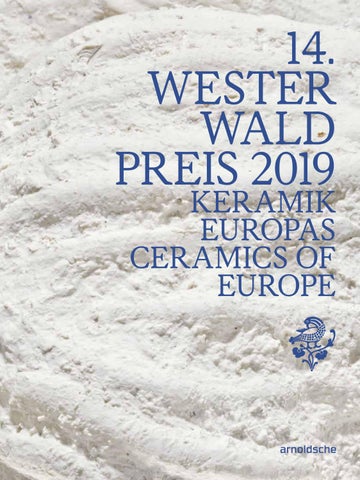
14. WESTER WALD PREIS 2019 KERAMIK EUROPAS CERAMICS OF EUROPE
Jury 14. Westerwaldpreis Jury 14th Westerwald Prize HELGA GERHARDUS Montabaur, Deutschland / Germany Geschäftsführerin der Museen im Westerwald GmbH Managing director of the Museen im Westerwald GmbH JÖRG JOHNEN Berlin, Deutschland / Germany Galerist und Kunstsammler Gallery owner and art collector DR. SABINE RUNDE Frankfurt am Main, Deutschland / Germany Oberkustodin des Museums Angewandte Kunst Head curator of the Museum Angewandte Kunst JULIAN STAIR London, Großbritannien / Great Britain Künstler und Kunsthistoriker Artist and art historian XAVIER TOUBES Chicago, USA Ehemaliger Professor für Keramik in North-Carolina und Chicago und ehemaliger Leiter des European Ceramic Workcentre, ’s Hertogenbosch, Niederlande Former Professor of Ceramics in North Carolina and Chicago and former Director of the European Ceramics Workcentre, ’s Hertogenbosch, The Netherlands DR. NELE VAN WIERINGEN Höhr-Grenzhausen, Deutschland / Germany Leiterin Keramikmuseum Westerwald Head of Ceramics Museum Westerwald
15
Freie Keramik / Free Ceramics
Johannes Nagel
1. PR EIS / 1. PR I ZE
Johannes Nagel gelingt es, zwischen der Tradition des Gefäßes und den Freiheiten der modernen Kunst einen eigenen Weg zu finden. Er verbindet die statische Festigkeit des Gefäßes mit gestischer Dynamik, das Handwerkliche mit dem Experimentellen, das Geplante mit dem Zufälligen. Durch die von Nagel entwickelte Technik der Grabung entstehen Formen, die von der Dialektik zwischen der Formvorstellung des Künstlers und den unsichtbaren Gesten der Hände in der mit Sand gefüllten Box geprägt sind. Mit den Grabungen hat Nagel eine Technik entdeckt, die ihm viele formale Möglichkeiten bietet. Es ergeben sich Objekte zwischen Auflösung und Gestalt, Natürlichkeit und Künstlichkeit, Struktur und Strukturlosigkeit. Die Objekte sind auf komplizierte, moderne Weise dekorativ. Sie fügen sich ins Interieur und sprengen doch durch Größe und ihre expressive Freiheit die Konventionen. Die aufgetragenen Glasuren reagieren auf die Besonderheiten der Objektformen. Auf diese Weise entsteht ein Spiel zwischen bemalten und unbemalten Flächen, Röhren und Rundungen, Innen- und Außenseiten, rauhen und glatten Oberflächen. Dazwischen entstehen auch unglasierte weiße oder schwarz glasierte Objekte. Nagel verfügt über eine enorme Freiheit und Vorstellungskraft, um eine immer wieder überraschende Vielfalt an Objekten zu schaffen. Diese Vielfalt erinnert an den üppigen Reichtum eines Korallenriffs, dessen Schönheit uns immer wieder begeistert. Johannes Nagel manages to find his own way between the tradition of the vessel and the freedom of modern art. He connects the static strength of the vessel with gestural dynamism, the artisanal with the experimental, the planned with the coincidental. The technique of excavation developed by Nagel creates forms which are shaped by the dialectic between the vision of form of the artist and the invisible gestures of the hands in the sand-filled box. With the excavations, Nagel has found a technique which allows him many formal possibilities. Objects arise between dissolution and form, naturalness and artifice, structure and structurelessness. The objects are decorative in a complicated, modern way. They integrate themselves into the interior and explode the conventions through their size and expressive freedom. The applied glazes react to the peculiarities of the object forms. This creates a play between painted and unpainted surfaces, tubes and curves, inside and outside, rough and smooth surfaces. White or black glazed objects emerge among them. Nagel has a huge freedom and imagination to create an ever surprising variety of objects. This diversity reminds us of the abundant richness of a coral reef, the beauty of which delights us again and again. Jörg Johnen JOHANNES NAGEL _ 2018, White cluster with plinth, 60 × 52 × 62 cm
28
29
Freie Keramik / Free Ceramics 1. PR EIS / 1. PR I ZE
JOHANNES NAGEL _ 2018, Coloured construction, 40 × 45 × 59 cm
JOHANNES NAGEL _ 2017, Monument, 40 × 50 × 61 cm
30
31
Freie Keramik / Free Ceramics 1. PR EIS / 1. PR I ZE
JOHANNES NAGEL _ 2018, Coloured construction, 40 × 45 × 59 cm
JOHANNES NAGEL _ 2017, Monument, 40 × 50 × 61 cm
30
31
Freie Keramik / Free Ceramics
Jesse Magee
2. PR EIS / 2. PR I ZE
Mit seinen monumentalen Skulpturen aus gesinterter Masse legt Jesse Magee in Mutterboden die Wesentlichkeit der Keramik frei. Indem er mehrere Kubikmeter Erde bei 1200 °C brennt, stellt Magee die Kernattribute der keramischen Praxis in den Vordergrund: der pure Materialismus und die alchemistische Wandlungsfähigkeit der Materie. Unberührt haben diese schlichten Blöcke Ur-Ton aus dem Rheintal eine geografische Charakteristik, erinnern uns aber auch an unsere generelle Position auf dem Planeten Erde. Magee demonstriert, wie die wandlungsfähige Natur der Keramik fähig ist, abstrakte Ideen greifbar zu machen und elementare zeitgenössische Kunst hervorzubringen. In Mutterboden, Jesse Magee demonstrates the bare essentialism of ceramics through his monumental sculptures of sintered mass. By firing cubic meters of soil to 1200 degrees Celsius, Magee foregrounds the core attributes of ceramic practice; the raw materialism and the alchemical transmutation of matter. Unmediated by touch, these simple blocks of proto-clay dug from the earth of the Rhine valley have a geographical specificity but also remind us of our wider place on the planet earth. Magee demonstrates how the transformative nature of ceramics has the power to make abstract ideas tangible and produce elemental art for the modern age. Julian Stair JESSE MAGEE _ 2017, Mutterboden (Neuwied 2017), je / each ca. 85 × 100 × 95 cm
32
33
Freie Keramik / Free Ceramics
Christoph Möller
CHRISTOPH MÖLLER _ 2017, o.T., 19 × 42 × 36 cm
CHRISTOPH MÖLLER _ 2018, o.T., 33 × 36 × 37 cm
64
65
Freie Keramik / Free Ceramics
Christoph Möller
CHRISTOPH MÖLLER _ 2017, o.T., 19 × 42 × 36 cm
CHRISTOPH MÖLLER _ 2018, o.T., 33 × 36 × 37 cm
64
65
Freie Keramik / Free Ceramics
Hasan Şahbaz
HASAN ŞAHBAZ _ 2019, Topographical Bowl – 1, 9 × 29,5 × 19 cm
HASAN ŞAHBAZ _ 2019, Topographical Bowl – 2, 9,3 × 33,5 × 20,5 cm
78
79
Freie Keramik / Free Ceramics
Hasan Şahbaz
HASAN ŞAHBAZ _ 2019, Topographical Bowl – 1, 9 × 29,5 × 19 cm
HASAN ŞAHBAZ _ 2019, Topographical Bowl – 2, 9,3 × 33,5 × 20,5 cm
78
79
Freie Keramik / Free Ceramics
Horácio Venturin
HORÁCIO VENTURIN _ 2017, no title, 36 × 20 × 20 cm
HORÁCIO VENTURIN _ 2018, no title, 28 × 22 × 30 cm
88
89
Freie Keramik / Free Ceramics
Horácio Venturin
HORÁCIO VENTURIN _ 2017, no title, 36 × 20 × 20 cm
HORÁCIO VENTURIN _ 2018, no title, 28 × 22 × 30 cm
88
89
MONIKA DEBUS _ 2019, invention no. 1, 33 × 61 × 43 cm
98
MONIKA DEBUS _ 2019, invention no. 1, 33 × 61 × 43 cm
98
Förderpreis / Talent Prize
Hyunjin Kim
PR EISTR ÄGER IN / PR I ZE W INN ER
Hyunjin Kim arbeitete von 2015 bis 2017 an der Muthesius Kunsthochschule in Kiel an einem persönlichen Projekt, betitelt Muttermal. Das koreanische Wort dafür – Jeom – kann sowohl Muttermal als auch einen kleinen Fleck, ein punktförmiges Zeichen oder ein Stadium innerhalb einer Entwicklung bedeuten. Die Studentin lotete in ihrem Projekt organische Prozesse in Zeichnungen, Aquarellen, Texten und keramischen Arbeiten aus. Die prämierten Arbeiten tragen den Titel: Kümmel – ein kleiner Samen, der im Wachstum neue Strukturen entfaltet. Hyunjin Kim bringt in den zwei Arbeiten mithilfe keramischer Techniken gekonnt Gegensätze ins Spiel. Sie stellt ein mattes, poliertes Weiß, oxidierend gebrannt, einem hochglänzenden, tiefen Kupferrot aus dem Reduktionsbrand gegenüber. Zusammen bilden die beiden Objekte ein ästhetisches Äquilibrium. Hyunjin Kim worked from 2015 to 2017 at the Muthesius Art College in Kiel on a personal project called mole. The Korean word for it – Jeom – can mean mole, a small spot, a point sign or a stage during a development. In her project the student plumbed the depths of organic processes in drawings, paintings, texts and ceramic works. The award-winning works have the titles: Caraway – a small seed, which, in growing, develops new structures. Hyunjin Kim in her two works skilfully brings out the opposites with the help of ceramic techniques. She confronts a matt, polished white, fired in an oxidising environment, against a highly polished deep copper red of a reductive atmospheric firing. Together the two objects form an aesthetic equilibrium. Nele van Wieringen HYUNJIN KIM _ 2017, Kümmel 2 aus der Serie: Muttermal, 50 × 44 × 42 cm
112
113
Förderpreis / Talent Prize
BENNO BRUCKSCH & EZRA DILGER _ 2018, Lost shape 2, 36 × 21 × 17 cm
BENNO BRUCKSCH _ 2017, Erde Wachs Stift, Kasten / box: 37 × 56,5 × 4 cm
118
119
Förderpreis / Talent Prize
BENNO BRUCKSCH & EZRA DILGER _ 2018, Lost shape 2, 36 × 21 × 17 cm
BENNO BRUCKSCH _ 2017, Erde Wachs Stift, Kasten / box: 37 × 56,5 × 4 cm
118
119
© 2019 Kreisverwaltung des Westerwaldkreises, Montabaur; arnoldsche Art Publishers, Stuttgart, und die Autoren / and the authors Alle Rechte vorbehalten. Vervielfältigung und Wiedergabe auf jegliche Weise (grafisch, elektronisch und fotomechanisch sowie der Gebrauch von Systemen zur Datenrückgewinnung) – auch in Auszügen – nur mit schriftlicher Genehmigung der Copyright-Inhaber. www.arnoldsche.com All rights reserved. No part of this work may be reproduced or used in any form or by any means (graphic, electronic or mechanical, including photocopying or information storage and retrieval systems) without written permission from the copyright holders. www.arnoldsche.com
HERAUSGEBER / EDITOR
Westerwaldkreis, Kreisverwaltung, Peter-Altmeier-Platz 1, 56410 Montabaur, Deutschland / Germany
BILDNACHWEIS / PHOTO CREDITS
Fotostudio Baumann GmbH, Höhr-Grenzhausen, Deutschland / Germany außer Seite / except page 34–35 Articus & Röttgen, Brohl-Lützing, Deutschland / Germany UMSCHLAGABBILDUNGEN / COVER ILLUSTRATIONS
Johannes Nagel, White cluster with plinth, 2018, 60 × 52 × 62 cm, Porzellan / porcelain Die vorliegende Publikation erscheint anlässlich des Wettbewerbes 14. Westerwaldpreis 2019. Keramik Europas The present publication is published to mark the competition 14th Westerwald Prize 2019. Ceramics of Europe Veranstalter des Wettbewerbes und der Ausstellung: Westerwaldkreis / Organizer of the competition and exhibition: Westerwald district Kreisverwaltung, Peter-Altmeier-Platz 1, 56410 Montabaur, Deutschland / Germany
AUTOREN / AUTHORS
SPONSOREN / SPONSORING
Prof. Dr. Konrad Wolf, Achim Schwickert, Michael Thiesen, Dr. Nele van Wieringen Jörg Johnen, Julian Stair, Dr. Sabine Runde
Gasversorgung Westerwald GmbH, Hilgert, Deutschland / Germany Firma Carl Jäger GmbH, Hilgert, Deutschland / Germany Firma Rastal GmbH&Co.KG, Höhr-Grenzhausen, Deutschland / Germany Stadt und Verbandsgemeinde Höhr-Grenzhausen, Deutschland / Germany Sparkasse Westerwald-Sieg, Bad Marienberg, Deutschland / Germany Westerwald Bank eG, 57627 Hachenburg, Deutschland / Germany
KONZEPTION UND REDAKTION / CONCEPT AND EDITING
Dr. Nele van Wieringen, Keramikmuseum Westerwald Helga Gerhardus, Museen im Westerwald GmbH, Montabaur ÜBERSETZUNG / TRANSLATOR
Margret Sloan, Bamberg, Deutschland / Germany
WETTBEWERBS- UND AUSSTELLUNGSKONZEPTION / COMPETITION AND EXHIBITION CONCEPT
Dr. Nele van Wieringen, Keramikmuseum Westerwald LEKTORAT / COPY EDITING
Bettina Keßler, Keramikmuseum Westerwald; Helga Gerhardus, Museen im Westerwald GmbH; Dr. Ramona Budde, Höhr-Grenzhausen ARNOLDSCHE PROJEKTKOORDINATION / PROJECT COORDINATION
Greta Garle GRAFISCHE GESTALTUNG / GRAPHIC DESIGNER
nalbach typografik, Silke Nalbach, Mannheim, Deutschland / Germany DRUCK / PRINTED BY
Druckerei Hachenburg GmbH, Hachenburg, Deutschland / Germany PAPIER / PAPER
Überzug / Cover: Surbalin glatt Inhalt / Core: 150 g/sm Munken Polar BIBLIOGRAFISCHE INFORMATION DER DEUTSCHEN NATIONALBIBLIOTHEK
Die Deutsche Nationalbibliothek verzeichnet diese Publikation in der Deutschen Nationalbibliografie; detaillierte bibliografische Daten sind im Internet über www.dnb.de abrufbar. BIBLIOGRAPHIC INFORMATION PUBLISHED BY THE DEUTSCHE NATIONALBIBLIOTHEK
The Deutsche Nationalbibliothek lists this publication in the Deutsche Nationalbibliografie; detailed bibliographic data are available on the Internet at www.dnb.de. BEZUGSQUELLEN / DISTRIBUTION
Keramikmuseum Westerwald, Verlag der Museen des Westerwaldkreises, Kreishaus, Peter-Altmeier-Platz 1, 56410 Montabaur ISBN 978-3-930081-28-8 arnoldsche Art Publishers, Stuttgart ISBN 978-3-89790-578-8 Made in Germany, 2019
ORGANISATION, DURCHFÜHRUNG DER AUSSTELLUNG UND DES WETTBEWERBES / ORGANISATION, REALISATION OF THE EXHIBITION AND THE COMPETITION:
Helga Gerhardus, Axel Simonis, Museen im Westerwald GmbH; Dr. Nele van Wieringen, Line Bast-Cerri, Hans-Jürgen Deblon, Enrico Eckhoff, Bettina Keßler, Sedat Mavili, Annette Zeischka-Kenzler