Foreword For my Rachael Dorrian and our ‘Paddington Bear’ adventures.
© Emons Verlag GmbH All rights reserved © Photographs by Philip R. Stone, except see p. 236 – 238 © Cover icon: shutterstock.com/koya979; russ witherington Layout: Eva Kraskes, based on a design by Lübbeke | Naumann | Thoben Maps: altancicek.design, www.altancicek.de Basic cartographical information from Openstreetmap, © OpenStreetMap-Mitwirkende, OdbL Editing: Karen E. Seiger Printing and binding: Grafisches Centrum Cuno, Calbe Printed in Germany 2021 ISBN 978-3-7408-0900-3 First edition Did you enjoy this guidebook? Would you like to see more? Join us in uncovering new places around the world on: www.111places.com
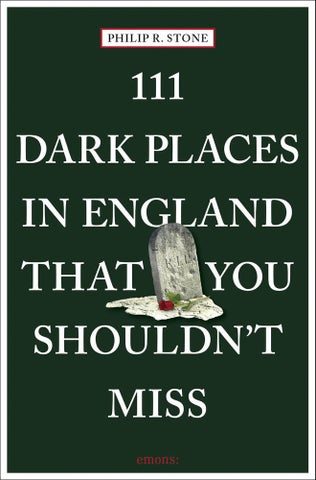
I have been writing about people visiting the dead for a long time. I first turned to the ‘dark side’ when a student of mine introduced me to ‘dark tourism’. That is, the act of traveling to sites of death, disaster, or the seemingly macabre. The idea of tourists visiting places that portray heritage that hurts is filled with many dilemmas. Of course, people have long been drawn to sites of death and fatality. In ancient times, gladiatorial games were a leisure mainstay of the Roman Empire. During the medieval period, public executions of criminals were spectator events. And, in 19th century Europe, morgue tours to encounter corpses were a common travel itinerary. As a social scientist, I am fascinated as to why particular deaths are remembered, by whom, and how our dead are (re)presented within the visitor economy. Sadly, the world is littered with sites of tragedy. Our mistakes and misfortunes are exposed by landscapes of adversity, accidents, and calamity. Visiting and remembering our dead is a cultural phenomenon – we attach importance to certain kinds of death and the dead. In turn, the dead can become significant to the living and warn us of our mortality. Yet, commemoration is challenged by politics of remembrance, commercialism, and conflict in memorialisation, as well as the ethics of interpretation. Dark tourism is further challenged by consumer behaviour and visitor experiences. I wrote this book to provide an authoritative yet accessible guide into the dark places of England. Each of the 111 places in this book offers a provocative and emotive account of the site and its uniquely dark story. I wrote it for you to discover the sites, do additional research on its themes, and respect the difficult heritage of places of pain and shame. Ultimately, this inimitable guidebook permits you to sightsee in the mansions of the dead, while having deference to those deceased.
Foreword For my Rachael Dorrian and our ‘Paddington Bear’ adventures.
© Emons Verlag GmbH All rights reserved © Photographs by Philip R. Stone, except see p. 236 – 238 © Cover icon: shutterstock.com/koya979; russ witherington Layout: Eva Kraskes, based on a design by Lübbeke | Naumann | Thoben Maps: altancicek.design, www.altancicek.de Basic cartographical information from Openstreetmap, © OpenStreetMap-Mitwirkende, OdbL Editing: Karen E. Seiger Printing and binding: Grafisches Centrum Cuno, Calbe Printed in Germany 2021 ISBN 978-3-7408-0900-3 First edition Did you enjoy this guidebook? Would you like to see more? Join us in uncovering new places around the world on: www.111places.com
I have been writing about people visiting the dead for a long time. I first turned to the ‘dark side’ when a student of mine introduced me to ‘dark tourism’. That is, the act of traveling to sites of death, disaster, or the seemingly macabre. The idea of tourists visiting places that portray heritage that hurts is filled with many dilemmas. Of course, people have long been drawn to sites of death and fatality. In ancient times, gladiatorial games were a leisure mainstay of the Roman Empire. During the medieval period, public executions of criminals were spectator events. And, in 19th century Europe, morgue tours to encounter corpses were a common travel itinerary. As a social scientist, I am fascinated as to why particular deaths are remembered, by whom, and how our dead are (re)presented within the visitor economy. Sadly, the world is littered with sites of tragedy. Our mistakes and misfortunes are exposed by landscapes of adversity, accidents, and calamity. Visiting and remembering our dead is a cultural phenomenon – we attach importance to certain kinds of death and the dead. In turn, the dead can become significant to the living and warn us of our mortality. Yet, commemoration is challenged by politics of remembrance, commercialism, and conflict in memorialisation, as well as the ethics of interpretation. Dark tourism is further challenged by consumer behaviour and visitor experiences. I wrote this book to provide an authoritative yet accessible guide into the dark places of England. Each of the 111 places in this book offers a provocative and emotive account of the site and its uniquely dark story. I wrote it for you to discover the sites, do additional research on its themes, and respect the difficult heritage of places of pain and shame. Ultimately, this inimitable guidebook permits you to sightsee in the mansions of the dead, while having deference to those deceased.
FA R S O U T H W E S T
1__ The Bampton Icicle Stone Death by icicle
Bampton, a historic Charter Town, lies on the edge of the Exmoor National Park. Saxon in origin, the small town is full of character, with many conserved buildings dating to the time of William the Conqueror. The Domesday Book of 1084/85 provides Bampton’s status by referring to it as the ‘Hundred of Baentona’. The town, built around the wool and pony trade, and later quarrying, was granted a Royal Charter in 1258 by King Henry III. The Bampton Fair, held on the last Thursday of October, celebrates local foods and livestock, as well as crafts and traditional skills of Exmoor. It is one of the oldest surviving Charter Fairs in England. Bampton was also a site of battle in the English Civil War. In 1645, the town was burned and looted, and only a few buildings remain pre-dating that event. As Royalist and Parliamentary forces in the Civil War clashed, the Royalists marched from nearby Tiverton Castle and spent four days torching the town. The Devon Clubmen, who were headquartered in Bampton, were a group of landowners armed with clubs, cudgels, and pitchforks. They attempted, with little success, to defend their property. Bampton is also home to a little known occurrence that sparks curiosity. In the early 12th century, St Michael and All Angels Church was built on the site of previous places of Celtic worship. Yew trees planted around 1483 still stand proudly in the graveyard, and the church is home to town stocks last used as punishment in 1862. However, at the base of the church’s tower on the west side is a stone tablet (a 1950s replacement) commemorating the death of an 18th century local lad. The odd rhyming inscription reads: IN MEMORY OF THE CLERK’S SON / “Bless my i.i.i.i.i.i. / Here he lies / In a sad Pickle / Killed by Icicle” / IN THE YEAR 1776 This unfortunate victim remains unknown, along with his name, age, his family, and how he actually died. 10
Address St Michael and All Angels Church, Station Road, Bampton, Tiverton, EX16 9NG, +44 (0)139 833 2885, www.hukeleymissioncommunity.org/locations/st-michael-all-angelsbampton | Getting there Train to Tiverton Parkway, then a 15-minute taxi ride | Hours Unrestricted | Tip Berry Pomeroy Castle is a romantic ruin with a history of ghostly intrigue (Berry Pomeroy, Totnes, Devon, www.english-heritage.org.uk).
FA R S O U T H W E S T
1__ The Bampton Icicle Stone Death by icicle
Bampton, a historic Charter Town, lies on the edge of the Exmoor National Park. Saxon in origin, the small town is full of character, with many conserved buildings dating to the time of William the Conqueror. The Domesday Book of 1084/85 provides Bampton’s status by referring to it as the ‘Hundred of Baentona’. The town, built around the wool and pony trade, and later quarrying, was granted a Royal Charter in 1258 by King Henry III. The Bampton Fair, held on the last Thursday of October, celebrates local foods and livestock, as well as crafts and traditional skills of Exmoor. It is one of the oldest surviving Charter Fairs in England. Bampton was also a site of battle in the English Civil War. In 1645, the town was burned and looted, and only a few buildings remain pre-dating that event. As Royalist and Parliamentary forces in the Civil War clashed, the Royalists marched from nearby Tiverton Castle and spent four days torching the town. The Devon Clubmen, who were headquartered in Bampton, were a group of landowners armed with clubs, cudgels, and pitchforks. They attempted, with little success, to defend their property. Bampton is also home to a little known occurrence that sparks curiosity. In the early 12th century, St Michael and All Angels Church was built on the site of previous places of Celtic worship. Yew trees planted around 1483 still stand proudly in the graveyard, and the church is home to town stocks last used as punishment in 1862. However, at the base of the church’s tower on the west side is a stone tablet (a 1950s replacement) commemorating the death of an 18th century local lad. The odd rhyming inscription reads: IN MEMORY OF THE CLERK’S SON / “Bless my i.i.i.i.i.i. / Here he lies / In a sad Pickle / Killed by Icicle” / IN THE YEAR 1776 This unfortunate victim remains unknown, along with his name, age, his family, and how he actually died. 10
Address St Michael and All Angels Church, Station Road, Bampton, Tiverton, EX16 9NG, +44 (0)139 833 2885, www.hukeleymissioncommunity.org/locations/st-michael-all-angelsbampton | Getting there Train to Tiverton Parkway, then a 15-minute taxi ride | Hours Unrestricted | Tip Berry Pomeroy Castle is a romantic ruin with a history of ghostly intrigue (Berry Pomeroy, Totnes, Devon, www.english-heritage.org.uk).
FA R S O U T H W E S T
2__ Charlotte Dymond Memorial Murder and miscarriage of justice
On 14 April, 1844, 18-year old Charlotte Dymond was brutally murdered. Her body was found several days later at Rough Tor on the desolate Bodmin Moor. Her throat had been cut. At first, the tragic killing appeared to be a result of spurned love, but controversy about the murder and its verdict has become local folklore. Charlotte Dymond was a domestic servant at Penhale Farm on the edge of Bodmin Moor. During her employment, she began a romantic relationship with Matthew Weekes, a young, disabled and illiterate farm labourer. They set off together for a Sunday walk onto the lonely moors, but Charlotte never returned home. Weekes fled to Plymouth but was soon arrested and charged with Charlotte’s murder. He pleaded not guilty. Weekes was tried at Bodmin Assizes, where a jury returned a guilty verdict in only 35 minutes, based on circumstantial evidence, a poor defence and unreliable witnesses. Sentenced to death, Weekes was hanged at Bodmin Gaol on 12 August, 1844 and buried in the prison’s coal yard. In the intervening years, there has been much doubt as to Weekes’ guilt, particularly as another lover – Thomas Prout – was implicated in the murder after the trial. Charlotte Dymond’s murder became a tabloid sensation and the stuff of Penny Dreadful fiction. Death-obsessed Victorians appeared to be entranced by the killing of a young girl at the hands of a lover during a secret moorland rendezvous. An estimated 20,000 spectators watched Weekes’ execution, and The West Briton newspaper reported that a fete with donkey rides and refreshment stalls was held at Rough Tor, with 10,000 attendees. People paid a penny to see the spot where the murder took place. A granite obelisk was erected in 1845 to commemorate Charlotte Dymond. 12
Address Roughtor Road, Bodmin Moor, Cornwall, PL32 9QG | Getting there By car, take A 39, exit at A 395 and follow the turns to Rough Tor Car Park. The memorial is situated on moorland near a stream. | Hours Unrestricted | Tip A stone headstone in 2017 replaced the wooden cross marking Charlotte’s grave. You can visit her actual burial site at St David’s Church (Davidstow, near Camelford, PL32 9XT).
FA R S O U T H W E S T
2__ Charlotte Dymond Memorial Murder and miscarriage of justice
On 14 April, 1844, 18-year old Charlotte Dymond was brutally murdered. Her body was found several days later at Rough Tor on the desolate Bodmin Moor. Her throat had been cut. At first, the tragic killing appeared to be a result of spurned love, but controversy about the murder and its verdict has become local folklore. Charlotte Dymond was a domestic servant at Penhale Farm on the edge of Bodmin Moor. During her employment, she began a romantic relationship with Matthew Weekes, a young, disabled and illiterate farm labourer. They set off together for a Sunday walk onto the lonely moors, but Charlotte never returned home. Weekes fled to Plymouth but was soon arrested and charged with Charlotte’s murder. He pleaded not guilty. Weekes was tried at Bodmin Assizes, where a jury returned a guilty verdict in only 35 minutes, based on circumstantial evidence, a poor defence and unreliable witnesses. Sentenced to death, Weekes was hanged at Bodmin Gaol on 12 August, 1844 and buried in the prison’s coal yard. In the intervening years, there has been much doubt as to Weekes’ guilt, particularly as another lover – Thomas Prout – was implicated in the murder after the trial. Charlotte Dymond’s murder became a tabloid sensation and the stuff of Penny Dreadful fiction. Death-obsessed Victorians appeared to be entranced by the killing of a young girl at the hands of a lover during a secret moorland rendezvous. An estimated 20,000 spectators watched Weekes’ execution, and The West Briton newspaper reported that a fete with donkey rides and refreshment stalls was held at Rough Tor, with 10,000 attendees. People paid a penny to see the spot where the murder took place. A granite obelisk was erected in 1845 to commemorate Charlotte Dymond. 12
Address Roughtor Road, Bodmin Moor, Cornwall, PL32 9QG | Getting there By car, take A 39, exit at A 395 and follow the turns to Rough Tor Car Park. The memorial is situated on moorland near a stream. | Hours Unrestricted | Tip A stone headstone in 2017 replaced the wooden cross marking Charlotte’s grave. You can visit her actual burial site at St David’s Church (Davidstow, near Camelford, PL32 9XT).
FA R S O U T H W E S T
3__ Exercise Tiger Memorial The forgotten dead of friendly and enemy fire
‘Exercise Tiger” was the codename of a training operation to prepare troops for D-Day and the liberation of Nazi-occupied Europe (see ch. 70). Supreme Commander of Allied Forces Dwight D. Eisenhower wanted drills for the invasion to be as realistic as possible, including the use of live ammunition. Slapton Sands in Devon was chosen as the exercise location because the beach closely resembled Utah Beach, a site of the Normandy landings. Over 3,000 local residents were told to leave six weeks before the exercise with no explanation. Then, on 27 April, 1944, as Exercise Tiger commenced, live artillery shells slaughtered over 400 American soldiers due to a timing blunder. Kept secret by authorities for decades and still not formally recognised by the US Government, the calamity was the worst case of friendly fire during World War II. The shocking event became a double tragedy on 28 April, 1944, when nine German E-boats passing through Lyme Bay stumbled upon the exercises. They opened fire on the mock-invasion, killing 639 men. The harrowing scenes of corpses washing up onto the beach would be replicated on D-Day six weeks later at Normandy. With over 1,000 soldiers slain, the irony is that Eisenhower achieved realism in his dress rehearsal attack. Survivors received no leave to recover from the trauma of Exercise Tiger. They were sworn to secrecy, under threat of court martial, and a media blackout followed so as not to compromise the impending landings of D-Day. In 1984, the late Ken Small raised a sunken Sherman tank from local waters – a remnant of that fateful day in 1944. After much bureaucracy, Small ‘purchased’ the tank from the US government for $50. He pursued the idea of a memorial to end 50 years of silence. The Sherman tank, with a plaque to commemorate Small’s endeavours, now rests on a cobbled plinth and honours the sacrifices of those who died. 14
Address Exercise Tiger Memorial, Torcross, Devon, TQ7 2TQ, www.exercisetigermemorial.co.uk | Getting there By car, take A 379 to Torquay | Hours Unrestricted | Tip Lynmouth Flood Memorial Hall is where a devastating flood in 1952 created conspiracy theories about secret RAF cloud-seeding experiments (Lynmouth Street, Lynmouth, Devon, www.visitlyntonandlynmouth.com).
FA R S O U T H W E S T
3__ Exercise Tiger Memorial The forgotten dead of friendly and enemy fire
‘Exercise Tiger” was the codename of a training operation to prepare troops for D-Day and the liberation of Nazi-occupied Europe (see ch. 70). Supreme Commander of Allied Forces Dwight D. Eisenhower wanted drills for the invasion to be as realistic as possible, including the use of live ammunition. Slapton Sands in Devon was chosen as the exercise location because the beach closely resembled Utah Beach, a site of the Normandy landings. Over 3,000 local residents were told to leave six weeks before the exercise with no explanation. Then, on 27 April, 1944, as Exercise Tiger commenced, live artillery shells slaughtered over 400 American soldiers due to a timing blunder. Kept secret by authorities for decades and still not formally recognised by the US Government, the calamity was the worst case of friendly fire during World War II. The shocking event became a double tragedy on 28 April, 1944, when nine German E-boats passing through Lyme Bay stumbled upon the exercises. They opened fire on the mock-invasion, killing 639 men. The harrowing scenes of corpses washing up onto the beach would be replicated on D-Day six weeks later at Normandy. With over 1,000 soldiers slain, the irony is that Eisenhower achieved realism in his dress rehearsal attack. Survivors received no leave to recover from the trauma of Exercise Tiger. They were sworn to secrecy, under threat of court martial, and a media blackout followed so as not to compromise the impending landings of D-Day. In 1984, the late Ken Small raised a sunken Sherman tank from local waters – a remnant of that fateful day in 1944. After much bureaucracy, Small ‘purchased’ the tank from the US government for $50. He pursued the idea of a memorial to end 50 years of silence. The Sherman tank, with a plaque to commemorate Small’s endeavours, now rests on a cobbled plinth and honours the sacrifices of those who died. 14
Address Exercise Tiger Memorial, Torcross, Devon, TQ7 2TQ, www.exercisetigermemorial.co.uk | Getting there By car, take A 379 to Torquay | Hours Unrestricted | Tip Lynmouth Flood Memorial Hall is where a devastating flood in 1952 created conspiracy theories about secret RAF cloud-seeding experiments (Lynmouth Street, Lynmouth, Devon, www.visitlyntonandlynmouth.com).
FA R S O U T H W E S T
4__ Kitty Jay’s Grave
Denied a Christian burial because of ‘self-murder’
At a crossroads of a country lane in the Dartmoor National Park is a burial mound and gravestone. Supposedly the final resting place of Kitty (Mary) Jay, an 18th-century orphan, the grave has become folklore. While tales of Jay have been romanticised and embellished over the years, including stories of the supernatural, her grave is a black spot on burial rites of yesteryear. Jay was abandoned as a baby and left at the Poor House in Newton Abbot in the late 1700s. She was given the surname ‘J’ (stylized as Jay) by the orphanage, but because ‘Jay’ was a slang term for a prostitute, she was given the Christian name Mary. Jay grew up to become a teenage apprentice at Canna Farm in the parish of Manaton, where she became known as Kitty. While at the farm, she was either raped by a farm labourer or fell in love with the farmer’s son. Consequently, Jay became pregnant and was dismissed from service. Penniless and in disgrace – and in fear of being ostracized – the young Kitty Jay committed suicide by hanging herself in the farm’s barn. At the time, suicides were judged guilty of ‘self-murder’ and punishable by withholding consecrated burial sacraments. Spirits of suicide victims were feared by the living. A way of dealing with this fear was to bury corpses at a crossroads (often with a stake through the heart), so any wandering ghost would be disoriented as to which way to haunt. Crossroad burials for suicides have been documented as early as 1510, with its origins in Anglo-Saxon times. They were abolished by law in 1823, after the suicide of Lord Castlereagh, the Foreign Secretary, who helped defeat Napoleon. However, the memory of Kitty Jay, a downtrodden orphan girl, has lasted longer than the people who denied her a Christian burial. Today, her grave is always adorned by votive offerings of flowers, pennies and mementos by passing visitors and secular-pilgrims. 16
Address Manaton, Newton Abbot, Devon, TQ13 9XF | Getting there The grave is located one mile north-west of Hound Tor at the Green Lane to Natsworthy. | Hours Unrestricted | Tip Instead of numerals, the ‘My Dear Mother’ church clock at St Peter’s Church spells out a memorial to a lost loved one (Buckland-in-the-Moor, Newton Abbot).
FA R S O U T H W E S T
4__ Kitty Jay’s Grave
Denied a Christian burial because of ‘self-murder’
At a crossroads of a country lane in the Dartmoor National Park is a burial mound and gravestone. Supposedly the final resting place of Kitty (Mary) Jay, an 18th-century orphan, the grave has become folklore. While tales of Jay have been romanticised and embellished over the years, including stories of the supernatural, her grave is a black spot on burial rites of yesteryear. Jay was abandoned as a baby and left at the Poor House in Newton Abbot in the late 1700s. She was given the surname ‘J’ (stylized as Jay) by the orphanage, but because ‘Jay’ was a slang term for a prostitute, she was given the Christian name Mary. Jay grew up to become a teenage apprentice at Canna Farm in the parish of Manaton, where she became known as Kitty. While at the farm, she was either raped by a farm labourer or fell in love with the farmer’s son. Consequently, Jay became pregnant and was dismissed from service. Penniless and in disgrace – and in fear of being ostracized – the young Kitty Jay committed suicide by hanging herself in the farm’s barn. At the time, suicides were judged guilty of ‘self-murder’ and punishable by withholding consecrated burial sacraments. Spirits of suicide victims were feared by the living. A way of dealing with this fear was to bury corpses at a crossroads (often with a stake through the heart), so any wandering ghost would be disoriented as to which way to haunt. Crossroad burials for suicides have been documented as early as 1510, with its origins in Anglo-Saxon times. They were abolished by law in 1823, after the suicide of Lord Castlereagh, the Foreign Secretary, who helped defeat Napoleon. However, the memory of Kitty Jay, a downtrodden orphan girl, has lasted longer than the people who denied her a Christian burial. Today, her grave is always adorned by votive offerings of flowers, pennies and mementos by passing visitors and secular-pilgrims. 16
Address Manaton, Newton Abbot, Devon, TQ13 9XF | Getting there The grave is located one mile north-west of Hound Tor at the Green Lane to Natsworthy. | Hours Unrestricted | Tip Instead of numerals, the ‘My Dear Mother’ church clock at St Peter’s Church spells out a memorial to a lost loved one (Buckland-in-the-Moor, Newton Abbot).
FA R S O U T H W E S T
5__ Museum of Witchcraft & Magic A bewitching cauldron of curiosities
The Museum of Witchcraft and Magic is a Cornish cabinet of curiosities, where witches, piskies and spriggans are displayed. Reimagined tales of folklore and magic are told at this independent museum in the picturesque fishing village of Boscastle. With significant collections of paraphernalia relating to witchcraft, the museum is both a pilgrimage site for modern witches as well as an authority on the occult. Exhibits include a reconstruction of an 18th-century ‘cunning woman’ cottage, complete with various herbal remedies and divination tools. The museum also contains exhibits devoted to witch trials, the Pagan religion of Wicca, as well as other esoteric practices such as ceremonial magic, alchemy, Satanism and Freemasonry. The museum was originally founded by folk magician Cecil Williamson in 1951 and located on the Isle of Man. Assisted by prominent Wiccan and resident witch Gerald Gardner, the pair fell out, and Williamson brought his collection to England. Located first at Windsor and then at Bourton-on-the-Water before moving to Boscastle in 1960, the museum faced violent opposition, including the hanging of dead cats outside the premises. In 1996, Graham King took over the museum and removed many of the sensationalist objects. King also organised the burial of Joan Wytte, who had died at Bodmin Jail in 1813, having been accused of witchcraft. Her corpse had been at the museum for many years and was laid to rest in local woodlands. In the past, witches were persecuted for felony acts rather than for blasphemy. Whilst the museum works to build narratives that illustrate witchcraft over time, it positions magic and witchcraft as a significant contemporary force. The museum offers a focus for occult heritage, but ongoing problems of romanticised Pagan myth-making ensure the collections remain a cauldron of controversy. 18
Address The Harbour, Boscastle, Cornwall, PL35 0HD, +44 (0)184 025 0111, www.museumofwitchcraftandmagic.co.uk | Getting there By car, take B 3263 or B 3266 to Boscastle, continue on B 3263 to Drs Hill, and New Road to the destination on the left | Hours See website for seasonal hours and tickets | Tip Visit Merlin’s Cave in the coastal cliffs beneath Tintagel Castle, once home to the wizard of Arthurian legend (South-West Coastal Path, Castle Road, Tintagel, Cornwall).
FA R S O U T H W E S T
5__ Museum of Witchcraft & Magic A bewitching cauldron of curiosities
The Museum of Witchcraft and Magic is a Cornish cabinet of curiosities, where witches, piskies and spriggans are displayed. Reimagined tales of folklore and magic are told at this independent museum in the picturesque fishing village of Boscastle. With significant collections of paraphernalia relating to witchcraft, the museum is both a pilgrimage site for modern witches as well as an authority on the occult. Exhibits include a reconstruction of an 18th-century ‘cunning woman’ cottage, complete with various herbal remedies and divination tools. The museum also contains exhibits devoted to witch trials, the Pagan religion of Wicca, as well as other esoteric practices such as ceremonial magic, alchemy, Satanism and Freemasonry. The museum was originally founded by folk magician Cecil Williamson in 1951 and located on the Isle of Man. Assisted by prominent Wiccan and resident witch Gerald Gardner, the pair fell out, and Williamson brought his collection to England. Located first at Windsor and then at Bourton-on-the-Water before moving to Boscastle in 1960, the museum faced violent opposition, including the hanging of dead cats outside the premises. In 1996, Graham King took over the museum and removed many of the sensationalist objects. King also organised the burial of Joan Wytte, who had died at Bodmin Jail in 1813, having been accused of witchcraft. Her corpse had been at the museum for many years and was laid to rest in local woodlands. In the past, witches were persecuted for felony acts rather than for blasphemy. Whilst the museum works to build narratives that illustrate witchcraft over time, it positions magic and witchcraft as a significant contemporary force. The museum offers a focus for occult heritage, but ongoing problems of romanticised Pagan myth-making ensure the collections remain a cauldron of controversy. 18
Address The Harbour, Boscastle, Cornwall, PL35 0HD, +44 (0)184 025 0111, www.museumofwitchcraftandmagic.co.uk | Getting there By car, take B 3263 or B 3266 to Boscastle, continue on B 3263 to Drs Hill, and New Road to the destination on the left | Hours See website for seasonal hours and tickets | Tip Visit Merlin’s Cave in the coastal cliffs beneath Tintagel Castle, once home to the wizard of Arthurian legend (South-West Coastal Path, Castle Road, Tintagel, Cornwall).
FA R S O U T H W E S T
6__ William Donaghy Memorial The tragic case of a dead school teacher
Dartmoor has inspired enigmatic myths and legends, including the haunting of pixies, a headless horseman, and a mysterious pack of spectral hounds. During the Great Thunderstorm of 1638, the village of Widecombe-in-the-Moor was said to have been visited by the Devil himself. However, the tragic demise of William Donaghy is one shadowy event that is remembered by a difficult-to-find boulder memorial deep inside the moor heartlands. On 21 February, 1914, two farmers discovered the fresh corpse of a young man near Hartland Tor. There was no evidence of foul play or self-harm, but he was wearing inadequate attire for the winter moor weather. The man was wearing a blue spotted tie and a Swiss watch, and his possessions included a Dartmoor guide book, £20 in gold coins (£2,400 at today’s rates) and a cloakroom ticket dated 4 February from Exeter Railway Station. When police redeemed the ticket, they recovered a bag that had been deposited under the name ‘Jones’. It contained a revolver and ammunition, a knife, a watch and chain and a mourning ring inscribed 1817. The body was identified as 33-year-old, Liverpool-based William Donaghy, a science teacher, who worked at Warrington Technical School and who had been diagnosed with ‘morbid melancholy’. On 21 November, 2013, Donaghy left his brother a note that read, ‘I am going away. Please settle my affairs.’ He was never seen alive again. What did Donaghy do after he left Liverpool? What was he doing on the moor so far from home? And why did he have weapons under an assumed name? After his funeral in Liverpool, the boulder near where his body was found was engraved – there is no record of who inscribed it. In 1934, another Warrington teacher was found dead close to where Donaghy died, and yet another died at Beachy Head in Sussex. Both were wearing blue spotted ties and Swiss watches. 20
Address Dartmoor National Park, Devon,+44 (0)162 683 2093, www.legendarydartmoor.co.uk/donaghy-mystery-the.htm, hq@dartmoor.gov.uk | Getting there Car parking at Postbridge National Park Visitor Centre, PL20 6TH. Follow the right-hand side bank of East Dart River for about two miles northwards. Pass Hartland Tor before arriving. The boulder is set in some gorse at 364 metres. | Hours Unrestricted | Tip Trek to Hollowcombe Bottom, the site of a mysterious Dartmoor Pony Massacre in 1977 (Near Postbridge, Devon, www.legendarydartmoor.co.uk/ufo_ponies.htm).
FA R S O U T H W E S T
6__ William Donaghy Memorial The tragic case of a dead school teacher
Dartmoor has inspired enigmatic myths and legends, including the haunting of pixies, a headless horseman, and a mysterious pack of spectral hounds. During the Great Thunderstorm of 1638, the village of Widecombe-in-the-Moor was said to have been visited by the Devil himself. However, the tragic demise of William Donaghy is one shadowy event that is remembered by a difficult-to-find boulder memorial deep inside the moor heartlands. On 21 February, 1914, two farmers discovered the fresh corpse of a young man near Hartland Tor. There was no evidence of foul play or self-harm, but he was wearing inadequate attire for the winter moor weather. The man was wearing a blue spotted tie and a Swiss watch, and his possessions included a Dartmoor guide book, £20 in gold coins (£2,400 at today’s rates) and a cloakroom ticket dated 4 February from Exeter Railway Station. When police redeemed the ticket, they recovered a bag that had been deposited under the name ‘Jones’. It contained a revolver and ammunition, a knife, a watch and chain and a mourning ring inscribed 1817. The body was identified as 33-year-old, Liverpool-based William Donaghy, a science teacher, who worked at Warrington Technical School and who had been diagnosed with ‘morbid melancholy’. On 21 November, 2013, Donaghy left his brother a note that read, ‘I am going away. Please settle my affairs.’ He was never seen alive again. What did Donaghy do after he left Liverpool? What was he doing on the moor so far from home? And why did he have weapons under an assumed name? After his funeral in Liverpool, the boulder near where his body was found was engraved – there is no record of who inscribed it. In 1934, another Warrington teacher was found dead close to where Donaghy died, and yet another died at Beachy Head in Sussex. Both were wearing blue spotted ties and Swiss watches. 20
Address Dartmoor National Park, Devon,+44 (0)162 683 2093, www.legendarydartmoor.co.uk/donaghy-mystery-the.htm, hq@dartmoor.gov.uk | Getting there Car parking at Postbridge National Park Visitor Centre, PL20 6TH. Follow the right-hand side bank of East Dart River for about two miles northwards. Pass Hartland Tor before arriving. The boulder is set in some gorse at 364 metres. | Hours Unrestricted | Tip Trek to Hollowcombe Bottom, the site of a mysterious Dartmoor Pony Massacre in 1977 (Near Postbridge, Devon, www.legendarydartmoor.co.uk/ufo_ponies.htm).
MIDLANDS
7__ Bevin Boys Memorial
Forgotten World War II heroes sent to the mines
Over 48,000 men were conscripted into an underground army that many have forgotten. Between 1943 and 1945, ten per cent of male military conscripts between 18 and 25 years old were randomly picked and forced into coal mining. By 1943, mining had lost 36,000 workers, as many men opted to join the armed forces. Faced with a labour shortage, the minister of Labour and National Service, Ernest Bevin, proposed compulsory mining conscription. Conscripts became known as ‘Bevin Boys,’ though many feared the social stigma of not being in uniform, and many resented being coerced into mining. Bevin Boys also faced resentment down the mines from experienced miners because of the quantity of coal dug and subsequent payments. Life as a miner was dangerous, and accidents were commonplace. Over 5000 men were killed in British mines during World War II. The first Bevin Boy to be killed accidentally was Henry Hale from London, aged 18, who died only a month after his training in 1944. Bevin Boys disabled by accidents did not get a pension, and for those killed, their dependents did not receive benefits. Yet the conscription did not stop until 1948, when most servicemen had already been demobilized. But, unlike military personnel, Bevin Boys did not have the right to return to their original jobs. In 1950, all records of Bevin Boys were destroyed, and former miners could not prove their wartime service. This lack of recognition has been a stain on England’s war memorialisation. It was not until 2004 that Bevin Boys were allowed to march past the cenotaph on Remembrance Sunday – whilst other civilian groups had long been represented. Fortunately, in 2007, the British Government stated mining conscripts would receive long-overdue recognition. In 2013, the Bevin Boys memorial at the National Memorial Arboretum (see ch. 19) was unveiled, in remembrance of the young men who served underground. 22
Address National Memorial Arboretum, Croxall Road, Alrewas, Staffordshire, DE13 7AR, +44 (0)128 324 5100, www.thenma.org.uk, info@thenma.org.uk | Getting there Train to Lichfield Trent Valley, then a 15-minute taxi ride | Hours Daily 10am – 5pm | Tip The Staffordshire Regiment Museum shares its military history from 1705 to the present-day (DMS, Whittington, Lichfield, www.staffordshireregimentmuseum.com).
MIDLANDS
7__ Bevin Boys Memorial
Forgotten World War II heroes sent to the mines
Over 48,000 men were conscripted into an underground army that many have forgotten. Between 1943 and 1945, ten per cent of male military conscripts between 18 and 25 years old were randomly picked and forced into coal mining. By 1943, mining had lost 36,000 workers, as many men opted to join the armed forces. Faced with a labour shortage, the minister of Labour and National Service, Ernest Bevin, proposed compulsory mining conscription. Conscripts became known as ‘Bevin Boys,’ though many feared the social stigma of not being in uniform, and many resented being coerced into mining. Bevin Boys also faced resentment down the mines from experienced miners because of the quantity of coal dug and subsequent payments. Life as a miner was dangerous, and accidents were commonplace. Over 5000 men were killed in British mines during World War II. The first Bevin Boy to be killed accidentally was Henry Hale from London, aged 18, who died only a month after his training in 1944. Bevin Boys disabled by accidents did not get a pension, and for those killed, their dependents did not receive benefits. Yet the conscription did not stop until 1948, when most servicemen had already been demobilized. But, unlike military personnel, Bevin Boys did not have the right to return to their original jobs. In 1950, all records of Bevin Boys were destroyed, and former miners could not prove their wartime service. This lack of recognition has been a stain on England’s war memorialisation. It was not until 2004 that Bevin Boys were allowed to march past the cenotaph on Remembrance Sunday – whilst other civilian groups had long been represented. Fortunately, in 2007, the British Government stated mining conscripts would receive long-overdue recognition. In 2013, the Bevin Boys memorial at the National Memorial Arboretum (see ch. 19) was unveiled, in remembrance of the young men who served underground. 22
Address National Memorial Arboretum, Croxall Road, Alrewas, Staffordshire, DE13 7AR, +44 (0)128 324 5100, www.thenma.org.uk, info@thenma.org.uk | Getting there Train to Lichfield Trent Valley, then a 15-minute taxi ride | Hours Daily 10am – 5pm | Tip The Staffordshire Regiment Museum shares its military history from 1705 to the present-day (DMS, Whittington, Lichfield, www.staffordshireregimentmuseum.com).
MIDLANDS
8__ The Coffin Works Conserving funerary heritage
In the heart of Birmingham’s old Jewellery Quarter is a small factory whose industry relied on death. The Coffin Works is the former factory of the brothers Alfred and Edwin Newman, who produced some of the finest funerary furniture when it opened in 1882. Originally brass founders, the factory’s commercial mainstay became funerary furniture. However, after emphasizing being the best coffin furniture factory in the UK, the company ceased trading in 1998, due to a reluctance to modernise and the fact that metal components were banned in cremations. The factory opened as a museum in 2014, a time capsule of social and industrial history. With its working machinery and funerary products, such as coffin handles, urns and ornaments, linings and shrouds, the factory is left as it was in the 1960s, preserving the Victorian engineering. The Newman brothers produced coffins for the funerals of Winston Churchill, Joseph Chamberlain, the Queen Mother, and Princess Diana. Coffin Works is not only testament to funerary heritage, but it also highlights a UK death disposal industry that is worth about £1 billion annually, with over 600,000 funerals taking place every year, an estimated 4,000 funeral directors, and the average funeral cost of a funeral at £4,184 (in 2021). Coffin Works is also home to an extensive and unique collection of funerary artefacts that contribute to understanding changing attitudes towards death and, indeed, life over the past century. In 1935, the first major initiative to replace the term ‘undertaker’ with ‘funeral director’ emerged. It was this effort to professionalise the status of the trade that propelled the Newman brothers’ business. Those operating in the funeral industry wanted social recognition for their care of the dead. As a result, the ‘sights, sounds and smells’ of Coffin Works as a funerary furniture factory encapsulates this care, even when death rites are ever changing. 24
Address T13-15 Fleet Street, Birmingham, B3 1JP, +44 (0)121 233 4790, www.coffinworks.org, newmanbrothers@coffinworks.org | Getting there Train to New Street or Snow Hill | Hours Fri – Sun 10.45am – 4pm; reservations required | Tip Warstone Lane Cemetery Catacombs, also known as Brookfields or Mint Cemetery, hosts a tiered semicircle of tombs. It’s also a former place of ‘unhealthy vapours’ (Icknield Street Hockley, Birmingham).
MIDLANDS
8__ The Coffin Works Conserving funerary heritage
In the heart of Birmingham’s old Jewellery Quarter is a small factory whose industry relied on death. The Coffin Works is the former factory of the brothers Alfred and Edwin Newman, who produced some of the finest funerary furniture when it opened in 1882. Originally brass founders, the factory’s commercial mainstay became funerary furniture. However, after emphasizing being the best coffin furniture factory in the UK, the company ceased trading in 1998, due to a reluctance to modernise and the fact that metal components were banned in cremations. The factory opened as a museum in 2014, a time capsule of social and industrial history. With its working machinery and funerary products, such as coffin handles, urns and ornaments, linings and shrouds, the factory is left as it was in the 1960s, preserving the Victorian engineering. The Newman brothers produced coffins for the funerals of Winston Churchill, Joseph Chamberlain, the Queen Mother, and Princess Diana. Coffin Works is not only testament to funerary heritage, but it also highlights a UK death disposal industry that is worth about £1 billion annually, with over 600,000 funerals taking place every year, an estimated 4,000 funeral directors, and the average funeral cost of a funeral at £4,184 (in 2021). Coffin Works is also home to an extensive and unique collection of funerary artefacts that contribute to understanding changing attitudes towards death and, indeed, life over the past century. In 1935, the first major initiative to replace the term ‘undertaker’ with ‘funeral director’ emerged. It was this effort to professionalise the status of the trade that propelled the Newman brothers’ business. Those operating in the funeral industry wanted social recognition for their care of the dead. As a result, the ‘sights, sounds and smells’ of Coffin Works as a funerary furniture factory encapsulates this care, even when death rites are ever changing. 24
Address T13-15 Fleet Street, Birmingham, B3 1JP, +44 (0)121 233 4790, www.coffinworks.org, newmanbrothers@coffinworks.org | Getting there Train to New Street or Snow Hill | Hours Fri – Sun 10.45am – 4pm; reservations required | Tip Warstone Lane Cemetery Catacombs, also known as Brookfields or Mint Cemetery, hosts a tiered semicircle of tombs. It’s also a former place of ‘unhealthy vapours’ (Icknield Street Hockley, Birmingham).
MIDLANDS
9__ Eyam Plague Village Dammed by a pestilential death
Nestled within the picturesque Peak District National Park is the historic village of Eyam (pronounced ‘EEM’). Inhabited since AngloSaxon times, the village became famous due to its unique response to the bubonic plague in 1665-66. The Plague had ripped through England during various pandemics in the Middle Ages, peaking with the Black Death of 1346-1353. The Oriental rat flea was the primary vector for transmitting the deadly Yersinia pestis bacterium, which caused an agonising death with an 80% mortality rate. When the Plague reached Eyam, the whole village, under the leadership of Reverend Stanley and Reverend Mompesson, decided to quarantine itself rather than flee the Plague. No one was allowed to enter or exit the village during the fourteen months the disease took hold. The Plague apparently arrived at the village on fleas within a bundle of cloth from London ordered by local tailor George Vicars. He became the first victim, along with 260 other villagers (out of 800). Families were required to bury their own dead in unconsecrated ground. But the quarantine prevented the disease from spreading into surrounding areas. Just outside Eyam is a small graveyard, known as the Riley Graves. Here, Elizabeth Hancock buried her husband and six of her seven children over a period of eight days in August 1666. Marked rocks around the village indicated the Cordon Sanitaire, or boundary of the doomed community. Villagers left money disinfected with vinegar in return for foodstuffs brought by outsider merchants. Eyam reported the last case of Plague in England, and the self- isolation of the village became a medical case study for treating infectious diseases. In 2020-21, the global COVID-19 contagion also saw whole communities self-isolate. Eyam Museum in the village is where to begin to explore this plague of the past and learn lessons for modern pandemics. 26
Address Eyam Museum, Hawkhill Road, Eyam, Derbyshire, S32 5QP, +44 (0)143 363 1371, www.eyam-museum.org.uk, contact@eyam-museum.org.uk | Getting there Train to Grindleford, transfer to bus 257 Bakewell to Coach Park | Hours See website for hours and tickets | Tip Visit the grave where ‘Little John’, the most famous of Robin Hood’s legendary ‘Merry Men’, is reportedly buried at St Michael’s Centre (2 Main Road, Hathersage, Derbyshire, S32 1BB).
MIDLANDS
9__ Eyam Plague Village Dammed by a pestilential death
Nestled within the picturesque Peak District National Park is the historic village of Eyam (pronounced ‘EEM’). Inhabited since AngloSaxon times, the village became famous due to its unique response to the bubonic plague in 1665-66. The Plague had ripped through England during various pandemics in the Middle Ages, peaking with the Black Death of 1346-1353. The Oriental rat flea was the primary vector for transmitting the deadly Yersinia pestis bacterium, which caused an agonising death with an 80% mortality rate. When the Plague reached Eyam, the whole village, under the leadership of Reverend Stanley and Reverend Mompesson, decided to quarantine itself rather than flee the Plague. No one was allowed to enter or exit the village during the fourteen months the disease took hold. The Plague apparently arrived at the village on fleas within a bundle of cloth from London ordered by local tailor George Vicars. He became the first victim, along with 260 other villagers (out of 800). Families were required to bury their own dead in unconsecrated ground. But the quarantine prevented the disease from spreading into surrounding areas. Just outside Eyam is a small graveyard, known as the Riley Graves. Here, Elizabeth Hancock buried her husband and six of her seven children over a period of eight days in August 1666. Marked rocks around the village indicated the Cordon Sanitaire, or boundary of the doomed community. Villagers left money disinfected with vinegar in return for foodstuffs brought by outsider merchants. Eyam reported the last case of Plague in England, and the self- isolation of the village became a medical case study for treating infectious diseases. In 2020-21, the global COVID-19 contagion also saw whole communities self-isolate. Eyam Museum in the village is where to begin to explore this plague of the past and learn lessons for modern pandemics. 26
Address Eyam Museum, Hawkhill Road, Eyam, Derbyshire, S32 5QP, +44 (0)143 363 1371, www.eyam-museum.org.uk, contact@eyam-museum.org.uk | Getting there Train to Grindleford, transfer to bus 257 Bakewell to Coach Park | Hours See website for hours and tickets | Tip Visit the grave where ‘Little John’, the most famous of Robin Hood’s legendary ‘Merry Men’, is reportedly buried at St Michael’s Centre (2 Main Road, Hathersage, Derbyshire, S32 1BB).
Acknowledgements I would like to thank the following people for their valued insights and respected contributions in the making of this book: Aaron Stone, Sara Stone, David Stone, Stephen Stone, Katie Dorrian, Rachael Dorrian, Daniel Wright, Richard Sharpley, David Jarratt, Sean Gammon, Peter McGrath, and Stephen Moran… and everyone who stayed out of shot for my photos! And, a special thank you to Karen Seiger and all her colleagues at Emons Verlag for inviting and helping me complete this poignant ‘dark’ project. Gratiās vōbīs agō to one and all.
Philip R. Stone, Ph.D. is an internationally recognised scholar in the field of ‘dark tourism’ and ‘difficult heritage’. He has published extensively about the subject in the academic literature and has presented his work at conferences across the world. Philip is also a media consultant on dark tourism, with clients including the BBC, CNN, The New York Times, The Guardian, and The Washington Post.