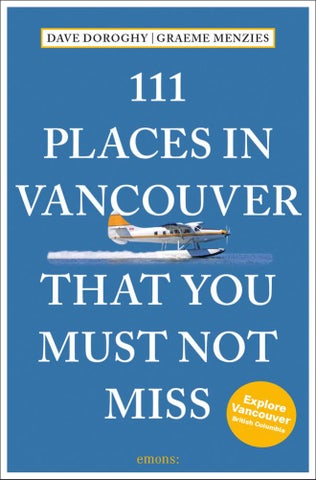
Foreword Our first collaboration was just over a decade ago in the years building up to Vancouver’s hosting the 2010 Winter Olympic Games. Although we had different roles, we were both on the same team and shared many challenges, laughs, and deadlines leading up to this worldwide event. The same can be said for this project – a team effort all the way! But even among teammates there is always some friendly competition. In this case, the creative challenge was for one of us to find some way to surprise or amuse the other when reviewing a story. There was no greater compliment than to hear the other say, “I did not know that!” Or to make each other laugh out loud. So we encouraged and brought out the best in each other, as every good team should. As a lifelong resident of the city, Dave was able to use his personal experiences and many local friendships to highlight the things only a long-time resident would know – like when CFUN operated out of what is now a thrift shop, how to find the mysterious stone carvings along the Stanley Park Seawall, why the Toys “R” Us sign is weird, or whether there was any truth to the rumour that one of America’s biggest Country stars got her big break in Vancouver. A keen history buff and curious researcher, Graeme enjoyed many hours discovering local places connected to the likes of Harry Houdini, the botanist from Captain Vancouver’s ship, royalty from Hollywood’s Golden Era, rock stars, hippies, and tycoons. Working sessions, split between Dave’s houseboat and Graeme’s condo, were complemented by several ‘photo safaris’ – driving around the city in Dave’s classic Morgan or his Westfalia, depending on the weather – and provided enjoyable opportunities to compete together for the best angles on a story or a photograph. The result, we hope, is a collection of 111 Places that will amuse and entertain you, either by tickling your funny bone or by revealing something new about Vancouver that you may not have known before. – DD and GM
111 Places 1_ 1700 Block of Dunbar
Turn-of-the-century time capsule homes | 10
2_ 55 Dunlevy Avenue
From metal foundry to foodie fantasy | 12
3_ A Baker’s Dozen Antiques
Unusual antiquities through the ages | 14
4_ Alibi Room
From fur traders to movie stars | 16
5_ Archibald Menzies’ Bust
The bronzed botanist beckons | 18
6_ Artillery Search Lights
Hidden relics of World War II | 20
7_ Baden-Powell Trail
Hikers’ haven, hiding in plain sight | 22
8_ Beaucoup Bakery
Food that inspires | 24
9_ Big Yellow Sulphur Pile
What on earth is that stuff ? | 26
10_ The Billy
Badges, beers, and bombers | 28
11_ Blue Whale Skeleton
The biggest one in Canada is at the Beaty Museum | 30
12_ The BowMac Sign
Large Signs “R” Us | 32
13_ Brassneck Brewery
A witty West Coast whistle whetter | 34
14_ Cartems on Main
Where history and donuts collide | 36
15_ Catfe
The cat’s meow | 38
16_ Centennial Rocket Ship Time passages | 40
17_ CFUN Building
From stacks of wax to stacks of slacks | 42
18_ City Farmer
Composting, cultivating, and computing | 44
3__ A Baker’s Dozen Antiques Unusual antiquities through the ages
After forty-five years under the same owner, A Baker’s Dozen Antiques surely holds a lot of passion and expertise behind the front door. Owner Heather Baker has created a store so chock-full of wonders that it is an experience all its own. When you walk through the front door, you’ll need to take a moment to catch your breath as your senses decipher the cornucopia of attractions competing for your attention. What to look at first? The human skeleton? The wooden prosthesis from the 19th century? Is that a snuff box? Perhaps you’d like to take a look at the antique toys or the hand-carved coconut shells, or accessorise your wardrobe with a fancy antique walking stick? Wouldn’t that phrenology model look cool in your office? Heather’s motivation originates from her earliest memories of going to the local dump and poking around for treasure with her grandfather. The walls of her childhood home were filled with found objects, art, and curiosities. Today, she is one of Canada’s top antique toy dealers, an expert on The Antiques Roadshow TV series, and the go-to person for just about anything you can imagine but can’t find. If you are looking for that special and unusual item to decorate your home, cottage, man cave, she shed, or office, this is the place. You might even pick up a famous movie prop or two – sometimes production teams will come here to rent objects for a scene. The taxidermy items are such popular movie rentals that Heather never sells them (look for cameos of Otto the Otter and Rocky the Raccoon in numerous productions, including Netflix’s The Chilling Adventures of Sabrina). Sometimes even the actors come by to scour the hallways for curiosities. Jackie Chan, Arnold Schwarzenegger, and Bryan Adams have dropped in. A Baker’s Dozen is a time machine, carnival ride, and imaginarium all rolled up in one irresistible shop. 14
Address 3520 Main Street, Vancouver, BC V5V 3N3, +1 (604)879-3348 | Getting there By car, metered parking is available on Main Street | Hours Mon – Sat 11am – 5:30pm, Sun noon – 5pm | Tip Almost just across the street enjoy breakfast or lunch at a funky little local eatery called Slickity Jim’s Chat ‘N’ Chew (3475 Main Street, Vancouver, BC V5V 3M9, www.skinnyfatjack.com).
6__ Artillery Search Lights Hidden relics of World War II
Sometimes mistaken for gun placements or bunkers, these two concrete structures were originally designed to help illuminate the approaches to the Port of Vancouver along the Strait of Georgia in the event of enemy attack by naval vessels or submarines during World War II. The two towers are located close to the shore, below what used to be the series of three gun placements of Point Grey Battery (now the Museum of Anthropology). Those guns had a range of just under 13 kilometres – enough power to hit Bowen Island – and could fire at a rate of six shells per minute. In 1939, the Point Grey Battery was the most heavily armed of the five coast artillery forts built to defend Vancouver. The searchlights were controlled remotely from an observation post and boasted a brightness of some 800 million candle power, which, if you are not all that familiar with candles, is enough to illuminate a target about three kilometres away. The only time a ship was hit by the Point Grey Battery guns was in 1942, when a shell fired over the bow of a delinquent fishing boat ricocheted on the water and hit a freighter. Oops! The Royal Canadian Artillery used the lights and guns until 1948, at which point the guns were removed. They began to transfer use of the buildings to the University of British Columbia, which converted them into student residences. Today, the search lights are functional only as a canvass for graffiti artists. The towers are out of the way but actually not all that hard to find, and getting to them makes for a pleasant hike. The simplest way to get there is to follow Trail 4 to Tower Beach, located just to the west of the Museum of Anthropology. At the bottom of the 70-metre descent down a well-maintained path, turn right and walk along the rocky beach (wear sensible shoes). Be forewarned: the beach access is ‘clothing optional’. 20
Address Tower Beach, Vancouver, BC V6T 1X8 | Getting there By car, park at the Museum of Anthropology or the UBC Rose Garden Parkade | Hours Unrestricted from the outside only | Tip Once an exclusive dining lair for nearby UBC faculty, the Sage Bistro (6331 Crescent Road, Vancouver, BC V6T 1Z2, www.sage.ubc.ca) offers terrific views of the ocean, modern West Coast cuisine, and brilliantly preserved 1960s’ architecture.
7__ Baden-Powell Trail Hikers’ haven, hiding in plain sight
Vancouverites have never had to worry too much about finding ways to get back in touch with nature, and hiking around the mountains on the North Shore has been a favourite pastime for generations. Some trails existed before written history, some were initially created for commercial reasons, and some by design. The Baden-Powell Trail falls among the latter category, having been established in 1971 at the initiative of the Boy Scouts and Girl Guides of British Columbia. The trail’s name and the date of its creation are both significant: the trail is named after Lord Baden-Powell, who was responsible for creating the worldwide Scouting movement, and the date marked the 100th anniversary of British Columbia joining Canada. The trail runs an impressive 42 kilometres across the south-facing slopes of the North Shore Mountains from Horseshoe Bay on Howe Sound to Deep Cove on Indian Arm. Along the way, it crosses many interesting features and sights, including the Cleveland Dam at the south end of Capilano Lake (seen in Dawn of the Planet of the Apes and the Smallville TV series), and the historic Lynn Valley Suspension Bridge. From one end to the other, the Baden-Powell Trail covers a total of 1200 metres in elevation, the highest point being Black Mountain and the lowest being at sea level. Most people enjoy the trail the way one might enjoy a fine wine – a bit at a time, and not all at one go. But for those who enjoy a punishing challenge, there is the annual Knee Knackering North Shore Trail Run, which covers 30 kilometres of the trail in a single day. The fastest time to date is 4:32:03. A favourite short hike, for those wanting something less extreme, is the 3.8-kilometre hike up to quarry rock near Deep Cove at the eastern end of the trail. The exposed rock face rewards visitors with a panoramic view over Indian Arm, a 20-kilometre-long glacial fjord left over from the last ice age. 22
Address Accessible at many different places across the North Shore, www.trailsbc.ca/ loop/lower-mainland/hike-baden-powell-trail-42-km | Getting there Access the trail from Deep Cove. Park at Panorama Park. | Hours Unrestricted | Tip Donut aficionados should not miss the opportunity to check out the hearty creations offered by Honey Doughnuts & Goodies. You earned a dozen after hiking the trail (4373 Gallant Drive, North Vancouver, BC V7G 1L1, www.honeydoughnuts.com).
12__ The BowMac Sign Large Signs “R” Us
In 1958, North America’s largest freestanding sign towered above the sidewalk at 1154 West Broadway proudly advertising the BowMac car dealership below. The colossal 80-foot structure could be seen from 18 miles away and was one of the largest illuminated structures in the city. Today, one might think that its 1,200 incandescent light bulbs and extensive colourful neon tubing would have seemed more at home on the Las Vegas Strip than in sleepy little Vancouver. But during the late 1950s, Vancouver was considered the neon capital of North America, with dozens of smaller artistic signs scattered throughout its early commercial urban landscape. In the 1980s and 1990s, signage bylaws became stricter in Vancouver, and the outdated beacon began to stick out like a sore thumb. Some local residents considered it an earthquake hazard, others complained that it was noisy and contributed to unnecessary light pollution. Many local residents considered it nothing more than an old eyesore. Controversy ensued, and the red, blue, and white sign almost ended up being demolished in 1997. That’s when the City of Vancouver, under a Heritage Revitalization Agreement, stepped in and gave the giant toy store chain, Toys “R” Us, zoning approval to drape their logo over it. The BowMac sign was granted official protected status, so it is not going anywhere any time soon. BowMac was short for Bowel-McDonald and later BowellMcLean, and they sold Cadillacs, Pontiacs, and Buicks. Toys “R” Us is short for Toys Are Us, and they sell Barbie dolls, Lego, and video games in the shadow of the old giant sign. As traditional bricks-andmortar retail gets replaced with more luxury condos in Vancouver, the long-term future of the sign is anyone’s guess. It’s best to go see the sign in the light of day though. Although all the components are still intact, the sign has not been lit for years. 32
Address 1154 West Broadway Street, Vancouver, BC V6H 1G5 | Getting there By car, street parking available | Hours Unrestricted | Tip One of Vancouver’s most iconic neon signs advertised the 1930s’ Aristocratic Restaurant. A working copy of the sign, complete with the restaurant’s cartoon mascot Ritsy, and their slogan ‘Courteous Service, Quality Food, All Over Town’, can be seen at its original location today. The corner however is now occupied by Chapters Indigo Books, which prominently displays the artefact in their front window (2505 Granville Street, Vancouver, BC V6H 3G7, www.facebook.com/ indigogranville).
15__ Catfe
The cat’s meow
Are you looking for that ‘purr-fect’ cup of coffee? Or maybe you just need a relaxing break from your hectic day, and nothing short of a full-on, fluffy, feline-friendly encounter will do. Cats just seem to bring out the best in us, but in today’s busy world, having a cat of your own can be expensive and a bit of a hassle – after all, they need to be fed every day. The Catfe on the border of Chinatown and Gastown in Vancouver has the solution. It’s a hip coffee shop where you can sit among 8 to 12 laid back cats and enjoy some quality kitty time in a clean, odour-free lounge. Imagine the solace and comfort you’ll achieve while you stir your coffee with one hand and gently pet a cat on the floor with your other hand, or sit with one on your lap as you sip a latte, or just observe them as they do what cats do, which is often nothing. Speaking of which, it’s a good idea to go online and make a reservation, because sometimes the place shuts down for an hour to let the residents take a ‘cat nap’ to ensure they are fresh for the onslaught of adulation. Keep in mind that cats are more active in the morning, and it’s not unusual to find them all snoozing in the afternoon sunlight. While you’re online, you can also see who’s who in the cat house, complete with each cat’s name and a cute picture. You can’t make this stuff up. If you are not used to being around cats, don’t worry. The friendly staff at the Catfe can instruct you on some subtleties to make them like you. First of all, you are not supposed to pick them up. That’s right – you have to wait for them to jump onto your lap or somehow make the first move. And don’t worry – there is even a handy brochure with tips on where they like to be touched. All of the cats are from the BC SPCA and available to be adopted. If you just want a souvenir though, there is a gift shop with a small selection of ‘meowchandise’. 38
Address International Village Mall, 88 West Pender Street, Unit 2305, Vancouver, BC V6B 6N9, +1 (604)379-0060, www.catfe.ca, info@caffe.ca | Getting there SkyTrain to Stadium-Chinatown (Expo Line); by car, metered parking is available nearby | Hours Check website and book ahead | Tip Big cats – stone lions, in fact – guard the entrance to historic Chinatown, just a couple minutes’ walk away (West Pender Street and Taylor Street, Vancouver, BC V6B 2T2). The female lion has her paw on a cub, and the male lion has a paw on a ball. Legend has it they both used to have polished granite balls in their mouths, but no one knows what happened to them.
19__ Commodore Lanes Canada’s oldest bowling alley
Its glory days are mostly long gone. But if you haven’t been to the Commodore, you’re not only missing out on a really fun way to experience Vancouver’s past, you’re also missing out on some unusual sports history. The Commodore has many claims to fame: the oldest bowling alley in Canada; the first to rent bowling shoes; and the first to field a women’s bowling league. The billiard parlour claims to be the last original pool hall of its kind in the city. If Jeff Bridges’ character, The Dude, were from Vancouver, you know he’d abide in this place. In fact, many celebrities and movie stars have abided in the Commodore since it opened its subterranean doors below the Commodore Ballroom in 1930. Legend has it that Hollywood cowboy Roy Rogers rode over on horseback from the Pantages Theatre for a few games in 1932. Some reports say he parked his horse Trigger outside. Some say he rode the horse down the stairs. In any case, he made a big entrance. Clark Gable (Rhett Butler in Gone With The Wind), Jack Benny (The Jack Benny Show), Buster Crabbe (Flash Gordon) are also known to have dropped by. The place remains popular today, and their old slogan still promises customers ‘a place where pleasant days may be spent’. Another quirky feature of this place is the fact that there is no modern ten-pin bowling; instead, patrons use the uniquely Canadian five-pin bowling style. Sports folklore credits Torontonian Thomas F. Ryan for inventing the five-pin game in 1909 after some of his customers complained that the ten-pin bowling balls were too heavy. So if big balls have always discouraged you from bowling, this might be the place for you. And, if you would like to play with more small balls, the Commodore also has many billiard tables, foosball tables, and pinball machines. The Commodore is licensed, so you can drink a White Russian while you channel your inner Dude. 46
Address 838 Granville Street, Vancouver, BC V6Z 1K3, +1 (604)681-153, www.commodorelanes.com, commodorelanes@yahoo.com | Getting there SkyTrain to Vancouver City Centre (Canada Line); by car, Pacific Centre Parking at 818 Howe Street | Hours Sun – Thu 11am – 11:30pm, Fri 10 – 12:30am, Sat 11 – 12:30am | Tip Bowl in vintage apparel from the eclectic collections at F as in Frank (2425 Main Street, Vancouver, BC V5T 3E1, www.fasinfrankvintage.com), or Mintage (1714 Commercial Drive, Vancouver, BC V5N 4A3, www.mintagevintage.com).
23__ Deadman’s Island
The most haunted island in North America?
You can’t really visit Deadman’s Island. The best you can do is walk up to the front gates and look past the searching eyes of the sentry guarding the entrance to the Navy base that has occupied the land since 1943. But just because you can’t walk the land doesn’t mean you shouldn’t know what you’re missing. And when you do know what you’re missing, maybe you’d rather not walk the land after all … because Deadman’s Island is reputed to be one of the most haunted islands in North America. Though it looks peaceful and serene today, this place was once the sight of a major bloodbath. Sometime in the 1700s – the exact date is unknown – some 200 Coast Salish warriors were massacred on the island following a raid by one of their local rivals. In subsequent years, it served as a burial site for the Coast Salish peoples. Except the deceased weren’t buried – they were placed in cedar boxes resting on platforms in the trees. European settlers discovered the boxes, and by 1870 they had all been removed and buried in Stanley Park. Ever the traditionalists, the new settlers of the 20th century retained the island as a cemetery for the city of Vancouver. British merchant sailors, Canadian Pacific Railway workers, victims of the fire of 1886 and the smallpox plague a decade later all rest on the island. Burials there stopped during World War II after the federal government gave the land to the Canadian Navy. The Navy Reserve base is called HMCS Discovery, after the name of George Vancouver’s ship, which laid anchor near this site on June 13, 1792. Close your eyes and try to imagine what that would have looked like, and listen for a ghostly whisper from the past. While nearly impenetrable to the general public, Arnold Schwarzenegger was able to film bits of The 6th Day here, and a few episodes of Danger Bay and MacGyver were filmed on the base too. 54
Address 1200 Stanley Park Drive, Vancouver, BC V6G 3E2 | Getting there By car, parking is available 20 metres past the military base, at left. By bicycle, a Mobi Bike station is located at the parking area. | Hours Open for scheduled tours only, reservation required | Tip If naval history rings your bell, plan to visit the Vancouver Naval Museum located within the base (www.sites.google.com/site/vancouvernavalmuseum/welcomeaboard). Access is limited and only by appointment, but it’s worth the effort – and it’s free.
26__ Engine 374
Once derailed, now delightful
She looks great today, but there was a time when this Canadian Pacific Rail (CPR) beauty was a neglected wreck. It began with her construction in Montreal in 1886. The brand new steam engine, fuelled by wood and with capacity to hold 2,800 gallons of water, immediately made its way to Port Moody, along the way becoming the first scheduled train to cross Canada. The next year, she became the first transcontinental train into Vancouver. Garnished in laurels, festooned in all manner of celebratory materials, proudly sporting a portrait of Queen Victoria on her smokestack, and the words ‘Ocean to Ocean’ painted on her boiler, her arrival was a seminal moment in the city, for the country, and for the British Empire. She was greeted with cheers from citizens, with music from bands, and with whistles from ships in the harbour. But after that, it was all downhill. She laboured away, hauling passengers hither and yon for the next 30 years, until she was almost scrapped in 1915. Luckily, she was selected for a complete rebuild instead and managed to get another 30 years’ service on the rails. But by 1945 she was exhausted, and the CPR decided to put her out to pasture. Feeling nostalgic, they retrofit her to resemble her original old self and donated her to the City of Vancouver. But the City, perhaps not knowing what else to do with her, hauled her out to Kitsilano Beach and left her exposed to the elements for 40 years. Salvation came from local railway history enthusiasts, who seized upon the fact that Vancouver was hosting the 1986 World Exposition on Transportation and Communication. The result is what you see before you today – a beautiful engine, restored by the passion and determination of citizens and housed in the stately comfort of the historic Roundhouse building, and a piece of Canadian railroad history saved from ruin. 60
Address 181 Roundhouse Mews, Vancouver, BC V6Z 2W3, +1 (604)713-1800, www.roundhouse.ca, info@roundhouse.ca | Getting there By car, metered parking is available on Pacific Boulevard and Davie Street; ferry to Yaletown Ferry Dock | Hours Daily summer 10am – 4pm, winter 11am – 3pm | Tip A number of businesses took root near the Roundhouse, and just a short walk away you’ll find the Gray Block (1202 Homer Street, Vancouver, BC V6B 2Y5), a well-preserved 1912 commercial warehouse that was once used as a starting off point for ‘exporting’ booze into the US during the Prohibition era.
29__ First Canadian McDonald’s
McHistory is made outside the USA
Ray Kroc, the American founder of McDonald’s, loved to use the expression, “When you’re green, you’re growing.” And never did the burger chain experience more growth than in the halcyon days of the mid-1960s. That was when McDonald’s had over 700 restaurants in the United States and was expanding at a rapid pace. As a first step toward global fast-food domination, Kroc decided to plant the first pair of Golden Arches in a foreign country. He chose Canada, and more specifically the city of Richmond, BC. Richmond was a new suburb of Vancouver to where McDonald’s target market of young, busy families was moving in droves. Kroc also chose Richmond for the town’s proximity to the airport. On June 1, 1967, McHistory was made when McDonald’s expanded into Canada. Back then, Number 3 Road in Richmond, where their first Canadian restaurant still stands today, was a thoroughfare sparsely populated by a Simpsons Sears department store and the occasional commercial store. A plaque by the front door commemorates the opening of the restaurant and the important role it played in the chain’s amazing growth. Inside, a large video screen plays a looped film on the chain’s history. Today, there are 1,486 McDonald’s restaurants across Canada. Much of McDonald’s success in Richmond and around the world has been built on the youthful enthusiasm of its employees. Inside the Richmond McDonald’s hangs another historic plaque that frames a chronological display of 12 McDonald’s business cards. They all belong to the current restaurant owner and franchisee, Joe Guzzo, who began working for McDonald’s as a crew kid in 1975 at the age of 15. As you read the title under each card, you can see a young man’s ambition as he progresses up the corporate ladder. Today, Joe owns 12 McDonald’s. 66
Address 7120 Number 3 Road, Richmond, BC V6Y 2C6, +1 (604)718-1045 | Getting there By car, closest paid parking is the Impark lot at 8120 Cook Road | Hours Open 24 hours | Tip Right around the corner is the modern Richmond City Hall. A noteworthy feature is a 12-foot, silver metal sculpture of a Fraser River sturgeon fish under a waterfall. You won’t find one of these protected species in your Filet-O-Fish sandwich (6911 Number 3 Road, Richmond, BC V6Y 2C1).
103__ Tsawwassen Terminal Fantastic ferry flotilla
North America’s second-biggest island is nestled in the Pacific Ocean less than 50 miles from Vancouver. In 1960, the BC government devised a system to shuttle people, cars, and trucks back and forth between these two points. BC Ferries has grown since then to be the planet’s largest ferry fleet, carrying a staggering 23 million passengers and over 8 million cars per year on 34 different vessels. The one thing the ships have in common is they are almost all painted white. The epicentre of the system is the Tsawwassen Ferry Terminal 40 minutes from Downtown Vancouver. The First Nations’ word tsawwassen means ‘land facing the sea’. At this busy hub, you can purchase what is surely the best transportation value on the Pacific Ocean. For less than $20, you can board one of these massive ships to enjoy an ocean cruise without having to bring a suitcase. The sailing to Victoria boasts some of the most spectacular craggy and rugged coastline scenery in the world. Don’t be surprised if the ferry’s captain announces, “Ladies and Gentlemen, a pod of killer whales can be seen on the ships’ starboard side.” Sightings of whales, eagles, and otters are common. The amazing, supernatural beauty of the windswept inlets and narrow saltwater passages can distract you from the ships’ great inside amenities. Three comfortable passenger decks with massive windows have all the restaurants, coffee, and gift shops offered by luxury cruise lines. But instead of being at sea for 7 days, your cruise is 90 minutes. The terminal is named after the West Coast First Nations’ Tsawwassen Band, which owns the surrounding land. Some of the ferries have graphics and motifs depicting traditional aboriginal art, and others have large colourful sports murals created for the Vancouver 2010 Olympic Winter Games. Venture out to the Tsawwassen Ferry Terminal simply to watch the ferries come and go. 214
Address 1 Ferry Causeway, Tsawwassen Ferry Terminal Delta, Vancouver, BC V6C 0B9, +1 (888)223-3779, www.bcferries.com | Getting there By car, parking is available at Impark | Hours Daily 7am – 9pm | Tip The BC Ferries Experience Card offers fare discounts on 15 ferry routes in the system. Available at any ferry ticket booth.
The authors
With pen in hand and camera strapped around his neck Dave Doroghy has visited over 50 different countries. Unlike most of the city’s inhabitants, he was actually born in Vancouver and spent most of his life living and working downtown. His careers have spanned radio broadcasting, advertising and finally 20 years in sports marketing where he was the Vice President of the former NBA Vancouver Grizzlies and more recently the Director of Sponsorship Sales for the Vancouver 2010 Olympic Winter Games. Dave now lives on a floating home just outside of the city where he raises bees.
Graeme Menzies has lived in seven cities across Canada, in the United States, England, and Brazil, but still thinks Vancouver is the prettiest of them all. An international marketing and communications professional with past experience in the arts, public policy, technology, sport, and higher education, Graeme’s curiosity fuels his passion for discovering new places and for shedding new light on old ones.