The Algonquin Lounge
Legendary literary lair
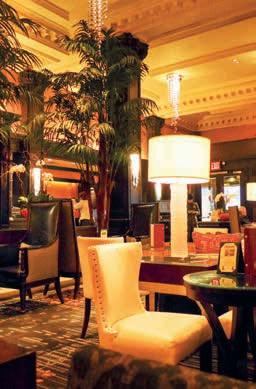
For years the lobby lounge of the Algonquin Hotel has been the quintessential spot for a soigné midtown rendezvous. Whatever the hour, lights are low and it’s cocktail time. Despite its spaciousness, the elegant room’s tasteful placement of upholstered settees, armchairs, and softly shaded lamps encourages comfortable, even intimate, conversation. Beneath potted palms and tall mahogany columns, tuckedaway corners offer privacy for discreet tête-à-têtes.
Conversation is what the Algonquin is most famous for. In the 1920s it’s where that infamous group of about a dozen sharp-tongued, witty writers and theater people met for lunch every day for nearly a decade to trade ideas, banter, gossip, and generally outdo one another’s clever quips. They called themselves the Vicious Circle. But when a Brooklyn Eagle editorial cartoonist caricatured them clad in suits of armor and redubbed them the Round Table, it stuck. This mutual admiration society was the cream of New York’s literati: critics, columnists, playwrights, and authors, whose charter members included Dorothy Parker, Robert Benchley, George S. Kaufman, Alexander Woollcott, and New Yorker magazine founder Harold Ross. A colorful mural in the lobby immortalizes the group, and these celebrated ghosts remain in residence to this day.
Though major renovations and updates have been made by various owners since the hotel opened its doors in 1902, the lounge’s unique character endures. Wifi throughout encourages the bon mots of bloggers and tweeters, today’s online quipsters. The location, steps away from Broadway theaters, is a perfect place to meet a companion before a show or nurse a nightcap after. Immerse yourselves in old-world ambiance and sip the signature Algonquin Cocktail: rye whiskey, dry vermouth, and pineapple juice. Order a Dorothy Parker mini-burger from the bar menu – she surely would have had a good laugh at that.
ADDRESS 59 West 44th Street (between Fifth Avenue and Avenue of the Americas), New York 10036, +1 212.840.6800, www.algonquinhotel.com TIP Nearby, same-day discount theater tickets (up to 50 per cent off) for many shows are available at the Times Square TKTS booth.
Bohemian National Hall
Reality Czech
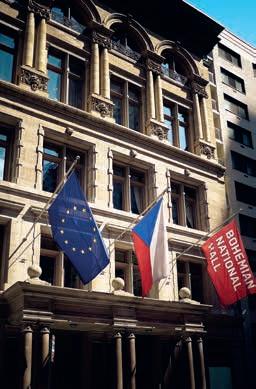
One of the city’s many exciting venues for contemporary art, music, film, and theater is this little-known treasure on a sleepy Upper East Side street. Judging by its exterior, Bohemian National Hall is an elegant neo-Renaissance townhouse. But step inside for a postmodern surprise: a sleek white-on-white lobby emblazoned with catchphrases and quotes, multimedia screen projections, and a glassed-in art gallery. The bright yellow reception desk faces a space-age spiral staircase and state-of-the-art screening room.
Various local and international organizations within Bohemian National Hall are dedicated to promoting and celebrating Czech culture in the United States, encouraging dynamic dialogue between American and Czech communities, and presenting a richly diverse calendar of events. It’s filled with free performances, exhibits, rooftop screenings, lectures, workshops, and galas – all presented (or subtitled) in English. There’s something for everyone, including Bohemian Spirit, a sophisticated gastropub with an inventive menu and pilsner pumped four distinct ways.
Originally built in 1897 by local Czech and Slovak immigrants as a social hall, it was central to community life – with a theater, ballroom, club rooms, gymnasium, bowling alley, even a rifle range. For nearly a century it played an essential role in the neighborhood by providing a place for gatherings, special events, language education, political action, and the exchange of ideas. But as the area’s Czech population dwindled, the building fell into disrepair. In 2001, ownership was transferred to the Czech Republic for one dollar, and renovation began. By 2008 the major overhaul, incorporating restoration with dramatic interior re-design, was complete. The revived Bohemian National Hall – now also home to the Consulate General of the Czech Republic – has become a vibrant cultural venue for new generations of New Yorkers.
ADDRESS 321 East 73rd Street (between First and Second Avenue), New York 10021, +1 646.422.3300, www.bohemiannationalhall.com, www.czechcenter.com TIP View (and bid on) fine art and antiques on exhibit at Sotheby’s, the legendary international auction house, 75th Street & Madison Avenue.
Croquet in the Park
A wicket way to spend the day
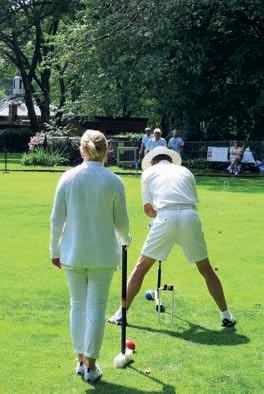
Peek through the fence at a manicured lawn where players dressed in white from head to toe whack colorful balls with wooden sticks. Curious crowds gather to watch, and folks new to the game try to puzzle out its rules. Chatting with players on the sidelines you’ll get to know croquet, a sociable pastime – and often seriously competitive sport – that’s been played on these courts since 1972.
The sticks are called mallets, hoops on the ground are wickets, and the idea is to knock the balls through the wickets. What looks simple actually requires great skill. In Alice in Wonderland the Queen of Hearts’ mallet was a live flamingo and a hedgehog was the ball. Today’s players are more civilized, their equipment less fantastical, but competition can still be fierce.
The game’s origins date back to eleventh-century France’s jeu de mail, borrowed later by the British, and developed by the Irish into croquet as it’s played today. Modifications made by Scots created the game of golf. King Louis XIV’s displeasure at his inability to play outdoors in winter gave rise to an indoor variation: billiards.
Competitive croquet in the US began with the establishment of the New York Croquet Club in 1967. Its members are men and women of all ages and backgrounds, from stockbrokers to students. It’s one of the few sports in which both sexes play with a similar handicap. Many players on the court are champions who compete in national and international tournaments. Members get a Parks Department permit to play on the court and keys to its front gate and adjacent clubhouse. If you’re interested in learning the game or brushing up on rusty skills, take a free lesson from an expert any fair-weather Monday evening, May through October. White attire isn’t required for a lesson but flat-soled shoes are a must.
Discover croquet’s home in Central Park and have fun swinging a mean mallet.
ADDRESS Enter Central Park at West 69th Street, Central Park West, New York 10023, +1 917.310.8724, www.newyorkcroquetclub.com, nycroquetclub@yahoo.com
TIP Le Pain Quotidien, steps from the croquet court, serves tartines, French pastry, and iced hibiscus tea for your picnic in the Sheep Meadow.
The Drag Show at Lips
Boys will be girls
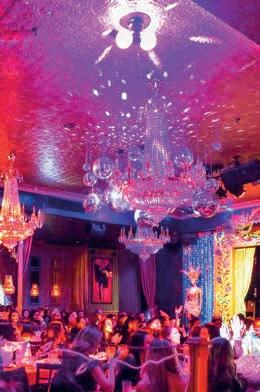
Judging by its chic exterior masquerading as an exclusive men’s club –black canopy, elegant wood paneling, and beveled-glass doors framed by carriage lanterns – you’d expect Lips to be a sophisticated boîte where upper-crust patrons feast on foie gras and sip fine wine. Ah, but it’s a clever trick. This self-proclaimed “Disneyland of Drag” is really a glitzy palace of glamour and gaiety. Inside its classy entrance, instead of a dining room fit for a king you’ll encounter a raucous Las-Vegasmeets-Barbie-Dream-House full of gorgeous queens!
Curvaceous drag queen divas in extravagant, over-the-top, sequined and bejeweled costumes, with glam-fabulous makeup and spectacular coiffures impersonate legendary musical and theatrical icons, performing comedy, songs, and dance routines live on stage. They serve you food and drink (‘The more you drink, the better we look!’), engage in saucy banter, sit on your lap, and do their bosomy best to tickle your … um, fancy.
It’s always hilarious fun. Nightly shows like Drag Karaoke, Bitchy Bingo, Queens of Drag, Dinner with the Divas, and Superstar Sundays are crowd-pleasers, delighting a widely diverse audience of men and women – native New Yorkers, commuters from the boroughs and surrounding suburbs, and fun-loving tourists. Sunday’s showstopping Broadway Brunch, hosted by the fab-dazzling Ginger Snapt, is so popular it’s a good idea to book your table two weeks in advance! Come with a sweetheart, friends, or adventurous co-workers. Large groups are welcome, just call ahead to reserve. Lips is a sensational place for birthdays, bachelorette parties, or anything worthy of a memorable celebration.
Named-for-divas cocktails are featured on the drinks menu –like brain-freezing Yvonne Lamé Frozen Cosmo. The food is tasty, served in super-sized dinner and brunch portions. And while dinner’s delightful, the divas are even more delicious. Oh boy!
ADDRESS 227 East 56th Street (between Second and Third Avenue), New York 10022, +1 212.675.7710, www.lipsnyc.com TIP A world of glitter and glamour is at Tiffany’s Fifth Avenue flagship store (at 57th Street), but they don’t serve breakfast.
Grate Sound
Times Square humdinger
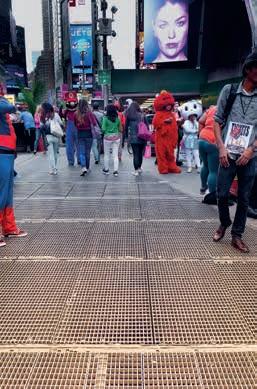
A peculiar sound floats up through a metal grate in the sidewalk of one of Times Square’s busiest intersections. Garish neon lights pulse and flash, enormous billboards compete for attention, and wildly animated colorful images crawl over every surface. Here, amid the cacophony of blaring traffic, rushing crowds, beeping horns, and shouting vendors – a high-decibel area if there ever was one – the bizarre sound that rises through this iron grid is clear and distinct. Some call it a persistent hum, others compare it with a faraway reverberating gong. More musical than a vibration, mellower than a buzz, its sustained single note almost sounds like the sacred chanted syllable, Om.
Head over to the 46th Street end of the triangular pedestrian island between Broadway and Seventh Avenue, where costumed characters like Elmo and Statue-of-Liberty Man like to hang out. If you stand near the grate you won’t need to lean down or strain your ears. Just listen – it’s unmistakable. Omm, humm … While hordes of people tread across this same spot day and night, almost no one appears to notice it. If they detect it at all, they may assume it’s nearby construction in a subway tunnel.
But, in fact, it’s a very deliberate installation of auditory art created in 1977 by the late artist-in-sound Max Neuhaus, who expected that most people would walk by without paying any attention to it. He hoped certain others would encounter it, stop for a moment to experience its indescribable mechanical drone, and be surprised by the revelation. And because Neuhaus specified that no sign be posted to identify or explain its existence, you have no way to know it’s there at all! For a decade, 1992-2002, it was removed by the artist, but later reinstalled by the Dia Art Foundation. Today, this strangely haunting hum continues to escape from the belly of the beast that is Times Square – day after day, year after year.
ADDRESS North side of triangular pedestrian island between West 45th and 46th Street and between Broadway and Seventh Avenue TIP Hear more great sounds of Broadway show tunes sung by aspiring musical stars as they wait tables at Ellen’s Stardust Diner (1650 Broadway).
Jane’s Carousel
A real survivor
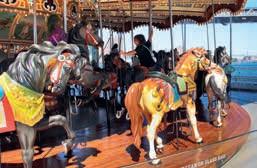
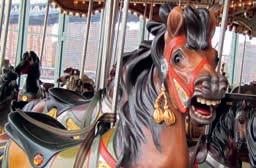
In a classic rags-to-riches tale, what was once a Midwestern carnival ride is now an urban treasure on the Brooklyn waterfront, housed in a transparent jewel-box pavilion designed by noted French architect Jean Nouvel. Art and magic combine when you ride one of the 48 painted ponies alongside a posse of giddy-up kids and handholding couples. Like many New Yorkers, Jane’s Carousel was born someplace else, moved here, and after a time found its heart and home in this city. Like other New York transplants, it arrived with a fascinating history, distinctive character, and that special something that tests the mettle of newcomers.
This story begins in 1922 when the carousel was built for an amusement park in Youngstown, Ohio. Loved by generations of Ohioans, it was the first carousel added to the National Register of Historic Places. When fire destroyed the park in 1984, the damaged ride was put up at auction. Once-magnificent horses and chariots, scorched and in sad shape, were nearly sold off one-by-one when artist Jane Walentas and husband David – a developer of Dumbo and Brooklyn Bridge Park – came to its rescue, bought the entire merry-go-round, and had it shipped to Brooklyn.
For more than two decades Jane restored every part to recapture its original splendor. In 2006, it was reassembled for the first time since leaving Ohio. For four more years, until completion of its outdoor site, the carousel sat idle in the window of a local warehouse, giving passers-by a preview of the park’s coming attraction. In 2011, Jane’s labor of love was moved to its present location and opened to the public. In 2012 it survived yet another disaster, Hurricane Sandy, damaging – fortunately – only its electronics. Seeming to float on the river with panoramic views of the Brooklyn Bridge and Manhattan’s skyline, this magical musical ride is, at heart, a tried-and-true transplanted New Yorker.
ADDRESS Brooklyn Bridge Park (at Dock Street), Brooklyn, New York 11201, +1 718.222.2502, www.janescarousel.com TIP Treat yourself to a luscious waffle cone or dreamy sundae – all natural and homemade – at famous Brooklyn Ice Cream Factory (14 Old Fulton Street). The restaurant & bar serves live jazz on Friday nights. Walk it off with a 1.1-mile hike back to Manhattan on the scenic Brooklyn Bridge pedestrian walkway.
Keith Haring Mural
Whimsical swims
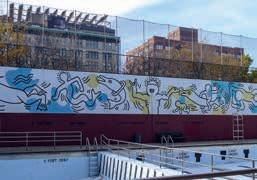
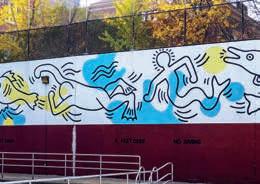
Dolphins fly through hoops as mermen, kids, and fantasy fish dive and romp across an 18-foot-high, 170-foot-wide concrete wall at the Carmine Street free outdoor public swimming pool. An exuberant celebration of aquatic fun rendered in bright blue, yellow, white, and black, this joyous giant mural is unmistakably the work of internationally acclaimed NY artist and social activist Keith Haring. He painted it in 1987 without a preliminary sketch, letting the inspiration of the moment and his love for city kids guide his hand. Tucked between tree-lined West Village streets, it brings smiles to local children spending sweet summer hours at the pool and dazzles anyone passing by.
Born in 1958 in Pennsylvania, Haring studied art and admired cartoonists like Walt Disney. He moved to NYC in the early eighties to continue his art education, then joined a downtown scene of young graffiti artists and punk, hip hop, and dance musicians shaking up the established art world. City dwellers first spotted his distinctive outline figures drawn on blank ad spaces in the subways. Gallery shows and public works attracted a far wider audience to his bold-lined renditions of birth, life, love, death, sex, and war. Openly gay, unafraid to portray erotic imagery, and intent on raising public consciousness, his art often espoused a social message. In 1986, he founded Pop Shop – a store based on the esthetic that art is for everybody – selling inexpensive objects (key chains, pins, tee shirts) featuring his images, with all shop proceeds donated to programs that support art in city schools, oppose apartheid, and fund research to conquer AIDS.
Tragically, Keith Haring was only thirty-one when he succumbed to AIDS in 1990. His art lives on in exhibitions and museum collections, enjoyed every day by ordinary folks around the world in hospitals, day care centers, playgrounds. And at this cool summertime pool.
ADDRESS 1 Clarkson Street (near Seventh Avenue), New York 10014, +1 212.242.5228 TIP Brazilian street muralist Eduardo Kobra’s stunning Ellis Island celebrates generations of immigrants. It’s just a few steps away at 16 Clarkson Street.
National Museum of Mathematics
Discovery is way cool!
Way more fun than you or your kids might ever imagine, MoMath, as it’s popularly known, shines a dazzling spotlight on the creative, exploratory, and engaging aspects of mathematics. The only mathematics museum in North America, it’s dedicated to invigorating math’s dull-as-a-doorknob reputation. It’s a math playground!
A recent move to a space twice the size of its previous location –44,000 square feet on two floors separated by a show-stopping spiral staircase – was cleverly reimagined, expanding from 40 exhibits to over 70! From π-shaped front-door handles to an ingenious assortment of interactive ‘stations’ – hands-on constructions, projections, work tables, floor puzzles, arcade and video games, devices and exhibits. Every area is designed to spark curiosity and engagement. The senses delight to bright colors and sounds reverberating everywhere. While many stations are geared to kids aged seven to twelve, there are loads of eyeswide, thrill-inducing activities for tots, teens and adults to enjoy.
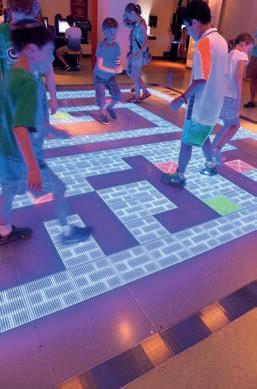
Touch-screens self-instruct and a squad of friendly guides (all math majors!) are eager to explain the workings and lessons of the displays and chat about math and the museum. Kids (and grownups!) can pedal square-wheeled tricycles over a bumpy circular track. Agile feet navigate the Math Square, a neon-lit, pattern-changing floor game. Exhibit names are intriguing, like Twisted Thruway, Formula Morph, Symmetry Selfie, Light Grooves, Structure Studio, Human Tree, and Shapes of Space.
For keepsakes, the in-house gift shop offers a well-curated assortment of challenging games, puzzles, posters, books, and MoMath souvenirs. For ecology-minded reasons, brochures are digital only, and found on MoMath’s website.
Executive Director / CEO Cindy Lawrence says the museum’s guiding principle is: “Math IS cool and we’ll show you how super cool it is!”
ADDRESS The Museum of Mathematics (MoMath), 635 Sixth Avenue (corner of West 19th Street), New York 10011, +1 212.542.0566, www.momath.org, info@momath.org TIP Madison Square Park, a short stroll away, hosts seasonal sculpture installations. Count how many people stand in line for great burgers, fries, and shakes at the city’s original Shake Shack location, inside the park, near Madison Avenue & 23rd Street.
Small Dog Run
Go to the dogs in Carl Schurz Park!
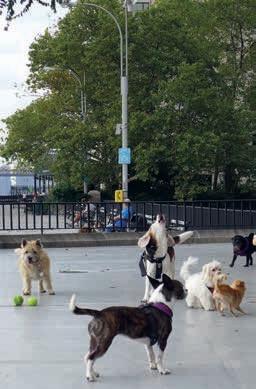
A promenade along the East River adjacent to verdant 15-acre Carl Schurz Park is home to a beloved oasis where Upper East Side residents and their furry companions mingle and play. Here, wellbehaved little purebred pups are set free from the confines of city apartment life. Off-leash and exuberant, with tails wildly wagging, little pooches run circles around each other, race after tennis balls, leap, crouch, and pounce to the delight of their owners, and captivate anyone and everyone who strolls by.
Enter the riverfront promenade by walking east as far as you can on East 84th Street, past East End Avenue. Directly ahead is a breathtaking river view and a few steps away on the left is the small dog run: an immaculate and smooth-paved surface that’s equipped with running water and drainage, doggie water bowls, pooper scoopers, poop disposal bags, and an occasional left-behind rubber squeak toy. A low fence with a secure gate encloses the modest-sized oval expanse. Wooden benches line the inside of the fence where dog owners of all ages and descriptions mingle, while exchanging stories about Wookie’s new groomer and neighborhood gossip. Benches on the promenade just outside of the fence provide convenient viewing stands for clusters of excited children who gather wide-eyed to observe the hilarious hijinks of chihuahuas, pomeranians, shih tzus, poodles, lhasa apsos, and assorted other miniatures.
Even though there’s a lovely playground and lush, green, hilly Carl Schurz Park only steps away, you’ll find it’s a challenge to tear yourself away from the small dog run. Some locals insist it’s better than the zoo. Take a small child or that book you’ve been meaning to read. You’re likely to remain for quite a while. On the other hand, wise neighborhood insiders suggest you come alone, lose the book and socialize. Go to the dogs – it could be the beginning of a beautiful friendship.
ADDRESS East River Promenade (at East 84th Street between East End Avenue and East River), New York 10028, www.carlschurzparknyc.org TIP Meet, fall in love with, and take home your very own furry four-legged friend at the NYC ASPCA Pet Adoption Center (424 East 92nd Street).
Winnie-the-Pooh
Friends forever – even longer
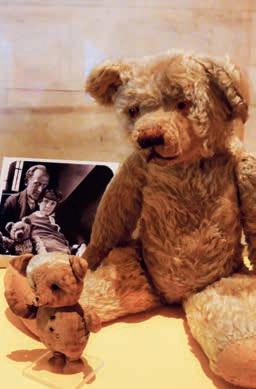
You may think he lives in The Hundred Acre Wood, but the real Winnie-the-Pooh is happily at home – with Kanga, Piglet, Eeyore, and Tigger – in the Children’s Center at the main branch of the New York Public Library.
Years before his reinvention by the Disney animation studios, this chubby stuffed teddy bear belonged to a real British boy named Christopher Robin Milne. His father bought the bear at Harrod’s of London in 1921 and gave it to him for his first birthday. Christopher called him Edward (the proper form of Teddy), but later changed that to Winnie, the name of a black bear at the London Zoo who was named after the city of Winnipeg, Canada. Christopher’s dad, playwright A. A. Milne, so enjoyed watching his son play with Winnie and his stuffed animal pals that he made up stories about them to tell the boy at bedtime. In these tales, a young lad named Christopher Robin had adventures with Winnie-the-Pooh and his friends in a forest that resembled the woods near the Milne’s country house. As the stories grew longer, poems were added, and illustrator E.H. Shepard made drawings for what became four beloved books: When We Were Very Young (1924), Winnie the Pooh (1926), Now We Are Six (1927), and The House at Pooh Corner (1928). They were an instant sensation.
Beginning in 1947, when his stories reached the United States, the real Winnie toured throughout the country, frequently returning to England. In 1987, to the enormous delight of Americans and the outrage of many British, American publisher E. P. Dutton donated him to the New York Public Library. Pooh’s adventures are translated into many languages and the endearing character has captured the hearts of children of all ages around the world. In 2026, at the first British royal visit to the Library, Queen Camilla gifted the exhibit with a new companion for Pooh – a bespoke replica of Kanga’s baby Roo, created by Britain’s oldest stuffed toy maker.
ADDRESS Children’s Center at NY Public Library, Fifth Avenue at 42nd Street, New York 10018, +1 917.275.6975, www.nypl.org TIP Over 15 million items reside in the NYPL main branch. All exhibits are free and as impressive as many in the museums. Visit the Map Room, Menu Collection, and a genuine Gutenberg Bible.
THE AUTHORS

Jo-Anne Elikann was born in Brooklyn, grew up in Queens, and lives in Manhattan. The day her parents let her ride the subway she fell hopelessly in love with the city, and has feasted on its smorgasbord of extraordinary experiences ever since. A freelance writer, artist, and photographer whose proudest achievement has been raising six kids in a NYC apartment, her career includes stints as an art /antiques cataloguer, director of a children’s art center, partner in a graphics firm, and healthcare administrator. She’s a die-hard New Yorker and lifelong explorer of its nooks, crannies, and endless power to amaze.

Susan Lusk has had a long career in publishing as an art director, magazine designer, book editor, author, photographer, and indie publisher. She co-authored 111 Shops in New York You Must Not Miss with her partner Mark Gabor. Born and bred in New York City, she never tires of exploring it to unearth new little gems hiding in plain sight.
PHOTO CREDITS
Photos by © Jo-Anne Elikann except: © Susan Lusk ch. 4, 8, 11, 13, 18, 38 (top), 47, 50, 55, 57, 59 (top), 66, 99, 105; © Glen diCrocco ch. 35 (top); © Frank Cooper ch. 41; © Yadi Guevara ch. 42; and ch. 104 © Jo-Anne Elikann with permission of The Metropolitan Museum of Art, The Henry R. Luce Center for the Study of American Art, Luce Center Visible Storage, Gallery 774
The information in this book was accurate at the time of publication, but it may change at any time. Please confirm the details for the places you’re planning to visit before you head out on your adventures.