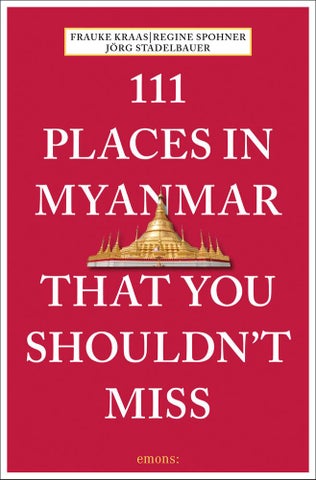
Foreword A garage as a restaurant serving tofu specialities, the golden spire of a pagoda next to skyscrapers, grey herons flying up from a labyrinth of reeds, glittering gemstones in a street market, a strenuous ascent to breathtaking views, roads of every possible grade, from unsurfaced mountain tracks for four-wheel drive to well-developed motorways for cross-country buses between the biggest cities – Myanmar, formerly Burma, is a country of diverse contrasts. Fascinating discoveries await, both in the dense crowds of the mega-city Yangon and in the remoteness of the Chin Hills. Culinary delight is to be found in top restaurants and simple street kitchens, and like the Buddhist sanctuaries, the Christian churches and Hindu temples inspire reflection on cultural diversity. One locomotive acts as a memorial to many years of war, another pulls some similarly old carriages over a rickety-looking bridge at dizzying heights. And everywhere you encounter friendly, open people. A visit becomes a journey back in time: the economy shows extensive irrigated rice production and modern industrial businesses, but also highly specialised micro businesses, working with techniques that are long forgotten or never existed in many other countries in proto-industrial production or in craftwork. Colourful markets as places of pulsating everyday life can be experienced all over the country, while the first shopping malls are being built in the big cities. Myanmar also offers huge diversity in landscape, from tropical rainforests and palm beaches over broad river landscapes and mangrove deltas to barely accessible mountain regions. There is rich potential for tourism, but its development will require mutual acceptance, adaptation and respect.
111 Places 1_ Singu Min Bell | Yangon
The lost sound in Shwedagon Pagoda | 10
2_ Thein Gyi Zay | Yangon
The 100-year-old market hall | 12
3_ Convocation Hall | Yangon Where careers are made | 14
4_ 19th Street | Yangon
Out of old Rangoon | 16
5_ Shri Kali Temple | Yangon
Colourful ornamental figures in the city hubbub | 18
6_ Wardan Jetty | Yangon
Everyday life between water taxis and freighters | 20
7_ National Races Village | Yangon
The multi-ethnic state in an open-air museum | 22
8_ Shin Mway Loon Pagoda | Thanlyin Lonely place of an unhappy love | 24
9_ Old Royal Palace | Bago
Excavating the ghost of a kingdom | 26
10_ Kyaikpun Pagoda | Bago
Four Buddhas with one world view | 28
11_ Moeyin Gyi Wetland | Bago
Bird reserve on the motorway | 30
12_ 115 Miles | Phyu
The country’s meeting place | 32
13_ Hluttaw | Nay Pyi Taw
The heart of the state government | 34
14_ Uppatasanti Pagoda | Nay Pyi Taw Take the path inside | 36
15_ White Elephant | Nay Pyi Taw
Symbol of political legitimation | 38
16_ Gem Museum | Nay Pyi Taw
Bling for endless astonishment | 40
17_ Puppet Theatre | Mandalay The story of creation | 42
18_ Geological Garden | Mandalay
Teaching that’s far from stony broke | 44
19_ Bronze Casters | Mandalay The last of their kind | 46
20_ Oxen Taxis | Mingun
The ruins of giants | 48
21_ Sagaing Hill | Sagaing
Meditative view across the water | 50
22_ Jade Bead Production | Sagaing
Beads from the shaking board | 52
23_ Twin Ywar Lake | Monywa
Local recreation in a crater vent | 54
24_ Myinkaba Lacquer Village | Bagan A whole lotta lacquer | 56
25_ Mine Lake | Mogok
Welcome relic of an unsuccessful explosion | 58
26_ 1,000 Buddha Monastery | Mogok
The heart of the Chinese community | 60
27_ Gemstone Paintings | Mogok
Shaken, not stirred, but glued | 62
28_ Street Gems | Kyatpyin Rubies from a bag | 64
29_ Mining Village | Kyatpyin
Neighbourhood in an excavated landscape | 66
30_ Slash-and-Burn Islands | Pong Hkaw Light green in dark green | 68
31_ Former Shan Palace | Hsipaw Forgotten? | 70
32_ Kuan Yin San Monastery | Lashio Crowning the slope | 72
33_ Hot Springs | Lashio In hot water | 74
34_ Gokteik Railway Bridge | Gokteik
Riding an iron horse over trestles | 76
35_ All Saints Church | Pyin Oo Lwin World War commemoration | 78
36_ Coffee Plantation | Pyin Oo Lwin Golden Shrimp coffee | 80
37_ Nyaung Done Village | Kalaw
From self-sufficiency to medicinal plants and tourism | 82
38_ Pagoda Mountain | Taunggyi
Elevated change in perspective | 84
39_ Shan Culture Centre | Taunggyi The language of others | 86
40_ Shan Breakfast | Taunggyi Hot tofu in a garage | 88
41_ Pioneer Wine | Ayetharyar German wine artistry | 90
42_ Inndein | Inle Lake
Bamboo forests flooded with tourism | 92
43_ The Haw | Nawng Mawn
Who still knows it exists? | 94
44_ Cave Monastery | Hopone I have a dream … | 96
45_ Border Trading Paradise | Tachileik Entering a casino with a visa | 98
46_ Mobye Reservoir | Pekon
Energy for the country as far as the eye can see | 100
47_ Loikaw Clock Tower | Loikaw He who rings the bell | 102
48_ Prayer Mountain | Thandaung Gyi 374 steps to the summit | 104
49_ Old Tea Factory | Thandaung Gyi Reading the tea leaves | 106
50_ San Su Si | Thandaung Gyi
No Prussian reminiscence | 108
51_ Glass Noodle Maker | Taungoo Noodles on a washing line | 110
52_ Taungoo Moat | Taungoo
All-round protection and enclosed royal lake | 112
53_ Bazaar on the Steps | Kyaikhtio
Health kick of a different kind | 114
54_ Myathabeik Pagoda | Thaton Karst and sea | 116
55_ Over the Thanlwin | Mawlamyine
Longest wonder-bridge in Myanmar | 118
56_ Surtee Sunni Jamae Mosque | Mawlamyine Out of India | 120
57_ Colonial-style University | Mawlamyine Educated relic | 122
58_ Waterside Promenade | Mawlamyine Punctual seagulls in formation | 124
59_ Ywalut Village | Bilukyun Pipes for the world | 126
60_ Zwegabin Mountain | Hpa-an A view to sweat for | 128
61_ Kyauk Ka Lat Pagoda | Hpa-an
In the middle of the primordial ocean | 130
62_ Saddan Cave | Hpa-an
Great darkness with bats | 132
63_ Commuters | Myawaddy
The open border to Thailand | 134
64_ Railway Memorial | Thanbyuzayat
The unknown end of Death Railway | 136
65_ Pagoda in the Sea | Kyaikkhami Wade or wait | 138
66_ Fishermen’s Quarter | Myeik Freshly dried fish | 140
67_ Village on the Coast | Mingalar Thaungthan Destruction and reconstruction | 142
68_ Colonial Quarter | Pathein A complex past | 144
69_ Umbrella Makers’ Quarter | Pathein
Family handicraft with global fame | 146
70_ Fishermen’s Village | Chaungtha Cooked or dried | 148
71_ Aung Mingalar Island | Chaungtha Petrified under your feet | 150
72_ Coastal Swamp Rice Farms | Ngwe Hsaung Wet feet for lunch | 152
73_ Silver Beach | Ngwe Hsaung The ultimate beach | 154
74_ Access to the World’s Oceans | Sittwe
Development would be most welcome | 156
75_ The Mahamuni Museum | Kyauktaw Loss of the most sacred | 158
76_ Pyay Night Market | Pyay
Light, air and fried food | 160
77_ Baw Baw Gyi Pagoda | Sri Ksetra Standing in a rice field | 162
78_ Burial Grounds | Sri Ksetra Respect for shards | 164
H PA - A N
61__ Kyauk Ka Lat Pagoda In the middle of the primordial ocean
The view is breathtaking: blue lakes, lush green rice paddies, rugged mountain chains, steeply towering needles of rock all around. At the end of the rainy season the landscape is immersed in the most intense colours. From the peak of the rock, which you can climb to the small monastery, you look out onto the spectacular karst landscape of the region around Hpa-an. Countless caves and grottos with impressive stalactite formations are hidden in the parallel forested mountain chains and the individual, steep tower and cone karst rocks. In many caves there is evidence of prehistoric settlers. Today there are stupas, shrines and altars here. More and more caves are developed and opened up for visits. The deeper meaning in climbing to the top of the rock for the locals lies not, of course, in enjoying the beautiful view, but rather in visiting the monastery. However, the two are not in conflict: to delight in beauty and to be inspired to wonder and look, is part of the meditative experience of being outside the mundane. You climb, in the truest sense, into higher spheres. This is based on notions from Indian cosmology, which arrived in Myanmar with Buddhism: a tall mountain, especially one standing alone in water, symbolises the sacred Mount Meru. Around this seat of the gods, to which all spheres of the world are oriented, is the primordial ocean, circular and divided into individual spheres by ring walls. The inhabited Earth is divided into the four quarters of heaven by two axes and limited in its extent by the primordial ocean. In the real world they are natural or artificially installed mountains and bodies of water with monasteries placed on top. The hierarchically tiered central-peripheral spheres of existence are architecturally staggered in large temple complexes. The four terraces of decreasing height, oriented to the compass points, lie concentrically around the symbolic centre of the world. 130
Address 97°38’25.98” E 16°49’6.36” N | Getting there 2.5 miles west of Lumbini Buddha Garden | Hours All day | Tip Around 7 miles from the centre of Hpa-an on the AH1 towards the southeast, next to the Kaw Ka Thaung Cave, is a swimming pool fed by a spring, ready to provide refreshment.
H PA - A N
62__ Saddan Cave Great darkness with bats
On the southern end of the mountain range that culminates in Zwegabin, the water has created a long cave in the limestone massif. It is only one of several caves near Hpa-an that are accessible to visitors. For the Buddhist population it is both an excursion destination and a place of worship, for foreign visitors a remote attraction. Respect for religious practices demands that outsiders also only enter the cave barefoot. A huge hall opens up behind the rather unassuming entrance, subdivided by small ground sills or limestone concretions with individual stalagmites and stalactites. The path for the visitor snakes around one mile through the cave system, steps overcome the difference in height between individual sections, which seem like sequential chambers and give rise to ever new views, even in the scant lighting. Not all sections of the cave are natural. In the front part especially, the walls are partly stabilised with concrete, a practise that is found in numerous caves in Southeast Asia. Some side caves are closed off so that visitors don’t get lost. You come across religious and mythological figures time and again on the tour through the cave: a large lying Buddha, countless small golden Buddha figures and animal shapes integrated into the rock. Once you reach the main exit, your view is directed towards the tropical landscape. From here the way back to the car park is possible either by boat or on foot via a narrow path. The drive to the cave is in itself fascinating; the site is approached on unpaved roads, which lead through rural settlements with simple dwellings that are still covered with dried leaves in the traditional manner, and through expanses of farmland with rice paddies. One can often watch fishermen on the edges of rice paddies throwing out their nets and taking the catch back into the villages in wicker baskets by bike or motorbike. 132
Address 97°43’7.42” E 16°44’23.72” N | Getting there Around 7 miles from Lumbini Buddha Garden, west along the mountain ridge on unpaved local roads to the car park at Saddan Cave | Tip There’s a rich abundance of bird life to be found nesting in holes in the steep karst rocks of the area.
M YAWA D D Y
63__ Commuters
The open border to Thailand
The crossing of the last mountain ridge on the way from Hpa-an to Myawaddy has drivers in awe: the AH1, part of the Asian Highway Network, winding and sometimes steep because of the differences in height, was beaten through the mountain range with enormous, artificially terraced embankments, a Myanmar-Thailand joint effort that is evidence of the growing economic influence of the neighbouring country to the east. Thanks to this route, it is no longer necessary to use the original road over the mountains, where the direction of travel alternates on a daily basis. A lively city has grown directly on the border, in which Thai car and motorbike number plates appear. Beyond passport inspection, the modern friendship bridge spans the border river Thaungyin / Moei; a lane change takes place in the middle, as Myanmar introduced right-hand traffic after separating from the British Empire, while they drive on the left in Thailand. A few yards further on, the border can be crossed in another way: motorboats for 10 to 20 people cover the short distance from the steps of the landing area on the Myanmar side to the natural bank on the Thai border within about a minute. Once you become aware of the situation you will also discover small groups of people walking to the landing point on the riverbank on the Thai side. These are mainly daily commuters from Myanmar, looking for work on the Thai side. Investors from Thailand, China, Japan, Korea and other Asian countries have located numerous companies in labour-intensive textile industries here in Mae Sot. This informal border crossing cannot be recommended to foreigners, as the return would be an illegal entry, and the entry stamp needed upon leaving Thailand would be missing. But the border has been open to foreigners since August 2014; they can pass through the regular processing on the bridgeheads. 134
Address 98°30’59.17” E 16°41’27.86” N, Myawaddy | Getting there Take AH1 to the Thaungyin / Moei border river | Tip At the west entrance to Myawaddy, around 100 yards east of the City Petroleum Thai Cuisine Restaurant, on both sides of the Myawaddy-Thin Gan Nyi Naung Road, is the interesting transhipment centre of Thai-Myanmar trade.
MYITSONE
106__ Source of the Ayeyarwady Pebbles, gold-panners, hydropower
In Myitsone, the N’Mai Kha and Mali Kha rivers flow together and from here bear the name Ayeyarwady. This point is considered the source of the river with the greatest length, largest volume and greatest importance in Myanmar, and attracts many visitors as a mystical place. A Kachin house constructed in a traditional building style and a pagoda represent the location’s spiritual importance, while a couple of plain restaurants, safe from flooding on a natural terrace around 65 feet above the river, satisfy the traveller’s refreshment needs spirituality and relaxation come together in one place. The visitor is quickly drawn to the pebble riverbank. Depending on the mineral composition, the pebbles reveal the very varied origins of the material to the knowledgeable; but their variety also delights the amateur. The power of the transporting water becomes clear on the rounding of the pebbles; with a little patience you can find almost perfectly spherical stones. The sand that the river carries out of the mountains contains gold dust. Not surprisingly, some gold-panners have temporarily settled on the sediment of the valley, trying in the simplest possible way to extract tiny grains of gold from the sand. Wealth isn’t to be expected, but you never know … Long boats glide by on both of the headwaters, often loaded with goods that supply the settlements above to the basin of Puta-O or transport workers. A Chinese company had planned the construction of a huge dam with a hydroelectric power plant downstream of the confluence; the electricity produced was mainly to be exported to China. The project would have required the resettlement of 15,000 people, and the risk of earthquakes is not to be underestimated either. In 2011, the then president stopped the project, whose future is now in the balance. 220
P U TA - O
107__ Fort Hertz
Those with the overview
Only very few walls of the earlier building are still standing, and they have been changed by a later conversion into an almost unrecognisable condition, but they still give you a sense of the defensive power that the old fort would have demonstrated. The British couldn’t have picked a better location: once the rampant vegetation on the hill was removed, there was a clear view of the vast plain of Puta-O over the Nam Pa Lak River, so the fort must have seemed like a fortification on a bastion with a sloping bank in front – completely in line with traditional defence engineering – to the colonial powers. The hill on which the former fort stands enables today’s visitor to cast a view over the largely unpopulated plain, which is used for agriculture where it is not traversed by the Nam Pa Lak with its highly different water levels depending on the season. Despite it appearing like a small trickle in the dry season, the river grows dramatically when the rains come. In the flood zone one can, with effort, protect small garden areas from the scree that is carried along by the river during the strong monsoonal rains and is spread out over the area. The hill with the former fort thus also protects the residential areas on the other side from flooding. Puta-O had great strategic importance in the British colonial era. It was founded back then as Fort Hertz, named after the regional officer William Axel Hertz, who mapped the area in 1888. Seen from India, from where the ‘Farther Indian’ territories of the United Kingdom were governed into the early 20th century, the small fortress was an outpost in the northern region of ‘independent clans’ bordering Upper Burma. It was east of the Himalayan spur that divides the river systems of Brahmaputra and Ayeyarwady from each other, and controlled the Ledo or Stilwell Road to China. Today, only the modest remains of the walls of the fort that was rebuilt later remind us of its strategic importance in colonial times. 222
P U TA - O
108__ Morning Market Breakfast on a banana leaf
The cool morning mist creeps through you, down to the marrow. It’s good that there are such things as warm jackets and hats. The visitors to the market, doing their morning shopping, seem shivery and half asleep. The first stalls open shortly before sunrise: flat, waist-high bamboo frames, partly covered with plastic sheets, on which fresh vegetables – banana trunk, bitter squash, butter beans, frangipani, rosella, Indian mustard, tamarind leaves, taro, water spinach or lemon grass – and fresh local fruit are offered for sale. Most delicious are the fresh sweet grapefruits, oranges, pineapples and quinces. As fertilisers and agrochemicals are unaffordable for most farmers, most of the products, at least the local ones, are genuinely organic. Many mothers, with their children cosily wrapped up against the cold, swing their shopping energetically into their back carriers woven out of rattan or flat strips of bamboo. Early in the morning, you will soon notice that markets are not only places for buying and selling, but also offer regional culinary specialities, some of which you won’t find in a normal restaurant. Especially busy and clearly popular among customers of all age groups are the stands that sell steamed dim sum – ‘heart’s delight’ – for example, dumplings filled with shrimp paste or yeast dumplings with lotus seed mash. But the traditional Kachin breakfast enjoys even greater demand: steamed vegetables, often okra and aubergine, mixed with sticky rice mash, garnished with lots of coriander and parsley, seasoned with local herbs and chilli sauce – and then fresh tofu or pieces of rice or pumpkin pudding baked in a little oil. The breakfast is traditionally served on a banana leaf. Lots of vegetables and rice, but little oil, are generally used in all traditional Kachin dishes. Fish or beef are also used, like in shan hkak: minced beef with garlic, basil, ginger, chillies and pepper. A fantastic lunch! 224
Frauke Kraas studied geography, biology, ethnology and philosophy, finished her doctorate in MĂźnster in 1991, qualified with a habilitation in Bonn in 1996 and has been a professor of urban and social geography at the University of Cologne since 2000. She has worked in Myanmar since 1996, at one point living there for two years, and has travelled throughout the whole country within the framework of several research projects.
Regine Spohner studied cartography and geography in Karlsruhe, Cologne and Bonn, finished her doctorate in Bonn in 2004 and has been a research assistant at the Institute of Geography in Cologne since 2004. She works on research projects on Myanmar and has visited the country in this capacity numerous times.
JĂśrg Stadelbauer studied geography, history and Latin, finished his doctorate in 1972 and qualified for his habilitation in 1979. From 1987 to 1991 he held a professorship in Mainz, and from 1991 to 2009 he was professor of cultural geography and regional studies at the University of Freiburg. The focuses of his work are cultural geography, Russia, the Caucasus and Central Asia. He has travelled around Myanmar several times since 1996.