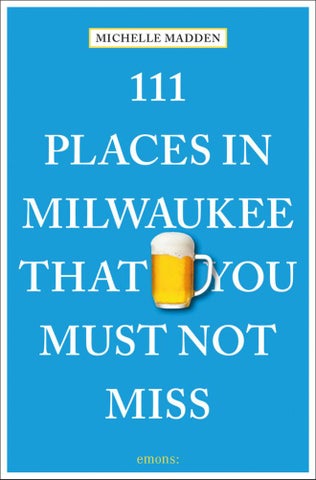
Foreword Dear Milwaukee, I hope this love letter of a book conveys my respect and admiration, dear city, for your character, heart, wit, and killer sense of humor. I was born in your county hospital and had the privilege of sharing my youth with you, swimming in the lake, playing in snow banks, eating frozen custard. I moved away after college, but I succumb to your gravity; I return all the time. This offers me a fortunate perspective, one that combines the pride of a local with the thrill of a tourist. If ever a place embraced the extremes of its civilization, it’s you. You’ve been deemed both the ‘German Athens’ and the ‘Bowling Capital of America.’ Your fine artists brew beer and make cheese, while your factories hang fine art in the lunchroom. You have a museum dedicated to the beauty of hard work, and you design motorcycles that have inspired their own culture. Both churches and bars stud your corners. You have flair. Houdini, Liberace, Golda Meir, Gene Wilder, Al Jarreau, and Oprah have called you home. 1970s television tried to claim you, setting Happy Days and Laverne & Shirley within your bounds. You have possibly the coolest art museum on the planet, and your landscape is dotted with Frank Lloyd Wright masterpieces. Yet you are low-key. You like to drink with your dogs. You like a haircut on a basketball court. You like your hodag, the sandwich named for a folkloric Northwoods creature, with free Atari. You are fun, festive, innovative, and sometimes even a bit strange. You invented Miller Time. You are The City of Festivals. You are the birthplace of the QWERTY keyboard. Your literati bow down to a mummified cat. You strive to be, as the old slogan goes, “A Great Place on a Great Lake.” I’d say I miss you, Milwaukee, but I haven’t had time. I’m too busy coming back, still your biggest fan. Always yours, Michelle Madden
111 Places 1_ 4 Seasons Skatepark
Drop in for a good ride and family vibes | 10
2_ AGSL’s Rare Mappamundi
Fall off the map in a cartographer’s dream library | 12
3_ Al Capone’s Rural Hideout
A public enemy’s Brookfield retreat | 14
4_ Alice’s Garden
Finding the culture in agriculture | 16
5_ Allen-Bradley Clock
Once in a ‘Polish moon’ | 18
6_ The Annunciation Church
It’s all ball bearings nowadays | 20
7_ The Appomattox Shipwreck
Lake Michigan’s maritime capsule | 22
8_ Art Smart’s Dart Mart
For those who heart darts and farts | 24
9_ Basilica of St. Josaphat
An early green building known for its gold | 26
10_ The Be A Maker Space Making it happen | 28
11_ Beer Baron Corner
Neighbors in the sweet beer-after | 30
12_ Black Husky Brewing
Where everybody knows your dog’s name | 32
13_ Booth Street Stairs
Steps toward freedom | 34
14_ Breweriana at Best Place A beer gear boutique | 36
15_ Bridge Lane Footbridge
Get on the good foot (bridge) | 38
16_ Burnham Block
House in a box | 40
17_ Chudnow Museum
One man’s trash is another man’s home to Americana | 42
18_ Clock Shadow Creamery
Some curds are squeakier than others | 44
1__ 4 Seasons Skatepark Drop in for a good ride and family vibes
“We definitely have wow-factor,” says Neal Levin, owner of 4 Seasons, a 22,000-square-foot indoor skatepark, which happens to be Wisconsin’s largest. “The fact that we have so much natural light and the high ceilings – anybody who comes in here is just in awe of the building, and surprised by the use of it.” That’s because this aesthetically pleasing skatepark, tucked into a secluded former industrial area beside the Menomonee River, is housed in the circa-1902 Milwaukee Gas Light Company campus, a cluster of historic red brick buildings designed by famed local architect Alexander Eschweiler. 4 Seasons opened in 1999, making it an old-timer among indoor parks – Levin surmises it’s among the country’s top five oldest. Through the years, it’s attracted plenty of names, like Tony Hawk and Matt Hoffman. Levin says, “We’re kind of one of those stops, a bucket list-type thing. We’ve been around for so long and people see the park in videos and magazines, so if they’re traveling, they’ll stop to get a session in.” Levin attributes the park’s longevity to the fact that they welcome riders of all kinds – skateboard, BMX, scooter, and roller skate, both inline and quad – and, even more importantly, that they create a true family-like atmosphere. “It’s why people choose to come here. Parents feel comfortable dropping off, and we have a huge group of girls now. There’s a big girls’ skateboard movement, and we also have the derby girls who roller skate, which is super cool,” he says. Levin estimates that female participation is up 500%. The park rents gear, offers lessons and a pro shop, and hosts events like the Ladies Session (girls’ skate club) and monthly Lock-Ins to further make the riding experience accessible and intimidation-free. The warm welcome is extended even to those who are less daring and prefer just to watch. Levin says, “Spectating is free. People are free to come through to see what it’s all about.” 10
Address 200 North 25th Street, Milwaukee, WI 53233, +1 (414)933-7275, www.4seasonssk8park.com, seasonssk8park@yahoo.com | Getting there Bus 30 to Wisconsin Avenue & North 25th Street | Hours Mon – Fri 3:30 – 10pm, Sat 11am – 10pm, Sun 11am – 9pm | Tip For further wheeled-sport spectator opportunities, check out Milwaukee’s roller derby, the Brewcity Bruisers, and their junior counterparts, the Micro Bruisers (various locations, www.brewcitybruisers.com).
4__ Alice’s Garden
Finding the culture in agriculture
“There are many great community gardens in Milwaukee, but you won’t find Fieldhands & Foodways anywhere else,” says Venice Williams, of the program she developed at Alice’s Garden. This part of the urban farm, which was created on empty land from an abandoned freeway project, is dedicated to Milwaukee’s African-American and Native American roots and designed to connect visitors to the important history of the area. “The land we’re on was part of Samuel Brown’s farm. As he and others took in a young freedom-seeker named Caroline Quarlls, Wisconsin’s Underground Railroad was born,” says Williams. Unlike most, Quarlls’ story was documented and thus retold. Alice’s Farm even routinely hosts Quarlls’ third great-granddaughter from Detroit to share her family’s history. Fieldhands & Foodways is planted to reflect the time from preslavery through sharecropping. The Master’s Kitchen Garden is a historical plot containing what an enslaved person might have been responsible for cultivating. Other sections are devoted to culinary and herbal education, and there is always an artist-in-residence, such as a potter making clay utensils that would have been used on a plantation, or a quilter working with visitors to make quilt squares. There are scheduled demonstrations throughout the growing season, and visitors are invited to wander, using the garden’s detailed signage as their guide. Another garden highlight is the living labyrinth, constructed of stones, fragrant herbs, and other plants. Spiritual caretaker Cheri Johnson leads meditative walks, during which folks from all over the city – all ages, races and socioeconomic backgrounds – turn up to contemplate ideas like ‘sustainability’ and ‘global landscape’. “People have bought into the idea that this is one of the most segregated cities in the country,” says Williams. “Well, we want to invite people to come and see it at its best.” 16
Address 2136 North 21st Street, Milwaukee, WI 53205, +1 (414)687-0122, www.alicesgardenmke.com | Hours Daily Apr – Sep; Labyrinth Walks Wed 6 – 8pm; check website for events schedule and off-season hours | Tip Alice’s Garden grows up to 60 herbs each season, which are used in their cooking spices, teas, and herbal body products sold each Saturday at Fondy Farmers Market, June–November (2200 West Fond Du Lac Avenue, Milwaukee, WI 53206, www.fondymarket.org).
6__ The Annunciation Church It’s all ball bearings nowadays
The eye-catching Annunciation Greek Orthodox Church, which resembles a grounded flying saucer, isn’t instantly recognizable as the work of famed Wisconsin architect Frank Lloyd Wright. One of his final projects, completed in 1961 after his death, this edifice combines Byzantine architectural elements with Wright’s modern sensibilities. Influenced by the marvelous Hagia Sophia in Istanbul, and by his third wife, who was of the Greek Orthodox faith, Wright embraced the forms and symbols of the historic architecture and religion to create this wholly original masterpiece for the Annunciation congregation. The structure is a true feat of engineering. The 106-foot diameter dome floats on thousands of ball bearings in a rail, an extremely innovative solution to keep the dome shell stable as materials expand and contract during Wisconsin’s extreme weather changes. Meanwhile, 345 glass spheres positioned directly beneath the dome allow natural light to pour inside. The interior is at the same time intimate and awe-inspiring. There’s seating for 700 congregants, and yet, due to the circular, multi-level arrangement, each spot feels close to the sanctuary. Gazing downward from the upper level reveals the Greek cross-shaped floor plan; looking upward creates the sensation of floating. All three levels are accessed by stairways that spiral around sculptural posts ringed with clusters of lights. Ocean blue upholstered seating and golden carpet complete the bold yet serene palette. On the National Register of Historic Places, this site remains a functioning church. In fact, unless you are in a group, attending Sunday Divine Liturgy is the only way to visit. The services are welcoming and offer time to contemplate this mesmerizing space where, in fact, strongman Joseph Stalin’s granddaughter, who was the daughter of a Wright protégé, was christened in 1971. 20
Address 9400 West Congress Street, Wauwatosa, WI 53225, +1 (414)461-9400, www.annunciationwi.org, info@annunciationwi.org | Getting there Bus 23 to North 92nd Street & Grantosa Drive | Hours Divine Liturgy Sun 9:30am; see website for group tour information | Tip Visit the Johnson Wax Headquarters, another Wright masterstroke, about 30 miles south. Tour the compound, which includes the Research Tower and Administration Building, where Wright employed striking dendriform columns he dubbed ‘lily pads’ (www.scjohnson.com/en/a-family-company/architecture-and-tours).
13__ Booth Street Stairs Steps toward freedom
Jutting from a Brewer’s Hill bluff, this modern gangplank-like structure known as Booth Street Stairs promises a stunning view of the Milwaukee River and surrounding Beerline neighborhood 67 feet below, as well as a sure case of vertigo for those with that proclivity. The award-winning sculptural steel and concrete design, completed by architecture firm Vetter Denk in 2005, features seven upward-soaring rectangles that are echoed in the platform’s lower supports, providing a striking frame for selfies taken at the top and a graphic profile view from Commerce Street below. The stairs stand stark above a rustic, wildflower-strewn hillside, creating a fitting gateway from the historic 19th-century neighborhood to the contemporary condos along the river. The stairs rise to the intersection of Booth Street and Glover Avenue, which is marked with a plaque. In 1854, Joshua Glover was arrested as a fugitive slave and held at Milwaukee’s Cathedral Square. Sherman Booth, a local newspaper editor, led an outraged mob into the jail to free Glover, who then continued along the Underground Railroad until he was safe in Canada. According to Carl Baehr’s book Milwaukee Streets: The Stories Behind Their Names, this street was named for Booth in 1857, while he was still in a legal battle for his violation of the Fugitive Slave Law. Because of his case, the Wisconsin Supreme Court declared the law unconstitutional. That decision was overturned by the U.S. Supreme Court but remained a pivotal event in the state’s antislavery movement. It wasn’t until 1994 that Glover got his street. According to Baehr, a group of Riverside High School students were inspired by Glover’s story. They chose this section of Reservoir Avenue (where it intersects Booth) and collected residents’ signatures until they had enough to have it renamed, thus bringing Glover and Booth together once again. 34
Address Intersection of Booth Street and Glover Avenue at the top, and Commerce Street below, Milwaukee, WI 53212 | Getting there Bus 14 to Humbolt Avenue & Garfield Avenue | Hours Unrestricted | Tip If climbing stairs left you thirsty, head 12 blocks north to the Booth Street Bubbler, a drinking fountain for everyone. Plumber Micah MacArthur, moved by “neighborhood rivalry, a longing for our socialist past and a touch of heartbreak,� installed this bubbler for public use on the edge of his property. It welcomes humans and animals from May to October (3155 North Booth Street, Milwaukee, WI 53212).
26__ Garry Marshall’s MKE Tinseltown loves Brew Town
For people of a certain age, Milwaukee remains synonymous with 1970s’ Garry Marshall-created television hits Happy Days and Laverne & Shirley. While it was fun for the town to be theoretically associated with such high-profile shows, the reality could be a bit disappointing. The shows weren’t shot in Milwaukee, the actors certainly weren’t around, and the 1950s were long gone. Anything truly Cream City-inspired came from the memories of the shows’ Milwaukee-born producer Tom Miller who, in a 2008 Milwaukee Journal Sentinel article, said the Milky Way (now remodeled, and a Kopp’s Frozen Custard stand, 5373 Port Washington Road) was his basis for Arnold’s Drive-In. But instead of telling the world to “sit on it,” Milwaukee built it, and they came. In 2008, the city unveiled its Bronze Fonz statue (North Riverwalk Way, at Wells Street). The Fonz himself (Henry Winkler) turned up for the dedication, along with half the cast. Ron Howard, who played Richie, came later. Entertainment reporter Gino Salomone says, “When Ron was shooting in Chicago, he came up to get a photo with the Bronze Fonz.” Marion Ross’ motherly instincts brought her here in 2009, this time with knitwear. Salomone says, “She insisted I take her to the Bronz Fonz – she wanted to put a hat and scarf on him so he wouldn’t be cold.” Lakefront Brewery (1872 North Commerce Street) offers a nod to Laverne & Shirley, as brewery tour patrons are invited to sing along to the show’s theme song while placing a glove atop a bottle moving along a beer line, just as the stars do in the opening credits. Also in the show’s opener? Milwaukee’s historic City Hall, though it no longer bears the ‘Welcome to Milwaukee’ lettering. Over 100 of those letters are now housed at the Milwaukee County Historical Society (910 North Old World Third Street). MKE is displayed in the atrium, with other letters available for rent. 60
Address Milwaukee City Hall, 200 East Wells Street, Milwaukee, WI 53202, +1 (414)286-3285, city.milwaukee.gov/cityclerk/Tours, warnol@milwaukee.gov | Getting there Bus 30 to Water Street & Wisconsin Avenue | Hours Mon – Fri 8am – 5pm; see website for tours | Tip For an authentic Happy Days-type experience in Milwaukee today, Gino Salomone recommends the Nite Owl Drive In. Elvis Presley apparently caught wind of their handmade burgers when he played Milwaukee in 1977 and had a bunch delivered to his plane (830 East Layton Avenue, Milwaukee, WI 53207).
52__ Marie Herndl’s Window The art of glass
A lion cub used to play on the roof. Frank Lloyd Wright entered the building’s design competition and lost to Ferry & Clas. In the balcony, there’s a ‘Persian flaw,’ or a deliberate mistake made by the craftsman because it’s believed only God can create something perfect. This place even hosts something called Loud Days. So many surprises and treasures, yet one of the most intriguing things about Milwaukee’s magnificent Central Library is the stained-glass window in the Betty Brinn Children’s Room. This dazzling work of painting on glass was created by artist Marie Herndl in 1896. At that time, it was incredibly rare for a woman to excel in the realm of stained glass. Perhaps because of that fact, accounts of Herndl’s life and career are fragmented and contradictory. It’s widely acknowledged that she was born in Munich and trained there. She later came to America and possibly worked in the studio of Louis Comfort Tiffany. She had pieces displayed at two separate World’s Fairs, in Chicago in 1893 and St. Louis in 1904, and won medals at both. She settled in Milwaukee around 1899. Herndl’s work was well regarded, but it has often had the misfortune of ending up in storage. The first World’s Fair piece went to the Milwaukee Auditorium, but got stowed in their basement for decades. It bounced around before landing at a museum in Chicago that ultimately closed, so the piece is presumed back in storage. A George Washington portrait was meant for the U.S. Capitol, but there was nowhere to display it, so it went to the Smithsonian before gracing the Senators’ Dining Room. Similarly, the library’s Hans Christian Andersen Window hung in Milwaukee’s original children’s library. It spent some time in a storage locker before being restored and hung in the Children’s Room in 1998, where it remains one of the Central Library’s loveliest and most beloved attractions for people of all ages. 112
Address 814 West Wisconsin Avenue, Milwaukee, WI 53233, +1 (414)286-3000, http://mpl.org/hours_locations/betty_brinn.php | Getting there Bus 30 to Wisconsin Avenue & 10th Street | Hours Mon noon – 8pm, Tue 9am – 8pm, Wed – Fri 9am – 6pm, Sat 9am – 5pm, Oct – Apr also Sun 1 – 5pm | Tip St. Paul’s Church has a fantastic collection of 19th-century stained glass, including the largest window ever created by Tiffany Studios (914 East Knapp Street, Milwaukee, WI 53202, www.stpaulsmilwaukee.org).
81__ Riverwest Radio Back to the future
Milwaukeean Brooks Stevens, a renowned industrial designer, is credited with coining the phrase “planned obsolescence,” referring to purposefully built-in shelf life for products. Meanwhile, Milwaukeean Xav Leplae sees the beauty and function in bygone technology long after popular favor has moved on. “The things I do tend to become outmoded,” laughs Leplae, who is founder of both Riverwest Radio and Riverwest Film & Video. Both businesses are rooted in what some might call passé media (broadcast radio, DVDs, and VHS), yet somehow they are the foundation for a forward-thinking, creative community stemming from this storefront on Center Street. Ironically or not, Riverwest Radio’s low-power (reaching a fivemile radius) FM radio station, found at 101.4, began as a webcast. Born as an extension of the Occupy movement, the station, which programs about 80% talk and 20% music, is devoted to sharing local voices and lesser-heard music, often live, on public airwaves. Milwaukeeans are invited to produce their own shows, resulting in a huge range of unadulterated content, from what Leplae calls, “the super Christian, socialist, or anarchist, to comedy, French culture, and cooking.” A gentleman named Charles Carmikle does his show in rhyming verse. A show called Cinema Fireside is co-hosted by Mark Borchardt, a name and voice familiar from Chris Smith’s 1999 cult documentary, American Movie. Walking onto the premises is a singular experience. There might be a live radio show in a front window booth, film students buying microphone kits, or people browsing DVDs ranging from art house to 1990s’ blockbusters, while Laplae fixes a meal in the fully stocked kitchen. The storefront resides on a lively stretch of Riverwest, making it a fun stop amid restaurants and bars for browsers or those who just want to gaze through the glass to see the faces behind the radio. 170
Address 824 East Center Street, Milwaukee, WI 53212, +1 (414)265-7420, www.riverwestradio.com | Getting there Bus 14 to Humbolt Boulevard & Center Street | Hours Daily 3 – 11pm | Tip Further indulge in Riverwest’s indie culture at the seminal original Fuel Café. Enjoy strong coffee and a gooey sub called ‘The Buttafuoco’ alongside radio hosts prepping guests for their Riverwest Radio shows (818 East Center Street, Milwaukee, WI 53212, www.fuelcafe.com).
95__ St. Joan of Arc Chapel Home of the original cold stone
One of the oldest structures in America, and by far the oldest in Milwaukee, the St. Joan of Arc Chapel, was originally built sometime around 1420 in France’s Rhône River Valley. It served its small village for a few centuries before being deserted during the French Revolution and falling into disrepair. During the 1920s, a French architect recognized the chapel for its remarkable Gothic architecture and decided to restore it. Gertrude Hill Gavin, daughter of a wealthy railroad magnate and avid St. Joan of Arc admirer, purchased the chapel and had it taken apart, stone by stone, and shipped to her home in New York. St. Joan of Arc (1412 – 1431) was a French heroine of the Hundred Years’ War who was burned at the stake at age 19. As legend goes, Joan, before going into battle, prayed to a statue of the Virgin Mary and kissed the stone at its foot. From that point on, the stone remained colder to the touch than the stones surrounding it. Hundreds of years later this stone, known as the ‘Joan of Arc Stone,’ was purchased by Gertrude Hill Gavin to install in her imported French chapel that she dedicated to St. Joan. The chapel miraculously survived a fire and changed hands again before it was donated to Marquette University, disassembled again and reconstructed in Milwaukee in 1966. The famed cold stone, which visitors are indeed invited to touch, truly is seven to ten degrees cooler than the other surrounding stones, as verified by several science students over the years. The chapel also contains the 15th-century tomb of a French knight (though his remains remain in France), in addition to other noteworthy artifacts that pre-date even the stone. Tours are offered seven days a week, and masses are offered during weekdays. Students traditionally fill the tiny chapel Tuesdays at 10pm, seeking the serenity offered by this amazing slice of medieval France. 198
Address 1415 West Wisconsin Avenue, Milwaukee, WI, 53233, +1 (414)288-6873, www.marquette.edu/st-joan-of-arc-chapel | Getting there Bus routes 14, 21, 30, 53, PUR | Hours Tours Mon – Sat, 10am – 4pm, Sun noon – 4pm; masses Mon – Fri at noon and Mon – Thu at 10pm during Marquette University’s academic year | Tip Cross campus to The Haggerty Museum of Art. The permanent collection includes On The Fence, from that time in 1987 when Keith Haring came to town and painted the plywood surrounding the museum’s construction site. You will also find works by Warhol, Lichtenstein, Caillebotte, Chagall, Toulouse-Lautrec, Rauschenberg, and Dali’s famed The Madonna of Port Lligat.
108__ The Waxwing Birds of a feather
Those versed in ornithology might know the waxwing to be a local bird. One such person is Stef Davies, who, while a student of scientific illustration, was impressed with the elegant passerine and later named her shop after it. The word also affords further meaning when split. Davies says, “ ‘Waxwing’ evokes the idea of craft and freedom of flight,” nice imagery for a transcendent handmade goods outlet. Waxwing fans have described it as “a makers fair all-in-one store,” or “Etsy that you can touch.” Davies says, “We’ve worked hard to create an experience for you, whether you’re stopping in for inspiration, cruising through on your lunch break, trying to find the perfect gift, or just wanting to learn more about a local maker.” The store’s selection, which is 70% local, showcases the art and crafts of creative Milwaukeeans. Shop for soap made with Pabst Blue Ribbon beer, Wisconsin-shaped cutting boards, clever cards, pottery, leather work, clothing, candles, and jewelry. These are just a few of the locally made and locally themed treasures. Davies also acquired the Milwaukee Home brand known for its T-shirts and collaborations with area businesses. Milwaukee Home has a store of its own, in addition to their presence at The Waxwing. For those looking to discover their maker calling, The Waxwing offers classes like tintype photography and screen-printing. Operating on consignment with about half of their vendors has allowed the shop to take a chance on new artists and introduce both novice and established artists to the community. Davies, an artist and maker herself, enjoys the kinship she shares with her vendors. “I know every single person who sells work in the shop,” she says. “I know their stories and have watched as they’ve gone from doing art on the side to doing it full time. I am honored to be a part of that journey, and inspired by them daily.” 224
Address 1800 East North Avenue, Milwaukee, WI 53202, +1 (414)265-2900, www.thewaxwing.com | Getting there Bus 14A to Jane Street & 9th Avenue | Hours Mon – Thu 11 – 12:30am, Fri & Sat 11 – 2am | Tip Fischberger’s Variety in the Riverwest neighborhood is another fun local shop. Owner Sarah Ditzenberger takes her inspiration from the Ben Franklin and Woolworth’s ‘dime stores’ of old (2445 North Holton Street, Milwaukee, WI 53212, www.facebook.com/fischbergersvariety).
The author Michelle Madden is a screenwriter and journalist who has contributed to publications from The New York Times to NYLON. She was the researcher on films Being John Malkovich and Adaptation, and on many TV commercials. Prior to that, she was a chemist, which was unlikely yet formative training for her writing and work as an actor, radio personality, and bear-suit-wearing mascot. She lives in Los Angeles with her husband, son, and animals, but was born and raised in Milwaukee. The Cream City’s allure remains undeniable to her. She visits often, which affords a unique vantage point, one that combines the wonder of a tourist with the pride of a local.
The photographer Janet McMillan is a professional photographer in Milwaukee, WI. When she isn’t covering local events, you can find her training women to compete in a triathlon, making personal wellness products for her company, Betty Loves Freddie, and being a tourist in her beautiful city. She lives in the historic Washington Heights neighborhood with her artistic husband and two teenage children. And her favorite Kopp’s custard flavor is bienenstichkuchen.