3
The 90 Bus A safari, not just a journey
Glasgow is well served by its guided bus tours. But there is a proletarian alternative that will take visitors off the tourist beat and give glimpses of where and how Glaswegians live. The 90 bus is part of the workaday bus network, but it is unique because its circular route takes in all points of the city’s compass. It is Glasgow on a single bus. There is obviously no commentary to point out the highlights. But you can always ask a local, who may well give an insight that you won’t get on the tourist buses. Glaswegians are usually more than happy to talk to visitors. Many of the 111 places described in this book are on the 90 route. If you buy a day ticket, you can get off at any of the 100 or so stops to explore, and get back on a later bus to continue the journey. The complete round trip takes more than two hours from Partick Bus station in the north to Govan in the south, or vice-versa. If you cannot decide where to start, do not fret as Partick is one stop from Govan on the Subway, a journey that takes all of two minutes. The 90 passes close by all three of Glasgow’s main football stadia: Hampden Park, home of the Scotland national team and venue for cup finals and semi-finals, Celtic Park, or Paradise as the Bhoys (Celtic fans) call it, and Ibrox, where the Teddy Bears gather for a football picnic. Just a couple of suggestions: as you pass Ruchill Park, about 15 minutes into the north route from Partick, you should see a decorative tower on the hillside that looks like a chunk of a French chateau. It is, in fact, a 10-storey water tower, the last remnant of the former Ruchill Hospital for Infectious Diseases. Or get off at Paisley Road Toll in Kinning Park to have a close look at the Angel Building, so called because of the magnificent gold statue on the rooftop. It was built in 1899 as a department store and now houses an Italian restaurant.
ADDRESS The 90 bus route map and timetables can be found online at www.firstbus.co.uk/greater-glasgow. Services on the complete route run daily at 30-minute intervals until about 4.30pm TIP Shawlands on the southside is recommended as a stopping-off point for refreshment. Interesting bars, cafes and restaurants abound in what is regarded as one of the best places to live in Glasgow.
6
The Arlington Baths A place of health and beauty
A private members’ swimming club founded in 1870, the Arlington is the oldest institution of its kind in the world. The A-listed building has more than a hint of the Roman bathhouse, in a solid Glaswegian way. So successful was the Arlington set-up that an exact replica was soon built in London. The sunlit pool, with its trapeze and Tarzanesque swing ropes, offers both gentle and vigorous exercise. The ambience of the club is typified by the darkly seductive Turkish room. Steam rooms, saunas, big slipper baths and cool rooms add to the relaxation and comfort. But the Arlington has changed with the times. In its earlier days its healthy pursuits were countered by the provision of poolside ashtrays for swimmers to pause for a cigarette. The wooden-beamed billiards room has now been transformed into a gym with the latest equipment. And it no longer employs a ‘pants boy’ to collect discarded swimwear. The Arlington has a place in history as the pool where water polo was invented, and developed into an Olympic sport, by William Wilson, its first baths master and a major figure in the promotion of aquatic exercise. ‘Water rugby’ was how the sport was first described, but it also involved wrestling, dive-bombing by the goalkeeper, and holding opponents underwater to recover the ball. Water polo is less rough now, but it’s still a lively sport that Glasgow can be proud of. A few decades ago, with dwindling membership, the Arlington faced a crisis merely to preserve the fine building. Volunteers rose to the challenge and sparked off a renaissance, not only securing the fabric but also updating all the facilities sensitively, in keeping with the original ethos. It is a private club, but anyone with an interest can arrange a free tour, sample the facilities for a fee, or visit on an open day. Recent special events have included an underwater light and sound experience.
ADDRESS 61 Arlington Street, G3 6DT, +44 (0)141 332 6021, www.arlingtonbaths.co.uk TIP The Park Circus area across Woodlands Road is well worth a stroll around, to have a look at some of Glasgow’s grandest town houses and other fine 19th-century architecture.
9
Barrowland Ballroom Ziggy’s pocketful of stardust
In the 1980s, the grand era of the Glasgow dance hall was over, and the famous Barrowland Ballroom faced an uncertain future. It was saved when local band Simple Minds chose this place of unforgotten dreams as the backdrop for a video. The music industry realised it was a unique concert venue, and Barrowland was given a new lease of life. The barrelled ceiling made for great acoustics. The Glasgow audiences contributed atmosphere and a bit of edgy intimacy in the 1,900-capacity hall. Irish singer Christy Moore declared Barrowland his favourite venue, adding that it was ‘not for the faint-hearted’. Moore is not alone in his admiration. Arctic Monkeys and Alice Cooper, Blur and Blondie, Madness and Manic Street Preachers through to Amy Winehouse and The Waterboys – the alphabetical archive is a hall of fame. When spaceman David Bowie took his Earthling tour there in 1997, he caught a falling star and put it in his pocket. One of the decorative stars on the ceiling fell off during the performance. Bowie purloined it, and kept it as a souvenir in the bathroom of his Paris flat. The Barrowland star then became a tradition, with the management thoughtfully decorating the dressing room with celestial facsimiles for visiting performers to steal. Scottish band Biffy Clyro made their mark by having their lyrics inscribed on the steps of Barrowland’s magical staircase. Various big music venue operators have tried to buy Barrowland, but it remains resolutely in Glaswegian hands. It was built in 1934 by legendary Barras Market founder Maggie McIver as a place to hold events for her stallholders. It soon became a hot spot for ‘the jiggin’, as Glaswegians called a night out at a dance hall. For three decades the resident band was Billy MacGregor and the Gaybirds. Something of a showman, Billy and his boys interspersed the music with comedy sketches. The fun continues.
ADDRESS 244 Gallowgate, G4 0TT, +44 (0)141 552 4601, www.glasgowbarrowland.com TIP The Scotia Bar, 112 Stockwell Street, G1 4LW, is the place for lively music from a wealth of local bands. This classic Glasgow boozer claims to be the city’s oldest pub, as do some other contenders (+44 (0)141 552 8681).
15
The Bon Accord Nip in for a dram
As the song goes, ‘Show me the way to the next whisky bar…’ Glasgow is not short of premises specialising in Scotland’s national drink. The Bon Accord is a family-run pub that has regularly been named UK Whisky Bar of the Year. The selection of 400 single malt whiskies may not be the biggest in town, but as its much-missed creator, the late Paul McDonagh explained, ‘We don’t go for quantity. We seek out the rare and the old.’ Malt whisky aficionados come from all over the world to sample the gems in the Bon Accord collection. Scotland’s more exclusive malts can fetch thousands of pounds per bottle at auction, and customers here are unfazed by hefty bills after their long voyages of discovery. The well-informed staff are on hand to discuss the intricate details of varieties from the Highlands, Islands and Lowlands. Or perhaps a smooth Japanese Hibiki. ‘Our visitors are serious and knowledgeable,’ says Paul. Those who are not hard-core connoisseurs or winners of the Euromillions lottery may opt for the malt of the month at around £3. The language used in tasting notes for malt whisky can be as elaborate, and perhaps as pretentious, as the terminology for Bordeaux clarets. A whisky may have a fascinating nose of polished grand piano, exotic fruits, Haribos and scented tea. Or treacle sponge, vanilla custard, garam masala and antique cigar box. You are unlikely to hear such terms at the Bon Accord. It is a place of pilgrimage for lovers of uisge-beatha (water of life, i.e. whisky) but mainly it is a hospitable Glasgow bar. It is also known for its wide range of ales, with about 1,000 on offer over the year, on a rotating basis. You may be tempted by the local tradition of a ‘hauf an’ hauf ’ – a half-pint of beer accompanied by a spirit. Whatever your tipple, line your stomach with a plate of home-made steak pie from the pub grub menu.
ADDRESS 153 North Street, G3 7DA, +44 (0)141 248 4427, www.bonaccordpub.com TIP On your way home, take a look at the Cameron fountain at nearby Charing Cross. It’s not just the effects of the whisky you may have had. This Doulton terracotta drinking fountain, a tribute to a Glasgow MP, really is leaning seriously to one side, tower-of-Pisa style.
48
Glickman’s Where sweet dreams come true
Glickman’s is not just a sweetie shop. It is a time machine, transporting customers of various ages back to their own place in the confectionery space-time continuum. We are not talking here about the Mars Bar, Milky Way or Galaxy of the multinational companies. Founded in 1903 and still going strong, Glickman’s is all about local favourites, many of them still made in the back shop according to Isaac Glickman’s original recipes, by his granddaughter Irene and her daughter Julie. The small shop stocks a vast range of delicacies, including the best-selling Candy Balls and Macaroon Cake. The Scottish macaroon has nothing to do with delicate almond biscuits. It is an intensely sweet, solid fondant dipped in chocolate and rolled in toasted coconut. It has a strange connection with Scottish football, as a favourite ‘dessert’ for spectators after the traditional match snack of a pie with Bovril beef drink. Vendors used to pass through the terracing calling out, ‘And it’s your Macaroon Bars!’ (Spearmint chewing gum was also on offer, possibly to cleanse the palate.) It is a mystery how mashed potato came to be one of its major ingredients. The Lucky Tattie (lucky potato), another age-old favourite, has no actual potato in it, consisting chiefly of sugar and glucose fused into a chewy lump and dusted with cinnamon. At its centre there was once a lucky charm such as a plastic Scottie dog, but these have now gone, presumably due to modern health and safety concerns. Not everything is so sweet. The Soor Plooms (sour plums) have a lime-flavoured acidic kick. The melt-in-the-mouth Cough Tablet with aniseed is a blast from the past, when Glasgow’s industrial pollution caused widespread respiratory problems. A dentist fan of Glickman’s says, ‘It’s OK to eat sweets in moderation, preferably as a digestive after a meal, followed by a thorough brushing of the teeth.’
ADDRESS 157 London Road, G1 5BX, +44 (0)141 552 0880, www.glickmans.co.uk TIP Contrary to popular perceptions of the Glasgow diet, a lot of fruit and vegetables are in fact consumed in the city. For an ample selection of healthy foods, check out the market-style Roots & Fruits at 457 Great Western Road, G12 8HH and its organic deli next door.
68
Mr Ben Retro Clothing Dedicated followers of fashion
This is not so much a second-hand clothing emporium as a giant dressing-up box for adults. If, for instance, you want to look like a sentry outside Buckingham Palace in full Scots Guards uniform, complete with busby (the big bearskin hat), Mr Ben is the go-to place. There are many other military options available – dashing red jackets from a variety of regiments, loads of khaki and cosy flying jackets. A green French army greatcoat dating from 1780 is the most antique item in the collection. Away from the battlefield, there is no end of choice of apparel and accessories, from ripped denim and sneakers to dandy vintage frock coats and Britain’s biggest collection of top hats. Quality counts, as can be seen in the range of Harris tweed jackets. Most customers come looking for outfits that could be described as ordinary, except that extraordinary and colourful tend to be the norm. Though you may spot the occasional Glaswegian looking like a pirate from the Caribbean, most of Mr Ben’s more exotic costumes usually go out on hire for theatre, film and opera productions. Rock musicians flock there to dress on the wild side. Mary Ann King and her husband Robert Corlett opened Mr Ben more than 30 years ago, before retro became so fashionable. ‘Our customers – mostly young, some slightly vintage – create their own look,’ she explains. ‘They don’t want to be labelled, though they will buy a designer label at a knock-down price.’ Mary describes a recent example of a young woman who turned herself into a punk Cinderella, going to the ball in a gorgeous silk gown, an American GI battlefield tunic and a pair of Doc Marten boots. It is not entirely accurate to describe Mr Ben as a second-hand shop. Much of the stock has had a lot more than one previous owner. Customers come back and trade in the old, maybe for the even older, in a dedicated following of their own fashion.
ADDRESS Kings Court, 101 King Street, G1 2RB, +44 (0)141 553 1936, www.mrbenretroclothing.com TIP The Italian Centre on John Street, Ingram Street and around has a large number of top fashion designer shops, including Armani, Boss and Cruise, to use just the first three letters of the alphabet.
69
The Mural Trail From blight to beauty
Like many a post-industrial city, Glasgow has had its share of urban blight. Add in mindless vandalism and graffiti, and the results were not too pleasing to the eye. The eventual response of the city council was to encourage and even fund highly skilled artists to turn derelict eyesores into eye-catching outdoor art. The city now has scores of gloriously illustrated walls by Smug, Rogue-One, Klingatron and others who are in demand worldwide. Many of the murals are in a dramatic photorealist style. The gable end of a tenement – often created by the wilful demolition of a perfectly good adjacent building – provides the best canvas for this new breed of city muralists. One in the High Street is decorated with Smug’s stunning contemporary take on Saint Mungo. But any stretch of wall or boarded-up shopfront will do. Animals and birds feature prominently, with local wildlife including the rabbit, badger, fox, robin and deer. There’s also a magnificent tiger and a scary crocodile, and a surreal scene with an elephant seated in a pub, a shark with a cocktail and a rhinoceros as bartender. Strathclyde University has turned the exterior of what is perhaps the ugliest building on its campus into the Wonderwall, a vast portrait gallery celebrating the institution’s proud history as a leading centre in science and technology. Most of the murals on the trail are in the centre, but there are many others across the city. There is a delightful and very tall giraffe grazing on a gable end in Shettleston Road, slightly off the beaten track in the East End. Glasgow characters also take pride of place, most notably its favourite son Sir Billy Connolly, comedy genius, film actor, storyteller, writer – and not too bad a singer, despite his insistence on playing the banjo. Given the transitory nature of Glasgow’s city centre development, some murals inevitably disappear. Others soon appear in their wake.
ADDRESS The mural trail is available to download at www.glasgow.gov.uk/ citycentremurals. TIP For art in the great indoors, take a trip out to the refurbished Burrell Collection, home to 9,000 treasures scoured worldwide in magpie fashion by Glasgow shipping merchant Sir William Burrell and his wife Constance, and then donated to the city. It’s housed in Romanesque greenhouse style in Pollok Country Park, 2060 Pollokshaws Road, G43 1AT.
76
The Pollok Park Highland Cows Country estate in the city
Probably the most endearing welcome you can get to this city is an inquisitive stare, through a mop of ginger hair, from one of the furry Highland cows that literally belong to Glasgow. These cutest of beasts can be seen roaming the fields of Pollok Country Park, only a short train ride from the city centre. In 1966, when the Maxwell family donated their ancestral 146-hectare estate to Glasgow Corporation, six Highland cows came as part of the deal. The fold – the correct term for a herd of these particular cattle – now numbers around 70. The pedigree Pollok cattle are fine examples of the ancient, hardy breed. One of their number, Una Ruadh by name, was crowned Scotland’s bovine beauty queen when she was named champion at a recent Royal Highland Show. The Highlander comes equipped with two furry coats and thrives in a cold, wet climate. When encountered on a dinner plate, the meat is lean, succulent and low in cholesterol. The park is also home to the Clydesdale, a breed of tall and majestic horse evolved over centuries for heavy work on the farms of Lanarkshire. Compared to their ancestors, these Clydesdales have a more relaxed lifestyle. Visitors can sometimes get up close to them, watching them being groomed and getting fitted with new shoes. In the school holidays, children can enjoy horse-and-cart rides through the park. There is almost too much to be enjoyed at Pollok Park, and one visit may not be enough. Take woodland walks, check out the wildlife garden, stroll along the White Cart Water with its beautiful arched bridge, tour the refurbished Burrell Collection, explore the formal and walled gardens of Pollok House mansion or just have a picnic. The fairy dell and dinosaur fossil features will enchant children. More active pursuits available include mountain biking and orienteering.
ADDRESS 2060 Pollokshaws Road, G43 1AT, +44 (0)141 287 5064, www.glasgow.gov.uk TIP In the heart of the park is Pollok House, grand ancestral home of the Maxwell family, preserved and run by the National Trust for Scotland. Among its contents is a fine collection of Spanish paintings. Life below stairs can be explored, and the kitchen is now a delightful tearoom (Mar – Jan, daily 10am – 5pm; charges apply).
85
Scottish Football Museum Home of the beautiful game
Scotland’s national football stadium, Hampden Park, was the world’s biggest until the Maracana in Rio de Janeiro was built in 1950. Hampden still holds records for match attendances in Europe. The official crowd figure for the Scotland v England international in 1937 was 149,415, but an estimated further 20,000 fans found their way into the ground. The stadium is also the home of Queen’s Park FC, a small amateur club, but one with a unique history. Queen’s Park is Scotland’s oldest team, founded in 1867. Football historians (and not just Scottish ones) have recorded how the club changed the face of the game as we know it. In its early days, the sport was played in a kick and rush fashion, with mobs of players pursuing the ball up and down the park. The Spiders, as Queen’s Park became known because of their black and white hooped jerseys, were the first team to develop the tactical passing game that soon became the standard in Scotland and England, and gradually the rest of the world. In the world’s first international match, Scotland v England in 1872, the entire home team was made up of Queen’s Park players. All this history and much more is on display at Hampden’s Scottish Football Museum. Check out the massive sculptural tableau commemorating one of the best World Cup goals ever, Archie Gemmill’s mazy run through the Holland defence in Argentina in 1978. (Scotland won that game, but exited the tournament in yet another glorious defeat.) See the penalty spot stolen from Wembley Stadium in 1977, when Scotland supporters invaded the pitch to celebrate their 2 – 1 victory over England, and took home the goalposts and much of the turf as souvenirs. Read the original team list document, with Puskas, di Stefano and Gento of Real Madrid, when the Spanish club beat Eintracht Frankfurt 7 – 3 in the legendary European Cup final of 1960, at Hampden Park.
ADDRESS Hampden Park, Mount Florida, G42 9BA, +44 (0)141 616 6139, scottishfootballmuseum.org.uk TIP Partick Thistle, Glasgow’s third football team, offer a civil and courteous alternative to the torrid rivalry of Celtic and Rangers. The ‘Jags’, who are based at Firhill Stadium and prefer to be known as Maryhill’s premier club, compensate for their gentlemanly reputation by having football’s scariest mascot, Kingsley (ptfc.co.uk).
90
Square Sausage Scottish soul food
This delicacy defined by its shape – square-section, skinless, sliced sausage – is an essential part of local food culture. It may be served as part of the full Scottish breakfast with bacon, eggs, tattie (potato) scone, a link sausage, black pudding, tomato, baked beans, sautéed mushrooms and toast. For many, however, the humble square (made by shaping the sausage meat in a metal loaf tin) is best savoured sandwiched inside a breakfast roll, which it fits perfectly. Accompanied with an ice-cold can of Irn-Bru, the national soft drink, it is a comfort food that is recognised as an effective hangover cure. But you do not require to have overindulged the previous night to enjoy this breakfast. Some people smother it with brown sauce, a spicy relish that contains tamarind. But a good quality square, already delicately flavoured with nutmeg, coriander, pepper and salt, does not require such embellishment. The meat is usually beef, although pork may find its way in, and rusk is added as a binder. The fat content should not be more than 30 per cent. It is also known by the more upmarket name of Lorne sausage. The origin of this is unclear. Lorne is a rural district of Argyll that may have been the source of the beef. Another popular theory is that the name came from the 1920s Glasgow comedian Tommy Lorne. It is more likely that it was the sausage that made him famous. It is often referred to simply as slice. There is a lesser variety of sliced sausage, made of pork, which is round. To complete the geometry of the Scottish breakfast, the tattie scone is usually triangular. The square sausage is beloved of Scots exiles, and it is the illegal food import most confiscated at US airports. You will hear Glaswegians specify a Morton’s roll. This bakery’s product is indeed tasty and has become iconic, but McGhee’s rolls stand comparison. So far, neither the square sausage nor the Morton’s roll has been granted Protected Designation of Origin status.
ADDRESS Square sausage in a roll is ubiquitous in fast and slow food establishments across the city, including Café Wander, 110 West George Street, G2 1QJ (90a); Gordon Street Coffee, 79 Gordon Street, G1 3SL (90b); Bank Street Bar Kitchen, 52 Bank Street, G12 8LZ (90c) TIP Rose & Grants café and deli at 27 Trongate, G1 5EZ, proudly proclaims itself to be ‘home of the famous vegan square sausage’. The spicy soya slice is worlds away from the meaty original, but the veggies love it.
THE AUTHOR
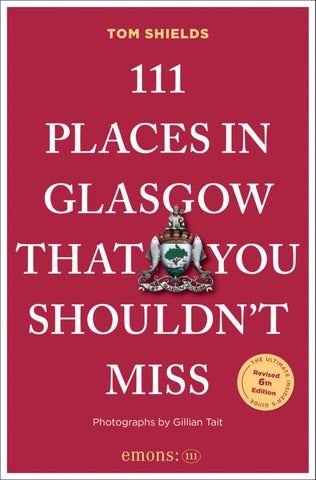
Tom Shields was born in Glasgow and has never left, apart from frequent sojourns in Barcelona, which is a fascinating place but not Scottish. He studied at Strathclyde University on and off (more off than on) and after 32 years graduated with a hybrid BA degree in engineering, mathematics, Spanish, Latin American studies, Catalan and wine-tasting. He fell into journalism at an early age, and spent more than 40 years being paid to have fun at the Glasgow Herald and Sunday Herald, much of the time writing supposedly humorous Diary columns, before escaping into retirement. His Diary books are still bestsellers in charity shops.
THE PHOTOGRAPHER
Gillian Tait is a native of Edinburgh. She is a Gill-of-many-trades; trained as an art historian and then as a painting conservator, she originally worked in the museum sector. More recently she has occupied her time as a researcher, editor, writer and photographer, while indulging her passions for singing and travel, particularly to Italy. In addition to her work on 111 Places in Glasgow, which includes writing the new material for this edition, she has contributed three books to this series as both author and photographer: 111 Places in Edinburgh That You Shouldn’t Miss, 111 Places in Fife That You Shouldn’t Miss and 111 Places in the Lothians & Falkirk That You Shouldn’t Miss.
The information in this book was accurate at the time of publication, but it may change at any time. Please confirm the details for the places you’re planning to visit before you head out on your adventures.