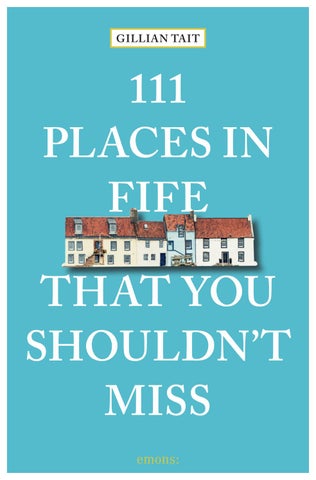
GILLIAN TAIT
111 PLACES IN FIFE THAT YOU SHOULDN’T MISS emons:
WEST FIFE: ABERDOUR
2__ The Orontes Ceiling First-class glass that sailed down under Known to the Victorians as the Jewel of the Fife Riviera, Aberdour became a popular holiday destination thanks to the paddle steamers that once plied the Firth of Forth, and the elegantly spired Woodside Hotel, built in 1873 to cater to the better class of tripper, still dominates the heart of the village. In the late 1920s the hotel’s west wing was given a fashionable palm-court atmosphere by the installation of a magnificent stained-glass vault, supported on elaborately carved woodwork. A close inspection of this carving reveals the surprising sight of fauna not normally spotted in Fife – a kangaroo and an emu. These offer a clue to the ceiling’s far-flung history: for the first 24 years of its life it was the centrepiece of the first-class dining saloon on an ocean liner that travelled between London and Australia. That ship was the RMS Orontes, run by the Orient Line, all of whose vessels had names beginning with O. (The original Orontes is a river in the Levant). Built in 1902 at the Clydeside Fairfield yard to carry 1000 passengers and a cargo of mail to Melbourne and Sydney, she later made voyages to Africa and America, and also spent time as a troopship during World War I. But by the 1920s she was no longer up to the standard required of passenger liners, and in 1926 she was scrapped at Ward’s yard in Inverkeithing, just down the coast from Aberdour. Shipbreakers were only interested in metal parts, and were happy to be rid of the furnishings – though salvaging an entire glazed ceiling for the enterprising owner of the Woodside was quite a feat. The exquisite stained glass is the work of the unjustly forgotten artist Oscar Paterson, a key exponent of the Glasgow Style whose studio was one of the most acclaimed in the UK in the decades around 1900, supplying churches and grand residences as well as several liners, including the ill-fated Lusitania. 10
Address Woodside Hotel, 78 High St, Aberdour KY3 0SW, +44 (0) 1383 860328, woodsidehotelaberdour.co.uk | Getting there Train to Aberdour and 5-min walk | Hours The ceiling is in the Clipper Restaurant, open for lunch and dinner; see website for bookings | Tip The newly refurbished Woodside has now been established as an intimate music venue, with recent concerts by artists such as Glenn Tilbrook and Richard Jobson. For quieter recreation, take a walk down to the secluded Black Sands beach, much appreciated by locals and by visitors from the Victorian era onwards.
WEST FIFE: ABERDOUR
2__ The Orontes Ceiling First-class glass that sailed down under Known to the Victorians as the Jewel of the Fife Riviera, Aberdour became a popular holiday destination thanks to the paddle steamers that once plied the Firth of Forth, and the elegantly spired Woodside Hotel, built in 1873 to cater to the better class of tripper, still dominates the heart of the village. In the late 1920s the hotel’s west wing was given a fashionable palm-court atmosphere by the installation of a magnificent stained-glass vault, supported on elaborately carved woodwork. A close inspection of this carving reveals the surprising sight of fauna not normally spotted in Fife – a kangaroo and an emu. These offer a clue to the ceiling’s far-flung history: for the first 24 years of its life it was the centrepiece of the first-class dining saloon on an ocean liner that travelled between London and Australia. That ship was the RMS Orontes, run by the Orient Line, all of whose vessels had names beginning with O. (The original Orontes is a river in the Levant). Built in 1902 at the Clydeside Fairfield yard to carry 1000 passengers and a cargo of mail to Melbourne and Sydney, she later made voyages to Africa and America, and also spent time as a troopship during World War I. But by the 1920s she was no longer up to the standard required of passenger liners, and in 1926 she was scrapped at Ward’s yard in Inverkeithing, just down the coast from Aberdour. Shipbreakers were only interested in metal parts, and were happy to be rid of the furnishings – though salvaging an entire glazed ceiling for the enterprising owner of the Woodside was quite a feat. The exquisite stained glass is the work of the unjustly forgotten artist Oscar Paterson, a key exponent of the Glasgow Style whose studio was one of the most acclaimed in the UK in the decades around 1900, supplying churches and grand residences as well as several liners, including the ill-fated Lusitania. 10
Address Woodside Hotel, 78 High St, Aberdour KY3 0SW, +44 (0) 1383 860328, woodsidehotelaberdour.co.uk | Getting there Train to Aberdour and 5-min walk | Hours The ceiling is in the Clipper Restaurant, open for lunch and dinner; see website for bookings | Tip The newly refurbished Woodside has now been established as an intimate music venue, with recent concerts by artists such as Glenn Tilbrook and Richard Jobson. For quieter recreation, take a walk down to the secluded Black Sands beach, much appreciated by locals and by visitors from the Victorian era onwards.
WEST FIFE: CHARLESTOWN
3__ The Lime Kilns The miraculous powder that came from the stones Anyone who chances on Charlestown’s waterfront by fluke or egregious satnav blunder might wonder if they’ve discovered a lost outpost of the Roman empire: the imposing ranks of masonry arches built into the cliffside appear almost like a fragment of an ancient amphitheatre. But in fact they date from the beginning of the industrial era, and their purpose was far from recreational. Now silent and firmly gated, these vaulted chambers once housed furnaces that glowed day and night as hosts of workers toiled to produce one of the most important commodities of the 18th and 19th centuries: lime. Their construction began in the revolutionary 1760s when the local landowner, Charles, 5th Earl of Elgin, resolved to maximise the potential of his estate’s rich seams of limestone – a pale grey rock made from the fossilised shells of ancient sea creatures – and of coal. A good supply of the latter was essential for the transformation of the former. Lime had been prized for thousands of years for its quasi-mystical properties and myriad applications, not only in building but in farming, iron- and glass-making and medicine. Its manufacture on an industrial scale at Charlestown was hugely significant for the construction trade (not least in the emerging New Town of Edinburgh) and, though it may seem paradoxical for such a grimy business, equally crucial in fuelling a local green revolution, as its widespread use as a fertiliser dramatically improved the productivity of Fife’s arable land. The state-of-the-art Charlestown limeworks soon became one of the largest complexes of its kind in the whole of the UK, with a harbour built specifically to allow ships to get close to the kilns, and a horse-drawn tramway linking them to the quarry. By 1837 the plant employed over 200 men. Quarrying ceased a century later, though the kilns continued in operation until as late as 1956. 12
Address East Harbour Road, Charlestown, KY11 3EA | Getting there Off A985; bus 6 to Charlestown (Saltpans); Saltpans leads directly into East Harbour Road | Hours Viewable from outside only | Tip The model village of Charlestown, just north of the harbour, was begun in 1761 to house the lime industry workers. Its core streets are laid out in the form of the letters C and E, for Charles Elgin. The admirable Scottish Lime Centre, housed in the former estate workshops, is a charitable trust offering advice and training courses at all levels in traditional building skills. It has a small but illuminating exhibition on the subject of lime (2 Rocks Road, KY11 3EN, Mon – Fri 8.30am – 4.30pm).
WEST FIFE: CHARLESTOWN
3__ The Lime Kilns The miraculous powder that came from the stones Anyone who chances on Charlestown’s waterfront by fluke or egregious satnav blunder might wonder if they’ve discovered a lost outpost of the Roman empire: the imposing ranks of masonry arches built into the cliffside appear almost like a fragment of an ancient amphitheatre. But in fact they date from the beginning of the industrial era, and their purpose was far from recreational. Now silent and firmly gated, these vaulted chambers once housed furnaces that glowed day and night as hosts of workers toiled to produce one of the most important commodities of the 18th and 19th centuries: lime. Their construction began in the revolutionary 1760s when the local landowner, Charles, 5th Earl of Elgin, resolved to maximise the potential of his estate’s rich seams of limestone – a pale grey rock made from the fossilised shells of ancient sea creatures – and of coal. A good supply of the latter was essential for the transformation of the former. Lime had been prized for thousands of years for its quasi-mystical properties and myriad applications, not only in building but in farming, iron- and glass-making and medicine. Its manufacture on an industrial scale at Charlestown was hugely significant for the construction trade (not least in the emerging New Town of Edinburgh) and, though it may seem paradoxical for such a grimy business, equally crucial in fuelling a local green revolution, as its widespread use as a fertiliser dramatically improved the productivity of Fife’s arable land. The state-of-the-art Charlestown limeworks soon became one of the largest complexes of its kind in the whole of the UK, with a harbour built specifically to allow ships to get close to the kilns, and a horse-drawn tramway linking them to the quarry. By 1837 the plant employed over 200 men. Quarrying ceased a century later, though the kilns continued in operation until as late as 1956. 12
Address East Harbour Road, Charlestown, KY11 3EA | Getting there Off A985; bus 6 to Charlestown (Saltpans); Saltpans leads directly into East Harbour Road | Hours Viewable from outside only | Tip The model village of Charlestown, just north of the harbour, was begun in 1761 to house the lime industry workers. Its core streets are laid out in the form of the letters C and E, for Charles Elgin. The admirable Scottish Lime Centre, housed in the former estate workshops, is a charitable trust offering advice and training courses at all levels in traditional building skills. It has a small but illuminating exhibition on the subject of lime (2 Rocks Road, KY11 3EN, Mon – Fri 8.30am – 4.30pm).
W E S T F I F E : VA L L E Y F I E L D
7__ Preston Island Floating Bob’s high-water mark Rail travellers who look east while crossing the Forth Bridge to Fife are rewarded with alluring glimpses of four scattered islands, Inchgarvie, Inchcolm, Inchkeith and the Isle of May. But a world away from the ruined abbeys, wartime defences and wheeling seabirds of these rugged outcrops, the western reaches of the Forth estuary hide a much lesser-known islet. The tiny Preston Island is man-made, reclaimed from the tidal waters for an early industrial venture. And since it’s now part of an artificial peninsula – a nature reserve of ash lagoons, landscaped out of waste dumped from Longannet Power Station – you don’t even need a boat to take you there. This latecomer to the firth was created around 1800 by local laird Sir Robert ‘Floating Bob’ Preston, a congenial bon viveur who earned his nickname during his time as a naval commander with the East India Company, where his lucrative trading ventures helped restore the family fortunes. Back on his Valleyfield estate, he was inspired to emulate the engineering feat of Sir George Bruce, who had created an undersea colliery at nearby Culross some two centuries earlier (see ch. 6). Preston succeeded in sinking his own coal mines half a mile off the coast, and constructed fine sandstone buildings on the pocket of land housing a pumping engine, factories and workers’ homes – all in order to manufacture salt. Up to six tons of coal were needed to produce one ton of this valuable commodity, made by boiling sea water in vast iron pans. The enterprise was successful, but it ended abruptly in 1811 when an explosion resulted in the death of several miners. Preston himself died, aged 94 and worth a million pounds, in 1834. Saltworkers continued to lease his island until the 1850s when excise officers, alerted by the ‘wrang reek’ [wrong smell] from the chimneys, discovered it was being used to distil illicit whisky. 14
Address Low Causeway, Valleyfield, KY12 8HL | Getting there Off B9037, just east of Culross; bus 8, 28 to Low Causeway (Veere Park). From the bus stop, walk down Station Path, cross the railway level crossing and follow the path along the shore (c 30 min) | Hours Buildings viewable from the outside only | Tip Take a close look at the limestone boulders along the shoreline shortly before the path turns inland – they’re from Charlestown quarry and are full of fossilised sea creatures. A contrasting walk takes you to the site of Sir Robert’s long-gone mansion and once magnificent estate, just north of High Valleyfield. The woodland still contains elements of the park designed by the great landscape architect Sir Humphrey Repton (see Valleyfield Heritage Project Facebook site).
W E S T F I F E : VA L L E Y F I E L D
7__ Preston Island Floating Bob’s high-water mark Rail travellers who look east while crossing the Forth Bridge to Fife are rewarded with alluring glimpses of four scattered islands, Inchgarvie, Inchcolm, Inchkeith and the Isle of May. But a world away from the ruined abbeys, wartime defences and wheeling seabirds of these rugged outcrops, the western reaches of the Forth estuary hide a much lesser-known islet. The tiny Preston Island is man-made, reclaimed from the tidal waters for an early industrial venture. And since it’s now part of an artificial peninsula – a nature reserve of ash lagoons, landscaped out of waste dumped from Longannet Power Station – you don’t even need a boat to take you there. This latecomer to the firth was created around 1800 by local laird Sir Robert ‘Floating Bob’ Preston, a congenial bon viveur who earned his nickname during his time as a naval commander with the East India Company, where his lucrative trading ventures helped restore the family fortunes. Back on his Valleyfield estate, he was inspired to emulate the engineering feat of Sir George Bruce, who had created an undersea colliery at nearby Culross some two centuries earlier (see ch. 6). Preston succeeded in sinking his own coal mines half a mile off the coast, and constructed fine sandstone buildings on the pocket of land housing a pumping engine, factories and workers’ homes – all in order to manufacture salt. Up to six tons of coal were needed to produce one ton of this valuable commodity, made by boiling sea water in vast iron pans. The enterprise was successful, but it ended abruptly in 1811 when an explosion resulted in the death of several miners. Preston himself died, aged 94 and worth a million pounds, in 1834. Saltworkers continued to lease his island until the 1850s when excise officers, alerted by the ‘wrang reek’ [wrong smell] from the chimneys, discovered it was being used to distil illicit whisky. 14
Address Low Causeway, Valleyfield, KY12 8HL | Getting there Off B9037, just east of Culross; bus 8, 28 to Low Causeway (Veere Park). From the bus stop, walk down Station Path, cross the railway level crossing and follow the path along the shore (c 30 min) | Hours Buildings viewable from the outside only | Tip Take a close look at the limestone boulders along the shoreline shortly before the path turns inland – they’re from Charlestown quarry and are full of fossilised sea creatures. A contrasting walk takes you to the site of Sir Robert’s long-gone mansion and once magnificent estate, just north of High Valleyfield. The woodland still contains elements of the park designed by the great landscape architect Sir Humphrey Repton (see Valleyfield Heritage Project Facebook site).
EAST FIFE: GUARDBRIDGE
78__ Eden Mill Distillery The doctrine of original gin Just a decade ago, gin was widely dismissed as a one-note drink, jokingly vilified as ‘mother’s ruin’ and the province of a stuffy older generation. Its resurrection as a modish, nuanced premium spirit began in London in 2009, after a long campaign for the repeal of the 1751 Act that had outlawed small-scale distilleries. Scotland soon took up the torch, and now produces 70% of the UK’s gin. Fife’s Eden Mill was established in 2014 within the former Guardbridge paper mill, on the extensive estuary of the River Eden. This earthly paradise for drinkers already had a history of alcohol production when co-founder Paul Miller set up his original microbrewery here in 2012. From 1810 to 1860 the site had been the home of the legendary Haig Brothers’ grain whisky distillery, and this motivated the Eden team’s expansion from wood-matured beers into spirits. They began with whisky, reviving interest in the skill of blending before launching their own estimable single malt in 2018. But it was their venture into small-batch gin production that really caught the contemporary zeitgeist. Besides the core ingredient of juniper berries, Eden Mill’s unique portfolio is subtly blended with flavourings including hops (a natural choice for brewers) and select botanicals, many of which, like the vitamin-C-rich sea buckthorn, are sourced locally. All are bottled in stoneware flasks, originally intended for premium beer and cleverly repurposed as part of the gin’s distinctive identity. Eden Mill’s success is such that they are currently expanding their premises, creating a larger distillery and brewery within the mill building to allow for increased production and new visitor facilities. The refurbishment will include that of the mill clock, an iconic symbol of the village which has survived both a wartime bombing raid and the more recent theft of its mechanism (since recovered). 26
Address Main Street, Guardbridge, KY16 0US, +44 (0)1334 834038, www.edenmill.com | Getting there Bus 42, 77A, 92 / A / B/C / D, 94, 99 / A / B to Guardbridge Main St | Hours The new distillery is due to open in autumn 2020, when tours will be available. Meanwhile, tutored tastings of gin, whisky and beer take place in the Gatehouse, a pair of geodesic domes opposite the mill clock. Booking essential; see website for times | Tip Just across the ancient bridge (a 5-min walk along Main Street) is the Eden Coffee Shop, a family business housed within the friendly and eclectic complex of Malcolm Antiques, with good home baking and a sunny terrace from where you can watch the bird life on the river. Keen birdwatchers should also seek out the excellent Eden Estuary Centre, overlooking the nature reserve (signposted off Main Street; daily, 9am – 5pm (4pm Nov – Mar); for access code phone 07985 707593).
EAST FIFE: GUARDBRIDGE
78__ Eden Mill Distillery The doctrine of original gin Just a decade ago, gin was widely dismissed as a one-note drink, jokingly vilified as ‘mother’s ruin’ and the province of a stuffy older generation. Its resurrection as a modish, nuanced premium spirit began in London in 2009, after a long campaign for the repeal of the 1751 Act that had outlawed small-scale distilleries. Scotland soon took up the torch, and now produces 70% of the UK’s gin. Fife’s Eden Mill was established in 2014 within the former Guardbridge paper mill, on the extensive estuary of the River Eden. This earthly paradise for drinkers already had a history of alcohol production when co-founder Paul Miller set up his original microbrewery here in 2012. From 1810 to 1860 the site had been the home of the legendary Haig Brothers’ grain whisky distillery, and this motivated the Eden team’s expansion from wood-matured beers into spirits. They began with whisky, reviving interest in the skill of blending before launching their own estimable single malt in 2018. But it was their venture into small-batch gin production that really caught the contemporary zeitgeist. Besides the core ingredient of juniper berries, Eden Mill’s unique portfolio is subtly blended with flavourings including hops (a natural choice for brewers) and select botanicals, many of which, like the vitamin-C-rich sea buckthorn, are sourced locally. All are bottled in stoneware flasks, originally intended for premium beer and cleverly repurposed as part of the gin’s distinctive identity. Eden Mill’s success is such that they are currently expanding their premises, creating a larger distillery and brewery within the mill building to allow for increased production and new visitor facilities. The refurbishment will include that of the mill clock, an iconic symbol of the village which has survived both a wartime bombing raid and the more recent theft of its mechanism (since recovered). 26
Address Main Street, Guardbridge, KY16 0US, +44 (0)1334 834038, www.edenmill.com | Getting there Bus 42, 77A, 92 / A / B/C / D, 94, 99 / A / B to Guardbridge Main St | Hours The new distillery is due to open in autumn 2020, when tours will be available. Meanwhile, tutored tastings of gin, whisky and beer take place in the Gatehouse, a pair of geodesic domes opposite the mill clock. Booking essential; see website for times | Tip Just across the ancient bridge (a 5-min walk along Main Street) is the Eden Coffee Shop, a family business housed within the friendly and eclectic complex of Malcolm Antiques, with good home baking and a sunny terrace from where you can watch the bird life on the river. Keen birdwatchers should also seek out the excellent Eden Estuary Centre, overlooking the nature reserve (signposted off Main Street; daily, 9am – 5pm (4pm Nov – Mar); for access code phone 07985 707593).
EAST FIFE: LUNDIN LINKS
82__ Lundin Ladies’ Golf Club Elusive links with prehistory Fife is a golfer’s nirvana, with over 50 courses in locations ranging from rugged clifftops to rolling parks that cater to all levels of ability. There’s even one that might intrigue many of the game’s most avowed detractors – though for reasons that have little to do with the business of whacking a wee ball with a big stick into a series of holes around a field. The Ladies’ Golf Club in Lundin Links is one of the oldest in the world with an exclusively female membership. Constituted in 1891, the club moved in 1910 to its present 9-hole course, designed by the renowned James Braid, after its members were asked to vacate their previous location in order to give Lundin’s gentlemen golfers the room to manspread. The ladies’ new site was aptly called Standing Stanes Park, for right in the middle of what is now the manicured sward of the second fairway are three colossal prehistoric megaliths, the remains of a ceremonial centre of tremendous significance to the people who lived in this area around 4000 years ago. Records show that there was originally a fourth stone, giving grounds for the theory that the group was a ‘four-poster’ – a stone circle that was more of a stone rectangle. It’s likely that it once had an astronomical purpose, focused on Largo Law, though its complex meaning changed for subsequent generations. A legend of dubious date connects the place with medieval scholar Michael Scot, a wandering polymath who became mythologised as a powerful wizard. You have to spend time contemplating the formidable trio (golfers permitting) to begin to appreciate – as our ancestors would have done – their anthropomorphic presence and subtle interrelationship. Watching their shape-shifting shadows, you might fancy you hear the breeze whispering, ‘When shall we three meet again?’, as the weird sisters of Shakespeare’s ‘Scottish play’ drift through your mind. 28
Address Woodielea Road, Lundin Links, KY8 6AR, +44 (0) 1333 320832, www.lundinladiesgolfclub.co.uk | Getting there Bus 95, 97, X 60 to Leven Road (Lundin Links Hotel). The Ladies’ Club is signposted down Woodielea Road (NB Do not confuse it with Lundin Golf Club, down Links Road.) Ask at the hut by the entrance to the course before walking to the stones (c 5 min), and keep to the verge to avoid disrupting play. Golfing visitors of all ages and genders are welcome to play, on payment of green fees | Hours Always open, but avoid Wed up till 2pm, when club competitions are held | Tip Jane’s Gift and Coffee Shop is a congenial spot for a cappuccino and cake or a bowl of home-made soup, with the likely bonus of a friendly chat with a few ladies of Lundin (19 Leven Road, KY8 6AQ, Mon – Sat 10am – 4.30pm, Sun noon – 4.30pm).
EAST FIFE: LUNDIN LINKS
82__ Lundin Ladies’ Golf Club Elusive links with prehistory Fife is a golfer’s nirvana, with over 50 courses in locations ranging from rugged clifftops to rolling parks that cater to all levels of ability. There’s even one that might intrigue many of the game’s most avowed detractors – though for reasons that have little to do with the business of whacking a wee ball with a big stick into a series of holes around a field. The Ladies’ Golf Club in Lundin Links is one of the oldest in the world with an exclusively female membership. Constituted in 1891, the club moved in 1910 to its present 9-hole course, designed by the renowned James Braid, after its members were asked to vacate their previous location in order to give Lundin’s gentlemen golfers the room to manspread. The ladies’ new site was aptly called Standing Stanes Park, for right in the middle of what is now the manicured sward of the second fairway are three colossal prehistoric megaliths, the remains of a ceremonial centre of tremendous significance to the people who lived in this area around 4000 years ago. Records show that there was originally a fourth stone, giving grounds for the theory that the group was a ‘four-poster’ – a stone circle that was more of a stone rectangle. It’s likely that it once had an astronomical purpose, focused on Largo Law, though its complex meaning changed for subsequent generations. A legend of dubious date connects the place with medieval scholar Michael Scot, a wandering polymath who became mythologised as a powerful wizard. You have to spend time contemplating the formidable trio (golfers permitting) to begin to appreciate – as our ancestors would have done – their anthropomorphic presence and subtle interrelationship. Watching their shape-shifting shadows, you might fancy you hear the breeze whispering, ‘When shall we three meet again?’, as the weird sisters of Shakespeare’s ‘Scottish play’ drift through your mind. 28
Address Woodielea Road, Lundin Links, KY8 6AR, +44 (0) 1333 320832, www.lundinladiesgolfclub.co.uk | Getting there Bus 95, 97, X 60 to Leven Road (Lundin Links Hotel). The Ladies’ Club is signposted down Woodielea Road (NB Do not confuse it with Lundin Golf Club, down Links Road.) Ask at the hut by the entrance to the course before walking to the stones (c 5 min), and keep to the verge to avoid disrupting play. Golfing visitors of all ages and genders are welcome to play, on payment of green fees | Hours Always open, but avoid Wed up till 2pm, when club competitions are held | Tip Jane’s Gift and Coffee Shop is a congenial spot for a cappuccino and cake or a bowl of home-made soup, with the likely bonus of a friendly chat with a few ladies of Lundin (19 Leven Road, KY8 6AQ, Mon – Sat 10am – 4.30pm, Sun noon – 4.30pm).
EAST FIFE: ST ANDREWS
97__ West Sands A pretty good run for their money Chariots of Fire, the inspirational true story of two British sprinters competing in the 1924 Olympics, has a special place in the annals of film. Made on a shoestring budget of £3 million, it was the maverick winner of four awards including best picture at the 1981 Oscars, heralding a resurgence of British cinema after the doldrums of the previous decade. Today it’s remembered above all for the much-imitated slow-motion running sequence that forms the backdrop to the credits, enhanced by the pulsating riffs of Vangelis’ score. It’s a scene that has brought serendipitous fame to the location where it was shot, the lovely two-mile-long West Sands in St Andrews. The action follows a group of keen young men jogging along the shore (from left to right – always the direction of cinematic heroes) while the wind whips up white horses on a choppy sea. Then, as the camera pans to show the instantly recognisable Old Course golf links, a voiceover identifies the town as ‘Broadstairs, Kent’. Cue hoots of incredulous derision from audiences all over Scotland. The choice of location was led by economic considerations. Other scenes were set in Edinburgh and near Crieff, so it was practical to find a Scottish substitute for this short key sequence. But the shoot was far from problem-free. The original footage was filmed on a dull and windless day; however, a grain of sand in the camera was found to have spoiled the negative, which allowed the filmmakers to claim an extra day’s shooting on their insurance. It was reshot a week later, on 1 May 1980, when the weather was brighter though distinctly chilly. The camera tracks kept sinking into the sand, and actor Ben Cross later recalled the ‘hell’ of splashing through the surf in the repeated takes. A beach race is now held annually in which hundreds of runners recreate the experience – to the strains of Vangelis, naturally. 30
Address West Sands, St Andrews, KY16 9XL | Getting there Buses X 24, X 59, X 60 etc to St Andrews Bus Station, then a short walk towards the Old Course | Tip For those seeking a real adrenaline rush by the sea, Blown Away is a mobile outdoor experience company based at West Sands that offers landyachting, surfing, stand-up paddleboarding and other organised activities to individuals and groups. Tuition and safety gear are provided (+44 (0)7784 121125, www.blownaway.co.uk).
EAST FIFE: ST ANDREWS
97__ West Sands A pretty good run for their money Chariots of Fire, the inspirational true story of two British sprinters competing in the 1924 Olympics, has a special place in the annals of film. Made on a shoestring budget of £3 million, it was the maverick winner of four awards including best picture at the 1981 Oscars, heralding a resurgence of British cinema after the doldrums of the previous decade. Today it’s remembered above all for the much-imitated slow-motion running sequence that forms the backdrop to the credits, enhanced by the pulsating riffs of Vangelis’ score. It’s a scene that has brought serendipitous fame to the location where it was shot, the lovely two-mile-long West Sands in St Andrews. The action follows a group of keen young men jogging along the shore (from left to right – always the direction of cinematic heroes) while the wind whips up white horses on a choppy sea. Then, as the camera pans to show the instantly recognisable Old Course golf links, a voiceover identifies the town as ‘Broadstairs, Kent’. Cue hoots of incredulous derision from audiences all over Scotland. The choice of location was led by economic considerations. Other scenes were set in Edinburgh and near Crieff, so it was practical to find a Scottish substitute for this short key sequence. But the shoot was far from problem-free. The original footage was filmed on a dull and windless day; however, a grain of sand in the camera was found to have spoiled the negative, which allowed the filmmakers to claim an extra day’s shooting on their insurance. It was reshot a week later, on 1 May 1980, when the weather was brighter though distinctly chilly. The camera tracks kept sinking into the sand, and actor Ben Cross later recalled the ‘hell’ of splashing through the surf in the repeated takes. A beach race is now held annually in which hundreds of runners recreate the experience – to the strains of Vangelis, naturally. 30
Address West Sands, St Andrews, KY16 9XL | Getting there Buses X 24, X 59, X 60 etc to St Andrews Bus Station, then a short walk towards the Old Course | Tip For those seeking a real adrenaline rush by the sea, Blown Away is a mobile outdoor experience company based at West Sands that offers landyachting, surfing, stand-up paddleboarding and other organised activities to individuals and groups. Tuition and safety gear are provided (+44 (0)7784 121125, www.blownaway.co.uk).
EAST FIFE: TROYWOOD
105__ The Cold War Bunker Not with a bang but a whimper There’s a rather comical irony in the marketing of ‘Scotland’s best-kept secret’ – a hidden nuclear bunker decommissioned in 1993 that’s now a well-publicised visitor attraction, with conspicuous signposts to guide you to its location. But the place itself is definitely no laughing matter. Ominous military hardware flanks the oddly porticoed bungalow at the entrance. Supposed to pass as a normal Fife farmhouse, this was built to disguise the access to a labyrinth 40 metres underground – a massive double-storey complex of operations rooms and living quarters. Designed in 1951 as a radar station, it was later repurposed as a regional headquarters from where the armed forces would have run the country, or what was left of it, in the event of nuclear war. The electrical plant, air filtration and food supplies were capable of sustaining 300 personnel for three months in what would surely have been a kind of desperate purgatory. Now reconstructed with original equipment from the Cold War era, the bunker has a strange familiarity to those brought up on the celluloid spy fiction of the 1960s. Quirkily British details catch the eye: lime green nylon seat covers, cigars on the Minister of State’s desk, a cat flap on a high security door. But though you might meet Cleo, the blue-eyed Bengal mouser with access to all areas, you may be sure that no hunky action hero in a black polo-neck is going to burst in and save the day. Sobering statistics are on display to remind us that the world’s nuclear arsenals still pose the threat of death and destruction on an unimaginable scale. It’s an utterly absorbing experience – and you’ll be so grateful to get out again. For those born since the dissolution of the USSR, however, the effect seems to be different. The bunker is regularly rented out for parties, and even weddings in the fully-furnished chapel: carpe diem, and all that! 32
Address Crown Buildings, Troywood, KY16 8QH, +44 (0)1333 310301, www.secretbunker.co.uk | Getting there Subway On the B 9131 between St Andrews and Anstruther, take the B 940 east; bus X 60, then 1-mile walk, or 93 from St Andrews or Leven to the door ( July – mid Aug only, Mon – Sat) | Hours Feb – Nov, daily 10am – 5pm (last admission) | Tip Be sure to visit the two bunker cinemas, where Peter Watkins’ harrowing 1965 docudrama The War Game, once banned by the BBC, is shown alongside grimly risible public information films from the 1960s and ’70s. There is also a café serving snacks in the original, surprisingly small mess hall.
EAST FIFE: TROYWOOD
105__ The Cold War Bunker Not with a bang but a whimper There’s a rather comical irony in the marketing of ‘Scotland’s best-kept secret’ – a hidden nuclear bunker decommissioned in 1993 that’s now a well-publicised visitor attraction, with conspicuous signposts to guide you to its location. But the place itself is definitely no laughing matter. Ominous military hardware flanks the oddly porticoed bungalow at the entrance. Supposed to pass as a normal Fife farmhouse, this was built to disguise the access to a labyrinth 40 metres underground – a massive double-storey complex of operations rooms and living quarters. Designed in 1951 as a radar station, it was later repurposed as a regional headquarters from where the armed forces would have run the country, or what was left of it, in the event of nuclear war. The electrical plant, air filtration and food supplies were capable of sustaining 300 personnel for three months in what would surely have been a kind of desperate purgatory. Now reconstructed with original equipment from the Cold War era, the bunker has a strange familiarity to those brought up on the celluloid spy fiction of the 1960s. Quirkily British details catch the eye: lime green nylon seat covers, cigars on the Minister of State’s desk, a cat flap on a high security door. But though you might meet Cleo, the blue-eyed Bengal mouser with access to all areas, you may be sure that no hunky action hero in a black polo-neck is going to burst in and save the day. Sobering statistics are on display to remind us that the world’s nuclear arsenals still pose the threat of death and destruction on an unimaginable scale. It’s an utterly absorbing experience – and you’ll be so grateful to get out again. For those born since the dissolution of the USSR, however, the effect seems to be different. The bunker is regularly rented out for parties, and even weddings in the fully-furnished chapel: carpe diem, and all that! 32
Address Crown Buildings, Troywood, KY16 8QH, +44 (0)1333 310301, www.secretbunker.co.uk | Getting there Subway On the B 9131 between St Andrews and Anstruther, take the B 940 east; bus X 60, then 1-mile walk, or 93 from St Andrews or Leven to the door ( July – mid Aug only, Mon – Sat) | Hours Feb – Nov, daily 10am – 5pm (last admission) | Tip Be sure to visit the two bunker cinemas, where Peter Watkins’ harrowing 1965 docudrama The War Game, once banned by the BBC, is shown alongside grimly risible public information films from the 1960s and ’70s. There is also a café serving snacks in the original, surprisingly small mess hall.