QR code notice: External content is provided via Google Maps. Google’s privacy policy applies.
Edited by: Tania Taylor
Printing and binding: sourc-e GmbH
Printed in Europe 2026
First edition 2025
ISBN 978-3-7408-3018-2
Revised second edition, August 2026
The automated analysis of this work in order to extract information – particularly patterns, trends, and correlations – in accordance with Section 44b of the German Copyright Act (“text and data mining”) is prohibited.
Guidebooks for Locals & Experienced Travellers
Join us in uncovering new places around the world at www.111places.com
FOREWORD
‘Take your time, enjoy the view, eat when you can.’ These words of wisdom were imparted to us on a quintessentially Dorset experience, ambling with two donkeys through a hazel wood. It’s the secret to donkey longevity – and a brilliant mantra for exploring this beautiful county and its foodie delights. Poole and Bournemouth have been covered by two excellent guides in the 111 Places series so we have focused on the rest of Dorset. The Jurassic Coast tends to hog the headlines (understandably so, it’s a UNESCO World Heritage Site) but there’s so much more to this ancient county. Researching and writing this book has taken us to some amazing places and uncovered some fascinating stories. We’ve wandered with peacocks through Larmer Tree Gardens, been tank spotting on the Isle of Purbeck and discovered that slug slime was once used in the making of Blue Vinny cheese.We’ve talked to swanherds and bakers, seaweed artists and cider makers, flower farmers and sustainable fashion creators. Thomas Hardy popped up everywhere. Some locations can only be reached on foot, but we promise that the hike (or occasionally the climb) will be worth it – nothing compares to the view from the ramparts of Eggardon Hill or the serenity of the valley that Forcey’s Tower sits in. Dorset is mostly rural, but its scattering of towns are full of character. For small town charm Bridport is hard to beat, while Weymouth combines Georgian grandeur with a touch of urban grit. And the Isle of Portland, a mini-Gibraltar rising out of the English Channel, is windswept and otherworldly. We’ve tried hard to get our facts straight, but if we have slipped up anywhere, please forgive us. We had an absolute blast criss-crossing the country in search of our 111 locations. Some were old favourites, others delightful new discoveries, but all capture Dorset’s unique charm. We hope you’ll be inspired to explore this corner of the West Country and uncover more secrets and quirks for yourself.
Abbey Farm Flowers
A
blooming marvellous site
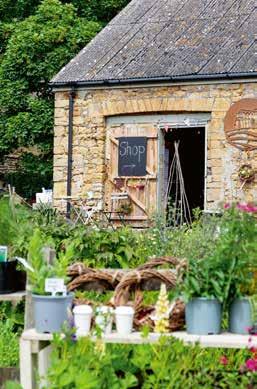
It’s no surprise that in the achingly picturesque village of Abbotsbury there should be an impossibly pretty cut-flower farm. Abbey Farm Flowers, founded by friends Amy Ralph and Emma Hughes, is based in a converted piggery, looking out over a medieval tithe barn and a duck pond.The mallards happily waddle around the flower beds and occasionally poke their beaks into the shop – it’s hard to imagine a more bucolic setting.
From March to late October, the beds at Abbey Farm are a riot of colour, an ever-changing canvas of shrubs, annuals and perennials. The emphasis is on sustainability and growing with the seasons, so you won’t find polytunnels or out-of-season flowers. Armed with a pair of snips you can pick your own blooms, or you can take home a ready-tied bunch from the shed by the gate. The pick-your-own buckets have proved popular with local weddings – one bride even picked her own bouquet on her way to the ceremony.
Abbey Farm Flowers is something of a passion project for both women. Amy has a background in horticulture and environmental education, while Emma managed a veterinary rehabilitation centre but always had green fingers.The flower farm’s historic setting comes with some special challenges. ‘We have a “no-dig policy,” as we’re in the grounds of the ruined Benedictine abbey and might disturb something of archaeological importance,’explains Amy. Instead, they plant into compost laid on top of existing ground.Traditional medicinal plants like wild clary have popped up in the beds nearest the abbey ruins, suggesting that the plot might once have been an apothecary garden. Inside the old piggery there’s a small but perfectly formed collection of garden-themed gifts and products by local makers.The place has become a bit of a social hub, with a monthly flower club, jewellery workshops and festive wreath-making classes in the winter, when the beds are bare.
ADDRESS The Piggery, Church Street, Abbotsbury, Weymouth DT3 4JJ, +44 (0)7583 250754, www.abbeyfarmflowers.co.uk TIP If you’re in need of a pick-me-up after picking your own at the flower farm, Cherry’s Café next to the Tithe Barn at Abbey Farm is the perfect spot for brunch or a light lunch (www.cherriesdorset.com).
The Swannery
Close encounters of the avian kind
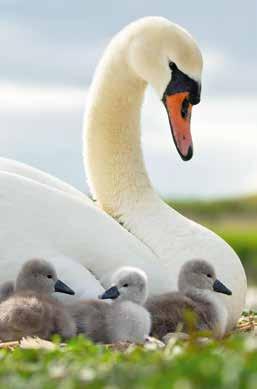
There’s only one place in Dorset you’ll find someone with the esoteric job title of swanherd, and that’s Abbotsbury Swannery. Steve Groves is the current swanherd, managing more than 600 Mute swans that nest on the Fleet Lagoon. The Swannery owes its existence to the 11th-century Benedictine monks at the nearby abbey who farmed the swans for food. Although meat and poultry were restricted to feast days, the monks bent the rules by deeming that swans, with their webbed feet and fishy taste, qualified as fish. Swans don’t normally live in colonies, but the monks’ birds thrived on the eel grass growing in the brackish water of the lagoon. When Henry VIII dissolved the monasteries, the abbey’s land and its swans were acquired by Sir Giles Strangways, whose descendants became the Earls of Ilchester. Fifteen generations later, the Swannery is still part of the Ilchester Estate.
It’s quite something to see these majestic creatures, who roam (and fly) freely around the 25-acre site, at such close quarters. The swans at Abbotsbury get five-star treatment: a tailored diet, ready-cut reeds for nest building, and separate pens for poorly birds and cygnets that need fostering. Despite, or perhaps because of, this pampering, the swans are not remotely bothered by visitors, but according to Steve they can give the staff who handle them a hard time. At midday and 4pm, the swannery staff arrive with a wheelbarrow full of grain, and volunteers are handed scoops to join in the mass feeding. Swan watchers in need of a snack can grab a bite at the Swannery Café.
Scattered around the stunning coastal site are information boards packed with fascinating swan-related facts. Who knew that Lloyd’s of London uses quills made from pinion feathers (collected during the annual moult) to keep a record in their ‘Loss’ ledger of ships sunk? Or that beekeepers gently sweep bees from honeycombs with a swan’s feather?
ADDRESS Abbotsbury Swannery, New Barn Road, Abbotsbury DT3 4JG, +44 (0)1305 871858, www.abbotsburyswannery.co.uk TIP During the English Civil War, Parliamentarians besieged Royalists in nearby St Nicholas Church. Check out the two bullet holes in the Jacobean pulpit, evidence of a skirmish in 1664.
Fire Monument
The brilliant Bastard Brothers
On the afternoon of 4 June, 1731, Blandford Forum changed forever. An overloaded furnace in the candle makers’workshop, rogue embers and a summer breeze sparked a blaze that burned the market town to the ground.The fire raged through thatched roofs, destroying homes and ruining lives (12 people were recorded to have died, but seeing as all the church records, kept at the town hall, were also lost, no one can be certain), until barely anything was left.
So, what happens when a whole town turns to cinders? You just build it back up. With a fair share of wealthy landowners in the area the word quickly reached London, which helped raise refurbishment funds; there were charity shows on Drury Lane, and even King George II donated a generous sum. Luckily, the town had a pair of accomplished architects and builders on hand. Whilst the Bastard Brothers may sound like a pair of cowboy tradesmen, they were far from it. John (1668–1770) and William (1689–1766) Bastard were brothers with building in their blood – it was the family business after all. Walk through this Georgian town today and you’ll probably find yourself stopping to admire their handiwork. Highlights include the church, which is capped with a cupola instead of a spire, thanks to dwindling funds (they did have almost an entire town to rebuild); the fine detailing on their own home complete with a ‘The Bastards’ House’ blue plaque; and the regal-looking Corn Exchange with its perfectly placed archways.
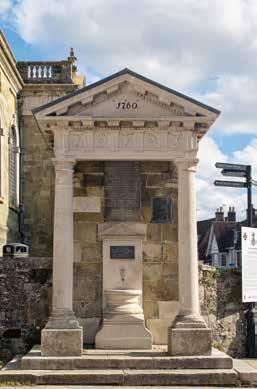
When Blandford’s rebuild was finished in 1760, John Bastard designed and paid for a monument to be built ‘In REMEMBRANCE of God’s dreadful Visitation by FIRE’. Constructed in the brothers’ classical style, this columned creation sat over a spring, and housed a working pump – just in case – before it was changed to a water fountain in 1899. What would Blandford have done without its brilliant Bastard Brothers?
ADDRESS Church Lane, Blandford Forum DT11 7AD TIP Ever wondered about military communications? How did they get messages to each other during the Napoleonic Wars? What exactly is semaphore? Find out at the Royal Signals Museum just outside Blandford Forum (www.royalsignalsmuseum.co.uk).
Badger Roundabout
Watch out, badgers about
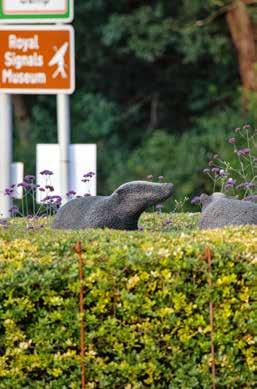
It’s not unusual to stumble upon badgers in Dorset. They’re all over the place: fields, woodlands, a roundabout. Yes, you read that right. You’ll find three of them on the aptly named Badger Roundabout near Blandford St Mary. They’re not real badgers, but they look real enough to make you do a double-take. Crafted from galvanised chicken wire by local artist Helen Godfrey, these mustelid mirror images moved in in 2013, and apart from the odd badger kidnapping (and one badger’s brief relocation to a Wimborne roundabout), they’ve settled in well. They even inspired a ‘Badger Banksy’, an anonymous artist, who snuck around in the middle of the night transforming the trio into a whole host of characters, from tennis players for Wimbledon, Santa and his elves at Christmas, festival goers during the summer season, and even the late Queen Elizabeth II and her corgis, to name but a few.
The wiry trio were commissioned by Hall & Woodhouse, the Blandford-based brewers. The badger has featured on the company logo since 1875, making it one of the oldest registered trademarks in the country. Founded in 1777 by Charles Hall in the village of Ansty, the brewery originally supplied local workers. Hall, an astute businessman, also won a licence to serve Wellington’s troops stationed in Weymouth during the Napoleonic wars. The ampersand was added when Charles’ son Robert inherited the brewery and his niece Hannah married Edward Woodhouse. As a wedding present Robert made Edward a partner in the business.
Today, as well as brewing in Blandford, Hall & Woodhouse also runs pubs, but it’s their Badger Beers that are their ‘crown jewel’. With names like ‘Fursty Ferret’ and the ‘Cranborne Poacher’, these pints are as charismatic as the badgers featured in their logos for over 100 years – and most definitely as charming as the three who have made a happy home amidst the steady stream of traffic.
ADDRESS what3words ///hydrant.sensitive.cork, the nearest postcode is DT11 9PU TIP There are other mustelids to spot in Blandford. A walk through the park along the River Stour might offer you a fleeting glimpse of an otter.
Red Signpost
Convicts this way
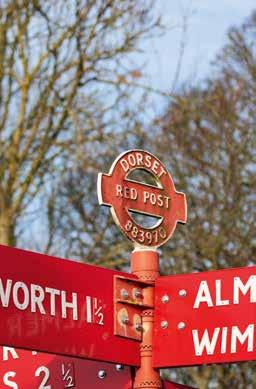
We’ve all taken a wrong turn at some point on our travels, and it’s easily done on Dorset’s twisting, turning, narrow country roads. Luckily, because of the General Turnpike Act of 1773, which made signposts at road junctions compulsory, you’re never far from a helpful fingerpost to get you back on track. Most of the remaining 700 or so Dorset fingerposts are the traditional white with black lettering, but there are four painted a blood-curdling crimson. Found at Hewood, Poyntington, Benville and on the busy A31 near Bloxworth, these red signposts tell us much more than just the way: their vivid colour hints at a violent history.
Like many stories surrounding some of Dorset’s oddities, there’s a bit of speculation. Some say these posts marked the site of gallows, or even the crossroads where suicides were traditionally buried. The most common theory though, and one that fits with the best-known sign on the A31, is that they acted as route markers for convicts, and their often illiterate prison guards, as they marched from Dorchester to Portsmouth for deportation. They may have been muster points or directional aids, or simply showed where to stop for the night. In 1787, when the infamous First Fleet left Portsmouth for Botany Bay, Sydney, there’s a good chance that the men, women and children (yes, they deported children) on board may have trudged past this wellknown waymarker.
The proximity of the Botany Bay Inne and Botany Bay farm to the Bloxworth sign lends credibility to the deportation route story. One version even suggests that the convicts were held overnight at the farm, shackled to the barn wall.
Today that road is busy, not with convicts, but cars carrying commuters and holidaymakers: thousands of people passing a lone red signpost that marks not just the 13.5 miles to Dorchester, but all the way back into Dorset’s dark past.
ADDRESS Blandford Forum DT11 9EY, what3words ///standing.regulates.iterative TIP Two miles east on the A31, look out for the stag on the gateway to the Drax family’s Charborough House. He has an extra leg so that he appears to have four legs, whatever angle he’s viewed from.