
The Swannery
Close encounters of the avian kind
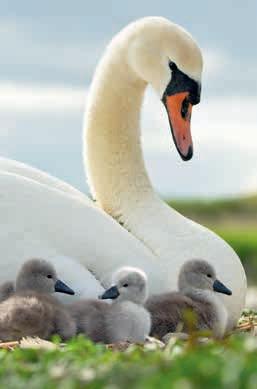
There’s only one place in Dorset you’ll find someone with the esoteric job title of swanherd, and that’s Abbotsbury Swannery. Steve Groves is the current swanherd, managing more than 600 Mute swans that nest on the Fleet Lagoon. The Swannery owes its existence to the 11th-century Benedictine monks at the nearby abbey who farmed the swans for food. Although meat and poultry were restricted to feast days, the monks bent the rules by deeming that swans, with their webbed feet and fishy taste, qualified as fish. Swans don’t normally live in colonies, but the monks’ birds thrived on the eel grass growing in the brackish water of the lagoon. When Henry VIII dissolved the monasteries, the abbey’s land and its swans were acquired by Sir Giles Strangways, whose descendants became the Earls of Ilchester. Fifteen generations later, the Swannery is still part of the Ilchester Estate.
It’s quite something to see these majestic creatures, who roam (and fly) freely around the 25-acre site, at such close quarters. The swans at Abbotsbury get five-star treatment: a tailored diet, ready-cut reeds for nest building, and separate pens for poorly birds and cygnets that need fostering. Despite, or perhaps because of, this pampering, the swans are not remotely bothered by visitors, but according to Steve they can give the staff who handle them a hard time. At midday and 4pm, the swannery staff arrive with a wheelbarrow full of grain, and volunteers are handed scoops to join in the mass feeding. Swan watchers in need of a snack can grab a bite at the Swannery Café.
Scattered around the stunning coastal site are information boards packed with fascinating swan-related facts. Who knew that Lloyd’s of London uses quills made from pinion feathers (collected during the annual moult) to keep a record in their ‘Loss’ ledger of ships sunk? Or that beekeepers gently sweep bees from honeycombs with a swan’s feather?
Address Abbotsbury Swannery, New Barn Road, Abbotsbury, Dorset DT3 4JG, +44 (0)1305 871858, www.abbotsburyswannery.co.uk | Getting there By car, take the B 3157; bus X53 or X52 to llchester Arms, then a 10-minute walk to the Swannery entrance gates | Hours Mid Mar – end Oct, daily 10am – 4pm | Tip During the English Civil War, Parliamentarians besieged Royalists in nearby St Nicholas Church. Check out the two bullet holes in the Jacobean pulpit, evidence of a skirmish in 1664.
Badger Roundabout
Watch out, badgers about
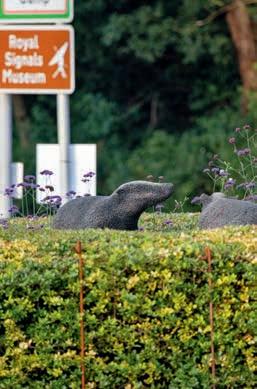
It’s not unusual to stumble upon badgers in Dorset. They’re all over the place: fields, woodlands, a roundabout. Yes, you read that right. You’ll find three of them on the aptly named Badger Roundabout near Blandford St Mary. They’re not real badgers, but they look real enough to make you do a double-take. Crafted from galvanised chicken wire by local artist Helen Godfrey, these mustelid mirror images moved in in 2013, and apart from the odd badger kidnapping (and one badger’s brief relocation to a Wimborne roundabout), they’ve settled in well. They even inspired a ‘Badger Banksy’, an anonymous artist, who snuck around in the middle of the night transforming the trio into a whole host of characters, from tennis players for Wimbledon, Santa and his elves at Christmas, festival goers during the summer season, and even the late Queen Elizabeth II and her corgis, to name but a few.
The wiry trio were commissioned by Hall & Woodhouse, the Blandford-based brewers. The badger has featured on the company logo since 1875, making it one of the oldest registered trademarks in the country. Founded in 1777 by Charles Hall in the village of Ansty, the brewery originally supplied local workers. Hall, an astute businessman, also won a licence to serve Wellington’s troops stationed in Weymouth during the Napoleonic wars. The ampersand was added when Charles’ son Robert inherited the brewery and his niece Hannah married Edward Woodhouse. As a wedding present Robert made Edward a partner in the business.
Today, as well as brewing in Blandford, Hall & Woodhouse also runs pubs, but it’s their Badger Beers that are their ‘crown jewel’. With names like ‘Fursty Ferret’ and the ‘Cranborne Poacher’, these pints are as charismatic as the badgers featured in their logos for over 100 years – and most definitely as charming as the three who have made a happy home amidst the steady stream of traffic.
Address what3words ///hydrant.sensitive.cork, the nearest postcode is DT11 9PU | Getting there By car, look out for the badgers where the A 354 and A 350 meet at the roundabout near Blandford St Mary; buses X8, CR8 and CR9 all stop at Blandford St Mary, outside Tesco | Hours You can’t get onto the roundabout, but you can see the badgers 24 hours a day | Tip There are other mustelids to spot in Blandford. A walk through the park along the River Stour might offer you a fleeting glimpse of an otter.
Mercato Italiano
A taste of la dolce vita in Dorset
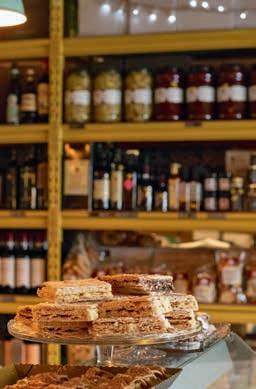
Tucked away next to a carpet warehouse on the Dreadnought Trading Estate, Mercato Italiano is an unusual foodie destination. The business is the brainchild of Ilaria Padovani and her husband Rob McVey, who’ve transformed an industrial unit into a buzzy café, deli counter and wholesale outlet selling the finest Italian produce. The 1970s brutalism of the warehouse has an urban vibe, but it’s a cheerful, vibrant space. Bright red metal chairs and tables bear the scuffs of a previous life in a Belgian circus, while classic Italian products are stacked on the yellow shelving. The jars of olives, San Marzano tinned tomatoes, olive oil and pasta shapes are an integral part of the décor. There are seasonal treats, too –panettone at Christmas and dove-shaped ‘Colomba di Pasqua’ cake at Easter. At the deli counter there’s a mouthwatering selection of cheeses and salami that customers are encouraged to try before they buy. The wines are mostly from Veneto, Ilaria’s home region. ‘Provenance is really important to us,’ she says. ‘We know all our producers.’
Ilaria’s foodie credentials are impeccable: she has a degree in the Science of Gastronomy from the University of Parma. It was always her ambition to have her own business, and she started small with a stall in Bridport market before moving into wholesale, supplying restaurants in the West Country. The move to the warehouse was a game changer, giving the couple space to expand. Ilaria’s loyal market stall customers followed her to the industrial estate for mid-morning espressos and cannoli. ‘We were very happy to see customers eating the food that we’d been selling from our market stall,’ she says. It wasn’t long before Ilaria and Rob added a pizzeria with a DJ booth. The final touch was Mercato Nero, a cocktail bar on the mezzanine floor dedicated to the ‘definitive Italian aperitivo’.
Address Unit 3B Dreadnought Trading Estate, Bridport DT6 5BU, +44 (0)1308 459274, www.mercatoitaliano.uk | Getting there Buses X51 and X53 stop at Bridport bus station, then it’s a 3-minute walk; limited parking outside the café | Hours Café and deli Mon & Tue 10am – 4pm, Wed – Sat 9am – 10pm; pizzeria and Mercato Nero Wed – Sat 5 – 11pm | Tip Seafood fans should head to Davy’s Locker, a retail and wholesale fishmonger around the corner from Mercato Italiano on the Dreadnought Estate (www.davyslocker.co.uk).
Charmouth Heritage Coast Centre
Focused on fossils
Ever fancied being a fossil finder? Dreamt of discovering dinosaur remains? Perhaps you just adore ammonites? If that’s the case, then a trip to Charmouth is in order. The sound of hammers chinking against rocks rings out across the beach, as professionals, enthusiasts and families hunt for Jurassic treasure. But, before you embark on any excavations, stop by the Charmouth Heritage Coast Centre. Here you’ll find all the fossil information and inspiration you could possibly need, for free.
What started as a tabletop display in the seafront car park in the 1980s has transformed into an educational centre, with ever-changing exhibitions of specimens found in the local area by collectors. And it seems dinosaurs have been in this building’s destiny for some time. In 1858, when the centre was a cement works, local resident James Harrison spotted the skeleton of a Scelidosaurus (think heavily armoured herbivore) in the stone and saved it from becoming building material.
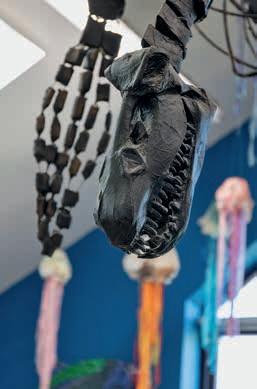
Today, the centre’s collection sparks the imagination of scientists and artists alike. Suspended from the back-room ceiling hangs ‘Bones’, an affectionately named plesiosaur model, created by local children and artist Darrell Wakelam. These sea-dwelling creatures lived in Dorset’s waters around 215 million to 66 million years ago, and standing beneath this life-sized reconstruction you can’t help but marvel at Dorset’s epic history.
Some of the most common specimens you can find on the beach, such as the spiral-form ammonite and the torpedo-shaped belemnite, are the remains of molluscs. To learn more about the art of fossil-hunting from an expert, join one of the centre’s regular walks. Who knows what you’ll find – maybe you’ll discover something that will take centre stage in the local finds cabinet.
Address Lower Sea Lane, Charmouth DT6 6LL, www.charmouth.org | Getting there By car, turn off the A 35 into Charmouth, and follow signs for the seafront car park; Jurassic Coaster buses X51 and X53 stop at St Andrews Church, a 10-minute walk away | Hours Peak season daily 10.30am – 4.30pm; Nov – Mar Mon, Tue, Sat & Sun; closed at Christmas (see website for seasonal opening times) | Tip Hungry after all that fossil hunting? Stop by The Royal Oak in Charmouth for traditional pub food and refreshments (www.royaloakcharmouth.co.uk).
The Fleet Lagoon
Smugglers’ tales
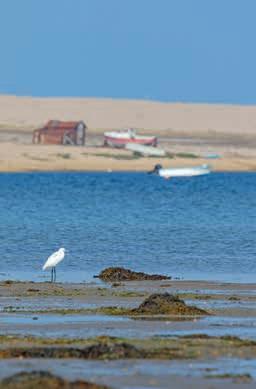
It must be hard to live in the shadow of something as impressive as Chesil Beach, where the sea has perfectly graded 100 million tonnes of shingle from pea- to potato-sized. But the Fleet Lagoon, running behind its steep banks, from Abbotsbury to Portland, is more than capable of holding its own. It might not be as mighty as Chesil (it’s only 8.2 miles long compared to the beach’s impressive 18 miles), but it makes up for it with a rugged wildness and roguish history.
Smuggling is a common thread woven through Dorset’s heritage. And in the 18th and 19th centuries, this tidal lagoon was a smuggler’s dream for hiding stolen goods. Barrels, called ‘tubs’, containing contraband were landed at Chesil, before being hauled up and over its slopes and stashed in the Fleet’s shallow waters. Unsuspecting revenue men would stroll by, entirely unaware of all the tea or French brandy bobbing below. It didn’t always go to plan, though. One particularly bad storm in 1822 freed some of the hidden tubs, resulting in a frantic race between the revenue boat and the smugglers, both desperate to retrieve the contraband washed away by the waves. On taking the lead, one smuggler added insult to injury by ‘striking his posterior in derision’ as they sailed smugly past the revenue men.
Today, instead of stolen goods, you’ll find over 150 species of seaweed under the surface. And whilst you’re unlikely to cross paths with smugglers, the Fleet is perfect for a spot of birdwatching. From April to October, you can take to the water on the Fleet Explorer – Dorset Wildlife Trust’s boat, designed to reach the shallower sections where you can get better views of birds like little egrets, ringed plovers, or the little terns that breed here during the spring. It’s certainly worth paying a bit more attention to this often-overlooked stretch of brackish water brimming with wildlife and rebellious history.
Address The Fine Foundation Wild Chesil Centre, Portland DT4 9XE | Getting there
By car, from Weymouth take the A 354 towards Portland; park at the Wild Chesil Centre (the Fleet Explorer runs from here), and head out on foot; bus 1 to The Ferrybridge and then a 9-minute walk | Hours Accessible 24 hours; Fleet Explorer Apr – Oct (www.dorsetwildlifetrust.org.uk) | Tip In need of refreshments after all that exploring? The Cove House Inn is the ideal place to recharge with plentiful beverage options, fresh food, and some impressive sea views (www.thecovehouseinn.co.uk).
Drop the Anchor Brewery
Hop to it
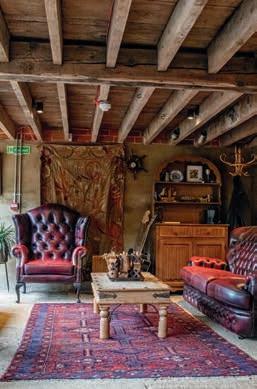
If you’re after a drinking establishment with as much character as its beer, you need to swing by Drop the Anchor Brewery. It’s made itself at home in the red-brick buildings of a disused dairy farm, with charming vintage finds decorating its cosy tap room. This is the kind of place you want to pull up a chair and settle yourself in for a sampling session.
Neil Hodgkinson’s beer-brewing adventures began with a mission to make an all-natural ale. Many breweries today use preservatives and things like isinglass (fish bladders, to the uninitiated) to help the beer settle more quickly and give a clear, crisp finish. But Neil opted for a more natural solution, and one closer to more traditional brewing methods. ‘We’re sort of the last of the old school,’ he explains. So, you won’t find any fish bladders here, only preservative-free, vegan-friendly beverages on tap. He’s clearly doing something right, judging by the number of awards he’s picked up along the way: 23 (and counting) CAMRA Champion Beers. With around 100 brewing recipes in his pocket, including some Willy Wonka-sweet-inspired flavours, Neil has gotten good at keeping even the most avid ale experts on their toes.
And it’s not just about the beer. There’s food and vibes as well. Chris Rowland of Origins BBQ is the resident chef, whipping up flavoursome feasts to accompany a lively year-round events programme that includes the ever-popular Twelve Beers of Christmas and music nights where bands and DJs take to the stage in the old barn. The sense of community and friendly atmosphere here is as palpable as the heady scent of hops that greet you on arrival. Long tables stretch out in the courtyard, chess boards sit in quiet corners, and a welcoming smile waits behind the bar. Drop the Anchor Brewery is a place to make new friends, as well as find your new favourite tipple.
Address Building 9, East Close Farm, Lyndhurst Road, Hinton, Christchurch BH23 7EF, www.droptheanchorbrewery.co.uk | Getting there By car, from Christchurch, follow the A 35 towards Lyndhurst. The brewery is on the right roughly a mile after the Cat and Fiddle. | Hours Fri & Sat 1 – 8pm, Sun 1 – 6pm | Tip Steamer Point is a multi-habitat nature reserve at nearby Friars Cliff, offering the opportunity to take in a sea view whilst wandering through the woods.
The Pilot Boat
How a Dorset dog found Hollywood fame
She made her screen debut with Elizabeth Taylor in 1943, starred in a long-running television series and was awarded a star on the Hollywood Walk of Fame. She even had her own tinned food line in the 1960s. Lassie was one of the world’s most famous fictional canines, but her back story is less well-known, beginning with a World War I maritime disaster.
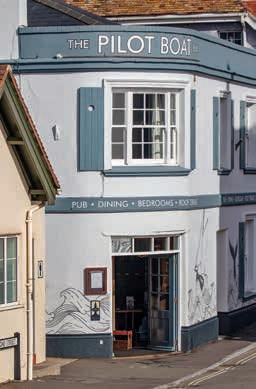
Lassie’s inspiration was a collie belonging to Tommy Atkins, the landlord of the Pilot Boat Hotel in Lyme Regis. The landlord’s wife was epileptic and, when she suffered a fit and lost consciousness, Lassie would raise the alarm by barking, and lick her face to bring her round. It was a talent that would come into its own on 1 January, 1915, when a German U-boat torpedoed and sank HMS Formidable in Lyme Bay. Forty-eight survivors and nine bodies were landed at Lyme Regis and taken to the Pilot Boat Hotel. Residents rallied round with blankets, food and hot-water bottles to revive the victims, many of whom were suffering from hypothermia. The hotel cellar became a temporary mortuary, and among the bodies was Able Seaman John Cowan. At some point, Lassie made her way into the cellar and started barking and licking Cowan’s hand. The rescuers upstairs heard her and discovered faint signs of life in the sailor. He was whisked off to the cottage hospital and, during his convalescence, Lassie never left his side.
This act of canine heroism was reported in the national press and Lassie became a celebrity. Her fame spread worldwide and caught the attention of a boy called Eric Knight, who went on to become a writer. His short story ‘Lassie Come Home’ was published in The Saturday Evening Post, a US weekly magazine. Knight turned it into a novel, which was picked up by Metro-Goldwyn-Mayer and made into the eponymous film in 1943. Sadly, there’s no record of what became of the inspiration for Knight’s rough-coated heroine.
Address 1 Bridge Street, Lyme Regis DT7 3QA, +44 (0)1297 443157, www.thepilotboat.co.uk | Getting there Buses 378, X51 and X53 stop at Lyme Regis Square. The museum is a minute’s walk away up Bridge Street. | Hours Licensed hours daily noon – 11pm; food 9am – 9pm | Tip You can find out more about the sinking of HMS Formidable on the second floor of Lyme Regis Museum, a short walk up the hill from the Pilot Boat.
Jailhouse Diner
A café that rocks
In 1845, the Admiralty decided to create a harbour in Portland by building a breakwater. There was just one problem – a shortage of quarry workers to break the stone. The solution? Build a prison and use convict labour. By 1848, the sheer walls of HMP Portland dominated the once-isolated village of The Grove. Houses for prison staff and their families sprang up in its shadow, and some enterprising residents opened tea rooms in the upstairs of their homes so visitors could watch the convicts at work.
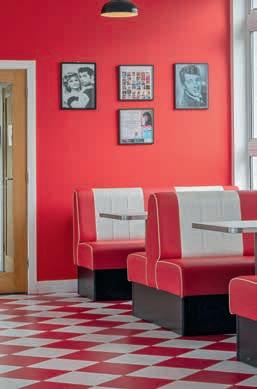
Nearly two centuries later, social attitudes have changed, as The Jailhouse Diner demonstrates. Located close to the gates of HMP Portland and Young Offenders Institute, it’s run by Expia, a charity that aims to reduce re-offending by providing work opportunities and training for prisoners and ex-offenders. The interior is pure Americana, with leatherette booths, white Formica tables and chequerboard floor tiles. Black and white photos of Hollywood legends line the walls, and pancake stacks, burgers and milkshakes are the main events on the menu. The life-sized cutout of Elvis in the corner provides endless selfie opportunities. Expia had already launched two projects on Portland: the Jailhouse Café at HMP The Verne and the Jailhouse Farm Shop. The diner was an ambitious next step. All three enterprises help prisoners develop skills and gain qualifications, as well as creating local employment. Rachel Barton of Expia explains: ‘The Grove was badly in need of a place that would serve local people, the prison staff and families visiting prisoners, as well as tourists.’
The very rundown Prisoner Officers’ Social Club across the road from the prison was in the ideal location for the diner. Expia raised the funds to transform an eyesore into a cheerful, light-filled space that brings together communities that rarely have the opportunity to mix.
Address 106 Grove Road, Portland, DT5 1DZ, + 44 (0)1305 824364, www.thejailhouse.co.uk | Getting there By car, leave Easton Road (A 354) at Grove Road, and the diner is at the very end of the road, with limited parking; the 1 Portland Link bus stops at Grove Road, then it’s a 20-minute walk | Hours Tue – Fri 9am – 2pm, Sat & Sun 9am – 3pm | Tip The South West Coast Path runs alongside the Jailhouse Diner, with spectacular views over Weymouth Bay and the Jurassic coastline towards Purbeck.
Big Yellow Bus Project
Planting seeds of hope
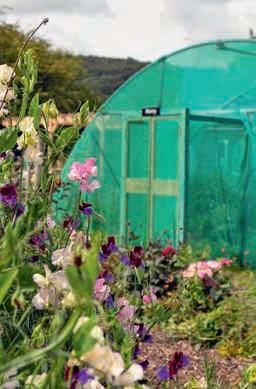
What would your dream garden consist of? A landscaped area with a beautifully curated willow tunnel, a wildlife pond complete with ducks and dragonflies, a BBQ and firepit to chill out by and enjoy it all from? Maybe a cut flower garden brimming with sweet peas and dahlias in the summer, or perhaps polytunnels filled with vegetables? How about an overflowing orchard? All pesticide-free, of course.
If any, or all, of those are on your list, then you need look no further than The Big Yellow Bus Garden Project. This four-acre community garden has all those things and more. Whether you want to come and pick your own flowers or vegetables, get your hands stuck in the soil, or just need a moment of calm, the garden is open to all to use as they wish.
But there’s more than just gardening going on here. The vegetables grown on site are sent to three different food banks, and schools and community groups run regular sessions within the space. Paul Williams, project founder, noticed the need for a connection to nature whilst he was working with young people with mental health issues. Initially at a smaller location, he got his hands on an old yellow bus and converted it into a classroom, and the seeds for the project were planted. Seeds grow, and tended by Paul and a team of volunteers the garden has transformed into what it is today: a safe space for everyone. Whilst on-site classrooms and potting sheds have replaced the yellow bus, the name has stuck, and so has its spirit.
Whether people are here to volunteer or to borrow a bike to explore the North Dorset Trailway, which passes right past the garden, they are all made to feel part of something. ‘The project isn’t about individuals, but community,’ Paul explains. And that is clear as soon as you step on site. If gardening is good for the soul, you’d be hard pushed to find a more nurturing, soothing space.
Address Blandford Road, Shillingstone, Blandford Forum DT11 0SQ, www.bigyellowbus.co.uk | Getting there By car, follow the A 357, the project can be found half a mile south east of Shillingstone | Hours Accessible 24 hours | Tip The village of Shillingstone earned itself the reputation of ‘the Bravest Village in Britain’ due to the number of residents who stepped forward to fight in World War I. An honour it wears proudly on its village sign.
Blue Vinny Vending Machine
The revival of a Dorset delicacy
Blue Vinny was reputed to be Thomas Hardy’s favourite cheese, but by the beginning of World War II it had all but disappeared from the county. A few farms carried on making Blue Vinny in secret, smuggling the distinctive blue-veined cheese to shops and customers. But by the 1970s, not even die-hard blue cheese lovers could get their hands on it.
The 1980s Blue Vinny revival is down to the efforts of one Dorset farmer, Richard Davies. It was the era of EU milk lakes and butter mountains, and he was tired of getting up at the crack of dawn to milk his herd for a product that nobody wanted. His training had covered cheesemaking, so he decided to have a go at producing Blue Vinny using a 300-year-old recipe and a second-hand vat in the garage. His first efforts were matured in the pantry and the resulting mould turned everything blue, including the walls. The cheese is now made in a converted cow barn.
There are many stories about how the blue veining was created in the past: adding slug slime to the milk, dragging mildewed harnesses through it or standing dirty wellies by the ripening cheese. Modern methods are more hygienic: ‘We add penicillium roqueforti,’ explains Richard’s daughter Emily. Keeping the flavour consistent is a challenge as it varies according to the cows’ diet. ‘We learned the hard way,’ she says. ‘Let’s just say that after the herd spent time in a turnip field, the milk tasted terrible.’ Now the 250-strong Woodbridge Farm herd of Holstein-Friesians are fed a carefully regulated diet.
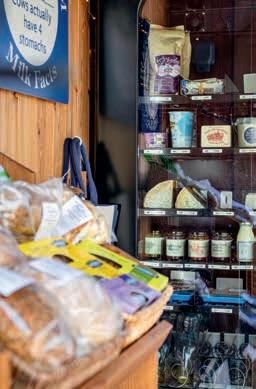
In 1998, the Woodbridge Farm Blue Vinny was awarded PGI (protected geographic indication) status, which means that anyone wanting to make the cheese must use the Davies’ recipe. Dorset’s traditional cheese is now widely available, but fromage fans looking for an outof-hours fix can find it in the Woodbridge Farm vending machine.
Address Woodbridge Farm, Stock Gaylard, Sturminster Newton DT10 2BD, +44 (0) 1963 23133, www.dorsetblue.com | Getting there By car, Woodbridge Farm is roughly midway between Bishop’s Caundle and Stock Gaylard on the A 3030 | Hours Daily 7am – 8pm | Tip The octagonal postbox at Barnes Cross, Holwell, is a 5-minute drive from Woodbridge Farm. Installed in 1853, it’s reckoned to be the oldest working pillar box in the UK.

Jeni Bell is a freelance writer based on the Wiltshire / Dorset border. Her work is inspired by nature and landscape. She has an MA in Nature and Travel Writing from Bath Spa University, and her work has been published in a variety of online and print publications. In 2022, Jeni won the Nature Writing Prize for Working Class Writers.

Karen Heaney turned her back on the city and relocated to West Dorset after two decades of living and working in London as a magazine journalist and editor. She now works as a freelance writer, contributing to a range of online and print publications. In her non-writing hours, she loves walking the drove roads and back lanes of her adopted county.
The information in this book was accurate at the time of publication, but it may change at any time. Please confirm the details for the places you’re planning to visit before you head out on your adventures.