12__ Better Than Jam Shoo-be, doo-be, dye
Though the entrance up the stairs is small and unassuming, this creative and clean artist’s paradise is nestled among coffee shops and thrift stores. With sewing machines, big tables, drying racks, and full beautiful light, Better Than Jam is a creative, communal space that packs a lot of energy into an ordinary storefront. The ground level is filled with local artists’ labors of love. Paper, ceramics and, most notably, textiles (hold for applause) are all attractively displayed for sale and discussion. A friendly and inviting environment, this is the place for 111 intricate “How do they make this stuff ?” conversations. Better Than Jam is the brainchild of Karin Persan, an artist and supporter of local creators, makers, and producers. She not only displays and sells works and goods from fellow artists, but she generously and passionately teaches classes and workshops about media like sewing, screen-printing, and textile dying. Try a beginner class on Shibori, the traditional technique of dying fabrics with indigo, whose methods remain largely unchanged since the 8th century. Grab a white shirt or dress from a thrift store around the corner or use samples of cotton material to make gorgeous bandana-sized pieces. Using the studio’s workspace means not permanently staining the bathtub blue, leaving you with beautiful and unique pieces to bring home. Sign up using Better Than Jam’s easy-to-navigate website, with classes offered at times throughout the day. Prior to class, enrollees will receive an email from Karin providing instructions about what to wear, how to get there, and what you’ll need. Group classes are a fun way to hang with friends and stretch some creative muscles. There are intermediate classes and space rental options are available as well. Better Than Jam is truly a mecca for people who long to create and aren’t afraid to get a little messy in the process. Dig in! 32
Address 20 Grattan Street, Brooklyn, NY 11206, +1 (929)441-9596, www.squareup.com/ market/better-than-jam-online | Getting there Subway to Morgan Avenue (L) | Hours Thu – Sun 1 – 7pm | Tip Free Tours By Foot offers just that – free walking tours of Bushwick’s graffiti art. Check the website for the schedule (www.freetoursbyfoot.com/ new-york-graffiti-street-art-tours/#brooklyn).
13__ Biggie Smalls’ Brooklyn Walk the streets of the legendary recording artist
For Glenn Gamboa, pop music writer for Newsday, Brooklyn is central to the work of Biggie Smalls. “One of the first things I did when I moved to Brooklyn was go to Biggie’s house,” he says, “because I really wanted to see where he came from. He and Jay-Z, they really did transform not just hip-hop, but pop music. It took a whole other turn because of them.” Christopher George Lattore Wallace, better known as The Notorious B.I.G. or Biggie, grew up in a late 1980s’ Clinton Hill that now, with the arrival of the Barclays Center and bands of gentrifiers, can be difficult to conjure. Gamboa speculates that his music helped fuel those changes. “Biggie helped create this idea of how Brooklyn was cool, even if it was a little dangerous. People moved here to be a part of that.” A number of sites that help tell Biggie’s story are clustered around his childhood home – the third-floor apartment at 226 St. James Place where he lived with his mother, Voletta – and offer the chance to glimpse fragments of his all-too-short life. Just around the corner, you’ll find Respect for Life (932A Fulton Street), the barbershop he frequented. The Key Food across the street (991 Fulton) was formerly the Met Food Supermarket where he bagged groceries and, later, dealt to make ends meet. Further along, Country House Diner (887 Fulton) was a favorite, where you can still order up the Big Poppa, “a T-bone steak, cheese eggs, and Whelch’s grape.” Parties at Orient Temple (197 St. James Place) are where the young Biggie honed the unique elements of his craft. “Before Biggie, hip-hop was still more or less party music and having a good time,” Gamboa explains. “The rhymes are fun, everything was happy. Biggie took it and captured the happiness, but he also described his life in a way that people who lived in Akron or all over the country could relate and understand.” 34
Address 226 St. James Place, Brooklyn, NY 11238 (home); see chapter for other addresses | Getting there Subway to Clinton – Washington Avenues (A, C) | Hours Unrestricted from the outside only | Tip Don’t miss the superb 38-foot mural of Smalls as King of NY by artists Scott Zimmerman and Maoufal Alouai, at the corner of Bedford Avenue and Quincy Street. Meanwhile, Notoriouss Clothing (514 Atlantic Avenue, Brooklyn, NY 11217, www.notoriouss.com) offers Biggie-inspired clothing at this shop run by the singer’s daughter, Tyanna Wallace.
56__ Gristle Tattoo Needles that relieve suffering
Combining an artistic impulse with public service, Gristle Tattoo perfectly straddles the twin poles of new Brooklyn’s socially conscious, creative style. A vegan tattoo parlor that supports local animal shelters, Gristle has an underlying ethic of treating living things with compassion, whether it’s a nervous, first-time tattoo recipient squirming in the chair or a scared kitten in need of a cozy home. That sense of mission originates among Gristle’s warm and welcoming staff, and is underscored in their 100% vegan tattoo process. Then, there are those binders full of adoptable kitties you can browse while you’re in the waiting area… “Tattoos are our priority. We just happen to be vegan,” owner Dina Dicenso clarifies, when asked to explain. “There are advantages to a vegan tattoo, even if you’re not living a strictly vegan life.” While tattoo ink is vegan, other parts of the process are not. “When people find out what’s in their stuff, they care,” she notes. Some inks, though not all, still have ingredients that are animal-derived. Stencil papers are commonly derived from lanolin. Disposable razors used in tattoo preparation often have that blue glycerine-based strip that contains animal-derived substances. Gristle also substitutes petroleum-based aftercare products like lotion with plant-based products. Unlike rats in clinical trials, you sign a waiver before the tattoo artist applies needle to skin. Appointments are strongly encouraged, and deposits for work can be made through links on the website. But, despite the longtime association of tattoo artists with toughness and rebellion, Gristle is the embodiment of how these stereotypes are changing. Gristle’s web presence makes it easy to participate in their pet adoption events with Whiskers-A-G-Go and RightMeowRescue, for example. Like much of hipster Brooklyn, the shop is a haven for people of diverse backgrounds looking for a refuge for free expression. This is anti-establishment cool – with a heart. 120
Address 26 Bushwick Avenue, Brooklyn, NY 11211, +1 (347)889-6422, www.gristletattoo.com, info@gristletattoo.com | Getting there Subway to Graham Avenue (L) | Hours To make an appointment, email info@gristletattoo.com | Tip Another local animal rescue is Badass Brooklyn. Look for adoption events and opportunities to foster dogs in need, as well as fun fundraisers, many involving dogs and drinks (www.badassbrooklyn.com).
57__ Halva at Sahadi’s
The bliss of that sweet, perfect crumble
If “Sahadi’s halva” were in the dictionary, you might just find this definition: “a tasty treat that takes its name from a Yiddish word derived from a Turkish word with Arabic roots meaning ‘sweet confection,’ made by a grocer of Middle Eastern foods founded in Victorian Manhattan that’s been a beloved Brooklyn institution for more than 65 years.” That’s it in a nutshell. Originally from Lebanon, the Sahadi family opened a shop on Atlantic Avenue in 1948, landing in the middle of what was an historic Arab community that ran along the thoroughfare to the waterfront. Though the local real estate has transitioned and much of that community has since scattered, this grocer preserves a bit of that past. No mere historical anachronism, however, Sahadi’s goods remain the borough’s benchmark for ingredients by connoisseurs of Middle Eastern cuisine. The market’s stellar reputation extends even to the national level, as it recently won a James Beard America’s Classics Award as one of the country’s top groceries. Ron Sahadi, co-owner and grandson of the founder of the Brooklyn store, sums it up, “We were artisanal before it was cool.” Each of Sahadi’s halvas are produced locally by the same family for more than 50 years. The classic vanilla plain halva, suffused with the honied tastiness of crushed sesame combined with sugar and palm oil, can be eaten alone or, perhaps, blended into that bowl of ice cream you’ve saved for dessert. A second variety offers a slight variation courtesy of delicious pistachio bits. Finally, don’t miss the marbled halva, whose flavor is supplemented with just the right amount of dark chocolate as well as almonds and cashews. While Sahadi’s is the epicenter of halva in New York City, variations on this sweet treat can actually be found across the Middle Eastern diaspora throughout Africa, Asia, Europe, and the Americas. But no matter where you hale from, or what spelling variation you prefer, each bite is worth savoring. 122
Address 187 Atlantic Avenue, Brooklyn, NY 11201, +1 (718)624-4550, www.sahadis.com | Getting there Subway to Borough Hall (2, 3, 4, 5) | Hours Mon – Sat 9am – 7pm | Tip Since the 1920s, Joyva, a company founded by Nathan Radutzky and named for his daughter – you guessed it – Joy, has also been creating lovely halva and other luscious sweets in their Brooklyn factory (www.joyva.com).
58__ Handball Courts at Pier 2 Bouncing off the walls at Brooklyn Bridge Park
Playing handball at Pier 2 might just be like no other sporting experience you’ll ever have. The water lapping at boulders that form the shoreline plays against the steady thrum of double-decker lanes of traffic on the BQE, above which sits a stately row of elegant Brooklyn Heights townhouses. As if that weren’t enough, to the north, the iconic Brooklyn Bridge gracefully spans the East River, joining Brooklyn to a Manhattan that seems larger than life, behemoth glass towers shimmering in light. In the late afternoon, that light often migrates from pumpkin orange to blood red as the sun sets beyond Ellis Island and Lady Liberty. You can be forgiven if, with this feast of the senses all around, you occasionally lose track of the score. Handball arrived in the borough via the wave of Irish immigrants who came over in the late 19th century. A one-wall version, the most popular outdoor variant of the game in Brooklyn, gradually evolved when beachgoers played against walls at Coney Island. Later, growth in the sport came when FDR’s Works Progress Administration constructed courts throughout the city. With over five acres of area, the six handball courts, covered for all-weather play, are only a portion of what’s on offer at Pier 2. There are five full basketball courts (two covered), as are one bocce and three shuffleboard courts. A workout area offers fitness equipment, including specific ADA-approved pieces. There are swing sets and play areas for younger members of the sporty set, and picnic tables to take five and grab a drink. A roller rink, operated privately with skate rental available, is open at the water’s edge. Free kayak use is available during the summer on a first come, first served basis. Kayak instruction is available for 11- to 18-year-olds, with a focus on safety. Space is limited, so check the website for details. Lockers are available for 25¢. 124
Address Pier 2, Brooklyn Bridge Park, Brooklyn, NY 11201, +1 (718)222-9939, www.brooklynbridgepark.org/park/pier-2 | Getting there Subway to High Street (A, C), to York Street (F), to Clark Street (2, 3), or to Court Street (R); ferry to DUMBO – Brooklyn Bridge Park Pier 1 (East River or South Brooklyn) | Hours Daily 6 – 11pm | Tip Handball courts abound throughout the borough. Check out the New York Park Department’s website for locations (www.nycgovparks.org/facilities/handball, then click the Brooklyn tab).
59__ Harbor Defense Museum Letting objects tell the story of war
From the promontory of Fort Hamilton, a brief three-minute walk from the beautifully preserved Caponier that houses the Harbor Defense Museum, visitors to this hidden gem at Brooklyn’s edge will have a spectacular up-close view of the Verrazano-Narrows Bridge. That view turns out to be important, as it provides the starting point for the story of why the fortress was built. The shoreline just beyond the streams of traffic on the Belt Parkway served, in late summer 1776, as the landing ground for the British troops that engaged Washington’s colonial army in the Battle of Brooklyn. That conflict made the strategic importance of the Narrows, as the principal entrance to the city’s harbor, absolutely clear. When the War of 1812 reinforced this defensive need, Fort Hamilton was built. Though never under attack, it has stood ready to protect the harbor since its completion in 1831. One of a network of around 60 museums operated by the Department of Defense, director Justin Batt notes that the prime directive for each is to “stick to your story.” Accordingly, the museum’s collection of over 3,000 artifacts, many contributed by those who served here, have been astutely culled to distill this long and complex history. If available, one of the volunteer docents will provide rich texture to the materials on display. From reproduction Revolutionary War uniforms and a Civil Warera Howitzer, to cannonballs and projectiles that highlight the evolution of ammunition, the exhibition traces the story of the American military in broad brushstrokes. For a more individual human touch, be sure not to miss the artifacts that tell the story of Gunner First Class Angelo Rizzo, a Brooklyn native who served in the Coastal Artillery Corps during World War I. Rizzo’s diary allows us to follow the troop movements in France, culminating in 47 harrowing days of battle on the front at Argonne. 126
Address 230 Sheridan Loop, Brooklyn, NY 11252, +1 (718)630-4349, www.harbordefense-museum.business.site | Getting there Subway to Bay Ridge–95 Street (R), take bus (B 8) to Fort Hamilton Parkway, then walk south along Fort Hamilton Parkway to the base entrance; parking is available | Hours Tue – Fri 10am – 4pm | Tip Budget 15 to 20 extra minutes in order to be admitted to the US Army Garrison at Fort Hamilton. A photo ID is required, and you will need to complete an admission form at the base’s Visitor’s Center. If you choose to drive, you will also need to provide proof of insurance and registration.
60__ Highest Subway Station Taking “elevated” platforms to the extreme
It’s difficult to think of the stop at Smith and 9th Streets as “sub” anything. Coming in a 87.5 feet above ground, the platforms for this stop on the F and G lines offer the fearful a chance to exchange claustro- for acrophobia. Make a brief pitstop on your next ride to and from Prospect Park for distinctly different cityscapes. The platform sits above the Culver Viaduct, part of a mile-long stretch of track connecting Park Slope and Carroll Gardens. The Coney Island-bound platform offers, on its west end, an unobstructed view of lower Manhattan that shows off the city in all its audacious architectural might. This is Jay McInerney’s Bright Lights, Big City, the playground of Tom Wolfe’s “masters of the universe.” Tall glassy towers that glimmer and gleam in the right sunlight dominate, though humanized by the carpet of building tops that fill the space between and the rattle and hum as the subway trains come and go. Pride of place goes to One World Trade Center, which stands in the place of the former Twin Towers, clocking in at 104 stories, or 1,776 feet tall – with its antenna. Wander down to the east end of the same platform to peer down into the Gowanus Canal as it winds its way toward the sea and passes under the ever-bustling BQE. Still a working canal, and an EPA Superfund site being brought back to life by the efforts of locals, the waterway is what necessitated this passage of above-ground subway. On the return trip, the City-bound platform offers a distinct set of perspectives. The eastern end looks out toward the Williamsburg Bank and the Atlantic Yards, being transformed daily through the rise of impressive skyscrapers rivalling those of Manhattan. Meanwhile, the west end offers a view out past the docks of Red Hook toward the harbor where, if the timing is right, you will enjoy a view of Lady Liberty bathed in gorgeous amber light. 128
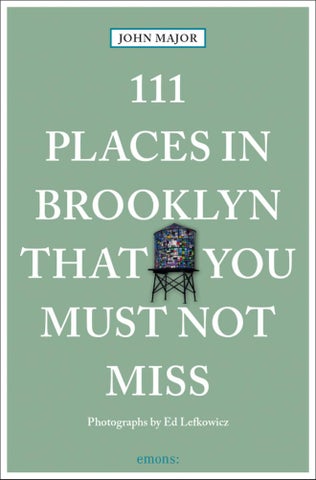
The author John Major writes about art and culture, especially events and places in Brooklyn, his home for the last 12 years. He is also writing a memoir about life as a stay-at-home father of three managing a divorce and international relocation, uniquely told through pilgrimages to paintings by the Italian artist, Caravaggio. Originally from southern Ohio, John is a dedicated explorer of cities. Among his favorites are London (which he called home for a dozen years), Barcelona, Rome, and Paris. He is determined to never lose the sense of wonder from being a curious explorer, both at home and abroad.
The photographer Ed Lefkowicz is a commercial, corporate, and editorial photographer. A native New Englander who eventually moved to Brooklyn with his wife Cynthia, he enjoys exploring New York City life in all its storied quirkiness. Never without a camera, he chronicles the cognitive dissonances that color life in the boroughs with his alt website TheQuirkySide.com. As photo editor of Edible Queens magazine, he fancies himself a saveur and may have been the first to introduce the American term “foodie’’ to to the French.