1__ 40 South Street For those about to frock
Punks, hipsters, and lovers of funky secondhand fashion, take heed. This tiny boutique, owned by local rocker and renaissance woman Hilken Mancini, is jam-packed with handpicked, one-of-a-kind vintage styles that are just begging to be worn on stage or your next album cover. From retro graphic tees to disco-inspired dresses and chic blazers, the 1960s, 1970s, and 1980s – give or take a decade on either side – are all alive and well on the racks here. The store existed as a shop called Gumshoe for years before being transformed into a treasure chest of coed clothing, shoes, and accessories. It all began when Mancini, who has played in local bands like Fuzzy, The Monsieurs, and Shepherdess, crossed paths with Gumshoe owner Otto Johnson, a bartender at storied Boston punk club The Rathskeller (aka “The Rat.”). Johnson was using the space above the club to sell pre-owned clothing in addition to operating the space in Jamaica Plain, more of a warehouse than a store at the time. “He was only selling men’s vintage out of there,” Mancini recalls. “There wasn’t a dressing room or any track lighting.” The pair’s rock and roll roots made them the perfect match, and they decided to join forces around 2005. “He liked me because I was a musician who had just lost my record deal and was figuring out ways to make money,” she explains. “So I moved in and made it more of a store, and we split the rent.” Since then, she has carved out a special space that fits right into the already-artsy neighborhood. Aside from offering statement pieces and unique duds, 40 South Street doesn’t just look the part; the lifestyle is in its DNA, through and through. Mancini is the creator of Punk Rock Aerobics and was a cofounder of the Girls Rock Campaign Boston, which provides music education and enrichment programs to the future Joan Jetts and Debbie Harrys of the world. 10
Address 40 South Street, Jamaica Plain, MA 02130, +1 (617) 522-5066, www.fortysouthst.com | Getting there Subway to Green Street (Orange Line) | Hours Thu & Fri 1 – 7pm, Sat 11am – 6pm, Sun noon – 5pm | Tip Don one of your new-to-you outfits and walk a few doors down to Aviary (48 South Street, Jamaica Plain, www.aviarygallery.com), a community-centered art gallery and cultural space.
1__ 40 South Street For those about to frock
Punks, hipsters, and lovers of funky secondhand fashion, take heed. This tiny boutique, owned by local rocker and renaissance woman Hilken Mancini, is jam-packed with handpicked, one-of-a-kind vintage styles that are just begging to be worn on stage or your next album cover. From retro graphic tees to disco-inspired dresses and chic blazers, the 1960s, 1970s, and 1980s – give or take a decade on either side – are all alive and well on the racks here. The store existed as a shop called Gumshoe for years before being transformed into a treasure chest of coed clothing, shoes, and accessories. It all began when Mancini, who has played in local bands like Fuzzy, The Monsieurs, and Shepherdess, crossed paths with Gumshoe owner Otto Johnson, a bartender at storied Boston punk club The Rathskeller (aka “The Rat.”). Johnson was using the space above the club to sell pre-owned clothing in addition to operating the space in Jamaica Plain, more of a warehouse than a store at the time. “He was only selling men’s vintage out of there,” Mancini recalls. “There wasn’t a dressing room or any track lighting.” The pair’s rock and roll roots made them the perfect match, and they decided to join forces around 2005. “He liked me because I was a musician who had just lost my record deal and was figuring out ways to make money,” she explains. “So I moved in and made it more of a store, and we split the rent.” Since then, she has carved out a special space that fits right into the already-artsy neighborhood. Aside from offering statement pieces and unique duds, 40 South Street doesn’t just look the part; the lifestyle is in its DNA, through and through. Mancini is the creator of Punk Rock Aerobics and was a cofounder of the Girls Rock Campaign Boston, which provides music education and enrichment programs to the future Joan Jetts and Debbie Harrys of the world. 10
Address 40 South Street, Jamaica Plain, MA 02130, +1 (617) 522-5066, www.fortysouthst.com | Getting there Subway to Green Street (Orange Line) | Hours Thu & Fri 1 – 7pm, Sat 11am – 6pm, Sun noon – 5pm | Tip Don one of your new-to-you outfits and walk a few doors down to Aviary (48 South Street, Jamaica Plain, www.aviarygallery.com), a community-centered art gallery and cultural space.
2__ A4cade Kiddin’ around
What’s better than a dimly-lit emporium of retro video and pinball games? A dimly-lit emporium of retro video and pinball games that serves grilled cheese sandwiches and cocktails. At Central Square’s A4cade, the joint effort of beloved local restaurants Area Four and Roxy’s Grilled Cheese, nostalgia and kitsch are baked into every part of the experience, whether it’s the Pac-Man machine or a cheeky, Mario-inspired tiki drink called Princess Peach’s Downfall. There’s also an impressive selection of craft beers from area breweries and wines by the glass if you absolutely insist on acting like a grown-up. Roxy’s renowned grilled cheese sandwiches and burgers, which were born from a food truck, are the other stars of the show. This isn’t your average Kraft-singles affair. Rather, you’ll find dressed-up takes like the Mighty Rib Melt with a three-cheese blend, caramelized onions, and braised barbeque short rib, or the Green Muenster Melt, which combines North Country bacon and house-made guacamole. And it wouldn’t be a proper party without classic burgers and hot dogs, though veggie options are also available. If you were wondering, the games operate on the same token system you remember from those carefree days when you’d spend all afternoon furiously trying to defeat the Frogger machine, only to be rewarded with a plastic mood ring. There aren’t any prizes here, but there is booze, which more than makes up for it. For an extra dose of childhood happiness, grab a cone of vanilla soft serve or a cereal milkshake to sip while playing Mortal Kombat II and Galaga. Adding to the jovial atmosphere are near-nightly DJs spinning live and frequent events. “A4cade has no pretense or agenda – we just want to do fun stuff,” says Roxy’s founder and owner James DiSabatino. “From drag trivia to pinball tournaments and Area 51 parties, our vibe is just about having a good time.” 12
Address 292 Massachusetts Avenue, Cambridge, MA 02139, +1 (617) 714-3960, www.a4cade.com, a4cade@areafour.com | Getting there Subway to Central Square (Red Line) | Hours See website | Tip Sort through the racks at Boomerangs (563 Massachusetts Avenue, Cambridge, www.shopboomerangs.org) to find an old-school outfit that’s perfect for a leisurely day of Tetris and Skee-Ball.
2__ A4cade Kiddin’ around
What’s better than a dimly-lit emporium of retro video and pinball games? A dimly-lit emporium of retro video and pinball games that serves grilled cheese sandwiches and cocktails. At Central Square’s A4cade, the joint effort of beloved local restaurants Area Four and Roxy’s Grilled Cheese, nostalgia and kitsch are baked into every part of the experience, whether it’s the Pac-Man machine or a cheeky, Mario-inspired tiki drink called Princess Peach’s Downfall. There’s also an impressive selection of craft beers from area breweries and wines by the glass if you absolutely insist on acting like a grown-up. Roxy’s renowned grilled cheese sandwiches and burgers, which were born from a food truck, are the other stars of the show. This isn’t your average Kraft-singles affair. Rather, you’ll find dressed-up takes like the Mighty Rib Melt with a three-cheese blend, caramelized onions, and braised barbeque short rib, or the Green Muenster Melt, which combines North Country bacon and house-made guacamole. And it wouldn’t be a proper party without classic burgers and hot dogs, though veggie options are also available. If you were wondering, the games operate on the same token system you remember from those carefree days when you’d spend all afternoon furiously trying to defeat the Frogger machine, only to be rewarded with a plastic mood ring. There aren’t any prizes here, but there is booze, which more than makes up for it. For an extra dose of childhood happiness, grab a cone of vanilla soft serve or a cereal milkshake to sip while playing Mortal Kombat II and Galaga. Adding to the jovial atmosphere are near-nightly DJs spinning live and frequent events. “A4cade has no pretense or agenda – we just want to do fun stuff,” says Roxy’s founder and owner James DiSabatino. “From drag trivia to pinball tournaments and Area 51 parties, our vibe is just about having a good time.” 12
Address 292 Massachusetts Avenue, Cambridge, MA 02139, +1 (617) 714-3960, www.a4cade.com, a4cade@areafour.com | Getting there Subway to Central Square (Red Line) | Hours See website | Tip Sort through the racks at Boomerangs (563 Massachusetts Avenue, Cambridge, www.shopboomerangs.org) to find an old-school outfit that’s perfect for a leisurely day of Tetris and Skee-Ball.
3__ The Abiel Smith School “O” is for Opium, “P” is for Prostitution
In 1783, Massachusetts became the first state in the US to abolish slavery. As a result, it quickly amassed the highest concentration of free Blacks in the country. By the early 1800s, Boston was a hotbed of progressive black political activity. Writer and former slave Frederick Douglass, along with abolitionist and journalist William Lloyd Garrison, established Boston as a major stop on the touring abolitionist speaker circuit. With such a firm commitment to the raising of collective consciousness, it should come as no surprise that the first public school for free Black people in the country was founded here. The school began in 1798 at the home of former slave and son of the founder of Black Freemasonry, Primus Hall. When it outgrew his home, it moved to the basement of the African American Meeting House. Then, in 1815, when philanthropist Abiel Smith left significant funds “for the education of Black youth” in his will, it became the Abiel Smith School, officially joining the larger American public school system in 1816. Smith’s endowment allowed the construction of the current building, which opened its doors in 1835, hosting over 100 students in that first year. But the school was not without its scandals. There were frequent complaints about the quality of the teachers assigned here compared to white schools. In particular, there were complaints that one teacher was “visiting a house of ill fame” during the school day. And now archeological evidence points to the possibility that teachers were medicating their students as much as they were educating them! Tensions rose about the racial inequity in the city’s public school system until violence erupted in 1850. By 1855, courts forced the school system to integrate, and the Abiel Smith School closed, ultimately becoming a part of the African-American History Museum. 14
Address 46 Joy Street, Boston, MA 02114, +1 (617) 725-0022 x330, www.maah.org/ boston_campus | Getting there Subway to Park Street (Red or Green Line) | Hours Mon – Fri 10am – 4pm | Tip The Abiel Smith School is one of many stops in the Beacon Hill area that are on Boston’s African American Heritage Walking Trail. Find out more and download a map (www.maah.org/boston_heritage_trail).
3__ The Abiel Smith School “O” is for Opium, “P” is for Prostitution
In 1783, Massachusetts became the first state in the US to abolish slavery. As a result, it quickly amassed the highest concentration of free Blacks in the country. By the early 1800s, Boston was a hotbed of progressive black political activity. Writer and former slave Frederick Douglass, along with abolitionist and journalist William Lloyd Garrison, established Boston as a major stop on the touring abolitionist speaker circuit. With such a firm commitment to the raising of collective consciousness, it should come as no surprise that the first public school for free Black people in the country was founded here. The school began in 1798 at the home of former slave and son of the founder of Black Freemasonry, Primus Hall. When it outgrew his home, it moved to the basement of the African American Meeting House. Then, in 1815, when philanthropist Abiel Smith left significant funds “for the education of Black youth” in his will, it became the Abiel Smith School, officially joining the larger American public school system in 1816. Smith’s endowment allowed the construction of the current building, which opened its doors in 1835, hosting over 100 students in that first year. But the school was not without its scandals. There were frequent complaints about the quality of the teachers assigned here compared to white schools. In particular, there were complaints that one teacher was “visiting a house of ill fame” during the school day. And now archeological evidence points to the possibility that teachers were medicating their students as much as they were educating them! Tensions rose about the racial inequity in the city’s public school system until violence erupted in 1850. By 1855, courts forced the school system to integrate, and the Abiel Smith School closed, ultimately becoming a part of the African-American History Museum. 14
Address 46 Joy Street, Boston, MA 02114, +1 (617) 725-0022 x330, www.maah.org/ boston_campus | Getting there Subway to Park Street (Red or Green Line) | Hours Mon – Fri 10am – 4pm | Tip The Abiel Smith School is one of many stops in the Beacon Hill area that are on Boston’s African American Heritage Walking Trail. Find out more and download a map (www.maah.org/boston_heritage_trail).
69__ Liberty Hotel A jail gone upscale
Fortunately, the most you’ll be in for is a few nights at this jailhouse-turned-luxury-hotel. Opened in 1851 and constructed in the Boston Granite style, the Charles Street Jail was a joint effort between renowned architect Gridley James Fox Bryant and Reverend Louis Dwight. The result was a grand, light-filled space with facets of Romanesque and Renaissance architecture that eschewed the bleak prison stereotype. The inmates were also anything but typical: Malcolm X and Sacco and Vanzetti were among the famous names who got locked up here. Despite its pretty appearance, it wasn’t all skylights and rainbows. A combination of overcrowding and substandard living conditions led to a revolt and a declaration of constitutional rights violations in 1973, but it wasn’t until the end of 1990 that the jail was fully vacated. The building was purchased by Mass General Hospital the next year, and in 2001, work to transform the property began. In 2007, the Liberty Hotel finally opened its doors to the public. Many distinctive elements of the prison remain, including the breathtaking central atrium. A cupola, removed during construction in 1949, was rebuilt from scratch to be meticulously accurate to Bryant’s original design. The hotel’s bars and eateries, bearing playful names like Alibi and Clink, retained the original cells, guests-only retreat Catwalk sits on the same “runway” where inmates once walked, and the outdoor exercise area is now a chic courtyard lounge. Even new features incorporate nods to the jail, like the exposed brick and “Crime does not pay” poster that hangs in fine dining restaurant Scampo (Italian for “escape”). And each of the 298 guest rooms combine history with luxury, from the deluxe rooms to the suites with Charles River views. Don’t plan on staying the night? You can still take a guided tour to dive into the Liberty’s former life. 146
Address 215 Charles Street, Boston, MA 02114, +1 (617) 224-4000, www.libertyhotel.com, reservations@libertyhotel.com | Getting there Subway to Charles/MGH (Red Line) | Hours Unrestricted | Tip Mosey on over to Louisburg Square to explore more of Beacon Hill’s dark side, at the site of the Debutante Murder (85 Pinckney Street, Boston), the home where the pregnant niece of actor Montgomery Clift shot and killed her boyfriend in 1962 after he refused to marry her.
69__ Liberty Hotel A jail gone upscale
Fortunately, the most you’ll be in for is a few nights at this jailhouse-turned-luxury-hotel. Opened in 1851 and constructed in the Boston Granite style, the Charles Street Jail was a joint effort between renowned architect Gridley James Fox Bryant and Reverend Louis Dwight. The result was a grand, light-filled space with facets of Romanesque and Renaissance architecture that eschewed the bleak prison stereotype. The inmates were also anything but typical: Malcolm X and Sacco and Vanzetti were among the famous names who got locked up here. Despite its pretty appearance, it wasn’t all skylights and rainbows. A combination of overcrowding and substandard living conditions led to a revolt and a declaration of constitutional rights violations in 1973, but it wasn’t until the end of 1990 that the jail was fully vacated. The building was purchased by Mass General Hospital the next year, and in 2001, work to transform the property began. In 2007, the Liberty Hotel finally opened its doors to the public. Many distinctive elements of the prison remain, including the breathtaking central atrium. A cupola, removed during construction in 1949, was rebuilt from scratch to be meticulously accurate to Bryant’s original design. The hotel’s bars and eateries, bearing playful names like Alibi and Clink, retained the original cells, guests-only retreat Catwalk sits on the same “runway” where inmates once walked, and the outdoor exercise area is now a chic courtyard lounge. Even new features incorporate nods to the jail, like the exposed brick and “Crime does not pay” poster that hangs in fine dining restaurant Scampo (Italian for “escape”). And each of the 298 guest rooms combine history with luxury, from the deluxe rooms to the suites with Charles River views. Don’t plan on staying the night? You can still take a guided tour to dive into the Liberty’s former life. 146
Address 215 Charles Street, Boston, MA 02114, +1 (617) 224-4000, www.libertyhotel.com, reservations@libertyhotel.com | Getting there Subway to Charles/MGH (Red Line) | Hours Unrestricted | Tip Mosey on over to Louisburg Square to explore more of Beacon Hill’s dark side, at the site of the Debutante Murder (85 Pinckney Street, Boston), the home where the pregnant niece of actor Montgomery Clift shot and killed her boyfriend in 1962 after he refused to marry her.
71__ The Living Room Project Art patrons aren’t the only kinds of collectors
The Isabella Stewart Gardner Museum is well known for many things: its beautiful courtyard, its famous unsolved art heist, and its strict rules about not making any changes to the collection assembled by its original curator, Isabella Stewart Gardner. But showing art contemporary to the 21st century is not among those things. In fact, in recent years the museum has been finding subtle, creative ways to curate contemporary art within the constraints of its charter, including hosting process-based work that doesn’t stay in the space continuously. One such piece of art is The Living Room Project by Taiwanese artist Lee Mingwei. Mingwei isolates what seem like run-of-the-mill, everyday experiences, and he uses them to highlight moments of connection between people. The Living Room Project evolved out of Mingwei’s residency at the museum. It began as a temporary installation in 2000 of an actual living room at the Gardner, where Mingwei invited museum visitors and staff to gather and hang out with him and talk – in particular, about objects included in the décor, echoing Isabella Stewart Gardner’s once renowned salons. But The Living Room Project persists long after Mingwei’s temporary installation was dismantled. Twice a week, Boston-area residents act as “living room hosts” in the museum’s New Wing, sharing, as Isabella Stewart Gardner did, objects from a personal collection that they maintain. Originally the invitations to share a collection went out only to local artists, but then the circle expanded, and now well over 400 people have shared their personal obsessions with strangers. Entry to these events is free, but the museum does not list them on their website. So you’ll have to call to find out when they’re scheduled. But it’s worth the extra effort to see someone’s massive cupcake or glass eye collection, up close. 150
Address 25 Evans Way, Boston, MA 02115, +1 (617) 566-1401, www.gardnermuseum.org/ about/living-room-project, information@isgm.org | Getting there Subway to the Museum of Fine Arts (Green “E” Line) or to Ruggles (Orange Line) | Hours Wed – Mon 11am – 5pm | Tip If you’re seeking more contemporary art, saunter around the corner and check out Boston’s new MassArt Art Museum (MAAM) (621 Huntington Avenue, Boston, www.maam.massart.edu). It’s free!
71__ The Living Room Project Art patrons aren’t the only kinds of collectors
The Isabella Stewart Gardner Museum is well known for many things: its beautiful courtyard, its famous unsolved art heist, and its strict rules about not making any changes to the collection assembled by its original curator, Isabella Stewart Gardner. But showing art contemporary to the 21st century is not among those things. In fact, in recent years the museum has been finding subtle, creative ways to curate contemporary art within the constraints of its charter, including hosting process-based work that doesn’t stay in the space continuously. One such piece of art is The Living Room Project by Taiwanese artist Lee Mingwei. Mingwei isolates what seem like run-of-the-mill, everyday experiences, and he uses them to highlight moments of connection between people. The Living Room Project evolved out of Mingwei’s residency at the museum. It began as a temporary installation in 2000 of an actual living room at the Gardner, where Mingwei invited museum visitors and staff to gather and hang out with him and talk – in particular, about objects included in the décor, echoing Isabella Stewart Gardner’s once renowned salons. But The Living Room Project persists long after Mingwei’s temporary installation was dismantled. Twice a week, Boston-area residents act as “living room hosts” in the museum’s New Wing, sharing, as Isabella Stewart Gardner did, objects from a personal collection that they maintain. Originally the invitations to share a collection went out only to local artists, but then the circle expanded, and now well over 400 people have shared their personal obsessions with strangers. Entry to these events is free, but the museum does not list them on their website. So you’ll have to call to find out when they’re scheduled. But it’s worth the extra effort to see someone’s massive cupcake or glass eye collection, up close. 150
Address 25 Evans Way, Boston, MA 02115, +1 (617) 566-1401, www.gardnermuseum.org/ about/living-room-project, information@isgm.org | Getting there Subway to the Museum of Fine Arts (Green “E” Line) or to Ruggles (Orange Line) | Hours Wed – Mon 11am – 5pm | Tip If you’re seeking more contemporary art, saunter around the corner and check out Boston’s new MassArt Art Museum (MAAM) (621 Huntington Avenue, Boston, www.maam.massart.edu). It’s free!
74__ The Mapparium Journey to the center of the Earth
The Mapparium at the Christian Science Plaza is a giant, stainedglass globe of the world that you can walk through on a glass bridge, and it’s one of the most unusual and colorful spaces in Boston. The Mapparium offers a uniquely accurate perspective on the world – from the inside rather than the outside, as is typical of most globes. The shapes of the countries and continents are proportionally accurate here, as each part of the sphere is a different distance from your eye. There’s no foreshortening that you’d see looking at the same shapes from the outside. You’ll see that many geopolitical borders and names have changed since the Mapparium was completed in 1935, reflecting how ideas have traversed time and geography to transform the world. For example, the State of Israel did not yet exist. Conceived by architect Chester Lindsay Churchill, the Mapparium remains a symbol for the global outreach of The Christian Science Monitor anda feature of The Christian Science Publishing Society’s art deco building. The Mapparium was also Boston’s answer to the spinning globe in the lobby of the New York Daily News Building in New York City. In this instance, Boston may have ended up with the more magnificent object in the Mapparium and its three stories’ worth of elegant, richly colored, curved stained glass. In 2015, the lighting was updated to 175 computerized LED fixtures, providing a dramatic new brightness in the globe. In addition to the red, green, and blue colors of light used in the past, amber and white were also added. The Mapparium now glows even more vividly. There is also a very special acoustic feature that you should try out. Because of the curvature of the space and the reflective qualities of the glass, this world keeps no secrets. Have a friend whisper something to you from one end of the walkway, and you will hear every word of it perfectly from the opposite end of the bridge. 156
Address 200 Massachusetts Avenue, Boston, MA 02115, +1 (617) 450-7000, www.marybakereddylibrary.org/project/mapparium, librarymail@mbelibrary.org | Getting there Subway to Prudential or Symphony (Green “E” Line) or Hynes Convention Center (Green “B,” “C,” or “D” Lines) | Hours Mon – Sat 10am – 5pm, Sun 11am – 5pm | Tip The Boston Symphony Orchestra has a range of family-friendly musical programming, and it’s just a short walk from the library (301 Massachusetts Avenue, Boston, www.bso.org/brands/bso).
74__ The Mapparium Journey to the center of the Earth
The Mapparium at the Christian Science Plaza is a giant, stainedglass globe of the world that you can walk through on a glass bridge, and it’s one of the most unusual and colorful spaces in Boston. The Mapparium offers a uniquely accurate perspective on the world – from the inside rather than the outside, as is typical of most globes. The shapes of the countries and continents are proportionally accurate here, as each part of the sphere is a different distance from your eye. There’s no foreshortening that you’d see looking at the same shapes from the outside. You’ll see that many geopolitical borders and names have changed since the Mapparium was completed in 1935, reflecting how ideas have traversed time and geography to transform the world. For example, the State of Israel did not yet exist. Conceived by architect Chester Lindsay Churchill, the Mapparium remains a symbol for the global outreach of The Christian Science Monitor anda feature of The Christian Science Publishing Society’s art deco building. The Mapparium was also Boston’s answer to the spinning globe in the lobby of the New York Daily News Building in New York City. In this instance, Boston may have ended up with the more magnificent object in the Mapparium and its three stories’ worth of elegant, richly colored, curved stained glass. In 2015, the lighting was updated to 175 computerized LED fixtures, providing a dramatic new brightness in the globe. In addition to the red, green, and blue colors of light used in the past, amber and white were also added. The Mapparium now glows even more vividly. There is also a very special acoustic feature that you should try out. Because of the curvature of the space and the reflective qualities of the glass, this world keeps no secrets. Have a friend whisper something to you from one end of the walkway, and you will hear every word of it perfectly from the opposite end of the bridge. 156
Address 200 Massachusetts Avenue, Boston, MA 02115, +1 (617) 450-7000, www.marybakereddylibrary.org/project/mapparium, librarymail@mbelibrary.org | Getting there Subway to Prudential or Symphony (Green “E” Line) or Hynes Convention Center (Green “B,” “C,” or “D” Lines) | Hours Mon – Sat 10am – 5pm, Sun 11am – 5pm | Tip The Boston Symphony Orchestra has a range of family-friendly musical programming, and it’s just a short walk from the library (301 Massachusetts Avenue, Boston, www.bso.org/brands/bso).
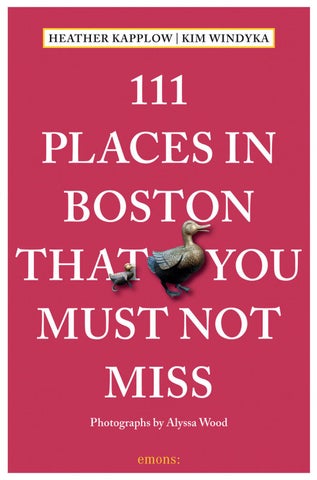
Heather Kapplow (www.heatherkapplow.com) is one of the rarest kind of creatures you’ll find in Boston: a native Bostonian. A visual and performing artist as well as a writer, Heather travels frequently for projects in both spheres and has a very deep understanding of what it’s like to be a newcomer in an unfamiliar city. (Exciting, but it can also take forever to find the cool stuff if you don’t know any insiders…) It’s among Heather’s life goals to make Boston a more welcoming place, as well as to throw spotlights on Boston’s many nuanced subcultures. You can find anything you need in Boston (except maybe a parking space in the winter) if you seek it out—take it from a native. Kim Windyka fell in love with Boston while growing up in nearby southern New Hampshire, and has never tired of the city’s beauty and historic charm in the 12 years she’s been living here since attending Emerson College. A full-time copywriter with experience in multiple industries including travel, tech, and fashion, she has also written pieces for The Atlantic, New York Magazine, McSweeney’s, and more. See more of her work at www.kimwindyka.com and follow her on Twitter at @kimlw. Alyssa Wood is a New England based photo grapher specializing in event and documentary photography. She is a graduate of New England School of Photography graduating with a major of portrait and editorial photography and spent four years living and photographing in Boston. She now lives in Rhode Island with her husband two kids, Bella & Sam and enjoys grabbing a coffee and relaxing by the beach and travels to Boston frequently for work and pleasure.