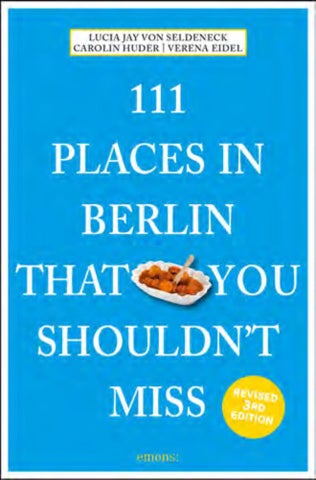
Foreword Berlin is crooked and jumbled, not smooth and shiny, and definitely not all of a piece. This becomes clear very quickly when you go in search of the places that define Berlin. Where do you start in a city that has no beginning and no end? What is typically Berlin about Berlin? We started with our own favourite places – always the three of us, always with our city map, camera and notepad. We let ourselves drift into the furthest corners of this enormous, paradoxical city. And our zigzag paths kept taking us to new places: in which bar did David Bowie drink whisky, how do you find 11th Heaven in the concrete tower blocks of Marzahn, and where did the boatmen's pastor preach in the Westhafen? On countless trips we gained a knack for discovering lively, unexpected places that are typical for Berlin. Every new square and every new street taught us that above all it is the people who give life to all these places – and their way of telling old and new stories. Berlin isn't a whole, it's a diversity. The 111 discoveries are home to images, stories and highly distinct moods. Here Berlin reveals itself to explorers. In the end a single notepad wasn't enough: every new place triggers at least two more ideas. It takes hold of you. On fire! We can't get enough of these sparks – after all, they are supposed to be sparks of inspiration! There are no rules and guidelines for getting to know Berlin. You simply have to start. And stick at it. Because Berlin just keeps going on and on. So don't fall behind – go for it!
111 Orte 1_ 11th Heaven The Princess's Boudoir in a tower block | 10
2_ The Abandoned Iraqi Embassy A bit of unfinished history | 12
3_ Alt-L端bars A place to slow down | 14
4_ Animal Town Eyeball to eyeball | 16
5_ Antique Building Material Liebchen's sanctuary for Berlin's treasures | 18
6_ The Apartment of Kommune 1 Where the revolution was practised | 20
7_ The AVUS Motel Where records are kept | 22
8_ The Ballroom in Gr端nau Berlin's abandoned Riviera | 24
9_ The Barbr端cke at Night A test of courage beneath the stars | 26
10_ The Bat Cellar A world upside down | 28
11_ The Berberis by the Panke Healing power in the past and present | 30
12_ The Berlin Room Occupying a free space | 32
13_ Berlin's Balcony This is summer | 34
14_ The Bieberbau Hospitality in a master craftsman's house | 36
15_ The Bierpinsel A sign of the times | 38
16_ The Black-and-White Photo Machine It's over in a flash | 40
17_ The B端cherwald Recommended reading | 42
18_ Burg am See The Turkish beer garden by the canal | 44
18__ Burg am See The Turkish beer garden by the canal A German corner pub next to a Turkish tea-shop, a Turkish greengrocer next to a German supermarket – this is a perfectly normal scene on the streets of Kreuzberg and Neukölln. Nevertheless, usually it is a case of one alongside the other: a blend of German and Turkish culture is rarely to be seen. However, on the Landwehrkanal, where waters from Kreuzberg, Neukölln and Treptow meet, this mixing does exist. White sunshades advertising German Paulaner beer provide shade. Families, both German and Turkish, sit at the beer-garden tables. Children run up and down the hedges. In the middle of the garden, teenagers sit and share a shisha. Over their heads its fruity smoke mingles with the spicy smell of hearty food that wafts over from the barbecue. The aroma of fresh pizza, and a somewhat greasier contribution from the fat in which the French fries are cooked, add to the mixture. At the counter there is German wheat beer – or tea from a big samovar. All over the world, beer gardens are known as a truly German phenomenon. And equally, tea gardens are as Turkish as it gets. Here on the canal bank these two traditions with their typical habits and customs blend in one single place: a family tea-and-beer garden with a view of the water. One couple are sitting opposite each other – she eating French fries, he cracking sunflower seeds. The warm summer evening passes with pleasant slowness. A fountain splashes in the middle of the garden. Guests are assured that this is a wishing-well for lovers. Though with no guarantee. What is guaranteed here, however, is that two cultures come closer, and that people sit next to each other on the benches in a way that rarely happens so naturally and by chance in Kreuzberg. Perhaps this has something to do with the big wooden castle in which German and Turkish children climb around together – until their parents return to the tables with their trays. 44
Address Ratiborstrasse 14c, 10999 Berlin-Kreuzberg | Transport Bus M 29, 171, 194 to Pflßgerstrasse | Opening times In the beer-garden season daily 10am – 10pm | Tip Table tennis: on the canal bank you can challenge experts to a game.
19__ The Cafeteria in the Bürgeramt Fresh meatballs and an all-round view The free view all the way to the horizon refreshes the eyes and the soul. A view across fields, a lake or the sea is said to have a calming effect. In the city, such an unimpeded view is only to be had over the rooftops. From the cafeteria in the Bürgeramt (city offices) in Kreuzberg, for example. As in every canteen, the furnishings are above all utilitarian. Plain, eggshell-coloured tables for four with dark brown wooden chairs, a shelf for indoor plants as a partition, and the trolleys on which to place returned trays next to the counter where the food is served. The special thing about this cafeteria is outside: the sky. In every direction. Your eyes linger for a moment on a church tower or Potsdamer Platz – but then they can roam. Beneath you are red-brown roofs, and below them canyon-like streets with tiny cars creeping along and the bustle of tiny people at the crossroads. The food here is down-to-earth. The favourites are home-made meatballs, stews and of course a mug of coffee. Up here, it will be a long time before latte macchiato to go replaces the good old mug of coffee. And at the neighbouring tables a local speciality is thrown in: all around people shout and rant in the immaculate Berlin dialect that is used for arguments in pubs. At breakfast time it is mainly elderly people from the neighbourhood, making comments about the newspaper that they have spread out on the table in front of them, and reading aloud the best bits, including the special offers from supermarket advertisements. Later the employees of the city offices come here to eat their lunch – and, whether you want to or not, you find out what happened that morning behind the doors on the long corridors. In this way you certainly keep your feet firmly on the ground here – even if the view of the skies all around might give a different impression. 46
Address Bezirksamt Friedrichshain-Kreuzberg, Yorckstrasse 4 – 11, 10965 Berlin-Kreuzberg | Transport U 6, U 7 to Mehringdamm; bus M 19, 140 to Yorckstrasse / Grossbeerenstrasse | Opening times Mon – Fri breakfast 7 – 11am, lunch 11am – 3pm | Tip The Kreuzberg: walk along Mehringdamm to Kreuzbergstrasse, then climb to the summit of the Kreuzberg, one of the tallest hills in the city, in Viktoriapark.
20__ The Capitol The cinema in a living room Keeping a genteel distance, entirely untouched by the events of the world, the fine houses of Dahlem sleep undisturbed in the shade of mature trees, surrounded by rhododendrons. The house next to the main building of the Freie Universität Berlin, for example. It looks like many of the houses in this neighbourhood: box-like, with a vine growing up its light-coloured two-storey façade. If it were not for the signage above the terrace, no-one would ever guess that inside, in the impressive piano nobile of this residence, there is a cinema. Its history, too, is known to few: Prof. Carl Fröhlich, president of the Reichsfilmkammer, which controlled the cinema industry in the Nazi period, had a room for private viewings built here in 1942 in his villa in Dahlem. For three years this inconspicuous house on Thielallee was the final court of judgment at which the Nazis viewed new and old films, and decided what German audiences were permitted to see – and what was not allowed. There was no escaping this controlling body. Everyone who wanted to take part in any way in film productions in the Third Reich had to become a member of the Reichsfilmkammer. The Nazis really succeeded in doing what had been thought impossible: gaining control of art. Today old film posters hang up to the ceiling above the curved staircase in the Capitol. And, if as they were witnesses to a tacit reconciliation, the titles of films that were banned during the Third Reich catch the eye: Charlie Chaplin's »Goldrush«, for example, and »Les Enfants du Paradis«. The Capitol has a reputation as an especially charming arthouse cinema, with select films – and style: the coffee is not served in paper cups here, and many people come a little earlier to enjoy a glass of wine in the evening sun. It almost seems as if the guests had been invited personally, first for a drink on the terrace – and later to watch a film in the living room. 48
Address Thielallee 36, 14195 Berlin-Zehlendorf | Transport U 3 to Thielplatz; bus 110 to Lรถhleinstrasse | Opening times Tel. 030 / 8316417 for the latest programme | Tip The dome of the Reichstag is not the only one by Norman Foster: he designed a dome for a library, the Philologische Bibliothek, right next to the cinema at Habelschwerdter Allee 45.
62__ Majakowskiring Where the gentlemen from Pankow lived They stand to attention with green helmets on their heads along the small, shaded cobblestone road: old street lamps on Majakowskiring, looking like tin soldiers and instantly raising memories of days gone by. The East German political elite once resided in large, pre-war detached houses, hidden behind a wall and well guarded by real, arms-bearing soldiers. This is where Walter Ulbricht, Erich Honecker and the other members of the government of the GDR led bourgeois lives – and to make sure that this was not embarrassingly noticeable in the workers' society, they shielded their private sphere thoroughly from public view. In the West, too, the existence of this enclave in Pankow was known – and thus the name of the district quickly became a synonym for the government in East Berlin. Konrad Adenauer liked to refer to Walter Ulbricht and his regime as »the gentlemen from Pankoff« – pronouncing the last consonant, incorrectly. And the veteran rock star Udo Lindenberg wrote a song about going to Pankow to drink a glass of cognac with Erich Honecker – in order to get permission to perform in East Berlin. »Sonderzug nach Pankow« (to the tune of »Chattanooga Choo-choo«) became a cult song in 1983, not only in the East. In response to the song, a few months later Lindenberg was invited to the Rock for Peace festival in the Palast der Republik in East Berlin, where he presented his leather jacket to Honecker – who had previously written to him that rock music was compatible with the ideals of the GDR. After the workers' revolt of 1953, the party cadres felt insecure in the city, and in 1960 move to a protected estate near Wandlitz. Today only a few plaques testify to the past on Majakowskiring. Modern detached houses are filling the vacant plots beneath the old trees, and Erich Honecker's old house is now home to Kulti, a place for children to play. 132
Address Majakowskiring, 13156 Berlin-Pankow | Transport Tram M 1, bus 107, 250 to Tschaikowskistrasse | Tip Majakowski-Gasthaus: in the beer garden at Majakowskiring 63, between the old leaders' houses, the house speciality is borscht.
63__ The Maltings Careful renewal The monk who advertises Schultheiss beer is as relaxed as can be. Visible from afar, he greets you by raising his foaming glass from the white chimney that rises above the industrial estate on the A100 road. Most people who come here are on their way to the big furniture store or the DIY shop next to the approach road. However, since 2009 a new symbol has stood proudly above the old Berlin malt factory next to the Schultheiss monk, who has faded somewhat with the years: the flag of Switzerland. Frank Sippel is Swiss. He bought the factory, as he bought many factories before – in order to sell it again. That would have meant the continuation of what began next door with the furniture shop and the DIY store. But when Sippel visited the Schultheiss site, he changed his mind and took charge of its conversion himself. There was a significant difference to most other redevelopment projects: he had time. Nothing is being done in a rush on this industrial area in Tempelhof. Artists now work in the buildings around the factory yard. There is a hall for events, and above all lots of space for projects and ideas. The malt team proclaim their commitment to environmental awareness: in the yard stands a waste container with a closed loop for biological recycling, and on the grass behind the factory a fish pond and a bathing lake are being created. The main building with its four gigantic chimneys, which was used for producing malt until 1996, has remained untouched. The winding mechanisms on the shafts have become rusty, and dusty cobwebs hang from the chimneys, but the last grains of barley left over from the drying process still lie on the malting-floor grid. No decision has been taken on a new use for the factory, but whatever happens here, the plan is to combine the two main principles of the new maltings: art and sustainable use. 134
Address Bessemerstrasse 2 – 14, 12103 Berlin-Tempelhof | Transport S 41, S 42, S 45, S 46, S 47 to Südkreuz (15 minutes' walk); bus 106 to Bessemerstrasse | Opening times Viewing from outside and visits to studios daily, for tours see www.malzfabrik.de and by appointment, tel. 030 / 755124800 | Tip Out in the sun: on the roof terrace of the Bergstübli you have the feeling of being in a Swiss mountain hut with a view of the factory yard. Lunch Mon – Fri 12.30 – 2.30pm.
The author Lucia Jay von Seldeneck was born in Berlin in 1977 and grew up there. She experienced the fall of the Wall, got used to the incessant changes in the city – and believes that Berlin has still not arrived at its goal. She studied public relations and Latin American studies in Berlin and Valencia, and works as a freelance journalist today. She is fascinated by the people, places and ideas that continually reinvent the city.
The photographer Verena Eidel is a freelance photographer and graphic artist. She has always been fascinated by the idiosyncratic charm of the city where she was born: following the fall of the Wall, Berlin redefined itself completely at a breathless pace as a city outside the mainstream. As so often before. A city in permanent flux – which is why, even as a dyed-in-the-wool Berliner, Verena Eidel never tires of making journeys of exploration there.
Research Carolin Huder, born in Erlangen in 1968, moved to Berlin at the age of seven and later studied geography there. She worked in a public relations office where she discovered her interested in Berlin's artists, managing the singer Max Raabe and the Baseballs, among others. Since 2009 she has been managing director of the theatre Heimathafen NeukĂślln. 240