
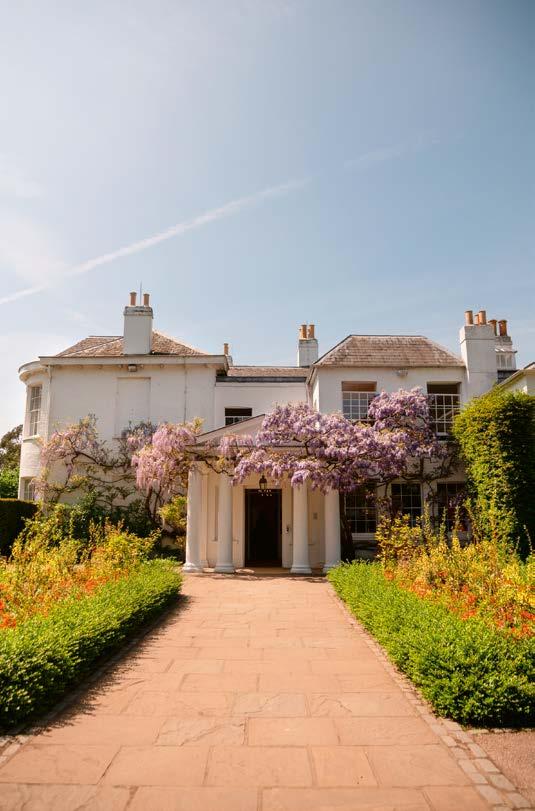
Bertrand Russell’s Home
Nobel Prize winner’s childhood at Pembroke Lodge
Built as a mole-catcher’s lodge in around 1774, Pembroke Lodge is now a tearoom, and a wedding and banqueting venue. Set in 11 acres within Richmond Park, the York stone path, green lawns, manicured flower beds and handsome design betray its aristocratic past. In 1847 it was given by Queen Victoria to her Whig prime minister Lord John (later Earl) Russell. And in 1874, a two-year-old Bertrand Russell and his three-year-old brother Frank came here to live in the care of their grandparents, having been orphaned by the death of their parents, Lord and Lady Amberley.
Lord Russell died when Bertie was six, but the countess lived until he was an adult. From her he developed a deep religious faith – although he was later one of the century’s great anti-religious polemicists – and a life-long love of English literature. Here, he imbibed an understanding of his family’s role in British political history, and resistance to authority and tyranny that sowed his later dissent.
Frank went to Winchester, but Bertie was tutored at home, with an education that fitted the future prime minister that his grandmother aspired he should become. He learned modern languages, economics, constitutional history, science, and mathematics. A lonely child, Russell wandered in the grounds and woods, delighting in the changing seasons. But when he was 11 there came the great turning point in his intellectual life: he was introduced to Euclidean geometry. To him it was ‘as dazzling as first love’.
Russell devoted his life to mathematics, philosophy, logic, and political activism. In 1950 he was awarded the Nobel Prize for Literature.In old age he reflected on the profound influence those long past years at Pembroke Lodge had had upon him: ‘I grew accustomed to wide horizons and to an unimpeded view of the sunset. I have never since been able to live happily without both.’
ADDRESS Pembroke Lodge, Richmond Park, SW10 5HX, +44 (0)208 940 8207, www.pembroke-lodge.co.uk TIP You’re in one of London’s most extensive and attractive parks – look out for deer while you’re there! 630 Red and Fallow deer have roamed freely here since 1637. They are wild, though, so keep 50 metres’ distance!
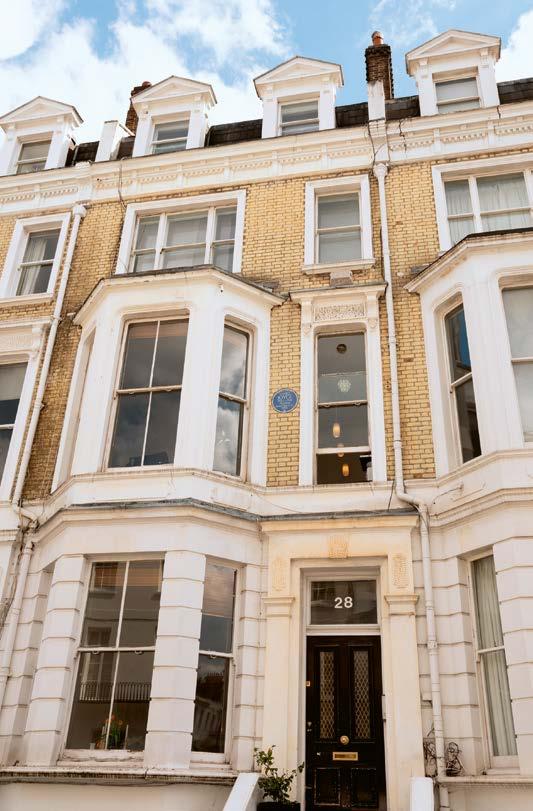
Campden Grove
James Joyce ties the knot
It took 23 years and two children to do it, but in 1931 James Joyce and his muse, Nora Barnacle, married. It was only from early May to early September 1931 that they lived in a flat in 28 Campden Grove, and in July formalised their relationship in the now demolished register office on Marloes Road. It was nine years after his novel Ulysses had gained Joyce fame and notoriety (banned in Britain until 1936) and he was writing Finnigan’s Wake.
The wedding was never going to be a quiet one, for there was great press interest that Joyce shunned. He eventually put out a statement that the couple had been invalidly wed in Austria in 1904, so the British marriage was ‘for testamentary reasons’. But on the morning of the wedding there was widespread media coverage and the couple – he was 49 and of ‘independent means’, and she 47 – drew a veil over two decades of ‘living in sin’ by declaring themselves bachelor and spinster on the marriage certificate. They had two children and their daughter Lucia also was not best pleased, believing that her parents were already married. Nora’s family in Galway disowned the couple.
Failing sight caused Joyce to become more dependent on Nora. She was never intimidated by his literary fame – she refused to read Ulysses and her response to his celebrity was to say to friends, ‘I’ve always told him he should give up writing and take up singing’. She disparaged the seeming incomprehensibility of Finnigan’s Wake. They lived in Paris throughout the 1930s, but the marriage of their son Giorgio and the birth in 1932 of a grandson, Stephen James, was no compensation for the severe mental illness that afflicted Lucia. The Nazi invasion of France forced the family to move back to Switzerland in 1939, leaving Lucia in an asylum in Brittany. A month later Joyce died of a perforated ulcer, and he now rests in a cemetery in Zurich.
ADDRESS 28 Campden Grove, W8 4JQ TIP Take the bus to Hyde Park Corner to visit the imposing Wellington Arch, which marks Wellington’s defeat of Napoleon; take a lift to the roof for a good view of London.
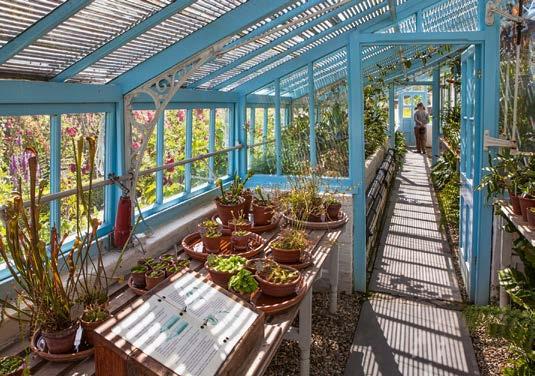
Down House
Where Darwin explained our origins
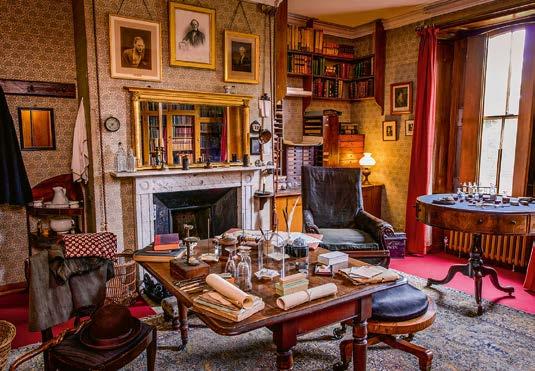
Few places could be as different as the Galapagos Islands in the eastern Pacific and Down House in the rural outer reaches of London. But after spending five weeks on the islands in 1835, during his voyage on HMS Beagle, Charles Darwin returned to his home in Downe to consider his observations of the wildlife he had seen, to formulate his theory of evolution. It was in the ground floor study of the house that he wrote On the Origin of Species by Means of Natural Selection. Published in 1859, this proved to be one of the most influential books ever to appear in print.
Darwin lived in the Grade I-listed house for 40 years until his death in 1882. He and his wife Emma took possession in 1842, along with their two children, William and Anne. Nine days after the Darwins moved to the house, Etty, their third child, was born, and over the next 14 years another six children were born at Down. They were occasionally permitted to enter the study, on the understanding that they did not disturb their father.
Apart from a wish by the Darwins to get away from the noise of London, where they lived on Gower Street (see ch. 33), they were attracted to the countryside. Of the house, Darwin wrote, ‘being situated on rather high table-land, [it] has somewhat of a desolate air ... The charm of the place to me is that almost every field is intersected (as alas is our’s) by one or more foot-paths – I never saw so many walks in any other country.’ The couple remodelled the house and its extensive gardens. The gardens were for more than leisure, but an open-air laboratory. Visitors can still see this today, and can walk Darwin’s ‘thinking path’, passing bountiful vegetable patches and fragrant flower beds. Emma died at the house in 1896, and it later became a girls’ school where, during the First World War, one pupil was the future novelist, Elizabeth Bowen (see ch. 38).
ADDRESS Luxted Road, Downe, Kent, BR6 7JT, +44 (0)370 333 1181, www.englishheritage.org.uk TIP Six miles from Down is Quebec House, 18th-century childhood home of General James Wolfe, victor in the Battle of Quebec (1759), where he also died.
Middle Temple
Where law meets literature
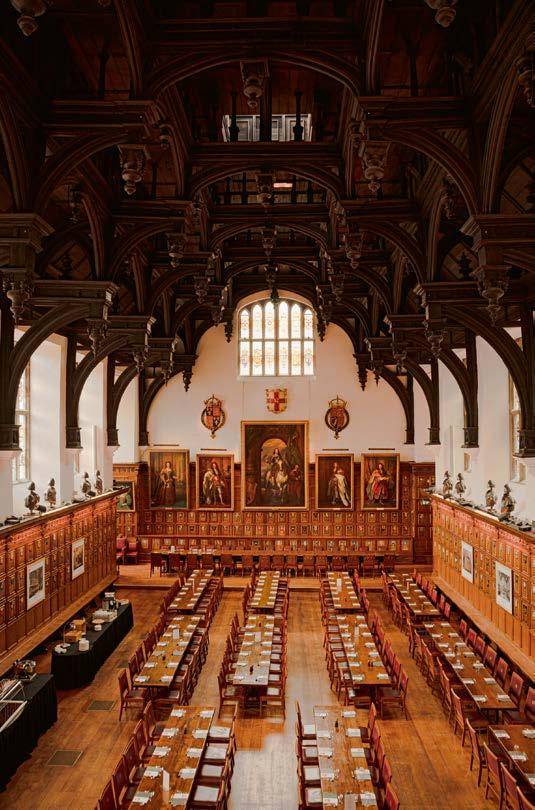
Middle Temple summons up the law. And quite right, too – it is one of the four Inns of Court that promote and support the rule of law and its fair and effective administration throughout the Common Law world. But Middle Temple has had another, far less well-known life – that of literature.
During the 17th century, it was common for law students in the Middle Temple to organise and act in masques and plays in the Hall, which remains the centre of the Middle Temple. Revelry around Christmas sometimes lasted from All Saints’ Eve to Candlemas Day. There were celebrations, riotous feasting, drinking, dancing, and processions. Candlemas Feast 1602 is particularly notable. While no Middle Temple records survive, a student, John Manningham, noted in his diary the first known performance of Shakespeare’s Twelfth Night in the Hall. Actors are not mentioned, but it is possible that the author himself was one of them.
Middle Temple was in this period sometimes referred to as ‘the third university’ after Oxford and Cambridge, since the young men, who were wealthy and socially well connected, who studied to qualify in the law occupied this elite place. Student lawyers lived and worked as ‘members’ at an inn of court, and often frequented the nearby indoor theatres. While notable Middle Templars very obviously include distinguished lawyers, its members also include famous writers, among them the diarist John Evelyn, the playwright William Congreve, the novelists John Buchan and Charles Dickens (see ch. 19), and latterday historians, Cecily (C. V.) Wedgwood and Lisa Jardine.
The library, designed by 20th-century architect Edward Maufe, holds approximately 250,000 volumes, covering all aspects of British, European and American law, as well as the its archives, and a collection of rare antiquarian books. Lectures are open to non-members.
ADDRESS Middle Temple Lane, EC4Y 9AT, +44 (0)207 427 4800, www.middletemple.org.uk TIP The long-closed Aldwych Underground station is minutes away on The Strand. Official tours of this and other disused tube stations are available (www.ltmuseum.co.uk).
National Poetry Library
Little-known literary treasury
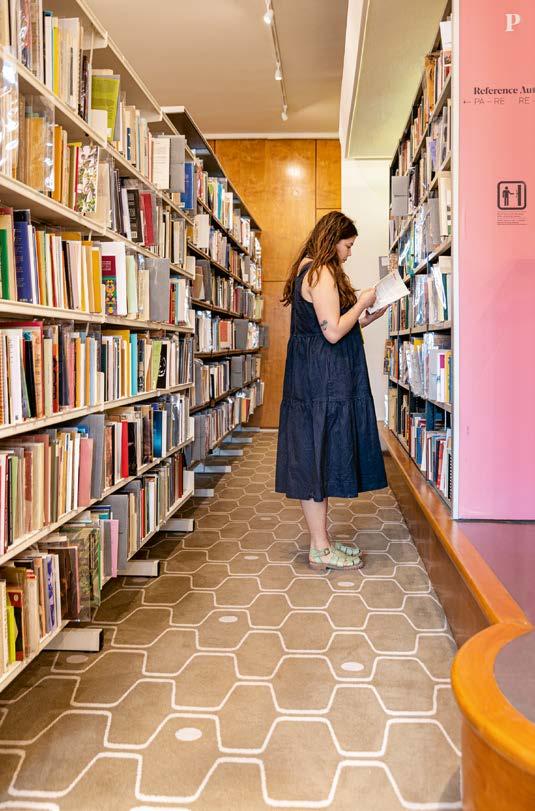
With the National Theatre, the Hayward Gallery and the British Film Institute (BFI South Bank) as well as many restaurants and a bookshop, it is easy to overlook the National Poetry Library in the bustle of the South Bank, even if it is on the fifth floor of another of the area’s attractions: the Royal Festival Hall. Its 95,000 volumes comprise the largest modern poetry collection, and it is the largest poetry public lending library in the world, with UK stock dating from 1912. Its ever-growing collection of almost 300,000 items includes books, magazines and audio recordings, often of poets reading their own work. Much of the collection is from overseas.
Founded by the Arts Council, the library was opened in 1953 by the writer Herbert Read and the Nobel Prize winner T. S. Eliot (see ch. 76). The library has had several homes, but came to the South Bank in 1988, when another Nobel laureate, Seamus Heaney, opened this venue. In fact, Heaney and the former Poet Laureate Ted Hughes (see ch. 85) co-edited an anthology, Rattle Bag, and Hughes wrote of his experience of researching the book in the library, when working in its then offices in Covent Garden (the South Bank is its fifth address). He wrote of ‘going through every book that showed any likelihood of producing a poem for the anthology... I was trekking for days through the densely packed Ys and the insuperably ranked Ws’. Andrew Motion, also Poet Laureate, worked in the library on his anthology, Here to Eternity, while Philip Larkin called the library ‘pure flowerings the imagination for which the English are so seldom given credit’.
Now in its 53rd year, membership is free and 18,000 books are loaned each a year. This is a testament to the library’s belief that poetry is for everyone, whether those ‘who can’t live without it’, families and children, academics, teachers, researchers, the curious –and, of course, poets themselves.
ADDRESS Level 5, Royal Festival Hall, Southbank Centre, Belvedere Road, SE1 8XX, +44 (0)207 921 0943, www.nationalpoetrylibrary.org.uk TIP Apart from all the other cultural attractions on the South Bank, don’t neglect the open air book market under Southwark Bridge, offering a huge selection that ranges from biographies to modern and classic fiction, music and art, as well as old prints.
Royal Horseguards Hotel
The library without books
What was and still is called the Gladstone Library is unique – it has no books. The library had 35,000 books and over 30,000 pamphlets in what was to be Britain’s largest library of 17th to 20th-century political literature. Once part of the adjoining National Liberal Club, in the 1960s and 1970s the club was in poor shape: it needed repairs, it was losing money, and its membership was declining. Liberal leader Jeremy Thorpe appointed a Canadian confidence trickster, George Marks, to staunch the financial flow. Marks, who called himself George de Chabris, claimed to be an aristocrat and multi-millionaire (he was neither), who said he would subsidise the club (he didn’t).
He managed the club for nine months, during which time he defrauded the club, moved in his family rent-free, ran several dubious businesses, bought a sports car, and had the club pay his children’s school fees. Claiming that the club could no longer afford a librarian, in 1977 he sold the library to Bristol University for £40,000 – a price judged to be derisory. After his dismissal, Marks agreed to pay back £60,000, a lesser part of what he had gained.
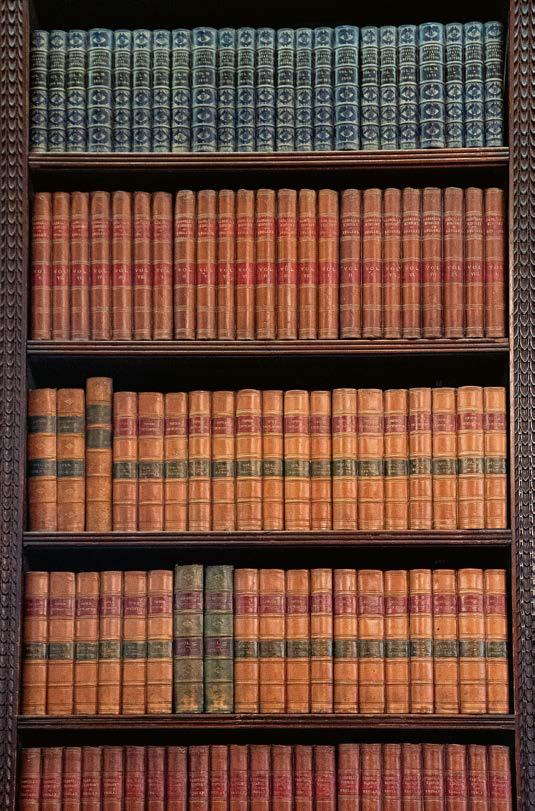
Later measures gave the club financial stability and a secure future. These included selling the second-floor and basement function rooms, and the 140 bedrooms from the third floor to the eighth floor, which included the Gladstone Library, to the adjoining Royal Horseguards Hotel. As a homage to the library’s former existence, its empty shelves are now filled with fake book spines, resplendent in green, gold, and red.
The library has had its glory days: as recently as 1999 it played host to the lunch for the W. H. Smith Book Awards, when Beryl Bainbridge gained £10,000 prize money for her novel, Master Georgie. The club now operates a much smaller library acquired long after the Gladstone Library’s books made their way to the West Country.
ADDRESS 2 Whitehall Court, SW1A 2EJ, +44 (0)207 523 5062, www.guoman.com
TIP You don’t have to go to Calais to see one of Rodin’s most famous works. A short walk south is Victoria Tower Gardens, next to the Houses of Parliament, where his Burghers of Calais stands. The sculpture was made in 1889, and commemorates the heroic end of the siege of Calais in 1347.
Russell Square
Where T. S. Eliot, the poet, discovered poets
In what is now part of the University of London’s Birkbeck College’s School of Social Science, History and Philosophy, 25 Russell Square was once the offices of Faber & Faber, where T. S. Eliot worked as a publisher for 40 years. By the time he joined in 1925, the American, who later became a British citizen and was awarded the Order of Merit and the Nobel Prize for Literature, had published The Waste Land. He had taught at Harvard, arrived in England in 1914, made an unhappy first marriage to Vivienne Haigh-Wood, and tried teaching and banking. Virginia Woolf called him a ‘corpse’, with a ‘great yellow bronze mask for a face’. He must have been unaware of this, as a photograph of her was on his office mantelpiece. Despite Woolf’s description, he was said to light fire crackers in office waste bins to mark 4 July.
It was at Faber that he discovered a gift as a playwright and also converted to High Anglicanism. He enjoyed the conviviality of editorial life at Faber, which functioned like a club. He was responsible for publishing many modern poets, including Louis MacNeice, Stephen Spender, W. H. Auden, and Ted Hughes (see ch. 85). One visitor was his fellow poet George Barker, who remembered Eliot in 1939, as war clouds gathered over Europe, looking out of the window and saying in a tired voice, ‘We have so very little time...’.
It was also here that Eliot met Valerie Fletcher, his secretary, whom he would marry in 1957. Thirty-eight years his junior, she would become his editor and protective literary executor. Before then, often to escape his first marriage, he would sometimes sleep in a top-floor flat. Eventually committed to an asylum, Vivienne would sometimes turn up at the office unannounced. Eliot’s secretary would detain her, while he made his exit. Despite his increasing fame, Eliot remained with the company until he died in 1965.
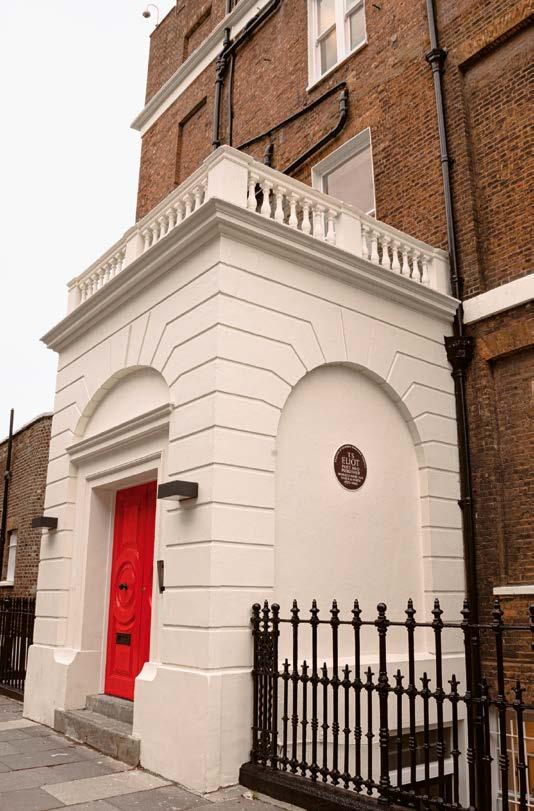
ADDRESS 25 Russell Square, WC1B 5DT TIP In nearby Cartwright Gardens is a statue of the man after whom it is named: John Cartwright, the first English writer to openly maintain the independence of the USA, and who also supported universal suffrage, annual parliaments, and voting by ballot.
Tavistock Street
Where De Quincey got high
It was in his lodgings at 36 Tavistock Street, now a restaurant, that Thomas De Quincey wrote Confessions of an English Opium Eater. He recounts the pleasures and pains of his addiction to the then legal drug, which he first took to ease neuralgia when he came to London as a young man. He met the poets Samuel Taylor Coleridge (see ch. 87), William Wordsworth (see ch. 107) and Robert Southey, and decided to devote his life to literature. When he returned in 1811, he left his wife – who bore him eight children – in Grasmere in the Lake District. In 1821, he moved to a small room at the back of 4 York Street, in what was then a far from desirable district.
Confessions appeared in book form in 1822 and soon after, the poet Thomas Hood visited to find De Quincey ‘at home in a German ocean of literature, in a storm, flooding all the floor, the tables and the chairs – billows of books …’. His reputation was made, but his debts remained. De Quincey often hid from creditors, several times returning to the Lake District, yet he seems to have made this his home until at least 1825.
De Quincey’s mother added the ‘De’ to Quincey – the blue plaque misspells it as ‘de Quincy’ – when his father died when De Quincey was eight. His was somewhat of a peripatetic, sickly and solitary childhood. He gained a place at Oxford at the age of 15, but pulled out after 19 months. He took to the road, mostly in Wales, but was allowed to return to Oxford when he ran out of money. He turned to journalism and essay writing. A Mancunian by birth, he later moved to Edinburgh and became a contributor to journals such as the prestigious Blackwood’s Magazine. His Recollections of the Lakes and the Lake Poets, published before Confessions, remains a work of some importance due to his portraits of Wordsworth, Southey, Coleridge and others. He died aged of 74 in Edinburgh, where he is buried.
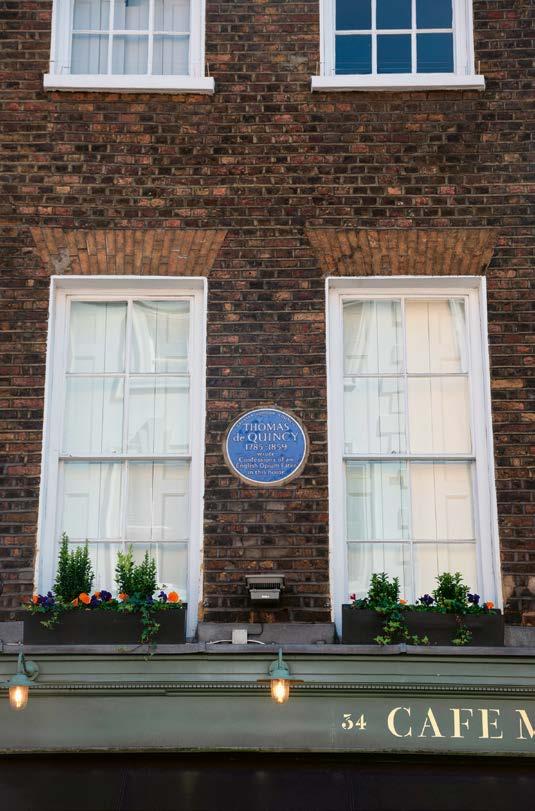
ADDRESS Café Murano, 36 Tavistock Street, WC2E 7PB, +44 (0)207 240 3654, www.cafemurano.co.uk TIP Also in Covent Garden, the London Transport Museum details the growth of the capital over the last 200 years, with the development of all forms of public road and tube transport, from horse-drawn carriages to the electric bus (www.ltm.co.uk).
Temple Tube Station
Where the author sought him and found him
Novelists gain inspiration in many different places and circumstances, but coming up with an 18th-century aristocratic adventurer while waiting for a London tube train is certainly unusual. In Paris, Baroness Orczy had conceived the idea of a play that became the 12-volume Scarlet Pimpernel series of novels. But it was on the westbound platform of Temple Station, as she waited to travel home to Kensington, that she came upon her idea of the ‘perfect English gentleman’ – Sir Percy Blakeney, who would go on to rescue French aristocrats from the guillotine during the Reign of Terror.
She had been to see someone at the nearby Daily Express, and while waiting on the tube station platform, Sir Percy appeared before her. She wrote, ‘Now, of all the dull, prosy places in the world, can you beat an Underground railway station? It was foggy, too, and smelly and cold. But I give you my word that as I was sitting there –yes, I saw – Sir Percy Blakeney just as you know him now.’
He wore ‘exquisite clothes’, while his slender hands held a spy glass. Orczy described his speech as ‘lazy’ and ‘drawling’, his laugh ‘quaint’. She does not detail everything she saw and heard – it was ‘a mental vision’ lasting just seconds – but during those moments the life story of the Pimpernel was revealed to her. The rest of the day remained ‘a blur in my mind,’ she said, ‘but my thoughts were clear enough for me to tell my beloved husband about the wonder that had occurred; the birth of the Scarlet Pimpernel.’
Orczy, who spoke no English when she came to London from Hungary aged 15, wrote the novel – originally envisaged as a play –in five weeks, but it was rejected by a dozen publishers. The play was not a great success in 1903, but the novel was published in 1905, when the play came to London, and was an instant bestseller. It led to eight film versions and also numerous television versions.
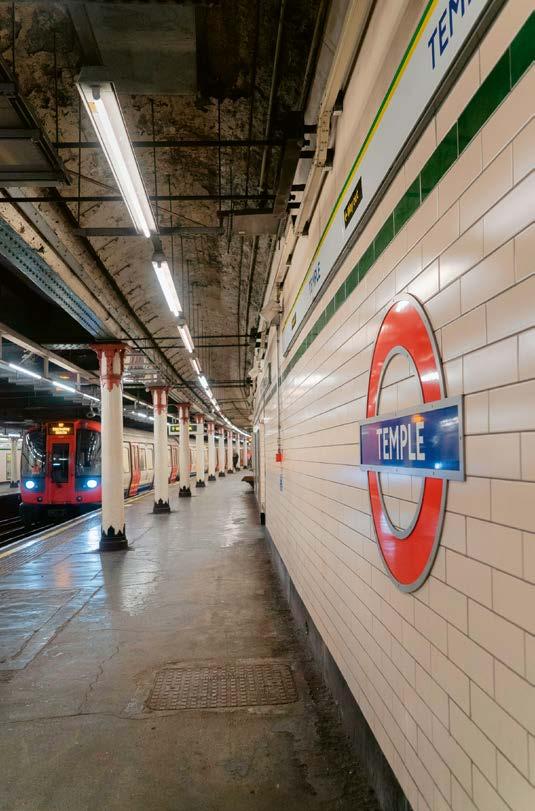
ADDRESS Victoria Embankment, WC2R 2PH, www.tlf.org.uk TIP Along Victoria Embankment is Cleopatra’s Needle, one of a pair – the other is in New York – made for the Pharaoh Thutmose III in 1460 bc in Egypt. It was given to commemorate British victories of The Nile and Alexandria, and arrived in England in 1878. A philanthropist paid the £10,000 cost of transportation.
Wiener Holocaust Library
The mystery of Hitler’s book
The origins of the oldest Holocaust library in the world lie in 1920s Germany. A concerned Dr Alfred Wiener started collecting posters, newsletters, books and assorted memorabilia about growing antisemitism, the rise of right-wing groups and militia and, eventually, the Nazis. His collection is the great-grandparent of today’s holdings, which include 80,000 books, magazines, and pamphlets, 45,000 photographs, 2,000 documents, 3,000 periodicals, one million press cuttings, as well as oral histories, scrapbooks, pamphlets, film and posters. There are books in French, Hebrew, English, Yiddish, German, Russian and other languages, that cannot be found elsewhere. The library has several copies of Mein Kampf. These are mostly in German, but one in English is signed by the author, Adolf Hitler, and has a curious history.
It is not known how the library obtained the book, but there is a clue to its origins. There is a photograph inside showing a group of people gathered around Hitler and other Nazis, including someone who appears to be his secretary, Martin Bormann. In the group a young, blonde woman in a white dress is smiling. Beneath the photograph are lines written in pencil by (it is assumed) the young woman. She tells of visiting Berchtesgaden, near Hitler’s mountaintop summer home, and relates how he came to the village to shake hands with tourists. She adds, ‘Signed in pencil standing up! Just before we were evacuated.’
Thus, it seems the young woman was a tourist who took an English translation of the book to Germany, apparently in the hope that she would see Hitler and he would sign it. Perhaps she was naïve in her youth, or maybe she was a Nazi sympathiser. Interesting as the signature is, the story of its owner – and why she was visiting Hitler’s now infamous retreat on the eve of war – will always be an intriguing mystery.
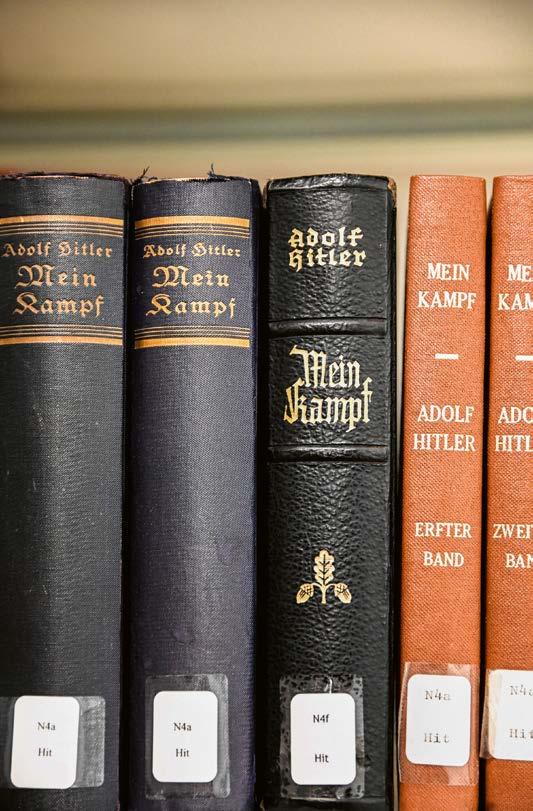
ADDRESS 29 Russell Square, WC1B 5DP, +44 (0)20 7636 7247, www.wienerholocaustlibrary.org TIP Grab a bite and a drink at the cabbies’ greenpainted, wooden shelter directly opposite the library; look out for these little-noticed but iconic places dotted around the capital.
THE AUTHOR

Terry Philpot was born within the sound of Bow Bells (which are not in the East End). He is a writer and award-winning journalist. He has written and edited more than 20 books ranging from social history to social policy. He has contributed to The Times, The Guardian, The Daily Telegraph and other publications. He is author of 26 entries for the Oxford Dictionary of National Biography. He has been a trustee of several charities and a co-founder of the One World Group. He worked with prisoners on Death Row in the USA and is a volunteer for New Bridge, which works with UK prisoners. He is a volunteer guide with the Wiener Holocaust Library.
THE PHOTOGRAPHER
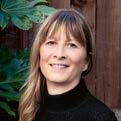
Karin Tearle has a BA in French and Italian from Goldsmiths, University of London and lived in Bordeaux, France for several years before returning to the UK to have a family. She is a trustee of the Rwanda Development Trust which funds small capacity-building projects and was interpreter for the BBC World Service for a programme about the 1994 genocide. Karin has retained her links with the country and continues to work with the Rwandese. She also manages a listed building in Greenwich and has an affinity with this historic town where she has lived for thirteen years. Karin is social secretary of Aperture Woolwich Photographic Society, one of the oldest clubs in the country and is extremely passionate about photography.
The information in this book was accurate at the time of publication, but it may change at any time. Please confirm the details for the places you’re planning to visit before you head out on your adventures.