FOOD SECURITY, AFFECTS OF COVID-19, AND AN AQUAPONICS SOLUTION Marginally food secure families experience occasional anxiety about accessing adequate The U.S. Department of Agriculture (USDA) food, but their eating patterns remain largely uninterrupted. On the other end of the defines food insecurity as a lack of spectrum, families experiencing very low consistent access to enough food for an food security are forced to regularly reduce active, healthy life. Food insecurity is a their food intake. complex, household-level problem that arises when families do not have enough resources to meet their basic needs.
WHAT IS FOOD INSECURITY?
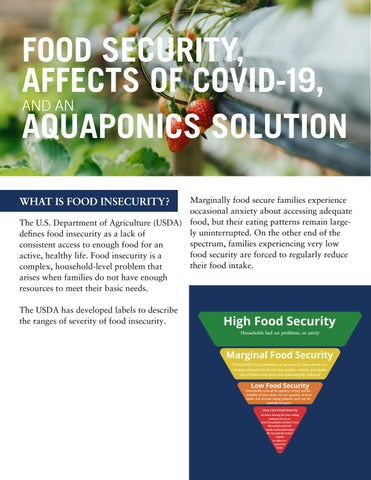
The USDA has developed labels to describe the ranges of severity of food insecurity. Households had no problems, or axiety
Households had problems or anxiety at times about accessing adequate food, but the quality, variety, and quantity of their food were not substantially reduced
Households reduced the quaility, variety, and desirability of their diets, but the quantity of food intake and normal eating patterns were not sbstantially dirupted At times during the year, eating patterns of one or more household members were disrupted and food intake reduced because the household lacked money or other resorces for food.
v
HOW IS THE COVID-19 CRISIS EXACERBATING FOOD INSECURITY FOR CHILDREN? The current public health crisis and it’s socio-economic effects are creating waves in an already unstable food supply for many families. Layoffs, furloughs, and reduced incomes are straining budgets across the country. With the eviction moratoriums coming to an end, families may be faced with the choice between paying rent or putting food on the table. Due to the pandemic, half of the nation’s children will attend school virtually this year. The Forsyth Country school district reports that 34% of elementary school children and 38% of middle school children will participate in remote learning. As a result, breakfast and lunch will no longer be provided to these kids in school cafeterias, increasing the financial burden on families who are enrolled in free and reduced-price meal programs. Several government programs at the local and federal level have been put in place to relieve families of this new food-related financial burden.
However, these solutions pose challenges. Neither local or federal nutrition-assistance programs have been scaled up to support large number of families. The Supplemental Nutrition Assistance Program (SNAP), which provides enrolled families with a weekly food allowance, does not cover children of undocumented immigrants. In addition, the program does not set limits on allowable purchases. As a result, family food choices using SNAP money may not adequately meet children’s nutritional needs. According to Feeding America, 84% of food insecure households report buying the cheapest food — instead of healthy food — in order to provide enough to eat.
Looking more locally, grab-and-go meals are available in most school districts across the country. However, school systems may not be fully prepared to effectively and equitably distribute grab-and-go meals in large numbers while also preventing disease transmission. Additionally, grab-and-go meals will inevitably contain more sugar, refined carbs, and preservatives, in order to maintain a longer shelf-life.
AQUAPONICS AS ONE OF MANY POTENTIAL SOLUTIONS TO FOOD INSECURITY Feeding America reports that 25% of children in households at risk of hunger may be forced to rely exclusively on hunger relief charities to make ends meet. Aquaponics farms like Fill Ministries are an increasingly popular solution to increasing food shortages and the need for healthy food options. Due to their resiliency in changing conditions and community-focus, cost effective and well-managed aquaponic farms have potential to provide a greater level of food security for otherwise food insecure communities.
HOW IS THE COVID-19 CRISIS EXACERBATING FOOD INSECURITY FOR CHILDREN? The current public health crisis and it’s socio-economic effects are creating waves in an already unstable food supply for many families. Layoffs, furloughs, and reduced incomes are straining budgets across the country. With the eviction moratoriums coming to an end, families may be faced with the choice between paying rent or putting food on the table. Due to the pandemic, half of the nation’s children will attend school virtually this year. The Forsyth Country school district reports that 34% of elementary school children and 38% of middle school children will participate in remote learning. As a result, breakfast and lunch will no longer be provided to these kids in school cafeterias, increasing the financial burden on families who are enrolled in free and reduced-price meal programs. Several government programs at the local and federal level have been put in place to relieve families of this new food-related financial burden. However, these solutions pose challenges. Neither local or federal nutrition-assistance programs have been scaled up to support large number of families. The Supplemental Nutrition Assistance
Program (SNAP), which provides enrolled families with a weekly food allowance, does not cover children of undocumented immigrants. In addition, the program does not set limits on allowable purchases. As a result, family food choices using SNAP money may not adequately meet children’s nutritional needs. According to Feeding America, 84% of food insecure households report buying the cheapest food — instead of healthy food — in order to provide enough to eat. Looking more locally, grab-and-go meals are available in most school districts across the country. However, school systems may not be fully prepared to effectively and equitably distribute grab-and-go meals in large numbers while also preventing disease transmission. Additionally, grab-and-go meals will inevitably contain more sugar, refined carbs, and preservatives, in order to maintain a longer shelf-life.