Volume 37, Number 1
WWW.ACCESSPRESS.ORG
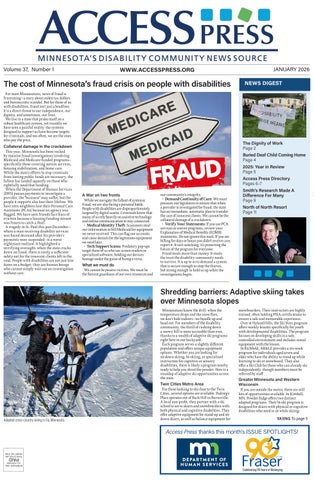
The cost of Minnesota’s fraud crisis on people with disabilities For most Minnesotans, news of fraud is frustrating—a story about stolen tax dollars and bureaucratic scandal. But for those of us with disabilities, fraud isn’t just a headline; it is a direct threat to our independence, our dignity, and sometimes, our lives. We live in a state that prides itself on a robust healthcare system, yet recently we have seen a painful reality: the systems designed to support us have become targets for criminals, and too often, we are the ones who pay the price.
Collateral damage in the crackdown This year, Minnesota has been rocked by massive fraud investigations involving Medicaid and Medicare-funded programs— specifically those covering autism services, housing stabilization, and home care. While the state’s efforts to stop criminals from looting public funds are necessary, the fallout has landed squarely on those who rightfully need that funding. When the Department of Human Services (DHS) pauses payments to investigate a provider, the "business" may suffer, but the people it supports also lose their lifeline. We have seen neighbors lose their Personal Care Assistants (PCAs) because an agency was flagged. We have seen friends face fears of eviction because a housing funding stream was frozen to catch a thief. A tragedy in St. Paul this past December— where a man receiving disability services was found deceased after his provider’s payments were suspended—is a worst nightmare realized. It highlighted a terrifying oversight: when the state cracks down on fraud, there is rarely a sufficient safety net for the innocent clients left in the void. People with disabilities are not just line items on a budget; they are human beings who cannot simply wait out an investigation without care.
A War on two fronts While we navigate the fallout of systemic fraud, we are also facing a personal battle. People with disabilities are disproportionately targeted by digital scams. Criminals know that many of us rely heavily on assistive technology and online communication to stay connected. • Medical Identity Theft: Scammers steal our information to bill Medicaid for equipment we never received. This can flag our accounts and cause denials for the legitimate equipment we need later. • Tech Support Scams: Predatory pop-ups target those of us who use screen readers or specialized software, holding our devices hostage under the guise of fixing a virus. What we must do We cannot be passive victims. We must be the fiercest guardians of our own resources and
our community’s integrity. • Demand Continuity of Care: We must pressure our legislators to ensure that when a provider is investigated for fraud, the state has an immediate, automatic plan to transfer the care of innocent clients. We cannot be the collateral damage of a crackdown. • Verify Your Statements: If you use PCA services or waiver programs, review your Explanation of Medical Benefits (EOMB) statements. Do not ignore this mail. If you see billing for days or hours you didn't receive care, report it. It isn’t snitching, it’s protecting the future of the program for everyone. Fraud steals more than money. It steals the trust the disability community needs to survive. It is up to us to demand a system that is secure enough to stop the thieves, but strong enough to hold us up when the investigations begin.
JANUARY 2026 NEWS DIGEST
The Dignity of Work Page 2 Buried Deaf Child Coming Home Page 4 2025: Year in Review Page 5 Access Press Directory Pages 6-7 Smith's Research Made A Difference For Many Page 9 North of North Resort Page 11
Shredding barriers: Adaptive skiing takes over Minnesota slopes Minnesotans know the drill: when the temperature drops and the snow flies, we don’t hide indoors—we bundle up and head out. For members of the disability community, the thrill of rushing down a snowy hill is more accessible than ever, thanks to a wealth of adaptive ski programs right here in our backyard. Each program serves a slightly different population and offers unique equipment options. Whether you are looking for sit-down skiing, bi-skiing, or specialized instruction for cognitive or sensory disabilities, there is likely a program nearby ready to help you shred the powder. Here is a roundup of adaptive ski opportunities across the state.
Adapted cross-country skiing in Ely, Minnesota.
Twin Cities Metro Area For those looking to ski close to the Twin Cities, several options are available. Padraig’s Place operates out of Buck Hill in Burnsville. A local non-profit, they partner with a ski school to serve skiers and snowboarders with both physical and cognitive disabilities. They offer adaptive equipment for stand-up and sitdown skiers, as well as balance equipment for
snowboarders. Their instructors are highly trained, often holding PSIA certifications to ensure a safe and memorable experience. Over at Hyland Hills, the Ski Stars program offers weekly lessons specifically for youth with developmental disabilities. The program focuses on developing skills in a safe, controlled environment and includes rental equipment with the lesson. In Richfield, AR&LE provides a six-week program for individuals aged seven and older who have the ability to stand up while learning to ski or snowboard. They also offer a Ski Club for those who can already ski independently, though members must be referred by staff. Greater Minnesota and Western Wisconsin If you are outside the metro, there are still lots of opportunities available. In Kimball, MN, Powder Ridge offers two distinct adapted programs. Their bi-ski program is designed for skiers with physical or cognitive disabilities who need to sit while skiing; SKIING To page 5
Access Press thanks this month's ISSUE SPOTLIGHTS!
TWIN CITIES, MN PERMIT NO. 4766
PAID
NONPROFIT ORG. U.S. POSTAGE
JANUARY 2026 Volume 37, Number 1
Pg 2
OPINION
The Dignity of work: How to improve Minnesota MA-EPD By Joey Carlson At seventeen, I knew the rules and rewards of capitalism: work hard, earn more, buy cool stuff. I held three jobs in high school. I developed photos at Target, worked for a landscaping company, and I mowed my neighbors' lawns for extra cash. Then, life changed. I was in a car accident and incurred a paralyzing spinal cord injury. I was unable to work for years. To return, I needed new skills and training. I worked hard, earned a four-year degree from Augsburg University, and was once again ready to contribute. Returning to work, however, was more complicated than I imagined. My survival depended on personal care attendant services, which could only be paid for through Minnesota Medical Assistance (MA), a program primarily designed for people with low income. I was at a crossroad as to whether I should continue my healthcare or pursue my career. Luckily, I found my solution in Minnesota MA-EPD: Medical Assistance for Employed People with Disabilities. I paid a premium. I kept my vital health benefits. I got back to work. This program is a success story. It allows me to work full-time and I contribute to society through my work and paying taxes. Having a career has also given me a sense of dignity and independence that I wouldn’t have otherwise. Minnesota MA-EPD has helped me live a more fulfilling life, but with a few tweaks, we
I learned the value of a hard day's work when I was seventeen. My injury changed my body, but it never touched my drive to work. MA-EPD is the bridge that lets me return to the world of work as a taxpayer and contributor. can make it even better. • First, the paperwork is a nightmare. The requirements are intense and often vague. These hurdles cause people to lose coverage or have to go through the stress of retroactive payments. This creates needless work and expenses for the government and providers. We need to reduce this friction. The solution is simple: allow a several month grace period to complete renewal paperwork, this will give plenty of time for correspondence between all parties. • Second, communication is broken. Members cannot easily find their coverage status or bill. Currently, the only solution is calling county
caseworkers. This means hours waiting on hold. Even if you reach a county worker, bill status requires a separate call to a different department and if Medicare is involved it gets even more complicated. This process is confusing. To solve this, I propose a state operated online MA-EPD portal, that counties can directly access. This simple website could display current member status, renewal requirements, and the correct bill amount. • Finally, having age restrictions is wrong and discriminatory. Currently, workers over the age of 65 have different rules for MAEPD. These rules are unfair and block many experienced workers from returning to their careers after a disability.
I learned the value of a hard day's work when I was seventeen. My injury changed my body, but it never touched my drive to work. MA-EPD is the bridge that lets me return to the world of work as a taxpayer and contributor. The MA-EPD program isn't charity. It is an investment in human dignity. Let's fix the paperwork, clarify the communication, and remove the arbitrary age limit. Doing this will ensure that everyone in Minnesota can experience the profound freedom of earning their own way.
HISTORY NOTE
'Person of the year' honors: Awareness or tokenism? By Jane McClure In decades past, several disability-focused organizations and causes presented honors to a person or persons of the year. In many cases honorees appeared at an event and then went back to their lives. In other instances the honorees spent the next year raising awareness about a disability. Some also helped with fundraising. Today such honors in a disability context might provoke a mixed reaction. Some might consider it vital to be able to represent and speak for a disability community groups. Others might call it tokenism. Holding people with disabilities up as inspirations can also be troublesome. Readers would also be less likely to see people with disabilities held up as inspirational. Years-ago news accounts of disabilityfocused people of the year included language that would not be used today. Readers today would cringe to see someone described as “crippled.” But that was not the case 60 years ago. In January 1966, Minnesotans met young Julie Wessel and Jerry Breitzkreutz. The youngsters were named “Courage Children of the Year.” The Minnesota Society for Crippled
A bonfire at Camp Courage Children and Adults (MiSCCA) announced the honors in a statewide news release, noting that “The two will represent the many handicapped children and adults served through MiSCCA’s programs in its annual Crippled Children’s Appeal.” Wessel was eight years old in 1966 and lived in Minneapolis. She was born with amyotonia, a condition with severe muscle weakness. Breitkreutz was nine years old in 1966 and
lived in Hector. He has cerebral palsy. Both children used wheelchairs and enjoyed summer visits to Camp Courage. The two children were honored guests at the MiSCCA annual meeting that year. The meeting, held at the Sheraton-Ritz Hotel in Minneapolis, included a panel discussion on attitude toward disability and presentation of the annual Jay and Rose Phillips Awards to five outstanding Minnesotans who lived with disabilities.
The children were also part of the publicity for the society’s fundraising drive, which was known as the Crippled Children’s Appeal. The two-week campaign highlighted MiSCCA’s support of Camp Courage, 20 more day camos statewide; research and education; scholarships; six rehabilitation centers; four sheltered workshops and a statewide equipment loan program. Access Press would be interested to know more about Julie Wessel’s life after her 1966 honors. Jerry Breitkreutz lives in Mankato, where he has served on the board of the SMILES Center for Independent Living. More than a decade ago he was one of the people featured in David Engen’s interviews, which were compiled as “The Wagon Wheel Project.” Engen interviewed more than 50 people who were regulars at the old Wagon Wheel Cafe on Front Street in Mankato. As for MiSCCA, its founding in 1928 led to what is now Courage Kenny. The History Note is a monthly column produced in cooperation with the Minnesota Governor’s Council on Developmental Disabilities. Past History Notes and other disability history may be found at https://mn.gov/mnddc
EDITORIAL: Editorial submissions and news releases on topics of interest to persons with disabilities, or persons serving those with disabilities, are welcomed. We reserve the right to edit all submissions. Editorial material and advertising do not necessarily reflect the view of the editor/ publisher of Access Press. DEADLINE: 15th of each month.
Website: accesspress.org email: access@accesspress.org phone: 651-644-2133 Executive Director..................................................................................................................................................................... Heidi Holste Managing Editor........................................................................................................................................................................ Joey Carlson Contributing Writer................................................................................................................................................................ Jane McClure Board of Directors..........................................................................................................Tim S. Benjamin, Catherine Hunter, Jane Larson, ..................................................................................................Brandon Miller, Lynda Milne (President), John Tschida, Kay Willshire Business Operations and Advertising Manager.........................................................................................................Mary Graba Advertising Sales................................................................................................................................................................Rhett Lundgren Co-Founder/Publisher Wm. A. Smith, Jr. (1990-96) Co-Founder/Publisher/ Editor-in-Chief Charles F. Smith (1990-2001) Editor-in-Chief/Executive Director Tim Benjamin (2001-2020)
CIRCULATION/DISTRIBUTION: Distributed the 1st of each month through more than 200 locations statewide. Approximately 750 copies are mailed to individuals, including political, business, institutional and civic leaders. SUBSCRIPTION: Free and accessible to anyone in MInnesota, visit www.accesspress.org to subscribe. ABOUT ACCESS PRESS: A monthly newspaper published for persons with disabilities by Access Press, Ltd. POSTMASTER: Send address changes to Access Press, PO Box 40006, Industrial Station, St. Paul, MN 551048006. INQUIRIES AND ADDRESS CHANGES should be directed to: Access Press, PO Box 40006, Industrial Station, St. Paul, MN 55104-8006; 651-644-2133; email: access@accesspress.org Website: accesspress.org
JANUARY 2026 Volume 37, Number 1
Pg 3
CHARLIE SMITH AWARD DETAILS FORTHCOMING
ISSUE SPOTLIGHT | FRASER
CHARLIE SMITH AWARD DETAILS FORTHCOMING
GETTY
Fraser substance use disorder services — Meeting people where they are
Substance use disorder (SUD) rarely exists on its own. For many individuals, substance use is not the first challenge they experience, but rather a response to underlying needs, such as anxiety, depression, ADHD, trauma, autism, disability, or chronic stress. Alcohol, cannabis, or other substances may become a way to cope, self-regulate, or manage overwhelming emotions. At Fraser, this understanding recognizes that effective treatment must account for how neurodivergence, mental health, and substance use intersect. Fraser Substance Use Disorder (SUD) Services are licensed and follow American Society of Addiction Medicine (ASAM) criteria for assessment, treatment, placement, and discharge. What makes the program unique is its intentional design for individuals with substance use disorders who also have autism, other neurodevelopmental needs, or co-occurring mental or behavioral health conditions—as well as parents and caregivers of children with autism or mental health diagnoses. Central to Fraser SUD Services is a harm reduction approach. Rather than requiring abstinence as a starting point, harm reduction meets individuals where
they are in their recovery journey. The focus is on improving quality of life, safety, stability, and overall wellbeing. For some, this may include reducing substance use. For others, it may mean developing healthier coping strategies, addressing mental health concerns, or building stronger support systems. Harm reduction acknowledges that progress is meaningful at every stage and recovery looks different for each person. This approach is especially critical for neurodivergent individuals. Research shows that individuals with autism and ADHD or other developmental differences may be at higher risk for substance misuse, often related to sensory regulation challenges, social stress, anxiety, or unmet support needs. Fraser’s long-standing expertise in autism and mental/behavioral health allows clinicians to tailor treatment in ways that are accessible, respectful, and effective. This experience creates a compassionate, whole-person approach to substance use care. Fraser SUD Services begin with comprehensive assessments for individuals ages 12 and older. These assessments help determine whether services are needed and identify the most appropriate level of care. Treatment plans
are individualized and may include early intervention strategies, individual therapy, group education, group counseling, and ongoing assessments. This flexible structure ensures that care evolves as each person’s needs change. Eligibility for Fraser SUD Services includes individuals age 12 or older with identified substance misuse or a substance use disorder. Services are available to individuals already receiving Fraser services for autism, mental/behavioral health, or disability supports, allowing for coordinated care across programs. This integrated model reduces fragmentation and ensures substance use is addressed alongside the full scope of a person’s needs. Fraser’s approach reflects a core belief: substance use is often a coping strategy— not a moral failure. By understanding the complex connections between neurodivergence, mental health, disability, and substance use, Fraser creates space for dignity, trust, and meaningful progress. As a nationally recognized nonprofit leader in autism, mental and behavioral health, and disability services, Fraser brings decades of experience to its SUD programming. The organization provides healthcare, housing, education,
employment, and support services across the lifespan, ensuring individuals and families receive care that is comprehensive and compassionate. For more information about Fraser Substance Use Disorder Services, individuals and families can contact the Fraser Initial Access Program at 612767-7222. Referrals from primary care providers and other SUD programs are also accepted through the Fraser Professional Referral Form at fraser.org/forprofessionals. At Fraser, recovery is not defined by a single outcome. It is defined by safety, progress, and improved quality of life. By meeting people where they are, Fraser SUD Services offer hope, respect, and support—every step of the way.
For more information about Fraser Substance Use Disorder Services, contact Fraser Initial Access Program at 612-767-7222. www.fraser.org/preschool.
Ready to shine?
Access Press presents advertiser spotlights! This approach allows advertisers to craft compelling copy, showcase visuals, and share their story with readers effectively. This is an excellent opportunity to shine a spotlight on a dedicated month that centers around a particular disability or theme. Highlights feature a promotion on page 1 and an article on page 3.
Reserve your spotlight today! Email for more details:
ads@accesspress.org
JANUARY 2026 Volume 37, Number 1
Pg 4
People who live with Long COVID and are trying to remain part of the workforce need to know their rights. Long COVID and reasonable accommodations under the Americans with Disabilities Act (ADA) is the focus of education efforts by ADA Minnesota and the Metropolitan Center for Independent Living (MCIL). This information is presented by those two organizations. What is Long COVID and is it considered a disability under the ADA? Long COVID can be a challenge to diagnose as it presents in different ways with symptoms that may overlap with other conditions. The most recent definition from the National Academies of Sciences, Engineering, and Medicine states that Long COVID is an infection-associated chronic condition that occurs after SARS-CoV-2 infection. It is present for at least three months as a continuous, relapsing and remitting, or progressive disease state that affects one or more organ systems. Long COVID can be a disability under ADA Titles II and III, Section 504 of the Rehabilitation Act of 1973, and Section 1557 of the Patient Protection and Affordable Care Act. Each of these federal laws protects people with disabilities from discrimination. Long COVID can be a disability under these laws if it substantially limits one or more major life activities. For more detailed information, go to: Guidance on “Long COVID” as a Disability Under the ADA, Section| HHS.gov In addition, the Minnesota Department of Health provides Long COVID resources at Long COVID Resources and Support - MN Dept. of Health What is a reasonable accommodation? A reasonable accommodation is any change in the workplace or in the way things are usually done that provides equal
opportunities for those with disabilities. It is not an unfair advantage but rather something to level the playing field for all employees. An employee can ask for a reasonable accommodation at any point during employment or the interview process and does not need to disclose Long COVID, or any disability, unless they are requesting a reasonable accommodation. It is best to ask for a reasonable accommodation before issues arise as an employer usually does not need to accommodate past performance issues. The employer does not need to remove essential job functions or lower productivity but must engage in the interactive process and review each request on a case-by-case basis. Please note, an employer can ask for medical documentation if the need for an accommodation or disability is not obvious, or to confirm that a person has a disability and needs a reasonable accommodation. They cannot ask for a complete medical history. Requests for medical documents can only be made to confirm that someone has a disability that is impacting their work and about their accommodation request. Unsure of what accommodations to request? A good resource is the Job Accommodation Network (JAN). It is a free service of the U.S. Department of Labor’s Office of Disability Employment Policy. For more detailed information, go to www.askjan.org.
What are some long COVID specific reasonable accommodations? *Specialized equipment such as organizing software and applications for reminders *Written versus verbal instructions for symptoms such as brain fog *Use of captioning during virtual or inperson events for memory and auditory processing issues
ISTOCK
Long COVID: Your rights at work
*Quiet area to reduce distractibility *Additional break times and rest periods for those with fatigue *Personal protective equipment (PPE) *Temporary leave such as ADA Leave and/ or qualifying FMLA leave *Remote/telework or hybrid work schedules *Modifying job duties such as removing non-essential job tasks *Reassignment to a vacant position if employee is qualified for the job duties
Additional Resources: US Equal Employment Opportunity Commission (EEOC) toll free: 800-6694000, local number: 612-335-4040 Great Lakes ADA Center 800-949-4232 (V/ TTY), 312-767-0377 (Video Phone)
ADA Minnesota - Metropolitan Center for Independent Living (MCIL) Voice: 651-603-2015 Toll free: 888-630-9793 Metropolitan Center for Independent Living (MCIL) - Removing Barriers, Promoting Choices Voice: 651-646-8342 Email: info@mcil-mn.org Access Press provides coverage of COVID issues with support from the Metropolitan Center for Independent Living (MCIL). Learn more about MCIL at https://mcil-mn.org/ This activity is made possible by a grant from the Long COVID Program of the Minnesota Department of Health.
FROM OUR COMMUNITY
Buried deaf child coming home A personal story by Ellie Sherwood Kidder When I was seven years old, I experienced something I did not have the language to explain. I was a Deaf child with no access to communication. I could not speak. I could not lipread. And in the public school I attended, American Sign Language was not permitted. This was common for many Deaf children of my generation, and it was deeply harmful. People often assume language is a luxury. For Deaf children, language is survival. Without it, a child cannot ask questions, express fear, name pain, or understand the world around them. A child without language is not simply quiet. They are cut off from human meaning. Many decades later, a news headline appeared on my screen: “Girl buried except for her head.” The details were disturbing, but what struck me was the emotional recognition. It echoed something buried in my own life — a truth I had never been able to speak. Growing up without language felt like being buried alive. My body sat in the classroom, but my voice, identity, and understanding of the world were trapped beneath the surface. I was present, yet unreachable. One day, I went home from that school and refused to return. My teachers never knew why. I had no language to explain what I had endured. And so the truth — like my voice — stayed underground. Today, I understand something I could not understand then: linguistic deprivation trauma is real. It is not caused by being Deaf. It is caused by barriers to communication, by the denial of sign language, by systems that expect children to function without access to understanding. And it is important for the public to understand that linguistic deprivation is not a thing of the past. It is still happening today. Families often learn about hearing loss from hearing medical professionals, who present early options — hearing aids or cochlear implants, spoken English or ASL. These choices shape language access, and many children enter early special education without full language.
Across Minnesota and the U.S., Deaf children continue to enter school without full access to a natural language. Some are delayed in receiving ASL. Some are encouraged to rely solely on speech long before they are ready. Some families are given conflicting information. And some systems still treat ASL as optional instead of essential. The trauma I experienced decades ago has not disappeared — it has only changed shape. If a Deaf child is denied communication access from birth to age three, it is reasonable to expect that this early deprivation will follow them into adulthood, creating lifelong communication challenges that compound over time. When Deaf children are denied language, the effects are profound: delayed cognitive development, emotional dysregulation, social isolation, chronic stress, difficulty forming relationships, and long-term mental health impacts. This is not a communication preference issue. It is the human right to language. My story is not unique. Many culturally Deaf adults carry memories of linguistic deprivation — being punished for signing, told to “watch the mouth harder,” or expected to learn without access to communication. Some endured years of silence inside classrooms that never adapted to them. We cannot change the past, but we can name it. As adults, many of us are still unburying the parts of ourselves that were silenced in childhood. I share my story not to place blame, but to help Minnesota understand the cost of language denial, and why accessible communication must be embraced from the beginning. We know better now. Early sign language access is essential. ASL is not harmful.
Got news to share? Drop us a line or call
651-644-2133 access@accesspress.org
“Deaf children deserve language. They deserve connection. They deserve to grow without being buried in silence.” Ellie Sherwood Kidder Signing does not limit Deaf children — it liberates them. When language is given early, Deaf children grow with confidence, connection, identity, and belonging. No child should live the way I lived. No child should be buried in silence. My story is coming home now because it is time to recognize that communication access is not optional — it is foundational. If we want Deaf children to thrive, they must be given language from day one. This essay is my story, but it reflects a wider truth: Deaf children deserve language.
They deserve connection. They deserve to grow without being buried in silence. This is the beginning of that unburying. About Ellie Ellie Sherwood Kidder is a Deaf artist, educator, and founder of DCAW (Deaf Cultural Arts & Wellness), dedicated to healing and storytelling within the Deaf community. Ellie offers training and workshops focused on Deaf cultural identity, trauma, and the importance of early language access through the arts.
Responsive PCA Choice Services
PCA Choice Services Open for Responsive on-site services! Independent Living Services
Independent Living Services Independent Living Services ADA Information & Referral ADAInformation Information & Referral ADA Minnesota Covid Community Coordination COVID Community Coordination Covid Community Coordination Transitional and Housing Services Long COVID Information & Referral Transitional and Housing Services PCA College Service Corps Contact us today!
Contact usContact today! us today! www.mcil-mn.org
www.mcil-mn.org 651-646-8342 www.mcil-mn.org 651-646-8342
530 North651-646-8342 Robert St, Saint Paul, MN 55101
530 North Robert Street 530 North Robert Street Saint Paul, MN 55101 Saint Paul, MN 55101 Live your most independent life, follow your path!
Live your most independent life, follow your path!
Live your most independent life, follow your path!
JANUARY 2026 Volume 37, Number 1
Pg 5
2025 year in review: A year of resilience and resistance As 2025 draws to a close, we look back on a year defined by loss, advocacy, and the fight for essential services. From the corridors of the State Capitol to the streets of our communities, 2025 was packed with change. Here is a look back at the moments that shaped our year.
assassinations of House Speaker Emerita Melissa Hortman and her husband, Mark, on June 14.
July: ADA at 35 The community paused to celebrate the 35th Anniversary of the Americans with Disabilities Act (ADA). August: A Legislative Win Perseverance paid off when legislators secured $8.3 million in funding for Individual Placement and Support (IPS) services, a vital victory for mental health employment programs that had faced severe cuts. September: Fighting Fraud & Barriers Governor Walz issued an executive order to combat fraud in state programs, while the private sector saw movement with Starbucks announcing renovations to make cafes more
accessible.
October: More Fraud in Minnesota Governor Walz issued an executive order directing state agencies to intensify efforts to prevent, detect, and combat fraud in state programs. November: Funding Emergency The Autism Society of Minnesota (AuSM) faced a critical $500,000 budget shortfall, rallying the community to save its programs. December: Business Changes The disability community faced major upheavals as Dependable Home Health Care shut down, UCare announced it would wind down operations, and the state paused payments for 14 Medicaid programs to investigate fraud.
UCARE
January: The Care Crisis Deepens The year began with a stark warning: Minnesota’s care crisis is hitting a breaking point. Access Press highlighted the severe shortage of Direct Support Professionals (DSPs), leaving many without critical daily assistance. February: The Right to Play February brought a focus on inclusion in public spaces. Advocates rallied behind a proposal for statewide inclusive playground grants, ensuring every child has a safe place to play.
March: Cuts Have Costs! In a massive show of strength, more than 1,000 people flooded the State Capitol for Disability Services Day. The message was loud and clear: Cuts have costs. April: Travel Troubles Accessibility in travel took center stage as stories emerged of wheelchair users being stranded or mishandled by airlines. May: Advocates Fight Eviction Two longtime Minnesota disability community leaders and their teenage daughter spent much of April fighting eviction from a Maplewood apartment. June: A Community in Mourning The summer was marked by a devastating tragedy that shook the entire state. The community mourned the shocking
PROACT
Significant financial losses lead to UCare's end
Personal messages stood out at Disability Services Day at the Minnesota capitol
Sen. John Hoffman
Daughter Alley and her parents Nikki-Villaviencio-Tollison and Darrell Paulsen
The annual mental health rally and advocacy day drew a huge crowd
Enriching Lives Since 1988
Gov Tim Walz
SHOP IN-STORE: St. Paul: 2505 University Ave W., St. Paul, MN 55114 Mankato: 1400 Madison Ave (Ste. 618), Mankato, MN 56001
SHOP ONLINE: AUSM
www.handimedical.com
Participants played with a bright parachute during an AuSM activity
Call to start your order today: 651-644-9770!
JANUARY 2026 Volume 37, Number 1
Thanks to
ALL OF YOU
for supporting Access Press We appreciate your tax-deductible donations to Access Press.
DONATE TODAY!
BENEFACTOR ($1000 & up)
Tim & Mollie Benjamin Janice Chevrette Just Comfort, Inc. Jane Larson Ronna Linroth Brandon and Cathy Miller Lynda Milne Kay Willshire
GOLD
($500-$999) Dena Belisle Kent Fordyce Catherine Hunter and Christopher Ockwig Morgan Stanley GIFT (anonymous) Tamarack Habilitation Tech John Tschida
SILVER
($150-$499) American Online Giving Rosebud Elijah Vicki Gerrits Foundation, Inc. Anonymous Donor from Robert P Gregory Jim Muckenhirn Burnsville Jeff Bangsberg and Scott Neamy Anita Boucher Manley & Ann Olson Jay Beck and Gretchen PayPal Giving Fund Bratvold Julee Quarve Peterson Ken Rodgers Choice, Inc. John and Marilyn Clark Rick & Susie McPherson Stephan Cox Fund Yoshiko S. Dart Barbara Smith Neil Doughty Amanda and Mark Craig J Dunn & Candy Tempel Hart Daphne Thompson
BRONZE ($75-$149)
John Albanese Nancy E Casey Tom Clark Dawn R. Doering Claudia Fuglie Anne Henry and Jarod Peterson Dale H Janiszeski Gregory Lais & Patricia Thurber Gene Martinez John D Marty
Michael Miner William & Joen Overby Mark & Mary Payette Kelly Rathcke Reach for Resources Stephanie Schwartz Walt Seibert Lee Shervheim Jon Skaalen Dick VanWagner Nick and Jackie Wilkie Joan Willshire
FRIEND ($50-$74)
Anonymous Donor from Minneapolis Katrin Bachmeier Nora Aileen Beall Paula Brunetti Gayle Cooper Stephanie Cunningham Darrell, Nikki and Alley Paulsen and Company Inc: Voices for the Disabled Celeste Doherty-Riley Wendy Harbour Annamary Jeffery Herther
Greg, Cindy and Jenna Johnson Mark Knutson and Margaret Knutson Steve Larson Marilee McGraw Christopher J. Meyer Alina Schroeder Sue Singer David Trouten Kathy and Jack Tschida Jenna Udenberg Marie A Welch Rachel Wobschall
ii
Pg 6
ACCESS PRESS DIRECTORY
MN RELAY SERVICE 800-627-3539 OR 711 ADVOCACY Advocating Change Together
V-651-641-0297
act@selfadvocacy.org
www.selfadvocacy.org
Guthrie Bayard - People with Disabilities
V-612-554-3666
guthrie.bayard@minneapolismn.gov
www.minneapolismn.gov/ncr
Cow Tipping
V-507-201-9678
bboyce@cowtippingpress.org
https://cowtippingpress.org
Mayor's Advisory Council for People with Disabilities
V-651-266-8902
michele.severson@ci.stpaul.mn.us
https://bit.ly/stpadvisory
MCIL
V-651-646-8342
info@mcil-mn.org
www.mcil-mn.org
Mid-Minnesota Legal Aid - MN Disability Law Center
V-612-334-5970
mndlc@mylegalaid.org
mylegalaid.org/our-work/disability
MN Consortium for Citizens with Disabilities
V-612-455-1232
info@mnccd.org
www.mnccd.org
MN Governor's Council on Developmental Disabilities V - 651-296-4018
admin.dd@state.mn.us
mn.gov/mnddc
SMILES Center for Independent Living
V -507-345-7139
bdanberry@smilescil.org
https://smilescil.org
V-952-938-5511
info@opportunities.org
www.opportunities.org
ACCORD
V-612-362-4400
info@accord.org
www.accord.org
Opportunity Partners
V-952-938-5511
info@opportunities.org
www.opportunities.org
ACCORD
V-612-362-4400
info@accord.org
www.accord.org
Opportunity Partners
V-952-938-5511
info@opportunities.org
www.opportunities.org
Vinland Center
V-763-479-4525
intake@vinlandcenter.org
www.vinlandcenter.org/
V-612-362-4400
info@accord.org
www.accord.org
Avivo
V -612-752-8000
contact@avivomn.org
www.avivomn.org
Vinland Center
V-763-479-4525
intake@vinlandcenter.org
www.vinlandcenter.org/
MCIL
V-651-646-8342
info@mcil-mn.org
www.mcil-mn.org
Opportunity Partners
V-952-938-5511
info@opportunities.org
www.opportunities.org
Reach for Resources
V-952-200-3030
info@reachforresources.org
www.reachforresources.org
Advocating Change Together
V-651-641-0297
act@selfadvocacy.org
www.selfadvocacy.org
Avivo
V -612-752-8000
contact@avivomn.org
www.avivomn.org
Avivo
V -612-752-8000
contact@avivomn.org
www.avivomn.org
Opportunity Partners
V-952-938-5511
info@opportunities.org
www.opportunities.org
PAI
V-651-846-9274
mminer@paimn.org
www.paimn.org
ProAct
V-651-686-0405
aballard@proactinc.org
www.proactinc.org
Reach for Resources
V-952-200-3030
info@reachforresources.org
www.reachforresources.org
Rise
V-763-786-8334
info@rise.org
https://rise.org
WACOSA
V-320-251-0087
info@wacosa.org
www.wacosa.org
The Work Incentives Connection at GoodwillEaster Seals Minnesota
V-800-976-6728
workincentivesconnection@ gesmn.org
www.goodwilleasterseals.org
V-612-554-3666
guthrie.byard@minneapolismn.gov
www.minneapolismn.gov/ncr
Mayor's Advisory Council for People with Disabilities V-651-266-8902
michele.severson@ci.stpaul.mn.us
https://bit.ly/stpadvisory
Minnesota Commission of the Deaf, DeafBlind &
V-612-404-2441
mn.commission@state.mn.us
www.mn.gov/deaf-commission
V-612-404-2441
mn.commission@state.mn.us
www.mn.gov/deaf-commission
NARI of MN
V-612-332-6274
info@narimn.org
www.narimn.org/
Reach for Resources
V-952-200-3030
info@reachforresources.org
www.reachforresources.org
ASSISTED LIVING Opportunity Partners
AUTISM SERVICES
BRAIN INJURY
CASE MANAGEMENT ACCORD
CHEMICAL HEALTH
COMMUNITY LIVING
EDUCATION
EMPLOYMENT/VOCATION
GOVERNMENT Guthrie Byard - People with Disabilities
HEARING DISABILITIES Minnesota Commission of the Deaf, DeafBlind & Hard of Hearing (MNCDHH)
HOUSING
MAIL YOUR SPONSORSHIP AND SUBSCRIPTION TO: Access Press, LTD. PO Box 40006, Industrial Station St. Paul, MN 55104-8006
DONATE ONLINE:
www.accesspress.org/donate
HOUSING - CONSTRUCTION AND REMODELING NARI of MN
V-612-332-6274
info@narimn.org
www.narimn.org/
Refined Homes
V-651-699-2489
tricia.w@refined-homes.com
https://refined-homes.com
JANUARY 2026 Volume 37, Number 1
Changing our customers’s lives,
Pg 7
ACCESS PRESS DIRECTORY
one ramp at a time.
MN RELAY SERVICE 800-627-3539 OR 711 INFORMATION/REFERRAL RESOURCES ADA Minnesota; a program within MCIL “It is important that our clients who struggle with stairs are able to maintain their freedom, dependence and community ties.”
• Low cost • FREE home evaluations • Rent or buy • Installed in days For your FREE estimate, call
800-649-5215 651-399-3075 Learn more at amramp.com
Be part of our
Access Press Directory
651-644-2133 ads@accesspress.org
NEXT EDITION: APRIL 2026
V-651-603-2015
711 relay service
www.adaminnesota.org
mndlc@mylegalaid.org
mylegalaid.org/our-work/disability
LEGAL Mid-Minnesota Legal Aid - MN Disability Law Center
V-612-334-5970
MEDICAL SUPPLIES/EQUIPMENT Handi Medical Supply
V-651-644-9770
ayana.soria@handimedical.com
www.handimedical.com
HME Medical Shop
V - 800-258-6313
sales@hmemedicalshop.com
www.hmemedicalshop.com
National Alliance on Mental Illness (NAMI)
V-651-645-2948
namihelps@namimn.org
www.namimn.org
Reach for Resources
V-952-200-3030
info@reachforresources.org
www.reachforresources.org
ROLLX Vans
V-952-890-7851
questions@rollxvans.com
www.rollxvans.com
Avivo
V -612-752-8000
contact@avivomn.org
www.avivomn.org
ACCORD
V-612-362-4400
info@accord.org
www.accord.org
BrightPath
V-651-462-2380
services@brightpath-mn.com
www.brightpath-mn.com
Fraser
V - 612-861-1688
fraser@fraser.org
www.fraser.org
National Alliance on Mental Illness (NAMI)
V-651-645-2948
namihelps@namimn.org
www.namimn.org
Reach for Resources
V-952-200-3030
info@reachforresources.org
www.reachforresources.org
PAI
V-651-846-9274
info@paimn.org
www.paimn.org
BrightPath
V-651-462-2380
services@brightpath-mn.com
www.brightpath-mn.com
MENTAL HEALTH
RECREATION
RECREATION-ADAPTIVE RECREATION - HOBBIES Lake Harriet YC - Adaptive Sailing
V-928-264-2069
pavawin@gmail.com
https://lhycsailing.com/adaptive
RECREATION-HOBBIES/CLUBS/SOCIAL GROUPS Reach for Resources
V-952-200-3030
info@reachforresources.org
www.reachforresources.org
RECREATION - MOVIES/PERFORMING ARTS/SPECTATOR
Be part of a
great resource! The best way to reach Minnesota’s disability community is through the Access Press Directory. In print four times annually and online 24/7, the Access Press Directory offers quick information for people seeking an array of resources. From housing to health care, recreation to recovery, clubs to consumer-directed community supports, we offer the information you need for your best life! Just $60 per year gets your listing in front of readers eager for services and supports. Add additional listings for a small fee.
Have a business, service provider or organization needing visibility at a low cost? Contact us today!
access@accesspress.org 651-644-2133
MN Access Alliance
V-651-539-2689
info@mnaccess.org
www.mnaccess.org
Young Dance
V-612-423-3064
info@youngdance.org
www.youngdance.org
Hammer Travel
V -1-877-345-8599
info@hammertravel.org
https://hammertravel.org/
Wilderness Inquiry
V-612-676-9400
info@wildernessinquiry.org
www.wildernessinquiry.org
RECREATION-TRAVEL/CAMPING
RESIDENTIAL/GROUP HOME PROGRAMS BrightPath
V-651-462-2380
services@brightpath-mn.com
www.brightpath-mn.com
Opportunity Partners
V-952-938-5511
info@opportunities.org
www.opportunities.org
V-763-331-3000
info@candocanines.org
www.candocanines.org
SERVICE ANIMALS Can Do Canines Helping Paws
V - 952-988-9359
general@helpingpaws.org
www.helpingpaws.org
Pawsitive Perspectives Assistance Dogs (PawPADs)
V-612-643-5671
info@pawpads.org
www.PawPADS.org
V-651-778-1000
info@mssmn.org
www.mssmn.org
BrightPath
V-651-462-2380
services@brightpath-mn.com
www.brightpath-mn.com
Phoenix Alternatives, Inc. (PAI)
V-651-846-9274
info@paimn.org
www.paimn.org
V-651-431-5961
mn.commission@state.mn.us
www.mn.gov/deaf-commission
ACCORD
V-612-362-4400
info@accord.org
www.accord.org
Advocating Change Together
V-651-641-0297
act@selfadvocacy.org
www.selfadvocacy.org
Reach for Resources
V-952-200-3030
info@reachforresources.org
www.reachforresources.org
SOCIAL SERVICES MSS
SUPPORTS - OTHER TYPES
VISION IMPAIRMENT Minnesota Commission of the Deaf, DeafBlind & Hard of Hearing (MNCDHH)
WAIVER CASE MANAGEMENT
JANUARY 2026 Volume 37, Number 1
RADIO TALKING BOOK Happy New Year! All the best to you in 2026!
We’re excited to start the year off right with 21 new books premiering this month. As always, if you have comments about current books you’d like us to broadcast or other programming issues, please be in touch: 651.539.2316 or joseph.papke@state. mn.us.
Missed a book broadcast?
If you’ve missed a broadcast of a book you can access it for two weeks following its original broadcast in our online weekly program archive. For help accessing the archive, please contact Ronnie Washington at 651.539.1424 or SSB.Equipment@state. mn.us. Chautauqua* Monday – Friday 6 a.m. Plunder? – Nonfiction by Justin M. Jacobs, 2024. A provocative reassessment of a popular narrative that connects museums, the antiquities trade, and theft. Read by Jan Pettit. 7 broadcasts; begins Thursday, January 1. Air-Borne – Nonfiction by Carl Zimmer, 2025. The fascinating, untold story of the air we breathe, the hidden life it contains, and invisible dangers that can turn the world upside down. Read by Carol McPherson. 21 broadcasts; begins Monday, January 12. Past is Prologue* Monday – Friday 11 a.m. Embers of the Hands – Nonfiction by Eleanor Barraclough, 2025. A history of the Viking Age, from mighty leaders to rebellious teenagers, told through their runes and ruins, games and combs, trash and treasure. Read by Carol McPherson. 13 broadcasts; began Monday, December 22. Remembering Peasants – Nonfiction by Patrick Joyce, 2024. A landmark history of the peasant experience, exploring a now neglected way of life that once encompassed most of humanity, but is rapidly vanishing in our time. Read by Paul Ranelli. 14 broadcasts; begins Monday, January 12. – L6 Bookworm* Monday – Friday 12 p.m. Sing To Me – Fiction by Jesse Browner, 2025. After the fall of Troy, an eleven-yearold boy sets off for the razed city when his father and sister vanish into the war zone. Read by Paul Ranelli. 7 broadcasts; began Monday, December 29.
and deeply personal account of Native American boarding schools in the United States, and the legacy of abuse wrought by them in an attempt to destroy Native culture and life. Read by John Gunter. 12 broadcasts; begins Thursday, January 8. Booth Girls – Nonfiction by Kim Heikkila, 2021. A thoughtful and emotional multigenerational story of contested motherhood and the stigma of adoption— equal parts biography, oral history, history, and memoir. Read by Carol McPherson. 11 broadcasts; begins Monday, January 26. Choice Reading* Monday – Friday 2 p.m. A Forty Year Kiss – Fiction by Nickolas Butler, 2025. A small-town story about one couple's second chance at love, forty years after their divorce. Read by Tom Speich. 9 broadcasts; began Monday, December 29. – L Optional Practical Training – Fiction by Shubha Sunder, 2025. A recent college graduate from India embarks on her first year as a teacher in the U.S. Read by Andrea Bell.8 broadcasts; begins Monday, January 12. – L, S In Tongues – Fiction by Thomas Grattan, 2024. A young gay man grows from a life of “reckless impulses” into a reflective adult in this affecting novel. Read by John Schmidt. 7 broadcasts; begins Thursday, January 22. – L, S Afternoon Report* Monday – Friday 4 p.m. Bone of the Bone – Nonfiction by Sarah Smarsh, 2024. A collection of brilliant and provocative essays by one of the most important commentators on America’s class problem. Read by Judy Woodward. 12 broadcasts; began Monday, December 22. – L Dodge County, Inc. – Nonfiction by Sonja Trom Eayrs, 2024. A righteously wrathful defense of the family farm and fierce denunciation of corporate agriculture by a working farmer and attorney. Read by John Potts. 12 broadcasts; begins Thursday, January 8. On Democracies and Death Cults – Nonfiction by Douglas Murray, 2025. A New York Times bestselling author explains how no less than the future of the Western World is at stake in the Israeli-Palestinian conflict. Read by John Potts. 10 broadcasts; begins Monday, January 26.
The Boy From the Sea – Fiction by Garrett Carr, 2025. A captivating debut novel about a baby boy who is discovered on the beach beside a small Irish fishing town, as told by the locals who fall under the boy’s transfixing spell. Read by John Potts. 11 broadcasts; begins Wednesday, January 7.
Night Journey* Monday –Friday 7 p.m. The Turtle-Jack Killings – Fiction by Glenn Ickler, 2025. Journalists are targeted by a killer in this Minnesota-set thriller. Read by Pat Ocken. 9 broadcasts; began Monday, December 22. – L
The Paris Express – Fiction by Emma Donoghue, 2025. A clever, ambitious, and richly researched historical novel about the infamous 1895 disaster at the Paris Montparnasse train station. Read by Joanne Turner. 8 broadcasts; begins Thursday, January 22.
The Grey Wolf – Fiction by Louise Penny, 2024. A routine break-in at the home of Sûreté homicide chief Armand Gamache leads slowly but surely to the revelation of a potentially calamitous threat to all Québec. Read by Brenda Powell. 16 broadcasts; begins Tuesday, January 6. – L
The Writer’s Voice* Monday – Friday 1 p.m. Penman of the Founding – Nonfiction by Jane E. Calvert, 2024. The biography of a lesser-known Founding Father, a contrarian patriot who supported abolitionism and women’s rights. Read by Stevie Ray. 26 broadcasts; began Tuesday, December 2.
Lethal Prey – Fiction by John Sandford, 2025. Lucas Davenport and Virgil Flowers join forces to track down a ruthless killer who will do whatever it takes to keep the past buried. Read by Phil Rosenbaum. 12 broadcasts; begins Wednesday, January 28. – L, S, R
Medicine River – Nonfiction by Mary Annette Pember, 2025. A sweeping
SKIING
From page 1 participants are tethered and guided down the hill by an instructor. Alternatively, their Modified Ski program supports those with cognitive disabilities who can use regular skis and boots but require one-on-one instruction and modifications. Both options include lift tickets, equipment rentals, and a private lesson. Down in southern Minnesota, the Mankato Area Adaptive Ski Program (MAASP) is dedicated to giving people with physical disabilities the opportunity to ski. Just across the border in Dresser, WI, Trollhaugen Adaptive offers lessons seven days a week by appointment. They are equipped with a wide variety of adaptive
Off the Shelf Monday – Friday 8 p.m. Intermezzo – Fiction by Sally Rooney, 2024. devices, including mono-skis, bi-skis, threetrack, and four-track equipment. Because of the personalized nature of the equipment, reservations are required. Specialized statewide programs For skiers who are deaf or hard of hearing, the Midwest Sport/Ski Council offers a specific program to teach children how to ski or snowboard for the first time, or to help experienced skiers advance their skills. Finally, Special Olympics Minnesota offers adaptive skiing in various areas across the state. Their programs range from beginners to advanced competitions. You can find out more by visiting https:// specialolympicsminnesota.org/sports/alpineskiing/. Winter is long, but it goes a lot faster when you’re having fun.
Two brothers—one a lawyer, one a chess prodigy—work through the death of their father, their romantic lives, and their even more tangled relationship with each other. Read by Carl Voss. 15 broadcasts; began Monday, December 22. – L, S The Pilgrimage – Fiction by John Broderick, 2025. An erotic nightmare of Catholic longing, guilt, and desire and a banned classic of modern Irish literature. Read by Paul Ranelli. 6 broadcasts; begins Wednesday, January 14. – S Liars – Fiction by Sarah Manguso, 2024. An eviscerating novel about being a wife, a mother, and an artist, and how marriage makes liars of us all. Read by Lannois Neely. 7 broadcasts; begins Thursday, January 22. – L Potpourri Monday – Friday 9 p.m. The Long Run – Nonfiction by Stacey D’Erasmo, 2024. A rich meditation on the artist’s life and work over time. Read by Pat Ocken. 7 broadcasts; began Wednesday, December 31. – L, S Enchanted Creatures – Nonfiction by Natalie Lawrence, 2025. A fascinating journey through 15,000 years of human imagination and mythology, exploring the incredible variety of monstrous creatures we have created and what they can tell us about ourselves. Read by Parichay Rudina. 10 broadcasts; begins Monday, January 12. Miracles and Wonder – Nonfiction by Elaine Pagels, 2025. An extraordinary new account of the life of Jesus that explores the mystery of how a poor young man inspired a religion that reshaped the world. Read by Jim Gregorich. 9 broadcasts; begins Monday, January 26.
Pg 8
All times listed are Central Standard Time. Abbreviations V – violent content R – racial epithets L – strong language S – sexual situation G – gory descriptions by Pat Muir. 10 broadcasts; begins Tuesday, January 6. – L, V, G The Lady of the Mine – Fiction by Daisy Pearce, 2025. A haunting novel set in eastern Ukraine where the presentday Russian invasion in 2014 unearths unreckoned historical atrocities that continue to plague the region. Read by Dan Sadoff. 8 broadcasts; begins Tuesday, January 20. – L, S, V, G, R RTB After Hours* Monday – Friday 11 p.m. rekt – Fiction by Alex Gonzalez, 2025. A disturbing examination of toxic masculinity and the darkest pits of the Internet, about a young man’s algorithmic descent into depravity in a future that’s nearly here. Read by Paul Ranelli. 11 broadcasts; began Monday, December 29. – L, S, V, G, R The Pairing – Fiction by Casey McQuiston, 2024. An evocative romantic comedy where two exes reunite on a food tour of Europe and attempt to prove to each other—and themselves—that they’ve moved on. Read by Holland Richner. 13 broadcasts; begins Tuesday, January 13. – L, S Weekend Program Books Your Personal World, 1 p.m. Sat, presents How Sondheim Can Change Your Life by Richard Schoch, read by Stuart Holland.
Good Night Owl Monday – Friday 10 p.m. Witchcraft for Wayward Girls – Fiction byGrady Hendrix, 2025. Hung out to dry by the elders who betrayed them, a squad of pregnant teens fights back with old magic. Read by Pat Muir. 16 broadcasts; began Thursday, December 11. – G
For the Younger Set, 11 a.m. Sun, presents Humphrey and Me by Stuart H. Brady, read by Jack Rossman.
Something in the Walls – Fiction by Daisy Pearce, 2025. A fledgling psychologist tries to unravel a teen’s mysterious affliction in a community gripped by the occult. Read
The Great North, 4 p.m. Sun, presents Perpich: A Minnesota Original by Ben Schierer, read by Michelle Juntunen.
Poetic Reflections, noon Sun, presents Short Film Starring My Beloved's Red Bronco by K. Iver, read by Laura Young – L; followed by Natural History by Brandon Kilbourne, read by Philip Lowry.
Trellis Management offers quality, affordable living throughout Trellis Management offers quality, affordable living throughout the Twin Cities in neighborhoods and communities including: the Twin Cities in neighborhoods and communities including: Minneapolis Minneapolis Brooklyn Brooklyn Center Golden Center Golden Valley Fridley Valley Fridley Hopkins Hopkins Eden Prairie Eden Prairie Elk River Elk River
Saint Paul Saint Paul Roseville Roseville Anoka Apple Anoka Apple Valley Valley Burnsville Burnsville Mahtomedi Mahtomedi Cottage Grove Cottage Grove
Outstate residents also benefit from Trellis’ commitment to Outstate residents also benefit from Trellis’ commitment to affordable housing in greater Minnesota Communities affordable housing in greater Minnesota Communities including: including: Hibbing Eveleth Hibbing Eveleth Little Falls Mankato Little Falls Mankato Park Rapids International Park Rapids International Proctor Falls Proctor Falls For more information about Trellis Management’s For more information about Trellis Management’s portfolio of quality, affordable apartments, and rental portfolio of quality, affordable apartments, and rental homes visit us at www.trellismn.org or call 612-371-0766. homes visit us at www.trellismn.org or call 612-371-0766.
Trellismn.org Trellismn.org Equal Housing Opportunity Equal Housing Opportunity
USDA is an equal opportunity provider, employer, and lender. USDA is an equal opportunity provider, employer, and lender.
JANUARY 2026 Volume 37, Number 1
Pg 9
IN MEMORIAM
Smith’s research made a difference for many John Good Smith was a respected research specialist at the University of Minnesota’s Institute on Community Integration (ICI). He was known for his ability to translate complex research and policy data into actionable information, helping people with intellectual disabilities to take greater control of their lives. Smith died December 4. He was 66 and lived in St. Paul. Smith grew up in Mankato and graduated from Mankato State University in 1981 with a degree in therapeutic recreation. He earned his master degree in social work at the University of Minnesota in 1998. His career included work as a self-advocacy coordinator for Arc of Hennepin County, a therapeutic recreation specialist and director of resident programs at Trevilla of Robbinsdale, and Wilderness Inquiry trip leader for socially integrated outdoor adventure programs. For more than 30 years, Smith was a research specialist at ICI. His work in knowledge translation included developing content for Self-Advocacy Online, a website providing useful and accessible information for self-advocates. He was also involved in policy and program evaluation, research on self-determination, and measuring outcomes of home and community-based services. Smith assisted in developing and evaluating a self-determination training curricula for direct support professionals and
John Good Smith led an independent evaluation of the Region 10 Quality Assurance Initiative in Minnesota, an alternative licensing system focused on the quality of supports provided based on
outcomes determined by individuals with disabilities rather than minimal licensing requirements. He was known for his tenacity, self-
determination and wry sense of humor, qualities that endeared him to family, friends, colleagues and his church community. In a podcast on the ICI website, Smith said that he wanted to be “the guy on top of the mountain, who got there because he worked his ass off.” He lived exactly that way, through decades of research, evaluation, writing and mentoring that advanced disability rights and community inclusion. An ICI tribute stated, “His loss is profound, and his impact will endure in the people and projects he moved forward.” In 2006 Smith received the Access Press Charlie Smith Award for his accomplishments in supporting Minnesota’s self-advocacy movement. He also was a recipient of the Rose and Jay Phillips Award for his success in employment and leadership in the community. He is survived by his sister Candace, brother Patrick, nephews Mike, Peter, Ted, Tyler, niece Tara, and four great-nephews. Services have been held. See Smith talking about his life at https:// www.facebook.com/reel/1373171997537345 Read the ICI tribute to Smith at https://ici. umn.edu/news/unbounded-spirit-rememberingjohn-g-smith An obituary is at https://www. ballardsunderfuneral.com/obituaries/john-smith
Seibert combined talents with compassion Walt Seibert was known for his compassion for people with disabilities, and his commitment to helping everyone live their best lives. Seibert died at his home November 25 after a six-year battle with laryngeal cancer. He was 80 and lived in St. Louis Park. Seibert had polio as a child, and also stuttered. His lived disability experience resulted in a strong desire to empower others with disabilities. That carried over into his professional work and volunteer activities. Brown in small-town Iowa, Seibert’s young life included many adventures. He sold Bibles door-to-door, helped to build a railroad in the California desert and worked as a cowboy in Wyoming. He earned a bachelor’s degree in social work/political science in 1979 from the University of Wyoming and a master’s degree in social work from the University of Michigan in 1981. Seibert was the first director of the
Metropolitan Center for Independent Living (MCIL). He then worked for more than two decades as a fundraiser and gifts officer for Courage Kenny Rehabilitation Institute. In retirement, he supported numerous nonprofits as a consultant. He served three terms on the Access Press Board of Directors, starting in 2013. His fundraising efforts and consulting work touched hundreds of lives, and he cherished his lasting friendships with donors and colleagues. Siebert maintained his humor, strength and independence until his final days. He is survived by many loving friends and family, including his partner Rose and sons Spencer and Elliot. Services are at 2 p.m. Saturday, January 17 in the Eddie Manderville Chalet, 1301 Theodore Wirth Parkway, Golden Valley. Memorials preferred to Courage Kenny, WaltMemorial.com.
KentFordyce Fordyce Kent
KENT’S SERVICE, LLC LLC KENT’SACCOUNTING ACCOUNTING SERVICE,
612-889-2959 612-889-2959 fordyce6@aol.com fordyce6@aol.com Fax: Fax:952-472-1458 952-472-1458
6371 Bartlett Blvd Mound, MN 55364
6371 Bartlett Blvd Mound, MN 55364
Certified ProAdvisor 2022 | 2005-2021
Certified ProAdvisor 2022 | 2005-2021
Walt Seibert
Stay informed and connected.
Subscribe to Access Press online. In a world that’s constantly changing, having a reliable source for disability news in Minnesota is more important than ever. From legislative updates to powerful personal stories, Access Press has been your trusted voice since 1990. Don’t miss a single headline. Whether you prefer reading on your laptop, tablet, or phone, our online coverage brings the latest news directly to you.
Why Subscribe? Expert Coverage: Deep dives into policy, accessibility, and community achievements. Convenience: Access our digital editions anytime, anywhere.
Join our community of readers today!
www.accesspress.org
Individualized Service Options We are now expanding our unit-based services, including Individualized Home Supports (IHS) and 24-Hour Emergency Assistance (EA). Who We Serve Now Serving: Adults, seniors, and minors Aitkin, Anoka, Benton, with CADI, BI, DD, CAC Chisago, Crow Wing, waivers Hennepin, Isanti, Kanabec, Families needing reliable Mille Lacs, Morrison, Pine, support Case managers looking for a Ramsey, Sherburne, responsive, person-centered Stearns and Washington provider Questions or Referrals? Email: johnr@marytinc.com Phone: 763-913-8640 A special thanks to the HCBS Provider Capacity Grant from the Minnesota Department of Human Services, we’re able to deliver personalized, high-quality care to more individuals and families.
JANUARY 2026 Volume 37, Number 1
Pg 10
ISSUE SPOTLIGHT | DHS
CHARLIE SMITH AWARD DETAILS FORTHCOMING
CHARLIE SMITHfacts AWARDabout DETAILSthe FORTHCOMING Learn the changes coming to Medicaid By the MN Department of Human Services Federal changes coming in the next year will make it harder for some people to get and keep Medicaid health insurance. Medicaid is called Medical Assistance in Minnesota. Major changes starting in January 2027 include shorter periods of retroactive coverage, work reporting requirements and more frequent renewals. Not all the changes affect all enrollees. Visit the Minnesota Department of Human Services’ federal changes website to learn the facts. If you are uninsured, don’t wait for a medical emergency to get insurance. Connect with a navigator who can help you apply for Medical Assistance. There is no charge to you for this help. Here’s what you need to know.
More frequent renewals
Since 1972, Medicaid has provided retroactive coverage going back up to three months from when you apply. If you have a health crisis, you’ve got time to complete the paperwork and get insurance. Beginning in January 2027, it will become harder to get Medicaid to pay for care you received before you apply. The federal government will shorten retroactive coverage to: • One month for adults ages 21 to 64 who don’ have dependent children and don’t get Medicaid based on a disability • Two months for adults who get Medicaid based on a disability, adults 65 and older, children, parents of dependent children and everyone else. Shorter periods of retroactive coverage can hurt anyone who qualifies for Medicaid but isn’t enrolled yet – especially people who have a medical emergency, find out they have a health condition, experience a mental health issue or get sick. Many more people may end up with medical bills they can’t pay. Example: Maria, 54, White Earth Nation member, Mahnomen Maria ends up in the hospital for diabetic ketoacidosis in December 2026. She applies for Medicaid in March 2027
ISTOCK
Shorter periods of retroactive coverage
with help from a friend. Before the changes, Medicaid would have covered Maria’s hospitalization. But since the changes took effect in January 2027, Medicaid won’t pay for her hospital stay. Maria is left with a $38,000 bill she can’t pay. It hurts her credit and her health. She now avoids follow-up visits to avoid debt collectors. Find out if you qualify for Medical Assistance and apply now – before you need it.
Work reporting requirements
To qualify for Medicaid, over 225,000 Minnesota adults could face new administrative reporting requirements starting in January 2027 to verify they are working, in school, in a work program or doing community service. In Minnesota, the requirements will affect certain adults ages 21 to 64 who don’t have dependent children and don’t get Medicaid based on a disability. People subject to this provision who don’t meet the
administrative reporting requirements or qualify for an exemption can lose their Medicaid benefits, even if they otherwise would be eligible. Exemptions include caring for a family member with a disability, receiving substance use disorder treatment, being medically frail, and other circumstances. Most people with Medicaid already work, many of them in unstable, parttime or seasonal jobs with low pay. Example: Trevor, 41, Minneapolis Trevor drives for a ride-share app and sometimes picks up restaurant shifts. He gets paid in cash or through apps. Documenting work hours will be tough because he doesn’t get pay stubs. Trevor takes medications for high blood pressure, so meeting the administrative reporting requirements will be necessary to keeping his Medicaid coverage. If he loses Medicaid, his health will suffer. It will also be harder for him to keep working.
In January 2027, more frequent renewals will start for adults ages 21 to 64 without dependent children who don’t get Medicaid based on a disability. Renewals will be every six months, instead of once a year. Having to renew more often increases the chances that people will lose Medicaid if they miss important mail or don’t respond in time – even if they remain eligible. More frequent renewals will not apply to people who get Medicaid based on a disability, adults 65 and older, and others.
What can I do now?
• Visit the Minnesota Department of Human Services’ federal changes page. • Apply for Medical Assistance (Minnesota’s Medicaid program) if you are not currently enrolled. Contact a navigator today. • Update your contact information so you don’t miss important time-sensitive materials. • Renew Medical Assistance on time so you don’t lose your insurance. Look up your renewal date. • If you’re enrolled and your renewal is current, there’s nothing else you need to do right now. • Share your Medicaid story on the Faces of Medicaid page at https:// mn.gov/dhs/medicaid-matters/faces-ofmedicaid/.
To learn more, visit mn.gov/dhs/medicaid-matters
Share your story with Access Press! Access Press is dedicated to amplifying the voices of Minnesota’s disability community, but we can’t do it without you. We are looking for fresh perspectives, community news, and personal stories that matter to our readers. Do you have a story idea, news tip, or a submission you’d like to share? We invite you to be part of the conversation. Let’s work together to keep our community informed, united, and connected.
Send your story ideas, pitches and submissions to:
editor@accesspress.org
Invest in pity free, disability journalism.
Make your tax-deductible gift today!
Visit accesspress.org
JANUARY 2026 Volume 37, Number 1
Pg 11
PEOPLE AND PLACES
North of North Resort opens Minnesota wilderness to all For many people with physical disabilities, northern Minnesota’s wilderness has long felt just out of reach, especially in winter. Snow-covered trails, frozen lakes, and rustic cabins often present more barriers than invitations. But just south of Ely, on the shores of Birch Lake, North of North Resort & Outfitters and the nonprofit Adaptive Wilderness Within Reach (AWWR) are opening the northwoods to all, in every season. North of North was founded by Sean and Jill Leary, whose vision for accessibility is rooted in lived experience. In 2001, Sean sustained a T12 spinal cord injury in a car accident shortly after high school. While the injury permanently altered his mobility, it did not diminish his connection to the outdoors. What it did expose were the barriers that routinely exclude people with disabilities from outdoor recreation, particularly in wilderness settings. Sean and Jill, former canoe guides who completed month-long trips in Ontario and Manitoba, Canada, were not the type to give up. Rather than accept limited access as inevitable, the Learys set out to build something different. Located near Ely and the Boundary Waters Canoe Area Wilderness, North of North Resort was designed from the ground up using universal design principles. The resort’s cabins feature step-free access, wide doorways, accessible bathrooms and kitchens, and porches and decks designed for wheelchair access, with smooth transitions throughout. A defining feature is a wide boardwalk that crosses a wetland to a secluded island point, where guests can enjoy sweeping views of pristine shoreline framed by spruce, pine, and aspen, with rocky cliffs along the lake’s edge. Accessible docks, an adaptive kayak launch, and groomed trails for crosscountry sit skiing show that access is not an afterthought but a core priority. Accessibility alone is not enough. To address financial and logistical barriers, the Learys also founded AWWR, a nonprofit dedicated to expanding access through adaptive equipment, trained guides, and community partnerships. AWWR works to ensure that people with disabilities are not just accommodated but actively welcomed. Sean Leary said, “This is so much more than just access, it’s about belonging. Not just inclusion, but adventure. We built this so no one has to stand at the edge of the wilderness and wonder what it would feel like to go in.”
Winter Programming Expands Access While many adaptive programs focus on summer, North of North and AWWR have made winter access a priority. In northern Minnesota, winter is an integral part of life and culture, and the Learys believe it should be accessible to everyone. This season, AWWR is offering a growing slate of adaptive experiences, all launching from the resort: • Adaptive dog sledding: In partnership with Cast Outdoors, participants can become mushers or ride as passengers in specially designed sleds, gliding across frozen lakes behind a team of sled dogs. • Ice fishing: Using the Ely SnoBear®, a fully enclosed mobile shelter, anglers with limited mobility can fish comfortably and safely while enjoying the social and outdoor aspects of the experience. • Adaptive cross-country sit skiing: Groomed winter trails on Birch Lake provide exercise
Ice fishing from a fully accessible and heated SnoBear®.
Jill and Sean Leary and scenic views of snow-covered trees and cliffs. After a day outdoors, guests can unwind in fully accessible saunas attached to each cabin, with large windows overlooking Birch Lake and surrounding forests. Cabins feature radiant in-floor heating, ensuring warmth after winter excursions. Because trips leave directly from the resort, participants can enjoy these facilities without long travel. Sean noted, “I know firsthand what it’s like to go fishing, skiing, and hunting as a disabled outdoorsman,” adding that Birch Lake, Ely’s largest and wildest lake, is perfect for day trips into and around the BWCA.
More Than Recreation The impact of North of North and AWWR extends beyond recreation. For many
DRUG & ALCOHOL TREATMENT for Adults with Cognitive Impairments
• Located on 180 acres along beautiful Lake Independence, Vinland Center provides drug and alcohol treatment for men with brain injuries, cognitive impairment, and/or multiple disabilities. • There are many causes of brain injury, and each brain injury is unique. • Our staff members are highly trained to work with people living with disabilities caused by brain injuries.
763.479.3555 • VinlandCenter.org
A view from seat of a dog sled musher.
Dog sled demonstration outside of North of North Resort participants, these experiences mark the first time they have independently accessed a wilderness environment since acquiring a disability. The result is not only enjoyment but renewed confidence and a sense of belonging. By pairing thoughtful design with adaptive programming and nonprofit support, the Learys have created a model for inclusive outdoor recreation that extends beyond their property. Their work
shows that accessibility and wilderness conservation are not opposing goals but complementary ones. As winter settles across the northwoods, North of North and Adaptive Wilderness Within Reach continue to show that frozen lakes, snowy trails, and quiet forests are not obstacles but opportunities. With the right design and intention, the wilderness can truly be within reach for people with disabilities.
CLASSIFIEDS FOR RENT METES & BOUNDS MANAGEMENT Company manages the following Section 8 & Section 42 (Tax Credit) properties in Minnesota. Income and rent restrictions apply. Section 8 Boardwalk Wayzata 952-473-0502 Dewey Place/The Pines Foley 320-968-7791 Greenwood Wadena 218-631-2575 Highwood Homes Prior Lake 952-447-6961 Mission Oaks Plymouth 763-559-5770 Rustic Creek Two Harbors 218-595-1018 Todd 27 Long Prairie 320-732-6154 Town Square East Grand Forks 218-773-3631 Victory Duluth 218-722-2629 Section 42 (Tax Credit) Abbott Apartments Mpls 612-338-5588 Eastwood Village Oakdale 651-773-1949 Nature's Edge St. Cloud 320-203-7726 Parkside Rochester 507-281-9003 Valley High Rochester 507-536-4797 Cottages of White Bear Lake White Bear Lake 651-413-7977 Metes & Bounds is an equal housing opportunity housing company FIND YOUR NEW HOME WITH AT HOME APARTMENTS. Call 651-224-1234 or visit AtHomeApartments.com for an apartment or townhome. Equal Opportunity Housing
Classified rates: $21 (first 12 words); $1/each additional word. $10/logos. Deadline: 20th of each month. We will email total cost of classified ad. Email your classified to access@accesspress.org
TH A NK YOU to the Say Advertisers who support Access Press
Accessible Space ADA Amramp ARC Minnesota At Home Apartments Central MN Legal Services Coldwell Banker Realty CommonBond Communities Constellation Coffee Cow Tipping Press Disability Hub Fraser Goodwill Easter Seals - MN Workforce Connection Guthrie Handi Medical Hennepin County Hennepin Healthcare Interact Center for the Performing Arts Mary T MCD - MN Council on Disability
MCIL Metes and Bounds Metro Transit Goldline / B-Line/E-line MNAA (MN Access Alliance) Minnesota Department of Human Services(DHS) Minnesota Olmstead Minnesota Star Program Minnesota State Fair NHHI - Accessible Housing OIO - Dendros Group Planned Parenthood
Rabata Reach for Resources Rise Tamarack Habilitation Technologies Inc. The Weco Trellis True Friends Vinland National Center
ADVERTISE IN 2026! 651-644-2133 ads@accesspress.org
JANUARY 2026 Volume 37, Number 1 Pg 12 Call 800-466-7722 TTY/TDD 800-627-3529
Accessible, Affordable Housing Call 800-466-7722 For adults with qualifying disabilities. Over 50 barrier-free apartment TTY/TDD 800-627-3529 communities & homes throughout the Metropolitan Area, Greater
Minnesota & throughout the Midwest. Locations also available in many other states. Income limits apply. Immediate openings in Hibbing, MN!
Accessible, Affordable Housing For adults with qualifying disabilities. Over 50 barrier-free apartment Affordable Senior Apartments communities & homes throughout the Metropolitan Area, Greater
Minnesota & throughout the Midwest. Locations also available many For qualifying senior households age 62 or better. Metro &inGreater other states. Income limits apply. Immediate openings in Hibbing, MN locations available. Accessible apts, available for seniors inMN! these locations. Income limits apply. Immediate openings in Worthington and Albert Lea, Minnesota
Affordable Senior Apartments For qualifying senior households age 62 or better. Metro & Greater Housing with Care* MN locations available. Accessible apts, available for seniors in
locations. Income limits apply. * Adult Foster Care *these 24-hour Assisted Living Services Immediate openings in Worthington and Albert Lea, Minnesota * Independent Living Services * Eligibility for or selection of ASI services is not requred to qualify for housing. ASI services are not available in all locations.
Housing with Care*
CORPORATE ADULT LICENSE FOSTER WITH ASLEEP OVERNIGHT * 24-hour Assisted Living Services * Adult Foster Care STAFFING AVAILABLE IMMEDIATELY IN METRO AREA * Independent Living Services Call * Eligibility for or selection of Today! ASI services is not requred to qualify for housing. ASI services are not available in all locations. CORPORATE ADULT LICENSE FOSTER WITH ASLEEP OVERNIGHT STAFFING AVAILABLE IMMEDIATELY IN METRO AREA
Call Today!
www.accessiblespace.org www.accessiblespace.org