Lawsuit fights to save vulnerable Minnesotans from institutionalization
By Joey Carlson
For the average Minnesotan, waking up, going to work, doing a load of laundry, and brushing their teeth are simply the mundane, unthinking routines of a regular day. But for Chris Freilinger, these everyday actions are monumental victories, milestones of an independence he spent years fighting to achieve.
Today, Chris clocks at least 20 hours a week at Cub Foods, taking immense pride in maintaining the store and pushing carts through the lot. It is a reality that would have seemed entirely unimaginable six years ago, when he weighed 300 pounds, suffered from severe dental decay, and endured a life of profound institutional neglect. Chris credits his life-saving transformation entirely to his Family Residential Services (FRS) home, a deeply personalized care setting managed by disability advocate Angela Strasser.
In Strasser’s home, care is never treated as a transactional, clock-in clock-out shift. She makes it her life duty to treat everyone in her house with human dignity.
“When you have individuals who truly want to be a part of something, they want someone to invest in them, they want to be seen, they want to be heard, they want to have opportunities. Well, that’s what family residential settings are,” Strasser explained. “We’re a family here. We do everything. We cry together, we eat together... It’s a beautiful, beautiful thing.”
Today, Freilinger’s hard-won stability is under siege. A drastic, bureaucratic shift in Minnesota’s adult foster care reimbursement framework threatens to dismantle the exact family environments that allow individuals like Chris to truly live, rather than just exist. But with its recent replacement of individualized care budgets with rigid flat rates, the state is forcing a vulnerable community out of their sanctuaries, driving a statewide coalition of families and advocates into a high-stakes legal fight to save their homes and their freedom.
The cost of neglect
Before moving into Strasser’s home, Freilinger experienced neglect from multiple providers, including stints in corporate group homes that left him feeling deeply isolated. While exceptional corporate providers across the state deliver vital, high-quality care every day, Freilinger’s personal journey highlights
what happens when the fit isn’t right.
“They didn’t really care,” Freilinger recalled. “They put me in a room, put a TV in front of me, and then gave me chicken nuggets. They really didn’t give a crap. They were in it for the paycheck, and that’s about it.”
Everything shifted when he entered an FRS

Helping people in Minnesota and Liberia
Page 4
Redefining inclusion on the racecourse
Page 5
MnDOT’s Greater Minnesota Transit Plan
Page 8
DOJ memo sparks outrage Page 11
Children’s
Museum of Minnesota celebrates Disability Pride Month with a book wall
By John Kuziej
The Children’s Museum of Minnesota launched a yearlong installation highlighting diverse communities, cultures, and heritages to amplify the state’s diversity.
“It’s important to celebrate everybody’s differences, and we can do it in big ways and small ways, but everybody should have an opportunity to see themselves represented in our public spaces,” Jess Turgeon, the vice president of museum experiences, said.
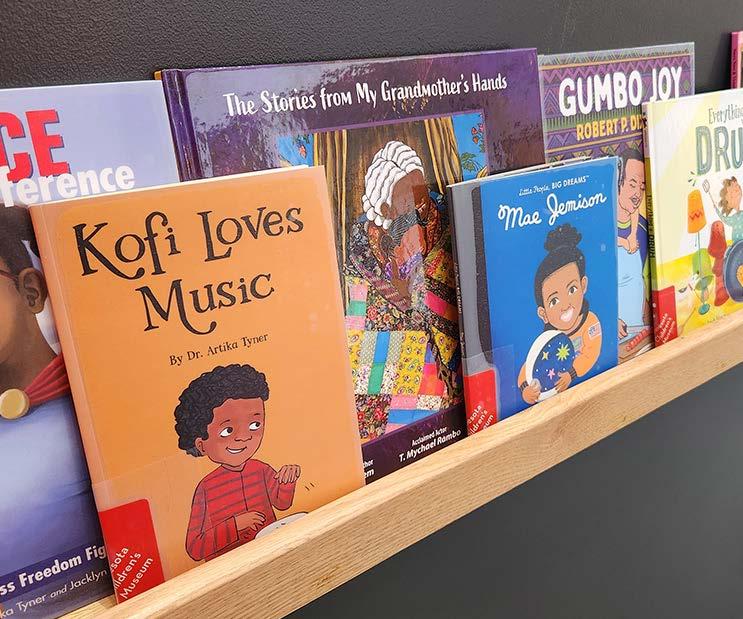
In July, visitors entering the museum’s atrium saw books lining a large black wall, designed to stand out against the colorful space, along with a banner representing Disability Pride Month. The museum believes seeing themselves represented can help children with disabilities feel included.
“I think a child with a disability often might feel like an ‘other’ in their community,” Turgeon said. “So when something is put on display, kind of loud and proud, then that’s celebrating that child, and I think that’s hopefully going to make them feel more comfortable and more confident in themselves.”
The museum selected books featuring a range of disabilities and placed them along the book wall and in book bins throughout the atrium.
“We really also just wanted books that
highlighted a diverse set of different abilities or disabilities,” Turgeon said.
An important goal of the book wall was to help build a community of children who are empathetic to others’ needs.
“When kids are exposed to different types of people, they build up their empathetic skills, and that’s really important to us,” Turgeon said.
How the books were selected for display
Every month, the museum works with a partner organization to make sure the books are relevant to the communities it aims to highlight.
For Disability Pride Month, the museum reached out to the PACER Center for book recommendations.
When selecting the books, PACER Center staff wanted to find stories that showed a person’s disability isn’t the whole story.
“Disability goes beyond simply explaining the disability and the diagnosis. It’s more like the child, the whole child at the center,” Elizabeth Ross, marketing and communications director at PACER, said.
When deciding which books to feature, the PACER Center asked its staff for
DISABILITY PRIDE To page 8


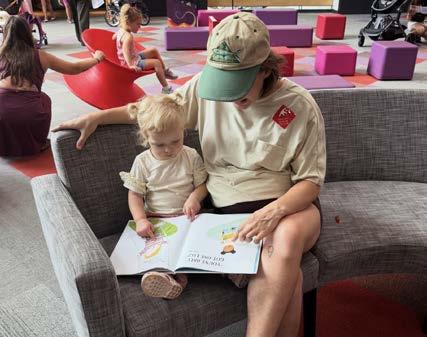
The Children’s Museum of Minnesota has a wall of books featuring children with a variety of disabilities.
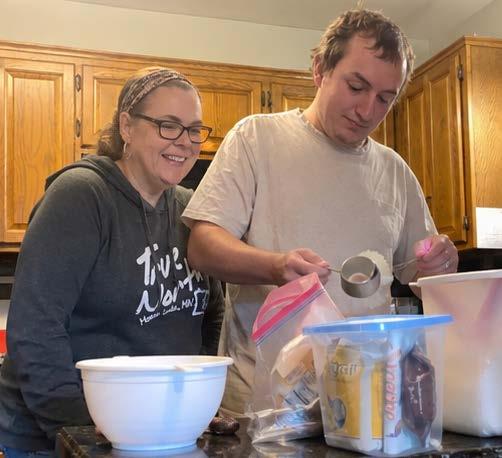
Hands-on learning - Angela Strasser guides Chris Freilinger through a cooking lesson at home.


COMMENTARY
What does disability pride mean to me?
By Joey Carlson
Managing Editor, Access Press
This July (Disability Pride Month), I personally spent a lot of time thinking about what disability pride means to me.
I looked at social media and saw that a lot of people celebrated disability pride by saluting those that helped pass laws like the landmark Americans with Disabilities Act. Others discussed how they were proud of their neurodivergence or the different ways they interact with the world.
But as the July heatwave intensified, I kept seeing generic social media posts about disability pride. This made me think to myself: What are we actually proud of? What does disability pride mean to me?
For me, the answers required taking a step back to August 3, 2000.
Before that hot summer day, my world revolved around athletics and the relentless pursuit of winning speedskating races. Then a car accident changed everything. I snapped my spine and crushed three of my cervical vertebrae. Overnight, my identity had changed from world-class athlete to quadriplegic. Everything about my physical body transformed, but the drive inside me never changed.
I went back to school, earned two degrees, and built a career. Today, alongside my work here at Access Press, I have the privilege of
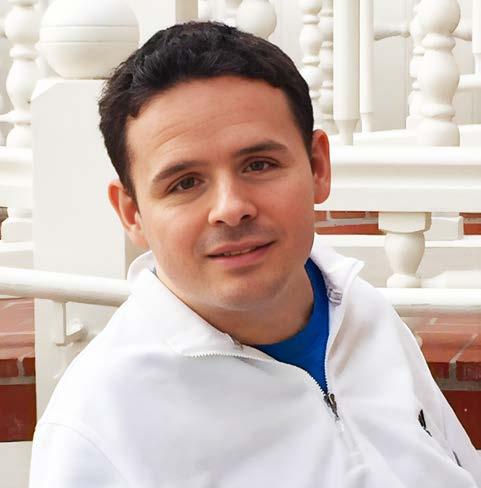
Joey Carlson
leading peer support groups, lobbying at the state and national capitals, and serving on the board of the Minnesota Spinal Cord Injury Association. Outside of work and formal volunteering, I love the simple moments of every day: taking my dog for a walk, throwing a fishing line out on the water, playing video games, and being a good neighbor, cousin, son, and friend.
Here is the truth that often gets lost in the mainstream conversation about disability pride: I am not proud of the wheelchair, nor am I proud of the bad hand life dealt. But I feel
Historic thoughts on disability pride
“Disability is not a brave struggle or courage in the face of adversity. Disability is an art. It’s an ingenious way to live.”
— Neil Marcus, Playwright and Disability Rights Activist
“Pride is not just about feeling good about who you are. It’s about being visible, making noise, and demanding equal access, equal rights, and equal dignity in every corner of society.”
— Judy Heumann, Activist and “Mother of the Disability Rights Movement ”
“Pity is a choice, and so is pride. Choosing pride allows us to see our differences not as limitations, but as unique aspects of who we are that deserve respect and celebration.”
— Haben Girma, Human Rights Lawyer and Author (first deafblind graduate of Harvard Law School)
“I officially came out as disabled... It was a freeing moment because I spent so many years trying to hide my disability, trying to fit into a world that wasn’t built for me.”
— Lois Curtis, Artist and Disability Rights Advocate (key plaintiff in the landmark Supreme Court Olmstead decision)
“For me, disability pride is about unlearning the shame that society tries to attach to our bodies and minds. It’s about standing in your truth and knowing that your existence is valid and powerful.”
— Imani Barbarin, Disability Rights Activist and Speaker
The pride I feel isn’t rooted in what happened to me. It’s embedded in how I choose to exist and feel in the world.
like the car crash was just a twist of fate, not a character-changing moment.
To me, Disability Pride Month shouldn’t just be about celebrating a diagnosis, a mobility device, or a physical condition. The pride I feel isn’t rooted in what happened to me. It’s embedded in how I choose to exist and feel in the world.
Everyone has a responsibility to look inside and find their own voice. Being proud of your basic existence, your character, and your humanity is a choice that can lead to happiness for you and others around you.
So, as we fly the disability pride flag, let’s honor the civil rights movement that brought
us here, and make sure we find pride within ourselves no matter what. But do not let your story be swallowed by your diagnosis. Let your flag fly free because of who you are on the inside.
I’m not proud of my chair or my injury. I’m just proud to be me. Now, I put the question to you: What does disability pride mean to you?
What does disability pride mean to you?
Email your thoughts to editor@accesspress. com for a chance to be featured in an upcoming issue.

“Disabled people are not ‘broken’ versions of non-disabled people. We are whole, complete human beings with our own culture, history, and ways of moving through the world.”
— Alice Wong, Disability Rights Activist and Founder of the Disability Visibility Project
“Disability is art. It’s an ingenious way to live, and it’s time the world saw it as a source of creativity, strength, and innovation.”
— Stella Young, Comedian, Journalist, and Disability Advocate
EDITORIAL: Editorial submissions and news releases on topics of interest to persons with disabilities, or persons serving those with disabilities, are welcomed. We reserve the right to edit all submissions. Editorial material and advertising do not necessarily reflect the view of the editor/ publisher of Access Press.
DEADLINE: 15th of each month.
CIRCULATION/DISTRIBUTION: Distributed the 1st of each month through more than 200 locations statewide. Approximately 1,400 copies are mailed to individuals, including political, business, institutional and civic leaders.
INQUIRIES AND ADDRESS CHANGES should be directed to: Access Press, PO Box 40006, Industrial Station, St. Paul, MN 55104-8006; 651-644-2133; email: access@accesspress.org Website: accesspress.org Executive
REMEMBERING
SUBSCRIPTION: Free and accessible to anyone in Minnesota, visit www.accesspress.org/subscribe ABOUT ACCESS PRESS: A monthly newspaper published for persons with disabilities by Access Press, Ltd. POSTMASTER: Send address changes to Access Press, PO Box 40006, Industrial Station, St. Paul, MN 551048006
CHARLIE SMITH AWARD DETAILS FORTHCOMING
Growing Accessibility Guest Services at the Minnesota State Fair
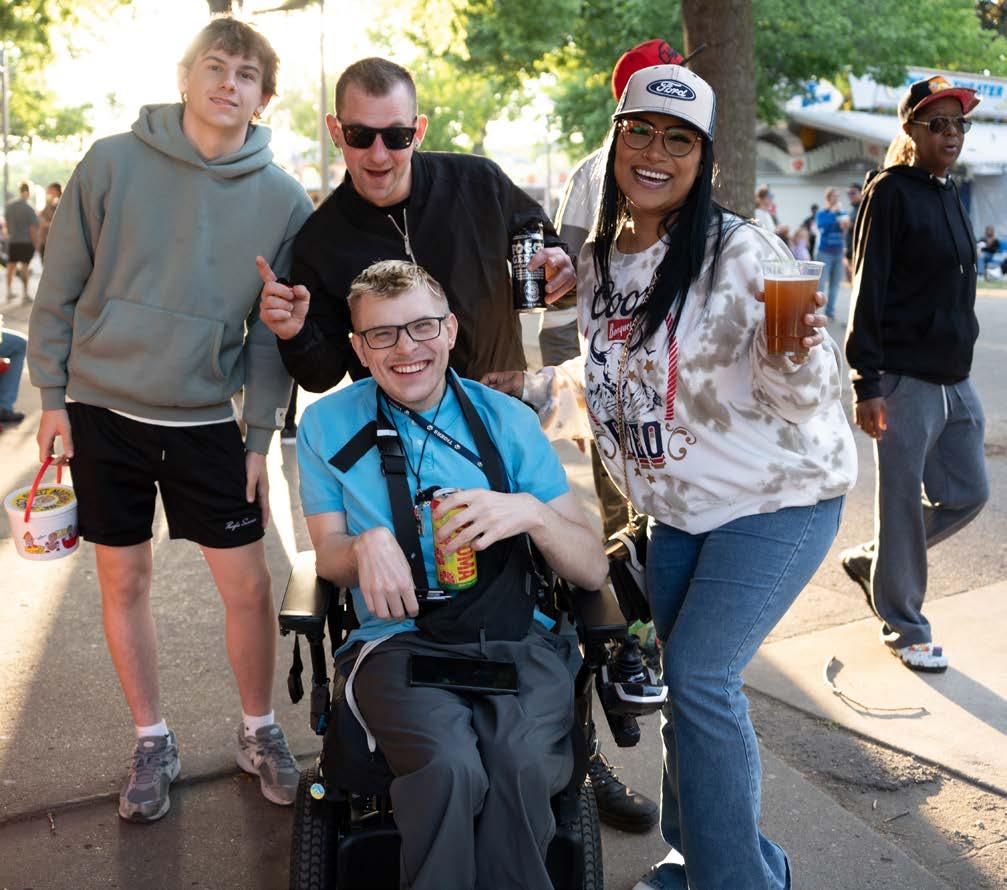
BY MINNESOTA STATE FAIR
A cherished end-of-summer tradition, the Great Minnesota GetTogether welcomes more than 1.9 million guests annually to a fun, worldclass showcase of agriculture, art and industry. Perennially popular are the 1,600 food items (more than 80 on-astick); 900 entertainment shows free with fair admission; livestock competitions; Mighty Midway and Kidway rides & games; horse shows; CHS Miracle of Birth Center; baking, fine arts, talent, 4-H and FFA contests; 1,000 specialty merchandise vendors; hundreds of howto demonstrations; a nightly fireworks show; and more!
The Minnesota State Fair is always 12 days ending Labor Day. The 2026 State Fair is Thursday, Aug. 27 through Sept. 7. Every year, the State Fair strives to enhance its accessibility guest services to help ensure all guests can enjoy a day at the State Fair with confidence and independence.
2026 PLANS
• A new Human Guide Service provides trained guides who offer shortterm personalized, one-on-one assistance to guests who are blind or have low vision, as well as others who may benefit from navigational support while visiting the fairgrounds. Guides are available upon request by contacting the fair’s accessibility department, 651-288-4448 or accessibility@mnstatefair.org. Human guides receive training in sighted guide techniques, effective communication and respectful customer service to provide safe, reliable and individualized assistance.
• Pre-recorded audio descriptions are available for select works in the crop art exhibit and fine arts exhibition and for an overview of the Creative Activities Building. Additional audio description is available with two weeks notice.
• There are four locations with adult-size changing tables: Momentum Refresh Universal Changing Table with Hoist (bring your own sling) on the north end of the fairgrounds; KaiBi Family Care Center in the center/south section of the fairgrounds; Lee & Rose Warner Coliseum on the south end; and Family & Baby Care on the west end.
• The new Ultimate Dinosaurs exhibit, presented by the Science Museum of Minnesota in the North End Event Center, displays Braille signage.
• A variety of free entertainment shows are ASL-interpreted this year – the schedule changes daily. The Opening Ceremony, Smokey Bear Live, pet surgery, Harvesting Honey, POWER: Drag Revue, milking demonstrations, storytimes, The Raptor Center, Naturalization Ceremony & Oath
of Allegiance, stunt dog shows, magic and comedy, lumberjack shows, select live music performances and more. There’s something for everyone! ASL interpreters are at the fairgrounds 9 a.m. to 6 p.m. daily.
• ASL interpretation is available for Grandstand and Bandshell concerts, as well as other programs and needs –please make your request two weeks in advance.
• Use the Aira app on mobile devices for visual assistance to read menus, find buses, locate the right line to stand in and more. This will be the third year of offering this service for those who are blind or have low vision.
• Captioning is offered for the 4-H Llama & Alpaca Costume Contest.
• For those with sensory sensitivities, stop by take-a-break spaces at the Fraser Sensory Building, KaiBi Family Care Center and the Momentum Refresh location. Tips and a pre-visit story to help prepare for a day at the fair are available on our website. On Monday, Aug. 31, for a sensoryfriendly morning at Kidway (9 to 11 a.m.) and Mighty Midway (10 a.m. to noon), lights, sounds and non-safety-related announcements will be minimized. Note: The sensory-friendly hours apply only to Mighty Midway & Kidway; there are areas in other parts of the fairgrounds that may contain loud music and lights. Also, in Mighty Midway & Kidway, some lights and sound may still occur, as not all attractions can completely eliminate all sound and light.
• Did you know the State Fair operates a free Park & Ride lot and shuttle exclusively for those with disabilities and their companions? It’s located at the Oscar Johnson Arena lot off Energy Park Drive. A disability parking certificate or license plate is all that’s needed to park – and the shuttle drops off at Gate 9 – Loop Gate on Como Avenue.
• The fair also offers designated Metro Mobility and rideshare dropoff and pick-up points – one on the north and one on the south end of the fairgrounds.
• Need an electric scooter, wheelchair or wagon? They’re available for rent at the major gates. Make a reservation for a scooter to ensure one is available when you arrive.
Discount State Fair admission tickets are on sale now through Aug. 26 online or at metro area Cub stores and other outlets.
Sign up for our e-newsletter to receive accessibility-specific email updates at bit.ly/msf-enews. Our Accessibility Guide has all the details! Check it out at bit.ly/ msfaccessguide.
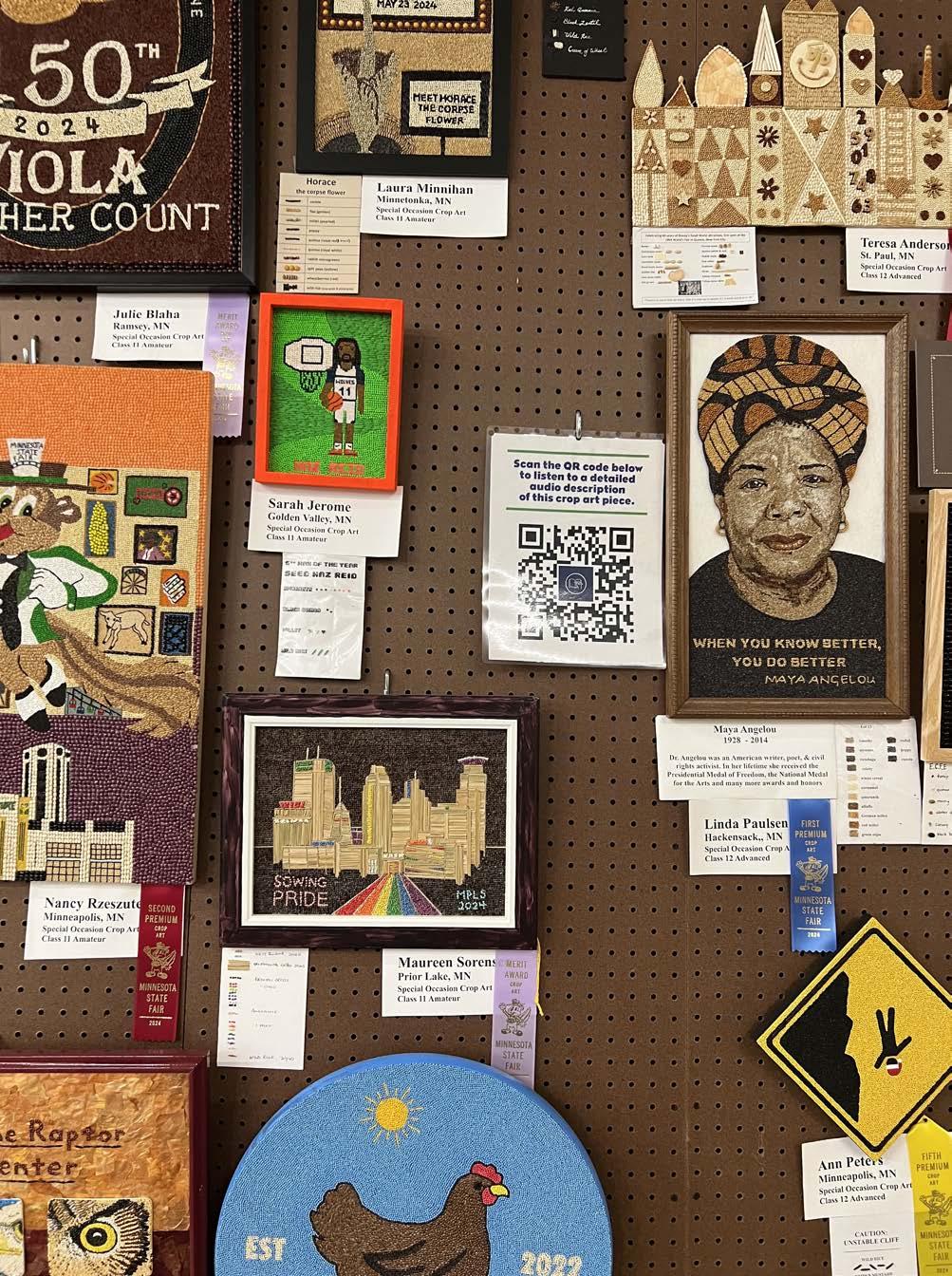

People of all abilities create and enjoy displays like this collection of crop art (art created using seeds and crops). Audio descriptions are even available for those with vision disabilities.
The Minnesota State Fair offers fun activities for everyone.
Twin Cities couple is helping people with disabilities in Minnesota and Liberia FEATURES
By Joey Carlson
Navigating the maze of healthcare benefits when you have a disability is always daunting and can often feel overwhelming. If you are a recent immigrant, these challenges can seem like they’ve been multiplied by double digits since you’re also dealing with all the bureaucracy involved with immigration. Because so many people experience these challenges, Agnes Cole co-founded the organization, Disability Motivational Network (DMN) with her husband, Prince Cole.
“Living in both countries, a developed country and undeveloped country… it seemed like two different worlds. What we try to do is make those worlds make sense to people, which is a problem I had at first when I was going to school here,” Agnes Cole said.
Agnes Cole moved from Liberia to Minnesota in 2015, went back to school, and earned a Master of Arts degree in Human Services and Health Administration from Saint Mary’s University Minnesota.
Yet, despite her advanced academic background, she faced staggering systemic hurdles when looking for healthcare and a job. “It was really really challenging for me you know just navigating the whole system,” Agnes said. “So I didn’t know who to talk to and just felt lost.”
Learning to access standard accessibility accommodations was a frustratingly slow process. “It took years before I got to know about Metro Mobility,” she recalled. “And there was no one there to help explain what my options were for health coverage.”
Determined to ensure other disabled immigrants would not have to struggle in isolation like she did, Agnes and her husband, Prince Cole—who immigrated to Minnesota
in 2003—officially launched DMN in 2016 to serve as a peer-led navigation hub.
A lifeline in the Twin Cities
In the Twin Cities, DMN operates as a critical community connector designed to pull isolated individuals out of the shadows. Meeting monthly at area spaces, including the Fridley and Brooklyn Center libraries, the network hosts support groups that directly address the gaps in the traditional social services system.
“The support group gives people the bright idea of how to advocate for themselves. This is especially helpful for people who are struggling with their caseworker or PCAs,” Agnes Cole said.
Many disabled immigrants arrive in Minnesota completely unaware of the programs available to them, sometimes remaining trapped inside their homes for months simply because they do not know how to coordinate accessible transit. DMN steps directly into this gap by teaching members how to communicate effectively with case workers, manage interactions with personal care assistant (PCA) agencies, and advocate for their own specific care requirements. By showing members that they have a fundamental right to mobility and independence, DMN helps open their world.
Creating opportunities across the Atlantic
While DMN works to strengthen the safety net in Minnesota, the organization’s transnational work is fundamentally reshaping infrastructure in Liberia where systemic stigma and a lack of physical accessibility present severe challenges. The network has successfully guided more than 20 young people
with disabilities through college education, but they also prioritize localized vocational training for youth and adults with disabilities. “Some of our students who didn’t go to school at an early age would prefer to do vocational school,” Agnes explained. “We were able to open a vocational sewing school for some individuals who did not go to school and want to just learn how to do something with their hands so that they can provide income for their families.”
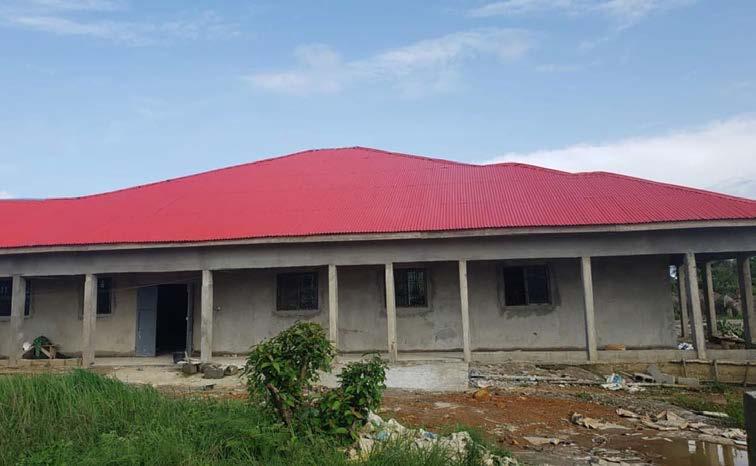
DMN’s most ambitious international project to date is the recent construction of a massive, fully accessible medical clinic in Monrovia, Liberia. In Liberia, an estimated 99% of medical facilities lack basic ramp access, accessible restrooms, or interpreters for patients with hearing impairments.
“We started building our clinic to provide essential and reproductive health... just basically like primary care for people living with disabilities because most of the hospitals and clinics are not really accessible,” Agnes said. “Some of the hospitals have steps and then for our friends who have speech impairments or are hard of hearing, they don’t have interpreters or translators.”
This systemic lack of inclusion proved fatal for a beloved friend and DMN member named Stephenie. “In that process, we lost a friend who went to deliver a baby and passed away,” Agnes shared. “She went in labor and then, you know they didn’t give her the rightful help... so that inspired us to build this clinic.”
Determined to prevent future tragedies, DMN spent the past two years building a state-of-the-art, 35-bedroom brand new clinic. Once open, the clinic will offer comprehensive healthcare tailored to patients with disabilities and serve as an inclusive employer, creating jobs for individuals with disabilities in Liberia.
Standing in solidarity with DMN
Although construction on the Monrovia clinic building is complete, its doors cannot open until vital operational hurdles are cleared. The clinic cannot serve patients without standard clinical inventories and running water. “We cannot open the clinic without running water, so we need running water... and standard medication,” Agnes said. The infrastructure has been funded entirely by grassroots donations, largely driven by the organization’s annual benefit.
“Every year we have a fundraiser gala and then the proceeds from there fund materials to complete the clinic,” she says.
Minnesota residents can support the completion of the clinic by attending this year’s Light of Hope Dinner Gala on Saturday, September 19, 2026, at the Church of the Open Door, located at 9060 Zanzibar Lane N, Maple Grove, MN 55311 at 5:30 PM. The evening will feature powerful testimonies of survival and impact, community fellowship, and a presentation by special guest speaker and Goodwill Ambassador, Mamie Free.
Beyond physical supplies, DMN is actively searching for arts volunteers to pick up the mantle of their late friend, Gigi, who was the artistic heartbeat of DMN’s local community programming. “She was the director for the art part... she knew how to bring people together,” Agnes remembers fondly. “She taught people to make everything from jewelry to Christmas ornaments.”
To purchase gala tickets, sign up for the DMN email newsletter, or learn more about volunteering or coordinating a medical equipment donation, community members can visit the Disability Motivational Network official website at www.dmnetwork.org.
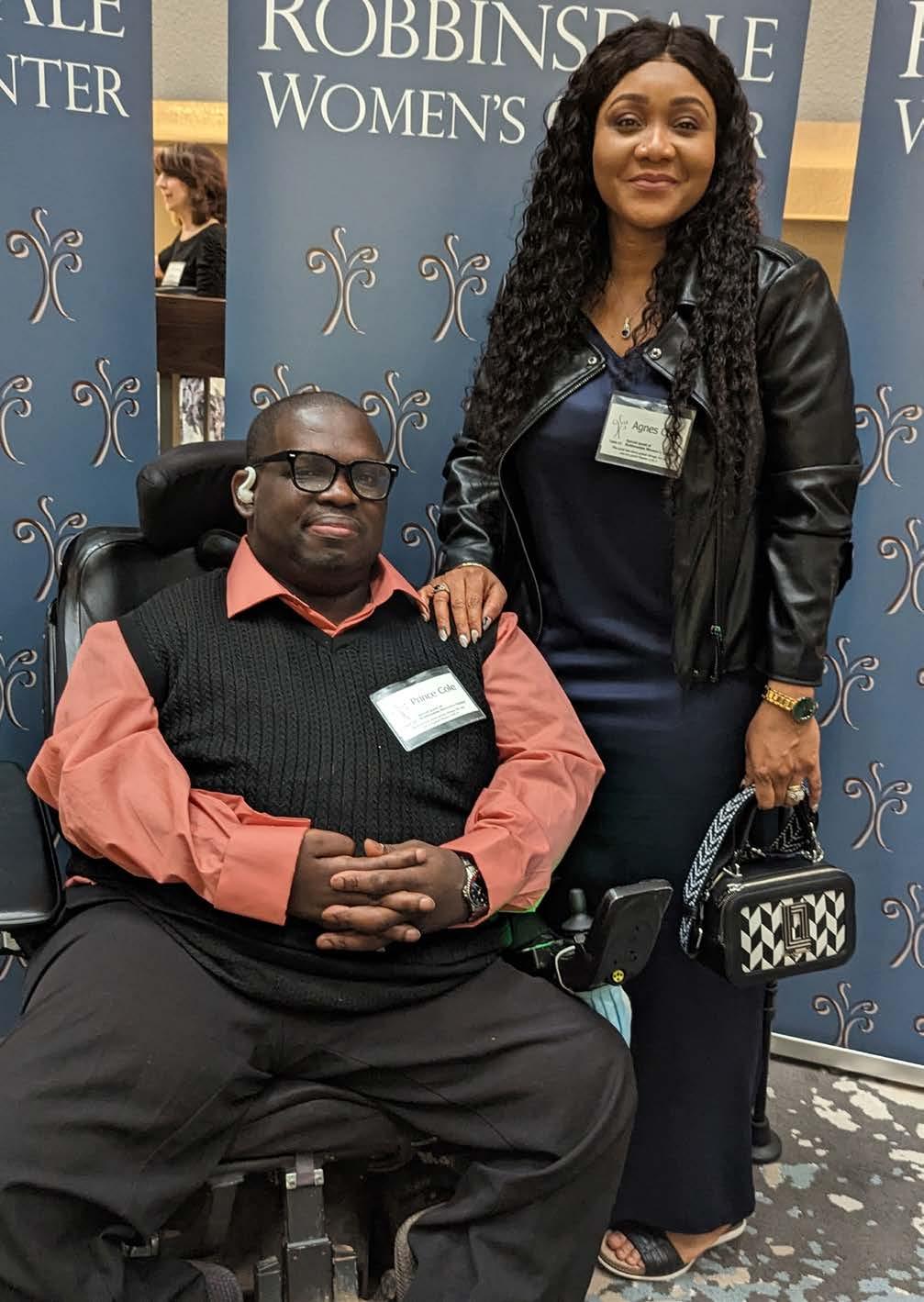

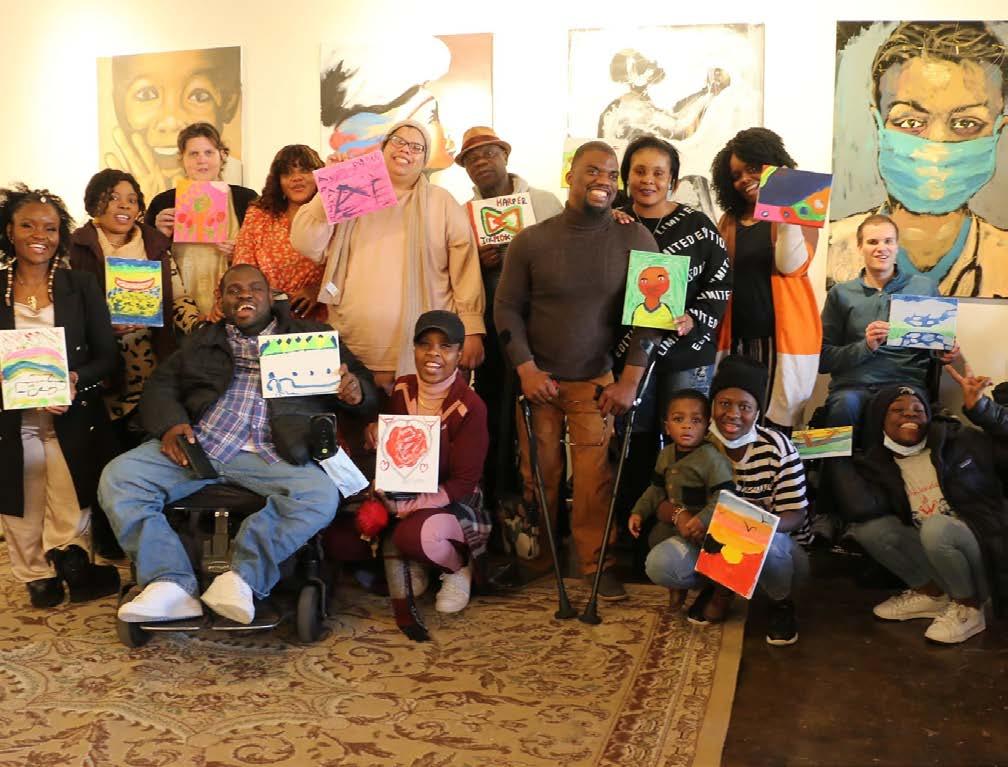
Disability Motivational Network frequently connects at communnity events.
Agnes and Prince Cole are the founders of Disability Motivational Network (DMN).
Agnes and Prince Cole are helping build an accessible clinic in Liberia.
The Kyle Pease Foundation is redefining inclusion on the racecourse

The finish line of a marathon offers an unmatched mix of achievement and relief. For runner Therese Kuvaas, however, crossing it has become about something far bigger than a personal record. As a push-assist teammate for The Kyle Pease Foundation (KPF), she takes to the pavement to prove that the thrill of the finish line belongs to everyone.
About The Kyle Pease Foundation
Founded in 2011 by brothers Brent and Kyle Pease, the organization was born out of a simple, life-changing question. After watching Brent complete an IRONMAN competition, Kyle, who lives with cerebral palsy, asked, “Can people in wheelchairs do IRONMAN?” The answer was a resounding yes.
Since completing their first triathlon together, the brothers have catalyzed a national movement. The foundation’s core purpose is to create awareness and raise funds to promote success for people with disabilities by assisting them to meet their individual needs through sports and beyond.
The impact of KPF’s work spans across several critical areas:
• Adaptive sports equipment: Providing specialized racing chairs, hand-crank bikes, and mobility devices to remove physical barriers.
• Scholarships and grants: Supporting athletes with disabilities so they can pursue athletic and personal milestones.
• Inclusive employment: Moving beyond the racecourse to fund and create meaningful job opportunities for individuals with disabilities, ensuring their skills are valued in the workforce.
For KPF, the experience isn’t about charity, it’s about shared equity. As the foundation highlights, an in-chair athlete experiences the exact same rush of endorphins, competitive drive, and pride as their push-assist partner. It provides a vital sense of community and joy for families who often struggle to find accessible social and athletic networks.
Driven by purpose: Therese Kuvaas’s story
For Therese Kuvaas, joining the foundation’s mission felt like a natural extension of her love for running, transforming a solitary sport into a partnership.
Having spent more than 20 years in the running community, Kuvaas’s perspective shifted during a 29029-endurance event. There, she heard KPF Executive Director Brent Pease share the story of growing up with his brother Kyle and his drive to ensure Kyle had equal opportunities in sports. Listening to Brent opened Kuvaas’s eyes to

I might be providing the physical leverage with my legs, but the heart, the grit, and the spirit driving us through those tough miles come straight from my teammate in the chair.
how endurance sports could extend beyond personal accomplishments.
As she prepared for her 15th marathon, Kuvaas decided she wanted her training to serve a greater purpose. That decision led her to sign up as a push-assist teammate with KPF for the Publix Atlanta Half Marathon. Running alongside Team Josh turned out to be one of the most meaningful experiences of her running career. The joy, determination, and camaraderie shared among chair athletes, push-assist teammates, families, and volunteers created a community unlike any she had encountered before. Crossing the finish line together delivered a sense of fulfillment that far surpassed any individual race result.
“When you are out there on the course, you quickly realize you aren’t just pushing a chair—you are moving forward together as a single unit,” Kuvaas shared. “The energy is entirely mutual. I might be providing the physical leverage with my legs, but the heart, the grit, and the spirit driving us through
those tough miles come straight from my teammate in the chair. We are pulling from the exact same well of determination.”
Looking ahead and inspiring the next generation
Upon returning home from Atlanta, Kuvaas knew her journey with KPF was just beginning. Although KPF has been changing lives for 15 years, Kuvaas views her involvement as a starting point to raise awareness, assist with fundraising, and help provide athletes with access to specialized equipment. She has already committed to fundraising and serving with KPF at the Dopey Challenge during the Walt Disney World Marathon Weekend in January 2027.
“The Kyle Pease Foundation shows us that true inclusion isn’t a passive concept or a policy on a piece of paper; it’s an action,” says Kuvaas. “Crossing that finish line together changes you forever. It strips away the societal labels of disability and leaves only two athletes who refused to accept limits,

achieving something extraordinary as one. Together, anything truly is possible.”
Beyond her athletic and advocacy goals, Kuvaas’s commitment carries personal significance at home. She hopes her involvement sets a lasting example for her two teenage daughters about the importance of service.
“I want them to see the importance of giving back, serving others, and using our time and abilities to make a difference,” Kuvaas noted. “If they grow up understanding that we all have the opportunity and responsibility to help others, then that will be one of the greatest gifts I can give them.”
Crossing the ultimate finish line
As upcoming races approach, Kuvaas and her teammates stand as a powerful testament to what happens when communities choose to wheel together. Through the support of everyday advocates, volunteers, and donors, The Kyle Pease Foundation continues to change the national narrative around disability, proving that every athlete deserves the right to say, “I did that.”
To support Team Josh, get involved, or learn more about the inclusive programs reshaping endurance sports, visit www. kylepeasefoundation.org.
Sarah Robertson, Josh Porter, and Therese Kuvaas finished the race and posed with medals.
By pushing Josh Porter in marathons, Therese Kuvaas raises funds and awareness for disability issues.
Beating the heat: How Minnesotans can stay safe in extreme summer heat
By Frank Murphy
When summer hits Minnesota, warm days are a welcome relief from frozen winters. However, extreme heat—weather that is significantly hotter or more humid than usual—is quietly the deadliest weatherrelated hazard in the United States, causing more deaths annually than flooding, tornadoes, and hurricanes combined.
As Minnesota’s climate warms, extreme heat events are projected to become more frequent, severe, and long-lasting.
When temperatures surge, our bodies must work significantly harder to maintain a normal core temperature. When heat overwhelms the body’s cooling mechanisms, heat exhaustion or life-threatening heat stroke can quickly follow. Heat can also aggravate underlying conditions like heart disease, asthma, and kidney conditions. While extreme heat poses a threat to everyone, high-risk groups include older adults, young children, pregnant individuals, outdoor workers, and people with limited access to air conditioning.
Staying safe during hot stretches comes down to proactive habits and early recognition of heat illness symptoms. How to beat the heat
Taking preventative steps before you feel overheated is the most effective way to protect yourself and your family:
• Hydrate proactively: Drink water or electrolyte solutions frequently throughout the day. Do not wait until you feel thirsty to start drinking, and avoid alcohol and heavily caffeinated beverages, which can contribute to dehydration.
• Seek cool environments: Spend time in air-conditioned spaces, shaded areas, or local cooling centers. If indoor temperatures
LAWSUIT
From page 1
home. Unlike corporate environments staffed by rotating shifts, family foster care integrates individuals directly into a stable household.
“The people I live with now, they don’t all have to clock in and clock out,” Freilinger said. “Many are working 24 hours a day, 7 days a week, 365 days a year. They see me through the bad, they go through the good... they do it anyway because they care.”
Under this dedicated care, Freilinger’s transformation has been profound. He even took his new voice directly to the State Capitol to advocate for disability services.
The flat-rate crisis
The stability Freilinger relies on is now hitting a wall due to sweeping legislative changes to Minnesota’s Disability Waiver Rate System (DWRS). The state has transitioned FRS frameworks away from individualized funding models, which scale based on a person’s specific, real-time needs, to a rigid, tiered flat-rate system.
Under the new model, a provider caring for a resident assigned to a standard tier like “Case Mix B” receives a flat reimbursement of approximately $254 a day. But for individuals with complex profiles, providers must hire specialized support staff, which costs between $22 and $24 an hour. When accounting for the 24/7 staffing required by federal 245D home and community-based compliance rules, the flat rate fails to cover basic operational costs.
Strasser warns that this structural shift is systematically dismantling family-based care, forcing providers to choose between funding gaps out of their own pockets or discharging individuals they have cared for as family for years. For advocates, the goal isn’t to diminish corporate options, but to protect a vital continuum of care that offers true, personcentered choices.
Human and financial cost of “flawed math”
Freilinger’s current waiver ends at the end of August. If a solution is not found by September 1, he faces displacement into a corporate residential setting (CRS), a prospect that terrifies him.
Freilinger navigates multiple complex mental health and neurodivergent diagnoses, including Asperger’s, bipolar disorder, oppositional defiant disorder (ODD), OCD, and ADHD. His case manager has already indicated that if he is moved to a corporate facility, his severe mood swings and anger management history will trigger a mandatory 2:1 staffing ratio.
“Two full-grown adult men will be shadowing every one of my moves,” Freilinger
reach 95°F or higher, do not rely on electric fans for cooling, as blowing hot air can increase body temperature.
• Dress appropriately: Wear lightweight, light-colored, and loose-fitting clothing to help sweat evaporate. Apply broad-spectrum sunscreen when outdoors.
• Adjust outdoor activities: Limit heavy physical labor or exercise to the cooler early morning or late evening hours. Take frequent breaks in the shade if you must be outdoors.
• Stay informed: Check local weather updates and tools like the National Weather Service Heat Risk index or the OSHA-NIOSH Heat Safety app to gauge daily danger levels.
• Check on vulnerable neighbors: Connect regularly with older adults, neighbors living alone, or those without home air conditioning during high-heat days.
Knowing the symptoms of heat stroke
Understanding the difference between mild heat distress and a medical emergency is vital.
Heat stroke is a life-threatening emergency that occurs when the body’s temperature regulation system fails completely.
Key symptoms of heat stroke to watch for include:
• Extremely high body temperature: Body temperature rising quickly (103°F or higher).
• Altered mental state or behavior: Confusion, slurred speech, dizziness, irritability, or loss of consciousness/fainting.
• Altered sweating response: Red, hot, and dry skin, or heavy, profuse sweating despite extreme heat.
• Rapid pulse and breathing: A fast, strong pulse and fast, shallow breathing.
said. He fears the loss of his family support system and the suffocating restriction of a corporate facility will break his progress. “I know that if I get put in a corporate-run facility, I will end up in prison within two months.”
Beyond the human toll, Freilinger points out that the state’s attempt to save money is backed by profoundly flawed math. While policymakers claim these flat-rate adjustments cut spending, forcing individuals out of FRS homes and into corporate settings exponentially inflates costs for taxpayers. Corporate group homes historically charge up to 2.5 to 3 times more than family residential services. Furthermore, advocates note that FRS homes inherently provide a level of caregiver consistency that prevents expensive crisis interventions, emergency room visits, and repeated placement disruptions, making the model a highly responsible fiscal choice for the state.
“They think they’re saving money,” Freilinger explained. “But they’ll be spending a lot more if I have to move into an institute or prison.”
The legal battle
With legislative avenues stalled, FRS providers and the individuals they support are taking the battle to the courts. The Minnesota Association of Residential Service Homes (MARSH), a non-profit advocate network

• Physical distress: Severe throbbing headache, nausea, or vomiting.
What to do in an emergency
If you suspect someone is experiencing heat stroke, call 911 immediately. Heat stroke is a medical emergency. While waiting for emergency responders, move the person to a cool, shaded, or air-conditioned area and quickly cool them down using cold water, wet towels, or ice packs applied to the neck, armpits, and groin. Do not give the person anything to drink if they are confused or unconscious.
I n the case of heat-related power outages, seek a public space with air conditioning. Those spaces might include a hospital or urgent care clinic.
By staying hydrated, seeking airconditioned spaces, and knowing when to seek emergency help, Minnesotans can enjoy the summer months safely while keeping their communities protected.
where Strasser serves as Vice President, has filed a class-action lawsuit against the Minnesota Department of Human Services (DHS).
The lawsuit alleges that the state is effectively violating civil rights and the historic Olmstead plan by dismantling the least restrictive community environments available to Minnesotans with disabilities,
stripping them of their right to choose where they live.
For Freilinger, the stakes of the lawsuit are dire. His home, his job, and his freedom hang in the balance.
“I just want the family foster cares to survive, so I can just live my life,”
said.

Freilinger
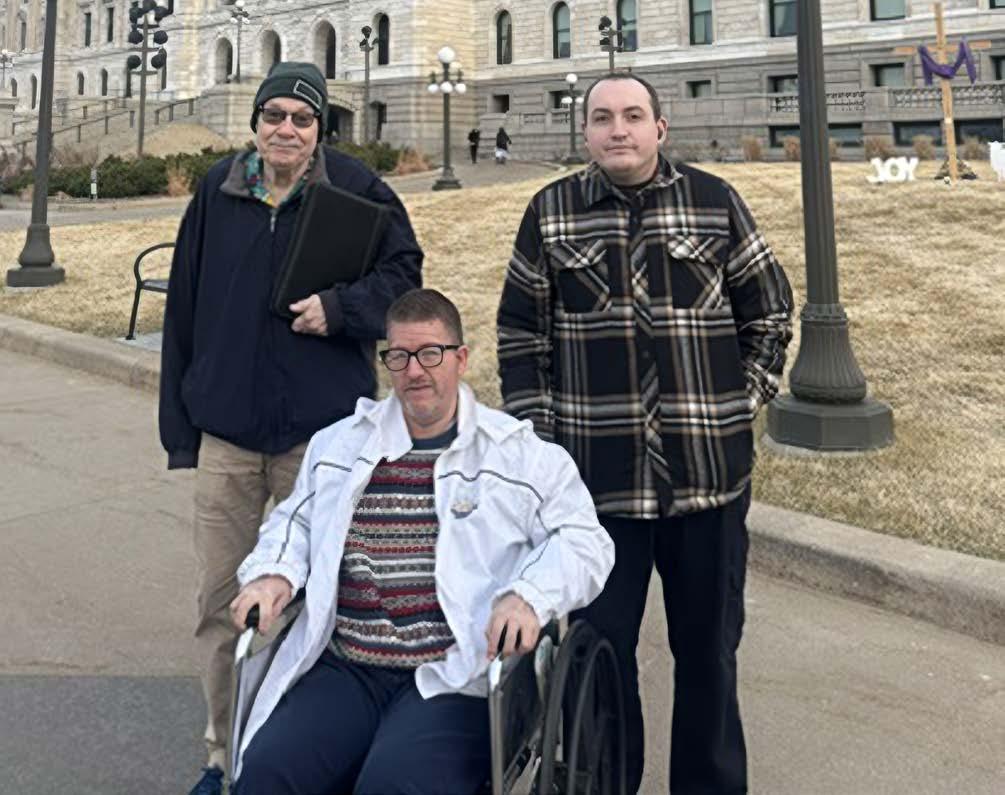
Mark Bochler, Shawn Engman, and Chris Freilinger brought key issues to the forefront during their visit to Saint Paul.
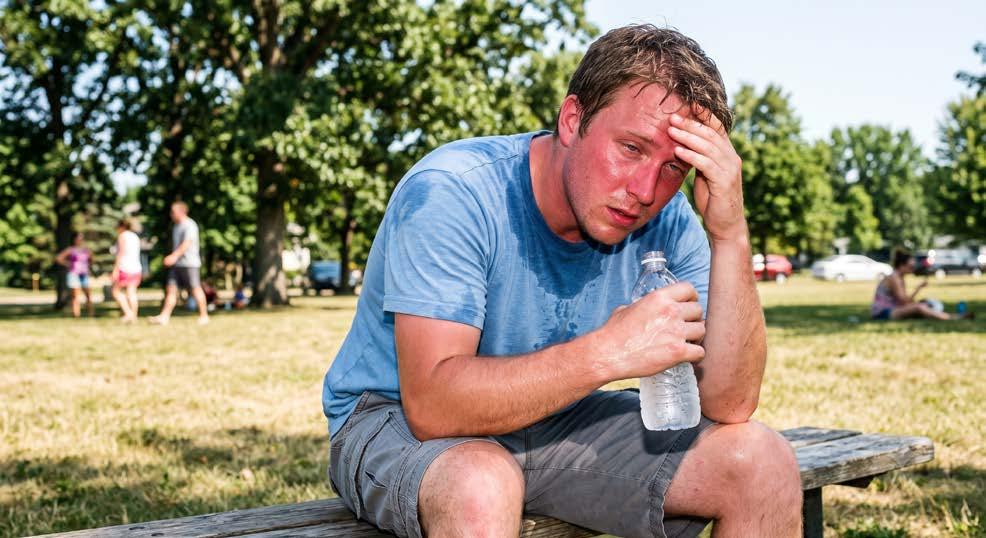
It’s important to stay hydrated and use sunscreen in the Minnesota summer sun. Taking extra breaks from the sun and staying hydrated are great ways to prevent heat stroke.
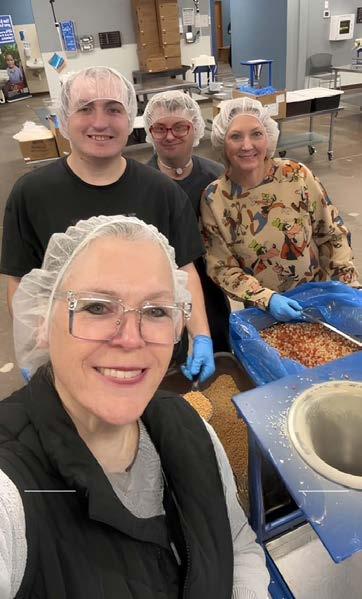
Angela Strasser and Chris Freilinger volunteer with others at Feed My Starving Children.
By Greta Cunningham, University of Minnesota Institute on Community Integration
It was part history lesson, part retirement party, and all heart at a recent evening celebrating the vision and work of Jeanne Calvit, founder of Interact Center for the Visual and Performing Arts in St. Paul, Minnesota. Interact’s mission is to create art that challenges society’s perceptions of disability and builds community connections.
The June 30 event was hosted by the Institute on Community Integration (ICI), with wellknown writer and storyteller Kevin Kling serving as emcee. The evening featured performances and reflections from Interact artists and supporters. ICI has collaborated with Interact for decades, from creating training videos for the direct support workforce to hosting gallery installations showcasing the work of Interact’s visual artists.
Interact is celebrating its 30th anniversary and is the only performing arts organization to offer the full-time, daily practice of professional-level theater and visual arts to support the creative growth of artists with disabilities. Since Calvit founded Interact in 1996, the organization has produced dozens of original theatrical works and mounted more than four dozen visual art exhibitions.
Creativity was the main theme of the celebration.
ICI’s marketing and communications director, Jerry Smith, introduced the event and spoke about his long history with Interact dating back to the early 1990s.
“What struck me then—and still strikes me today—is that Interact never seemed interested in making ‘important theater.’ They were making great theater. The art came first, and social change followed naturally,” Smith said.
Smith has created videos to capture Interact performances and profiled some of the company’s actors. Charlie Lakin, the former director of ICI’s Research and Training Center on Community Living, helped Calvit as she was launching Interact.
“Without Charlie’s help, I’m sure I would not have succeeded,” Calvit said. “At the time, I knew nothing about how bureaucracy and government funding operated, and he helped me write the prospectus. He was a big supporter of Interact.”
First someone had to believe
Four Interact actors began the evening by performing the song, “First Someone Had to Believe.” Kevin Kling told the audience, “The song was perfect because Jeanne helped people to see the deeper side of themselves and encouraged performers to believe in their talents.”
Kling shared his personal story of his involvement with Interact dating back to the 1990s and how Calvit reassured him after a near-fatal 2001 motorcycle accident that resulted in a brain injury.
“Because of the accident, I was not sure I had the capacity to remember lines,” Kling recalled. “Jeanne visited me and said she wanted me to be in her next play. I was unsure, but she knew just what to say to get my attention. Jeanne said, ‘Kevin, I want you to play a god.’ That was just what I needed to hear,” Kling said with a smile.
Kling played a god in the play Cloud Cuckooland and toured England with the Interact theater company.
Bringing radical inclusion to the world
Calvit and Interact are known for having a vision of radical inclusion that celebrates the talents of performers with and without disabilities. That vision has been shared internationally as Interact has performed in Denmark, Thailand, England, Sweden, Norway, Australia, and other countries.
Two company members, Mike Brindley and Matt Dahlstrom, had the opportunity to perform in Thailand and shared poems they wrote after being inspired by their trip. They were joined by their mothers, who spoke about how Interact changed the trajectory of their adult sons’ lives.
Mike’s mother recalled how her son previously had a job “stomping cardboard” so it could be recycled, and was mistakenly seen as someone without creativity. She said working at Interact exposed her son to Shakespeare, world travel, friends, and tapping into his own talents for performing and writing.
A book and a legacy
Calvit retired in 2024 and credited ICI with much of her success during the event. She is currently working on an autobiography to capture stories from her experience at Interact, including profiles of performers and other company members who have passed away.
“I had a free-range childhood growing up in Louisiana. Even then, I was organizing performances like a neighborhood circus or haunted house,” Calvit said. “Eventually, I traveled to Europe and made my way to Paris, where I received training in theater and performing by the world-renowned actor, mime, and theater instructor, Jacques Lecoq.”
In the early 1980s, Calvit was invited to create plays with people with disabilities at Camp New Hope in McGregor, Minnesota. She was also affiliated with Pillsbury United Neighborhood Services. Those experiences inspired her to start Interact and sparked a new understanding of how people with disabilities could create art.
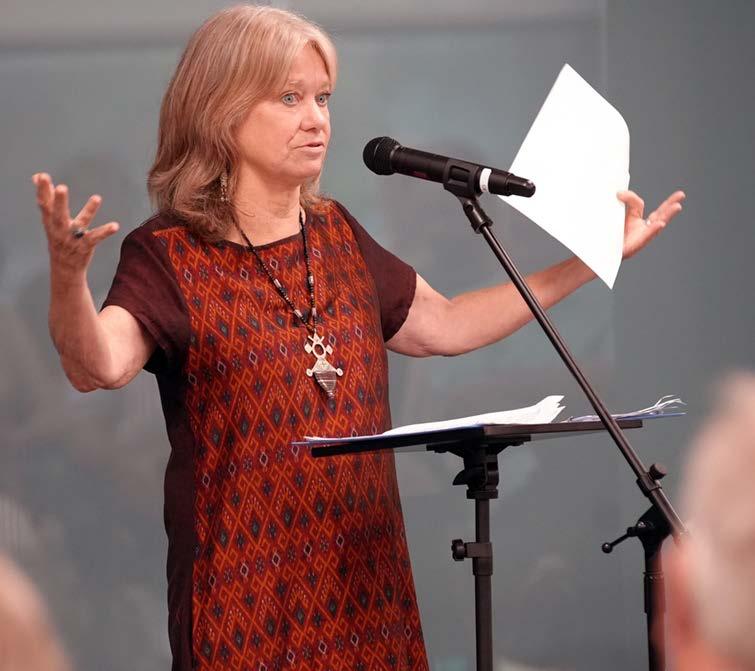
“At that time, no one was doing original theater created by artists with disabilities,” Calvit said.
Under Calvit’s leadership, Interact Center has won two Ivey Awards, as well as awards from the National Endowment for the Arts. It also received a 2018 Innovation Award from the Minnesota Department of Human Services.
Calvit’s autobiography will include stories of people whose lives were changed by working with Interact. “I want to include some stories from the projects in Thailand, Congo, and Australia,” Calvit said. “Writing a book is an ambitious project, but after the celebration event at ICI, I was left feeling that people are interested in my stories.”
This article was provided by The University of Minnesota ICI, a designated University Center for Excellence in Developmental Disabilities.
BENEFACTOR
($1000 & up)
ARRM
Dena Belisle
Tim & Mollie Benjamin
Janice Chevrette
Just Comfort, Inc.
Jane Larson
Brandon and Cathy Miller
Lynda Milne
Kay Willshire
GOLD ($500 & up)
Accessible Space
Kent Fordyce
Barbara Grams
Catherine Hunter and Christopher Ockwig
Kim Kang
Ronna Linroth
MRCI
Tamarack Habilitation Tech
John Tschida
Jeff Bangsberg and Anita Boucher
Jay Beck and Gretchen
Bratvold
John and Marilyn Clark
Stephan Cox
Sarah Berg
Tom Clark
Craig J Dunn
Lee Ann Erickson
Anne Henry and Jarod
Peterson
Maren Hulden
Anonymous Donor from Minneapolis
Katrin Bachmeier
Marta Cleaveland
Gayle Cooper
Dawn R. Doering
Celeste Doherty-Riley
Yoshiko S. Dart
Dean Doering
Rosebud Elijah
Vicki Gerrits
Heidi Holste
Kim Keprios
Steve and Wendy Kuntz
Jim Muckenhirn
Manley Olson
PayPal Giving Fund
Lila Ploof
Ken Rodgers
BRONZE ($75-$149)
Dale H Janiszeski
Gregory Lais & Patricia Thurber
Steve Larson
Maple Grove Women of Today
Gene Martinez
FRIEND
Sean M Fogarty
Mary Graba
Ann J Griffith
Mike Gude
Wendy Harbour
Annamary Jeffery
Herther
John D Marty
Michael Miner
William & Joen Overby
Kelly Rathcke
Stephanie Schwartz
Walt Seibert
Jon Skaalen
($50-$74)
Greg, Cindy and Jenna
Johnson
Steve Larson
Marilee McGraw
Sonja Peterson
Alina Schroeder
Kathy Thurston
Rick & Susie MacPherson Fund
Barbara Smith
Amanda and Mark Tempel
Daphne Thompson
Dick VanWagner
Nick and Jackie Wilkie
Joan Willshire
Linda Wolford
Kathy and Jack Tschida
Marie A Welch
Rachel Wobschall

Jeanne Calvit founded Interact Center for the Visual and Performing Arts in St. Paul, Minnesota, in 1996.
How MnDOT’s new Greater Minnesota Transit Plan could help accessibility
By John Kuziej
For people with disabilities, transportation is more than just the ability to get around, it’s a lifeline, and in the Greater Minnesota area, that can be hard to come by.
Through the Greater Minnesota Transit Plan, the Minnesota Department of Transportation (MnDOT) is focusing on transit systems outside the metro area, which advocates in those areas say are often overlooked.
“The smaller communities are kind of on the back burner, they’re forgotten about,” Heather Everson, advocate trainer for Options, Re-Interstate Resource Center for Independent Living, said.
The new plan stems from a 20-year vision to improve transit services and access, build stronger connections across communities, and respond to changing needs.
To better understand those needs, MnDOT wanted to hear from as many Minnesotans as possible.
“The plan is really focused on hearing from as many Minnesotans as we can and really identifying those needs of people in Greater Minnesota. So we did that through a number of different engagement steps and different activities,” Nathan Abney, statewide transit planning coordinator at MnDOT, said. Why accessible transit matters
Transportation options for people with disabilities can impact their health, social life, and sense of independence, and for many in Northwest Minnesota, that transportation can be unreliable.
“During emergencies, or doctor’s appointments, last-minute ones, sometimes transportation has to be set up prior to any doctor’s appointments, so then that way there’s like a 24-hour leeway. But if somebody has to get a last-minute one, it’s kind of hard to be able to do that,” Everson said.
To help shape their plan, MnDOT collected stories and heard firsthand experiences from
DISABILITY PRIDE
From page 1
recommendations. One employee with a disability was a former middle and high school teacher and explained why books can have a lasting impact on older children as well.
“She used to read children’s picture books to her middle and high school students, and kind of in the beginning they didn’t really care for it,” Ross said.
“As the year would go on during downtime, these older teens would actually ask her to pull out children’s books and read to them. So some of these books she actually read to her students.”
No matter the reader’s age, the PACER Center hopes everyone knows that we all
the disability community about the problems they were facing with transit in their area.
“Hours of transportation can be a huge issue for people with disabilities. They might only be able to do things on Monday through Friday, maybe on Saturday, but on Sundays, sometimes people can’t attend church because there’s no transportation available for them, especially accessible transportation,” Everson said.
This is an issue the agency says it is working to address.
“We are working with our transit systems
value the same thing: being included.
“The ability of a good children’s book to encourage conversation and thoughtfulness among children is really key,” Ross said.
Accessibility and inclusion beyond Disability Pride Month
Beyond Disability Pride Month, the museum works every day to create an accessible and inclusive environment for visitors.
Throughout the building, you’ll find things like low-stimulation comfort rooms for families who need a break from the noise, or an alternative path at the shipwreck exhibit so children with different mobility needs can still enjoy it.
to see if we’re able to stretch their service to have service extended to the weekend or offer Sunday service so people can be mobile on the weekends, not just during the week,” Abney said.
Expanding transit services is one of the priorities disability advocates in Greater Minnesota hope this plan will address. It would give people more opportunities to get to work, access health care, and participate in community events.
“Having those services expanded, I think, would be a huge improvement,” Everson said.
This is something the museum says is a part of an overall effort to make sure everyone has a fun experience.
“We’re always thinking about accessibility and mobility and making sure that we have kind of equitable experiences throughout the museum,” Turgeon said.
Families have taken to social media to share how the museum’s accessibility efforts have made a difference in their experience.
“We saw a family post a video of their child who was in a wheelchair and appeared to have limited mobility moving through the museum and being able to engage in all the different spaces of the museum,” Turgeon said.
There’s an ongoing effort by the museum to make sure children with disabilities feel

What’s next for the plan
This is just the beginning of MnDOT’s multi-phase plan. The agency hopes to complete the plan by the end of the year and then begin implementation, using feedback they received during the public engagement period.
One of the biggest needs MnDOT heard during its public engagement period was better regional connections so people can travel more easily across the state.
“Can someone in their rural community get to the larger urban center where there’s jobs and education opportunities and healthcare? So that’s one aspect we’re looking at,” Abney said.
Throughout the remainder of the process, MnDOT says it wants to ensure it’s increasing accessibility and will continue to receive input from the disability community.
“Our goal of our office is to increase mobility and accessibility, and the transit plan is really the first step in doing that. We know we have a ways to go, but I think the plan really outlines our vision and future for transit and Greater Minnesota,” Abney said.
included through year-round inclusive design and activities.
“We really strive for universal design, inclusive design that we’re thinking about all of the different ways that people with different abilities, different sensibilities, different mobilities might be able to use our experiences,” Turgeon said.
In the fall, the museum hosts different activities, including a multi-year partnership with Metro Deaf School, where they’ll host Deaf Day at the museum.
“We want everybody to feel like they have a place here at the museum,” Turgeon said.
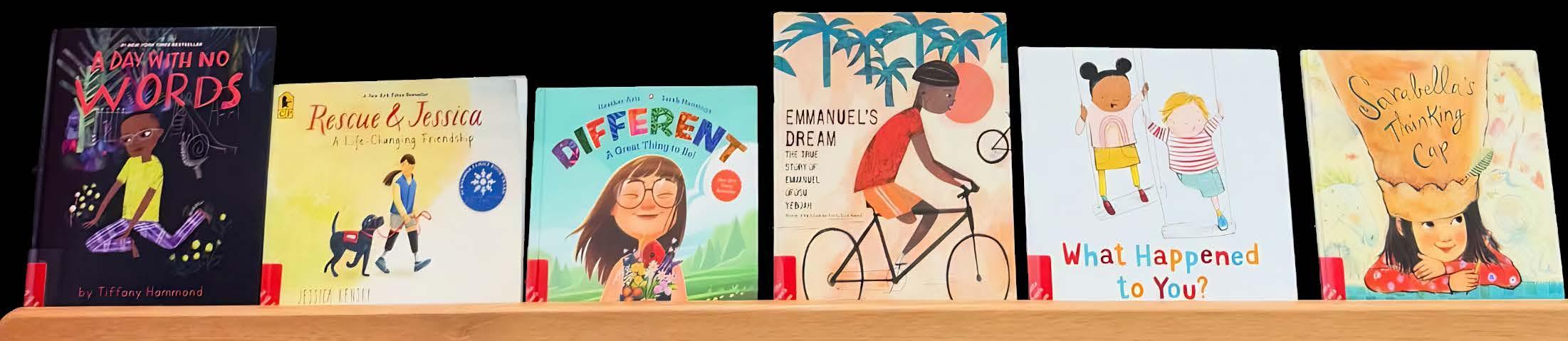

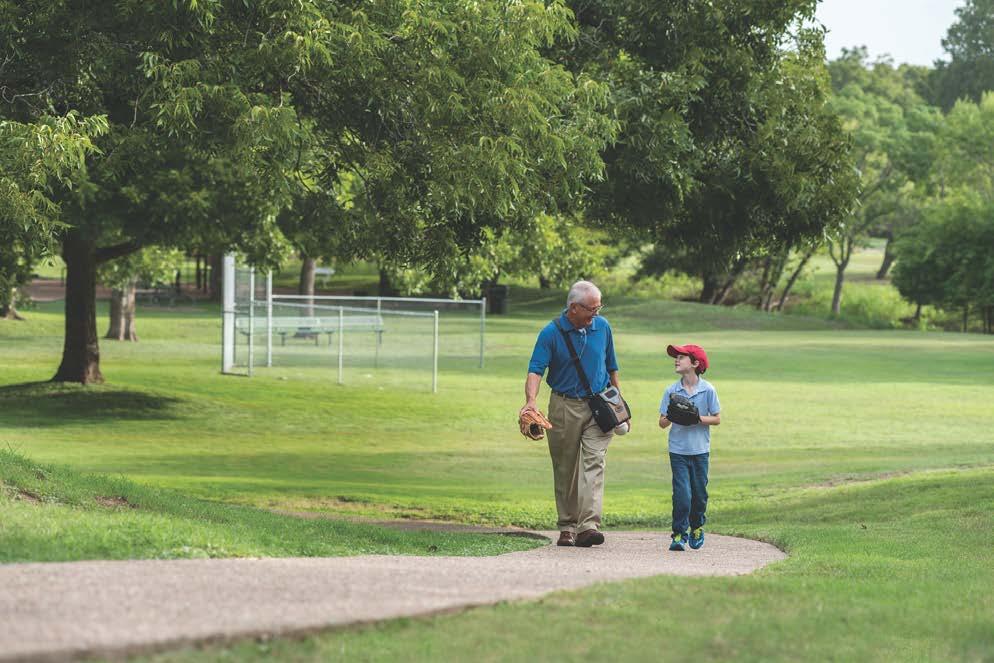


A variety of books about different disabilities are on display.
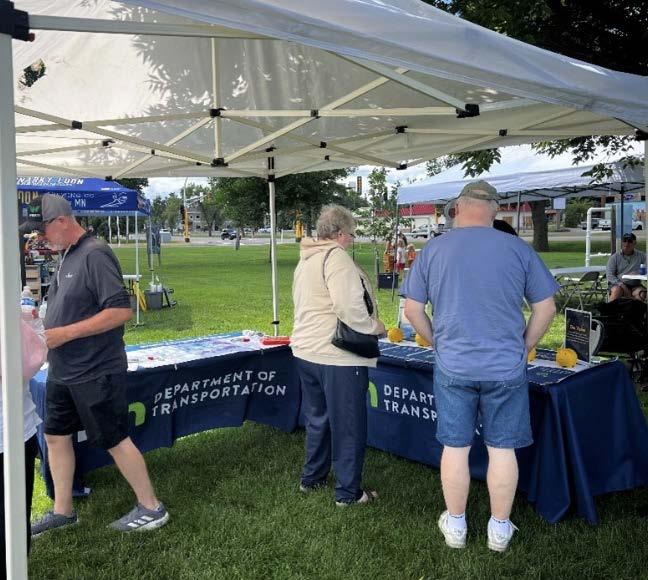
The Minnesota Department of Transportation is attending community events to gather feedback on accessibility plans.
PUBLIC AFFAIRS
On Medical Assistance? Be aware of changing work requirements this summer
By Melanie Tucker
You may have heard some of the recent buzz in the news and social media about changes in Medicaid work requirements. This article is meant to address questions many disabled people may have about what has changed. The information provided below is meant to go beyond some of the alarming rumors, and to examine some of the varied interpretations of law and policy. Why is this important to the disability community?
According to the Minnesota Department of Human Services, about 123,000 Minnesotans with disabilities currently receive Medical Assistance (MA). Disabled and blind people represent only 9 per cent of the 1.4 million Minnesotans on MA. And disabled Minnesotans on MA total just under 20 per cent of all 600,000 Minnesotans with disabilities. So these changes affect a minority of the disability community in Minnesota. But if you’re one of the 123,000 in the MA program, you may well have concerns.
Some background information
The budget reconciliation law signed by President Trump on July 4, 2025, called by some the “One Big Beautiful Bill,” requires states to determine Medicaid eligibility based on recipients meeting work requirements starting January 1, 2027.
In Minnesota, federal Medicaid funding is distributed through Medical Assistance, the state’s health care program for eligible low-income adults, children, pregnant women, and people with disabilities. States use their own budgets as well as federal funding to administer their Medicaid programs. To some extent, they establish their own rules for their programs. But the federal government sets many rules and policies for all Medicaid programs, as they do for Medicare, the senior health care program. The agency responsible for those rules is The Centers for Medicare & Medicaid Services (CMS), which is responsible for
implementing laws passed by Congress related to Medicaid. And the CMS issued its work requirements rule in June, 2026.
Who’s affected?
The changes affect adults in the Affordable Care Act (ACA) Medicaid expansion group and some enrollees in 1115 waiver programs.
The “Medicaid expansion group” includes people who qualified for Medical Assistance after the introduction of the Affordable Care Act, based on low income.
MA already based on disability?
If you qualify for disability benefits through the Social Security Administration (SSA), and are enrolled in Medical
vary
Political arguments about tying work requirements to public assistance benefits have a long history. Consider the arguments offered by these two nonprofit organizations.
Wilder Foundation
The Wilder Foundation’s research project, Minnesota Compass, sums up what the data shows in “Four Myths About Medicaid Work Requirements.”
Many people assume that Medicaid work requirements are a good way to encourage employment, but the facts tell a different story. The vast majority of Medicaid recipients already have jobs, and those who don’t are typically caregivers, students, or dealing with serious health conditions. Threatening to take away someone’s healthcare doesn’t motivate them to find work; instead, losing access to critical medications and doctors makes it significantly harder for them to find and keep steady employment.
Americans for Tax Reform
Americans for Tax Reform “opposes all tax increases as a matter of principle,” and in general argues that public benefits are out of control and often used by those who don’t need them. Here’s how they summarize the need for, Big Beautiful Work Requirements: https://atr.org/big-beautifulwork-requirements/. Medicaid has strayed from its original purpose of helping vulnerable groups and is now spending too much taxpayer money on able-bodied adults who are not working. To solve this, ATR strongly supports implementing mandatory work requirements—such as 80 hours a month of work, education, or volunteering—for able-bodied recipients. This change will save the government hundreds of billions of dollars, lower the financial burden on everyday taxpayers, and return Medicaid to a temporary safety net, while safely exempting individuals with serious medical conditions.
Beyond hurting individuals, these requirements create an expensive, bureaucratic nightmare for states to run. Confusing paperwork often causes the most vulnerable people to lose their coverage by mistake, costing taxpayers millions with no real benefit to the workforce. Read the full article from Minnesota Compass (https://www. mncompass.org/four-myths-about-medicaidwork-requirements) to uncover the real impact of these policies and why they ultimately cause more harm than good.
Assistance based on your disability, you are not affected by the new 2027 work requirements.
The Minnesota Department of Human Services (DHS) says: “This change generally applies to adults ages 21 to 64 who do not have dependent children, are not pregnant, are not eligible for Medicare and do not qualify for Medical Assistance based on a disability.”
Other possible exemptions
There are conditions that may qualify for individual exemption from the work requirements even for those whose MA is not based on disability. For example, individuals who are “medically frail,” and live with
a serious, complex, or chronic medical condition, or are getting regular therapy or treatment, may apply for an exemption. Exemptions may also be obtained by those who are caregivers of a disabled individual, or who are participating in a drug or alcohol treatment and rehabilitation program. So what’s changing?
For those affected, MA renewals (as well as applications for new enrollment) will involve demonstrating how you meet the federal requirements for work, education, or community service. There are a number of ways to meet the requirements. For example, you can combine hours spent at work, school, and community service to meet the 80-hour-per-month expectation. Or, if you have earned or unearned income of at least $568 per month, you will meet the requirement.
What will I need to do?
Again, if you qualified for SSA and MA based on disability, you will not need to meet the new work requirement. However, the most important thing to do for anyone enrolled in Minnesota Medical Assistance is to review the information at the DHS “Federal Work Requirements” site, https://mn.gov/dhs/federalchanges/ work-requirements/. There you’ll find specific guidelines and a brief video on steps to take now and over the coming months as your 12- or 6-month renewal comes due. DHS encourages all MA enrollees to take some time to prevent any problems during the upcoming program changes. See the steps and find the renewal look-up tool at https:// mn.gov/dhs/health-care/renew/
1. Know your renewal date and make sure your contact information is current.
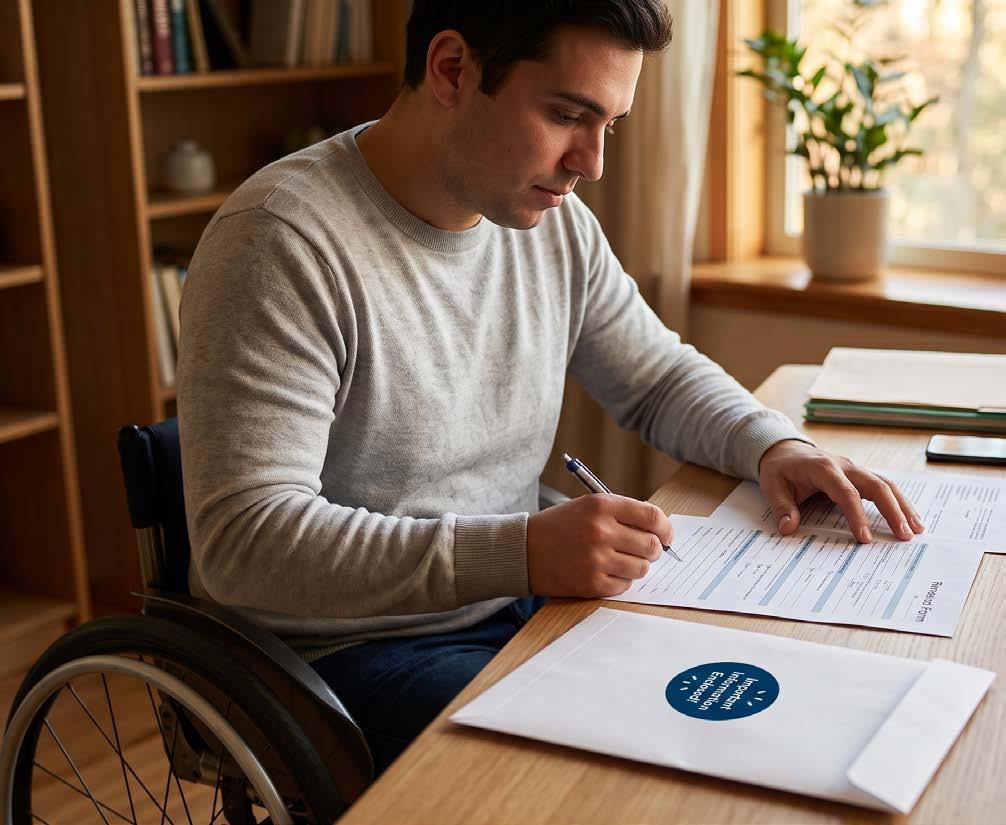
2. Watch for “the circle in blue” in your mail. “The circle in blue means it’s time to renew.”
3. Gather your supporting documents and fill in the renewal forms completely.
4. Submit your renewal paperwork on time.
Policy dictates our ability to work, travel, and live independently. Access Press is Minnesota's unique voice—dedicated solely to reporting how these laws truly affect disabled lives. We think this is essential work. We hope you do too.
To support these claims, ATR points to past successes with work requirements in other federal aid programs, like food stamps and public housing, which have historically led to higher employment rates and significantly boosted participants’ incomes. Because entrylevel jobs are plentiful and generally pay enough ($15/hour) ATR suggests it would be relatively easy for able-bodied adults to find enough work to lift themselves above the poverty line. ATR views work requirements as a win-win scenario that helps individuals achieve financial independence while strengthening the broader economy.
St. Cloud’s “polio mother” believed to be last U.S. patient who used an iron lung HISTORY NOTE
By Jane McClure
When an Oklahoma woman and iron lung respiratory device user died earlier this summer, it brought to mind past Minnesota news coverage of polio and post-polio patients. Martha Lillard was believed to be the last U.S. polio patient who used an iron lung.
The first iron lung was developed at Harvard University and made its debut in 1927. The following year, it was used at Boston Children’s Hospital to save the life of an eightyear-old girl with polio.
The dreaded polio epidemic of the 1940s and 1950s brought use of iron lung devices to prominence. Some patients were able to regain health and strength and didn’t have to rely on machines indefinitely. Others were not so fortunate.
News coverage from that era often focused on what we would call “pity stories” today. Patients were held up as courageous role models.
Seventy years ago, the St. Cloud Times and other Minnesota papers covered the story of the “St. Cloud polio mother.” Mary Bartelme, 27, had contracted polio and relied on an iron lung to breathe.
The newspaper in 1955 had reminded readers to send Christmas cards to Bartelme. She was unable to be home with her family, which included her husband Michael and two-year-old son Michael Jr.

She was flown to Omaha in a DC-4 military air transport plane. The Military Air Transport Service by that time had provided transportation for 300 polio patients in the past four years.
Her trip to Omaha for treatment was extensively covered by the local newspaper. Bartelme and her iron lung were lifted into the plane with equipment used in
PUBLIC AFFAIRS
construction, in a process that took about 45 seconds. The trip took place January 16, 1956.
The news accounts described the number of medical personnel on hand, the delays in making the flight and even the fact that Bartelme was wearing a “scotch plaid” cap to keep her head warm.
Mary’s husband Michael took a separate
flight to Omaha to join her, while their twoyear-old son, Michael Jr., stayed with family.
One wonders if such coverage would be allowed today, under the Health Insurance Portability and Accountability Act (HIPAA) and other safeguards for patient privacy.
Coverage of the death of Martha Lillard brings to mind those who lived or still live with post-polio syndrome. The Associated Press reported that Lillard struggled with long-haul COVID-19, using her iron lung much of the time during the past two years. Her death certificate lists causes as chronic pulmonary failure and post-polio syndrome. She was 78. Other, more modern devices were available but she preferred the older iron lung. Family members were desperate to find someone who could repair her latest device. Lillard was diagnosed with polio as a fiveyear-old. She was eventually able to spend time outside of the iron lung, regaining the ability to walk and limited use of one arm. She lived on her own for many years.
But then COVID-19 struck.
Learn about the history of the iron lung at https://www.woodlibrarymuseum.org/museum/ iron-lung/
The History Note is a monthly column sponsored by the Minnesota Governor’s Council on Developmental Disabilities, http://mn.gov/ mnddc or www.partnersinpolicymaking.com
How a St. Paul family overcame zoning rules to keep their daughter safe
By Jane McClure
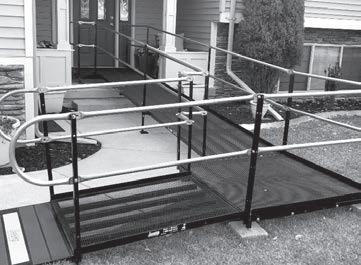
A St. Paul family can erect a taller fence than allowed, to accommodate a young daughter with disabilities. The family’s request for a height variance won approval July 6 from the St. Paul Board of Zoning Appeals (BZA).
The case is an illustration of what can be covered under the Environmental Accessibility Adaptations (EAA) waiver service. EAA is available to people eligible for one of the following waivers or programs:
• Brain Injury Waiver
• Community Alternative Care Waiver
• Community Access for Disability Inclusion Waiver
• Developmental Disabilities Waiver
• Elderly Waiver
• Alternative Care Program
The family, working with a case manager and an accessibility consultant, made the variance request. The family’s young daughter lives with disabilities including ADHD and Turner Syndrome, which is a genetic condition.
The family’s last name is not being used for privacy reasons.
The BZA is a group that reviews and acts on variance requests in the city of St. Paul. Other local units of government in Minnesota have similar groups.
City and county land uses in Minnesota are governed by zoning codes. The codes can be modified through what are called variance processes if someone can make a successful case for the variance. In the case of disability-related accommodations, federal laws come into play.
The board was asked to act on the request in June but sent it back to staff for more consideration of thew EAA report. Under strict city zoning rules, the request was

recommended for denial. But in the case of disability, more comes into play.
“Under the federal Fair Housing Act and Americans with Disabilities Act (ADA), and Saint Paul’s own local law, the city is required to make reasonable accommodations in its zoning rules when those rules create barriers for people with disabilities,” said BZA staff member Kaozouapang Yang. “Ruby’s ADHD and elopement behaviors are precisely the kind of disability that federal and local laws were designed to protect. A three-foot fence simply cannot keep her safe; a six-foot fence can.”
“At the heart of this request is Ruby, a seven-year-old girl who simply wants to play in her own backyard like any other child. But for Ruby, that simple pleasure comes with serious risks. Ruby has been diagnosed with ADHD, a condition that makes it nearly impossible for her to control her impulses or recognize danger. She is highly active, loves
to climb, and has absolutely no awareness of when she is putting herself in harm’s way.”
“The EAA Assessment paints a clear picture of the family’s daily reality: Ruby wanders and elopes without warning, she cannot tell the difference between a safe situation and a dangerous one, and she is drawn to anything outside that catches her eye, including strangers walking by or cars passing on the street.
Ruby is also able to climb the family’s existing chain link fence, which is old and has openings she has tried to slip through.
The family’s home is in what is called a zoning overlay district on busy White Bear Avenue. New fences can only be three feet high, driving the need for a variance for a new, taller fence.
City staff initially recommended denial of the request, saying that it didn’t meet the six standards needed to approve the variance. But in June board members sent the request
back for further review, citing the need to consider the EAA.
The BZA approval July 6 included a condition that the fence be designed in a way that it doesn’t completely block vision at the alley’s intersection with White Bear Avenue. Learn more about zoning law and disability at https://www.revisor.mn.gov/ statutes/2018/cite/462.357
Here is information about the EAA from the Minnesota Department of Human Services. Learn more at https://www.dhs.state.mn.us/main/ idcplg?IdcService=GET_DYNAMIC_


Fax: 952-472-1458

6371 Bartlett Blvd Mound, MN 55364
6371 Bartlett Blvd Mound, MN 55364
Certified ProAdvisor 2022 | 2005-2021
ProAdvisor 2022 | 2005-2021
An iron lung is a type of negative pressure ventilator that is rarely used in modern medicine.
A recent U.S. Department of Justice (DOJ) legal memo has sparked widespread backlash across the disability rights community by challenging the legal foundation of community living. The opinion directly targets the “integration mandate”—the cornerstone derived from Title II of the Americans with Disabilities Act (ADA) and Section 504 of the Rehabilitation Act, which guarantees people with disabilities the right to receive services and housing in the most integrated setting appropriate to their needs. Issued at the end of June, the memo argues that federal disability laws and the Supreme Court’s landmark 1999 Olmstead v. L.C. decision do not create a broad statutory requirement for states to prioritize community-based care over institutionalization—suggesting institutional care isn’t inherently discriminatory unless it is entirely “arbitrary.”
For millions of disabled Americans who rely on home- and community-based services to live independently, the memo represents a direct threat to decades of hard-won civil rights. Below is a roundup of how advocacy organizations in Minnesota and across the country are responding.
NAMI (National Alliance on Mental Illness)
“All people — including people with mental illness — deserve to be treated with dignity and respect. This opinion threatens the progress we have made to ensure that people with mental illness are treated like people with any other health condition, with the same rights and same level of care. The rights of people with mental illness should be protected because we cannot return to a time when institutionalization was all but inevitable.”
A new era for ethical direct support: NADSP releases revised code of ethics PUBLIC AFFAIRS
By The
University of Minnesota Institute on Community Integration and Access Press Staff
For over 25 years, the National Alliance for Direct Support Professionals (NADSP) Code of Ethics has served as a foundational guide for direct support professionals (DSPs). It outlines what it means to deliver respectful, person-centered support to people with intellectual and developmental disabilities. Now, NADSP has launched a fully revised Code of Ethics alongside a brand-new Practice Guidelines & Guidebook to reflect the modern realities of the direct support workforce. Why the update matters now Direct support work has changed significantly over the last two decades. Today’s DSPs navigate complex environments: using new technology, supporting people in community settings, promoting supported decision-making, and delivering culturally responsive care. Agency policies cannot cover every realworld situation. Much like nurses, teachers, and social workers, DSPs make daily judgment calls that directly affect people’s rights, health, and dignity. The updated Code provides a clear ethical compass when rules fall short, keeping individual choices and human dignity at the center of every decision. Built on real-world experience
The update was developed through a rigorous national research process in partnership with the University of
The Arc of the United States
“This opinion is a direct threat to decades of progress toward community living for people with disabilities which has always been at the heart of The Arc’s 75 years of advocacy. Olmstead remains the law of the land, but this opinion tells people with disabilities that the federal government seeks to attack one of their most basic civil rights. People with disabilities shouldn’t be forced into institutions because a state refuses to provide services in the community.”
— Shira Wakschlag, Senior Executive Officer of Legal Advocacy and General Counsel
American Association of People with Disabilities (AAPD)
“The DOJ just gave the White House and other federal entities a green light to take disabled people back to a time when the state could, at any time, strip us of our homes, families, autonomy, and our lives.”
American Council of the Blind (ACB)
“Although on the surface it seems to

Minnesota’s Institute on Community Integration (ICI)—the same institute that helped build the original Code 25 years ago.
Rather than simply tweaking language, researchers conducted focus groups where DSPs shared actual ethical dilemmas from their daily work. Subject matter experts, frontline supervisors, and people with lived disability experience reviewed every
principle. Structured validation sessions then tested proposed changes against real-world scenarios to ensure the new guidelines were practical, relevant, and easy to apply.
Practical tools for everyday use
To help DSPs, trainers, and provider organizations put these principles into action, NADSP and ICI developed a suite of practical, accessible resources:
exclusively attack the integration mandate as it concerns individuals with mental health disabilities, this memo is functionally attacking the rights of all individuals with disabilities to live in their communities without fear of institutionalization.”
Autistic Self Advocacy Network (ASAN)
“Olmstead says that people who can live in the community should not be forced into institutions. Olmstead says forcing people who can live in the community into institutions when they don’t need to be there is discrimination. ASAN knows all people with disabilities can live in the community with the right supports.”
Minnesota Disability Law Center (Mid-Minnesota Legal Aid)
In an official statement released on July 1, 2026, the Minnesota Disability Law Center (MDLC) strongly condemned the memo’s legal reasoning:
“The Minnesota Disability Law Center (MDLC) of Mid-Minnesota Legal Aid strongly objects to this repudiation of 27 years of hard-won legal progress for persons with disabilities and their civil rights.”
MDLC warned that the DOJ’s interpretation attempts to weaken Olmstead by allowing states to justify institutionalization under low legal thresholds:
“The new OLC opinion attempts to weaken the promise of Olmstead and countless other hard-won legal authorities upholding the rights of persons with disabilities to be integrated into the community... MDLC contends that the DOJ’s interpretation is contrary to law.”
• Practice Guidelines & Guidebook: Available in English and Spanish, this resource translates ethical concepts into daily actions—covering topics like technology, privacy, documentation, and ongoing training.
• Accessible Video Series: Short videos illustrate each of the Code’s nine core tenets through realistic scenarios. They include captions, Spanish subtitles, audio description, and American Sign Language (ASL) interpretation.
• Educational Materials: Redesigned posters, brochures, and training tools designed to bring ethical discussions directly into team meetings and workplace settings. A milestone for the profession Leadership from both organizations emphasized that this code belongs to the workers who use it every day. NADSP President and CEO Joseph Macbeth called on DSPs across the nation to “embrace it, teach it, and adopt it” in their daily practice. ICI Director Amy Hewitt highlighted the update as a major step forward in recognizing direct support as a skilled, essential profession where every decision shapes lives.
Ultimately, the revised Code is a collective promise. When DSPs, provider organizations, educators, and advocates champion these ethical standards together, they strengthen both the quality of support and the direct support profession itself.
By John Kuziej
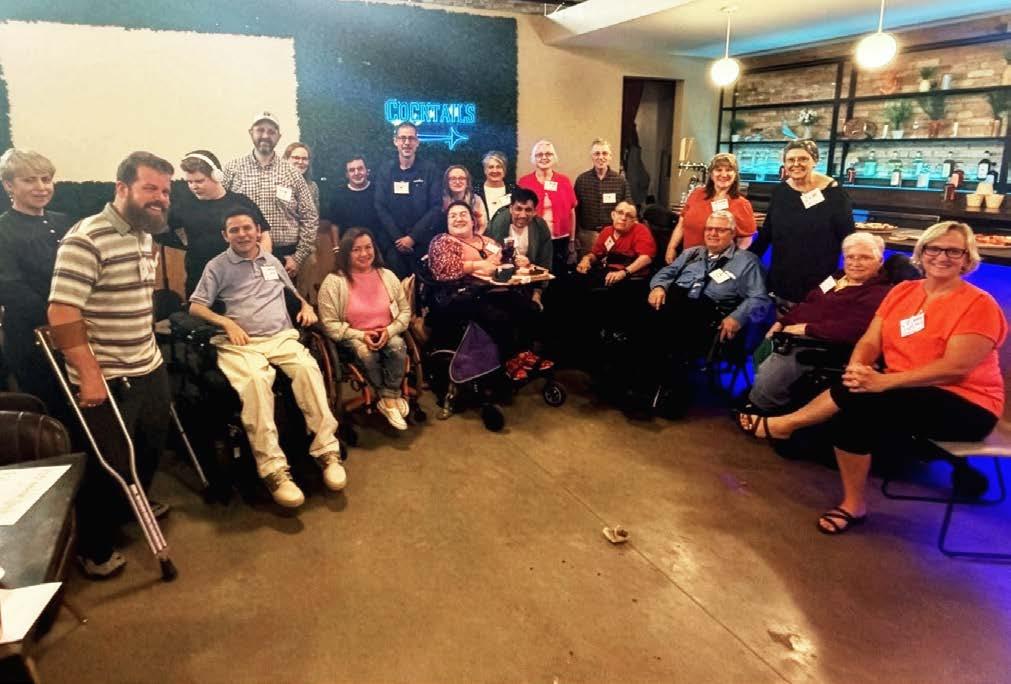
Join us for a fun and relaxed happy hour on August 4 from 5 to 7 p.m. at Surly Brewing Co in Minneapolis. It’ll be a great chance for Access Press readers to meet and catch up with staff, board members, and advertisers in person.
This is a great way for you to learn more about Access Press and express your opinion on what challenges the disability community is facing. We love a chance to meet new people and get a fresh perspective on the issues. The fun doesn’t stop at talking to each other; we will have a cash bar for alcoholic drinks, and non-alcoholic beverages will be
free, and the food available will be appetizers, provided by sponsors MRCI and Access Press board members Catherine Hunter and Tim S Benjamin.
On top of drinks and food, you’ll get a chance to meet new faces at Access Press, including our assistant editor John Kuziej and new ad sales representative Randall Oldenburg.
We hope to see you on Tuesday, August 4 at Surly Brewing Co, 520 Malcolm Ave SE in Minneapolis.
Also, if your organization wants to sponsor this event, you can reach out to admin@accesspress.org.
Stay informed and connected.
Subscribe to Access Press online.
In a world that’s constantly changing, having a reliable source for disability news in Minnesota is more important than ever. From legislative updates to powerful personal stories, Access Press has been your trusted voice since 1990. Don’t miss a single headline. Whether you prefer reading on your laptop, tablet, or phone, our online coverage brings the latest news directly to you.
Why Subscribe?
Expert Coverage: Deep dives into policy, accessibility, and community achievements.
Convenience: Access our digital editions anytime, anywhere.
Join our community of readers today! www.accesspress.org





Affordable Senior Apartments
Housing with Care*
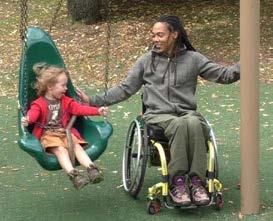

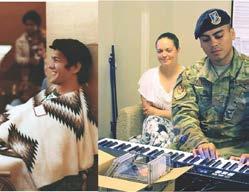

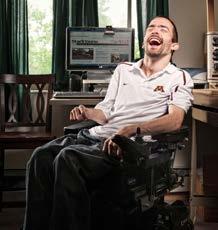

Everyone had a blast at our previous happy hours, so we hope you can join us this time.