A Catalog Of Small Machines — Summer 2026
Page i
Page ii
A Catalog Of Small Machines — Summer 2026
A Catalog Of Small Machines — Summer 2026
Page iii
Page iv
A Catalog Of Small Machines — Summer 2026
A Catalog Of Small Machines
A Catalog Of Small Machines — Summer 2026
Page v
Page vi
A Catalog Of Small Machines — Summer 2026
A publication of the Driftless Writing Center Volume VII: Summer 2026 Editor: Mark MacAllister Covers: Katrin Talbot
A Catalog Of Small Machines — Summer 2026
Page vii
Page viii
A Catalog Of Small Machines — Summer 2026
A poem is a small (or large) machine made of words. — William Carlos Williams
A Catalog Of Small Machines — Summer 2026
Page ix
Page x
A Catalog Of Small Machines — Summer 2026
A Catalog Of Small Machines — Summer 2026
Page xi
Page xii
A Catalog Of Small Machines — Summer 2026
Table of Contents
Maureen Adams • Boxing...........................................................................................................3 Devin Ambrosia • Love Haiku....................................................................................................4 Jane Barnard • Beware the Crotchety Knitter............................................................................5 Sue Blaustein • Seasons..............................................................................................................6 Deb Bushy • Dirty Hands............................................................................................................7 Paula Dáil • Happy Birthday Anyway.........................................................................................9 Cynthia Dorfman • Valentine for Madison..............................................................................10 Matthew Duffy • A millennial’s survival in late-stage capitalism............................................11 Susan Freiss • In the garlic mustard diaspora on Ho Chunk land..........................................12 Richard Hedderman • The Towns Of Wisconsin.....................................................................13 Mrill Ingram • Transubstantiation...........................................................................................14 Sharon Jessee • A Piece Of My Coldwar Girlhood...................................................................15 Lamia Kosovic • Hu(wo)man Writer (2030)............................................................................17 Dee Lambert • Good Morning, America, How Are You?.........................................................18 Mark MacAllister • Refugees....................................................................................................20 Gwendolynn Maitzen • A Prayer: We Beseech You..................................................................21 Freesia McKee • Heartwood Sonnet.........................................................................................22 Alex Newman • A Short History of Life with Girl Child..........................................................23 Christine Rundblad • Wildfire Smoke......................................................................................25 Lesley Salas • Catalysts.............................................................................................................26 Cosima Sinclair • Grateful.........................................................................................................27 Trish Stachelski • Farm Poem..................................................................................................28 Katrin Talbot • Firing the Trees...............................................................................................29 Stephen Weiser • Bloom...........................................................................................................30 Special Section Maureen Adams • On Both Sides.............................................................................................33 Jane Barnard • In Viroqua News..............................................................................................34 Deb Bushy • He was taken care of............................................................................................35 Cynthia Dorfman • Ghost Poet.................................................................................................37 About The Authors....................................................................................................................39 About The Cover.......................................................................................................................49
Page 2
A Catalog Of Small Machines — Summer 2026
Maureen Adams Boxing Hate blinds us, keeps us from seeing any shred of good in whatever or whomever is the object. We resort to boxing them in to a generality, a trope with a clear label scrawled in Sharpie on the outside, as if this alone defines them. As if the writing on the outside shouts clearly that this box should be ignored , dumped or given away. Nothing of value here! If we too hastily purge from our lives things that have grown contrary, are we becoming a narrower box ourselves, a mere slice of what we can be or once were? Can we be tempted to reopen what we have taped shut and discarded? Can the thought of one lone memory or one smidge of worth spur us toward another closer look? And if we closely examine and find nothing remains to bind us to this object, that holding on only intensifies estrangement or hate, can we release the contents and finally be free?
A Catalog Of Small Machines — Summer 2026
Page 3
Devin Ambrosia Love Haiku Fireflies pulsing, my heart beats with their rhythm spark I want to show you “My star,” I call and you turn, loving wonder gaze, and I come undone Toes to nose it flows energy of aliveness we ride golden waves I want to make you sing, absentminded, while the water boils for tea
Page 4
A Catalog Of Small Machines — Summer 2026
Jane Barnard Beware the Crotchety Knitter After 6 pm, when my neurons take their naps, I like to cozy down into the meditative knitting zone: my many-pillowed couch. Knitting is tactile, soothing, and mindless when the pattern stitch is simple: knit, purl, repeat till comatose. So far this winter, I’ve knit three pairs of fingerless gloves and two slouchies for my teenage granddaughter. With that, I met her quota for hands and head so—fool that I am—I said, “How about a pair of socks?” Alas, darling, you’d forgotten two things: sock knitting is not for the faint of hand. And never start a project with “how hard can it be?” I’ve now unraveled the first sock, a red-and-orange, multi-striped L-shaped thing, for the third time. Meditative? No. Homicidal. Good thing I’m alone on this couch and there is no one nearby or I swear I’d stick this pointed needle right in their eye. Then I’d go to hell in a hand-basket filled with unfinished orphan socks and gladly sizzle for eternity. But I’d scream all the way down: don’t blame me, the human foot has a serious design flaw. Any fool can see that a sock would be much easier to knit if feet weren’t so ungodly architected—at a right angle! Who thought of that? Feet should be straight! A breeze to knit. But then we’d fall right over darling. Okay. There’s that. Clearly I’m a bad example: a sock failure, a quitter, and a whiner. I should be more like my honeyvoiced, eighty-something Aunt Edith who always wore store-bought Wigwam wool socks, even under summer sandals. At a family picnic one Sunday at the beach, she sat blissfully enthroned in her faded red aluminum lawn chair while her feet sweated and smelled like a teenage jock. I asked her,” Auntie, why don’t you take off your socks?” An angelic smile. “Oh I’d never wear open-toed shoes. I don’t want to scare the children.” I’m lazy too. Yesterday, I needed a second skein of yarn for a soft latte-brown headband, but alas, the additional yarn was far, far away. Darling, it was across the room. Ten feet away, maybe? See, I was perfectly wrapped up on the couch, swaddled in my cushy blue blanket, the four pillows fist-punched into a precise moat around me. I couldn’t possibly get up and ruin the afghanically calibrated fortress of softness encircling me. Must I ravage that perfect nest? No. I simply unraveled and re-knit the first part again. And again. I do relish the story of Gioachino Rossini don’t you just love saying that juicy Italian name out loud? Sorry, carry on. He was composing opera from his bed, as he usually did. A just-written aria fell off the bed and wafted to the floor. Rossini simply stayed put, happily horizontal, and rewrote it. Man after my own heart. Once on a long flight, as the plane was climbing to altitude, my ball of yarn slipped off my lap and rolled back behind me, down the aisle which the flight attendants had left uncluttered, apparently not just for me. Once the seat belt sign turned off, I had to slink down the aisle peering shamelessly at passengers’ feet as the yarn unwound without mercy, past several glaring and apparently fiberunfriendly passengers. I finally had to ask a sleeping three-piece suit—in the V of whose wing-tips it had landed perfectly—to hand it to me, please. He glared. Ever the well-mannered lady, I hid my sneer and suppressed my expletives. I held out my hand with a syrupy smile and cooed, “Thanks so very much.” Another time, I took a flight right after 9/11 and was astonished that the TSA Brunhilde did not bust me for a circular bamboo needle which, in addition to being pointed, formed the perfect garrote. Guess she figured—incorrectly—that a nicely-coiffed older woman wouldn’t strangle anyone. So my granddaughter can buy her own socks, wouldn’t kill her. Take your meds now dear, it’s time for bed.
A Catalog Of Small Machines — Summer 2026
Page 5
Sue Blaustein Seasons The company Christmas tree, the tavern Santa the Styrofoam, dot-eyed gingerbread men of the breakroom dwell in utility closets with water heaters and mop sinks till the calendar flips and the heading reads November. Black Friday is coming, and parties and potlucks. No privacy for them now, no rest… They’re ushered upstairs or past the vending machines… They’re dusted, festooned and it’s on.
Page 6
A Catalog Of Small Machines — Summer 2026
Deb Bushy Dirty Hands Seeds. Plants. Flowers. Trees. A promise of a new beginning. Just what I desperately need. Some of you thrive. Some of you die. You are nurtured. You grow. A gardener---me this year! I’m in love with the process. Growth. Growth. Growth. Harvest. The cycle of life. Then there are the necessary. Dirt. Worms. Pesky pests. Just ordinary. Natural tests. Sun. Drought. Flood. Everything else. I deal with them or I live without. Beauty. Nature. The fruits of my labor. Beneficial. Crucial. Love the ornamentals! Of course there is the tedious. Water me! Weed me! Feed me! Oh my! The results are amazing.
A Catalog Of Small Machines — Summer 2026
Page 7
Satisfying. I’m grateful I began to grow my garden. Patience. Resilience. The glow up has begun. A miracle in a seed. The result of a labor of love. That is what gardening is all about. Peace. 7.18.2026
Page 8
A Catalog Of Small Machines — Summer 2026
Paula Dáil Happy Birthday Anyway Recently, I was asked to pen a celebratory note about America250. It wasn’t easy, but with a nod to one of my favorite writers, who admonishes us to sing alleluia anyway, this is what emerged: For many, it’s been hard celebrating our 250-year-old, self-destructing country’s birthday. Regardless, it’s still our country, and we can’t claim to love it yet ignore that grand old lady, symbol of all we believe in, standing proud in New York Harbor waving her torch to welcome the yearning freedom-seekers our badly misguided leadership insists we don’t want. Despite a totally dysfunctional Congress, a constitutionally blind Supreme Court, a decimated rule of law, and being the laughingstock of the world because of a profoundly confused president who thinks he’s a king, she’s still standing resolute. We disgruntled Americans who don’t feel like celebrating this country anymore need to remember it’s her birthday, too, and more than ever before, she deserves our good wishes. She’ll appreciate knowing that in her 250th year those of us who love her managed to save birthright citizenship and mail-in ballots. In other positives, Minneapolis faced down ICE, and in the run-up to the midterms, White House poll numbers stink like a bag of dirty diapers. She’ll have a good laugh hearing about that boisterous, unruly mob of five or six who attended that Great American whatchamacallit on the National Mall that at least 20% of states totally ignored. The patriotic blue Washington Monument reflecting pool added to the overwhelming lack of enthusiasm by turning slime green. Way to go, George! That’s telling ‘em what you think! We can’t forget to mention the lie-soaked word salad political rallies President I-Love-the-Sound-ofMy-Own-Voice mutters incoherently to ever-shrinking crowds while the rest of us are leaving big tips at our local Mexican restaurants where our immigrant neighbors warmly welcome us with fantastic guacamole. We can’t forget a shout-out to the immigrant workers keeping the agricultural economy afloat or a salute the military forced to fight a war everybody except our puppet Congress and President Know-It-All thinks is an extremely bad idea. Democracy is a relentless, demanding taskmaster and yes, we’re tired. But you’re still here, and so are we. We’re still showing up, speaking out, and pushing back. Yes, we’re sad and angry that our country is so divided and rudderless. But we haven’t given up. We still claim this land as our land, we still welcome the immigrant longing for freedom, and we still believe in the people’s democracy we’re fighting like hell to preserve. Our patriotism isn’t dead—it’s just momentarily lost its sense of humor. So, from the bottom of our hearts, HAPPY BIRTHDAY old girl. Take a deep breath, blow out your candles, and keep showing us what you’ve got. We’ll do the rest.
A Catalog Of Small Machines — Summer 2026
Page 9
Cynthia Dorfman Valentine for Madison They float, the birch bark canoes and sandhill cranes, through land and air and lake, moving in grace in the wake of limnologists, lyricists and luminaries at the shores of learning. Floating Forward from the hub of Madison, holding spokes of pens for signers of the Constitution. Their nibs pointing in the direction of the paint-washed ghost sign for the Hotel Fess and sidewalks stamped with poems on Williamson. Madison sits in the moon glow of dome echoing effigy mounds marking origins of civilization. Followed by Yankees blown across the Lake Effect of exploration when floating boats steamed across ice-cracklings of lakes. That quartet of lakes now chants odes to the chamber of law-crafting. And strains from The Overture accompany the Reveille of coronet calls from the sandhill cranes and bass notes from birch bark canoes afloat.
Page 10
A Catalog Of Small Machines — Summer 2026
Matthew Duffy A millennial’s survival in late-stage capitalism I am not writing poetic I am not scribbling stanzas I am not motivated to put pants on for the virtual meeting I am contriving the protection of brook trout from the concentrated animal waste run-off on the fields of monocropped, private equity seeds I am learning how to communicate with my baby boomer relatives despite the waves of propaganda that enter their ears I am fighting the addiction of moving images on a tiny screen that drop dopamine faster than any drug in an IV line in a Level 1 trauma hospital While I work the second of three jobs over the summer weekend, I yearn to hike on the foliated rock in the state park, maybe cast a floating fly line into a babbling stream and monkey wrench my way through this new epoch
A Catalog Of Small Machines — Summer 2026
Page 11
Susan Freiss In the garlic mustard diaspora on Ho Chunk land Yellow feathers and small pools of ruby elfcup blood are scattered among the mustard’s cascade down the southern slope of this steep ridge. First above the leaf litter in spring, their ropy roots endured the winter and call my fingers to find them, to loosen their hold. When I fail, each break reveals a purple core the private emanation of this green tonic, this potherb, this naturally antiseptic plant. From Europe to an 1868 garden on Long Island to Michigan by the 1950s, the mustard traveled with we immigrants and dispersed its seeds. The first people who tended the forest gardens here—the ginseng, the goldenseal, the elderberries—with a wisdom my pulling knows so little of, were cruelly scattered and yet they remain. In secret Kickapoo hills, their hands too work cool soil where hidden seeds germinate, small worms startle from acorn homes, and mayapple protrudences wait unfurled. Early immigrants sought garlic mustard’s spring restorative but by the 1980s our potherb became renown. We assigned it the characteristics of our own settler ways: a severe menace, ecological threat, emitting chemicals that deter neighbors, invasive, outcompeting, out of control, responsible for a decline in biodiversity. A scientist put garlic mustard in pots with native plants, the relics of those forest gardens. They grew well together. A complexity of climate change, clear cutting, earth worms and deer are at play. Another scientist studied pulling garlic mustard and found the stands were made resilient. Left alone the groves of green will flash and subside in time. And here I am daughter of Irish and German immigrants, wandering the forest floor loosening stories, sitting to rest, wondering if I can defy the narrative, quit my disturbance, and allow the mustard its way. Page 12
A Catalog Of Small Machines — Summer 2026
Richard Hedderman The Towns Of Wisconsin lie strewn across the prairies in remote archipelagoes of vaunted hamlets like Gotham, Metropolitan, and Hub City. I wonder what they’re smoking in Pipe, how many laborers it took to dig Tunnel City, and do its citizens ever glimpse the flaring blue sky arcing above the plains with their countless grain silos and numberless herds of guernseys? Rib Lake I imagine is a reservoir of barbecue sauce studded with reefs of brisket. How I would grip the gunnels of my raft as we chase the Whitewater to Cascade, and scramble to outrun death by snow in Avalanche—18 feet above sea level. I wouldn’t bet on my chances in Waterloo, and would watch my step in Treacherous, just as I would in Rolling Ground. (Cheeseville and Rural, on the other hand do not provoke caution.) I’d take refuge in Retreat then exchange passwords with double agents in Moscow’s sulking alleys of espionage, while a dark, Slavic rain soaks my trench coat. O, the spectacle of the big top, the sword swallowers and lion tamers of Barnum, to bear the icy, desolate silences of Neptune! O, the august glories and endless statuary of Rome, Sparta, Ithaca, and Athens! How I long to heft the historic weight of the tomes in the great library of Monticello, and discover what furrows the brows of the scholarly children of Cambridge and Oxford. Let me wake each day in Rising Sun and exult with triumph in Victory. And, each night, let me to surrender my heart by candlelight to my beloved as we repair to a petal-strewn bed draped in blush-hued silk in the amorous burg of Romance.
A Catalog Of Small Machines — Summer 2026
Page 13
Mrill Ingram Transubstantiation The blank page in front of me reminds me of the whitish, featureless sky outside. Through the window I can barely make out Madison’s capitol building. It stands only a few blocks away but today in mid-July, I have to search for its vague outline. Actually, the capitol is obscured by trees! Millions of trees. Conifers like jack pine and white pine, cedar, fir, and black spruce, yes, so many black spruce. And also black bear and blackberries and black capped chickadees and black ink cap mushroom. All these things were, just days ago, hundreds of miles away, north of here in country I have traveled through by canoe. Now, they are here, as ash and smoke, converted by fire to rise up, swirl, drift, and settle as dense blobs of smoky air, miles from home. A thousand Canadian wildfires have consumed the homes of entire communities of First Nation peoples and bring dense smoke into the lungs of children in Duluth, Madison, Chicago, Detroit, and New York. I don’t see only smoke. I see ghosts. Is that otter I saw last summer here? That osprey? That moose? That lovely outfitter’s cabin? I attempt coping by testing out bigger picture theories on the flux of all things. Earth has always danced with fire, that generator of clean slates and fresh starts; friend to the little guy, the understory, the blueberry. Still, this air refuses ecological theorizing. The extent of the burned land is vast, but worse, I sense not just burning wood but the stink of greed and failure. This is not smoke from a fire of resurrection and rebirth, but that of a hell on Earth. Imagine the smoky transformation of over a million square miles of boreal forest into grassland. Enduring hotter and dryer summers, Canada’s forests are burning at rates that may exceed anything in thousands of years. I know things recover. Here in Wisconsin, I live in a land not so long ago utterly denuded and burned by humans. But the stench of contemporary corruption and rapaciousness produced by people who turn their backs on of a lower carbon less hot future for personal gain is quite literally breathtaking. But I have to breathe, and every breath brings into my body the bodies of those northern trees. Inside me, the tiny particles assemble. It is heavy. I am sad for what is lost. I am brought low by my ineptitutde and enormous helpless rage at a global economy that will do anything for profit, a system which, by design, burns its own foundations. I close my eyes and think about the ghosts of the trees as I inhale. I feel the weight of those trees very much alive. Then, there is water pushing gently against my shins. I feel the air moving, stretching out from across the reach of a lake and bringing to me the earthy smell of the water. The wind pushes harder, inviting me to lean in and laughing as I have to rebalance. Sunlight chases openings between pine needles and bounces off momentarily reflecting wavelets. The lake is aglitter. This vision is salvation. Assembling inside of me, the forests produce and reproduce transcendance. This is no mere symbolic invention of mind, but a transubstantiation. Smoke becomes being, feeding the roots growing from my feet, the branching of my lungs, and the veins in my limbs, feeding the multitudes that are this body. The insistence and persistence of life. Weightier now, I reassess. Outside, the smoke is thicker. Inside, I feel fortunate for my respite. It is not gone, that forest. It is in me. And the page is no longer blank.
Page 14
A Catalog Of Small Machines — Summer 2026
Sharon Jessee A Piece Of My Coldwar Girlhood On Saturday, August 31, 1963, I got my first period. I was 12.5 years old. “Men-stru-ation,” with just a little nod to the “u” sound, is how I liked to pronounce it: not “men-stray-shun” like others did. Stumbling into early adolescence, as this phase in a female human’s life is termed by physicians and psychologists, was not the only factor in the oscillations that took place for me that next year, but it definitely counted toward my ability, halfway through 1964, to catapult myself out of and away from my childhood Cold War fears. No more bomb dreams, no more cringing when the Civil Defense sirens were being tested. I recall that it was Labor Day weekend, and in just a few days I would be starting junior high. The dark, reddish-brown blood came when I was alone in my bedroom, watching the portable TV that belonged in the den. My parents were hosting one of their monthly bridge clubs out in the airconditioned den and didn’t need the TV there. The south-facing windows in my bedroom were open. It had been up to 95 that day, but it was cooling off, and the powerful attic fan in the hallway was bringing in night air that had a fresh odor, a mix of green grass and smell of the stockyards just a few miles south, and it was much better than the smoke-filled den. I got up gingerly—there was that pull, not quite a pain (yet) in my abdomen—and I padded barefoot down the hall toward the bathroom, pausing to look up into that enormous attic fan, something that always soothed me. Behind the bathroom door was a tall, white cabinet where I fished out my first sanitary napkin and the little belt that pinched it and held it in place. I got it on just fine, and hearing the laughter of the bridge-players behind the closed hallway door, I soft-stepped back to the bedroom to continue watching a variety show, Hollywood Palace. Frequent hosts included Frank Sinatra and Bing Crosby, and guests included Hollowood stars, dancers, comedians, and musicians. The Rolling Stones had appeared just a few weeks earlier. They played “Not Fade Away” and “I Just Wanna Make Love to You.” It was this latter song that set Dean Martin off as the host that night: he mocked the Stones. Not like Ed Sullivan, who, a few months later, would praise the Beatles in their first appearance on his variety show. I was everything rock n’ roll music then and liked the Stones, especially Mick Jagger’s way of moving. But, on that August Saturday night weeks later, I don’t think I watched who was on. I was thinking about being this young woman, still a girl, but no longer a child. It felt good, an important revolution into whomever I was to become. My self-possessed feeling vanished by my second menstrual period, however; in girl’s gym class, we had to change into our shorts and top uniforms in front of one another in the dressing room. As I unbuttoned my dress, I looked surreptitiously around, as did the other 12-year-old girls, and realized that I was the only one who was wearing a sanitary napkin under my panties. I felt my skin burn in embarrassment. As we were filing into the gym, one girl—Nancy? She patted my shoulder. That made all the difference. And then there was the gym class swim day. Girls had been issued ugly uniform swimsuits. I had my period, but I still had to sit out by the pool. You knew what that meant. I tried to stare into the middle distance above chlorine splashed as I sat on the cold floor with cramps in my belly. That first semester was rough; not many girls had “started” yet. Just my luck for having a December birthday. Now, I can look back with humor on those embarrassments, but then they didn’t last long, for just a few months later it was like I was lashed to the mast of a great ship, to keep me from flying into the hormonal storm that was beginning to swell all around me, like great foamy waves of warm water. With hormones shifting, I easily slid into the storms of 1964: Beatlemania, Civil Rights marches, and
A Catalog Of Small Machines — Summer 2026
Page 15
the over 1,200 sonic booms happening for six months over my hometown, to test the effects of supersonic flight on a civilian population.
Page 16
A Catalog Of Small Machines — Summer 2026
Lamia Kosovic Hu(wo)man Writer (2030) It is 2030. Sanctuary cities are gone and with them most of the shelters for the weakest forms of life. The underground resistance is weak. It exists but it’s scattered, fragmented and disorganized.The winds are red and warm, and the sky over the city is dark, unsettling. The Cartesian subject had long dissolved. Bodies no longer end at the skin. They bleed into code, memory, viruses, and machines. The sound of a typewriter, making a plea for a corporeal embodiment. Its existence is forbidden. Yet, someone is out there hitting the keys. Another key, and the city begins to unfold. Neon lights, flickering in the distance, are hanging off the rails. A deserted, old Volkswagen van is parked next to a collapsed bridge. Most of the humans are gone, wiped out by viruses, killed by AI agents. Simply vanished. The smoke of her cigarette rolls up from the ashtray. Conradian silence seeps through the cracks as she hits another key and blows the smoke out of her mouth. Beasts are dormant, she thought. It’s safe. Another key. Somewhere in the distance, a leg was limping, a body moving, occasionally turning around as to see if it was followed. Two stray dogs were devouring a corpse on a cracked pavement. A raven was looking down at dogs, waiting for leftovers. A petite woman, wrapped in black shawl, appeared across the street from a demolished auto shop. In her arms, she was tightly squeezing a backpack. Her feet barely touched the ground as she looked around and crossed the street. She moved like a wave. Another key. Another puff of a cigarette. The door opened and she disappeared into the darkness of the shop. Inside, another woman was waiting. Anxiously. Her hair was gray with black highlights. “Hurry, we do not have much time,” she said to the petite woman. “Here it is.” The petite woman handed a bag to her. The woman with the gray hair opened the bag and pulled out a book. The smell of the book spread throughout the shop with high ceilings and darkened, metal-closed windows. “Is this real?” The gray-haired woman asked. “Yes,” the woman said. “I wrote it with a pen.” It smelled of ink, sweat, fear, dried blood, and piss. There it was. A book, written by a human woman. Suddenly, the alarm in the shop went off. The automated voice announced: Intruder, intruder. Two women looked at each other and ran out of the shop. They ran across the streets until they disappeared among the ruins of what once were buildings. The raven was feeding on the leftover flesh. A limping man stopped by the shop and kneeled to pick up something from the ground. It was a pen. He looked at it, put it in his pocket, and continued down the street. The smoke of her cigarette rolls up from the ashtray and disappears into the ether. Another key.
A Catalog Of Small Machines — Summer 2026
Page 17
Dee Lambert Good Morning, America, How Are You? —The City of New Orleans, Steve Goodman
Good Morning, America, How Are You? Don’t you know me, I’m your Native Son. The train whispers with each turn of the line. Poverty in America lies by old train tracks, Hopelessness. Between Wide open ranges, canyons in the distance razors against the enormous blue, buttes poking through scrubs and desert sands, cattle pens from the Old West, Mountains and streams, riches we barely see. This train sways the body, softly, side to side. Throw in a cowboy song, the Blues from the Southland. Too easy to fall asleep…too easy. Plastic bags crucified on broken fences tall, scraggly grasses filled with styrofoam cups, broken glass, shining in the sun, from barren back yards, abandoned toys up to the very rails themselves. Rusted old trucks and cars, weeds growing inside the empty shells, monuments to better days, better years, scattered about in one man’s dreams junk meant to be part of a whole. That dream, like so many, long gone. In the backyards, train yards of the cities only blocks beyond the glassed-in, glittering towers of wealth and power, chipped and broken pillars of the L-train, the trash of a magnitude of lives accumulate, multiply, like trophies from a storm, the detritus of a receding flood.
Page 18
A Catalog Of Small Machines — Summer 2026
See this America with me. The glory of America reduced to litter next to the track, Storage sheds, abandoned Texaco stations, stucco houses with bullet holes, cracked, broken parking lots where once, wildflowers grew, all speed past these windows, on this old train. Then answer this for me, Good morning, America, How are you – Today?
A Catalog Of Small Machines — Summer 2026
Page 19
Mark MacAllister Refugees — Alligator River National Wildlife Refuge, North Carolina
They of the long jaws and brief legs slide into the namesake water and barely disturb the surface coldblooded midwesterner sent to mind wolves for the summer you work and drink and fish chat up sweet tea waitresses park the government’s pickup on humid levee gravel as obese black bears stream into millet fields to feast as plain polite brown birds disappear into the pocosin as coyotes and frogs start in at one minute to black dark the fireflies you have learned to expect pass as a thick bright fog over the truck alight on the dashboard the antennae the mirrors and then vanish giddy as a child you turn the headlights on see a feral cat scruff her kitten across the road
Page 20
A Catalog Of Small Machines — Summer 2026
Gwendolynn Maitzen A Prayer: We Beseech You To You Great Mother Your power not forgotten Praise to you we sing Universe exists By your creativity From your womb, the Earth Your wisdom needed To glorify this planet Always source of life From the hearts of all We must be reborn with love For all is sacred Fear, strife, greed no more Understand the joy of life To You Great Mother
A Catalog Of Small Machines — Summer 2026
Page 21
Freesia McKee Heartwood Sonnet Love was a motorcycle that could kill you through no fault of your own, you believed, just thoughtless other drivers on the slick night roads of Northern Wisconsin. For a time, you did blame love itself. The thought of love spinning out from underneath you was terrifying, love’s heft skidding like a chipped leaf, leaving you with little protection: helmet, boots, leather whatever. No wonder so many people adopted the persona, the look, didn’t actually ride love, fearful, but wanted Easy Rider as they waited perpetually for perfect weather to head north along Lake Michigan. Who were you kidding? The whole idea of love was rife with danger. Your eyes followed the tops of pine forests like a homesick sailor at the periplum after you pretended to dismount.
Page 22
A Catalog Of Small Machines — Summer 2026
Alex Newman A Short History of Life with Girl Child For most of her 20-plus years, my daughter has elicited—at least in me—one of two responses: the yoke of love or the desire to throttle. Unusual for me since I’ve always avoided conflict, walking away from people, jobs, relationships. Like the guy I left waiting outside the jewelry store the day we were to pick out wedding rings, while I drove to the US border. The note I left on the kitchen counter read: Feed the dogs. I’ve gone away and won’t be back. I eventually did marry—not that guy but a different one who had some of the same commitment issues as me. After much back and forth, we decided to venture into parenthood. Our first child, Aidan, was easy. And then along came Anna. No cherubim this one although she looked the part—rosebud lips, halo of fuzzy blond hair, and cerulean eyes. She arrived amidst yowling fanfare, a foreshadowing of things to come; pushing her way to the centre of every conversation, laughing hysterically one minute (or making others do so), sobbing the next. Thrusting her head towards the floor like an overwrought opera diva when she didn’t get her way or rocking back and forth and howling like an injured Italian soccer player over a scrape on her finger. My elderly father used to say of her: Life is either one big joke, or a vale of tears. He was right—when I wasn’t tearing my hair out, I was laughing: at five, she tromped around a department store in size 10 boots with four-inch heels, prompting a friend of mine to say she was a 40year-old French woman trapped in a child’s body; waving like the queen from the backseat of the car at stoplights (people always waved back); wondering aloud if a girl had to be a princess in order to get married, then asked if I had ever been a princess. At six, furious with me over something, she whispered to her dad at the dinner table: “Mommy is such a bad cook, I really hate the things she makes, these hamburgers are disgusting.” And when he told her he’d made them, she replied: “These are yummy Daddy.” But she could flip the other way too. At seven, she walked into the store where I’d admired something in the window and asked if she could put it on hold until she was old enough to buy it for me. When she turned 13, I jokingly told a friend I was going to blog The Year of Living Dangerously: My Life with a Teenage Girl. Once she turned 14, I realized the blog had at least a four-year shelf life. In retrospect, I could have made an online career out of it. As a teenager, her complicated personality converged with hormones and a not-yet-matured prefrontal cortex to predictable results, which often left me emotionally spent. Our fighting escalated. One time I broke down in tears, asking her how we got to this point. She said: “Mom, you need to relax—all mothers and daughters fight.” But there were days it felt like my daughter was seizing power—and succeeding—and I wondered if we’d forever be caught in this cycle. I started putting up pictures of her all over the house to remind myself just how much I did love this child. We had become so joined at the hip the images provided me a much-needed long view of our God-given Otherness—not just hers, but mine as well. It allowed me to see in more sanguine moments that the intense behaviour was her way of punching through the walls of the baby cocoon in order to emerge one long limb at a time, into adolescence and then ultimately into adulthood. And to see
A Catalog Of Small Machines — Summer 2026
Page 23
through the drama to her inner subtext: don’t be mad at me; I’m trying to be grown up and will clean my room eventually; those friends stick by me, and that makes me happy. Still, there were plenty of times I wanted to walk away. And never far from my lips was the suggestion she go live with her father. But I swallowed it because no one should feel unwanted, especially one whom I love to the bone. Besides, my daughter had managed to do what nobody else had been able to—helped me to embrace responsibility but know when to let go. She once told me that when her father is mad at her he scowls and walks off. I remind her that I have done the same. “Yeah, but I know you’re coming back.”
Page 24
A Catalog Of Small Machines — Summer 2026
Christine Rundblad Wildfire Smoke When forests burn in the North, insistent winds circle the globe carrying urgent messages like couriers burdened with dismal warning. The notice reaches even here, across the meaningless borders and over the greatest of lakes. The smell is not the cozy smell of campfire, and not the sticky sweet smell of decay, but rather the dry and scratchy smell of age mocking the juiciness of life. The horizon over the lake dissolves into dun yellow fog as the morning sun emerges russet in the tainted air. The streets of the city now are sepia as old photographs. I see my face as if from a mottled antique mirror, missing pieces of the silver backing that once held a bright reflection.
A Catalog Of Small Machines — Summer 2026
Page 25
Lesley Salas Catalysts Cows make me happy, even when I speed past them on the highway with no more than a blur of recognition Cows have perfected the art of noticing while not getting too excited about anything It takes a lot to stand or lie in a field all day without looking stupid Inward-focused, appreciating the sun on their hide literally ruminating on life and grass Their job is so clear make milk, get the milk expressed twice a day Much simpler than the bulls who have to keep up appearances and run around and find someone to fight or impregnate They have the joy of rain on their backs and the evening walk home with their babies and the filling of metal tanks with their gift Cows seem to understand something about the world that we do not The cows don’t come home. They are home.
Page 26
A Catalog Of Small Machines — Summer 2026
Cosima Sinclair Grateful If I think about it—and I haven’t lately, not really—I am grateful to—and in awe of —Planet Earth. Her placement in our solar system, in the endless Cosmos, is...mystifying. Her perfectly designed ecosystem is...humbling. I sense it is a privilege to have been placed here. The first thing I think of is the wild life...and for me, the birds have a special place—although they go hand in hand with the trees and bushes. To try to imagine this world without them is beyond eerie. When I’m feeling overwhelmed by life, I think of being a bird—or even a squirrel—and how hard it must be in winter, and realize how lucky I am to be a human, and I am grateful. Big Nature: I lived for years on the west coast in San Francisco, with short stints in San Diego, and Bellingham, WA, and took drives both north and south, the road edge dropping off precipitously, going down, down, down to the Pacific Ocean. I think this was my first experience with Big Nature. That’s what I call it. So irregular. The road cut out of rock, curving, going up, then going down. The big, whale like boulders rising out of the water. The drives were exhilarating with many twists and turns. The vistas are mind expanding! I remember my first time, traveling down the coast from Bellingham in a loaded down Super Beetle. I had my trusty Sony tape recorder and maps by my side. It was 1977— cell phones and GPS were long into the future. I imagined what it must have been like for early frontier people, on horse or in wagons and that gave me courage. I felt so grateful to feel safe enough to explore the world on my own like this. Insects: When I’m up north, at our country place, I slow down. I never have been one to kill insects, so in the process of capturing them to put outside, I look at them closely and watch how they behave. I am utterly amazed at how intricate their design is, and how many skills they demonstrate. How could I possibly just snuff out their life? But then, when a swarm of mosquitoes entered our house from the fireplace grates and we had to cut our visit short, I watch how my feelings and thinking about insects change. The tables are turned: In 2000 I starting going backpacking with my brother Rick to Pictured Rocks, in the Upper Peninsula of Michigan, and I experienced Big Nature again. The cliffs looking down on Lake Superior are what make the hiking so special—and trees lining the edge provide cover from the beating sun or falling rain. We seldom saw another human. The forest was like another world. Rick shared that it was bear scat we were seeing on the trails and I started obsessing, imagining bears hiding behind the trees. Our first day of hiking was long, with plenty of time to think, and I finally I came to the realization that this forest was the home of all the wildlife and they had every right to be here. I was the uninvited guest. This changed how I felt. I was grateful to be allowed to experience their wilderness. The weather. This year the amount of rainfall in summer was unprecedented, the temps in late October were more like early September, and in November, my forest ranger brother had his open deer hunting season cut in half due to fire threats all over Wisconsin. Is Mother Earth making necessary changes to keep the ecosystem viable? Well, if I was Mother Earth, I would be. But, still I am grateful to have been put into this world, on Planet Earth. I am currently in a Philosophy class, which covers a lot of history, going way back to the ancient Greeks—over 500 years before Christ. What I have been amazed at is how often, throughout history, the governments of man have been corrupt, with an exceptionally egotistic and immature or troubled person at the top, surrounded by greedy, power-hungry individuals. But, still I am grateful to have been put into this world, on Planet Earth, and to have the life I live.
A Catalog Of Small Machines — Summer 2026
Page 27
Trish Stachelski Farm Poem I. they take another pass at the field cut down the hay for cows’ and horses ‘ winter feed II. my sore hands, red eyes, muscles all done in I flop into bed the breeze kicks back the scent of cut hay cricket song through my window in the morning, I open the kitchen door the yellow and brown floor of the land stretches out like an enormous painting I step into the sun spills out
Page 28
A Catalog Of Small Machines — Summer 2026
Katrin Talbot Firing the Trees They’ve brought me too much joy, the white pines specifically, the royalty of my window stare, the bank of pine full of life and dance and an occasional owl which is what life and dance are all about But the time I spend staring at them could be put to better use, I suppose So I fired them, or rather had HR do the deed, and now they get unemployment and in their happiness often call for a murder of crow
A Catalog Of Small Machines — Summer 2026
Page 29
Stephen Weiser Bloom We live out on a ridge in the Driftless area of Wisconsin outside the village of Wonewoc. Every spring the first flowers that bloom on our hill are trillium. They are beautiful orchid-like flowers with three green leaves and single blossoms consisting of three white petals. Sometimes the flowers are white and sometimes they are pink. They are ephemeral and always bloom the first week in May and are gone a few weeks later. The first year I observed the trillium, we had a scattering of them on the north side of our driveway that goes up a steep hill. They bloomed up to the old logging trail that faced the road. The following year, I observed that we had more trillium than the previous year. They covered both sides of the gravel driveway and seemed to be spreading to the flat top of the ridge. I turned to my husband Andrew and asked: “Do you think we have more trillium this year because I love them so much?” He just looked at me and shrugged his shoulders. Sure enough, the following year we had trillium spreading further on to the flat part of the ridge. I asked Andrew again: “Do you think we have more trillium this year because I love them so much?” The next year we had even more trillium. We never had blooms of trillium by our house on the west side of the ridge. But sure enough, they started blooming closer to the house. And I asked my husband Andrew, “Do you think we have more trillium this year because I love them so much?” The following year, we had trillium everywhere on the top of the ridge, even blooming along our propane gas tank. So, I got this idea. Why don’t I start loving the purple wild geraniums more? And sure enough, in the following years, we had more wild geraniums. I loved the wild geraniums because at sunset and dusk you could see the flowers creating a purple haze along certain sections of the ridge. One year by way of association, I started to think of a former boyfriend of mine who had been a florist. Dennis was the first love of my life, whom I met one summer in Provincetown. We had this wild and intense love affair. And even though we did not remain lovers, we stayed friends, and I never stopped loving him. Dennis was an artist in Philadelphia. When he graduated from art school, he worked as a florist to support himself. His arrangements became known in the Old City section of Philadelphia. He could not keep up with the orders that he would get every weekend. He thought about starting his own business, but he didn’t because he realized it would not leave him enough time to do his artwork. Many years later he moved to Boston to be closer to his family. He became the head florist at the Massachusetts General Hospital. Now it may not seem like such a big deal to be head of a florist at a hospital. But at the time, the Mass General was considered the best hospital in the world. The types of people that would come into his shop were rich and famous. So, he started to receive calls for flower arrangements from Beacon Hill and Back Bay. His clients included many who were not even there to visit patients in the hospital. One day, Dennis called me. He didn’t sound right. He told me he was afraid of this old woman who had come into the shop because he had dropped her order, and the vase broke and there was water all over the floor. I asked, “Was anyone hurt.” He replied: “No but I had to get a bucket and clean up all the water. And now I think this old woman is out to get me. I think she is going to sue me.” Dennis did not sound right in the head. In fact, the way he was talking he sounded paranoid bordering on psychotic. I told him, “You know Dennis you don’t sound right. You better go to the mental health center at Beth Israel Hospital and get yourself checked out.”
Page 30
A Catalog Of Small Machines — Summer 2026
Well, that night, Dennis called me back. He had seen a psychiatrist and confirmed my suspicions. Dennis had a psychotic break. The cause of it was quite clear. Dennis told me that he had been diagnosed with AIDS about six months previous. He had kept it a secret from everyone. The stress of withholding this information from his partner, with whom he shared a home, and his family was more than he could bear. Back then, a diagnosis of AIDS was a death sentence, and he was afraid of the rejection he thought he would have to deal with as well as the shame. I told him I loved him. I also told him he had to tell his boyfriend and his family. I knew his mother and sister, and I knew they would be there for him. He did tell his partner. That had not been a pretty scene; however, his lover did not throw him out of the house. They broke up about three months later and Dennis had to get a new apartment. His mother and sister promised to stand by his side. In one year, Dennis was dead. He died at the beginning of Spring. I always think of him at the anniversary of his death. And it is also that time of year that the trillium starts to bloom, followed by the wild geranium. And it got me thinking, if I had loved Dennis as much as the trillium would that have kept him alive longer? If I loved my other friends who had died of AIDS a little bit more than I did, would they have survived? And then I realized, of course not, because every year the spring flowers bloom and they die. They don’t call them ephemerals for nothing.
A Catalog Of Small Machines — Summer 2026
Page 31
Special Section The inspiration for this edition's special section comes courtesy of our friends at the Vernon County Museum and History Center in Viroqua, Wisconsin—our favorite venue for DWC's open mics, author readings, and workshops. During the course of its research, the Vernon County Museum and History Center discovered and shared with us the following advertisement from a 1911 Driftless-area newspaper:
Wanted. Small Family to occupy 8-room house with basement and garret. Rent free in return for making young man member of family. Apply Lock Box 23, Viroqua, Wis. Post Office for full particulars. When our friends at the museum shared this prompt with us, they asked: What happened before? What happened next? Those are just a couple of the questions that seem to volunteer themselves. Our museum friends also wondered if the advert would make for a good writing prompt. We most certainly believe it does. So we asked our writing community to send prose or poetry that launches from the words above. In response, we received the pieces that follow. Thanks to all that contributed!
Page 32
A Catalog Of Small Machines — Summer 2026
Maureen Adams On Both Sides what despair was there to offer a free house for caretaking a young man perhaps a home where he had grown and failed to thrive alone perhaps a clan whose luck ran out and left them wanting under any reasons strong hope remains that the fit was found and mutually sound
A Catalog Of Small Machines — Summer 2026
Page 33
Jane Barnard In Viroqua News After turning over the title of his former eight-room house to the Marchant family, the prior owner, Billy Borchers, was found in the garret. He passed away under mysterious circumstances. Local authorities questioned the Marchands, who have disavowed all knowledge. “We thought he’d gone off to visit his girlfriend in Madison. We didn’t even know he was up there,” they said. The investigation continues.
Page 34
A Catalog Of Small Machines — Summer 2026
Deb Bushy He was taken care of A family is torn by greed and opportunity. Most decide to chase fame. The rest decide to gamble on fortune. They leave behind their infant son. He was told-You will be fine. You will be taken care of-Grandma’s coming she’ll read you nursery rhymes. That didn’t happen. Days. Weeks. Months. A kind, elderly neighbor— She heard his cries! Mildred took him home. Fed him. Clothed him. Cared. She couldn’t do it no more. Tired. Worn out. Mildred placed an ad in the newspaper. Giving away her home. If only a family would care for the boy— Abandoned by displaced need. Families came. Families went. Love is non-negotiable. Love is forever. Not a want based on need. Finally. Finally! After months of comings and goings— The son almost hopeless by then. Mildred had her Faith tested— She knew this time was a win! October 18. The family came at noon. A family of 3—almost 4. A mother. A father. A doggo—Wally. A son soon to be—cared for permanently.
A Catalog Of Small Machines — Summer 2026
Page 35
They thank Mildred. Excitement! Joy! A house for free. God blessed all. Finally.
Page 36
A Catalog Of Small Machines — Summer 2026
Cynthia Dorfman Ghost Poet We fell on hard times at the edge of our fast for Lent— a convenient practice when work abandoned the faithful with pockets full of hope but void of gold coin. The advertisement caught my mother’s eye. She, who read papers faithfully, clipping clippings of stories hoarded in her apron’s pocket to share as homework for our edification—to feast on history and news trends. We fell on hard times, all fending for nourishment. My mother took in sewing. My brother mowing lawns for Mrs. McKenzie and Biddee Bee Dewey— widows with purses graying with moths. I, with a voice, they said, of a lark, sang at teas and soirées at the Senator’s house behind stone walls crawling with wisteria and roses. My father for a time, the sexton of the parish, until the drink caught up with him. He said he wanted the garret, moved his valise and rucksack to the back of the house—servants’ quarters they called it, although we were all servants then. My father dubbed him the lodger—Roger his real name—my father fancied the rhyme. He only appeared at our humble meals, shepherd’s pie and vegetable hash. Then read to us with a whispering chant from his catalog of small machines. He was a poet. Letters came to him with a few payments for words written on pages of dreams. Peregrine voyages and migration epics fashioned of fantasy from a frigate of attic. He kept us afloat when hard times fell, and we moved to the house that held us all. He, the Viroqua ghost poet wrote in the garret and inspirited our meager existence.
A Catalog Of Small Machines — Summer 2026
Page 37
Page 38
A Catalog Of Small Machines — Summer 2026
About The Authors Maureen Adams writes from a basement corner in the Driftless Region of Wisconsin. She seeks beauty, meaning, and utility in small things around her, especially things that may be repressed, overlooked, or on the very edge of ruin. Her work has appeared in Trouvaille Review, Creative Wisconsin Magazine, Capsule Stories, A Catalog of Small Machines, Moss Piglet, and the WFOP 2024 Poetry Calendar. She was an award winner in the 2022 Muse Prize through Wisconsin Fellowship of Poets. She is currently studying French and learning to paint.
Devin Ambrosia (they/them) loves to dance, read fantasy and sci fi, eat, and be a feral foraging forest freak on the South Shore of Gitchigammi. Devin writes visionary fiction for Shousetsu Bang*Bang, a free adults-only webmagazine of erotic 18+ art and short stories. They also dabble in poetry, painting, and collage. Find their current and upcoming projects at bit.ly/devinambrosia.
A Catalog Of Small Machines — Summer 2026
Page 39
Jane Barnard is a Madison, Wisconsin writer. She has a Master’s Degree in English Literature from Marquette University and a Diplome Annuel from the Sorbonne. Her publications include Children of the Quadrilateral, from The Bitter Oleander Press (translation of French Surrealist poet Benjamin Peret), the Chicago Story Press, Moss Piglet, and others. She was a finalist for the Wisconsin Writers Awards in short nonfiction, 2025. At this time of fracture in the world, she holds firmly to the belief that Art Heals—as does humor.
Sue Blaustein is the author and publisher of poetry books “In the Field, Autobiography of an Inspector” (2018), “The Beer Line” (2022) and “All the Secrets Around Me” (2025). She retired from the Milwaukee Health Department in 2016 after 25 years as a food safety inspector. She also served as an officer of her union AFSCME Local 1091. She lives, writes and appears at open mics in Milwaukee.
Page 40
A Catalog Of Small Machines — Summer 2026
Deb Bushy is inspired by the natural world. She can be found hiking in and around Mid-west parks taking photos and jotting down notes for future poetry.
Paula Dáil is an emerita research professor of social welfare and public policy. Widely published in the social sciences, she is the author of ten fiction and nonfiction books and, among other recognitions, has twice received the Council for Wisconsin Writers Non-fiction Book of the Year award. A member of the Wisconsin Academy of Sciences, Arts and Letters, she is currently working on her fifth non-fiction book for McFarland Publishers. Website: paula-dail.com. Facebook: paula.dail.73
A Catalog Of Small Machines — Summer 2026
Page 41
Cynthia Dorfman writes from Maryland and Wisconsin (whenever she can). "Valentine for Madison" was written to honor her late husband, who introduced her to Madison and who fact-checked her references. She continues to love Madison and is grateful to her husband for his lovely gift. A version of her poem was first published by the 608 Today online newsletter on February 13, 2024 as the first place winner of the “Love Poem to Madison” contest.
Matthew Duffy is a writer from the Maa Wákąčąk ("Sacred Earth") area on ancestral Ho-Chunk land in Wisconsin. His poetry appeared in Ink Waves and A Catalog of Small Machines. Matthew is a decarbonization in the built environment educator, and he serves as the Editor of the Alder Fork Journal for the Aldo Leopold Chapter of Trout Unlimited. He teaches a creative writing class at River Arts in Prairie du Sac.
Susan Freiss writes poetry to clothe the sounds within vibrant silence and to hear what she might discover. She is a mother, grandmother, gardener, teacher, and community activist in Madison, Wisconsin. She has published pieces with the Madison Vets for Peace, Amethyst Review, and, soon, in the 2026 Lost Blonde Anthology.
Page 42
A Catalog Of Small Machines — Summer 2026
Richard Hedderman's most recent book of poems is Choosing a Stone (Finishing Line Press). Additional publishing credits include dozens of poems in the U.S. and abroad such as The Stockholm Review of Literature, The American Journal of Poetry, Rattle, Chicago Quarterly Review, Santa Fe Literary Review, and the anthology In a Fine Frenzy: Poets Respond to Shakespeare (University of Iowa Press.) A multiple Pushcart Prize nominee, he has been a Guest Poet at the Library of Congress, performed his writing with the Boston Symphony Orchestra, and formerly served as Writer-in-Residence at the Milwaukee Public Museum. He teaches creative writing at Mount Mary University in Milwaukee.
Mrill Ingram is a geographer-at-large and author of Loving Orphaned Space, the art and science of belonging to Earth (Temple University Press). She is also Participatory Action Research Scientist at Michael Fields Agricultural Institute, and lives in Madison, Wisconsin (mrill ingram.online).
A Catalog Of Small Machines — Summer 2026
Page 43
Sharon Jessee is a retired Professor of English, University of Wisconsin-La Crosse. She currently leads the Monday Morning Memoirs group at Pearl Street Books in La Crosse (10:30-11:30 a.m.).
Lamia Kosovic is a writer and philosopher living in Madison, WI. She holds a PhD in Arts and Philosophy and an MA in Digital Media Studies. She published Re-imag(in)ing of Posthuman (2003), Violence of Sensation (2017), Cyberpunk Periphery in Cybernetic Imaginations (2026), and several articles and chapters in academic journals.
Page 44
A Catalog Of Small Machines — Summer 2026
Hildegard (Dee) Lambert was born in Vienna, Austria. The family migrated to America in 1955. She was raised in Janesville, Wisconsin, and is currently residing in Cazenovia, part of the Driftless Area. She has been writing since her teen years, mainly poetry, journaling and short essays. She has had a number of her poems published in the last few years: Bramble, the WFOP calendars, the Museletter, and A Catalog of Small Machines. She has also written a historical novel, Fräulein Anni (2026).Dee is a member of WFOP, Shake Rag Alley Poetry Group and Driftless Writers.
Mark MacAllister grew up in northern Illinois, spent a great deal of formative time on his grandparents' dairy farm in southwest Wisconsin's Driftless region, and learned to write at Oberlin College. He now lives in Pittsboro, North Carolina but travels often to the Wisconsin Northwoods and to Michigan's Upper Peninsula to hike and bike the backcountry.
Gwendolynn Fabert Maitzen (MSEd, MFA) is a retired high school Art Teacher enjoying retirement to the fullest. She enjoys painting, crafting hand-made books, constructing mixed media collages (exhibited at Overture Center, Madison, WI - 2024) and writing. She was accepted into a summer course at the Iowa Writers’ Workshop in poetry 2010 and now enjoys the Driftless Writing Center community and writing workshops at Holy Wisdom Monastery. She lives in Oregon, WI with her two dogs and a cat, making her art, gardening, caring for her prairie and planting trees. Website: circlestudio.net
A Catalog Of Small Machines — Summer 2026
Page 45
Freesia McKee writes about gender, genre, history, and place. Her work has appeared in Painted Bride Quarterly, The Journal, The Ploughshares Blog, and Cream City Review, as well as in three chapbooks. Freesia is as an Assistant Professor of English at the University of Wisconsin-Stevens Point where she runs a monthly open mic.
Alex Newman is a writer and editor from Toronto, Canada who by happy accident fell in with this amazing group of Wisconsin writers in the Driftless area. Her piece is excerpted from an essay originally published in Still Here Magazine (March 2026).
Christine Rundblad lives most of the time in Milwaukee but spends several days each month on a ridgetop in the Driftless, where she watches her sweet patch of restored prairie bloom. Going back and forth, she has the joy of sunrise over Lake Michigan and sunset over the Ocooch Mountains. Poetry is her way of looking around and holding close each moment.
Page 46
A Catalog Of Small Machines — Summer 2026
Lesley Salas is a crone age hippie living by the Mississippi River. Her poetry flows from the intersection of her many identities and her lifelong commitment to social justice. Retired from full-time work, she is now in her Culver’s era.
Cosima Sinclair lives in Madison, is currently writing memoir fiction, daily feeding and watering the backyard wildlife, and caring for a forty-acre getaway four hours north. Her current dream is to de-clutter enough so that she can hire a cleaning lady. And, dance and paint...abstract-primitive:
Trish Stachelski grew up in Milwaukee, Wisconsin and traveled to the Driftless region in Wisconsin where she spent time walking the coulees and meandering creeks as a student of UW-Richland. As an English teacher, she traveled and lived in South America. Now she meanders the river gorge in Minneapolis where she lives with her family.
A Catalog Of Small Machines — Summer 2026
Page 47
Australian-born Katrin Talbot’s collection The Square Footage of Awe was recently released from Kelsay Books. The Devil Orders A Latte (Fernwood Press) and Falling Asleep at the Circus (Turning Point Books) and The Waiting Room for the Imperfect Alibis (Kelsay Books) are her other full-length collections. She has seven chapbooks, two Pushcart Prize nominations and quite a few pairs of swim goggles. She is also a violist and photographer. Website: katrintalbot.com Instagram: ktalbot21
"Stephen from Wonewoc" (aka Stephen Weiser) is an artist who lives in a state of radical amazement surrounded by woods on a ridge in the Driftless. He endeavors to spend the second Monday of every month story telling at the Madison Moth at the High Noon Saloon. A longtime resident of the Midwest, his heart and soul are never far from his roots in southeastern New England and his hometown of Fall River, Massachusetts.
Page 48
A Catalog Of Small Machines — Summer 2026
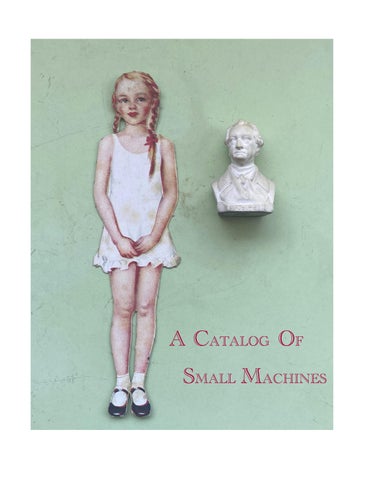
About The Cover I was recently in Spain, visiting my twin sister, and we came across some treasures of our late mother. This paper doll was hers. We could only imagine her playing with this, the little girl who didn’t get glasses until second grade, who couldn’t quite believe there were actually birds until she was finally able to see them. There’s a certain pathos and vulnerability to this doll in that context, so I grabbed a tiny Goethe bust from my sister’s bookshelf to keep her company. — Katrin Talbot
A Catalog Of Small Machines — Summer 2026
Page 49