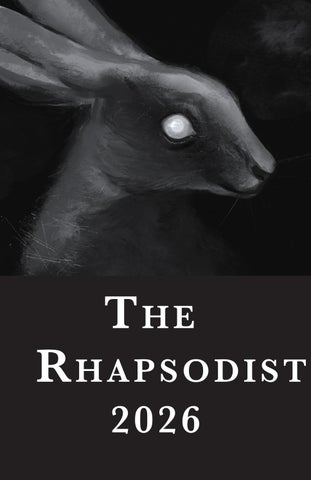
The Rhapsodist
Spring 2026
Asheville-Buncombe Technical Community College Asheville, NC
Editors
Barbie Byrd
Erik Moellering
Rafaella Mowad
Hannah Shabaan
Readers
Jennifer Browning
Robyn Luney
Eleanor Macken
Chelsea Patterson
Maggie Poist
Lisa York
Design/Layout
The Rhapsodist Editors
rhapsodist, n.
Pronunciation: Brit. /’rapsěd ist/ , U.S. /’ræpsědist/
Etymology: < rhapsody n. + -ist suffix.
Compare French rhapsodiste ...
1. A collector of miscellaneous literary pieces. Now hist. and rare.
This issue made possible by the generous support of
A-B Tech’s Student Services Department

Editors' Note:
“The stars we are given. The constellations we make. That is to say, stars exist in the cosmos, but constellations are the imaginary lines we draw between them, the readings we give the sky, the stories we tell.”
-Rebecca Solnit, StormingtheGatesofParadise
Dear Reader,
As A-B Tech’s primary venue for literature and fine art, The Rhapsodist showcases the best examples of creative expression from our college’s diverse population. We hope you enjoy this year's issue of writing and art - a catalogue of our collective constellations. Thank you for your continued support of The Rhapsodist.
Solnit, Rebecca. StormingtheGatesofParadise:Landscapesfor Politics. U of California Press, 2007.
Paper Heart
Jessica Padua

Bramble & Bruise
Chloe V. Jackson
Pluck the fruit from the drooping tree, Fig or apple, we’ll make sweet jam, And stick it to our bloodied knees and tangled hair, And spin it in our wine and destructive clawing spirits,
Laughing at God and the pointed finger of the sun. Spike the glistening orange with the fragrant clove, Draw in the torrid perfume, And hold that singing note until you turn to plum.
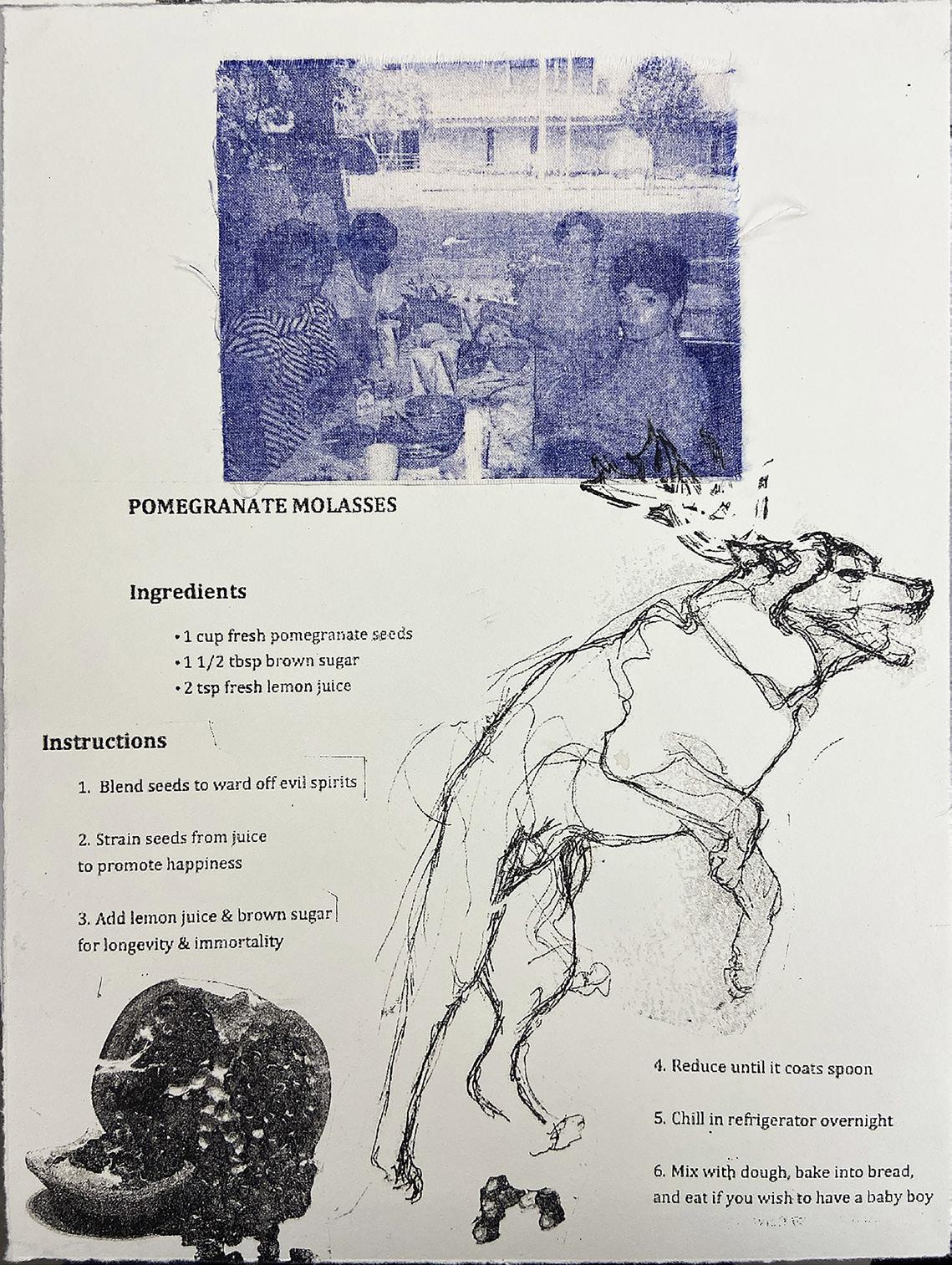
The King of All Fruits
Ani K. Volkan
The Things We Bury
Ashlee Lutz
Wemoved down South in July, two months before Eli turned sixteen. The heat clung to our skin like a second punishment, but I welcomed it. After everything we’d been through in Philly-the arrests, the shelters, the rehab-I wanted to believe North Carolina could be a place to begin again. A place without sirens outside the window or needles in bathroom drawers.
I had been clean for nine months when we arrived, and I carried that chip in my back pocket like a shield. It felt fragile. It still does. I was told anytime I wanted to use to place it under my tongue and when it melted, I could use... It still hasn't melted.
Eli didn’t speak much in the car during the move. He just stared out the window, earbuds in, hoodie up, even though it was nearly 100 degrees. He never said it out loud, but I knew he didn’t want to leave. He missed his friends, the corner store, the cracked pavement he called home. He missed the version of me before I got better, when I was too high to parent and too ashamed to try. I thought the move would help him too. I thought a new school, clean air, and quiet nights might give us both a chance.
But trauma doesn’t pack lightly.
Eli struggled. He came home silent, slept too much, flinched when I asked about his day. I tried everything, therapy, talks, even getting him a dog, but I think he’d already started slipping through my fingers.
He wasn’t angry, just tired. Tired in that ancient way that kids shouldn’t be. The kind of tiredness that looks like giving up.
And still, I missed it.
It was a Tuesday. I had picked up extra hours at the hotel, scrubbing tile and replacing soaps, proud of how far I’d come, obliv-
ious to what I was about to lose. When I came home, the first thing I noticed were his shoes; I got him them for Christmas last year. I remember feeling so lost as I went to so many different stores looking for "The hottest out." They were left in the middle of the floor; one tipped on its side. It was such a normal thing for him, I almost smiled. Then I saw the door to his room cracked open.
Then the silence.
“Eli?” I called. No answer.
I pushed the door slowly, half-expecting to hear his music, see him buried in his bed with his phone in his face. But the room was quiet. Too quiet.
And he was lying on the floor.
At first, I didn’t understand what I was looking at. His body was curled, his lips tinged blue. For a second, my brain tried to pretend he was sleeping, playing a joke, anything. Then I dropped everything in my hands and ran.
“Eli!” I screamed his name again, shaking him, slapping his cheeks, begging him to wake up. I tilted his head back and started rescue breathing. One breath. Two. My lips pressed to his like I was trying to breathe my soul into him. I’d learned CPR in a rehab group that brought in nurses once a month to help us “build life skills.” I never thought I’d use it on my child. I pumped his chest. My tears splashed onto his skin.
“Come on, baby, come back to me. Come on.”
Thirty compressions. Two breaths.
I counted. I begged. I whispered his favorite lullaby under my breath as my arms ached and my heart broke.
The paramedics came so fast, I don’t remember calling them. Maybe I had. Maybe a neighbor had heard. They took over.
I was pulled back, arms flailing, screaming his name like I could drag him back with the force of it. They shocked him once. Twice.
Nothing.
One of them looked at the other and gave a small shake of the head.
“No, no, please!” I dropped to my knees. “He’s sixteen. Just sixteen. You must keep going!”
But they didn’t.
Time of death: 17:48 p.m.
The words shattered something inside me. I watched them zip him up in a black bag like he was some broken object to be filed away or a leftover. I clawed at the air, at my chest, at anything to wake myself up from this nightmare, but I wasn’t sleeping.
I never would again.
The house was too quiet after that. I couldn’t throw away the shoes he left on the floor. I couldn’t wash the hoodie he’d left on his bed. I carried it with me everywhere, pressing my face into it like it still held the scent of him, like the fabric could tell me where I went wrong. I didn’t sleep. I didn’t eat. But I didn’t use. Not once.
Even when I found his pills hidden in the vent under his bed, blue fentanyl pressed like candy, I didn’t use. I flushed them, sobbing, shaking, hating the water for swallowing what had swallowed him. I screamed into my pillow. I prayed. I screamed again.
And then I started writing his eulogy.
His funeral was small. Too small for the size of the hole he left in this world. I stood at the front of the chapel, my hands trembling, a crumpled paper in one fist, though I already knew I wouldn’t read from it. I looked at the pews. I saw his father, stiff in a pressed shirt like he gave a damn now. I saw neighbors. A few teachers. Some classmates I didn’t recognize. But mostly, I saw people who didn’t show up when he needed them. I took a breath and let the paper fall.
“You’re all here now,” I began, my voice brittle but loud. “Now that he’s gone.”
No one moved.
“Where were you when he needed someone to talk to? When he stopped coming to school, when he wore long sleeves in
summer?” I looked at the counselor. “You called him a problem. You never asked what he’d been through.”
I turned to the coach. “You benched him. He was quiet, not lazy. He was tired, not weak.”
And then my eyes landed on his father. “And you! You left. You left us when he was barely out of my womb and only came back now, for a box in the ground. That’s not parenting. That’s cowardice.”
Gasps. Someone stood to leave. I didn’t care.
“I am not innocent,” I said. “I know my failures. I brought chaos into his life. I chose drugs over everything, for years.” My voice cracked. “But I got clean. And I was trying. And he was trying, too. He just didn’t make it.”
I stepped back and looked down at the casket, his favorite sneakers placed beside it.
“I love you, Eli,” I whispered. “I will never let them forget you.”
I stayed clean. That was my vow. Even when the grief felt like drowning. Even when I screamed at the stars and punched the ground. Even when I wanted to crawl into that casket with him.
I went back to work. I went back to meetings. And then I went back to school. Because if Eli’s death was going to mean anything, I had to do something more. I enrolled in a community college just outside town, majoring in psychology. I want to work with adolescents, especially the ones no one listens to. The ones who seem fine on paper but have eyes that look too old. The ones like Eli. My first semester, I wrote an essay called “The Things We Bury.” My professor cried.
It’s been three years now. I still carry Eli’s hoodie in my backpack every day. I still whisper to him before bed. I still feel like half a person most days. But I’m clean. I speak at recovery meetings. I hand out Narcan kits. I started a support group for grieving mothers, and I named it “Eli’s Light.”
Because light doesn’t die. It just changes shape.
I’ll be the first in my family to graduate college next spring. I’ll walk across that stage holding the memory of my son like a lantern. And when I work with kids like him, wounded, quiet, brave, I will see his face in theirs. And I will listen. I will not turn away. Not again.
Dogwood Hills Ln. #1
Ronnie Z. Nielsen
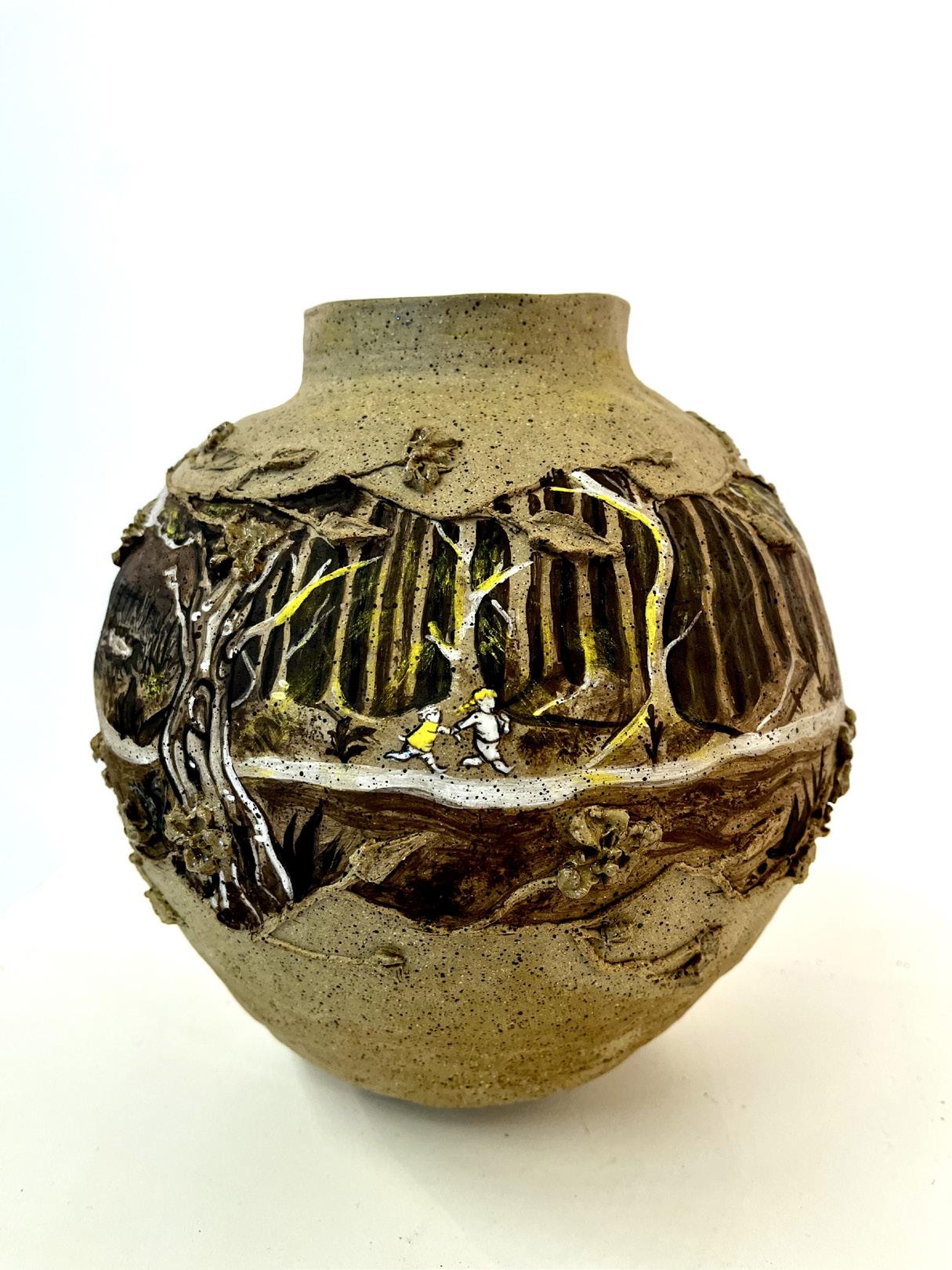
Dogwood Hills Ln. #2
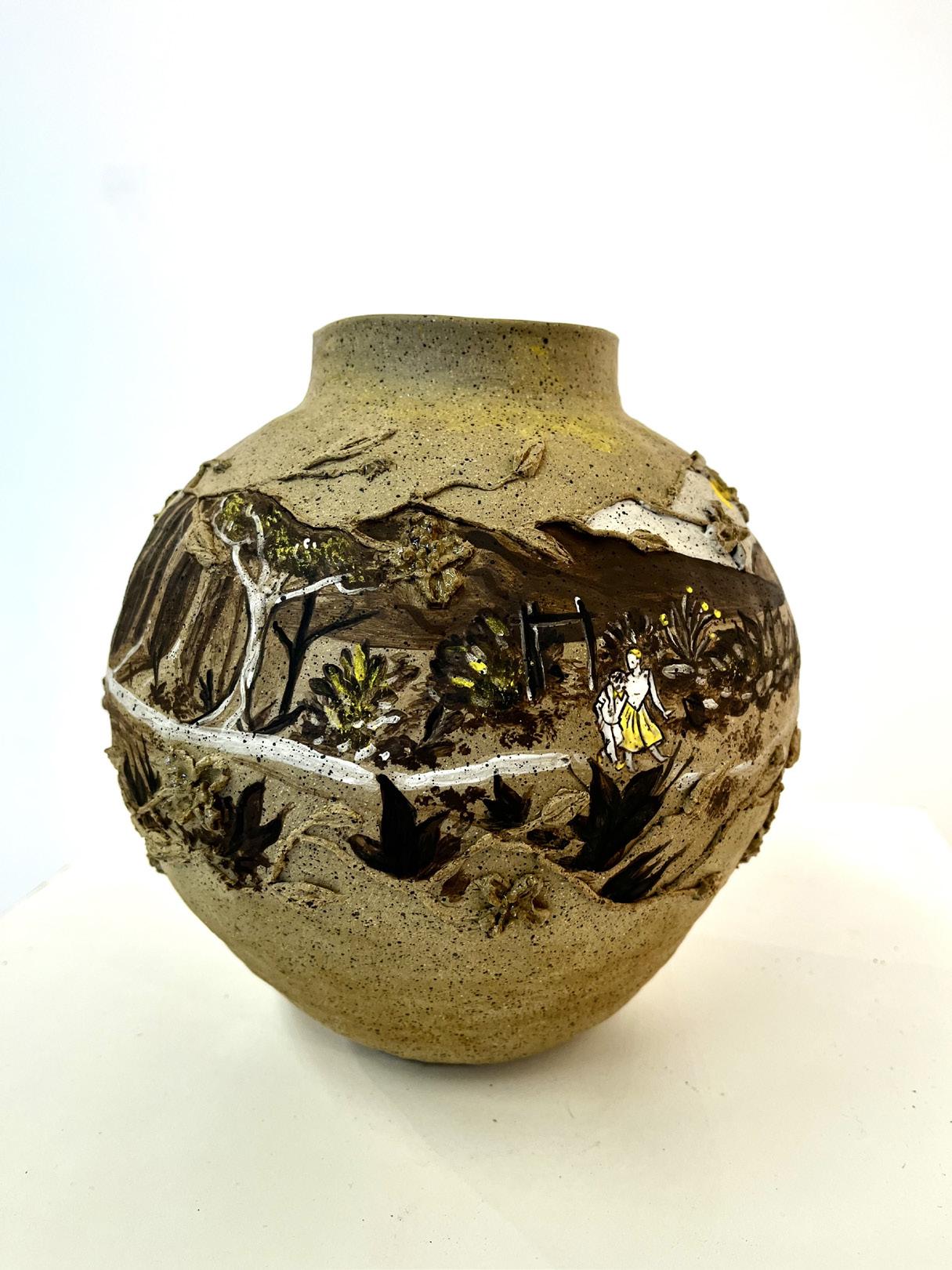
Ronnie Z. Nielsen
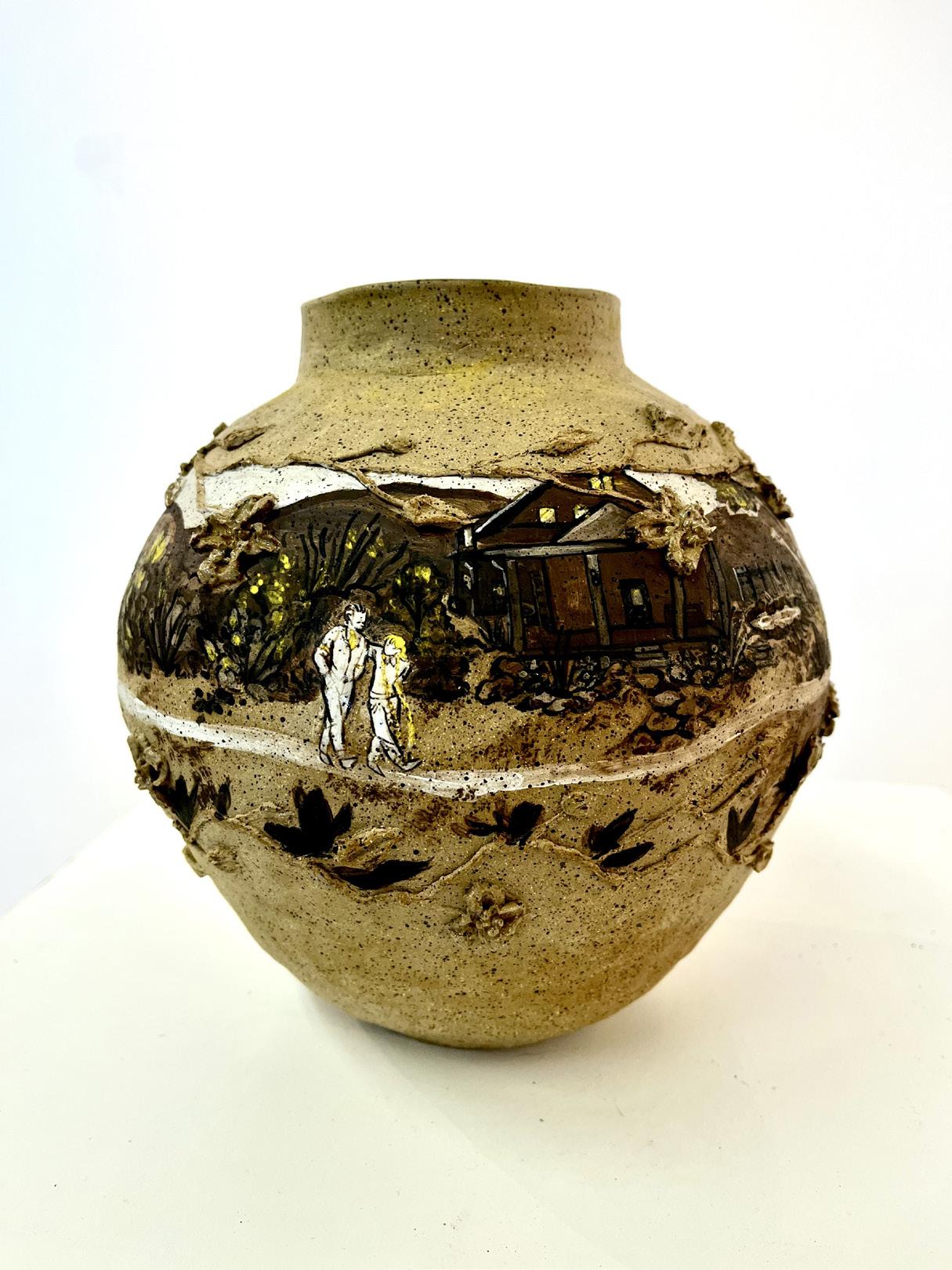
Dogwood Hills Ln. #3
Ronnie Z. Nielsen
Interim
Anna Claire Applegate
Thethird time Fleur smiled at me, I knew I was in limbo. It began when time started to lurch violently: missing hours, shifting locations between blinks. I had long ignored the increasingly wide gaps in my memory, how my life felt as if I watched it on a corrupted VHS tape. I smothered any contradictions in my head, all reason or delusion, until it was normal to exist in the fuzzy moments I was conscious for.
This time, we’re back at the doctor’s: a neurologist, one who specializes in migraines. My visits here were cyclical before, but this room keeps appearing since the change. I brought my journal from after I addressed the gaps in time. It was once a diary, claimed when I wrote “Kit” in kindergarten letters and scribbled over the first page in black. Just the first, I never touched it again. I guess I’ve always felt that I had nothing worth writing. I use the little green journal to rebuild some kind of timeline, recording the time of day, any clues of what I’ve missed. I ripped out the first page.
Despite the Jumps, I know I’ve been assessed in this office in at least five instances. Each time, I’ve watched Fleur silently record my information, a stack of paperwork in her hands. She never turns, never double checks any allergies, no “Howoldareyounow? 15? I can’t believe it, you’ll always be that little kid to me…” Back when adults towered over us, we would whisper stories about the lives of other patients. We’d complain about how long we had to wait. Fleur’s silent now, filling out papers.
Few people inhabit the cramped waiting room. A wrinkled man droops like wax in the snaking rows of chairs. His patchy white hair blends in with the texture-spackled drywall. The room, more a
sterile box, is broken only by the reception alcove and a small window unit by the entrance. The man is called by a hidden technician, and he rises from the circle of waiting statues. Everything’s mundane, quiet. It’s been a long time since I’ve trusted it. I breathe in the smell of cigarettes from Fleur beside me. My eyes are misted as if filmed in tobacco residue. Her legs draped over each other, she sits with her crisp skirt laying over her straight knees. Her face is blurred by gossamer strands kissing her nose and neck. The scent lingers on mom’s borrowed jacket, rose-pink and classy. Fleur tries to mask the smell with lilac. I pivot toward her still frame.
“Why am I here?”
“Did your mother not tell you?” She responds with a blank glance.
“That doesn’t answer the question.”
This response is expected. From before the change, Fleur has adopted my father's tactics for dismissal, but it sounds wrong in her sweet voice. Fleur is only related to him in law, but she is more of a daughter to him than I am. Fleur’s someone you can only see a fragment of at a time. Her pale eyes drift across my hollow features as light plays on clear surfaces. Her face is a perfect mask of “I’m listening; I care.” I can never tell if she is or not, and I can’t trust anything now.
“You’ll be fine,” she says.
“I hope you die,” I reply.
It doesn’t matter what I say; Fleur has no reaction. Since the change, Fleur has become an immovable object, only answering prompts she decides to hear. I discovered this when I screamed at her until my voice died. They decided to leave me home alone that day, my parents taking her to visit a prestigious institution upstate. Fleur had her chestnut hair in a relaxed bun, tendrils of hair falling around thin silver hoops. She shouldered her tan crossbody with the grace of routine. She hid her eyes with dainty sunshades and floated out the door as if fate had opened it for her. My parents stumbled
out after her. When the door latched, I experienced a particularly violent Jump, and, suddenly, I was on the other side of the door in a ring of luggage. Fleur was beside me in white crewneck that draped over a short jean skirt. My stomach rolled from the nausea from the memory shift. She tried to hug me, it felt like a goodbye. I fell to her feet, head feeling like it was smashed by a hydraulic press. She just patted my head once and collected her pink floral duffle bag. I yelled at her to come back, my eyes fuzzy. I had 10 seconds to make up for the time I lost. She just left, a blur of white, never looking back. No. Since the change, Fleur Northrop-my cousin, the sister I never had-does not exist and cannot speak.
I hear the swish of navy scrubs approaching from the hall. The technician appears from the patient entrance and scans the room. She’s tight-lipped with a weight sagging her shoulders. She points to the mauve clipboard tucked in her elbow.
“Murphy,” her voice echoes in the sparse room.
“Yeah hi, I’m here.”
I stand up, prepare myself for another appointment. It’s just down the hall, one turn to the right: room 125. I resent the pale green cabinets and the strong anti-bacterial that always makes me cough. The doctor, impersonal and beady-eyed. I’ll play the game, stuck in a strict script of “What’stroublingyou?” and “Areyoueatinghealthy?You’restillabitthin.” I’m ready for the receptionist to give me a tight thank you and leave as if I was never here.
“Murphy, Kit.”
What?The woman is looking my way now. Clinical niceness pierces from her white-ringed eyes, made more severe from her tootight bun. She dons a plastered, practiced smile and hails my name again: “Kit Murphy?”
“Right here.”
My voice sounds smaller than I mean it to be. I step toward the woman with the gummy white teeth. Her face resets as if on a timer and she turns to reassimilate into the matrix behind the
reception desk. On instinct, I follow after her past the opaque glass door.
Plated office numbers flash by. 111, 112, 113, 114, 115—
“Caution: Radiation Area.” My head feels as if I just walked into a diving chamber. 117, 119—a sharp right—123—room 125: “Dr. Mahogany.”
The technician halts. She raps on the veneered wood door with the back of her fist. I just stand there, staring at the door. After no answer, she turns the knob, hinges swinging, near-blitzing me in the face. I jump back with a yelp. The woman charges forward into the examination room. The door snaps shut with a dull thud. I don’t understand her problem. I wouldn’t have called her pleasant before, but not nearly violent. My eyes bead from the familiar chemical smell in the hallway. I take a wobbly breath. Did she not see me? I grab the cool metal handle, opening the door.
My splitting headache is the first indication that I Jumped. I slump to the side, caught by a wall. The static in my eyes fizzles out until my eyes hone onto my surroundings: I’m back in the waiting room, by the glass patient door. The desk alcove is to my left. The receptionist drones on the landline, blowing blue bubble gum while rolling her eyes. She doesn’t notice the girl near fainting next to her. That’s fine; I didn’t expect her to. At least I get to leave. If I missed the news of some fatal illness, Mr. Neurologist can fuck off. The glass door swings forward, looking at me as it passes. My eyes jump to my face, scanning for wrinkles—the will of stupid paranoia. I see a flash of my watery reflection on the surface, hardly anything.
“Murphy.”
I freeze. The receptionist’s eyes are glued to what used to be my chair. She checks her clipboard.
“Murphy, Kit.”
I can’t be here.
“Kit Murphy?”
This already happened. I turn towards her. I’m assaulted by
her forced expression, the exact same. She pivots and marches back through the doorway.
“Wait!”
Footsteps. I peel myself off the spackled wall. Sliding on the tile, I skid until I see her back disappearing down the hall. I halfwalk half-run after her. “Ms. Graham, please! I think that’s your name—what’s this appointment for? Please slow down! Like why?” She doesn’t respond. I’m within arm’s distance now, and I reach for her as an animal tests an electric fence. She stops at room 125. My hand closes the distance between my palm and her upper back. It doesn’t stop, swiping through her ribcage. I scream, snapping the hand to my chest, cold like I dunked it in glacier water. The door flies open and it passes straight through me. She enters the room. I stand there. My head is cushioned with a dull buzzing in my ears. Thisshouldn’tbehappening. My right hand tingles uncomfortably as I shakily retrieve my journal from my back jean pocket. I hold it unopened, pressing my palm to a sharp corner. I should make another entry. I switch hands, pressing harder. When I realized my situation, it made my symptoms worse. Jumping headaches started as ghosts of pressure behind the eyes; now a shockwave booms from the nape of my neck, my ears pop, my sinuses clear, and the migraines never quite leave. I close my eyes, trying to will my heart to retreat from my throat. My vision’s worsened, too; I ignore the white spots that keep multiplying. I drop my journal; it smacks to the floor. It’s sharp and bright, angled on a seam between tiles. My eyes are clear. I blink, pick up the journal, running over the soft cover with my hands. I look at the doorknob, white polished silver. I reach out my hand to grasp it. I pass through.
Back in the waiting room.
“Murphy.”
I ignore her this time, heart rate spiking. Fleur is as I left her. I manually force my legs to step after each other, inching closer to her stone face. She’s filling out paperwork, head bowed.
“Fleur?”
I walk over to her. She lifts her head and I gasp. There is a gaping hole yawning from her face. It’s black and swirling, three-dimensional as if I am looking at the void of space. I cover my own mouth; my eyes widen when she tracks the movement with a twitch. She has no eyes, but I feel it watching me. The nothing branded on her face starts to pour like tar down her front. It slides between her legs and sloshes onto the floor in a glob. Where it hits, the tiles rupture, cracks spreading from the mass as sharp capillaries. The floor cracks under me, empty between the gaps. A bit of tile presses against the rubber sole of my Converse. I close my eyes, waiting to fall. I never do. I slowly crack my eyelids. I stand as I am in a churning grey expanse. My head feels like the hour before a shift in time. A residual dull ache, my temples pressured. I close my eyes again and feel carpet beneath my feet.
I hear the slow bass of my father’s voice down the hall, words lost and muffled. My eyes adjust to the wisps of evening creeping under purple curtains. It smells safe. I can’t help the weak laugh that bubbles from my chest. My room. I stumble over to the floor length mirror in a dark corner, Fleur’s head still burning into me in the memory of my vision. Dark hair, deep set-eyes, scrawny, stubborn baby face. I touch my cheek, imagining an empty recess dripping darkness. Shivering, I look away. I must have had a psychotic break. I fell asleep and dreamed the Jumps, or something. My bed is made with a powder-pink duvet I haven’t seen since my childhood. I run a hand over the worn threads. My bed is usually crumpled like rejected paper. Now, here it is: foreign with a mysterious crown of settled plushies looking at me with prude button eyes. It is styled for a porcelain cabinet, barred from the chaos of the rest of my room. It looks nothing like my bed. I sink to the floor beside it, bracing my journal on my knee, flipping it open with the pink ribbon that keeps my spot. I retrieve a dusty pen from under the bed. I snatch my hand away like the darkness would take me.
I’veofficiallylostmymind—Don’tmakeitworse,goinorder,Kit.Day:Unknown.Month:Unknown.Year:2003.Ihavenever regressed in time before, but it happened today…became invisible and impermanent in body. Called out to the technician and she didn’t hear me, reached out to her, passed through her body completely. I start giggling. Looking at my hands they seem so solid; it can’t be. My vision has improved, strange development, I need to think. I hold my air to stop the babbling coming from me. No one seesme.Noonehearsme.Idon’thaveanything.Idon’tcare. I slice the pen across the paper, ripping it. I scribble, laughing some more. I guide my hand in circles, mesmerized. Black ink bleeds through the paper. I have more to say. Void, I write over the jagged pen strokes. Void Void Void. I’ve ruined it. I flip the page over. Oh. It is the last one. I hold the full journal in my hands. All that time, recording everything, only to never find answers.
A knock on the doorframe makes me turn my head to the shadow now swallowing my ankles.
“Fleur?”
Her name always feels too drawn out when I say it, like I haven't grown up with the syllables in my mouth. Now her name’s a beg for mercy; she must have a face. The shadow of Fleur drifts from the doorway to the bed. The plushies bow as she perches on the cool metal frame. I watch the covers dip like ripples in still water. She sits at a stiff 45 degrees and casts her head down to the hands wedged in her lap. She looks towards me; her lips move on a hinge:
“You were always so damn awkward. I thought you would grow out of it; why couldn’t you grow out of it?”
“What?”
Her mouth continues to move up and down after she stops making noise. I sit completely still, letting her tower over me while clicking her jaw. My own clenches. Fleur starts to whisper something. My hair stands on end. I inch away from her. She’s still wrong.
“I’m so proud of you. I always was. I’m so proud of you. I was
always so proud.”
“W-what?”
She would never say that. I slowly get to my feet, a ghost kept at bay by my imaginary salt circle.
“This isn’t funny.”
I take a step towards her.
“You were everything we could have wanted. You were perfect.”
Her eyes bore unwavering to an unknown vanishing point, as if I am not here at all.
“No, I—”
My eyes well. Perfect. What a cruel word. My breath catches.
“Look at me, please.”
Fleur stares over my shoulder. I turn. My overlapped teeth grin from my too-small mouth. Cheesy bubble letters exclaiming "FirstGrade,1994!”arch over my tilted head. Tears bead on my chin and drop to the floor. It’s my last yearbook photo with a genuine smile.
“Not at her, me,” I plead. “Look at me.”
She doesn’t. Something snaps inside. The wail that comes out of my mouth belonged to someone much younger than me.
“WHY? Why do you never look at me!? I’m right here. Why can’t you ever listen to me? Do you know how stupid you make me look? I know you’re not gonna fucking answer! You never do. I’m not dumb enough to get my hopes up but, God, I miss you every day. I want to live again! How can you not see that, you selfish bitch?? JUST ANSWER ME—”
I lunge towards her. I’m not sure if I want to punch her or hide in her elegant arms. I could return to that inky dark. My head passes through hers like she doesn’t exist. No. My arms are braced against the duvet, our torsos overlapped like a gel print. My entire body goes cold. Fleur’s chest rises and falls inside of mine, she starts
to speak.
“Why did you have to die?”
I retreat and see tears shining in her eyes. Static fabric sticks to her ankles. She’s in a black, straight-cut dress with a slight drape over her left hip. Long sleeves hug her arms, sitting off of her sculpted shoulders. She grips a pendant on a chain around her freckled neck. I hold in a sob. It’s a gaudy neon green half-heart with hot pink around the broken edge.
“I-”, her voice shakes. “I wore this to your funeral. It was earlier today. I thought—I thought your half might be in here.”
I throw myself at her feet, my watery eyes gluttonous, devouring her contorted face. She hides a broken laugh as she rocks her face into her knees.
“Oh Kit, it was so fucking ass. I know I’m not supposed to say that to you, but it was so boring. I kept—I—kept trying to turn and whisper to you, but you’re not—you’re not here.”
Her voice breaks at the end. I sob. Her words wash over me. She’s crazy: a supernova in my empty sky. She went to my funeral, but she is a corpse come to life. I’ve waited so long for her to speak.
“Why did you have to die?”
I try to grip her dress with hands wet from my face. I feel like a newborn left in the woods.
“Fleur, I'm here! You came back to me. I don’t know what you’re saying.”
“I love you, Kit. I miss you so much, you stupid kid.”
“I’m right here! Please.”
I try to hug her. Wrap my bony arms around her and squeeze. My arms hit my own waist, her forehead in my heart. I try to kiss her on the head. My tears fall through her onto the baby pink fabric beneath her. I yell. I try to sandwich her perfect face between my uneven hands. I just want to look into her eyes. She stands up, walks through me—
“Goodbye, Kit. Sleep well, my darling—”
—And leaves. I’m just a girl, alone on the floor of my room. I found my Fleur again. She kept the necklace I got her at 9. I threw mine out a bus window when she moved away. Her’s sits on her collarbone. I curl up into a ball, sobbing. I got her back, but now she’s lost me.
It was all pointless. Since I learned to daydream, I would play out my own death. I would tuck myself into a miniature casket, and, one by one, I would stare at the crying faces over me. I kept my own death in a cookie tin in the back of my mind. I would gaze at the smooth metal walls, imagining its once contents. I taste chocolate in my mouth. The tin was empty.
It’s strange, somehow I thought that death would make me feel more alive.
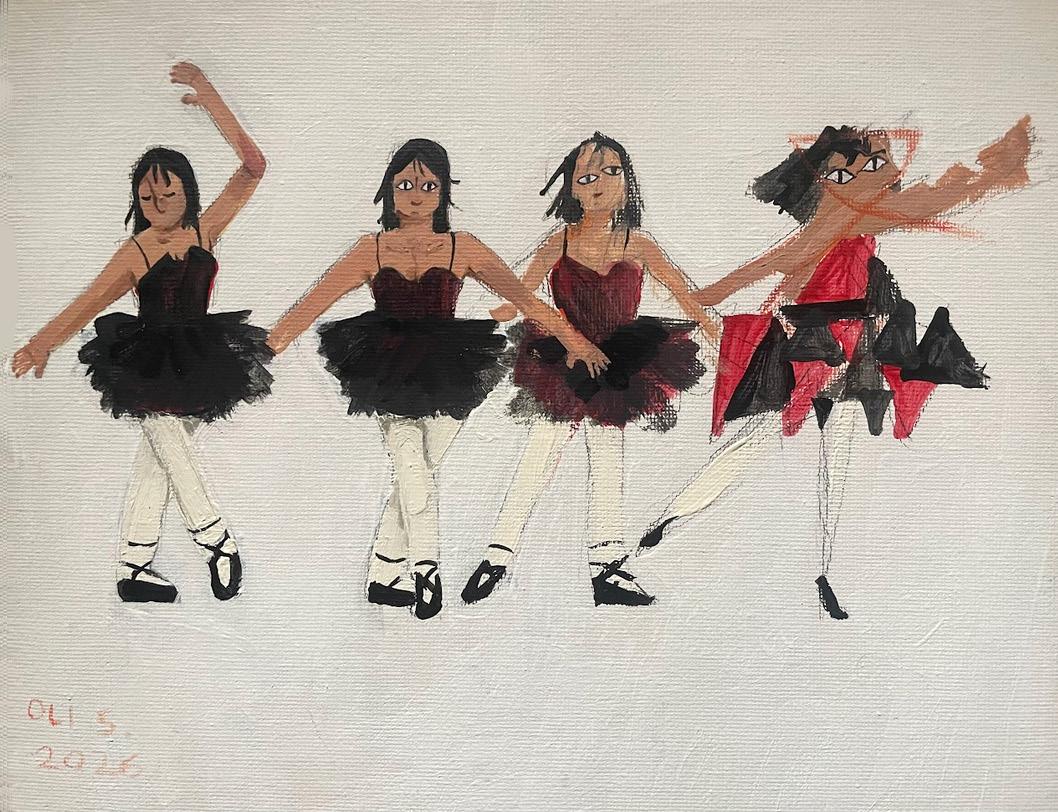
Point to Where It Hurts
Oli Von Sigler
Alchemy of the Unseen: AFieldNotefromtheLandofSky
Christopher Robert Coward
InAsheville, geography is destiny, and the map is written in elevation. Up above, the tourists flock to the "Land of the Sky" to witness the mountains transmute into the burning, temporary gold of autumn. They crowd into trendy bars, paying outrageous prices for craft beer in tiny cups, buying a curated view of Appalachia. But gravity works harder down here, on the pavement level, where the Alchemy of the Unseen takes place.
The Beaucatcher Tunnel is not just a hole in the mountain; it is a portal between worlds. Pass through it, and the postcard dissolves. You find yourself on Tunnel Road, or in the stairwells of public housing where the wind cuts through the concrete. In Hillcrest, there is only one way in and one way out across the bridge over the interstate—a brutal architectural metaphor for the life lived within it.
We seek shelter where we can. When the Code Purple shelters are full, or the rules are too tight, the stairwells become bedrooms. We try not to freeze in the shadow of the Ramada Inn and Compass Point Village—places where "Housing is a Human Right" is a slogan painted on the wall, but the headlines in the Citizen-Times are always the same: another overdose, another murder, another ghost made visible only by their absence.
The city knows we are here, but their alchemy is one of removal. They deconstruct the bus stops, so we cannot escape the rain. They cut down the trees, so we have no shade from the summer heat. They try to make the landscape hostile to human rest, hoping we will evaporate.
But we do not evaporate; we transmute.
The catalyst for this change is famously strong here. It comes in chunks of purple, blue, or white—stones that look like candy but carry the weight of an anchor. We are the chemists of the roadside, fashioning boats out of aluminum foil and straws to imbibe the smoke.
When the flame hits the foil, the stone melts into a pool of golden nectar. It smells sickeningly sweet, a perfume that promises to solve the equation of suffering. It makes you fall in love. It makes you willing to do anything for it. For a moment, it performs the miracle: it makes time disappear. It makes you forget you are cold. It makes you forget you are alone.
But the gold is fool’s gold, and the transmutation is a trick.
The nod is not sleep; it is the act of turning off the television while the show is still running. If you go too deep, the screen goes black forever.
Unless you are lucky.
Resurrection in Asheville does not come with a choir; it comes with the sharp hiss of Narcan. Waking up is a violence. The golden nectar turns to ash in your blood. The first thing you see is not the face of God, but the terrified eyes of a stranger who just saved you. It might be a community paramedic, a Post-Overdose Response Worker, or a saint from the Haywood Street Congregation— that Church of Holy Chaos where the hungry are fed and the unseen are looked in the eye.
You gasp, the air rushing back into your lungs like fire. The portal closes. You are back in the "Land of the Sky," back on the cold concrete. But the experiment is not over. To wake up is to refuse the dissolve. We stand up, shaky on legs that remember the cold, and we claim the oxygen that belongs to us.
This survival is the only true gold in the flask. We are the
roots cracking through the sidewalk on Tunnel Road, stubborn and inevitable. We are the mountains that remain after the fog burns off—eroded, perhaps, but unmovable. We carry the history of the unseen in our veins, no longer ghosts, but monuments to the hardest thing a human being can do: endure.
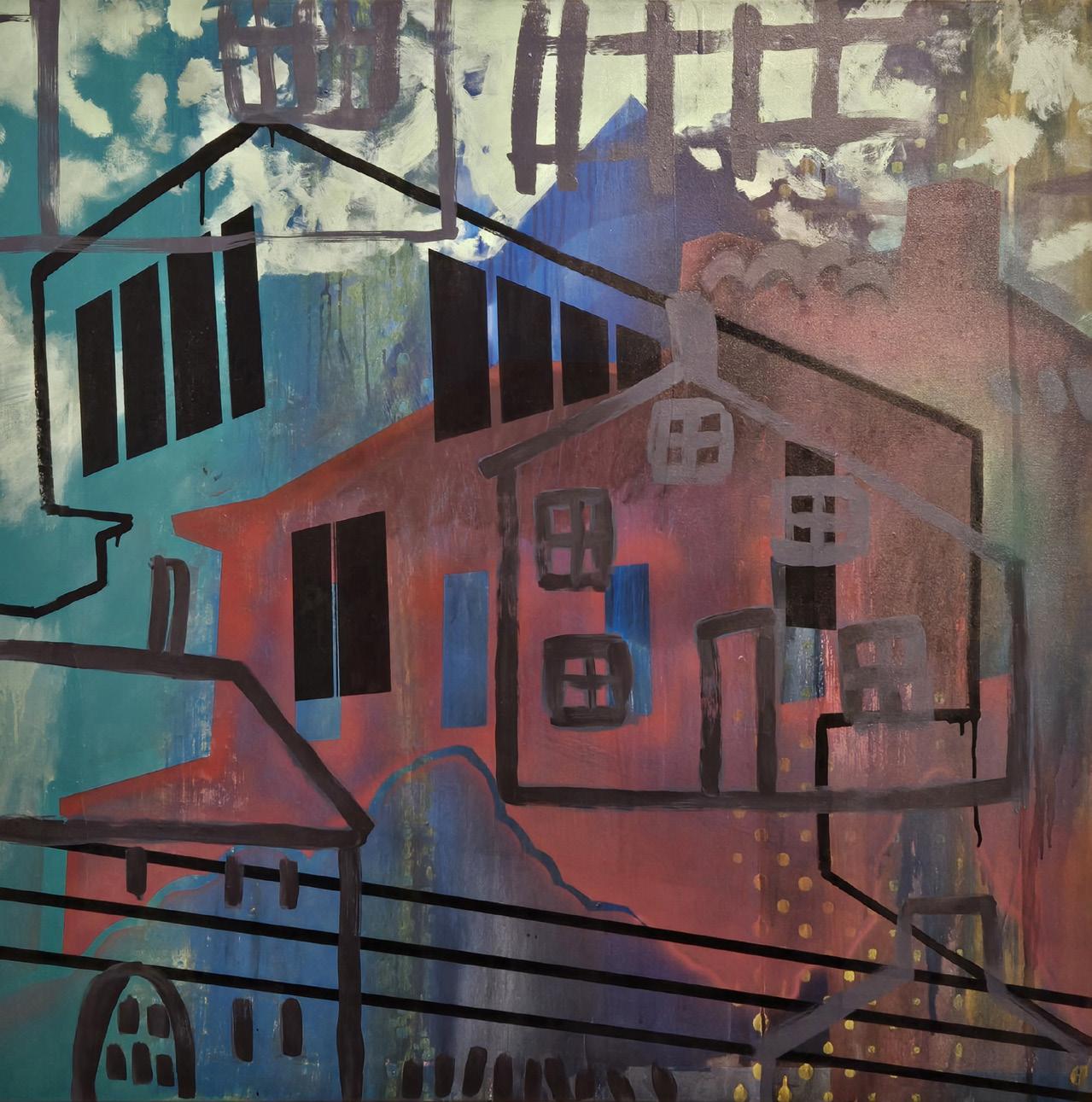
House Hunting
Heather Lewis
The Oak's Dirge
Gianna L. Hill
As I find myself in the cold darkness of night, I can only hear the memories of a far away sight.
Your whispers ring like a haunting melody, and though I can’t stand it, there’s no place I’d rather be.
For this is the only place I can hear you, can only see your smile, and somehow, it scares me, but it makes it all worthwhile.
The crickets sing their funeral march as I look upon the marble arch; the one that reads your family name, where you began, where you left, containing the dash that held your every breath.
The long-leaf pines watch over you as the deer trot by to keep you company, but when I close my eyes in this barren forest, I only wish you could talk to me.
The gnarled and ancient oak trees stand like broken harps in a forgotten land, their splintered branches, brown and bare, claw at the moon’s constant stare.
Their roots, like fingers, clutch the stone, where sorrows have been left alone.
No bird will nest, no sun will warm, this place that has forgotten its form; where melody is just a breath that sings its lullaby to death. No vibrant chord, no harmony, doth shake its rigid frame; The tune is nothing but a frisson that cannot speak its name.
As the cyanic moonglade hypnotizes the stillness, humming the tune of growing fear, there is a minor key in every groan, from roots that clutch the cold, dark stone.
I Saw My Grandpa at a Car Show
Casper C. Raines
his ashes spread among the metals and men his blood became oil, his being became the air surrounding the space of the Walmart parking lot.
his likeness seen amongst the older men showing off their cars with glee only he would understand. he was even in their voices, their accents.
Needless to say it was peculiar to see him, not among the crowd but as the crowd itself. a moment of grief hit me, washing over me without my permission.
I didn't comment.
Self-Portrait
Lillian Martin
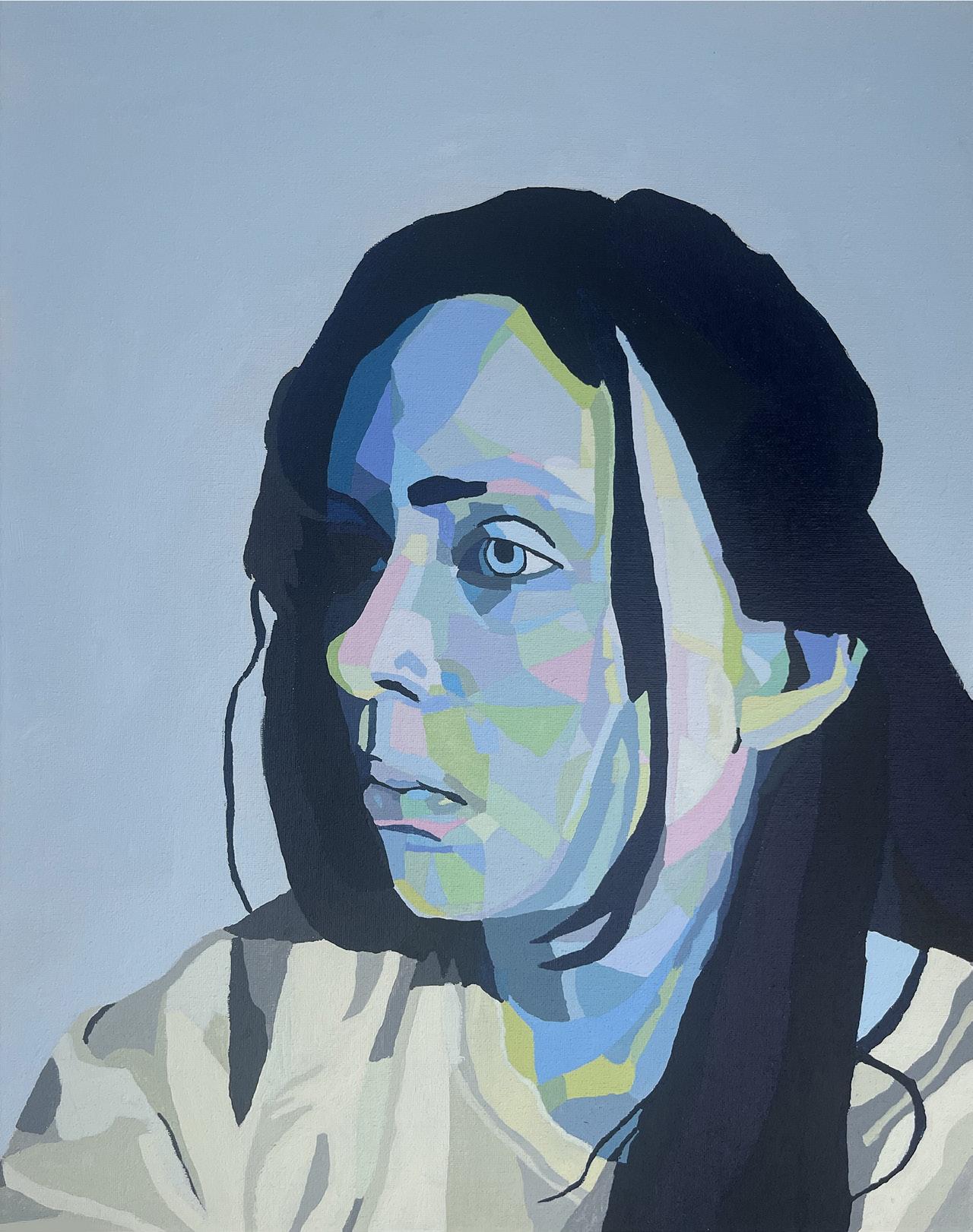
Áine Djoli Brown Tasting Colors
“What flavor of Brown are you?”
A slippery smirk creases his mouth like fresh leather. The corners greased from two beers and three bowls of chili five minutes earlier. He made it normal, like he was asking my favorite flavor of ice cream, tiptoeing over the freezer case trying to decide.
but I was not mint chocolate chip— and my skin did not melt in pools of crisp off-white cream.
I was salt and detergent and vanilla musk essential oils, layered over olive groves and wine vineyards straight out of fifth generation Italy.
And I stood between an area of gray gravel driveways and stared at him, not a glare, not a smile— I don’t know. What flavor I am.
Framed in White faces spaces, Peered at in checkout lines, hair caressed by foreign hands
—“Can I touch it?”
At friends' birthdays. Boys half drunk, fully dumb: I.
Don’t. Know.
I am the slackline between Steel Towers my mom watched fall: Snatched, stacked, and strained. I am the story a mirror tells in lights and darks.
So I ask again: What Flavor of Brown Am I?
I see shaded black curls blue raspberry in the light.
Matte wine lips always chewed from the inside.
Speckled chocolate dots across my nose and, cinnamon cream legs billow from my hips.
That is what I taste, but you tell me; truth is I am what YOU see.
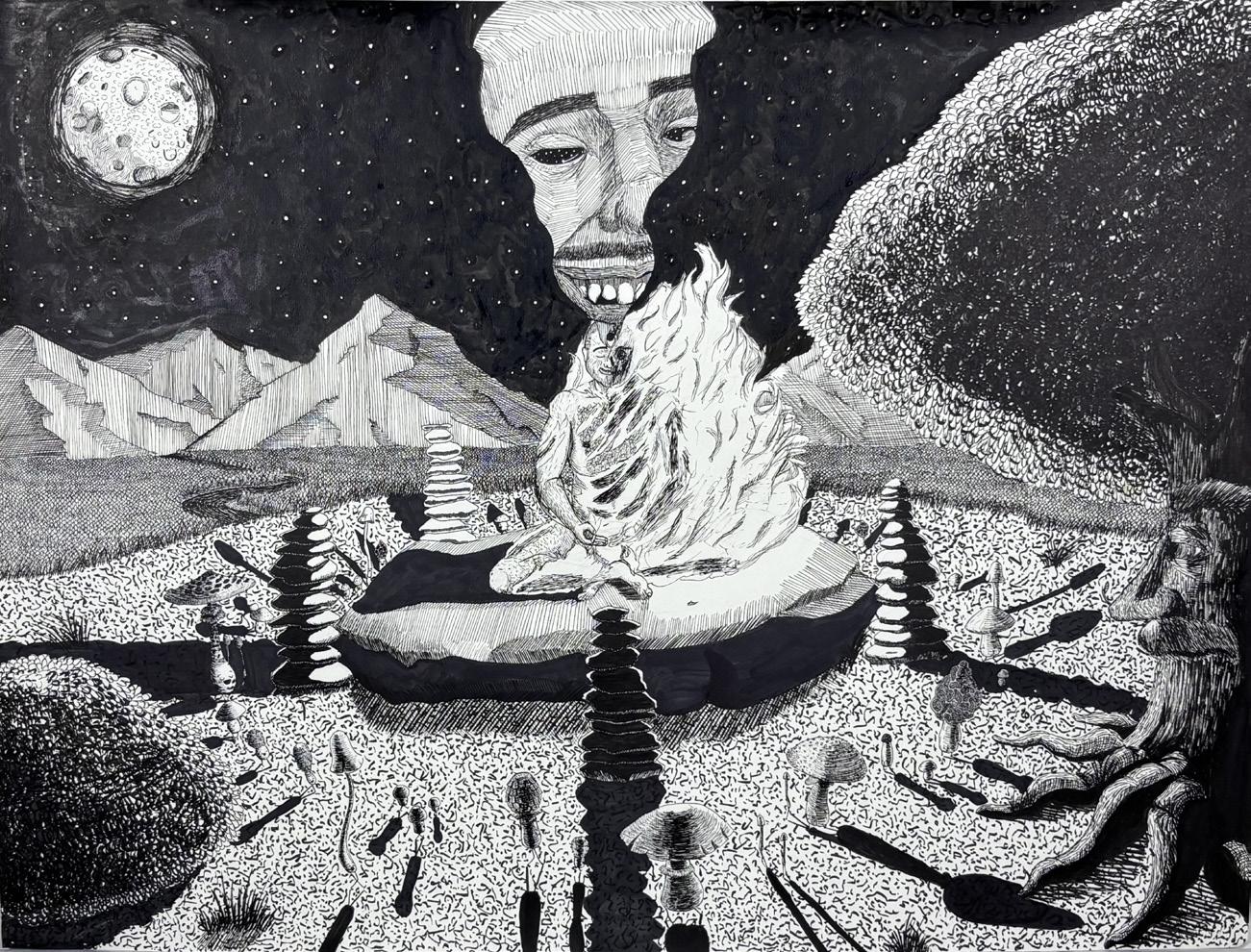
Bliss
Jesse Rodriguez
Where I'm From
Samantha R. Tomes
I’m from a stereotypical lower class, southern family raised by a single mother with an all too common albeit tragic history. Where church was on Sunday, even if it’s just on TV, and “an ounce of prevention is worth a pound of cure,” because “Can’t never could do nothing.” I learned that men raised by single women and soldiers of foreign wars often turn into absent fathers who drink too much, so they can grieve the absence of war. For generations, the only wisdom passed on to the women of my family was that life was unfair, and you’re on your own. Somehow watching the women in my life survive and even thrive in that dystopian-like narrative formed the foundation of my personality. I witnessed numerous heartbreaks, poverty, gender roles, oppressive religious institutions run by desperate cons hellbent on stealing the notion of self-worth, and learned of the worn-out bodies created by emotional abandonment and factory work for low wages, all of it seemingly rewarded by a peace of mind that never actually comes. In the absence of proper male role models and the presence of lovers refusing the roles of husband or father, the women of my youth were able to face a world not meant for their comfort, even in solitude. The women in my life were my heroes, fundamentally defining how I see the world. I like to describe the essence of my mother in her rare, tension-free moments during my childhood. When she stood free and unencumbered by maladjusted menfolk at the kitchen sink making last year’s “school shoes” look brand new with just an old toothbrush and some Soft Scrub. She sang along to her boom box on any given Saturday circa ’95, giving The Carpenters and Chicago a church choir kind of twang, equal parts southern belle and Appalachian medicine woman. I found her accent annoying as a child because of the
negative stigma attached to Southern accents that had informed my young mind that the people who have them aren’t well-spoken or intelligent. And yet, I’d still pause from dancing with the full-length mirror on my closet door or writing on loose leaf paper about some precocious ballerina to observe those fleeting moments of my mother’s joy. She was most beautiful when she laughed and sung unbothered by whatever intense emotion would steal her away. Whatever lingering trauma or subpar love interest she had would often rob her of her peace. My sister was 7 years my senior and troubled in her youth, for the same reason I coped by disappearing into my imagination. Our mother wouldn’t learn what healthy intimate relationships looked like until later in life; her earlier choices never reflected her ideals but sought instead the missing pieces of her heart left by absent caregivers. My sister had similar life experiences in the time following her teens, after her loud music and passionate opinions were demonized and punished by our mother’s pious fears and tender nervous system. She rebelled against an oppressive sense of “normalcy” our mother tried to create, seeing the hypocrisy and contradiction in it all. She and my mother were (and still are) guarded in ways that make it hard to get to know them, showing their love not with traditional sentiment or affection but in consistency, practicality, structure, and through random acts of kindness and service.
When I was a child, my mother clung to the sermons of Christian pastors while I stared horrified, wondering what solace she got from the idea that peace was a reward that may never come, not even in death. Maybe she was looking for a reprieve from all the unanswered questions still left by absent caregivers or books she never had time to read. She’d become very skilled at walking away from poorly intentioned men, but her heartbreak never kept her from loving the ones who needed it the most, even when they didn’t deserve nor reciprocate that love. I see myself in my mother’s endless service, her forgotten hopes and dreams, her sacrifices to make life better than the lives my ancestors were lucky to hard-
ly endure. Never would I have understood the lesson in my sister’s rage, created by stolen innocence and the lack of just accountability or punishment. Never would I have been able to decipher greed and egocentrism over benevolence and integrity if it weren’t for the lack of peace brought by the Corporation of modern-day religion. I wouldn’t understand the simple enough-ness of pinto beans and raw onions on buttered cornbread. The smell of kerosene wafting through the air in the winter during snow days in the mountains with chicken noodle soup wouldn’t feel like peace and safety to me. I see my ambition was born of meager means for a reason, so that I could really appreciate how things are, rather than how they appear to everyone else. So many beautiful, powerful truths are left unspoken for the sake of fear, political correctness, and pious vanity. How else would I have learned that the key to my shackles was in my own voice, if I didn’t notice my heroes were constantly biting their tongues?
I remember my sap-covered hands, my cousin and his pre-pubescent screech coming from the highest peak of the pine trees parallel to my grandmother’s house. That house had a room with an entire wall dedicated to romance and Encyclopedia Britannica. My grandmother wreaked of wisdom, Estee Lauder, and heartbreak; she had such a mysterious inner world. You could see it in her eyes in the way she’d disappear from the room for several minutes without physically leaving. Or in the way she never raised her voice and rarely said an unkind word to anyone, even when she probably should have. Her bedroom was off limits, but I still remember sneaking in, and her vanity smelled of travel to places I’ve never been, face powders, and musky perfumes inspired by vintage Hollywood. Her bed was made with luxurious linens and careful precision, forming the standard of my future adult sanctuaries. A book often lay open, page down, ready to be lifted to whatever world she went to before she slept. I would inherit her love of the written word and her hands, matching mine with an uncanny likeness. I miss helping
her make peanut butter and coconut balls every holiday season and nearly missed her fair skin and black hair fading to crepe and gray, her tall stocky frame turning small and frail. As she closes in on 90 years old, her evolution is one I sincerely regret avoiding. It makes me wonder what her eyes witnessed when they were still sharp and hopeful. I wonder who taught her the witchcraft responsible for the delicious food that punctuates my earliest memories, or if it were born of a book as well. Did she ever contemplate how those dishes would land on her granddaughters’ dinner tables or travel on to their in-law’s family tables, too? The irony of our identical hands was never lost on me. I see her as mysterious and regal, a Warrior and Saint from my youth, with a level of patience and resilience that can only be earned with equal shares of battles won and service to others. I see it in me, too.
It seems necessary to point out that fond memories are often fond because of the contrast of the unpleasant. The resilience of my heroes emerged when they didn’t allow hardship to break them or make them cruel and indifferent to the suffering of others. I wouldn’t be who I am if they had succumbed to the torment of adversity; in refusing to do so, they taught me to use my voice, to have faith in something greater, and to love with the utmost compassion and understanding. I also learned to have self-worth and know when it’s time to move on, even if I am moving on alone. The bravery of the women in my life will forever mold how I see the world.
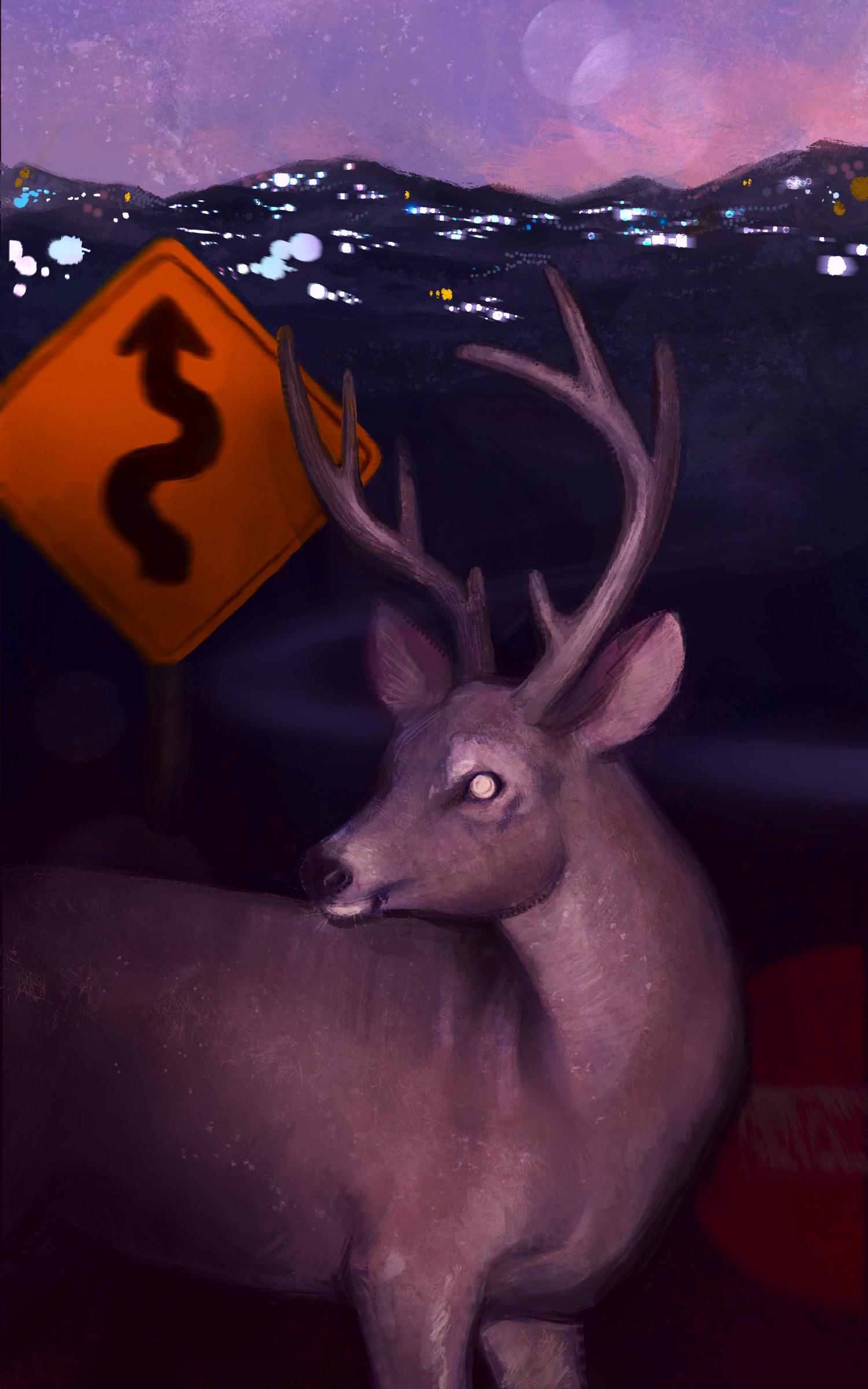
The Highway
Chloe E. Moore
Misconstrewn
Finn Ridley Traylor
When the southern wind blows across my mind, I can’t help but be Swept up, and, Sinking my lips, my tongue, And my fangs into the ground, Get carried into northern territory, Clawing and cursing the cold With my own dirt crumbling in my mouth. This wind which blows against me; (As all wind will–) A temptest, A must devil, Meant to pick me off, To bring my world a thousand feet beneath mine And deliver it to hell by comparison.
Having mistaken Auster for austere, I step outside to A gentle breeze Which only came To show me how her world moves.
The Death of the Sun
Madden G. Alpaugh
Minato squinted at the tiny black characters on the bright white paper. They swam around his vision, all blending into each other and looking like the same letter after a minute. Who could blame him-they all looked the same. And why was it written sideways? Focus,Minato. He stared at it long enough for his brain to recall the translations he’d been learning and then translated the first line. “To Mr. and Mrs. Sengi.” Great. They’d spelled his family name wrong. He continued translating, then reading. “It hasbecomeaconcernofminethatyourson,Hank,isnotdoingwell in school.” Acid burned in his stomach at that name. “He turns in all of his homework on time, and does well on tests, but he never respondstohisnameinclass,neveranswersquestions,andhasn’t made a single new friend this year. I’m concerned about his poor performanceinclassandunwillingnesstospeakwithothers.”There was more to read, probably more complaints, Minato guessed, but he put the paper down when he heard his brother stumble through the door. He turned the paper face-down; he didn’t need Niko worrying about this, too.
Minato’s eyes wandered over the walls, then to the door, then down to where his younger brother was standing a foot from the doorway, his frown a stark contrast to the bright California sun sending rays all around him through the stained glass door. Minato sighed. Back in Japan, Niko would’ve been the last person ever caught frowning. He was always a child full of energy, enthusiasm, and joy for every little flower and raindrop and bug and plant in the world. Taiyōnoko, the people in the neighborhood would call him. It meant child of the sun. But now he looked more like a raincloud. He slipped off his shoes wordlessly before walking to the table in the
middle of the dining room and sitting down, opening a large book in front of him with numbers and symbols on the front and back covers. As if learning another language wasn’t enough, they were making Niko learn algebra at nine.
Minato took a seat across from Niko, tried to read the numbers even though they were upside-down to him. Gosh, who did he think he was? He couldn’t help Niko figure any of that out even if he saw it right-side up. And judging by Niko’s fast, scribbling handwriting on the pages, he didn’t need any help. So then what was the problem? Minato had an idea, but he asked anyway. “How was school?”
Niko froze for a half-second before resuming his scribbling.
“It was fine.”
Minato reached into Niko’s backpack and pulled out a bag of those round cookies everyone seemed to be snacking on now. He offered them across the table to Niko.
“Did anything interesting happen?”
Niko stopped scribbling, but didn’t look up. His shoulders tensed the tiniest bit.
“The teachers want me to start using the name Nick in school. Said it would make everything easier.”
The burning feeling came back to Minato's stomach, this time worming up into his throat as well. Going through it himself was bad enough, but he'd thought his little brother would have it easier. Why couldn't he have it easier? And it was so clear, so obvious that it was gnawing at Niko, eating him alive, sucking out all of what made him Niko. And Minato couldn't let that happen. He already sensed it in how his father never came home before Niko's and his bedtime. How his mother's ankles would be covered in blisters from the high heels she wore every day at work. Niko was next. He couldn't be. He was so young.
Minato wanted to choke on his words and let them drown forever, but he couldn't just say nothing
“Do you like the name?”
Niko hesitated, then slowly shook his head.
“No, but I guess they're right. It would just be easier.”
“Easier for you or for them?”
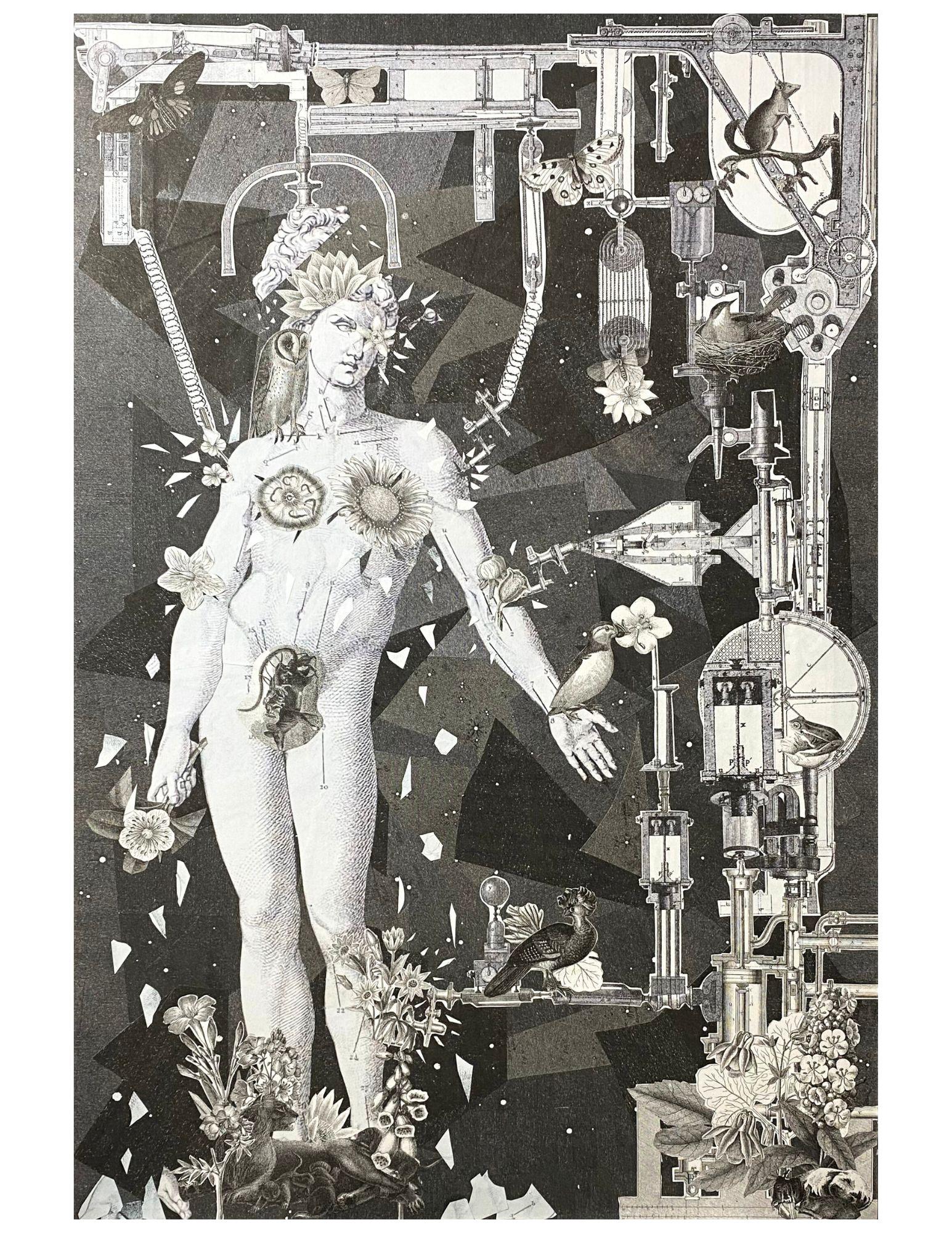
Man Made, Naturally
Max Smith
Aquaphor & Bactine
Elora Crisp
Momma! Gerry called from the kitchen, words passing through the screen door with ease. She stepped out onto the back porch, careful to keep the door from slamming behind her. All eyes at the bonfire turned to her, sparing small smiles and waves in her direction. She nodded politely, recognizing the same crew of relatives and locals that often kept their home busy.
“What?” her mother rasped, lazy and slurred from more than exhaustion.
“I still need that gas money when you get a sec’. Isaac has an appointment in the morning, and I don’t get paid ‘til Friday.”
Her mother shrugged, tossing her head back to take another hearty sip from a dented red can. She didn’t even like Budweiser, but Gerry doubted she’d been the one to pay for the box of red cans sitting at her feet. Knowing she’d already be in a mood from the poor replacement alcohol, Gerry kept a flat expression and tried to keep her tone in check when she replied.
“What does-” Gerry mimicked her mother’s shrug, “mean?”
“It means figure it out yourself, Gerry. It’s your fuckin’ car.” Venom dripped into her mother’s words, tasting like cheap beer and bile. Gerry bit her lip and spared a glance to the person sitting at the edge of the group closest to her. Her aunt, Mary, was perched over her own knees, sighing beneath her breath as she met Gerry’s eyes. Gerry might’ve heeded Mary’s warning expression on a better night, but her back still ached from her shift at the shop that evening, and her head hurt from the previous sleepless night. She considered letting it go but couldn’t stand to hear her brother complain for another month about his broken tooth if she had to reschedule.
“Yeah… Exactly why you owe me gas money.”
Gerry kept her tone tempered, edging on desperately calm.
“ I didn’t bring it home with an empty tank last night.”
Their cousin, Sam, had paused his storytelling at some point, and their neighbors, Red and Everett, both watched with hesitant glances between Gerry and her mom.
“Christ Almighty, can you get off my fuckin’ back? I know you’re not stupid enough to not keep cash around here somewhere.”
Gerry watched the snap of a scuffed lighter, her mother’s words interrupted by a cloud of cigarette smoke.
“I’ll pay you back.”
“No you won’t.”
She dug her nails into the tender skin of her palm.
“And I don’t keep cash in the house. You know that.”
Gerry figured she didn’t need to say her mother was the reason she didn’t keep physical money around. It wasn’t anything they didn’t all already know. But she just wanted to go to bed, not dig her grave any further.
“Then I don’t know what to tell you, kid.”
Her mother’s laugh was cold and thin, a second warning. She leaned down to grab the glass bottle of Jim Beam from between her and Mary, spinning the lid off with just her thumb. Another drink she’d usually detest, joining a mouthful of Budweiser. Gerry somehow kept herself from outwardly cringing.
She leveled a look at her mother once more, trying to decide if it was worth it. She had an exam in the morning, but if she got up early enough, she could siphon a gallon of gas from one of their neighbors' cars and replace it later. She could pick up a shift at the diner tomorrow and get some quick cash in tips, enough to fill up her tank at least. Not to mention, she needed to start hiding her keys better. This probably wouldn’t be happening if she’d just tucked her keys away in their proper hiding place last night instead of out in
the open.
So, she turned on her heels, deciding to finally take her sister’s advice to “be the bigger person.” Gerry personally considered that a load of shit, but she was tired. She’d figure it out, like she always did. She mumbled a curse beneath her breath in frustration but shook out her shoulders and headed back towards their trailer.
“What’d you say?”
The snap of her mother’s voice was like ice water, but it reacted to Gerry’s internal fire as if it were gasoline.
“Doesn’t matter,” Gerry spat back, reaching the first step of their porch around the same time that her mother’s grip found her wrist.
She hadn’t even heard her move over the sound of rushing water in her ears. But the shatter of breaking glass made its way through the haze.
“Don’t fuckin’ walk away while I’m t-”
Gerry barely turned in time to see the glass bottle hit the wooden railing of the porch as he mother stumbled across the first step. She tried to rip her wrist out of her mother’s grip before someone got hurt, swinging her mother’s body towards her at the force of her tugging. The glass bottle was moving before anyone could stop it. Gerry was only able to throw an arm up to cover her face and neck.
“Jackie!”
The last thing she’d heard was her aunt’s voice, furious and weighted, before successfully wrenching herself from her mother’s grip and storming inside. She was careful not to let the screen door slam. Isaac didn’t need to see her like this again. Blood followed her down the hall towards the bathroom, alongside the sound of a scuffle outside and the complaining yells of her mother.
She shouldered her way into the bathroom, holding a tight pressure to the wound. Her hands were shaking, and her breaths caught in her throat in unfamiliar spasms. Gerry blinked at herself
in the mirror a few times before clenching her eyes closed, suddenly nauseous. She quickly used her free hand to grab the door handle, picking up the weight of the door to minimize the squeal of the hinges as she closed it. She grabbed a stained rag from the counter, sinking to the floor as she swaddled her throbbing forearm. Pressing her back to the door, a draft licked at her legs from the gap beneath it.
She gave herself a moment to process everything, to let her overwhelming anger and unnamed emotions in her chest subside. Desperately, she tried to distance herself from the pain of the cut. Letting herself focus on the burn of her lungs, the heat dripping down her forearm, the whistling wind from the broken window across from her. Her head had already been tender and slowed from the exhaustion, but it pounded relentlessly now. Her forehead dropped to her knees for a moment, ignoring the blood that was now beginning to soak her thigh.
Gerry didn’t remember the last time she’d cried. It’d been years at least. She’d grown out of crying at a young age. It's an animal instinct to call attention to yourself when your needs aren’t being met, or danger is licking at your heels. But in their home, receiving attention was a gamble. It was either a spotlight, middle stage, with the eyes of the masses on you-or it was complete ignorance. Neglect or overage. Fire or ice.
But even as she felt her miasma of emotions gather in the dip of her sternum, she couldn’t do it. She couldn’t even force herself to cry if she wanted to. She probably needed to, at least that was what her sister always said, but she couldn’t do it. But it’d never done anything for her before, why would it help now? She wished Morgan was still around, just to ask advice from. She always knew how to handle their mom. But that was the big divide between them, wasn’t it? Gerry had been the one to stick around. Despite the fact that she and her mother were like oil and water, shestayed. She never thought she was stronger than her sister, but she was certainly
braver than her.
The thought raised her head from her knees, a reminder that she had a different situation to deal with. She could call Morgan if she wanted, except she didn’t actually want to. She would handle it herself, like she’d been doing for years now.
Gerry rummaged beneath the sink, pulling a red first aid kit from behind the twisted pipes. Medical supplies spilled out as she shuffled through the bag, eyes digging between unraveled gauze and opened blister packs. She used her uninjured arm to grab a small black case, snapping it open with one hand, freezing at the rusted sutures and missing needles inside.
Her expression twisted, shaky hands grabbing the kit and throwing it against the shower wall with a hollow thud. The sound played over and over inside her head. The pounding against her temple now had an audible sound to accompany it. Shortening breaths threatened her. Frustration and adrenaline crept up her spine in warning. She gripped her arm tightly against her chest, the span of her legs now sticky with blood dripping in stutters from the rag.
Another breath, deep and penetrating, allowing the dizzying static to fog her senses and soothe the raw fury ebbing at her chest. Hollers and hums of noise wafted past the decomposing curtains across the room. Obviously, her mother’s ring of ‘friends’ had passed over their little scene and returned to casual chatter. Hues of orange and yellow light illuminated one of the walls, and she took in the scent of woodsmoke and Marlboro Blacks when she inhaled. After a moment, she released her long-held breath. Her body washed with an oxygenated relief, almost like her own type of high.
“Gerry?”
Gentle words rolled beneath the gap of the door, causing her to flinch. She recognized her brother’s voice instantly, rasped and sleepy as it was. She used her good elbow to shove herself up off the floor, resting against the counter.
“C’mon,” she said, catching her breath from where she’d
been in the middle of a chaotic storm of thoughts and feelings only a few seconds ago.
The blood felt dry and sticky on her legs, having made its way through the flannel fabric of her pajama pants. But her arm wasn’t pouring blood, at least not as much as it had been before she’d clamped a rag over it. The door creaked as it opened, no longer needing to be quiet anyway with Isaac being awake. His phone’s flashlight illuminated the space, while a broken bulb hung above them uselessly.
“I brought Morgan’s medkit,” he offered softly, holding the orange bag up between them.
His eyes blinked slowly, and Gerry cracked a smile at the remaining youth in his features. His own smile was nebulous, unbrushed curls poking off the right side of his head, and bits of skin exposed through the thin fabric of her old bible camp t-shirt. She bumped his shoulder lightly as she moved around him and towards the bathtub, sitting on the lip of it.
He exchanged her rag for a dry one, and she winced as she pulled the fabric away from the sticky, drying wound. Isaac washed his hands and came to sit on the closed lid of the toilet across from her. Their knees bumped and the towel-bathmat ground against their feet as they settled into a position they were far too familiar with. Gerry smiled softly as Isaac pulled his overgrown hair back with a sparkly pink headband she recognized from deep in her memories.
“Did you finish your homework?” she asked, Isaac’s wincing expression catching her attention every few seconds as he prepped her.
She held her breath when he swiped at the wound with a wet wash rag, then slathered it in Bactine.
He nodded in response to her question, letting the orange antiseptic dry on her skin a bit. She inhaled when he nudged her, doing so each time he went to fiddle with the wound, giving her a
subtle warning to the stinging pain.
As he began dabbing generic-brand lidocaine cream on the edge of the wound, she wondered if that would affect the antiseptic. But she shook away the anxious thought. They’d done this song and dance before, after far worse nights and with far less resources, and they’d yet to get an infection. It was probably fine. Better than another round with CPS if they got reported trying to visit urgent care or the ER.
Don’t get her wrong, she wanted out as much as anyone would. But their short stints in foster care previously had proved that there were in fact worse places to be. Their mother might have been an alcoholic who refused to take her meds, but they knew how to handle her . They didn’t know how to handle group homes, or God forbid being split up again.
So this would be fine.
It was subpar, but at least they were together in a place they knew how to navigate.
“What are you studying?” she asked, needing something to think about, anything but self-taught first aid and their mother’s likely death by cirrhosis.
She watched his freckled nose scrunch as he dipped the hooked needle in antiseptic and met her eye before he moved. He pinched the skin of the cut together with his bare fingers from one side, brandishing the needle-bearing forceps with his others. Her teeth squeaked when she clenched her jaw, forced to drop her head down again and think of anything but the stabbing of an already irate wound.
“We’re reading Lord of the Flies.”
His words were barely audible over the rush in her ears and the hum of the wind behind her.
Gerry grinned lightly at her knees, remembering her aunt reading that same book to her when she was in high school. Curled side-by-side on her bed as she spoke slow, careful words and leaving
a vanilla-citrus scent on her sheets when she left. Gerry had never been a big reader, but Isaac was.
“What’s it about?” she asked, gripping her fist around the fabric of his pant leg, rather than her own blood-soaked one.
He passed the needle through the wound with little resistance, tugging the thread through before using the forceps to make a triple knot close to the skin. She silenced a wounded cry by digging her teeth into her sore and marred lower lip, a metallic taste spreading immediately.
He only started speaking after the first stitch was finished, giving her a synopsis of the first few chapters of the book. His shoulders slowly dropped from their position near his ears as he kept talking, his voice beginning to crack more as he spoke more consistent words with a steadier tone. Gerry didn’t snort like she usually would at his developing voice, just keeping her head low. Eyes trained on the unnoticed drops of blood running over the tops of their feet, attempting to restrain herself from biting straight through the tender skin of her mouth.
“Why are you still up?” she finally asked, once he’d tied off the last stitch and set aside the suturing tools.
He scoffed under his breath, zipping up the small bag. “Why are you still up?” he sang, cutting his eyes at her as he stood to wash his hands again. “If I remember correctly, someone promised to be in bed by midnight…” he taunted, clicking his tongue and shaking his head. He furrowed his brow in faux disappointment.
“You shouldn’t be waiting up on me,” she chastised, leaving the mess of contaminated medical supplies in the tub basin as she stood to follow him.
“Then you shouldn’t be out there antagonizing her,” he snipped, echoing words that weren’t his own.
He grabbed her wrist once his hands were washed to rinse the sutured wound one last time and wrap it. Gerry didn’t respond. Their footsteps were silent, navigating the house in pitch
black. They dodged boxes and over-packed shelves of unfinished craft projects, careful of broken objects crowding the hall. They stopped at Isaac’s door.
He glanced back at her expectantly, and she rolled her eyes.
“I’ll be right back. I gotta grab my stuff from the kitchen,” he huffed, pointing two fingers to his own eyes and back to hers with a glare, leaving his door open as he shuffled towards his bed.
She didn’t turn any lights on as she padded across the trailer, socks grabbing on unfinished floorboards. A burning sensation vined around her jaw, the stiff tension held in her neck and shoulders returning. She couldn’t seem to shake off his words, sounding like a perfect echo of their older sister.
She didn’t antagonize their mother.
Morgan had never challenged their raising, never tried to hold their mother accountable. She found it easier to just fly under the radar and pick up after her, counting her days until she could run away and leave them to deal with her alone. Gerry didn’t do that.
Their mother was entirely capable of taking care of them; she had all the resources at her disposal to get help. She’d even been sober before, lasting a whole twenty-three months, almost making it to Gerry’s fifteenth birthday.
When she wasn’t making a cocktail out of her mood stabilizers and Jim Beam, she had shown the ability to be a functioning adult. Gerry would even go so far as to call her an acceptable parent when she was sober. Not good, just to be clear, but acceptable enough to show up to Isaac’s parent-teacher meetings and contribute to the bills. She wasn’t helpless.
It wasn’t like Gerry was trying to cause problems either. Against her better judgment, she loved her mom. She didn’t particularly like her, but beggars can’t be choosers.
She wanted the best for her mom, but she wasn’t going to sit back and pretend like she was doing her best. Because shewasn’t
She turned the corner silently, stepping into the kitchen. The noise outside became clearer when she entered the room, the screen door being the only barrier between her and the crowd outside. The scratch and pop of the radio hummed in the background, overshadowed by their tone-deaf cover of some Ted Nugent song Gerry could probably recite by heart, but couldn’t recall the name of. They circled around the bonfire like a pack of hyenas, crooning and cackling in the background.
Her phone rested on the counter across the room, screen lighting up the ceiling with a notification. She crept forwards cautiously, like a gazelle concealed in high grass.
“-lazy.Idon’tlikethem‘holierthanthou’types.”
“Probably‘causeitdoesn’ttakemuchtobeholierthanyou, huh,Red?”
“Don’trilehimup,man.”
Her aunt Mary’s voice drifted softly over the rest. Gerry could see her through the screen, sat next to her mom by the fire, the only person without a red solo cup in hand.
Her mom was curled over her own knees, forehead pressed against her legs, and Mary’s hand curled around her back in a loose grip. They weren’t speaking, though Mary kept light conversation with Sam and Red. Looking at her back, Gerry could see Mary’s shirt stretched over her back like cling wrap, but she stayed by her sister’s side, occasionally offering a limp pat to her shoulder.
Gerry glanced away from the scene quickly, uninterested in sacrificing any more of her attention for the evening to her mother. The flash of broken glass and crimson caught her eye as she turned away, the scene remaining untouched at her mother’s feet.
Of course, it truly was an accident. It always was. She’d probably get an unclear text later into the night, with a half-baked apology and one too many ‘xo’s tacked on the end. But the pressure that held her aunt’s shoulders taut was the same weight that forced Gerry to look away, the same weight that felt suffocating and cruel,
the same weight that her old sister didn’t care to shoulder, and her younger brother didn’t yet understand.
Gerry collected her textbook and binder, dumping the rest of the Dollar Store writing tools and cheap flash cards into the cupped hem of her shirt. When she picked up her phone, two twenty-dollar bills slid across her fingertips from underneath the case. She stared down at the money, not needing to wonder where it came from. The scent of vanilla and citrus still lingered in the kitchen.
The weight pushing down her shoulders remained heavy as she returned to her brother’s room. It didn’t move when she curled onto the floor by his bed, laid out on a makeshift pallet of blankets, squeezing his hand with mumbled ‘goodnights’ spoken into the darkness. It didn’t lighten the next morning when she woke up to three texts, one from her mom, her aunt, and her sister. It didn’t relent when she changed her gauze in the morning, hissing at the trickling pain, and applying ChapStick to her injured bottom lip. It didn’t shift when they left early the next morning, shielding Isaac from seeing her mother passed out half in the floor of her room. And it didn’t relent when Mary kissed their foreheads on their way out the door, mumbling an unnecessary apology into Gerry’s temple. It was a suffocating weight that smelled like Bactine, tasted like Aquaphor, and sounded like her mother’s laugh from back when Gerry was still fourteen.
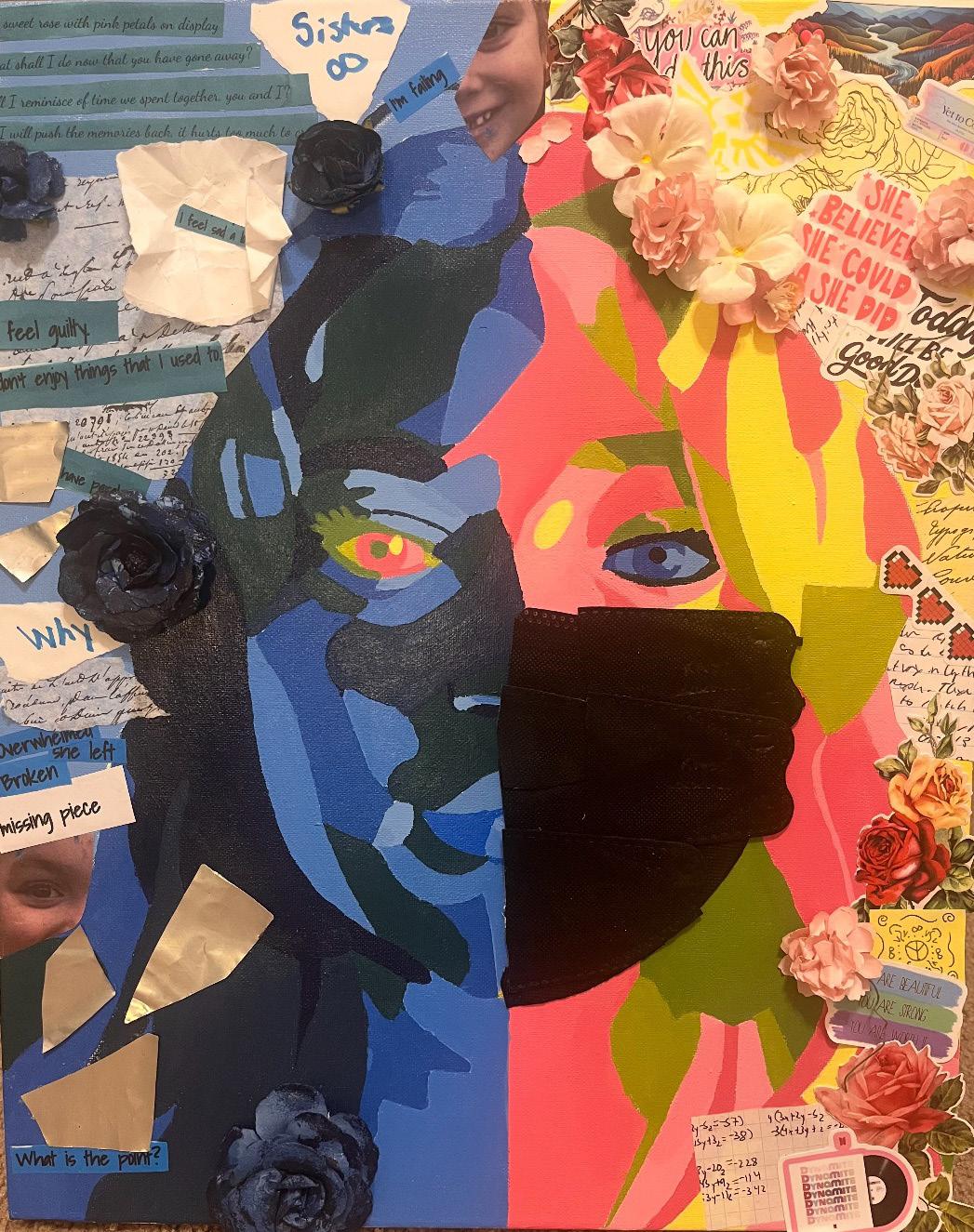
Self-Portrait: Duality
Sierra Faith Alvarez
Pizza Night
Clay Noel Jones
CHARACTERS
SALLY, late 20s or early 30s. Masculine-presenting woman and romantic partner to JADE.
JADE, late 20s or early 30s. Free spirit and romantic partner to SALLY.
WAITER.
OPTIONAL: RESTAURANT EXTRAS, unvoiced.
SETTING
Hryhorij’s Ukraini Pizza, a local Ukrainian Pizzaria. Later, after the light-change, Pilot Light Diner.
PROPS
Onstage, there is a table with at least two chairs for JADE and SALLY.
OPTIONAL: Other tables and chairs set up around the stage, creating spaces for the RESTAURANT EXTRAS to congregate around. A projector displays images of the menu from Hryhorij’s Ukrainian Pizza, and later, Pilot Light Diner, onto the back curtain or a screen. Details of these projections are depicted in the stage directions. An early image displays common pizzas and all text is in English. As the play goes on, the pictures of pizza and other food become more exotic and unfamiliar. Eventually, all visible text should be translated into Ukrainian. After the light-change, the projector should display an image from Pilot Light Diner’s menu. This diner’s menu is old-fashioned and simplistic, written entirely in English, containing no pictures of the food or colors at all, and limited descriptions of the items.
TIME Early evening.
Lightsriseonthetable.Thesoftbuzzofacrowdcomesfromthe stage,accompaniedbyUkrainianpopmusic.SALLYsitsacross fromanemptychair.Shestaresdown,unseeing,atthetable, withherarmscrossed,withdrawn.SALLYisanautomechanic, andwearsstainedworkwearcoveralls.ShehascometoHryhorij’s UkrainianPizzarightafterwork.JADEfloatsintothepizzeria.She wearsbig,earthyjewelryandsomekindofcardigan,sweater-poncho,orsomeothermulticolored,wide-sleevedtop,whichresembles wings.
JADE: Sally! Sweetie!
(JADEswoopsovertoSALLY,hugsSALLY’sheadtoherchest,and kissesherseveraltimes.Afteramoment,SALLYpullsaway.)
SALLY: Hey, baby.
JADE: You smell.
SALLY: (Laughs.) Like the love of your life, right?
JADE: (Sarcastically.) Ha. More like a trash fire at a bad bus terminal.
SALLY: Just got off work. I’ve been eyeball-deep in broken engines all day. Turn your cute, discerning nose to the kitchen. (Pause.) Baby, I love you, but this place is weird.
JADE: It’s not weird.
SALLY: Ukrainian pizza? You don’t think it’s just a little weird?
JADE: It’s inventive. It’s creative. (Smilesmischievously.) It’s a little queer, don’t you think?
SALLY: (Noncommittalgrunt.) Hmm. I don’t see how this creative pizza is a part of our community.
JADE: No, no, not like that. It’s a deviation from the norm! This place is fresh and bold, sweetie.
SALLY: That’s one way to look at it. This sausage pizza looks pretty good.
(Theprojectordisplaysanimageofabasicpizzawithroundslices ofsausage,withanEnglishtextdescriptionortitle.Akid’smenuis alsoseenonthisslide,withsimple,comfortingfarelikefrenchfries andchickennuggets.)
JADE: You get sausage everywhere we go.
SALLY: Sausage is always good. Breakfast, dinner, snacking, at work, at the park, wherever. Haven’t seen a single foreign culture ever fuck it up.
JADE: (Exasperated.) Sally!
SALLY: I still think about the sausage and gravy biscuits they had at the Pilot Light Diner back home.
JADE: Home? Sally, we haven’t lived in Franklinburg in years. We don’t even go for Christmas anymore. God, that place was a grease trap.
SALLY: The town or the diner?
JADE: Both.
SALLY: (Wistful.) I liked Pilot Light. I still miss it sometimes.
JADE: I’d be happy to never step foot in Pilot Light again. (Irritated,wantingtomovetheconversationalong.) When Katie and I came here, we split the borscht pizza and got some cheesy varenyky.
SALLY: Borscht…pizza? Like with dill and…?
JADE: (Points to the menu on the table.) See, it’s right here.
(Sallylooksdownatthemenuonthetable.Theimageonthe projectorswitchestoapictureoftheborschtpizza;redbeetsona whitepiewithfreshdillandslicedmeat.ThereisamixofEnglish
andUkrainiantextframingthepicture.)
SALLY: (Horrified,halftoherself.) There’s beetroots on that poor pizza. (Looksbackup.) Jade, baby, I don’t know about all this.
(TheWAITERbeginstoapproachtheirtable.)
JADE: I know you will be very brave, Sally. You always are.
WAITER: How are y’all this evening? Any questions about the menu?
SALLY: You could say that, yeah.
WAITER: We have a special right now on our holubtsi pizza.
SALLY: Holu…huh? Why wouldn’t we want to order a whole pizza?
WAITER: It’s a rich, delicious pie with tender cabbage, spicy sausage, a signature dill-tomato sauce, and a rustic rye crust!
(Theprojectorswitchestoanimagedisplayingtheholubtsipizzaas described.ThereislessEnglishandmoreUkrainiantextthistime.)
JADE: Sounds so interesting! I think we’ll take a large, to split. And an order of the cheesy varenyky, please.
WAITER: (Looks between the two.) Of course! Anything else for you folks?
SALLY: Um, well, could you make one half of that pizza just meat?
(Silenceforabeat.JADElookspointedlyatSALLY.WAITERfollows hergaze.)
SALLY: Or, erm, extra sausage. That’s what I meant to say. Extra meat, please. On the cabbage pizza. Thank you.
WAITER: You won’t regret it. Shouldn’t be too long, ladies.
JADE: You know, Mark is actually a huge fan of cabbage. It’s very silly. He’s always talking about how cheap and nutritious it is. An
undersungpowerhouse, he calls it.
SALLY: What?
JADE: It’s versatile, too. A very flexible vegetable.
SALLY: Who in the world is a bigfanofcabbage, Jade?
JADE: Well, Mark. Your metamour. I’ve talked about him before.
SALLY: Meta…?
JADE: Metamour. You know what that is, Sally.
Sally: I don’t think I do.
JADE: Your partner’s partner.
(Silence.Theprojectorswitchestoanewimage,composedentirely ofpicturesandUkrainiantext.Picturesdisplayanotherrye-based pizzatoppedwithsauerkraut,mushrooms,andslicedpotatoes. Thereisanotherpictureonthisslideofmeataspic,ormeatinjelly. Atthebottomrightcorneroftheprojection,anadurgesrestaurant patronstodonatetoaUkrainianwarrelieffund.Inthissection,a basicvectorgraphicofadovefloatsaboveajarfullofloosechange and cash.)
JADE: Sweetie, haven’t you read that book I gave you? It’s been months. You said you would.
SALLY: I…started it. It’s on my nightstand.
JADE: I know where it is, Sally. Under three old glasses of water and an empty bag of Funyuns. Have you been going on any other dates? Trying to talk to anyone?
SALLY: (Leansbackinherchair,crossingherarms.) I don’t know, It’s been busy at the shop. Haven’t really had the chance.
JADE: Sally, you said you wanted to try this, too.
SALLY: I said I was open to it.
JADE: You agreed to it.
SALLY: I did, didn’t I?
JADE: It’s going to be so good for your soul to meet more people, I know it will. This city is such an interesting place, and we’ve hardly
seen any of it. When we were in Franklinburg, we just had each other, but now we have the whole world. I want the world for you, baby. I want you to have more girlfriends. I want to meet them and learn about them.
SALLY: (Sadly.) I know you do.
(A beat of silence.)
JADE: Sally, do you really want this?
SALLY: I…love you, Jade. I really do. I want this to work for us.
(Theprojectorzoomsinonthedovefromthecharityad.Theimage islowfidelityandnotmeanttobeblownuplikethis-audience members should see blurred and artifacted lines.)
SALLY: I keep thinking about that wedding we went to back in the spring. It was a great time. We had so much fun looking after Melissa’s kids, didn’t we?
JADE: (Uncomfortable.) Huh? Babysitting can be fun sometimes, but…
SALLY: Have you thought about it anymore? IVF? A couple of kids would be great for us.
JADE: (Beginstodigthroughherpurseorpocketsforaphone.)
Wait, what time is it?
SALLY: We have the income now, the stability. You know I have great insurance at the shop.
JADE: Damn, how is it almost nine already?
SALLY: Jade?
JADE: I’ve gotta run. Katie and I are going to get drinks tonight.
SALLY: Wait, that’s your other meta-more, right? But it’s pizza night! Friday is always our night! It’s pizza night, and then we watch movies. Ever since we first met in Franklinburg!
JADE: (Getsup.) I’m sorry, sweetie. Let’s catch some movies tomor-
row.
SALLY: We haven’t even gotten our pizza yet! I thought we could watch-
JADE: (KissesSALLY,beginstoexit.) Bye, Sally. I’ll see you later. Don’t wait up for me.
SALLY: Wait, Jade, come back! Just for a second! I’ll read the book! It’s cool! We can- (JADEdoesnotstop.SALLYgivesupasJADE exitsthestageanddisappearsbehindthecurtain.)
(SALLYholdsherheadinherhands,lookingsmallandsad.Asshe waits,thelightchangesfromwarmwhite-yellowtoacooler,darker blue.Theaudioshifts-thenoiseofthecrowdfallsawayentirely andtheuptempo,Ukrainianpopshiftstoasimple,bittersweetmusic-boxmelody.Theprojectorswitchestoanewslide,whichsays:
“Yearsago, Inafarawayplace.”
JADEreenterswithherheadbowed.Shewalksheavilyintothis new-oldspace,almostdraggingherfeet.Shewearsakitschy,pale, washed-outwaitressuniformwithasmallapronandpuffysleeves. Therearevisiblespotsofmustard,ketchup,andcoffeeonher clothesandarms.ShesitsdownacrossfromSALLYtiredly.She leansback,looksupward,butcovershereyeswithherhand.Asshe settles,theimageontheprojectorchangesagain.Thistime,itdisplaysapageofPilotLightDiner’smenu,labeledassuch.Themenu isentirelyinEnglish,lackspictures,andlacksallcolorsexceptfor blacktextonawhitebackground.Therestaurantoffersnothing beyondstandardAmericandinerfood.Afterabeatofstillness, SallybeginstorubherfaceandfinallynoticesyoungJADEsitting before her.)
SALLY: Oh! J-Jade! I didn’t see you!
(JADEtakesamomenttowipethesweatoffofherbrowand stretchbeforelookingbackatSALLY.)
JADE: (Smiling.) I know. I’m here now, Sally. Lord, what a horrible shift.
SALLY: Well, it’s over now. (Grins.) And we’ve got the whole night to ourselves, just the two of us.
(JADEgrabsSALLY’shands,pullsthemtowardsher,andrestsher head on them.)
JADE: Good. (PullsherfaceawaybutcontinuestoholdSally’s hands.) Baby, do we really have to eat here? I work here. I’ve had everything we can serve and I hate it all.
SALLY: Well, I’m sorry Jade, we could go somewhere else but I've already ordered. (Disappointed.) I didn’t know you were already so tired of this place.
(JADEletsgoofSally’shands,pullsaway,andlooksattheceiling again–thistimewithopeneyes.)
JADE: No, it’s ok. Same-old, same-old is just fine for one more night.
Do You Know Now?
Jaye A. Polgar
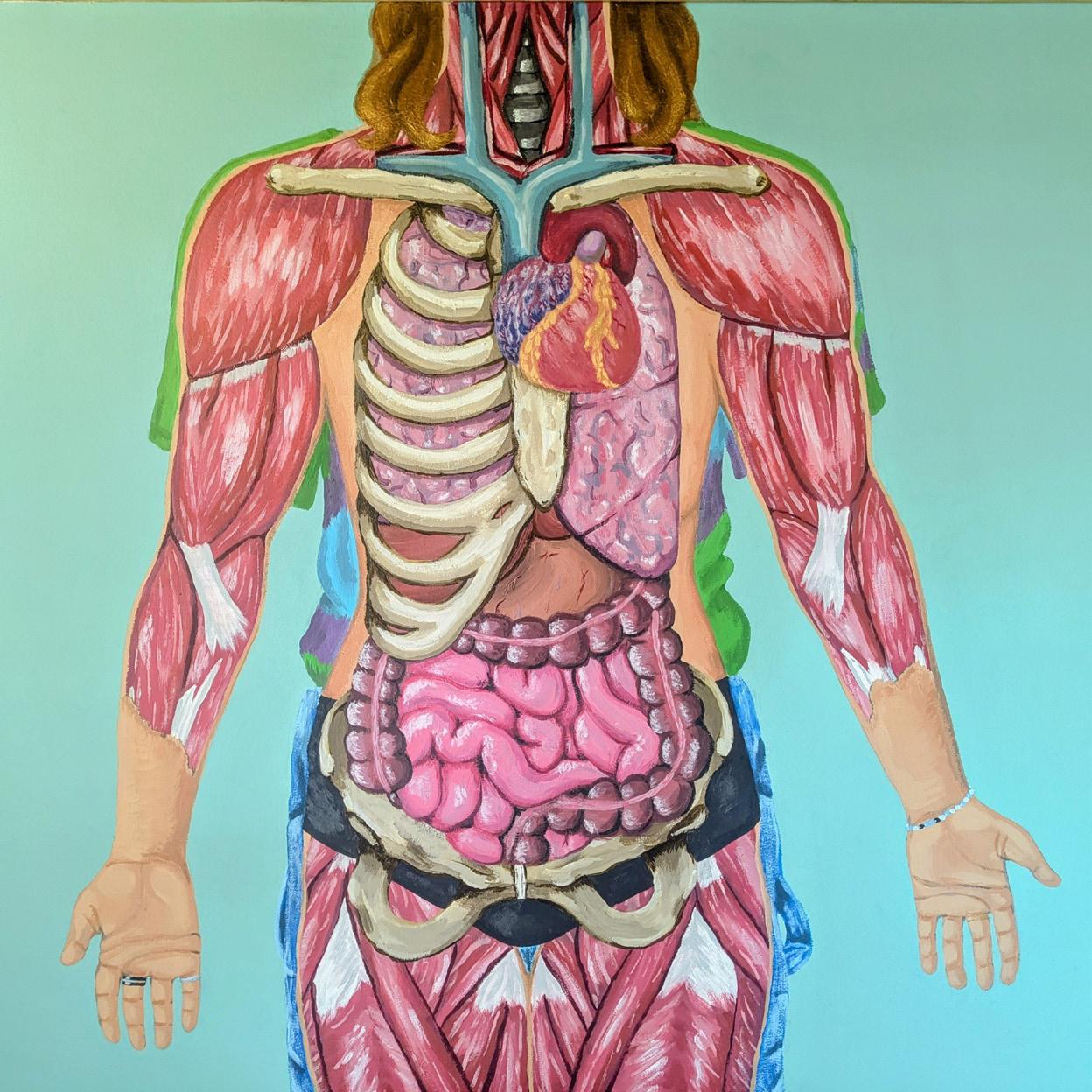
Remembering and Forgetting
Shana Zimnoch
Memories are stirred as of late, and I keep trying to forget through mindlessly streaming shows, spending time with friends, and sleeping. Sleeping and begging the night's rest to not let me remember my dreams.
There are images of a mother and two teenage females posing in front of a story-high of sandy-soaked furniture and debris carried by the rushing waters...the greatest trash of America posing in the forefront of people's heartache.
Wolf spiders accompany me on the floor, atop the convenient Ikea fold-out cushion and sleeping bag. To my side, trash bags of my clothes, organized by drawer. And after a long day's work, there's the crazy, out-of-touch aunt starved to talk at someone... anyone. And who better than the one without a door, a room, or any real physically defined boundary.
Thoughts of standing in the cold dampened hollowed house, formerly named home, and seeing the green blades of grass from a slight fracture in the concrete foundation. It was grey and dark and cold and empty.
Remembering can be painful, and forgetting can be painstakingly hard. So, I ignore for the moment. Even when moments become years. And when a hurricane finds the mountains and demolishes towns and lives, memories start catching my periphery, much like a wolf spider. And when I start to explore old haunts, the nervous system manages the rush of emotion, ache, anger, and hollowness. It all gets muddy and muddled and lost. Like drowning, it fades to darkness.
Helene
Sierra Faith Alvarez
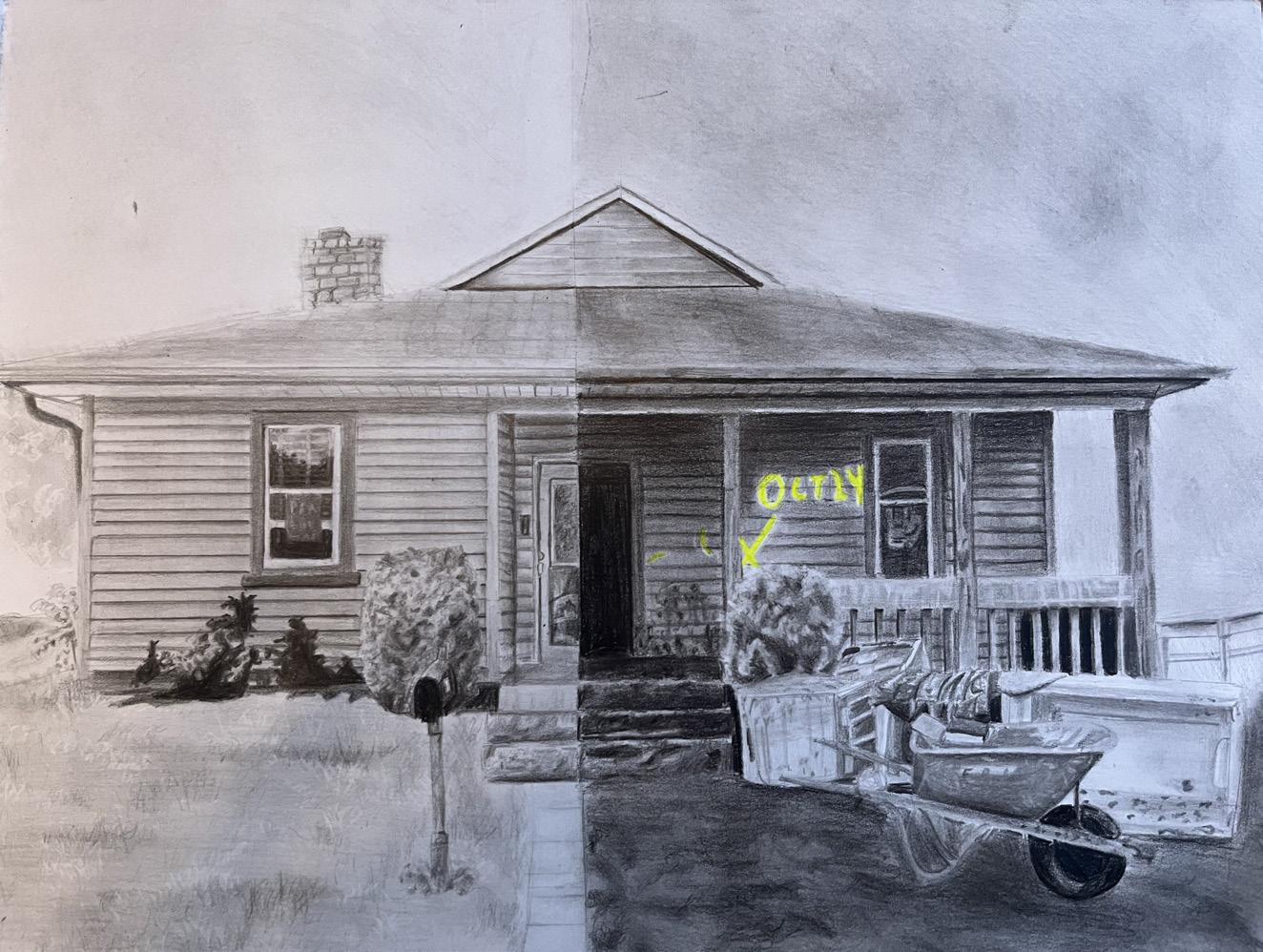
Breakfast up the Mountain
He cuts me to the quick up near the peak of The Granite Mountain.
Jeff Horner
He’s sufferedenoughfools, he says, tofillthegravesinArlington
He jokes that I might like a nap in the fresh dirt beside his sunchokes.
His broad back ignores me now, so I wander down to stare at the stream. Maybe it will listen to my well-polished anecdote about being foolish until I wasn’t.
Up the ridge, I couldn’t hear how it gurgles and babbles to feed the process of smoothing away the hard edges of the granite boulder that rolled down The Granite Mountain. Its soft, incessant will has worn a hole through the rock side facing me,
and a rivulet lays claim to the new void.
To think that this, too, this mass beyond my mass, can be unmade, can be carried off in bits like so much hard-earned wisdom, and the wound from being cut gathers its own kind of sediment.
Maybeyouwilllisten, I say to the stream, to the rock, to the hole in its side, to his broad back up the rise, and it gurgles and babbles back, the dang aggregate of it all.
But the hole is getting larger, sure, only he can’t hear it, and I can’t see it, as much as I squint, the actual unmaking at its most granular level.
He uses that word a lot to explain what I am missing. If I could only show this to him, at least, in the way I see it.
But I can’t because I don’t.
I can only see the stream in front of me. I can only feel the mid-morning sun
warm the back of my stiff neck, and I figure I’m starving.
I bet he would make me eggs if I asked quiet enough.
How to Be Grateful
R.S.
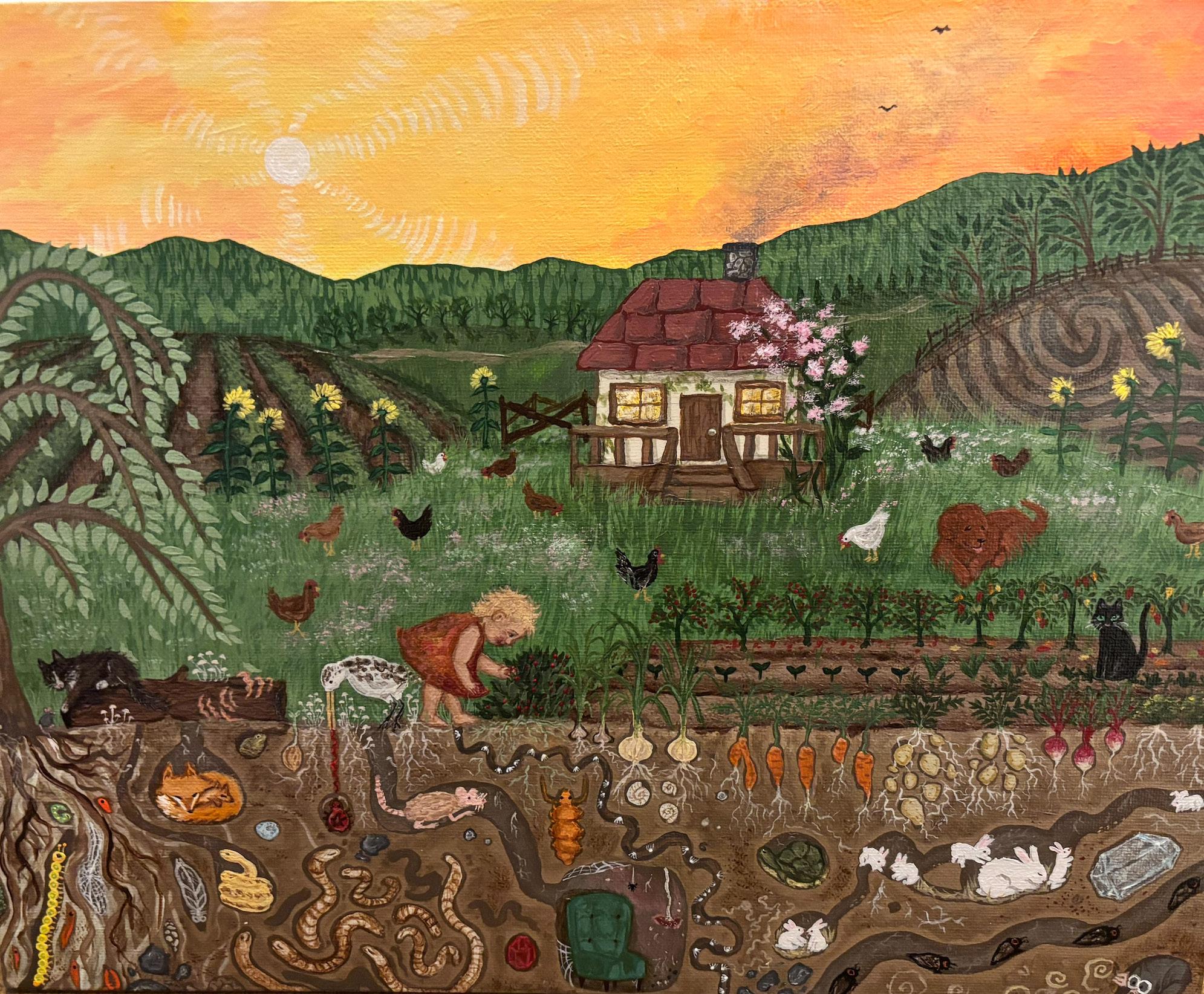
The Tavern
Laura Elizabeth Mayfield
Themagnetic train whizzed by, spraying hissing water droplets into the air and sending them crashing fifty feet to the pavement below. It was one of those misty evenings where up was down and left was right—you could have been at the bottom of the world, and you wouldn’t know it. Usually, the shimmering city sent shivers of disgust down Esther’s spine, but tonight the storm had washed away the sparkle and had left the buildings a dull gray. Normal. Equal.
Esther adjusted her cowl and stood up, masked in shadows. She grabbed the ledge above her head and heaved herself up onto the higher rooftop. She slipped her tetra out of its holder and spun it once, gripping the handle so it would extend. She dashed across the rooftop and pushed off with the tetra, landing on the roof of a small building in the middle of the street. The rest of her journey was only a matter of grasping onto available metal poles and swinging herself to the other side.
No matter where she was, in any district, there was always something to climb onto. Wires and tubes and stairs crisscrossed over the streets, taking up almost every inch of space. The builders of the city must have wanted to block out the sky, even though everything living was desperate for a glimpse of it.
Esther slid down a ladder and landed in a small alleyway. Empty. After slipping around the side of the building, she peered into the windows. A faint yellow glow filtered out onto the street, but the glass itself was too dirty to see inside. Not a good sign.
She shouldn’t be surprised at the dirty glass, though. She was in a rougher portion of the elite district, if one could believe such a thing. Every district had its flaws; some were just harder to
see. But the clues had led her here, and she couldn’t give up now. She had promised Azir that she would come back with the moonstone.
The customers looked up when she entered. The barkeeper’s hand froze around a glass for a split second before she continued polishing. The conversations in the room quickly turned into frantic, hushed whispers. Runa didn’t roam here often. Esther guessed that at least half of the customers were petty criminals; she would have to alert Azir and get a team sent here tomorrow. Now, though, if she didn’t act quickly, the tavern would be cleared out in a heartbeat. It had taken her forever to track this place down. She wasn’t about to lose it.
Esther started as her gaze landed on a cloaked figure in the corner. He was sitting by the fire, his hands wrapped around a mug of something warm. His cowl was down, but his shaggy blond bangs hid his eyes. It was almost the middle of the night, and unless there was another moonstone here that Esther wasn’t aware of, no other Runa should have been here. She had clearly marked this moonstone’s riddle with her personal sign, something every Runa in the district would have recognized. Was he here to challenge her? Or was he just ignorant?
The latter was ridiculous. The former was... troubling. Esther stepped to the side and slid into a seat at the Runa’s table. The other customers would think that the two knew each other, which was false, but at least her seating choice wouldn’t raise suspicion.
The man raised his head and flinched. Apparently, he hadn’t heard her sit down.
What is your purpose here? Esther signed to him. Every Runa was trained in sign language—the art of speaking without speaking. It had saved her on countless missions. Honestly, sometimes she preferred it over actually talking.
The man gave her a blank look. Esther signed her question again. Maybe he wasn’t very good at the language.
The man smiled and nodded. Now it was Esther’s turn to give him a blank look. What...
The door burst open. A woman of about twenty sauntered in, two cronies at her back. Her hair was dyed a blinding purple and tied up into two messy pigtails.
“Three of your best drinks, Baziir,” she called to the bartender. “It’s a win for us all, today. Look what I found out back.”
She flipped a large rock into the air, catching it with both hands. The light from the fire glinted off the silver stone.
Esther’s eyes narrowed.
Whispers filled the restaurant. A few of the customers shook their heads at the thief, gesturing to where Esther and the blond-haired boy sat. Esther stood up.
“That moonstone is property of Queen Justine, ruler of Goelinde. Hand it over peacefully and you will not face the court of law.” Esther extended her hand.
The thief smirked. “Runa, are ya? Y’all don’t come to these parts.”
She flipped the moonstone again, then tucked it in her bag. “Come and get it, sweetie.”
She beckoned Esther over, crouching and pulling out a spear. Esther frowned. It had been worth a shot. She glanced at the other customers and at the barkeeper, who was frantically glancing at the back door.
“Care to take this outside?” Esther said.
The thief snorted. She lunged.
With a twist and a squeeze, Esther’s tetra was extended, and she lunged forward to catch the thief’s blade. Duck. Spin. Slash–counter. The woman was fast. They spun around the tables and customers leaped out of the way. Esther got close and almost hit the woman, but the thief jumped back. Deliberately, she dropped her spear. Esther stared. The thief smirked and pulled out a sword.
Esther stared at the wickedly sharp edge. Those were ille -
gal. With a gleam in her eye, the thief stepped to the side and thrust, which Esther easily deflected.
“Get ‘er, Poppy!” a bystander shouted.
Esther stepped back and to the side, whacking the end of her staff into Poppy’s wrist. The thief shook out her wrist for a brief second, her eyes narrowing. Their weapons clashed. Esther wouldn’t be able to hold out for long, but she was expecting backup soon. At any second the other Runa would leap up and join her.
Esther risked a glance to her right, where the man was clutching his staff, his gaze darting back and forth frantically. After a moment, he jumped in and thrust his staff. Poppy immediately knocked it out of the way. Gizmos and gadgets. A newbie. Even so, he probably knew basic two-person fighting techniques. Esther adopted the traditional stance, expecting the other Runa to lunge forward and fill in the gap so Esther could thrust from behind. The man froze. The thief thrust her sword toward him, and Esther had to block the movement, which ruined her tactic. The staff slammed into the man, who went toppling to the floor.
What was with this guy?
Sweat dripped off of Poppy’s face as she growled, lunging for Esther again. Esther dived onto the floor, her back sliding against the wood as she knocked Poppy’s staff out of her hands, sending it scattering across the room and landing near the fireplace. With a lunge and a twist, Esther catapulted to her feet and wrestled Poppy’s hands behind her back.
“You little—”
One hand on her tetra, Esther pushed the button near the handle and sprayed a loop of mervium against the far wall. With a snap, the red moonstone powder locked the portal into place, and blue lightning shivered in an oval on the wall. Esther shoved Poppy through the portal, knowing that the soldiers on the other side would take care of the criminal.
Esther whipped around to where the man laid on his back
beside the upturned table, his chest rising and falling rapidly as he tried to suck in air.
“That,” he gasped, “was the craziest thing I’ve ever done.” He cracked a grin, sweat dripping from his hair into his eyes. “We should do that again.”
Esther jammed the button that magnetically pulled the mervium dust back into her staff, then smashed the other button that released the different dust, creating a portal back to the Runa’s central location in the elite district. After the blue lighting shimmered on the wall behind her, she snapped her tetra back into place and turned to face the man. A muscle ticked in her jaw.
“Get up.”
Groaning, the man got to his feet. He brushed his hair out of his face and eyed the portal.
“We going somewhere?”
“What does it look like?” Esther raised an eyebrow.
“Now see, I appreciate you saving my life and all, but I dunno if I want to go through that,” the man laughed. “You sending the criminal there, and all.”
Esther frowned. Something about his accent set her on edge. It was almost like he was trying too hard.
“Different place,” Esther said.
He should have known that. Didn’t he see her respray the portal? Esther looked him up and down. His cloak seemed to be a genuine Runa cloak, but his staff . . . were those buttons real? He didn’t know sign language. He didn’t know how to fight. He didn’t know how tetras worked. Not to mention the fact that Esther had never seen him before in her life.
He’snotRuna. The realization struck her like a bolt of lightning. Then where did he get the cloak? Esther’s mind jumped into hyper-speed. If she accused him of his crime now, he would likely make a run for it, but if she could convince him to go through the portal, she could confront him in the safety of headquarters.
Esther pointed at the portal, fixing the fraud with her nastiest glare.
“Inside. Now.”
“All right, all right.” The man held up his arms. “I’m going.”
He saluted her mockingly and then stepped in the portal backwards.
Foolish. Esther scanned the restaurant. Most of the customers had fled, the ones who remained were huddled in the corners or behind the counter. Two lamps were broken and a table was knocked over. Esther’s hand itched to reach into her pocket and drop a silver round. These people are criminals, she reminded herself. Save the money for the people who deserve it. Despite her better judgement, she flicked the silver round out of her purse and dropped it on the floor.
“For the damages.”
Maybe the store could get fixed up. After Azir raided the place, maybe it could become an honest restaurant. It was possible. Or maybe she was an optimist. Giving the dimly-lit room one last glance, she stepped into the portal and let the blue light wash over her.
Fuerza
Dana Marie Phillips
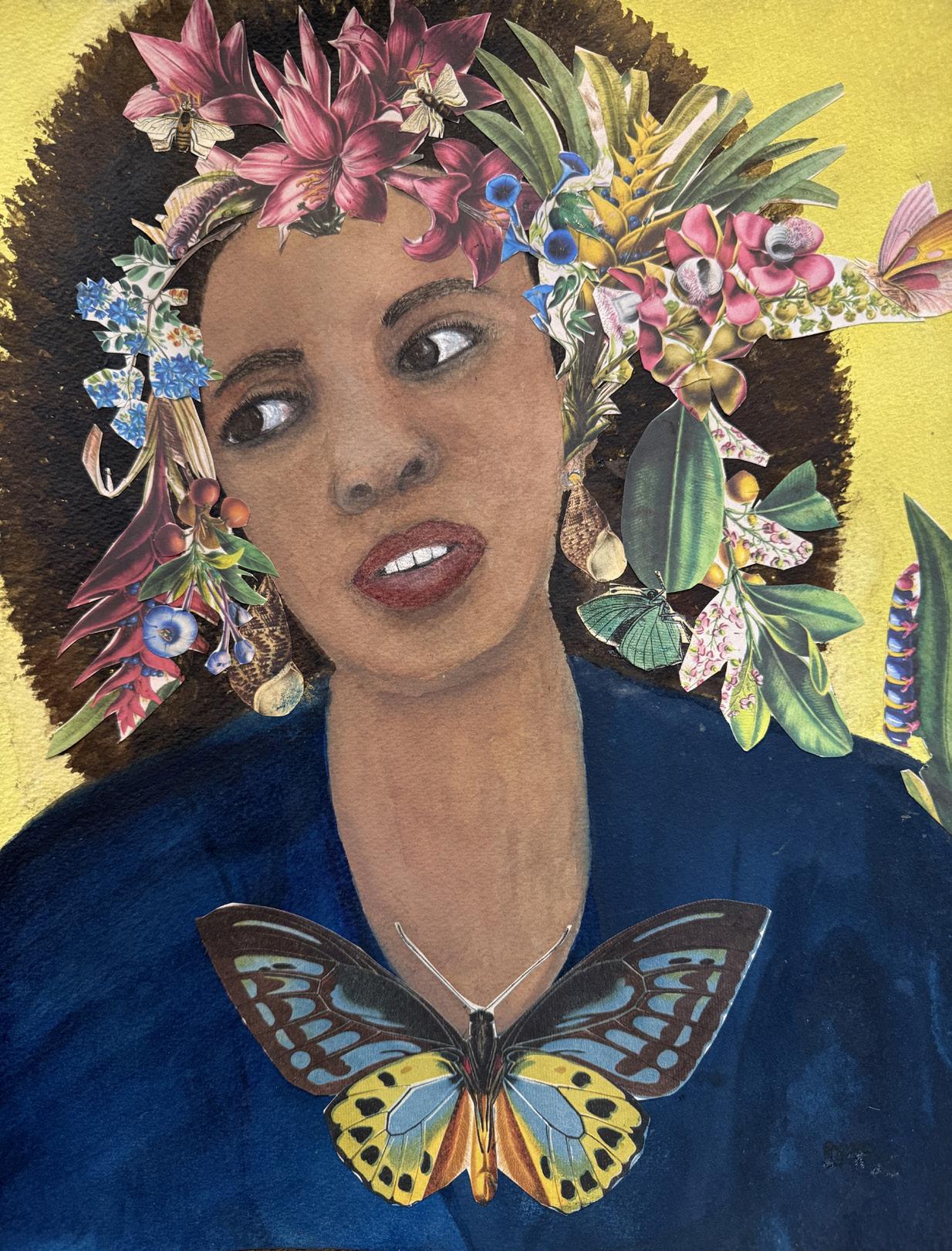
No Paperwork for This
Ashlee Lutz
They give you one day. It is said like a kindness, like something generous. One day of bereavement. One day to handle personal matters. One day before you are expected to return shaped properly again. I accept it without argument. Compliance reads as stability.
The overdose happens the first time I touch a drug in years. There is no gradual unraveling, no warning spiral. My body responds immediately, like it remembers something I believed I had outlived. Like it has been waiting.
I do not remember falling.
I remember not breathing.
I remember my name being used the way people use it when they are trying to tether you to the world. I remember pain blooming hard and sudden in my chest. Later, I am told there was a sternum rub. Later, I understand how close it came to not being enough.
I wake up in a trauma bay I recognize.
That is the part no one prepares you for.
I know the layout. I know the sounds. I know the rhythm of this place. This is a room I once entered with purpose, when I wore a uniform, when I arrived upright and needed. Now I am horizontal. Exposed. Delivered. Faces move around me with practiced efficiency, professional distance stretched thin over recognition.
A doctor I have known for years holds the bag while I vomit. He does not ask questions. He does not need to. The intimacy of it is unbearable. The worst part is not that they know me. It is that they always have.
I tell them not to call my family. I am still in control of that much.
I leave the hospital by cab. I return to the house where it happened because my car is there. Then I drive home, because that is what you do when you survive and no one hands you instructions for what comes next.
The following morning, a team goes to my mother’s house. They drop off a bag. Pamphlets. Phone numbers. Language designed to soften impact. She does not know why they are there yet. She only knows something is wrong. By the time I arrive, the bag has been opened. She looks like she has been crying for hours. She did not know anything had happened. She thought I was doing well.
I almost tell her that I am.
I do not.
One day.
That is what I am given to contain all of this.
The next day, I return to work. I wear my badge. I smile. I ask people how they are and listen carefully to the answers. Fluorescent lights hum overhead. Someone complains about the coffee. Someone thanks me for helping them. The world continues with alarming confidence.
My chest is sore where they tried to wake me. My throat burns. My hands shake when I pour my drink. None of this is visible. None of it is recorded. Survival generates no documentation.
I am careful with my face. Careful with my voice. Careful not to look tired in a way that invites concern instead of praise. I have learned this skill well. Courtrooms. Stations. Rehabs. Rooms where people watched me for signs of failure. I know how to be acceptable.
The one-day rule assumes something about crisis. About recovery. It assumes these things move forward neatly. It assumes that if you are breathing, the danger has passed. It assumes survival is an ending.
But survival is not an ending.
It is exposure. It is recognition.
It is being carried into a place where everyone knows your name for the wrong reason.
I do my job well that day. I always do. No one knows how close I came to being absent from this room, from this shift, from these ordinary exchanges that only matter when you almost lose them.
No one needs to know.
When my shift ends, I go home. There is no revelation waiting. No lesson revealed. Just the quiet understanding that being alive will require more than one sanctioned day.
There is no paperwork for this.
did he die here?
Grandma's Bed
Sierra R. Winters
I guess I forgot on purpose. I am lying in That place in grandma’s bed. It’s made neatly, Not a crease where it shouldn’t be. I weigh the sanctity of the way Grandma takes care of things. Grandaddy was feeble of body, and I, feeble of mind.
I’m thinking about death Like how he must have Before leaving us behind.
I’m lying at the beach Sinking slowly with each Syllable of my obituary. When the tide is low, My gravestone cannot go Unnoticed. I become exposed To remind them not to forget About me. They say,
I don’t remember…
hasanyoneseenherghost-whitebone underlowtide,crescentmoonglow?
But as they neglect, the sea shows who I am by breaking down my headstone carefully. I need to be felt the same as the sea needs to be fed. Forgetting and being forgotten, symbiotic as time and death.
Flora and Fauna in La Jolla, CA
Trevor Youtz
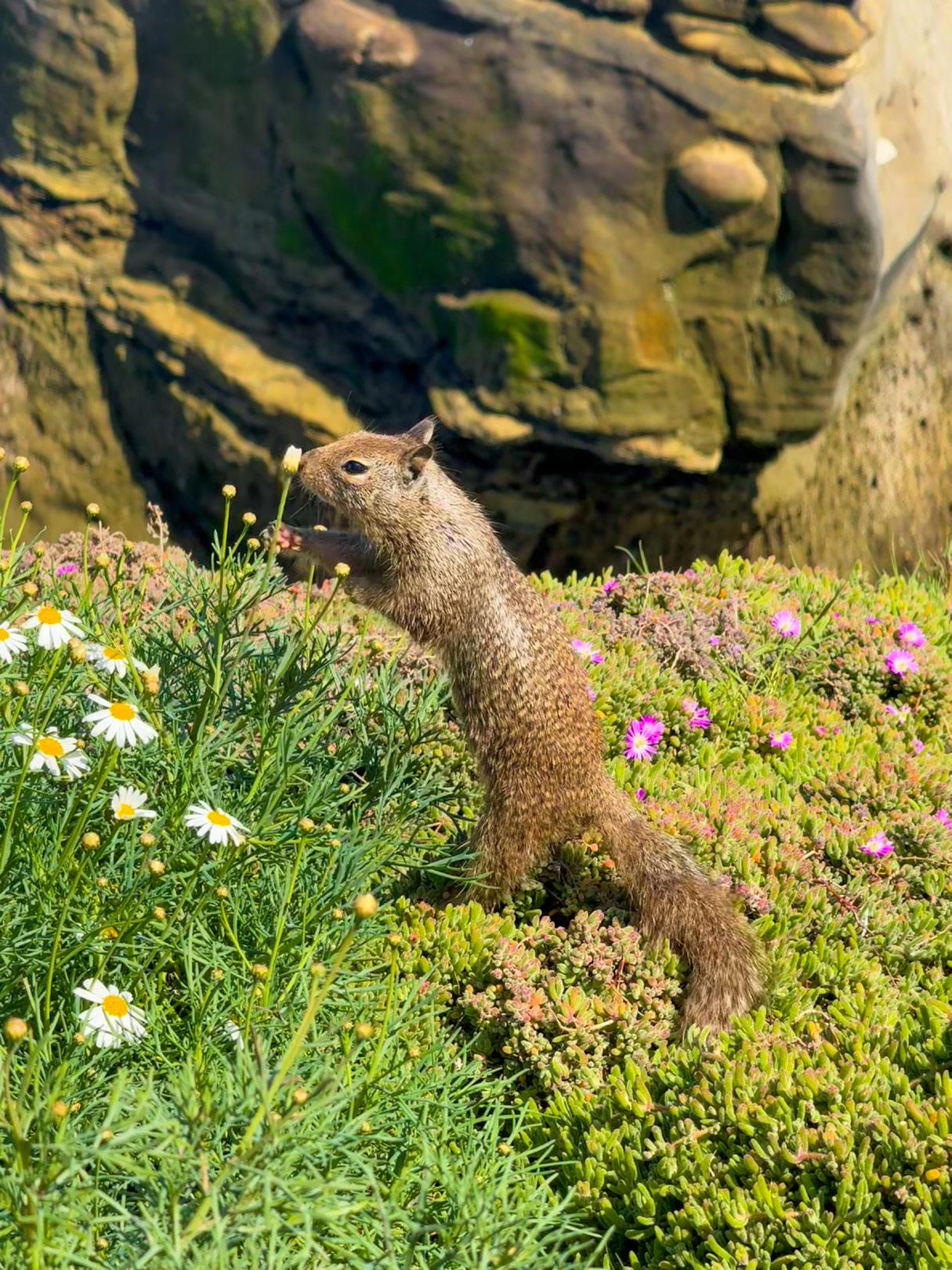
This Is for When
Sascha Hamilton
This is for when our cities were full of wonder, for when any road could take us anywhere. For when we made our homes in cheap rooms at the edge of town. For the kids who grew too fast, for the ones who stood tall in the looming shadow of death. For the kids who found solace slipping over the fence, slinking through the gravestones like ghosts waiting to be born.
This is for when we lived fast and fleeting. For when we lived our lives in defiance. For when we refused to allow the violence imposed on our bodies before we learned to live in them to corrode our souls.
This is for when we did our makeup in a lipstick-smudged mirror while waiting for the sun to sink below the mountains to the west. For when we raced away from the light, sipping on the splendor of an urban night. For when I was ready as ever to walk into the dark next to you, for when you draped your arm elegantly from the driver’s side window, flicking ash onto the avenue. Deep somewhere in the folds of fall, right when the air began to carry a crisp chill, dusting the ground with a rime of frost in the mornings.
This is for when we dressed in our resplendent best, big vegan combat boots, mail-ordered from England. Steel-toed and synthetic leather ensconcing our calves. Soles as thick as the calluses that could have carved their way into our careworn hearts. But luckily for us, they never did. For when you wanted to sit on top of a mausoleum and stare off at the city skyline, flickering and glittering in the distance, concrete monuments of a different sort.
This is for when you hit sixty on Sixth Avenue headed east. For when I pushed a mixtape into the stereo. One I had been carrying around since I made it when I was sixteen. Across state
lines and innumerable moves. It lived at the bottom of backpacks, slept safe and sound in shoeboxes on the floors of perpetually breaking down cars. For when your lined lips curved into a crooked smile. For when shifted up, pushing the speedometer up to seventy, letting the wind rush through your hair, singing along.
“...andinherfearshesoughtcrackedpleasures 'Thepassionofloversisfordeath'saidshe Lickedherlipsandturnedtofeather.”
This is for when a song I had listened to a thousand times in my young life came to have a new meaning, a sweetness of symmetry echoing from your speakers.
This is for when you eased the car into the empty parking lot of a fading suburban strip mall. For when you let the engine idle for another minute to hear the end of your song. For when the soft metallic click of car doors closed with care mingled with the blood rushing in my ears. The rush of your hushed boots racing across the street, taking the lead. A fearless leap into the dark, you hit the fence first, sliding into the space where wrought iron didn’t quite greet the earth.
This is for when a tangle of chain link chiseled its way into your thigh, and I watched with an alien hunger. For when the inspiration, blood borne and beautiful, hit later. For when you stayed up late writing a short story about a young woman sneaking into a cemetery and getting a scratch just like yours. A twisted tale of mysterious grave bacteria infecting her bloodstream and carrying her off to her own death. For when I watched in awe as you typed and typed, spilling your own fear of dying young onto the page. For when I scrawled in my journal, writing poems of my own, pausing only to flip the record over once more. This is for when you were mine and I was yours.
This is for when our days passed in a flash, jagged and erratic. For when we kept the company of storms. For when we couldn’t help but sharpen our claws. For when our words were weapons pointed in the wrong direction. For all the wounds we wished we had never wrought.
This is for when we were always growing up by falling down.
This is for when holy forgiveness was the most precious lesson.
For the rhapsody and wreckage of youth.
For time passed but not wasted.
Etched in the marble of memory, never to be forgotten.
This is for when.
Collection
Chloe V. Jackson
Inside me I envision a deep red cave with story book creatures roaming, silhouetted and carved from black glass echoes. Candle light flickers on the slick walls, and there’s a sense that an angel has been there, and maybe died there, and there’s also something formless which eludes tactility, and we don’t know what it is, but only that it’s coming, or was grieved briefly, undeservedly, and in the beginning.
And those creatures are kind when I sacrifice, and wretched when I starve. Callusing in the modern sun, I burn to keep the clawing from your taut leather skinYou whimper at the intensity of the fire, the cruelty of my assembled soul.
I too recede from singed heavens, I’ll pass over threads which bear the hue of vehemence, I’ll close my eyes hard as prayer when I see a bird that flies too free, or look into the eyes of a dog-wolf that forces my gaze downward. I’ll let the brush fall from my bitter hands when the paint can speak back to meThere’s no time to tell whether that voice is a piercing screech, or delicate, deliberate, song,
And all the time for the decoding of messages, But impatience is my only sin and all I have, Except the creatures which collect kindling from my bones and acrid acid from my bilious throat to burn. That mystic light is all that guides me, and the only reason which I find imperceptible.
I hope I find a shadowy translator with a long woolly coat and felted face,
Who will speak to the creatures, teaching them to rest, And replace the brush in my balmy palms, Licking away salt from my heated cheeks, Twisting out melancholy in my hair, Kissing my soul.
And I’ll understand the landmark inside of you, and the creatures will dance as they unlock the door that’s been hidden by the hearth, inside grasping a vial of feeling. They’ll lug it to the well, dump it into my bloodstream. It’ll be accepted by my thirsty tongue, which now speaks your language-
Mossy troll talk, endless forest talk, echoing forever talk, Mirrorless confounding talk, Corrupted, rich talk.
And those words taste like French, and ragged wind, and swirling eddies of a trickling stream, and oh such beauty that I’ve always seen, but through antique lacy curtains, and patterned colored glass.
My eyes are open under water, and my soul is a cool river rock, silky and tumbling like the universe in your eyes,
Mine too
How can I sleep in my tundra of a room when I know you’re out there? We’re both grasping at the griddle black, sizzling abyss, palms upward now, and in our dreams, interlaced, hopelessly complex.
Lilies
Heather Lewis
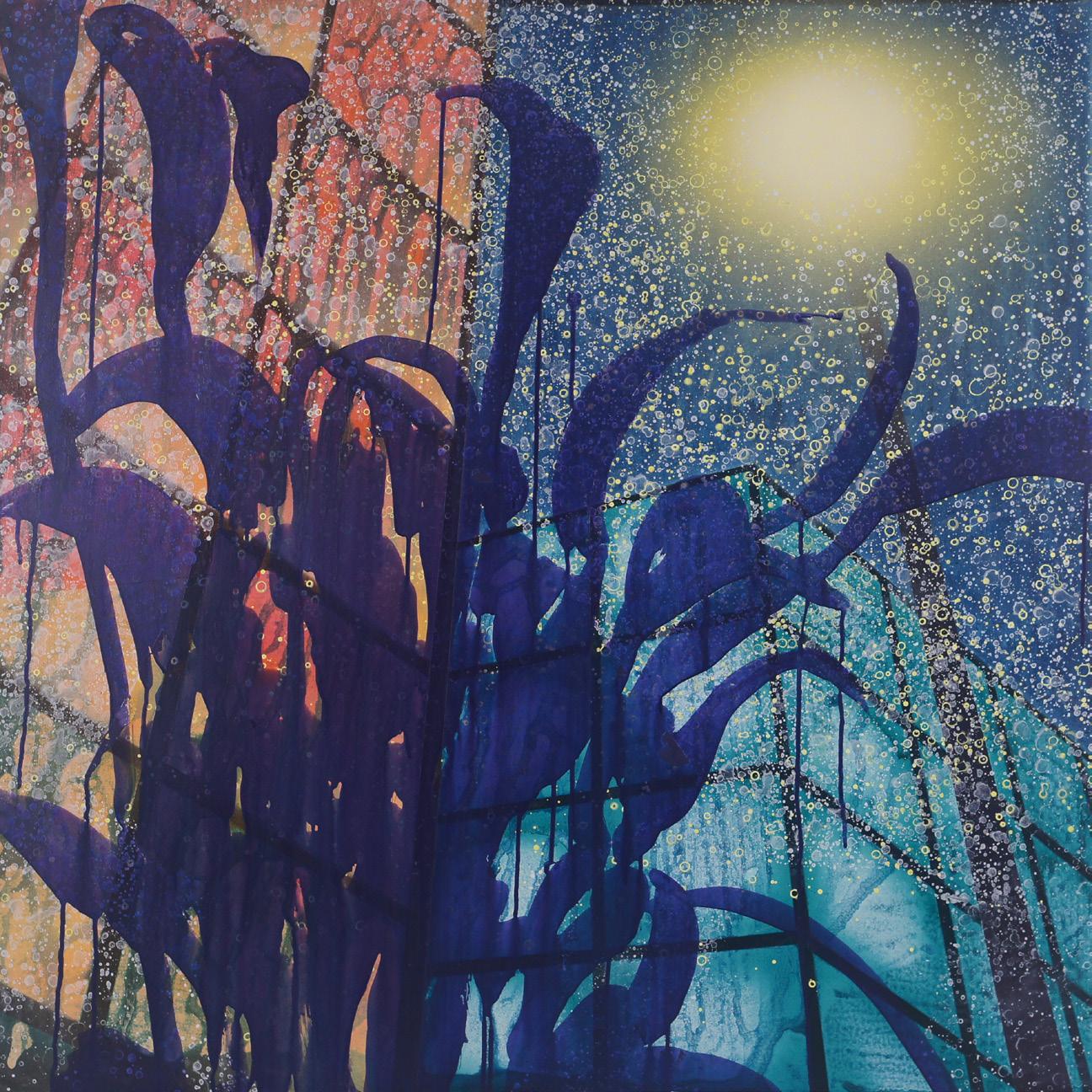
I Wanna See You Again
N33.903, W78.082
Clay Noel Jones
Warm September, grey Atlantic, decades ago, almost before I could remember. The line between life and death is never so sharp as we’d like. That’s is where I found you, in Living Waters, diseased, dying or dead already, Horseshoe Crab.
Moon-pulled chariot, muddy crustacean with missing legs, clipped tail and small barnacles growing out of your spine. What were you like when you were younger, Mother?
What if we had met in a better scene? Maybe we’ll meet again when some other September meets the edge of the grey Atlantic, where I’ll find you feeling better.
N36.018, W79.111
Icy March, white sky, decades ago, they called us in from recess, but I stayed frozen in place, with the willow tree and all the sharp, cold grass. And sharp, cold fear walked across my hand in the shape of a
Wasp.
Your stinger pulsed, worked up and down, in to out. Back then, I still ran crying from all stinging pollinators and your Natural Weaponry left tiny red spots on my skin, little flames, swelling sharp in the cold air. But, they didn’t hurt much. You were so curious, your footsteps so gentle, so blameless. Was there ever anything to forgive you for, Child?
The adult finally screamed on the hill that our window of freedom had closed and you flew away, leaving behind seeds of potential alliance. Maybe next time I’m in the neighborhood, I’ll drip nectar on my palm and go looking for you.
N36.915, W81.443
Blossomed July, green world, 8 years ago. The season past its crest already. Leases ending soon. My friends and I would haunt mountain waters all summer. Semi-civilized sirens with smokers’ rasps. I had already loved you for years: Boulders on the River.
Granite and water flowing downhill through eons of trees, stratifying sediment. Big chunks left on the mountain, soft silt carried out to the grey sea. I would lie flat on the biggest of you,
Father, and fear no rejection, raised voices, nor violence. All those people are gone now. Gone like 8 years ago, gone like last summer. But time is kinder to stone and maybe I’m overdue, well overdue, for a visit.
S60.518, W64.203
My heart swims sympathy at the bottom of an icy sea my rib bones compress and tangle and puncture my lungs. Who am I kidding here? You are so far away, beneath the waves or behind the stars somewhere no one knows I’ve been too long away and I know, I know, I know, I will never see you again.
In What Covers My Mind's Vacancies
Luca T. Campbell-Zocher
Doubts laid bare, naked on the asphalt outside my family home is a rusted hoard of trust, like offerings to a guiltless god —but I only cry lightly, because this time I’ll be careful I promise you that mydear
Sometimes, after dark, My lashes grow weighted. World-weary worshipers, perched upon my face patterns running down my cheeks.
Still, I listen for the hum beneath the silence, the soft percussion of memory tapping against the ribs of night.
Maybe my love curls in the small, unlit corners, where the dust of old promises settles, pale like dusted snow.
I sweep slow, careful not to disturb the ghosts. They’ve learned to sleep beside me, huddled in for borrowed warmth.
When morning comes, I’ll open the blinds and let the light rehearse its entrance— trapezing carefully caressing creases in my hands until I slip out from the covers of my dreams.
Self-Made, Man
Max Smith
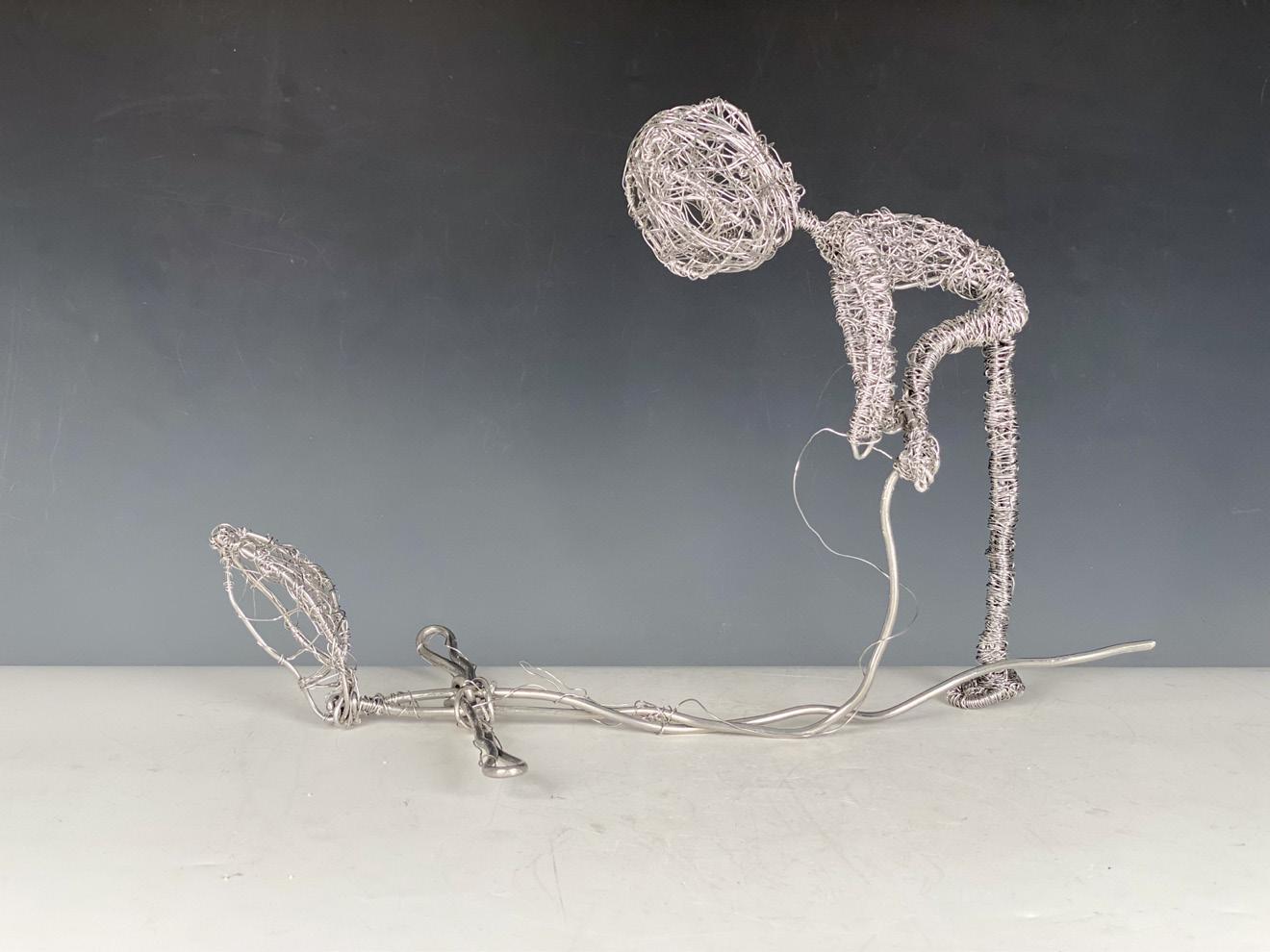
We All Want the Same Thing
Joe McCarty
She found him right where he lay, tucked in the quilts on the bed. She waded through the trash to reach him, trash she hadn’t a clue about.
We thought he was doing okay.
The strings on his guitar will rust. Pick it up. Shake off the dust.
A month after the water rose high, the community gathered, and he sang hauntingly. I hear it booming in my ears now. The notes floated into the air like the leaves of fall, soothing the grief we felt, like ice on a pounding head.
Now she isn’t sleeping, and his roommate is in despair and uncertainty.
Dilemmas bounce around their heads like a ping-pong match. Sober is a fickle word, bleeding from our mouths in fear.
We all want the same thing.
Little Voices
Jessica Hardesty
Small voices swirl like autumn leaves in a restless wind, Exhaustion drapes on her like a dense wool cloak, heavy on the mind
No time for breath, no sanctuary for silence.
Can she give a voice to her restlessness that hums like low voltage under her skin?
Could she shrivel up like one of those fallen leaves, And float away for just a day, beyond the white picket fence?
She longs to sail to a solitary destinationOh, to feel the salty shores blowing sand against her sun-kissed skin!
Her longing is cut short as she drifts through her kitchen like a ghost.
Unseen behind a tower of dirty dishes.
Unheard over the scallywags with their piercing squeals of laughter.
Unjudged by her inability to batten down the hatches of her selfmade crew.
Her heart beats like a war drum for these demanding, sweet little souls.
Tiny feet slap against dirty wooden floors, leaving a trail in their wake.
They are ready for her to walk the plank!
Countertops bloom with chaos-bowls crusted with oatmeal, spoons sticky with jelly, The air is thick with the scent of peanut butter and day-old milk Her coffee cup with the chips was microwaved and has since gone cold.
Morning light creeps through the blinds like a lighthouse beacon, Bright rays chase shadows away, revealing corners where toys hide like guilty conspirators, Another day rising to reveal another level of uncharted chaos.
She yearns to grow wings like a seagull, to be lifted on a breeze, To escape the oppression of calendars and clocks, To taste the salty air on her tongue.
Instead, she slips into the cluttered pantry with forgotten spices, With a stale cookie only longing for five minutes of silence. Pushing indulgent fantasies aside, she dons her frayed dish towel cape.
The kids are shouting, declaring her a pirate, Queen of the deck! The dog, covered in mud, signs on as her loyal first mate. She exits the cramped captain’s quarters, past the crumbs falling on the shelf.
Five BLISSFUL minutes, passed by like a storm-blown cloud, She returns to the helm, loving her buccaneers with renewed compassion,
Lifting the anchoring thoughts of her mind, she once again sets sail towards just another day.
Somewhere Away from Here
Sophia Monet Van Bumble
Somewhere, the grass lets out a sigh, A soft whistle in the noon air.
It hums above the old man’s mumbled cry, His breath still sweet with memories gone bare.
The molasses of his past has thickened slow A taste once warm, now stale with years of strain He rocks his chair where splintered armrests know The weight of waiting pressed into his frame.
Somewhere, a kettle erupts, ruining the peace. The old man turns toward the sound, His hands trace the chair's familiar brace, An anticipation for something else unbound.
He watches as the final train departs. Its smoke writes lies through the sky. They called it hope. They called it doing one’s part. His friends believed it. He stayed behind.
Somewhere, industrialization has arrived at last, Too few resist the growing temptation. Quickly, they say, "change is needed fast.” Toward our final devastation.
The old man condoned, Their actions saved the greater mass, No matter the lives loaned.
Even his, alas.
Somewhere, the wind beckons out a shout, Bringing the old man’s hearing aid to shrill. He winces once, then smooths his doubt, His eyes grow worn by every passing drill.
Slow down, he mutters toward the unknown. His fields lay out before him. Watch now , toward the warzone. Everyone will soon be victim.
Somewhere, the rural area dreams, Oblivious to the youth of power, Oblivious to their schemes
Enjoy the air raid shower
The old man has seen the cycle's way
But this year's crop is indifferent No ending should be faced without a hand. He’d say But harvest comes with aching first, persistent
Somewhere, toward the horizon
Where light and silence intertwine
A secret cascades from the dictatorion
Defiance against mankind
Somewhere, the world prepares to scream. He does not rise. He does not pray. Somewhere, the kettle cools. The fields still dream. The war will come. He’ll stay.
Production
Ronnie Z. Nielsen
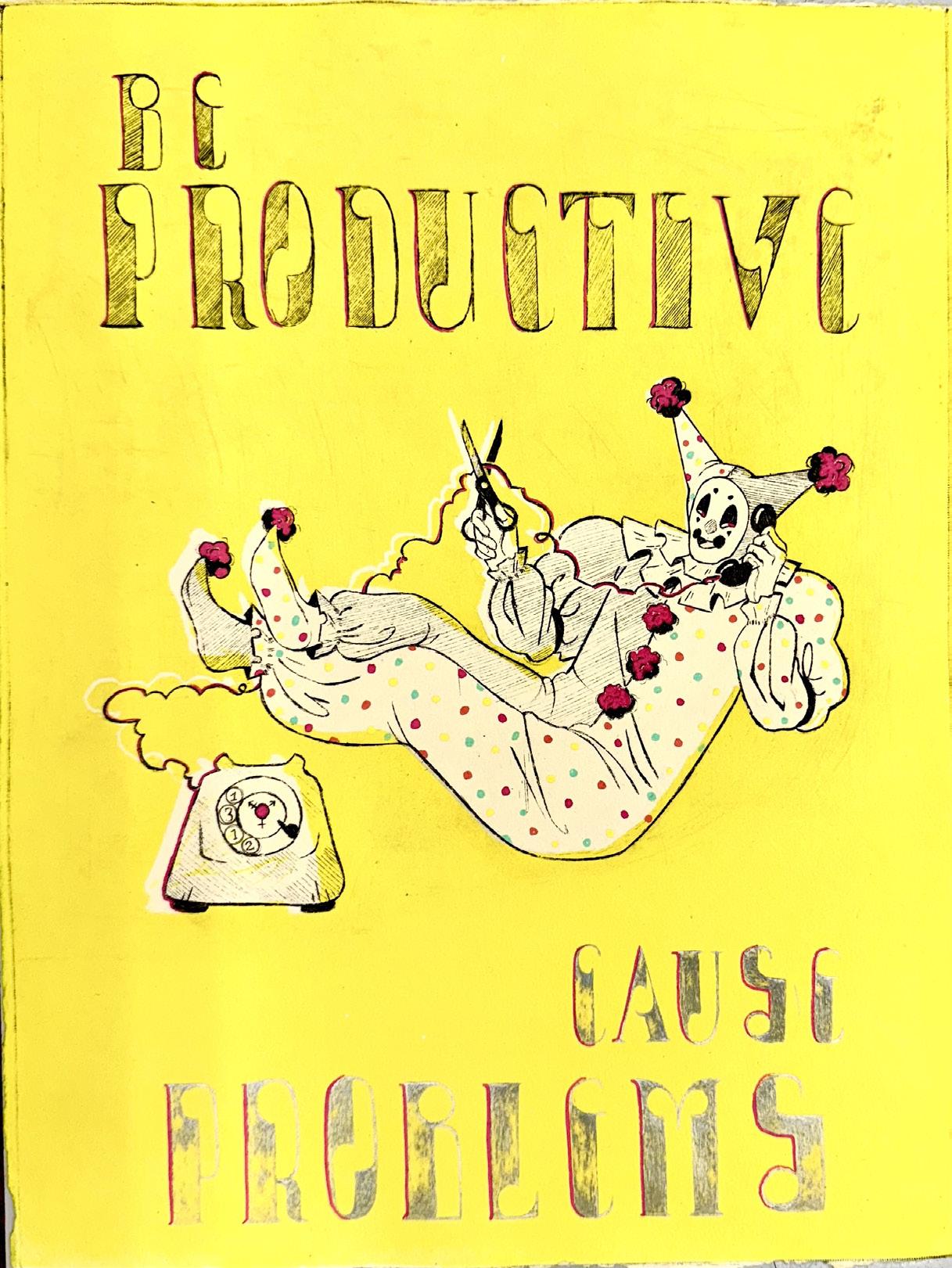
PHQ-9
Nilah Wharton
Over the last two weeks, have you been bothered by feelings of existence? Are you tired yet of living in checkboxes? The space inside your bones holds an old battlefield. You stand where your mother fought, where her mother fought. History drives needles into your tendons, dances down misfiring nerves. You are not over yet.
Have you been troubled by thoughts that you would be better off alive? You tend a condemned house, but the floor has not rotted out yet. You will not paint despair into the cavity of your chest. No sunbeams pierce your skin, but hope grows thick and ugly where you keep it. Scrub it away, if you must. It will grow again.
Tired? Are you tired? Do you feel tired yet?
Lay down more sandbags. You can catch the tears before they seep under the door. Gravity will turn your limbs into trees or axes, if you let it. You can choose: grow into place, chop and hack, or learn how to walk again.
Over the last two weeks, how often have you been bothered by feelings of existence? Please score your faith in living by more than grit teeth and waiting on the following scale: Not at all. Severaldays. Morethanhalfthedays. Nearlyeveryday.
Wolf Dev
Ani K. Volkan
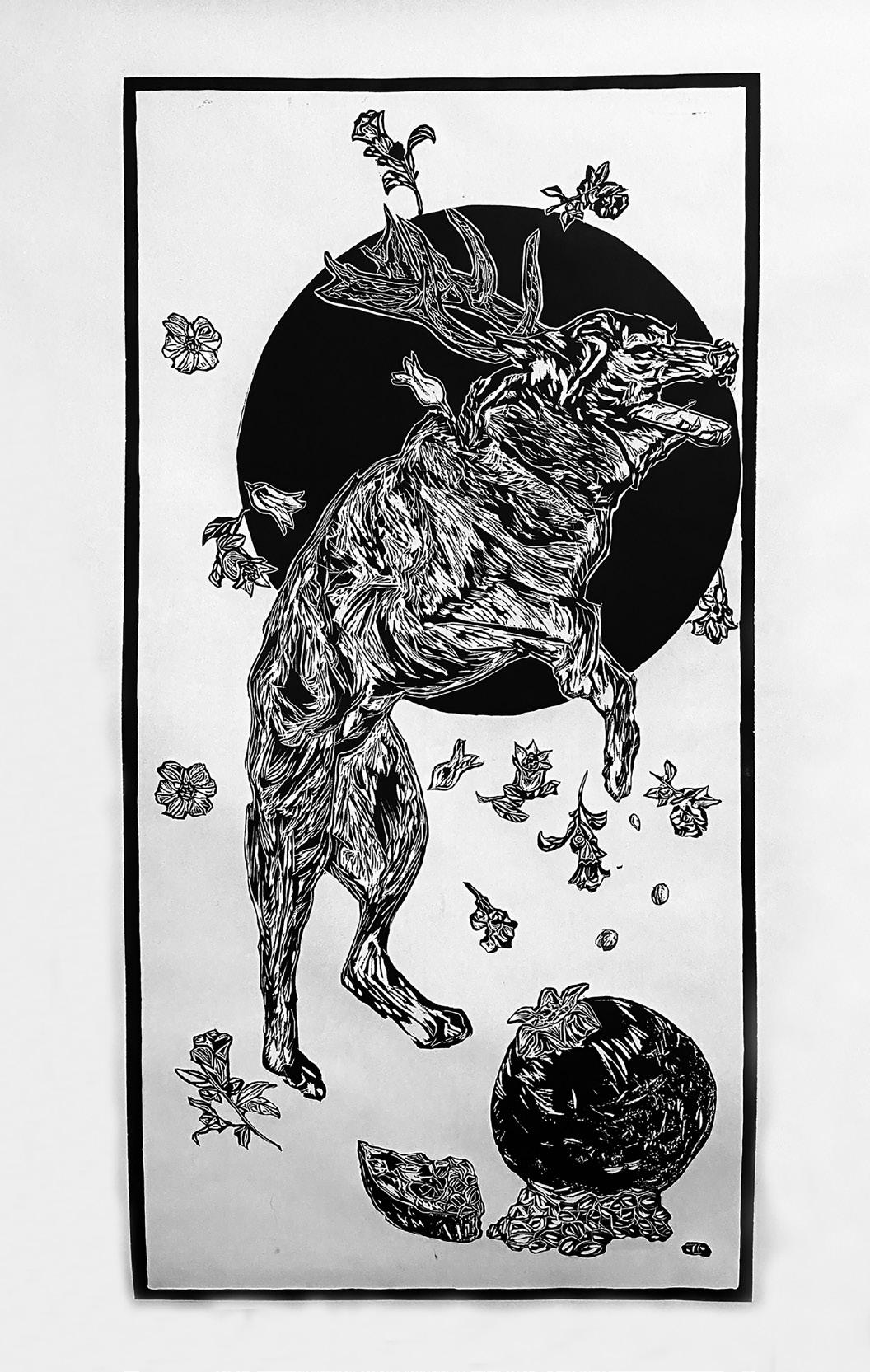
At the Carnival
Sascha Hamilton
Dylanparked in the empty Crescent Industries lot and killed the engine. He reached under the seat, pulled out a bowl and a tiny bag of weed. Packing it with practiced efficiency, he took a hit and passed the bowl to Sarah. The crackle of burning buds mixed with the murmur of the boombox, quiet enough to catch the sound of anyone approaching. It was Sarah’s turn to pick the music. She chose a copy of The Head on the Door
I didn’t feel like getting high. Not when I didn’t know who we might run into, or what kind of bullshit might wait for us at the carnival. But I stayed in the car to keep Dylan and Sarah company. Besides, even when I wasn’t doing drugs, I felt like a badass being around them, a teenage criminal by proximity.
Dylan and Sarah finished smoking. Dylan tapped the ashes out the open window, brushing them onto the pavement with a flick of his wrist. The three of us got out of the car and joined our friends. I hoped I didn’t smell too much like weed I hadn’t even smoked, but a cloud of harsh cigarette smoke drowned out those worries as everyone lit up. Jimmy, Danny, and Mace sat on the hood, watching the street. Mace took a drag of her cigarette, exhaling smoke into the night air as she glanced toward the carnival, a scowl forming on her lips.
Cutting through an alley behind the park, we slipped into the crowd. The moment we stepped into the park, eyes followed us. People stared, sometimes pointed, but no one said a word. We had safety in numbers. We all said we hated the stares, but deep down, they fed us, too. In the distorted, ugly music that was becoming the soundtrack to our lives, we found something we had been searching for without knowing. A subterranean world hidden behind the doors
of smoke-filled clubs, locked in the grooves of the records we hunted. And we needed to remind ourselves how bravely we stood apart. The stares proved what we knew. Here, our truth looked like screaming kids and wailing guitars from a thousand lonely bedrooms and basements. Our truth bled from the pages of books and zines.
Fucked-up kids with fucked-up haircuts and fucked up clothes.
Out in the cold. Outside looking in. Doing our best not to care.
We were on our second round, near an empty corner of the park, when we saw Ronnie with his friends, Greg and Pat.
Like some primal instinct warning of danger, Ronnie’s body language registered before his face. He walked with an arrogant, lazy swagger. Like he owned every inch of ground beneath his feet. Like anyone who crossed his path owed him something, especially if they were female. My hand moved to my pocket, fingers wrapping around the knife and pepper spray I carried everywhere. It was instinct. The same one that had been drilled into me after an entire year of dreading sixth-period study hall with Greg and Pat.
Pat had been following Ronnie around for years, scurrying in his shadow like a rat, complete with beady little eyes and a wispy dirtbag mustache. Held back twice, small for his age, he took his feelings of inadequacy out on everyone around him. Every day, he knocked my books off my desk, called me a faggot, and promised to find me after school. He never said anything to me unless I was alone.
Greg was worse. A narrow-eyed, fetal-alcohol-syndrome-looking motherfucker. He looked like his mom had taken a rolling pin to his forehead when his skull was still soft. And racist, too. He covered his textbooks with swastikas and "KKK" in thick black marker. As soon as we sat down, Greg started in on me. Telling me what a faggot I was, how I deserved to die. Mrs. Klausberg sighed, barely looking up, and told him to calm down, as if she didn’t
care either way.
No one ever stood up for me.
Not until Jimmy.
The day Jimmy caught Greg trailing behind me, chanting ‘Faggots get AIDS and die!’ he grabbed Greg’s books and threw them down the stairs.
“Looks like you dropped your book. Better go fetch it, you little racist bitch,” Jimmy said. Greg just stood there, too dumb and scared of Jimmy to do anything else.
Jimmy leaned against the lockers, his arms crossed over his “Never Again” shirt, the crossed-out swastika screaming from the fabric. Greg’s beady little eyes flicked to it, but he didn’t say a word. His shoulders slumped in defeat, and he turned to grab his books. He was halfway down the stairs when Jimmy launched him the rest of the way down with a vicious shove. Greg landed on top of his scattered books, looking back up, defeated eyes filled with hate.
Jimmy just laughed.
“Remember this next time you think about fucking with my boy.”
And then there was Ronnie. A few years older than us, Ronnie was a stoner bully with an appetite for shitty weed and sexually harassing Melody and Mace. Earlier that spring, Ronnie had done something unforgivable. Something that went beyond fucking up, beyond high school drama. Everyone in the crew hated him, but Melody and I hated him like it were our sacred duty. We had the feeling he had gotten away with what people got murdered over in less forgiving places. Instead, everyone in our little rust belt town looked the other way in the spirit of “boys will be boys.” I had hated people before Ronnie, but nothing compared to how much I hated him. It was a hate as pure and as unforgiving as a desert sun bleaching bones. Melody and I spent weeks talking about revenge. Fantasizing about it. So many sleepless nights, I lay awake, picturing him bleeding out on the ground.
And we almost got him once.
That first Monday back at school. The night before, Melody called me. Her voice was steady, but underneath it, I could hear a lick of fury, waiting to burn our corner of the world clean. She told me about Jasmine’s mother’s frantic phone call on Friday night. About the agonizing hours of silence that followed. When she finished, her voice dropped lower.
“Whatever it takes, Jamie. I’m going to see that guy in the ground one day.”
I gripped the phone, silent venom coursing from my heart to my fingers. My other hand moved on its own, picking up my uncle’s knife and the pepper spray my mother had bought me. I stuffed them into the pocket of the jeans I’d wear to school the next day.
The next morning, standing in our usual spot in the back lobby, Melody caught sight of Ronnie before I did.
“Fuck. There he is. I want to stab him.”
I glanced around the hallway and reached into my pocket. No teachers in sight.
Wearedoingthis, I thought.
Without a second thought, I handed the knife to Melody. Like it was nothing. As casually as I would pass her a lighter or a pen. My other hand found my pepper spray. She moved first, falling in behind Ronnie. Unfolding the knife, she hid it in her sleeve. I followed with grim determination, like destiny demanded we draw blood. I realized I couldn’t stop my feet from moving, even if I wanted to.
Ronnie didn’t know we were behind him.
I flipped the safety off my pepper spray, ready to use it if the first stab didn’t take him down. Or if his shithead buddies showed up before Melody could finish.
Then Mrs. Morrison stepped out of a classroom.
“Melody! I’m subbing for your math class today!”
Melody faltered.
Ronnie walked into his homeroom, never realizing how
close he had been. Years later, Melody and I would talk about that moment, about how Mrs. Morrison unknowingly saved him. More importantly, she saved us from ourselves and the consequences that would have accompanied our actions.
Ronnie’s voice dragged me back to the present.
“Hey, nice hair, faggot.”
Ronnie and his friends stood in our path. Panic shot down my spine, followed by relief. Melody had stayed home. I froze. Every muscle in my body begged to be used, to inflict maximum damage on Ronnie’s worthless fucking face. Every synapse in my brain screamed hate. I swallowed hard. The taste of funnel cake and bile clung to the back of my throat. Around me, the crew stood their ground.
Sarah groaned. “Oh, just great. All we need. Three homophobic burnouts with one brain cell between them. What’s the matter, boys? Did your sisters have a date tonight?”
Ronnie started to say something, and Sarah interrupted. “If I’m talking too quickly and using too many big words for you, I can slow it down. Growing up with assholes like you, I’m fluent in moron.”
Ronnie hid his shock behind a laugh. “Shut up, bitch.”
Mace stepped closer to Sarah, clenching her right fist, the spikes on her leather hand guard catching the light. I pictured them sinking into Ronnie’s cheek. She nudged Jimmy with her elbow, flashing a razor glint of a smile.
“Look. It’s everyone’s favorite misogynistic little piece of shit.”
Jimmy stood next to her, poised and ready to attack. Feral. Deadly. A slow grin spread across his face, containing neither humor nor warmth.
That spring, Jimmy and I sat in the grass in my mother’s backyard as I recounted what happened. He listened, his cigarette smoldering between his fingers. When I finished, he exhaled a cloud
of blue smoke, stubbed the cigarette out on his boot, and pulled me into an embrace.
“I love you. I love all of you, really. Whatever it takes, we’ll handle it.”
Dylan rested his arm on my shoulder. Warm. Protective. A physical connection that dared Greg and Pat to talk that shit in front of him. A gesture that left no question of where he stood: beside his friend. His usual sneer stayed frozen, though his lips curled into a sliver of hate.
Danny took a protective step in front of his baby sister. He never liked confrontation, but he knew when to stand his ground. He and Sarah had learned young to protect each other. Years of bedroom searches, trashed records, and a mother whose faith didn’t help her understand her children made sure of that. Strangers often mistook them for a couple, which horrified them both. Now, standing between Sarah and Ronnie’s crew, Danny squared his shoulders, his usual warmth gone. Despite his size, Danny was no fighter. He’d rather be cracking jokes or playing drums than throwing punches. He and Jimmy had been tight for years. Walking together, they could have made an imposing pair if not for Danny’s easygoing nature, a stark contrast to Jimmy’s wire-taut aggression.
The light and sound cascading off the carnival rides bathed the area in an almost hallucinogenic glow. Ronnie and his friends didn’t budge. Neither did we. Dancing lights from a nearby ride filled the no-man’s-land between their crew and ours. Jimmy let out a low, menacing laugh and took a step forward. We tensed as a teenage pack, primed and ready to pounce. The air went still. The only sound was the incessant ringing of a bell from a nearby rigged game.
Jimmy pulled a pair of brass knuckles from his pocket. Slipping them on his right hand, his smile grew wider. He took a step towards Ronnie and his boys, raising both of his hands in a “take a step closer, motherfucker” motion. The possibility of life-altering violence hung thick in the air. I shivered, unsure whether it came
from excitement or terror. For a moment, I smelled an illusory copper scent of blood. Jimmy looked even more terrifying than usual, head shaved to the skin and glowering. Ronnie went to speak and faltered, his mouth hanging open, silent, betraying his fear. All his courage evaporated like steam from the pavement.
Ronnie swallowed hard and choked out a nervous laugh. “Fuck this. You faggots aren’t worth it. I’ll catch you around sometime,” he said. He and his boys turned and walked away.
The laughter started with Jimmy, raw and vindictive. I followed. Razor sharp, like my howling mockery at Ronnie’s humiliation might cut him to the bone. Dylan breathed a sigh of relief next to me and lit up a smoke. The Stonewalls relaxed; the invisible wire of fearful tension between them uncoiled.
We were still laughing in high spirits as we resumed circling the park.
Pushing through the throng, I spotted two goth boys navigating the crowd. We passed them once, then twice, each time nodding in silent solidarity. Sarah asked, “Have any of you seen those kids before?” None of us recognized them; they must have come from one of the neighboring towns. Both of them had smeared their eyes with thick, smudged raccoon makeup, the dark rings stark and dramatic against their pale skin. I noticed one of them was even smaller than I was. If I had to guess, the kid could not have been older than 12. He wore a giant Cure T-shirt. His companion, perhaps his older brother, wore a dress. The kid wore a dress at a carnival packed with drunken hicks, half of them dying to punch something different from them.
These poor kids might as well have been wearing targets on their backs.
I turned to Dylan and Jimmy, about to suggest we introduce ourselves. Then Dylan’s eyes went wide, and his smoke slipped from his lips. I spun around just in time to see a man in his early twenties, with long ratty hair, a thin mustache, and a faded Slayer
shirt, sprint up behind the kid in the dress and land a crushing sucker punch to the back of his head.
Humiliation and confusion flashed across the kid’s face as he registered the blow. He staggered forward but caught his balance, spinning and landing a wild, desperate punch to his attacker’s jaw. A hollow thud resounded over the murmur of the crowd. The hick didn’t even flinch. He ripped off his faded Slayer shirt and hurled it aside. He lunged at the goth kid, tackling him to the ground. Pinning him down, he let loose a barrage of hammering punches down on the goth kid’s face.
Slayer shirt’s friends circled, laughing as they formed a perimeter, cheering their buddy on and throwing kicks whenever the goth kid found a moment to breathe. They shoved his smaller friend around.
“You’re next, faggot.”
The goth kid raised an arm to shield his face. His other hand slipped under the folds of black fabric and came back with a knife. Time slowed as I tried to process what I was seeing. No one else noticed. He was fumbling with the knife, getting ready to stab the hick in the side.
I pulled a key from my pocket and unlatched the padlock on the chain around my neck. Securing the lock at one end, I coiled the chain around my fist. I waited until all eyes were on the fight. Slayer Shirt was still on top of the goth kid, pinning him down, landing punch after punch on his face. Making my move, I swung the chain upward, aiming for his forehead. The lock cracked against his skull with a sickening thud. Dazed, he reeled backward, blood streaming down his face. The goth kid dropped his blade and scrambled out from under him. Slayer Shirt swayed, blinking through the blood, trying to process what had just happened.
I tried to fade back into the crowd, but one of the hick’s friends locked eyes with me. His face twisted into a scowl. Then he tapped his friend’s shoulder and pointed at me. My stomach
clenched. There was no way he missed me cracking his buddy’s skull. I hoped he wasn’t sober enough to remember our faces. Out of the corner of my eye, I saw Jimmy snatch a handful of napkins from a nearby funnel cake stand. Casual as anything. Like he was just another bystander. He used them to pick up the knife by the handle, then melted into the crowd.
Mace grabbed Sarah’s sleeve and tugged her back toward her car. Before they left, Sarah shoved a handful of napkins into my hand. “Here. Try not to look like an extra in a zombie movie. It might help you get away.” Danny hovered for a second, shifting his weight like he wanted to stay, then exhaled sharply and hurried after them.
I turned back to the goth kid, passing him a handful of napkins. “You alright?” I asked, offering them to him.
He pressed them to his mouth and nodded. Blood pooled at the corners of his lips, dribbling between his fingers. He coughed, and a fresh spray of red hit the grass and my face, splattering my cheek, just below my eye. The revulsion didn’t hit until a second later, crawling up my spine. At that moment, security guards arrived and began shoving their way through the crowd. One of them grabbed Slayer Shirt by the arm. His friend was already pointing at us.
“You might wanna get out of here,” the goth kid muttered, still dabbing at his mouth. “I’m already gonna get nailed. No reason you should, too. Thanks for the help.”
He was right. That was when I realized Dylan and I were alone.
We slipped away from the crowd, making our way to the far edge of the park. We found ourselves alone in a deserted alley across the street from the Crescent Industries warehouses. The Cordoba was parked a block away. As we hurried towards the car, Dylan shot a glance over his shoulder.
“Oh fuck. I think we’re being followed.”
I turned. Three large men were pushing through the crowd, closing in fast. No doubt they wanted payback for their buddy. For a
second, fear took a backseat to a begrudging admiration. If our roles were reversed, I’d do the same for my friends.
“I don’t know how they escaped the cops and security guards,” I muttered.
“I don’t know if it matters. What matters right now is if you’re ready to run,” Dylan whispered.
“Yup,” I said.
“Okay, break.”
Dylan took off. I followed, my heart pounding. The rush of blood and adrenaline drowned out everything else, the sound of my boots hitting the pavement, my breathing. Tunnel vision set in; the world narrowed to the stretch of pavement and the Cordoba ahead. Somewhere behind us, I thought I heard laughter mingling with footsteps, closing in faster than I’d like.
We reached the car, fumbling with the keys in our haste, fighting back panic. Dylan yanked open the door, keys already in hand. The Cordoba roared to life, and we peeled out, tires screaming against the pavement.
“Dude, take the long way home. Make sure nobody’s following,” I said, glancing back through the rear window. The men chasing us had slowed, giving up the pursuit.
“Should we go to your house or mine?” Dylan asked.
“Let’s go to mine. You live right there on West Forest Avenue. You never know who might drive by tonight. I’m out at the edge of town. With any luck, those guys won’t remember our faces or your car through their hangovers tomorrow.”
I glanced back one more time. To the assholes chasing us, we were nothing more than a pair of fading taillights. Dylan hit the corner, and we were gone. We exchanged a look in the dark, the lights of the park receding behind us.
It was going to be a long summer.
Contributors
Madden G. Alpaugh is a part-time student working towards an associates degree. She loves drawing, writing, and playing with her dog.
Sierra Faith Alvarez is a sixteen-year-old student at A-B Tech. She has lived in North Carolina for her entire life and finds joy in nature and the mountains. Since childhood, she has had a passion for creating and enjoys many forms of art. Sierra is now working towards her goal to have a career in graphic design.
Anna Claire Applegate is a high school dual enrollment student who is predominantly a visual artist and has tried her hand at creative writing through A-B Tech this semester. Her typical mediums are traditional illustration and character design, along with wirework, painting, and sculpture. She has dabbled in multiple writing genres and styles. This piece is her take on surrealist fiction..
Áine Djoli Brown is a Madison Early College Student who is dual-enrolled with A-B Tech. She enjoys writing in as many mediums as time will allow and learning any new approach that will be taught.
Luca T. Campbell-Zocher is a full-time student and cook who writes short stories and poetry in his spare time..
Christopher Robert Coward balances full-time studies in human services and social work with a career in addiction treatment. His writing draws from these experiences to explore the human condition and highlight uncomfortable truths. He is currently working on a radical storytelling project called "Under the Bridge, Over the Stigma," to tell the stories of those who are too often overlooked.
Elora Crisp is a full time student set on studying linguistics in the future, with a deep love for language and writing, still happy to be improving her literary skills everyday.
Sascha Hamilton is a punk rocker, a writer. When they aren't at home with their pets and their partner, you can find them in the crowd at a show, or making noise with their friends in ON THE BLOCK.
Jessica Hardesty is a part-time student working towards her associates degree while being a full-time mom of two! She has minimal time for writing but enjoyed dabbling in creative writing this semester.
Gianna L. Hill is a student author based in Mars Hill, North Carolina.
Jeff Horner can't even SPELL glib.
Chloe V. Jackson is a full-time student and part-time poet who writes poetry and short-fiction inspired by dreams, nature, and the rhythm of daily life.
Clay Noel Jones is an employee at the A-B Tech bookstore and enjoyer of art in all its forms.
Heather Lewis is an instructor in the Art Department and a working artist.
Ashlee Lutz is a student at A-B Tech studying psychology and writing creative nonfiction. She plans to transfer to a four-year university to continue her studies and pursue work supporting children and adolescents. Her writing explores survival, recovery, and the quiet aftermath of crisis.
Joe McCarty is a writing tutor at A-B Tech. He loves film, his cat, and his partner.
Lillian Martin is a multidisciplinary creative with interests in videography, painting, sculpture, and digital art. She was born and raised in Asheville, North Carolina and is a recent AFA graduate.
Laura Elizabeth Mayfield has loved writing since she was a little girl, especially in the fantasy genre. She strives to merge fantastical elements with deep themes and intricate worlds. She also loves her family, her three dogs, and American Sign Language.
Chloe E. Moore is a full-time student working in painting and illustration across both traditional and digital media.
Ronnie Z. Nielsen is an illustrator, actor, and musician based in Asheville, NC. They are graduating Spring 2026 with their AFA.
Jessica Padua is currently in her second semester at A-B Tech, where she is pursuing an Associates degree in Fine Arts.
Dana Marie Phillips is a student studying fine arts. She is an artist, musician, traveler, and aesthete of the arts.
Jaye A. Polgar is a dual enrolled student who does art as her first language.
Casper C. Raines is a full-time student who enjoys consuming and making art of all forms in their free time - often using it to cope and express their emotions no matter how big or how small.
Jesse Rodriguez is a Colombian artist who specializes in pen and ink art. He likes to create works of art that blend whimsical surrealism with taboo subjects, such as death in hopes that people feel more comfortable talking about those topics.
R. S. is a full-time nanny and student at A-B Tech.
Oli Von Sigler is a dual-enrolled homeschooled student currently pursuing an Associate in Fine Arts at A-B Tech. Artist since childhood, Oli enjoys exploring a range of styles, mediums, and subjects. In their free time, they like reading, amateur photography, and walks in nature.
Max Smith is a full-time AFA student, multimedia artist, father, and cat-dad. His preferred mediums are collage and watercolor, and he currently has work on display in the Bridge and Tunnel Cafe.
Samantha R. Tomes is a millennial-aged adult student of social work whose first love was always writing. She uses her real life experiences to engage in writing as a form of deep emotional contemplation and expression.
Finn Ridley Traylor is a drummer, audio engineer, and dual-enrolled high school senior pursuing electrical engineering at NC State next year. With a passion for free improvisation in his music, poetry became a space for him to explore form and rhythm in more permanent ways.
Sophia Monet Van Bumble is a 16-year-old artist and writer attending A-B Tech through dual enrollment at Madison Early College High School. She spends her time gazing at random objects, pondering existence.
Ani K. Volkan received her MFA in Printmaking. Her work combines storytelling with her Armenian heritage, incorporating textiles, and embroidery. She is going to In Cahoots printmaking residency in Summer 2026. She helped open a community print shop called PrintLeagueKC, serving as director 2017-2019. She received a 2025 grant to buy equipment to produce work for a solo exhibition.
Nilah Wharton is sometimes a writer and always a daydreamer and likes to spend their free time putting words in new and interesting orders. They are working towards a sonography degree.
Sierra R. Winters is a part-time student in a creative writing class.
Trevor Youtz is a part-time student and amateur photographer living in Asheville, NC. He enjoys outdoor activities like hiking, skateboarding, and paddling, and loves the colors of nature.
Shana Zimnoch dabbles in various artistic pursuits, from crafting the written word to exploring mixed media creations. Originally hailing from the South Jersey marshlands, she now finds inspiration in the vibrant community of Asheville. Shana earned her BA in Literature with minors in art and anthropology from Stockton University.
Call for 2027 Submissions
ENG 125: Creative Writing
Interested in learning the craft of poetry, prose, and dramatic dialogue? Enroll in A-B Tech’s Creative Writing course!
The Rhapsodist will begin accepting submissions for our next issue in May 2026. Deadline: January 31, 2027.
Please visit our webpage:
abtech.edu/content/the-rhapsodist-literature-and-arts-journal
Send all other queries to rhapsodistjournal@gmail.com
Check out our Facebook and Instagram for details (The Rhapsodist Literary Arts Journal).