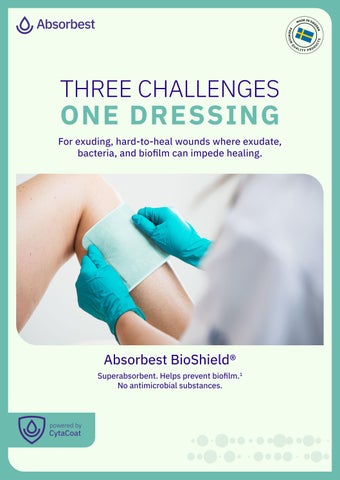
THREE CHALLENGES
ONE DRESSING For exuding, hard-to-heal wounds where exudate, bacteria, and biofilm can impede healing.
Absorbest BioShield® Superabsorbent. Helps prevent biofilm.1 No antimicrobial substances.
powered by
CytaCoat
WHEN HEALING DOESN’T GO AS EXPECTED If a wound isn’t healing as expected, there may be several reasons. One of them is biofilm.
68–78 %
Reported prevalence of biofilm in hard-toheal wounds. A reminder that biofilm may still be relevant when it isn’t visible.
What is biofilm? Biofilm is a protective layer that forms as microorganisms colonise and organise themselves in a wound. It makes it harder for the body’s defences to reach them, which can prolong inflammation and delay wound healing.
INDIVIDUAL MICROORGANISMS
ATTACH TO THE WOUND
MULTIPLY AND FORM A PROTECTIVE BIOFILM
Biofilm is not always visible. But the process starts early. Microorganisms can quickly attach to the wound surface, beginning biofilm formation. It may therefore be worth considering biofilm when several changes recur or the wound does not progress as expected.
WHEN SHOULD YOU THINK ABOUT BIOFILM? Biofilm is not always visible, so monitor how the wound changes over time. If a hard-to-heal wound stops progressing, behaves differently, or changes repeatedly, biofilm may be one of several factors to consider.
The wound is not healing as expected Despite appropriate treatment, healing has stalled or is progressing slowly.
Deposits that quickly reappear Deposits on the wound surface may include fibrin, tissue debris, or other material that covers parts of the wound bed. If they reappear quickly after cleansing, this may indicate a need for further assessment.
Recurring signs of local inflammation For example, redness, warmth, swelling, or tenderness in or around the wound. These signs should always be assessed in context.
Increased wound exudate The wound produces more fluid than before or requires more frequent dressing changes.
LOOK FOR CHANGES OVER TIME One change alone doesn’t necessarily indicate biofilm. But if several changes keep recurring or healing stalls, biofilm may be one of several factors to consider.
ONE DRESSING. THREE FUNCTIONS.
2
TRAPS BACTERIA AND FUNGI Traps microorganisms in the wound exudate and retains them within the dressing.
1
MANAGES WOUND EXUDATE Absorbs and retains wound exudate in the dressing.
3
HELPS PREVENT BIOFILM FORMATION The unique contact surface makes it more difficult for microorganisms to attach and form biofilm.1
Why the combination is important In exuding, hard-to-heal wounds, you need to manage both wound exudate and microorganisms while addressing early biofilm formation. Absorbest BioShield combines all three functions in one dressing.
THIS IS HOW ABSORBEST BIOSHIELD® WORKS Unique wound contact surface Placed towards the wound, its white surface is designed to make it harder for microorganisms to adhere and form biofilm.1
Breathable, fluid-repellent green backing
Allows excess moisture to evaporate, helping minimise strike-through and reduce leakage risk.
Another way to help prevent biofilm Non-antimicrobial dressings rely on microorganisms adhering to the dressing on contact. Absorbest BioShield works differently: its unique contact surface is designed to inhibit early biofilm formation at the dressing–wound interface without releasing antimicrobial substances.1
Superabsorbent core
Absorbs and retains large volumes of wound exudate within the dressing, even under compression.
Non-antimicrobial approach
The white surface helps prevent biofilm from forming without releasing antimicrobial substances into the wound.1
WHEN IS ABSORBEST BIOSHIELD® RELEVANT? Biofilm is commonly found in hard-to-heal wounds. Absorbest BioShield combines effective exudate management with support for preventing early biofilm formation,1 creating more stable conditions for wound care.
When wound healing stalls Biofilm can be one of several factors that delay healing. Absorbest BioShield’s unique surface helps prevent early biofilm formation at the wound contact surface.1
When managing large volumes of wound exudate Absorbest BioShield pairs a surface that helps prevent biofilm formation1 with a superabsorbent core that absorbs and retains large volumes of wound exudate, even under compression.
When there is a risk of biofilm Biofilm can quickly form or reform after cleaning and debridement, so it’s important to prevent new biofilm from developing between dressing changes.
Three challenges. One dressing. By managing exudate and bacteria while helping prevent early biofilm formation, Absorbest BioShield addresses three challenges with one dressing. In vitro and preclinical in vivo data support this approach.1
WHAT DOES THE EVIDENCE SHOW? Absorbest BioShield was evaluated in laboratory experiments and a porcine wound model. Biofilm formation and bacterial burden were compared with those of uncoated controls and DACC dressings. Biofilms were analysed by confocal microscopy, and bacterial levels were quantified as CFU/g of tissue.
IN VITRO: Biofilm is prevented from forming on the Absorbest BioShield® surface
After seven days, structured biofilm is present on both the uncoated control and DACC surfaces. In contrast, the Absorbest BioShield surface shows only scattered microbial cells, with no structured biofilm. The arrows highlight the key difference in organisation: biofilm forms dense, organised clusters of microorganisms.
UNCOATED CONTROL SURFACE
DACC SURFACE
ABSORBEST BIOSHIELD® SURFACE
PRECLINICAL IN VIVO: Less biofilm and a faster reduction in microbial burden
In a preclinical porcine wound model, the Absorbest BioShield dressing had less biofilm accumulation on the surface, and the bacterial burden in wound tissue decreased more rapidly than with the control dressing.
These results support Absorbest BioShield’s surface-based, non-antimicrobial strategy to help prevent early biofilm formation. ABSORBEST BIOSHIELD® SURFACE
No biofilm build-up between the fibres
UNCOATED CONTROL SURFACE
Biofilm build-up between the fibres
Absorbest BioShield® Item
Product size cm
REF
Pieces per box
Absorption capacity
Absorbest BioShield®
5x5
F60910/10
10
20 ml
Absorbest BioShield®
7.5x7.5
F60911/10
10
60 ml
Absorbest BioShield®
10x10
F60913/10
10
125 ml
Absorbest BioShield®
10x20
F60915/10
10
310 ml
Absorbest BioShield®
15x20
F60914/10
10
400 ml
Absorbest BioShield®
20x20
F60916/10
10
600 ml
Absorbest BioShield®
20x30
F60917/10
10
910 ml
Free swell absorption capacity according to EN 13726:2023
References1 • • • • • • • • • • • • • • •
Brookes G, Junker J, Larsson H, et al. A new non-antimicrobial dressing that prevents biofilm formation under clinically realistic wound conditions. Poster presentation EP165. European Wound Management Association (EWMA); 2026. Todhunter J, Greenhow H, McSkeane A. Use of a superabsorbent dressing in wounds with moderate-to-high exudate volume. J Community Nurs. 2024/2025 Dec-Jan;38(6):38-43. Collier M. A clinical observational case series evaluation of a superabsorbent dressing on exudating wounds. Br J Nurs. 2024;33(12):S29-S37. doi:10.12968/bjon.2024.0180. Hindhede A, Meuleneire F. A clinical case-series evaluation of a superabsorbent dressing on exuding wounds. J Wound Care. 2012;21(11):574,576-580. doi:10.12968/jowc.2012.21.11.574. Hoglin G, Freijd H. A cohort study to investigate the benefit of the use of DryMax EXTRA superabsorbent wound dressing on a population of wet wounds. In: Wounds UK Annual Conference; 2011; Harrogate, UK. Larkö E, Persson A, Blom K. Effect of superabsorbent dressings in a 3D acellular tissue model of Pseudomonas aeruginosa biofilm. J Wound Care. 2015;24(5):204,206-210. doi:10.12968/jowc.2015.24.5.204. Absorbest AB. Data on file. Barker JC, Khansa I, Gordillo GM. A formidable foe is sabotaging your results: what you should know about biofilms and wound healing. Plast Reconstr Surg. 2017;139(5):1184e-1194e. Coelho MMF, Avelino BMA, de Oliveira BA, Rios MA, do Amaral Gubert F, Martins MC, et al. Prevalence of biofilm in chronic wounds: systematic review with meta-analysis. Wounds. 2025;37(8):283-291. doi:10.25270/wnds/24124. Malone M, Bjarnsholt T, McBain AJ, James GA, Stoodley P, Leaper D, et al. The prevalence of biofilms in chronic wounds: a systematic review and meta-analysis of published data. J Wound Care. 2017;26(1):20-25. doi:10.12968/jowc.2017.26.1.20. Malone M, Radzieta M, Schwarzer S, Walker A, Bradley J, Jensen SO. In vivo observations of biofilm adhering to a dialkylcarbamoyl chloride-coated mesh dressing when applied to diabetes-related foot ulcers: a proof-of-concept study. Int Wound J. 2023;20(6):19431953. doi:10.1111/iwj.14054. Brandenburg KS, Calderon DF, Kierski PR, Brown AL, Shah NM, Abbott NL, et al. Inhibition of Pseudomonas aeruginosa biofilm formation on wound dressings. Wound Repair Regen. 2015;23(6):842-854. doi:10.1111/wrr.12365. World Union of Wound Healing Societies (WUWHS). The role of non-medicated dressings for the management of wound infection. London: Wounds International; 2020. Blackburn J, Ousey K, Rippon M, Rogers A, Pastar I, Lev-Tov H. Applying antimicrobial strategies in wound care practice: a review of the evidence. Int Wound J. 2025;22(6):e70684. doi:10.1111/iwj.70684. Maillard JY, Kampf G, Cooper R. Antimicrobial stewardship of antiseptics that are pertinent to wounds: the need for a united approach. JAC Antimicrob Resist. 2021;3(1):dlab027. doi:10.1093/jacamr/dlab027.
Interested in evaluating Absorbest BioShield® in clinical practice? Contact our UK partner CD Medical +44 1942 816184 info@cdmedical.co.uk www.absorbest.co.uk
Contact Absorbest
Thomas Palmér +46 (0)70 969 99 57 thomas.palmer@absorbest.se