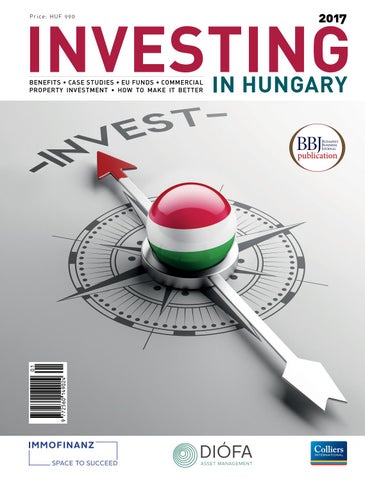
INVESTING P ri c e: H U F 9 9 0
BENEFITS • CASE STUDIES • EU FUNDS • COMMERCIAL PROPERTY INVESTMENT • HOW TO MAKE IT BETTER
2017
IN HUNGARY B publication
4
INVESTING IN HUNGARY
INTRODUCTION
Adding Jobs, Creating Value, Drawing Investment When Hungary was first able to draw breath again following the shock of the deep economic crisis that hit the Western world in 2008, it tried to lay down some plans to prevent it being hit so dramatically a second time around. A country with an economy as open as Hungary’s was always going to be vulnerable. There is little hope that it will ever get to the stage where it is unbuffeted by the winds of change elsewhere. But Germany, for example, although also hit by that same storm, was better able to weather it. For Germany, the effects were felt less deeply, and for a shorter period of time. At one of their first meetings, then U.K. Prime Minister Tony Blair is supposed to have asked German Chancellor Angela Merkel where the secret of Germany’s robust economy lay. “My dear Mr. Blair,” she is said to have replied, “we still make things.” The current Hungarian government of Viktor Orbán may not agree with the German Chancellor about very much politically,
these days, but it could understand the logic of making things. The Hungarian economy was service-heavy, jobs that were easy to move. It needed, as the Hungarians say, to stand on “more than one foot”. Hence a drive to attract manufacturing investments, under the slogan “Made in Hungary”. There is a crucial caveat to Chancellor Merkel’s advice to Prime Minister Blair; you need to make things the world wants. There is still precious little use for a chocolate fireguard, and even less demand. So, Hungary targeted the world’s automakers (Suzuki and Opel were already long established here), along with their Tier One suppliers, and did it well enough that Mercedes built a brand-new plant here, and then a second. But the problem with manufacturing jobs is that they will increasingly disappear, replaced by digitalization and automation. Having secured economic recovery, Hungary’s government turned its attention to attracting the type of investments that bring value-added jobs; jobs that are much
INVESTING IN HUNGARY
less likely to be replaced by machines. “Made in Hungary” became “Invented in Hungary”. Funnily enough, while it speaks to the sort of cutting edge R&D work that automakers excel at (Audi will soon start producing electric engines at its plant in Győr, 121 km west of Budapest), it also brings the service sector firmly back into view. Not that it ever went away; the government just seemed to speak about it less. Not now. In November, at the third Hungarian Shared Services Gala, Minister of Foreign Affairs and Trade Péter Szijjártó declared: “The shared services sector will be the most important sector in the transition of Hungary’s economy to a new dimension.” He added: “The shared services center sector is a young sector of the Hungarian economy, but has developed ‘by leaps and bounds’ in recent years and plays a determining role among foreign investments in Hungary”. Szijjártó noted out that the sector is in second place when it comes to the number of newly created jobs, with almost 2,500 positions created in 2016 through 12 projects. There are (at the time of writing) 110 shared service centers operating in Hungary, employing some 46,000 people, primarily young and with university degrees. “The SSC sector is a sector that represents high added value, and a host of projects that
involve a high level of technological and intellectual value have arrived in the country in recent years within this field,” Szijjártó acknowledged. “If the SSC projects planned for this year are all realized it will mean the creation of over 1,600 new jobs requiring a high level of training.” Hungary has much to offer, not least location, a well-educated work force and high-level engineers and programmers. It also faces challenges, including an increasingly tight labor market, the pressures of which will inevitably lead to rising wages and a decreasing cost benefit over more mature Western markets. It is also incredibly capital-centric, with very little development of secondary cities in terms of international investment levels. The picture above is not just pretty, it is apt. For many, investing in this country means investing in Budapest. This first volume of what we intend to be an annual publication looks at the opportunities and pitfalls that lie ahead. We detail successful case studies, and talk to international analysts about the market trends, and the levels of government support. We hope you will find it a useful guide to “Investing in Hungar y”.
Robin Marshall Editor-in-Chief Budapest Business Journal
5
20
INVESTING IN HUNGARY
TER N E C OF NCE E L EL C X E
Richards was in Budapest to make it just a bit bigger, part of a team celebrating the inauguration of its latest operation. Planned to employ a total of 100, Itron’s so-called Center of Excellence will provide software, services and research & development functions worldwide, though primarily for Itron’s European customers and its own operations. R&D BREAKTHROUGH Emphasizing the project as part of a breakthrough in propelling Hungary from a production base to an R&D location, Péter Szijjártó, Hungary’s Minister for Foreign Affairs and Trade, put the total investment of the new center at HUF 2 bln, of which the
state provided HUF 412 million as part of an incentive package. Why, though, choose Budapest, and swish District V, to locate this unit? “We not only looked at Budapest, we did a whole tour of different cities in central Europe… We were really impressed by the talent pool, and the cost-effectiveness was higher here. So, per dollar, we could get more here than in [competing] cities,” says Bruce Douglas, senior vice-president at Itron and general manager for software and services. Among those passed by on the way were Prague and Brno, in Czech Republic. Despite a fast-growing reputation
INVESTING IN HUNGARY
FINDING THE RIGHT TALENT IN BUDAPEST With unemployment levels a mere touch above 4% across Hungary, it’s one thing to create the company strategy and find the right office location, and quite another to staff it, especially with numerous competing companies scouring the landscape for anyone with half-decent IT skills. But Gaurav Swarup, director of Itron’s European center of excellence in Budapest, says the U.S. company’s leading position in the IoT sector, especially its green-social role in terms of energy and water saving, is itself an attraction for job seekers. “Many of the candidates find the work very inspiring. We’ve managed to build a good team so far, with 30 people in two-to-three months. These are early days, of course, but I’m quite confident.” That confidence seems well grounded; the head count had jumped to 47 by late November.
for affordable IT skills in the latter, Budapest won out on accessibility. “As a location, it’s easier for us to get here from Paris and Frankfurt direct [than Brno],” Douglas says. As for the expensive offices – for Douglas that is just par for the caliber employees needed. UNIQUE SPACE “We were looking for a unique space, because the [people] that we’re looking to attract are really high-focused technology talent,” he says. But two other factors played crucial roles in the decision to opt for Budapest. For one, the enthusiasm of government officials selling the country made a big impression on the team.
Swarup, originally from India, has been working in Paris and across the United Kingdom for 17 years, and says most jobs will be filled by “Hungarian talent”, but the need for multi-lingual people, such as Spanish and French speakers, for specialist jobs means he has also been hiring selected non-Hungarian recruits. And so far, even finding these people has not been overly difficult. “Some were already here, in the market. I think that the ecosystem that exists here probably enables that. It [Budapest] has been attracting international people for some time now,” Swarup tells the BBJ.
21
36
INVESTING IN HUNGARY INSIDE VIEW
Data protection and competitiveness The forthcoming application of the EU’s General Data Protection Regulation (“GDPR”) in May 2018 will have significant effects on the competitiveness of the EU markets and online investments. Whilst safeguarding customer data, the GDPR may give rise to a vast number of regulatory ambiguities, which could cause significant costs for companies. DEVELOPMENT COSTS For the first time in the EU, the GDPR requires companies to consider the principles of “Privacy by Design” and “Privacy by Default” when developing a product, service or project and throughout its lifecycle. The compliance demands the most appropriate technical background suitable for the safe storage and transfer of data. According to a global study by Veritas Technologies, an information management company, companies are expected to spend an average of EUR 1.36 mln on GDPR readiness initiatives worldwide.
Tamás Tercsák, Counsel CMS Budapest
Márton Domokos, Counsel CMS Budapest
An analysis published by the European Center for International Political Economy (ECIPE) estimates that disruptions to crossborder data flows could result in negative impact on the EU of up to 1.3% of the GDP. On the other hand, a higher level of data protection can also induce competition in many sectors, which is often not guaranteed by third country privacy laws. According to NASSCOM, an Indian-based not-for-profit industry association, and the Data Security Council of India (DSCI), there is already an opportunity loss of USD 2-2.5 billion in India’s economy owing to data transfer related concerns from the European perspective. All-in-all, companies will spend more money on data protection compliance under the GDPR than ever.
than 350,000 credit card numbers in 2015. The investigation of the U.S. regulator found that the hotel did not provide consumers affected by the breach with immediate notice, did not maintain a comprehensive information security program, and did not conduct data security assessments. To better understand the costs of data breaches, IBM Security and Ponemon Institute released a global study this year, which covers 419 companies, as well as 13 countries and regions. According to the study, in 2017 the average cost of data breach in the United States was significantly higher than that taking place in the EU. For example: the average cost of data breach in the States was USD 7.35 million, whereas in Germany it was “only” USD 3.68 mln. To further assess the indirect costs of the data breaches, IT consultant CGI and Oxford Economics analyzed Gemalto’s Breach Level Index and found that two-thirds of firms breached had their share price negatively impacted. Of the 65 companies evaluated, the breach cost shareholders more than USD 52.40 bln. Currently, only 5% of the breaches were reported from Europe. This is likely to change, once the GDPR becomes mandatory as of May 25, 2018 and new data breach reporting obligations will apply to European companies as well.
PRICING THE TRUST According to a study by Gemalto, a digital security firm based in the EU, in the first half of 2017 there were 918 data breaches, resulting in 1.9 billion data records being exposed. This is a 164% (!) increase over the last six months of 2016. Some 86% of the breaches were disclosed in North America. A recent example from the United States: the New York attorney general announced a USD 700,000 settlement with a major hotel chain after a data breach exposed more
HR COSTS Costs associated by complying with the provision of the GDPR may range from appointing an internal data protection officer (DPO) to the general operation of a safe data management system. According to a study by the International Association of Privacy Professionals (IAPP), as many as 75,000 DPO positions will be created in response to the GDPR worldwide. A significant number of DPO positions will be established by the top EU trading partners: approximately 9,000 by the USA, 7,600 by China and 3,000 by Russia. A GDPR MENTALITY Despite the additional costs that may arise for companies, GDPR should not serve as any form of impediment for e-commerce or cross-border investments. The new and strict rules (including fines up to EUR 20 mln) can also help companies to mitigate the data protection risks, like data breaches and data security problems. Companies should consider the GDPR as the price of consumer trust, rather than a barrier, and by developing solutions and acting in line with the new rules, companies can preserve their market shares or even become frontrunners in EU markets. Our guide “Greenfield investments in CEE” can be downloaded from our website: cms.law
cms.law
NOTE: ALL ARTICLES MARKED E XPERT OPINIONS ARE PAID PROMOTIONAL CONTENT FOR WHICH THE BUDAPEST BUSINESS JOURNAL DOES NOT TAKE RESPONSIBILIT Y
INVESTING IN HUNGARY
REAL ESTATE 2017
IMPROVING INVESTOR SENTIMENT TOWARDS REAL ESTATE Investors and financial lenders are showing an increasingly favorable attitude to the development, investment and redevelopment of buildings in the office, industrial, retail and hotel market sectors in Budapest. By Gary J. Morrell This provides employment for staff in the various market sectors, along with work opportunities for property management, facility management and building maintenance professionals and workers in the construction industry. One brake on further, or faster, market development is the shortage of skilled labor in all market sectors. The volume of investment into income-producing real estate is rising after a prolonged downturn, with a significant proportion of transactions being undertaken by local investors that provide additional liquidity and security for the market. The region as a whole is attracting more investment, with Czech Republic and Poland currently the leading Central European investment destinations, although the gap with Hungary is narrowing.
Aréna Plaza
Arguably the most immediate competitor for Hungary is the Czech market, where yearend volume is expected to exceed EUR 3 billion, compared to an anticipated 2017 figure of circa EUR 1.7 bln locally. Continued on page 38. ► ► ►
“I would argue that the market is split 50/50 between core and opportunistic investors, so there is a healthy mix between the two types of buyers.”
37
40
INVESTING IN HUNGARY
REAL ESTATE 2017
Cushman & Wakefield Portfolio Services Center in Budapest.
Continued from page 38. ► ► ► (Hungary was a relative latecomer to this coordinated national approach to selling the country, and it was a move that was much welcomed by the market when it did come.) At MIPIM 2017, HB Reavis showcased its latest Budapest office project, the phased 138,000 sqm Agora Budapest. (The company also presented the 140,000 sqm Varso Place in Warsaw, including the 230 meter Varso Tower, which will be one of the tallest buildings in Europe.)
“Increasing construction costs are slowing down speculative development in the industrial market, hence Budapest stock is unable to keep up with demand.”
The office markets in the four core Central European capitals of Budapest, Prague, Warsaw and Bratislava – the countries are collectively known as the Visegrad Group or the Visegrad 4 – are all seen as benefiting from strong demand with the resulting development opportunities.
projects. It is fair to say that the market for well-located sites in Budapest is under-supplied, with almost no availability thereof,” commented Bence Vecsey, director of investment services at Colliers International.
DEVELOPMENT PROJECTS “Development projects and land deals are usually excluded from transaction data given transparency concerns, although Colliers estimate that in the last three years more than EUR 300 mln was invested in development projects and land in Budapest. The number only refers to larger, 400 plus units of residential
The choice of Budapest as the location for its global Portfolio Services Center (PSC) by Cushman & Wakefield is seen as a significant success for Hungary in that it is by attracting companies from a high-quality service industry that the country can offer exciting employment possibilities to its workers. Continued on page 42. ► ► ►
INVESTING IN HUNGARY INSIDE VIEW
Proposed Screening of FDI to Hungary Earlier this fall, the Hungarian Ministry for Internal Affairs launched a public consultation on its proposal for adoption of rules to enable screening of foreign acquisitions of certain Hungarian strategic companies handling critical infrastructure or technologies by investors from outside the European Union (EU) and the European Economic Area (EEA).
János Tóth, Partner Wolf Theiss Budapest The key justification for this proposal is that some of these acquisitions by non-EU investors could be detrimental to national security or public policy in Hungary and that currently there is a limited and unsophisticated mechanism available for the Hungarian government to screen and potentially prohibit acquisitions by foreign investors in such strategic companies. Accordingly, the proposal would make the acquisition of a stake in excess of 25% in a Hungarian company operating in the selected strategic businesses subject to the prior review and approval by the Hungarian Minister of Interior. The Hungarian initiative came just ahead of a very similar proposal the European Commission issued in September 2017 for a regulation establishing a framework for screening FDI in the European Union, which was highlighted by European Commission President Jean-Claude Juncker in his speech on the State of the European Union as a top priority for the European Commission. Unlike the United States or China, which pursue aggressive trade policies and where FDI transactions have long been subject to certain screening and restrictions, the EU currently does not have any legislation in place on the review of foreign investments. Instead, about half of the EU’s Member States, such as
Germany or Poland, have their own national screening mechanisms, which vary widely but generally can lead to the modification or prohibition of certain investments on grounds of public policy and national security. As mentioned, no such rules exist in Hungary either, let alone certain sectorial reviews available in selected regulated industries, such as energy or banking, in which the acquisition of certain controlling stakes have long been subject to prior approval of the competent national regulator. The apparent turbulence around this topic results from a series of recent takeovers of leading European companies by statecontrolled foreign investors. Chinese investors, in particular, have been actively pursuing European companies that develop technologies or maintain infrastructures that are viewed as essential to critical functions in the European economy. The Commission’s proposal is expected to enable EU members states to follow companies and investors with interests in the EU, as well as foreign governments. The European Commission has also pointed out, however, that rather than allowing similar restrictions on FDI to become politically uncoordinated at national level, it is desirable to create a regulatory framework and provide well-designed and uniform investment review mechanisms for the EU to protect strategic companies, which could also help increase legal certainty and provide a more transparent and fairer process to foreign investors. Eventually, however, the devil will be in the details, as these screening mechanisms can differ in scope and procedure, e.g. general cross-sectoral coverage vs. specific coverage of the selected sectors; ex-ante vs. ex-post review mechanisms; voluntary vs. mandatory notifications, etc. The proposed regulation would create a framework for information sharing between member states and the European Commission, ensure that screening mechanisms meet common basic criteria concerning transparency, non-discrimination and judicial review, and establish common
criteria that member states should consider in any screening process they operate, including whether a foreign investor is controlled by the government of a third country. A member state that currently does not have an FDI screening mechanism in place is not required to establish one, but it would be obliged to consider the views of another member state or the European Commission on an FDI in its jurisdiction, and to provide information in that respect to other member states and the Commission. The final decision on whether to restrict a given investment would remain with the country in which the investment is planned, leaving member states with a fair amount of discretion to determine what their essential public policy concerns are, provided that they are not discriminatory. The proposed regulation would specifically authorize member states to adopt provisions that prevent circumvention of the screening mechanisms, to capture situations, for example, where an investment is structured with a company already established and operating in a member state, but owned or controlled by a non-EU foreign investor. Apparently, the Hungarian proposal does not stand at this level of sophistication, however. Its succinct wording leaves important questions open such as: (i) how indirect control by non-EU investors should be construed; would staggered acquisitions also be captured?; (ii) what exact criteria the minister would apply when rendering its decision; (iii) would a prohibition by the minister (subsequently confirmed by the Hungarian government) still remain subject to court review? It is to be seen during the few weeks remaining from the fall session of the Hungarian Parliament if and how the Hungarian proposal will progress its way against the European Commission’s proposal.
www.wolftheiss.com
NOTE: ALL ARTICLES MARKED E XPERT OPINIONS ARE PAID PROMOTIONAL CONTENT FOR WHICH THE BUDAPEST BUSINESS JOURNAL DOES NOT TAKE RESPONSIBILIT Y
41
LEADER REAL ESTATE COMPANY IN CEE REGION
Office
Retail
Logistics Hospitality
www.cpigroup.hu