HUNGARY’S PRACTICAL BUSINESS BI-WEEKLY SINCE 1992 | WWW.BBJ.HU
HUF 1,250 | €5 | $6 | £3.5
BUSINESS JOURNAL BUDAPEST
VOL. 27. NUMBER 2
FEBRUARY 1 – FEBRUARY 14, 2019
SPECIAL REPORT BBJ Expat CEO of the Year SPECIAL REPORT
Fifth BBJ Expat CEO of the Year Awards Gala See our five-page coverage of the annual event celebrating the very best of expat CEOs and the contributions they help make to improving Hungary’s competitiveness. 16-20 BUSINESS
Keeping up at CEE’s Fastest- growing Airport Traffic management poses ever more challenges to Budapest Ferenc Liszt Airport. But changes to ease traffic are on the way, operator Budapest Airport tells the Budapest Business Journal. 10
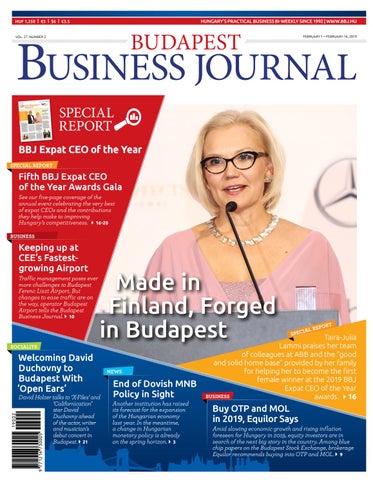
Made in Finland, Forged in Budapest
SOCIALITE
Welcoming David Duchovny to Budapest With ‘Open Ears’
David Holzer talks to ‘X-Files’ and ‘Californication’ star David Duchovny ahead of the actor, writer and musician’s debut concert in Budapest. 21
NEWS
End of Dovish MNB Policy in Sight
Another institution has raised its forecast for the expansion of the Hungarian economy last year. In the meantime, a change in Hungarian monetary policy is already on the spring horizon. 3
SP
LR EC I A
EPOR
T
Taira-Julia Lammi praises her team of colleagues at ABB and the “good and solid home base” provided by her family for helping her to become the first female winner at the 2019 BBJ Expat CEO of the Year BUSINESS awards. 16
Buy OTP and MOL in 2019, Equilor Says Amid slowing economic growth and rising inflation foreseen for Hungary in 2019, equity investors are in search of the next big story in the country. Among blue chip papers on the Budapest Stock Exchange, brokerage Equilor recommends buying into OTP and MOL. 9
2 | 1 News BBJ
www.bbj.hu
Budapest Business Journal | February 1 – February 14, 2019
THE EDITOR SAYS
EDITOR-IN-CHIEF: Robin Marshall EDITORIAL STAFF: Zsófia Czifra, Kester Eddy, Bence
Gaál, David Holzer, Christian Keszthelyi, Gary J. Morrell, Robert Smyth, Zsófia Végh, Zalán Zubor. LISTS: BBJ Research (research@bbj.hu) NEWS AND PRESS RELEASES:
Should be submitted in English to news@bbj.hu LAYOUT: Zsolt Pataki PUBLISHER: Business Publishing Services Kft. CEO: Tamás Botka ADVERTISING: AMS Services Kft. CEO: Balázs Román SALES: sales@bbj.hu
CIRCULATION AND SUBSCRIPTIONS: circulation@bbj.hu
Address: Madách Trade Center 1075 Budapest, Madách Imre út 13-14., Building A, 8th floor. Telephone +36 (1) 398-0344, Fax +36 (1) 398-0345, www.bbj.hu SUBSCRIPTIONS: Budapest Business Journal 1 year 6 months 3 months
HUF 27,500+VAT HUF 13,750+VAT HUF 6,875+VAT
News Services Hungary A.M., Energy Today, Regional Today 1 year, from HUF 179,000+VAT 6 months, from HUF 104,900+VAT 3 months, from HUF 58,900+VAT Book of Lists 2018-2019: HUF 19,120+VAT DigiBOL HUF 39,900+VAT Call +36 1 398-0344 or email circulation@bbj.hu What We Stand For: The Budapest Business Journal aspires to be the most trusted newspaper in Hungary. We believe that managers should work on behalf of their shareholders. We believe that among the most important contributions a government can make to society is improving the business and investment climate so that its citizens may realize their full potential.
We may “only” have been celebrating its fifth birthday, but it felt as if the BBJ Expat CEO of Year awards gala had really come of age on January 25. When asked what they think expat CEOs bring to Hungarian economic life, the word most often heard from our short-listed nominees is “diversity”: of nationalities, races, cultures, ideas, skill sets, mentalities, life experiences and more. It came up again this year. And it was apt it did so; the fifth annual event, staged once again in the Grand Ballroom of the Corinthia Hotel Budapest, was diversity personified. For only the second time in five years, we had a woman shortlisted. As if to celebrate, we promptly had another. Men still made up the majority of nominees in 2019, but two out of five isn’t bad. And to top it all, we had our first female winner (TairaJulia Lammi, of Swiss-Swedish technology multinational ABB). It felt like an important moment. As one Hungarian female said to me at the gala: “It doesn’t matter what the nationality is; it is important for us as women to see role models up there on stage.” Over the half decade we have been running the event, the majority of those short-listed (and most winners) have been German, which makes sense if you consider geography and the fact that Germany is Hungary’s largest investor. But this year we had our first British candidate (Melanie Seymour, of the U.S.based global investment management corporation BlackRock), and our first American (Kevin A. Murray, of Citibank).
Ticking yet another box, Lammi was our first Finnish nominee. We had our first Indian candidate, Prabal Datta of Tata Consultancy Services, and our first Indian winner, Kannan Prabhakar of Apollo Tyres, who picked up the HIPA Partnership Award from our official event partner, the Hungarian Investment Promotion Agency. Diversity was also there in the list of ambassadors present for at least part of the evening, with the representatives of Austria, France, Germany, Poland and the United States all in attendance. In a slightly odd coincidence, last year’s winner of the Expat CEO title, Marc de Bastos Eckstein, broke new ground in becoming the first winner whose first name did not begin with the letter “J”. This year’s winner both continued that trend, and reversed it. By her own admission at a recent AmCham event, Lammi’s Finnish forename, Taira-Julia, is “monstrous”. She is generally, therefore, known as Julia. You will find more about this year’s event in our Special Report inside this issue. There is also a gallery of photos on our website. We wait to see what records may be broken at the 2020 gala, when we will be able to borrow from author A.A. Milne and say “Now we are Six”. But we hope we will be able to add further examples of diversity in practice. Hungary is a better place, and has a better economy, as a result of it. Robin Marshall Editor-in-chief
Photo: MTI / Balázs Mohai
Photo: Fortepan.hu / Bence Sebestyén
The Budapest Business Journal, HU ISSN 1216-7304, is published bi-weekly on Friday, registration No. 0109069462. It is distributed by HungaroPress. Reproduction or use without permission of editorial or graphic content in any manner is prohibited. ©2017 BUSINESS MEDIA SERVICES LLC with all rights reserved.
DIVERSITY SHINES THROUGH AT 5TH EXPAT CEO AWARDS
THEN & NOW
BBJ-PARTNERS
VISIT US ONLINE: WWW.BBJ.HU
In the color photo, a child exits a carriage on Hungaryʼs Gyermekvasút (Childrenʼs Railway), the 11km narrow gauge line that connects Széchényi-hegy and Hűvösvölgy in Budapest, during an open day on January 27. In the black and white picture, dated to 1949 a child operates a VES-type railway security device on the same line.
1
www.bbj.hu
Budapest Business Journal | February 1 – February 14, 2019
News///macroscope
MNB Changes Anchor, end of Dovish Policy in Sight?
Another institution has raised its forecast for the expansion of the Hungarian economy last year, along with one of the large international credit rating agencies. In the meantime, a change in Hungarian monetary policy is already on the spring horizon.
ZSÓFIA CZIFRA
Economic research institute GKI raised its earlier growth projection for 2018, to 4.6% on January 28, noting that 2018 “was probably the best year of the decade for Hungary”. This rate was remarkably high in the EU, the GKI says, noting that the growth cycle is likely to have reached its peak, and the rate of expansion is expected to fall back to
around
3.4%
in 2019. According to the research institute, expansion continues to be driven primarily by domestic demand. This year’s GDP projection is still up from a 3.2% forecast GKI released in December. The research institute expects EU transfers to continue to grow in 2019, but puts investment growth at a relatively low rate. “Although EU transfers will continue to grow in 2019, they will only generate an investment growth of around 5%,” the forecast reads. As for inflation trends, GKI recalls that inflation was 3.8% in October, and fell to 2.7% in December, which can mainly be contributed to a 12% drop in fuel prices over the two months. However, it was still the third highest rate in the EU.
Core Inflation
Also, the tax-filtered core inflation (which excludes volatile fuel prices)
General Government Balance in Hungary (January-December 2018) Balance of the Central Budget
General Government Balance
HUF trillion
-1.368 -1.763
-1.445 -1.833
Source:
continued to rise, and nearly reached the 3% inflation target of the National Bank of Hungary (MNB) in December. Although fuel prices started to rise again in January, the chances of a somewhat lower year-on-year rise in consumer prices have increased, GKI’s forecast says. With core inflation inching ever closer to the medium-term goal of the MNB, the central bank has already signaled that it is prepared to tighten its monetary policy. Analysts prior to the rate-setting meeting of the Monetary Council on
January
29
expected the MNB to take a more hawkish stance. Deputy Governor Márton Nagy had made some comments two weeks ago that linked tightening to a rise in tax-adjusted inflation, excluding food and energy prices, to 3% or more. It rose to 2.9% in December from 2.7% in November. Some analysts did not rule out that the bank may signal a cut in its FX swap stock, which could lead to a rise in short-term interbank rates, Reuters wrote in advance of the Monetary Council meeting. However, the MNB left its main interest rates unchanged at its record low of 0.9%, on Tuesday and repeated its commitment to a “gradual and cautious” normalization of monetary policy, but no new clues about timing was indicated.
Anchors Away
Now, all eyes on the March inflation report of the central bank, as the MNB has lately changed its anchor. It no longer keeps an eye out for a possible interest rate raise by the European Central Bank, as weaker economic data of the eurozone now indicates that the ECB is not likely to raise interest rates before 2020. Therefore, the MNB now looks instead at the inflation trends in Hungary, however, headline inflation is not in the focus anymore; instead, the central bank considers tax-filtered core inflation as the anchor for its monetary policy. This is mainly due to the rather volatile fuel prices, as mentioned before. The fact that there is no change in the Monetary Council’s tone means only a delay in the possible start of a tightening cycle, analysts say. The bank’s inflation report in March might be a good opportunity for this, CIB bank analysts said. As the first step of normalization, the MNB might seek to influence market interest rates by narrowing liquidity, and in the next stage (or possibly in parallel), it could modify monetary conditions via its interest rate corridor, Reuters cited analysts as saying. The council, indeed, has said earlier it is “prepared for the gradual and cautious normalization of monetary policy” but it has also signaled that any tightening would start with adjustments to unconventional policy tools, before any changes to the base rate.
Gergely Suppan, analyst at Takarékbank also noted that the tax-filtered core inflation rate might reach the
3% target
in the coming months, therefore normalization could start soon, possibly as early as in March. Morgan Stanley analyst Pasquale Diana commented that the MNB has kept the possibility of starting a tightening cycle in March on its agenda; however, external factors, such as the more cautious monetary stance by the ECB, might delay this further until the summer.
Numbers to Watch in the Coming Weeks On February 5, the Central Statistical Office (KSH) will publish the muchawaited December retail trade data; according to expectations, Hungary’s retail sector closed a very good year in 2018. On February 7, December industrial output will be in the spotlight: the first estimate on that day will be followed by the second estimate on February 13. The consumer price index for January will be released on February 12, and this might give further ground for a change in the monetary policy in the coming months. A flash estimate of fourth quarter GDP will come out on February 14.
4 | 1 News
www.bbj.hu
Budapest Business Journal | February 1 – February 14, 2019
Budapest and Back, via Alberta, Hong Kong and Hollywood Refugee, photographer, hairdresser, wig maker, motionpicture producer and film commissioner; Andy Vajna, who died in Budapest on January 20, aged 74, had been there and got the T-shirts. KESTER EDDY
As a kid in the Hungarian capital during the early 1950s, András Vajna was, in his own words, “the hottest thing on the block”. “I used to get the greatest toys for Christmas from my aunt in Los Angeles. Everyone would come and play with my toys.” So when, during the 1956 Uprising, family talk came to fleeing Hungary, the favored destination was obvious. “I wanted to go where those toys were being made,” he told journalists of the Hungarian International Press Association at their annual dinner in February, 2012. Vajna left, aged 12, and made it to Vienna (see box), but as an unaccompanied minor, was refused entry to the United States. “I looked at the map, at what was the closest to Los Angeles, and ended up in Edmonton Alberta,” where a Hungarian family fostered the boy. Vajna was soon able to reunite with his parents, who had meanwhile escaped to the fabled California. Vajna studied at film school, but soon launched his own career, becoming a photographer, hairdresser, then wig producer, with 3,000 employees in Hong Kong.
A Life in Film
Selling that business, in 1973, he began his life in films, buying cinemas in Hong Kong before turning to movie production. After the international success of “Rambo:
Andy Vajna getting into his car outside a Budapest hotel, September 29, 2011. Photo by Northfoto/Shutterstock.com. First Blood” in 1982 (see sidebar) Vajna went on with the sequel, which grossed USD 300 million worldwide. Along with the Rambo series, his most notable films include “Terminator 3: Rise of the Machines” and “Evita”. Numerous sources report his association as a producer with up to 59 films (although his Wikipedia page details “only” 42). Life in Hollywood was turbulent, however: Vajna’s companies and his business associate Peter Hoffman were involved in long-running U.S. Federal Tax investigations around the turn of the millennium.
Vajna on Fleeing Hungary in 1956 “I was 12, leaving with neighbor’s kids, my friends. I was supposed to be in Vienna that night. I arrived three days late, ’cos we were hiding in some stable ’cos the drunken guy who was supposed to take us across had no idea which way Austria was,” Vajna recalled in 2012. “I was the youngest in the group, so I was given the task of getting food for everybody, ’cos they
figured they wouldn’t shoot me. I made it to Vienna, where, through Radio Free Europe we would send messages back to our parents that you had made it. My mother waited up three nights, and then kind of gave up. By the time I sent my message, she wasn’t listening. She went to bed that evening a beautiful blonde, and woke up next morning with white hair.”
Vajna maintained links with the land of his birth for much of his life, and was instrumental in getting movies like “[Escape to] Victory” shot in Hungary as early as 1981. Contacts increased after 1989, when he moved into film distribution, and famously produced the record-breaking Hungarian comedy “A miniszter félrelép” (“Out of Order”) in 1997. In 2011, Prime Minister Viktor Orbán appointed Vajna as government film commissioner, with instructions to reform the Hungarian film industry. Despite the concerns of many critics, his term as industry chief produced notable successes, including the Oscar-winning “Son of Saul” in 2015. Vajna took no salary as commissioner, although the Orbán government awarded him the lucrative concession for Budapest’s casinos and a monopoly on the online betting market. He was also provided with state-backed loans to purchase the struggling broadcaster TV2 in 2015. Forbes Hungary ranked Vajna the 18th richest Hungarian last year, with an estimated wealth of HUF 67.3 billion. András György Vajna (known as Andy), born August 1, 1944, died January 20, 2019.
Vajna on Stallone and how Rambo Almost Never got Released The making of “First Blood: Rambo”, Vajna’s first foray into movies as an executive producer, was long and tortuous, though exactly why depends on who tells the story. Vajna, speaking to the Hungarian International Press Association, in February 2012, said he and business partner Mario Kassar hired Sylvester Stallone for USD 3 mln for the lead. It was 1982, and though famous after “Rocky”, for the U.S. actor “Rambo” was still a big deal. Signed and apparently sealed, Vajna was in Mexico on a location search when Stallone called: he was backing out. “His agent and friends had asked him: why are you doing this movie about a Vietnam vet who kills everyone? They are gonna hate you! Don’t do this movie!” Vajna and Kassar flew to Los Angeles to “to get him back on board”, suggesting Stallone re-write the script. “We paid him $300,000 for the rewrite. I think he changed about two pages, but he thought he’d rewrote it.” It was enough. “His friends then couldn’t say the script was terrible, so they loved it. We made the movie,” Vajna recalled. The tribulations, however, were far from over. “We finished shooting; lots of problems. We cut this film together, and I saw 3 hours 20 minutes of “Rambo”. It was a disaster.” Worse still, “Sly insisted on seeing it”, and Ted Kotcheff, the director, obliged. “Next morning I get a call from his agent saying we’d destroyed Sly’s career. ‘I wanna buy the movie back. We’ll give you USD 9 mln’.” Having spent USD 13 mln making the film, Vajna balked. “I mean, I lived in an apartment for USD 100 a week. How could I lose USD 4 mln? We said ‘No: we’ll re-cut it’.” So Vajna and Kassar produced a 50-minute version for the trade. “We had a screening scheduled, with 400 top buyers from all over the world, and I had to cajole Sly. ‘Come on, you’ve got to see the movie’. He said: ‘You’re out of your mind,’ … but anyway, he came. We sat him down in the theater: packed. Fifty minutes [later], and the movie gets a standing ovation. Within ten minutes, we’d sold it to the entire world.” “Rambo: First Blood: Rambo” went on to gross USD 125 million at the box office.
1 News | 5
www.bbj.hu
Budapest Business Journal | February 1 – February 14, 2019
Office Supply Expected to Fall Despite Landmark Developments Office demand in the Budapest office market has continued to boom, with vacancy falling despite the highest new supply recorded for 2018 since the economic downturn. Take-up reached 535,000 sqm for the year, representing a 13% year-on-year increase in activity according to Cushman & Wakefield. GARY J. MORRELL
Total supply in the Budapest office market has now reached 3.6 million sqm after six new schemes were delivered in the last quarter of 2018, according to the Budapest Research Forum (CBRE, Colliers International, Cushman & Wakefield, Eston International, JLL and Robertson Hungary). The market data provider puts the overall vacancy rate at 7.3% as of the end of last year. “This high level of demand has not gone unnoticed by developers, as the city
includes a 3,300 sqm interior garden, restaurant and café and parking for 300 vehicles and more than 100 bicycles.
Ideal Solution
“The 21,000 sqm office building is an ideal solution for one or two companies seeking a headquarters building due to the double lobby design and the flexible floor plates of over 2,400 sqm,” comments Christophe Boving, head of development for Hungary at Codic. The 36,000 sqm Agora Tower, the first building scheduled to be finished at Agora Budapest will be completed this year, with the complex planned to
provide
136,000 sqm
Green Court by Codic . now has circa 482,000 sqm of office space under construction, of which almost 50% is already pre-committed,” said CBRE. “As a result of the strong demand in the market, the average vacancy rate in Budapest has eroded to an all-time
low of
7.3%,
with further reductions expected over 2019.” The strongest occupational activity was recorded in the two current development hotspots with the Váci Corridor attracting 38% of total demand, followed by north Buda at 15%. The largest transaction in the quarter was a 19,000 sqm pre-lease at Agora Tower by HB Reavis with Raiffeisen Bank, and a 6,000 sqm lease at GTC’s White House.
In the latest Budapest office development, the Brussels-based developer Codic International has commenced construction of the 21,000 sqm Green Court office complex, part of a mixed-use development. The complex is located on Dózsa György út, described as the new focus point of the inner Váci Corridor by Codic. The project includes the Green Court Residence, two residential buildings with 275 apartments due to be handed over by the end of the year, with the office component scheduled to be complete by the end of 2020 according to Colliers International, co-exclusive leasing agents with JLL for the office project. Green Court is aiming for BREEAM “Excellent” certification and the complex
of office, retail and service space developed on a phased basis. In another large, phased office development, Belgium’s Atenor is developing the speculative Váci Greens office project that will consist of 130,000 sqm of space in six buildings upon completion. In parallel with development of the final phases of the project, the developer has undertaken construction of the 85,000 sqm Arena Business Campus in District VIII (also speculative and phased). Such further large-scale projects reflect the current confidence in the Budapest office market. Both Nikolett Püschl, development and leasing manager at Atenor Hungary, and Jan Hübner, country CEO at HB Reavis Hungary, expressed confidence in their longterm projects – despite any potential market downturn – at the recent Europaproperty CRE forum at the Hotel Marriott Budapest. All major office developers, including Attila Kovács, managing partner of Horizon Development, agreed that suitable office development sites in Budapest are becoming more difficult to source. New supply for this year is expected to be 126,000 sqm in comparison to the 230,000 sqm of space delivered in 2018.
Industrial Developers Opting for Speculative Projects The development of the Budapest industrial market continues to be impeded by a limited supply of Western standard logistics space. Take-up for 2018 was 378,00 sqm; total leasing activity decreased year-on-year due to the lack of high-scale transactions, according to Cushman & Wakefield. GARY J. MORRELL
Renewals represented 55% of the total demand in 2018, due to the lack of existing quality space. Net absorption for last year was put at 153,000 sqm. This low availability of contiguous industrial space in the Budapest
area, combined with rising demand, has resulted in record low vacancy rates
of
2.4%
in a market with a total stock of 2.18 million sqm. Six new schemes representing 120,000 sqm were handed over in 2018. Some leading developers are moving towards
the speculative development option in established logistics parks, often as an addition to a built-to-suit (BTS) project. “A record low availability of existing vacant space continued to boost renewals in 2018. Speculative supply is expected to enter the market in 2019,” comment Cushman & Wakefield.
‘Disciplined Increase’
Prologis has commenced construction of a 10,600 sqm speculative facility at Prologis Harbor Park, due to be delivered next March after a six month construction period. The logistics park operator and developer has also undertaken development of a 39,000 sqm speculative facility at Prologis Park Brno in Czech Republic as part of what the company describes as a “disciplined increase in speculative building” across its European portfolio. “Our strongest markets include Germany, the Netherlands, Czech [Republic], Italy, Spain, Hungary and Sweden in order of net
operating income,” says Ben Bannatyne, president of Prologis Europe. Another regional industrial developer, CTP plans to go ahead with a 32,000 sqm speculative development at CTPark Budapest West, approximately 19,000 sqm of which is already let, according to CTP. The company is also constructing a 22,000 sqm facility at CTPark Budapest South and plans to start construction of 20,000 sqm of space at CTPark Budapest East, where there
is
80,000 sqm
built-out potential. At CTPark Arrabona in Győr, Dana Hungary (a major Audi supplier) has requested a 9,000 sqm extension to its existing facility. Cushman & Wakefield estimate the 2019 industrial pipeline for the Budapest area at 130,000 sqm, with 24% of the pipeline already prelet. Headline rents rose by a little over 13% in 2018 and currently stand at EUR 4.75 per sqm per month for BTS and EUR 4.25 for existing stock.
6 | 1 News
www.bbj.hu
Budapest Business Journal | February 1 – February 14, 2019
Best of Commercial Real Estate Celebrated at Gala Awards EuropaProperty has held its 2nd annual CRE Awards at the Marriott Budapest Hotel, on the banks of the Danube. The quality and number of commercial real estate nominations suggests an underlying, and growing confidence in the region’s property markets. GARY J. MORRELL
The event brought together some of the top-performing firms and professionals operating in the CEE region. Chosen by members of EuropaProperty’s CRE Awards Academy, this year’s winners were recognized for their continued market success and achievements in 2018. Major winners included Wing, GTC, and Belgrade Waterfront. Wing was recognized by the jury for its excellent year of deliveries, disposals and acquisitions in Hungary. The company
Winners for 2018 • RETAILER Fresh Corner • PROFESSIONAL SERVICE PROVIDER First Title Insurance • LAW FIRM Lakatos, Köves and Partners • PROPERTY MANAGEMENT Eston International • AGENCY JLL • RESIDENTIAL DEVELOPER Luka Living • WAREHOUSE DEVELOPER Goodman • RETAIL DEVELOPER Belgrade Waterfront
The “Investment Deal of the Year” title went to NEPI Rockcastle for its acquisition of the Mammut shopping center in Budapest. Meanwhile, Bluehouse Capital picked up the award for “Investor of the Year”, on the back of its successful investment strategy throughout the region. Overall “Professional of the Year” went to JLL’s Benjamin PerezEllischewitz. The international consultancy also collected “Agency of the Year”. Relative newcomer to the market, Eston International, won “Property Management Firm of the Year”.
Other Awards
Woman of the Year, Bori Gedai, deputy director of GTC Hungary. walked away with the “Overall Company” and “Office Developer of the Year” awards. Developer GTC also scooped a couple of the main prizes including “Office Project of the Year” for its recently opened GTC White House project in Budapest, and “Professional Woman of the Year” for sales and marketing director Bori Gedai. Belgrade Waterfront, an investment and development consortium, redeveloping and revitalizing a substantial downtown area in Belgrade, won “Future Project” for its ambitious mixed-use development. The company was also recognized as “Retail Developer of the Year”. Other Serbian winners included PSP-FARMAN Holding for phase one of its residential development West 65. Other project winners included the developer Luka Living, winning with its
• OFFICE DEVELOPER Wing • INVESTOR Bluehouse Capital • INVESTMENT DEAL Mammut shopping center (Budapest) acquired by NEPI Rockcastle • RESIDENTIAL PROJECT SERBIA West 65 (phase I) – PSP-FARMAN Holding, Serbia • RESIDENTIAL PROJECT CEE Luka Living, Czech Republic • WAREHOUSE PROJECT Üllő Airport Logistics Center, Hungary, Goodman • WAREHOUSE BTS PROJECT Inpark Hatvan, Hungary, Inpark-NIPÜF Group
first foray into the residential sector with the eponymous mixed-use Luka Living project in Prague. “Refurbishment Project of the Year” went to CEETRUS for its Budaörs refurbishment. Goodman won “Warehouse Project of the Year” for Üllő Airport Logistics Center in Hungary. The company also took the “Warehouse Developer of the Year” award. The Hungarian state-owned Inpark-NIPÜF Group won “Warehouse BTS Project of the Year” for Inpark Hatvan, 56 km northeast of Budapest. Gránit Pólus Group was recognized for its continued excellence in property development and management and took away awards for its mega successful shopping center in Budapest, WestEnd City Center and the “Cultural Project of the Year” award for the Palace of Arts and Budapest Sportaréna.
Other company winners included First Title Insurance, which picked up the “Professional Service Provider of the Year” for the second year running, a feat repeated by Lakatos, Köves and Partners, which once again won “Law Firm of the Year”. Luka Living picked up “Residential Developer of the Year”. Company of the Year awards were presented to the leading companies in the region for their activities and accomplishments during 2018. Companies were judged on their overall market contribution, quality of customer services, market innovation, commercial success, leadership and market penetration. Accentuating the interest in the region’s retail sector, a few key retailers were
• REFURBISHMENT PROJECT Budaörs refurbishment, Hungary, CEETRUS • OFFICE PROJECT GTC White House, Hungary, GTC • FUTURE PROJECT Belgrade Waterfront, Serbia • CULTURAL PROJECT Palace of Arts and Budapest Sportaréna, Hungary, Gránit Pólus Group • COMPANY OF THE YEAR Wing • PROFESSIONAL WOMAN OF THE YEAR Bori Gedai, GTC Hungary • PROFESSIONAL OF THE YEAR Benjamin Perez-Ellischewitz, JLL
NEPI Rockcastle wins deal of the year. shortlisted. The eventual winner of the “Retailer of the Year” was F&B retailer Fresh Corner. The title was given to the most active retailer throughout the region based on its market innovation, expansion, contribution to the market, market share, concept and design, and commercial success. The awards were judged by an independent elite panel of industry professionals from some of the leading commercial real estate companies in the region. The jury selected the winners of the awards from the shortlisted companies. In order to ensure maximum objectivity and transparency of the final results, the judging procedure is overseen by Big Four professional services firm EY.
1 News
www.bbj.hu
Budapest Business Journal | February 1 – February 14, 2019
Strong Guest Demand Attracting Hotel Developers and Investors Tourist numbers to Hungary are continuing to rise with 5.5 million visitors to Hungary in the first half of last year. Overall there growth of around 3% across the CEE region for 2018, and this is expected to continue. Developers, investors and operators all, therefore, see the potential for hotel development.
CBRE has traced a pipeline of around 18 three-five-star hotels under construction in Hungary, a clear majority of which are in Budapest. However due to the complex development process and labor issues, delivery dates are very difficult to estimate as many completions are slipping. Despite this the hotel sector in Hungary, CEE is attracting an increasing number of development projects according to the third HOTCO Hotel Investment Platform CEE & Caucasus. The program of the two-day event at the Kempinski Hotel Corvinus in Budapest had the central theme of “How to Maximize Return on Investment throughout the Hotel Development and Ownership Cycle”. The conference, attended by some
350
delegates
(drawn from a cross section of consultants, developers, hotel managers, architects, brand managers, investors and financers), followed the process of hotel development: from site assessment, feasibility through concept design, branding, financing, construction, staffing, operation and eventual exit. The CEE hotel markets are no longer the Cinderella to the more established office, retail and industrial market sectors. Rolf W. Schmidt, founder and general manager of TopHotelProjects, has traced 242 hotel projects representing 49,600 rooms in 19 countries. As many
position as the most progressive market in Europe. Hotels are currently moving from alternative to mainstream investments as investors get increasingly comfortable with the CEE becoming a maturing hotel market,” Vokřínek added.
Limited Availability
According to Marius Gomola, managing director of Horwath HTL Hungary and HOTCO Hotel Investment Platform CEE & Caucasus founder, there were
520 hotel
Meininger Hotel in Budapest. as 88 projects are due to deliver 13,684 rooms in 2019, with a further 58 projects planned to complete in 2020. Austria is the leading CEE hotel development market with 68 projects, followed by Poland with 53 and Croatia with 25. Hungary and Czech Republic are fourth and fifth in the region, both with ten hotel development projects. An interesting comparison reflecting the development potential in the markets is that Germany alone has 373 projects,with 129 hotel openings scheduled for this year.
High-end Market
GARY J. MORRELL
|7
In the next scheduled delivery at the top end of the Budapest hotel market, the Hungary-based, Jordanian-owned hospitality developer Mellow Mood is due to complete the long-awaited, 110-guest room and suite Párisi Udvar Hotel in the historic center of Budapest. The complex has been designed by Archikon and a franchise agreement has been reached with the Hyatt Unbound Collection. The Art Deco Párizsi Udvar building dates back to the 19th century. The project has been under development for several years, making it a perfect example of the difficulties associated with the redevelopment of a historic, listed building in the heritage protected center of the Hungarian capital. However, the large number of historic buildings in key central locations does provide the opportunity for the redevelopment of boutique hotels. In the medium level of the Budapest market, the Hungarian Bedori Investment has delivered 184 three-star rooms at the 6,500 sqm Meininger Hotel Budapest in Csarnok tér, directly opposite to the Nagy Csarnok food market. The hotel will be operated by Meininger Hotels based on a
20-year lease,
its first CEE project, the development is seen as the first hostel-hotel complex in Budapest aimed at urban travelers. The complex will open in March. Also in the mid-range segment of the hotel market, Deutsche Hospitality
in conjunction with the B&L Group has acquired construction permits for the 300room and six conference room, 16,000 sqm InterCity Hotel Budapest, its first CEE InterCity Hotel, at Keleti pályaudvar (Eastern Railway Station). The company has a policy of developing the brand at what it sees as key train and airport locations, and the Budapest project is scheduled to complete in 2020. A contract with DVM Group has been agreed for the design and construction management of the development. “It is exciting to see the evolution of the CEE hotel market with a growing number of sophisticated investors and the arrival of new brands tailoring their concepts to the needs of new generations of travelers (affordable life-style hotels, soft-brands, new generation of hostels and innovative serviced-apartments concepts),” said Bořivoj Vokřínek, head of Hospitality Research, EMEA at Cushman & Wakefield, speaking at HOTCO. “The relatively low brand penetration across the region provides space for expansion of innovative products and therefore presents a tremendous opportunity for the CEE hospitality market to propel itself into a leading
investment transactions between 2009-2018. “The major problem with the development of the hotel investment market is the limited availability of investment grade stock to meet the growing needs of investors,” he commented. Despite this low availability of investment grade assets, established European investors such as Deka and Invesco have become increasingly active in the hotel sector to the background of growing tourism visits and concerns regarding the retail sector. “We are core investors and it is not too easy to find the right assets in CEE of EUR 30-35 million upwards; we concentrate on stable jurisdictions such as Poland, Czech, Hungary and the Baltics,” commented Frank Hildwein, head of hotel acquisition and sales at Deka Immobilien. David Kellett, senior director of hotel transactions at Invesco, sees the best options in assets of EUR 50-100 million plus, of which, again, there is limited availability. The company is concentrating on the key CEE cities of Budapest, Prague and Warsaw. With regard to management strategies, the pros and cons of the choice of a management contract, lease, franchise or hybrid, by a developer depends on the type of business and location and the extent to which a developer wishes to be hands on in a business according to Arik Ramot, owner, lawyer and investment banker at Ramot & Co Investment House. It is seen as more difficult to source debt finance the further a developer is from the management of a project. The Hungarian developer Redwood Real Estate Holding has agreed a management contract with Hard Rock International for the operation of the 136-room Hard Rock Hotel Budapest in Nagymező utca, due to be completed in the fourth quarter of the year. The “life-style” hotel and Hard Rock Cafe reflects the growing sophistication of the market, and the need for different models of hotel development.
2
www.bbj.hu
Budapest Business Journal | February 1 – February 14, 2019
Business
Mapping the True Costs of Nuclear and Renewables
A OECD-report that looks at the true costs of nuclear and renewable energy from a new angle has been unveiled in Hungary, where the redesign of the country’s long-term energy strategy and the planned expansion of its nuclear power plant makes the study especially relevant. ZSÓFIA VÉGH
Opponents of nuclear power often cite cost as a major counter-argument to building new power plants. Pro-nuclears, on the other hand, claim that renewable energy generation can end up being just as expensive, taking all cost into account. Up till now, only nuclear projects have been obliged to assess overall costs from preparation to decommissioning, at least at the beginning of the project. However, a new study by the Organization for Economic Cooperation and Development’s Nuclear Energy Agency, whose world premier was held in Budapest on
January
25,
looks at the true costs of renewables and also how they can complement nuclear energy. “The current markets and policies do not prepare us for the future market,” said NEA Director General William D. Magwood at the report’s launch in Budapest. “The most important conclusion of the study is that you need all your low-carbon options if we want to meet future demand.” But the problem is that massive investment is needed to meet demand and it is almost impossible to make those investments without state subsidies, he added. The study is relevant for Hungary in several regards. The country’s long-term energy strategy, published in 2011, is now being updated to keep up with changes in the industry. Hungary is also one of the very few OECD-countries where new nuclear power plants are planned.
Redesigned Strategy
“We are in the phase of redesigning Hungary’s energy strategy,” said Péter Kaderják, Minister of State for Energy and Climate Policy at Hungary’s Ministry for Innovation and Technology.
From left: William D. Magwood, János Süli and István Mittler. “Any input looking at how carbon-neutral and non-neutral sources can co-exist, how their costs bear to one another, what costs we shall look at when designing the energy mix, are very useful.” Hungary does not need to be convinced about applying low-carbon thinking: the policy already states that energy saving methods and low-carbon technologies need to be applied together to transition to a lowcarbon energy industry, Kaderják said. The carbon emission of the Hungary’s electricity sector is not too high, he said. The main message of the study – taking total costs into account – comes across, but it should be applicable to every technology, he added. The nuclear industry badly needs a good example, he continued. “There aren’t really nuclear power plant constructions in OECD-countries,” he said. Demonstrating an existing project would be the most credible way to support the argument that there is a need for cost-effective nuclear power generation. “I hope that Hungary will take the lead in this and will serve as a good example and could be a sound reason to promote nuclear energy generation among OECDmembers,” he said. The study takes a good look into the flexibility of energy systems. “Comparing the models in the study with the Hungarian reality, I can say that the Hungarian electricity system is very open and flexible,” Kaderják stated. Market integration and cross-border capacities largely boost this flexibility. So the co-existence of nuclear and more costly variable energy sources in Hungary and the necessary flexibility can be met from
non-domestic sources as well. “I haven’t seen a study [like this] before that would take into account both long-term and short-term factors,” Ambassador-at-large for Energy Security Pál Ságvári said. “I expect it to help the European discourse become more grounded and to create a platform that serves as a starting point to discuss the future energy market,” he added.
Growing Demand
The electricity demands of the housing sector, transportation and industry will only grow in the future. “When building a new power plant, not only the costs of the plant itself should be taken into account, but also those of the network and social costs as well,” said Attila Hugyecz, chief economic consultant to the Paks 2 project to expand Hungary’s sole nuclear power plant. According to the expert,
the ideal energy mix in Hungary – from a security of supply viewpoint – would be
40% nuclear
energy and 60% gas and renewables, gas being a transition energy source until new technologies emerge. When deciding on the country’s energy mix, security of supply should be the single most important consideration, said Kaderják. “Nuclear energy has been, and apparently will remain, the backbone of security of supply. The question is where we stand with the other pillars,” he added. If one needs to reach a decarbonized energy system bearing in mind security of supply, it can only be achieved by applying high carbon prices, he said. This is also one major recommendation of the study – as this is what helps return investment in nuclear energy and renewables.
The Costs of Decarbonization Many nations have committed to ambitious goals to limit emissions. Yet the world is not on track to achieve these environmental goals, nor are countries pursuing these policies in a cost effective way, the OECD’s Nuclear Energy Agency concludes in its new report, “The Costs of Decarbonization: System Costs with High Shares of Nuclear and Renewables”. The report
highlights that the increased share of variable energy sources has resulted in large inefficiencies imposed on the entire electricity system. These system costs are not properly recognized by current market structures and are currently borne by the overall electricity system in a way that makes it difficult, if not impossible, to make well-informed decisions and investments.
2
www.bbj.hu
Budapest Business Journal | February 1 – February 14, 2019
Business | 9
Buy OTP and MOL in 2019, Equilor Says Amid slowing economic growth and rising inflation foreseen for Hungary in 2019, equity investors are in search of the next big story in the country. Counting only blue chip papers on the Budapest Stock Exchange, brokerage Equilor recommends buying into OTP and MOL but staying away from Magyar Telekom. VERONIKA GULYÁS
OTP Bank’s shares have been hovering around an all-time high of HUF 11,900 since it announced the acquisition of a Bulgarian target and after record-high net profits in the third quarter of 2018. A favorable economic background, a further decrease in the Hungarian banking sector tax, strengthening lending activity in the region and a slow turnaround for a higher interest rate environment being the main drivers.
Lajos Török, Equilor head analyst. “We expect OTP Bank to outperform its competitors on the stock exchange,” Equilor head analyst Lajos Török said at a press conference on January 24. OTP’s Bulgarian unit DSK Bank announced the closing of the acquisition of the Bulgarian unit of France’s Société Générale Group on
January
15,
and OTP chairman-CEO Sándor Csányi said the bank would keep its eyes peeled for further such possibilities. Among possible target countries, Slovenia and Balkan states such as Bosnia or
Macedonia seem to be the natural choice, with Société Générale slowly but surely giving up its foothold in the region. To be sure, risks related to OTP’s operations are also plentiful, especially
Among possible [OTP] target countries, Slovenia and Balkan states such as Bosnia or Macedonia seem to be the natural choice, with Société Générale slowly but surely giving up its foothold in the region. regarding country-specific regulations such as the surprise Romanian banking tax, or sanctions in Russia. In addition, OTP’s wage-related expenses are rising due to a narrowing pool of available professionals. Equilor, nevertheless, expects news related to acquisitions and the bank’s increasing weight in the region to drive the share price to new heights in 2019, and therefore recommends buying the stock. Hungary-based regional oil and gas firm MOL is another favorable target for equity investment this year, the brokerage reckons. After a strong performance in the first nine months of 2018, the company’s stocks are trading minimally below HUF 3,328, its highest since 2007. While results for the full year are due to be published only on February 22, Equilor expects the year to have been an overall success for MOL, despite a drop in refinery margins.
petrochemical and refinery margins. Nevertheless, the company intends to raise its oil stock via acquisitions or organically, continuing drilling in its Norwegian fields. MOL’s Croatian refinery, INA, also remains a question mark, with the story likely dragging on this year as well. MOL has signaled its willingness to sell its stake at a fair price. The ongoing lawsuit that MOL filed against the Croatian government is nearing an end. But recent regulatory steps in Croatia may indicate that hopes MOL’s stake in INA would be subject of a state buyout could be trashed and the case could, again, stall. “This is, indeed, a never-ending story, so to say, and risks continue to loom,” Török said. Magyar Telekom, the telecommunications paper on the BSE, should be avoided in 2019, Equilor says. The fundamentals currently do not underpin the share price that saw a major rally late last year on buyout rumors. The stock
reached
HUF 465
earlier in January, the highest in 11 months. These rumors have proved unfounded, but investors are seemingly still hoping for related news and expect its German stakeholder Deutsche Telekom to sell its ownership in Hungary’s largest telco. “We have heard the rumors. We do not think a buyout is likely to take place this year,” Török said. Yield versus the risks involved is relatively low, Equilor says, with competition on the market increasing with the UPC-Vodafone fusion, as well as Digi having acquired Invitel. Another factor that has marred profitability is high personnel costs, while the increasing interest rate environment would also be a negative for the paper, whose dividend
the rate to remain unchanged this year, since Magyar Telekom needs to put money aside for coming frequency tenders in Hungary. The government is set to announce tenders for 5G frequencies, which ensures immediate data transfer, and the technology will likely help replace the landlines that have been used thus far for data protection.
Neutral Target
Equilor considers Gedeon Richter, the Budapest-based international pharmaceutical company, a neutral investment target in 2019. Last year the company had its ups and downs, with the operations of its Romanian wholesaler, Pharmafarm, temporarily suspended and issues around its Esmya that ate into profits for the whole 2018. “It’s a big positive that Pharmafarm is operating again. The string of unlucky events may be over at Richter; we will take a careful look at this year’s performance,” Török noted. Richter is set to publish 2018 results on February 7, when exact figures of the revenue fallout on the Romanian suspension should be published. The stock price rose to as high as HUF 6,020 in January, the highest since
March
2018,
Reaching its Goals
The company is on a path towards reaching its 2030 goals, strengthening is presence in the petrochemical market to diversify its portfolio amid decreasing oil prices, Equilor says. MOL, in its latest investor presentation in London, raised its net profit outlook by 10% for the 2019-2021 period, and also for 2021-2023. Risks involved here include a prolonged weakness in oil prices and a slowing global economy that would, in turn, make its mark on
Szilárd Buró, Financial and Innovation Director at Equilor.
Bálint Szécsényi, CEO of Equilor. yield is traditionally compared to government bond yields. The company paid HUF 25 per share in dividends last year and Equilor expects
which could remain around current levels this year. Equilor expects a further increase after the publication of the 2018 results if there is a lower-than-expected drop in revenues and profits, and on any favorable news around the drug Esmya, used to treat uterine fibroids in adult women. On the upside, the company’s own Cariprazine, a drug approved in the United States under the brand name Vraylar for treating bipolar depression, has been a success. The company may be well over the shocks that hit operations last year and may return to business as usual in 2019.
10 | 2
Business
www.bbj.hu
Budapest Business Journal | February 1 – February 14, 2019
Keeping Ahead of Traffic at Region’s Fastest-growing Airport
which have served their purpose until now, but growth drives newer demands and product standards,” the expert notes. With more aircraft departing and arriving than ever before, the airspace has also become more crowded. In recent decades, the air traffic in Hungary’s skies has increased tenfold, allowing Hungarian air traffic management company HungaroControl to post record numbers almost every month last year, eventually arriving at the one million mark. Traffic has grown by 10% year-on-year in the last three years, the company reports. European airspace data has far exceeded the official forecasts on which air traffic control companies have based
Traffic management poses ever more challenges to the operators of Budapest Ferenc Liszt International, which has become the fastest-growing airport in the CEEregion. But changes to ease traffic are on the way, operator Budapest Airport tells the Budapest Business Journal.
“Air navigation services are forced to perform under double pressure: on the one hand, they have to provide significantly more capacity to safely handle traffic far exceeding forecasts, while they are also forced to cut operating costs under strong pressure from the European Commission.” the planning of their capacities (human resources, technology and so on), says Kornél Szepessy, CEO of HungaroControl.
ZSÓFIA VÉGH
In the past few years, traffic has increased considerably at Budapest Ferenc Liszt International Airport: only last year nearly 14.9 million passengers used the airport, 13.5% more than a year earlier. Air traffic movements increased in 2018 by 12% to an annual 115,028 take-offs and landings, which the operator attributes to better utilization of aircraft with higher load factors. Growth over a longer period has also been remarkable. “The number of passengers we served has grown by 75% over four years,” László Kurucz, deputy spokesperson of Budapest Airport tells BBJ. There are several factors behind the growth. TransAtlantic flights have been relaunched, and the number of other non-Schengen flights also increased as a result of serious marketing efforts spanning several years.
Double Pressure
László Kurucz “On the short-haul network, we were pleased to welcome 14 new routes in 2018, helping us connect to more than
Checking in and getting through security can often take more than two hours, boarding the plane at least an hour more.
destinations
Among future infrastructure investments costing up to EUR 700 million is the construction of a new terminal building next to the existing Terminal 2, but it is unlikely to be opened before 2024. Fortunately, some measures to manage traffic are on the way. “Budapest Airport does everything to meet the demands of increasing passenger traffic, which creates certain pressure points in the system. Right now, we will extend the area of passenger security screening on both [Terminal] A and B sites by 30% and we are doing this by taking space away from retail stores, because improving the passenger experience is at the heart of our goals for 2019,” Kurucz says. This will be completed by April as one of the many measures the operator says it is undertaking to improve efficiency and circulation space. “In addition, we commenced the design works for a brand new 21st century terminal. Once it is built, the airport will have capacity to serve around
130
in 124 countries with a network of 45 airlines,” Kurucz says. Budapest Airport has, meanwhile, implemented major developments including a new 10 000 sqm pier, runway refurbishments, and security enhancements, while it has also extended the check-in areas in Terminal 2B as part of its BUD 2020 program, he adds. Yet one cannot help noticing how much this traffic has impacted travel time, especially if one travels on a busy day.
Debrecen Also on Expanding Flight Path Traffic at Debrecen International Airport has also increased significantly, according to a recent release. Last January, a grand total of 24,072 passengers used the airport in Debrecen. This number was surpassed this year after a mere 22 days, indicating strong growth. The airport expects a 35% increase in passenger numbers compared to the same month of last year by the end of January. As the leading airport in the region, Debrecen International
Airport says it is prepared for a dynamic growth in passenger numbers. To prepare for that, it has extended the waiting room on both the air and land sides, upgraded water blocks, and doubled the number of gates. The airport has also acquired modern tools for passenger services and hired new employees. Modernization is regarded as important as the airport expects to reach 700,000 passengers this year.
New Terminal
27
million
passengers per annum (up to 2030). As part of this project, our first phase foresees that we will decommission the basic boarding gates on the site of Terminal 2A,
“Air navigation services are forced to perform under double pressure: on the one hand, they have to provide significantly more capacity to safely handle traffic far exceeding forecasts, while they are also forced to cut operating costs under strong pressure from the European Commission,” he adds. With inaccurate forecasts, matching the number of air traffic controllers needed to serve the increased traffic is hard. That is especially true since the training of such experts and the acquisition of all the necessary licenses take years. Thus, underestimating air traffic inevitable leads to capacity gaps in Europe. This places an extra burden on air control traffic companies which need to handle more airplanes with the same number of staff, Szepessy notes. HungaroControl is committed to perform its most important task (guaranteeing safe flying and landing) using the most advanced methods, the CEO says. Several innovative projects by the company, including a program to reform tower control systems, have won EU-funding. In the coming years, HungaroControl will invest a total
of
HUF 6 billion
in the technology infrastructure of airport airspace control. Among the innovations the company is looking at is the potential use of electroencephalogram (EEG) for air traffic management, and a fog-screening software solution developed with the help of contractors that, by improving visibility, could help the work of air traffic controllers.
2
www.bbj.hu
Budapest Business Journal | February 1 – February 14, 2019
Automotive World Must Prepare for Unprecedented Challenges Developments in digitalization, connectivity, electric transmissions, energy storage and artificial intelligence are to transform both auto production and automotive service industries in the next decade, with far-reaching consequences. KESTER EDDY
The self-driving car of the very near future will be able to “see” around corners 200 meters ahead and begin decelerating if approaching congestion, both for reasons of safety and to save fuel. Simultaneously, it will be transmitting information on traffic conditions to vehicles behind it (so they can also begin to decelerate) and, should it hit a pothole, it will automatically inform the highway maintenance authorities of the fault. This example, cited by Jens Brüning, an expert on advanced driving assistance systems with the German automotive services company Continental, is an indication of the impact modern technology – most particularly advanced computers and artificial intelligence – will have on not only the automotive industry, but on broad swathes of society in general. “With autonomous, self-driving cars, our vision is that in the future we will have zero accidents. [But] we can only reach that if we have a whole bunch of assistance systems for drivers in complicated traffic conditions, [including] ice and snow,” Brüning said, addressing a conference entitled “Automotive in Transition” in Budapest on
January
24.
Change, disruption and ultimately perplexing legal and ethical issues related to the automotive world in general, and Hungary in particular, were the common themes of the conference, organized by law firm CMS and the German-language Andrássy University Budapest.
Gigantic Role
Pointing to data showing vehicles made up 20% of Hungary’s exports in 2017, Ágnes Halász, head of economics and strategic
Business | 11
company ABB in Hungary (and winner of the 2019 BBJ Expat CEO of the Year title, see Special Report in this issue), pointed to the statistics on robot density as an indication of one means to boost productivity. According to data from the International Federation of Robots, Hungary has
57
robots
per 10,000 manufacturing workers, compared to 309 in Germany, which leads the robotic rankings in Europe. “So, here in Hungary we still have more room for automatization in factories, at least when it comes to robots,” she said. (For a regional comparison, robot density in 2016 was highest in Slovakia, at 135 per 10,000 workers, followed by Czech Republic on 101. Poland, on 32, lagged Hungary.) Summing up the conference, Martin Wodraschke, a partner with the CMS AutoTech group, argued that Hungary “is
László Palkovics, Minister for Innovation and Technology, and Martin Wodraschke, partner with CMS AutoTech group listen on as Dietmar Meyer, Rector of Andrássy University Budapest, makes his opening remarks. analysis at UniCredit Bank, said: “The car industry plays a gigantic role in the Hungarian economy. Therefore, it is crucial for us to be a winner in this transition.” Indeed, the automotive sector is even more important than the basic statistics imply at first sight, Halász stressed, as it is a major driver of higher added value throughout any economy. “[Globally], empirical studies show that 1% growth in automotive production eventually results in
1.5% GDP
growth in the economy [….] and [in Hungary] its share in GDP is higher than its share within employment, and this means the per capita added value of the Hungarian car industry is higher than the national average.” The high productivity of the domestic automotive sector is largely down to the presence of leading international
companies such as Audi, Mercedes and now BMW establishing modern production plants in Hungary, along with an increasing role played by automotive research and development centers, László Palkovics, Minister for Innovation and Technology, noted. Yet, despite significant recent developments, Hungary still lags behind Czech Republic and Poland in global competitiveness rankings. The government intends to change this through more “dual education” courses involving integrated college and practical training in industry, along with special facility developments, such as the stateof-the-art auto test track in Zala county, southwest Hungary, built to attract research and development work within the auto industry, Palkovics said.
Boosting Productivity
Speaking from the side of industry, Taira-Julia Lammi, managing director of the Swiss-Swedish engineering
The Connected Car: a Cyber-security Risk The connected car, fitted with sensors and computers to control every function from steering and fuel consumption to humidity and tire pressures, holds out the promise of many astonishing advantages. But the very systems that provide these enormous benefits also offer a challenge to a more nefarious type of “entrepreneur”: the hacker. “Autonomous cars, vehicle-tovehicle connectivity, [both are] coming in the next few years. The amount of computers in every car is exploding,” Tamás Kerecsen, chief technical officer with NNG, a Budapest-based software
“With autonomous, selfdriving cars, our vision is that in the future we will have zero accidents. [But] we can only reach that if we have a whole bunch of assistance systems for drivers in complicated traffic conditions, [including] ice and snow.” on the right way” with a solid education system and economic basis supporting efforts to meet the challenges. However, he expressed concerns over the ability of domestic small- and medium-sized enterprises to cope with the myriad of tasks ahead. “How can the SMEs, out in the countryside, do the same changes? This is not a [subject] only for the international elites, this is a thing which is going through the whole Hungarian automotive industry. I think this will be the most difficult thing in the future.”
least because of the vast number of different component makers in the provider for the automotive industry, industry. Even cars are built with limited told the CMS conference. connectivity, owners are likely to “[But], thanks to all these different plug in their own systems, “opening trends coming together, cars are this door ever wider” to potential becoming a huge risk, because a car cyber intruders, Kerecsen said. which is a computer upon wheels, “There are many issues: who is when it’s hacked, it’s not only that it can become disabled, or you can lose going to be liable if, for example, the owner of a car fails to take some data, you [put at] risk other his car in for a software update? people on the roads, the passengers Solutions are out there, and we are in the cars, the infrastructure of a working with a lot of partners. […] city,” he said. There is a huge need for solutions NNG, which began life as a to this problem [… but] this is not navigation software provider something that a single company [originally called Nav N Go] has, can solve,” Kerecsen noted. perhaps unsurprisingly, since moved “Industry and governments need to into the cyber-security arena. The come together [on this].” task, however, is immense, not
12 | 2
Business
www.bbj.hu
Budapest Business Journal | February 1 – February 14, 2019
S TA R T U P S P O T L I G H T
Serving up Inventory Solutions With Drones Hungarian startup Aeriu innovates the way inventory management is carried out via drones, with interest on the rise for its solutions. The Budapest Business Journal asked Aeriu CEO Gergely Ellenrieder about the project. BENCE GAÁL
“Ecommerce is booming, which is a great thing. This is a story where the pie is getting bigger every year. The problem is that the way we cook this pie has not changed. We still cook it in the same oldfashioned way,” ponders Ellenrieder. “Human error and inefficiency are something that Aeriu removes by working with modern drones.” The CEO also noted that the service developed in the last two years is based on customer needs, as companies seek methods for making their inventory management more effective. The key to Aeriu’s simple and safe solution to the problem is that the drones it uses are not specialized aircraft, but the ones you can find on shop shelves, Ellenrieder notes. “Behind the actual drones themselves is a data collection system with an AI module that makes it simple to collect
data to identify what the existing inventory situation of the company is. And all the data that we get from this AI module is saved in a secure cloud-based platform, which automates the whole data measurement process; it really is an easily managed and simple-to-use system that anybody with a couple of hours of training can use,” he adds.
Saving Costs
Two advantages drones offer is saving costs, while making the job easier. “It effectively replaces up to two fulltime workers yearly, who normally would be used to complete inventory management functions. There is an initial HR cost saving that comes from not having to replace hard-to-find employees, and it actually creates a more attractive work environment for the workers,” Ellenrieder says. “The energy savings you get come from the better use of the forklift [typically used for accessing stock labels in the highest
parts of the warehouse]; you also actually get better stock accuracy using the system, which lowers the returns and the number of unhappy customers.” There are a number of benefits on the operational side as well, as the inventory management process is five times faster, and “you actually don’t have to find forklift operators, which we know is currently hard especially in Hungary; you increase the quality of the whole process, which results in higher customer satisfaction; and it actually enables much more prompt safety checks,” Ellenrieder adds. Currently, Aeriu has a five-person team based in London and Budapest. The CEO notes that the members (László Szili, Ádám Mocskay, Bertalan Eck, and Márton Kelemen) have known each other for nearly a decade, with some of those connections originating in high school. The team have since gathered experience at firms such as Morgan Stanley, Nestlé, and Siemens.
Aeriu is already experiencing success on the market, attracting interest from buyers and investors alike. “We validated our software with great companies from different industries; we have ten industrial companies interested in our solution. We have a market-fit with paying customers, and we also have our first investor. We have a cooperation agreement with the University of Pannonia and existing frame work agreement with a hardware reseller,” Ellenrieder adds. Currently, Aeriu is working on moving its service from manual drone control to automatic operation, and is looking for further investors and business partners at gergely.ellenrieder@aeriu.co. Startup spotlight is a monthly column dedicated to giving Hungarian startups and early stage companies much needed exposure. If you know of a business the BBJ should highlight, send us the details in English to bence.gaal@bbj.hu
ADVERTISEMENT
How can YOU benefit from the
BOOK OF LISTS • Sales Prospecting – Discover the top companies by industry that need your goods and services. Connect with decision makers by importing contact information and start closing sales with efficiency. Annually updated, useful information about 2,500 Hungarian companies. Reliable source of information for business partners. • Business Research – Want to see who’s on top in your industry? Find vital statistics on the top businesses in your local metropolitan area and see how your business measures up. Company Registry and business data (i.e., major customers). • Competitve Landscape – Who are the leaders in your industry? Get key facts and statistics on your competitors and plan your business positioning strategies. Comprises the 100 most
2018 2019
important business fields in Hungary, ranked by business performance. • Track companies that matter to you – In the interactive edition, you can create watchlists of companies you want to track and find: latest company news and updates; comparable ranking over last year’s data; new operators and the history of successful players. • B2B Transactions – Does your company have a product or service that other businesses need? Search for prospective clients via criteria that are specific to your business industry. • Job Search – A competitive economy calls for a powerful job searching tool. Search prospective employers via a number of criteria levels that are important to you in your job search.
Business Publishing Services Kft. +36/1 398-0344; circulation@bbj.hu
By Qat ar Airways
Take your business travel further Elevate your business with a rewards programme that makes the most of your corporate travel. With Beyond Business by Qatar Airways, your company can earn valuable Qrewards for every dollar spent, and enjoy exclusive benefits including fast track Gold and Silver status along with lounge access. Our new corporate rewards programme features three beneficial tiers, specifically designed to grow your business and take it further. Visit qatarairways.com/beyondbusiness to learn more. *Terms and conditions apply.
14 | 2
Business
www.bbj.hu
Budapest Business Journal | February 1 – February 14, 2019
Debt Levels: Have we Learned the Lessons of 2008? 240%
50%
of the total corporate bond market in September 2018, versus 35% in 2006, says tortoiseadvisors.com. According to Fitch Ratings, USD 500 billion of U.S. bonds are just one downgrade away from junk bonds. If downgraded, this would create major losses for investors, potentially creating a vicious circle of them withdrawing funds from the bond market, further driving up interest rates, etc.
230% 225% 220% 215% 210%
Total global debt levels have reached a whopping USD 247 trillion as of 2018, up from USD 164 tln in January 2009, the time of the last financial crisis. That’s up from 213% to 318% of global GDP, according to the Institute of International Finance One of the most basic principles of finance is that leverage is always correlated to risk. Hence systemic risk in the global financial system is considerably higher today than it was in 2008. That’s not to say that a recession or depression will happen tomorrow. But it does mean that the global economy is less able to withstand shock, should one arise. Financial shocks can come from unexpected places. In 2008, the financial shock came from subprime debt. It was like the spark that set off the tinder keg. Before 2008, most people hadn’t heard of subprime debt, and to the best of my knowledge, no economist had predicted that this could trigger a financial crisis. It is not possible to predict the origin of the next financial crisis. It might be triggered by the current trade war, loss of confidence in a particular government, a war, the failure of a financial institution, or a combination of the above. Or it might come from a totally unexpected area. Whatever the source of the shock, the higher the levels of debt, the more likely that there will be conflagration and contagion. Because there is likelier to be conflagration and contagion at those pressure points of the global economy where debt levels are highest, for the
205%
Much of corporate bonds are low grade: the BBB bond market in the United States has exploded as it represented
nearly
235% DEPT AS A % OF GDP
In this regular biweekly column, Les Nemethy of Central European corporate finance firm Euro-Phoenix questions whether the world really has learned from the last financial crisis.
Total Global Debt as a Percentage of Global GDP
Household Debt
2008 2009 2010 2011 2012 2013 2014 2015 2016 2017 2018 Source: McKinsey Global Institute – Visualizing global debt
remainder of this article I will focus on breaking down global debt, to identify places where risk is greatest. Corporate debt has increased fastest (from 79% to 92% of global GDP), while government debt has also grown healthily (from 62% to 84%), from 2008 to 2018. Only household debt has been moderate (falling from 66% to 59%) over the same period, according to McKinsey Global Institute Visualizing global debt. And yet, in 2008, the general conclusion was that debt levels were way too high, and should be paid down in order to make the world a more stable place. Instead, governments and corporations have continued to pile on debt. They have not learned the lesson of 2008. We’ll now examine government, corporate and household debt in more detail.
Government Debt
As the chart below demonstrates, it is the Japanese and Chinese governments that have piled on the most debt, although the Chinese debt levels started from a much lower base in 2008:. You might say that a government can never go bankrupt; they can always print more money. But a government may default where debt is denominated in foreign currencies. The likelier scenario is that, in the event of a crisis, governments will
need to pay significantly higher interest rates to sell bonds. The U.S. Government currently pays
about
8%
of its budget to service debt, according to thebalance.com, and this is with extremely low interest rates. What if the U.S. Government had to triple its cost of servicing treasuries during a recession, when tax revenues are falling? Ouch!
Corporate Debt
Here again, China has been among the most profligate, with the European Union also showing healthy increases in debt, according to McKinsey Global Institute. It should be borne in mind that the Chinese economy has been the fastest growing major economy in the world, more than doubling over the 2008-2018 period, to become the largest economy in the world on a Purchasing Power Parity basis, so the fact that Chinese corporate debt has increased by more than 50% relative to GDP points to a truly staggering level of debt growth with Chinese corporations. This is particularly worrying where stateowned banks are lending to state-owned corporations, as well as lightly regulated non-bank financial institutions accounting for so much lending.
Household debt has generally been decreasing in most economies of the world, with the dramatic exception of China (which, once again, started with a relatively low base in 2008). Nevertheless, there are certain segments of household debt that still provide cause for concern. For example, according to the Federal Reserve, student loans represent
roughly
USD 1.5 tln
in the States, and have more than doubled since 2008. It is now the second-largest category of consumer debt outstanding, after mortgages. According to the U.S. Department of Education and studies of Judith ScottClayton, associate professor at Columbia University, every year more than a million people default on their student loans and approximately 40% of borrowers are expected to default on their student loans by 2023. In conclusion, it seems that most governments and corporations have not learned the lessons of the 2008 financial crisis. (Perhaps most households have.) This creates a virtual certainty that there will be another financial crisis; the only questions are when, and whether the next recession could be more severe than the one in 2008?
Les Nemethy is CEO of Euro-Phoenix (www.europhoenix.com), a Central European corporate finance firm, author of Business Exit Planning (www. businessexitplanningbook.com) and a former president of the American Chamber of Commerce in Hungary.
ADVERTISEMENT
MADOFF_OroszBarbi_hirdetes_252x77mm_02v.indd 1
2019. 01. 25. 16:52
The New C-Class
NEVER STOP IMPROVING. With its dynamic design and exceptional features the new C-Class brings a new level of driving experience. Learn more about our new tax-free offers and choose the Mercedes-Benz that suits your demands the most. www.mercedes-benz.hu
3
www.bbj.hu
Budapest Business Journal | February 1 – February 14, 2019
Special Report BBJ Expat CEO
Lammi Wins Fifth BBJ Expat CEO of the Year Award that their presence is vital to the growth of country’s economy, “Even if you have the most competitive tax system.” He also reflected on the agency’s record breaking year; HIPA was able to successfully conclude
The fifth annual Budapest Business Journal Expat CEO of the Year awards gala saw ABB Hungary’s country managing director Taira-Julia Lammi triumph, with Apollo Tyres Hungary head Kannan Prabhakar winning the HIPA Partnership award. BENCE GAÁL
The exclusive, invitation-only, black-tie gala dinner event held at the Corinthia Hotel Budapest on January 25, saw the creme de la creme of the country’s expat company heads and other special guests from investment, political and diplomatic sectors, such as Deputy Minister of Foreign Affairs and Trade Levente Magyar, and Hungarian Investment Promotion Agency head Róbert Ésik. This year, no less than five ambassadors also attended, including U.S. Ambassador to Hungary David B. Cornstein, and German Ambassador Volkmar Wenze, alongside the diplomatic representatives of Austria, France, and Poland. “The BBJ is Hungary’s only Englishlanguage economic bi-weekly, and has always played an important role in providing information for expat CEOs working and living in Hungary. That is why we decided to found an award to recognize their efforts annually,”
98
investment
negotiations. (To learn more about HIPA’s 2018 results, see “HIPA 2018: More Projects, More Jobs, Higher Value-add” from the BBJ’s first issue of the year.)
“Thank you for all the work you put in the country; without you the state of the economy would not be in the position it is in right now.” After Ésik’s speech, Marshall invited Levente Magyar, Deputy Minister of Foreign Affairs and Trade to share a few thoughts. He opened 2018 Expat CEO winner Marc de Bastos Eckstein by noting how like the Oscars the event presents the 2019 award to Taira-Julia Lammi. felt, and said everyone in the room knew the country’s history and track record, while he also lauded the effect of investors in Hungary. Approximately an hour after the arrival “Thank you for all the work you put in of the first guests, the doors to the “My thank you goes to the the country; without you the state of the ballroom opened, and the representatives jury for this honor, it must economy would not be in the position it of the country’s most significant economic is in right now,” Magyar acknowledged. players found took their seats at the tables, have been really hard to During his speech the Deputy Minister under the ballroom’s elegant, gigantic make a decision as any of the chandeliers, and overlooked by portraits of also praised the economy itself, calling nominees could be standing some of Hungary’s most important cultural the forecasts “almost boringly positive”, and noting that the country will be able to figures, such as Endre Ady. here today. Also I thank the “withstand any turbulences”, and that the The evening’s host, BBJ editor-incountry should try and “go for the clouds”. chief Robin Marshall, opened the gala ABB Team, this is a team by lauding the event’s ever-growing prize, without my wonderful importance and tradition. “Tonight we reach a minor milestone, in that it is now colleagues at work I would our fifth gala: The event we launched
not be here today.”
explained Balázs Román, the BBJ’s CEO, regarding the founding of the gala. It has been around for half-a-decade now, and represents one of the highlights of the year for expat businesspeople in Hungary. Upon arrival, guests were offered alcoholic and non-alcoholic welcome drinks. Before the program started in the hotel’s magnificently restored Grand Ballroom, the crowd mingled around two high-end cars exhibited by Mercedes, one of the main sponsors of the gala, while others utilized the opportunity to have their photos taken by a professional photographer.
in
2015
has become an institution,” he said.
Promote and Support
“When we were planning the first of these galas, we were lucky enough to find an official event partner who was not only prepared to promote what we were trying to do in recognizing the contributions expat CEOs make to improving Hungary’s competitiveness, but was also willing to support the project by putting up its own prize, the HIPA Partnership award,” Marshall added, before inviting the Hungarian Investment Promotion Agency’s president, Robert Ésik, to the stage. Ésik thanked the assembled foreign company heads for their work, noting
HIPA president Róbert Ésik with Kannan Prabhakar of Apollo Tyres.
3
www.bbj.hu
Special Report | 17
Photos by Marianna Sárközy
Budapest Business Journal | February 1 – February 14, 2019
Thomas Narbeshuber Before the soups and appetizers were served, Marshall recognized and thanked the night’s other sponsors: MercedesBenz Hungária Kft., PwC Hungary, Special Effects Ltd., and Bird & Bird International LLP; and invited the night’s musical guest Bálint Szilassi to play the piano.
Promoting Culture
The 12-year old aspiring musician is already beginning to make a name for himself after his appearance in the Hungarian television talent show “Virtuózok” (Virtuosos) at the
age of
11.
He is supported by the Foundation for Musical Youth, founded in 2005 to identify and nurture children with outstanding musical talent from deprived backgrounds, often from the Roma community, though not exclusively so. Marshall said the BBJ is committed to promoting Hungarian culture, and especially up and coming talents, and said business “looking for an individual or an organization to support as part of your CSR outreach” should “consider this our very strong recommendation”. Gala attendees
About the Award The Budapest Business Journal founded the Expat CEO of the Year award with the aim of recognizing the efforts of expat CEOs in Hungary to the benefit of both the country and their companies. “The BBJ is Hungary’s only English-language economic bi-weekly, and has always played an important role in providing information for expat CEOs working and living in Hungary. That is why we decided to found an award to recognize their efforts annually,” explains Balázs Román, the CEO of the newspaper. The BBJ Expat CEO of the Year Gala is an invitation-only event for the most important players in the Hungarian economy. The award is given to the foreign business leader who is determined to have made the most outstanding achievements in the previous year. In January 2019, Taira-Julia Lammi, CEO
Melanie Seymour were also able to make donations to the Foundation for Musical Youth at the event. After the first two courses were served, the event’s focus shifted towards the HIPA Partnership award, given in recognition of the use of local suppliers in a firm’s value chain. The award was presented on stage by Ésik himself. This year’s recognition went to Apollo Tyres Hungary managing director Kannan Prabhakar, who thanked the agency for being a “helping hand” and praised his company’s performance in Hungary as being “much better than expected” when he received the award. The expert has been running the Hungarian operation of Apollo Tyres since the launch of the company’s investment in Gyöngyöshalász (79 km northeast of Budapest) back in 2014. Regarding investment in Hungary from India, Prabhakar’s home country, Ésik also noted that investors from the subcontinent had contributed greatly to the recent Hungarian investment promotion success story, with projects from this community earning the “Investor of the Year” award in both 2014 and 2015. The evening’s guests had the opportunity to enjoy the main course of
of ABB Kft. Hungary, was recognized as the Expat CEO of the Year 2019, while in 2018 it was Marc de Bastos Eckstein, CEO of thyssenkrupp Components Technology Hungary Kft. In 2017 it was Jörg Bauer, then of GE Hungary, now of Tungsram Group; in 2016 it was Jost Ernst Lammers, of Budapest Airport Zrt. and in 2015 it was Javier González Pareja, then of Bosch Magyarország. Over the years the Hungarian Investment Promotion Agency’s Partnership Award has been presented to: Kannan Prabhakar, Chief, Projects of Apollo Tyres Hungary Kft. (2019); Frank Müller, Head of the Regional Office of VW Group Eastern Europe (2018); Ekkehard Günter Philipp, CFO of Mercedes-Benz Manufacturing Hungary (2017); Naoyuki Takeuchi, CEO of Magyar Suzuki Zrt. (2016); and Kersten Bachmann, CEO of TAKATA Safety Systems Hungary Kft. (2015), in recognition of their firms’ use of local suppliers in their value chain.
Prabal Datta
The Expert Jury
Kevin A. Murray
• Róbert Ésik President of the Hungarian Investment Promotion Agency
The professional expertise of the independent jury members • Balázs Román strengthens the high quality of the CEO of the BBJ award. It includes leaders of bilateral chambers and international business Jury members are charged with nominating expat CEOs development organizations with for the award based on outstanding experience both in international and domestic economic the following criteria: life, complemented by the prize • Innovative skills; winner of the previous year and the • Successes on domestic and CEO of Budapest Business Journal. international markets; The jury responsible for deciding • Being a prominent the 2019 winner was: and committed • Marc de Bastos Eckstein representative CEO of thyssenkrupp Components of his or her mother Technology Hungary Kft. country in Hungary; • Írisz Lippai-Nagy • Impact on Hungary’s CEO of the American Chamber of economic life; Commerce in Hungary • Must have lived in Hungary • Dale A. Martin for at least two years; President of the German• The financial results of Hungarian Chamber of Industry the company represented by and Commerce, and President and the CEO must be positive. CEO of Siemens Hungary
steak and potato au-gratin alongside some fine wine before the start of the gala’s main event. The Expat CEO of the Year title is awarded to the candidate working and living in Hungary who has contributed most to the country’s development and international recognition, via his or her professionalism and exceptional achievements. The winner was selected by a professional jury of five just 30 minutes before the gala. The panel consisted of BBJ CEO Balázs Román, American Chamber of Commerce in Hungary CEO Írisz Lippai-Nagy, HIPA president Róbert Ésik, German-Hungarian Chamber of Industry and Commerce President Dale A. Martin, and last year’s Expat CEO of the Year Marc de Bastos Eckstein.
Winning Criteria
The jury picks the winner based on a variety of criteria, such as: innovative skills, successes on domestic and international markets, being a prominent and committed representative of his or her home country, impact on Hungary’s economic life. Expat CEOs are only eligible for the award after having lived in Hungary for a minimum
Deputy Minister of Foreign Affairs and Trade Levente Magyar. of two years, and if the financial results of their company is positive. Before revealing the five nominees for the award, Marshall recalled the event’s past winners, noting: “The award was Continued on page 20
‣‣‣
18 | 3
Special Report
www.bbj.hu
Budapest Business Journal | February 1 – February 14, 2019
Epat CEO Gala 2019
Photos by Marianna Sárközy
Zoltán Gelencsér of Vodafone Hungary (left) and Farkas Bársony, AmCham president.
Sándor Baja (left), managing director Czech, Hungary, Romania at Randstad.
Kevin A. Murray of Citi and his wife (at center), with Robert Stöllinger (second left), CEO of KPMG Hungary, and members of his team.
Mónika Lovász (left), head of partner management at HIPA, and Júlia Lipovecz MD of Swiss Chamber.
Jörg Bauer, owner and CEO of Tungsram Group, and his wife.
Anikó Nagy, director, and Kálmán Kozma, brand ambassador, from Gundel.
From left: Sarah Windheuser, Dietmar and Claudia Focke, Nelly Moellendorfer and Barbara Árvay
Virágh Adrienn (center) and her husband Lajos Barta from Siemens with Balázs Román (left), CEO of BBJ.
Jörg Schmidt, CEO of Mercedes-Benz Hungary.
Florian Naegele CEO of Penny Market and his wife Susanne.
Csaba Polacsek (left), executive director of PwC and Tamás Lőcsey (right), CEO of PwC, and their wives.
3
www.bbj.hu
Budapest Business Journal | February 1 – February 14, 2019
Special Report | 19
Martin Strier (left), CEO of MAN Truck & Bus, Andreas X. Müller CEO of Linde Group and his wife Birgit (at center), with Klaus Windheuser, CEO of Commerzbank.
Levente Magyar (left), Deputy Minister of Foreign Affairs, with David B. Cornstein, U.S. Ambassador to Hungary. Marco Iannacone (left), deputy CEO of UniCredit Hungary.
Prabal Datta (left), CEO of TATA Consulting Services, and Kannan Prabhakar, MD of Apollo Tyres.
German Ambassador Volkmar Wenze.
Ekkehard and Christiane Philipp.
Dale A. Martin (left), President-CEO of Siemens and his wife Csilla with Marc de Bastos Eckstein, CEO of thyssenkrupp.
Bálint Halász, Bettina Kövecsecs, Pál Szabó and Gábor Helembai of Bird & Bird.
20 | 3
Special Report
www.bbj.hu
Budapest Business Journal | February 1 – February 14, 2019
12-year-old pianist Bálint Szilassi. Continued from page 17
‣‣‣
won for the first time in 2015 by Javier González Pareja, then CEO of Bosch in Hungary, who has since been promoted and is now president of Bosch in Spain and Portugal – that is the power of this award, ladies and gentlemen!. In 2016 the winner was Jost Lammers of Budapest Airport; in 2017 it was Jörg Bauer, then president of GE Hungary, now CEO of Tungsram Group, and last year it was de Bastos Eckstein, of Thyssenkrupp Components Hungary Kft.” Marshall jokingly added that Eckstein had “the distinction of being our first winner of at least partly Brazilian descent, and also the first whose Christian name did not begin with the letter ‘J’.” Prior to the presentation of the award itself, the guests were shown short introductory videos of this year’s five top expat CEOs. In addition to the eventual winner, Finland’s Taira-Julia Lammi, the other short-listed candidates were: BASF Hungary managing director Thomas Narbeshuber from Austria, a two-time nominee; Blackrock Budapest head Melanie Seymour from the United Kingdom; Citi Central Europe CEO Kevin A. Murray from the United States; and Tata Consultancy Services’ Hungary Branch managing director Prabal Datta from India.
The excitement slowly reached its peak after the screening, when Marshall yielded the floor to last year’s winner de Bastos Eckstein to reveal the recipient of the 2019 Expat CEO of the Year award. Before opening
Ésik thanked the assembled foreign company heads for their work, noting that their presence is vital to the growth of country’s economy, “Even if you have the most competitive tax system.” the envelope containing the winner’s name, he expressed his astonishment at the difficulty of the selection-process, and pointed out that nothing had been decided in advance, noting how close the jury meeting was to the beginning of the night’s official program. Moments later, he announced the winner: Taira-Julia Lammi, as the room filled with cheers and applause.
In her acceptance speech, Lammi praised the milieu of the gala, echoing Magyar’s earlier comment when she noted that she felt as if she was “at the Oscars”. She thanked her colleagues at ABB for their work, saying: “My thank you goes to the jury for this honor, it must have been really hard to make a decision as any of the nominees could be standing here today. Also I thank the ABB Team, this is a team prize, without my wonderful colleagues at work I would not be here today.”
Family is Key
She also stressed that her family was one of the most important factors in her success. “One needs to have a good and secure home base as well,” Lammi said, while adding that her husband was unfortunately unable to attend the award ceremony as he was skiing with some Finish friends in Chamonix, because she had forgot to mark the evening in her schedule. Regarding Hungary and its economy, she noted the country “is riding the positive wave of the energy revolution and the fourth industrial revolution”. She also emphasized that during her twoand-a-half years in Hungary, she “saw the business environment as very positive” and described the country as “beautiful”, especially praising the night sight of the river
The winners, nominees and jury members from the 2019 BBJ Expat CEO of the Year Awards.
Previous Winners of BBJ Expat CEO of the Year Award: • 2018 Marc de Bastos Eckstein thyssenkrupp Components Technology Hungary Kft. • 2017 Jörg Bauer Managing director of GE Hungary Kft. • 2016 Jost Ernst Lammers CEO of Budapest Airport Zrt. • 2015 Javier González Pareja CEO of Bosch Magyarország
Danube, and the green areas of the capital. Ending her speech on a lighthearted note, she noted that one of the main differences between her native Finland and Hungary is that one does not have to worry about the warmest season of the year, as “In Hungary, summer always comes.” Lammi is the first woman, and the first person from Finland, to win the BBJ Expat CEO of the Year title. After thanking the event’s partners once again and congratulating Lammi, Marshall closed the program with the words of the late great Irish comedian Dave Allen, saying: “Thank you, good night, and may your God go with you.” After those final words, the jury, the two winners, and the short-listed candidates walked up to the stage for a photoshoot. The four runners-up for the expat CEO award did not go home empty handed, as they received certificates in recognition of their performance. After the conclusion of the gala’s official business, the truly international crowd had the opportunity to get to indulge in more networking (always one of the highlights of the evening, the CEOs say), while sampling desserts in Corinthia’s Valetta Bar and enjoying the generosity of the champagne bar, sponsored by PwC, as the night slowly gave way to a frosty Budapest morning.
The Budapest Business Journal would like to thank our sponsors for 2019
We look forward to welcoming you all back to the 2020 BBJ Expat CEO of the Year awards gala.
4
www.bbj.hu
Budapest Business Journal | February 1 – February 14, 2019
Photo by Sean Mcglynn
Socialite
‘X-Files’ and ‘Californication’ star David Duchovny talks to the Budapest Business Journal ahead of his debut concert in the Hungarian capital.
Welcoming Duchovny With ‘Open Ears’
22
Olaszrizling Will go to the Ball
23
22 | 4
Socialite
www.bbj.hu
Budapest Business Journal | February 1 – February 14, 2019
Welcoming David Duchovny – the Musician – to Budapest With ‘Open Ears’ David Holzer talks to ‘X-Files’ and ‘Californication’ star David Duchovny ahead of the actor, writer and musicianʼs debut concert in Budapest. DAVID HOLZER
Actor, director, writer and now singersongwriter and performer David Duchovny comes across as a serious dude. This might be because he’s talking to me, a complete stranger, via WhatsApp. Or, because he’s dreading being asked if there will ever be another series of “The X-Files”, the sci-fi TV series that made his name way back in the early ’90s, much to his surprise. I don’t blame him. I finally make him laugh when I ask him if he plans to try being an artist next. And at least one of us gets to relax a little. Duchovny is clearly a bright guy. He has an English literature degree from the United States’ prestigious Princeton University and has written three novels. The first two, “Holy Cow” and “Bucky F*cking Dent” hit the New York Times Best Sellers’ list. “Miss Subway”, his latest, has had excellent reviews. And now Duchovny is doing music. He’s clearly a fan, comfortable talking about anyone from Bob Dylan to The Clash. “Hell or Highwater”, his first album, came out in 2015. The second, “Every Third Thought”, was released on vinyl and CD towards the end of 2018. He will be at MOM Sport in Budapest on February 11. Which is why I’m interviewing him. Have you been to Budapest? I never have and I have no preconceptions. I’m told it’s a beautiful city, but I don’t know much about it. Do you enjoy touring? I do. I find it very inspiring to go to places I’ve never been and see the people, the architecture, get the feel of the city. I find new ideas can come from journeys like that. In some way, all creative expression is filtered through where you find yourself to be. How did you start playing and singing? It all arose organically just from learning to play the guitar and getting chord progressions from the Internet. It was just really for me. Then I thought, “Maybe I’ll try to write a song or two.” I was pleased to find out I could hear certain melodies when I was playing chords and I didn’t think they were bad. I knew I could throw chords on melodies. That was the least of
David Duchovny. Photo by Sean Mcglynn. my concerns. I started banging out songs, shared a couple with a musician friend named Keaton Simons and we recorded a couple in his garage, just for me. We
“I’m trying to make something of human worth. That’s my only goal. Not world domination. Not wearing sequined glasses.” played these demos to a guy named Brad Davison, now my music manager, and he said we should record and release them. And now we’re playing them live. It’s been a surprise to me every step of the way. What about your musical influences? My first musical loves were all British Invasion: The Beatles, Stones and Who. But then I found my way back to the roots of it all. I’m always jumping back and forth from the Englishification of the roots. It goes around in a circle and that’s as it should be. And new music? Even though I have kids, I don’t listen to new music. I think I have open ears but maybe my mind is closed.
Do you feel like a rock and roller or an imposter? As a rock and roller, sure. I didn’t bet everything on making it when I was 19. There’s a certain glory to these guys who had nothing to fall back on. It really was a high wire act for them, and I respect that. But musically, no. I don’t believe there’s such a thing as a musical imposter. Music is music and, when you hear it, you either like it or you don’t. It doesn’t matter who’s making it. Everyone’s ears are open. If you just play the music and don’t tell them who it is, they’ll either get it or they won’t. That’s all you can ask for. So I don’t feel like an imposter at all. A beginner, maybe. But that’s not a bad thing. Many of the artists I love did their best work early. How about the leather pants and tattoos? I think I’m done with my tattoos. I’ve got four, which is equal to zero in this day and age. Pants, I don’t know. I haven’t really chosen what clothes I’m going to wear on stage. I’ve listened to “Every Third Thought” several times now. It takes a while to get into, but I’m liking it. Are you concerned about how your music will be received? It’s not of paramount importance. Of course, I want everyone to love everything I do. That would be fantastic. But the older I get, what I’m concerned with is being an authentic expressive artist. I’m searching for universality,
authenticity and trying to reach out to whoever it is who’s watching, reading, listening, whatever. It’s very hard to do. It’s very noisy out there. There’s a lot of interest in the personalities of the people making any kind of art. I’m most interested in whether this song I wrote makes your emotions flow. Did you plug your personal experience into it, did it help you in your life in some way? Did you like it, did it make you tap your foot, make you dance? That’s way more important to me. I’m trying to make something of human worth. That’s my only goal. Not world domination. Not wearing sequined glasses. Your resumé is impressive. What’s next for you, painting? (Laughs) I would if I could. I think I’m tapped out in terms of whatever natural talents I’ve been given. I think, naturally, I’m a writer who acts and now I’m an actor who sings, but I think that’s about it.
David Duchovny is at MOM Sport in Budapest on Monday, February 11. You can listen to his albums at the usual streaming sites or download them from davidduchovnymerch.com.
www.bbj.hu
Budapest Business Journal | February 1 – February 14, 2019
4
Socialite | 23
Olaszrizling Will go to the Ball Once considered a relative pauper among local grape varieties, certain Hungarian winemakers have been showing that, when taken seriously and grown in the best vineyards, Olaszrizling can produce wines that deserve their place on the table with the country’s finest whites. ROBERT SMYTH
So much so that Figula’s Száka Olaszrizling 2017 is taking its place alongside a dry Furmint by Tokaj doyen István Szepsy for some of the courses to be dished up at this year’s Magyar Borok Bálja (Ball of Hungarian Wines). Száka Olaszrizling 2017, from the Balatonfüred-Csopak region on the northern side of Lake Balaton, is set to be paired with a crab and Mangalica brawn dish at the Magyar Borok Bálja, which will be held at the Corinthia Hotel Budapest on February 16. The grapes for the wine (priced at around HUF 3,990) were harvested on September 23 as small, concentrated clusters from nine-year-old vines from the mineral-rich Száka vineyard, three kilometers from the lake in Balatonszőlős. This wine flies in the face of the assumption that young vines aren’t capable of yielding complex wines. The fermentation was started spontaneously with no added
almost 90 wineries will be pouring over 200 wines (entry cost: HUF 12,500). A press tasting related to Furmint February featured two of Tokaj’s newer producers, Juliet Viktor from Mád and Préselő from Erdőbénye, who will both be pouring their wares at the grand tasting. Juliet Viktor is owned by Wizz Air co-founder and CEO József Váradi, and it has plots in prime vineyards around Mád. “Juliet Victor” is a moniker from his own initials while also referring to the phonetic alphabet used in aviation: “J” for Juliet and “V” for Victor. “Flying makes the world better by creating a condition for happiness. Juliet Victor was born to help us enjoy happiness – this makes my personal story round and complete,” says Váradi. The winemaker is Zsolt Vincze. The early releases are promising, clean and pure expressions of Furmint and Mád terroir. I wonder if they will start selling Juliet Viktor wine on Wizz Air flights. Préselő has a plot in Erdőbénye’s exciting Rány vineyard, which is three or four degrees colder than Mád, standing it Wine maker István Szepsy (standing) at the 2018 event. in good stead with global warming which the owner/winemaker Zsolt Nagy says is already helping bring more ripeness. the Furmint grape for its ability to be an yeast in steel tanks, then finished in 1,000 The wines from here often have articulator of terroir, but Olaszrizling also liter used Hungarian oak barrels, where it exhilarating acidity and a Chablis-like, appears to be up to the terroir task. was aged for six and a half months. cool-climate chillingly fresh factor, as does István Szepsy, who greets visitors to his The oak doesn’t impede on the wine cellar in the Tokaj hotspot of Mád by showing whatsoever, which exudes citrus fruit and a collection of varied volcanic rocks plucked green herb notes, but has served to enable from his vineyards to convey the power of the the developing wine to take in small It is impressive how the likes amounts of oxygen through the porous oak, soil, will be represented by the single vineyard of Mihály Figula are able to Szent Tamás Furmint 2016, which comes which builds the complexity and structure. from old bush vines from the very mixed The acidity of 5.7 g/l tingles nicely on both coax complexity out of volcanic soils of the prized Mád vineyard. the tongue and gives the kind of steely the Olaszrizling grape and In all, 100 wines can be imbibed at structure one would more readily associate the Magyar Borok Bálja, including three with the likes of Furmint, delivering convey the essence of the sparkling wines (from Garamvári) and five impressive length and zestiness. places of growth through wines that go with the menu. Many of the Often the acidity of Olaszrizling drops wines feature in the “100 legjobb Magyar bor single vineyard wines. off quickly as the grapes are left out on the 2018” (“100 Best Hungarian Wines 2018”). wine in the pursuit of full ripeness but that Incidentally, the top eight wines, and thankfully didn’t happen here. nine out of the first ten were all sweet, Other exciting Olasz offerings from botrytized Tokaji Aszú offerings, with Préselő’s Rány 2015 (HUF 5,500 from BorCsopak come from the Szent Donát, top spot going to Grand Tokaj for its 6 Box). It is nutty and briny with the crispy Jásdi and Homola wineries. The Száka puttonyos 2013. green apple notes typical of wines from 2017 is available at the Figula winery in Various packages are available this northern vineyard, but it also has good Balatonfüred and at the Figula Borsarok at body and ripeness. It was spontaneously Bartók Béla út 64 in Budapest’s District XI. for the Magyar Borok Bálja (www. borbal.hu), which is being organized fermented and aged in a four-hectoliter Coaxing Complexity by the Winelovers team. Amid lots of barrels from the local Zemplén hills. For a review of Figula’s excellent Öreghegy entertainment, winemakers will be on hand “We want the barrel for micro-oxygenation, Olaszrizling 2015, from old vines, check to present their wines to the guests. not for oak influence,” says Nagy. out this column in the previous issue. It is The pre-tasting was held at the Kálvária Furmint February impressive how the likes of Mihály Figula Pince, which is a very well stocked wine For a huge amount of Furmints, especially are able to both coax complexity out of the cellar in Budakalász, which is a good place dry ones, head to the grand tasting of Olaszrizling grape and convey the essence for vinous events in a village setting, just Furmint February at the Hungarian of the places of growth through single a short 16 km hop north from Budapest – Agricultural Museum on February 7, where vineyard wines. Indeed, winemakers prize and indeed closer than Etyek.
Highlights from the 2018 Ball of Hungarian Wines.
www.volkswagen.hu
Belül tudományos. Kívül fantasztikus.
Az új Touareg. Innovision Cockpit kezelőfelülettel: digitális műszeregységgel, valamint érintés-, gesztus és hangvezérelt infotainment rendszerrel. Ami tegnap még csak vízió volt, ma már valóság. Például az opcionálisan rendelhető Innovision Cockpit egy nagyméretű, ívelt üveg mögött egyesíti a Digital Cockpit műszeregységet és a Discover Premium infotainment rendszert. Utóbbi érintés-, gesztus- illetve hangvezérelhető, így a mechanikus kapcsolók és gombok nélküli kezelőfelület, az egyképernyős műszerfal tovább fokozza az új Touareg lenyűgöző megjelenését. A 3.0 V6 TDI motorizáltságú új Touareg kombinált átlagfogyasztása: 6,9 l/100 km, CO2-kibocsátása: 182 g/km. A megadott értékek a típusjóváhagyás során rögzített, gyári felszereltséggel kerültek megállapításra, és a hirdetés feladásának időpontjában érvényesek. A nevezett értékek nem egyes járművekre vonatkoznak, nem részei a tájékoztatónak, hanem a különböző járműtípusok összehasonlítására szolgálnak, a 715/2007/EK rendelet jelenleg érvényes előírásainak megfelelően. Ezen értékeket egyes többletfelszereltségek, tartozékok, valamint a vezetői szokások és egyéb, nem technikai jellegű tényezők (pl. környezeti feltételek) is befolyásolják. Részletes tájékoztatásért és az ajánlatért forduljon márkakereskedéseinkhez!