HUNGARY’S PRACTICAL BUSINESS BI-WEEKLY SINCE 1992 | WWW.BBJ.HU
HUF 1,250 | €5 | $6 | £3.5
BUSINESS JOURNAL BUDAPEST
VOL. 27. NUMBER 1
JANUARY 18 – JANUARY 31, 2019
SPECIAL REPORT
The Year Ahead
SPECIAL REPORT
More of the Same Expected From Economic Analysts in 2019 The Hungarian economy surpassed all analysts’ expectations last year. Among the reasons why were strong domestic consumption and higherthan-average EU-money inflows, but will these be enough to propel further growth in 2019? 16 SPECIAL REPORT
How Might Brexit Effect Hungary? While the debate about Theresa May’s proposed deal continues in Britain, a hard Brexit would definitely not be in Hungary’s interest. 20
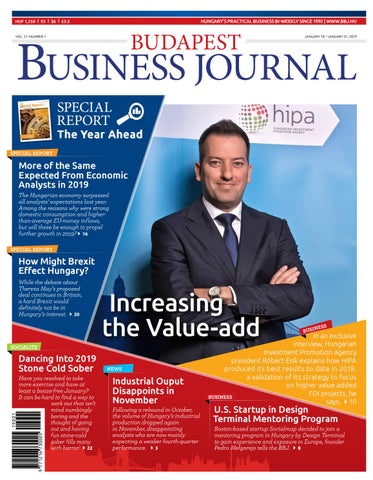
Increasing the Value-add
SOCIALITE
Dancing Into 2019 Stone Cold Sober Have you resolved to take more exercise and have at least a booze-free January? It can be hard to find a way to work out that isn’t mind numbingly boring and the thought of going out and having fun stone-cold sober fills many with horror. 22
NEWS
Industrial Ouput Disappoints in November Following a rebound in October, the volume of Hungary’s industrial production dropped again in November, disappointing analysts who are now mainly expecting a weaker fourth-quarter performance. 3
BUSI
N E SS
In an exclusive interview, Hungarian Investment Promotion Agency president Róbert Ésik explains how HIPA produced its best results to date in 2018, a validation of its strategy to focus on higher value added FDI projects, he BUSINESS says. 10
U.S. Startup in Design Terminal Mentoring Program
Boston-based startup Socialmap decided to join a mentoring program in Hungary by Design Terminal to gain experience and exposure in Europe, founder Pedro Melgarejo tells the BBJ. 8
2 | 1 News THE EDITOR SAYS
EDITOR-IN-CHIEF: Robin Marshall EDITORIAL STAFF: Zsófia Czifra, Kester Eddy, Bence
Gaál, David Holzer, Christian Keszthelyi, Gary J. Morrell, Robert Smyth, Zsófia Végh, Zalán Zubor. LISTS: BBJ Research (research@bbj.hu) NEWS AND PRESS RELEASES:
Should be submitted in English to news@bbj.hu LAYOUT: Zsolt Pataki PUBLISHER: Business Publishing Services Kft. CEO: Tamás Botka ADVERTISING: AMS Services Kft. CEO: Balázs Román SALES: sales@bbj.hu
CIRCULATION AND SUBSCRIPTIONS: circulation@bbj.hu
Address: Madách Trade Center 1075 Budapest, Madách Imre út 13-14., Building A, 8th floor. Telephone +36 (1) 398-0344, Fax +36 (1) 398-0345, www.bbj.hu SUBSCRIPTIONS: Budapest Business Journal 1 year 6 months 3 months
HUF 27,500+VAT HUF 13,750+VAT HUF 6,875+VAT
News Services Hungary A.M., Energy Today, Regional Today 1 year, from HUF 179,000+VAT 6 months, from HUF 104,900+VAT 3 months, from HUF 58,900+VAT Book of Lists 2018-2019: HUF 19,120+VAT DigiBOL HUF 39,900+VAT Call +36 1 398-0344 or email circulation@bbj.hu What We Stand For: The Budapest Business Journal aspires to be the most trusted newspaper in Hungary. We believe that managers should work on behalf of their shareholders. We believe that among the most important contributions a government can make to society is improving the business and investment climate so that its citizens may realize their full potential.
Photo: Fortepan.hu/Tamás Urbán
The Budapest Business Journal, HU ISSN 1216-7304, is published bi-weekly on Friday, registration No. 0109069462. It is distributed by HungaroPress. Reproduction or use without permission of editorial or graphic content in any manner is prohibited. ©2017 BUSINESS MEDIA SERVICES LLC with all rights reserved.
GETTING TO GRIPS WITH 2019 With the year’s turn firmly behind us (remember 2018, anyone?), it is time to look ahead at what the still relatively fresh and shiny 2019 has to offer us. What it has to offer British nationals living and working in Hungary would seem to be more uncertainty, at least for a few more weeks. With the U.K. parliament having kicked Theresa May’s laboriously negotiated Brexit deal into the long grass by a remarkable majority, a new deal, a new referendum, a no deal and a no Brexit all seem at least theoretically possible. Whichever might be most probable is another matter altogether. A no-confidence vote was due as we went to press (although the opposition seemed to have no confidence it might pass), but more could yet follow if it fails. I appreciate that, for all our many non-Brit readers, this must seem like an isolated local difficulty, so I won’t pursue it any further, other than to point out Brexit is due (at the time of writing) in just 72 days, and could have very real financial implications for Hungary, as is explored in our story “How will Brexit effect Hungary?” on Page 20. Elsewhere, we present a series of wishes for 2019 on Page 18 and 19. As with last year, we have
THEN & NOW
BBJ-PARTNERS
VISIT US ONLINE: WWW.BBJ.HU
deliberately cast the net wide, to try and give some exposure to voices that might not normally be heard, especially in a business publication like this. And, naturally, we have a roundup of what the economic analysts are expecting for the year ahead (see “More of the Same Expected From Economic Analysts in 2019” on Page 16 and 17). More growth would be the quickest up sum, albeit perhaps slightly more muted than in 2018, and with more of a weather eye on downside risks (sluggish EU growth and the on-off U.S.-China trade war, to name two). A New Year by now naturally also brings a new BBJ Expat CEO award, and you can read about the preparations for our fifth gala on Page 5. The presentation itself will take place on January 25, so look out for more on that in the next issue. All told, it is a packed first issue. We look forward to bringing you all of the important news and analysis you would expect from a publication dedicated to “Business news that works” throughout 2019, but for now, and on behalf of the whole staff, let me wish you a Happy and Prosperous New Year. Robin Marshall Editor-in-chief
Somewhat similar to the British tradition immortalized in “Mary Poppins”, Hungarians believe that should you meet a chimney sweep, you should tap one of your own buttons to bring good luck. In the black and white photo dated to 1970, a chimney sweep toasts the New Year from the top of a house. In the color photo, Hungaryʼs President János Áder receives the best wishes of chimney sweeps, as is traditional, on January 7 at his official Sándor Palota residence in the Castle District.
Photo: MTI/Szilárd Koszticsák
BBJ
www.bbj.hu
Budapest Business Journal | January 18 – January 31, 2019
1
www.bbj.hu
Budapest Business Journal | January 18 – January 31, 2019
News///macroscope
Industrial Output Disappoints in November
Following a rebound in October, the volume of Hungary’s industrial production dropped again in November, disappointing analysts who are now mainly expecting a weaker fourth-quarter performance. ZSÓFIA CZIFRA
The volume of industrial output grew by a moderate 4% on a year-on-year basis in November, following a 5.9% increase in October. According to the latest report released by the Central Statistical Office (KSH), the workingday adjusted data was 3.5%. The report indicates that the majority of manufacturing subsections contributed to the increase. The manufacture of transport equipment, representing the largest weight, grew at a similar rate to the previous month. The manufacture of computer, electronic and optical products went up remarkably, while the manufacture of food products, beverages and tobacco was also higher than a year earlier. In the first
He pointed out that industry continued its monthly rollercoaster ride in the 11th month of the year. He also noted that the
moderate
3.5%
calendar-adjusted growth matches the average performance of January-November. “Overall, the recent reading fits into the picture of a trend-like deceleration,” the ING analysis stated.
The usual yearend shutdowns are also bad news, Virovácz emphasizes. Although the KSH commentary suggests that all of the main subsectors expanded on a yearly basis, “however, it is quite clear that without a strong performance in any of the key sub-sectors (like car manufacturing, electronics and the food industry), an okay-ish expansion is not enough to provide strong overall industrial figures. Looking forward to December, the usual yearend shutdowns won’t help towards the overall Q4 performance, suggesting a weaker growth rate and thus a lower contribution to GDP growth. Our view is backed up by soft indicators, too,” he says.
Numbers to Watch in the Coming Weeks Hungarian minimum wages and general private sector salary rises have been at the center of attention for a while, and we will find out about average earnings between January and November 2018 on January 22, when the Central Statistical Office publishes the fresh data. On January 30, employment and unemployment figures for the October-December period will be released.
Downside Risks
“We expect an average growth rate of 3.5% in industry in 2018, but the new year might bring slightly stronger performance with a growth rate of roughly 5% year-on-year on
average on the back of newly built capacity. However, our forecast
in
2019
is accompanied by downside risks, mainly stemming from the gloomy eurozone outlook,” the ING note concluded. Takarékbank analyst Gergely Suppan also notes that the industrial output underperformed expectations in November. He partially attributes the weaker performance to new legislation on vehicle emissions that caused turmoil for several car manufacturers, with several models temporarily disappearing from the line.
11
months
of this year, production was 3.5% higher compared to the same period of the previous year. The KSH data shows that industrial output in November – according to both seasonally and working-day adjusted indices – was 1.1% below the level of the previous month.
“Industrial production dropped on a monthly basis, and as the yearend holiday shutdown affected data, we expect an overall weak fourth-quarter performance.”
Growth ‘Here to Stay’
In spite of the poorer-than-expected figures, the Hungarian government is confident that the overall strong performance will continue. A government official told state television news channel M1 that the data showed Hungary in second place among the Visegrád countries and the 24% increase in Hungarian industrial output since 2014 was twice the European average. Gyula Pomázi, Deputy State Secretary at the Ministry of Information and Technology, told the channel that the positive industrial data indicated that growth was here to stay “in some form”. The fresh figures, however, are lower than what analysts had previously expected. “Industrial production dropped on a monthly basis, and as the yearend holiday shutdown affected data, we expect an overall weak fourth-quarter performance,” Péter Virovácz, head analyst with ING Bank said in a note.
Bence Rétvári, Parliamentary Secretary of State of the Ministry of Human Resources (EMMI), holds a press conference on the 2019 pension increase on January 4, 2019. “This year, pensions will be increasing by 2.7% ... by an annual HUF 42,000 in the case of an average pension,” he said. Photo: MTI/Zoltán Máthé
However, with new production capacities to open in Hungary, industrial output is expected to liven up again, the analyst says. Although he notes that the economic environment in Europe poses some risks to this, this can partially be balanced by strong domestic demand. All in all, he expects a faster expansion this year due to the growing capacity of car manufacturers. Dávid Németh, head analyst at K&H Bank, also emphasized that the performance of Hungarian industry is volatile. Due to data from the previous months, it seems that the automotive industry could not contribute effectively to the industrial output; on the contrary, it rather put a restraint on it. On the whole, industrial output might have been extended by 4% on a yearly basis in 2018, and he forecast a similar figure for 2019, Németh said.
4 | 1 News WHO’S NEWS
www.bbj.hu
Budapest Business Journal | January 18 – January 31, 2019
Do you know someone on the move? /// Send information to news@bbj.hu
focuses on making the industry serve both people and sustainable development. The three vice presidential positions will be held by Péter Baráth of Vodafone Hungary (advertising), Gabriella Vidus of M-RTL Television (media), and Urbán (service sector) from 2019 until 2021.
Advertising Association Elects Head
Ford Hungary Appoints Commercial Director
Budapest Bar Association Names New President
Danubius Hotels Group Recruits Péter Dobos
János Gulyás The Hungarian Advertising Association (MRSZ) has announced the election of János Gulyás as its new president for the next three-year cycle. Gulyás is the managing director of new media agency Wavemaker Hungary. For the last six years, the seat was held by Zsolt Urbán, head of 1080p Solution Agency. In its meeting at the headquarters of professional services firm KPMG, the association also elected members of its 24-person board, alongside the three members of its oversight committee. “I gladly accept this task, and hope that I will be able to give something to this profession, in which I have been working for a quarter of a century,” said Gulyás. “I believe that we can follow our way developed under the leadership of Zsolt Urbán in the past years, that made the MRSZ the most active and indispensable organization of the communications industry.” Gulyás also emphasized that he trusts the MRSZ will be instrumental to the beginning of a way of thinking about the communications industry’s future that
Danubius Hotels Group has announced the appointment of award-winning expert Péter Dobos as project director. Dobos has years of international experience, with his 24-year career taking him through a series of construction and office development and maintenance companies. He has been working on technical maintenance projects of domestic and international hotels for a decade, gathering experience at luxury apartment houses and hotel chains such as Hilton and Radisson. Working at the Danubius Hotels Group will not be entirely new to Dobos, as he also took part in the renovation of the hotels on Margaret Island in Budapest.
Péter Dobos Dobos has been recognized with two Constructors’ Masterworks awards for his work on the Károlyi and Ybl palaces.
sales. With his support, all conditions are given for our company to achieve significant successes on the Hungarian personal and commercial vehicle markets in the future as well.”
András Nagy Ford Hungary has announced the appointment of András Nagy as its commercial director, starting January 1, taking over a position previously held by Attila Dalos, who moves on to a global planning role, the company told the Budapest Business Journal. Nagy has spent the last four years as fleet sales manager at the company. He has been at Ford for 12 years, working as a regional sales leader at the fleet division for seven years, later working as commercial vehicle director for a year as well. During his time in his latest role he has been responsible for fleet deals such as a 1,500 auto tender for the national police force, and for energy company ELMŰ. The 43-year old is married with two children. Meanwhile, his predecessor Attila Dalos will continue his career in a global planning role within the company. “Both Attila and András are members of Ford’s domestic management who are extraordinarily experienced, wellproven, and have reached significant results in their own fields,” says Viktor Szamosi, managing director of Ford Hungary. “With András, a resolute, professionally well-prepared person will head Ford’s
The Budapest Bar Association, with more than 8,000 members from Hungary’s capital, elected Gábor M. Tóth as its president for the next four years on November 16. The new president, aged 45, primarily handles criminal law cases, as does the newly elected chief secretary Balázs Gyalog, also 45. László Réti, president for three cycles, did not stand for reelection. Two presidential candidates stood for election. According to observers, the campaign was informative, fair, and utilized a number of new tools. The other candidate, Zsolt Németh, was elected a member of the board. In his statement, the new president committed himself to the morally infallible, highly professional operation of lawyers and the unified professional order. He emphasized that lawyers are indispensable, unique, sovereign members of the judiciary system. He also noted that these qualities, which are factors of trust for citizens seeking justice, are crucial requirements for the democratic structure and operation of the country.
Gábor M. Tóth
ADVERTISEMENT
FOOD AT IT’S BEST in Budapest 2018 edition
EATING WELL AT WEEKENDS • TAKING THAT CEO OUT • THE WIND OF CHANGE AT GUNDEL • GASTRO 101 • SECRET GOODNESS IN THE CAPITAL • DOLCE VITA BUDAPEST • SPECIAL OFFERS • GETTING OUT OF BUDAPEST • COUNTRYSIDE DINING
Budapest’s Casual, Business & Fine Dining Please forward your subscription request to: circulation@bbj.hu. Copy price: HUF 2,990
1 News | 5
www.bbj.hu
Budapest Business Journal | January 18 – January 31, 2019
Javier Gonzáles Pareja
Jost Ernst Lammers
Jörg Bauer
Gearing up for the Expat CEO Gala Final preparations are being made for the Budapest Business Journal’s annual Expat CEO of the Year Gala at the Corinthia Hotel Budapest on January 25. The event reaches a minor milestone this year, being staged for the fifth time. BBJ STAFF
The aim of the event is to recognize the significant contribution the best expat CEOs make to Hungary’s economy. The main award is sponsored by the BBJ, with a second prize, the Local Partnership Award, presented by the Hungarian Investment Promotion Agency to the CEO of the multinational company that has done most to involve local suppliers in its value chain. HIPA has been the official event partner since its launch. For the BBJ, the award and the gala are an important element of community building around the country’s expat business leaders. The recognition of significant achievements is important, of course, but so is providing a platform
Marc de Bastos Eckstein year we are delighted to welcome Róbert Ésik, the president of HIPA, as a new jury member, further cementing HIPA’s role in the awards. The fifth and final place is, by tradition, taken by the previous year’s winner, meaning Marc de Bastos Eckstein will have a vote in picking his successor.
Roll Call
for CEOs (and their partners) to meet and network with their peers, high level members of the diplomatic corps and other decision makers in Hungary. “Over the past few years, the annual Expat CEO Gala has become an important community building event for the BBJ,” says Balázs Román, BBJ CEO. “I think we are all very much looking forward to the gala, and the unveiling of our fifth BBJ Expat CEO of the Year.” This year’s short list has already been drawn up, and the nominees notified, but it is being kept under wraps until the evening, just to build tension and excitement that little bit further. The final vote on the overall winner will only be taken just before the gala itself starts. What we can reveal is that, for the first time, the short list contains two women, with the nationalities split between Germany (naturally), the United States, Finland, Britain and India (perhaps surprisingly, both firsts). The companies they represent are, American,
Indian, German and Swiss-Swedish multinationals; they are a conglomerate, a global investment manager, a global bank, a pioneering technology company and a chemical business. It is a true crosssection of the expat business world – and the people who work in it – in today’s Hungary.
The Jury
The award has been blessed with an expert jury that has largely remained unchanged since the launch. Írisz LippaiNagy, CEO of the American Chamber of Commerce in Hungary; Dale A. Martin, president of the German-Hungarian Chamber of Industry and Commerce, and president and CEO of Siemens Hungary; and our very own Balázs Román, have all been in place since 2014. For many years, László Szabó, then Deputy Minister for Foreign Affairs and Trade, was also a jury member, until his promotion to the role of Hungary’s Ambassador to the United States made that impossible. This
Last year’s Expat CEO of the Year was Marc de Bastos Eckstein, the GermanBrazilian head of Thyssenkrupp Components Hungary Kft. In a weird piece of gala trivia, he became the third consecutive winner who was at least partGerman, and the first whose Christian name did not begin with the letter “J”. His immediate predecessor were Jörg Bauer (then CEO of GE Hungary, now CEO of Tungsram Group) in 2017, another German, albeit head of an American multinational. Yet another German, Jost Ernst Lammers, of Budapest Airport Zrt., the operator of Budapest Ferenc Liszt International Airport, won the 2016 title. The inaugural title in 2015 was presented to Spanish national Javier Gonzáles Pareja. Then CEO of Bosch Magyarország, today he is the president of the BOSCH Group in Spain and Portugal, as well as president of the German Chamber of Commerce for Spain.
HIPA Local Partnership Award 2018: Frank Müller, head of the regional office of the VW Group Eastern Europe. 2017: Ekkehard Philipp, then CFO of Mercedes-Benz Manufacturing Hungary Kft. 2016: Nagoyuki Takeuchi, then CEO of Magyar Suzuki Zrt. 2015: Kersten Bachman, CEO of TAKATA Safety Systems Hungary Kft.
6 | 1 News
www.bbj.hu
Budapest Business Journal | January 18 – January 31, 2019
White House Gains LEED ‘Platinum’ Accreditation The White House by GTC has become the second Budapest office development after Skanska’s Green House to be awarded LEED “Platinum” accreditation, the highest category level possible by the U.S.-based LEED for rating scheme for building design and construction. GARY J. MORRELL
LEED (Leadership in Energy and Environmental Design) examines the property’s location, efficiency of water and energy consumption, materials and resources, alongside built-in innovative technologies an indoor air quality. The recently acquired accreditation is reflected in the White House’s location in Váci út, adjacent to the metro on the site of
the
100-year-old
former Schleck Elevator Factory and includes a refurbished area that provides a stand-alone loft with 2,000 sqm of office space in addition to the newbuilt 19,000 sqm office area. “GTC White House is a symbiotic complex that combines great modern architecture with a traditional urban
White House by GTC in Budapest . development,” says Thomas Kurzmann, CEO of GTC, of the project. The site itself was a sustainable choice as it is a former brownfield area that has been redeveloped to a modern “A” category office building, according to Colliers International.
Excellent Opportunities
“Built on the Váci Corridor, GTC White House has excellent public transportation opportunities within a short walking distance, complemented by a bicycle lane passing by the building,” says Norbert Szircsák, a senior associate of Colliers Green Building Advisory Services. “Plenty of bicycle racks, common area showers and changing rooms serve the needs of environmentally conscious employees as well as electric car chargers for the growing number of electric car
owners. A large green roof, rainwater harvesting for flushing toilets, a high efficiency HVAC system, good thermal isolation, and above average volumes of fresh air to the occupants are among the many factors that contributed to this success,” Szircsák ads. The certification process was advised by the Colliers International Hungary Green Building Advisory Team. The other LEED Platinum office complex in Budapest is the 20,000 sqm Green house by Skanska, which was completed
in
2012.
Skanska has a policy of developing in line with LEED specifications throughout Europe. The development strategy of GTC, meanwhile is to aim for a minimum of LEED “Gold” accreditation across its CEE portfolio in Budapest, Poland, Bucharest, Belgrade, Zagreb and Sofia. It has a further pipeline of more than 400,000 sqm across the CEE capitals. Although LEED is the accreditation system favored by leading developers
EUR 1.8 bln Invested in Property in 2018 Real estate investment volume for Hungary in 2018 was close to EUR 1.8 billion, reflecting a third consecutive year of strong investor appetite and the highest annual transaction volume since the economic downturn of 2007, according to JLL. GARY J. MORRELL
Last year saw a record broken with domestic capital investing a record high of
around
JLL’s preliminary investment volume for Poland for the same period is put at EUR 6.3 bln, with EUR 2.4 bln-2.5 bln for Czech Republic, while Cushman & Wakefield estimate the Czech total at EUR 2.8 bln. The CEE regional total (taking in Czech Republic, Hungary, Poland, Romania and Slovakia) stood at EUR 11.6 bln-12.3 bln, according to JLL.
EUR 1 bln,
57% of the total. It was even larger at EUR 2 bln, or 65% of the volume, in Czech Republic. “Among the large institutional funds, OTP RE Fund was the most active, investing twice as much as Erste RE Fund and Diófa RE Fund together,” comments Benjamin Perez-Ellischewitz, head of capital markets at JLL Hungary.
The disposal of the 88,000 sqm Corvin Offices portfolio by Futureal was the largest office transactions to date in Hungary, and one of the top ten in CEE, following such prominent deals as the sale of Rondo 1 in Warsaw and The Park and Florentinum in Prague, according to JLL.
Changed Attitude
“Furthermore, the acquisition of Corvin Offices by the local OTP Real Estate Fund signals the changed investment attitude of the Hungarian investors, who have become strong competitors to foreign capital not only in the value-add or core plus assets, but also for prime properties,” adds Perez-Ellischewitz. JLL advised on the transaction. Other deals involving domestic capital were the acquisition of MOM Park Offices and Shopping Center by OTP RE Fund and the purchase of Mill Park by Erste RE Fund
such as GTC and Skanska, the preferred sustainability option in Hungary and Central Europe is generally the U.K.based BREEAM with 84 accreditations in Hungary as of November last year, according to the Hungarian Green Building Council (HuGBC). This is followed by LEED and, increasingly, developers are looking to the WELL accreditation system. Whichever system developers opt for, accreditation is now the norm for quality office developments in Budapest and other CEE office markets “BREEAM is much better suited to the CEE markets than other green building schemes,” comments Zsombor Barta, president of the HuGBC. “Further, BREEAM is the only certification scheme that has a very user-friendly and therefore highly successful certification for existing buildings. Also, you are able to submit evidences for BREEAM “In-Use” in your own local language, which makes BREEAM much more attractive, and also more efficient. This is the reason why BREEAM is clearly dominating the CEE market,” Barta ads.
BREEAM & LEED Registered Office Buildings in CEE: November 2018 Country BREEAM LEED Czech Rep.
143
59
Hungary
84
51
Slovakia
64
17
Poland
568
172
Romania
145
44
Source: HuGBC
from Skanska. Another prominent deal was the purchase of Mammut Shopping Center by South Africa’s NEPI Rockcastle from Lone Star. As in recent years, the office asset class generated the largest share of volume
at
46%,
followed by retail with 39% and logistics at 7%, with the balance made of assets purchased for future development purposes. JLL estimate prime yields at 5.75% for offices and shopping centers and 7.5% for logistics. “Competition among investors is at its peak, pushing capital values up and yields down, therefore we recorded a 25-basis point compression in the prime office sector,” concludes Perez-Ellischewitz. Rita Tuza, head of research & consultancy at JLL, expects the 2019 investment total to be in the region of EUR 1.5 bln-1.8 bln. JLL forecasts EUR 5 bln and EUR 2.5 bln for Poland and Czech Republic, respectively. The 2019 forecast for the CEE region as a whole is EUR 11.55 bln.
1 News
www.bbj.hu
Budapest Business Journal | January 18 – January 31, 2019
AmCham Elections Draw Record Number of Candidates AmCham reelected Dr. Farkas Bársony as its president, along with a new second vice president, and five members at large. ROBIN MARSHALL
The December 13 event at the Budapest Marriott Hotel was the American Chamber of Commerce in Hungary’s 29th annual general assembly, and had been moved from its usual afternoon slot to the morning. Bársony’s election as president was uncontested, perhaps an indication of how well received his tenure has been since he emerged victorious from a three-way race for the position in 2017, but he still had to get the approval of the meeting. “Thank you for the trust you truly demonstrated in the last couple of years along the actions I made, we made as a board, we made as an organization,” he concluded. “Thanks for all the volunteer hours [you put in] in contributing to make our goals. Without your help, we would not be where we are today as the most prestigious organization of our business community and beyond.” The other elections were far from onehorse races, however; there were four candidates for the second VP role, and 12 for the members at large. As the chamber’s CEO Írisz Lippai-Nagy said towards the end of the meeting, “In my time involved with AmCham, we have never had such a prestigious, big group of people as this, so many candidates.” Kevin Murray, country head for Citibank Europe in Hungary and CEO of Citi Central Europe won a close fought contest for the second VP’s position. Banking is actually his second career: he is a decorated retired
The new AmCham board of directors.
AmCham members voting at the annual assembly. Lieutenant Colonel in the USAF. He has been with Citi for 32 years, during which time he has lived in six countries beyond the Unites States, and been on “ten boards, seven of which I have chaired”. The victorious board members at large were: Ákos Burján (PwC Hungary, who also contested the second VP position); Ildikó Beck (Beck to Nature, LLC.); Dr. Dávid Kőhegyi (DLA Piper); Taira-Julia Lammi (ABB Kft.) and Zoltán Szabó (BT Regional Operations Center). Burján, a tax partner, was reelected to the board. He told the assembly “I like living in Hungary, but I’d like to make it a better place, not just for us [business people], but these two little ones [his children] and your kids.” He particularly wants to see reform to the local business tax and the pharmaceutical tax. Beck built a business in the United States out of a personal crisis (at one point she thought she would have 30 days to leave the country), importing coconut matresses from Hungary. “Nuts?” She
asked. “No, coconuts!” She added: “Today I have a plan, I have my nuts and I have my running shoes, and I hope to put them to work for AmCham.” Kőhegyi built his presentation around a silent movie of his attempts to win support through making a video with a cute puppy, until his wife told him to remind voters of all his years’ involvement with AmCham. Lammi (“Yes, I have a monstrous first name; even the Finns can’t get it!”) listed her watchwords as “Technology”, “Diversity” and “Influencing”. She said she represented diversity, being Finnish, a woman, an engineer, a leader and a mother of two teenagers. “My grey hair would show if I were not so blonde.” Szabó, general manager of the BT ROC, said he was passionate about improving the country’s future. He told the assembly he had a friend who said he was the best skipper in the world, because he could not swim and so would never leave the boat. “I am a father of four children and will never leave this country.”
|7
AmCham By-laws Update At the AmCham general assembly on December 13, the membership elected a supervisory board comprised of Dr. Andrea Jádi-Németh, who became the first chair, and David Young. In what became an unusually spirited exchange, the assembly also discussed new by-laws proposals regarding: A) the establishment of a supervisory board as required by the law; B) changes to the rights of honorary members; and C) some other minor, largely technical adjustments. The proposal, discussed as one package, did not reach the three-quarters supermajority that is required by the Civil Code for approval; consequently, AmCham is still operating under the by-laws adopted on December 7, 2016, which do not regulate or include a supervisory board, thus it will not be compliant with the Civil Code regulations. In December 2017, the previous general assembly had accepted by-laws changes proposed by the board, which would have extended the rights of honorary members to vote or fulfill positions in the chamber; however, the Budapest Capital Regional Court rejected the proposals on the notion that the status of honorary members do not comply with applicable laws (see paragraph four section five of Act CLXXV./2011.). For the 2018 assembly, the board had sought to revert the changes in order to be compliant with the law, therefore honorary members would not be able to vote or stand for board election at the general assembly. This proposition was challenged by those present and subsequently the by-laws modifications did not receive the three-quarters supermajority vote required. The newly elected AmCham Board has decided to call another assembly in early 2019, to present a revised by-laws proposal and to approve the elected supervisory board. Consultations have begun to find a solution suitable for all impacted parties. Honorary members of the chamber have been invited to share their concerns and participate in the discussion. The date of the new assembly will be announced later and the new by-laws proposals will be sent to the membership 30 days prior to the assembly. If you would like more information in the meantime, please contact the AmCham office.
2
www.bbj.hu
Budapest Business Journal | January 18 – January 31, 2019
Business
U.S. Startup Learning From Design Terminal Mentoring Program Boston-based startup Socialmap decided to join a mentoring program in Hungary by Design Terminal to gain experience and exposure in Europe, founder Pedro Melgarejo tells the Budapest Business Journal. When finalized, their system applying artificial intelligence will be able to tell if a customer will buy a product or not – probably even before they are aware of it. ZSÓFIA VÉGH
BBJ: What is Socialmap? Pedro Melgarejo: Socialmap is a platform that can track people-to-people interaction in real time. It gets some insights into how people behave, how members of a group fit together. We started off in classrooms and studied the relationship between students and teachers and got some numbers. For example, we discovered that in a regular classroom setting, an average student looks at the teacher’s face only 3% of the time. Then we moved into corporate training, where the purpose was to see how the participants interact or engage in an activity. Also, how they interact during actual work activities. Then we took all this social human behavior background and moved it into the retail space – to watch customer behavior – and now we are working on helping stores to turn that behavioral knowledge of the customer into better conversion rates. BBJ: Why did you change the setting? PW: From a business perspective, retail is more appealing than the corporate environment; it is a bigger space. But we are not quitting the other; rather we are going more into a research space for the actual social collaborative platform. We are talking to some consultancies in the United States, working on some form of partnership with them so they would use the platform in a leadership program, which, hopefully, will go global.
Pedro Melgarejo BBJ: If face-to-face communication between people improves, what will it bring about? PW: The technology will give insight to them on how to keep them on track when “training” the program and get them to a higher level. Our technology is able to observe subtle insights that we humans can’t: even an expert eye will miss some things the technology can track. BBJ: And what do you aim to achieve in the stores? PW: The retail industry is facing many challenges these days. Sales are low: 2018 was a bad year for brick and mortar stores in the world. They need to innovate, they are desperate for that. Of course, much of this innovation will happen via partnerships, as they might not have team, the experience or the time to develop the technology. We want to be a partner to them in this. BBJ: You changed the environment, but has the basic idea remained the same? PW: In a certain way: we wish to track how store associates interact with customers and improve that relationship.
At the same time, we are focused on how customers engage with a product. BBJ: How do you measure that? PW: The main insight we look at is body language as it tells you a lot. One of the most important parts of it is how you move your upper body, your head and the proximity to an object. The more motivated one is, normally the more they lean toward an object/ person. There are changes in the skin arousal, changes in the pupil size; the purchase process is a total emotional state of mind and stores needs to know about these customer patterns to improve the customer experience. BBJ: What devices do you use to track it? PW: We use eye-tracking devices, so we know what people walking around in the store are looking at. We can follow the gaze, measure fixation and points of interests, how long they spend looking at it if they revisit a product. With focus groups, we are testing eye-tracking glasses but later on we would have similar capabilities using cameras in the shop. We retrieve and process data in real time and train the artificial intelligence system.
By looking at people’s body language (for example, how far leaning forward they are, how close their heads are to the objects, etc.) you can tell about purchasing intentions. We annotate all these measurements that led to a purchase and train the system. So, next time the algorithm identifies all these movement patterns, it recognizes them. We start by collecting all this information and build a platform that can predict, for example, the chances of a person buying a product. BBJ: How unique is this method in the market right now? PW: One major difference is our background: behavioral science. [Editor’s note: One co-founder of Socialmap is an anthropologist who came up with the idea after studying bonobo monkeys.] This has given us some advantage as we know human interaction better. Also, to the best of my knowledge, no other companies are developing a collective real-time peopleto-people social interaction tool. We are building the minimum valuable product for the above cases and are targeting an office supplies store in the United States, trying to get the analytics from there. After that, we can build a white paper using the information. BBJ: Why did you apply to Design Terminal’s mentoring program in Hungary? PW: Part of the answer is my personal goals in life. Socialmap is not the only thing I do, I have other businesses. I am building my career toward having a say in the international entrepreneurship ecosystem: I started as a hardware-software engineer, then went to study in the USA and stayed there after working in San Francisco and Boston. In the beginning, I focused on the technology side only – my first startup was in technology infrastructure – then I started to be more curious about the business perspective. In five to ten years, I see myself in the technology entrepreneurship world, helping other startups. The technology side will always be there, I manage that pretty well. [I chose to come here because] I wanted to get some European experience and exposure; I have been to Canada, to the United States, but I have never worked in Europe. We were invited, it looked like a serious program so we applied. BBJ: What did you find the most relevant in the program from your business’ viewpoint? PW: The mentoring part was really nice; the mentors are pretty good and professional. I can see a trend in Hungary of many Hungarians coming back here after spending a number of years in the States, or London, and all those people bring their valuable experience to the program. Part of the strategic changes we made in the company was based on our work together. BBJ: Are investors interested in Socialmap? PW: I have talked to a couple but to some extent you to have some sales and others traction. So, we are building up the traction and we get some sales, then it will be easier to get some investors. We don’t want to push that too hard: waiting for the right investor is sometimes better than selling 50% of the company at a low price. This year we are planning to get the product out, after that validate it in stores in the USA; that will give us credibility to get new customers. In the company we are targeting, they have 1,300 stores, so if we could be in 10-20% of those stores it would be big. After that, growth is next.
2
www.bbj.hu
Budapest Business Journal | January 18 – January 31, 2019
Doherty Hungary Sees Healthy Automotive Sector in Hungary The car making and associated industries are key players in the Hungarian economy. Largely in response to the dynamic automotive sector in Germany, Hungary has benefitted from proximity to its German customer base and the good infrastructure and resources available here, Jim Doherty, CEO of Doherty Hungary Kft., tells the Budapest Business Journal. CHRISTIAN KESZTHELYI
The Hungarian automotive sector has attracted numerous companies covering all the various aspects of car manufacturing. Many believe that this versatile landscape has started creating synergies, and as such, these companies can work together more effectively. Doherty Hungary also senses this opportunity.
Jim Doherty “This synergy is having a significant impact on our ability to keep business in Hungary. In the first ten years of our life here, we would often be seeking service and support from companies in Western Europe, typically the U.K. and Germany,” CEO Jim Doherty tells the BBJ. “Now we can find most of what we need — machine tool support, raw materials, oils, tooling, automation, consultancy etc. — in Hungary itself which is, of course, a very positive development compared to the early years of comparative isolation. With these synergies in place, Hungary can move from subcontractor to innovator status,” he adds. Doherty Hungary Kft., based in Orosháza (197 km southeast of Budapest) has been producing shafts for electric motors in Hungary for
20 years.
The original business, which was founded in England, was established in 1934. The company produces more than one million shafts per month (to 4-5 micron tolerances)
for its customers in the automotive, home appliances and power tools sectors. Following the trends in Hungary over the past five years, its fastest growing sector has been automotive. Doherty Hungary has enjoyed on average 10% growth per annum for the last ten years and whilst the automotive sector is now beyond its historical growth cycle, the company head says it is readying itself for a bigger drive towards e-mobility. The importance of the automotive sector as the main engine for Hungary’s industrial output is well reflected by the figures. In the past years, many times hiccups in the sector have caused a slowing of overall industrial output. Production volume of the sector declined 9.5% year-on-year in September, while total industrial output was down 0.6%, a detailed second reading of monthly data released by the Central Statistical Office (KSH) showed.
Problem vs. Opportunity
According to Doherty, this dependence can be seen both as an issue and as an opportunity. “The automotive sector has
Business | 9
gone well beyond its typical cycle of growth and then retraction and the move away from dirty diesel to clean electric is still at a very disruptive stage. So in that case it’s a problem, because so much of Hungary’s GDP and manufacturing sector is committed to automotive,” Doherty says. “The consensus at the moment is that schedules are slowing but we are still at the stage where that is a relief from an overheated market rather than having to cut shifts due to significant reductions in demand. The opportunity comes when we start to really innovate. A change in customer requirement means we all have to think about new products and processes and innovative ways of managing cost. With such a large proportion of manufacturing being automotive, we have the breadth and depth of support services and business partners in Hungary to become more innovative and rise up the value chain,” he adds. As such, the sector sees crucial attention, and further expansion is highly beneficial for the national economy. Although Hungary now operates from a far higher baseline, last year’s significant expansions by Daimler and the announcement of the BMW factory coming to Debrecen show that there is still capacity for the market to grow further. “The key to all this expansion is training and development, because all the available labor has now been recruited,” Doherty says, it was has becomes a familiar refrain for virtually all business fields in Hungary. “The Germans, again, are particularly good at taking a long-term view of business development and that, mostly, means people development. The understanding in Hungary now that dual education is part of all of our growth plans is a really positive change in mindset. The rather negative alternative to training and development is that the employers chase the same people, drive wages up but get no skill or productivity improvement for the additional cost,” he points out. “So the expansion question is really based on people and training, and possibly the return of Hungarians who moved abroad when there was less opportunity at home,” Doherty says.
ADVERTISEMENT
Real Estate Review Property Hungary 2018
is available now! ARCHITECTURE / URBAN DEVELOPMENT • FINANCE • HOTEL • INDUSTRIAL • INTERIOR FIT-OUT • INVESTMENT • OFFICE OVERVIEW • OFFICE TRENDS AND TECHNOLOGIES • RETAIL • SUSTAINABILITY
Order: Business Publishing Services Kft. +36/1 398-0344; circulation@bbj.hu
Business
10 | 2
www.bbj.hu
Budapest Business Journal | January 18 – January 31, 2019
PRESENTED CONTENT
HIPA 2018: More Projects, More Jobs, Higher Value-add HIPA, the Hungarian Investment Promotion Agency, produced its best results to date in 2018, a validation of the strategy to focus on higher value added FDI projects, says its president, Róbert Ésik. ROBIN MARSHALL
“As far as the highlight figures are concerned, we have been able to close 98 investment negotiations successfully; those projects represent EUR 4.3 billion of capital expenditure and they will create more than 17,000 new jobs in the near future,” Ésik told the Budapest Business Journal in an exclusive interview. “This basically means we have been able to beat all three KPIs compared to the previous year. This represents a 23% increase as far as the investment volume is concerned, and again, for the third consecutive year represents job creation in excess of 17,000 positions.” Ésik says that,
since
2014,
when he was appointed president, more than 75,000 jobs have been or are being created. “That is more or less equivalent to the population of Szombathely.” The numbers certainly sound impressive, and it comes as little surprise to learn that Site Selection, a U.S.-based magazine focusing on investment, named HIPA the best investment promotion agency in Central and Eastern Europe and Central Asia. The automotive sector was once again the source of most investments with 36 projects worth EUR 2.7 bln. “What is very interesting and important to point out is that ten projects of the 36 exclusively focus on either engineering or research and development activities. So what we can clearly say is that investors are not looking at Hungary as simply a location for assembly projects, but increasingly as a location for engineering and R&D services.”
Breakthrough Project
One of the breakthrough projects of 2018 was the decision by BMW to develop a factory in Debrecen. “We are now in the situation where we can proudly say that Hungary is the only country in Europe, outside of Germany, where all three premium German OEMs [Audi, BMW and Mercedes Benz] are present and have, or will have, a manufacturing footprint,” Ésik points out.
HIPA President, Róbert Ésik. Photo by András Kiss. “We can also say, thanks to the decisions made in 2018, that we can now quote eight OEMs, five of them in the manufacturing area, and three in the services area [Ford, Nissan and Jaguar Land Rover].” The second most important sector was the electronics industry, with ten projects. Ésik believes this is an increasingly important sector, especially in battery manufacturing, with three out of five makers who have a European operation are based in Hungary: SK Innovation and Samsung SDI from South Korea, and GS Yuasa from Japan. Last year alone, battery manufacturers, or companies that are part of the value chain for them, have invested EUR 0.5 bln in Hungary, the president says. The business services center sector took third spot, also with ten projects, six of which were newcomers to Hungary. That was followed by the ICT sector, with nine projects. These are again companies that invest into human capital and represent jobs with high local value add, for example companies like Cloudera and evosoft, Ésik points out. “So, overall in 2018, we again see a dominance of automotive, but in the meantime, a transformation within automotive, a clear shift towards services, engineering and R&D, and also, let us say, a balanced set of results from electronics, business services, and ICT, helping us overall to move towards higher local value add creation.” Just how much of a move is taking place is, in part, revealed by the salaries that go with all these shiny new jobs. “The average wage level of our successful
98 projects
having a state aid component has increased by approximately 40% compared to the previous year. In 2018 we talk about a figure of HUF 425,000 [per month] on
average in gross salary terms. This is again underpinning that the adjustment of our strategy to focusing on higher value ad projects is working out. This increase is higher than the increase of average wages
“The average wage level of our successful 98 projects having a state aid component has increased by approximately 40% compared to the previous year. In 2018 we talk about a figure of HUF 425,000 [per month] on average in gross salary terms. This is again underpinning that the adjustment of our strategy to focusing on higher value ad projects is working out. This increase is higher than the increase of average wages on the market, and, of course, higher than the increase in the minimum wage.” on the market, and, of course, higher than the increase in the minimum wage.” For the record, the guaranteed minimum wage (for those with skills and qualified at least to secondary level) was raised by 12% in 2018, from gross HUF 161,000 a month to gross HUF 180,500.
Biggest Investor
Germany’s position as the biggest investor in Hungary was also underscored last year: 28 projects came from the EU powerhouse, collectively worth EUR 2 bln. “This not only means that Germany was the number one investor in 2018; but it also means that in the stock values the share of German investment will increase, because in the FDI stock values the share of German investments is approximately 25%, and in the last year in the flow data their share is close to 45%.” Individually, the American investment community came second, with 15 projects, but collectively South Korea, India, Japan, and China were responsible for 17 projects, up from 13 in 2017. “The share of Asian investors has increased and we see strong growth, especially in the battery business, but also in packaging and some automotive-related activities as well.” With Hungary being such a Budapestcentric country, it is easy to fall into the trap of assuming most investments are made in or near the capital, but Ésik says
80%
of projects
are targeted at the countryside. “We can clearly see some new regional centers strengthening, such as Debrecen, for example, or Miskolc, which means we have been able through our projects to contribute to the reduction in regional economical differences between the western and the eastern part of the country.” That should be a trend that continues, the HIPA leader believes, saying that infrastructural investments due to be completed this year or shortly afterwards – Route 67 to Kaposvár, the M44 to Békéscsaba, and the highway to Zalaegerszeg – will see “additional opportunities open up for new investors”.
2
www.bbj.hu
Budapest Business Journal | January 18 – January 31, 2019
Part and parcel of the drive to open up areas and reduce regional economic differences has been the introduction of incentives for companies bringing R&D activities to Hungary and technology intensive development (i.e. new technologies, but not necessarily new jobs). Ésik says the number of technology intensive subsidized projects has increased by a factor of seven, so from one to seven, and for R&D it has increased from four to ten. “It means these new incentives work, companies are interested and we have more and more successful cases.” Does the success of these incentives mean more might follow? The president says HIPA is “continuously evaluating” its incentive system, including benchmarking it against other investment agencies.
Investor Impact on Hungary’s Economy 2018
NUMBER OF JOBS
“This basically means we have been able to beat all three KPIs compared to the previous year. This represents a 23% increase as far as the investment volume is concerned, and again, for the third consecutive year represents job creation in excess of 17,000 positions.” Given the success of 2018, the obvious question is what might 2019 look like. “We continue to see a strong interest in Hungary; we are in discussion right now with 120 different companies about investments that could potentially represent
up to
EUR 7 bln
of capital expenditure, creating potentially up to 18,000 new jobs,” says Ésik.
“The second trend we can observe is the drastic increase in terms of the high value ad projects, and if I only take into account the projects which are in the area of services, related to R&D, info communications or business services then we could see an increase of 60% year-on-year; last year we already had 29 projects alone in these three service sectors, resulting in the creation of almost 4,800 jobs. This is a trend we would like to continue to focus on, potentially even strengthen if possible.” HIPA also plans to continue with its drive to reduce regional differences, focusing on areas Ésik says have been “traditionally under-represented in our results” and those areas that have higher labor reserves: the southwest, some parts of the southeast, and some areas in the north and northeast of Hungary. That also ties in with another continuing trend: the tightening labor market. It is not a feature unique to Hungary, being rather a CEE-wide problem, but how does Ésik convince potential investors their workforce needs can be met? “In terms of labor reserves, there are several parts of the population that can be considered. Of course, one part is the unemployed, to which in Hungary
Project Breakdown Automotive
18
Other
10
51
10 9 ICT Source: HIPA
€
Electronics
BSC
4 311
14 133
17 024
75 432
you can add those people on public work schemes. If you look at the demographics in Hungary you may observe that the activity rate in Hungary is still sixto-eight percentage points lower than, for example, in Germany or Czech Republic, which means some parts of the population, especially mothers returning from maternity leave, youngsters under the age of 25 and people over 55 where we still have some reserves. Adding all these together, theoretically the number of people in work and paying taxes could increase up to five million [from the current 4.5 million].”
Mobilizing Reserves
Targeting, Ésik says, is vital. “The question and the focus should be on how to mobilize those reserves; that is number one. Number two is that regionally there are still big differences; we have some parts of the country where there is basically full employment, and there are still regions where unemployment reaches high single digit or even double digit value.” Directing investors towards suitable site locations in regions with higher unemployment is an obvious “here and now” solution to the labor issue, but the agency also has a longer-term function, acting as a go between for investors and government, passing on the need, for example, for an education system that produces people with good language ability, but also STEM (science, technology, engineering and mathematics) skills. “HIPA has a special role to link the private sector with the public sector, and in that sense one of our duties is to make sure that smart ideas and proposals are reaching political decision makers,” the president acknowledges. “We consider policy advocacy as one of our activities, so if something is important for the investment community, we try to understand that, analyze that, and make some proposals to that, developing suggestions and opinions together with the business community. So, whether its infrastructure related, education related, taxation related, we are dealing with those topics in order to be able to improve the competitiveness of the country.” Five years ago, when he left a private sector career that had seen
Source: HIPA
VOLUME (BLN EUR)
2014-2018
98 392
NUMBER OF PROJECTS
Fine Tuning
“Based on this, we plan some fine tuning during the course of this year, because we believe we should continue with our focus on quality versus quantity as far as the FDI investments are concerned.”
Business | 11
him work in senior roles for Siemens, Nokia and Amazon, could he have believed the
2018 picture
would look like this? “I think this is a set of results I would have signed up for,” he says with a laugh, acknowledging that the results have exceeded his expectations. He says he is particularly proud of the past year. Securing the BMW
“We consider policy advocacy as one of our activities, so if something is important for the investment community, we try to understand that, analyze that, and make some proposals to that, developing suggestions and opinions together with the business community. So, whether its infrastructure related, education related, taxation related, we are dealing with those topics in order to be able to improve the competitiveness of the country.”
investment, for example, required 14 months of negotiations, during which time the automaker was looking at more than 160 locations in Europe. The relationship that led to the opening of the Jaguar Land Rover hub goes back even further. “We have been in contact with them since 2014, and the fact is that, although manufacturing went to one of our competitors, we have stayed in contact, and they have decided to bring engineering to Budapest. This is a great achievement.”
12 | 2
Business
www.bbj.hu
Budapest Business Journal | January 18 – January 31, 2019
Calculation
LIN E M O T T O B E TH
Entrepreneurs Must Dream and get Real I live on a graveyard, metaphorically speaking, at least regarding retail outlets. Iʼve lost count of the shops, cafes and bars that have opened and closed on the street near me. KESTER EDDY
This is especially so in recent years, when even the dreamiest entrepreneur must have understood the increased competition from on-line competition would make any bricks-and-mortar operation a higher risk. I admit, it appears tempting. At just 150 meters from the Déli pályaudvar (Southern Railway Station), there seems to be plenty of people nearby, with constant passing traffic. One unit, a former bar, attracted a florist start-up in the summer of 2017. The owners could not be faulted for enthusiasm or effort: they poured their hearts into the venture, and the place became an oasis of fragrance and beauty. It lasted until Christmas. Undaunted – or perhaps just unobservant – another team promptly launched a health-nutrition outlet in the same unit. That too survived barely six months. Meanwhile, straddling both time lines, a matchbox-sized cafe opened on the opposite sidewalk, pleasantly
fumigated its environs with the aroma of coffee for a month or two, and folded. Perhaps these ventures were selffinanced, perhaps subsidized with grants (which, perversely, may have encouraged a foolhardy rush to begin business). Whatever, a few enquiries into the fates of previous outlets, along with some good, old-fashioned eyeball checks could have saved an awful lot of money, time and heartache – because the heavy pedestrian footfall nearby mostly fails to make it 50 meters up the street and passing cars struggle to park. These naïve endeavors contrast sharply with those of Árpád and Gabi Kreisz, a couple who, jaded by their years in the logistics sector, opted to change careers, opening a breakfast-restaurant-plusluggage-locker service across town in Budapest’s popular District VI. (For more on this, see Wish List 2019: More Homes, Happy Children and Inter-generational Harmony, pages 18-19.) The couple spent six months planning their enterprise, visiting and evaluating an assortment of potential locations.
“I was a transport manager for 20 years… the base of every business is a calculation; if you don’t know your costs, you will not be successful,” Kreisz told me during a slack winter afternoon at his eatery. True enough, even if the eventual location was more down to female intuition than hard logic. “My wife found the place. When we first opened the door, I said I would never come back. It had been [derelict] for 20 years. But my wife liked it… [so], it was mandatory,” he recounted. Put off by the bureaucracy and regulations, the couple declined applying for either a grant or a bank loan, and sank their savings into renovating the premises. But, always mindful of costs, Kreisz employed his architect nephew for the interior design while constructing much of the furniture, counter and lockers himself. His son managed the online marketing. Lion’s Locker (named after four stone lions on the building’s facade) opened in May 2017. The couple’s cheery attention to customers soon won plaudits on
TripAdvisor, but the first year finances were still “terrible”. However, buoyed by the synergy between the popular locker service, relaxed atmosphere and varied breakfast menu, the Kreisz family now has a going operation, largely based on foreign tourists. Entrepreneurs are optimists and dreamers: it’s an intrinsic part of their nature, and essential for their own and society’s development. But they must also keep at least one foot on the ground – or find an adviser to help them do so. Had those ventures near me consulted Árpád Kreisz beforehand, they might have pulled through, though perhaps, by starting elsewhere. The Bottom Line is a monthly column written by Kester Eddy, a long-standing and well respected Budapest-based business and economic journalist, who has written for the Financial Times and many regional publications. The opinions expressed in the column are not necessarily those of the Budapest Business Journal. To comment on this column, or on anything else in the BBJ, email the editor at robin.marshall@bbj.hu
ADVERTISEMENT
Ask for the Budapest Business Journal’s daily English-language premium newsletters
NOW Ask for a ten-day trial! Contact: circulation@bbj.hu
and get the latest news about Hungary, the region and the energy industry direct to your email intray early each work morning
· Tel.: +36/1/398-0344
2
www.bbj.hu
Budapest Business Journal | January 18 – January 31, 2019
Business | 13
Why Should You Care About Yield Curves? In the first of a regular biweekly column, Les Nemethy and Mael Rohrig of Central European corporate finance firm EuroPhoenix look at why all investors should pay attention to the yield curve.
Normal Yield Curve
Whether you are a businessman or an ordinary citizen concerned about what’s going on in the world, the yield curve is something you should care about. The yield curve is probably the single best indicator of where markets are headed, perhaps the best indicator of an upcoming recession. Many decisions, from how to invest your portfolio to what kind of job you might take would be impacted if you knew a recession was approaching. Business owners, armed with this kind of knowledge, would be able to make more informed decisions about whether to expand capacity, invest or raise capital, borrow, change floating rate debt to fixed-term debt, possibly even sell their business. Built from all the interest rates paid by a particular government or corporation,
When investors perceive that a recession is approaching, there is a flight to quality: they typically flock to government bonds, particularly U.S. Government bonds (the reserve currency of the world monetary system). In such times, investors are concerned about preserving the value of their holdings in the medium- to long-term. Hence there is a so-called “compression” of the yield curve: the premium of long-term yields or interest rates over short-term interest rates diminishes (as will be illustrated and discussed in more detail below). In extreme cases, the yield curve may even become inverted (e.g. investors are prepared to accept a lower yield on longterm than on shorter-term bonds). In such a risk-averse environment, investors are prepared to accept a discount in order to preserve capital.
Good Predictor of Recession?
Historically, the inverted bond yield curve has been a signal of an impending recession as it has accurately predicted every recession since mid 1960s,
U.S. Bond Yield Curves in 2016 and 2018 3
YIELD (IN %)
2,5 2 1,5
Yield curve in 2018 Yield curve in 2016
1 0,5 0 3 Mo
6 Mo
1 Yr
2 Yr
3 Yr
5 Yr
7 Yr
BOND MATURITY
10 Yr
20 Yr
30 Yr
Normal Yield Curve YIELD (INTEREST RATES)
after issuing multiple bonds with different duration, the bond yield curve below is the typical shape. The longer the term of the bond, the higher the yield, because, under normal circumstances, money is worth more today than tomorrow, as bond holders will typically look for a premium to postpone their spending that dollar today.
MATURITY (YEARS)
with only one false positive, in 1966, according to the Wall Street Journal. The 2007 inversion, followed by the 2008 crisis is a perfect example of the strength of the yield curve as a predictor. While the above yield curve was a harbinger of the 2008 crisis, it is interesting to note that in subsequent month the extent of the inversion diminished and even stopped being inverted. By the time Lehman Brothers filed for bankruptcy on September 15, 2008, the U.S. bond yield curve was even less inverted. In the same way that an electrocardiogram does not reveal continuous problems leading up to a heart attack, but may very well reveal some temporary negative patterns in the proceeding weeks or months, so too with the yield curve.
What are Yield Curves Saying Today? In a nutshell, over the past two years, there has been a so-called “flattening” of the yield curve. The chart to the left compares the yield curves as of January 1, 2016 to the curve as of August 27, 2018. On December 7, 2018, the five year yield temporarily dipped below the three year yield. This created some market panic, with the Dow Jones Industrial Average tumbling 799 points that day. Some investors feared that this would also be a harbinger of a future recession. It should be noted that this was just a very brief inversion of the yield curve, over a very short period and that the curve has since normalized. Nevertheless, the
flattening of the curve and this skittish inversion should warrant caution. The bull market will not last forever.
Implications for business owners? If a business owner believes a depression or recession is approaching, he or she might consider any of the following steps: 1. Selling the business, or be prepared to ride the down cycle, until equity markets pick up again. These cycles typically tend to be of five-to-eight year duration. 2. Raising equity capital. This not only provides you with some “dry powder” to ride the recession; for those business owners who might consider acquisitions, it makes sense to raise fresh equity when equity is cheap (e.g. in boom markets), and buy equity (e.g. acquisitions) during a recession, when equity is cheap. 3. Switching from variable rate financing to fixed rate financing. During economic booms, interest rates are typically lower than during recessions. Hence, such an action could help your business ride the recession, not being choked by high costs of serving interest payments. Of course, one can never know with certainty when the next recession will hit. But the yield curve can provide some extremely valuable insights. Les Nemethy is CEO of Euro-Phoenix (www.europhoenix.com), a Central European corporate finance firm, author of Business Exit Planning (www. businessexitplanningbook.com) and a former president of the American Chamber of Commerce in Hungary.
ADVERTISEMENT
HR&EDUCATION 2018 A special publication of the Budapest Business Journal
is available.
Educating Tomorrow’s Workers
Order: Business Publishing Services Kft. +36/1 398-0344; circulation@bbj.hu
14 | 2
Business
www.bbj.hu
Budapest Business Journal | January 18 – January 31, 2019
Company ///news Record High Numbers at Budapest Airport Passenger numbers at Ferenc Liszt International Airport rose 13.5% to 14,867,000 last year, hirado.hu reported, citing the communications director for operator Budapest Airport. The number of take-offs and landings increased 12% to 115,000. Last year, 45 carriers operated flights to 134 destinations from Budapest. Low-fare airlines Wizz Air and Ryanair accounted for 49% of turnover at the airport. Long-distance flights launched during the year included American Airlines’ direct flight to Philadelphia and LOT’s routes to New York and Chicago. Budapest Airport targets capacity-boosting expenditures of HUF 225 billion by 2024. The Cargo City handling center opens this year, as well as two new passenger security gates.
Duna House Reports 23% Q4 growth Real estate service provider Duna House announced 23% growth at its franchise real estate brokerage arm in the fourth quarter of 2018, with commission volume reaching HUF 2.1 billion, according to preliminary figures, portfolio.hu reported. Duna House’s commissions from its own offices grew by 12% yearon-year in the quarter due to the strong performance of the Hungarian branches. The financial intermediation business line improved significantly with the acquisition of Gold Finance in Poland and extremely strong demand for home savings products in October. The government abolished state subsidies on home savings contracts signed after October 16. Intermediated loan volumes increased by 15% year-on-year to HUF 12.9 bln. Home savings volumes reached HUF 15.9 bln in the quarter.
an unfavorable tax environment, Spar will uphold its loyalty program which provides further fringe benefits to workers. The multinational will also provide a 13th month wage. The firm will cover the implemented benefits entirely from its own resources, the press release noted.
Mahart Places HUF 1.5 bln Boat Order State-owned Hungarian passenger shipping company Mahart has ordered 20 boats from French company Nicols for HUF 1.5 billion in a negotiated procedure, the government’s commissioner for active tourism said, tozsdeforum.hu reported. Mahart will take delivery of the first ten boats this year and the rest in 2020, said Mariusz Révész. Mahart has also called a tender to build the docks necessary for the boats. The first boats will start operating on the Tisza and Bodrog rivers.
Mapei Revenue up More Than 30% in 2018 The Hungarian unit of Italian building materials maker Mapei rose 30.2% in revenue to HUF 16.32 billion last year, napi.hu reported. Mapei took full
advantage of construction industry growth, improving efficiency and boosting its market share. Despite problems caused by the labor shortage, managing director Béla Markovich projects a further expansion of the sector this year. Higher wages have slowed the migration of skilled laborer’s abroad, and more construction industry workers are returning home for jobs, he added. He said guest workers could provide a shortterm solution to the labor shortage. In November, Mapei resumed exports which were halted in mid-2017 to meet booming domestic demand, after completing a HUF 2.8 bln capacity expansion at its plant in Sóskút (25 km southwest of Budapest). Mapei says it expects 15% of revenue growth for 2019.
4G networks,” said Read. He noted that the decision of the European Commission, as the competition authority, on a transaction announced in 2018 is also expected this year. Under the deal, Vodafone Group would acquire the Hungarian, German, Czech and Romanian subsidiaries of Liberty Global for an enterprise value of EUR 18.4 billion. Included is the cable and broadband internet operator UPC Hungary with 1.8 million homes in Hungary. Read noted that Vodafone participates in Hungary’s Digital Prosperity Program, is a member of the board of the 5G Coalition, and a founding member of the Artificial Intelligence Coalition. The firm also supports the advancement of digital education in the country through the Vodafone Hungary Foundation.
Vodafone Group CEO Meets Ministers
Wizz Air Transforms to Zrt.
László Palkovics, Minister for Innovation and Technology and Péter Szijjártó, Minister of Foreign Affairs and Trade held discussions with Nick Read, CEO of global telco Vodafone Group on January 8 and 9 respectively, about the digital advancement of Hungary and the operator’s future plans, Vodafone Hungary told the BBJ. Topics discussed included the digital advancement of Hungary. “The launching of 5G mobile technology is essential for the development of all European economies, including Hungary’s, and on its major markets Vodafone is ready to be a 5G quality leader, building on its high quality
Hungarian low-cost airline Wizz Air announced its transformation to private limited company (Zártkörűen működő részvénytársaság or Zrt.) as of March 31, hvg.hu reported. The company said Zrt. is the best legal form in terms of its actual size. Founded in June 2003, Wizz Air closed its business year from April 2013 to March 2014 with a post-tax profit of HUF 32 billion with a HUF 311 bln of revenue. Its turnover more than doubled in 2017-2018, with the company generating HUF 89 bln in profit. Shares of Wizz Air Holding, a subsidy registered in the Channel Islands, are traded in London’s bourse, but the company does not plan to go public in Hungary, hvg.hu said.
Hungexpo Revenue Climbs 30% Budapest exhibition organizer Hungexpo generated 30% revenue growth, producing HUF 7.9 billion in 2018, napi.hu reported, based on information published in business daily Világgazdaság. The national fairground drew more than 450,000 visitors last year, to trade shows, conferences and corporate events, marketing and communications director Gabriella Szántó told the paper. Some 3,000 companies showed at Hungexpo fairs.
Spar, Union Reach Agreement on Wage Rise Dutch food retail chain Spar has reached agreement with retail worker’s union, Kereskedelmi Alkalmazottak Szakszervezete, according to a press release sent to the Budapest Business Journal. Under the agreement, a significant part of the company’s employees will receive higher wages in 2019, while the current rules of the Collective Agreement remain in force unchanged in terms of overtime and working hours. Despite what the press release calls
Bosch Announces HUF 14.1 bln Investment German engineering giant Robert Bosch will invest HUF 14.1 billion at its automotive industry unit in Miskolc (182 km northeast of Budapest), portfolio.hu reported. Robert Bosch Energy and Body Systems will add production lines for next-generation products as well as testing systems by 2021. Hungary’s government is supporting the investment with a HUF 2.65 bln grant, said Minister
of Foreign Affairs and Trade Péter Szijjártó. Robert Bosch Energy and Body Systems makes vehicle parts, relays and electric drives. Among its products are next-generation items such as brake servomotors and ESP systems used in hybrid and electric cars. According to official government news portal kormany.hu, the financial director of Robert Bosch Energy and Body Systems, Frank-Stephan Kupfer,
spoke about the fact that thanks to the latest investment, the strategic importance and outstanding position of the automotive industry plant in Miskolc will increase further in global comparison. Bosch has been present in Hungary for more than 120 years, since 1898. The company’s nine Hungarian subsidiaries, which employ a total of some 15,000 people, realized more than HUF 244 billion (EUR 74.6 million) in turnover in 2017. Photo by kormany.hu/Márton Kovács
3
www.bbj.hu
Budapest Business Journal | January 18 – January 31, 2019
Special Report The Year Ahead
The economic analysts polish off their crystal balls to tell us what might lie ahead in 2019, and what Brexit could mean for Hungary.
More of the Same Expected From Economic Analysts in 2019
16
Wish List 2019: More Homes, Happy Children and Inter-generational Harmony
18
How Might Brexit Effect Hungary?
20
What Will Cafeteria Bonuses Look Like in 2019?
21
16 | 3
Special Report
www.bbj.hu
Budapest Business Journal | January 18 – January 31, 2019
More of the Same Expected From Economic Analysts in 2019 Analysts were cautious in late 2017 with their 2018 outlooks, but all proved wrong: the Hungarian economy surpassed all their expectations last year. Among the reasons were strong domestic consumption and higher-thanaverage EU-money inflow, but will these be enough to propel further growth in 2019? ZSÓFIA VÉGH
“Everyone was pessimistic; all estimates fell short [of the actual figures],” said Éva Palócz, CEO of Kopint-Tárki Institute for Economic Research at the Forecasters’ Forum organized by Hungarian Economic Association in early December, where the heads of the leading research institutes discussed the 2019 economic outlook. Except for 2016, when the inflow of EU funds stalled when there was a lag between two EU seven-year budget cycles, in the past five or six years, no forecaster has been able to accurately determine the following year’s growth. All underestimated it, even the most exact ones, Palócz said. Turning to this past year, Palócz said that estimates ranged from 2% to 4%, with
4% being
the extreme. As the year passed, estimates were raised as the analysts became more optimistic. In October, the median forecast stood at 4.3%. It may come as no surprise that the two main drivers of this growth were EU-funded investment projects and growth in trade and consumption. This latter is the result of minimum wage increase and the labor shortage. That growth would be so robust was not expected, Palócz said. On the production side, industrial performance was quite weak, but since the main pillar of the economy is services,
the effect of this was not that significant, the expert said. Construction has grown robustly, although its 5-6% growth has been somewhat curbed by labor shortage, she added. “Before it turns worse, it will turn better was our assumption,” said András Vértes, chairman of GKI Economic Research. “That is, we expected strong growth for 2017 and 2018 – even if our figures also turned out to be lower than the actual growth.”
The 2019 growth rate could match that of this year and might even exceed it, according to Palócz. “Growth may exceed 4% [in 2019] too, driven by the same factors as this year: investments and increased consumption.” The major risk is the base: “Can this growth be increased by another 4%-5%?”
Hungarian Innovation
The excess created is [in part] of the result of a Hungarian innovation; the Hungarian government has paid much of the EU money from non-EU funds. As a result, roughly 60% of the EU funds of the current budget period will have been paid in Hungary by the
end of
2018,
he explained. By way of comparison, in other member states this ratio is 20-25%, he added. This has been key to propel growth. Also, it has been an election year, which also has its advantages taxwise, etc. It remains to be seen how this will affect the coming period, Vértes noted Despite its growth estimates being at the upper end of the scale, Gergely Tardos, chief economist of OTP Bank said his organization was also pleasantly surprised at the rate of growth: it put growth in 2017 and 2018 at 4%. “The economy has entered a mature stage where, unless there is strong external pressure, it is propelled by domestic demand and delayed investments,” he said. On a less positive note, OTP expected lower inflation rates. The Hungarian government has indeed paid a lot of EU-money in advance both to the public and the private sector but, as long as it is not used, it won’t strengthen or add to GDP, Palócz said.
wage slowdown (which will also come eventually), Palócz explained.
Slowing Growth
GKI expects growth to slow to 3.2-3.5% this in 2019. There are multiple reasons behind this, from global slowdown to increased external, and European risks – the EU will be preoccupied with elections and Brexit – that will affect the economy, Vértes said. Local government elections taking place will also impact the economy, more than that of the European Parliament. Also, in fields that affect any economy in the long run, such as education or digitalization, no progress has been made. In the long run, a growth rate 3-3.5% is something any economy would be very happy about, said Gábor Regős, director of
Companies’ willingness to invest has been lower in a relatively unstable business environment and they weren’t really forced to do so, as there was plenty of low-cost labor. This dynamic is now changing, with productivity levels likely to increase in the future thanks to private sector investments. the macroeconomics division of Századvég Economic Research. Among the trends that positively impact the economy in the long run, Regős cited employment. Poor GDP growth in Germany, however, could negatively affect Hungary in the long run, he added. Another external risk could be Brexit, Britain being the second largest foreign trade partner of Hungary in terms of services. Századvég expect wages increases to be above the level of inflation. Investments will continue, though at a slower pace. Taking all this into consideration, Századvég analysts puts 2019’s GDP at 3.5-4%. OTP estimates growth at 3.8% with upside risks, and a one-percent slowdown compared to the end of this year, Tardos said. Domestic consumption and investment projects will continue to increase, albeit at a slower rate of approximately
0.8-1% compared
Éva Palócz Palócz asked. In the longer run, a slowdown will definitely come, the effects of which may be healthy for the economy, but not for companies lacking in efficiency, which will need to shut down as a result. With the minimum wage rate being high, Kopint-Tárki doesn’t foresee any substantial wage increases in the future. Yet, domestic consumption will likely continue to grow in part as a result of delayed consumption, but also because there is now some momentum behind it, and people have started spend more freely not worrying about a potential real
to last years’ 2%-rate. Monetary policy will likely remain unchanged and will not affect the economy in 2019; nor will tightening European monetary policy, which will be done gradually, Tardos said. If the European Central Bank raises interest rates, it could force the National Bank of Hungary (MNB) to raise interest rates as well, Regős said. But until then, the MNB can sustain its loose monetary policy. There aren’t really any factors that might force MNB to raise interest rates, said Tardos. Unlike in the past, there are no foreign currency loans in the household sector and its ratio also been lowered substantially in the state sector; it is concentrated rather in the corporate sector.
3
www.bbj.hu
Budapest Business Journal | January 18 – January 31, 2019
Special Report | 17
“Growth may exceed 4% [in 2019] too, driven by the same factors as this year: investments and increased consumption.” However, the economy is showing signs of overheating, something MNB should be careful about, Tardos added. The interest rate environment outside Hungary is increasing: that, with a low inflation rate, could eventually prompt MNB to start monetary tightening to smooth cycles, the expert said.
Productivity Issues
In an economy there is hardly anyone on the “average” wage, said Palócz, when asked if current wage raise levels can be sustained in the future. The Hungarian economy is torn between SMEs and large companies with below-average productivity and wages, and foreign owned SMEs and large companies with aboveaverage productivity and salary-levels, said Palócz. Labor migration continues, so companies need to ensure workforce from an ever smaller pool that, together with increased minimum wage levels, will favor companies with better productivity, she said. Sooner or later, wages increases will be driven by higher-than-average productivity levels but will be curbed by companies’ ability to raise wages. As a result,
2019 will see
high-level wage raises, but beyond that the pace will have to slow down. Calculating with a 3.5% growth rate, a 2% increase in productivity and lower corporate tax rates will result in an approximately 7% nominal wage raise, or a 3% real wage increase, Vértes said. “Large companies will undoubtedly be able to keep up, but SMEs may not.” The productivity of Hungarian firms has not really increased in the past few years, said Tardos. Companies’ willingness to invest has been lower in a relatively unstable business environment and they weren’t really forced to do so, as there was plenty of low-cost labor. This dynamic is now changing, with productivity levels likely to increase in the future thanks to
Property prices at Lake Balaton are expected to rise in 2019. private sector investments. According to the expert, wage raise levels can be sustained until the next recession. “Based on recent statistics from 2017, most industries are sound enough and there is room for further
“The economy has entered a mature stage where, unless there is strong external pressure, it is propelled by domestic demand and delayed investments.” increase,” Tardos said. Those mainly smaller companies unable to improve productivity will fold, he added. Can a lack of skilled workforce curb growth? That is is a question analysts
are often asked and it was put at the forum again. It is low productivity that is causing a problem, Palócz said. If the product could be produced by fewer people as is the case, for example, in Austria, there wouldn’t be labor shortage, she said. The public sector employs far more people than in neighboring states, Vértes added. “Releasing state institutions on the market could be a solution,” he suggested. Or the transition of activities from the public to private sector – already started – must be continued more intensely, he added.
Exchange Rates
Unless something “severe” happens in the region, the euro forint exchange rate will likely remain similar to its rate today and will hover around the HUF 320-325 mark, Palócz said. Real estate prices in the capital and some major cities will continue to increase next year as well, she said.
GKI expects a slightly weaker exchange rate
of
HUF 325-330
or even higher. Regarding real estate prices, Vértes said that only really good properties in Budapest and near Lake Balaton will see a price increase. For years, we were spoiled with rates of HUF 310-315, Regős said. Századvég expects the annual exchange rate across 2019 to be similar to the rate in December 2018. Demand for housing will continue to grow, which will increase prices in Budapest and regions with employment opportunities. OTP’s exchange rate estimate is HUF 325, although that may change with external risks, Tardos said. Real estate prices will continue to increase, though at a slower pace, he added. Kopint-Tárki estimates for inflation rate is put at above 4%, while the rest of the analysts expect it to be in the range of 3.5-4%, Palócz said.
ADVERTISEMENT
HELLO WINTER
100
HELLO
95 75
RESTAURANT
25
THE
BOAT
H-1052 Budapest, Vigadó tér 3. kikötő + 3 6 . 1 . 41 1 . 09. 3 3 w e b : s p o o n . r e s t a u r a n t
JANUARY - FEBRUARY
-15% FROM A’LA CARTE
5 0
18 | 3
Special Report
www.bbj.hu
Budapest Business Journal | January 18 – January 31, 2019
Wish List 2019: More Homes, Happy Children and Inter-generational Harmony The Budapest Business Journal approached a number of people from diverse backgrounds to gather a broad cross-section of Budapest business wishes for 2019. KESTER EDDY
Adjust to the new Generations CSABA IGLÓDI Lead Consultant, Your Way Consulting 2019 will be the Year of People, at least in my field of operations; I support C level executives as their personal adviser. I believe human resource management, inter-generations communication, retention of talent and, parallel to these, the displacement of human beings with technology will have a special focus in 2019 and beyond. Companies have already recognized the importance of their customers, but it
As part of this process, by 2025 we will be surrounded by employees from Generation Y – those born in the period roughly 1975-1990. This generation has a very different view of their occupation, the ownership of assets, money and values compared to Gen X – that is, people born between 1964 and 1975. This is not to mention the job-starting Generation Z newcomers born after 1990. Gen Z people simply assume new ways of interaction and communication are the norm. They require more flexibility, creativity and a totally different leadership approach. The labor shortage in Hungary also raises at least two important challenges that managers cannot afford to ignore any longer. The first is the need for reorganization of processes and reallocation of resources. In particular, leaders need to face up to organizational structural changes, the need to move from a 20th century corporate operation to a more modern style. The words “flexible employment” have, for too long, been merely a slogan: they need to be made reality. Secondly this situation provides a great opportunity for a credible management team to use their available financial resources for not only expanding and
“Waste handling is also a sector where some irresponsible companies cut corners, which creates risks and ultimately longterm costs for communities. Therefore, we very much wish that the process of making the economy transparent will continue.” renewing operations, but to convince their shareholders to invest in people development and capability improvement. My wish for 2019 is that all these processes make progress.
More Happy Children ANDREA MOLNÁR President of Kindergarten-Sport Public Benefit Foundation
is evident now that their employees need similar attention: their remuneration, career planning, management development track, their ambitions, their work environment, and their overall engagement. The idea that the “Customer is King, Shareholder is God Almighty” is already covered by dust – it’s outdated – at least until the next upcoming global crisis reaches us.
Our foundation was established by the late Jenő Buzánszky. Nicknamed “Kazal”, he was Hungarian soccer-hero and member of the “Golden Team” of the 1950s. His dream was to provide an opportunity for high quality sports facilities for very young children, to support them to become healthy adults. I’m living in his dream, because nothing can be more important than healthy and happy children. Of course, I want 2019 to have even more successful projects than last year, but that won’t be easy. In 2018, we created another 58 of what we call our “Kazal-Kinderpitches” – that is a 6x12 meter sport fields – at day-care facilities in Hungary last year.
the year after, and for many more, is that politicians all over the world, economists all over the world, business all over the world, and last but not least people all over the world start addressing the problem of climate change as the most urgent issue of their lives, of their children’s lives.
More Programmers SZABOLCS FILEP Founder and mentor at PROGmasters
On top of this, we built four in Transcarpathia (Ukraine), one in Transylvania (Romania) and one in a Croatian hotel. We’ve also teamed up with Albanian soccer-star Lorik Cana and built two Kazal Kinderpitches in Albania with two more under construction. In fact, the Kazal Project became “The Sport Project of the Year” in Albania in 2018. Our work also includes our professional coaches giving training courses for the teachers about the use of the Kinderpitch for volleyball and handball. As a result, we have trained almost 3,000 teachers and created more than 300 Kinderpitches during the last six years, which means we’ve helped make sport a part of everyday life for close to 50,000 children. I just wish that in 2019 we can continue to get support from companies to continue the Buzánszky dream.
My wish is for even more success at PROGmasters! Well, I would say that, wouldn’t I? Let me explain. We train people who want to begin a new career path in IT as coders. There are good reasons for this: there is a shortage of up to 30,000 professionals in the Hungarian IT sector, and our “coding bootcamps” – fourmonth, practical training courses – are a really good way to help relieve this problem. We launched these in 2015, and our “bootcamps”, although considerably
Tackle Climate Change IZABELLA ZWACK Founder of Dobogó Winery, Tokaj We are winemakers, we come from the earth. Our biggest wish for 2019, and for
shorter than classical graduate programs, equip students with high-quality coding expertise and practical skills. We certainly had a very fruitful 2018. Our student intake increased to 65, up from 38 in 2017, and our graduates were taken on by 35 different IT companies, up from 25 in 2017. In the past three years, 98% of our graduates got jobs with IT companies within three months. We’ve realized that there are thousands of people out there who want a change in their careers. My wish is that in 2019, more such people discover the opportunities that the IT sector offers, and we get a record 100-plus bootcamp graduates. We’ve had graduates start off as junior software developers with salaries of up to HUF 450,000, so there’s no doubt both individuals and the entire IT industry can benefit from a move like this.
3
www.bbj.hu
Budapest Business Journal | January 18 – January 31, 2019
A Roof Over More Heads VERA KOVÁCS Managing director, From Streets to Homes Association
provide to escape their situation. For more info: utcarollakasba.hu/about-us
Cleaning up the Environment – Cleaning up the Economy PÉTER VERMES Managing director, Eltex
At our NGO, we try to provide housing for families and people trying to escape homelessness. This is all the more urgent today, at a time when the law criminalizes those sleeping on the streets. So, as for the “big picture” in 2019, my main wish is that the Constitutional Court may abolish this law on street homelessness, and that our elected politicians finally find a realistic, humane situation for these people. Honestly, for our association, my first wish is to survive. Of course, we hope that we can add some new homes to our housing stock over the next 12 months. But the real question is whether we can find partnerships and funding to survive to 2020. If so, we will remain a hope for both the homeless of Budapest to get affordable rentals, and also that we may win some fights on housing policies to be changed. That way, sooner or later, more people will have the kind of possibilities that we
At Eltex, we have more than 27 years’ experience in selective waste-handling systems. Every industrial process generates superfluous materials, which are treated as waste. Sorting and removing these materials, including hazardous waste, is what we do, so our wishes for 2019 are related to this. First up is manpower. Because ours is a very labor-intensive industry, we certainly hope that the labor market crisis will ease, and labor shortages disappear. Another very important aspect of our work is a predictable legal environment. This has been achieved in recent years, and we surely hope that this year it will remain so. Related to this, I’d like to mention the environmental product fee, and we certainly hope that the draft amendment on the 2011 LXXXV Environmental Product Fee Act will come into force. With much of our work involving foreign
markets (our operations stretch to 23 different countries), we also wish for a more stable euro exchange rate, as large fluctuations cause difficulties and uncertainty.
“My wish for 2019 is to maintain growth in visitors to our capital city. Sustainability is a crucial part of business, but we in the hospitality sector can only achieve this through dedication to our jobs, by providing the highest quality service.”
Special Report | 19 the progress of the city in the past decade. The sights, events and the revolution in gastronomy has made our home very popular among tourists, and the people who visitors meet make for a great experience, so tourists want to return. My wish for 2019 is to maintain growth in visitors to our capital city. Sustainability is a crucial part of business, but we in the hospitality sector can only achieve this through dedication to our jobs, by providing the highest quality service.
Waste handling is also a sector where some irresponsible companies cut corners, which creates risks and ultimately longterm costs for communities. Therefore, we very much wish that the process of making the economy transparent will continue.
Who Says Wishes Can’t Come True? Editor’s note: In our Wish List 2018, Klemens Wersonig, founder and CEO of Target Executive Search, expressed a yearning for an independent eatery were he could enjoy a good breakfast with a guest in the Hungarian capital. We even put his wish into our main headline last year “Ethics, Calmness and a Good Breakfast”. And before you could say Abra-Breakie-Dabra, well, within a few weeks, he had found one, even writing about it on his blog. So, last but by no means least:
Keep up the Growing Popularity of Budapest ÁRPÁD KREISZ Founder and manager of Lion’s Locker breakfast restaurant/ luggage locker service As a man born in Budapest and living here ever since, I am very content with
At Lion’s Locker, we like to say: “We are the product”. This means us, the staff: if we love our guests, show a personal interest, then they are going to feel this enthusiasm, this welcome, and then, when they get home, tell their acquaintances to come here. The challenge for us is to find staff who share this same attitude towards work. We most definitely feel the labor shortage. So my second wish for 2019 is to add new members to our team: that way we can introduce our breakfast place and luggage store to more people over the next 12 months.
ADVERTISEMENT
How can YOU benefit from the
BOOK OF LISTS • Sales Prospecting – Discover the top companies by industry that need your goods and services. Connect with decision makers by importing contact information and start closing sales with efficiency. Annually updated, useful information about 2,500 Hungarian companies. Reliable source of information for business partners. • Business Research – Want to see who’s on top in your industry? Find vital statistics on the top businesses in your local metropolitan area and see how your business measures up. Company Registry and business data (i.e., major customers). • Competitve Landscape – Who are the leaders in your industry? Get key facts and statistics on your competitors and plan your business positioning strategies. Comprises the 100 most
2018 2019
important business fields in Hungary, ranked by business performance. • Track companies that matter to you – In the interactive edition, you can create watchlists of companies you want to track and find: latest company news and updates; comparable ranking over last year’s data; new operators and the history of successful players. • B2B Transactions – Does your company have a product or service that other businesses need? Search for prospective clients via criteria that are specific to your business industry. • Job Search – A competitive economy calls for a powerful job searching tool. Search prospective employers via a number of criteria levels that are important to you in your job search.
Business Publishing Services Kft. +36/1 398-0344; circulation@bbj.hu
20 | 3
Special Report
www.bbj.hu
Budapest Business Journal | January 18 – January 31, 2019
How Might Brexit Effect Hungary?
Status of Immigrants
While the debate about Theresa May’s proposed deal continues in Britain, a hard Brexit would definitely not be in Hungary’s interest. ZALÁN ZUBOR
In late November, British and European Union representatives drafted an agreement outlining the relationship of the United Kingdom and the EU after 2021. However, it is still uncertain whether or not this “soft Brexit” agreement will come into effect as the British government and parliament remains divided on the issue, with a crunch vote due as this issue was going to press. Because of this, the “hard Brexit” option (the United Kingdom leaving all European treaties including the single market and the customs union and trading with the EU by basic WTO rules) is still on the table. According to a study by Oxford Economics, Hungary’s GDP could shrink by as
much as
0.5%
in the case of a no-deal Brexit – the third highest damage after Britain itself and Ireland. The study states that the United Kingdom’s exit from the European Union will affect Hungary in three major ways: the volume of EU funds may decrease, Hungarian companies with business ties to Great Britain could suffer a drop in revenue and many of the hundreds of thousands of Hungarian citizens working in Britain (who send home more than HUF 50 billion every year) could be forced to move.
Uncertainty for Companies “If Brexit happens without a deal, only a few, already signed bilateral treaties will stay in effect, causing complete uncertainty,” Dr. Zoltán Gábor, senior manager of Deloitte Hungary’s tax and legal department tells the Budapest Business Journal. “The proposed Brexit deal would decrease uncertainty, since it would guarantee that the current rules for trade applied for a transitional period, until December 31, 2021. The deal would regulate the relationship between the U.K. and European countries in many ways, and provide time to negotiate bilateral agreements between Britain and individual countries,” he adds. If a no-deal Brexit happened, Hungary, like other countries, would have to negotiate bilateral trade agreements with the island nation.
European member states, who are doing comparably well economically, to southern countries.”
Britain is Hungary’s seventh most important trading partner,
with
3.7%
of Hungarian exports arriving there, according to Observatory of Economic Complexity (OEC) data from 2016. Trade between the two countries would be seriously disrupted by a hard Brexit: companies cannot really prepare for this scenario since nobody can tell what the eventual legal framework for trading between the two countries will be; it would only be finalized by bilateral agreements negotiated and signed after Brexit becomes a legal fact. Until then, making longterm business deals would be virtually impossible. “The most important change is the one regarding sale and supply chains,” says Gábor “Even if the proposed deal is accepted, the U.K. would leave the European customs union, so after Brexit, tariffs would be imposed on products traded between the U.K. and EU member states, on top of the sales tax already in effect.” Gábor advises companies connected the United Kingdom to review their current supply chain and if necessary, employ customs experts to prepare for the effects of Brexit. “It is already certain that, as Brexit draws closer, logistics companies are becoming overburdened, causing delays in shipping. Market sources say that these companies are already fully booked for deliveries for the weeks before the final deadline of Brexit.” He also added that exports into the United Kingdom will also have to comply with different regulations (new British safety, environmental or quality standards replacing EU rules). Therefore, companies are advised to acquaint themselves with the new rules in advance.
Loss of EU funds
Whether or not a Brexit deal is signed, the United Kingdom will eventually stop
paying into the EU’s cohesion funds, which could be a significant blow to Hungary’s economy. Britain’s payments account for
approximately
7%
of the EU’s budget; however, Hungary might lose more than that in EU funding after 2021. As Kinga Kenyeres, governing advisor of Deloitte Hungary notes, the EU’s funding of its peripheral member states is being restructured at the same time Brexit happens. “According to the [current] European Commission’s proposal, Hungary would receive 24% less EU funds between 2021 and 2027. Brexit is not the only thing to blame. The Union is facing new challenges, such as economic issues in southern member states, the migration crisis and several European industries losing their competitive edge. These issues force the EC to reallocate cohesion funds away from Central and Eastern
Stop Press On January 15, MPs in the British parliament rejected Theresa May’s negotiated deal to withdraw from the European Union by 432 votes to 202 after five days of debate. While the defeat had been widely expected, the crushing nature of it did surprise many (reuters.com described it as the worst parliamentary defeat for a government in recent British history). On January 16, as we went to print, the government was facing a vote of no confidence, called for by the opposition Labour Party in the hope of triggering a general election should the government
Much more complicated is the issue of Hungarian nationals living in the United Kingdom. If the proposed deal is signed, their status will not change significantly: EU citizens who, until the end of the transitional period in 2021, will have spent five or more years in Britain will gain permanent residency in the country. After Brexit takes effect, immigration from the EU will become much harder. In essence, there will not be any difference between EU citizens and third country nationals, and Hungarians will have to apply for working visas and residency permits. According to leaked government letters published by British daily newspaper The Daily Telegraph, U.K. lawmakers also plan to reduce the legal stay time for unskilled workers from the EU. According to these proposals, those arriving after the grace period is over would have to renew their residency permit every 11 months. They would not be able to use their permit to gain the right of entry for their family members either. By contrast, those with higher education could still gain permanent residency and the right for family reunification. “If the current deal is accepted, it is unlikely that Hungarian workers who currently (and until the end of the transition period) stay in the U.K. will be forced to leave,” says Gábor. “If no deal is reached, new directives can make expats’ lives harder. In this scenario there is a chance for a wave of people coming back to Hungary.” At a town hall meeting organized by the British Embassy in Budapest on January 8, both U.K. Ambassador Iain Lindsay and Szabolcs Takács, Hungarian Minister of State for EU Affairs in the Prime Minister’s office went out of their way to say both sides would do their best to protect the rights of the other’s citizens. In a comment the British embassy put out later, it said: “In the case of a ‘no deal’ scenario, the Hungarian government has committed to protecting the current rights of U.K. nationals legally resident in Hungary on March 29, 2019, on a broadly reciprocal basis with the U.K.”
lose. Many of the Conservative rebels, and the Northern Irish DUP which also voted against the Brexit deal, have indicated they will back the government. Some Labour politicians have also said they expect to lose, on this occasion, but have suggstd more no confidence votes will follow. Should she survive, Prime Minister May has just a handful of days to consult with MPs and go back to the EU in search of further compromises. Should she not get any, or the so-called plan b is also rejected, a no-deal Brexit, a new referendum, or even a move to cancel Brexit are all possible. The U.K. is due to exit the EU on March 29, 2019.
3
www.bbj.hu
Budapest Business Journal | January 18 – January 31, 2019
Special Report | 21
What Will Cafeteria Bonuses Look Like in 2019? The latest tax code, ratified by the Hungarian Parliament in November massively changes the country’s popular “cafeteria” system. Companies will need to completely transform their packages, focusing on the few items that remain tax-exempt.
Most Common Cafeteria Items in 2018 (by value)
Other Private Healthcare Funds
SZÉP Card (hospitality)
11% 24%
6% Private Retirement Funds
Real Estate Funds
7% 9%
9%
5%
9% Erzsébet Coupons BBJ infographic
SZÉP Card (accommodation)
SZÉP Card (hospitality)
20% Cash Payments
Source: BDO Hungary
ZALÁN ZUBOR
The term cafeteria refers to a number of coupons, vouchers and bonuses (ranging from food coupons and gift cards to payments into private health insurance funds or student loan repayment) that could be paid to employees tax-free (disregarding the 41% tax imposed on all income, as long as the value of the bonuses does not exceed a certain amount per year). Because of this, cafeteria has proved a popular option to complement regular wages, as employers could give additional compensation without being burdened with increased taxes. This, however, changed with the new tax code that came into effect on January 1. The code imposes new burdens on most cafeteria items; while employers will still be able to pay up to HUF 450,000 in cafeteria items, most will be burdened with up to 40.71% tax regardless of value, raising the full tax rate (including taxes of employers and employees) of cafeteria payments to over 81%, the same tax rate as regular wages. Such items will immediately lose their function, as the only reason for giving them as regular bonuses was their taxexempt status. Items that are no longer tax-exempt include the so called Erzsébet coupons, a common food coupon that was included by almost every employer as part of their cafeteria package. In December, the issuer of the vouchers, announced that once the new tax code takes effect, they are discontinuing Erzsébet coupons (coupons still in circulation can still be used until the end of 2019). The following items will also lose their reduced tax rate and may also disappear completely: • payments into housing funds, • payments into rent funds,
• partial repayment of employees’ student loans by the employer, • “starting school support” payments, bonuses given to employees to help them buy school supplies for their children • various gift cards
Retirement and Health Insurance One of the most important changes in the cafeteria system is the new tax imposed on private retirement and health insurance fund payments. This option had been one of the most popular cafeteria items:
It is entirely possible to exhaust the HUF 450,000 limit solely using the SZÉP card options and it is likely that the majority of cafeteria payments next year will be SZÉP card-related. in 2018, 13% of all cafeteria payments went to such funds. In 2017, 63% and 68% of cafeteria recipients received tax-free payments into retirement and health care funds, respectively. As Dr. Zsófia Horváth, secretary general of the Association of Private Care Funds (ÖPOSZ), explained to the Budapest Business Journal, the tax benefit for this kind of payment is significantly reduced this year. “Despite the changes in the tax code, employers’ assistance to employees’
Employers may pay more than that, of retirement and health funds will remain course, but they will have to account for one of the best cafeteria items,” said 40.71% tax. Horváth. The detailed quota for SZÉP card “From 2019 employees can request a tax payments is as follows: write-off. This way, receiving payments into self-care accounts will be more • Hospitality subaccount: HUF 150,000 of economical than getting the same amount tax-free payments per year allowed as a wage.” As she explained, the 33.5% • Accommodation subaccount: HUF new tax on employees will overall reduce 225,000 of tax-free payments per year the value of the item; however, this is allowed partly balanced out by the aforementioned • Leisure subaccount: HUF 75,000 of taxoption for a tax write-off. free payments per year allowed With everything taken into account, employees can save 10% in tax if While the “starting school support” will they chose this option. According to no longer be tax exempt, parents with Horváth, there are two ways an employer children in kindergarten or nursery may may give self-care assistance as a still receive tax free bonuses. Another cafeteria item. The first form is called “self-care fund contribution and donation” form of bonus that retains its taxexempt status is what was commonly and is taxed at the same rate as wages; called “football game cafeteria” in the however, employees can request a 20% press. Employers may still give tickets tax write-off. to sporting events, theaters, museums or After the second one, known as a concerts tax free. “targeted service”, employers have to pay In conclusion, there will be very few an increased 40.71% tax; however it is options for cafeteria next year compared fully tax-exempt for the employee. The to 2018, and employers are required downside is that the use of this fund to completely transform their cafeteria is more limited: instead of a personal packages if they want to continue saving account, payments are collected in a on taxes. company fund, from where all partners It is entirely possible to exhaust the HUF can request assistance for certain services, 450,000 limit solely using the SZÉP card such as medical treatment or buying options and it is likely that the majority of medication. cafeteria payments next year will be SZÉP card-related. SZÉP Card Payments Another option that will still be Cafeteria also includes payments somewhat economic are payments to made into an employee’s Széchenyi private self-care funds – although the tax Relaxation Card (SZÉP card for shot), benefit for these will not be as great as a pre-paid card, issued by banks and for SZÉP cards, the option of the 20% tax divided between sub-accounts, that write-off will still make this item a viable can be used to cover travel and hotel alternative. expenses and various other recreational These packages might be complemented services. Bonuses placed on SZÉP with benefits supporting child care for precards will remain tax-free for up to school children and the occasional sports HUF 450,000 for private companies. or theater ticket.
4
www.bbj.hu
Budapest Business Journal | January 18 – January 31, 2019
Socialite Dancing Your Way Into 2019 Stone Cold Sober Have you resolved to take more exercise and have at least a boozefree January? The problem is that it can be hard to find a way to work out that isn’t mind numbingly boring and the thought of going out and having fun stonecold sober fills many of us with horror. DAVID HOLZER
Which is why you might like to try 5Rhythms dancing. 5Rhythms was invented by American dancer and musician Gabrielle Roth in New York in 1977 as a meditative system of movement. Dancers move through five rhythms – flowing, staccato, chaos, lyrical and stillness – in what’s called a wave. A complete wave usually lasts for around an hour to 90 minutes. During a two-hour 5Rhythms session, there will also be short breaks where the teacher encourages dancers to take part in mindfulness and sharing exercises. If you’re new to holding hands with a complete stranger or staring mindfully into their eyes or not particularly keen, don’t worry. You don’t have to share your soul if you’d rather not. I first tried 5Rhythms around ten years ago on a dare. Much as I enjoyed dancing, I hadn’t been to a club since I was in my 20s and I don’t think I’d ever strutted my funky stuff without at least one drink inside me. Although my first experience was a tiny bit intimidating – I may have been the only guy in a room full of gyrating women – I ended up loving 5Rhythms and it’s been a regular part of my life for years. For me, 5Rhythms was a great contrast to yoga. If you throw yourself into the practice, it’s exhausting and completely empties your mind. As a woman at the class I went to at Eötvös10, a smartish cultural center not far from Oktogon, said afterwards, “It’s therapy.”
Warm Glow
The class was taken by Péter Fejér, a teacher with perfect English who received accreditation to teach from Gabrielle Roth herself in 2011. Sadly, she passed away in 2012 aged 71. Her son, Jonathan Horan, is now executive director of 5Rhythms Global.
bitterly cold Thursday night. It looked to me like the other dancers were regulars. One of the great things about 5Rhythms is that you don’t have to know what you’re doing to enjoy yourself. I’d explained the principle of the wave to my Hungarian partner but, being a free spirit and prone to turning her nose up at New Age waftiness, she opted to do her own thing for the duration of the class. She wasn’t the only one. Two or three of our number spent most of the time on the floor undulating like seaweed or, in the case of one woman in bright red, purple and orange Thai fisherman’s trousers, sitting absolutely still for at least 30 minutes. One couple had clearly practiced contact improvization dancing, which involves exploring your body – not in a PG way, I hasten to add – by tying yourselves in knots and rolling around together.
Music is obviously extremely important in 5Rhythms, as a wave progresses through gentle upbeat house, through the hip-hop that accompanies staccato, into the wild tempo of chaos, through lyrical to silence. Lowering Boundaries The best teachers are also Even if you haven’t stuck your head someone’s arm or rolled up good enough to DJ in clubs. underneath their back, 5Rthyms is very much about Music is obviously extremely important in 5Rhythms, as a wave progresses through gentle upbeat house, through the hip-hop that accompanies staccato, into the wild tempo of chaos, through lyrical to silence. The best teachers are also good enough to DJ in clubs. Péter played the right mix of house with a world music flavor and the occasional odd little number thrown in to keep us dancers on our toes. There were between 15 and 20 of us, which was not a bad turnout at all for a
lowering your boundaries, overtly or discreetly. So, by the end of a class, when you all sit down together, it’s always with a pleasant, warm and shared glow. Not least because 5Rhythms is an excellent workout. It’s every bit as good for the body as a session at the gym and nowhere near as tedious. I always finish up a class with a good stretch and it’s a wise idea to have a hot shower as soon as you get home. Another side effect of 5Rhythms is that you’re invariably starving after a class. Fortunately, Eotvos10 is just around the corner from TGIF, on Oktogon. It was a
little strange to go from the touchy-feely environment of a 5Rhythms class into the bustle of a bar packed with office workers and couples on dates who clearly weren’t interested in abstaining from alcohol. I was tempted by a Cowboy Triple Meat Burger but remembered just in time that I was meant to be vegetarian in 2019. My partner, who doesn’t eat meat but enjoys a little tipple almost weakened and had a Banana Cream Pie Shake, made with Bacardi Black rum. Instead, we fortified ourselves with soup and bruschetta followed by a Fridays Sundae for me and Coconut Mango Panna Cotta for her. Although what we ate probably cancelled out the calories we’d burned off bouncing around the room, we had that smug feeling that comes from knowing we’d exercised and had reasonably good fun. I could see in my partner’s face a certain degree of satisfaction because she’d taken me up on my dare and survived two hours of sober dancing surrounded by people who wanted to reach out and share with her. I also knew she was filing away the experience to remind me of how much she does for me. This is usually before she suggests we hit the Mammut shopping mall in Buda.
Péter teaches 5Rhythms three times a week. The cost is HUF 300 per person. He also organizes a number of retreats throughout the year. You can find out more at 5rhythms.com/who-we-are/ teacher-communities/europe/hungary/
4
www.bbj.hu
Budapest Business Journal | January 18 – January 31, 2019
Socialite | 23
Furmint February Flies in to London Town Furmint frenzy will be in the air when the 2019 wine tasting season in Budapest begins in earnest with the grand tasting of Furmint February at the Hungarian Agricultural Museum on February 7. Hungary’s flagship white grape variety has come a long way in the ten years of Furmint February, which is now even going international, with a press and trade tasting to be held in London on January 30. ROBERT SMYTH
In the ten years of the celebration – a month of Furmint-related activity with the grand tasting at the epicenter – dry Furmint has become firmly established as a wine to be reckoned with. Indeed, it has been gaining increasing plaudits from wine critics from beyond Hungary’s borders. Much more dry Furmint is being made and drunk than the botrytized sweet wines like Aszú and Szamorodni (typically blends with Furmint as the dominant grape) that gave the Tokaj region legendary status. While high-end dry Furmint has only really been on the scene since the millennium, Tokaj vintners in particular have slowly but surely got a handle on this distinctive grape and managed to rein in its searing natural acidity to make wines of elegance and finesse, often by allowing a few grams of residual sugar to remain in the finished wine to counterbalance that high acidity, without making the wine feel sweet whatsoever. Now, the often steely Furmint is also making sparkling wines of considerable complexity. “One exciting thing about Furmint is its versatility. It has some similarities to Riesling; able to go from bone-dry, crisp and vibrant; to intensely sweet, always with its hallmark steely acidity,” says Caroline Gilby, Master of Wine. “At the same time, it has a touch of Chardonnay’s nature about it; capable of
fine sparkling wines and able to respond well to oak and malolactic fermentation to give layered complex, almost Burgundian wines,” she adds.
Reinstated
Furmint is being planted way beyond its strongholds of Tokaj and Somló, as well as being reinstated where it once thrived before the phylloxera louse devastated most European vineyards. Incidentally, Furmint was known as Szigeti when it thrived on both sides of Balaton. While dry Furmint is not very aromatic, it’s restrained character helps it to convey terroir, and accordingly the last few years have seen a surge in single vineyard releases. Tokaj heavyweight István Balassa, who will be pouring his wines at the event in Budapest, says that the relatively neutral Furmint offers winemakers a carte blanche in terms of winemaking.
“One exciting thing about Furmint is its versatility. It has some similarities to Riesling; able to go from bone-dry, crisp and vibrant; to intensely sweet, always with its hallmark steely acidity.” He believes it enables winemakers to capture the essence of the terroir as it allows the characteristics of the place of growth to come through unimpeded by overt expressions of the grape. He adds that the grape has very complete acidity that plays on the tongue for a long time, delivering length and complexity. One note that is common to many Furmints is quince, which gives the wine distinctive character. However, Furmint often benefits from having a few percent of Tokaj’s second most planted grape Hárslevelű to flesh out the wine with its more opulent fruitiness
and florality. Indeed, it comes as no surprise that these two grapes that work so well in tandem together in Tokaj’s botrytized Aszú can also make it as Tokaj Dry – the emerging category that we are set to hear much more about. Almost 90 wineries will be pouring more than 200 wines at the Budapest event which costs HUF 12,500, while there will be more than 60 Furmint wines from 20 different producers in attendance at 67 Pall Mall, London on January 30 at the event organized by Wines of Hungary U.K. At the Budapest event, look out for Vino Gross from the region of Štajerska Slovenija in Slovenia, where Furmint (also known as Šipon in Slovenia) is the second most planted grape variety after Laški Rizling (Olaszrizling in Hungary).
Szepsy’s Input
Johannes and Michael Gross planted the Gorca vineyard with vines originating from cuttings from selections made from Tokaj doyen István Szepsy’s vineyards. Frigyes Bott also turned to Szepsy in re-establishing Furmint vines in Muzsla just across the border in Slovakia. His spontaneouslyfermented, minimumintervention, biodynamically-made wines are a must-try at the grand tasting, and are not to be confused with the Bott winery from Bodrogkisfalud in the Tokaj region, where the excitingly expressive wines are made by Judit Bodó – who follows a similar natural winemaking approach – and greatly appreciates the help that Szepsy gave her as a young winemaker. The euphoria around Furmint has pushed some other local grapes into the shade. At the Pannon
Karácsony (Christmas) tasting, it was wines from another pair of Carpathian Basin grape varieties that really hit the spot for me. Frigyes Bott’s Kékfrankos 2017 was as varietally pure as the grape comes, with concentrated but fresh sour cherry notes and tingling, long acidity. Olaszrizling is usually considered far inferior to noble Furmint, but two single vineyard wines – Öreghegy Olaszrizling 2015 and Száka Olaszrizling 2017 (from a very promising young plantation) – from the Figula winery from the BalatonfüredCsopak region on the northern side of Lake Balaton also stood out. The Öreghegy Olaszrizling 2015 was harvested quite late on October 8 from 61-year-old vines, but the acidity (5.8 g/l) is nicely preserved thanks to the mainly limestone soil (often the acidity of Olaszrizling drops off quickly as the grapes are left out on the wine in the pursuit of full ripeness). The fermentation started spontaneously in steel tanks, and then was finished in used 1,000 liter Hungarian ászok oak barrels, and the wine was then aged in those barrels for eight months before bottling. It has lovely bottle age, just the right amount of oak, serious complexity and nice nuttiness, with great length. This wine shows that Olaszrizling can also be a fine articulator of terroir and at HUF 6,850 from Bortársaság it fetches a price comparable to fine Furmint.
Flexible Fleet Solutions Operational Leasing Fleet financing Exclusive „Mini Lease� offers for 1-12 months rental period Short term rental
budgetflotta.hu/en budgetflotta@budget.hu +36 1 700 4864