HUNGARY’S PRACTICAL BUSINESS BI-WEEKLY SINCE 1992 | WWW.BBJ.HU
HUF 1,250 | €5 | $6 | £3.5
BUSINESS JOURNAL BUDAPEST
VOL. 26. NUMBER 18
OCTOBER 5 – OCTOBER 18, 2018
SPECIAL REPORT Energy
SPECIAL REPORT
Smart Meters yet to Catch on in Hungary Still regarded as too expensive, it will be a while yet before smart meters to replace conventional ones in Hungarian households. 14 SPECIAL REPORT
Solar Surging Ahead, but Still Overshadowed by Other Renewables
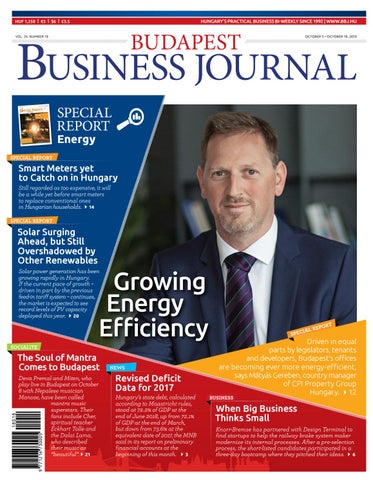
Growing Energy Efficiency
Solar power generation has been growing rapidly in Hungary. If the current pace of growth – driven in part by the previous feed-in tariff system – continues, the market is expected to see record levels of PV capacity deployed this year. 20
SOCIALITE
The Soul of Mantra Comes to Budapest Deva Premal and Miten, who play live in Budapest on October 8 with Nepalese musician Manose, have been called mantra music superstars. Their fans include Cher, spiritual teacher Eckhart Tolle and the Dalai Lama, who described their music as “beautiful”. 21
NEWS
Revised Deficit Data for 2017 Hungary’s state debt, calculated according to Maastricht rules, stood at 72.2% of GDP at the end of June 2018, up from 72.1% of GDP at the end of March, but down from 73.6% at the equivalent date of 2017, the MNB said in its report on preliminary financial accounts at the beginning of this month. 3
SP
LR EC I A
EPOR
T
Driven in equal parts by legislators, tenants and developers, Budapest’s offices are becoming ever more energy-efficient, says Mátyás Gereben, country manager of CPI Property Group Hungary. 12
BUSINESS
When Big Business Thinks Small Knorr-Bremse has partnered with Design Terminal to find startups to help the railway brake system maker modernize its internal processes. After a pre-selection process, the short-listed candidates participated in a three-day bootcamp where they pitched their ideas. 6
2 | 1 News
www.bbj.hu
Budapest Business Journal | October 5 – October 18, 2018
BBJ
THE EDITOR SAYS
EDITOR-IN-CHIEF: Robin Marshall EDITORIAL STAFF: Zsófia Czifra, Kester Eddy, Bence Gaál,
David Holzer, Christian Keszthelyi, Gary J. Morrell, Rob Smyth, Bálint Szőnyi, Zsófia Végh, Ágnes Vinkovits. LISTS: BBJ Research (research@bbj.hu) NEWS AND PRESS RELEASES:
Should be submitted in English to news@bbj.hu LAYOUT: Zsolt Pataki PUBLISHER: Business Publishing Services Kft. CEO: Tamás Botka ADVERTISING: AMS Services Kft. CEO: Balázs Román SALES: sales@bbj.hu
CIRCULATION AND SUBSCRIPTIONS: circulation@bbj.hu
Address: Madách Trade Center 1075 Budapest, Madách Imre út 13-14., Building A, 8th floor. Telephone +36 (1) 398-0344, Fax +36 (1) 398-0345, www.bbj.hu SUBSCRIPTIONS: Budapest Business Journal 1 year 6 months 3 months
HUF 27,500+VAT HUF 13,750+VAT HUF 6,875+VAT
News Services Hungary A.M., Energy Today, Regional Today 1 year, from HUF 179,000+VAT 6 months, from HUF 104,900+VAT 3 months, from HUF 58,900+VAT Book of Lists 2017-2018: HUF 19,120+VAT DigiBOL HUF 39,900+VAT Call +36 1 398-0344 or email circulation@bbj.hu
IN PRAISE OF TALKING SHOPS I once had a cynical business friend (cynical even by the standards of journalism, where it is something of a professional requirement) who told me chambers of commerce were a waste of time and money, a talking shop that achieved very little. At the time, he may have been right. Not any longer. The American Chamber of Commerce in Hungary held its fourth annual “Business Meets Government Summit” this week (for a more detailed report, see “Everything is Connected to Everything”). The chamber went through something of a reinvention a few years back, refining its mission, its focus and how it hoped to achieve that. The summit is one of the outcomes of that process. I suspect there is an element of “size matters” about this. AmCham and the German chamber, which has also managed the grab the ear of law makers, between them represent some of the very largest investors in Hungary. But the chambers have also become smarter at how they communicate with government, coming up with solutions as well as problems, and presenting a business case for fixing them. And they have learnt the virtue of patience. Last year Farkas Bársony, the current president of AmCham, pointed out that the chamber had first called for reforms to corporate income tax in 2004, 13 years before the government slashed it to an EU-record low of 9%. Governments, of course, have different priorities from businesses. Including BBJ-PARTNERS
What We Stand For: The Budapest Business Journal aspires to be the most trusted newspaper in Hungary. We believe that managers should work on behalf of their shareholders. We believe that among the most important contributions a government can make to society is improving the business and investment climate so that its citizens may realize their full potential. The Budapest Business Journal, HU ISSN 1216-7304, is published bi-weekly on Friday, registration No. 0109069462. It is distributed by HungaroPress. Reproduction or use without permission of editorial or graphic content in any manner is prohibited. ©2017 BUSINESS MEDIA SERVICES LLC with all rights reserved.
the one already in power in 2004, there have been five cabinets since 2004 (six if you count the unelected caretaker government of Gordon Bajnai who was in power from 200910 following the resignation of Ferenc Gyurcsány). The last three have all been led by Fidesz; perhaps the two sides have simply finally found a way of working together. It is one thing for the business world to speak, quite another for the political world to react. An event such as the summit is about building relationships, exchanging views. It genuinely is a talking shop (if not here, then when?) It was certainly refreshing to hear state secretaries talking about “joined-up thinking”; the effects one policy has on another. Too often, politicians think in isolation, looking for a box to tick, a shortterm fix, a boost in the ratings. Actions need to follow words, but at least the words suggest a better direction. The Competitiveness Council, a gathering of the grand and the wise from the business world to advise government, has made many good suggestions. Seemingly quite low down on the priority list is one of its latest ideas: doing away with dubbing over foreign TV programming in Hungary. It’s important because it has a clear impact of the level to which children learn foreign languages. It is not by accident that so many Dutch children speak such good English: they watch subtitled programs, not dubbed. One of the state secretaries made the point that there are rival voices, the dubbing lobby which claims that Hungary is a world leader at synchronization. It quite possibly is, but that’s not necessarily a skill you want to lead the world in. Quite what power the dubbing lobby has I do not know, but I get the feeling the council is pushing against an open door. If so, it will be another victory for patience; I first had conversations with linguists about this back in the noughties.
VISIT US ONLINE: WWW.BBJ.HU
Robin Marshall, Editor-in-chief
ADVERTISEMENT
STOCKHOLM
SAMUEL AKESSON
NEW YORK
×109
Forsman & Bodenfors, Creative Director
STOCKHOLM
JOHAN RADOJEWSKI Absolut Vodka, Global Brand Director
AMSTERDAM
18-19 OCTOBER 2018
FELICE VAN DER SANDT
Influencer Marketing Agency (IMA), Sr. Brand Partnership Manager
JESI
BF_2018_Print_hirdetes_BBJ_252x158_02.indd 1
LONDON
CORTNEY HARDING
Friends With Holograms, Co-Founder
MILAN
CAMERON WORTH SharpEnd Agency, Founder
DUBAI
ASHLEY BENIGNO
ROBIN SMITH
Fjord, Group Director
Geometry/Ogilvy, Creative Director
FRANKFURT
LONDON
RICHARD NOCKLES
GABRIELLA VIDUS
GÉZA PALOCSAY
OTTÓ NÉMETH
GABRIELLA HEISZLER
KRISZTA D. TÓTH
SZABOLCS MÁRTON
Spar Magyarország, CEO
MEDIA SPONSORS:
NEW YORK
Liferay, Marketing Manager Europe
Schibsted Classified Media Hungary, CEO
wmn.hu, Founder & Editor-in-Chief
...AND MORE THAN 100 SPEAKERS
×12
Bartle Bogle Hegarty (BBH) London, Head of Interactive Design
EDMUND DUECK
RTL Magyarország, CEO SPONSORS:
Vanity Fair contributing editor
ROSS MAWDSLEY
GRAZIANO GIACANI Brand Festival (Italy)
FEATURED SPONSORS:
MONICA LEWINSKY Social activist &
LONDON
Surround Vision, Creative Director
Henkel Magyarország, General Manager
Republic Group, Creative Director
GET YOUR TICKET NOW! BRANDFESTIVAL.HU
2018. 10. 01. 12:12:08
1
www.bbj.hu
Budapest Business Journal | October 5 – October 18, 2018
News///macroscope
Revised Deficit Data for 2017
State debt and general government deficit data came out in the past weeks, topped with a lower-than-expected purchasing manager index. It has not been a very exciting period in the macro calendar though, although more relevant data, including industrial performance and inflation, will come to light in the coming weeks. ZSÓFIA CZIFRA
Hungary’s state debt, calculated according to Maastricht rules, stood at 72.2% of GDP at the end of June 2018, up from 72.1% of GDP at the end of March, but down from 73.6% at the equivalent date of 2017, the National Bank of Hungary (MNB) said in its report on preliminary financial accounts at the beginning of this month. Adding Eximbank’s debt to the state debt, Maastricht debt was two percentage points higher,
at
74.2%,
than the ratio calculated under Hungarian financial accounts methodology. This ratio was up from 73.9% at the end of Q1 2018, but down from 75.7% in Q2 2017. In August, the ratio of state debt to GDP, including Eximbank, was cited as 74.5%. The net financing requirement of the general government, which is a good approximation of the general government deficit, was HUF 1.338 trillion, or 3.4% of ADVERTISEMENT
In a second reading of data from 2017, KSH reported that the deficit of the general government sector was HUF 849.2 bln in 2017, or 2.2% of GDP. The figures were revised up from HUF 746.3 bln and 2% of GDP GDP in the four quarters to the end of Q2. Within households’ financial assets, there was a significant increase in currency, current account deposits, and debt securities issued by central government. On the liabilities side, the stock of housing loans within borrowing from credit institutions rose significantly due to transactions. The stocks of consumer and other loans also increased.
The KSH also released the balance of the general government sector for the first six months of the year on October 2. According to this, Hungary’s general government ran a HUF 13.7 billion deficit in the first half of the year, equivalent to 0.1% of GDP, calculated according to the European Union’s accrual-based accounting methodology.
Deteriorating Balance
The balance deteriorated by HUF 223 bln in H1 2018, or by 1.2 percentage points as a proportion of GDP compared to the corresponding period of 2017, KSH noted. In absolute terms in the first half of 2018, the general government sector’s revenues totaled HUF 8.964 tln, and its expenditure HUF 8.978 tln. Revised data for the
2017 deficit
was also published by the statistical office. In a second reading of data from 2017, KSH reported that the deficit of the general government sector was HUF 849.2 bln in 2017, or 2.2% of GDP. The figures were revised up from HUF 746.3 bln and 2% of GDP in the first preliminary reading released early in April. The 2017 deficit widened from 1.6% of GDP in 2016.
Numbers to Watch in the Coming Weeks Industrial production data for August will be published on October 5, and the KSH will also release the consumer price index for September a few days later. The performance of the construction sector in August will be in the limelight on October 12.
Smaller Rate Hike for 2019? London-based analysts expect a smaller base rate hike that will come later in Hungary, Fitch Solutions Macro Research wrote in a note at the end of September. According to the analysts, the MNB will first start to tighten monetary conditions by lifting the base rate in the second half of 2019 (previously, they said a spring date was more likely) and there will be a 0.75 percentage point hike instead of the earlier forecast 1.1 percentage point rise next year. Therefore the key rate in Hungary will stand at 1.65% at the end of 2019, instead of the previously thought 2%, Fitch analysts said. However, they also added that the pace of the tightening will likely be faster than that of the European Central Bank, projecting that the rate will hike to 3% by the end of 2020, which would represent a 2.1 percentage points of cumulated base rate hike in the following two years in Hungary, while the ECB is expected to carry out a 0.75 percentage point hike in the same period, Fitch said.
The debt of the general government sector at the end of 2017 – based on data from the MNB – was HUF 28.095 tln, 73.3% of GDP, down from 75.9% at the end of 2016. Data for the balance of the general government sector in the third quarter of the year, and for Q1-Q3 2018, will be published by the KSH in January 2019. In the meantime, the Hungarian Association of Logistics, Purchasing and Inventory Management (HALPIM) released its seasonally adjusted Purchasing Manager Index for September. In its original data release on September 3, the association said the index stood at 53.2 points in August, but it revised the figure slightly downwards in the fresh release.
4 | 1 News WHO’S NEWS
www.bbj.hu
Budapest Business Journal | October 5 – October 18, 2018
Do you know someone on the move? /// Send information to news@bbj.hu
EY Appoints Ex-KPMG Advisor György Sallai György Sallai joins EY as director responsible for technology and riskanalysis services, having previously worked for rival Big Four company KPMG for more than a decade, according to a press release sent to the Budapest Business Journal. “Increasing efficiency is the greatest challenge companies face nowadays,” says the freshly appointed Sallai. “Robots execute increasingly complex tasks, therefore it is of key importance that companies start and maintain the development of their processes as early as possible, in addition to automating the core of their business services.” Coming from an IT engineering background, Sallai is specialized in the automotive industry, financial sector, telecommunication, and the oil and gas industries. He will also be responsible for services related to digitalization, robotics, and intelligent automation.
György Sallai Over the course of his career, he has headed several IT management, quality insurance, outsourcing, system implementation, auditing, and planning projects.
Wolf Theiss Grows Corporate and LDR Team in Budapest CEE and SEE law firm Wolf Theiss announced the appointment of a new team of four in Budapest: the group
includes M&A expert Ákos Erős, former managing partner of Squire Patton Boggs in Budapest, as well as Judit Nádor and
Ákos Erős Artúr Tamási, senior assoyÁgnes Budai, associate. The new appointees join Wolf Theiss from international law firm Squire Patton Boggs to strengthen the Corporate/ M&A and Litigation & Dispute Resolution Departments of the company. Wolf Theiss says the newcomers are widely recognized as leading corporate/ M&A and litigation lawyers, with experience in advising clients on a range of both domestic and cross-border matters. Ákos Erős is a partner, specialized in M&A and private equity, MBOs, and other corporate matters. As managing partner of Squire Patton Boggs in Budapest he also advised on important capital market transactions in Hungary. Judit Nádor is a senior associate, who focuses on corporate and employment law. She has experience in M&A transactions and general corporate law and has participated in numerous privatizations and company acquisition procedures. Artúr Tamási is a senior associate, who represents clients in Hungarian commercial litigation, Hungarian and international commercial arbitration, enforcement proceedings, administrative proceedings and litigation as well as in matters involving public law and criminal law. Ágnes Budai is an associate, who will strengthen Wolf Theiss’ Corporate/ M&A team. She focuses on corporate matters including M&A, international
business, telecommunication, competition and trademarks. “It’s a great pleasure for us to join a leading law firm in the CEE/SEE region and to be part of Wolf Theiss’ eminent team,” Erős says. “Working together, we can continue to serve our clients on the highest level and further expand our services and workforce not only in Hungary but also in the region.” “We are looking forward to the new opportunities that the expansion will bring us,” managing partner of Wolf Theiss Budapest office Zoltán Faludi says. “We are happy to add the talents of Ákos, Judit, Ágnes and Artúr to our team in Hungary. They will be a great addition to our highly regarded corporate and dispute resolution practice and their market knowledge will be a great asset for our clients.”
manager for industrial developer VGP NV, overseeing its activities in Czech Republic, Slovakia, Hungary and Romania.
ASB Group Appoints Dan Ledvinka to Head Business Development ABS Group, a professional outsourcing provider, has appointed Dan Ledvinka as its new group head of business development and marketing for the CEE region. Ledvinka will be responsible for leading and coordinating marketing, public and media relations across the region.
Prologis Strengthens Project Management Team in CEE Prologis, which describes itself as the global leader in logistics real estate, has promoted Michal Vrba to vice president, head of project management of Prologis CEE, replacing Balázs Bellák, who moves to vice president, head of project management, Prologis Europe. Vrba will be responsible for the overall management of developments in the CEE region, overseeing multiple projects from initiation to completion, as well as acquisitions and disposals.
Michal Vrba Vrba has over 16 years of experience in construction and project management. Prior to joining Prologis in August 2011, he served as development and project
Dan Ledvinka “I am grateful that I can be a part of the expansion, dynamic growth and, last but not least, a great team,” Ledvinka says. “It will continue to be my challenge to strengthen the position and image of ASB Group in the key CEE countries.” Ledvinka joined the group last year as business development manager, with more than six years of experience in the field. Previously, he worked for Mladá fronta, one of the biggest publishing houses in Czech Republic, as well as Media Events Company, a marketing, PR, and PA agency. He is also the organizer of the Prague Capital Market Summit. “In the last year, we have been developing transaction advisory services across our CEE offices,” says ASB Group’s managing partner Petr Studnicka. “We also started implementing our expansion on the Hungarian market and opened a new office in Budapest. Dan’s background, his experience in marketing and business development, will help us with our plans and I am convinced Dan will further improve our services provided to our clients and partners.”
ADVERTISEMENT
Hauer Confectionery & Café Traditional Hungarian Cakes and Pastries Breakfast & Sandwiches· Coffee As You Like It Selected Premium Drinks H-1088 Budapest, Rákóczi út 47-49. +36 1 612 1313· hauercukraszda.hu facebook.com/hauercukraszda
BBJ_Hauer_ad_252x77_cmyk_300dpi_composite_v5.indd 1
7/19/2018 7:38:42 AM
1 News | 5
www.bbj.hu
Budapest Business Journal | October 5 – October 18, 2018
Wing Completes Magyar Telekom Headquarters Wing has completed the 58,000 sqm Magyar Telekom Group headquarters, located in District IX, adjacent to the Groupama Ferencváros Stadium. A daily average of around 1,000 builders and 150 subcontractors worked to complete the built-to-suit project over the course of the 28 months. GARY J. MORRELL
The Hungarian developer has acquired a niche role of developing tailored, research and development buildings for high-tech companies. This latest BREEAM preaccredited building, designed by TIBA Architectural Studio and constructed by Market Építő, will include a 300 person capacity conference center, two restaurants, fitness and wellness center on the top floor with a running track, 2,000 sqm internal garden, 1,350 parking spaces, 350 bicycle parking places with changing facilities and 50 electric vehicle charging places.
by only going ahead with projects once a built-to-suit agreement or a significant prelease has been agreed. In another recent built-to-suit development, Wing have completed the Ericsson research and design HQ at the Nobel Prize Winners Research & Development Park located on the Buda side of the Rákóczi híd. Wing will start construction of a second, 20,000 sqm phase of the project next year as the Hungarian developer is
building a
22,000 sqm
New Telekom HQ by Wing. The building is located at the intersection of Könyves Kálmán körút and Üllői út, providing direct metro and road access to the city center and the airport. Wing acquired the three hectare development site from the state after a public auction. The complex will provide a working environment for
more than
UniCredit Bank Hungary and K&H Bank. The HQ is the largest single office building in Budapest, according to Wing, and represents 2% of the total modern Budapest office stock. A long-term, 15-year letting agreement was concluded between Wing and Magyar Telekom after the project was put out to open tender by the telecom.
4,000
Telekom and T-Systems employees as the company recognized the need to establish a single headquarters that provides for the needs of a workforce previously spread over six different locations across the city. The circa HUF 50 bln project is being financed by Wing’s own equity and a consortium of banks consisting of
Conservative Strategy
Despite the current low vacancy and strong demand, Wing has been pursuing a conservative office development strategy
Budapest headquarters for evosoft Hungary, 100% owned by Siemens. “With built-suit projects, we are able to agree a long-term lease with a major tenant and this puts us in a position to tailor the building to the specific needs of that tenant. At the same time, the tenant needs to commit to a long-term lease of more than ten years,” comments Noah Steinberg, chairman & CEO of Wing, on the development strategy of the company. “In contrast, those buildings that are not developed on a built-to-suit basis are designed to a more flexible specification to meet the needs of multi-tenants. Wing has developed major headquarters facilities for international and local corporations, and our track record of success speaks for itself. With this project, we can demonstrate to potential tenants that we are able to complete large-scale built-to-suit projects on time,” he adds. Wing has the opportunity to develop a further project on an adjacent one hectare site in an area that is developing into a business district with its excellent road, metro, and tram transportation links. Such well located, three hectare sites are becoming increasingly difficult to source in the booming Budapest office market.
Futureal Concludes Financing for Etele Plaza Futureal have concluded a EUR 150 million (about HUF 48 billion) loan agreement with UniCredit Bank and Erste Group for its Etele Plaza retail project. GARY J. MORRELL
Construction of the Etele Plaza is already in progress and the view among analysts is that this is the right time for the development of new shopping centers to freshen the market, after a gap of several years since the delivery of the last shopping center. The fact that long-term pipeline retail projects are now going ahead reflects the confidence of developers, retailers and financers in the Budapest market. Etele Plaza is located at a transport hub with access to the Kelenföld Railway Station, the Metro 4 underground line and the approach section of the M1 and M7 motorways. The hub is used by
165,000 people
daily, according to Futureal, and the 55,000 sqm project will consist of around
180 retail outlets. The development project also includes the 65,000 sqm Budapest ONE office park, the first phase of which will deliver 25,000 sqm of office space in addition to 2,600 sqm of commercial and service units according to the development plans.
We kept this in mind also in the case of Etele Plaza,” says Gábor Vörös, head of financing at UniCredit Bank Hungary. “Erste Group and Futureal Group have been in a close business partnership for more than a decade. In the course of our cooperation, our bank has participated in the financing of several successful office development projects, underlining our strong commitment to financial partnership and value creation,” adds
Zoltán Balázs, head of real estate and structured finance at Erste Bank Hungary. The Futureal Group portfolio has been involved in more than
90
real estate
projects with a total value of EUR 3 bln and over two million sqm of development space. Those development projects have continued to attract investors.
Long-term Operation
Under the Etele Plaza financing package around EUR 150 mln will be available for ten years for the development and long-term operation of the shopping center. UniCredit are acting as bookrunner and facility agent and the two banks are providing project finance on a 50-50 basis. “Our goal is to satisfy our clients’ financing needs with competitive project and syndicated loans tailored to their individual needs, thereby contributing to the implementation of their major projects.
Etele Plaza by Futureal.
2
www.bbj.hu
Budapest Business Journal | October 5 – October 18, 2018
Business
in our company or get involved in world class innovation projects. Many of them stay with us and join our international team of engineers. BBJ: Many companies are after innovation in technology. AB: Knorr-Bremse Budapest has just launched a largescale industry 4.0 project in cooperation with BME and two small businesses, IQ Kecskemét Ipari Kutató Kft. and 4Sales System Kft., in order to develop the prototype of a production management and control system based on IoT and Big Data technology. However, first of all, we need a more modern and dynamic corporate culture, capable of adopting new solutions.
When Big Business Thinks Small
Knorr-Bremse has partnered with Design Terminal to find startups to help the railway brake system maker modernize its internal processes. After a pre-selection process, the shortlisted candidates participated in a three-day boot camp where they pitched their ideas. The Budapest Business Journal talked to Attila Bolla, leader at Knorr-Bremse Rail Systems Budapest, about the process.
ZSÓFIA VÉGH
BBJ: What is the aim of this cooperation? Attila Bolla: In order to address present and future challenges as well as meet today’s industrial demand, Knorr-Bremse Budapest, a traditional large corporation, needs to change and become more like a small-sized company. We need to be more flexible, quick to respond and become more innovative. So, we asked Design Terminal [an incubator with a multiindustrial focus] to help us tie up with startups. Our aim is to get a better understanding of agile methods, operation and business management. We also aim explore the potential that lies in the cooperation of a large company and startups – in the medium and long run. At the same time, we wish to find innovative solutions that respond to the challenges listed.
BBJ: So, what do you intend to improve, say, in internal communication or administration? What are the problems that need to be solved? AB: I would not say there are flaws. This is an organization that functions well. We rather are looking at what could be done to meet the challenges of today and future market challenges. Worldwide, Knorr-Bremse is growing at a fast pace. The factory in Budapest is no exception; its revenues and number of staff are increasing, we cover an ever wider spectrum of railway brake systems, the organization have more members. We are not just a manufacturer, but a development center, where we have an R&D team. The various occupations and departments located at one place breed cultural and communicational differences – both globally and locally. We try to deal with these differences by delegating a member of each function into another team. However, many of the tools we use (for example email or phone communication) have become outdated.
Attila Bolla BBJ: What makes Design Terminal a good partner in achieving this? AB: Design Terminal is a renowned and experienced organization, and a good catalyst between startups and large corporations in the current ecosystem; it knows both sides. We invited startups to address challenges in three areas: internal communication; red tape reduction and effective workflow; and corporate communication. Following a two-month scouting period, we selected ten startups out of 83 enterprises who applied from around the world. BBJ: Was it important for you to invite startups from outside of Hungary as well? AB: The main criterium was to find a partner that is well-known in the startup ecosystem and has an extensive network that helps us mobilize startups. BBJ: Is this a local initiative? AB: It is entirely a Budapest-based initiative. We are aware that there are similar ones elsewhere, but they are independent of one another.
BBJ: Why is it timely to change now? Are your competitors more ahead in these fields? AB: Quite the opposite. We have several goals: one is employer branding. We wish to distinguish ourselves from other industry players. We want to be more attractive for prospective employees, and introduce new momentum to the Budapest center that helps us retain our employees. BBJ: So, you also experience a labor shortage? There is a huge demand for engineers in Hungary. AB: As it is for every player of our industry in Hungary, we have to cope with some degree of labor shortage. Besides employer branding programs designed to address prospective employees, we have concluded an agreement on dual training with vocational schools and run widescale cooperation with universities, especially the Budapest University of Technology and Economics (BME). Our scholarship and trainee programs are especially popular in BME. We regularly receive students, graduates and PhD students who conduct various research projects
BBJ: And you are hoping to find a solution for these with the help of these startups? AB: Right now, the teams are familiarizing themselves with our specific problems, and will come up with a solution for those during these three days. The last day of the boot camp is dedicated to their sales pitches, when we will select a few projects. BBJ: How many projects will you pick? AB: The management wants to take an agile approach and will not limit the number of projects. If there are several that we see the potential in, we may launch several. BBJ: What type of cooperation are you planning to have? Will they work within the company or remain independent? AB: We are trying to be flexible in this as well: there are a number of options on how to integrate them into a corporate environment, but we haven’t decided as yet. One of them is to develop these projects within company. If some turn out to be too complex to be managed in-house, we will use external support. BBJ: Will these pilots later be used by Knorr-Bremse in other countries? AB: It is too early to say that. The first step is to test the solutions in a smaller environment. If they work out well, we will look at how we can expand it factorywide. Should it turn out to be a benchmark solution, then can we start thinking about a broader use, but we are not planning that far ahead at this moment.
2
www.bbj.hu
Budapest Business Journal | October 5 – October 18, 2018
Business
|7
Business Schools Cold-shoulder Ceeman to Their Cost Georgia, “I discovered that there is a whole world outside for us Hungarians!” In a global sector dominated by big names such as Harvard, Insead, IMD and London, Ceeman, he says, provides an accessible and cost-effective forum for the valuable exchange of ideas. “Where would someone from, say, Wroclaw, go to discuss management education trends?” he asks, “At any big [business schools’] conference they would be ridiculed and have nothing to say. Ceeman fills this gap.” The Prague conference attracted some
Hungarian management schools and universities are “extremely missing out” by not joining Ceeman and sharing in its regional and international activities, according to Zoltán Buzády, associate professor of leadership at Budapestʼs Corvinus University. KESTER EDDY
Ceeman, originally the Central and East European Management Development Association, was founded in 1993 specifically to enable management schools in what had been communist Europe and the former USSR to share and exchange know-how and knowledge in order to kickstart business leadership skills. Headquartered in Bled, Slovenia, Ceeman has proved so effective that, after attracting considerable international interest from outside its core region, it changed its name (but not its acronym) to the International Association for Management Development in Dynamic Societies in 2013 to reflect its growing reach. Despite this success – and despite hosting two of Ceeman’s 26 annual conferences in Budapest (in 1999, by IMC, forerunner of the CEU Business School, and 2014 by the Budapest wing of France’s ADVERTISEMENT
ESSCA School of Management) – the response from Hungarian management institutions has been lukewarm at best.
150
Center of Europe
“We were thinking that we were going to import knowledge from Harvard and the West, and this would radiate strong enough,” says Buzády. Arguably, management education in Hungary has regressed as a result: the CEU Business School merged with the university’s Economics Department in 2017 and dropped its MBA programs, while the Hungarian government has recently announced that Corvinus University will come under the Ministry of Innovation and Technology in a move designed to boost its global standing. Speaking to the Budapest Business Journal at Ceeman’s 26th annual conference, hosted by the University of New York in Prague, Czech Republic – headed by Andreas Antonopoulos, a former professor
participants,
Zoltán Buzády at the CEU Business School – Buzády said that after winning a case study competition and attending a Ceeman conference in
including representatives of business schools from across Central and Western Europe, Russia, China, Brazil, South Africa and India. Along with Buzády, Hungary was represented by Zsuzsa DeliGray, director of the ESSCA School of Management’s Budapest operations.
Corvinus Professor Wins Ceeman Innovation Award Zoltán Buzády, associate professor of leadership at Corvinus University, Budapest, received the Ceeman 2018 Champion award in the category of Innovative Pedagogy at the association’s conference in Prague on September 21. Buzády won the accolade on account of his
work with the Hungarian-American professor Mihaly Csikszentmihalyi and others on Fligby, an acclaimed leadership development simulation game which enables operators to objectively gauge management capabilities using a so-called “non-intrusive assessment of leadership skills”.
8| 2
Business
www.bbj.hu
Budapest Business Journal | October 5 – October 18, 2018
Continental Opens 7th Plant in Hungary, Plans Innovations German technology manufacturer Continental has laid the cornerstone of a EUR 100 million plant in Debrecen (231 km east of Budapest), which will lead to the creation of 450 new jobs. BENCE GAÁL
The 7,000 sqm Debrecen factory is Continental’s seventh unit in Hungary. The company expects production to start in the third quarter
of
2020.
Initially, products for the transmission and sensors and actuators business units will be produced in the facility. The Budapest Business Journal spoke with Lukas Juranek, head of the Debrecen plant, to discover how Continental decided on the location. “The entire assessment process proceeded in a very uncomplicated and appreciative way,” Juranek says. “Debrecen is the second largest city in Hungary, having an outstanding infrastructure and highly qualified workforce in the region, so it is the ideal location for
our next expansion. With this decision, we are continuing to expand the electronics production and European presence in order to better satisfy customers’ demands,” he said.
Broad Spectrum
According to Juranek: “Hungary offers young talents, a highly qualified workforce and a good business environment, which is a competitive set up comparing to other countries.” In return, he says Continental offers “a broad spectrum of career and job opportunities in the production sector from operator, engineer up to management level, which all require a different set of competencies and qualifications. Although educational background and technical knowledge is important, methodical expertise and social competence are gaining increasing relevance.” Continental also plans enhanced training in automotive applications and manufacturing.
LEGO Building Innovative Future Brick by Brick Since its handover in 2014, LEGO’s additional brand new Hungarian plant in Nyíregyháza has been an important hub in the manufacturing of the iconic building blocks and has been on a constantly expanding and developing, Lóránt Siket, communications manager at LEGO Manufacturing Kft., tells the Budapest Business Journal. CHRISTIAN KESZTHELYI
Although digital games appear to be taking the playing arena from physical toys, the world-renowned plastic building blocks of LEGO are still fashionable among youngsters and their parents. “We believe that physical play and the LEGO system-in-play will remain as relevant as they are today. According to a fresh global survey done by the LEGO Group, 95% of parents say that play is essential for the wellbeing and development of their child. This is something that encourages us to stick to our mission: inspire and develop the builders of tomorrow,” says Siket. “Along with product development trends, we in the LEGO factory in Nyíregyháza have to be leaders in production technology, in order to ensure the best possible quality of LEGO products; and
even more than that, as our motto says: ‘Only the best is good enough’,” says Siket. As an addition to its original plant in Nyíregyháza, LEGO added a state-of-theart unit in 2014. Among its innovations, the new factory applies advanced molding technology and the biggest automated highbay-warehouse in the region, in order to ensure best product quality and effectiveness. “Through a decade of immense growth, we had to ensure a swift growth in production capacity and keep the extraordinarily high-quality standard that marks LEGO products,” Siket adds.
Fighting Plastic
Aside from developing technologies further, new platforms need to be installed in the factory as time progresses, in order to keep pace with business demand. The development of new products, meanwhile, demands the ability to work on multiple platforms, and further develop materials and technologies.
for driverless robot taxis in the city.” In addition to that, the company is also developing an autonomous and automated parking system. Another development Continental highlights is its integrated cockpit system, which it says was recently crowned “Innovation of the Year 2018”. Continental says the company had impressed the jury of the German Design Council with its “innovative control concept for the vehicles of the future, which comprises multiple displays and touchscreens that are housed under large, curved glass surfaces and stretch across the entire width of the vehicle”. The company is also expanding its range of solutions for automated driving in commercial vehicles. “To this end, Continental is currently developing an environment model that captures the vehicle environment using various Lukas Juranek sensors. The data from sensors such as camera, radar and [laser-based] lidar is combined with additional information The company follows what it calls a such as the profile of the route ahead and “tripartite technology development” for collected, evaluated and interpreted by an motorway, city, and parking. “In addition intelligent control unit, the Assisted and to the production readiness of highly Automated Driving Control Unit (ADCU),” automated driving, Continental is also Continental says. working on fully automated driving on The innovations do not stop there, the motorway by 2025. Continental also however, as Continental will soon “unveil believes in autonomous driving. With its for the first time anywhere in the world its Continental Urban Mobility Experience digital electronic air spring damping test platform, the company tests systems solution for the driver’s cab in trucks”.
Future driven innovation
sponsored by
And as public dialogue becomes louder on cutting back on plastic production and usage, LEGO, which has plastic as the core material for its bricks, is making a commitment to reduce its plastic usage. “One of the biggest challenges for us is to replace the raw material [plastic] we use with sustainable materials. We already introduced polyethene made of sugar cane this year in our products, and plan to find an alternative to our main raw material ABS by 2030: a Sustainable Materials Center has been established in our headquarter in Billund, Denmark, where about 100 researchers and professionals work on a perfect solution,” Siket adds. Innovation at LEGO has a special focus on the safety of employees. “Looking at technology, our colleagues are part of our innovation efforts, as in the spirit of ‘LEGO Continuous Improvement’, our idea program delivers a number of relevant development projects that we implement. We make construction toys for children, which means also a great responsibility: we have to ensure at all times that the products we make are absolutely safe and of the highest quality,” Siket explains. He further adds that the plant is committed to create the safest possible work environment.
As LEGO expects the bricks themselves to remain the core of its business — despite a swiftly and constantly changing industry — production processes are not likely to change significantly in the near future. Yet, LEGO still thinks it important to keep employees posted about changes. “We inform our employees about all important innovations in our company and provide them with the necessary training to develop the skills they need to work in a global environment,” the communications manager concludes. This regular column, run in association with Audi, looks at how some of Hungary’s biggest companies involve innovation in their daily practice.
2
www.bbj.hu
Budapest Business Journal | October 5 – October 18, 2018
Business | 9
Photo: Hajnalka Hurta
‘Everything is Connected to Everything’ When it comes to reforming the education system to provide businesses with the workers of the future, “Everything is connected to everything,” Deputy State Secretary for Vocational Training and Adult Education Gábórné Pölöskei told AmCham’s fourth Business Meets Government Summit on October 1. Gábórné Pölöskei, center, speaking during the state secretaries’ panel discussion. With her are, from left: moderator Ferenc Pongrácz ; László György; Balázs Rákossy; and Ádám Szigeti.
ROBIN MARSHALL
Pölöskei was speaking in the plenary panel discussion, moderated by Ferenc Pongrácz, the leader of AmCham’s Investment Policy Task Force and a former president of the chamber. Other speakers were László György, State Secretary for Economic Development and Regulation; Balázs Rákossy, State Secretary for the Utilization of European Union Funding; and Ádám Szigeti, Deputy State Secretary for Innovation. Pölöskei told delegates at the Hilton Budapest in the Castle District that education required “a systemic transformation from our [the government’s] side”, but added that education “cannot resist the need for transformation”. Importantly, there is a need to restructure from the current setup that tries to do too much, with vocational education attempting to prepare students for a
staggering
750
professions. “In Germany at present there are 320 professions, and they want to get that down to 150. Finland has 170 and wants to go down to 80,” Pölöskei said. She set the target for Hungary at 150, saying that would enable higher quality, and a more modern and versatile approach. Several speakers referenced McKinsey research that has many professions, including accounting, disappearing in a couple of decades. “When Generation Z enters the labor market they will have professions that do not exist today. We have to give them skills and capacities, and not professions. We do not have to focus on future
professions because we do not know what they will be,” the deputy state secretary pointed out.
Free up Reserves
On a similar theme, Szigeti said automation would free up labor reserves. “That is also why I do not envisage such a grim picture,” he said, in reference to a statistic that shows the working population falling by two million between now and 2060. The key issue will be making sure the workforce has skills that can be transferred as jobs change. “We cannot really deal with the quantity issue with anything less than quality,” he said. Currently, some 1.4% of Hungarian GDP is being spent on research and development. The goal
by
2020
is to have raised that to 1.8% he said, “but ideally it should be 3%”. Rákossy made the point that, rather than teaching students two or more foreign languages, perhaps the system should concentrate on doing just one language, but to a very high level. “I apologize to French and German investors, but if someone does not speak English, they will not be able to make business,” Rákossy said. “It is very important everyone speaks English at a good level.” On the issue of the brain drain, György said the government has been pursuing a number of policies aimed at simultaneously improving salaries in Hungary and also encouraging those who had left to country to return.
“We also see it is possible to attract people home from abroad; we see now a balance between those leaving and those returning.” But government cannot create the jobs, he said, only create the
“When Generation Z enters the labor market they will have professions that do not exist today. We have to give them skills and capacities, and not professions. We do not have to focus on future professions because we do not know what they will be.” ecosystem that encourages businesses to make hires. “BlackRock, for example, has been able to create 500 high value jobs and has been able to attract many Hungarians back.”
Real World Challenges
In terms of research, he said the system needs to change so that, rather than university professors deciding what problems should be investigated by the students, businesses should give the universities real world challenges for their students to look into. Again, it requires partnership. “We can only make our universities more potent if we can rely on your input,” he told the business representatives present.
Pongrácz ended by asking the speakers for one measure of what success would mean for them. For György it was “how we create an ecosystem and a business environment” that enables more higher value jobs to be created. Pölöskei said it was hard to pick just one from “such a system with so many problems” but opted to see the number of children leaving education with no qualifications at zero. For Rákossy it was to “Maintain a stable macroeconomic environment with a growth rate
of
4%
that allows you [businesses] to invest more in Hungary.” Szigeti wants an increase “in the number of researchers: I would like it to reach 56,000”. Earlier, AmCham President Farkas Bársony had noted in his opening remarks that it is “clear that we need to talk in depth about moving Hungary up the global value chain, as it is now obvious that we no longer have infinite quantity of labor force, so we need to focus on quality.” He added: “The ‘Business Meets Government Summit’ is a key milestone each year when, based on your input collected throughout the year and in the summit itself the formulation of the ‘AmCham Recommendations For More Competitive Hungary’ starts. As in the past, we count on you, your ideas, your input to make our fourth recommendation pack a valuable contribution to the competitiveness of Hungary.”
10 | 2
Business
www.bbj.hu
Budapest Business Journal | October 5 – October 18, 2018
High-speed Rail Link Will Make Bratislava Good for a Night out – at a Cost The Visegrad Four (V4) countries have put their weight behind a feasibility study to build a new, highspeed rail line linking Budapest, Bratislava and Warsaw – along with Brno (Czech Republic’s second city). Reports of Monday’s announcement vary, but most state trains will be travelling at “at least 250 kilometers per hour”. KESTER EDDY
Such speeds would slash current schedules, putting Bratislava (200 km) within an hour of Budapest. Warsaw – around 900 km distant – would be more like four and a bit. It’s the kind of news that allows politicians to offer the TV cameras a broad smile: the line would propel Hungary into the age of the high-speed train proper (the BudapestBelgrade project, at 160 kmph, while an excellent improvement, is a mere canter in terms of modern rail performance), and will surely get consultancies very excited. Construction companies especially, and those involved with railway signalling, track and rolling stock, will also have taken note. Coincidentally, the news comes just one week after Otilia Dhand, an analyst with political think tank Teneo Intelligence, visited Budapest to talk about her recent book “The Idea of Central Europe: Geopolitics, Culture and Regional Identity”. Dhand, a Slovak educated at Oxford, grew up in the euphoria of the 1990s thinking “Central Europe was the second best place to be, after the West”. But after studying the region’s 20th century geopolitical history – and living it in the 21st – she’s concluded, in short, that the V4 grouping is nothing better than a talk shop. Hungary, Slovakia, Czech Republic and Poland have such different interests that in the V4’s 27 years of existence its members have united on only one, negative issue – the rejection of asylum seekers/illegal immigrants.
M LIN E TH E BOTTO
Misplaced Pessimism?
So, will this V4 initiative prove Dhand’s pessimism misplaced, at least in terms of rail transport? In truth, only time will tell. But for sure, it is one thing for ministers to discuss high-speed rail links, and another altogether to build and – most especially – finance them. A new, 900 km line fit for 250 kmph is an enormous undertaking. The BudapestBelgrade project, at some 370 kilometers, has been costed by Hungary at EUR 1.65 billion – but this is essentially an upgrade, based on an existing rail alignment. Moreover, for mile after mile, it traverses the flat plains of Hungary and Vojvodina. Any route to Warsaw traverses some seriously hilly country and river crossings in Moravia and northern Hungary, not to mention the Tatra Mountains on the Slovak-Polish border. Designing high-speed routes through such terrain involves miles of tunneling – and spiraling investment costs. Then there is the question of who, exactly, will use the super-fast trains? In another, coincidental twist, your correspondent took the train to Prague at the end of September. (Note, the present plan does not include Prague in the high-speed project – let’s see how that goes down politically with Czech voters.) The current service, based largely on trains from Budapest to Prague connecting at Breclav (Czech Republic) with others
from Vienna to Warsaw – is only two hourly. The fancy new trains – according to the politicians – will only stop in Brno and national capitals. Yet, from the crowds joining and alighting at intermediate stations by far the largest passenger flows are from stations within their respective countries. High-speed trains will certainly attract new, long-distance passengers – but how much will they cover the enormous capital and running costs of such new services? If a 900 km high-speed line does go ahead as announced (as opposed to sectional upgrades to the current route – that would be another matter) it will be political, rather than an economically justified project. Taking Otilia Dhand’s arguments forward one stage, the V4 countries are simply not connected enough for passenger traffic to pay even a majority of the costs of such a scheme. These will be left on the shoulders of future taxpayers. The Bottom Line is a monthly column written by Kester Eddy, a long-standing and well respected Budapest-based business and economic journalist, who has written for the Financial Times and many regional publications. The opinions expressed in the column are not necessarily those of the Budapest Business Journal. To comment on this column, or on anything else in the BBJ, email the editor at robin.marshall@bbj.hu
ADVERTISEMENT
You’d Better Know! 5 Important Facts About Stroke True enough, some of us have a higher risk and genetic disposition toward disrupted circulation to the brain – commonly known as a stroke.
All the same, the causes behind this debilitating and possibly fatal incident are often chronic health conditions, such as diabetes, high blood pressure and cardiac disease. Treating them might be the best prevention to fend off an untimely attack. Here’s five important facts to know about stroke.
1 Stroke happens when decreased blood flow to the brain causes cell death. There are two basic types. Ischemic stroke happens when a clot blocks a blood vessel, cutting circulation to part of the brain. The affected tissue quickly atrophies and dies off due to lack of oxygen and nutrients. In case of hemorrhagic stroke, a weakened blood vessel in the brain starts leaking or bursts, causing an often fatal bleeding inside the cranium. Ischemic stroke is nearly five times more frequent than hemorrhagic.
2 Typical symptoms of stroke include: temporary loss of vision; slurred speech; intense dizziness; weakness in the limbs; partial paralysis; impaired coordination; numbness; drooping mouth and loss of sensation on one side; headache; sudden, piercing pain at the back of the head.
3 When a stroke is suspected, you can quickly assess the condition of the
patient. Ask them to point at their teeth, then lift and stretch forward both their arms and say a whole sentence. Should they fail to complete any of these tasks you should call an ambulance immediately. In the case of an ischemic stroke it is important to administer anticoagulants within three hours but no later than four and a half hours, following a brain scan in a hospital. You must always call a specialist stroke center.
4 The most effective measure in stroke prevention is ultrasound screening of neck arteries. This painless procedure takes only a few minutes and gives a comprehensive diagnosis not only on the condition of blood vessels feeding into the brain, but also about the general condition of your circulatory system.
5 There is no time to be wasted after a stroke event – customized, targeted rehabilitation within a year gives stroke patients the best chance of improving brain function and mobility.
3
www.bbj.hu
Budapest Business Journal | October 5 – October 18, 2018
Special Report Energy Making Better Use of Office Energy
12
Smart Meters yet to Catch on in Hungary
14
Energy lists
16
Solar Surging Ahead, but Still Overshadowed by Other Renewables 20
How are Budapest’s offices changing, how is the energy mix adapting, and at what pace are smart technologies being adopted?
Special Report
12 | 3
www.bbj.hu
Budapest Business Journal | October 5 – October 18, 2018
Making Better Use of Office Energy Hungary’s buildings are becoming ever more energy-efficient in a movement being driven in equal parts by legislators, tenants and developers, Mátyás Gereben, country manager of CPI Property Group Hungary, tells the Budapest Business Journal in an exclusive interview.
Exercise Charging
One example of reclaiming space for alternative, social use is the addition by CPI of five or six exercise bikes in the lobby area of some of its buildings where tenants (or indeed people coming in off the streets) can
“Right now we have more and more Millennials in the workforce, which means more people coming to work by bike, so we are creating more bike racks and shower rooms in our buildings. But we have to plan these steps: how are we serving the individuals coming into our buildings, how can they, and us, be more energy conscious.”
ROBIN MARSHALL
“It starts with new buildings being obliged by the rules to be more energy efficient, to cope with 2020 European Union regulations by law,” Gereben explains. All new buildings constructed
after
2020
will have to meet EU standards for high energy performance and incorporate renewable energy sources to meet the nearly zero energy building (known in the industry as NZEB) standard imposed by the European Commission. “At the same time, many of the asset holders, the investor funds that have buildings from five, ten, or 15 years ago, have to stay competitive over how energy conscious a building is. Tenants are also taking these measures into consideration. Third, and perhaps most important, is how we as developers and landlords see our buildings, from an energy conscious point of view.” Gereben says energy consciousness is “definitely moving up the table” in terms of priorities for tenants, and that is reflected by the fact that all new office buildings in Budapest come with some form of green accreditation, usually from the two biggest organizations, BREEAM and LEED. The public recognition of such certification is an important part of how developers “convince the market and tenants about being energy conscious”, he adds. “The second stage is what we are trying to do as new developers apart from green certificates. CPI, as asset managers and building operators, are looking at our buildings from top to toe, trying to understand how each building works as a whole mechanically. You look at a building as a living organism, almost, an integrated environment reacting with the weather, its own control systems, and the use the tenants make of it.”
Data Harvesting
It might seem counterintuitive, but this is easier to achieve with a new building, because it can be designed to include more (and more accurate) sensors and input devices. That allows building operators
water for irrigating the garden, or turn paved areas into green spaces.” Those spaces can also be used for outdoor gyms or, if installed with Wi-Fi, breakout areas, or simply a place for quiet relaxation.
Mátyás Gereben, country manager of CPI Property Group Hungary to “harvest the data” and understand how tenants are using their offices. That, in turn, enables operator and tenant to discuss how to use space to optimize the building in terms of energy efficiency. You might discover, for example, that space on the sunny, naturally lighter southern side
“CPI, as asset managers and building operators, are looking at our buildings from top to toe, trying to understand how each building works as a whole mechanically. You look at a building as a living organism, almost, an integrated environment reacting with the weather, its own control systems, and the use the tenants make of it.”
new buildings. Unfortunately, for older constructions, you cannot simply install more points. “The building management systems in most cases were simply not designed to deal with all that data, so that would require the whole system to be replaced, which is a huge investment.” That points to a need for developers to try and “future proof” their projects as much as possible. But how a building is used also evolves as the tenant mix changes. “What does ‘being green’ mean; how does that meet with tenants requirements?” Gereben asks. “Right now we have more and more Millennials in the workforce, which means more people coming to work by bike, so we are creating more bike racks and shower rooms in our buildings. But we have to plan these steps: how are we serving the individuals coming into our buildings, how can they, and us, be more energy conscious. That’s what we are thinking through. What are these steps, and what makes a building greener?” CPI is a relative newcomer to the Hungarian scene, having come to the market in 2014 through purchasing an existing real estate portfolio. Currently its
of a building is being underutilized, or that more shading is needed in some areas, or less air conditioning at certain times at others. The level of detail depends on the number of data collection sources, which is why it is much easier to collect from
existing assets and 10% under construction. Gereben and his team are, therefore, spending a lot of time on rehabilitating the older buildings, with the first refurbished project handed over last year. “Even in an older building you can install solar panels, just as you can use drain
mix is
90%
get away from their work station and exercise for a few minutes. The novelty feature is that your mobile phone can be plugged into the bike and, while you exercise, it charges, using the energy you generate. The latest addition to the developer’s Balance project which includes the refurbished Balance Office Park and Balance Loft, is Balance Hall, currently under construction and part of CPI’s “Conscious Building” brand. Gereben says the idea is to develop a brand that represents the way smart technology, energy efficiency, social spaces and tenant use all interconnect and influence one another. It is due to be completed next September and will feature sustainable mechanical solutions, energy saving systems, electric car charging, water saving, and selective waste collection. It will be sound proof and heat insulated, with windows that can be opened, a modern VRV system, and innovative lighting. “Due to the conscious, energy-efficient operation of the office building, the operating expenses will be significantly lower,” Gereben says. Cost still matters, of course. Some ideas sound nice, but may not yet be practical. Even given the abundance of thermal water in Hungary, Gereben says the technology does not allow its use as an energy source for heat, at least for now. “In our portfolio we have one building over a thermal water deposit. We have had long discussions about how we can utilize that for heating or other services for visitors, but so far we have not been able to do so.” Over time, technology will improve and costs come down, Gereben says, and there may also be funding available from EU and governmental bodies. “In Hungary today, there is no broad debate shaping the current system; it does not support green consciousness from a visibility point of view. In other countries, especially in Scandinavia and Iceland, you can find 60-70% green energy funding. Hopefully that will change here.”
3
www.bbj.hu
Budapest Business Journal | October 5 – October 18, 2018
Fuel Excise tax to Remain Unchanged in Q4 The excise tax on fuel will remain the same in Q4 because the price of oil, which determines excise tax under Hungarian law, remained over USD 50 per barrel in Q3, portfolio.hu reported, citing the website of the National Tax and Customs Administration of Hungary. The excise tax on gasoline will be HUF 120 and on diesel fuel HUF 110.35 from October 31.
Firewood Prices set to Soar due to Shortage Due to a lack of laborers, a shortage of firewood and higher prices are expected this winter, napi.hu reported. There are not enough woodcutters because they have gone to Budapest to work in the construction sector. Firewood sellers say they have never experienced such a shortage. Firewood prices have risen 13.5% year-on-year, napi.hu says.
Gov’t Mulls Amendment of Paks II Agreement The government is discussing an amendment of the Paks II agreement, said János Süli, Minister without Portfolio responsible for the project, hvg.hu reported. Süli mentioned that the schedule could be amended but did not confirm that. When Süli became minister in May 2018, the project was already 22 months behind schedule and since then two public procurement procedures have failed. At the beginning of the summer, Süli said that several thousand licenses are still missing and hundreds of those are prerequisites for construction to start, hvg.hu said.
Hungary, Gazprom Reach Agreement for 2020 Hungary has reached an agreement on gas deliveries from Russia for both 2019 and 2020, Prime Minister Viktor Orbán said at a joint press conference with Russian President Vladimir Putin in Moscow on September 18, portfolio.hu reported. Putin said the path of a gas pipeline which would connect the Turkish Stream pipeline with Central Europe could go through Hungary.
Turkish Stream will extend from Russia across the Black Sea to Turkey. Work on the upgrade of the Paks nuclear power plant is progressing well, Orbán said. Russia is financing a large part of the addition of two blocks at the plant, Hungary’s sole source of commercial nuclear power, and Russia’s Rosatom, the general contractor, will soon start the construction of the two new blocs. Orbán said he had urged the launch of a direct flight between Budapest and the Russian city of Kazan, and also noted that OTP employs 5,000 people in Russia. Gas consumption in Hungary came to 10.3 bln cubic meters last year, data from the Hungarian Energy and Public Utilities Regulatory Authority shows. Portfolio.hu also cited Minister of Foreign Affairs and Trade Péter Szijjártó as saying that talks on boosting Hungary’s role in the Moscowbased International Investment Bank (IIB) are at an advanced stage. The IIB is involved in Hungarian projects worth about EUR 70 million at present, he added.
Mátrai Erőmű to Build two 20MW Solar Parks The shareholders of Mátrai Erőmű, which operates Hungary’s second-biggest power plant, approved a long-term strategy that includes investments in renewable energy and energy storage at an extraordinary general meeting on September 19, hvg. hu reported. Mátrai Erőmű plans big investments in renewable energy, electricity network regulation and power storage in the strategy which looks ahead till 2030. But it also aims to ensure its coal-, biomass- and gas-fueled power businesses are profitable for the coming decade, as the era of coal comes to an end. Among the investments Mátrai Erőmű plans are two solar parks with a combined capacity of 40MW, the construction of which will start soon. The projects will be financed with proceeds from the sale of a 16MW solar park to MVM Hungarowind. The investments will not require a capital raise, hvg.hu said. Mátrai Erőmű accounts for one-fifth of the electricity generated in Hungary; only the Paks nuclear power plant generates more. Mátrai Erőmű is controlled by listed holding company Opus Global, which is owned by billionaire investor Lőrinc Mészáros, a close ally of Prime Minister Viktor Orbán.
INSIDE VIEW
Altering the energy market and the rise of the state
Legal safeguard for foreign owners of energy assets? Dr. András Lovas Partner SÁRHEGYI AND PARTNERS LAW FIRM
The Hungarian state is well on track to implementing one of its primary energy policy goals: strengthening its position in the Hungarian energy market. It is well established that every state plays a major and central role at the operation of a national energy market. The state has two major instruments for strengthening its influence: ownership of strategical energy assets and energy regulation. In the last couple of years, the state and some government-friendly businessmen have purchased important energy assets, and made deals across a multibilliondollar range. Even if we do not count the extraordinarily heavyweight Paks2 nuclear power plant project, then the list of other state executed M&A transactions is long enough: acquiring the Russian-owned stock purchase in MOL in 2011, the purchase of MOL gas storage and EON’s wholesale gas portfolio – including its gas storage – in 2014, and the purchase of the Hungarian electricity and gas distribution subsidiaries of French and German energy giants between 2016-2017. These acquisitions were often made under very interesting circumstances and the former foreign owners were not always happy about the sale. Interestingly, most of the foreign owners opted for an amicable settlement in their commercial disputes. Hence, they preferred to make a suboptimal deal and avoid lengthy and costly legal disputes. However, we must address the legal question of whether there would have been any legal measures to withstand the heavy acquisition activity of the state.
International investment protection
It was well established so far that international investment protection law provides an effective legal regulation against expropriatory and bad faith driven sate measures. Currently, there are 54 bilateral investment treaties (BITs), as well as the Energy Charter Treaty (ECT) in
force in Hungary. Both the BITs and the ECT contains so-called dispute settlement clauses, which allow the (energy) investors to submit the matter to an ad hoc international tribunal constituted under the terms of the given treaty. Energy companies fairly often use this legal possibility, and several energy sector participants remember the famous long-term power purchase cases heard before the International Centre for Settlement of Investment Disputes (ICSID) and UNCITRAL. The ECT provided the legal basis for these cases (Electrabel S.A., AES Summit and EDF vs Hungary) and in the latter case a EUR 107 million award was rendered against Hungary in 2014. Likely this award played a major role for the decision makers of the French energy giant Engie (formerly GDF Suez), when they decided to submit a claim against Hungary before the ICSID under the ECT, over the acquisition negotiations with the state about the Hungarian subsidiary in 2016. A judgment rendered by the European Court of Justice (ECJ) in the case C-284/16 Slowakische Republik v. Achmea BV. at March 2018 was not as shocking for the French as for the rest of the foreign investors. Engie had dropped the legal dispute just a month before the Achmea judgment came out, and had closed the sale of ÉgázDégáz with the state owned Nemzeti Közművek. The Achmea decision stated that all intra-EU BITs are against acquis communautaire (the rules of the EC) and the tribunal awards based on these BITs are neither valid nor enforceable in the EU. This was particularly bad news for EU-based investors; leading legal analysts are almost sure that the next target will be awards rendered under the ECT. It is, as yet, still unknown how the ECJ will decide on the compatibility of EU law with tribunal awards based on ECT. However, the investment arbitration community has already delivered its answer. In the ICSID case of Vattenfall vs Germany, the tribunal published a decision on the Achmea issue on August 31 and dismissed all of Germany’s jurisdictional objections in the light of the Achmea judgment too. This probably means that the ECT’s dispute settlement mechanism is still alive and, henceforward, there is a legal possibility for foreign energy companies to legally challenge any Hungarian state measures that they think to be unfair or that constitute expropriation.
www.sarhegyi.hu
NOTE: ALL ARTICLES MARKED INSIDE VIEW ARE PAID PROMOTIONAL CONTENT FOR WHICH THE BUDAPEST BUSINESS JOURNAL DOES NOT TAKE RESPONSIBILITY
Energy ///briefs
Special Report | 13
14 | 3
Special Report
www.bbj.hu
Budapest Business Journal | October 5 – October 18, 2018
Smart Meters yet to Catch on in Hungary case for a full-scale rollout at a national economy level. “Therefore, many countries opted for a selective rollout – there is little benefit to installing a smart meter in a garage where the lights are switched on twice a day,” Lengyel says. The European Union mandated a smart meter rollout by 2020 with a target of
Still regarded as expensive, it will take time for smart meters to replace conventional ones in Hungarian households. A recently ended pilot project may give some new cues to consumers and transmission operators on the business case for these systems, but its result are yet to be published.
at least
80%
of households for electricity in countries with a positive cost-benefit analysis previously run across the EU. From Hungary, however, there was no data available according to official EU data (see box). In the meantime, another project aimed at analyzing the benefits of a smart meter rollout was run by KOM Központi Mérés Zrt., a subsidiary of state-owned MAVIR. Started in 2016, it looked at the issue from a different
“It is also useful for traders: this way they can keep track of the actual consumption and can bill more precisely as opposed to a monthly estimate.”
ZSÓFIA VÉGH
In an era when anything smart from phones to activity trackers sells like hot cake, it is somewhat counterintuitive that smart meters have taken so long to catch on, in particular in households, where the promise of saving on energy bills is supposed to convince most. Yet, to date, only a fraction of Hungarian households have had a smart meter installed. The main culprit is price; although it has dropped somewhat in the past few years, it is still regarded too high to help smart meters become widespread. In the past few years, there have been several changes in the energy industry that make the introduction of smart meters more timely than five years ago. Among them are the growing ratio of intermittent renewable energy on the grid, the appearance of “prosumers” (a consumer who also produces energy) by, for example, using solar panels, and the ever stricter rules on energy efficiency. One major benefit of smart meters is that they promote energy saving, but this is not the only one. By tracking their consumption every
15
minutes,
users get a clear picture of, for example, the fluctuations of the energy flow, the peaks and lows throughout a day. There is no need to call customer service and dictate the monthly consumption. “It is also useful for traders: this way they can keep track of the actual consumption and can bill more precisely as opposed to a monthly estimate,”
András Lengyel András Lengyel, senior manager at PwC Energy & Utilities Advisory told the Budapest Business Journal. Transmission system operators, too, can benefit by seeing the production of solar PVs and being able to plan ahead more, he added.
Business Case Not Made? Yet, despite all these advantages, smart meters are barely used in Hungarian households. (The largest energy
Why no Rollout? Hungary is not the only country in the EU where smart meter rollout is yet to happen. According to a review by the EU’s Joint Research Center and the Energy Directorate in 2017, in Hungary, Bulgaria, Cyprus, and Slovenia cost benefit analysis or rollout plans were not available. At the opposite extreme are 14 member countries (Austria, Denmark, Estonia, Finland, France, Greece, Ireland, Italy, Luxemburg,
consumers have already switched to smart meters: they are responsible for more than two-thirds of the country’s energy consumption.) Compared to a traditional meter, smart meters may cost up to ten times more, around HUF 20,000-30,000 or more. The current logic is that it is the distribution system operator that owns, operates and also finances the rollout of smart meters, and in most cases, it is still not worth it for them. It is also questionable whether there is a business
Malta, Netherlands, Spain, Sweden and the U.K.) where a large-scale rollout will likely finish by 2020 or earlier, or already has done so, the report says. For these countries, the stated expected penetration by 2020 is 95% or more, compared to the EU’s 80% target. In three of the countries (Finland, Italy and Sweden), close to 45 million smart meters are already installed, amounting to almost a quarter of the 2020 total.
angle; it took a multi-utility approach rather than focusing on just electricity and gas. The project ended this March, and a report on the findings was submitted to the Hungarian Energy and Public Utility Regulatory Authority in September. (The BBJ contacted KOM Központi Mérés Zrt. for some preliminary results, but received no answer). The results are not likely to be published until the end of this year. Regardless, the rollout of smart meters will definitely take place in the medium-term, Lengyel says. The process will be driven by further price drops and the expansion of intermittent renewables – such as solar power – as well as e-mobility, he adds. All of these will create a demand to get a clearer and more up-to-date picture of households’ energy consumption and production.
The estimated member state commitments amount to close to 200 million smart electric meters and 45 million smart gas meters by 2020 at a total investment of around EUR 45 billion. These correspond to smart meter penetrations among European consumers of almost 72% for electricity and 40% for gas. They indicate that while the 80% target should be exceeded in many of the deployment countries, the 80% EU-wide target will fall short, the report notes.
16 | 3
Special Report
www.bbj.hu
Budapest Business Journal | October 5 – October 18, 2018
Electricity traders Ranked by total net revenue in 2017
1
mvm paRtneR eneRgiakeReskedelmi ZRt.
538,503
✓
✓
–
–
✓
2002
MVM Zrt. (100) –
2
e.on eneRgiakeReskedelmi kFt.
212,276
✓
–
–
–
–
2013
E.ON Hungária Zrt. (100) –
balázs lehoczki – –
1134 Budapest, Váci út 17. (20) 459-9600 – ertesites.eker@eon-hungaria.com
3
nkm ÁRamsZolgÁltató ZRt.
györgy kóbor – –
6720 Szeged, Klauzál tér 9. (62) 565-565 (62) 568-000 ugyfelszolgalat@nkmaram.hu
4
Budapesti elektromos művek nyRt.
5
www.mvmp.hu
www.eon.hu
Coal
oil
gas
total net Revenue in 2017 (HuF mln) eleCtRiCity
Company Website
emission CeRtiFiCates
oWneRsHip (%) HungaRian non-HungaRian
Rank
yeaR establisHed
types oF eneRgy tRaded
top loCal exeCutive CFo maRketing diReCtoR
addRess pHone Fax email
balázs vándor – –
1031 Budapest, Szentendrei út 207–209. (1) 304-2000 (1) 202-1246 info@mvmp.hu
95,459
✓
–
–
–
–
1991
(100) –
91,350 (2016)
✓
–
–
–
–
1991
Magyar Villamos Művek Zrt. (15.63), other (1.87) RWE Beteiligungs GmbH (55.25), EnBW Trust e.v. (27.25)
maria-theresia elisabeth thiell – –
1132 Budapest, Váci út 72–74. (1) 238-1000 (1) 238-2822 elmu@elmu.hu
BC-energiakereskedő kft.
50,479
✓
✓
–
–
–
2004
BorsodChem Zrt. (100) –
sándor varga – –
3700 Kazincbarcika, Bolyai tér 1. (48) 511-816 (48) 511-891 energiaker@borsodchem.eu
6
isd poWeR kFt.
41,645
✓
✓
–
–
–
1996
ISD DUNAFERR Zrt. (100) –
evgeny tankhilevich – –
2400 Dunaújváros, Vasmű tér 1–3. (25) 581-186 (25) 412-658 isdpower1@isdpower.hu
7
Jas budapest ZRt.
35,733
✓
✓
–
–
–
2002
Ferenc Arató (50), Mónika Edit Arató (25), Thália Theoharidis (25) –
Ferenc arató – –
1141 Budapest, Mogyoródi út 168. (1) 460-9300 (1) 460-9301 jastitkar@jas.hu
8
ÉsZak-magyaRoRsZÁgi ÁRamsZolgÁltató nyRt.
32,522 (2016)
✓
–
–
–
–
1991
MVM Zrt. (12.05), other (6.86) RWE Beteiligungs GmbH (54.26), EnBW Trust e.v. (26.83)
maria-theresia elisabeth thiell – –
3525 Miskolc, Dózsa György utca 13. (46) 535-000 (46) 535-110 emasz@emasz.hu
9
Budapesti energiakereskedő kft.
1,216
✓
–
–
–
✓
2003
– B.E.K. GROUP s.r.o. (100)
péter takács – –
1061 Budapest, Liszt Ferenc tér 5. (1) 240-7504 (1) 242-3628 ptakacs@energiakereskedo.hu
Ÿ
✓
✓
✓
✓
✓
2009
– Invidivuals (100)
peter dworak – –
1085 Budapest, Kálvin tér 12. (1) 886-3400 (1) 886-3401 admin.hun@alpiq.com
NR
www.nkmaram.hu
www.elmu.hu
www.bcenergia.com
www.isdpower.hu
www.jas.hu
www.emasz.hu
www.energiakereskedo.hu
alpiq eneRgy se magyaRoRsZÁgi Fióktelepe www.alpiq.ch
3
www.bbj.hu
Budapest Business Journal | October 5 – October 18, 2018
Special Report | 17
Gas traders
Rank
Ranked by total net revenue in 2017
1
Company Website
Magyar Földgázkereskedő zrt. www.magyarfoldgazkereskedo.hu
total net Revenue in 2017 (HuF mln)
yeaR establisHed
oWneRsHip (%) HungaRian non-HungaRian
top loCal exeCutive CFo maRketing diReCtoR
addRess pHone Fax email
521,737
2000
MVM Magyar Villamos Művek Zrt. (100) –
gabriella pap – –
1138 Budapest, Váci út 144–150. (1) 354-7000 (1) 354-7043 info@mfgk.hu
1993
NKM Nemzeti Közművek Zrt. (100) –
gábor lászló králik – –
1081 Budapest, II. János Pál pápa tér 20. (1) 477-1111 (1) 477-1195 e-kezbesites.nkmfoldgaz@ nkmfoldgaz.hu
balázs lehoczki – –
1134 Budapest, Váci út 17. (20) 459-9600 – ertesites.eker@eon-hungaria.com
2
NkM Földgázszolgátató zrt.
3
e.oN eNergiakereskedelMi kFt.
212,276
2013
E.ON Hungária Zrt. (100) –
4
met magyaRoRszág eNergiakereskedő zrt.
199,769
2007
– MET Holding AG (100)
gergely szabó – –
1068 Budapest, Benczúr utca 13/B (1) 464-1111 (1) 464-1112 info.methu@met.com
5
PríMaeNergia zrt.
18,608
1991
PG Investment Befektetési Kft. (100) –
zoltán szirmai – Árpád Molnár
1117 Budapest, Budafoki út 56. (1) 209-9900 (1) 209-9999 vevoszolgalat@primaenergia.hu
6
Flaga HuNgaria kFt.
17,575
1990
– Zentraleuropa LPG Holding GmbH (100)
bálint Ézsiás – –
2040 Budaörs, Puskás Tivadar utca 14. (23) 507-600 (23) 507-607 balint.ezsias@flaga.hu
7
tigáz tiszántúli gázszolgáltató zrt.
711
1993
– MET-csoport (100)
Balázs gábor lehőcz – –
4200 Hajdúszoboszló, Rákóczi utca 184. (52) 558-100 (52) 361-149 ugyfelszolgalat@tigaz.hu
www.nkmfoldgaz.hu
www.eon.hu
www.met.com
www.primaenergia.hu
www.flaga.hu
www.tigaz.hu
472,828
18 | 3
Special Report
www.bbj.hu
Budapest Business Journal | October 5 – October 18, 2018
Universal electricity providers Rank
Ranked by total net revenue in 2017
Company Website
total net Revenue in 2017 (HuF mln)
yeaR establisHed
no. oF Full-time employees in 2018
oWneRsHip (%) HungaRian non-HungaRian
top loCal exeCutive CFo maRketing diReCtoR
addRess pHone Fax email
balázs lehoczki – –
1134 Budapest, Váci út 17. (20) 459-9600 – ertesites.eker@eon-hungaria.com
1
e.on eneRgiakeReskedelmi kFt.
212,276
2013
259
E.ON Hungária Zrt. (100) –
2
ELMŰ-ÉMÁSZ EnErgiakErESkEdő kft.
163,952
2002
239
ELMŰ Nyrt., ÉMÁSZ Nyrt. (100) –
Zoltán nagy, Csilla Jenei fejesné, László koncz – –
1132 Budapest, Váci út 72–74. (1) 238-1150 (1) 238-2905 kapcsolat@elmu-emasz.hu
3
nkM ÁraMSZoLgÁLtató Zrt.
györgy kóbor – –
6720 Szeged, Klauzál tér 9. (62) 565-565 (62) 568-000 ugyfelszolgalat@nkmaram.hu
4
budapesti ELEktroMoS MŰvEk nyrt.
5
ÉSZak-MagyarorSZÁgi ÁraMSZoLgÁLtató nyrt.
www.eon.hu
www.elmu-emasz.hu
www.nkmaram.hu
www.elmu.hu
www.emasz.hu
95,459
1991
551
(100) –
91,350 (2016)
1991
364
Magyar Villamos Művek Zrt. (15.63), other (1.87) RWE Beteiligungs GmbH (55.25), EnBW Trust e.v. (27.25)
Maria-theresia Elisabeth thiell – –
1132 Budapest, Váci út 72–74. (1) 238-1000 (1) 238-2822 elmu@elmu.hu
71
MVM Zrt. (12.05), other (6.86) RWE Beteiligungs GmbH (54.26), EnBW Trust e.v. (26.83)
Maria-theresia Elisabeth thiell – –
3525 Miskolc, Dózsa György utca 13. (46) 535-000 (46) 535-110 emasz@emasz.hu
32,522 (2016)
1991
Universal gas providers Rank
Ranked by total net revenue in 2017
Company Website
total net Revenue in 2017 (HuF mln)
yeaR establisHed
no. oF Full-time employees in 2018
oWneRsHip (%) HungaRian non-HungaRian
top loCal exeCutive CFo maRketing diReCtoR
addRess pHone Fax email
1,368
NKM Nemzeti Közművek Zrt. (100) –
gábor lászló králik – –
1081 Budapest, II. János Pál pápa tér 20. (1) 477-1111 (1) 477-1195 e-kezbesites.nkmfoldgaz@ nkmfoldgaz.hu
evgeny tankhilevich – –
2400 Dunaújváros, Vasmű tér 1–3. (25) 581-186 (25) 412-658 isdpower1@isdpower.hu
1
nkm Földgázszolgátató zRt.
2
isd poWeR kFt.
41,645
1996
509
ISD DUNAFERR Zrt. (100) –
3
alpiq Csepel kFt.
27,010
2001
16
– Alpiq AG (100)
gábor briglovics, Csaba varga, balázs bene – –
1085 Budapest, Kálvin tér 12. (1) 429-1030 (1) 268-1536 info.csepel@alpiq.com
4
tigáz tiszántúli gázszolgáltató zRt.
711
1993
Ÿ
– MET-csoport (100)
Balázs Gábor Lehőcz – –
4200 Hajdúszoboszló, Rákóczi utca 184. (52) 558-100 (52) 361-149 ugyfelszolgalat@tigaz.hu
5
oeRg ózdi eneRgiaszolgáltató és keReskedelmi kFt.
142
1993
23
Ózd Industrial Park Kft. (Ÿ), Fémiksz Kft. (Ÿ) –
imre kovács, péter miksztaj – –
3600 Ózd, Gyár út 1. (48) 574-399 (48) 471-345 oerg@oerg.hu
www.nkmfoldgaz.hu
www.isdpower.hu
www.csepel.alpiq.hu
www.tigaz.hu
www.oerg.hu
472,828
1993
3
www.bbj.hu
Budapest Business Journal | October 5 – October 18, 2018
Special Report | 19
Fuel retail companies Rank
Ranked by total net revenue in 2017
Company Website
1
mol magyaR olaj- és gázipaRi nyRt.
2
omv HungáRia ásványolaj kFt.
3
www.mol.hu
www.omv.hu
auCHan magyaRoRszág keReskedelmi és szolgáltató kFt.
total net Revenue in 2017 (HuF mln)
1,539,530
329,163
293,604
no. oF Full-time employees in 2018
5,372
52
6,614
yeaR establisHed
oWneRsHip (%) HungaRian non-HungaRian
top loCal exeCutive CFo maRketing diReCtoR
addRess pHone Fax email
1991
Hungarian State (25.20), other (24.50) Foreign investors (34.80), other (15.50)
zsolt Hernádi – –
1117 Budapest, Október huszonharmadika utca 18. (1) 464-1395 (1) 464-0427 mol@mol.hu
1990
– OMV Refining & Marketing GmbH (100)
tibor balogh – –
1117 Budapest, Október huszonharmadika utca 6–10. (1) 381-9700 (1) 381-9889 info.hungary@omv.com
2004
– AUCHAN Retail International S.A. (100)
gergely polgár, dominique andré Henry ducoux – –
2040 Budaörs, Sport utca 2–4. (23) 886-200 (23) 886-299 info@auchan.hu
erika andrea istenesné solti – –
1113 Budapest, Bocskai út 134–146. (1) 436-3200 (1) 436-3399 shell-hungary-legal-mailbox@ shell.com
www.auchan.hu
4
sHell HungaRy keReskedelmi zRt.
272,708
103
1989
– Shell Petroleum N.V. (100)
5
mabanaFt HungaRy keReskedelmi kFt.
59,668
8
2001
– Mabanaft GmbH & Co KG (100)
lajos alács, nikolaus gehrs – –
1016 Budapest, Mészáros utca 58/B (1) 450-2960 (1) 450-1900 katalin.gyarmati@mabanaft.hu
6
RÜK RepÜlőtéRi Üzemanyag kiszolgáló kFt.
21,006
39
2005
Budapest Airport Zrt. (100) –
timothy Christopher dinsdale, péter Huszka, tamás dékány – –
1185 Budapest, Liszt Ferenc Nemzetközi Repülőtér (1) 296-5107 – companysecretary@bud.hu
7
mpH poWeR zRt.
15,894
5
2009
Individuals (100) –
anna papp lázárné – –
1095 Budapest, Ipar utca 2/A (20) 400-6373 (1) 878-0833 info@mobilpetrol.hu
8
mo-to '95 kFt.
1995
Individuals (100) –
attila Hoffer – –
9028 Győr, Őrhely út 7. (96) 437-029 (96) 437-029 mo-to95@freemail.hu
9
j und j kFt.
1996
Individuals (100) –
jános pajkos – –
4030 Debrecen, Galamb utca 2–4. (52) 470-519 (52) 541-056 jundj@t-online.hu
10
Full-sopRon keReskedelmi és szolgáltató kFt.
2004
Individuals (100) –
béla andrás magyar – –
9400 Sopron, Ágfalvi út 2/B (96) 595-250 (96) 595-250 fullsopron@t-online.hu
11
enviRoCHem kFt.
1995
Gábor Egri (65), Adrienne Bakos (35) –
gábor egri – –
1225 Budapest, Nagytétényi út 221–225. (1) 391-0570 (1) 394-0049 mail@envirochem-ltd.com
12
gRovi kFt.
1994
Tibor Vizler (100) –
tibor vizler, andrea vámosi vizlerné – –
4300 Nyírbátor, Szentvér utca 41. (42) 510-288 (42) 510-288 postmaster@grovi.t-online.hu
13
sCHnell Öl kFt.
1990
– Smaragd investicna spol s.r.o. (100)
ágnes Herpai – –
1105 Budapest, Gergely utca 8. (1) 250-3232 (1) 250-3264 info@schnellol.eu
14
tabol kFt.
1996
Individuals (100) –
ákos kocsis, györgy kocsis – –
8600 Siófok, Vak Bottyán utca 34. (84) 320-720 (84) 320-720 kocsisgyuri@tabol.hu
2003
– Oleg Tolochko (100)
tomas Ribanszky – –
1138 Budapest, Népfürdő utca 22. (1) 465-7600 (1) 465-7645 Oleg.Tolochko@lukoil.com
NR
www.shell.hu
www.mabanaft.hu
–
www.mobilpetrol.hu
–
www.maxiline.hu
www.full-sopron.hu
www.envirochem.hu
www.grovi.hu
www.schnellol.hu
www.tabol.hu
lukoil lubRiCants euRope gmbH magyaRoRszági Fióktelepe www.lukoil.hu
13,541
9,274
7,782
7,632
6,002
4,927
2,835
Ÿ
47
93
4
16
40
35
24
2
Special Report
20 | 3
www.bbj.hu
Budapest Business Journal | October 5 – October 18, 2018
Solar Surging Ahead, but Still Overshadowed by Other Renewables Solar power generation has been growing rapidly in Hungary, driven mostly by solar projects developed under the previous feed-in tariff scheme, known by its Hungarian acronym of KÁT. If the current pace of growth continues, the market is expected to see record levels of PV capacity deployed this year. ZSÓFIA VÉGH
If, a few years ago, you had asked a Hungarian energy expert to name the single most important renewable energy source in the country, they would have, without a doubt, pointed at biomass. In fact by volume, biomass is still the energy source that contributes most to the country’s RES-based electricity generation. According to statistics from the Hungarian Energy and Public Utility
‘Gold Rush’
“Such a dramatic rise will not serve the needs of the market; a gradual increase would be more beneficial,” says András Mezősi, senior researcher at the Regional Center for Energy Policy Research (REKK). From a business development viewpoint, it is hard to plan ahead with sudden policy changes: “At such a pace, companies need to take on staff to implement these projects, but when the framework expires, they need to let go of them.” This spike is the result of the slow policy response to the changes of the industry; prices have been kept high and, in fact, still are, only the duration of the support scheme has been shortened, the expert says. “Investors don’t look further than ten years; if they see their investment return during that time, it does not matter if the support scheme lasts
25 years.
Regulatory Office (MEKH) from 2016, the most recent available, it is responsible
for
57%
(47% from solid biomass, with another 10% from biogas). However, in the past two years, solar power has seen a steep surge and, if this growth pace keeps up, the country is likely to see record capacities this year. This sharp increase in solar power generation is the result of both global and national processes. The technology behind solar PVs – both in terms of output and production – has improved enormously, pushing prices down. Consequently, installation in many cases is now worth it at a market level, meaning ever more businesses and also households can afford to opt for it. It is also a good investment alternative to, say, property, often offering a similar or even better return on investment. The decentralization of the grid has also promoted the expansion of solar PVs, with
Share of renewable electricity production in 2016 7%
6%
Hydropower
Solar
57%
biomass (47% solid, 10% gas)
technology now allowing for balancing mechanisms for two-way energy flows. In Hungary, probably the biggest boost to the recent and future upsurge in solar power was due to a change in legislation. A renewable support scheme came into effect in 2017, designed to be more in line with today’s energy market. The most significant change was that the previous KÁT system of feed-in tariffs was replaced by one that relies mostly on tenders.
22%
8%
Renewable part of communal waste and others Source: MEKH
This has caused this ‘gold-rush’ that may end up being harmful for the market: the price will be paid by industry players.”
High Tariffs
The imminent elimination of the generous tariffs caused a huge rush for solar power plant permits (approximately 2,500, totaling between them 2.1 gigawatts) submitted by the end of 2016. The date of project completion, originally set for yearend 2019, has since been extend until 2020. According to statistics from the Hungarian Independent Transmission Operator Company Ltd. (MAVIR), by the end of this June, the output of solar power plants operating under the feed in tariff scheme was at 190 megawatts, compared to 85 mw at the end of 2017. “This is still a relatively low figure, considering we are halfway through,” said Ádám Szolnoki, president of the Hungarian Photovoltaic Industry Association (MANAP). If this growing trend continues, by the end of this year the Hungarian solar market could see about 300-400 MW deployed capacity. It will also mean that
roughly
Wind power
BBJ infographic
suspended. Power plants between 500 kW and one MW need to sell electricity on the market but will receive the difference between the market and feed in tariff price as a premium. “This helps producers ease into the new system of selling electricity on the market,” Szolnoki explains.
30-50%
or even more of the submitted projects will be completed, which is more or less in line with previous industry estimates. The current tariff under the METÁR/ KÁT scheme is the same as in the old KÁT tariff scheme. At HUF 32/kWh it is substantially higher than market prices. However, only new power plants of up to 500 kW output will receive this price – as a result, the allocated budget for this year has been exhausted and this scheme was
Ádám Szolnoki As for other renewable energy sources, wind power projects have been becalmed in the past few years. Due to the intermittent nature of their energy source, they were regarded as unpredictable by energy legislators. This may change, though, as the new Secretary of State for Energy, Péter Kaderják, has recently said he will look at what role wind can have in the Hungarian energy mix. The introduction of the so-called “brown premium” paid for existing biomass power plants is helping biomass projects run with more certainty. Apart from a few pilot projects in electricity generation, geothermal energy is used predominantly in heating. To increase its proportion compared to fossil fuels, a more predictable policy would be needed. Currently, prices are set on a yearly basis, which does not make for an investor-friendly environment, Mezősi noted.
4
www.bbj.hu
Budapest Business Journal | October 5 – October 18, 2018
Socialite Deva Premal and Miten: the Soul of Mantra Comes to Budapest Deva Premal and Miten, who play live in Budapest on October 8 with Nepalese musician Manose, have been called mantra music superstars. Their fans include Cher, spiritual teacher Eckhart Tolle and the Dalai Lama, who described their music as “beautiful”. DAVID HOLZER
They have been delighting audiences with their mix of mantras from India and Tibet and original songs that draw from the whole broad church of music for the past 26 years. Mantras are sacred Sanskrit words spoken or sung, used in meditation to help with concentration and to alter consciousness. Miten, formerly known as Andy Desmond, is a British musician who reached the heights of the music industry, playing with bands that included Fleetwood Mac and Hall and Oates. He met Deva at the Osho ashram in Pune, India where she was working as a bodywork practitioner. Premal sang backup for Miten at first. She lacked confidence in her voice and was shy about singing in front of people. But at an Osho music festival she heard someone singing the Gayatri mantra, which she remembered from her childhood, and sang along at full volume from her heart. She had stepped out from the shadows. Manose is a musician from Nepal, trained in classical raga music, also known as North Indian classical music. His studies gave him great technical skill along with a remarkable ability to improvise along with any kind of music. Premal and Miten’s first album, “The Essence”, was recorded in Deva’s mother’s apartment
in
1998.
It became hugely popular in yoga studios, massage clinics and retreat
Miten (left) and Deva Premal centers. Deva Premal and Miten were on their way.
Mantra, Healing and Life
My yoga teacher here in Szeged is a great lover of Deva Premal and Miten. For the past year or so I’ve drifted off into savasana, the relaxation at the end of the class, to the sounds of Premal’s pure voice and Miten’s sumptuous music. So, it was a great pleasure to talk with Deva about mantra, music and life. Why, I wondered, does chanting mantras have the effect it does? “It’s energybased language that’s very specific in its effects,” she told me. “In Sanskrit, the sound is actually what it is. Not like in other languages, where the word has no intrinsic relation to the object it describes. You don’t have to believe in mantra for it to heal or change your consciousness. That’s why I love singing mantra, and why it benefits everyone. Also, the act of chanting energizes your body. When we chant out loud we charge ourselves up with the vibration of our voice. Chanting with others has the added benefit of everyone singing in the same rhythm, which lifts us all up and carries us away.” What does chanting and making music do for you? “It’s a total shortcut to meditation. I feel completely different after just three Oms. What’s so special about our concerts is that we can all experience this together. Afterwards, there’s total silence. Suddenly no-one needs to cough or shuffle. It’s so healing and nourishing and that’s what’s missing in this world.” What about technique, virtuosity and all the things musicians are expected to demonstrate? “Miten really is a musician and has been one all his life. He’s constantly honing his craft. For me, practice is singing and chanting. I’ve had singing lessons here and there but not for a long time. I
never thought I’d become a singer. I just wanted to be together with Miten and that meant backing him up. It took me totally by surprise when I really started singing. The changes in my voice reflect the work I’ve done on my inner world. Something moved and transformed. It certainly hasn’t come from practicing, effort or technique. And we don’t feel we’re in the music business. We have nothing to do with it.” I told Premal I was surprised that the concert in Budapest was sold out. “It’s not surprising to me,” she said. “We go to so many places I would never have thought we’d sell out. We’ve performed to
1,000 people
in Siberia! In Eastern European countries, we’ve found that people are very open anyway. We play a lot in these places.
But what we do is beyond any country or belief system. We could go pretty much all over the world and find people who are into this. We’re all looking for inner, peace, joy and love. All that is nourished in our concerts. But the mainstream world doesn’t know about it and it doesn’t really happen anywhere else anymore. It’s an open secret.”
“We go to so many places I would never have thought we’d sell out. We’ve performed to 1,000 people in Siberia! In Eastern European countries, we’ve found that people are very open anyway. We play a lot in these places. But what we do is beyond any country or belief system. We could go pretty much all over the world and find people who are into this.” What do you hope people take away from your concerts? “We often get feedback from people along the lines of ‘this concert changed my life’. It’s very humbling and beautiful to be told something like that. I hope what people experience in the moment has a longlasting effect, that they keep the fire burning. They can make a commitment to start a mantra practice or form satsang circles to chant together with other people. It’s very easy to do. You don’t need any money. But the truth is that just chanting three Oms out loud or to yourself when you get up in the morning has the power to change your life, even in this busy, nonstop world that we live in. It’s as simple as that.”
Deva Premal and Miten with Manose are live in concert at Budapest Congress Center. The concert is already sold out, but why not go to www.devapremalmiten.com to find out about their 2019 dates.
ADVERTISEMENT
steak ÉS house (*ÉS means AND in Hungarian)
ONE OF THE BEST STEAKHOUSES IN DOWNTOWN BUDAPEST FREE RANGE CATTLE FROM THE AUSTRIAN ALPS SPECIAL SOUTHBEND OVEN GRILL MASTER ÉS SHOW KITCHEN ÉS Bisztró 1052 Budapest, Deák Ferenc utca 12. +36 (1) 429 3990 // info@esbisztro.hu
ES 124x77 mm.indd 1
2018.09.27. 15:38:15
22 | 4
Socialite
www.bbj.hu
Budapest Business Journal | October 5 – October 18, 2018
An October ode to Olaszrizling The continued rise of the Olaszrizling grape goes to show that unfancied, journeyman grapes are capable of making quality wine when the vines are treated with respect and tender loving care in the vineyard and the cellar. ROBERT SMYTH
While many people will still turn their noses up at the mere mention of the grape, increasing examples show that it can take its place towards the top end of Hungarian whites, and although there is still plenty of the (at best) average stuff around, most of it is at least drinkable, which certainly couldn’t be said in the past. Many of the country’s best Olaszrizling offerings will be poured – some 70 wineries with 200 wines – at the sixth Olaszrizling Október Grand Tasting, which will be held at the Corinthia Hotel Budapest on Saturday, October 13 from 2-10 p.m. While it may once have been a big ask to devote one’s palate to this supposedly humble grape for a whole day, many tasters have still been up for more when the shutters have come crashing down at closing time in the last few years. Olaszrizling is a highly versatile grape that can make not only dry still wine from the light, fresh and zesty to the rich and concentrated, but is also a key component
in botrytized sweet wine, such as the TBA (Trockenbeerenauslese) wines of Austria’s Burgenland, which rival Tokaj Aszú.
Sparkling in Brazil
It’s interesting that it is hardly used to make botrytized – that is grapes afflicted by so-called ‘noble rot’ – sweet wine here in Hungary, although I have had a good one in the past from Badacsony’s Borbély Családi Pincészet (read on for more on them). In Austria, where the grape is called Welschriesling, it is also used to make sparkling wine in the Weinviertel (particularly from grapes sourced from Poysdorf). It is even used in Brazil to make sparkling wine. The grape, which is no relation to Riesling, most likely originates from northern Italy (Olasz meaning Italian in Hungarian), where it can be found in regions such as Friuli, Collio and Trentino as Riesling Italico. Central Europe has become a stronghold of the grape, and some those northern Italian regions have historically been part of Central Europe. Indeed, the grape sometimes keeps its Austrian moniker in Trentino’s Alto Adige (also known as Südtirol or South Tyrol). This essentially pan-Central European grape makes some fine wines in Croatia
in Kutjevo and Ilok as Graševina, which are often dry but sometimes sweet and sumptuous. In Slovenia, it goes by the name of Laški Rizling, while in Czech Republic and Slovakia it’s Ryzlink vlašský. It also pops up in Romania as Riesling Italian. For the grand tasting, a jury of experts blind tasted assorted Hungarian Olaszrizlings to pick the Top Ten. The results certainly confirm the notion that the grape excels on and around the northern side of Lake Balaton, with eight of the top wines coming from there. Badacsony’s Borbély Családi Pincészet scooped top spot, with its “Nász a Bácson” Badacsonyi Olaszrizling Limited Selection 2016, as well as sixth place with Bács hegy Badacsonyi Olaszrizling Selection 2013. This cellar manages to make Olaszrizling that is both concentrated and well structured.
Moderating Influnce
Badacsony is noted for its volcanic basalt soils but it would be wrong to assume that the grape only thrives in volcanic soil. It can often be hard to retain Olaszrizling’s acidity as the grape gains in sugar as it ripens, but the lake appears to play a moderating influence,
preventing the grapes becoming overheated on hot summer nights. Second place was claimed by the great value Dobosi Pincészet Bio Háromszög Olaszrizling 2016 (this one is just HUF 2,390 from wineliner.com), with Figula Pincészet’s Öreghegy Olaszrizling 2017 third and Sáfránkert Olaszrizling 2017, fourth. Mihály Figula has shown that Olaszrizling can be an excellent articulator of terroir with the wines showing subtle differences. In seventh, the same vineyard pops up again with Homola Pincészet’s Sáfránkert Olaszrizling. These particular wines all come from the BalatonfüredCsopak region, which has an impressive array of mixed soils that are conducive to retaining that all important acidity to build the wine’s structure. It’s back to Badacsony for eight place with Laposa Birtok’s Apukám Világa 2016 – a wine made by Zsófi Laposa in a more rustic style that her dad likes – from slightly overripe grapes, fermentation in the barrel and longer ageing than the cellar’s more reductive style. It’s then on to Pannonhalma for Pannonhalmi Apátsági Pincészet Olaszrizling 2017, which is made from various Olaszrizling clones. Pannonhalmi prides itself on its Riesling, but it is important for a leading cellar like this to offer something local. Incidentally, I was up there recently during the harvest and the sensitive Riesling grape seriously suffered from the ongoing rains of September. Tenth place was claimed by Spiegelberg Kézműves Borpince’s Somlói Olaszrizling 2015. While Olaszrizling isn’t at all planted in Furmint’s Tokaj fortress, and Furmint is only just finding its way into Olaszrizling’s orbit via a frenzy of new planting, the tiny but sacred (in wine terms) Somló Hill is perhaps the only place where a true comparison of Hungary’s two leading white grapes can be made across many vintages. It must be said that Olaszrizling often surpasses Furmint in Somló. For Tamás Kis of Somlói Vandor Pince, Olaszrizling is second only to the Juhfark grape from the volcanic basalt of Somló Hill, while Furmint is fourth in line in terms of the quality of the wine (behind Hárslevelű in third for him). A pre-purchased ticket to the Olaszrizling Október Grand Tasting costs HUF 9,900 and offers unlimited tasting of Olaszrizling, which some would consider limited in itself – but not me anymore! The price goes up to HUF 10,900 on the day itself.
ADVERTISEMENT
252x77_CHB_rendezveny_ENG.indd 1
26/09/18 18:05
www.bbj.hu
Budapest Business Journal | October 5 – October 18, 2018
PRESENTED CONTENT
4
Socialite | 23
Csibi Szilvia/Müpa
Müpa Budapest on a Mission With CAFe Budapest The Budapest Business Journal speaks with Csaba Káel about cultural tourism, the mission of Müpa Budapest, of which he is CEO, and the upcoming CAFe Budapest Contemporary Arts Festival.
BBJ: CAFe Budapest runs from October 5-21. What role does Müpa Budapest play? Csaba Káel: In the course of the past almost three decades, CAFe Budapest Contemporary Arts Festival – formerly the Budapest Autumn Festival – has become one of the most important event series dedicated to the contemporary arts in Central Europe. It is an effervescent, extraordinary and colorful festival that cooperates with Budapest’s leading cultural institutions and, for the last five years, Müpa Budapest has been responsible for the festival as its main organizer, in strong cooperation with Budapest Festival and Tourism Center and the Hungarian Tourism Agency.
Hungarian National Ballet, Marialy Pacheco, Recirquel Company Budapest, Masego and the Belgian Peeping Tom: the 27th CAFe Budapest Contemporary Arts Festival presents real treats in every genre from fine arts to contemporary dance and ballet, from theater to classical music and jazz. We think it important to emphasize how progressive, vibrant and dynamic the contemporary art scene is; it is the art of our present, the essence of our age, a powerful reflection on who we are now. The mission of the festival is to provide a space for all these exciting ideas, and the city of Budapest is just the perfect place for that. With its colorful program, the festival makes the Hungarian capital an attractive destination for cultural tourism, and creates a unique and absolutely positive vibe around the Hungarian capital.
BBJ: What makes CAFe Budapest standout? CK: The most exciting and inspiring creators of the Hungarian and international cultural scene present their latest works here. Ólafur Arnalds, Sinfonietta Rīga, The King’s Singers, Dean Brown, Chad Lawson, the
BBJ: Müpa Budapest has become one of Hungary’s best known cultural brands and is one of its most modern cultural institutions. Which acts are you particularly looking forward to seeing on stage this season?
ROBIN MARSHALL
ADVERTISEMENT
Csaba Káel CK: It’s not easy to answer this question, as I am really proud of the whole season, but to mention a few highlights: we are pleased to welcome the iconic conductors Sir John Elliot Gardiner and Sir Simon Rattle this year; the stunning virtuoso pianist, Denis Matsuev, is going to perform at Müpa, along with the National Philharmonic Orchestra, as will the dazzling violinist Midori, who will arrive with the Munich Chamber Orchestra. We are thrilled to present young artists in collaboration with members of European Concert Hall Organization every year, in the framework of the “Rising Stars” series. And Wagner’s
fantastic opera-tetralogy “Der Ring des Nibelungen” is also going to return in 2019. BBJ: You have been the CEO of MÜPA Budapest since 2011; what attracted you to the role? CK: In the Hungarian language, közönség (audience) and közösség (community) is almost the same word, but that one letter difference does make a huge difference. I am so happy to say that in Müpa, we have an amazing and loyal audience that creates a real community. They belong to us, they inspire us and, thanks to them, Müpa Budapest has become an important place to meet, where the greatest artists and spectators can share some important moments evening by evening. We have such an amazing cultural heritage here in Hungary, and extremely talented artists to show to the world; I truly believe that we have to make these treasures visible and accessible, and we have to create an international perspective for these artists. As the CEO of Müpa, this is my mission.
Müpa Budapest CEO Csaba Káel, is also chairman of the executive board of CAFe Budapest Contemporary Arts Festival. He was recently awarded the French National Order of the Legion of Honor lately and has been appointed as the Culture and Tourism Ambassador of Budapest for 2018.
Unbeatable operational lease offers!
Renault MEGANE GrandCoupĂŠ from
78 500 Ft + VAT monthly lease fee* *Duration: 3 year; Mileage: 20.000 km/year.