HUNGARY’S PRACTICAL BUSINESS BI-WEEKLY SINCE 1992 | WWW.BBJ.HU
HUF 1,250 | €5 | $6 | £3.5
BUSINESS JOURNAL BUDAPEST
VOL. 26. NUMBER 4
FEBRUARY 23 – MARCH 8, 2018
SPECIAL REPORT
BBJ Expat CEO SPECIAL REPORT
Building Economy Through Diversity, Ambassadorial Activity
For the fourth time, a prestigious crowd gathered for an invitation-only black tie gala to witness an annual award founded by the BBJ in 2015 to recognize the efforts of outstanding expat CEOs working in Hungary. 11
Building Best Practice Cooperation The Budapest Business Journal sat down with Frank Müller of the VW Group to ask him what winning the HIPA Local Partnership Award means. 16
SOCIALITE
Péter Korniss: A Lifetime in Photography
David Holzer secured an in-depth interview with one of Hungary’s leading photo artists as the Hungarian National Gallery staged a retrospective exhibition of around 50 years of work. 21
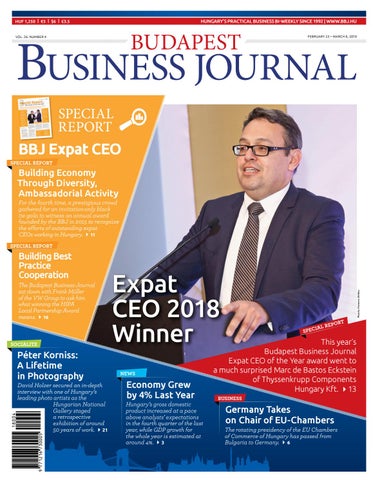
Expat CEO 2018 Winner NEWS
Economy Grew by 4% Last Year
Hungary’s gross domestic product increased at a pace above analysts’ expectations in the fourth quarter of the last year, while GDP growth for the whole year is estimated at around 4%. 3
S
AL R PEC I
EPOR
T
This year’s Budapest Business Journal Expat CEO of the Year award went to a much surprised Marc de Bastos Eckstein of Thyssenkrupp Components Hungary Kft. 13 BUSINESS
Germany Takes on Chair of EU-Chambers The rotating presidency of the EU Chambers of Commerce of Hungary has passed from Bulgaria to Germany. 6
Photo by Marianna Sárközy
SPECIAL REPORT
2 | 1 News BBJ
www.bbj.hu
Budapest Business Journal | February 23 – March 8, 2018
THE EDITOR SAYS
EDITOR-IN-CHIEF: Robin Marshall EDITORIAL STAFF: Zsófia Czifra, Kester Eddy, David
Holzer, Levente Hörömpöli-Tóth, Christian Keszthelyi, Gary J. Morrell, Rob Smyth, Ágnes Vinkovits. LISTS: BBJ Research (research@bbj.hu) NEWS AND PRESS RELEASES:
Should be submitted in English to news@bbj.hu LAYOUT: Zsolt Pataki PUBLISHER: Business Publishing Services Kft. CEO: Tamás Botka ADVERTISING: AMS Services Kft. CEO: Balázs Román SALES: sales@bbj.hu
CIRCULATION AND SUBSCRIPTIONS: circulation@bbj.hu
Address: Madách Trade Center 1075 Budapest, Madách Imre út 13-14., Building A, 8th floor. Telephone +36 (1) 398-0344, Fax +36 (1) 398-0345, www.bbj.hu SUBSCRIPTIONS: Budapest Business Journal 1 year 6 months 3 months
HUF 27,500+VAT HUF 13,750+VAT HUF 6,875+VAT
News Services Hungary A.M., Energy Today, Regional Today 1 year, from HUF 179,000+VAT 6 months, from HUF 104,900+VAT 3 months, from HUF 58,900+VAT Book of Lists 2017-2018: HUF 19,120+VAT DigiBOL HUF 39,900+VAT Call +36 1 398-0344 or email circulation@bbj.hu What We Stand For: The Budapest Business Journal aspires to be the most trusted newspaper in Hungary. We believe that managers should work on behalf of their shareholders. We believe that among the most important contributions a government can make to society is improving the business and investment climate so that its citizens may realize their full potential.
A few weeks ago, amid no little ceremony and fanfare, Hungary launched a Blockchain Competence Center, with the laudably ambitious goal of becoming a regional hub for the technology. Blockchain feels like it has come from nowhere, and for all that it is the buzzword of the moment (and perhaps for some because of that very fact), it can seem a very esoteric science. As the website Lifehacker put it in a blog filed in mid-January: “It’s actually a pretty simple concept, though things quickly get more complicated the harder you look.” Reinforcing the feeling that this is something of an overnight sensation, the technology itself was only invented in 2008, specifically to provide the operating system for the Bitcoin currency to launch in the following year. And while so-called cryptocurrencies such as Bitcoin are probably still the most obvious users today, the potential goes far beyond that. One of the reasons Hungary is so keen to get an early adopter award is that the technology is commonly predicted to disrupt a wide range of industries. Indeed, in our article on the launch of the Blockchain Competence Center in our previous issue, Ervin Jobbágy, of the company Interticket, compared where we are today with the dawn of the internet age. My best layman’s attempt at describing what blockchain does would be to say it provides a means for the safe transmission of a value, a piece of data, from point A to point B, with encryption thrown in to keep it all secure. Given its development for cryptocurrencies, it takes no great leap of imagination
to see plenty of uses in the financial and banking fintech sphere, but the technology could be applied to almost any business that requires data transfer for it to operate. Little wonder that consultancy firms like EY and PwC are turning out ever more reports on the impact, threats and opportunities presented by blockchain. You might not want to explain the technology to your grandmother, but the chances are strong that you will end up using it somewhere soon, at the very least as a consumer. This week, a Hungarian cryptocurrency, given the suitably Hungarian-sounding name of Korona, was unveiled, with a projected launch date of March 26. The move is interesting because the National Bank of Hungary (MNB), among other things the financial market watchdog, has been distinctly sniffy about cryptocurrencies. Last year it took action against OneCoin, saying it showed signs of being a pyramid scheme, but it has consistently warned consumers that virtual currencies carry many risks. At the end of 2016, for example, it again said that cryptocurrencies do not fall under the regulation of central banks or regulatory authorities, and made it clear that it does not approve, nor does it register, any such currencies. It will be interesting to see how the Korona story plays out. The developers insist that it is different (they would, wouldn’t they), in that it is a real currency, not a so-called pseudo-currency, and that it will be regulated. Interestingly, though, not by the MNB; supervision will apparently be provided by the Swiss financial authorities. I suspect this is a story we shall return to. Blockchain definitely is.
fortepan.hu / GALI
MTI / Márton Mónus
The Budapest Business Journal, HU ISSN 1216-7304, is published bi-weekly on Friday, registration No. 0109069462. It is distributed by HungaroPress. Reproduction or use without permission of editorial or graphic content in any manner is prohibited. ©2017 BUSINESS MEDIA SERVICES LLC with all rights reserved.
BLOCKCHAIN AND CRYPTOCURRENCIES
THEN & NOW
BBJ-PARTNERS
A dog being judged at the international Winter Dog Show 2018, held in Budapest’s Hungexpo exhibition hall on February 17. In the black and white photo, a dog is being shown at an event in Hungary’s capital held in 1939.
VISIT US ONLINE: WWW.BBJ.HU
1
www.bbj.hu
Budapest Business Journal | February 23 – March 8, 2018
News
///macroscope
Economy Grew by 4% Last Year
Hungary’s gross domestic product increased at a pace above analysts’ expectations in the fourth quarter of the last year, while GDP growth for the whole year is estimated at around 4%, which was in accordance with most of the previous forecasts. All the same, S&P left Hungary’s debt rating unchanged in its latest review. ZSÓFIA CZIFRA
Hungary’s economy expanded by 4.4% on a year-on-year basis in the fourth quarter of 2017, according to a flash estimate of data that exceeded analysts’ expectations. The pace of growth accelerated from 3.9% in Q3. In Q4, GDP grew by 4.8% according to seasonally and calendar-adjusted and reconciled data, compared to the corresponding quarter of the previous year. Compared to the preceding quarter, the volume of GDP grew by 1.3% in Q4, according to seasonally and calendaradjusted and reconciled data. According to the Central Statistical Office (KSH), the main contributors to growth were marketbased services and construction. As for the full year, the GDP growth was 4%, unadjusted, raw KSH data revealed. The Hungarian government targeted a GDP growth of 4.1% for the past year. “These figures are remarkable, even from a historic perspective: this KSH data has been the best since 2005,” Minister for National Economy Mihály Varga commented on the data. In his analysis, Varga pointed out that in 2017 there were three working days less than in 2016, of which two were missed in the last quarter. GDP data which takes this factor into
CHANGE IN GDP IN HUNGARY, 2003-2017 2004 2005 2006 2007 2008 2009 2010 2011 2012 2013 2014 2015 2016 2017
GDP
+4.8 +4.5
+4.1
+4.0
+0.5
+0.6
+0.6
+2.2
+1.7
+3.3
+4.2
+2.1
-1.5
-6.6
Annual economic growth volume index, same period of the previous year = 100; seasonally and calendar-adjusted and balanced data BBJ infographic
account and is used for EU statistics show an even more favorable picture, he said. According to these, GDP was up by 4.2% last year and by 4.8% in the last quarter.
Economic Drivers
K&H Bank chief analyst Dávid Németh forecast GDP growth could be around 3.8% this year but is likely to slow down somewhat in 2019. According to him, as with the past year, domestic consumption and investments - the latter based on EU funds - will drive economic growth in 2018, and the favorable international environment also supports the expansion of the Hungarian economy. CIB analyst Sándor Jobbágy told the national news agency MTI that he expects strong GDP data this year too; however, growth could be a little slower than in 2017. In his estimate, he suggests economic growth of 3.5-3.7% for the whole of 2018. CIB Group said Q4 growth was supported by market-based services to the greatest extent, similar to Q3. The contribution of construction was also strong, although in this case the low base from 2016 played a significant role, given the significant fluctuation of EU funds over the years. Overall GDP growth was broad-based, CIB noted. Based on monthly figures published earlier, CIB assumes a persistently outstanding role for domestic consumption. In addition to local factors, the role of the European boom is also significant. The growth of the strongest driver, i.e. the German economy, was close to 3% in Q4, while the entire euro area probably showed similar year-on-year growth, which has been outstanding in the period since the economic crisis. In 2018, it is likely that growth will remain significant, but somewhat less dynamic than in 2017, says CIB. Based on consensus calculations, the average expectation of
Source: KSH / MTVA Sajtóadatbank / MTI
market players suggests full-year 2018 growth of 3.5-3.7%, the bank adds. It also emphasized that market services contributed the most to the growth in the fourth quarter of last year, while the performance of the construction sector was also noteworthy.
Available EU Funds
Erste Bank head analyst Orsolya Nyeste said GDP growth could be 3.5% or more this year. As for the main contributors to the growth, she also thinks that it is likely to remain unchanged from last year; namely, driven by domestic consumption and stronger investment activity. She also noted that mid-term outlook is strongly determined by the inflow of available EU funds, the labor market situation and its influence on consumer consumption, and also the sustainability of the current ADVERTISEMENT
favorable economic environment in Europe. In spite of expectations that were supported by such favorable figures reported by the KSH, ratings agency Standard & Poor’s left Hungary’s debt rating unchanged in its current country review. S&P Global Ratings affirmed its ‘BBB-/A-3’ long- and short-term foreign and local currency sovereign credit ratings on Hungary on February 16. The outlook remains “positive”. In its reasoning, S&P wrote on its website that the positive outlook primarily reflects the possibility that Hungary’s strengthening economic metrics might support ongoing improvements in the banking sector, thereby reinforcing the monetary transmission channel. Although it did acknowledge some risks, it also outlined a scenario that could see it give a further upgrade. “We could raise the ratings in the next
12-18 months
if recent improvements in the financial sector enhanced the authorities’ ability to influence domestic monetary conditions. This would be signaled, for example, by a stronger recovery of bank lending alongside continued economic growth, accompanied by current account surpluses and contained fiscal deficits,” the credit rating agency said. Although the awaited upgrade did not happen this time, the institution also acknowledged Hungary’s performance. Hungary, like its regional peers, is undergoing a strong cyclical recovery. Therefore S&P expects real GDP growth will approach 3.5% in 2018, only modestly lower than in 2017. This is due to booming consumption, triggered by real wage and employment gains; fiscal stimulus and minimum wage hikes; substantial recovery in EU structural and cohesion fund inflows; rising expenditure on housing subsidies; stronger private-sector balance sheets; and the ongoing recovery in the eurozone. In 2017, after a 10-year lapse, real consumption and investment in Hungary recovered to pre-crisis levels, S&P noted.
4 | 1 News
www.bbj.hu
Budapest Business Journal | February 23 – March 8, 2018
‘Beyond State-of-the-art’ Szeged Laser Gets Pulsating On the northern outskirts of the city of Szeged, adjacent to the old main road to Budapest, lies the cold, derelict hulk of a former Red Army barracks: five hundred yards to its rear, a gleaming, futuristic steelglass complex housing some of the world’s latest laser technology dominates the skyline. The symbolic contrast between Hungary’s troubled past and hoped-for future could hardly be starker. KESTER EDDY
Viktor Orbán, Hungary’s Prime Minister, ceremoniously opened Szeged’s EUR 260 million laser research institution with due pomp in May last year; nine months later, on February 12, a smaller gaggle of scientific dignitaries called a press conference to mark the facility’s initial operational experiment. This necessitated the generation of the first ultra-short duration light pulses at the facility proving, in essence, the laser works.
Swiss Chemist Leads First Experimental Team at Szeged Facility
“This unique, international research infrastructure, which was completed within deadline and within the planned budget, has now been proven in operation to [the specified] technical parameters as well,” József Pálinkás, President of Hungary’s National Research, Development and Innovation Office, told the media present. The first experimental program, undertaken by a team led by Professor Hans Jakob Wörner, seeks to measure how free electrons created by high-energy radiation propagate through water. (See Sidebar.) The Szeged facility - officially the ELIALPS (Extreme Light Infrastructure Attosecond Light Pulse Source) Research Institute - employs high-powered lasers emitting pulses of electro-magnetic energy of such ultra-short duration that the length of the pulse is measured in attoseconds. An attosecond is 10 to the power minus 18, i.e. one billionth of a billionth of a second.
Extremely Fast
“These extremely short light bursts make it possible to investigate extremely fast processes in life-matter interactions; for example, the charge migration [movement
Laser Facility Boosts Szeged Employment, Salary Levels ELI-ALPS Szeged currently employs some 150 research scientists and engineers, of whom roughly onethird are non-Hungarian, says Károly Osvay. With new recruitment, the center expects to boast a total of 170 fulltime equivalent researchers which, together with back office and maintenance staff, will mean a total headcount of some 270 - 280. Salaries are at “a European level,” Osvay says, based on an average at equivalent French, German and Italian governmental institutions. This means an “early stage scientist, just out from university, grosses EUR 1,200 per month roughly 20% above average wages levels in Hungary - while “a wellestablished senior scientist would
have five times” that, i.e. EUR 6,000 (HUF 1.86 million) per month. “We don’t pay more than the German government institute. Of course, everyone is underpaid compared to [private] industry,” Osvay said.
“These extremely short light bursts make it possible to investigate extremely fast processes in lifematter interactions; for example, the charge migration [movement of particles such as electrons] within atoms and within molecular clusters. It’s very fundamental physical effects that we are investigating.” of particles such as electrons] within atoms and within molecular clusters. It’s very fundamental physical effects that we are investigating,” Károly Osvay, research technology director at the institute told the Budapest Business Journal. While this may sound wildly esoteric to anyone other than laboratory boffins, Osvay says in practical terms, the research here will lead to far deeper understanding of vast range of biological and chemical processes, which in turn are likely to drive improvements in materials and products as diverse as semi-conductors and pharmaceuticals. ELI-ALPS Szeged is one of three facilities approved so far as part of the European Union’s ELI program. (The others are located in Czech Republic and Romania.) The European Union contributed some EUR 220 mln (85%) of the initial investment value of the Szeged center, with the balance coming from the Hungarian budget, Pálinkás told the BBJ. Gedeon Richter, the leading Hungarian pharmaceutical producer, has “shown an interest” in conducting research in Szeged. “This is really at the cutting edge of science,” Prof. Pálinkás said. “And if such equipment is here, this is like a magnet, and I hope will attract scientists here from Europe and all over the world.
The very first experiments at the ELI-ALPS facility are designed to look at how electrons travel and collide with water molecules - a process which takes place in ultra-short time periods below a femtosecond - 10 to the power of -15, or one millionth of a billionth of a second. “What we are doing is making real-time measurements, we are making a real-time movie, of how electrons propagate in liquid water,” Hans Jakob Wörner, professor of physical chemistry at the Swiss Federal Institute of Technology, Zürich, told the BBJ. “We have brought an experimental apparatus from our laboratory here, because at ELI-ALPS they have extremely powerful lasers that are beyond state-of-the-art.” “We use attosecond pulses that we generate ourselves [using the laser and associated equipment] and we use these to launch electrons from liquid water. We let the electrons propagate through liquid water, and we measure the time-scale of this propagation, by superimposing an infra-red beam,” Prof. Wörner explained. So far, nobody has been able to accurately map how the electrons do, in fact, interact with “simple” water molecules. The layman may well ask: so what? The answer is that high-energy radiation, for example gammaor X-rays, cause havoc in living tissue both directly (from the inherent high-energy content) and indirectly, by inducing freeroaming electrons to fire off in all directions - and thereby damaging the molecules in proteins essential to life. Researching how these processes occur in water is only the first state to understanding how they occur in living tissue, says Wörner, which in turn could lead to better understanding of how both to protect tissue and use radiation to better effect when working on materials. Asked how long the Zürich team will work on the first experiments, he answered: “As long as it takes to get the measurement done! An optimistic prediction would be three weeks, and perhaps it will take six, not more than that.” And if this initial phase is successful? “We already have more experiments in mind,” he said.
1 News | 5
www.bbj.hu
Budapest Business Journal | February 23 – March 8, 2018
Increased Demand for Industrial Space Total industrial and logistics complex completions in Hungary for 2017 amounted to 118,000 sqm, the highest level of delivery since the pre-crisis era. Industrial stock as of the end of 2017 stood at 2.04 million sqm, with 118,000 sqm of space completed during the year according to Gábor Halász-Csatári, head of industrial at Cushman & Wakefield Hungary. Despite the improving indicators, Hungary is still being outperformed by its Central European neighbors, however.
East Gate Business Park.
GARY J. MORRELL
As much as 80% of the 115,000 sqm 2018 pipeline is pre-let. Around 20,000 sqm of speculative space is expected to be delivered at Üllő Airport Logistics Center. Vacancy has fallen from more than 20% to a record low of 4% and there are no existing logistics/industrial parks that offer 10,000 sqm or more of contiguous spaces. This lack of large size quality space is seen as throttling market growth. “Prime rents are now close to levels that make speculative development feasible, yet the cost of construction and related services remains a limiting factor,” said Cushman & Wakefield. That said, Wing is set to undertake the construction of two, 14,000 sqm and
11,000 sqm speculative
logistics facilities at the East Gate Business Park.
In the current market environment, with high demand and low availability, companies need to plan far ahead. “The difference between built-to-suit and speculative is a bit misleading nowadays, as most of the delivery is taken by tenants at the planning stage or during the construction phase. So, there is not as much typical speculative construction as there was in the past. The market is simply hot,” said Ferdinand Hlobil, head of Central European industrial at Cushman & Wakefield. The CE industrial market (comprising Hungary, Poland, Czech Republic, Romania and Slovakia) is continuing to record positive indicators. Total CE industrial stock increased to 26 million sqm as of the turn of the year, and the region now has the lowest vacancy in the last ten years at 5%. CE take-up at 6.6 million sqm for 2017 outperformed new supply, which was 3.6 million sqm according to Cushman & Wakefield.
Continuous Requirement
“Due to e-commerce, automotive changes, automatization and robotization changes in the production industry, there will be a continuous requirement for modern or upgraded industrial and logistics space,” commented Hlobil. Poland and Czech Republic remain the dominant CE markets regarding delivery and take-up. Total industrial stock in Poland stands at
13.5 million,
with 2.3 million sqm delivered last year; stock in Czech Republic stands at seven million sqm. The Romanian market is also booming, with 460,000 sqm of space delivered in 2017, bringing total stock to 1.8 million sqm. In contrast to Poland, Czech Republic and Slovakia, a functioning industrial market has not developed outside the capital in Hungary. Those companies establishing light industrial facilities have tended to develop their own buildings. In Poland, for example, Panattoni has agreed a 73,000 sqm built-to-suit facility with the Media Expert chain at the Central European Logistics Hub located in Lodz in central Poland. One problem with developments across Central Europe is a lack of skilled workers. “The labor shortage is a problem; the shortage is a reality. But in another way, this is not a problem, as the pressure for expansion or to move to CEE is so big that new investors are prepared to move and fight. The labor shortage is pushing development costs upwards and the usual construction time is now four-to-six months,” Hlobil added.
Goodman Starts Hungary’s Largest Logistics Facility Auchan Retail Hungary is increasing its commercial capacity in Hungary, with the international industrial park operator and developer Goodman undertaking construction of a new warehouse for the retailer at Üllő Airport Logistics Center, close to Budapest. GARY J. MORRELL
The logistics park is owned and operated by Goodman. The 87,000 sqm center will be the largest of its kind ever built in Hungary, according to Auchan. The complex is scheduled to open later this year and will be big enough to handle Auchan Retail Hungary’s food and non-food logistics for both existing and planned stores, while also supporting the company’s online commerce in Hungary. The French retailer operates 19 hypermarkets in Hungary, one supermarket, 18 filling stations and an online retailing service that employs around
7,000 staff.
and manage’ business model has proven to be successful again in delivering a highquality logistics facility for our customers that will provide for their needs now and into the future.” The Goodman Group business model provides what it describes as integrated “own+develop+manage” customer service. Across Continental Europe, Goodman is present in Belgium, Czech Republic, France, Germany, the Netherlands, Poland, Slovakia and Spain, in addition to Hungary. Goodman’s current portfolio in Hungary
comprises more than 88,000 sqm of warehouse and office space in two locations in Gyál and Üllő, both in the greater Budapest area. The Üllő Airport Logistics Center is next to the M4 highway and M0 ring road, on the pan-European transport corridor to Ukraine, Romania and Serbia. “When completed, this large-scale development project for Auchan will double the size of our Hungarian portfolio, along with capacity to develop a further 20,000 sqm facility for this key customer to allow them to expand further,” concluded Kerekes.
“In addition to boosting our physical expansion plans, the new, integrated logistics base will also help our multichannel commercial model in the long run,” said Dominique Ducoux, CEO of Auchan Retail Hungary. “This is a multi-billion forint investment employing hundreds of people in the local area, which will provide an innovative and efficient platform for our business in Hungary. This integrated and centralized logistics hub enables us to provide excellent customer service at all our current and future stores.”
Successful Model
Commenting on the development, István Kerekes, country manager of Goodman Hungary, said: “Goodman’s own ‘develop
Üllő Airport Logistics Center.
2
www.bbj.hu
Budapest Business Journal | February 23 – March 8, 2018
Business
EU Chambers of Commerce of Hungary EU-Chambers was founded in 1994 by the British, German, Italian and French chambers, and now numbers 15 members. According to its website (euchambers.hu): “The mission of the Permanent Commission of the bilateral business chambers of EU member states operating in Hungary (EU-Chambers) is to support the improvement of the legal, institutional and business framework for successful operation of companies of other EU member states in Hungary.”
Germany Takes on Chair of EU-Chambers
The rotating presidency of the EU Chambers of Hungary was passed from Bulgaria to Germany in a small ceremony at the German Ambassadorʼs residence in Budapest on February 16. ROBIN MARSHALL
The presidency has been held for the past two years by Rossen Tkatchenko, head of the Hungarian-Bulgarian Chamber of Commerce. The role will now be taken by Dale A. Martin, president of the German-Hungarian Chamber of Industry and Commerce (and President-CEO of Siemens Zrt.)
From left: Ulyana Bogdanska, Ambassador of Bulgaria, the country which currently holds the rotating presidency of the Council of the European Union; Volkmar Wenzel, Ambassador of Germany; Dale A. Martin, president of the German-Hungarian Chamber of Industry and Commerce; and Rossen Tkatchenko, president of the Hungarian-Bulgarian Chamber of Commerce. As is traditional for EU-Chambers, Martin will be assisted by two vice presidents, one the outgoing president, the other from the chamber due to follow the current post holder, and that will be Alessandro Stricca, head of the GreekHungarian Chamber of Commerce (and also president of the Italian Department of the BKIK, the Budapest Chamber of Commerce and Industry). The event is possibly the first official function to be held at the German ambassador’s residence since it was renovated. Host Volkmar Wenzel commented that
when the EU-Chambers was formed, Hungary was not even a member of the trading block. “Today, Hungary is a prosperous member of the EU, and very much integrated into the single market.”
Improve Cooperation
Tkatchenko said he had worked “to make this organization conspicuous to the business community” and had “tried to improve cooperation between the chambers and the business communities”. Martin echoed the German ambassador’s comments, saying that the
mission for the individual chambers had changed over the years, with the focus now more on “concentrating on the needs of our member companies”. The challenges, too, had changed, with digitalization, the labor shortage and training all priority areas. He said he saw no need to reinvent the way EU-Chambers works and pledged to continue the Business Chill, a “very successful string of [networking] events”. But he also called on others to share ideas for doing things better, so that member companies feel welcome in Hungary and are happy “to invest in future growth and progress, which is in the interests of all of us”. To mark taking over the presidency, the German chamber has made one of its publications more widely available to all. “Vocational Training in Hungary” was originally written in German in May of last year, before being translated into Hungarian and now English. It is aimed at C-suiters, rather than entrepreneurs, giving “an overview for businesses interested in vocational training”.
ADVERTISEMENT
BOOK 2017/ OF LISTS
2018
«««
Guide to Hungarian Business is available.
The Book of Lists c ontains all the i nformation that you might n eed in business.
Order: Business Publishing Services Kft. +36/1 398-0344; circulation@bbj.hu
2
www.bbj.hu
Budapest Business Journal | February 23 – March 8, 2018
Business
|7
M LIN E O T T O B E H T
BUD must work well, and be perceived to do so Traffic at Ferihegy, as many still call Budapestʼs Ferenc Liszt International Airport, is at record levels. It handled 13.1 million passengers last year, up 15% on 2016, and expects at least 13.7 million this year. If you are in business – from hotels to banking, from car hire to puszta horse shows – thatʼs good news.
2nd district
But the airport has hit some turbulence - on the ground. First to give notice of problems was my pal, Mr. A, who, experienced queues and chaos both sides of Christmas. Particular pandemonium occurred on December 14, when Mr. A was on a predawn flight to Luton. Arriving only with hand baggage at 04:40 a.m., he found queue jumpers and “total chaos” in a long, snaking line. When someone announced half those waiting should decamp to the adjacent terminal, a near-stampede ensued. It doesn’t help, he claims, that passengers arriving two hours before departure time – as instructed by airlines – all too often then find the check-in gates unmanned, and/or insufficient to meet demand. He acknowledges that Ferihegy is now a nice airport, but adds “far too often, it’s a stressy Liszt Feri”. Over the past month, passenger angst has increased by reports of thefts from luggage - most notably featuring Hungarian tennis star Tímea Babos, whose bags were pillaged on a flight to Doha. Checks were enhanced, police found loot in the homes of a clutch of suspects, and the Ministry of National Development “began inquiries”. But perhaps most surprising was news that Budapest Airport, or BUD, the airport operator, does not exercise direct control over either check-in staff nor baggage-handlers. Individual airlines select one of four licensed agents for these tasks.
Airport Managers
“At BUD, we are rather airport managers, not operators, which means that we
manage the stakeholders who perform at our airport. Our role is to provide the infrastructure, such as runways, terminals or in this case, baggage systems and hardware,” Mihály Hardy, Budapest Airport’s spokesman, told me. “Budapest Airport provides security screening of passengers and checked-in baggage, and all our operations are closely monitored 24/7 by airport police. Our staff have no physical access to checked-in baggage at all, unless we have to open them together with police due to some prohibited items.” Ultimately, Hardy points out, passengers have a travel contract with an airline, and it is the airline which carries the responsibility “to transport the passenger and baggage safely from A to B.” CCTV cameras cover “most, if not all buildings.… where bags are handled,” he says. But not, understandably, in aircraft holds, which is commonly believed to be “the primary source of theft opportunity”. As to “queuing chaos”, Hardy accepts it can happen, especially in winter when people have more layers and coats and therefore more trays clog the security scanners. Delays have recently been exacerbated as some discount airlines now restrict carry-on luggage, leading to more checking. Running an airport safely and securely involves coordinating a plethora of operations. But as an essential element of the national economy, whoever is responsible, Ferenc Liszt International Airport must work well, and be perceived to work well. Hungary simply cannot afford a “stressy Liszt Feri”.
2nd district
28 sqm – shop, Budagyöngye shopping mall
48 sqm – shop, Budagyöngye shopping mall
78 sqm – 3 rooms, herman ottó street
In the Budagyöngye shopping mall, this shop in good condition is situated on the ground floor. The mall is located next to a busy road. Good connection to public transport.
In the Budagyöngye shopping mall, this shop is situated on the 1st floor and it can be divided to two or three shop areas. The mall is located next to a busy road.
This very sunny apartment has separate rooms, 2 bathrooms, 2 balconies and it is situated within a building with renovated facade and well kept common garden.
39.000.000 huF
55.000.000 huF
68.000.000 huF
+36.70.376.4138
2nd district
+36.70.376.4138
2nd district
+36.1.336.1706
2nd district
287 sqm – lot, Ürömi street
140 sqm – 5 rooms, szemlőhegy street
500 sqm – 6 rooms, gyöngyvér street
This lot has possibility to build a 4 apartment condominium. Electricity, water and gas are in the street. It is located in a very quiet and green area.
Panorama over the Buda Hills, this renovated apartment has 2 entrances, 2 living rooms, 3 separate bedrooms, 2 kitchens, 2 bathrooms and 4 balconies. Within a villa house with garden.
Next to the forest, this new, two storey family house built on 5000 sqm of lot, has 77 sqm of terrace, 100 sqm of wellness area, 4 car garage and well kept garden.
75.000.000 huF
85.900.000 huF
+36.1.336.1706
3rd district
KESTER EDDY
2nd district
+36.1.336.1706
3rd district
259.000.000 huF
+36.70.376.4138
3rd district
37 sqm – 1 room + hall, Kolosy square
55 sqm – 2 rooms, KisKorona street
50 sqm – 2 rooms, Csillaghegy
This completely renovated, street facing apartment has kitchen with dining room and separate bedroom. It is located in the centre of the district.
This very sunny, park facing, top floor apartment, that needs renovation, has separate rooms and balcony. It is situated within a well maintained building with elevator.
In a new built subdivision with well kept garden, this bright apartment benefits of a living room with fully fitted kitchen, separate bedroom, wardrobe room, terrace and private garden.
22.900.000 huF
27.900.000 huF
36.490.000 huF
+36.1.430.1403
3rd district
+36.1.430.1403
3rd district
+36.70.669.5350
3rd district
88 sqm – 3 rooms, Csillaghegy
58 sqm – 3 rooms, rómaiFÜrdő
147 sqm – 4 rooms, igló street
This new built semi-detached house built on 170 sqm of lot, has living room with fully fitted open kitchen, 2 separate bedrooms, terrace and parking space in the garden. Handover in 2018.
Next to the Danube, in a subdivision with swimming pool, this renovated apartment benefits of a living room with fully fitted open kitchen, 2 separate bedrooms, terraces and private garden.
This two storey family house, that needs renovation, built on 820 sqm of lot, has 2 kitchens, 2 bathrooms, terrace and garage. Good connection to public transport.
43.900.000 huF
46.900.000 huF
49.900.000 huF
+36.70.669.5350
6th district
+36.70.669.5350
6th district
+36.1.430.1403
9th district
77 sqm – 3 rooms, szinyei merse street
87 sqm – 2 rooms, andrássy Boulevard
95 sqm – 3 rooms, Kinizsi street
This very bright and quiet apartment benefits of a living room with open kitchen and 2 separate bedrooms. It is situated within a secession style building with elevator.
This very sunny and spacious apartment in good condition has separate rooms, sleeping gallery and private gas heating. It is located at the Kodály Circus.
This garden facing apartment in good condition has private gas heating and balcony. It is situated within a well maintained period building, close to the Museum of Applied Arts.
36.500.000 huF
63.000.000 huF
44.500.000 huF
+36.1.351.0446
13th district
+36.1.351.0446
13th district
+36.1.351.0446
13th district
75 sqm – 3 rooms, BulCsú street
110 sqm – 3 rooms, Kádár street
100 sqm – 3 rooms, visegrádi street
This very bright and quiet, high floor apartment has nice view over a park and private gas heating. It is situated within a nice period building with elevator. Close to the Lehel Market Hall.
Close to the St. István Circuit, within a renovated, period building with elevator, this spacious, well divided, street facing apartment has separate rooms and private gas heating.
In a very nice period building with elevator, this very spacious and bright, high floor apartment in good condition has private gas heating and balcony.
37.900.000 huF
51.900.000 huF
59.900.000 huF
+36.70.414.7759
+36.70.414.7759
+36.70.414.7759
gruppo t.F.m. KFt. 1068 Budapest, Király u. 102. each agency independently owned and operated. • these offers are valid, till the apartments are sold. • these information do not constitute a contractual element.
8| 2
Business
PRESENTED CONTENT
www.bbj.hu
Budapest Business Journal | February 23 – March 8, 2018
Masters of Business Budapest Building Connections One of the latest projects of the staterun Hungarian National Trading House (MNKH) is to provide a special B2B platform for experienced and potential local exporters in order to gather hands-on market information from pre-selected foreign partners and representatives of MNKH’s own worldwide network. The Masters of Business Budapest B2B platform was staged again this year.
LEVENTE HÖRÖMPÖLI-TÓTH
MNKH had a busy year in 2017, with lots of achievements to pride itself on. The number of successful business transactions completed thanks to its involvement tripled in comparison with 2016, while the value of deals closed soared six-fold. Ever more participants were drawn by MNKH’s signature training program, the so-called export academy, not least due to a newly released e-learning curriculum, which grants access to all interested parties without geographic limitations. More importantly, its presence at international fairs has become more focused and the number of business forums organized in 2017 increased by 30% year-on-year. One of those B2B
gatherings, Masters of Business Budapest was arranged for the first time only in 2016, and since it turned out to be such a great hit, the Hungarian National Trading House has decided to make a tradition of it. The latest edition of the business forum attracted almost 150 corporate partners, most of whom had done deals with the MNKH before. What is truly special about the event is the attendance of some 50 trading houses, which operate in partnership with MNKH all over the world. “It is a unique endeavor. By inviting our trading houses to take part, we are ‘bringing home’ business opportunities to Hungarian entrepreneurs who can effectively save on the resources, time and energy that they would normally need in order to seek out new customers,” said Gábor Kun, Deputy CEO of the MNKH
of Business Budapest,” noted Zsanett Oláh, MNKH CEO. “Nothing similar had taken place before around here, with market information from so many countries being available at one single event.” Another special angle of the event was that ethnic Hungarian companies based in neighboring countries have been invited too, so in total 15 enterprises from Carpathian Basin Transylvania, Vojvodina and Felvidék Cooperation - border regions that used to belong to Hungarian company executives benefitted Hungary up until the end of World War I from exploring new market destinations and are still home to millions of Magyars and specific business opportunities, in were represented. “They not only become addition to bolstering their network of part of this great initiative, but also they international contacts during the gathering. get to meet fellow Hungarian companies “By now, local companies regard us as from within the borders,” Oláh added. a professional partner, so now we can One such Magyar firm from across the build on our positive image, which is border is Tisacoop Kft., which has made a further improved by events like Masters name by becoming the top importer and in his opening speech. “By facilitating hundreds of face-to-face business meetings, we aim to help our key partners find the foreign trade information and opportunities that will ultimately enable them to realize specific export deals in growing numbers.”
Unexpected Opportunities on Horizon Thanks to MNKH’s Engagement InnovaSter Kft. participated in Master of Business Budapest this year for the second time. László Nagyváradi, director of trade, said its first appearance one year ago was very effective for marketing purposes. “We sell machinery, and the price tag is in the millions, so if we go to an exhibition, there might be some hundred potential buyers, with ten concrete interested parties and one actual buyer at best,” he explained.
“MNKH can help us attend events we could not normally afford, or get to markets that we would have never thought of. It also spreads the word about us abroad for free, and invite potential buyers directly to events like this, so it filters demand very efficiently.” It was thanks to MNKH’s work that Nagyváradi could meet with company representatives from Ghana, Iran and Turkey during the Masters of Business Budapest
2017, which opened new horizons for InnovaSter. “I am meeting up with Iranian and Turkish executives today. You know, if something gets started, you need to keep pushing,” he said. InnovaSter’s edge is its sterilization technology used in food processing which is unique worldwide, and Nagyváradi is very much hopeful that the MNKH partnership will land more matches he could otherwise never have counted on.
www.bbj.hu
Budapest Business Journal | February 23 – March 8, 2018
PRESENTED CONTENT
2
Business | 9
‘Selling in India is Like Selling in a Totally Different World’ “It’s difficult to meet with 16 companies while I’m here in Budapest, but this platform provides an opportunity to understand the needs of companies,” said Saurabh Khanna, a partner at T&A Consulting, based in New Delhi, India, of Masters of Business Budapest. “I need to understand what a Hungarian company focuses on, what quantities it can deliver, what its ultimate edge is. Then I go back to India, and that’s when the work starts.”
distributor of Hungarian food products in Serbia. Tisacoop has been selling the products of flagship Hungarian brands such as Pick, Tolle, Gallicoop and Törley in a number of Serbian supermarkets for 25 years now. It also operates five retail stores where Hungaricums (select typical Hungarian premium item) are sold. As managing director Zoltán Körmöci told the Budapest Business Journal, Tisacoop has teamed up with MNKH to market Hungarian honey on global markets. “MNKH is a great partner at arranging presence in business fora and meetings, and they play a key role in making this project happen, especially since this is a brand-new field for us,” he said. MNKH ensures a platform to get to foreign markets, a great asset for companies with scarce resources earmarked for foreign expansion. “If you just go to an exhibition, it’s very difficult to find the right partners. It makes a huge difference to have an operating trade house on the spot that prepares the ground and has an established network,” Körmöci added. He also noted that the Masters of Business Budapest event has the potential to gather hands-on information so that concrete deals can follow soon.
As Khanna explained to the BBJ, T&A Consulting seeks synergies in terms of agritech, automotive and IT in particular. What matters very much, though, is culture. “Hungarian companies need to be introduced to Indian culture, for it’s like selling in a totally different world,” Khanna said. “It takes a lot of patience to consolidate your market presence, and what is truly decisive is price, price, price. You need at least six months just to understand local requirements, but once you’re in, you’re in for a lifetime.”
Masters of Business Budapest: A Win-Win Venue for All Success on export markets is the result of a joint effort with the various stakeholders. Events like Masters of Business Budapest can further boost Hungarian business activity on the global stage, says Gábor Kun, deputy CEO of the MNKH in an exclusive interview with the BBJ.
on connecting competitive Hungarian companies with potential foreign partners. But the hit ratio could still be improved, and it is up to how well you prepare the ground in advance. On the other hand, our success has always been a joint effort with partner organizations, trade attachés and everybody involved in trade diplomacy. The companies themselves are also part of it because the whole thing wouldn’t work without their willingness to perform well abroad. BBJ: Are there any regions that stand out in their growth? GK: Asia is constantly developing. Several products such as duck or goose liver have built a strong presence there, but certain incidents may hamper sales from time to time; just remember bird flu and similar problems. The Balkans might be interesting, because of the physical proximity and the existing service network. Africa is on the rise, but enquiries really come from everywhere. Let’s not forget the impact of the Russian embargo, as a result of which an important market ceased to exist, and it lead to a huge fight for alternative markets.
Carefully Selected Sectors “If we are serious about establishing a single and competitive economic space in the Carpathian Basin, it is essential that once Hungarian companies in neighboring countries are able to increase their production capacities, they have access to new target markets in order to expand their exports,” noted Oláh. “Masters of Business Budapest is an excellent means to achieve this since these entrepreneurs can learn about the markets in almost 50 countries at the same time as building their international contacts, all in the course of a single day.” In addition, this event also fosters new forms of cooperation in production processes in partnership with companies based in Hungary itself, as well as mapping out possibilities for creating joint product pools that are marketable on a global level, the CEO added. The sectors represented at the event fully reflect the Hungarian national economy’s export capacities. As a result, most business executives in attendance were representatives of the agriculture and food industry, healthcare, mechanical engineering, the environmental industry and IT sectors.
Khanna’s consultancy has contact with 23 Hungarian companies. From those, five projects are at relatively advanced stages, with price negotiations under way. “Our aim is to have 12 brands to do active business in India in 2018,” Khanna said. With that, he had to go, since a tough day was still ahead of him. “We are back-to-back today as always. We are looking forward to working together with new companies. We are very excited.”
BBJ: MNKH is gaining a positive reputation among local SMEs. Apparently, ever more of them place their trust into your expertise. GK: Indeed, growing confidence towards our services is clearly there. It has to do with our approach, where we aim to personalize the available tool kit for each and every company we work with. The idea is to optimize it to the maximum. That is what MNKH is all about, namely to provide Hungarian enterprises with opportunities to present themselves. The more opportunities exist, the likelier it will be to get actual business deals done. BBJ: The figures speak for themselves in this regard; last year saw impressive improvement on pretty much all fronts of your activity. Are you aiming higher? GK: Our matchmaking is one of our key activities, according to which we work
BBJ: Hungarian firms often have the disadvantage that they can’t delivers the quantities needed for global markets. Can any positive signs be detected that this is changing? GK: Capacity shortages can form bottlenecks, indeed. It is imperative, therefore, to move into an integrator position and to encourage the formation of clusters. Serious success on any market is always subject to proper quantity and constant quality. And MNKH is good at identifying those few producers who have a fair chance to prevail on their own or in a joint effort. BBJ: How does the Masters of Business Budapest event work as a platform to help local enterprises with global ambitions find new opportunities? GK: The trade houses MNKH is teamed up with abroad have an image in mind of which types of companies they need, whilst the Hungarian enterprises also have an idea about what markets they would like to go to. Masters of Business Budapest is an amazing opportunity
for local businesses as all it takes is to come to Budapest, where they can have face-to-face meetings with the very executives they would like to discuss their business matters with. This is a great time for those wishing to enter cross-border trade to find out whether their company stands a chance at all in a given market, and if not, what alternatives are available for them. Sometimes packaging must be altered, or they need to effect changes in order to comply with certain rules applying in the target market. Those who came to the event are already committed to a certain extent; they are either ready to go global or would like to strengthen their presence. And that agility is something to build on. BBJ: Foreign participants also attended the event in droves. What is in it for them? GK: Foreign companies can capitalize on this immensely too, since having the chance to talk to a representative of a future partner in person is incomparably better than just going through a brochure. Such meetings always speed things up, so when they go back to their countries, it’s more likely a deal could be closed quicker.
Serious success on any market is always subject to proper quantity and constant quality. And MNKH is good at identifying those few producers who have a fair chance to prevail on their own or in a joint effort. BBJ: What is this year’s plan after your record-breaking 2017? GK: The number of similar events should be increased and in terms of our matchmaking we strive to increase our hit rate. We are in a great position to promote local businesses since great value for money is offered by Hungarian products and services.
10 | 2
Business
WHO’S NEWS
www.bbj.hu
Budapest Business Journal | February 23 – March 8, 2018
///
DVM Group Restructures Leadership
The founder and managing partner of DVM group, Attila Kovács (above, left) has given group sales director Tamás Sellyey (above, right) the leadership tasks of the company, including the operative management of its structural development and its external contacts with market players. Kovács simultaneously resigned from fulfilling these duties as of January 1. “It is an extreme honor that six months after I joined DVM group I am not only reconfirmed in my current position, but my scope of responsibilities also broadens with important new areas,” said Sellyey. “I feel privileged to be able to represent the company in the market (with a declared trust from its owners), and to jointly lay a solid foundation for its further growth as part of the current structural transformation,” he added. Reflecting on the handover, Kovács said: “After 23 years of organic growth, this was ADVERTISEMENT
Do you know someone on the move? Send information to news@bbj.hu
the appropriate moment to delegate the company’s organizational leadership to specialized management. Our long-term vision of further increasing the current level of professionalism represented by our company is secured this way. Tamás Sellyey - with his experience in management and organizational development gained at multinational companies and SMEs - is a guarantee of the optimization of intra-organizational processes, and the increase of operational efficiency.” DVM group has gone through an organic development process since it was founded in 1995, and gained a professional reputation in design, construction, construction management, project management. and environmental consultancy, the company said in a press release sent to the Budapest Business Journal. The company initially sprang from design and project management mandates (Kovács was an architect by education), before gradually moving into new professional fields. The ownership structure also expanded when three equal partners joined (all experts in their respective fields), the press release added. The company employed a handful of colleagues at the beginning, but now works with a team of 130 employees and represents a “significant market share,” DVM said.
The management group of Kovács, Balázs Czár, Péter Haberl and Tibor Massányi was completed with Sellyey’s arrival last year. He was immediately entrusted with top management tasks, including strengthening synergies among different scopes of activities and divisions within the company, as well as ensuring their complex market exposure. In future, Kovács said he intends to focus his attention as a company leader and building professional on the property development activities of Horizon Development. “This professional succession brings me absolute tranquility of mind, and I feel excited about being able to direct my energies to making our development plans a reality both in Hungary and abroad,” he added.
New Partner at Deloitte Technology Advisory Services From February, Csaba Komjáthy is head of Deloitte’s Technology Advisory Services, responsible for the further development of the business line, now comprising almost 30 experts, covering a wide range of technology solutions, according to a press release received by the Budapest Business Journal. Komjáthy has more than 12 years of experience in consulting, having participated in the development and successful operation of technology consulting and IT risk consulting business lines. He joins Deloitte as a partner with an eight-member professional team and will be responsible for the further development of the business line comprising now almost 30 experts, covering a wide range of technology solutions. The dynamically growing business line focusing on IT integration, data management, technology consulting related to compliance (e.g. PSD2, GDPR and IFRS 17 compliance), IT risk consulting, as well as corporate and banking system implementation, will closely cooperate with the almost 40-member cyber security team of the Hungarian office, which has been successful for years. “The continuous development of technology and digital consulting is a part of Deloitte’s global strategy,” said Komjáthy. “This is supported by the establishment of Deloitte Digital, which has by now become one of the world’s leading digital and technology networks. By uniting the competencies of several existing and new technology areas in Hungary, we are now able to actively join the global network of Deloitte Digital and provide end-to-end solutions to complex problems.” “Deloitte’s technology is based on the continuous extension of the traditional Big4 services to be able to provide fullscale and modern services to clients,” added András Fülöp, chairman-CEO of Deloitte Hungary. “The strengthening of our technology business line is a significant step in this process. I expect that this business line will offer solutions to clients’ most complex and challenging issues, helping Deloitte become the largest consultancy firm in Hungary.” Deloitte provides audit, tax and other advisory, as well as legal services, to public and private clients spanning a number of industries, noted the press release.
Banking and Capital Markets Expert Joins PwC Hungary PwC Hungary has appointed Zsolt Wermeser as a senior manager in its consulting practice. He will be responsible for creating solutions to help improve clients’ business processes and to ensure they comply with increasingly strict regulations, notably the EU’s General Data Protection Regulation (GDPR) taking effect in May 2018. Wermeser holds a degree in economics with legal specialization. He brings with him extensive experience gained in the financial services sector: prior to joining PwC, he worked at the Budapest Stock Exchange (BÉT), the National Bank of Hungary (MNB), the Government Debt Management Agency (ÁKK), and at commercial banks and supervisory authorities. Wermeser’s accomplishments as a capital markets expert include the launch of the primary dealer system, developing government securities for retail and institutional investors, modernizing the auction system, and creating reference yields and the MAX indices on the government securities market. Wermeser has gained experience in banking as a compliance and data protection officer, and as head of IT governance. In the course of his regulatory and supervisory activities, he was in charge of capital markets supervision, and later banking supervision, and as head of the IT supervision of financial institutions. In his free time, Wermeser enjoys road cycling, badminton, and going to the theater, and is also devoted to combating financial illiteracy.
Change in Hungarian Management at S IMMO AG As of March 1, 2018, Géza Barabás will head the subsidiary in Budapest of Austrian real estate investment firm S IMMO, and hence be responsible for the Hungarian portfolio management, according to a press release received by the Budapest Business Journal. Barabás was employed over the last five years at Porreal Ingatlankezelési Kft., where his position as managing director encompassed the responsibility of managing a portfolio including 20 office buildings, industrial estates, and hotels. He successfully led a team of 50 members. Before this period, he gained experience as head of property management and CFO at First Facility Ingatlankezelő Kft. As CEO, Barabás will be in charge of managing the assets and properties of the Hungarian portfolio holding. Katalin Sermer, who has been leading S IMMO Hungary since 2005, will support him up to the beginning of 2019. Until her retirement, effective from January 31, 2019, Sermer will perform an advisory function.
3
www.bbj.hu
Budapest Business Journal | February 23 – March 8, 2018
Special Report
BBJ Expat CEO of the Year
This year’s Budapest Business Journal Expat CEO of the Year award went to Marc de Bastos Eckstein of Thyssenkrupp Components Hungary Kft., while Frank Müller, head of VW Group’s Eastern Europe regional office, won the HIPA Local Partnership Award at the annual gala held at the Corinthia Hotel Budapest on Friday, February 9. LEVENTE HÖRÖMPÖLI-TÓTH
For the fourth time, a prestigious crowd gathered for the invitation-only black tie event to witness the award ceremony, which was founded by the BBJ in 2015 with the aim of recognizing the efforts of foreign CEOs working in Hungary. The award is given to the foreign businessperson who has delivered outstanding achievements in the previous year. The 2018 event was sponsored by Mercedes-Benz, PwC, Citi Plc., Special Effects International, and Prime Time Communications. The venue was the Corinthia Hotel Budapest’s Grand Ballroom. “It is so much easier to stand here as a non-nominee,” said Jörg Bauer, the former president of GE Hungary; Bauer won the award last year, and so had the privilege of naming the 2018 winner on behalf of the jury.
Photo by Marianna Sárközy
CEOs Building Hungary’s Economy Through Diversity and Ambassadorial Activity The Jury The expert jury for the Expat CEO of the Year Award this year was: • Dr. Petra Pana, Deputy State Secretary for Foreign Economic Affairs at the Ministry of Foreign Affairs and Trade (deputising for Levente Magyar, Deputy Minister and State Secretary for Parliamentary Affairs, Ministry of Foreign Affairs and Trade); • Írisz Lippai-Nagy, CEO of the American Chamber of Commerce in Hungary; • Dale A. Martin, President of the German-Hungarian Chamber of Industry and Commerce, and President and CEO of Siemens Hungary; • Balázs Román, CEO of the BBJ;
Last year’s winner Jörg Bauer and this year’s winner Marc de Bastos Eckstein, share a moment on stage.
“I believe this success is not only my achievement, but rather a result of hard team work; therefore, credit must go to the whole team supporting me.” “I am very honored by this recognition, and I must say any of the nominees would have deserved it just as much,” de Bastos Eckstein said. Indeed, the shortlist of contestants was truly impressive, also featuring David Wiernik (NNG), Minas Agelidis (Coca-Cola HBC), Thomas Narbeshuber (BASF), and Christian Wolff (Mercedes-Benz Manufacturing Hungary Kft.). “I believe this success is not only my achievement, but rather a result of hard team work; therefore, credit must go to the whole team supporting me,” de Bastos Eckstein added. Throughout the evening, the themes of diversity and acting as ambassadors for Hungary were emphasized again and again.
Expat Contributions Matter
Robin Marshall, editor-in-chief of the BBJ and host of the evening, reminded attendees that the newspaper is fully independent and by far the oldest Englishlanguage publication in circulation in Hungary; its stated goal is to become the most trusted newspaper in the country. For 25 years it has provided its readership with authentic, well-researched, timely, factual, useful and usable business analysis, something the local business community needs now more than ever.
• Jörg Bauer, former President of GE Hungary and managing director of GE Hungary Kft, winner of the 2017 award.
“Our reporting may sometimes be critical, but it will always be honest, and you deserve that,” Marshall stressed. “I can assure you that we will continue to bring you business news you can rely on, business news that works.” For too long, public discourse in Hungary about multinational companies had been about what was taken from the country, mostly in the form of repatriated profits. The award was founded partly
Continued on page 12
Expat CEO Roll of Honor
HIPA Roll of Honor
BBJ Expat CEO of the Year 2018: Marc de Bastos Eckstein, CEO of Thyssenkrupp Components Hungary Kft. 2017: Jörg Bauer, CEO of GE Hungary 2016: Jost Ernst Lammers, CEO of Budapest Airport Zrt. 2015: Javier González Pareja, CEO of Bosch Magyarország
HIPA Local Partnership Award 2018: Frank Müller, head of the Regional Office of VW Group Eastern Europe 2017: Ekkehard Philipp, CFO of Mercedes-Benz Manufacturing Hungary Kft. 2016: Naoyuki Takeuchi, then CEO of Magyar Suzuki Zrt. 2015: Kersten Bachmann, CEO of TAKATA Safety Systems Hungary Kft.
12 | 3
Special Report
www.bbj.hu
Budapest Business Journal | February 23 – March 8, 2018
“
The event has evolved into an institution, as it is a really unique occasion for top foreign executives to strengthen bonds and forge new ones, and without it something would be missing. As opposed to some others, who come here to work only for a certain period of time, my wife and I decided to stay here in the long run, and so, as a huge Hungary fan, this gathering has additional emotional meaning for me.
Dr. Petra Pana, the deputy state secretary for foreign economic affairs.
“
A thoroughly entertaining evening! As a newcomer to this event I was pleasantly surprised by how open the expat leaders were to share experiences of growing their businesses in Hungary!
“
Matt Pickard Syngenta CEO
Continued from page 11. to help redress the balance, so people recognize the actual value that MNCs and their CEOs bring here. “When you pitch to your boards back home for an investment here, you are ambassadors for Hungary,” noted Marshall. “When you win those pitches and that investment, the jobs that come with it are the sort of value-added jobs that might persuade Hungarians they can build worthwhile careers here, and might even attract those who have already gone abroad to come back. What you do matters; the wages you pay, the taxes you pay, the products and services you provide all help Hungary’s economy and all Hungarians. What you do matters; it is important and it should be recognized.”
“All this could not have become reality without your support, and what you need to know most of all is that you can still count on us in the future,” he added. In the absence of Levente Magyar, the minister of state for parliamentary affairs at the Ministry of Foreign Affairs and Trade, the administration was represented by Dr. Petra Pana, the deputy state secretary for foreign economic affairs. She highlighted that Hungary has undergone a dynamic economic transformation, with impressive key figures. “Not only FDI went up significantly but also exports. Your contribution in that area is also highly appreciated,” she said. “However, tonight is not about economic performance, but the persons behind the effort.”
HIPA’s Local Partnership Award That effort was also recognized in the form of the HIPA Local Partnership Award, which, in parallel with the Expat CEO of the Year title, is given annually for recognition of a firm’s use of local suppliers in its value chain. This year’s award went to Frank Müller, head of VW Group’s regional office for Eastern Europe.
“We pay particular attention to engage local partners since they provide added value,” Müller said. “There is a cooperation with 40 parts suppliers already and in 2017 we started our scouting for innovative startups to forge even more partnerships. This year Volkswagen is looking forward to further outstanding projects with HIPA.”
The venue, the professional organization and the fantastic musical performance of Béla Szakcsi Lakatos and Lajos Kathy Horváth made this event a truly worthy occasion.
“It’s really uplifting to be here. I believe foreign CEOs do deserve such recognition for what they bring to the Hungarian economy. They certainly have a different approach that is beneficial for everybody.”
Credit must go to the BBJ, too, for its dedication to provide the business community with impartial news coverage. One of my next measures in my new position will be to subscribe to it. Again, congrats to Marc and Frank for receiving the awards 2018 and to all the other candidates as well; they are all winners.
“
Róbert Ésik, president of HIPA.
I was pleased with the core theme of ‘Invented in Hungary’ very much, since the commitment to this approach is set to bring along sustainability and long-term strategic thinking, and foreign firms have a special responsibility to make it happen by investing in R&D activities on a large scale.
The attendees were not exclusively foreign high-ranking executives; in the spirit of mutual cooperation and respect, Hungarian CEOs at multinational companies were also invited. “It’s really uplifting to be here. I believe foreign CEOs do deserve such recognition
Ekkehard Philipp, Deputy CEO LightTech Ltd., LightSources Inc. and SauskaWines, who received HIPA’s Local Partnership Award in 2017 as CFO of MercedesBenz Manufacturing Hungary Kft. He has attended the BBJ Expat CEO Gala since its inception back in 2015.
Record-Breakers
On behalf of the Hungarian Investment Promotion Agency (HIPA), the official event partner, president Róbert Ésik said his organization could pride itself on record-breaking figures for the year 2017. “Ninety-six investment projects were closed, FDI
worth
Photos by Marianna Sárközy
EUR 3.5 billion
flowed in and more than 17,000 jobs were created last year,” he said. Ésik stressed that the total number of corporate R&D projects had gone up by 30%, and that is a great sign that the country is moving from the “Made in Hungary” concept to the “Invented in Hungary” era.
for what they bring to the Hungarian economy. They certainly have a different approach that is beneficial for everybody,” said János Takács, general manager of Zaharul Oradea SA, the second largest white sugar producer in Romania and a subsidiary of Pfeifer & Langen, a group of companies based in Cologne, Germany. Throughout the evening guests enjoyed the splendid hospitality of the Corinthia Hotel Budapest, and they were entertained by virtuoso music by local international jazz heavyweights, Béla Szakcsi Lakatos and Lajos Kathy Horváth, who played variations around Hungarian folk tunes. The evening ended with networking, with champagne sponsored by PwC.
www.bbj.hu
Budapest Business Journal | February 23 – March 8, 2018
3
Special Report | 13
Photo by Marianna Sárközy
Success Built on Identifying Opportunities Immediately after the Budapest Business Journal Expat CEO Gala, this year’s winner, Marc de Bastos Eckstein of Thyssenkrupp Components Technology Hungary Kft. took a wellearned holiday. Immediately after that, he reflected with the BBJ on what winning the award meant.
BBJ: Thyssenkrupp has been on a fairly rapid expansion path in Hungary. We often hear concerns raised about the labor shortage here and in the region. Have you experienced any problems in this regard, and how do you find the Hungarian workforce? ME: The automotive business area of Thyssenkrupp is present in Hungary for more than 18 years. We also experience every year the changes in the labor market. It is true that there are some functions or positions where it is a challenge to find colleagues who meet actual, international expectations. So far, however, we have always managed to do so. The conscious approach, including the operation of a training center or the support of university or college theses, is key, however. We do our best to support the interaction between industry and academia and have several cooperation agreements with schools, universities, and colleges.
ROBIN MARSHALL
BBJ: From a very strong shortlist, you emerged as the winner. What are you most proud of, and why do you think you won? Marc de Bastos Eckstein: I completely agree: anyone of the nominees could have won. Therefore, I would like to congratulate all of them as, from my perspective, every one of them deserved to win. It is not a question for me: I am proudest of my colleagues; without them I could never have received such a great honor as this prize. In Budapest, Thyssenkrupp started its R&D activity with only 70 people. Today we have around
700
engineers
there, and we call it an R&D Competence Center with a reason. In 2013, we started our activity in Győr, producing front and rear axles. The performance of these two activities speak clearly for the investment decisions regarding our projects in Jászfényszaru (72 km northeast of Budapest) and Debrecen. Therefore, I take this prize as a form of feedback, a confirmation that for several years now we managed to identify the opportunities in Hungary - such as the engineering creativity here - that are in line with the strategy of Thyssenkrupp. BBJ: How would you describe your personal management philosophy? ME: It is much like the philosophy of a pianist: notes, timing and the instrument itself create a closed framework for one’s work. And yet, an infinite number of different pieces can be played; some fantastic, some less so. One thing is for sure: understanding one’s colleagues is crucial. Be it professional topics or private issues that affect performance, without a real understanding it is not possible to give the right response to anything. But to give a more informed answer, some detachment is needed. Thus, I would be happy to revisit and answer this question again in around 60 years!
for new employees. The fantastic thing is, nonetheless, that there is still a tangible drive in the people themselves; this is again something that we experience in Győr and Budapest - possibly remaining from the time of the change of the regime that we can always do it better.
BBJ: In your acceptance speech you talked about the importance of diversity to success. You have German and Brazilian ancestry. Could you tell us a little more about how you see the importance of diversity in the business world? ME: Growing up and socializing in an “intercultural” environment builds skills to understand your partner, identify and reflect on issues, even on those that may emerge only in the future. It does not matter if it is about different cultures, personal or social backgrounds, or different business interests. The key is to be able to look at the same thing from different perspectives. Such a skill brings you closer to a comprehensive understanding of the issues and the effects of the different possible solutions of a specific situation. In my case, the structured approach characteristic of German thinking serves as the basis, while openness and ability to give human answers to difficult situations most likely comes with me from Brazil. BBJ: You also spoke about your early experiences with the Hungarian mentality. What has surprised you most about life in Hungary? ME: I know that most, if not all, expats share this experience, but the most unforeseen and astonishing thing for me was the difficulty and complexity of the Hungarian language. Having spoken five languages, I was certain that after a few weeks of practice at least I would be able to order fish at a restaurant. Then I was served a soup. Of course, my Hungarian has improved a lot since that day. Another great – and this time I mean really great – experience was to see how much pride Hungarians take in what they create. They are not simply proud of their work as a product of its own, but more as a Hungarian product. This we can see regularly in
“Today, Hungary is a country where great industrial and technological companies are active, it is a country where the largest companies in the world compete for new employees. The fantastic thing is, nonetheless, that there is still a tangible drive in the people themselves; this is again something that we experience in Győr and Budapest - possibly remaining from the time of the change of the regime - that we can always do it better.” Budapest and Győr. And indeed, this quality work fueled by pride served as the basis for the new projects of Thyssenkrupp. I expect to see it again from this year on in Jászfényszaru and Debrecen as well. BBJ: How would you say Hungary has changed since you first came here? ME: Hungary has changed a lot lately. In addition to all the successes, one can also witness the search for the right path, which is fully understandable after such a fundamental event like the change of regime. Today, Hungary is a country where great industrial and technological companies are active, it is a country where the largest companies in the world compete
BBJ: How would you describe your relationship with the Hungarian government? Are you happy with the regulatory framework? What would you change if you could? ME: We have a good and balanced relationship with the government. The activity and services of HIPA are especially valuable in this respect. As a large automotive enterprise, we see that the government has a conscious approach to questions like promoting Industry 4.0 or creating the necessary infrastructure for automotive R&D activities. On the other hand, dedicated grants and the Zalaegerszeg proving ground demonstrate that these initiatives do not stop at the planning or strategy level, but they are followed by actions. It is, nevertheless, clear that infrastructure itself is not enough; year-on-year, more and more dedicated young engineers, experts, and highly skilled workers will be needed from the universities, colleges, and vocational schools. For an operating company, however, there is another key element: predictability. Be it the applied tax measures, labor regulations, education and so on. Longterm corporate planning is best done in an environment where similar and reliable long-term plans are also available. BBJ: What plans lie in the future for Thyssenkrupp in Hungary? ME: When Thyssenkrupp started its automotive activity in Hungary, we had a vision. Today we are working on bringing that vision alive. At present we focus all our efforts on the two new investment projects currently under development. As the performance of the R&D Competence Center in Budapest and the axle plant in Győr served to lay the foundations for future investment decisions, we are nearing the time when the plants in Jászfényszaru and Debrecen could play a similar role. And we are working together with our Hungarian colleagues to do exactly that.
14 | 3
Special Report
Expat CEO Gala 2018
www.bbj.hu
Budapest Business Journal | February 23 – March 8, 2018
Photos by Marianna Sárközy
The shortlisted Expat CEO candidates, jury and hosts.
British Ambassador Iain Lindsay and his wife , Bridget.
Béla Szakcsi Lakatos (at piano) and Lajos Kathy Horváth put on a special musical presentation of variations around Hungarian folk themes.
Corinthia Hotel Budapest General Manager Jean Pierre Mifsud.
www.bbj.hu
Budapest Business Journal | February 23 – March 8, 2018
3
Special Report | 15
Italian Ambassador Massimo Rustico and his wife, Monica.
Jörg Schmidt (left) of Mercedes Benz Hungária Kft. and Christian Wolff (right) of Mercedes Benz Manufacturing Hungary Kft.
Proud BBJ hosts Balázs Román, CEO, Tamás Botka, publisher, and Robin Marshall, editor-in-chief.
16 | 3
Special Report
www.bbj.hu
Budapest Business Journal | February 23 – March 8, 2018
Building Best Practice Cooperation for Regional Offices HIPA’s Laudation for its Local Partnership Award
The Budapest Business Journal sat down with Frank Müller of the VW Group to ask him what winning the HIPA Local Partnership Award means. ROBIN MARSHALL
BBJ: What does winning the HIPA Partnership Award mean for you and the VW Group? Frank Müller: To me, the HIPA Partnership Award is a great honor. On Friday night on the stage, I felt like an Oscar awards ceremony participant. For the group, it will help to make cooperation with strong local partners best practice for regional offices worldwide BBJ: How has the way in which VW Group works with Hungarian suppliers changed? FM: As you may already know, our Regional Office Eastern Europe was founded in Budapest in 2007. In the beginning, we looked for every automotive supplier who might have been suitable for the Volkswagen Group. Later on, we sharpened our focus. How do the actual suppliers perform? What are their strengths and weaknesses? Where do we need more competition? Now we look at Hungary not only as a hub for automotive parts suppliers, but also as a source for innovations.
Photos by Marianna Sárközy
BBJ: How many Hungarian suppliers do you now work with, and what percentage of the total does this form? FM: In regional office at the moment we are working with approximately
Frank Müller (left) of VW Group, and Róbert Ésik, president of HIPA.
“For the VW Group, Hungary is one of the most significant Eastern European countries. In 2017, 30% of Eastern Europe’s purchasing volume was given to suppliers located in Hungary.” 80 Hungarian suppliers. That is almost one-third of our supplier base. BBJ: What sort of message does the success of VW Group in Hungary send?
For the VW Group, Hungary is one of the most significant Eastern European countries. In 2017, 30% of Eastern Europe’s purchasing volume was given to suppliers located in Hungary. In my opinion, Hungarian suppliers can rely on the VW Group as a stable business partner. BBJ: What is the biggest attraction of investing in Hungary? FM: Besides central location, advanced infrastructure and skilled workforce, one of the biggest attractions of Hungary for us is its qualitative and quantitative supplier network. BBJ: Companies such as Audi have clearly done very well here, but what do you think are the biggest challenges facing the Hungarian economy? FM: For further growth and development, a skilled and highly specialized workforce is mandatory. It will be a challenge to keep these talents in Hungary BBJ: How would you describe your relationship with the Hungarian government? Are you happy with the regulatory framework? What would you change if you could? FM: In relation to the framework... now and then an employee is looking for a new job inside or outside the VW Group. The short notice period means a real challenge for us to find an appropriate substitute in time. In my opinion one or two months longer notice period could be helpful.
Dr. Petra Pana, Frank Müller and his wife, Andrea.
Three years ago, HIPA introduced the Local Partnership Award for the Involvement of New Hungarian Suppliers. What HIPA intended to honor with the award is the commitment and the clear will of a foreign company leader to involve Hungarian suppliers in its manufacturing processes. This year, supporting Hungary to step up from “Made in Hungary” to the “Invented in Hungary” era was an important evaluation criterion. The HIPA Local Partnership Award 2018 goes to Mr. Frank Müller, Head of the VW Group’s Regional Office Eastern Europe Working for the biggest VW Group office around the world, Mr. Müller drives the cooperation between VW Group and HIPA in boosting business between Hungarian small- and medium-sized enterprises and the whole VW Group. Mr. Müller had a huge impact in effective scouting and training the next generation of suppliers last year by organizing the Audi Innovation Day together with HIPA, where
BBJ: What can you tell us about VW Group’s future plans in Hungary? FM: I am sorry, but predicting the future is not my core competence (laughs).
seven Hungarian startups had the opportunity to convince the company’s representatives to cooperate with them. Mr. Müller has been living in Budapest since August 2015. He’s in love with the unique architecture of Budapest, the variety of great restaurants and the outstanding Hungarian wines.
BBJ: Is there anything else you would like to add? FM: Yes: “Thank you!” Not only myself, but every expatriate colleague working in our office enjoys living in Budapest. For all of us – and our families – Budapest is one of the most beautiful and livable cities in Europe.
4
www.bbj.hu
Budapest Business Journal | February 23 – March 8, 2018
Focus
Fast Moving Consumer Goods
Labor Crisis Hits Retail and FMCG Hard Hungaryʼs growing economy and greater purchasing power, topped with some global trends, have seen the retail and FMCG sector become one of the most affected by the labor shortage. Will it only be able to solve its workforce challenges by attracting manpower from other sectors, thus passing the problem on, and where will the long-term solution come from? ÁGNES VINKOVITS
The lack of workforce is already causing operational problems in shops in Hungary. According to the Commercial Employees’ Trade Union (KASz), smaller chains and individual shops suffer most, as some of their units lack five-to-ten people out of their 25-35 staff members. The big retail chains also face challenges, although they have more capacity to handle them. For example, as published job vacancies show, Aldi has positions for
62
store managers,
while it has altogether 127 units in the country. Lidl, which operates 169 shops in Hungary, is searching for only one store manager but needs 42 deputy managers. “Companies do anything they can to attract and keep workforce,” Zoltán Karsai, president of KASz tells the Budapest Business Journal.
working among the store shelves but Karsai thinks that it is more common that retail attracts manpower from industrial sectors. At the same time, workforce moves within the sector are clearer. As Lidl and Aldi offer the highest salaries, these two chains attract the young. They are followed by Auchan, Tesco, Spar and Penny Market, which have become popular among middle-aged workers who might have less physical power but have more work
“Companies do anything they can to attract and keep workforce.”
It should come as no surprise, therefore, that wages in a previously less appreciated sector have sky rocketed. Salaries at the big retail chains have risen by an average of 40% in the past two years. Spar, for example, the employer of almost 13,000 staff, spent HUF 9 billion on a wage increase in 2017. The reduction of the contribution taxes covered HUF 1 bln, the company reported.
Little Choice Tesco, which employs more than 14,000 people, announced last December it would increase wages by an average of 10% from 2018. Together with the wage rise in 2017, it already costs the company an extra HUF 11.1 bln. The U.K. based retailer had little choice, however; Tesco workers went on a two-day pay strike in
September
2017,
causing shutdowns in several units. “We will see if a wage increase in itself will be enough,” Karsai notes adding that young workforce also pays attention to medium- and long-term career options and so an increasing number of companies publish these outlooks together with job offerings. Also, in addition to the regular means of recruitment, retailers often offer HUF 10,000-20,000 bonuses to those employees who convince their family or friends to also work for them. But while the rising salaries have somewhat softened the labor shortage in this field, it is difficult to tell where these new workers have come from in a country with record low unemployment rates (the latest official statistics for Q4 2017 have it at 3.8%). Since 2016, in the case of new hires, employers also have to inform the tax authority about the new employee’s qualifications. The regulation was created in order to gain data about workforce market moves. The BBJ did ask the Ministry for National Economy (NGM)
about the trends the two-years of data had thrown up but it had not replied by the time we went to print. However, there are some cases in the public domain, such as when the medical workers of the Number 3 internal medicine department of Jahn Ferenc Dél-pesti Kórház (Ferenc Jahn South Pest Hospital) in Budapest quit en masse and went to work for the nearby recently opened IKEA, a step that ended up in the temporary shutdown of the hospital department in summer 2017. That confirms that the state sector has some catching up to do in terms of wages. Again, that comes as little surprise.
Professionals Stacking Shelves KASz says it also knows about former school teachers and journalists now
experience. Inevitably, other chains and corner shops, especially in the countryside, have to make do with the rest. “Problems arise there and it is as yet unpredictable how it will be solved,” Karsai notes. One possible solution for the lack of labor could be digitalization. Estimates say that in the past five years, thousands of workplaces have been substituted by machines in the retail sector alone, a number which is only expected to grow with increasing pace in the upcoming years. Yet, businesses have to be careful not to have unrealistic expectations. If, in a rush to cut wage expenses, a new machine is optimistically planned to substitute 10 people but in reality, it can do only replace five, it means that the people working around the machine will have to work more in order to compensate. “They will burn out in a minute and leave. Now they can find better options,” Karsai warns.
WAGES AT BIG RETAIL CHAINS IN 2018 (CAFETERIA NOT INCLUDED) Company
Gross salary (thousands)
Position
Aldi
shop assistant
272
Aldi
shop assistant (10 years work experience)
352
Aldi
shelf-stacker
192
Aldi
shelf-stacker (10 years work experience)
248
Auchan
shop assistant (beginner)
234
Auchan
shop assistant (with some experience)
247
Lidl (central areas)
shop assistant
282
Lidl (rural areas)
shop assistant
252
Spar
shop assistant
200
Tesco
shop assistant
197 source: blokkk.com
Focus
18 | 4
www.bbj.hu
Budapest Business Journal | February 23 – March 8, 2018
FMCG Still Waiting on Digital and Tech Breakthrough The survey concluded that the main reason behind the digital delay for most Hungarian FMCG companies is the lack of clear responsibilities: despite their dissatisfaction with their companies’ digital performances,
In a world going digital, both business planning and physical works can be rationalized through new approaches. Is the Hungarian FMCG sector realizing the full potential of the technological breakthroughs? ÁGNES VINKOVITS
As the latest data from the International Federation of Robotics (IFR) shows, there were
5,400
industrial robots
in use in 2016 in Hungary. This represented a 13% increase year-onyear on 2015, and was enough for IFR to declare it was “content with the pace of the Hungarian digitalization”. While this is good progress, experts note that the vast majority of these machines work only in the production sector, while some other fields of the country’s economy still have to catch up (or even begin) in automatizing their systems in order to maximize efficiency. While machines are increasingly common in shops and can arrange basic tasks like lifting and handling goods, as
only
16%
well as more sophisticated ones such as automatized stock counting and ordering systems, some slow-changing circumstances seem to be holding back the FMCG sector’s digital development. “Customers are often averse to digital solutions,” Zoltán Karsai, the head of the Commercial Employees’ Trade Union tells the Budapest Business Journal, giving self-service checkouts as a prime example. “There were some stores where customers not only refused to use the self-service cashiers, but they even felt so frightened by the possible need of using them that they started to avoid the shops,” he explains. No surprise, then, that oldfashioned human operated checkouts were very quickly restored.
Great Opportunities
However, digitalization offers great opportunities not only to substitute the human workforce and so to cut the
company’s wage expense (and help solve the labor shortage), but also to collect data about customers and so to get closer to their needs. Still, when it comes to data-driven business planning, most FMCG companies seem to have a lot to make up, and in this case the blame can hardly be placed on the customers’ lack of digital courage. According to a recent survey conducted by strategy consulting firm Roland Berger, neither producers nor distributors take full advantage of the new technologies in Hungary. There is a big gap “in the fields of digitalization and the consolidation of the retail trade,” says Frigyes Schannen, managing partner of Roland Berger. “Market players really have to become more customer-focused in both sales and marketing. Their future depends on this,” he notes.
of marketing decision-makers and 8% of sales leaders consider themselves responsible for the development and maintenance of a data-driven business model. “If companies are not able to collect costumer data or do not have the infrastructure to systematically analyze data and build up adaptive strategies, their chance for success will get close to zero,” Schannen warns. It is not all bad news, of course. The demand for collaborative robots is increasing in Hungary, and Denmark’s Mobile Industrial Robots (MiR), which describes itself as the market leader of collaborative mobile robots, has just announced B&O Engineering Kft., is joining RONIX-AUTOMATIKA Kft. as a Hungarian distributor of MiR robots. Balázs Borsos, the managing director of B&O Engineering Kft., believes there are serious opportunities in mobile robots, and in the future they will also play an important role in the internal logistics procedures of companies. “For example the lack of workforce is a pressing issue in Hungary, more in the case of multinational companies, which can manifest itself as a disruption in the flow of production. To this collaborative mobile robots can provide a solution. Larger domestic corporations have already discovered their potential and are eager to invest in robots in large quantities,” said Borsos. MiR claims its new generation of advanced autonomous robots offer a quick ROI for the investor, sometimes in less than a year’s time.
ADVERTISEMENT
Your essential Guide to Investing in Hungary including articles looking at the benefits available, case studies, EU funding, and commercial property investment.
AVAILABLE TO ORDER NOW Order: Business Publishing Services Kft. +36/1 398-0344; circulation@bbj.hu
4
www.bbj.hu
Budapest Business Journal | February 23 – March 8, 2018
Focus | 19
Tesco Promoting Hungarian Wine Across the Region Any Magyar visiting Prague and wandering into a local Tesco hypermarket may be surprised by the variety of Hungarian wines on the shelves. In total, the U.K.based retailer has an astonishing 77 different borok listed on its Czech home page, more than all the other categories put together. (Czech wines, in second place, account for just 25 varieties of local vino.) KESTER EDDY
“The project was: how to increase the perception and quality of Hungarian wine. We needed to go double on sale price, so let’s say to EUR 3 or EUR 3.50 [per bottle],” he says. At this point, Wine Concept, a company working with the Hungarian National Trading House (owned by the Ministry of Foreign Affairs and Trade), stepped into the breach. Wine Concept had already developed plans to market and export Hungarian wines, and its ideas on raising the quality and price levels dovetailed with Tesco’s, says Gábor Petkovits, commercial leader and company founder.
More Appreciated
“One of our main goals is to get Hungarian wine more appreciated, especially in the Central European countries. And to raise the average price level. We’ve done that, we have significantly higher bottled price levels,” he told the BBJ - indicating, when quizzed further, that the average wholesale price of wines is now around EUR 1.75 per bottle - more than
100% above
the earlier figure. All Wine Concept wines state Hungary as the product of origin, but Petkovits wanted to refine this “umbrella brand” further, settling on the name “Budapest” as a brand for what he terms “an entrylevel product, not in terms of price, but in terms of this product we can get on the shelf, and this will tell customers that this is a Hungarian product. We think that Budapest is the most valuable brand from Hungary,” he says. With the label sporting an image of the Chain Bridge, and after signing a deal with the Hungarian capital to allow use of the name, the results appear to justify the choice. “One of our best-
The Hungarian offerings range from unbranded bottom-shelf reds, whites and rosés at CZK 34.90 (HUF 430, or EUR 1.38) to Tesco’s Finest Egri Bikaver and Tokaj Szamorodni, both at the equivalent of HUF 2,200 - or a healthy-looking EUR 7.10. But the latter, high-priced wines have largely been the exception, rather than the rule, according to Gábor Pálinkás, lead buyer of international wines for Tesco in Central and Eastern Europe. “What we saw is that the average price of Hungarian wine in the neighboring countries, Slovakia, Czech Republic and Poland, is very low. This was probably due to the other [communist] era, mass production, not quality production. And it somehow has stayed there, at a price which is really entry-level,” he told the Budapest Business Journal. “Entry-level” - marketing speak here for lower-shelf plonk - means a retail price in the region
of
EUR 1.50.
But Pálinkás, who has worked in London restaurants as a sommelier, knew full well that the better Hungarian vintners could achieve far more than this: he determined to improve both the quality of wines available and shelf prices.
Gergő Soltész, managing director of Ostoros Winery, said that while the initial order from Tesco was unlikely to be hugely significant, the potential it represented was “very significant. Hopefully, it’s a first step, and we’ll expand,” he said.
Taking Wine to the U.K. British shoppers are also set to benefit from the Wine ConceptTesco initiative, with Tesco U.K. planning to launch two Hungarian wines on the U.K. market in April. The selected wines are a Chardonnay, from the well-known Ostoros Winery, in Eger, and a late harvest Tokaj, from the Ungvár cellar, a small family-owned winery which has been developing over the past two-to-three years, says Wine Concept’s Petkovits. “These were chosen by Tesco U.K., but the idea behind the two is to show that you can buy a wellknown variety from Hungary, the Chardonnay, and then have something from Tokaj [Hungary’s flagship wine region]. It is not an aszú, but the late harvest, so it’s an
“One of our main goals is to get Hungarian wine more appreciated, especially in the Central European countries. And to raise the average price level. We’ve done that, we have significantly higher bottled price levels.” selling wines is Budapest Red Dry,” says Petkovits. Tesco began selling the Wine Concept wines across Central Europe last September, with the result that in Czech Republic, for example, the umbrella brand dominates the Hungarian offering, with 43 different wines on sale, at least at the larger hypermarkets, typically retailing within the EUR 2.5-4 range. Sales across the region have been “very good” says Tesco’s Pálinkás, with “more than 200,000 bottles” sold in the three months from November 2017 to January this year. There are plans to feature Hungary as “Wine Country of the Month” at Tesco stores in central Europe this year, and, in conjunction with Wine Concept, to hold a lottery, based on wine purchases, offering as first prize short stays in Budapest to the lucky winners. Petkovits is also now designing a further sub-brand of higher quality, higher priced wines. He admits, however, that it is a challenge. “Moving from an average price of EUR 0.87 per liter, and we are talking about foreign
affordable price level, but has some of the attributes of Tokaj wines. Sweet wine, of course, but you can already taste what Tokaj is about,” he says. Chosen after a careful selection process, Petkovits argues both wines will offer a good price/ quality ratio, with the Chardonnay expected to retail at “GBP 5 something”, though he admitted pricing is “a little bit tricky, because you have high taxes in the UK”. The wines will be available in almost 400 stores across the United Kingdom. The launch, however, will be a severe test of Magyar products. Tesco U.K. currently lists a staggering 682 different wines on its website. So far, a search indicated that list includes just one from Hungary, a St Stephen’s Tokaj aszú, priced at GBP 16.
markets where they don’t have a clue about Hungarian wine, to be honest, to reach the EUR 7 shelf-price - that doesn’t happen overnight,” he said.
20 | 4
Focus
www.bbj.hu
Budapest Business Journal | February 23 – March 8, 2018
Food retail chains Rank
Ranked by total net revenue in 2016
Company Website
total net Revenue in 2016 (HuF mln)
equity (HuF mln)
no. oF sHops
no. oF Full-time employees on July 1, 2017
oWneRsHip (%) HungaRian non-HungaRian
top loCal exeCutive CFo maRketing diReCtoR
addRess pHone Fax email
614,053(1)
144,755
219
18,167
– Delamare Luxembourg S.a.r.l. (99.75), TESCO Overseas Investments Ltd. (0.25)
zsolt pálinkás – –
2040 Budaörs, Kinizsi út 1–3. (20) 827-0000 (23) 449-201 tescoglobalzrt@hu.tesco-europe.com
gabriella anikó Heiszler – –
2060 Bicske, Spar út 0326/1 hrsz. (20) 823-7000 (22) 350-177 kezbesites@spar.hu
1
tesCo-global ÁRuHÁzak zRt.
2
spaR magyaRoRszÁg keReskedelmi kFt.
437,594
29,000
378
13,214
– Aspiag Finance & Services AG (100)
3
lidl magyaRoRszÁg keReskedelmi bt.
282,710(2)
64
156
4,426
Lidl Holding Kft. (0.01) Lidl Magyarország GmbH (99.99)
Jenő Grósz, Csaba kassai, sándor prigl – –
1037 Budapest, Rádl árok 6. (1) 346-6000 (1) 346-6010 info@lidl.hu
gergely polgár, dominique andré Henry ducoux – –
2040 Budaörs, Sport utca 2–4. (23) 886-200 (23) 886-299 info@auchan.hu
4
www.tesco.hu
www.spar.hu
www.lidl.hu
auCHan magyaRoRszÁg keReskedelmi és szolgÁltató kFt.
282,017
31,639
19
6,475
– AUCHAN Retail International S.A. (100)
190,288
4,840
192
3,718
– REWE-Beteiligungs-Holding International GmbH (100)
Jens-thilo krieger – –
2351 Alsónémedi, Északi-Vállalkozói tér 5 főút 21 km. (29) 339-234 (29) 339-191 info@penny.hu
imre Horváth, Christina na-young petermann, emmanuel pruvost, stephane maurin, gábor zsolt veszprémi – –
2041 Budaörs, Budapark Keleti 3. (23) 509-050 (23) 418-040 info@metro.co.hu
www.auchan.hu
5
penny-maRket keReskedelmi kFt. www.penny.hu
6
metRo keReskedelmi kFt.
151,373
2,375
13
2,569
– METRO Cash & Carry International Holding B.V. (100)
7
aldi magyaRoRszÁg élelmiszeR keReskedelmi bt.
134,165
1,400
78
2,743
Aldi Hungary Holding Kft. (1) Hofer KG (99)
tibor székács – –
2051 Biatorbágy, Mészárosok útja 2. (23) 533-500 (23) 533-719 –
8
ReÁl HungÁRia élelmiszeR kFt.
13,556
25
700
215
Corporate (100) –
tibor kujbus – –
1116 Budapest, Kondorosi út 6. (1) 371-2520 (1) 371-2520 mail@real.hu
9
Co-op HungaRy zRt.
8,468
768
5,225
67
(100) –
géza tóth – –
1097 Budapest, Könyves Kálmán körút 11/C (1) 455-5400 (1) 373-0455 coophungary@coop.hu
10
Cba keReskedelmi kFt.
6,632
2,402
3,342
96
(100) –
lászló baldauf – –
2351 Alsónémedi, 2402/1 hrsz. (29) 620-000 (29) 620-006 titkarsag@cba.hu
www.metro.hu
www.aldi.hu
www.real.hu
www.coop.hu
www.cba.hu
Notes: (1) Data of business year March 1, 2016-February 28, 2017. (2) Data of business year April 1, 2015-March 31, 2016.
Ÿ= would not disclose, NR = not ranked, NA = not applicable
This list was compiled from responses to questionnaires received by February 21, 2018 and publicly available data. To the best of the Budapest Business Journal’s knowledge, the information is accurate as of press time. While every effort is made to ensure accuracy and thoroughness, omissions and typographical errors may occur. Additions or corrections to the list should be sent on letterhead to the research department, Budapest Business Journal, 1075 Budapest, Madách Imre út 13–14., or faxed to (1) 398-0345. The research department can be contacted at research@bbj.hu
5
www.bbj.hu
Socialite
Budapest Business Journal | February 23 – March 8, 2018
The photograph of nativity players in traditional costume lined up in the snow in front of a Debrecen apartment block looked like it was by a young, contemporary photographer. In fact, the Hungarian National Gallery had chosen it to promote a career retrospective exhibition of around 50 years of work by Hungary’s Péter Korniss.
Photo: Gergely Vogt
Péter Korniss: A Lifetime in Photography of Korniss’ themes and changing vision. Women in traditional Transylvanian costume, who in the past would have worked as carers in their home village of Szék - where Korniss began taking photographs in the dance hall 50 years ago - are posed against mundane scenes of contemporary city life. Bulky and unsmiling, the women retain their dignity. The photographs are posed, which adds to the sense that the women carry the weight of the past with them and are more substantial than their flimsy, ephemeral environment. Especially when Korniss uses motion blur in “In the Underpass” (2014).
Meeting Péter Korniss
Korniss’ intention is not to romanticize, as many of the other images make clear. For instance, “Washing Day in Winter” shows a woman washing a nightdress in a hole she’s made in ice. Whatever they’re doing, the people Korniss photographs possess enormous dignity. They rarely smile, even when they’re dancing. I later read in the exhibition catalog that it was considered bad form to smile in the dance house. “The Guest Worker” (1979 to 1988) focuses on András Skarbit, a farmer from northeastern Hungary whose economic circumstances had forced him to become an unskilled laborer in Budapest. Like more than a quarter of a million other guest workers, Skarbit would work in town and return home at the weekends.
Brutally Changing
Again, I knew nothing of the history behind the images. I could see, though, that the necessities of a brutally changing present had shattered a way of life. Korniss DAVID HOLZER contrasts the harshness of Skarbit’s existence in Budapest with the simple joys I knew nothing of this when my partner and of life back home. One picture of Skarbit I walked into the vast “Continuing Memories” bending to embrace his granddaughter is exhibition, which closed on February 11. especially moving. Stretching across several rooms, Korniss’ “Transition” (1989 to 2016) is concerned work was grouped into visual chapters in with the encroachment of the modern world the continuing story of Eastern Europe, its on the people of remote Eastern European formerly isolated villages, culture and the villages. A woman drives a tractor. A couple people to whom he became close. sit on their verandah under a satellite dish. Taken between 1967 and 1978, “The An old woman stands in her new kitchen Past” chronicles a way of life unchanged as if she’d been transported there from 100 for centuries. To me, at first, this gave years before. Most bizarrely of all, a poster the images a romantic quality. I was of Michael Jackson stares out from behind a especially struck by “Girl Turning the collection of family photos. Hay” and “Resting Haymaker” (both “Tradition” (2005 to 2012) includes 1974). These depict the same girl in “Nativity Players in the Housing Estate”, traditional costume - the first in black the image that first led me to believe and white, the second in color. Korniss was a contemporary photographer. The contrast between the way the girl The Transylvanian nativity players are is dressed, in floral print layers, and her shown in their traditional costume against incongruously elegant straw hat, with the gritty, urban backdrop of Debrecen. the backbreaking work she’s doing, is In many of the photos, the nativity profound. There’s also something romantic players carry a model of a church with about the image, especially in color. But them - a neat contrast with the brutalist
apartment blocks and a reminder of the rich and strange traditions of Eastern Europe. The last chapter of the exhibition, “In Town” (2012-2017), is a poetic distillation ADVERTISEMENT
Somewhat overwhelmed by “Continuing Memories”, my partner and I sat down to rest our legs in the National Gallery café. By sheer good fortune, we fell into conversation with Péter Korniss and he graciously agreed to be interviewed by me. A week later, Korniss and I reconvened in the café.
Contimued on page 22.
22 | 5
Socialite
www.bbj.hu
Budapest Business Journal | February 23 – March 8, 2018
I asked what Transylvania was like at that time. “When I left where I was born it was a small town with a warm atmosphere. Going back, I found the same warmth and openness in the villages. Transylvanians are especially open and tolerant. This made me feel at home and able to do my work. But, back then, Transylvania was also politically taboo because the socialists didn’t want to stir up nationalism. Ordinary Hungarians knew very little of real life in Transylvania.”
Isolation
Did the fact that Transylvania was taboo add to the sense of isolation one feels in “The Past” section of the exhibition? “I don’t think so. I found the same Contimued from page 21. untouched culture in the Romanian mountains or Moldavia, which was Korniss put me at my ease right away. practically like the Middle Ages. I think A gentleman with excellent English, he is it’s more to do with geographic, social and full of life and charm itself. It’s not difficult cultural isolation.” to understand how he won over the Eastern Has the response to the photographs European villagers and made lifelong changed over the years? “I’ll tell you a friendships. I felt like I’d known him all my life. story. When I returned from Transylvania “I was born in Transylvania,” Korniss with my first photos, I sent them to a began, “and I still feel very Transylvanian. photography competition where there was We moved to Budapest when I was 12. I an open jury process. ‘Nice photographs of would have liked to have been a lawyer the Hungarian State Dance Ensemble’ they but in 1956, after the Revolution, I was said. I said ‘It’s not an ensemble. These are expelled from the law faculty of Eötvös just people who live in the village.’ ‘And all Loránd University. I didn’t do anything of them got dressed up for you?’ they asked. special. I wasn’t a hero. I must have just ‘They live like this!’ I replied. been a little too loud. After the Revolution Korniss never wanted to romanticize the there was a depression. I had to do several lives of the people he was photographing. jobs to survive. I found a job as a picture “I worked against it very consciously. Their drier at the so-called photographic lives were bloody hard. Take the picture cooperative on Andrássy Avenue. of the schoolgirls walking to school in the After a while, I started freelancing as mud. I always tell people that they did a photographer for the weekly sports that twice every day, 1.5 hours each way.” magazine. I got a job at Nők Lapja, the For this reason, Korniss waited until most popular women’s magazine, in 1961 1998 before showing “Girl Turning the and worked there for 30 years. I finished Hay”, sure no-one would believe that she as the picture editor and art editor.” wasn’t dressed up for the photograph. The journey to photographing the life of He waited even longer before showing Eastern European villagers began when “Resting Haymaker”, the companion color Korniss began taking photographs for image. “But someone still asked me if she the State Ballet Institute and later for the was a model!” he exclaims. “It proves I Pécs Ballet. This led him to photograph wasn’t paranoid.” the Bihari Dance Ensemble. In 1967, the I told Korniss I thought at first he was ensemble’s choreographer took him to a young, contemporary photographer the Transylvanian village of Szék, now and he was delighted. “The photographic in Romania, where he encountered the language is always changing with the peasant world and the dance house times. I believe I’m obliged to express movement. myself in a way that’s more adequate to Resting Haymaker. Photo by Péter Korniss.
the period I’m recording, technically and aesthetically. I moved from reportage to posed portraits because I wanted to emphasize the dignity and significance of the people who trusted me. I also hesitated before starting to work in digital, but I realized that using digital with my subject matter embodies the juxtaposition of old and new.”
“Their lives were bloody hard. Take the picture of the schoolgirls walking to school in the mud. I always tell people that they did that twice every day, 1.5 hours each way.” Given the impressive body of Korniss’ work, I asked what drove him to continue to take photographs. “It’s happiness,” he said. “It’s my life. You might have noticed that I always return to where they like me, where I enjoy myself. I always feel richer when I return. Now, though, I have to admit it’s harder to take good photographs. I have so much to live up to. I only have two photos from 2016, taken in the Romanian countryside. But I’m satisfied with this.” I was curious as to how Korniss was regarded by younger Hungarian photographers. “I have salons at my home a couple of times a year where they bring their work and we talk photography,” he said. “They like me, I think.” I’m sure they do. I certainly walked away from our conversation into the wintry chill of a Budapest afternoon feeling warmed and that much richer for spending time with Korniss.
Continuous Memories was visited by well over 40,000 people. This is by far and away a Hungarian National Gallery record for an exhibition of work by a single living artist.
Nativity Players in the Housing Estate. Photo by Péter Korniss.
PARTNER CONTENT
Make the Most of the Kempinski’s Hidden Gem, The Spa The Spa at the Kempinski Hotel Corvinus Budapest may be its best-kept luxury secret, as one frequent visitor tells the Budapest Business Journal. “I’ve been coming to Kempinski’s The Spa for 26 years, and I wouldn’t miss a day when I can! It’s my secret garden: the spa is boutique enough and most certainly fivestar in quality so as not to attract crowds, which makes it cozy. And I don’t ever have to jostle or queue up to get to the fitness equipment, which consists of state-of-theart Artis TechnoGym models,” says Ferenc Kulik, sales manager at Morea Travel. “You can also tweak your membership plan according to peak vs. off-peak, or a period of time any time within a year, which gives you flexibility of planning. Plus, it’s central, it’s got its own supervised underground garage, and often, when I’m done, I just have my meetings over lunch at ÉS or coffee at The Living Room. It saves me time, and my clients are always impressed by the treat,” Kulik says, explaining the additional benefits of The Spa’s location. “Another practical consideration is, literally, stuff. You get a bathrobe, slippers, towels and bath amenities, which means you don’t have to lug it around with you all day. And, you get 15% off spa treatments and Kempinski gift vouchers,” the sales manager says. “Over the years, I have seen little turnover amongst the staff members there, which makes The Spa even more intimate, and that kind of loyalty is to its credit. It’s comforting to come to a familiar space, where you know most of the people. Friendships and business relations have started here too,” Kulik adds. To find out more about The Spa at the Kempinski Hotel Corvinus Budapest, telephone +36/1 429-3585, or email spa. corvinus@kempinski.com.
5
www.bbj.hu
Budapest Business Journal | February 23 – March 8, 2018
Socialite | 23
Bikavérʼs Ballroom Blitz: Eger vs. Szekszárd Winemakers from Eger and Szekszárd are set to lock horns at this yearʼs edition of the EgerSzekszárd Bikavér párbaj (duel) in the ballroom of Corinthia Hotel Budapest on March 2, where wines from 33 producers will be poured. ROB SMYTH
For my palate, the Bikavérs from Eger edged those of Szekszárd at a teaser tasting organized by Wineglass Communication, held on February 6, although Szekszárd has come out on top overall in some previous editions of the párbaj event proper, in my opinion. However, what is perhaps more important is that a clear style appears to be emerging from each region, with more sophisticated and balanced wines being made. The scene is set for a bloody good Bikavér bash. (Many winemakers from both regions shun the use of the English translation of the word Bikavér (Bull’s Blood), due to the negative conations of the bottom shelf stuff that fueled many student hangovers back in the day in countries like the United Kingdom and can still be found. The counter argument is that at least Bull’s Blood has some traction on foreign markets, and however modest it is considerably more than the Hungarian moniker.) “It’s more of a Bikavér duet than a duel,” said Szekszárd winemaker Csaba Vesztergombi, about the upcoming tasting, though he did emphasize the individuality of the two regions. “There are huge differences between Eger and Szekszárd, despite Szekszárd only being some 130 km south of Eger,” he said, referring to soil and climatic factors. Cooler Eger is based on volcanic rhyolite tuff and brown forest soils plus some limestone, while warmer Szekszárd has loess and red clay with some pockets of limestone. Vesztergombi also observed that there’s
Eger vineyard. been a major change in oak use towards a subtler direction among vintners from both regions. He personally prefers to keep the wine in barrels for longer periods, as he feels that it integrates better and avoids harsh oak influence.
More Dynamic vs. Fuller-Bodied From the Eger camp, Tibor Gál described Bikavér from his region as fruitier, more dynamic, mineral and leaner than the wider, broader and fullerbodied style from Szekszárd, a description that pretty much hits the bullseye regarding stylistic direction. Gál’s vibrantly fruity Titi Bikavér 2015 has sold about
20,000 bottles
at Lidl in the United Kingdom at a price of GBP 8.99, and the 2016 version captures the same level of excitement in the bottle. Bikavér is a key wine style for Hungary that enables local heroes Kékfrankos and Kadarka (the latter mainly in Szekszárd but increasingly in Eger), to combine with international grapes to delicious effect. Many winemakers appear to have settled on a rough ratio of a combined 50% from the two local grapes, with Kékfrankos often at 45% and Kadarka at 5%. Kékfrankos provides the lean and focused backbone for
most Bikavér, but it is fleshed out delightfully by fuller bodied and more intense grape varieties like Cabernet Franc (particularly good in Hungary), Cabernet Sauvignon and Merlot, among others, although Zweigelt and Blauburger, both parented by Kékfrankos can put in an appearance. Just a few percent of the airy, aromatic and spicy Kadarka grape is practically a given in Szekszárd, and it gives the blend a unique feel. It brings lots of red fruit (to supplement that of the Kékfrankos) such as raspberry, sour cherry and blood orange, plus rose hip and a plethora spices to complement the black fruit of the Bordeaux varieties like Cabernet Franc, Cabernet Sauvignon and Merlot. Although tricky to cultivate, Kadarka was once the dominant grape in Eger, but it was for the most part grubbed up during communism in favor of less awkward varieties. However, Eger vintners are rapidly replanting, as they know the spicy kick is just the ticket for making expressive Bikavér - such as in the excellent Bikavérs of St. Andrea, Tibor Gál, Lajos Gál and Thummerer.
Gál Tibor Egri Bikavér “Titi” 2016 Coming from volcanic rhyolite tuff soils of the Síkhegy, Pajdos and Tornyos vineyards, this is based on a Kékfrankos backbone (40%) and also includes Pinot Noir (15%) Kadarka (15%), and 10% each
of Syrah, Cabernet Sauvignon and Cabernet Franc. It was fermented spontaneously in an open vat for 25 days, then aged in new and secondfill 500-liter Hungarian oak barrels. The oak is very well integrated in this wine, which enables this blend with its vibrant red and black fruit to shine, but it also has a complex touch of earthiness. This wine is fresh with its lively acidity, as well as balanced with smooth, light-medium tannins. It is medium-bodied yet it has good length. A modern wine which is classified in the Classic category, the first of three levels. It is due for release soon, but the similar 2015 is still available for HUF 2,790 from Bortársaság.
St. Andrea Merengő Bikavér Grand Superior 2013 This wine has been much more exciting for me since Kékfrankos took over providing the largest share of the blend from the 2011 vintage (although 2006 also had the local grape at the fore), with the supporting cast in 2013 featuring Merlot, Cabernet Franc and Kadarka. Spontaneously fermented in open vats and aged for 18 months in 500-liter barrels of mixed ages. Black olive, cedar, earth, cassis, mushroom, some dried fruit and eucalyptus on the nose and palate. Lots of complex stuff going on in this medium-plus bodied wine which comes from the lower yields of the Grand Superior classification, with elegance and freshness all the way. HUF 7,950 from Bortársaság.
PERSONAL AIRPORT SERVICE vip@bud.hu / +3670 949 9656 / vip.bud.hu