DAILY NEWS IN ENGLISH
Anabel Hernández honored with DW Freedom of Speech Award 2019 Mexican investigative journalist and author Anabel Hernández will be awarded the 2019 DW Freedom of Speech Award. "With gratitude and hope I accept the award on behalf of all the brave journalists who are doing their job every day," Hernández said. For the fifth consecutive year, Germany’s international broadcaster is awarding the prize, which was created to honor a person or initiative for the outstanding promotion of human rights and freedom of expression. "Anabel Hernández investigates thoroughly and always very close to the story. She follows cases of corruption, collecting legal evidence for years. Her fight against hush-ups and impunity is an impressive example of courageous journalism," DW Director General Peter Limbourg said in Mexico City on Tuesday, February 19.
Bilawal Bhutto: ʼPakistan needs to tackle extremism for its own sakeʼ Bilawal Bhutto-Zardari, the 30year-old chairman of one of Pakistanʼs oldest and most popular political parties, is trying to make a mark on Pakistani politics. Eleven years ago, on December 27, 2007, his mother Benazir Bhutto, a two-time premier, was assassinated in the city of Rawalpindi during an election rally. She was allegedly targeted by Islamists that are active in both Afghanistan and Pakistan. After Benazirʼs death, Bilawal took over the reins of the Pakistan Peoples Party (PPP), but from 2008 to 2013 his father Asia Ali Zardari played a more active part in leading the party, also becoming president after the 2008 general elections.
44/2019 • 21 FEBRUARY, 2019
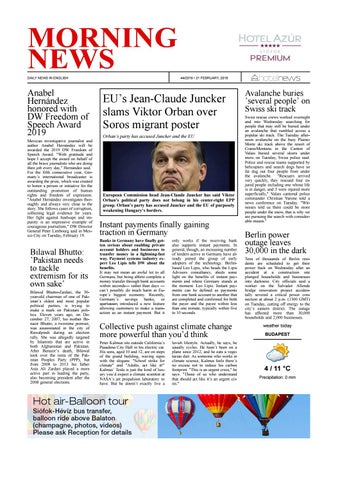
EUʼs Jean-Claude Juncker slams Viktor Orban over Soros migrant poster Orbanʼs party has accused Juncker and the EU
European Commission head Jean-Claude Juncker has said Viktor Orbanʼs political party does not belong in his center-right EPP group. Orbanʼs party has accused Juncker and the EU of purposely weakening Hungaryʼs borders.
Instant payments finally gaining traction in Germany Banks in Germany have finally gotten serious about enabling private account holders and businesses to transfer money in a lightning-fast way. Payment systems industry expert Leo Lipis tells DW about the benefits. It may not mean an awful lot to all Germans, but being ableto complete a money transfer through bank accounts within seconds— rather than days — canʼt possibly do much harm in Europeʼs biggest economy. Recently, Germanyʼs savings banks, or sparkassen, introduced a new feature allowing customers to make a transaction as an instant payment. But it
only works if the receiving bank also supports instant payments. In general, though, an increasing number of lenders active in Germany have already joined the group of early adopters of the technology. Berlinbased Leo Lipis, who heads the Lipis Advisors consultancy, sheds some light on the benefits of instant payments and where Germany stands at the moment. Leo Lipis: Instant payments can be defined as payments from one bank account to another that are completed and confirmed for both the payer and the payee within less than one minute, typically within five to 10 seconds.
Collective push against climate change more powerful than youʼd think Peter Kalmus sits outside Californiaʼs Pasadena City Hall in his electric car. His sons, aged 10 and 12, are on steps of the grand building, waving signs with the slogans: "School strike for climate" and "Adults, act like it!" Kalmusʼ Tesla is just the kind of luxury youʼd expect a climate scientist at NASAʼs jet propulsion laboratory to have. But he doesnʼt exactly live a
lavish lifestyle. Actually, he says, he usually cycles. He hasnʼt been on a plane since 2012, and he eats a vegetarian diet. As someone who works in climate science, Kalmus feels thereʼs no excuse not to reduce his carbon footprint. "This is an urgent crisis," he says. "Those of us who understand that should act like itʼs an urgent crisis."
Avalanche buries ʼseveral peopleʼ on Swiss ski track Swiss rescue crews worked overnight and into Wednesday searching for people that may still be buried under an avalanche that rumbled across a popular ski track. The Tuesday afternoon avalanche on the busy PlaineMorte ski track above the resort of Crans-Montana in the Canton of Valais buried several skiers under snow on Tuesday, Swiss police said. Police and rescue teams supported by helicopters and search dogs have so far dug out four people from under the avalanche. "Rescuers arrived very quickly, they rescued four injured people including one whose life is in danger, and 3 were injured more superficially," Valais cantonal police commander Christian Varone told a news conference on Tuesday. "Witnesses told us there could be more people under the snow, that is why we are pursuing the search with considerable means."
Berlin power outage leaves 30,000 in the dark Tens of thousands of Berlin residents are scheduled to get their power back on Wednesday after an accident at a construction site plunged households and businesses into darkness. City officials said a worker on the Salvador Allende bridge renovation project accidentally severed a critical power connection at about 2 p.m. (1300 GMT) on Tuesday, cutting off energy to the cityʼs eastern district. The outage has affected more than 30,000 households and 2,000 businesses.
weather today BUDAPEST
4 / 11 °C Precipitation: 0 mm
44/2019 • 21 February, 2019
Invisible and dangerous: The Salafist scene in North RhineWestphalia There are more Salafists in North Rhine-Westphalia than in any other German state. The scene has all but vanished from the public eye in its stronghold. But it is still very active, as DW is told by numerous sources. "Speak after me," the red-bearded German convert and Salafist preacher Pierre Vogel says as he publicly summons the young woman. Cheered on by an enthusiastic crowd in the pedestrian zone of the western city of Offenbach, she does exactly that, and repeats the words of the Islamic profession of faith. That was in 2010. The conversion was filmed and uploaded to YouTube — just one example of the many videos shared online from the heydays ofSalafist missionary work in Germany. Until 2016, the scene had a self-confident and sometimes aggressive public appearance. Bearded men in baggy pants and flowing white robes such as Pierre Vogel regularly distributed free German-language editions of the Koran in market squares and pedestrian zones.
Serena Williams knocks out Simona Halep in epic Australian Open clash Serena Williams underlined why she is the favourite to win the Australian Open with a 6-1 4-6 6-4 win over top seed Simona Halep in a high-quality last-16 match. The 37-year-old American dismantled Halepʼs game to race through the opening set in 20 minutes. Romaniaʼs Halep, 27, recovered in the second, breaking in what proved to be the final game.
Germany: Taxis denounce Transport Ministryʼs deregulation plans
Berlinʼs classic ad columns to disappear
Restrictive transportation rules have hindered the ability for ridehailing companies to offer their services in Germany for years. The coalition government now wants to change that.
Berlinʼs cityscape wonʼt be quite the same without them. While they may seem trivial in our digital world, advertising columns are seen as an immutable part of many urban environments, and of Berlin in particular. But now the city has decided that the legendary posts were to be removed — 20 of them a day, until they all disappear by June 30. Absurdly, according to the Berliner Zeitung newspaper, while the traditional ad columns will be removed, ILG, the new company from Stuttgart that has acquired the advertisement rights for the next 15 years, will build 1,500 new columns — 1,000 less than before — of a new type to replace the Berliner original ones. They will be larger and have lighting. It was in the German capital that the poster-plastered pillars were invented in 1854. In German, the advertising columns — known in the plural as Litfasssäulen — are named for their inventor, Ernst Litfass, who was born in Berlin over 200 years ago, on February 11, 1816.
Conservative Transport Minister Andreas Scheuer (CSU) wants to make it easier for companies like Uber to offer their services in Germanyand traditional taxi companies arenʼt happy about it. Uber first launched in Germany in 2014, buta string of court rulingsand the countryʼs restrictive transportation laws have limited it and similar companies from offering their ridehailing services. In a white paper published on Monday, the Transport Min-
istry proposed legal changes to inject more competition into the transportation sector. Read more: Uber CEO to end ʼpirateʼ culture in push for ʼresetʼ in Germany Chief among them is scrapping a rule that requires private hire drivers to return to a headquarters after every drop-off. The "obligation to return" — which doesnʼt apply to taxi drivers — also forbids ride-hailing drivers from accepting new customers during the ride back.
Cleaning up Everest – the worldʼs highest rubbish dump Mount Everest has turned into a dumping ground as the growing numbers of climbers leave their trash behind on the mountain. DW reporter Jasvinder Sehgal visited base camp to meet the mountaineers cleaning up the mess. Deepak Baijal is laying ropes, quickdraws, harnesses and other mountaineering equipment on a mat in his home in Jaipur, western India. The 34year-old is already preparing for his ascent of Mount Everest in four monthʼs time. Overcoming the worldʼs tallest peak unscathed takes meticulous preparation, even for an experienced mountaineer like Baijal. It will be his
first time climbing beyondEverest base camp. Nearly 300 people have perished on the mountain. But right now the scale of the dangerous challenge is not what concerns Baijal. "I love Everest — the god of mountains — for its beauty, mystery and mood," Baijal told DW. "But I am upset to know that it is becoming the worldʼs highest garbage dump." Baijalʼs deep respect for the worldʼs most famous mountain is not shared by everyone who climbs it. As the numbers of commercial trekkers and adventure holiday enthusiasts visiting the peak soar — a record 800 people reached the Himalayan summit in 2018 — so too has the amount of trash left behind.
Múzeum+ February at Museum of Fine Arts The February edition of monthly event series Múzeum+ is being held on the 14th at the Museum of Fine Arts. For each of these events, besides interactive workshops and concerts, an English-language guided tour also features. This time the theme is German Renaissance Art, starting at 7pm. For the complete schedule, check the museum website.
Hotel Azúr Prémium H-8600 Siófok, Erkel Ferenc u. 2/c. Telephone: 06 86 501 450 premium@hotelazur.hu http://www.hotelazur.hu/hu/premium
Published by: Mega Media Kft. 1075 Budapest, Madách I. út 13-14. +36 1 398 0344 www.hotelujsag.hu
Russia: Fake bomb threats prompt mass evacuations in Moscow A series of fake bomb threats forced tens of thousands of people on Tuesday to evacuate buildings in Russiaʼs capital of Moscow. School children, office workers and shoppers were among those who had to briefly empty 100 buildings in and around the city, reports said. In total, some 20,000 people were affected, while authorities swept the areas and ruled out any danger.Some institutions, such as the Russian State University of the Humanities, cancelled activities for the day due to the disruption caused by the mass evacuation. Tuesdayʼs incident was the latest in wave of false bomb alarms to hit Russia. Last week, some 55 buildings in Russiaʼs second city Saint Petersburg had to be evacuated. Similar threats were reported and let to evacuations in several other cities like Krasnoyarsk in Siberia and Volgograd in the south. Read more: High-rise mania overshadows Moscowʼs suburban dream In November 2018, a train station and 12 shopping malls had to be evacuated in Moscow due to anonymous calls warning of bomb threats that turned out to be fake.