Brief: MEPC 84
Session Dates: 27 April - 1 May 2026
OVERVIEW
The IMO Marine Environment Protection Committee (MEPC) held its 84th session from 27 April to 1 May 2026, continuing discussions and work across a broad range of environmental regulatory areas.
While no agreement was reached on the Net Zero Framework (NZF) and the associated alternative proposals, the session reinforced the direction of travel toward a globally applicable, consensus‑based framework, with confirmation that further work will continue intersessionally toward MEPC 85 and beyond. At the same time, MEPC 84 delivered concrete regulatory outcomes in other areas, notably air pollution and energy efficiency, life cycle GHG assessment, ballast water management, new Emission Control Areas, and marine plastic litter. This Brief provides an overview of the more significant issues progressed at this session.



KEY TAKEAWAYS
1. Net Zero Framework: The Committee reaffirmed the importance of developing a globally applicable IMO GHG reduction mid-term measure based on international consensus, while recognizing that further technical and political work is required. The Committee agreed to continue consideration of the NZF and alternative proposals on an intersessional basis ahead of MEPC 85, approving relevant Terms of Reference and noting that adoption remains pending.
2. Fifth IMO GHG Study: MEPC approved the Terms of Reference for the Fifth IMO GHG Study and invited the Secretariat to initiate the nomination process for the Steering Committee. The Study will update global GHG inventories and projections and will support the future review of the 2023 IMO GHG Strategy.
3. Life‑Cycle GHG Assessment: The Committee progressed work on the IMO LCA framework, including default emission factors, fuel pathway developments, and methodological treatment of carbon capture technologies. The GESAMP LCA was instructed to continue technical refinements and report to MEPC 85.
4. Energy Efficiency and Air Pollution: MEPC adopted amendments and guidelines related to IMO DCS accessibility, the EEDI framework, and emissions measurement and monitoring, and noted continued improvement in fleet wide carbon intensity. The Committee also continued the work on Phase 2 of the review of the short-term GHG reduction measures.
5. Onboard Carbon Capture: The Committee advanced draft guidelines on the testing, approval, survey and certification of onboard carbon capture systems, agreeing on a technology neutral, step‑wise approach. The Correspondence Group was re‑established to continue work toward MEPC 86.
6. Ballast Water Management: MEPC approved amendments to the BWM Convention Annex and associated guidelines, enhancing requirements on system operation, maintenance, certification, and challenging water quality, with the aim of strengthening consistent implementation.
7. Designation of Special Areas, ECAs and PSSAs: The Committee adopted the North‑East Atlantic Emission Control Area and considered protective measures for a new proposed PSSA, while initiating consideration of IMO’s role in supporting implementation of the BBNJ Agreement and advancing work on marine biodiversity protection.
8. Other Notable Outcomes:
• Amendments on Integrated Bilge Water Treatment Systems (IBTS) under MARPOL Annex I.
• Agreement to develop a legally binding biofouling framework as a standalone instrument by 2029.
• Adoption of the 2026 Strategy and Action Plan on Marine Plastic Litter, reaffirming the goal of zero plastic waste discharges by 2030.
• Further measures on underwater radiated noise, ozone-depleting substances, and preparatory work on MASS under MEPC’s remit.
CONTENTS (CLICK TO FOLLOW)
REDUCTION OF GHG EMISSIONS FROM SHIPS
• IMO Net-Zero Framework
• Terms of Reference for the Fifth GHG Study
• Further Development of the Life Cycle GHG Assessment (LCA) Framework
AIR POLLUTION AND ENERGY EFFICIENCY
• Annual Carbon Intensity and Fleet Efficiency (Reporting Year: 2024)
• IMO DCS Accessibility and Clarification of Entries in Data Reporting
• Phase 2 of the Review of the Short-Term GHG Reduction Measures
• EEDI Guidelines Amendments Addressing Dual-Fuel Engines Using Two Liquid Fuels
• Framework for the Measurement and Verification of Actual Tank-to-Wake (TtW) Methane and Nitrous Oxide Emission Factors and Cslip value
• Draft Guidelines for Testing, Survey, Certification and Approval of OCCS
• Use of Multiple Engine Operational Profiles for a Marine Diesel Engine
• Certification of Engines that Operate on Non-Carbon-Containing Fuels
• Shipboard Incinerator Type Approval Testing
• Volatile Organic Compounds (VOC) Emissions
• Exhaust Gas Cleaning System (EGCS)
• Reduction of the Impact on the Arctic of Emissions of Black Carbon (BC) from International Shipping
BALLAST WATER MANAGEMENT AND MARINE BIOSAFETY
• Review of the Ballast Water Management Convention
DESIGNATION OF SPECIAL AREAS, ECAs and PSSAs
• Adoption of the North-East Atlantic ECA
• Associated Protective Measures for the Nasca Ridge National Reserve as PSSA
• Biological Diversity of Areas Beyond National Jurisdiction (BBNJ Agreement)
MARINE PLASTIC LITTER
• 2026 Strategy and Action Plan
• Environmental Risk Associated with the Maritime Transport of Plastic Pellets
• Fishing Gear Marking
• Information Gathering Survey on Waste Produced by Ships During Their Normal Operations
OTHER DEVELOPMENTS
• Amendments to MARPOL Annex I and Associated Guidelines Related to IBTS
• Legally Binding Framework for Biofouling
• Reduction of Underwater Noise from Commercial Shipping
• Reintroduction of Ozone-Depleting Substance on Ships
• Measures to Address Maritime Autonomous Surface Ships (MASS) Under the Purview of the MEPC
REDUCTION OF GHG EMISSIONS FROM SHIPS
IMO Net-Zero Framework
Following the adjournment of the second extraordinary session (MEPC ES.2) last October, the Committee convened to continue discussions, focusing on re-engagement and consensus-building among Member States. During the discussion, the need for a global measure, applicable at the international level, was consistently emphasized. There was broad recognition that progress on the GHG reduction mid-term measures must be based on international consensus, avoiding fragmentation and ensuring uniform application across the sector. Several delegations reiterated the importance of keeping all proposals on the table, while working toward convergence.
The Committee agreed that more time and consideration is needed on the Net Zero Framework (NZF) and the related proposals, therefore the discussion should continue on an intersessional basis. This intersessional work is intended to advance progress through two working groups, ISWG-GHG 22 and ISWG-GHG 23 which have been provisionally scheduled to be held from Tuesday 1 September to Friday 4 September 2026 and Monday 23 November to Friday 27 November 2026 respectively, subject to endorsement by Council 137, with the following terms of reference:
1. Further consider how to address concerns and issues with the draft amendments to MARPOL Annex VI on the IMO Net-Zero Framework in line with the 2023 IMO GHG Strategy.
2. Further consider draft guidelines supporting the uniform and effective implementation of IMO’s mid-term measures.
3. Further consider the development of the IMO Life Cycle GHG Assessment (LCA) framework.
4. Submit a written report to MEPC 85.
The committee agreed that the above terms of reference will not prevent any Member State from submitting other proposals related to IMO mid-term measures for consideration by ISWG-GHGs.
Furthermore a one-day GHG Expert Workshop (GHG-EW 7), will be held ahead of ISWG-GHG 22 on chain of custody models to facilitate the understanding of such models allowing for fuel supply chain traceability requirements under the IMO LCA framework.
Resumption of MEPC Extraordinary Session.2
Subject to decision by MEPC 85, the MEPC Extraordinary Session 2 is provisionally scheduled to resume on Friday, 4 December 2026, in the same week as MEPC 85, which is scheduled to take place from Monday, 30 November to Thursday, 3 December 2026.
Progress under ISWG GHG sessions 20 and 21
As instructed by MEPC 83, sessions 20 and 21 of the Intersessional Working Group on the Reduction on Greenhouse Gas Emissions from Ships (ISWG-GHG) were held in October 2025 and April 2026. The Committee noted that the ISWG-GHG made technical progress toward the implementation of the IMO NZF through the preparation of:
• Draft GFI calculation guidelines on core methodologies for calculating a ship’s annual GHG Fuel Intensity (GFI) defining a WtW GFI calculation method, treatment of fuel oils, shore power, zero emission energy sources, and provisional handling of onboard carbon capture and ice class adjustments.
• Draft amendments to the 2022 Guidelines for Administration verification of ship fuel oil consumption data and operational carbon intensity;
• Draft guidance on monitoring, reporting and verification of energy from wind propulsion systems (WPS); and
• Draft text to support further development of the guidelines on requirements and procedures for recognition of sustainable fuel certification schemes and reporting of certification activities (SFCS guidelines).
The work of ISWG-GHG does not prejudge any future decision of MEPC on adoption of amendments on the IMO NZF and the timelines contained therein.
Terms of Reference for the Fifth GHG Study
The Committee approved the Terms of Reference for the Fifth GHG Study and requested the Secretariat to issue a circular letter to launch the call for nominations of members for a Steering Committee.
The indicative outline of the Terms of Reference include:
• Part 1 – GHG Emissions Inventory
1. Inventory of GHG emissions from international shipping 2018-2025.
1.1 Introduction and scope
1.2 Differentiation between domestic and international voyages
1.3 Methods and data
1.4 Outcome
2. Estimates of GHG fuel intensity from 2018 to 2025 (WtT, TtW and WtW basis),
3. Estimates of carbon intensity.
3.1 Carbon intensity estimates for the years 2018-2025.
4. Estimates of energy consumed and WtW emissions for the year 2008.
• Part 2 – GHG Emissions Projections
5. Scenarios for future international shipping emissions 2025-2050.
5.1 Introduction
5.2 Methods and data
5.3 Outcome
• Part 3 – General Provisions
Further to the considerable interest in a regional analysis in the emissions projections, the Committee invited interested delegations to consider submitting proposals on this matter to a future session. The Committee also noted the interest in developing a framework whereby IMO GHG Studies could be regularly updated.
MEPC 84 (Spring 2026)
Approval of draft terms of reference


Summer 2026
Tender evaluation by the steering committee
Figure 1: Suggested Timelines
Autumn 2026
Contract Signed
MEPC 87 (Spring 2028)
Consider the final report with a view to approval
MEPC 86 (Summer 2027)
Consider an interim report
Further Development of the Life Cycle GHG Assessment (LCA) Framework
The Committee considered extensive technical work by ISWG GHG 21 on refining and operationalizing the 2024 LCA Guidelines (MEPC.391(81)), supported by the GESAMP LCA Working Group. The focus was on methodological gaps, consistency, verification, and sustainability aspects needed for implementation of the IMO Net Zero Framework. The Committee did not adopt substantive amendments to the IMO Life Cycle GHG Assessment (LCA) Guidelines. Instead, but agreed on a structured way forward, referring most outstanding issues for further technical development, primarily through the GESAMP LCA Working Group, with MEPC 85 identified as the next decision point.
The Committee endorsed several foundational elements to allow technical work to progress. Interested Member States and international organizations were invited to submit proposals on incorporating the country of origin into default factors and assessing implications for the use of default emission values. In accordance with the 2024 LCA Guidelines, WtT default emission factors are to be calculated using representative and conservative assumptions, reflecting variability in feedstock to fuel pathways across regions and States. The Committee endorsed the uniform understanding of "representativeness" and "conservativeness" for WtT default emission factors, as developed by the GESAMP-LCA WG. The Committee further recommended that the GESAMP-LCA WG consider statistical approaches (e.g. weighted averages or measures of central tendency) to determine global default WtT emission factors for relevant fossil fuel pathways, and to report back to MEPC 85.
The Committee also supported, in principle, a risk based approach to Indirect Land Use Change (ILUC), while requesting further quantitative analysis and a dedicated report to MEPC 85. At the same time, more complex topics such as avoided emissions, actual well to tank values for fossil fuels, and methane slip corrections were acknowledged as lacking consensus and were deferred for further technical assessment. For ships using cargo as fuel, the Committee invited the GESAMP-LCA WG to further consider possible approaches in the calculation methodology, including the use of default emission values or correction factors, or adjustments to the etd parameter, to avoid double counting of shipping emissions. With regard to the certification of the GHG intensity of electricity, the Committee invited interested Member States and international organizations to further work intersessionally on better reflecting the actual GHG intensity of electricity in the LCA Guidelines and share lessons from existing contractual mechanisms and associated certification aspects, with a view to determining eligibility criteria.
In parallel, MEPC 84 agreed to continue refining LCA treatment for specific technologies and operational cases. The Committee invited further work on onboard carbon capture and storage (OCCS) accounting, verification, and certification, and on carbon capture and utilization (CCU), ensuring alignment with IPCC and ICAO/CORSIA methodologies. The Committee further supported the use of mass balance chain of custody models as a basis for fuel traceability, while calling for an expert level technical workshop prior to MEPC 85. Finally, the Committee agreed to expand the LCA framework by adding new fuel pathway codes in appendix 1 of the draft revised LCA Guidelines:
• Intermediate crop corn-based ethanol (EtOH_b_FR_intcorn_r_CHP); and
• LNG with upstream carbon capture and storage (CCS).
AIR POLLUTION AND ENERGY EFFICIENCY
Annual carbon intensity and fuel oil consumption data (Reporting Year: 2024)
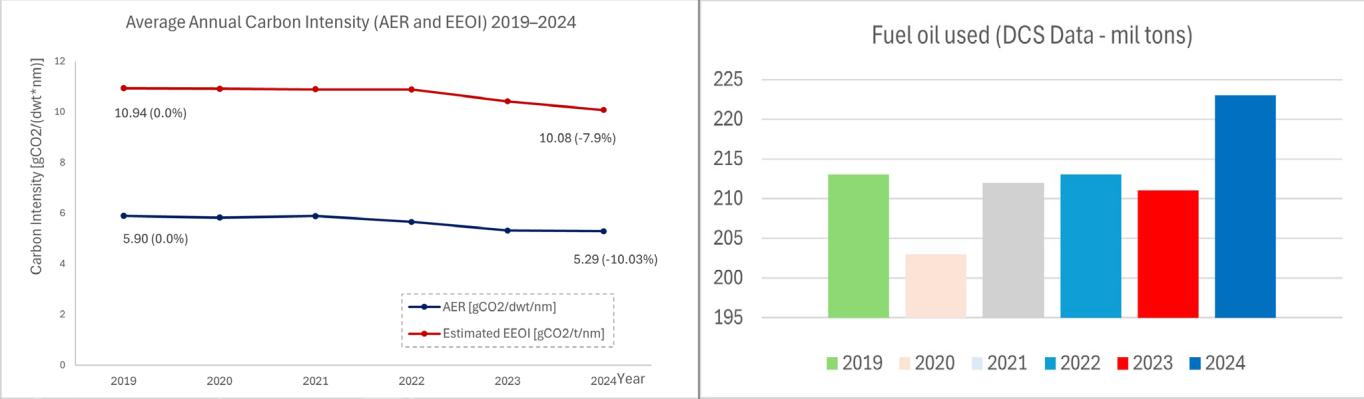
The IMO tracks progress in annual CII improvements by employing both “demand-based” (EEOI) and “supplybased” (AER/cgDIST) metrics, alongside the yearly analysis of fuel consumption data submitted to IMO DCS. It was noted that the trend of reduction in average fleet supply and demand based carbon intensity relative to 2019, has continued in 2024. Furthermore 223 million tonnes of fuel were used by 29,690 ships in 2024 which corresponds to an increase of total fuel used by 5.7% in 2024 compared to 2023. Conjunctural changes in seaborne navigation patterns (e.g. ships rerouting from the Red Sea/Suez Canal to the Cape of Good Hope) are potentially important factors contributing to the increase in fuel consumption owing to the increase in distance travelled.
IMO DCS accessibility and clarification of entries in data reporting MEPC 84 adopted amendments to Regulation 27 of MARPOL Annex VI to enhance accessibility to the IMO Data Collection System (DCS). The amendments provide that:
• Recognized Organizations duly authorized by the Administration shall have access to all the reported data from preceding calendar years for the ships under the particular Flag State.
• MARPOL Annex VI Parties shall have access to a non-anonymized database for analysis and review purposes. The Administration of a Party may however notify the IMO that its express approval will be necessary before the data of ships entitled to fly its flag are included in the non-anonymized database.
• On an ad hoc basis, the IMO may share data with analytical consultancies and research entities, under strict confidentiality rules.
• The IMO, on the request of a company, shall grant access to the fuel oil consumption reports of the company's owned ship(s) in a non-anonymized form to the general public.
Regulation 27 requires a ship transferred from one Administration to another, to report separately to each Administration (or any organization duly authorized by it) the aggregated data for the period of the calendar year corresponding to the relevant Administration. Regulation 28, however requires the attained annual operational CII to be calculated and reported for the full calendar year (1 January to 31 December) to the gaining Administration. As the current format of Appendix IX does not adequately reflect this distinction, the amendments to MARPOL Annex VI introduce two new fields specifying the start and end dates for the purposes of Regulations 27 and 28. In addition, the term “Oil-Fired Boiler(s)” is replaced with “Fired Boiler(s)” to ensure that Appendix IX also covers other equipment types, such as gas fired boilers.
The Committee adopted the amendments to MARPOL Annex VI concerning IMO DCS accessibility and clarification of entries in data reporting required by regulations 27 and 28 through Resolution MEPC.407(84), with entry into force on 1 September 2027.
Phase 2 of the Review of the Short-Term GHG Reduction Measures
At MEPC 81, the Committee agreed on advancing the review of the short-term GHG reduction measures by adopting a two-phase approach. The first phase of the review was completed at MEPC 83 with the conclusion on the CII reduction (Z) factors for 2027 to 2030. At the same session, the Committee also agreed to the work plan for Phase 2 of the review, which is expected to conclude at MEPC 87 (Spring 2028). Phase 2 commenced at MEPC 84 with the following objectives:
1. Further consider and finalize the development of the enhanced SEEMP framework.
2. Further consider and finalize the development of the cgHRS metric for cruise passenger ships.
3. Consider proposals to ensure synergies between the IMO carbon intensity/energy efficiency framework and the IMO Net-Zero Framework with a view to finalization as soon as possible.
Clarification of CII Calculation in enhanced DCS granularity reporting
Following amendments to appendix IX of MARPOL Annex VI (resolution MEPC.385(81), ships are required to report fuel oil consumption with an enhanced level of granularity, including breakdown per consumer type, total and “not under way” fuel consumption, and transport work. In addition, MEPC 83 adopted amendments to section 7 of the SEEMP Guidelines, clarifying the definitions of "under way" and "not under way".
To avoid any risk of misinterpretation that the newly included actual transport work data must be immediately applied in CII calculation, it was proposed to clarify in the CII Guidelines (G1), that the supply-based transport work (based on DWT or GT as applicable) should continue to be used as a proxy, pending completion of Phase 2 of the review.
It was also proposed to specify that, for CII purposes, total distance travelled should aggregate both “under way” and “not under way” distances, to maintain methodological consistency and avoid inequitable impacts across ship types. As a result, Appendix 4 of the 2024 SEEMP Guidelines was updated to require separate reporting of:
• Distance travelled while the ship is underway; and
• Distance travelled while the ship is not under way.
Following broad support for this proposal, and without prejudice to any future decisions on the CII metric, the Committee adopted:
• MEPC.412(84) - Amendments to the 2022 Guidelines on operational carbon intensity indicators and the calculation methods (CII Guidelines, G1)
• MEPC.413(84) - Amendments to the 2024 Guidelines for the development of a Ship Energy Efficiency Management Plan (2024 SEEMP Guidelines).
Proposed cgHRS metric for cruise passenger ships
Considering the adverse impact of significant periods of time spent in port on the CII rating of cruise passenger ships, a proposal has been submitted for a revised CII -cgHRS- using "hours in a year" in the denominator of the CII formula instead of distance. The metric cgHRS is the sum of CO2 emissions divided by gross tonnage per operating hours per year, aiming to better reflect the operational profile of cruise ships. Accordingly, new reference line and rating boundaries for the proposed cgHRS metric for cruise passenger ships were calculated using the IMO DCS data for year 2019.
While some support was expressed for the proposed cgHRS metric, divergent views remained regarding consistency with the overall CII framework and rating distribution impacts. In this regard, the Committee invited interested Member States and international organizations to submit an updated proposal to a future session and adjusted the Work plan with a view to finalization of the development of the cgHRS metric at a future session.
Proposals to ensure synergies between the CII framework and the NZF
It was noted that it is premature to consider possible synergies between the CII framework and the NZF while the NZF has not yet been finalized. Regarding the possible transformation of the CII into an energy-based metric to complement a fuel-based mid-term measure, it was emphasized that additional information would be required to assess the implications of such an approach. Following consideration, the Committee agreed to keep this issue in abeyance, pending further clarification of the mid-term measure.
Interim calculation approach for biofuel blends under IMO DCS and CII
The Committee considered a proposal to revise the interim calculation approach for biofuel blends under IMO DCS and CII. There was broad support to amend MEPC.1/Circ.905 to clarify that:
• For biofuel blends, the Cf should be calculated as a weighted average by mass of the respective fuels, instead of energy; and
• A biofuel, or the biogenic components within biofuel blends, that are not certified as sustainable or does not fulfil the well-to-wake emission factor criterion, should in their entirety be assigned a Cf equal to the Cf of the equivalent fossil fuel type.
As a result, the Committee approved the Revised Interim guidance on the use of biofuels under regulations 26, 27 and 28 of MARPOL Annex VI (MEPC.1/Circ.905/Rev.1), with an application date of 1 January 2027, aligned with the start of the next DCS data-collection year.
Consideration of other CII metrics
The Committee recognized the merits of further exploring alternative CII metrics and noted aspects requiring further consideration, such as the possible limitation of the CII calculation to fuel consumption during under way conditions, the incorporation of WtW GHG intensity, the development of an energy-based (MJ/transport work) approach, and strengthening of the enforcement.
The Committee recognized that priority should be given to addressing the identified gaps and challenges in the CII framework and invited interested Member States and international organizations to submit proposals for further consideration at MEPC 85.
Proposed enhancement of the SEEMP framework
The Committee considered documents providing further details on the proposed enhanced SEEMP framework. Key elements include a shift from the current focus on E and D ships to a continuous incremental improvement approach applicable to all ships, based on prior performance; the strengthening of audits and introduction of internal reviews; and the requirement to maintain an implementation log as evidence for implemented measures.
The potential benefits of the proposed framework in incentivizing operational energy efficiency were acknowledged. Nevertheless, concerns were noted regarding administrative burden, audit implementation, enforcement, and potential unintended impacts.
The Committee agreed to continue working on this matter inviting further submissions and agreed to adjust the work plan with a view to finalization of the development of the enhanced SEEMP framework at MEPC 86.
EEDI Guidelines amendments addressing dual-fuel engines using two liquid fuels
Dual-fuel engines using two liquid fuels within the EEDI Framework
Although currently the EEDI Guidelines contain provisions for ships with dual-fuel engines, these apply only to dual fuel engines using gaseous fuels (and more specifically LNG). To address dual-fuel engines using two liquid fuels, in particular methanol and ethanol, the Committee adopted the following amendments:
• MEPC.410(84) – Amendments to the 2022 Guidelines on the method of calculation of the attained Energy Efficiency Design Index (EEDI) for new ships; and
• MEPC.411(84) – 2026 Guidelines on survey and certification of the Energy Efficiency Design Index (EEDI)
The Committee also noted that there may be a need to further refine those sets of guidelines in order to appropriately cover other alternative fuel types, such as ammonia.
Definition
of hybrid propulsion
The Committee considered a proposal by INTERFERRY to clarify the scope and definition of hybrid propulsion for ferries under the EEDI framework. While the potential benefits were acknowledged, outstanding issues were identified, including:
• The appropriate regulatory instrument (MARPOL Annex VI, guidelines, or unified interpretation); and
• The need for further data and justification for proposed thresholds.
The Committee invited interested Member States and international organizations to liaise with INTERFERRY and submit a refined proposal to a future session.
Framework for the measurement and verification of actual tank-to-wake (TtW) methane and nitrous oxide emission factors and Cslip value
MEPC 83 adopted, by resolution MEPC.402(83), Guidelines for test-bed and onboard measurements of methane (CH4) and/or nitrous oxide (N2O) emissions from marine diesel engines To further develop the framework for the measurement and verification of non-CO2 GHG emissions, MEPC 83 re-established the Correspondence Group (CG) on Measurement and Verification of Non-CO2 GHG Emissions and Onboard Carbon Capture and Storage (OCCS) and instructed it to submit a written report to MEPC 84.
2026 Guidelines for Test-Bed and Onboard Measurements of Methane (CH4) and/or Nitrous Oxide (N2O)
The Committee adopted the 2026 Guidelines for test bed and onboard measurements of CH4 and/or N2O emissions from marine diesel engines, through resolution MEPC.414(84), thereby revoking the guidelines adopted by resolution MEPC.402(83).
Use of existing measurement data
Crankcase emissions
Fuel scope
Effect of fuel gas composition
A new section 3 was introduced to address the use of existing measurement data, providing that:
• Measurements conducted prior to the adoption of the Guidelines may be accepted, provided they were carried out in accordance with the NTC 2008;
• Where existing measurements for CH₄ are not available, emission values for total hydrocarbons (HC), as set out in the engine's NOₓ Technical File, may be used as a proxy. If the fuel composition is not available in the engine's NOₓ technical file, total HC emissions should be assumed to consist of 100% CH₄.; and
• Where E2 test cycle measurements do not contain emission values for the 10% load point, or the lowest mode point at which gas fuel would be used, data from the D2 test cycle of the same parent engine may be considered representative under certain provisions.
It was clarified that, where Cslip is reported, crankcase emissions should only be included for trunk piston engines without closed crankcase ventilation. Where crankcase emissions are not measured, an emission value based on technical justification and relevant emission data may be used. In the absence of such data, a fallback value of 1 g/kWh applies.
The applicable fuel scope for methane emission factor (CfCH4) and methane slip factor (Cslip-CH4) was clarified to prevent misapplication across fuel types. The definition of "fuel flow" in the Cslip-CH4 calculation was also clarified by specifying that only methane-containing fuel (excluding pilot fuel) should be included.
To account for the effect of fuel gas composition, the Cslip-CH4 result is to be corrected to a reference gas composition, i.e., the average of LNG compositions in ISO 23306:2020 (84.6 w-%, 92.2 mol-%). The reference gas correction formula is included in the revised Guidelines. Consequential amendments will be included in a future revision of the LCA Guidelines.
Measurement provisions
Measurement provisions were aligned with the with current best practices, i.e. ISO 81784:2020. A new appendix 4 was introduced describing the dual-flame ionization detector (FID) set-up method for methane analysis.
Guidelines for engine load monitoring and calculation of emission values (ELM Guidelines)
The Committee adopted the Guidelines for engine load monitoring (ELM) and calculation of emission values (ELM Guidelines) through resolution MEPC.415(84).
The guidelines specify the method for ELM to establish factors that reflect the actual operational profile of a marine diesel engine, and a method for the calculation of emission values. ELM may be used to monitor actual engine load during operation in lieu of the pre-defined weighting factors set out in the NOx Technical Code 2008. ELM is intended to be used in combination with verified CH4 and/or N2O emission measurement to enable more representative emission values.
Although, the ELM Guidelines are voluntary in nature and intended to support future mandatory instruments, where applied, the monitoring method, data collection procedure and yearly load monitoring data and corresponding emission calculations should be approved by the Administration.
Guidelines for continuous emission monitoring systems (CEMS Guidelines)
The Committee adopted the Guidelines for continuous emission monitoring systems (CEMS) used to quantify methane (CH4) and/or nitrous oxide (N2O) emissions from marine diesel engine through resolution MEPC.416(84).
The CEMS Guidelines aim to provide a uniform framework for onboard measurement and mass-based quantification of methane (CH4) and/or nitrous oxide (N2O) emissions from marine diesel engines using a continuous emission monitoring system (CEMS). In addition, the Guidelines establish a framework for the certification of CEMS by the Administration.
The Guidelines contain the following main sections:
1. Exhaust gas measurement.
2. Determination of exhaust gas flow rate (either by carbon balance method or direct measurement method).
3. Calculation procedures.
4. Data recording device.
5. CEMS documentation.
6. CEMS certification.
Overview and next steps
The Committee agreed that, without prejudice to any future mandatory framework, actual TtW emission values for methane (CH4) and/or nitrous oxide (N2O) emissions may be quantified, on a voluntary basis, using the following approaches:
1. Engine load monitoring, using the ELM Guidelines, in conjunction with the 2026 Guidelines for test bed and onboard measurements of CH4 and/or N2O emissions from marine diesel engines; and/or
2. Continuous emissions measurement system, using the CEMS Guidelines.
Additional guidance on the use of emission-reduction devices and onboard verification procedures to demonstrate the validity of established emission values is expected to be developed.
In this regard, the Committee re-established the CG on Measurement and Verification of Non-CO2 GHG Emissions and Onboard Carbon Capture and Storage, to continue work on this matter with the following terms of reference:
1. Further develop the framework for the measurement and verification of actual tank-to-wake methane (CH4) and/or nitrous oxide (N2O) emission factors and Cslip value for marine diesel engines;
2. Consider how this framework can support the application of the 2024 LCA Guidelines;
3. Report to MEPC 86.
Draft Guidelines for testing, survey, certification and approval of OCCS
According to the work plan on the development of a regulatory framework for the use of Onboard Carbon Capture and Storage (OCCS) (approved by MEPC 83), the Committee discussed further the draft guidelines on testing, survey and certification of OCCS, developed by the Correspondence Group.
Regarding the acceptable means of disposal of captured carbon, the Committee noted the discussions on a proposal that for any OCCS concept (with direct or indirect disposal of CO2 into the sea) a document should be submitted to the relevant London Convention and Protocol (LC/LP) bodies for evaluation of the concept and its acceptability, using also the expertise of the relevant GESAMP WG. In this regard, the Committee invited interested parties to submit a document to the relevant bodies, including the LC/LP, for evaluation of any OCCS concept with direct or indirect disposal of CO2 into the sea.
The Committee approved a technology neutral, environmentally robust, and aligned with the IMO GHG regulatory framework revised work plan. The work will focus on minimising harmful emissions and discharges, ensuring traceability of captured carbon, addressing legal and logistical barriers to transport, storage or utilisation ashore, enabling recording and reporting of data, and defining how GHG reductions from OCCS are accounted for. It will also cover testing, certification, enforcement, compatibility with shore reception facilities, and methodological guidance on OCCS accounting. Clear boundaries were set to ensure coordination with other IMO bodies and workstreams, notably the MSC on safety issues and the LCA framework on emissions accounting. The work is planned for completion in 2028, with highest priority given to tasks related to environmental protection, traceability, and OCCS certification.
Respectively, the Committee re-established the CG to continue the development of the regulatory framework on OCCS, with the following terms of reference:
1. Develop a regulatory framework for the use of OCCS using the revised work plan.
2. Develop specific methodological guidance on OCCS accounting, verification, and certification, building upon the existing OCCS framework in the LCA Guidelines; and
3. Report to MEPC 86.
Use of multiple engine operational profiles for a marine diesel engine
To allow for the use of multiple engine operational profiles for a marine diesel engine, MEPC 83 adopted amendments to the NOx Technical Code 2008 through resolution MEPC.397(83) (Use of multiple engine operational profiles for a marine diesel engine, including clarifying engine test cycles), with an entry into force date of 1 September 2027.
The Committee subsequently adopted the associated amendments to MARPOL Annex VI through Resolution MEPC.408(84), with entry into force on 1 September 2027. The amendments introduce:
1. A revision to the definition of "irrational emission control strategy" in regulation 2.1.19, to replace "ship" with "marine diesel engine" consistent with the amendment in Chapter 1 of the NTC 2008.
2. New rows to the Supplement to the IAPP, to denote Multiple Engine Operating Profiles use for engines certified to the multiple emission Tier.
3. Revisions to Appendix II, corresponding to the changes made regarding test cycle applications in Chapter 3.2 of the NTC 2008.
Certification of engines that operate on non-carbon-containing fuels
PPR 13 agreed to draft amendments to the NOx Technical Code (NTC 2008) to enable the certification of engines that operate on:
• Non-carbon-containing fuel; or
• Mixtures of carbon-containing and non-carbon-containing fuels.
As the existing carbon balance method is not suitable for low-carbon or zero-carbon fuels, the proposed amendments introduce hydrogen-balance and oxygen-balance procedures for determining exhaust gas mass flowrate. Following editorial refinements to improve clarity and accuracy, the Committee approved the draft amendments to NTC 2008 with a view to adoption at MEPC 85.
Shipboard incinerator type approval testing
PPR 13 agreed to a revised Unified Interpretation (UI) of Regulation 16.9 of MARPOL Annex V to clarify the distinction between requirements applicable to shipboard incinerator type approval testing and those applicable to onboard monitoring. It was clarified that the requirement for batch-loaded incinerators to reach 600 °C within five minutes after start-up in the actual combustion space where solid waste is combusted constitutes a design requirement. As such, this requirement is to be verified during type approval testing only. The onboard monitoring of the combustion chamber flue gas outlet temperature is intended for safe operation and continuous compliance, not for verifying the design requirement.
The Committee approved the revised UI and requested the Secretariat to disseminate it by means of MEPC.1/Circ.795/Rev.10.
Volatile
Organic Compounds (VOC) emissions
With a view to reducing VOC emissions from international shipping, PPR 13 agreed to draft amendments to regulation 15 of MARPOL Annex VI and consequential amendments to the Form of International Air Pollution Prevention (IAPP) Certificate. The amendments require new crude oil tankers to be fitted with P/V valves having a minimum opening pressure of 0.20 bar.
The Committee approved the draft amendments to regulation 15 of MARPOL Annex VI and consequential amendments to the Form of IAPP Certificate with a view to adoption at MEPC 85.
Exhaust Gas Cleaning System (EGCS)
The Committee continued work on harmonizing and evaluating regulations on discharge water from exhaust gas cleaning systems (EGCS), extending the target completion date to 2027, reflecting the complexity of the issue and the need for further evidence based analysis.
The Committee took note of progress in the work of the GESAMP Task Team on EGCS and supported continued discussion on possible regulatory measures, including consideration of EGCS related associated protective measures in Particularly Sensitive Sea Areas (PSSAs), while emphasizing that any future controls should be developed through the MARPOL process and based on sound science. The Committee also invited Member States to systematically report all national and local EGCS discharge restrictions through a new dedicated GISIS module, to improve transparency and consistency.
Finally, the Committee referred proposals on alternative, technology neutral approaches to PPR 14 for further consideration, noting divergent views among delegations, and confirmed that additional regulatory development would depend on further submissions, scientific evidence, and impact assessment.
Reduction of the Impact on the Arctic of Emissions of Black Carbon (BC) from International Shipping
The Committee noted that work on reducing the impact of Black Carbon emissions from international shipping in the Arctic remains ongoing, with the target completion date extended to 2027 to allow further development of the “polar fuels” concept. The Committee took note of progress at PPR 13, where discussions continued and additional submissions were invited to PPR 14, with particular emphasis on ensuring consistency with existing MARPOL Annex VI fuel quality requirements and related measures, including the Arctic HFO ban and applicable Emission Control Areas.
The Committee acknowledged divergent views among Member States, with some delegations cautioning against interpreting PPR 13 discussions as a mandate to develop a mandatory polar fuel standard at this stage, while others urged stronger action given the growing evidence of Black Carbon impacts on the Arctic climate, environment, and communities. Following consideration, the Committee agreed to refer the relevant submissions to PPR 14 for further technical discussion and refinement.
BALLAST WATER MANAGEMENT
Review of the Ballast Water Management Convention
MEPC 80 approved the Ballast Water Management Convention Review Plan (CRP), as set out in BWM.2/Circ.79 and MEPC 81 established a Correspondence Group (CG) to develop draft amendments to the BWM Convention and associated instruments, in line with an endorsed list of objectives. Due to the extensive scope of the proposed changes, MEPC 83 agreed to pursue adoption of a revised BWM Convention and a revised BWMS Code, rather than individual amendments and re-established the CG, with priority given to finalizing draft amendments to mandatory provisions (i.e. BWM Convention Annex and BWMS Code).
MEPC 84 made decisive progress on the comprehensive revision of the Ballast Water Management (BWM) framework. The Committee:
• Finalized and approved amendments to the BWM Convention for adoption at the next MEPC session.
• Adopted new 2026 Guidelines for Ballast Water Management and Ballast Water Management Plans (G4).
• Advanced, but did not yet finalize, amendments to the BWMS Code, targeting approval at MEPC 85.
• Confirmed policy intent for simultaneous entry into force of the Convention amendments and the revised BWMS Code, formally closing the EBP.
Amendments to Regulation A-3 (Exceptions)
Regulation A-3 was amended to provide a clear legal basis for the discharge of unmanaged or partially managed ballast water, on the high seas or in any areas designated by the port State, due to the ship having operated in challenging water quality conditions or applying a contingency measure.
These provisions are to be implemented taking into account CWQ guidance in resolution MEPC.387(81) and contingency measures guidance in BWM/2.Circ.62, as may be amended.
Amendments to Regulation B-1 (Ballast Water Management Plan)
Regulation B-1 was amended to require that the Ballast Water Management Plan (BWMP):
• Identifies the approval and operational status of any BWMS installed on board the ship, specifically whether it is type approved according to the BWMS Code or the 2016 G8 Guidelines, or operated in accordance with regulation D-4.
• Includes high-level information on BWMS maintenance procedures and schedules necessary to ensure good working order.
• Refers to the Operation, Maintenance and Safety manual (OMSM) for detailed procedures.
• Includes a procedure for safe ballast water exchange, including for partially treated and/or non-neutralized ballast water, taking into account relevant IMO Guidance.
• Details how the ship will plan for contingency measures, taking into account BWM.2/Circ.62, as may be amended.
• Where applicable, includes a procedure for the temporary storage of treated sewage and/or grey water in ballast water tanks, taking into account BWM.2/Circ.82, as may be amended.
In addition, Regulation B-1 was amended to incorporate the concept of BWMP reapproval, in line with the Guidelines (G4), to account for important updates to the standard format of the BWMP. Accordingly, changes to the mandatory provisions of the BWMP must be approved by the Administration and the BWMP must include a version history, documenting all such approved revisions.
Amendments to Regulation B-2 (Ballast Water Record Book)
Regulation B-2 was amended to introduce a requirement for a BWMS maintenance log to be included in the Ballast Water Record Book (BWRB). The maintenance log is intended to reflect the Operation, Maintenance and Safety Manual (OMSM) and the manufacturer’s maintenance schedule and must be kept updated and signed by crew involved in each action.
• Ships with an existing equivalent recording system: Provided it includes a detailed record of maintenance actions for any BWMS installed on board (according to the OMSM manual and the manufacturer's maintenance schedule) to the satisfaction of the Administration, the BWRB is required to include high-level information on such maintenance actions and refer to the existing equivalent recording system for the detailed records.
• Ships without an existing recording system: The BWRB must include a maintenance log for any BWMS installed on board, reflecting the OMSM manual and the manufacturer's maintenance schedule, kept updated, and signed by the officer in charge.
A definition was also introduced for the term "Final total quantity retained on board", meaning the aggregated volume of the ballast water remaining in all the ballast water tanks on board upon completion of the relevant operation.
Amendments to Regulation B-6 (Duties of Officers and Crew) Officers and crew must be familiar with their duties related to the implementation of ballast water management specific to the ship and with the ship’s BWMP. In this regard, Regulation B 6 was amended to require that IMO Guidelines be taken into account and that evidence of the familiarization be maintained on board the ship.
Amendments to Regulation D-2 (Ballast Water Performance Standard)
Regulation D-2 was amended to mandate the Maximum Allowable Discharge Concentration (MADC) for BWMS that use active substances. Ships conducting ballast water management in accordance with this regulation must discharge actives substances not exceeding the MADC in accordance with the limit set as part of the type approval.
Amendments to Regulation E-1 (Surveys)
Regulation E-1 was amended to introduce the following requirements:
1. Renewal and intermediate surveys must ensure that any BWMS on board the ship is properly installed and achieves the ballast water performance standard described in regulation D-2, taking into account the IMO Guidelines. This is in addition to the existing obligation to ensure that the equipment, associated systems and processes used for ballast water management fully comply with the BWM Convention and are in good working order.
2. Annual surveys must include confirmation that required maintenance has been undertaken by verifying the BWRB and/or any other equivalent maintenance recording system and annual sampling of residual active substances to ensure that any BWMS is operating in accordance with its type approval.
3. Additional surveys related to changes in ballast water management method are required when a ship, without changing its equipment, transitions its ballast water management method from compliance with regulation D-4 (Prototype Ballast Water Treatment Technologies) to regulation D-2 (Ballast Water Performance Standard).
When an additional survey is undertaken for a transition of the ship's ballast water management method from compliance with regulation D-4 to regulation D-2, the following applies:
• Prototype BWMS identical to a type-approved BWMS: A commissioning test is not required, provided that an equivalent test was successfully undertaken within 12 months prior to the transition date, taking into account BWM.2/Circ.70/Rev.1, as may be amended. In such cases, the installation date on the IBWM Certificate shall correspond to the completion date of the survey.
• Prototype BWMS not identical to the type-approved BWMS: The additional survey must include a commissioning test. The installation date on the IBWM Certificate shall correspond to the completion date of the commissioning test.
Where an accident occurs or a defect is discovered, which substantially affects the ability of the ship to comply with the BWM Convention, the owner, operator or other person in charge is required to submit a time-bound repair plan to both the flag State and destination port State(s) for their approval. This requirement is in addition to the existing reporting obligations to the Administration, recognized organization or the nominated surveyor responsible for issuing the IBWM Certificate, and to the appropriate port State authorities (if the ship is in a port of another Party).
Amendments to Appendix I (Form of the IBWM Certificate)
The Form of the IBWM Certificate was amended to include additional entries for details of the Type Approval Certificate, number issuance date and issuing Administration, where applicable.
As regulation D-1 is no longer a valid compliance option under Regulation B-3 (transition schedule of compliance from regulation D-1 to D-2), the option to select it as the principal ballast water management method was removed from Appendix I.
In addition, a new entry was introduced to specify that the BWMP has been approved in accordance with regulation B-1, taking into account the Guidelines developed by the IMO.
Amendments to Appendix II (Form of the BWRB)
Following the introduction of a BWMS maintenance log in regulation B-2, a template for such log was added to Appendix II. This template is intended for use by ships that do not have an equivalent recording system. It follows the overall approach of the BWRB and covers both planned and unplanned maintenance or repairs for any BWMS installed on board.
Amendments to the BWMS Code
The Committee advanced but did not yet finalize the package of draft amendments to the mandatory BWMS Code. Part 4 of the BWMS Code (sample analysis methods for the determination of biological constituents in ballast water) will be amended to require:
• Detailed and up-to-date instructions and procedures for the proper operation of the BWMS in the OMSM;
• Troubleshooting procedures, routine maintenance instructions, a maintenance schedule, and the minimum critical spares to be kept on board, as defined by the manufacturer to be included in the OMSM; and
• Recording of all maintenance and repairs in the BWRB and/or in an equivalent recording system as per the amended regulation B-2.
A Correspondence Group on Review of the BWM Convention will be re-established with priority to finalize the remaining BWMS Code amendments, with a progress report expected for MEPC 85 and submit a written report at MEPC 86.
2026 Guidelines for ballast water management and development of Ballast Water Management Plans (G4)
The Committee adopted revised Guidelines for ballast water management and development of Ballast Water Management Plans (G4), through resolution MEPC.409(84). The revised Guidelines require BWMPs to be updated when a BWMS is upgraded or retrofitted, to include ship-specific measures and procedures for challenging water quality (CWQ) conditions and to set out detailed procedures for contingency measures and suitable contingency measures where the ship is unable to manage ballast water in accordance with regulation D-2.
To avoid any uncertainty regarding the approval status of existing BWMPs resulting from the revision of the Guidelines, it was clarified that the revocation of the existing Guidelines G4 will take effect upon the entry into force of the amendments to the BWM Convention.
Unified Interpretation to Regulation D-3
The Committee approved a Unified Interpretation to regulation D 3 of the BWM Convention to clarify that ballast water management systems (BWMS) approved in accordance with the 2016 G8 Guidelines may remain installed on-board ships on or after 28 October 2020, as they are considered equivalent to the BWMS Code requirements. The interpretation was developed to address inconsistencies between regulation D 3 and the BWMS Code and to resolve confusion observed during recent port State control inspections, particularly under Paris and Tokyo MoU campaigns. The approved interpretation will be incorporated into BWM.2/Circ.66/Rev.6, providing regulatory certainty and consistent global application.
Future Work and re-establishment of the Correspondence Group Work remains outstanding, primarily related to the BWMS Code and supporting guidance. Priority pending items include stricter landbased test water conditions (higher TSS, DOC, POC and organism loads), introducing minimum reliability/endurance criteria for BWMS performance, limiting Treatment Rated Capacity (TRC) based on demonstrated performance in challenging water qualities, and standardizing test water composition to ensure uniform, repeatable typeapproval testing across facilities.
A number of objectives including sampling and analysis (G2), port State control guidance, contingency measures, and inspection practices remain not started. To address this, MEPC 84 reestablished a Correspondence Group, tasked with finalizing BWMS Code amendments for MEPC 85 and progressing the remaining guidelines thereafter. The completion of this work will underpin the end of the ExperienceBuilding Phase and the transition to full regulatory enforcement under the BWM Convention.
DESIGNATION OF SPECIAL AREAS, ECAsAND PSSAs
Adoption of the North-East Atlantic ECA
The Committee adopted the designation of the North-East Atlantic Ocean ECA for NOx, SOx and particulate matter through Resolution MEPC.407(84), with entry into force on 1 September 2027.The Committee also incorporated changes from a submitted proposal, making minor modifications to the coordinates of the North-East Atlantic Ocean ECA. In addition, Iceland indicated that further adjustments might be needed to better align the coordinates with the limits of its EEZ. However, as this would constitute a substantive amendment requiring more detailed technical consultation, Iceland was invited to submit a proposal to a future session.
Sulfur Oxides (SOx) and particulate matter:
Withing the North-East Atlantic Ocean ECA, ships will be subject to a maximum fuel oil sulfur content of 0.10% m/m.
Nitrogen Oxides (NOx):
The NOx Tier III requirements under Regulation 13 will apply to ships constructed on or after 1 January 2027 and operating within the ECA. “Ship constructed on or after 1 January 2027” means a ship:
1. For which the building contract is placed on or after 1 January 2027; or
2. In the absence of a building contract, the keels of which are laid or which are at a similar stage of construction on or after 1 July 2027; or
3. The delivery of which is on or after 1 January 2031.
Unified interpretation of Regulation 13.2.3
The Norwegian Sea ECA (adopted at MEPC 83) and North-East Atlantic ECA (adopted at MEPC 84) use the three-date criteria system, instead of the keel laying date used in the existing NOX ECAs, that could cause ambiguity in determining “the time the ship was constructed” for ships undergoing a major conversion, for determining Tier III compliance.
In this regard, the Committee approved a new Unified Interpretation (UI) of regulation 13.2.3 of MARPOL Annex VI (major conversion of engines), that clarifies that for ships constructed on or after the relevant dates and
operating in the Norwegian Sea or North-East Atlantic NOx Emission Control Areas undergoing major conversion, the three dates application criteria based on the building contract date, or in absence of a building contract the keel laying date, or the delivery date should be used to determine "the time the ship was constructed", without prejudice to the definition of "ship constructed" as set out in regulation 2.1.28.
Associated Protective Measures for the Nasca Ridge National Reserve as PSSA
MEPC 83 agreed in principle to the designation of the Reserva Nacional Dorsal de Nasca (Nasca Ridge National Reserve) (RNDN) as a Particularly Sensitive Sea Area (PSSA), based on the proposal submitted by Peru. MEPC 83 invited Peru to further develop the proposed Associated Protective Measures (AMP) and submit them to a future MEPC session for approval.
In this context, Peru submitted to MEPC 84 proposals for approval of the following measures:
• A prohibition on ballast water exchange and discharge operations within the geographical boundaries of the RNDN, through the adoption of an MEPC resolution, within the framework of the BWM Convention; and
• The designation of the RNDN as a Special Area under MARPOL Annexes I, II, IV, and V, thereby applying the enhanced pollution prevention regimes provided for MARPOL Special Areas.
Based on the report of the Ballast Water Review Group and the ensuing discussion, the Committee agreed that:
• The proposed BWM-related AMP would benefit from further refinement, and invited Peru to liaise with the Secretariat intersessionally with a view to submitting any refined proposal to a future session.
• The proposal for the designation of the RNDN as a Special Area under the relevant MARPOL Annexes was referred to PPR 14 for further consideration.
Biological Diversity of Areas beyond National Jurisdiction (BBNJ Agreement)
The Agreement under the United Nations Convention on the Law of the Sea (UNCLOS) on the Conservation and Sustainable Use of Marine Biological Diversity of Areas beyond National Jurisdiction (BBNJ Agreement) entered into force on 17 January 2026. It is the first global, legally binding treaty specifically designed to:
• Protect marine biodiversity in the high seas and deep ocean, i.e. areas beyond national jurisdiction, which cover nearly half of the planet’s surface.
• Address governance gaps under UNCLOS by strengthening international cooperation and coordination.
The Committee considered a proposal for a new output aimed at supporting the implementation of the BBNJ Agreement within the IMO regulatory framework for the protection of the seas and oceans and marine biodiversity. It was noted that:
• There is a potential to develop synergies and strengthen consultation, cooperation and coordination between the BBNJ Agreement's work on area-based management tools (ABMTs) including marine protected areas (MPAs) and IMO measures, such as Special Areas designated under specific MARPOL Annexes, including Emission Control Areas (ECAs), and Particularly Sensitive Sea Areas (PSSAs).
• The ABMTs, including MPAs, established under the BBNJ Agreement cannot adopt shipping measures that fall within IMO's mandate. Accordingly, cooperation between the BBNJ Agreement and IMO would support the contribution of any such ABMT, including MPAs, to the conservation and sustainable use of biodiversity in areas beyond national jurisdiction.
The Committee agreed in principle on the new output subject to further consideration by MEPC 85, to allow additional work to be undertaken, including further technical assessment and refinement of the scope of work, taking into account the respective mandates of the IMO and the BBNJ Agreement. In this regard, interested Member States and international organizations are invited to submit proposals for further consideration at MEPC 85.
MARINE PLASTIC LITTER
2026 Strategy and Action Plan
Further to the adoption of 2025 Action Plan to Address Marine Plastic Litter from Ships by MEPC 83, the Committee adopted the combined revised 2026 Strategy and the Action Plan to Address Marine Plastic Litter from Ships (Resolution MEPC.417(84)), agreeing to review it in in 2030. The resolution supersedes the 2021 Strategy (MEPC.341(77)) and 2025 Action Plan (MEPC.404(83). The Strategy reaffirms IMO's commitment to reduce marine plastic litter from all ships, with the goal to achieve zero plastic waste discharges to sea from ships by 2030.
Environmental risk associated with the maritime transport of plastic pellets
The 2025 Action Plan includes an action to develop mandatory measures to reduce the environmental risks of plastic pellets transported by sea in freight containers. In this regard, the Committee considered the appropriate regulatory instrument for the development of new mandatory code either under MARPOL Annex III and/or SOLAS.
In the ensuing discussion, the Committee noted broad support for the recommendation of PPR 13 regarding the development of a dedicated plastics code using the Recommendations for the carriage of plastic pellets by sea in freight containers (MEPC.1/Circ.909) as the basis. However, due to divergent views on the appropriate instrument under which the proposed code could be made mandatory, the Committee decided to instruct PPR 14 and subsequent sessions if necessary to:
1. Develop and finalize the draft text of the proposed code using MEPC.1/Circ.909 as a basis.
2. Develop the draft consequential amendments to MARPOL Annex III and SOLAS to incorporate the proposed code.
3. Submit the finalized draft text of the proposed code and the draft consequential amendments to a future MEPC Session, to allow the Committee to make a final decision on the appropriate instrument under which the proposed code will become mandatory.
Fishing gear marking
To promote the implementation of fishing gear marking systems and the Food and Agriculture Organization of the United Nations (FAO) Voluntary Guidelines on the Marking of Fishing Gear (VGMFG), the Committee approved circular MEPC.1 /Circ.921 – Implementation of fishing gear marking systems
Information gathering survey on waste produced by ships during their normal operations
A proposal submitted for an information gathering survey to be conducted to establish baseline data on the onboard management of waste generated by ships during their normal operations to support the IMO Study on marine plastic litter from ships.
Broad support was noted for generating this baseline data. However, concerns regarding the surveys conducted during port State control (PSC) inspection were raised regarding inter alia added workload for officers and the risk of inconsistent data due to time pressures and regional differences. The Committee invited the co-sponsors to submit a refined proposal to MEPC 85, taking into account the comments made at this session
OTHER DEVELOPMENTS
Amendments to MARPOL Annex I and associated Guidelines related to IBTS
New regulation 12B and amendments to Form of the IOPP certificate and Form of the Oil Record Book
Considering that MEPC 78 has already agreed in principle that forced evaporation may be accepted as a means for the disposal of oily bilge water, the Committee approved amendments to MARPOL Annex I, including the introduction of a new Regulation 12B, and the consequential amendments to the IOPP Certificate and the Form of Oil Record Book (ORB), with the view to adoption at MEPC 85.
Regulation 12B, concerning ships fitted with an integrated bilge water treatment system, the associated holding tanks, and the associated service tanks, which may incorporate heating coils for forced evaporation of the bilge water, applies to ships of 400 GT and above as follows:
• Ships constructed after the entry-into-force date (EIF) with an integrated bilge water treatment system (IBTS) installed on or after the EIF date; or
• Ships delivered after the EIF date with an IBTS installed after EIF + 48 months.
To specify the selected means for the disposal of oily bilge water retained in the oily bilge water holding tank, a new section 3.4 in the IOPP Certificate was included while a new item in Code D of the ORB Part I was added to allow the recording of forced evaporation of oily bilge water. For existing IBTS installations fitted prior to the EIF date, the requirements of Regulation 12B are to be applied as far as is reasonable and practicable.
2026 Guidelines for systems for handling oily wastes in machinery spaces of ships
In conjunction with the MARPOL Annex I amendments, and in order to provide further clarifications and guidance for record-keeping, the Committee approved in principle the 2026 Guidelines for systems for handling oily wastes in machinery spaces of ships incorporating guidance notes for an integrated bilge water treatment system (IBTS) and the draft revised Guidance for recording of operations in the Oil Record Book part I – machinery space operations (all ships) with a view to final approval by MEPC 85 in conjunction with the adoption of the draft amendments to MARPOL Annex I.
The 2026 IBTS Guidelines consolidate the existing IBTS related circulars and include:
• Definitions of IBTS, forced evaporation and oily bilge water service tank;
• Clarification of the system connection for an integral pump, where fitted for oily bilge water discharge;
• Requirements for forced evaporation as a treatment option for oil residue (sludge), including a maximum allowable temperature of 105°C oily bilge water in the relevant service tank;
• Additional heating options facilitating gravitational settling and forced evaporation for the oil residue (sludge) service tank;
• Design provisions for forced evaporation arrangements to avoid adverse effects on other equipment and prevent leakage;
• An updated typical IBTS flow diagram, with consequential adjustments to the oil residues (sludge) section;
• An updated format of the Statement of Fact on installation of IBTS installation.
Revised Guidance for recording of operations in the Oil Record Book Part I
Following agreement on the MARPOL Annex I amendments and the revised IBTS Guidelines, the Committee approved in principle with a view to final approval by MEPC 85, the revised Oil Record Book (ORB) Guidance MEPC.1/Circ.736/Rev.3, which will replace MEPC.1/Circ.736/Rev.2. The amendments include:
• Removal of a paragraph from example #10 under code D, regarding the bilge separation unit;
• New example #12bis under code D, regarding pumping of bilge water to clean bilge holding tank through 15-ppm equipment;
• New example #13bis under code D, regarding disposal of bilge water by forced evaporation; and
• New example #20bis under code I, concerning the pumping of clean bilge water overboard from clean bilge holding tank through a 15-ppm bilge alarm.
Legally binding framework for Biofouling
Further to the new output approved by MEPC 83 to develop a legally binding framework for the control and management of ships' biofouling to minimize the transfer of invasive aquatic species, the Committee concurred with PPR's recommendation that this framework should take the form of a standalone instrument and tasked PPR to finalize it by 2029, guided by the indicative following terms of reference:
1. Consider appropriate provisions for testing, verification, surveys, certification, inspections, documentation, record-keeping, and enforcement as appropriate.
2. Develop draft guidelines needed by the legally binding framework.
3. Ensure alignment with international law such as United Nations Convention on the Law of the Sea (UNCLOS) and other international agreements.
4. Address potential release of hazardous materials and microplastics arising from biofouling management.
5. Consider any implications for the reduction of air pollution, GHG emissions and underwater radiated noise.
Reduction of Underwater Noise from Commercial Shipping
MEPC 82 approved the Revised Guidelines for the Reduction of Underwater Radiated Noise (URN) from Shipping to address its adverse impacts on marine life (MEPC.1/Circ.906/Rev.1). It also approved the Action plan for the Reduction of URN from Commercial Shipping (URN Action Plan) as a dynamic document, subject to period review and revision.
The Committee approved the MEPC circular on technical guidance on co-optimizing energy efficiency and underwater radiated noise at the design and retrofit stage as prepared by SDC 12 (MEPC.1/Circ.922). Additionally, the Committee agreed in principle to extend the EBP on URN by two years (until end 2028) to address remaining gaps in implementing the Revised URN Guidelines, MEPC.1/Circ.906/Rev.1. The Committee also agreed in principle, subject to confirmation at MEPC 85, to proceed with an IMO commissioned study on URN emissions, based on draft terms of reference. On a possible URN policy roadmap, the Committee invited Member States and international organizations to submit further proposals and comments to MEPC 85, taking into account identified technical issues, relevant MEPC/SDC documents, and the outcomes of the 2025 workshop on ship energy efficiency and URN.
Reintroduction of ozone-depleting substance on ships
According to MARPOL Annex VI, regulation 12, no hydrochlorofluorocarbons (HCFC) containing system or equipment is permitted to be installed on ships constructed on or after 1 January 2020 and no new installation of the same is permitted on or after that date on existing ships. However, it has been observed that ships using nonODS refrigerants have subsequently replaced these with ODS-containing refrigerants, such as HCFCs, on or after 1 January 2020, despite such substances being regulated under MARPOL Annex VI.
Considering that the current provisions of MARPOL Annex VI do not explicitly prohibit such practices, the Committee agreed to include a new output titled "Amendments to regulation 12 of MARPOL Annex VI to prohibit the reintroduction of ozone-depleting substance on ships in the biennial agenda of the PPR sub-committee and the provisional agenda for PPR 14, with one session needed to complete the item.
Measures to address maritime autonomous surface ships (MASS) under the purview of the MEPC
Considering that the non-mandatory MASS Code is expected to be finalized and adopted at MSC 111, a proposal for a new work output has been submitted to address amendments to IMO instruments under the purview of MEPC, including MARPOL and the BWM Convention, in relation to the use of maritime autonomous surface ships (MASS). The proposal indicates that a Regulatory Scoping Exercise (RSE) and gap analysis of MEPC instruments would help identify and remove regulatory barriers to the use of MASS.
In the ensuing discussion, although support was noted, the need for two-step approach as per MSC, LEG and FAL was highlighted. The Committee agreed to include the proposed output in the post-biennial agenda of the Committee, using a two-phase approach, assigning the PPR Sub-Committee with two sessions to complete the item. The agreed scope of work is to:
1. Conduct the RSE gap analysis of the MEPC instrument;
2. Assess the adopted non-mandatory MASS Code and the progress made by MSC, LEG and FAL, and consider the need for amendments to, and interpretation of, the MEPC instruments; and
3. Develop a road map for the work (Phase II).
• ABS Regulatory News (link)
• ABS Regulatory Lessons (link)
• ABS Safety in Minutes Video Series (link)
• ABS Remote Survey Services (link)
• ABS Port State Control Checklist (link)
• ABS Rules and Guides (link)

1701 City Plaza Dr. Spring, Texas 77389, USA
Tel: +1-281-877-6000
Email: RegAffairs@eagle.org
© 2026 American Bureau of Shipping. All