2026
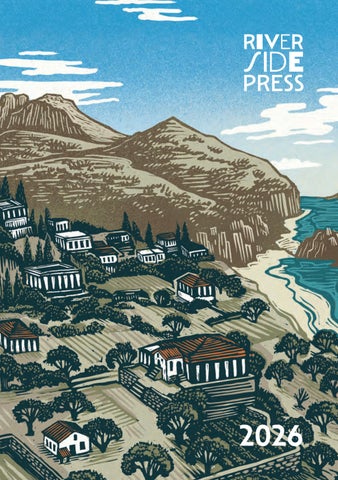
Cover Homer's Odyssey Illustrator: Joanna Lisowiec
“Those who contemplate the beauty of the earth find reserves of strength that will endure as long as life lasts.” — Rachel Carson, The Sense of Wonder Our new list adds another dimension to our storytelling: as we continue to examine our connection to nature, we also consider our place in history, myth and legend. All are firmly rooted in the natural world: history is shaped by our environment; myths and legends provide explanations of natural phenomena; tales of heroic achievements involve battling against the elements. So, alongside an invitation to understand and encounter trees, reflections on the language we use to describe nature, and a beachcombing guide to exquisite shells, we offer a compelling history of the Roman Empire, a modern retelling of Homer’s Odyssey, and a stunning photographic record of Ernest Shackleton’s extraordinary Endurance expedition to Antarctica. We hope you enjoy them as much as we do. Jenny Manstead Founder
Forty Ways to Know a Tree Meeting Trees to Understand Nature Trees are the living, breathing monitors and maintainers of Earth’s health. There are an estimated 3 trillion in the world, half as many as there once were. Trees are the lungs of the planet, with a mature example absorbing over 20 kg of carbon dioxide every year. Their growth-rings chronicle drought, fire, and flood. Their roots form an underground ecosystem with mycorrhizal networks of fungi. Their trunks, branches, and canopies provide shelter and sustenance to an abundance of 215 x 148 mm (53/4 x 81/2) 192pp, hardback Four colour throughout 90 images 35,000 words
mammals, birds and invertebrates. Their very presence bestows upon humans a sense of wellbeing. Forty Ways to Know a Tree offers 40 distinct ways of encountering, exploring and knowing a tree. You might know it at its birth or by its breathing; by its roots or its rings; by its shade or even by its
978-1-917226-17-2 £17.99 Publication March 2026
song. Each meeting is illustrated with artwork of a particular species, to convey a broad canvas of tree knowledge. With elegant writing turning tree science into storytelling, and beautiful photographs and watercolour art, this is the perfect gift for tree lovers.
Author Joan Maloof is Professor Emeritus of Biology at Salisbury University, Maryland, and founder of the Old-Growth Forest Network, which is working to create a national network of protected old-growth woodlands. Her work has been featured in The New York Times and The Washington Post and she is the recipient of prizes including the 2014 Mary Byrd Davis Award. She is the author of a number of published titles, including Treepedia, Nature’s Temples (both Princeton University Press), and The Living Forest (Workman).
6
Naming Nature A Cabinet of Natural Curiosities for Word Lovers Every language has its own words for the “endless forms of beauty” that make up our natural world. Human ways of seeing nature have flowered into words loaded with hidden meanings, twisted roots, and magical resonance. Take elephants, for instance. African languages often focus on the power of the animal; Tswana and Tsonga refer to “the unstoppable one”, and Zulu to the “one crashing through”. In ancient European languages, however, elephants were seen as commodities. When 213 x 136 mm (51/3 x 81/2) 256pp, hardback Full colour throughout Over 100 illustrations 40,000 words
Homer and Hesiod spoke of eléphâs in the 7th century BCE, they simply used the word for ivory. Naming Nature explores the immense variety of language used to describe the landscapes and creatures with which humans have lived for millennia. From butterflies and hummingbirds to narwhals and
978-1-917226-35-6 £18.99 Publication March 2026
leopards, the book celebrates our wondrous natural world through the many different ways we have interpreted it.
Author T. A. Barron is a passionate conservationist and New York Times bestselling author. He has won various literary prizes including the Nautilus Award Grand Prize and the de Grummond Medallion, and his popular children’s series The Merlin Saga is currently being adapted into film by Disney. Barron’s lifelong love of the natural world has led him to found various initiatives to encourage environmental awareness, including scholarships in environmental law at Harvard University and a biodiversity research fund. Born in Massachusetts, he studied at Princeton, Oxford, and Harvard before moving to Colorado, where he now lives with his family.
10
Homer's Odyssey An Illustrated Retelling Homer’s Odyssey is one of the world’s oldest and most famous works of literature. It has enthralled readers for almost three thousand years with its tales of gods and monsters, warriors and witches, family, faith, and the universal longing for home. This stunning new edition of Homer’s epic features a brand new retelling by celebrated classicist Barry Powell, who has studied, written about, and lectured on Homer for over three decades. Barry’s 230 x 180mm (7 x 9 in) 256pp, hardback Full colour throughout 60,000 words Over 60 illustrations 978-1-917226-39-4 £21.99 Publication April 2026
retelling is accompanied by sixty newly commissioned artworks, bringing the iconic scenes and characters to life, from the brutish Polyphemus, to the monstrous Scylla and Charybdis, mysterious Circe, faithful Penelope, and Odysseus himself.
Author and Illustrator Barry Powell is the Halls-Bascom Professor of Classics Emeritus at the University of Wisconsin-Madison, where he taught for 34 years. He has translated the Iliad, the Odyssey, and the Aeneid for Oxford University Press. He has also written short fiction (The House of Odysseus and Other Short Fictions), novels (Ramses in Nighttown, A Land of Slaves, The Berkeley Plan, Return to California), poetry (Rooms Containing Falcons), and a screenplay (Helen of Troy).
Joanna Lisowiec is an award-winning illustrator and designer. Originally from Poland, she lived in the US and Switzerland before settling in Yorkshire, UK. She is known for her bold style, which focuses on the beauty of nature and narratives inspired by folklore.
15
Atlas of the Roman Empire Battles, Conquests, Legions and Rulers At its peak, the Roman Empire stretched from the borders of Scotland to the shores of the Persian Gulf, and boasted a population of over 100 million people. Its mercurial emperors and generals include some of the most famous – and notorious – figures in history, from Julius Caesar to Marcus Aurelius, Commodus, Caligula and Nero. The Atlas of the Roman Empire maps the rise and fall of Rome in stunning detail, with hand-drawn maps 264 x 206 mm (8 x 101/2 in) 320pp, hardback Full colour throughout 70,000 words Over 125 images
showing the ebb and flow of conquest and resistance across continents, regions and individual battlefields. Stunning photography of classical art and statues brings key figures of the era to life. Renowned classicist David Potter provides a thrilling narrative, covering not only the grand politics of
978-1-917226-19-6 £36.99
empire, but also the personal rivalries, conspiracies and scandals of Roman imperial life.
Publication March 2026
Author David Potter is Francis W. Kelsey Collegiate Professor of Greek and Roman History and Arthur F. Thurnau Professor in the Department of Classical Studies at the University of Michigan, where he has taught for more than 25 years. He is the author of more than 10 books on Roman history and appears regularly on the History Channel.
19
Should We Collect Shells? You find a shell on the beach. It’s lovely. It feels wonderful in your hand. But then you pause. Should you take it home? It’s a question that comes with real considerations and here are some guidelines that might help with the decision. A shell’s primary role is as a home for an animal. Initially, the resident is the animal that built the shell. But even after the first occupant is gone, hermit crabs can move in. Shell surfaces are also habitat for mollusks, sea slugs, worms, sea anemones, and seaweeds. If there’s something living in or on the shell, it’s best to return it. As shells weather, they turn into sand. Globally, increased storms and sea level rise are eroding beaches faster. As much as half of the world’s sandy shoreline could disappear by 2100. Especially where tourism is high, remember that shells are key to the beach’s future. Always check local regulations about removing shells.
S P EC I OU S S N AI L S Gastropods are the most diverse of the mollusks, with 75,000 species. Their varied forms reflect great evolutionary creativity.
If you decide not to take a shell, you can still find ways to remember it. Posing a shell in front of waves, dunes, or the rising sun can make for standout photos. Or try sketching shells. Start with the general form, focusing on how the scale of its parts relate to the whole. Add the whorls and ridges next, then focus on the ways that light and shadow play across the curves to create depth. With some practice, you might just create an even more meaningful memento.
THE SHELL SEEKER
2
28
29
Juno’s Snail
The range of Juno’s snail extends from Florida to Texas and Mexico and includes two subspecies. Scaphella junonia butleri is found off of Mexico’s Yucatan Peninsula. Its shell is a lighter cream and has smaller spots and it looks like a sun‑faded version of Juno’s snail. Scaphella junonia johnstoneae has spots that are darker and closer together than Juno’s snail.
SC APHE L L A JUNO NI A
CLASS
Gastropoda RANGE
Caribbean
This subspecies lives exclusively off the coast of Alabama and was named for that state’s most famous amateur conchologist, Kathleen Yerger Johnstone (1906–96). Johnstone was a dance teacher who made shelling popular by giving speeches and writing books on seashells. In 1990, she became even more celebrated when her namesake was declared the state shell.
HABITAT
Sand or mud seafloor to depths of 361 feet (110 m) SIZE
Up to 6 inches (15 cm) OF NOTE
Subject of a collecting craze
DISCOVER MORE Juno’s snail is an elegant spindleshaped shell with a smooth aperture that may have teeth along a short section of its length. The whorls leading the shell’s point have an interesting texture, not unlike a thumbprint. The shell is patterned in square dots of different colors—blue, red, and purple on a cream-colored canvas. Long considered one of the rarest finds, junonia, as many in Florida call it, is revealing itself more often these days. The slight increase in the possibility of finding one has sparked a collecting craze. Some speculate that deeper seafloor dredging may be dislodging
THE SHELL SEEKER
THE SECRET WORLD OF SHELLS
“Should the wise legislators of Alabama decide to take meaningful public relations action, I hope their choice will be an attractive shell that is unique to the waters of Alabama,” said Tucker Abbott, director of the Shell Museum and Educational Foundation, Inc. at the time. “I can think of no more appropriate shell than the beautiful Johnstone’s Junonia.”
the snails from their deepwater habitat, or perhaps stronger storms and hurricanes scour the seafloor and kick the shells ashore. Finding a Juno’s snail has taken on mythical qualities and collectors describe the search as an almost spiritual experience, stating “The shell will find you when it’s ready.” Where the snail’s divine name came from is up for debate. Sources claim it was either named for the goddess Juno, protector or home and women, or the bird of Juno (the peacock). Perhaps the animal’s canary yellow foot with vivid black splotches in combination with the polka-dotted shell was behind that choice of appellation.
124
125
NATURE’S MASTERPIECES: THIRTY SHELLS
The Shell Seeker W
H
T H I R T
S
Encounters with Thirty Seashells E
A
E
H
O U
L S
Shell Seeker
L
N
T
CLASS
E
The
C
O S
W
I T H
T H I
S
N
R
Nautilus
H
JULI BERWALD
U E
S
E N
NAME
T
R T
Y
Seashells are uniquely appealing; from beachcombing adults to children exploring rockpools, everyone can
SIZE
L L
Nautilus
E
LATIN NAME
A
E N C
Y
S
R
I T
S
S
E
appreciate the natural beauty they embody. From the vast Australian trumpet shell to the exquisitely tiny Ammonicera minortalis, with colours ranging from dazzling blue to palest pink, shells are among the most beautiful and varied objects in our natural world. The Shell Seeker is a unique way of discovering these enticing forms. With an entrancing volvelle
210 x 147 mm (5 3/4 x 8 1/3 in) 192 pages Paperback with flaps Four colour throughout 30,000 words 100 images
set into the cover, the book introduces a wonderful selection of shells from all seven continents. Juli Berwald reveals the remarkable and sometimes surprising features of shells, including bioluminescence, camouflage, gigantism and more. Taking a new spin on this perennially popular subject, The Shell Seeker is the perfect gift for
Features a spinning wheel built into the cover
beachcombers and seasoned conchologists alike.
978-1-917226-37-0 £14.99
Author Juli Berwald is a celebrated ocean scientist and author
Publication May 2026
based in Austin, Texas. Her 2022 book Life on the Rocks: Building a Future for Coral Reefs was a finalist for the LA Times Book Prize and was named a Book of the Year by The New Yorker, while her memoir Spineless: The Science of Jellyfish and the Art of Growing a Backbone received rave reviews from The Guardian, The New Statesman and The New York Times. Juli is a regular contributor to National Geographic, Time Magazine and The New York Times; she also holds a PhD in Ocean Science from the University of Southern California.
23
The Endurance Photographs THE ENDUR ANCE PHOTOGR APHS THE DEFINITIVE VISUAL RECORD OF SHACKLETON’S EXPEDITION
Foreword by Alexandra Shackleton
The Definitive Visual Record of Shackleton’s Expedition The 1915 wreck of the Endurance, and the rescue of her crew after more than two years stranded on the Antarctic ice, is one of the great survival stories of our time. Every step of the journey was recorded in vivid detail by the expedition's photographer, Frank Hurley. The Endurance Photographs showcases fifty of
345 x 270mm 101⁄2 x 131⁄2 in) 128pp, hardback with jacket Four colour throughout 50 full-page showcase photographs Catalogue of over 150 thumbnails 8,500 words 978-1-917226-23-3 £30.00
Hurley’s iconic images of the voyage, digitally scanned from negatives rescued from the ice. Created by the Royal Geographical Society, the new scans uncover never-before-seen details, revealing the beauty and hostility of the Antarctic landscape, and the resilience of the men who explored it. Fifty showcase images are accompanied by a catalogue of Hurley’s surviving photographs from the expedition. Additional context comes from a portfolio of essays by leading experts, exploring the significance of the voyage, Hurley’s artistry as a photographer and the remarkable 2022 discovery of the wreck of
Publication June 2026
Endurance herself.
Authors Professor Dame Jane Francis is President of the RGS and Director of the British Antarctic Survey. Alexandra Shackleton is Ernest Shackleton’s granddaughter and president of the James Caird Society. Eugene Rae is the Principal Librarian of the Royal Geographical Society. Dr Jean de Pomereau is a renowned expert on the visual culture of Antarctica. Shane Murphy is a leading expert in Frank Hurley’s photographic archive. Frans Lanting is a multi-award-winning photographer. Mensun Bound is a maritime archeologist, and director of the expedition that located the wreck of the Endurance.
26