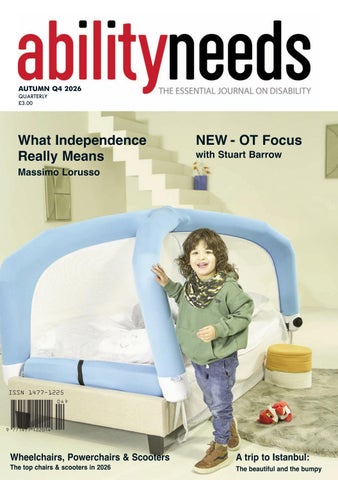
AN OFC_Autumn-26 Q4_ability needs COVER may 08 24/09/2026 20:30 Page 1
AUTUMN Q4 2026 QUARTERLY £3.00
What Independence Really Means Massimo Lorusso
Wheelchairs, Powerchairs & Scooters The top chairs & scooters in 2026
NEW - OT Focus with Stuart Barrow
A trip to Istanbul:
The beautiful and the bumpy
FORD_RSF2026_Motability_Puma_UK_Q4_press_210x297.indd 1
21.09.2026 17:07
AN_p01_conquering heights_02_AN107.qxd 23/09/2026 08:38 Page 1
POWER. PRECISION. POSSIBILITY.
For many powered wheelchair users, choosing a wheelchair means compromise. Exceptional indoor manoeuvrability often comes at the expense of outdoor performance, while all-terrain capability can make everyday environments more challenging. OMNI from Conquering Horizons was created to change that. Designed by former Royal Marines Commando and twotime Paralympian Phil Eaglesham, OMNI combines advanced engineering, clinical functionality, and premium British design into a single powered wheelchair built for real life. OMNI was created with a simple philosophy: wheelchair users shouldn't have to wait for the world to adapt around them. Instead, mobility technology should be capable enough to navigate the world as it exists today. From narrow doorways and busy cafés to uneven pavements, grass, gravel, and everyday obstacles, OMNI has been engineered to thrive in real-world environments, giving users the freedom to participate fully in work, family life, leisure, and their communities. Its unique omni-wheel technology delivers exceptional manoeuvrability in tight indoor spaces, making it easier to navigate homes, workplaces, restaurants, and shops. Outdoors, OMNI's powerful four-wheel-drive system, advanced suspension, and kerb climbing capability provide the confidence to tackle challenging terrain without hesitation. A standout feature is OMNI's patented Social Height system, allowing users to raise or lower their seat while moving. Whether reaching a kitchen worktop, speaking with colleagues at eye level, or enjoying a conversation with friends and family, users can engage more naturally and
Ability Needs Magazine
independently throughout the day. For healthcare professionals, OMNI offers a highly adaptable seating platform with tilt in-space functionality, pressure management options, and extensive adjustment capabilities to support comfort, posture, and long-term clinical outcomes. Advanced suspension helps minimise vibration and impact, improving ride quality across a wide range of environments. Built and engineered in Britain, OMNI combines durability with impressive performance. Its bespoke lithium-ion battery system delivers a range of over 30 miles on a single charge, while road-legal capabilities and transport-friendly design support independent living, work, travel, and leisure. More than a powered wheelchair, OMNI is a complete mobility solution developed by people who understand the realities of life as a wheelchair user. Every detail has been designed to maximise independence, confidence, and participation in everyday activities. Because true independence isn't waiting for the world to change. It's having the freedom and confidence to live in it today. Experience OMNI today through a personalised test drive or flexible hire programme. See how one wheelchair can transform the way you move, live and connect. Visit www.conqueringhorizons.com to learn more and follow Conquering Horizons on social media to see OMNI in action, hear from real users, and watch real-world adventures that showcase what's possible when mobility has no limits.
1
AN_p02_Contents snooza_02_AN107.qxd 25/09/2026 08:44 Page 1
Contents 1 4
Massimo Lorus
so
NEW - OT Focu
with Stuart Barrow
s
Motoring and Mobility - Featuring the latest vehicles and products available in the mobility marketplace
5 Merrick Road, Kilmarnock, KA1 3TA
2026
Cristian Brownlee
Wheelchairs,
The top chairs
Powerchairs
& scooters in
2026
& Scooters
A trip to Istanb
The beautiful
ul:
and the bumpy
Front cover ph SpaceSaverBedotograph courtesy of s
AUTUMN Q4
QUARTERLY £3.00
What Independ ence Really Means
- I Got Schooled by a 14-Year-Old on Reddit – Cristian explains why a printer, a wooden floor covered in trading cards and a comment from a teenager on the internet dismantled years of adult pride
18
Isaac Harvey MBE - A View I Never Knew I Was Missing – Isaac describes how much difference his new Series 5 wheelchair has made to his everyday life
email: info@abilityneeds.co.uk web: www.abilityneeds.co.uk
24
Tanni’s View - Baroness Grey-Thompson DBE – Tanni discusses how to get the nation more physically active and how it is dependent on accessible facilities and and Active Travel solutions
42
Eddie Peacock - You can’t judge a book by looking at the cover – Eddie looks into the life of Ian Durie, who sung Reasons to be Cheerful Pt 3 with the Blockheads and contracted polio as a child
All Rights Reserved No part of this publication may be reproduced or used in any way without written permission of the publisher. The views expressed in this magazine are not necessarily those of the publisher and although every effort has been made to ensure that the information is accurate, the publishers take no responsibility for errors and omissions. No responsibility can be accepted by the publishers for any claims made by the advertisers in this publication.
46
Industry Insight - Care of the vulnerable – Angus examines the reasons the Assisted Dying Bill was recently rejected by MPs and why it was the correct decision
50
Cheryl Everitt - Istanbul: The beautiful and the bumpy – Cheryl shares her experiences on her recent trip to the only major city that spans two continents
Purchase a digital copy of Ability Needs at www.magzter.com
SNOOZA OO
SENSORY.. SAFE SAFE . SA SANCTUARY AN NCTUARY
Instant Calm.
MADE MAD DE IN
OPHIR CARE
96% Succes s Rate
Featuring Sensory feedback. Proprioception. Postural alignment. For Relaxation. Regulation. Confidence. Smiles. Increased Communication. Safety. For all disabilities. For Schools. Home. Care homes. Hospitals. Hospices. Holidays. Gaming. ******BOOK A FREE ASSESSMENT ******
Request OT led Clinical Clin Reasoning here Ophir Solutions Ltd © 2
T:01622 801 401
E. info@ophircare.com
Scan for web info Ability Needs Magazine
HIGHEST
QUALITY & SAFETY
THE ONE TO TRUST
S T A N DA R D S
Designed in the Affinity’s image but created with greater accessibility in mind, our new Symphony home lift offers a more spacious platform that comfortably accommodates wheelchair users, without compromising on style. Thoughtfully engineered to support independence and future-proof the home, it delivers smooth and intuitive operation for everyday ease. With its light-filled design and seamless integration into a wide range of interiors, the Symphony, launching in 2027, reflects Terry Lifts’ commitment to combining elegant design with practical innovation. Making beautifully accessible living a reality for more people.
‘‘
Announcing the new
beautifully in tune with your home.
‘‘
Symphony Home Lift
Inspired by the Affinity
Wide, spacious cabin
Home Lift, launched in
Easy-reach illuminated controls
2024, the Symphony builds
Market leading weight capacity of 325kg (51st)
on the success of our most compact home lift, carrying forward its open-concept design, transparent materials and signature
Affinity Home Lift
From the moment the door glides open, it’s clear every detail of the Symphony was created with real users in mind. Prioritising comfort, usability, and safety.
personalisation.
Get in touch for a free, no-obligation quote
Discreet fire and smoke protection Smooth-glide powered door system Full safety suite: pressure-sensitive surfaces, in-car emergency lowering and battery backup Whisper-quiet travel
P RO U DLY
MADE IN BRITAIN
AN_p04_p06 Christian Brownlee scooter_18-19_AN306_Tani's_view.QXD 23/09/2026 08:42 Page 1
Cristian Brownlee I Got Schooled by a 14-Year-Old on Reddit All it took to dismantle years of adult pride was a thermal label printer, a polished wooden floor covered in trading cards, and a painful comment from an anonymous teenager on the internet.
If you joined me in the last issue, you might recall that I recently walked away from a recruitment tech project to start a rather unglamorous venture selling trading cards. If you are new here, welcome. You have arrived just in time to watch the romantic ideal of a simple, quiet business collide head-first with the cold, unyielding reality of physical logistics. A few weeks ago, regular orders began trickling in. Up until that point, the whole venture had lived safely inside my head as a quiet, tidy daydream. But suddenly, real people wanted real parcels sent to actual addresses, which meant I finally had to unbox the Zebra ZD421d direct thermal label printer sitting in the corner. I had convinced myself that printing a shipping address onto sticky paper would be a simple formality. It is, after all, a small plastic cube with three buttons. How complicated could it possibly be? Very, as it turned out. Within twenty minutes, the little black box had reduced me to complete, silent fury. It blinked a hostile red warning light, ignored every signal from my laptop, and spat out blank labels across the desk like a rogue fruit machine. After an hour of reinstalling drivers and swearing under my breath, I caved. I went to Reddit. I posted describing the blinking red light and asked what obscure network conflict was crippling my setup. Ten minutes later, a user with a handle along the lines of ‘Lord_Farticus_69’ and a profile picture of a Japanese cartoon ninja delivered the verdict: "Imagine spending three hundred quid on a commercial printer and not calibrating the sensor. Hold pause + cancel." I looked at the machine, held the buttons, and the printer gave a cheerful beep before instantly producing a crisp, razor-sharp label. There is a very specific, 4
teeth-grinding brand of humility that comes from being publicly roasted by an adolescent who probably had to pause his homework just to explain to a grown adult how a label printer works.
Suitably brought down to size, I decided to retreat to something I was getting pretty good at: physical inventory. I spent the next two hours sorting hundreds of individual cards into meticulous numerical order. As a wheelchair user, moving large, flat trays of loose paper stock from the table to the storage unit requires a delicate calculation of push momentum, lap balance, and doorway clearance. Having executed three flawless runs, I became insufferably smug. I felt less like a novice stock-picker and more like an elite piece of warehouse machinery. Gliding towards the hallway at pace, I took the corner with excessive flair and clipped the chair's push-rim hard against the doorframe.
continued on p6
Ability Needs Magazine
AN_p04_p06 Christian Brownlee scooter_18-19_AN306_Tani's_view.QXD 23/09/2026 08:42 Page 2
WELCOME TO SCOOTER STORE LIMITED Scooter Store Limited is an established company with over twenty-ĨŝǀĞ LJĞĂƌƐ͛ ĞdžƉĞƌŝĞŶĐĞ͕ ǁŚŝĐŚ has become very popular especially with the elderly and disabled community nationwide.
The concept is a small, secure store designed specifically for mobility vehicles, to be operated with minimal effort. This provides the user with more independence and effective storage for their scooter at home.
The Scooter Store was designed in response to a demand from the public as many mobility scooter users have struggled to store their scooters in living rooms, communal hallways etc, causing fire hazards and limiting their space. The Scooter Store is a fireproof, theft proof, compact alternative that will enable the user to securely store their scooter.
Our product has been extremely popular with the elderly and disabled community for over twenty-five years. tĞ͛ǀĞ worked with a multitude of local Housing Trusts/Associations, charitable organisations, County, City and Borough Councils to install Scooter Stores across the UK.
All Scooter Stores are manufactured from 2mm steel with a powder coated finish, push button controlled, fully lockable and include a socket for charging the scooter is provided inside the store.
Standard, Double and Bespoke sizes are available. The stores are delivered flat packed to allow installation to awkward sites. Stores can be relocated if required.
We also offer free site surveys to give advice on store locations, hard standing areas etc, if required.
continued from p4
Our Contact Details: Scooter Store Limited, Unit 11 Riverside Business Park, Cambridge Road, Harlow, CM20 2HE Tel: 01279 453565 www.scooterstoreltd.com info@scooterstoreltd.co.uk
The tray tilted, and physics did the rest. Three hundred precisely organised cards cascaded off my lap, fluttering through the air and scattering across the bare, polished floorboards. Sitting there looking down at the wreckage, my immediate reaction was disbelief. Picking up three hundred paper-thin cards from a hard, flat floor is a unique kind of torture. When you cannot simply drop to your knees, you are left playing an infuriating, seated game of curling. Armed with a long metal ruler, I spent the first five minutes attempting to get under the edge of a glossy card, only to slide it mockingly across the parquet just out of reach. For thirty seconds, I sat completely defeated by a sea of glittering monsters. Then the sheer ridiculousness broke through the annoyance. Nobody had forced me into this; I had voluntarily signed up for every bit of it. But there were no angry clients or boardroom politics to answer to. The only consequence was that I was going to spend the next hour angling a ruler from my wheelchair, rescuing fictional beasts entirely on my own time. In everyday life, we spend an exhausting amount of energy guarding against looking foolish. Throw a wheelchair into the mix, and that instinct goes into overdrive. There is a constant, unspoken pressure to appear thoroughly capable, fully in control, and 6
entirely sorted, lest anyone quietly question your competence. A pile of three hundred cards suctioned to a hallway floor does not care about your dignity. Neither does an angry plastic printer or a teenager on an internet forum. But there is genuine relief in being caught out, looking entirely ridiculous, and realising the world carries on regardless. Operational resilience is mostly just swallowing your pride, accepting the friction, and getting on with the unglamorous work of scraping up the floor. You either take the teenager's blunt advice, or the parcels do not ship. You either laugh at the hallway disaster, or you are just a grown adult having a silent standoff with a metal ruler. The printer and I have now negotiated an uneasy truce. I navigate around doorways with the exaggerated caution of someone carrying open cups of scalding tea. I may have lost an intellectual duel to a schoolboy, but at least the labels are printing. Cristian Brownlee is a columnist, entrepreneur, and wheelchair user. After pitching on Dragons' Den and winning UK Disabled Entrepreneur of the Year, he left tech startups behind to build an online trading card shop from scratch on his own terms. To follow along with the chaos and see if the venture actually works, give Glitch Guild a quick Google. Ability Needs Magazine
2026_08_12_MOTABILITY_ADVERT_SINGLE_V3.pdf
1
12/08/2026
14:50
Provided by
Home insurance was complicated. Uinsure redesigned it. We know finding the right home insurance can be stressful and it's not always easy to feel confident a policy will really look after you. We have partnered with Uinsure to give disabled people, their family and friends, access to competitively priced, comprehensive home insurance cover designed to give each customer peace of mind. Gary Parker | Director, Motability Enterprises Limited
Why we chose Uinsure Protection you can trust 5 Star Defaqto rated for 10+ years
Service that delivers Rated 5 stars on Trustpilot by real customers
A fair price, every year A panel that competes to give your their best price at renewal
No hidden fees No cancellation or adjustment fees*
*Please note that there is an annual fee of £36 for Uinsure to arrange and administer your Home Insurance policy (correct as of 13/08/2026).
C
M
Cover that supports everyday life
Y
CM
MY
CY
CMY
K
Carers included Loss of or damage to property caused by carers you’ve employed is covered with contents insurance. Plus, costs incurred due to injuries to carers caused by you or your family are covered up to £5m*.
Scooters, wheelchairs & other mobility aids Mobility scooters, wheelchairs and other mobility aids are covered in a contents policy when inside your home. Also, they’re covered under personal liability when outside the home*.
A friendly UK team
Support on your terms
Real people that take the time to understand your needs and support you. Uinsure advisers are there to help guide you towards the best outcome - no pressure and no upselling.
Uinsure is contactable online and through email, text, post and over the phone. And, if you would prefer to have a family member or friend speak on your behalf you can nominate them to do so.
*All policy covers are subject to limits and conditions, please see policy documents for full details.
Ready when you are | Get a quote online in about 60 seconds. Speak to the friendly team at Uinsure or scan the code to get a quick, no obligation quote online. 0161 524 1157 Monday to Friday 9am–5pm https://motability.uinsure.co.uk Uinsure Limited will pay a commission of up to 16% to Motability Enterprises Limited for each policy sold. These funds are used by the Motability Foundation to help disabled people with their personal mobility.
Motability Enterprises Limited (Registered No. 1786053 England and Wales) is a wholly owned subsidiary of Motability (a Registered Charity in England and Wales No. 299745 and in Scotland No. SC050642), both of which have their registered office at Warwick House, Stadium Way, Roydon Road, Harlow, Essex CM19 5PX. Motability operating as Motability Foundation. Motability Enterprises Limited is an Introducer Appointed Representative, registered at the Financial Conduct Authority (No. 538055), of Uinsure Limited. Uinsure Limited is registered in England and Wales with company number 06046870 with a registered office at XYZ Building (1st Floor), 2 Hardman Boulevard, Manchester M3 3AQ. Uinsure Limited is authorised and regulated by the Financial Conduct Authority and is registered on the Financial Services Register under number 463689.
AN_p08 Marsham-spacesaver_18-19_AN306_Tani's_view.QXD 23/09/2026 08:52 Page 1
Award-Winning Marsham Court Hotel Shortlisted Again for National Accessibility Honour Bournemouth's Marsham Court Hotel has once again been recognised as one of the UK's leading accessible hotels after being named a finalist in the prestigious Travel For Every Body Awards 2026. The hotel has secured a place on the shortlist for the Accommodation category, having previously won the award in 2025. The finalists were announced this week by David Wilcox and the Travel For Every Body team, with winners set to be revealed at a ceremony in Manchester October. The recognition marks a remarkable achievement for the independently owned Bournemouth hotel, which has built a strong reputation for accessible and inclusive hospitality. Having lifted the Accommodation Award last year, Marsham Court Hotel is now aiming to retain its title while continuing to champion accessible tourism across Dorset and the wider UK. Over the years, the hotel has invested significantly in facilities, staff training and guest experiences designed to ensure visitors of all abilities can enjoy a comfortable and memorable stay. Jane Langridge, Business Development Director at Marsham Court Hotel, said: "To be recognised as a finalist is wonderful in itself, but to receive this recognition after winning the award last year makes it particularly special. It demonstrates our ongoing commitment to accessibility and our belief that everyone should be able to enjoy a great travel experience." She added: "We are proud to play our part in
showcasing Dorset as a Coast for All Seasons, welcoming visitors from across the UK and beyond while helping make tourism more inclusive and accessible for everyone." The shortlist places Marsham Court Hotel among some of the most respected travel and accommodation providers working to remove barriers and improve accessibility throughout the visitor journey. For the Marsham Court team, the nomination is not only recognition of past achievements but also encouragement to continue leading the way in accessible hospitality. The winners of the Travel For Every Body Awards 2026 will be announced in Manchester in October To contact Marsham Court Hotel telephone 01202 552111 or visit www.marshamcourthotel.co.uk To contact Marsham Court Hotel telephone 01202 552111 or visit www.marshamcourthotel.co.uk
aeWB,B$ǀ p Wwǀ[T ǀ,BaHǀ ǀ[ # ǀ T; T å ÙǀT ¬Ã¤ǀÝÖ ¬ ¼¬Ý ǀ¬Ãǀ Ù å¬Ã¤ǀ[ £ £ ǀ Ãõ¬ÙÊàÃåÝǀ£ÊÙǀ ©¬¼ Ù ÃǀǾǀ é¼åÝƅǀ,åƉÝǀ ǀ¤Ù åǀ Ýʼéå¬ÊÃǀå© åÝǀØé¬ ¹ƀǀ éÝåÊÂ¬Ý ¼ ǀ à ǀ ÊÝåǀ Ě å¬õ ƅǀ q ǀÊĚ Ùǀ ǀA ǀåÊǀA ÝéÙ ǀ[ £ åüǀT ¬Ã¤ƀǀ ¹¬Ã¤ǀ Ý £ ǀ Ãõ¬ÙÊàÃåÝǀö© å© Ùǀå© åǀ ǀ åǀ ǀ ©¬¼ ǀÊÙǀ é¼åÝǀ ©Ê ƀǀ¬Ãǀ üǀ[Ö ¬ ¼ǀ[ ©ÊʼÝƀǀW ݬ Ãå¬ ¼ǀ[ ©ÊʼÝƀǀ üǀ Ù ǀ Ãå ÙÝƀǀBéÙݬäǀ à ǀW ݬ Ãå¬ ¼ǀ)Ê ÝǀÊÙǀ Ãüö© Ù ǀö© Ù ǀÖ ¬Ã¤ǀ üǀ ǀà ǀ£ÊÙǀÝ £ åüƅ q©üǀqÊé¼ ǀ[Ê Êà ǀ q©üǀeÝ ǀ[ £ åüǀ W Øé¬Ù ǀ ǀ[Ê£åǀ à ǀ[ £ ǀ T ¬Ã¤Ɔ WÊÊÂƆ • ; ÝÝǀW ÝåÙ¬ å¬õ ǀHÖå¬Êà • ;¬Â¬åǀW¬Ý¹ǀ#ÊÙǀ ¼¬ Ãå • TÙÊõ¬ Ýǀ#Ù ÊÂǀ#ÊÙǀ • W é ǀW¬Ý¹ǀ#ÊÙǀa©ÊÝ ǀ a© ǀ ¼¬ Ãå q¬å©ǀ[ ¼£ǀ) ÙŠǀ ǀ ǀ • [ £ T¼ ǀHéåݬ ǀH£ǀ © õ¬ÊéÙÝ e Ý é ¼ à ¼ÊÝ ǀ[Ö Ý ǀ • [ £ åüǀ#ÊÙǀa©ÊÝ ǀq¬å©ǀ • ÊÝåǀ[ õ¬Ã¤ ; Ùìäǀ ¬Ý ¬¼¬å¬ Ýǀ[é ©ǀ Ýǀ éå¬ÝÂƋ ) • ;Êäǀa ÙÂǀ[ʼéå¬ÊÃǀ
)HA ǀ [[ [[A Ba[ǀ p ,; ; ǀ WH[[ǀa) ǀe9 T å ÙǀT ¬Ã¤ǀTÙÊ ÝÝ
öööƅÝÖ Ý õ Ù Ýƅ Êƅé¹ǀǀǀǀǀǀǀħĨİħĬǀĪīĮǀĬĪįǀǀǀǀǀǀǀ¬Ã£ÊǽÝÖ Ý õ Ù Ýƅ Êƅé¹
8
Ability Needs Magazine
ed) d
AN_p10_Motability_10_AN406_IL_Scotland.QXD 23/09/2026 23:25 Page 1
Charity grant that helps disabled people get around is extended until 2029
The Motability Foundation has announced it will be extending funding for its ‘life-changing’ bespoke vehicle grant programme for disabled people until 2029. The charity, which helps disabled people get around, has granted more than £15 million to disabled people as part of its Bespoke Passenger Solutions (BPS) grant since it started in 2022. This decision to extend the programme beyond this year comes after an evaluation by the charity on the positive impact the grant programme has had on disabled people and their families. The evaluation drew on 166 survey responses from BPS beneficiaries and their families/carers, alongside five in-depth case studies and individual interviews. Nearly 80% of carers surveyed said the BPS grant has been significant or life-changing for them. To date, the Motability Foundation has supported 475 grants - with an average grant award of more than £31,500 towards the advanced payment for a bespoke vehicle on the Motability Scheme. Two years ago, Tyler Dervish, 20, and his mum and dad Teresa and Warren, based in Norfolk, received a BPS grant for their specially adapted Volkswagen Crafter. Tyler was born with spastic quadriplegic PelizaeusMerzbacher disease and cannot walk or sit unaided. Travelling was distressing for him before they were awarded a grant. Tyler’s mum Teresa said: “We are all so grateful for this and honestly can't express how much of a difference having this vehicle has made to our family. We couldn’t have afforded to purchase this without the help of this grant. “Tyler is so much more comfortable now whilst travelling, thanks to the hoist and rock and roll chair. He knows if he needs to have a stretch, we can stop and do so, which we have done on numerous occasions.” The family have nicknamed the VW Crafter ‘The Beast’ due to its size, and plan to take it to the Isle of
Wight soon. Teresa said the Beast can take all of Tyler’s equipment – plus their two small dogs. The BPS grant helps disabled people with the most profound mobility and care needs access specialist passenger solutions that offer more than just access in and out of a vehicle. BPS vehicles provide changing facilities, including personal hoisting and privacy, inside a large Wheelchair Accessible Vehicle (WAV). Results from the Motability Foundation’s evaluation show that BPS vehicles were found to improve independence, wellbeing, access to healthcare, social connections and choice for disabled people and their families. Comparing results before and after applicants received a BPS vehicle, respondents reported a 56% improvement in their social connections, a 50% improvement in wellbeing, and a 23% positive difference in getting to health appointments. The grant was developed to address a gap identified by the Motability Foundation in 2019 for disabled people whose needs extend beyond access in and out of a wheelchair accessible vehicle. Before BPS, many people faced constraints such as limited space, manual handling difficulties, and vehicles that could not safely accommodate medical, mobility or personal care needs meaning travel was possible, but often involved higher risk, additional effort and increased stress. Grant Programme Manager at the Motability Foundation, Helen Rose, said: “For disabled people with multiple and profound care needs, having the right facilities inside a vehicle can make a significant difference to everyday life. “That’s why we’re delighted to be able to continue with our BPS grant programme. The evaluation has demonstrated the positive and life changing impact BPS has on both disabled passengers and their carers, making their journeys and personal care easier to manage.” Disabled people or the appointee for a disabled person on the Motability Scheme, or applying to join, can apply for a BPS grant.
To see th e eligibility criteria for a grant and to fin d out mor e abou t BPS vehicles, visit: www.motabilityfo undatio n.org.uk/individual-grants/bespoke-passen ger -solutions 10
Ability Needs Magazine
ed) d
AN_p12_RNIB_10_AN406_IL_Scotland.QXD 24/09/2026 08:41 Page 1
Two in five UK adults interested in listening to television drama without the screen, RNIB research finds New research commissioned by sight loss charity RNIB and conducted by Ipsos found that 42 per cent of UK adults aged 18 to 65 expressed interest in listening to television drama without the screen after hearing examples of the experience. The research tested 'described drama': a television programme's original soundtrack - including dialogue, music and sound effects - mixed with audio description (AD) and presented as an audio-only experience. RNIB is calling on all broadcasters and content creators to have audio The panel discussion at the Audio Is King event held at description as part of their production RNIB's London headquarters, the Grimaldi Building. process. Immersive Technologies Team at RNIB, said: “Audio Audio Description enables people with sight loss to description has always enabled blind and partially watch content like everyone else. AD can enrich the sighted people to follow stories that would otherwise be experience for all viewers by adding detail and context inaccessible. Its value does not depend on whether a and is a powerful creative tool which describes key wider audience chooses to use it. visual elements, such as body language, scenery, and “This research, however, asks whether the same on-screen action, that are not conveyed through creative work could also allow more people to stay with dialogue alone. a programme when looking at a screen is not practical or Participants saw potential for described drama as a desirable. The 42 per cent finding gives us a compelling way to stay with a programme while travelling, doing reason to test the idea over full episodes and see other things or taking a break from screens. Interest was whether initial interest translates into sustained listening. strongest among existing listeners of podcasts, “Wider interest could strengthen awareness of and audiobooks and audio drama, as well as parents, investment in audio description, but blind and partially gamers and people who commute by public transport. sighted people must remain at the heart of how any Participants also responded positively to the AD future experience is developed and evaluated. RNIB is itself: now seeking partners to test described drama using full • 71% found AD clear episodes, measuring whether people complete an • 60% felt it reflected what was happening in the scene episode, return for the next one and how they discover • 58% said it improved understanding beyond dialogue and choose the content.” and sound effects Tak Ha, Research Director at Ipsos, said: “At Ipsos, For the experience to work well without the screen, we consistently see from our extensive research among the research identified several areas for further testing: audiences and their behaviours, signs of continuous evolution with media consumption that tracks alongside • How dialogue, music, sound effects and description shifts in technology and daily lifestyle routines. are balanced in the overall mix Audiences are increasingly looking for fluid media • How listeners maintain focus across a full episode experiences that adapt to their busy schedules and • How naturally the description feels integrated with the multi-device habits. programme “This study shows how repurposing established RNIB launched the findings at its Audio is King event accessibility tools like Audio Description into screenat the Grimaldi Building in London, bringing together free, audio-first experiences is a compelling example of broadcasters, streaming services, AD producers, how content can be reimagined to meet changing researchers and blind and partially sighted people. consumer demands. It offers broadcasters and Discussion focused on what the findings could mean for streaming platforms innovative pathways to maintain AD, audio-first content and the wider media sector and high engagement across different consumption what a useful next pilot should test. opportunities throughout the day.” Sonali Rai, Senior Manager, Media, Culture and For more information visit www.rnib.org.uk 12
Ability Needs Magazine
Do you need advice about equipment to help you manage at home? Manage At Home – Equipment Assessment Service If you would like independent professional advice about staying safe, comfortable and independent at home, you may wish to consider getting advice or an assessment through our Equipment Assessment Service.
This service offers you the option to self-fund an Occupational Therapy (OT) assessment to look at how you manage with everyday activities, providing advice on practical equipment and simple ways of doing things differently. Start with a free 15-minute consultation Speak with one of our Occupational Therapists for a free 15-minute telephone consultation. During this conversation, we can discuss any difficulties you are experiencing at home and help you understand what support options may be available. For many people, this initial consultation provides the information they need without requiring any further assessment. If more detailed support is needed Where a more in-depth assessment would be beneficial, you can choose to book an appointment with our staff. These assessments are carried out virtually by video call using a smartphone, tablet or laptop.
The full assessment costs £80 and includes: An Occupational Therapy
assessment of up to one hour
A personalised written report
with recommendations
A follow-up call within
one month
A discount code for any
recommended equipment
(with no obligation to purchase)
The service provides advice on widely used daily living equipment to adults aged 18 years and older. It is a selffunded assessment service but is not intended for situations that require a more detailed assessment within your home environment due to any complex needs you may have. All assessments are carried out by HCPC-registered Occupational Therapists, and your personal information is handled securely and in line with data protection laws. Your consent will always be obtained before an assessment takes place.
Not sure what’s right for you? Book your free 15-minute consultation and we’ll discuss your situation with you. If a full assessment would be beneficial, we’ll explain your options and costs before you decide whether to proceed. FREE Initial Consultation Optional Full Assessment £80
Find out more:
Scan the QR Code to
www.manageathome.co.uk Call us free on: 0800 910 1864
Book your Equipment Assessment
AN_p14 MSB_02_AN107.qxd 23/09/2026 09:01 Page 1
Making everyday care easier: Wombly adaptive childrenswear launches in the UK Innovative German childrenswear brand Wombly is launching in the UK through a new partnership with MSB Healthcare, bringing thoughtfully designed adaptive clothing to children and families with a wide range of medical and care needs.
Getting dressed is an ordinary part of everyday life, but for children with feeding tubes or stomas, those who wear orthoses or prostheses, use wheelchairs or rely on nappies, conventional clothing can make the routine considerably more complicated. German adaptive childrenswear brand Wombly was created to change that. Since 2022, Wombly has developed clothing for babies, children and young people with additional care needs, combining practical adaptations with comfort, quality and colourful, child-friendly designs. The idea grew from personal experience. When cofounder Lena Förster’s niece was born prematurely at 27 weeks, her family discovered how difficult it was to find suitable clothing for a baby receiving medical care. It highlighted a challenge faced by many families: conventional clothing is rarely designed around feeding tubes, catheters, stomas, orthoses and other medical or mobility needs. Wombly’s aim is simple: create clothing that adapts to the child, rather than expecting children and carers to adapt to their clothing. Designed around real life Parents and carers play an important role in Wombly’s product development, helping identify practical challenges during dressing, personal care and medical treatment. Garments feature carefully positioned openings, soft fastening systems and adaptable fits, providing easier access for medical care and simplifying dressing and undressing without unnecessarily repositioning the child. Comfort and quality are also central. Wombly uses carefully selected organic cotton and cotton fabrics, with garments manufactured in small facilities in Poland and
Portugal. Practical features are incorporated into contemporary, colourful designs, so children can wear clothing that both meets their needs and feels like childrenswear.
Adaptive clothing for different needs Among the first products available in the UK is the Björn adaptive bodysuit, designed to provide easier access to feeding tubes, ports, venous and urinary catheters and stomas. A horizontal abdominal opening provides access to medical devices without removing the garment, while sleeve openings accommodate lines and catheters. The Leon grow-with-me bodysuit is designed for children and young people who rely on nappies, offering larger, age-appropriate sizes with a secure fit and freedom of movement. The range also includes Pamela jersey trousers, featuring fully opening side seams and a flexible waistband to make dressing easier for children with orthoses or prostheses, as well as wheelchair users and children with stomas. The Karl adaptive long-sleeve top has fully opening sleeves, helping simplify dressing and care for children with upper-limb orthoses or prostheses, fractures, muscle weakness or contractures. A new UK partnership Wombly’s UK launch is being supported by MSB Healthcare, which identifies innovative healthcare products and helps bring them to UK patients, families and healthcare professionals. The partnership will make Wombly’s adaptive clothing more accessible in the UK, providing families with practical clothing designed around the realities of everyday care.
For more information or to view the range email hello@msbhealthcare.co.uk or visit www.msbhealthcare.co.uk
14
Ability Needs Magazine
Patient Lifting The Next Generation
M-Series Clinical
Silvalea are pleased to introduce to the UK and EU marketplace our new Clinical and Essential range of Savaria Lifters. Design advantages for patient, caregiver and facility: • Digital displays • Selectable speeds • Bluetooth / Wi-Fi connectivity
M-Series Essential M-Series Clinical
Lithium-ion technology provides huge performance advantages across the board: • Smoother operation • Faster charging • More lifting cycles on a single charge • More powerful lifting – even at the heaviest capacity. Key Features: • Infection control • Enhanced durability • Ease of use • Low cost of ownership • 3-Down™ three-mode powered emergency function (patent pending)
For all enquiries and distribution opportunities please contact our hoisting team on: equipment@silvalea.com
E: customerservices@silvalea.com I T: +44 (0)330 024 1045 I W: silvalea.com Savaria, trading as Silvalea Ltd
AN_p16 easylink_02_AN107.qxd 23/09/2026 08:36 Page 1
Affordable, Reliable Home Carer Support Technologies from Medpage
Caring for vulnerable individuals at home demands tools that are dependable, easy to use, and realistically priced. Medpage, a long established leader in assistive technology, continues to deliver exactly that. Their range of fall prevention and home care support products is designed for families, home carers, and community care teams who need professional grade safety without the complexity or cost of clinical systems.
Smart Fall Prevention for Everyday Home Care Falls remain one of the biggest risks for older adults and people with mobility challenges. Medpage’s MPRCG1 Bed Leaving Detection Alarm provides a complete, ready to use solution. The system includes a pressure mat, wireless transmitter, and a caregiver pager that alerts instantly when someone leaves their bed. Key advantages include wireless tone or vibration alerts, customisable delay settings, and a durable antimicrobial design. With minimal installation and portable components, it’s ideal for home environments where carers need reliable, fuss free monitoring.
Supporting Safe Recovery After Hospital Discharge The HDKMB2 Hospital Discharge Kit is tailored for patients returning home after a hospital stay. It bundles essential fall prevention tools into one simple package, helping carers maintain safety during the vulnerable post discharge period. For families who want a straightforward, affordable solution, the HDKMB2 offers reassurance without complexity. Enhanced Monitoring Through Smart Integration For homes using nurse call systems or community care services, Medpage’s CMEX 21 Multi-Port Wireless Sensor Input Expander allows multiple wireless sensors to connect to a single call point. This expands monitoring capability without expensive upgrades, making it a practical choice for more complex care needs.
Immediate Assistance in High Risk Areas Bathrooms are a common location for falls. The RON-WC2 Waterproof Disabled Pull Cord Alarm provides instant access to help. Fully waterproof and paired with a wireless receiver, it installs easily and delivers dependable emergency signalling. Why Medpage? Medpage products are built around affordability, reliability, and simplistic usability. Their technologies empower carers to create safer home environments with tools that genuinely make a difference. Explore the full range at www.easylinkuk.co.uk or call 01536 264 869.
6PDUW $VVLVWLYH 7HFK IRU 6DIHU /LYLQJ * ! ) +'" ,
" " $ , ) % (
- (( ( )
. ) / "
! " # $ % & ' ( )
'HWHFW PRYHPHQW ZDQGHULQJ RU GLVWUHVV EHIRUH LQFLGHQWV RFFXU
7UXVWHG DVVLVWLYH WHFKQRORJ\ IRU FDUHUV IDPLOLHV DQG SURIHVVLRQDOV ³ SURYHQ VROXWLRQV IRU IDOO SUHYHQWLRQ VDIHW\ PRQLWRULQJ DQG GDLO\ VXSSRUW (VWDEOLVKHG 16
Ability Needs Magazine
Scan to view website Who Are BAS NW? TRANSFER PLATES
Over Ring Electronic Accelerator
BAS (NW) Ltd — Over 40 Years of Vehicle Adaptation Excellence For over 40 years, BAS (NW) Ltd has been pioneering innovative vehicle adaptations, empowering drivers and passengers to enjoy greater independence and freedom on the road. As a trusted Motability partner, we specialise in designing, manufacturing and fitting mobility solutions tailored to every individual's needs. With a nationwide network of over 60 agents, our products can be fitted at a workshop or via a mobile service — offering flexibility and convenience wherever you are. Visit basnw.co.uk for our full range of products and services.
Official UK Distributors for
ELECTRIC HATCH OPENER
Over Ring Electronic Accelerator
Over Ring Accelerator — Smooth, Intuitive Acceleration
Transfer Plates
The Over Ring Accelerator allows gradual, controlled acceleration by simply pushing the ring towards the Transfer Plates — Seamless Vehicle Access Made Simple steering wheel. Designed for seamless integration, it enhances accessibility without compromising A transfer plate bridges the gap between a vehicle seat and a wheelchair or scooter, allowing for vehicle functionality. Available as a fixed or quick release option, with an smooth, comfortable transfers without lifting or awkward manoeuvring. Once inside, the plate Under Ring variant also available. swings up or removes completely, taking up minimal space. An electric option is also available Push brake not included. for effortless operation at the touch of a button.
Electronic Hand Controls
Mechanical Hand Controls
Electric Hatch Opener Electric Hatch Openers — Effortless Boot Access at the Touch of a Button An electric hatch opener provides a simple and convenient solution for those who struggle to open or close their vehicle's boot. Operated at the touch of a button, it removes the need for any physical effort — making it an ideal aid for anyone requiring extra assistance with boot access.
Person Lifts
Dual Controls
Towbars
AN_p18_p20 Isaac H_18-19_AN306_Tani's_view.QXD 24/09/2026 08:47 Page 1
Isaac Harvey MBE A View I Never Knew I Was Missing
I have crossed London Bridge more times than I can remember, but a few months ago I got to see it from a completely different view. I raised my wheelchair and suddenly I could properly see the River Thames between the sides of the bridge. I remember looking out and thinking, wow, is this what I have been missing all these years? For those who do not know me, I am a filmmaker, disability advocate and powered wheelchair user who loves travelling, exploring and going on different adventures. I have always pushed my wheelchairs to their limits. My previous chair took me to some incredible places, and I probably did things with it that it was never really meant to do. If I wanted to go somewhere, I would give it a go and deal with whatever happened along the way. Since becoming a Freedom One Life ambassador and getting my Series 5, I have realised just how much difference the right wheelchair can make to those experiences. Sometimes it is something really small. Going into Subway and being able to raise myself so I can actually see the ingredients behind the 18
counter. This might not sound like much, but I had never really been able to do that before. Even being closer to eye level when talking to someone feels different. Rather than the feeling of being looked down on. The funny thing is, even after having the chair for a few months, I still sometimes forget I can do it. Then there are the things that help me get through longer days. I have scoliosis and sitting in my wheelchair for long periods can cause a lot of pressure and pain through my legs. Being able to recline or tilt while travelling on the Elizabeth line or Underground, even if it is only for a couple of stops, gives me a chance to relax my body a little before carrying on. I still get pain. There are days when I am so busy that I do not get the chance to change position at all, and I can end up needing a long recovery afterwards. Having these options does not suddenly make that disappear, but they can help when I get the opportunity to use them. Battery life used to be another thing I was constantly thinking about. For years I relied on coloured lights and tried to guess what one green light or suddenly dropping to two orange
continued on p20
Ability Needs Magazine
Series 5: Possibility Over Limitation Rather than settle for the outdated industry standard, Freedom One Life founder Alex set out to design a powerchair built for the modern age. One shaped by his very own real, lived experience as an electric wheelchair user, with independence and adventure at the centre of every design decision. He saw the gap between what powerchairs could do and what disabled people actually wanted and deserved from their lives. A powerchair shouldn’t just get you from A to B, it should take you anywhere you dream of going. Out of that belief came the Series 5, a powerchair designed around possibility instead of limitation.
Isaac Harvey MBE has spent years proving that his wheelchair was never the thing holding him back. When watching Race Across Europe, a documentary created by Freedom One Life, he finally felt represented in the way disabled people should. The film follows four powerchair users as they travel from London to Italy using only public transport and a Series 5 powerchair. Watching powerchair users take on a raw, cross-continental challenge, he saw something he hadn’t quite seen before: a brand that believed disabled people belonged at the edge of adventure, not on the sidelines of it, and in Isaac’s own words, “it just felt normal”.
Isaac reached out to Freedom One Life, and what began as admiration quickly turned into partnership, as he became a brand ambassador ready to live out that same belief in his own way. Since then, Isaac has taken the Series 5 further than most people would dare, proving that a powerchair shouldn’t hold anyone back from the life they want to lead. Every trip is a reminder that adventure isn’t reserved for the able-bodied. With the Series 5 underneath him, Isaac keeps setting his own pace, and keeps showing others what’s possible.
Watch Race Across Europe in a Series 5 here!
@ freedom one life ltd
Book a Series 5 home test drive!
freedom one life . com
AN_p18_p20 Isaac H_18-19_AN306_Tani's_view.QXD 24/09/2026 21:50 Page 2
E
Take part in RNIB survey on AI smart glasses
continued from p18
There’s a lot of discussion among blind and partially sighted people – and the wider public and media – about the rise in AI smart glasses like Meta smart glasses. Whether you've tried smart glasses or not, we’d like to hear from blind and partially sighted people on this topic. AI smart glasses have the potential to increase independence for blind and partially sighted people by providing hands-free access to information, text, object recognition, navigation and descriptions of their surroundings. They can already, in the case of Meta glasses, offer hands-free video connections to remote sighted assistants. That might involve connecting to sighted volunteers on the Be My Eyes app or connecting the user to WhatsApp videocalls with friends and family. This technology can help with common daily tasks like browsing restaurant menus, identifying items from a grocery shop, reading street signs and information displays, or simply describing scenery to enable the person to become more aware of their surroundings.
lights actually meant. Now I can see an actual percentage, and knowing what I have left makes it much easier to decide whether I can stay out longer or go somewhere else. Recently, along with the Disabled Adventurer, I put that to the test on a 30 km trail along the Kent coast. We had wanted to do an adventure like this for years, but it had never really been possible before. Finally getting out there and doing it was really cool. Of course, having a wheelchair that gives me more freedom does not mean everything else in life suddenly works. Challenges with support at home can still leave me mentally drained and isolated, and there are things a wheelchair simply cannot solve. But I am grateful for the things that have changed. Sometimes that is finally doing a 30 km adventure with a friend. And sometimes it is crossing a bridge you have crossed countless times before and finally seeing what was there all along. 20
The glasses’ open ear speakers also mean nothing enters the user’s ears and it’s easier to keep on track of what’s going on around you than it would be with traditional in-ear earphones. We’ve had mixed feedback from blind and partially sighted people so far, suggesting AI glasses’ usefulness varies between individuals and the task in question. Some people are firm converts, while others are more cautious. At a basic level, their use is limited if you don’t have access to the internet, for instance, or if your internet connectivity is weak, making the AI processing speed sometimes slow. In addition, we have heard that the camera quality on AI smart glasses can be poor and might not always detect upcoming obstacles, as well as the AI responses not always being correct.
To take part in the survey scan the QR Code
Me and my new Series 5 from Freedom One Life Ability Needs Magazine
EDGE services Part of the RAH Group
Training that inspires confidence
2027 w s no e t a d able l i a v a e on th te si web
We’re at the OT Show Stand H *, 2 Come s 0 ay hello!
* Occupational Therapy Show 25th -26th November 2026
EDGE will train you to deliver Moving and Handling, Challenging Behaviour and Dementia Care courses to your colleagues, providing you with the resources, techniques and skills to make a real difference to the health and safety of both your colleagues and your clients. In-house dates available as well as Public dates available to book at www.edgeservices.co.uk/courses
Level 4 Award
EDGE services The Manual Handling Training Company
EDGE services Awareness & Wellbeing Training
People Handling and Risk Assessment Key Trainers Certificate – Customised Advanced Level 4 RoSPA Award Children Handling and Risk Assessment Key Trainers Certificate – Customised Advanced Level 4 RoSPA Award Dementia Care Key Trainers Certificate – Customised Level 4 RoSPA Award Understanding and Managing Behaviour that Challenges Key Trainers Certificate – Customised Level 4 RoSPA Award
EDGE services 01904 677853 enquiries@edgeservices.co.uk
Follow us on:
Edge GENERIC ad 2026 A4.indd 1
/EdgeServices
edgeservices.co.uk 21/09/2026 10:54
The Smart Everyday Vehicle
Expand Your Everyday
Quad-Drive System
evSense System
Uses Electronic Stability Program (ESP), Anti-Lock Braking System (ABS), Active Steering and real-time torque distribution for stability and comfort.
evSense utilizes an array of advanced sensors that allow the ev¹c to see and dynamically respond to your surroundings. Stay sharp with the help of 360° vision, advanced algorithms, and AI-powered features.
Up to
20 miles*
In Range Mode
5 modules
160 kg
Heaviest approx. 19.8 kg
Maximum user weight
*Up to 20 miles in Range Mode (evSense deactivated), using the 640 Wh battery. Manufacturer lab estimates. Actual range varies with load, terrain, temperature and use. Driving assistance requires active user participation.
Intelligent sensors support every move. Co-Pilot Detects obstacles and gently brakes near furniture or sudden edges, helping you navigate around people and pets.
Co-Pilot+ Combines braking support with automatic steering adjustments to help you move through narrow corridors and lifts.
Waypoint Save favourite places at home, then return automatically with a voice command or a tap on a saved destination.
The Strutt app Download the Strutt App to unlock the full experience, including remote control, access to all intelligent features, and the ability to lock and unlock your ev¹c.
Driving assistance requires active participation and depends on the environment. Follow the user manual.
iOS & Android
Make it yours.
Phone & Cup Mount
Side Storage
Rear Storage
Smart Push Handle
Phone and drink close by.
Everyday essentials to hand.
Room for a day out.
Assistance for a companion.
Accessories sold separately; ask about availability. App required for initial activation. App screen illustrative; range depends on use.
Request your free test drive. With Evolution One. Free. No obligation.
evolutionone.co.uk/pages/ability-needs Professional demonstrations also welcome.
Scan to enquire
AN_p24_p26 tanni TFL_18-19_AN306_Tani's_view.QXD 24/09/2026 17:16 Page 1
Tanni’s View Baroness Grey-Thompson DBE writes for Ability Needs How we can get our nation to be more physically active is something that I have been working on for quite some time. Sport for sports sake is great, but we need a fitter and healthier nation and it doesn’t do any harm for getting more athletes onto player pathways. A challenge has always existed around disabled people being able to be active or how they will be judged if they are. Repeated research has shown that there are multiple barriers and also a fear of being seen to be too active. I have tried multiple times to get the support system around disability to see the benefits of being active rather than having to prove what you can’t do to no avail. But being active is also dependent on having accessible facilities, ways to get there and knowing what to do. I have recently been at a conference on Active Travel with about 900 people in the room from a huge range of backgrounds thinking about the spaces that we all live in. Our world of work and transport has changed a lot over the years. Growing up, not many people in the road where I lived had cars. We probably didn’t travel as far and our leisure activities have changed a lot. When I think of growing up in Cardiff and how much it has changed, you went to the city centre to buy specific things from specific shops. Shopping wasn’t the pastime that it is now. There are now so many different ways to measure continued on p26
24
Ability Needs Magazine
AN_p25 Moorings_02_AN107.qxd 23/09/2026 09:21 Page 1
This year Moorings Mediquip have been supplying specialist equipment to the NHS and Education Authorities for 35 years throughout the UK and Ireland. We have a team of 12 area consultants making sure that our customers receive high standards of product support and expertise. Our product portfolio consists of a wide range of quality specialist equipment from market leading manufacturers around the world. We work alongside occupational therapists, physiotherapists, SENCO leaders and schools to assess, prescribe and implement these solutions. Our aim is to provide the most suitable equipment to our valuable customers on time, first time, every time! Full details of all products can be seen at www.mooringsmediquip.com or for more information call 028 2563 2777 or email sales@mooringsmediquip.com
Ability Needs Magazine
!
25
AN_p24_p26 tanni TFL_18-19_AN306_Tani's_view.QXD 24/09/2026 17:16 Page 2
New entrance at Kings Cross St Pancras Underground station provides step-free access from the south side of Euston Road for the first time
continued from p24
A new entrance at King’s Cross St Pancras Tube station is providing a new step-free access route on the south side of Euston Road. The entrance, fully funded by developer Precis Advisory, will provide additional and more direct accessibility options to the station thanks to a new lift, making journeys more accessible for thousands of Underground customers in line with TfL's Equity in Motion plan. This project is the latest progress in the Mayor of London and Transport for London (TfL)'s plans to work with developers to support making London's transport network as accessible as possible. London now has 95 step-free Tube stations, more than a third of the network, following the opening of a new entrance at Northolt earlier this month, and TfL continues to work with the Mayor of London to improve accessibility across the network. More than half of London Overground stations and all Elizabeth line stations, DLR stations and tram stops offer step-free access, while TfL's fleet of around 9,000 buses are all fully wheelchair-accessible and around 94 per cent of the capital's 19,000 bus stops are also accessible. Reducing the journey time difference for those who rely on step-free access is a key goal of the Mayor's Transport Strategy. Since 2016, there has been a 43 per cent reduction in the average additional journey
how we move, even on our phones let alone wearing something that specifically measures activity levels, and we are more aware of what we do than ever before. We’re being told to be more active and to eat less, although what we are being told to eat less of seems to change. The challenging part of active travel is not necessarily getting people who are active to do more, although that helps, it is how we get those who really don’t do anything to do something. Speaking at the conference this week, I said being an elite athlete was relatively easy. I didn’t mean it as simply as that, but you can have a team of coaches, a plan, and you have people checking you out in the lab to see that you are hitting your targets. As an elite athlete you have multiple people looking after you. If you are not active at all then it is on you. Yes, it is easy to tell people to go for a walk. It is less easy to do it. It is even harder if there is poor paving, wobbly dropped kerbs or you don’t feel safe. As an athlete you have all the kit to train in all weathers, and you know you have to go out in all weathers because you have to be prepared to compete in anything that is thrown at you. I look at the rain out of the window these days and there is not the same appeal to go for a walk. 26
time for customers requiring step-free access. This is helping to create a fairer, more accessible, and inclusive transport network, opening up more of London to everyone. The newly designed, modern entrance will be contained within the 25,000 square metre Belgrove House building and will provide a naturally lit, enclosed station entrance that will replace the two older entrances closed in 2024. Belgrove House has been designed to welcome both building occupants and the wider public with event spaces and an overall improved public realm.
The conference this week was insightful, and although I spend a reasonable amount of time thinking about graduating barriers on roads, lighting design and dropped kerbs I still learnt a lot. But if we don’t have the spaces to be able to move around with relative ease and feeling safe then becoming more active is not going to happen. There were some fantastic presentations but probably the most useful thing was connecting to other people and learning what they are doing in their own area to make it more accessible for everyone. It doesn’t always work out that if you make it better for disabled people you make it better for everyone, but it would be nice to think that accessibility was considered in the places we live and work and also how transport connects to those places There are some great examples but also something that came out strongly was the need to involve more people who live in these areas and to find a way of valuing their time. This should at the very least cover expenses and thinking creatively about how you involve people who might not be able to travel. I hope that we are at a turning point for access. It won’t change everything, but it feels that we might have most of the right people in the room to be able to think about what is needed. Ability Needs Magazine
AN_p27 Triride_02_AN107.qxd 23/09/2026 09:23 Page 1
Get out there with Triride
T
RIRIDE ARE A market leader in the production of Power Add-on devices. Whether you want full electrical assistance, or a Hybrid assisted handcycle we have you covered. Simply attach to your manual wheelchair in seconds and discover a new Freedom.
Intelligent Braking System makes driving with family and friends a breeze. Paired with Triride’s patented attachment method, fitting to most manual wheelchair is possible and customisable to each individual user requirements. Wanting to go off the beaten track further? Combine any one of our Triride or Tribike models with the ground breaking MTW Trekking system. The Trekking Power system is an easily attachable rear axle system that provides you with three wheel drive power and ultimate traction to tackle almost any terrain, truly know no limits with Triride and the Trekking Power system. With it’s multi use you know have 3 systems in one, indoor with joystick, Triride only for the city and MTW power for your trekking desires. Find out more information on www.triride.uk
The Triride Special Compact HT with all road tyre is a great all-rounder providing full electronic assistance. Small, compact, packed with plenty of
F R E E D O M
power to tackle those steeper inclines and handle some off-road use, but small enough and light enough to transport in the boot of your car. Triride technology compliments the drive performance with Intelligent Cruise Control and Ability Needs Magazine
27
AN_p28 RNID_33_AN306_QueenEliz.qxd 24/09/2026 08:27 Page 1
Clear Signals report reveals public transport inaccessible to millions of deaf people
RNIB has launched a first-of-a-kind report warning that people who are deaf or have hearing loss are being excluded from public transport across the UK. Millions of people are facing stress, anxiety and a loss of independence. Our new report, Clear Signals, produced with funding from the Motability Foundation, reveals that shockingly, over three quarters of people with hearing loss who use public transport experience accessibility barriers, with consequences that go far beyond the journey itself. People with hearing loss in the UK are being let down by a transport system failing to meet their needs, and face significant challenges across services such as trains, buses, metro systems and trams. The report highlights how barriers – including the inability for people with hearing loss to access critical real-time information and a lack of deaf awareness from staff – can make even every-day journeys feel impossible, requiring immense emotional effort and planning. As a result, people with hearing loss describe journeys by public transport as stressful, overwhelming and chaotic. Others said they are forced to restrict or adapt their travel behaviour, and in some cases, stop using public transport altogether. This affects people’s ability to work, socialise and travel independently.
“There’s a sense of having to rely on public transport and knowing that there’s going to be reactive changes, and it can be quite difficult to navigate that. There’s always a layer of nervousness if I’m travelling: ‘What if something happens and I don’t hear it? What if I miss something?’” The Clear Signals report is the first-ever published research focusing specifically on the real-life experiences of people who are deaf or have hearing loss on public transport in the UK. 41% of passengers who are deaf or have hearing loss said barriers limit their independence Over a third (35%) of those surveyed said they avoid using public transport whenever possible 76% of people who are deaf or have hearing loss and 81% of British Sign Language (BSL) users said that inaccessible information makes travelling stressful Nearly four in five (79%) said they feel the need to stay ‘on alert’ during journeys In anticipation of barriers, 68% of people overprepare and plan ahead for journeys 83% say they build in extra time to make their journeys because they cannot rely on information being accessible to them when travelling Our Clear Signals report sets out a number of solutions to tackle the barriers faced by people with hearing loss using public transport and we urge the Government and transport sector to work together on our recommendations. These include making audio announcements accessible through technology such as Auracast, British Sign Language translation of real-time travel information, and ensuring all customerfacing staff receive deaf awareness training. No one relishes the idea of a rush-hour journey on public transport. But if you are deaf or have hearing loss, everyday journeys can seem like an impossible prospect that leave millions feeling lost, anxious and often, simply unable to get where they need to be. Victoria Boelman, Director of Insight and Policy at RNID said: “In 2026, it’s completely wrong that millions of people are at the mercy of a transport network that fails Charlotte Young, 44, from Carlisle, has hearing loss to meet their needs. Now is the time for coordinated action from the Government and transport sector, so and wears a cochlear implant. She told us: “I have to travel on public transport quite a lot. But if I’m travelling everyone has the opportunity for safe and independent on my own, it can be quite nerve-wracking. It can make travel.” me anxious, because there are a lot of unknowns around announcements and train times changing. For more information visit www.rnid.org.uk 28
• • • • • •
Ability Needs Magazine
Swift Lift The all new Swift Lift, from Des Gosling Mobility, is a compact boot hoist which allows for quick and easy loading of mobility devices weighing up to 60kg into the boot of a vehicle. Packed with features to improve your experience, the Swift Lift does the heavy lifting so you can enjoy the journey ahead.
ELEVATE YOUR EXPERIENCE Thanks to its folding arm design, the Swift Lift is suitable for most vehicles including SUVs, Hatchbacks, Estates, and MPVs. In addition, various lifting attachments are available to suit all mobility devices. One hoist, endless possibilities.
Call Now to Book a Demonstration O1332 863 742
The Latest Product Innovation from Des Gosling Mobility has Arrived! The Swift Lift occupies minimal space in the boot, maximising room for your mobility device and other luggage.
The folding arm removes any obstruction from your rear-view mirror when driving, and once folded down usually even allows the parcel shelf to be refitted if required. The hoist arm is folded down in two simple stages after use to allow the boot to close. Single-handed operation for folding and unfolding makes this a breeze.
Designed to suit almost every vehicle. Effortlessly loads any mobility device up to 60KG. Easily transferable, no matter which car you choose next. Optimised design to minimise distractions during your journey. Zero power drain to protect the vehicle’s battery. Available on the Motability Scheme.
Scan this QR code or go to www.desgoslingmobilityltd.co.uk for videos and more information of the Swift Lift online!
or email sales@desgosling.co.uk
AN_p32 MS_02_AN107.qxd 24/09/2026 08:17 Page 1
How an MS diagnosis led to £1 million raised for research When Duncan Booth was diagnosed with MS in 2011, he and his family created the 10in10 and Challenge5, aiming to raise £1 million for MS research. 15 years after his diagnosis, they've hit their £1 million target and now want to continue until they raise £2 million. Duncan was diagnosed with secondary progressive MS in 2010 aged 39 when his young sons were just seven, five and two years old. Alongside his wife Yvonne, and inspired by the Lake District fells they’d grown up on, the Booths created the 10in10 and Challenge5. Since 2011, hundreds of people have taken on the unique ten fells in ten hours challenge. And this year the couple hit their initial target of £1 million to help fund our Cambridge Centre for Myelin Repair. Reflecting on the last 15 years, Yvonne says: “When Duncan was diagnosed, our boys were so young. We were only in our 30s and we really didn't know what the future was going to look like for our family. But we decided that we wanted to do something positive. We wanted to raise money and awareness and help other people living with MS. “Fifteen years later, to have raised £1 million is incredible. When I think back to those early days, I don't think we could ever have imagined where it would lead.” Duncan, a former primary school teacher, was an elite rock climber who put new routes up rock faces that haven’t been repeated since. MS affects every part of Duncan’s life. His symptoms include mobility issues which cause daily falls. And balance problems. Everyday tasks that many people take for granted - making a coffee - are very difficult. Duncan has had to adapt to how his mobility has changed. His symptoms mean that he's had to give up climbing, something he never thought he would do. He said: “First I had to give up my passion of climbing, then rowing, then cycling. I now use a handbike for exercise. Life is tough but I do what I can and try to get outisde in nature as much as
possible.” There are over 20 effective treatments for relapsing remitting MS, with a range of disease modifying therapies (DMTs) available. But like many people with progressive forms of MS, Duncan's treatment options are limited. Duncan is on a disease modifying therapy for secondary progressive MS called Siponimod. But this isn't available to everyone with secondary progressive MS, and the research we fund aims to develop effective new treatments. Yvonne and Duncan founded the annual 10in10 in their goal to raise thousands of pounds for MS research. And get answers to questions their family and so many others want. For over a decade they've championed fundraising for MS research across Cumbria, creating one of the region's biggest community events. To complete the challenge, participants have ten hours to climb ten peaks in the Lake District. Or for a less demanding challenge, there's also the five peaks in five hours route (Challenge5). The unique challenge grew into a nationally supported event involving thousands of participants over the years. It's been supported by over 70 volunteers, many of whom have been involved since the start. This year's 10in10 took place in June. But signups are already open for next year's event on Saturday 19 June.
To find out more about 10in10 visit www.10in10.org.uk 32
Ability Needs Magazine
AN_p33_Urathon_10_AN406_IL_Scotland.QXD 23/09/2026 08:54 Page 1
Urathon: 30 years of trusted mobility products If you or a loved one uses mobility equipment, chances are you have already experienced and enjoyed using Urathon products without even knowing it. For 30 years, this UK-based team have been quietly designing and manufacturing high-quality mobility aids behind the scenes. Now, they are stepping into the spotlight and putting the Urathon name directly on their range, making it easier than ever for people and their carers to access trusted, reliable equipment. By owning its manufacturing facility in China while maintaining direct oversight from its UK team, Urathon controls every detail of production. To complement its original designs, the company also sources high-quality equipment through a trusted global network, adapting every item specifically for the UK healthcare market. Urathon’s design philosophy centres around real-life experience. Every feature is crafted to ensure independence fits seamlessly into daily routines. A prime example is the Yo-Yo wheelchair. Inspired by direct feedback from the Managing Director’s brother - a wheelchair user who was looking for a more comfortable ride over different surfaces - the Yo-Yo features an innovative 4-wheel suspension system to absorb everyday bumps. Lightweight and easily foldable, it comes in both self-propelled and attendant-propelled models. User input also shaped the Hero powerchair, which won the Best in Show award at Spring Naidex in Birmingham. Built with an ultra-light carbon fibre frame, it combines sleek aesthetics with exceptional performance. For transfer needs, Urathon collaborated with occupational therapists to update the RS4 sit-to-stand device, introducing a lower base and a new-to-market height-adjustable seat. Similarly, health experts helped design the aluminium shower chair range to ensure it meets the highest standards of daily hygiene, durability, and comfort. And the company continues to innovate. Launching soon are a new rollator and a new ultralightweight transit chair, again designed in collaboration with healthcare professionals, with the needs of the customer in mind. Ability Needs Magazine
Beyond manufacturing, Urathon actively supports the community it serves. The company is the proud sponsor of teenage wheelchair athlete Toby Richardson, helping champion the next generation of sporting talent. Urathon also frequently partners with good causes, recently donating shower chairs to a stroke rehabilitation charity to assist patients during their recovery. Urathon is a certified Great Place to Work, an achievement based entirely on the positive feedback from the team who work there. It is also an active member of the British Healthcare Trades Association (BHTA). Adding to this milestone year, the company is honoured to be named a finalist in two prestigious BHTA awards. Whether you are looking to upgrade your own equipment or source reliable products for a loved one, Urathon’s 30-year legacy offers proven quality you can count on.
33
AN_p34_p35_p36 OT Focus 75_18-19_AN306_Tani's_view.QXD 24/09/2026 13:49 Page 1
OT Focus A Week in the Life of an Occupational Therapist and Company Director – Stuart Barrow Monday morning. 8am, school run. School runs are very important to me as well as pick up after school. When I am back home the working week starts with a manufacturer, a strategy meeting and a diary that already looks very different from most Occupational Therapists I know. I'm Stuart Barrow, an Occupational Therapist and Director of Promoting Independence Ltd I qualified as an OT in 2002. More than 20 years later, I've built a business around something I have always believed in: Occupational Therapy expertise has enormous value beyond traditional clinical practice. Today, Promoting Independence brings together three complementary areas of work: 1) Specialist Occupational Therapy consultancy for manufacturers, 2) An Independent Occupational Therapy practice specialising in home adaptations, and 3) Our growing programme of clinical events connecting Occupational Therapists with industry including the Occupational Therapy Adaptations Conference (OTAC) and The Moving and Handling Show. Alongside that, I currently work as an interim Occupational Therapy Manager for a local authority in England. It makes for an incredibly varied week but, more importantly, it has created an exciting business model that puts Occupational Therapy expertise at the centre of everything we do. Monday - Taking OT into industry Monday is normally focused on consultancy. Promoting Independence works closely with a number of core manufacturing clients, bringing specialist Occupational Therapy knowledge directly
34
into their businesses. This is one of the areas of my work that I find particularly exciting. Manufacturers are constantly developing new products and services to support independence, accessibility and life at home. But having an OT involved can help take a product from simply being a good idea to something that genuinely meets a clinical need. Our consultancy work can involve product development, clinical insight, professional education, market positioning and helping businesses understand how Occupational Therapists think about assessment and intervention. I can sit around a table with a manufacturer and look at a product through completely different eyes. Who is it for? What problem does it solve? How would an OT assess it? What barriers might there be to using it? And how could it make a measurable difference to someone's independence? That clinical knowledge has commercial value and that's something I think the profession should recognise much more widely.
Tuesday - Building OTAC Tuesday is generally dedicated to OTAC. OTAC, the Occupational Therapy Adaptations Conference, has grown into a major part of what we do. The concept is simple: bring the clinical profession and industry together. The reality of delivering it is considerably more complex! We're dealing with venues, speakers, exhibitors, sponsors, marketing, delegate communications, clinical Ability Needs Magazine
AN_p34_p35_p36 OT Focus 75_18-19_AN306_Tani's_view.QXD 24/09/2026 13:49 Page 2
experiences makes all the hard work worthwhile. OTAC isn't about putting clinicians and industry into separate camps. It's about creating a room where they can learn from each other.
content and event logistics across a growing programme of events. But this isn't simply an events business. OTAC has become a platform for professional learning, networking and innovation. It gives Occupational Therapists the opportunity to discover products and approaches while giving manufacturers direct access to the professionals who understand the needs of their customers. That connection is incredibly powerful.
Wednesday - Leading an OT Service Wednesday takes me into another part of the profession. I'm currently working as an interim Occupational Therapy Manager for a local authority in England, providing senior clinical and operational leadership. It's an opportunity to remain closely connected to frontline Occupational Therapy while also working at a strategic level, supporting teams, developing services and looking at how OT can deliver the best possible outcomes for people. I deliberately wanted my career to retain that clinical and leadership connection. Being involved in service delivery keeps my consultancy work grounded in reality, while my experience in business gives me a different perspective on innovation, efficiency and service development.
Friday - Strategy, leadership and looking ahead Friday brings another day in my interim OT management role, but the week doesn't stop there. Running Promoting Independence means constantly thinking about what comes next. Which manufacturers can we support? Where can OT expertise add value? How can we develop our clinical practice? What does the next generation of OTAC events look like? And how can we continue creating opportunities for Occupational Therapists to connect with innovation? That entrepreneurial side of my career has become just as important as the clinical side. I haven't left Occupational Therapy behind to run a business. I've built businesses around Occupational Therapy. That's a very different thing. One profession. Multiple opportunities. The exciting thing about my career is that all of these areas reinforce each other. Clinical practice keeps me connected to people and the challenges they face. Management gives me insight into how OT services operate at scale. Consultancy allows me to take that clinical expertise directly into industry. And OTAC creates a platform where the profession and industry can meet. The result is an OT business ecosystem that I could
continued on p36
Thursday (24th September) - OTAC Liverpool And then comes one of the highlights of this particular week. Thursday 24 September is OTAC Liverpool at Aintree Racecourse. By the time an OTAC event arrives, months of planning come together in one day. The programme, speakers, exhibitors, sponsors and delegates all have to work seamlessly. And then the doors open. That's the moment I love. Seeing Occupational Therapists arriving, manufacturers demonstrating new products, conversations starting and professionals sharing
Ability Needs Magazine
35
AN_p34_p35_p36 OT Focus 75_18-19_AN306_Tani's_view.QXD 24/09/2026 13:49 Page 3
Achieve together launches Family Charter
Leading specialist adult care provider Consultation Group created the Charter. Achieve together has launched its new It was then agreed by Unity – Achieve Family Charter, a document created by together’s pioneering co-production families, for families, setting out the group where people with lived organisation's commitment to working in experience take the lead in guiding the partnership with the people it supports organisation’s direction. and those closest to them. The Family Charter covers every Developed in collaboration with stage of a person's journey, from family members from across the exploring support options and moving organisation, the Charter reflects what into a new home, through to ongoing matters most to families and provides a communication, support planning, clear framework for communication, health and wellbeing, and opportunities involvement and transparency for families to become involved at an Family Charter throughout a person's support journey. organisational level. The Family Charter outlines Achieve The launch forms part of Achieve together's commitments, including together's ongoing commitment to delivering high-quality support, promoting dignity and valuing everyone, listening to feedback and respect, maintaining open and honest communication, strengthening relationships with families to achieve the involving families in support planning where appropriate, best possible outcomes for the people it supports. and providing opportunities for family members to Achieve together continues to grow, providing sectorinfluence and shape the organisation. leading specialist support to people with learning The Charter also highlights the important role families disabilities, autistic people, people with profound and play in helping teams understand a person's life, multiple learning disabilities (PMLD), mental health aspirations, interests and goals, ensuring support needs, and those who are D/deaf or have hearing loss. remains person-centred and focused on helping people For more information about the Family Charter, live happy, healthy and meaningful lives. visit https://www.achievetogether.co.uk/familyAchieve together’s Family Quality Checker & charter/ Scan to watch in BSL
continued from p35
Don't underestimate the value of what you know. Our ability to understand people, environments, occupations, risk, accessibility and independence is hugely valuable not just in a traditional clinical role, but in business, innovation, manufacturing, leadership and education. For me, Promoting Independence isn't simply the name of my company. It's the philosophy behind everything I've built.
Want to find out more? If you're a manufacturer interested in bringing Occupational Therapy expertise into your business, a professional looking for independent OT expertise or home adaptation services, or you'd like to attend one of our OTAC events, we'd be delighted to hear from you.
Stuart Barrow Occupational Therapist & Director Promoting Independence Ltd
never have imagined when I qualified in 2002. And perhaps that's the biggest lesson I'd share with other Occupational Therapists. 36
Promoting Independence: www.promotingindependence.co.uk OTAC: www.otac.org.uk Office: 02921 900402 Ability Needs Magazine
ily Values, D m at Fa
a
ed Care orm f In
Specialist residential care services for individuals with learning disabilities, autism and complex needs We create bespoke specialist services and environments to meet an individual’s holistic needs with a focus on meaningful outcomes and wider life fulfilment, enabling them to live ‘The World on My Terms’. •
Outcome-focused support that builds independence and self-worth
•
Homely settings tailored to each individual
•
Creative support to reach personal goals, building on skills learned at school and college
•
Close working with families & commissioners with active
We combine empathy, kindness and compassion with innovative, smart systems. Our high-tech, data-driven approach empowers colleagues to deliver therapeutic services and embrace new
The World o n
participation encouraged
M
erms yT
ways to deliver outstanding care.
Get in touch to find out more Call 0800 587 0372
homefromhomecare.com Follow us youtube.com/Homefromhomecare
OTAC 2026 Remaining events ®
Go to an OTAC® near you for expert seminars and exhibitors specialising in home adaptations and equipment.
OTAC® Liverpool
OTAC® Cardiff
OTAC® London
OTAC® Southampton
Aintree Racecourse 24th September 2026
Copthorne Hotel Cardiff 15th October 2026
Kempton Park Racecourse Utilita Arena 12th November 2026 10th December 2026
Confirmed dates for OTAC 2027 ®
OTAC® Glasgow
OTAC® Leeds
OTAC® Newcastle
Golden Jubilee Hotel 28 January 2027
Weetwood Hall 4 March 2027
Hilton Newcastle Gateshead 22 April 2027
OTAC® Cheltenham
OTAC® Peterborough
OTAC® Liverpool
Leonardo Hotel 6 May 2027
The Holiday Inn (West) 8 July 2027
Aintree Racecourse 23 September 2027
OTAC® East Midlands
OTAC® Exeter
OTAC® Cardiff
Hilton East Midlands Airport 14 October 2027
Exeter Racecourse 11 November 2027
Copthorne Hotel 2 December 2027
An event hosted by
stuart@promoting-independence.co.uk
Call us:
www.otac.org.uk
+44 (0)2921 900 402
Scan the QR Code to find out more!
ed) d
AN_p39_Future Living_10_AN406_IL_Scotland.QXD 23/09/2026 10:08 Page 1
Why True Accessi bi lity Should be Invisible When we think about accessible design, our minds often jump straight to clinical, institutional spaces. For decades, products designed for individuals with mobility challenges have prioritised medical utility over aesthetics and personal identity. But a home shouldn’t feel like a care facility. At Your Future Living, we believe that true inclusion happens naturally. Our philosophy is simple: design smart solutions that solve real-world barriers so seamlessly that the technology becomes invisible, allowing an individual’s lifestyle—not a diagnosis—to take centre stage. Good design should never make a person feel like an afterthought, nor should it loudly broadcast its own accessibility. The goal is simply to deliver highquality, elegant environments that are designed to work beautifully for each and every member of the family. Whether it’s a touchless sensor, an ergonomic layout, or an intuitively separated dual-control system, true home innovations are built to dismantle daily frustrations quietly. By introducing features like our multi-functional remote options—including a dedicated wireless disc control with tactile, oversized icons alongside standard wall interfaces—we ensure that daily operation requires zero strain. By focusing entirely on practical usability rather than dramatic medical framing, we ensure our users feel empowered, independent, and completely at home. Designed for Real Life We don’t design for design awards; we design for real life. That means rigorous engineering, premium materials, and a deep understanding of human ergonomics. When an everyday utility is built correctly, it doesn't just assist—it empowers. It allows users to manage their daily routines on their own terms, with total confidence in the environment around them. This philosophy is exactly why our solutions transition so naturally into the modern household. What often starts as a targeted installation to assist a family member with specific mobility requirements quickly becomes an indispensable asset that the entire household relies upon. The everyday comfort, enhanced
cleanliness, and intuitive convenience of smart home technology are benefits meant for everyone, not just those navigating physical barriers. Once a family experiences the dignity and ease of a truly intuitive space, using standard facilities elsewhere feels like a step backwards. Inclusion isn’t a special feature we add onto our products. It is the very foundation of how we build. About Your Future Living As seen at the Ideal Home Show, we are dedicated to transforming modern spaces to be inherently inclusive. Discover how we are creating a smarter, greener, and cleaner approach to everyday independence. • Address: Unit 11, Bridge Road Industrial Estate, Kingswood, BS15 4TA • Phone: 0117 956 3457 • Email: sales@yourfutureliving.com • Website: www.yourfutureliving.com
Designed for Independence. Built for Everyone. True inclusion belongs in the fabric of everyday life. At Your Future Living, we create beautifully designed, intuitively accessible bathroom solutions that effortlessly remove barriers—without compromising on style or sustainability.
Smarter. Greener. Cleaner.
• Visit: www.yourfutureliving.com • Call: 0117 956 3457 • HQ: Bristol, UK 12
Ability Needs Magazine
Ability Needs Magazine
39
AN_p40 SIA_02_AN107.qxd 24/09/2026 11:41 Page 1
New homes policy will build tomorrow’s accessibility crisis today, warns Spinal Injuries Association Charity says weak accessible housing rules will leave disabled people locked out of new homes — and councils paying to fix avoidable design failures later. Ministers are risking a new wave of inaccessible housing that will cost councils more in the long run, the Spinal Injuries Association (SIA) has warned. The charity says the new National Planning Policy Framework (NPPF) published on August 17 could leave thousands of disabled people locked out of homes being built today. It says the policy risks repeating the same mistakes that have already left many wheelchair users living in homes they cannot use safely or independently. Under the framework, at least 40% of homes on major developments must meet the M4(2) accessible and adaptable standard. But there is no national minimum for M4(3) wheelchair-user homes — the homes many people with spinal cord injury actually need. SIA says 40% must be treated as a floor, not a target, and ministers must go further if they want new homes to work for disabled people from day one. For wheelchair users, M4(2) is not enough. It can make a home easier to visit or adapt, but it is not the same as a fully wheelchair-accessible M4(3) home. That distinction matters when only a small proportion of homes in England have even basic accessibility features. Habinteg has estimated that more than 400,000 wheelchair users in England are living in homes that are neither accessible nor adapted to their needs. SIA says the true scale of need is likely to be even harder to see because many people are stuck outside the official data. “Build accessible now, or pay more to adapt later”
SIA says the policy creates a false economy: developers can build to lower accessibility standards today, while councils, the NHS, social care services and families are left dealing with the consequences tomorrow. When homes are not built to meet disabled people’s needs, they can require ramps, widened doors, level-access bathrooms, lifts, extensions and kitchen changes. In England, Disabled Facilities Grants administered by councils can help fund those 40
adaptations. For someone who sustains a spinal cord injury, accessible housing can decide whether they can leave hospital, live independently, return to work and receive care safely. Inaccessible housing can prolong dependence, increase care costs and place avoidable pressure on council budgets. The cheapest adaptation is the one that never needs to be made because the home was designed inclusively in the first place.
•
SIA is calling on the Government to: Restore the ambition for M4(2) accessible and adaptable housing to become the default standard for new homes. Introduce a robust national methodology and better data for assessing M4(3) wheelchairuser housing need. Require local plans to account for existing unmet M4(3) need as well as future demand, including a national minimum that 10% of all new housing is delivered to a wheelchairaccessible standard. Transparently monitor the number of M4(2) and M4(3) homes from planning permission through to completion. Make clear that 40% is a floor, never a target, and support local authorities to go further where local need is higher. A spokesperson for the Spinal Injuries Association said: “This policy risks building tomorrow’s accessibility problems today. “It is wrong for inaccessible homes to be built now, only for councils and taxpayers to be asked to fund costly adaptations later. “Accessible housing is not a luxury. For people with spinal cord injury, it can be the difference between being stuck in hospital, trapped in an unsuitable home, or living independently with dignity.” “The Government’s housebuilding ambitions are a once-in-a-generation chance to build homes that work for the population of tomorrow. We should not waste that opportunity by setting a standard that still leaves wheelchair users left behind.”
•
•
•
•
For more information visit www.spinal.co.uk
Ability Needs Magazine
AN_p41 Mobility matters_02_AN107.qxd 24/09/2026 12:43 Page 1
AN_p42_p43_eddiepea_40+44_AN107_Long.QXD 23/09/2026 09:28 Page 1
Eddie Peacock You can’t judge a book by looking at the cover Here is a tale to lift your spirits.
Do you remember the hit song “Reasons to be cheerful Pt 3”? It was a big hit for Ian Durie and the Blockheads way back in 1979. The fact that Pt 1 and Pt 2 didn’t exist appealed to me and although I am reluctant to admit it, I quite enjoyed it. They were a product of the punk boom. Personally, I thought that punk music was as alluring as an attack of hemorrhoids, but perhaps that was the whole point? Then again, you can’t judge a book…… As I said, Punk wasn’t really my cup of tea, but Ian Durie himself was quite a character. He was, in fact, a man with an acid sense of humour, an artistic flair and a prodigious ability with words.
The juice of the carrot, the smile of the parrot
He was certainly not a conformist and with his Blockheads, perfectly presented the wild and unruly face of Punk. He did not, on the face of it, have a lot of reasons to be cheerful at all. He was born in Harrow, North West London in 1942 and at 7 years of age contracted Polio. In the late 1940s there was a worldwide Polio epidemic which claimed the lives of over 650 people here in the UK and left more than 5000 paralysed. It was a 42
national disaster. Bluntly, Ian looked disabled and back in the 1950s and 60s attitudes were not as understanding and welcoming as today. His personal courage and methods of coping with the challenges he faced were admirable. He was placed in a hospital school which believed in toughening up its children to help them cope with the future. The less physically able were, for example, often left to get up from the floor unaided. This approach seems to have helped develop his somewhat rugged approach to both life and work. A bit of grin and bear it, a bit of come and share it
He was moved to a mainstream grammar school, but his independent and somewhat rebellious nature meant he did not enjoy the experience! He left at 16, progressed to college and, discovering some genuine inner artistic gifts, eventually took an MA at the Royal College of Art. This in time led to a few years as an art teacher himself at two separate colleges in the South of England. Whilst teaching, his interest in music led first to singing with a band called Kilburn and the High Roads and eventually to the Blockheads. Their output was prodigious and whilst much of is not perhaps of a suitable nature for this publication, “Reasons to be cheerful” is, I suggest, an unlikely anthem for any of us facing physical and emotional obstacles. It is not quite a song in the conventional sense anyway. It is more of an early example of rap, but his wild and skillful couplets display sensitive understanding and Ability Needs Magazine
AN_p42_p43_eddiepea_40+44_AN107_Long.QXD 23/09/2026 09:28 Page 2
Eddie Peacock has worked in the mobility industry for “rather a long time”. He enjoyed a challenging career having started by selling wheelchairs, scooters and stairlifts for Sunrise Medical, eventually working his way to the position of UK sales manager. After a period as a self-employed consultant he was invited to manage movingpeople.net, then Handicare Ltd, in the UK. In recent years he held the post of Marketing Manager for Mobility which also involved supporting and working with the BHTA. He has now retired and is looking forward to finding the time to perform useful tasks in the industry, playing drums in a blues band, travelling and most important, being silly with his grandchildren.
most of all an overwhelming sense of fun. If you remember it, or if this all sounds new to you and you can access the internet, I recommend that you get online and have a listen. You will probably need to play it a few times to gather it all in, but it is well worth the effort. We are all dealt with our share of difficulties in life. Some are certainly given more than others. This bloke definitely had his share, and through his own personality found his unique way of conquering them. Too short to be haughty, too nutty to be naughty
Dury certainly conquered his own “demons” and hopefully he has helped the rest of us appraise our own situations with a level of equanimity. This song is not a regular pop song. It belongs to that alternative view of our society. Any song that refers to Steve Biko, Woody Allen, Salvador Dali and John Coltrane, must be regarded as remarkable by any standards. His body of work was immense. As he and his Blockheads flourished, the two worlds of entertainment and art saw him as a true original. Reasons to be Cheerful, was even turned into a musical. There was a biopic made of him. He himself appeared in small parts in numerous films. He wrote music for TV shows. He was even offered the opportunity by Andrew Lloyd Webber to write the libretto for CATS. His Ability Needs Magazine
response was typical and brutally honest. “No, I can`t stand his music”. Hammersmith Palais and the Bolshoi Ballet
He gave time and energy to charities, especially the cancer charity BACUP. He became an ambassador for UNICEF, visiting Sri Lanka to promote Polio vaccination. Dury was obviously not easy to deal with. He was his own man and, whether it is your “cup of tea” or not, this song shows us all how to look inside ourselves and refuse to accept that disability should be an obstacle to a fulfilled life. However modest our daily lives are, we can all achieve. However small our ambitions, we should keep moving forward with optimism. Ian Dury was diagnosed with colorectal cancer in 1996, but he carried on performing for as long as he possibly could, with a final concert at Ronnie Scott’s famous club in mid1999. He died in March 2000 aged just 57. His daughter organised a memorial “musical park bench” to her dad in Pembroke Lodge, Richmond Park, West London. It was a spot where he loved to enjoy the view.
To contact Eddie send an email to info@abilityneeds.co.uk or write to him at Ability Needs, 5 Merrick Road, Kilmarnock, KA1 3TA 43
Making Waves for Accessibility
A generous donation helps a charity provide accessible boating experiences for disabled people. Internationally acclaimed user-led charity, the Warrington Disability Partnership, has been operating accessible day cruising for nearly twenty years on the scenic Bridgewater Canal from their mooring in Warrington.
The Disability Partnership undertook a £25,000 refit, including a semi-accessible toilet. During the next nineteen years over 26,000 people enjoyed a day out. In 2023, discussions commenced on replacing the Wizard. One year later, a chance conversation with a lady about her deceased husband’s dream of owning an accessible narrowboat led to her leaving a very large
In 2007 the charity bought “the Wizard” for just £1 from a local church, who had run the partly accessible 37ft narrowboat for over twenty-five years.
After their trip, passenger feedback showed: The slow pace of narrowboat travel encourages relaxation. Being surrounded by water and nature has a calming effect and helps to reduce feelings of stress. The absence of traffic, noise, and everyday pressures promotes peace of mind. Spending time on the Wizard increased exposure to natural light, which helps improve mood. Being with others on a day trip reduced loneliness and social isolation.
making waves 200.indd 2
The Terry S7 SR platform lift in use
22/09/2026 12:56:01
donation in her will, which the Disability Partnership was informed of after she died in early 2025. She left two stipulations, the first was that the Disability Partnership purchase a new boat and include her husband’s name in its title.
Designed with accessibility at its core, the Wizard II – John B is finished to the highest specifications and features: Fixed low access ramp to the stern. Wheelchair-accessible area where individuals can take the helm and experience steering the boat. A wheelchair-accessible platform lift provided in partnership with platform lift experts Terry Lifts. Fully equipped galley kitchen. An accessible toilet with fitted handrails and sink with a lever arm tap. Ample space inside the centrally heated cabin with tables, chairs with and without armrests and a TV. Detachable windows which provide closer contact with the outdoors and the water. The low-noise engine was chosen as it provides a quieter experience for neurodiverse passengers. Other general features include bow thrusters to assist with manoeuvrability and a camera mounted on the bow to assist with navigation. After months of planning, which included consultation with local disabled people, carers, previous cruisers of the Wizard, crew members and visiting several boat builders, plans were agreed for the Wizard II – John B. After six months, the build and fit-out were complete, and in May 2026 the fully accessible fifty foot long, ten and a half foot wide broadbeam canal boat was launched. As well as being larger, the Wizard II – John B is far more advanced and more accessible than the original Wizard.
team to input at every stage of the design and construction.” Dave added, “One of the key access features of the Wizard II – John B is the wheelchair accessible platform lift which transfers wheelchair users and passengers who have mobility impairments safely to and from the cabin and stern areas.”
Dave also added that “Steve Hill, Sales Director at Terry Lifts was eager to explore the best option and invited us over to their amazing factory and showroom in Knutsford where we could see and try the various lifts they have on display. Steve collaborated with us every step of the way.” The Disability Partnership offers fully crewed days out on the Bridgewater Canal for up to twelve passengers, and volunteering opportunities to join their team of over fifty skippers and crew members. For more details about the Wizard II – John B including the amazing photo gallery of the build, visit www. disabilitypartnership.org.uk. For more details about Terry Lifts visit their website www.terrylifts.co.uk or call 01565 752800.
Dave Thompson, Chief Executive of the Disability Partnership said “Finding the right boat builder was critical to the success of the Wizard II – John B. We chose Liverpool-based Collingwood Boat Builders, as they allowed our
making waves 200.indd 3
22/09/2026 12:56:01
AN_p46_p47_industry_10_AN406_IL_Scotland.QXD 23/09/2026 09:26 Page 1
INDUSTRY INSIGHT
Angus Long
Care of the vulnerable
One of my favourite books is a collection of wellknown quotes as I’m fascinated by the phrases, sayings, quips and idioms that have stood the test of time. Whether it be Churchill, Socrates, JFK or Confucius we all have our favourites. I have noticed too, that there seems to be a modern penchant for politicians, councillors, civil servants and spin doctors to create a catchy turn of phrase when addressing important issues and then utter it repeatedly in the hope no one can read between the lines and see that what is going on is, more often than not, the exact opposite. "Lessons must be learned” is a classic example. Another one is “One of the measures of a civilised society is how well it looks after the most vulnerable members of its society”. Indeed, if I had a pound coin for every time I hear or read this popular saying I’d be a wealthy man. This oft-used quote has tumbled from the lips of healthcare professionals, broadcasters, journalists and politicians whenever there is scandal relating to vulnerable people on the receiving end of degrading or negligent treatment. In 2024 MPs voted in favour of an “Assisted Dying Bill”. However, it was rejected by the House of Lords and didn’t become law. The bill was revised and came before parliament again in September this 46
year. However, this time MPs in the House of Commons rejected the bill. Back in 2024 a great number of celebrities, leaders, clerics, academics and ordinary folk supported the so called ‘suicide bill’. In many cases, often spurred by a personal experience of the suffering or untimely death of a family member or friend. I’m sure many people, families and friends of those who endure or witness a painful, often agonisingly slow demise, felt it only right that their suffering be ended peacefully and with dignity. However, since the Lords rejected the original bill there has been much concern and debate by all sides. There were a number of reasons which caused the majority of MPs to reject the bill this time. One of the main reasons was a fear that any relaxation on the current law, which acts as a powerful deterrent to wouldbe abusers, and exists to protect the sick, elderly, depressed, or disabled from exploitation and coercion to end their lives. There was also concern by many over how things could develop over time. Opponents were not convinced that any safeguards, no matter how strong, would last. They felt that over time they Ability Needs Magazine
AN_p46_p47_industry_10_AN406_IL_Scotland.QXD 23/09/2026 09:26 Page 2
would be watered down, bit-by-bit, until what was first proposed would no longer be practiced. Sadly, this happens with many things over time as emotional and compelling cases lead to small changes and a weakening of the original position. Two good examples are Abortion and Capital Punishment. First - Abortion. Legalised abortion was only passed by parliament on the strict understanding that it was purely for instances where a continued pregnancy was a serious threat to the health of the mother. The 1967 Abortion Act was one of the most fiercely debated and fought over laws to be passed at the time. It was passed because those who were uneasy about it were reassured by the promise of strict safeguards. Today, some 60 years on, in the name of choice, the UK aborts around 186,000 babies a year; sometimes for nothing more than the mother has changed her mind or there may be a risk of the baby having a disability or even if not, the mother is often pressured to terminate anyway. Pro or anti, the abortion act was not created for that. In 2017 the BMA voted to remove the restrictions which prohibit abortion after 24 weeks. So, even the medical profession sought to make it even easier to terminate an unborn baby at a point it could be perfectly capable of living if born. So much for those original safeguards. Second - Capital punishment. The Death Penalty was abolished in 1965. Those who were uneasy, were assured that murderers would face a ‘whole life sentence’ instead. However, like abortion, over the years the safeguards have been watered down. Today many convicted of murder are out after as little as 10 years with some even going on to kill again. So, once again, so much for the original safeguards. Back to Assisted Dying. While there are some well-known celebrities, like Dame Esther Rantzen, who supported it; there are some like Ian Birrell, an award-winning journalist and broadcaster, who had grave concerns. Birrell wrote an article where he looked at what Ability Needs Magazine
assisted dying is like in some countries that allow it. In particular the Netherlands and Belgium. The article made disturbing reading. It revealed that both countries have seen the number of assisted deaths soar as eligibility rules were extended to the point that they embraced even children with incurable conditions, teenagers with mental health problems and young adults with anorexia. The reasoning being that if assisted dying is permitted for physical pain, why not for mental agonies? So in Holland, where mercy killings now account for one in twenty deaths, a woman's life was ended 12 months after her husband's death due to 'prolonged grief disorder'. In 2002 the Dutch were the first to legislate for assisted dying for patients with 'continuous, unbearable and incurable suffering'. Twelve years later the law in Holland permitted a 47-year-old woman with bad tinnitus to extinguish her life. Data also revealed that 288 people with dementia were helped to die last year and 29 couples chose to end their lives together. This is despite the original proviso that patients must be 'of sound mind'. Many in Holland warned us on considering reform on assisted dying to look at the Netherlands because what happened there is highly likely to happen elsewhere. Thankfully, MPs rejected the bill and will now hopefully invest in providing better respite care and support for the terminally ill and disabled. 47
AN_p48_TBC + motability_02_AN107.qxd 23/09/2026 23:18 Page 1
TBC CONVERSIONS MARKS 20 YEARS OF KEEPING PEOPLE MOVING For two decades, vehicle conversion specialist TBC Conversions has been helping people travel with greater independence, comfort, and confidence. Founded in Dungannon in 2006, the company has grown from a small specialist workshop into one of the UK and Ireland's leading vehicle conversion providers, delivering thousands of bespoke vehicles to customers across the public, private and community transport sectors. Today, TBC works with organisations, operators and individuals across the UK and Ireland, designing and manufacturing high-quality wheelchair accessible vehicles (WAVs), minibuses, taxis and specialist transport solutions tailored to customers' unique requirements. Built around the customer "Every customer has different requirements, which is why we take a tailored approach to every vehicle we convert," explains Donavon McKillen, Managing Director at TBC Conversions. "Whether it's a family looking for a wheelchair-accessible vehicle, a taxi operator expanding their fleet, or a community transport provider seeking a practical and reliable solution, our focus is on delivering a vehicle that meets their needs today and into the future." Combining specialist engineering expertise with a deep understanding of accessibility, usability and comfort, TBC creates vehicles designed to make every day travel easier for passengers and operators alike. The company works closely with leading manufacturers including Volkswagen, Ford, Stellantis and MAN, while continuing to expand its partnerships to provide customers with an even wider choice of vehicles and conversion solutions.
Designed to make a difference "Over the last 20 years, our mission has remained the same: to deliver innovative, high-quality vehicle solutions that make a genuine difference to the people who rely on them every day," says Donavon. "As an award-winning company recognised for product innovation, we are committed to developing safe, reliable and accessible vehicles that enhance mobility, independence and quality of life." From wheelchair-accessible cars and passenger transport vehicles to specialist fleet solutions, TBC has built a reputation for combining quality craftsmanship with a genuine understanding of the communities and customers it serves. The future of accessible travel As TBC celebrates its 20th anniversary, the business continues to invest in its people, technology and manufacturing capabilities to meet growing demand and support the evolving needs of the transport sector. "Accessibility and innovation will remain at the heart of everything we do," Donavon concludes. "We're excited about the opportunities ahead and look forward to helping even more customers find the right transport solution for their needs." If you're considering a vehicle conversion, TBC will be showcasing its latest vehicle solutions at Euro Bus Expo, taking place from 3-5 November. Visitors will have the opportunity to meet the team, explore the latest conversions and discuss their specific requirements. Whether you're looking for an accessible vehicle for personal use, expanding a commercial fleet or sourcing transport solutions for your organisation, TBC's experienced team can help identify the right solution for your needs. To find out more, visit: www.tbcconversions.com
Plan your next charging stop with the Go App
Not all chargepoints are the same. Before you set off, take a look at the Go App. You can check reviews from other electric vehicle (EV) drivers on the Motability Scheme and view accessibility information for chargepoints on motorways and from major chargepoint operators. This gives you a clearer picture of what to expect before you arrive. So you can choose where to charge and plan your journey with more confidence. Reviews and accessibility information can help you get a better idea of what to expect before you arrive at a chargepoint. You can find out if a charging bay is wide enough for you, how easy the chargepoint is to reach, or if there are accessible toilets nearby. You can download the Go App from the Apple App Store or Google Play Store. Sign in using your Motability Scheme online account details to get started. 48
Ability Needs Magazine
0800 559 3636 info@drivingmobility.org.uk drivingmobility.org.uk #mydrivingmobility
Driving Mobility Centres Helping you with driving, accessibility and independent living • Advice for drivers of all ages affected by restricted mobility • Driving and passenger assessments • Wheelchair and scooter assessments • Driving tuition • Retirement from driving • Vehicle adaptations • Provisional drivers • Mobility equipment loading
Find your local centre at:
drivingmobility.org.uk/find-a-centre Charity Registered in England and Wales No 298178. Company Limited by Guarantee No 2192584. © Driving Mobility, The Old Carriage Works, Moresk Road, Truro. TR1 1DG 19.11.24. v1.
Supported in England by:
AN_p50_p51_p52 Cheryl Everitt_18-19_AN306_Tani's_view.QXD 24/09/2026 17:01 Page 1
Istanbul: The beautiful and the bumpy arrived into Sultanahmet, the historical heart, as the light was going down. It was a beautiful time to arrive, wandering past the sights with no crowds, absorbing the atmosphere. We decided to spend our first day just wandering and getting a feel for the city, rather than making a beeline straight for the sights. After a few hours the August heat became quite intense, so we found our way to the Basilica Cisterns, thinking they would offer respite. And they did indeed. This incredible place is a huge underground reservoir built in 532BC by the Byzantine emperor Justinian 1. Completely wheelchair accessible via a platform lift, visitors descend into a vast cavern filled with huge stone columns. Many of these are etched with pictures or symbols and a
Istanbul has been on my wish list for a very long time. Probably about twenty-five years in fact. As the only major city that spans two continents, I had long imagined sailing down the Bosphorus looking at Asia on one side with Europe on the other. But for varying reasons, I hadn’t made it until a very last-minute plan this summer found my son and I in the Turkish capital. We arrived in the early evening on a direct flight into Sabiha Gökçen International Airport. Only 32km from the city, the airport is on a direct train route into the city although and this is worth noting, to the Asian side. As our trip had been somewhat last minute we hadn’t checked this thoroughly and so our trip to our accommodation on the European side was slightly more complex. The trains are all fully accessible - the signage is less straightforward. Fortunately, some friendly locals pointed us in the right direction and we 50
Ability Needs Magazine
AN_p50_p51_p52 Cheryl Everitt_18-19_AN306_Tani's_view.QXD 24/09/2026 17:01 Page 2
smooth walkway leads you around a space that is somehow peaceful, even though full of tourists. Low lighting reflects off the water that is pooled all around, creating a somewhat eerie glow, but the overall effect is really quite magical. We found the upside-down Medusa heads and the column decorated with tens of watching eyes, before stepping back into the sunshine and refuelling with griddled corn on the cob from one of the many street vendors. A visit to Istanbul demands a boat trip along the Bosphorus. But while the trip was good, we were rather disappointed with the accessibility. There was a ramp to get on the boat but this was steep and narrow, meaning we had to lift the wheelchair on. Once on board there were steps to access the upper deck, so wheelchairs users have to stay in the very narrow walkway on the main deck. However, it was rather lovely to watch the sunset from this point on the return journey and see all the lights glittering on both sides of the river. The next day saw us visiting the Sultan Ahmed Mosque. This incredible UNESCO listed building, after which the surrounding area of Sultanahmet
is named, was built in the early seventeenth century. Its namesake Ottoman ruler commissioned the building in the very heart of historic Istanbul. It was somewhat controversial from the start, with one of the motivations for building being to outdo the nearby Hagia Sophia. Coupled with this was the decision to build six minarets, which caused outcry, as only the Grand Mosque of Mecca had this many. It is breathtaking. From the moment you pass through the large gates into the courtyard and even before entering the mosque itself, it is spectacular. It deserves time to really look at the details. From the Arabic script in gold above the main gate, the humbug like brickwork edging the arches or the perfect symmetry of the minarets, almost resembling a giant stone wedding cake, this building inspires awe. Once inside, it is easy to see where it gets its other name, the Blue Mosque. 20,000 tiles cover the walls, many of them in brilliant blue and turquoise. They are decorated with Iznik patterns and floral ones, tulips, roses and more. When the light shines through the 250 windows that line the interior, the effect is beautiful. Of course, we also had to visit the Hagia Sophia, immediately on the other side of the square. Initially built as a Byzantine Orthodox church on the site of a former place of worship, over six years and completed in 537AD. It has seen many changes, including fires and earthquakes, the most notable becoming an Islamic mosque in the 15th century when the Ottomans arrived. The interior is vast, with a cavernous interior topped by an enormous dome, supported at both ends by huge pillars. Once, the walls were covered with mosaics, although these were hidden when the church became a mosque. Unfortunately, when we visited there was restoration work being done, so we were unable to get a full
continued on p52
Ability Needs Magazine
51
continued from p51
AN_p50_p51_p52 Cheryl Everitt_18-19_AN306_Tani's_view.QXD 24/09/2026 17:01 Page 3
sense of its grandeur. The attached museum was, however, fascinating and took us on an interactive journey through its entire history. Also definitely worth a visit was the Topkapi Palace. We made the mistake of only giving ourselves a couple of hours. Having grossly underestimated how long it would take to visit this vast complex, home of the Ottoman rulers for four centuries, we had a whistle stop visit which definitely left me wanting to return. Each of the four courtyards are noticeably different in both architecture and atmosphere. They demand time to savour them. There is a rather steep hill to access the first one, so manual chair users will need either some good upper body strength or a willing helper. While most of our time was spent on the European side, we did spend a day exploring Kadikoy on the Asian side. My favourite place was the Akmar Passage, a narrow, covered street awash with old books, antique maps and plenty of cats! There are many incredible sights to see in Istanbul but one of the delights is just wandering aimlessly and seeing what you find. Whether it be discovering tiny cafes serving delicious food, shops aglow with
hundreds of Turkish lanterns or watching the hundreds of street cats curled up in the most unlikely places, this huge city seems best enjoyed when just getting slightly lost. This can be challenging for those whose mobility isn’t perfect. Pavements can be uneven and drop kerbs are a little scant. However, it is definitely possible and also, public transport is great with all the trams and metros being accessible to wheelchair users. In this city of over 15 million people, one can move between districts quickly, easily and cheaply. Our trip to Istanbul was one of two halves, much like its transcontinental status. It had some challenges, but there were usually ways around them. Major sights were easy and accessible. Shops usually had steps but could be accessed with portable ramps. Markets were generally flat. The Grand Bazaar was a disappointment but other places surpassed all expectations. Pavements could be rough but with care, mostly OK. Food was more expensive than anticipated but street food was cheap and tasty. And sitting on the rocks by the Bosphorus at night watching the sunset was absolutely magical. I loved it and can’t wait to return.
Cheryl Everitt is the founder of A Wheel and Away, an accessible travel consultancy designed to help people with disabilities plan exciting and independent adventures. She is also mum to two young people who are wheelchair users and, as a family, they share a love of exploring new destinations. For more information about A Wheel and Away go to www.awheelandaway.com 52
Ability Needs Magazine
AN_p53_p54 Massimo L + OT-CPD_18-19_AN306_Tani's_view.QXD 25/09/2026 10:44 Page 1
38 Years of Mobility and Daily-Living Aids:
What Independence Really Means by Massimo Lorusso The same piece of equipment On 14 August 1988, when I was can be excellent for one person and 17, I dived into the sea in Rimini completely unsuitable for another. and sustained a high spinal cord The assessment must consider the injury at C5-C6-C7. From that day, home, the body, the remaining my relationship with movement movements, the caregiver, the daily changed completely. For almost 38 routine and even the person's years I have lived with tetraplegia, personality. Independence does not and in that time, I have seen mean doing everything alone. It mobility and daily-living equipment means having the maximum evolve enormously. possible control over one's own At the beginning, my wheelchair choices. was manual and I depended This point has become even entirely on other people to push more important to me as the years me. That meant that even the have passed. When somebody simplest decision – moving from needs extensive daily support, there one room to another, going is a risk that the entire family outside, changing direction – relationship becomes organised depended on somebody else being around assistance. I have always available. Later, the electric believed that the person helping me wheelchair changed my daily life. It Massimo Lorusso at 17, before the dive in Rimini in August 1988 – especially my wife – must never be did not remove my limitations, but it reduced to the role of nurse, servant gave me something extremely or permanent caregiver. Assistive technology and important: the ability to decide where I wanted to go adequate professional support can protect not only the and when. person with mobility problems, but also the people Over the years I have used many different aids: around them. electric wheelchairs, electronic hoists, ceiling hoists, shower stretchers, electric beds, pressure-relieving A good aid can therefore preserve relationships. mattresses and home automation. Since 2025, after a There is another issue that deserves more serious pneumothorax and a major reduction in my attention: continuity. Equipment does not last forever. respiratory capacity, oxygen therapy and non-invasive Batteries deteriorate, electronics fail, cushions wear ventilation have also become part of my everyday out, posture changes and health conditions evolve. A life. wheelchair that was perfect ten years ago may no People sometimes look at assistive equipment only longer meet today's needs. Assessments and funding in technical terms: motors, batteries, controls, systems therefore need to recognise that assistive dimensions and functions. But for the person using it, technology is not a one-off purchase. It is part of a every aid has a human meaning. person's long-term health and independence. A powered wheelchair is not just a chair. It can My own needs today are very different from those I mean choosing to leave the house independently. A had at 18 or 30. Respiratory equipment has become ceiling hoist is not just a lifting device. It can reduce physical strain for the person assisting you and protect more important. Positioning matters more. Transfers require greater care. At the same time, technology has the dignity of both people during transfers. An electric opened possibilities that did not exist when I first bed can allow safer positioning. A pressure-relieving returned home in 1988. mattress can prevent serious wounds. Home After almost four decades, the lesson I have automation can turn a light switch, a door, a television learned is simple: the best aid is not necessarily the or a blind into something a person can control without most expensive or sophisticated. It is the one that having to ask for help every time. solves a real problem and gives back a piece of This is why I believe good assistive technology choice, safety or dignity. should always begin with the real life of the person, Sometimes that piece may seem very small to an not simply with a catalogue. continued on p54
Ability Needs Magazine
53
continued from p53
AN_p53_p54 Massimo L + OT-CPD_18-19_AN306_Tani's_view.QXD 25/09/2026 10:44 Page 2
outside observer. Being able to move a few metres without asking someone, adjust your position, open a door or control something in your own home may appear ordinary. But when those actions depend on another person, regaining even one of them can change the quality of an entire day. Technology cannot replace human relationships, and it should never try to. Its greatest value is the opposite: it can reduce unnecessary dependence so that relationships are not based only on assistance. For me, that is what independence really means. Not pretending that I do not need help, but having as much freedom as possible to decide how I live, while respecting the freedom and dignity of the people who share that life with me. Thirty-eight years have taught me that autonomy is rarely created by one dramatic invention. More often, it is built quietly, through a series of practical solutions that allow a person to say: this is my home, this is my day, and these are still my choices. Massimo Lorusso is an Italian author. His autobiographical book is also available in English as “The Voice of Silence – What Words Do Not Say”: https://amzn.eu/d/09SwtBDV
54
Massimo Lorusso today with his book “La Voce del Silenzio – Quello che le parole non dicono”
Ability Needs Magazine
Be free.
ShopMobility UK co-ordinates a network of local ShopMobility centres which hire mobility scooters, powerchairs and wheelchairs for everyone, of all ages, to enjoy independence. Find your nearest centre at:
www.shopmobilityuk.org Proud to be part of:
2499DM_adSMabilityneedsDec24v2.indd 1
Supported in England by:
02/12/2024 18:39
AN_p56 ohmi_02_AN107.qxd 24/09/2026 12:32 Page 1
One-handed playing of musical instruments takes centre stage in Birmingham The accomplishments of musicians playing instruments with only one hand were celebrated at a special concert held at the Royal Birmingham Conservatoire, organised by music disability charity The OHMI Trust. The concert marked the 15th anniversary of the Birmingham charity which enables musicians with an upper limb absence, impairment or weakness to play the musical instruments they wish to play. It sought to raise both funds and awareness of OHMI’s work in commissioning the research, design and manufacture of adapted instruments, making them available through the OHMI Instrument Hire Scheme and matching disabled musicians with qualified teachers. The concert showcased the art of the possible through a vibrant mix of repertoire and styles performed by OHMI musicians of all ages, alongside RBC students and alumni. The evening began with performances from the youngest of OHMI’s Music-Makers, including a powerful rendition of the ‘James Bond Theme’ by 10year-old Luca on the trumpet. One-handed performances, or those made possible with the use of enabling equipment, were delivered by:
• Hungarian musician Edit van der Burg, who plays • • • • •
the one-handed flute after incurring a significant brain injury. Teenage pianist, Freya Terris, who recently made history as the first person to pass ABRSM Grade 8 using only one hand. OHMI trustee, Liane Todd, who lives with complex regional pain syndrome following a life-changing accident, on the one-handed clarinet. Esther Mannouch, who returned to music-making after losing the use of her dominant hand due to the long-term effects of cancer treatment, on the onehanded recorder. Rebekah Goulston, whose cerebral palsy affects her conventional playing of the instrument, on the onehanded flute. French Horn player, conductor and teacher Chris Griffiths, who has the condition Charcot-Marie-Tooth (CMT), using his specially designed French Horn stand, developed through an OHMI-supported innovation project
The evening concluded with the massed ensemble of OHMI musicians and RBC students and alumni 56
One-handed flautist, Husna Alam performing with fellow flautist, Benji Maybury (Image credit: Maisy Neale @maisycreative)
Massed Ensemble of OHMI musicians and Royal Birmingham Conservatoire students and alumni ((Image credit: Maisy Neale @maisycreative)
performing Barry Mann and Cynthia Weil’s ‘Make Your Own Kind of Music’, arranged for the occasion by OHMI Chair of Trustees, Clare Salters. Speaking at the concert, The Lord Mayor of Birmingham, Councillor Zaker Choudhry said: “Before tonight, I did not know about this beautiful organisation, and I would like to congratulate all the organisers for this wonderful event. I have seen so many talented people on stage, some playing with only one hand and the music they played was excellent.” Event organiser, Emma Brown, who is also a postgraduate research student at RBC and trustee of The OHMI Trust, said: “Everyone deserves the opportunity to play, create and perform music to the highest level and I’d like to thank the RBC for their support, and of course the talented performers and my wonderful peers from RBC who kindly donated their time to help put on this event. There are so many people who are passionate about musical inclusion, and it was wonderful to get them all together in this way.” The concert was one of OHMI’s ‘15 for 15’ fundraising events where concert and ensemble performers are invited to support and raise awareness of OHMI’s valuable work through their own events over the course of OHMI’s anniversary year. facebook.com/TheOHMITrust2016 linkedin.com/company/the-ohmi-trust Instagram.com/theohmitrust/
Ability Needs Magazine
North Thursday 3rd December 2026 | 9:30am-4:00pm Exhibition Centre, Liverpool Experience Campus, Kings Dock, L3 4FP
25 Years!
For this year’s exhibition, we’re celebrating connection, inclusion and opportunity for children and young people with disabilities and additional needs, and the people who support them.
FREE entry As part of our charitable mission our exhibitions are free admission
100+ exhibitors | Fun zone FREE CPD seminars | Accessible facilities FREE prize draw!
kidzexhibitions.co.uk
As part of our 25th anniversary celebrations, visitors will have the chance to win... 4 Tickets to the Cinderella Panto 4 Tickets to the Liverpool Indoor Funfair at Christmas
AN_p58 sight village_02_AN107.qxd 23/09/2026 08:30 Page 1
Sight Village
is the UK’s leading exhibition and an integral part of the
blind and low-vision landscape, attracting thousands of visitors each year. The exhibition provides a unique and welcoming space where people with visual impairments or low vision can explore the latest technology, products, and support services, engaging with new innovations in a sensory-rich environment designed to meet the needs of the low-vision community. Sight Village delivers a national programme of events designed to ensure access to essential information and support across the UK. In 2026, Sight Village will host six events, beginning in Glasgow in March, followed by Exeter in April at a new venue, Leeds in June, Birmingham in July, North Wales in September — a new local event supported by North Wales Blind Society — and returning to London in October/November (dates to be confirmed). Visitors are encouraged to check the Sight Village website regularly for the latest updates, including confirmed dates, timings, venues, and travel information. At Sight Village, attendees can engage with a wide array of exhibitors, including charities, commercial companies, and voluntary organisations from the UK, Europe, and beyond. This diversity allows visitors to learn about the latest advancements in assistive technology, gain insights into vital support services, and connect with experts dedicated to improving the lives of people with visual impairments or low vision. Sight Village’s latest exhibition was held in London in November 2025 and attracted the interest of the Rt Hon Sir Stephen Timms MP, Minister for Social Security and Disability, who was welcomed to the event by Bev Jessop, Principal and Chief Executive of Queen Alexandra College (QAC). Reflecting on his visit, Minister Timms said: “My visit to Sight Village has shown me again that it is Assistive and Accessible Technology that is key to enabling independence, greater inclusion and participation for disabled people. We are committed to increasing awareness of existing assistive technologies and exploring ways to build capacity and digital skills, to create opportunities for disabled people in all areas of life.” Come along and see how Sight Village can help you today!
"Sight "Sight Village Village is is the the UK’s UK’s leading leading exhibition exhibition ffor or tthe he b blind lind a and nd low-vision low-vision community, community, featuring featuring the the latest latest technology, technology, products, products, and and services. services. Hosting Hosting a range range of of exhibitions exhibitions across across the the c country ountry e each ach yyear, ear, iitt d delivers elivers iinnovative nnovative s solutions olutions a and nd s support upport tto oc communities ommunities iin n as sensory-rich ensory-rich e environment." nvironment." AL egacy o ver 3 0Y ears o xcellence Legacy off O Over 30 Years off E Excellence a nd C ommunity E ngagement and Community Engagement
q qacsightvillage.org.uk acsight village.org.uk Tel: Te l: 0121 012 1 8 0 3 5 3 313 13 58
Ability Needs Magazine
AN_p59_TeaBrk_48_AN406_KidzSouth 23/09/2026 08:27 Page 1
Tea Break QUICK CROSSWORD 1
2
3
CROSSWORD CLUES 5
4
ACROSS DOWN 1. Person behaving as one brought 2. Exclamation of disgust (3) up in squalor (11) 3. News (7) 9. Planned to occur (9) 4. Alleviation of pain or 10. Fluffy scarf of feathers (3) distress (6) 11. Incite (3,2) 5. Gentle poke (5) 13. Latter part of the day (7) 6. Eg Jonathan Cape or 14. Song bird (6) Hamish Hamilton (9) 15. Distinguishing mark – 7. Showiness (11) prestige (6) 8. Mischief (11) 18. Portion (7) 12. Wreathed in flowers (9) 20. North Italian city (5) 16. With legs stretched apart – 21. Advanced in years (3) tirades (anag) (7) 22. Shrove Tuesday festival (5,4) 17. Brought up (6) 24. PM, 1970-74 (6,5) 19. Punctuation mark (5) 23. Codswallop (3)
6
7
8 10
9
12
11
13
14
15
17
16
17 18
19
21
22
20
23
24
REMEMBER WHEN...
QUIZ
All these events occurred in the same year but in which year was it? • Footballer, Eric Cantona, received a 9 month ban for attacking a fan • Babe was a huge hit at the Cinema • Take That had a UK No 1 with “Back for Good” • Rogue trader Nick Leeson was jailed for six years for bringing down Barings bank
THOUGHT FOR THE DAY
“
…There are only two days in the year that nothing can be done. One is called Yesterday and the other is called Tomorrow. Today is the right day to Love, Believe, Do and mostly Live…
”
Dalai Lama WORDPLAY:
THWAITE
1. What was the most lucrative export, quite literally an end product, for many west coast South American countries in the 19th century? 2. George Mallory, who some claim may have been the first man to conquer Mt Everest, is credited with which famous three word reply? 3. Who was the first woman to hit the charts with the song 'Bang Bang (My Baby Shot Me Down)'? 4. Which island country is the most westerly part of Africa? 5. Which epic movie, based on a real historical character, was the only film to have won the Oscar for Best Picture without a single female speaking role? 6. The registration plate for which famous vehicle reads "SCV 1"? 7. Nicknamed the "Eighth Wonder of the World", what was the name of the famous room or chamber in the Catherine Palace near Saint Petersburg which mysteriously disappeared during World War Two? 8. What were the names of the Titanic's two sister ships which ended with the letters 'ic'? 9. 'Icarus' is the name of the ill-fated space ship in which popular 1968 science fiction film? 10. Ukrainian Sergey Bubka is best-known for which sporting
The word may seem familiar but do you know what it means? n
A – Transverse B – Piece of reclaimed land C – The Staff of Bacchus
r
WHO AM I?
h
• A musician, I was born in Melbourne in 1947. • I learned to play the piano aged 5 and later studied at the Royal College of Music in London. • I suffer from neurosis. I was portrayed by Geoffrey Rush in the 1996 film “Shine”. Who am I? Ability Needs Magazine
Tea Break is sponsored by
Getting you noticed
Tel: 07968 421428 Answers can be found on page 60 59
AN_p60_Subs_p51-52_AN306_GoodService.qxd 23/09/2026 08:28 Page 1
TEA BREAK ANSWERS Quick Crossword ACROSS 1. Guttersnipe; 9. Scheduled; 10. Boa; 11. Egg on; 13. Evening; 14. Thrush; 15. Cachet; 18. Tranche; 20. Turin; 21. Old; 22. Mardi Gras; 24. Edward Heath DOWN 2. Ugh; 3. Tidings; 4. Relief; 5. Nudge; 6. Publisher; 7. Ostentation; 8. Naughtiness; 12. Garlanded; 16. Astride; 17. Reared; 19. Comma: 23. Rot
Quiz 1. Guano or bird droppings. (Important in the making of both fertilizer and explosives); 2. "Because it's there." In reply to the question "Why do you want to climb Mount Everest?"; 3. Cher; 4. Cape Verde; 5. Lawrence of Arabia; 6. The Popemobile SCV are Vatican vehicle registration plates; 7. The Amber Room or the Amber Chamber; 8. Britannic and Olympic; 9. Planet of the Apes; 10. Pole vault
Remember When . . . Word play
1995
B – Piece of reclaimed land
Who Am I?
David Helfgott
Reader Subscription Form Name Job Title Address Postcode
Tel No
Signature
Date
Special Needs Group
Nursing Home/Care Home
Based at Home
Social Work Department
Local Authority
NHS Trust
Private Hospital
Social Service Director
TERMS OF SUBSCRIPTION To obtain the next four issues of Ability Needs Magazine, please tick box and attach a cheque for £14 made payable to Ability Needs Media at:
5 Merrick Road, Kilmarnock, KA1 3TA 60
Cheque attached
Receipt Ability Needs Magazine
www.motomed.com
Medimotion A4 Muvi_Loop.indd 1
03/02/2022 13:06