Death Bombs’ Illegal Cannabis Farms Poison California’s Forests. Who’s Cleaning Them Up?
JPR Foundation
Officers
Liz Shelby – Medford
Vice President
Cynthia Harelson –Medford/Grants Pass
Treasurer
Andrea Pedley – Eureka
Secretary
Ex-Officio
Rick Bailey
President, SOU
Paul Westhelle
Executive Director, JPR
Directors
Ken Silverman – Ashland
Ron Metzger – North Bend
Rosalind Sumner – Montague
Dan Mullin – Eugene
Karen Doolen – Medford
JPR Staff
Paul Westhelle
Executive Director
Darin Ransom
Director of Engineering
Sue Jaffe
Membership Coordinator
Valerie Ing
Classical Music Director / Host
Abigail Kraft
Business Support Manager/ Jefferson Journal Editor
AJ McCalla
Host
Mike Green
Assistant Producer/ Jefferson Exchange Host
Dave Jackson Music Director/Open Air Host
Danielle Kelly Open Air Host
Soleil Mycko
Business Manager
Natalie Golay
Jefferson Exchange Senior
Producer
Calena Reeves
Marketing & Administration Manager
Heather Holben
Audience Services Coordinator
Vanessa Finney Reporter/Host
Roman Battaglia
Regional Reporter
Justin Higginbottom
Regional Reporter
Jane Vaughan
Regional Reporter
Milt Radford
Morning Edition Host
Dave Young
Operations Manager
Liam Moriarty
Digital Editor
Maria Carter
News Director
Andrew Crackel
Jefferson Exchange Assistant
Producer
Maddie Peterson
Jefferson Exchange Assistant
Producer
Marley Johnsen
Weekend Announcer
JPR News Contributors
Juliet Grable
JEFFERSON JOURNAL
FEATURED
JEFFERSON JOURNAL (ISSN 1079-2015), March/April 2026, volume 50 number 2. Published bi-monthly (six times a year) by JPR Foundation, Inc., 1250 Siskiyou Blvd., Ashland, OR 97520. Periodical postage paid at Ashland, OR and additional mailing offices.
POSTMASTER: Please send address changes to The Jefferson Journal, 1250 Siskiyou Blvd. Ashland, OR. 97520
Jefferson Journal Credits:
Editor: Abigail Kraft
Managing Editor: Paul Westhelle
Poetry Editor: Amy Miller
Design/Production: Impact Publications
Printing: Oregon Web Press
By Rachel Becker
Inadequate federal funding, disjointed communication, dangerous conditions and agencies stretched thin at both the state and federal level are leaving thousands of grow sites – and their trash, pesticides, fertilizers and more – to foul California’s forests. CalMatters’ Rachel Becker goes deep into the Shasta-Trinity National Forest to report on the lasting effects of abandoned illicit cannabis grows on California’s public lands. 13 A Rogue Valley Group Hoped to Start a Peer Respite in The Hills Above Ashland. Why Didn’t It Open?
By Justin Higginbottom
Five years ago, Oregon provided $6 million to fund short-term residential centers for those experiencing mental health crises. For organizations hoping to launch programs, getting funding was only the start of challenges.
at an illegal
TUNED IN
PAUL WESTHELLE
Reporting From America
This January, Jefferson Public Radio was selected as a 2026 newsroom partner by Report for America, a national service program that places journalists in newsrooms across the country as a way to strengthen coverage of under-covered communities and issues.
Following a rigorous national competitive process, Report for America selected JPR as one of 70 newsrooms to receive two years of funding to support up to half a local journalist’s salary, as well as provide training and mentorship opportunities. This year’s program brings the total number of journalists placed by Report for America to 758 nationwide since it was founded in 2017.
Report for America funding was awarded to JPR to hire a reporter based in Coos or Curry County to focus on local government and community issues along the Southern Oregon coast.
We’re thrilled to be able to expand our newsroom with this dedicated funding. It will increase our capacity to provide in-depth, accountability-driven reporting to a geographic area that has experienced a steep decline in local journalists and been an important part of JPR’s service region for over four decades. It will also enable us to tell rich stories from coastal communities that will benefit all our listeners.
In addition to providing funding, Report for America recruits and vets a pool of mostly early career reporters who are interested in working in underserved communities across the country to pursue public service journalism. JPR will select a journalist from this year’s class of Report for America corps members who have expressed interest in living and reporting on the Southern Oregon coast. This unique element of the program pairs skilled journalists motivated to work in under-covered communities with high-performing local news organizations.
Report for America is one of several innovative programs that has emerged in response to the local journalism crisis that has plagued the country since the disruption of the newspaper business began in the 1990s and has continued to accelerate as advertisers and readers have shifted to digital platforms.
Here at JPR, we’re actively working to respond to this shift, as we also work to develop a new sustainable business model without federal funding and expand our local journalism capacity. Securing support from Report for America is a significant step toward advancing both of these goals.
We also recognize that we would not be able to do this work without your support. We’ve made tremendous strides since we lost federal funding last year thanks to the generosity of so many JPR listeners. Yet we still have work to do. During a time when fact-based, local news is at such a premium, we’ll need to act both urgently and with a long-term view to rebuild a local journalism ecosystem that serves as a pillar of our culture and democratic society.
Paul Westhelle is JPR’s Executive Director.
‘Little Death Bombs’
Illegal Cannabis Farms Poison California’s Forests. Who’s Cleaning Them Up?
By RACHEL BECKER
Even after legalization, illicit cannabis grows continue to pollute California’s public lands. And the contamination, new research shows, lingers.
Law enforcement raided the illegal cannabis operation in Shasta-Trinity National Forest months before, but rotting potatoes still sat on the growers’ makeshift kitchen worktop, waiting to be cooked.
Ecologist Greta Wengert stared down the pockmarked hillside at a pile of pesticide sprayers left behind, long after the raid. Wild animals had gnawed through the pressurized canisters, releasing the chemicals inside.
“They’re just these little death bombs, waiting for any wildlife that is going to investigate,” said Wengert, co-founder of the Integral Ecology Research Center, a non-profit that studies the
harms caused by cannabis grows on public lands. For all her stoic professionalism, she sounded a little sad.
For over a decade, Wengert and her colleagues have warned that illegal cannabis grows like this one dangerously pollute California’s public lands and pristine watersheds, with lasting consequences for ecosystems, water and wildlife.
Now, they’re sounding another alarm—that inadequate federal funding, disjointed communication, dangerous conditions and agencies stretched thin at both the state and federal level are leaving thousands of grow sites—and their trash, pesticides, fertilizers and more—to foul California’s forests.
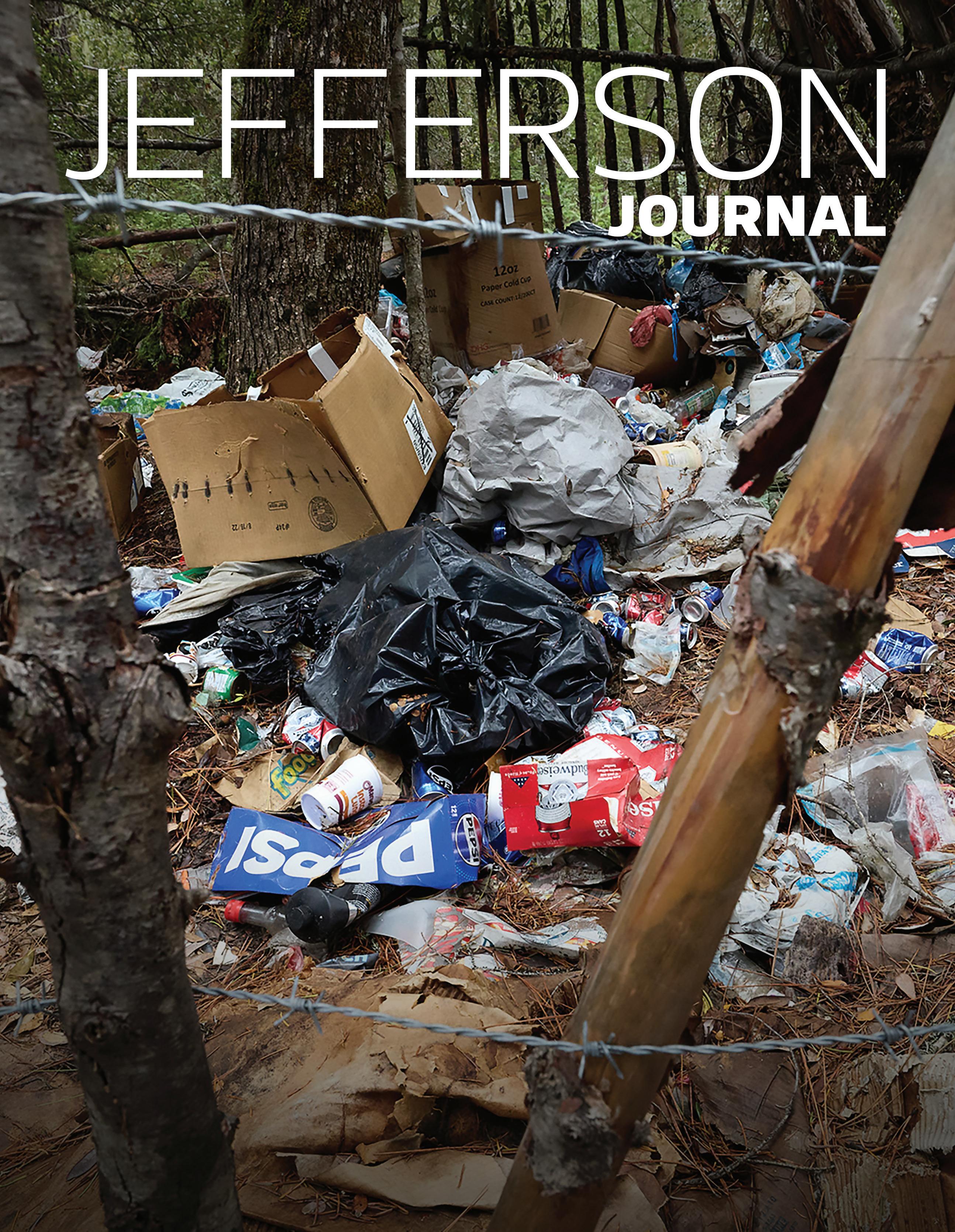
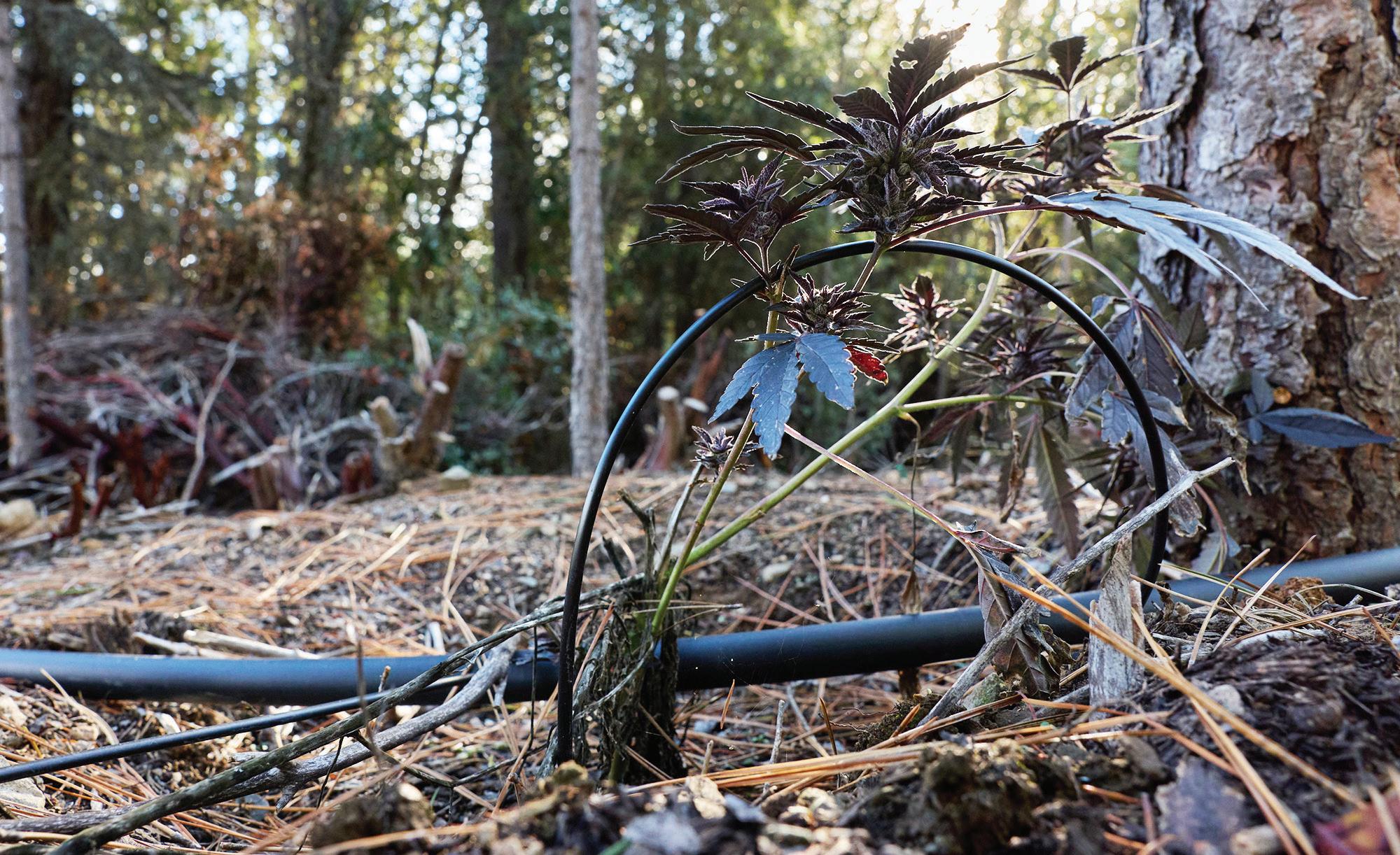
Dozens of fertilizer bags wept blue fluid onto the forest floor. Irrigation tubes snaked across the craters of empty plant holes. The cold stillness felt temporary—as if the growers would return at any moment to prop up the crumpled tents, replant
PHOTO BY FRED GREAVES FOR CALMATTERS
Wengert and Gabriel have found carcasses of creatures so poisoned even the flies feeding on them died, and detected dangerous pesticides in nearby creeks more than a year after raids.
their crop and fling more beer cans and dirty underwear into the woods.
Wengert has tallied nearly 7,000 abandoned sites like this one on California’s public lands. It’s almost certainly an underestimate, she said. Her team knows of only 587 that have been at least partly cleaned up.
No government agency can provide a comprehensive count; several referred CalMatters back to Wengert’s nonprofit for an unofficial tally.
Most of the sites Wengert’s team identified are in national forests, where “limited funding and a shortage of personnel trained to safely identify and remove hazardous materials” is driving a backlog in clean ups, a U.S. Forest Service spokesperson told CalMatters via an unsigned email.
The federal government, the spokesperson said, has dedicated no funding for the forest service to clean them up. And it’s leaving a mess in California.
A new playbook
The federal government owns nearly half of the more than 100 million acres in California. But it’s California’s agencies and lawmakers taking the lead on tackling the environmental harms of illegal grows — even as the problem sprawls across state, federal and privately managed lands.
The California Department of Fish and Wildlife’s policy is to clean up all grows spotted on its 1.1 million acres of wildlife areas, ecological reserves, and other properties, officials say.
Staff assist with clean ups on federal lands “when asked,” said cannabis program director Amelia Wright—typically on California’s dime. But, she said, “That’s not our mandate.”
Fees and taxes on California’s legalized cannabis market fuel state efforts—supporting the California Department of Fish and Wildlife’s cannabis program and funding tens of millions of dollars in grants for rehabilitating places damaged by cultivation. These grants can cover clean-ups and sustainable cultivation projects, or even related efforts like fish conservation
The department has helped remove almost 350,000 pounds of trash and more than 920 pesticide containers from grows on public lands over nearly a decade.
But former Assemblymember Jim Wood, a North Coast Democrat, said that as he prepared to leave office in 2024, progress on clean ups was still too slow.
“It doesn’t reflect what I see is the urgency to watersheds, and the water and the people that are served by them,” he said.
In 2024, lawmakers passed Wood’s bill directing the Fish and Wildlife department to conduct a study to inform a statewide cleanup strategy for cannabis grows. The law requires the department to provide regular reports to the legislature about illegal cultivation and restoration efforts on lands both public and private.
To Wright, that’s a path forward, however prospective it may be.
“It just feels like such redemption right now for many of us,” Wright said. “It’s a one of a kind program. So we didn’t have a playbook—we’re still creating it.”
But the study, which Wengert’s organization is conducting on the state’s behalf, isn’t due until next year. Meanwhile, the bloom of illicit pot grows on private land has been demanding California’s attention, a growing problem since voters legalized cannabis in 2016.
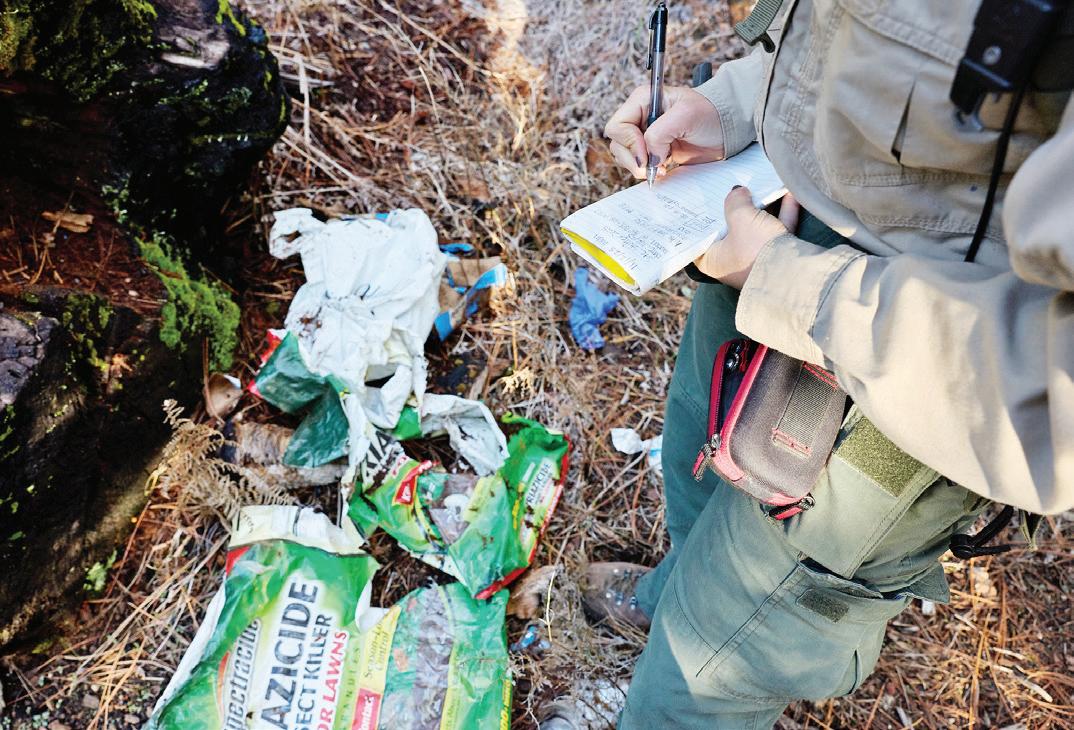
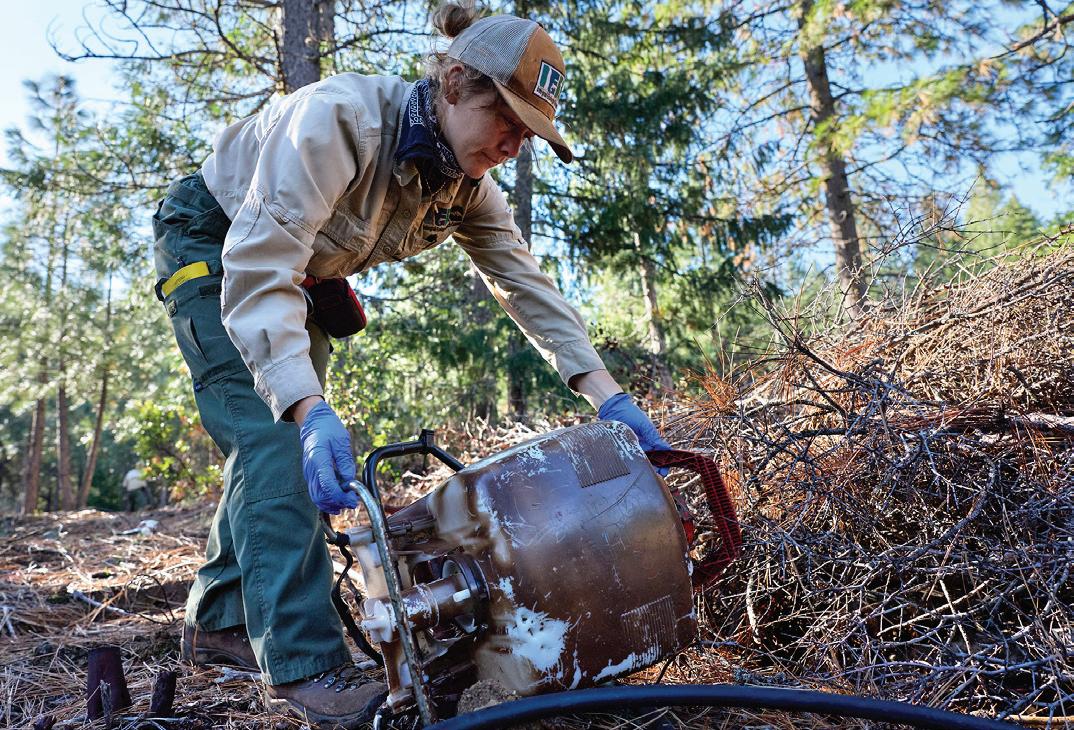
Jenna Hatfield, a member of Wengert and Gabriel’s team at the Integral Ecology Research Center, takes notes and recovers a pesticide sprayer that was hidden under brush at the Shasta-Trinity trespass grow on Nov. 12, 2025.
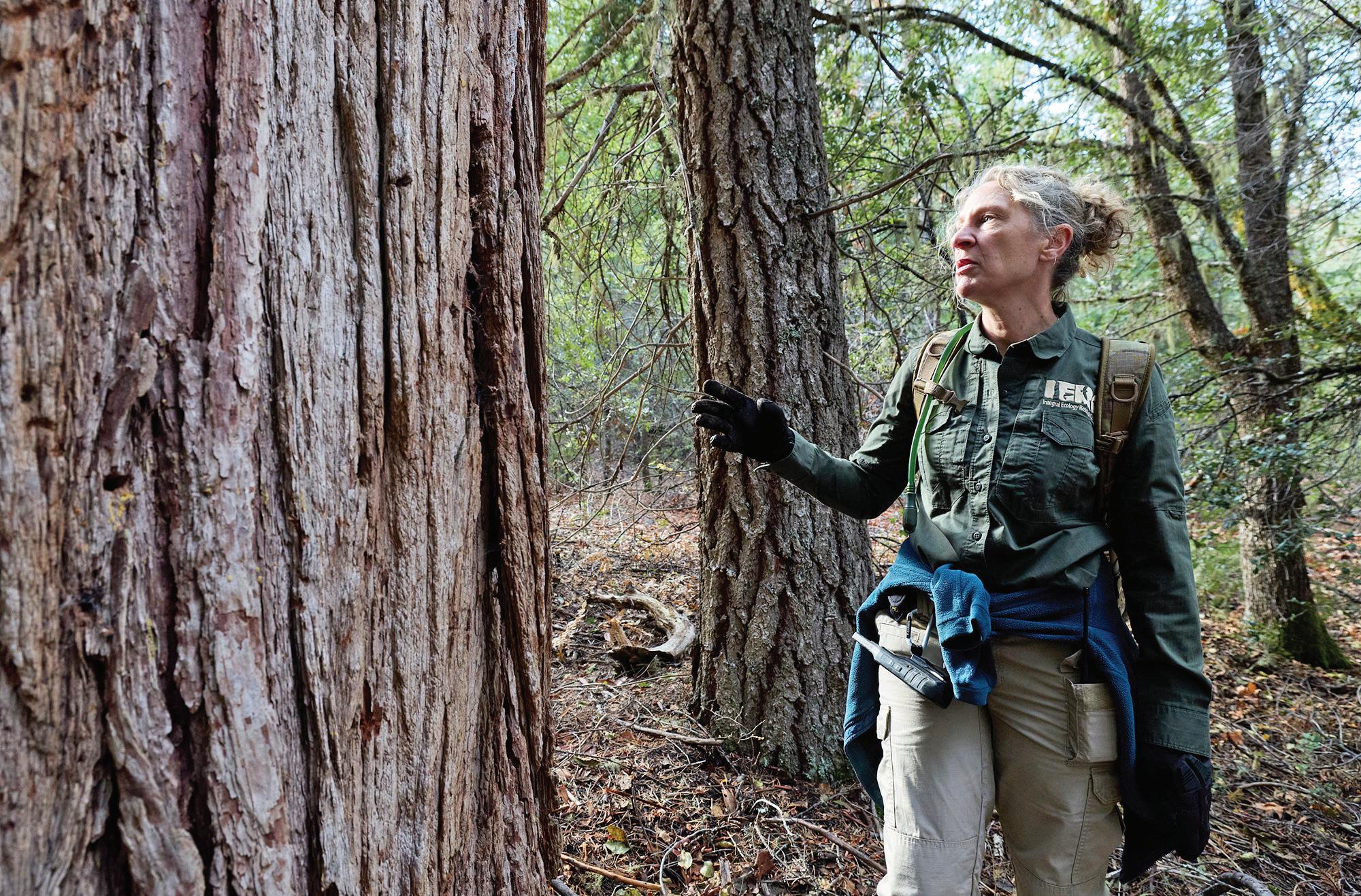
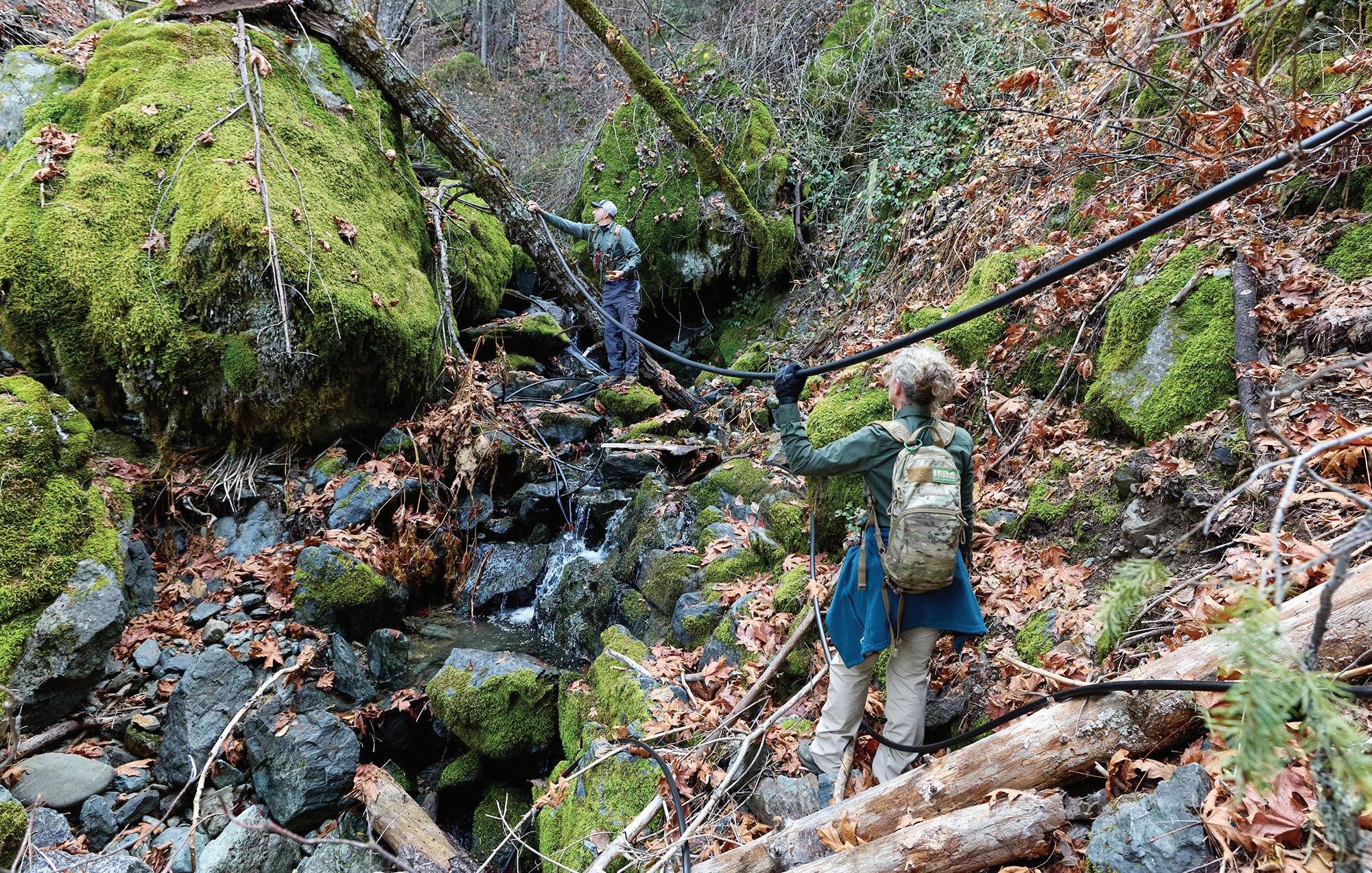
previous page: Greta Wengert, co-founder and co-director of the Integral Ecology Research Center, leads a team documenting the chemicals and environmental damage caused by an illegal cannabis site in the Shasta-Trinity National Forest on Nov. 12, 2025.
PHOTOS BY FRED GREAVES
“It’s like whack a mole. They pop up in a new location, and then we have to go there—but the impacts are occurring across the landscape,” said Scott Bauer, an environmental program manager with the Department of Fish and Wildlife’s cannabis office.
The California Department of Justice told CalMatters it recently identified a “substantial increase of illicit cannabis cultivations on or adjacent to public lands.” Of the 605 sites where a multi-agency state and federal task force ripped out illicit cannabis plants, roughly 9% were on public lands—up from an average of 3 to 4%.
“Everybody thought with legalization that a lot of these problems would go away,” said Wood, the former assemblymember.
But, he added, the sites remain. “It’s a ticking environmental time bomb.”
And the contamination, new research confirms, lingers.
‘This site will sit on this landscape’
On a cold November morning, down one dirt road and up another, ecologist Mourad Gabriel led a safety briefing at the grow site in Shasta-Trinity National Forest.
Gabriel, who previously spearheaded a U.S. Forest Service effort tackling trespass grows on public lands, co-founded the research center with Wengert and now co-directs it with her. He’s also her spouse, and a foil to her calm watchfulness—dismayed by the state of the forest one moment, and bounding off to investigate an interesting mushroom or animal scat the next.
“Please don’t push the red shiny buttons, or lick the big pink things,” Gabriel joked at the mouth of a well-worn path growers had carved into the woods. (Carbofuran, a dangerous and illegal pesticide often found on grow sites, is bright pink.)
The team, Gabriel explained, wasn’t there to clean up the grow. They didn’t have the money for that. Instead, he said,
shouldering his backpack and strapping on a first aid kit, they were there to document the contaminants as part of a U.S. Forest Service-funded investigation into wildlife around cultivation sites.
“This site will sit on this landscape until someone acquires some level of funding,” Gabriel said. “And no one can really push it, until we actually get that data.”
Wengert and Gabriel have spent years collecting data at grow sites like this one. They’ve found carcasses of creatures so poisoned even the flies feeding on them died, and detected dangerous pesticides in nearby creeks more than a year after raids.
In recent work they published with scientists at the U.S. Geological Survey, the team found that illegal grows pulsed pollutants from plastic, painkillers, personal care products, pot and pesticides into the soil that could be detected months or even years later. Some contaminants also showed up in nearby streams.
The pollutants diminished over time—absorbed into the landscape and washed into waterways. By the time the researchers tested for them, the concentrations had declined to levels lower than those found in agricultural soils.
But, they point out, remote habitats and sensitive headwaters are not where these chemicals are supposed to be. Past a marshy flat cratered with holes and piled with poison-green insecticide bags, Gabriel, Wengert and ecologist Ivan Medel trailed an armed U.S. Forest Service officer to a massive trash heap cordoned off by barbed wire.
Medel wedged himself through the strands and handed empty fertilizer bags dripping blue liquid out to Gabriel.
Force-feeding waterways the excess nutrients in fertilizer can upend entire ecosystems and spur algae blooms. The site is in the greater South Fork Trinity River watershed — vital, undammed habitat for protected salmon and other fish species.
A cannabis plant grows alongside irrigation tubing at the illegal grow site in Shasta-Trinity National Forest on Nov. 12, 2025.
PHOTO BY FRED GREAVES FOR CALMATTERS
“That was pretty nasty,” Gabriel said, as one bag spilled liquid over his gloved hands. He counted up the haul. “Twelve bags right there.”
By day’s end, the team discovered enough empty bags and bottles to have held 2,150 pounds of fertilizer and more than 29 gallons of liquid concentrate. All of that, the growers had poured into the land.
A federal void
In 2018, a federal audit lambasted the U.S. Forest Service for failing to clean up—or even document—trespass grows in national forests.
The agency was finding and eradicating cannabis grows in national forests effectively. But its failure to consistently clean them up, the audit said, put “the public, wildlife, and environment at risk of contamination” and could allow growers to return more easily.
Little has changed. From 2020 through 2024, when Gabriel worked for the agency, a spokesperson said the Forest Service “prioritized reclaiming sites over investigating active grows.”
But the agency said it still has received too little funding and has too few personnel trained to work with often hazardous materials. And the backlog persists. How big it is, the Forest Service wouldn’t say. After declining an interview request and taking two months to reply to emailed inquiries, a spokesperson said CalMatters must submit a public records request.
The Forest Service now is shifting the responsibility for cleanups to individual forests. That, too, contributes to the backlog, the spokesperson said.
U.S. Rep. Jared Huffman, a California Democrat and ranking member of the House Natural Resources Committee, said he has tried repeatedly to direct more funding to cleaning up trespass grows on federal lands, but with little success in Congress.
“We have tried just about everything,” said Huffman. “It’s clearly not enough.”
Now, under the Trump administration, the Forest Service is even more understaffed. A spokesperson said while law enforcement staffing “has remained steady,” roughly 5,000 nonfire employees “have either offboarded or are in the process of doing so” through “multiple voluntary separation programs.”
Huffman put it more starkly. “They’ve been gutted,” he said. “The Forest Service right now has a sign on the door that says, ‘We’re out of the office. We’re not sure when we’ll ever be back.’”
Cleaning it up
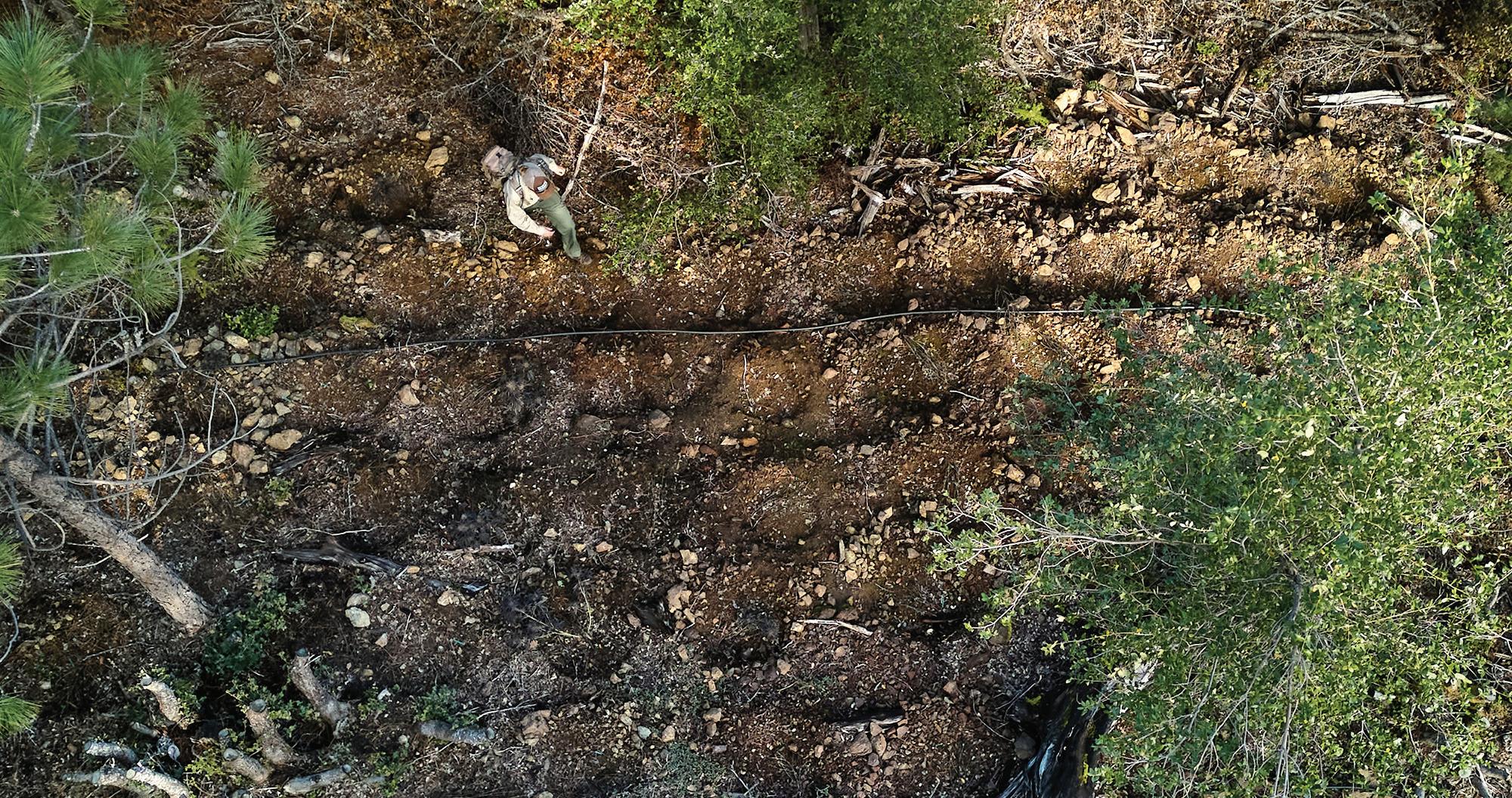
The Shasta-Trinity grow stretched for more than 6 acres through national forest land. Trash, and the smell of pot, were everywhere.
Law enforcement officers had removed the mouth of the irrigation tube diverting water from a nearby creek, but all the piping remained. It slithered over downed trees, past the craters of another abandoned grow to a waterfall where leaves and black tubing snarled in the rocks.
Gabriel clambered up the waterfall, where he discovered a sock and a plastic bottle with the top sliced off—a makeshift filter the growers used to keep the line clear of debris. He hung the bottle on a tree branch, like a ghoulish Christmas ornament.
Few organizations are qualified to do science-informed cleanups, and none work as widely as Wengert and Gabriel’s.
California’s Cannabis Restoration Grant Program is paying the team more than $5.3 million to conduct the legislatively mandated study on cleaning up grow sites, and also to train and support tribal teams and other organizations to do this work.
The study, and the training, include best practices for handling and disposing of hazardous waste, Gabriel said. More teams means more competition
Continued on page 11
An aerial view of a scientist walking through empty planting holes at the illegal Shasta-Trinity cannabis site, where growers chopped away brush and laid irrigation lines for their crop. Nov. 12, 2025.
PHOTO BY FRED GREAVES FOR CALMATTERS
APPLEGATE VALLEY OREGON
“Aside from the excellent Applegate wines I’ve had from producer, Vineyard, made such an impression on me over the last few years that I from the July the attitude, which are
“But Aside from the excellent Applegate wines I’ve had from Willamette producers, the wines of one producer, Troon Vineyard, made such an impression on me over the last few years that I drove seven hours from the Mendocino Coast in July to pay a visit to Applegate Valley, While I admire the way Troon farms and its empirical attitude, the proof is in the wines, which are invariably fresh, lively and expressive,”
—Eric Asimov The New York Times
—Eric Asimov, The New York Times
for the pot of state-allocated money, but he wants more allies in the fight.
“Until someone cleans it up, it stays out here,” Gabriel said from his perch in the waterfall, surrounded by a tangle of black irrigation pipes. He expected it could take years.
But that’s not what happened.
Two weeks later, the California Department of Fish and Wildlife choppered away nearly 1,500 pounds of trash, 4,000 feet of irrigation pipe and 7 pesticide containers—restoring the rugged, remote forest.
The department had offered to help out the U.S. Forest Service and take the lead on the clean up, with its own helicopter,
By day’s end, the team discovered enough empty bags and bottles to have held 2,150 pounds of fertilizer and more than 29 gallons of liquid concentrate. All of that, the growers had poured into the land.
on its own budget, according to spokesperson Sarah Sol.
Months later, when Gabriel learned about it, he was shocked—and concerned. Sol said that fish and wildlife staff did not encounter any banned or restricted pesticides, and all had masks and nitrile gloves available to them.
But Gabriel’s team found residue in the pesticide sprayers on the hillside from a class of chemicals that includes banned and dangerous carbofuran. He worried that the clean up team could have unknowingly put themselves and others at risk.
“There is a proper way to do it, and there is a cowboy way to do it,” Gabriel said.
It’s one site down—one patch of forest cleared. But thousands like it remain, littering California’s landscape.
Rachel Becker is a journalist reporting on California’s complex water challenges and water policy issues for CalMatters. She’s covered drought, water standoffs, groundwater depletion, water quality and the world’s biggest dam removal.
below: Greta Wengert and Mourad Gabriel, with Integral Ecology Research Center, follow an irrigation pipe that leads to the water source that growers used to water their cannabis crop in Shasta-Trinity National Forest. Nov. 12, 2025.
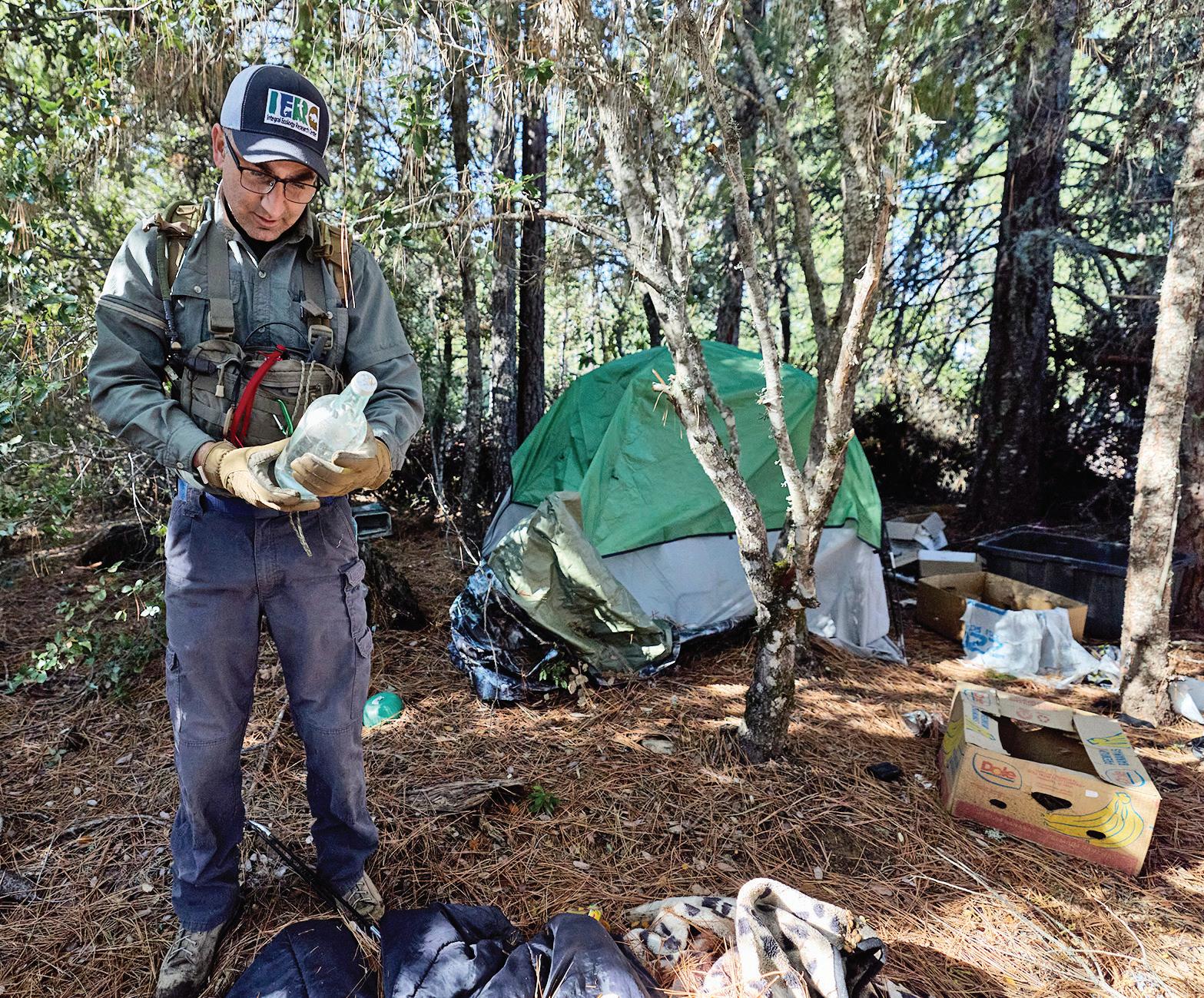
Mourad Gabriel, co-founder of the Integral Ecology Research Center, looks at an alcohol bottle found in the abandoned camp of the illegal cannabis site in Shasta-Trinity National Forest on Nov. 12, 2025.
PHOTO BY FRED
GREAVES FOR CALMATTERS
For People. For Nature. Forever. For People. For Nature. Forever. For People. For Nature. Forever.
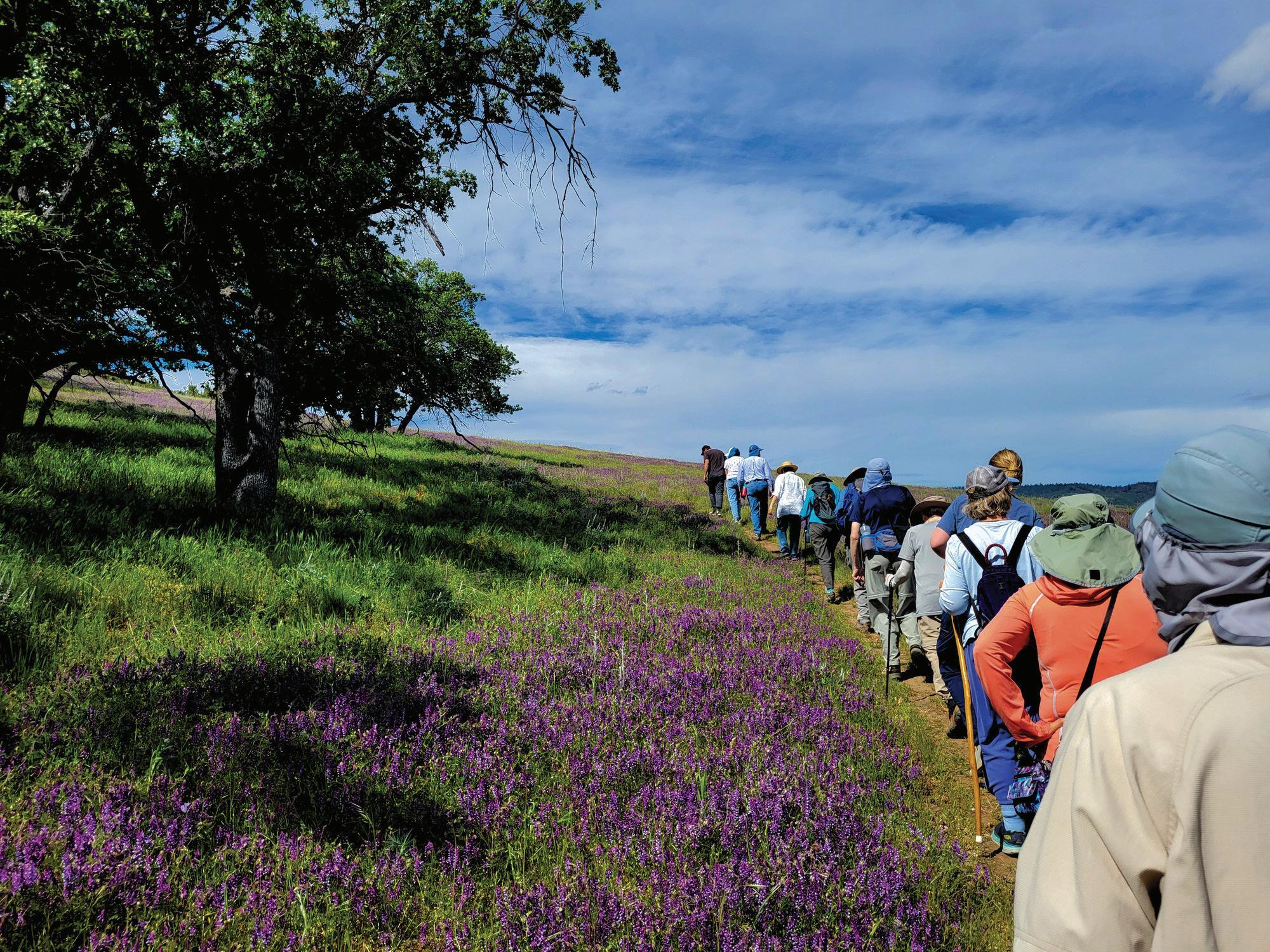
This spring, discover conserved lands alongside experienced naturalists through Southern Oregon Land Conservancy’s Spring Hike Series.
Visit our website to learn about upcoming events, membership, and volunteer opportunities.
SPRING HIKES 2026
Scan the QR Code for more hikes and information!
Scan the QR Code for more hikes and information!
A Rogue Valley Group Hoped to Start a Peer Respite in The Hills Above Ashland. Why Didn’t It Open?
By JUSTIN HIGGINBOTTOM
Five years ago, Oregon provided $6 million to fund short-term residential centers for those experiencing mental health crises. For organizations hoping to launch programs, getting funding was only the start of challenges.
Derek DeForest was forcefully hospitalized during a mental health crisis, an experience he said was not only traumatic but not helpful. Later, he became active in the psychiatric survivor movement, advocating for the civil rights of those involuntarily committed.
Although DeForest opposes forced hospitalization, he still thinks people in crisis need help. He worked on the East Coast at a peer respite, a short-term, voluntary residential program— usually in a home-like setting—staffed by those with similar experiences.
Research shows the resource can be effective, yet there are fewer than 50 programs in the U.S.
In 2021, the Oregon legislature passed a bill to fund the state’s first peer respites. Legislators and advocates argued peer respites could be a useful resource for those unwilling, or not a good fit, to enter psychiatric hospitalization. Around 30% of adults experience mental illness in Oregon—the highest rate in the country. Lawmakers approved $6 million to start four programs across Oregon.
Five years later, only two centers are open. One of the groups that failed to open a center was Stabbin Wagon, a harm reduction nonprofit. Deforest was part of the group’s efforts.
above: The proposed Ashland site of Mountain Beaver House, a planned peer respite center intended to support people in mental or emotional distress. Zoning issues and pushback from neighbors ended the project.
“When the peer respite funding became available, we were like, ‘Oh, this is actually a way we could constructively contribute,’” DeForest said. “This is something we know is important from our own experiences.”
OHA awarded Stabbin Wagon $1.5 million to open Mountain Beaver House, a planned peer respite in Jackson County.
“And that’s when the trouble started,” DeForest said.
The group hoped to operate in Medford but faced pushback from city officials and residents before OHA even delivered the grant. The uproar was due to Stabbin Wagon’s sometimes controversial work.
The organization runs a harm-reduction van, providing things like clean needles, pipes and overdose reversal medication. The group’s mission is to reduce health risks for drug users, but some residents say the group enables drug use. It’s also been very critical of the police.
“I think really it was just the fact that we were openly saying we’re not going to work with the police,” DeForest said.
Emails first reported by Information for Public Use reveal that the Medford Police Department, city officials and other non-profits contacted OHA to protest Stabbin Wagon’s grant.
“Everyone is in shock over this because it was completely under the radar and there has been no communication,” said
Lori Paris, former CEO of Addictions Recovery Center, in an email to the police department. “Community partners are concerned for several reasons, but most (are) concerned that the funds will be used to create a safe injection site.”
In another email, former Medford City Manager Brian Sjothun asked who to contact at the state level about the grant. “[T] his is a disaster waiting to happen,” Sjothun said.
Stabbin Wagon sued Medford, arguing opposition from city officials delayed the release of state funding. That lawsuit remains in federal court. City officials did not respond to a request for comment.
Stabbin Wagon eventually shifted efforts to Ashland, hoping a more progressive local government would welcome the project. There, a landlord who believed in their mission and offered a large house in a quiet neighborhood above Lithia Park.
Mountain Beaver House staff planned to use the home as a sanctuary to serve up to four people, offering two-week stays where residents could rest and connect with social services.
Things were looking up, DeForest said—until they weren’t.
The first problem was zoning. The respite bill didn’t include language about zoning, leaving Ashland planning officials to debate whether the program was appropriate in a residential neighborhood.
Folk Time’s peer respite center is located in Portland.
PHOTO COURTESY FOLK TIME
Mountain Beaver House’s future neighbors also had something to say.
“One of the secrets to small communities like this…is that everyone can’t live here,” Ashland-resident Ron Rusnak said during a packed planning meeting. “Only a special few people can live here.”
As opposition mounted, Mountain Beaver House employee Sam Strong began to lose hope.
“For me personally, it wasn’t when the city was being the way that they were being,” they said. “It was when the neighbors put together a petition to get us out of the neighborhood.”
DeForest said OHA told him to rent the house and figure out zoning later. Stabbin Wagon’s lawyers assured the group that it would win the zoning fight -- eventually.
The group followed OHA’s recommendation, renting and furnishing Mountain Beaver House and onboarding staff.
DeForest said reaching someone at OHA to discuss an extended timeline was hard.
“I mean, it was pretty bizarre,” DeForest said.
Emails show message after message from Mountain Beaver House seeking clarification and direction from OHA. DeForest said the group was “ghosted” and eventually resorted to calling every number in the OHA staff directory.
“I know people who took their own lives waiting for the respite to open,” DeForest said.
OHA did not agree to an interview. In a statement, the agency said it terminated its agreement with Stabbin Wagon last year because the group did not reach key milestones. The agency sent a notice in March asking for a return of grant funds.
DeForest and Strong left the Mountain Beaver House that same month.
Successes and failures
Mountain Beaver House was not alone in facing setbacks. OHA pulled a grant from Portland-based Black Mental Health Oregon after the state Department of Justice opened an investigation into the organization’s financial disclosure filings.
OHA also canceled a grant to The Stronghold in Klamath County. That organization, which focuses on tribal residents, couldn’t bring a property up to code. The Stronghold won a lawsuit against a contractor it blamed for the delay. The judgment included $1.5 million that the group said it lost in OHA funding.
Two groups, Project ABLE in Lincoln County and Folk Time in Portland, did open peer respites. Those organizations also had experience running mental health services.
For Kevin Fitts, a lobbyist with the Oregon Mental Health Consumer Association and author of the state’s peer respite bill, their successes aren’t a coincidence.
“Why in the world did OHA choose contractors that were not even prepared to set up and develop a center?” Fitts said.
Fitts thinks OHA failed to do its due diligence in approving grants.
“They gave them the grants and scored them in a way that I think was irresponsible,” Fitts said.
The agency scored applicants on eight categories. The highest-valued considerations were “overall program description” and “equity and cultural response,” worth 15 points each out of
a possible 70 points. No category existed for previous experience or work in a similar field.
Fitts said he believes the peer respite model can save both lives and public funds. He hopes the state will continue to support the program.
“I think the crucial thing will be the success of the two houses that are already set up,” he said.
Peter Starkey, executive director of Folk Time, said their peer respite has been a success. He said around 50 people have stayed at the center over the last year, including many unwilling to use clinical intervention like psychiatric hospitalization.
“We really treat it as a family environment,” Starkey said. ”The vast majority of people that go through are incredibly lonely,”
He’s seen people begin looking for work again after years of unemployment. And some who would regularly stay at a psychiatric hospital have not needed to reenter a facility since staying at the respite.
Folk Time, founded some 40 years ago, is Oregon’s oldest mental health peer agency. But Starkey said it was still a challenge to open a peer respite. He said, in his experience, fighting local zoning codes can be “trauma inducing.”
“It’s always a headache for peer respite, specifically because it is counter-cultural,” Starkey said. “There aren’t municipalities that are really set up for it.”
He said the difficulties Folk Time faced, while operating in a progressive city, are likely more pronounced in rural areas.
Building community
DeForest said he still wants to help people in mental and emotional distress, but he would be cautious about working with the state again.
“Policymakers in Salem and the Willamette Valley come up with ideas. They may be good ideas,” he said. “And they don’t actually care if it works for rural communities, for Southern Oregon.”
DeForest and Strong now volunteer at the Bear Creek Social Center, a new mutual aid project in Talent.
“The love and the community that was built from the Mountain Beaver House didn’t end there,” Strong said. “It was spread out into our community and is hyper saturated into the Bear Creek Social Center.”
Unlike peer respite centers, Bear Creek doesn’t provide beds or staff. But Deforest and Strong said it offers community—a core part of what they hoped to build at Mountain Beaver House.
Justin Higginbottom is a regional reporter for Jefferson Public Radio. He’s worked in print and radio journalism in Utah as well as abroad with stints in Southeast Asia and the Middle East. He spent a year reporting on the Myanmar civil war and has contributed to NPR, CNBC and Deutsche Welle (Germany’s public media organization).
JES BURNS DOWN TO EARTH
Oregon’s Elk Show Genetic Fortitude Against a Fast-Moving and Deadly Disease
Oregon is one of the last remaining safe zones from chronic wasting disease, a fatal illness that has killed tens of thousands of deer, elk and moose across North America . Of the western states, only Oregon, Nevada and Arizona have yet to register a case.
And now research suggests that at least some animals in Oregon may have a natural genetic resistance to the disease.
Chronic wasting disease (CWD) affects members of the deer family, spreading through close contact between animals. There
isn’t a cure, and those infected experience extreme weight loss, also known as wasting, loss of coordination, and drooling. It’s always fatal.
CWD is a neurologic disease caused by infectious proteins called prions that are also responsible for diseases like Creutzfeldt-Jakob in humans and mad cow disease. But unlike mad cow disease, there isn’t evidence that CWD can spread to humans
file — Wildlife managers are concerned about the spread of always-fatal chronic wasting disease through deer and elk across the region. An Oregon bull elk is shown in this 2005 photo.
Down to Earth
Continued from previous page
Chronic wasting just recently arrived in the Pacific Northwest. It was detected in Idaho for the first time in 2021 and in Washington in 2024.
So far, Oregon has been spared, but it’s only a matter of time. The Oregon Department of Fish and Wildlife predicts the disease could cause major declines in deer and elk populations in the state. The agency is working with hunters to test and monitor for CWD introduction on the ground.
But there’s new evidence that the eventual spread of CWD in Oregon may be slowed because of genetic good fortune.
Researchers from ODFW, the University of Illinois Urbana-Champaign , and the U.S. Fish and Wildlife Service Forensics Lab in Ashland conducted genetic testing on 183 elk across Oregon. They found that a large percentage of the two subspecies have a genetic variation associated with resistance to the disease.
Testing showed 42% of Oregon’s coastal Roosevelt elk and 49% of the Rocky Mountain elk had the genetic marker. The study authors say these rates are higher than they’ve seen in other states.
“Without advantageous genetic variants, a whole population can be wiped out fairly quickly,” University of Illinois researcher Alfred Roca said in a university announcement. “It’s not enough to prevent the spread of CWD once it enters the state, but it may slow it down a bit.”
These biological speed bumps could give wildlife managers more time to prepare and to step in to control the disease when they find infected animals.
The research is published in the Journal of Heredity (NOV 2025).
In these All Science Snapshots, “All Science. No Fiction.” creator Jes Burns features the most interesting, wondrous and hopeful science coming out of the Pacific Northwest. Her reporting comes to JPR through the Northwest News Network, a collaboration between public media organizations in Oregon and Washington.
JPR
FOCUS EDUCATION
JANE VAUGHAN
Students enrolled in career and technical education programs graduated at especially high rates statewide—nearly 98%.
Southwest Oregon Graduation Rates Improve, Still Trail State Average
The state hit an all-time high for its high school graduation rate, but southwest Oregon’s results tell a more complicated story.
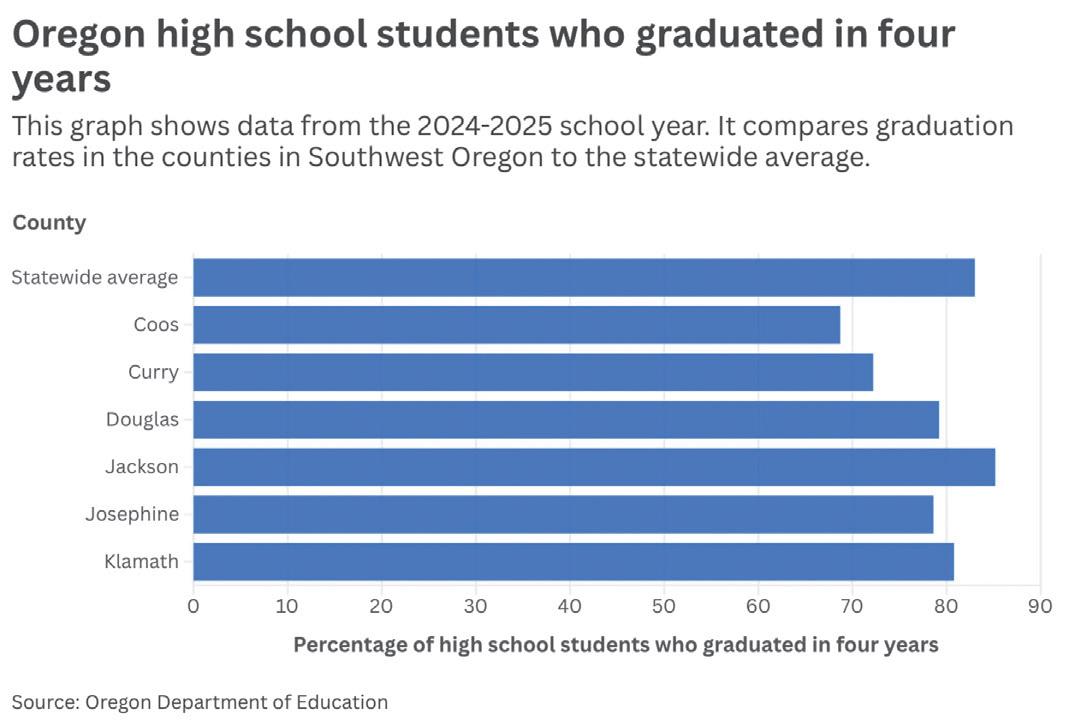
The Oregon Department of Education reported a record-high four-year graduation rate of 83% for the 2024–25 school year. But that statewide milestone contrasts with graduation outcomes in southwest Oregon, where most counties fell below the average even as some districts posted significant gains.
Curry County’s four-year graduation rate was about 72%, and Coos County’s was roughly 69%.
Several counties, however, improved compared with the previous school year. In Klamath County, the graduation rate rose to nearly 81%, up 6 percentage points.
At 85%, Jackson County’s graduation rate was the only one in the region higher than the statewide average.
Within Jackson County, the Medford School District did especially well, with more than 88% of students graduating in four years.
Interim Superintendent Jeanne Grazioli said the district tracks individual student progress.
“We have intentional systems that we regularly review data,” she said. “We look at individual students almost to a point where we’re case managing our students and identifying who might be not on track to graduate.”
In Curry County, at the Brookings-Harbor School District, the graduation rate increased by nearly 2 percentage points, even as the county’s overall rate dipped slightly.
Superintendent Helena Chirinian said they’re always working to increase graduation rates.
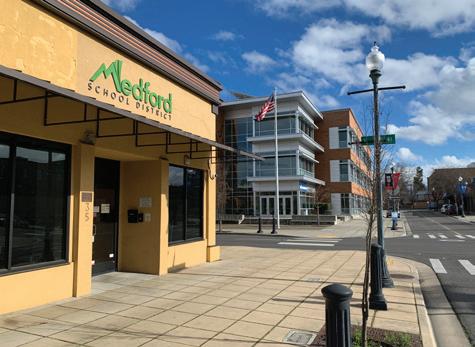
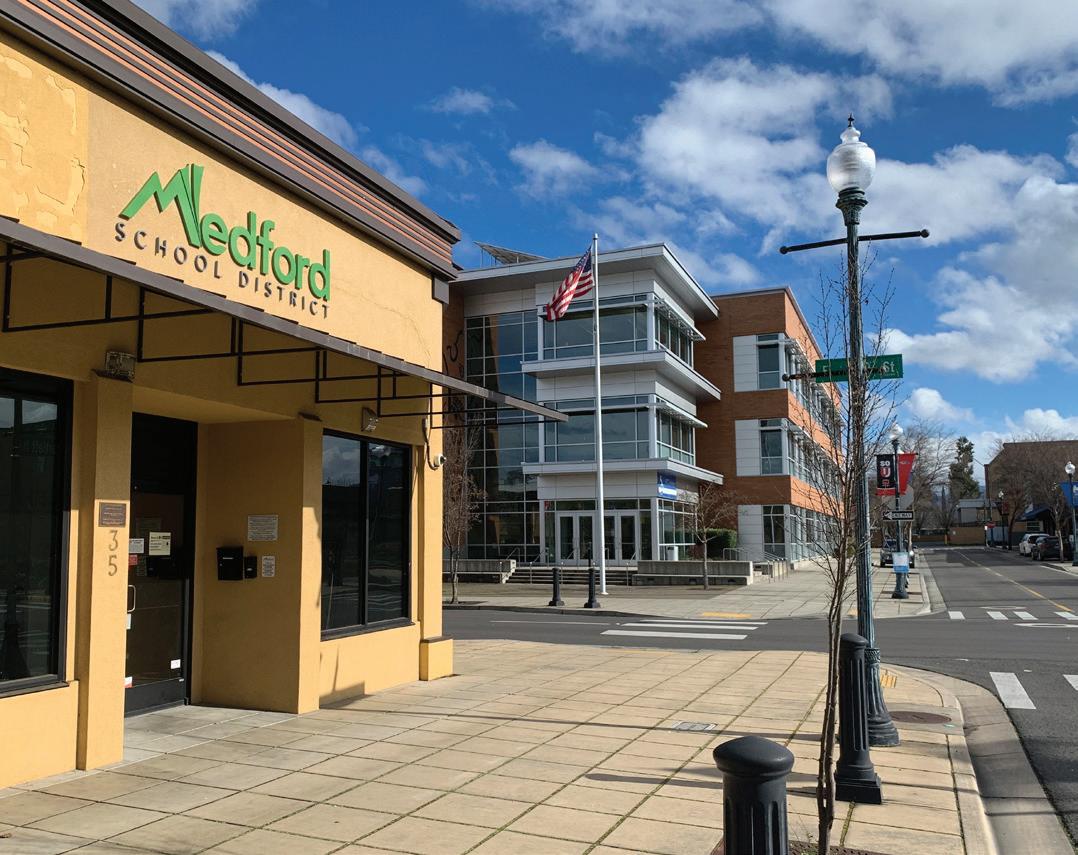
A Medford School District office in downtown Medford, Oregon on March 1, 2024.
“We need to keep working on student engagement when they’re here and building relationships,” she said. “Those things are the things that will make a difference.”
Several districts reported record graduation rates for the Class of 2025, including Medford, Klamath County School District, Douglas County SD 4 and Grants Pass.
“This milestone reflects a shared commitment to student success across our district,” Grants Pass Superintendent Tim Sweeney said in a press release. “Our focus remains on empowering each student to reach their potential and leave our schools ready for their next steps.”
While Oregon’s test scores remain low and many school districts struggle with attendance, superintendents insist their graduates are ready for the real world.
“[The test is] a one-time measurement. It’s not like a holistic measure towards graduation necessarily,” Grazioli said. “There’s kids that opt out of that. It doesn’t necessarily tell the whole story about graduation.”
Chirinian agreed, noting that students graduate based on credits earned in classes, not on test scores.
“I do worry a little bit about [them being] on time for work,” she said. “But we have some great kids, and they will be just fine. And we have some kids who will go out in the real world, and it will be a little bit of a learning curve, but they’ll be okay.”
State data also showed notable outcomes for certain student groups. Students enrolled in career and technical
JPR News Focus: Education
Continued
education programs graduated at especially high rates statewide—nearly 98%.
In Brookings-Harbor, about 94% of CTE students graduated in four years, while Medford’s rate topped 95%.
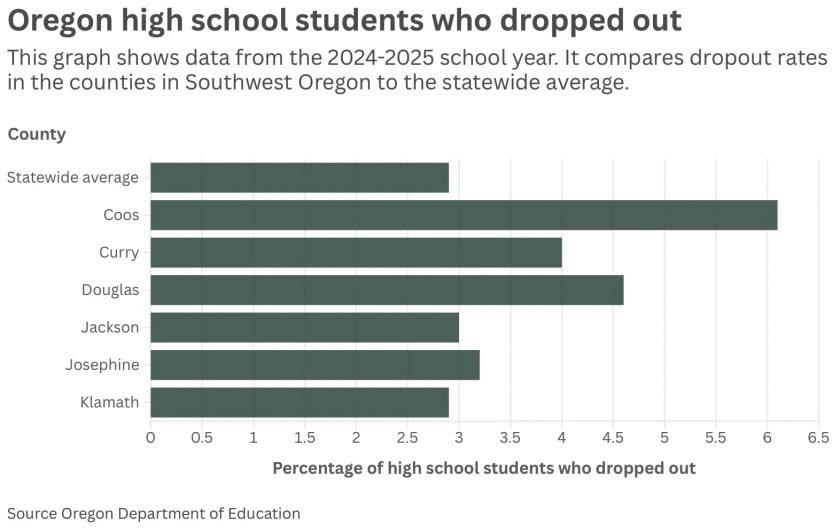
The data also tracked dropout rates, which averaged 2.9% statewide.
Klamath County matched the state dropout average, but other southwest Oregon counties exceeded it. Coos County
recorded a 6.1% dropout rate, and Douglas County reached 4.6%.
That number is larger in “high mobility districts,” Chirinian said, where families often move in and out of town.
“If they don’t report where they’re going or the records request from another high school doesn’t come, they will be counted as a dropout for us,” she said.
The state data also includes metrics on “completer rates”, which include students who earn a traditional diploma as well as those who receive a GED or other approved credential. The statewide average was about 85%.
Jackson County reached 88%, while Josephine County exceeded 84%.
Jane Vaughan is a regional reporter for Jefferson Public Radio. Jane began her journalism career as a reporter for a community newspaper in Portland, Maine. She’s been a producer at New Hampshire Public Radio and worked on WNYC’s On The Media.
APRIL EHRLICH
POLITICS & GOVERNMENT
Producer fees, which are based on how much paper and other packaging a company produces, are intended to pay for new recycling services the law requires.
More Businesses Demand Pause on Oregon’s New Recycling Fees, Following Court Decision
Asmall part of Oregon’s new statewide recycling system is on hold after a judge pushed pause in response to a lawsuit filed by product distributors.
The Plastic Pollution and Recycling Modernization Act aims to set statewide recycling standards and expand recycling service to more communities. It’s funded by fees on companies with over $5 million in annual revenue that sell packaged products in Oregon.
The National Association of Wholesaler-Distributors sued the Oregon Department of Environmental Quality last year, criticizing both the law and the state’s choice to have a thirdparty nonprofit administer the fee system.
The lawsuit is proceeding as Oregon lawmakers consider a bill that would exempt sellers of packaged berries, meat, poultry, fish and seafood from these packaging fees. Multiple industry groups voiced their support of the bill during a public hearing on Tuesday. They called on the state to pause the recycling system for all producers, not just the distributors affected by the judge’s recent decision.
In court documents, the distributors group calls the recycling system a “labyrinthine scheme, shrouded in secrecy,” that imposes fees on businesses that have little control over the rates they pay.
A handful of other states have passed similar laws, but Oregon is the first to officially launch its recycling system and begin charging producers fees. These producers—companies like General Mills, Ikea, Keurig and Dr Pepper—got their first invoices last July. The distributors group filed its lawsuit a few weeks later.
Producer fees, which are based on how much paper and other packaging a company produces, are intended to pay for new recycling services the law requires. Money might help a local hauling company purchase new trucks and recycling bins, for example, and some funds will help local governments administer the program and educate people about how to recycle.
Distributors have to pay for any new packaging they add to the system. So a distributor that delivers canned soda to grocery stores wouldn’t be charged for the cans the soda comes in, but it could be charged for pallets it uses to deliver canned soda and then disposed of afterwards.
In 2025, distributors’ invoiced fees made up less than 5% of all producer fees in Oregon, according to DEQ’s court filings.
Though they’re a small part of what the state collects, those fees were more than some distributors could afford, according to Eric Hoplin, chief executive officer of the National Association of Wholesaler-Distributors.
Cardboard packaging sits in a stack on top of a recycling bin outside a garage in Portland. Local and out-of-state businesses that sell packaged products in Oregon are required to pay fees into the state’s new recycling system.
“We operate in very small margins, so when a new fee is introduced, suddenly that impacts the profitability of moving things through Oregon,” Hoplin said, adding that the fees are “making it cost prohibitive to do business in the state of Oregon.”
The trade association requested a district court judge pause enforcement of the new system in November, at least for its members. The judge granted the preliminary injunction on Friday, meaning members of the National Association of Wholesaler-Distributors won’t face penalties if they don’t pay producer fees before the lawsuit is resolved.
Continued on page 23
ELI IMADALI / OPB
Michal/Yungen Duo
September 12
Dover Quartet
October 12
Reverón Piano Trio
October 18
Galvin Cello Quartet
November 2
Stile Antico
November 14
Dudok Quartet
Amsterdam
January 16
Baltimore Consort
January 30
The Esmé Quartet
February 21
Mandelring Quartett
March 14
Trio Bohémo
March 28
Borromeo/Verona Octet
April 18
Amit Peled, cello & Daniel del Pino, piano
May 2
Canadian Brass
May 17
JPR News Focus: Politics & Government
Continued from page 21
“Serious questions go to the merits of Plaintiff’s claims, there is a likelihood of irreparable injury, and the balance of hardships tips sharply in favor of Plaintiff,” U.S. District Judge Michael Simon wrote.
The distributors group is also challenging DEQ’s decision to delegate both fee collection and spending choices to Circular Action Alliance, a nonprofit founded by large corporations, including Amazon, The Coca-Cola Company and McDonald’s.
DEQ oversees and regulates the statewide recycling program, and approves the fee schedule that Circular Action Alliance sets.
Rates are calculated based on the overall recycling system’s cost, then those costs are divvied up among producers based on the types and weights of their product packaging.
The National Association of Wholesaler-Distributors says this system is unconstitutional. The trade association argued in court filings that DEQ has delegated “essential regulatory authority” and “sweeping regulatory power” to a private, third-party organization.
DEQ officials say the state agency is adequately overseeing the Circular Action Alliance and its members.
“They set the fees, but we review and approve the methodology that they use to set the fees, and we make sure that that methodology meets statutory requirements,” said Nicole Portley, who’s leading part of DEQ’s recycling program.
The distributors association also wants a clearer accounting of how producers were charged in 2025.
Circular Action Alliance didn’t publish the detailed formula it used to set those charges; it only published ranges and estimates. In its 2025 program plans, the nonprofit called the formula a trade secret, though it shared the formula with DEQ.
Larine Urbina, a spokesperson for Circular Action Alliance, said the nonprofit initially kept its rate formula secret to prevent competitors from stealing it, although the nonprofit did publish a detailed formula for 2026 rates.
“It’s really ensuring that the work that we’re doing on behalf of producers, that others aren’t able to take advantage of that investment of time and resources to then further their own program,” Urbina said.
The distributors group says this fluctuating fee structure makes it impossible for businesses to budget.
April Ehrlich is JPR content partner at Oregon Public Broadcasting. Prior to joining OPB, she was a regional reporter at Jefferson Public Radio where she won a National Edward R. Murrow Award for her reporting on the impacts of wildfires on marginalized groups. Her reporting comes to JPR through the Northwest News Network, a collaboration between public media organizations in Oregon and Washington.
For over two decades, The Folk Show has featured an eclectic blend of all things folk and some things not-so-folk. Singer/songwriters, Americana, bluegrass, Celtic, traditional, old-time, and some surprises are featured each week.
Hosted by Frances Oyung, Cindy DeGroft, Robin Terranova, Taurie Michelle, Eric Houghton, Noah Lindsday.
Sundays 6pm–9pm
JPR’s Rhythm & News Service www.ijpr.org
Join Host Mike Green and Producer Natalie Golay for in-depth conversations about the issues and ideas vital to our region. Weekdays – Live 9–10 AM Rebroadcast 8–9 PM Jefferson Public Radio’s News & Information Service with Mike Green Email: exchange@jeffnet.org
STATIONS & PROGRAMS
Classics & News Service
FM Transmitters provide extended regional service. (KSOR, 90.1FM is JPR’s strongest transmitter and provides coverage throughout the Rogue Valley.)
FM Translators provide low-powered local service.
Translators
Big Bend 91.3 FM
101.7 FM
Monday through Friday..
5:00am Morning Edition
8:00am First Concert
12:00pm Siskiyou Music Hall
2:00pm Performance Today
4:00pm All Things Considered
6:30pm The Daily
7:00pm Exploring Music
8:00pm State Farm Music Hall
Saturday
5:00am Weekend Edition
8:00am First Concert
10:00am Met Opera
2:00pm Played in Oregon
Stations
KSOR 90.1 FM
KSRG 88.3 FM
91.9 FM
3:00pm The Chamber Music Society of Lincoln Center
4:00pm All Things Considered
5:00pm New York Philharmonic
7:00pm State Farm Music Hall
Sunday
5:00am Weekend Edition
9:00am Millennium of Music
10:00am Sunday Baroque
12:00pm American Landscapes
1:00pm Fiesta!
2:00pm Performance Today Weekend
4:00pm All Things Considered
5:00pm Chicago Symphony Orchestra
7:00pm State Farm Music Hall
KSRS 91.5 FM
KNYR 91.3 FM
KOOZ 94.1 FM
MYRTLE POINT/COOS BAY
KZBY 90.5 FM
COOS BAY
KLMF 88.5 FM
KLAMATH FALLS
KNHT 102.5 FM
RIO DELL/EUREKA
90.9 FM Camas Valley 88.7 FM
METROPOLITAN OPERA
Junction 89.5 FM Chiloquin 91.7 FM
Coquille 88.1 FM
Mar 7: Les Troyens: Les Troyens a Carthage by Hector Berlioz
Mar 14: Madama Butterfly by Giacomo Puccini
Mar 21: Tristan Und Isolde by Richard Wagner (Live in HD)
Mar 28: La Traviata by Guiseppe Verdi
Apr 4: La Gioconda by Amilcare Ponchielli
Apr 11: Don Giovanni by W.A. Mozart
Apr 18: Innocence by Kaija Saariaho (MET Premiere)
Apr 25: La Sonnambula by Vincenzo Bellini
Coos Bay 90.5 FM / 89.1 FM Etna / Ft. Jones 91.1 FM Gasquet 89.1 FM Gold Beach 91.5 FM
Grants Pass 101.5 FM Happy Camp 91.9 FM Lakeview 89.5 FM Langlois, Sixes 91.3 FM
LaPine/Beaver Marsh 89.1 FM
In the Met’s production of Puccini’s Madama Butterfly, cultures collide in this poignant tale of a loyal geisha and a callous American naval officer whose fleeting romance leaves only devastation behind.
STATIONS & PROGRAMS
Rhythm & News Service
Monday through Friday..
5:00am Morning Edition
9:00am Open Air
3:00pm Today, Explained
3:30pm Marketplace
4:00pm All Things Considered
6:00pm World Café
8:00pm Folk Alley (M) Mountain Stage (Tu) American Routes (W) The Midnight Special (Th) Open Air Amplified (F)
10:00pm XPoNential
3:00am World Cafe
Saturday..
5:00am Weekend Edition
9:00am Wait Wait...Don’t Tell Me!
10:00am Radiolab
FM Transmitters provide extended regional service.
FM Translators provide low-powered local service.
Stations
KSMF 89.1 FM
KSBA 88.5 FM COOS BAY KSKF 90.9 FM KLAMATH FALLS
11:00am Snap Judgement
12:00pm E-Town
KNCA 89.7 FM BURNEY/REDDING
KNSQ 88.1 FM MT. SHASTA
KVYA 91.5 FM CEDARVILLE/ SURPRISE VALLEY
News & Information Service
1:00pm Mountain Stage
3:00pm Folk Alley
5:00pm All Things Considered
6:00pm American Rhythm
8:00pm The Retro Cocktail Hour
9:00pm The Retro Lounge
10:00pm Late Night Blues
12:00am XPoNential
Sunday..
5:00am Weekend Edition
9:00am TED Radio Hour
10:00am This American Life
11:00am The Moth Radio Hour
12:00pm Jazz Sunday
2:00pm American Routes
4:00pm Sound Opinions
5:00pm All Things Considered
6:00pm The Folk Show
9:00pm WoodSongs Old-Time Radio Hour
10:00pm The Midnight Special 12:00am XPoNential
Translators
Callahan/Ft Jones 89.1 FM Cave Junction 90.9 FM
91.9 FM Yreka 89.3 FM
Stations
KSJK AM 1230
TALENT
KAGI AM 930
GRANTS PASS
Monday through Friday..
12:00am BBC World Service
7:00am 1A
9:00am The Jefferson Exchange
10:00am Here & Now
12:00pm BBC News Hour
1:00pm Today, Explained
1:30pm The Daily
2:00pm Think
3:00pm Fresh Air
4:00pm The World
5:00pm On Point
6:00pm 1A
7:00pm Fresh Air (repeat)
8:00pm The Jefferson Exchange (repeat of 9am broadcast) 9:00pm BBC World Service
AM Transmitters provide extended regional service.
FM Transmitter
FM Translators provide low-powered local service.
KTBR AM 950 ROSEBURG
KRVM AM 1280
EUGENE
KSYC 103.9 FM YREKA
Saturday
12:00am BBC World Service
7:00am Inside Europe
8:00am Left, Right & Center
9:00am Freakonomics Radio
10:00am Planet Money/How I Built This
KHWA 102.3 FM MT. SHASTA/WEED KPMO AM 1300 MENDOCINO KNHM 91.5 FM BAYSIDE/EUREKA
KJPR AM 1330
SHASTA LAKE CITY/ REDDING
11:00am Hidden Brain
12:00pm Living on Earth
1:00pm Science Friday
3:00pm Unexpected Elements
4:00pm The Ezra Klein Show
5:00pm Radiolab
6:00pm Selected Shorts
7:00pm BBC World Service
Sunday..
12:00am BBC World Service
7:00am No Small Endeavor
8:00am On The Media
9:00am Throughline 10:00am Reveal
11:00am This American Life
12:00pm TED Radio Hour
1:00pm The New Yorker Radio Hour
2:00pm Fresh Air Weekend
3:00pm Milk Street Radio
4:00pm Travel with Rick Steves
5:00pm This Old House Radio Hour
6:00pm The Moth Radio Hour
7:00pm BBC World Service
Translators
Ashland/Medford 102.3 FM
Klamath Falls 90.5 FM / 91.9 FM Grants Pass 97.9 FM
96.9 FM
96.3 FM
98.7 FM
NEWS BRIEFS
Lawmakers Call for Coast Guard’s Return to Gold Beach and Bandon
By Justin Higginbottom/JPR News
Following a deadly accident, U.S. lawmakers from Oregon are calling for a return of the Coast Guard in Bandon and Gold Beach.
It’s been years since the Coast Guard has staffed stations in Bandon and Gold Beach. But after a boat capsized in August, killing two people, Oregon lawmakers want that to change.
U.S. Rep. Val Hoyle, Sen. Merkley and Sen. Wyden have requested the Coast Guard assess the need for search and rescue teams along the Southern Oregon coast.
A letter by the lawmakers notes private boat captains are increasingly offering rescue support once handled by the Coast Guard.
“What we don’t see is how often there have been accidents and other fishing or recreational boats have had to come in and save the people,” Hoyle said. “We’ve had some very near misses.”
Coast Guard crews stationed in Brookings and North Bend responded to last summer’s tragedy. But Hoyle said that minutes matter in the cold and dangerous Pacific waters.
She said the Coast Guard removed seasonal staffing in Bandon and Gold Beach without public or congressional notice or an opportunity for public comment. Since then, traffic and emergencies in the area have increased, according to the lawmakers’ statement. Around 23,000 boats pass through the area each year.
Curry County Commissioner Patrick Hollinger also sent a letter in September to Admiral Kevin Lunday asking for a return of staffing at the Gold Beach station.
“If the U.S. Coast Guard had been stationed here in Gold Beach, like they were in the recent past, all three men could have been rescued,” Hollinger said in a statement. He said the community has been left exposed after service members left the station around six years ago.
Hoyle said staffing was cut in Gold Beach and Bandon due to a personnel shortage. But with recruiting numbers improving, she hopes Coast Guard crews can return to seasonal work in the area.
She said the Coast Guard commandant is expected to visit the region soon.
The Coast Guard recently returned a helicopter to Newport after a lawsuit challenged its removal.
Jackson County Prosecutor Warns Oregon Supreme Court Ruling Could Hurt Public Safety
By Justin Higginbottom/JPR News
Jackson County courts will drop charges for over 100 defendants following a recent Oregon Supreme Court decision.
Jackson County’s chief prosecutor is concerned a recent Oregon Supreme Court ruling, which orders the dismissal of charges if a defendant is without representation for too long, will have consequences for public safety.
The Feb. 5 decision requires a court to drop charges if a person does not have access to a public defender within two months for a misdemeanor and three months for a felony. Defendants without access to an attorney within seven days of their initial court appearance are already released from custody due to a 2023 federal ruling
District Attorney Patrick Green said he expects the courts to dismiss more than 100 charges in Jackson County this week. He said that will also throw out pre-trial conditions, like a requirement for people charged with assault to not contact their alleged victim.
“I think it’s a bad decision for victims. I think it’s a bad decision for public safety,” Green said. “I think we’re going to see the consequences.”
Green said he would have liked the ruling to have more consideration for crime victims.
“I think we can all agree that somebody facing criminal charges should get timely access to defense counsel, but I think you’ve got to consider the real-world realities,” he said.
Green said the decision could even open new strategies for defendants.
“We do see some defendants intentionally delay proceedings by firing their attorney, and so this opinion really leaves open that hole,” Green said. “I would imagine it won’t take long for defendants to kind of catch on to that.”
If a court dismisses a case, prosecutors can’t refile charges for certain classes of misdemeanors or if the statute of limitations has run out.
Jackson County has cut its backlog of defendants without
representation by half in the last two years, Green said. But the county still has more than 400 defendants with no attorney— the third-highest in the state. Douglas County has the fourth highest number at 180.
Green said the majority of defendants in Jackson County without representation are facing misdemeanors, which can include charges of assault or DUI.
The ruling notes a dismissal is not required if a defendant fails to appear for court. The decision also left open the possibility for “truly extraordinary circumstances” in which a court does not need to drop charges after the monthslong period.
Green said what those circumstances include will be eventually decided through litigation.
Bandon Pauses New Vacation Rental Applications For 120 Days
By Roman Battaglia/JPR News
City officials say the pause will allow time to review existing rules and assess the impact of vacation rentals on housing availability.
Vacation rentals have long been a source of tension along the Oregon Coast, where long-term residents often struggle to find affordable housing as short-term rentals and second homes reduce supply.
Bandon has approved a 120-day moratorium on new vacation rental applications to study how those rentals affect local housing availability.
Mayor Mary Schamehorn said the city lacks so-called middle-market housing for workers such as doctors and teachers.
“Being on the hospital board, I remember when our CEO came to town, we had a really difficult time finding a house for him,” she said. “That’s the housing market that we’re missing.”
The moratorium allows city staff to review vacation rental policies and evaluate their impact on housing.
Community Development Director Jeff Mitchum said they aren’t laissez-faire on regulating rentals.
“We have a pretty robust regulatory climate for (vacation rental dwellings),” Mitchum said. “It’s not open-ended regulation, and it’s not a prohibition. It’s kind of a hybrid.”
In Bandon, vacation rentals closest to the coast must obtain a city permit. Only single-family, detached homes that are at least three years old are eligible, and no more than 30% of homes within a surrounding area may be used as vacation rentals.
Other communities, including Tillamook, Lincoln and Humboldt counties, have adopted strict caps on short-term rentals.
A 2023 housing needs study found Bandon will need to add more than 500 housing units over the next 20 years—a signifi-
cant increase for a city with roughly 2,000 existing homes. City staff will assess how current vacation rental policies align with those projected housing needs. Officials could extend the application moratorium for up to six months.
Southern Oregon Cities Push Back on State Housing Goals
By Jane Vaughan/JPR News
Oregon says to keep up with demand, Ashland needs to build more than 3,500 new housing units in the next 20 years, but city officials say that’s not possible.
The annual Oregon Housing Needs Analysis sets statewide and local housing production goals, targeting diverse income levels.
The state estimated that to keep up with demand, Ashland needs to build more than 3,500 new housing units over the next 20 years, but city officials say that’s not possible.
Ashland officials say this year’s state production target — more than 200 units — exceeds the historic high of 120.
Linda Reid, Ashland housing program manager, said the city would need more state funding to reach the levels suggested in the state report.
“We are very open to the creation of affordable housing in Ashland and try to encourage it, so we would love to meet those goals,” she said. “I don’t know how we would, unless the state were also giving us enough money to pay for the development of that specific housing.”
In an October email to the state, Ashland Community Development Director Brandon Goldman said private development alone will not meet those targets, even with reduced city fees, public housing support and more flexible land-use rules.
“Additionally, in my assessment the current capacity of regional affordable housing providers would not be capable of developing these numbers of low- and moderate-income housing throughout the region on an annual basis,” he said.
Instead, Ashland is focusing on its 2023 local Housing Production Strategy, including initiatives to encourage affordable rental housing and homeownership. A 2019 Oregon law requires cities with over 10,000 people to develop an eight-year housing strategy plan.
Oregon has underbuilt housing for decades and is currently suffering from a homelessness crisis
Grants Pass had a similar reaction to the state’s report. The city estimated that Grants Pass will need more than 4,000 housing units over the next 20 years — less than half of what the state plan projects.
Bradley Clark, community development director for Grants Pass, said the state’s report is somewhat useful because it happens more frequently than the local analysis.
NEWS BRIEFS
“The OHNA is just kind of a companion document that is there,” he said. “It’s nice to kind of see how those numbers compare and align with each other.”
Still, he said, they’re mostly focusing on their local plan from 2021.
The state’s production goals for cities’ urban growth boundaries are wide-ranging. Over the next 20 years, the report estimates cities will need:
• Medford: nearly 21,000 housing units
• Roseburg: almost 6,000 units
• Central Point: more than 2,500 units
• Bandon: about 850 units
Reid said Ashland will continue working to build more housing for diverse income levels, but wonders about potential repercussions if Ashland can’t build as much as the state expects.
“Will we be held accountable to numbers that we have no idea how we can attain?” she asked.
Ashland is studying whether to create a manufactured home park zone to protect the parks from being redeveloped for other uses.
Mental Health Advocate for Norcal Tribes Dies in Murder-Suicide
By Niguel Duara/CalMatters
Celinda Gonzales of the Yurok Tribe worked to prevent suicides among Native Americans after experiencing loss in her family. She “was a friend to many,” the tribe said.
Amember of the Yurok tribe who advocated for better mental health treatment and suicide intervention in rural Northern Californian has died in an apparent murder-suicide.
Celinda Gonzales was 59.
In 2020, CalMatters wrote about her work in Humboldt County, where about 2 and a half times as many residents die by suicide per capita as the rest of the state.
The Humboldt County Sheriff’s Office said they found two bodies in a home in the Yurok reservation village of Weitchpec on Feb. 3.
“Based on the preliminary investigation, the incident appears to be consistent with a murder-suicide,” the sheriff’s office said in a press release.
The sheriff’s office declined to elaborate on the nature of the crime scene or the identities of the people they found.
The Yurok tribe confirmed Gonzales’s identity in a memorial.
“She was a beloved friend to many Tribal Councilmembers, staff and community members,” the tribe said in the memorial. “This is a tremendous tragedy for the Tribe.”
Gonzales once had a grant-funded role as a suicide intervention specialist, working with local police and fire departments to recognize potential signs of an intent to self-harm.
In 2019, the federal funds that paid for her grant position ran out, so she started working on her own.
Gonzales lost her son, Paul, to suicide, when he was 19. Her 43-year-old brother, Gaylord Lewis Jr., died by suicide five years later, in 2014.
As the pandemic swept through California and rates of anxiety and suicidal ideation skyrocketed, Gonzales was motivated by her own losses to help in Humboldt County, where access to mental health services is already difficult, compounded by the dearth of psychiatrists willing to relocate to rural California.
A 2016 Humboldt County grand jury investigation found that the county behavioral health board did not adequately serve the county’s residents.
Gonzales believed that, despite the challenges of the pandemic, her community was resilient.
“They’ve survived wars, floods, fires and landslides,” she told a CalMatters reporter in 2020.
The Yurok tribe is offering grief counseling at the village clinic.
INSIDE THE BOX
SCOTT DEWING
When it comes to an AI-driven singularity, perhaps humanity has become the proverbial frog in the pot that doesn’t realize it’s being boiled alive until it’s too late.
The Singularity Is Not Near—It’s Already Here
In his 2005 book The Singularity is Near, futurist Ray Kurzweil predicted artificial intelligence would surpass human intelligence in 2045, triggering “the singularity”—that cosmic inflection point when machine intelligence becomes so advanced that it fundamentally and irreversibly transforms human civilization.
But what if the singularity isn’t some singular event in the distant future but rather more like a current we’re already swimming in where the water is slowly and imperceptibly heating up all around us? When it comes to an AI-driven singularity, perhaps humanity has become the proverbial frog in the pot that doesn’t realize it’s being boiled alive until it’s too late.
Consider how quickly things have changed in just the past couple of years. Generative-AI became mainstream when OpenAI’s ChatGPT was publicly released in 2022, gaining 100 million users within just two months of initial launch. By 2024, AI systems were writing code, generating art, composing music, and passing the bar exam. Today, they’re negotiating contracts, managing investment portfolios, and diagnosing diseases.
The economic tremors are already rumbling beneath our feet. According to a recent Goldman Sachs report, AI is projected to replace 300 million jobs worldwide by 2030, triggering a seismic shift in what work means for humanity. When AI systems can generate a year’s worth of marketing content in an afternoon, or when AI-powered legal research tools can do in minutes what once took a team of paralegals weeks to accomplish, we’re not just observing automation in the traditional sense—we’re witnessing the obsolescence of entire categories of human labor.
Of course, we’ve been here before. Well, sort of anyway.
The Industrial Revolution didn’t just replace jobs; it obliterated entire professions and created entirely new ones that our ancestors couldn’t have even imagined. Lamplighters became electrical engineers. Blacksmiths became auto mechanics. The agricultural revolution before that transformed humanity from hunter-gatherers into farmers, fundamentally altering our relationship with the land, with time, and with each other.
The difference with the AI Revolution, however, is speed and scope. The Industrial Revolution spanned generations. Humans had time to adapt. The AI Revolution has been unfolding exponentially in just the past decade. Everyday we’re bombarded with announcements of new and improved AI capabilities and uses. We don’t have time to process how our world is changing nor whether or not those changes are in our collective best interests.
We’re experiencing what futurist Alvin Toffler termed “future shock” more than 60 years ago: “[the] shattering stress
and disorientation that we induce in individuals by subjecting them to too much change in too short a time.”
The pace of technological change is accelerating beyond our biological capacity to adapt. Our institutions, designed for a slower world, are buckling beneath the strain. Our laws struggle to keep pace with technologies that didn’t exist when those laws were written. Our educational systems still prepare students for jobs that likely won’t even exist by the time they graduate.
We’re witnessing the rise of what sociologist Richard Sennett would call “the corrosion of character in the age of algorithmic capitalism.” When your work can be replicated by a machine, what happens to your sense of purpose? Your identity? The Protestant work ethic that has defined Western civilization for centuries is colliding headfirst with a future where work itself might become optional—or worse, unavailable.
The cultural transformation might be the most profound of all. We’re already seeing the emergence of “synthetic culture”— art, music, and writing created entirely by AI. Toffler predicted the rise of “throw-away” culture, but he was talking about disposable products. We’ve now entered an era of disposable creativity. When we can generate infinite variations of any artistic style with a prompt and it becomes increasingly difficult to discern whether a painting was created by a human or a neural network, whether a symphony was composed by Mozart or by a machine, or whether a novel was written by Stephen King or an AI simulating his writing, we enter a strange philosophical landscape.
Perhaps most unsettling is how AI is reshaping truth itself. In a world where deepfakes are increasingly indistinguishable from reality, where AI can generate convincing academic papers on nonexistent research and large language models can argue any position with equal eloquence and confidence, we’re forced to confront uncomfortable questions about the nature of knowledge, expertise, and authority. When the machines can bullshit as fluently as we humans can, how do we maintain the shared reality necessary for civilization to function?
And yet, while staring down the barrel of all of that, we keep building. We keep innovating. We keep feeding the machine even as we worry it might consume us. We trade our jobs, our certainties, our monopoly on intelligence itself for the promise of curing disease, solving climate change, unlocking the mysteries of the universe.
Technology has always been humanity’s greatest tool and our most dangerous weapon. The same fire that cooks our food burns down our forests. The same atoms that power our cities can also annihilate them. And now, the same intelligence that might solve our greatest challenges could render us obsolete.
Inside the Box
Continued from previous page
The singularity isn’t happening in 2045. It arrived the moment we created intelligence that could improve itself. We’re living through it right now, one algorithm at a time, one disrupted industry at a time, one obsolete skill at a time. And that accompanying future shock Toffler warned us about? It no longer is an approaching storm—it’s become the very air we breathe while whirling about inside the vortex of the singularity.
Scott Dewing is a technologist and human writer who hasn’t (yet) been fully replaced by AI.
These are AI-generated images generated by Google Gemini, the other by ChatGPT, both using the following image prompt:
A dramatic visual representation of accelerating technological time compression. Create a spiraling vortex or tunnel effect with distinct historical eras compressed together, moving from slow-moving agricultural age at the outer edges (sepia tones, pastoral imagery) through the industrial revolution (steam engines, factories in muted grays), rapidly accelerating through the digital age (computer screens, smartphones in vibrant blues and greens), and culminating at the center with an intense, bright singularity point representing AI (neural networks, algorithmic patterns, binary code spiraling into white light). The visual should convey exponential acceleration— each revolution of the spiral should be compressed tighter and move faster toward the center. Include subtle clock faces or calendar pages dissolving and fragmenting as they move inward, symbolizing the collapse of traditional time. The overall color palette should shift from warm earth tones at the periphery to cool digital blues in the middle zones, finally exploding into brilliant white-hot light at the singularity core. Style: dramatic, philosophical, slightly ominous, photorealistic with abstract elements. Perspective: viewer looking directly into the vortex, creating a sense of being pulled into the acceleration. Mood: urgent, transformative, both awe-inspiring and unsettling.
Image created by ChatGPT below: Image created by Google Gemini
JPR
FOCUS
ROMAN BATTAGLIA
POLITICS & GOVERNMENT
All the candidates have agreed to support each other, regardless of who wins the primary on May 19.
Democrats Hope to Ride a Blue Wave to Unseat Bentz in the Midterms
President Donald Trump’s policies have energized Democrats in Oregon’s only Republican-held congressional district.
Five Democratic candidates are running for the congressional seat now held by Republican Cliff Bentz. The 2nd Congressional District, covering Southern and Eastern Oregon, is among the largest in the country.
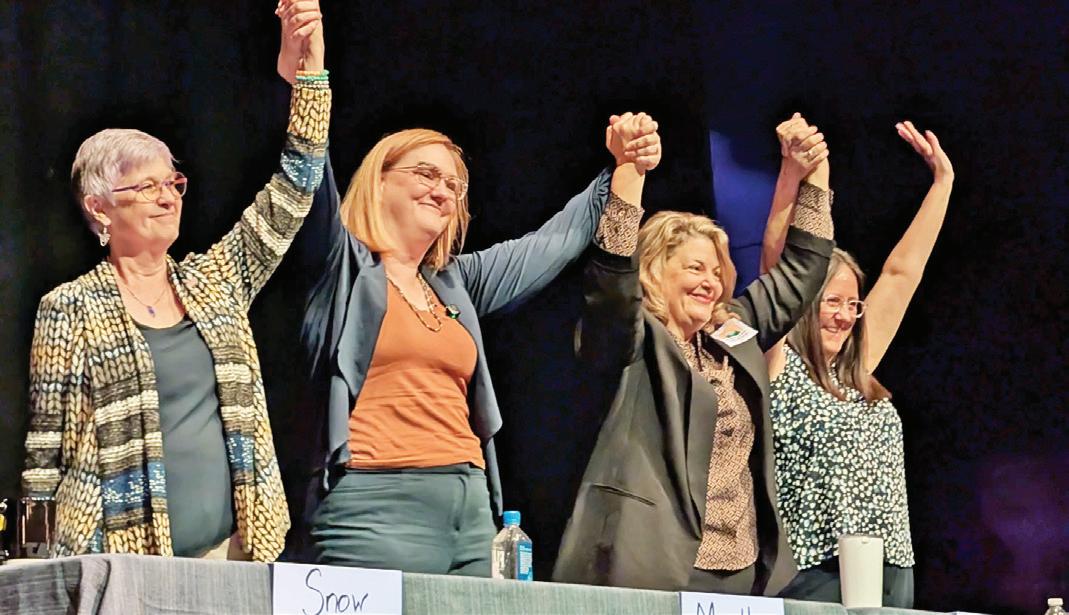
The 2nd District Democratic candidates gathered for town hall meetings in Klamath Falls, Grants Pass and Medford this weekend. The candidates include Patty Snow of Phoenix, Rebecca Mueller of Medford, Dawn Rasmussen of The Dalles, Mary Doyle of Bend and Peter Quince of Ashland. Quince only recently filed to run, so he wasn’t included in these most recent town halls. But the party said he’d participate in future events.
Organizers said the town halls were intended in part to draw attention to the fact that Bentz has not held an in-person town hall in Southern Oregon in more than a year and a half. Bentz said he canceled in-person town halls due to disruptions by activists.
The candidates criticized federal immigration enforcement efforts, citing recent deadly encounters in Minnesota in which two people were killed during operations by federal immigration officers.
“For any of you who didn’t think we’re an authoritarian government, think again,” said Snow, who described herself as a “purple Democrat.” “These people have been militarized to invade our streets, to separate children from their parents, to send people to facilities in states far away and then never to be heard from.”
All the candidates have agreed to support each other, regardless of who wins the primary on May 19. The winner faces an uphill battle in the heavily Republican district, where Democrats are outnumbered almost two-to-one.
Mueller, a pediatrician at La Clinica, said that Democrats need to think differently about how they approach this district if they want a chance at winning.
“We have had decades of the same speeches, of the same talking points,” she said. “And yet every cycle we point the finger at the other guy, and less and less gets done.”
Republicans have held the 2nd District for more than four decades, beginning in 1980, when Denny Smith defeated longtime incumbent Al Ullman during the Reagan landslide. Recently, Democrats were closest to taking the district during Trump’s first term in 2018, when Jamie McLeod-Skinner got 39.4% of the vote.
This year, candidates said they hope to capitalize on voter frustration over immigration enforcement and the affordability crisis.
Democratic candidates for
“The common theme is that there are a lot of corporations that are controlling every aspect of our life,” Rasmussen said, referring to rising prices. “They are charging us more and more. I am mad. I am furious, and I’m ready to fight all these inflationary, predatory tactics that these corporations are inflicting upon us.”
The Democrats will also have to raise a significant amount of money to match Bentz’s war chest. According to campaign finance reports, Bentz had more than $1.3 million cash on hand at the end of 2025, including donations from corporations like Toyota, Chevron and Paramount. He also receives some support from the Republican Party. Meanwhile, all five Democrats have raised just $57,000 total so far.
“I know how to ask the right questions and to follow the money,” said Doyle, a public-school teacher. “Because who has the money currently is who has the most power, and that’s why we need to take money out of politics and end corruption.”
Bentz is facing at least two challengers in the Republican primary. Andrea Carr from Chiloquin says she’s a progressive Republican who believes many politicians are too focused on corporations and special interests and not the community. Peter Larson, a teacher in La Grande, has been critical of Bentz, particularly regarding his decisions to vote for cuts to Medicaid and SNAP benefits.
Roman Battaglia is a regional reporter for Jefferson Public Radio. After graduating from Oregon State University, Roman came to JPR as part of the Charles Snowden Program for Excellence in Journalism in 2019. He then joined Delaware Public Media as a Report For America fellow before returning to the JPR newsroom.
Four of the
Oregon’s 2nd Congressional District at a town hall in Medford, February 1, 2026. From left to right: Patty Snow, Rebecca Mueller, Dawn Rasmussen and Mary Doyle.
PHOTO
ROMAN
BATTAGLIA/JPR NEWS
MAY 12-19, 2026
JPR’s 5th Annual Online Auction is an exciting way to raise funds for JPR, while bidding on one-of-a-kind items... including getaways and gadgets, gift certificates for fine dining, wine from regional producers, relaxing spa excursions, care packages and so much more.
ww w.ijp r.org/au c tion
Thanks to the generous support of our auction donors, every penny raised supports JPR’s service to the region. Your participation also makes this event possible!
JPR NEWS FOCUS ARTS & CULTURE
FRANCISCA BENITEZ & SHERAZ SADIQ
In October, OSF shipped an inky blue robe with gold threading on the collar and sleeves overnight to New York, where it was worn by Bad Bunny on Saturday Night Live.
From Regency Gowns to Cowboy Chaps, Oregon Shakespeare Festival Does Brisk Business in Costume Rentals
A group of culinary students from the Siletz Valley School was recently invited to cook under a trio of world-renowned Indigenous chefs.
In a warehouse in Talent, Oregon, OSF provides costumes for productions across the country.
For more than 20 years, Oregon Shakespeare Festival Costume Rentals has been making costumes and accessories created for its productions available to rent by local theater companies, academic institutions, film and photo shoots, and TV shows like “Saturday Night Live.”
OSF Costume Rentals Supervisor Celina Gigliello-Pretto and OSF Director of Productions Malia Argüello joined OPB’s “Think Out Loud” to talk about OSF’s vast collection, starting with how the festival started renting costumes to other organizations.
“I think it was just a combination of having something and needing something, honestly,” Argüello said. “We create so many costumes for the Oregon Shakespeare Festival, and our artisans are absolutely incredible.
“We realized there really was a life beyond just OSF. And wanting to share the artistry of our staff and, of course, create some revenue for the theater, because theaters are always looking for revenue.”
Argüello said OSF has a uniquely expansive costume stock with more than 30,000 costumes and accessories.
“Being able to store that much, take care of that much, we’re very lucky to have a staff who knows the inventory and can help other organizations out to find what they need, because they have such an encyclopedic knowledge of what’s there,” she said. Organizations can browse the online catalog, add to cart and check out. After completing a rental agreement, the costumes are boxed and shipped across the continental U.S.
OSF has institutional discounts to assist organizations with costume rentals, but they don’t currently rent to individuals. Gigliello-Pretto said final sales to individuals are something that’s under discussion for the future.
In October, OSF shipped an inky blue robe with gold threading on the collar and sleeves overnight to New York, where it was worn by Bad Bunny on Saturday Night Live. The Puerto Rican rapper was a guest host on the show. He wore the robe in a skit where he played a Spanish nobleman from the Middle Ages.
An Elizabethan gown with 23 interlocking pieces is shown in this photo taken on Jan. 21, 2026 at the Oregon Shakespeare Festival Costume Rentals department in Talent in Southern Oregon. The gown is one of more than 30,000 costumes and accessories OSF Costume Rentals makes available to rent for academic institutions, local theaters, TV shows and other productions.
“I do love seeing the clips they come up, and I’ll go, ‘Oh my God, they actually used it,’” Gigliello-Pretto said. “I love our relationship with SNL. We’re very grateful for it.”
The costumes are stored in a 72,000-square-foot warehouse located in Talent, separate from the OSF campus in Ashland.
JPR News Focus: Arts & Culture
Continued from previous page
“I love the reaction that people have when they walk in. They just have never seen that many clothes in one space before,” Gigliello-Pretto said.
The vast digital inventory includes thousands of costumes and accessories, from elaborate Elizabethan gowns and silky Regency dresses to velour smoking jackets and butterfly-collared shirts, organized by era in the room.
Gigliello-Pretto said she notices trends in the requests for costumes. For example, Victorian-era costumes are in greater demand around Christmas, when theaters stage productions of “A Christmas Carol” and “Christmas at Pemberley.”
Netflix’s hit Regency-era show Bridgerton has also had an impact, according to Gigliello-Pretto.
“A lot of people, since Bridgerton came out, a lot of high schools were really interested in doing Pride and Prejudice and things like that. So we’ve also beefed up our Regency era a little bit since then,” she said.
The costumes are built to be alterable and sturdy enough to withstand many productions.
“Every closure and trim, zipper, button … all of that is designed and put into that garment specifically for that show, for that world,” Gigliello-Pretto said. “The product is just not the same as something you could buy at Forever 21 or H&M or The Gap.”
“The fabrics are going to be thicker, the zippers are going to be sturdier. Everything is made to last,” Argüello said.
Francisca “Frankie” Benitez is a digital producer at OPB, a JPR news partner. Originally from La Grande, Francisca graduated from the University of Oregon School of Journalism and Communication in 2018. Sheraz Sadiq is the managing producer of OPB’s “Think Out Loud.” He is an award-winning producer and journalist who has created television, radio and digital content for over two decades. Their reporting comes to JPR through the Northwest News Network, a collaboration between public media organizations in Oregon and Washington.
Disclosure: The Oregon Shakespeare Festival is an OPB sponsor. OPB’s newsroom maintains editorial independence and is not informed by financial support to the organization.
At the Oregon Shakespeare Festival’s warehouse in Talent, Ore., costumes are organized by era. Undated provided image.
Boots for costumes hang in rows in the Oregon Shakespeare Festival warehouse in Talent, Ore., in this undated provided image.
COURTESY OF JOE SOFRANKO
COURTESY OF JOE SOFRANKO
RECORDINGS
Who is Tyler Ballgame?
The emerging singer/songwriter Tyler Ballgame just released his debut—For The First Time, Again. It’s steeped in classic rock sounds, giving a platform to Ballgame’s honest and thoughtful songwriting, and his dynamic voice that’s drawn comparisons to Roy Orbison.
Tyler Perry was born in Rhode Island in 1987. He was in musical theater as a kid which led to a stint at Berklee School of Music studying songwriting. He struggled in college due in part to depression. Inspired early on by Nick Drake and Elliott Smith, his songwriting tended toward the melancholy. After dropping out of college, he returned home, living in his mom’s basement and working for his father.
Tyler sought counseling for his depression and body image issues, which helped improve his self-confidence. At 29, on a whim, he moved to LA to pursue music in earnest, working for a real estate company by day and hitting open mics at night. He would play his songs, and then wrap with Roy Orbison’s Cryin’, which is always a crowd favorite.
From there, Tyler worked on his alter ego—Tyler Ballgame— inspired by baseball great Ted Williams, who was known as “Teddy Ballgame.” The name was a bit of self-deprecating humor, a persona that described something he was not. He imagined what Tyler Ballgame might sound like, and the kinds of songs he would write. He drew on all of his musical inspirations including classic rock from the ’60s, show tunes, grunge and even Fleet Foxes.
After moving to East L.A. and collaborating with other musicians in the neighborhood, Ballgame caught the attention of producer Jonathan Rado whose work includes Miley Cyrus and The Killers. Over the course of a few weeks, the pair wrote and recorded more than an album’s worth of new material.
Word of his unique voice and deeply personal songwriting got around. Ballgame had his choice of labels wanting to release For The First Time, Again. He settled on the British indie label Rough Trade. He says that he felt like they shared his musical tastes having already released albums by musicians he appreciated.
The album begins with the title track. It sounds like something from Bob Dylan’s Nashville Skyline, with a simple chord progression on an acoustic guitar. Tyler sings about a desire to find the excitement of a new relationship while getting to know someone on a more emotional level in spite of familiarity.
The advance single, I Believe in Love, sounds like a pep talk he’s giving himself in the hopes of maintaining his faith in the positive in spite of the pitfalls. He asks “was it so naïve to think it wanted me alive?”
Ballgame channels Allan Watts’ thoughts on the ego being an obsolete vehicle for human consciousness in the song Bought a New Car. It’s about letting go of past ways of thinking
Ballgame had his choice of labels wanting to release
For The First Time, Again.
and embracing the new with the same sort of feeling one gets from buying a new car.
The comparison to Roy Orbison’s vocals is evident on Deepest Blue. It’s another song about the fits and starts of love, with Ballgame effortlessly sliding between the highs and lows of his expansive vocal range for a dynamic delivery.
Matter of Taste is a cultural critique with a ‘70s folkrock vibe. The theme is that authenticity matters more than approval. Once again, Ballgame seems to be giving himself a pep talk about doing what makes him happy and not worrying about how it’s perceived.
For The First Time, Again was released in late January. It’s a collection of songs about hope, personal growth and universal lessons. Most importantly, the songs seem to be self-reflective and cathartic for Tyler. His honesty gives these tunes authenticity. The familiar folk-rock style makes it easy to listen to, but avoids sounding derivative. It’s a strong debut and a good introduction to someone with a complex history.
I suspect we’ll be hearing more from him.
Tyler Ballgame is performing in Medford at The Holly Theatre on March 31st, in support of St. Paul and the Broken Bones.
Dave Jackson curates the music on JPR’s Rhythm and News Service, manages music staff and hosts Open Air, JPR’s hand-picked house blend of music, JPR Live Sessions and Open Air Amplified. The exploration of music has been one of his lifelong passions.
DAVE JACKSON
JPR NEWS
FOCUS WEATHER
ALEJANDRO FIGUEROA
The last time Oregon had a record low snowpack, in 2015, the entire state was either under severe or extreme drought conditions toward the latter half of the summer, and 25 out of the state’s 36 counties had declared a drought of emergency.
Oregon’s Record Low Snowpack Is Not Likely to Recover, Scientists Say
If conditions don’t change, it could spell a challenging year ahead for cities, aquatic wildlife, outdoor recreation, farming, hydropower facilities, and, possibly, a longerlasting wildfire season.
An unusually warm, sunny and dry winter has brought with it little snow across much of the Pacific Northwest. And scientists say it’s unlikely Oregon’s record low snowpack will recover before the end of winter.
While Washington and Idaho are struggling, they appear to be in better shape than Oregon.
Those two states have reported warmer winter temperatures with some rain and some slightly better snowpack conditions toward their northern borders, whereas a mid-winter dry spell continues to loom across much of Oregon.
Oregon’s current statewide average snowpack—measured by how much water is trapped in the snow—is its lowest on record, at 2.9 inches. That’s nearly 30% lower than the previous record-breaking low snowpack in 2015.
Historically, January is a significant month for snow accumulation in much of the Pacific Northwest. This January, that didn’t happen.
And now, the chances of recovery are low, said Larry O’Neill, Oregon’s state climatologist.
“Our snowpack is doing really poorly, and at this point in time, a big recovery in the snowpack is really not likely based
on historical conditions of the typical amount of snow we get between now and the end of the snow season—typically around April 1,” he said.
Scientists attribute snow drought conditions to climate change, primarily caused by humans burning fossil fuels. O’Neill said it’s harder to say this year’s weather conditions were solely caused by climate change, but the warmer, drier winter does reveal something.
“This one winter doesn’t necessarily tell us it was caused by climate change,” he said. “But we know that the winters in the coming decades are going to be much more like this. And I think the story here is to look at how impactful these conditions are to us, because we know we’re going to expect them more in the future.”
Uncertain summer conditions
The last time Oregon had a record low snowpack, in 2015, the entire state was either under severe or extreme drought conditions toward the latter half of the summer, and 25 out of the state’s 36 counties had declared a drought of emergency. At one point that year, Oregon became the nation’s No. 1 wildfire priority
By then, many farmers and ranchers across Central and Eastern Oregon had already been dealing with multi-year droughts and low streamflow for irrigation.
Josh Bailey, the general manager at the North Unit Irrigation District in Central Oregon—one of the largest irrigation districts in the state—said he’s optimistic the region could still see some good snowpack buildup before the irrigation season begins.
“However, if we don’t, we can expect another year of subpar [water] allotments for district patrons,” Bailey said. “I don’t have any expectations of what that will be, as a lot can change between now and April 1.”
Continued on page 40
Still image from Mt. Ashland’s Lodge webcam, February 12, 2026.
A U.S. Department of Agriculture map of snow drought in the West as of Feb. 11, 2026.
DIRK VANDERHART
POLITICS & GOVERNMENT
House Bill 3991, included a 6-cent increase to Oregon’s 40-cent-per-gallon gas tax, substantial hikes to vehicle registration and titling fees, and a temporary doubling of a tax that funds public transit.
‘Budget Pothole’: Oregon’s Transportation Funding Challenge Comes into Clearer Focus
Lawmakers are looking at freezing open positions and pulling money from certain programs as they work to avoid deep layoffs at the Oregon Department of Transportation.
Oregon lawmakers on the hunt for money to balance the state’s transportation budget offered a look Tuesday at the difficult math problem before them.
The goal: plugging a $242 million hole in the current Oregon Department of Transportation Budget, and finding about $46 million more to make sure the agency has a financial buffer.
There are few simple options.
Declining to fill 138 of ODOT’s hundreds of vacant positions could offer up $70 million in savings, but it would also mean the sprawling agency is without staff once deemed necessary. Deeper cuts explored by ODOT would slash even more unoccupied jobs, but also require laying off active workers—as many as 400 under the most draconian possibility floated by the agency. Lawmakers appear unlikely to go to such lengths.
“We are down almost 700 vacant positions,” Lisa Sumption, ODOT’s interim director, told lawmakers at a legislative hearing on the budget gap. “Everyone is carrying the workload of two or three people.”
Shifting money currently dedicated to ODOT programs and projects could yield money to pay for basic road upkeep, but will be unpopular with whichever constituencies count on that money.
Up for potential grabs as lawmakers scout for funds: money that pays for bicycle and pedestrian upgrades near schools, strengthens bridges to withstand earthquakes, helps build out electric vehicle charging stations, subsidizes the state’s passenger rail system, improves marine terminals and airports, and much more
“The impact is you’re delaying projects,” Daniel Porter, administrator of ODOT’s budget division, told a legislative committee. “That’s the tradeoff we’re having to consider.”
One change that is likely to be an easy call? ODOT believes lawmakers can free up $85 million in state funding currently obligated to a host of highway projects lawmakers approved in 2017. Federal money would pay for the work instead.
What mix of cuts and funding shifts lawmakers ultimately choose will be answered later in this year’s one-month legislative session. Sumption and others stressed Tuesday there are few good options in an agency that has cut spending on nutsand-bolts services repeatedly in recent budgets.
“We’re looking at a budget pothole that gets deeper every time a tire hits it,” said state Rep. David Gomberg, D-Otis, cochair of the committee that oversees ODOT’s budget.
Unionized ODOT employees and their supporters walked the halls of the Capitol on February 10 to make the case that lawmakers should salvage agency jobs.
The state’s road funding quagmire is the product of a political drama that has immersed the Capitol in the last year.
With ODOT’s revenues unable to keep pace with agency expenses, Oregon lawmakers spent much of last year working toward an ambitious funding package that could set the agency up for nearly a decade. That bill failed, forcing Democrats to scramble to pass a stop-gap funding bill in a hastily called special session.
That bill, House Bill 3991, included a 6-cent increase to Oregon’s 40-cent-per-gallon gas tax, substantial hikes to vehicle registration and titling fees, and a temporary doubling of a tax that funds public transit. But Republicans uniformly opposed the bill, arguing ODOT should better prioritize its existing money rather than look for more.
Continued on next page
Oregon Department of Transportation crews clean up after a wind storm toppled trees and downed power lines in late December 2025.
PHOTO COURTESY OF ODOT
Weather
Continued from page 38
Farmers and ranchers have not received a full allotment of water since 2018 in that district.
Bailey does point at one bright spot, the Wickiup Reservoir—which supplies water to the district—is currently 83% full.
“This is beneficial, but it’s important to understand how the Cascade system operates: there is roughly a nine-month delay in the effects of water levels,” he said. “This means that the water availability we see now is a result of last year’s snowpack. If we don’t receive significant snowfall this season, it will certainly affect us this year, and we will likely experience a severe drop next season as well.”
As far as wildfire season this year, Karin Bumbaco, the deputy state climatologist for Washington, said it’s too early to tell what it will be like. It will depend on spring conditions.
“Usually when we have a low snowpack like this, and it melts out earlier than normal because it’s less-than-normal [snowpack], we just have a longer fire season,” Bumbaco said. “So once it dries out, we just have a bigger window of opportunity for fires to start.”
Alejandro Figueroa is a reporter for Oregon Public Broadcasting, a JPR news partner. His reporting comes to JPR through the Northwest News Network, a collaboration between public media organizations in Oregon and Washington.
Thinking about selling your car, boat, truck, motorcycle, or other vehicle?
Avoid the hassle and get a tax deduction by donating it to JPR instead!
Here’s How it Works
Simply call 844-577-2886 or fill out the web form at www.jprauto.org and we’ll take care of the rest, including pick-up, at no cost to you.
Once your vehicle has been sold, we’ll send you a receipt for your tax records, and the sale proceeds will be donated to JPR in your name. You will also receive a one-year membership to JPR.
Politics & Government
Continued from previous page
A GOP-led effort gathered enough signatures to put the tax and fee hikes before voters for approval. They are blocked until that vote occurs—either in November or May—meaning ODOT has a funding gap.
Gov. Tina Kotek has said she will lead a fresh effort to pass a transportation funding package next year. In the meantime, the Democrat has offered only one line in the sand to lawmakers looking for cuts: She won’t touch state funding that helps prop up public transit agencies statewide.
That funding, roughly $137 million per year, has been a focus of Republican lawmakers as they look for ways to shift money in the state’s transportation budget.
Meanwhile, others are offering ideas for places lawmakers can look. Move Oregon Forward, a coalition of progressive groups, has offered a “cheat sheet” to legislators that includes options that weren’t included in ODOT’s proposal on Tuesday.
Among them, the coalition suggests ODOT take on shortterm debt to close the budget gap. It also proposed redirecting money currently set to go toward a stalled proposal to widen and cap Interstate 5 as it travels through Portland’s Rose Quarter.
“This is not a zero-risk proposition,” said Indi Namkoong, the transportation justice coordinator at the environmental nonprofit Verde, who helped create the proposal. “There’s risk any way we move here… We have to look at what is the least harmful path out of this situation.”
The transportation funding gap is only one budgetary puzzle lawmakers are trying to solve this legislative session. A separate question is how the Legislature can fill a roughly $650 million hole in the state’s general fund budget, which does not go toward roads or other transportation system needs.
Dirk VanderHart covers Oregon politics and government for Oregon Public Broadcasting, a JPR news partner. His reporting comes to JPR through the Northwest News Network, a collaboration between public media organizations in Oregon and Washington.
Rep. David Gomberg (D- Otis) attends the opening day of the legislative short session in Salem, Ore. on Feb. 2, 2026.
JPR NEWS FOCUS SCIENCE & ENVIRONMENT
JULE GILFILLAN
It was these features that greeted early visitors as they made their way to the rim in horse-drawn carriages through the park’s old east entrance.
How Spectacular Rock Pinnacles Got Lost Behind the Scenes at Crater Lake National Park
What used to be a famous geological attraction has fallen into obscurity.
Tucked away in a forgotten corner of Crater Lake National Park, a series of extraordinary rock spires tower over a meandering creek.
Today, they’re hidden behind the scenes of the park’s main attraction: Crater Lake. The epic size, dramatic framing and vivid blue of the 2,000-foot-deep lake never fail to dazzle visitors. Formed after the eruption of Mount Mazama some 7,700 years ago, the site became the country’s fifth national park in 1902.
What modern tourists may not realize is that early visitors entering the park in horse-drawn coaches were treated to another spectacle known as the “Pinnacles.”
“The Pinnacles are so spectacular,” said former Crater Lake National Park ranger Larry Smith. “I’ve traveled in all 50 states. I’ve been in over 50 national park areas. I’ve never seen anything like this anywhere. They’re one of a kind.”
Smith, along with his twin brother Lloyd, served as volunteers at the park long after retiring from their ranger jobs.
“Even though I’ve seen them hundreds of times, I kinda get goosebumps looking at them,” Smith said.
Prior to its eruption, Mount Mazama, known as “Giiwas” to the Klamath people, was a massive peak made up of overlapping volcanic structures described as the “Mazama complex.” It appeared as a broad mountain of about 12,000 feet and amassed glaciers in its drainages like other peaks in the region. The cataclysmic eruption 7,700 years ago spewed superheated volcanic material across the Pacific Northwest and formed a deep caldera into which centuries of rain and snow gathered to form present-day Crater Lake.
On the slopes that remained of the mountain, pyroclastic flows filled the glacier-cut valleys with a slurry of molten debris.
“Think hot toothpaste,” Smith said. “Then, because the glaciers had melted, steam pockets formed down at the bottom of the canyon—and of course steam rises.”
As the steam forced its way upward through the volcanic rubble toward the surface, the superheated vapor welded the sides of its escape hatches into hardened chimneys, also known as fumaroles
Over the centuries, the lighter ash and pumice that filled the ancient glacial canyon after the eruption was carried downstream, revealing the relic pinnacles. Eventually, the gray monoliths stood alone as slender and delicate as spires on a Gothic cathedral, and now they tower above the steam bed below.
It was these features that greeted early visitors as they
made their way to the rim in horse-drawn carriages through the park’s old east entrance. Postcards and photos of the eerie monuments drew more visitors. But not for long.
By 1920, cars had become a common mode of transportation and required a new entrance to the park. Eventually, the original eastern approach was abandoned, and the eerie spectacle that is the Pinnacles was all but forgotten.
Early tourists to Crater Lake National Park enjoyed the spectacle of the “Pinnacles” near the old east entrance of the park in this image taken circa 1915.
A photograph taken by former park ranger Lloyd Smith in 1975 captures a view of the mysterious Pinnacles located in a remote part of Crater Lake National Park.
Support JPR Today
Contribute at least $60 annually, or become a sustainer with ongoing monthly contributions of any amount. Do your part to support public radio in southern Oregon and northern California and you'll also receive an annual subscription to the Jefferson Journal.
Please fill out the form below and mail it to: Jefferson Public Radio Attn: Membership 1250 Siskiyou Blvd Ashland, OR 97520
Contributions can also be made online at ijpr.org/support
Enclosed is my gift for $___________.
The JPR services I enjoy are: Classics & News Rhythm & News News & Information
Science & Environment
Continued from previous page
But according to Smith, the story of the Pinnacles is still unfolding.
“What’s so unique here is that the erosion is continuing. Wheeler Creek is moving in underneath where we’re standing right now and it’s being undercut, and those pinnacles are going to fall in.”
Standing on the high ground beside the Pinnacles’ canyon in September 2024, Smith pointed to his feet.
“As the creek moves this way, it’s going to continue carving,” he said, “and there are probably more fumaroles under where we’re standing.”
Today, the Pinnacles are all but hidden in a remote corner of the park and accessed by a secluded walking path . Despite their obscurity, Smith said, the haunting specter of the Pinnacles remains a secret gem in Oregon’s rich landscape.
Jule Gilfillan is a writer and producer for OPB’s science and environment series “Oregon Field Guide.” Since coming to OPB in 2010, she has received many honors, including Society of Professional Journalists awards, more than a dozen Northwest Emmys and a Gracie from the Alliance for Women in Media. Her reporting comes to JPR through the Northwest News Network, a collaboration between public media organizations in Oregon and Washington.
Twin brothers Larry and Lloyd Smith, pictured here circa 1979, spent many years as rangers at Crater Lake National Park. Larry, left, guided the “Oregon Field Guide” tour of the “Pinnacles” in August 2024.
This animated frame from OPB’s “Oregon Field Guide” story on the lost Pinnacles of Crater Lake shows how these geologic features emerged on the landscape following the eruption of Mount Mazama and centuries of erosion.
JPR NEWS
FOCUS ARTS & CULTURE
VANESSA FINNEY
The goal is to deepen emotional engagement and create a sense of presence that traditional museum viewing cannot replicate.
An Ashland Company Uses Virtual Reality to Change How People Visit Art Museums
Based in Ashland, Art Authority blends fine art, technology and longstanding museum partnerships to create an immersive, customizable virtual museum experience.
Art museums have traditionally been defined by their physical spaces, fixed hours and geographic limits. But Art Authority Museum, a new immersive digital space developed by Alan Oppenheimer’s team at Art Authority, aims to expand how museums present and share art.
Launched in 2024, the Art Authority Museum app curates virtual masterpieces from across history and around the world, reimagining what a museum can be in the age of virtual reality, artificial intelligence and global connectivity.
“Our mission is to bring all the world’s art to all the world,” Oppenheimer said.
A museum without walls
The Art Authority Museum exists entirely in digital space. Users can explore galleries through Apple devices, with the most immersive experience available through the Vision Pro headset.
“The Art Authority Museum is a new type of art museum,” Oppenheimer explained. “The only main difference between the Art Authority Museum and traditional museums is it has no physical presence.”
With the headset, visitors can step into virtual galleries and curated rooms that resemble a traditional museum. Unlike physical museums, the digital museum is open around the clock and accessible from anywhere.
“Because it’s an app, it can be open 24 hours a day, seven days a week,” Oppenheimer said. “It can do magic, things like spin up rooms in seconds versus years.”
Personalization and AI-powered discovery
Personalization is a central feature of the platform. Members receive their own private virtual lounge, a concept Oppenheimer says has no equivalent in traditional museums.
“You can take any art off the wall of our museum, put it in your members’ lounge and hang out with one work or 100 works,” he said.
Artificial intelligence helps users discover art in intuitive ways. With a few gestures, users can generate entire rooms of artwork similar in style, subject or composition to a piece they love.
“If you’re looking at the Mona Lisa and you go, ‘I would like to see other works like the Mona Lisa,’ we magically create, within a second or two, a room of works like the Mona Lisa,” Oppenheimer said.
The system uses an algorithm to analyze both the selected artwork and Art Authority’s database of more than 100,000 works to make recommendations.
Stepping inside art with spatial scenes
Art Authority leverages Apple’s spatial computing technology to immerse viewers inside iconic works of art, transforming paintings and photographs into explorable environments.
Continued on page 45
HEATHER ARNDT ANDERSON
Fae Flower Cordials and Other
Posey Preserves
Cordials, pickles and jellies that’ll make you feel like fae royalty
The weather has been glorious, everything is blooming and all I want to do is go on magical little strolls and fill baskets with gobs of fragrant blooms like the protagonist of a Victorian romance novel. That’s why, instead of a recipe, I’m waxing enthusiastic about things you can do with edible springtime flowers.
Flower cordials (flordials?) and syrups are the easiest and most versatile ways to preserve flowers — you’re basically just making very sweet and/or boozy tea, which you can then add to lemonade, sparkling wine, cocktails, seltzer, or even drizzle on pancakes. Flower jellies, too, are an unexpected treat for toasted English muffins or scones.
You could also ferment them into kvass or kombucha America’s first bottled kombucha brand, Portland-based Oocha Brew, had a fragrant rose kombucha that I especially liked (the company shuttered in the 1990s because they couldn’t keep the ‘booch from becoming boozy as it continued fermenting in grocery store refrigerator cases).
Violets are one of my garden’s weeds, and even though I have lots of the plants, the flowers are very fiddly to pick (and harvesting those shorties is not great on the knees). I recommend enlisting child labor for this task. Victorians were mad about violets, not just because they’re a symbol of faithfulness and modesty, but because they’re great candied or in liqueurs. Store-bought crème de violette doesn’t even come close to capturing the essence of a violet, so if you’re hankering for a Blue Moon cocktail you might try making your own violet liqueur.
Lilacs are another spring bloom that are splendid in syrups and jellies or candied to festoon cakes and cookies. And I know I’ve gushed about cherry blossoms many times, but they really do make a superb sour mix to drink with a sparkling sake or mixed with shochu for a very kawaii chuhai.
In the same vein, last year I learned about pickling magnolias, so I decided to give it a shot this year. I was delighted to discover that they have a delicately floral, slightly gingery/spicy flavor that’s ideally suited to a sweet pickle. I’ve seen some folks use magnolia pickles to make vegan sushi, and I bet they’d be a perfect pairing for salmon sashimi too.
Anyway, here are just a few ideas for enjoying the bounty of spring blooms.
Note: You can also use dried flowers to make syrups — hibiscus makes a lovely sour syrup for aguas frescas and butterfly pea (which is flavorless) is handy for adding a touch of blue to your syrups, but it will turn pink if you add acidity.
OPB’s “Superabundant” explores the stories behind the foods of the Pacific Northwest with videos, articles and a weekly newsletter. Every week, Heather Arndt Anderson, a Portland-based culinary historian, food writer and ecologist, highlights different aspects of the region’s food ecosystem. Her work comes to JPR through the Northwest News Network, a collaboration between public media organizations in Oregon and Washington.
Ingredients
Handfuls of edible spring flowers such as cherry blossom, violet, lilac, grape hyacinth, magnolia, and/or calendula
For syrups: Sugar and lemon juice or citric acid
For cordials: Sugar, lemon juice and vodka
For jelly: Sugar, lemon juice and pectin
For vinegars: Vinegar (rice, apple cider or champagne vinegar works well here)
For pickles: White, rice or apple cider vinegar, sugar and salt
Instructions
To make flower syrups, place blossoms in a pot and add enough water to cover the flowers. Bring to a boil, turn off the heat, and allow the flowers to steep for 10-15 minutes, then strain, add an equal volume of sugar (e.g., if you have 1 cup of liquid, add 1 cup of sugar) and stir to dissolve. Stir in lemon juice or citric acid to your preference — the flavor and color brightens up a lot with acidity, but I also like to add a little extra citric acid to turn syrup into a sour mix. Bottle and refrigerate once cooled.
To make flower cordials, make the syrup above and then add an equal amount of vodka. This is shelf-stable but may lose color over time.
To make flower jelly, make the syrup above and then add pectin (to make about a pint of jelly, I stirred about ¼ cup of pectin into 12 ounces of hot syrup). Boil for a minute, then pour the hot jelly into clean jars. You can either process the jelly for long term storage using a boiling water bath, or you can let it cool and then stash it in the fridge.
To make flower vinegars, stuff blossoms into a jar or bottle and cover with vinegar. You can use a combination of flowers or keep it single note (sprigs of flowering herbs are nice here too — my rosemary has begun blooming and I added some to the calendula vinegar).
To make pickles (in this case, magnolia buds and petals), layer the flowers in a jar. For every cup of vinegar, add 2 tablespoons of sugar and 1 tablespoon of salt, stirring until dissolved (warming the vinegar speeds this up). I added a little slice of ginger and a sakura bud to make it prettier.
Art & Culture
Continued from page 43
“You can totally feel like you are in ‘The Last Supper,’” Oppenheimer said. “Lean in to the painting, and you’re part of the scene.”
The goal is to deepen emotional engagement and create a sense of presence that traditional museum viewing cannot replicate.
Restoring lost masterpieces
One of the museum’s most striking projects is the virtual recreation of “Skygate, New York,” a monumental sculpture by Louise Nevelson that was destroyed in the Sept. 11 attacks.
Originally commissioned in 1978 for the World Trade Center lobby, the sculpture measured 32 feet wide and 17 feet tall. Working with the Louise Nevelson Foundation and Nevelson’s granddaughter, Art Authority used historical photographs and digital modeling.
“We realized that we could bring this work of art back,” Oppenheimer said. “We’re not going to create a 32-foot-wide physical copy, but we can do it virtually.”
The sculpture was reintroduced on Dec. 12, the anniversary of its original dedication, and now fills an entire wall in the museum’s Nevelson gallery.
Access, membership and supporting museums
The app is free to download, and visitors can explore the museum lobby and select exhibitions at no cost.
Membership unlocks additional galleries, advanced features and the personalized lounge, priced at $5 per month or $50 per year.
Oppenheimer said that digital access complements rather than competes with physical museums.
“When the web started, museums were maybe a little apprehensive,” he said. “It turned out to be quite the opposite. People look at works online and go, ‘Wow, I’ve got to see that for real.’”
A living, evolving museum
With more than 100 artist galleries and counting, the Art Authority Museum can respond quickly to cultural moments and collaborations.
“We can create a new room in days versus years,” Oppenheimer said.
Recent examples include a gallery of popes throughout history, special exhibitions from major institutions like the Brooklyn Museum and the Phillips Collection, and galleries from living artists exploring the medium firsthand.
You can learn more—and sign up for a demo of Apple Vision Pro—at artauthority.museum.
Vanessa Finney is JPR’s All Things Considered host. She also produces the Jefferson Exchange segments My Better Half — exploring how people are thriving in the second half of their lives — and The Creative Way, which profiles regional artists.
POETRY
CHER SIDES & YANNIGAN OWEN
From
the North The Scout
it’s only the wind that riffles the marsh now deserted by bright wings and gabble of waterfowl only the wind sibilant, harsh, a ceaseless exhalation that silences woodpecker, jay, crow and the chattering kingfisher wind, the only presence if not for the creaking of trees and small rebellious birds that chitter from brushy shelter
today the wind shouts ten thousand lesser voices will have the last word
—Cher
Sides
Cher Sides is a retired nurse who revived her interest in writing in recent years. Always a “woodsy,” she explores the interconnections of our lives with the natural world, of which we are a part. She lives with her spouse, Bill, at forest’s edge in Bandon, Oregon.
As climate changes, the dry detritus and slash remaining after long indifference become a thicket that has taken our expedition off course.
To find our route again, I look beyond the col where rock cairns have been left by others to mark the way across the granite talus that has buried the trail we are following. The conical mounds of stone point to where the trail resumes its journey to our destination.
I call the others over.
—Yannigan Owen
Yannigan Owen is a 24-year resident of Ashland, having been lucky enough to end his 32-year career with the U.S. Forest Service in the Rogue Valley. Growing up in the Bay Area and the Sierras with blue-collar parents and grandparents, he’s always had respect for the integrity of what we once called the working class
Writers may submit original poetry for publication in Jefferson Journal
Email 3–6 poems, a brief bio, and your mailing address in one attachment to jeffmopoetry@gmail.com , or send 3–6 poems, a brief bio, and a self-addressed, stamped envelope to: Amy Miller, Poetry Editor Jefferson Journal 1250 Siskiyou Blvd. Ashland, OR 97520