
This publication summarises our sustainability work in 2025. It draws on information from Kährs Group's 2025 Sustainability Statement, which forms part of our CSRD-compliant integrated annual report. The sustainability statement has been subject to limited assurance by an independent third party. This document has not been separately assured and is intended for informational purposes only. For full disclosures, methodology, and assured data, please refer to Annual Report Kährs BondCo AB (publ) available on Kährs Group’s website.
“Scandinavian design is not about styling; it is rooted in a deep respect for the raw material, a commitment to functionality, health, and a lighter footprint. Creating floors beyond expectations requires an attitude of excellence and the courage to explore outside the streamlined boundaries of shortterm trends.”
Emanuel Lidberg, Head of Design

A major focus for us at Kährs during 2025 has been to truly integrate sustainability across the entire company and throughout our value chain. Our work is guided by a double materiality assessment and a clear sustainability strategy, focusing on the most significant impacts, risks, and opportunities across climate, circularity, and our full value chain.
We have developed a sustainability statement compliant with the European Union’s Corporate Sustainability Reporting Directive (CSRD), which has been integrated and published within Kährs Group’s annual report. This has required strong focus and collaboration across the whole organization, as well as a more robust governance structure to ensure accountability and execution.
Significant progress has been made within our own production, transitioning to renewable energy across all our sites, alongside the continuous work to reduce emissions across Scope 1, 2, and 3 in line with our targets. We have also established follow-up processes for our suppliers, ensuring better insight and control, while starting to work towards shared goals across the value chain, including upstream sourcing and downstream impacts.
At the same time, we recognize that we operate in a context of increasing complexity and risk, including climate-related transition risks, volatility in raw material availability, and rising expectations on circularity, transparency, and responsible sourcing. Addressing these challenges will require continued focus, innovation, and collaboration across our entire value chain.
Underpinning this is our increased focus on leadership and people, recognizing that this is a critical foundation for success as a company, enabling employees to thrive, and driving sustainability courageously with a long-term perspective in mind.
Our journey began in 1857 in the heart of Nybro, Sweden. What started as a local commitment to wood craftsmanship has evolved into a global industry leader.
Our Swedish Heritage is not merely a nod to the past; it is the strategic foundation of our modern identity. By synthesizing the principles of Scandinavian Design, functionality, simplicity, and respect for nature, with rigorous governance, we bridge nearly 170 years of tradition with the transparency required of a modern industry leader.
We create "Floors Beyond Expectations" because how we work allows us to navigate today’s complex regulatory and environmental landscape with unmatched precision.
Value created for stakeholders
Customers: We deliver flooring solutions designed for long-lasting durability, good indoor air quality, and responsible use of materials.
Employees: We provide secure employment and safe working conditions for 810 people globally.
Suppliers: We foster long-term partnerships through a structured Supplier Relationship Management (SRM) system.
Investors: We offer financial resilience and transparent sustainability reporting aligned with CSRD and EU Taxonomy standards.
Integration across the company and our value chain
Kährs operates an integrated value chain, encompassing raw material sourcing, product design and innovation, manufacturing in Sweden, Finland, Romania, and Poland, and distribution across more than 70 markets. Our most important input materials include wood, polymer-based materials, chemicals, and packaging materials.
Wood Polymers Finished
Supplier due diligence across the entire supply chain
Packaging
Design & Innovation
Circular design principles
EPD’s for all product lines
Chemical Safety Review
Woodloc Patented Joint
MARKETS & CUSTOMERS PRODUCT
Key Markets
Nordics – Europe – North America
Manufacturing
Sweden, Finland, Poland & Romania
ISO 9001 & 14001 certified
Key Products
Engineered wood flooring Luxury Vinyl Tiles (LVT)
PVC-Free resilient flooring
Customers
Long-lasting, durable and quality floors that contribute to healthy indoor spaces
Trade & Specification
Retail – Wholesale –Distribution –
and safe employment
Kährs legacy is defined by industry landmarks that changed the world of flooring. These innovations share one common trait: no one expected them from us. By recognizing customer needs before they arise, we continue to deliver floors that go beyond expectations.
Our Timeline of "Industry Firsts"
• 1857: The Foundation: Our journey began in Nybro, Sweden, rooted in a deep respect for wood craftsmanship.
• The World’s First Engineered Wood Floor: We revolutionized the industry by inventing the multi-layer wood floor, a design that increased stability and preserved raw materials.
• 20+ Years of PVC-Free Innovation: Long before it was a regulatory requirement, Kährs became a proud pioneer of PVC-free floors for commercial environments, prioritizing indoor health and recyclability.
• The Woodloc® Revolution: We invented the world’s first glue-free mechanical joint in wood floors, a primary driver of circular value that enables easy disassembly, reuse, and recycling today.
• 2025: Leading the Transition: Today, this same pioneer spirit drives our SBTi-validated 1.5°C pathway and our near-total (92%) reduction in operational emissions.
At Kährs, we believe that a floor is more than a surface, it is a foundation for how we think, feel, and behave. As we look toward the future, we recognize that biophilia, the innate human need to connect with nature. is the next frontier of healthy building design.
Science shows that the spaces we inhabit directly shape our cognitive health. By bringing the Swedish forest indoors through natural wood and circular design, we create environments that:
• Support healthier behaviors: Reducing stress and improving focus through natural textures and patterns.
• Fuel the brain: Prioritizing uncompromising material health, where every floor is SVHC-free and low-VOC, to protect the air we breathe and the minds that work within our spaces.
• Enhance wellbeing: Using the principles of biophilic design to build spaces where the human mind can truly thrive.
Improving brain health isn’t only about what we do; it’s about where we are. We don't just build for today; we design for a world fit for life.
Sustainability as a Catalyst
Our sustainability strategy is not a stand-alone initiative; it is the engine of our future success and operational resilience. Guided by a rigorous Double Materiality Assessment, we have identified 17 material topics where our environmental and social impact directly intersects with our long-term business success. By focusing on these areas, we transform sustainability into tangible commercial value.
Future-Proof Products: By committing to a 1.5°C pathway and circular design principles, we deliver flooring that meets stringent green building standards and evolving customer expectations.
Supply Chain Stability: Our focus on responsible sourcing ensures a secure, traceable supply of highquality wood, mitigating the risks of resource volatility and regulatory change.
Operational Excellence: Powered by renewable energy and managing our resources effectively drives efficiency, reduces our climate impact, and lowers long-term operational costs.
Trusted Leadership: Through proven transparency and CSRD-compliant reporting, we provide the verified data that architects, builders, and investors need to make confident, sustainable decisions.
This strategy is our roadmap to remaining a leading global floor manufacturer for the next 165 years.
Our strategy is focused on the material topics where sustainability drives the greatest business impact, risk management, and long-term value. These material topics were identified across environmental, social, and governance areas, covering impacts, risks, and opportunities across the full value chain.
Nature & Biodiversity
Respect forests and reduce impact
→ Secure materials, certifications, and trust
Climate & Circularity
Reduce emissions and drive circularity
→ Lower cost, premium products, future-proofed offering
Responsible Sourcing
Secure materials and strengthen suppliers
→ Reduce risk, ensure supply, meet demand
People & Culture
Build a highperforming organization
→ Drive productivity, innovation, retention
Ethics & Governance
Ensure responsible business conduct
→ Reduce risk and strengthen trust

Industry Leading Decarbonization: Kährs is not just setting targets; we are delivering results ahead of schedule. Our climate action is grounded in the most ambitious science-based standards to ensure long-term resilience for our customers, employees, and partners.
Proven Transparency: As an early adopter of CSRD-compliant reporting, we provide assured data for our customers and partners to meet their own green building requirements
Responsible Sourcing: Continue to work diligently with our suppliers. We strive to hold our suppliers to the same standards we hold ourselves.
Respect for Nature & Biodiversity: The majority of wood we source, can be traced back to forests that are responsibly managed.
Commitment to Health: Ongoing work to manage chemicals in our Nybro, Sweden factory, to ensure that our floors contribute to healthy indoor spaces.
High-Performing Culture: Sustainability is driven by the 810 stewards of our brand. In 2025, we achieved 100% participation in DEI training and saw a positive shift in employee sentiment. We continue to build the resilient human foundation required to lead our industry's transition
25,000 Tree plants supported in 2025, through Kährs’ replanting subsidy program.
Proven Transparency where CSRD-compliance is the foundation of greater transparency and stringent governance.
97% Renewable Energy of the total energy consumption across global operations in 2025. All internal production sites powered by 100% renewable energy.
92% Reduction in Scope 1 & 2 emissions, against our 2020 baseline. Close to the 95% reduction target for 2030.
R&D Integration to support circular design reviews into the R&D and innovation processes during 2025.
89% Sustainably Sourced wood in our Chain of Custody schemes.
56% Reduction in Scope 3 emissions, beyond the 2030 target of 42%.
"Sustainability is in our DNA. We are proud standard - setters driving the entire value chain forward.
The investment in solar energy production at our production site in Poland is an example of how we move from words to action. We take pride in powering our legacy of craftmanship with renewable energy.“
Carl - Henrik Stenermark , COO
Kährs is committed to decarbonizing our value chain and continues to lead the industry with a 1.5°C pathway, validated by the Science Based Targets initiative. We are committed to reducing Scope 1 and 2 emissions by 95% and Scope 3 by 42% by 2030, with a long-term ambition to reach net-zero by 2040.
The headline in 2025 was a 92% reduction in Scope 1 & 2 emissions against our 2020 baseline, powered by our transition to renewable energy across all our production sites. This commitment and the progress to reducing climate impact is reflected in our products, so that we can contribute to the decarbonization efforts of the construction and built environment industry. This is reinforced with climate impact transparency on our products, where Environmental Product Declarations (EPDs) provide our customers visibility of the carbon footprint of their Kährs' product and empowers datadriven decisions.

Scope 1 & 2 reduction
92% against 2020 baseline, 2030 target 95%
Renewable energy consumption
97.4% of total energy use in 2025, 91.63% in 2024
Scope 3 reduction 56% against 2020 baseline, 2030 target 42%
Emissions intensity 0.02
tCO2e/kSEK revenue, 0.03 in 2024
In 2025, we are ahead of plan. In Scope 1 and 2 we achieved a 92% reduction against our 2020 baseline. While Scope 3 emissions reduced by 56% over the same period. These reductions reflect ongoing improvements in energy efficiency, a high share of renewable energy across our operations, and continued diligence in how we source materials. The results also reflect the divestment of our Russian operations at the end of fiscal 2024 and refinements to our calculation methodology, which provide a more accurate picture of where we stand.
In 2026, our focus shifts further upstream. Our target is to complete assessments for all major suppliers, model life cycle assessments across our full product range, and evaluate lower impact raw materials and goods. Closer to home, we will maintain renewable energy use at our own facilities and deepen our work with logistics partners to reduce transportation emissions. Integrating circular design principles across our product development is key to driving further reductions to the emissions across our value chain.
Uncompromising Material Health
Transparency isn’t just about carbon footprints, it’s all about the Material Health associated to our products and how we operate. We prioritize a rigorous commitment to health, safety, and the environment to ensure our customers can trust Kährs floors and how they’re made.
Our commitment is always to produce products that contribute to healthy and safe indoor environments, without compromising on the health and safety of our employees and the environment around us. No Kährs flooring product contains Substances of Very High Concern (SVHC) above the 0.1% REACH reporting threshold. And with the composition of our products, we can align and offer transparency to support the requirements for modern building certifications.
Environmental Stewardship at Kährs is where scientific data meets craftsmanship. By mastering our materials, we ensure a world fit for life for generations to come.
Manufacturing flooring means working with materials and processes that have a real environmental footprint. The most significant pollution impacts in our operations are VOC emissions from gluing and surface treatment, dust from wood and plastic processing, substances of concern in our chemical products, and microplastics in raw materials and manufacturing.
All four of our production facilities operate within national VOC and dust limits. And in 2025 we went further, launching a group-wide best-practice program on dust prevention and investigating carbon filter technology to reduce VOC emissions. We also made progress on substances of concern, making substitutions with our chemical suppliers to reduce the presence of hazardous substances in our products. No Kährs flooring product contains Substances of Very High Concern above the 0.1% REACH reporting threshold. Microplastics are an emerging area for us. In our resilient and plastic flooring value chain we are working towards closing the loop, both in production and at the products end-of-life. To improve transparency, we are building our data collection capability as knowledge and reporting frameworks develop.
In 2026, our priorities are to reduce VOC emissions from our own operations, substitute substances of concern, and strengthen our approach to microplastics data.
We rely on water in different ways across our operations. None of our production facilities are in water-scarce areas, and we have no known identified impacts on marine environments. For most of our sites, the impact is minimal. But at our sawmill in Blomstermåla, Sweden, access to fresh water is vital to how we work. On that site we draw fresh water from the Alsterån river to irrigate oak logs in storage. Without it, logs exposed to direct sun crack and become vulnerable to damage, making them unfit for production. In extreme dry summers, authorities may ban freshwater withdrawal from the river.
We reduced our exposure to this risk in 2025, by switching from large batch log deliveries to smaller, more frequent ones. Less stock in storage means less water needed, and more flexibility if a drought hits. It builds on our investment in a water recirculation system in 2023, returning irrigation water through a wetland area back to the river in line with EU Water Framework Directive requirements.
In 2025, we consumed 87,000 m³ of water across our operations, up from 52,000 m³ in 2024. The increase mainly reflects an extended irrigation period at the Blomstermåla sawmill, due to longer dry and sunny periods. Water is not a significant input in our manufacturing process, and none of our consumption occurs in water-stressed areas.

Sustainably sourced wood* 89%
75% in 2024, target 90% by 2030
Oak replanting subsidy contributed to 25 000 plants being planted
The health of the forest matters to us, not just as a supply question, but as genuine environmental responsibility. The impact of wood sourcing on forest ecosystems is a biodiversity risk and while oak makes up just 1.4% of Swedish forest cover, it is central to our products. That scarcity shapes how seriously we take responsible sourcing.
To manage this, we work closely with forest owners and prioritize wood certified and controlled to FSC® or PEFC standards. Our target is for 90% of the wood we source to be sustainable* by 2030. In 2025 89% of our wood met this requirement, up from 75% in 2024. The remaining 11% of wood sourced came exclusively from Sweden, where we work directly with forest owners to ensure it is harvested responsibly. Most of our wood is sourced from Sweden as a preference, followed by Northern and Eastern Europe. The Swedish wood we source travels an average of 160 km to reach our sawmill in Nybro, Sweden.
We also go beyond certification. Through our oak replanting program, we subsidize forest owners to replant, supporting the long-term health of the forests we depend on. In 2025, we supported the planting of nearly 25,000 plants. Implementing the EU Deforestation Regulation in 2026 further reinforces our commitment not to contribute to deforestation anywhere in our supply chain.
*Sustainably sourced wood is defined as wood that meets the requirements of the FSC® (Forest Stewardship Council® license FSC-C019122) and/or PEFC (Program for Endorsement of Forest Certification license PEFC/05-35-153) traceability certification systems.
"Circularity is not a new concept for us at Kährs. We have always designed products that respect the raw materials we use and last a long time. Not as compliance, but as the foundation of how we work.
Our focus now is to extend that responsibility across the entire lifecycle, so that by 2030 every Kährs product has a circular solution.“
Saad Ghauri, Global Sustainability Specialist
Designing durable, long-lasting, and high-quality floors is core to our brand values. We offer products that do not require frequent replacement, can be disassembled for reuse, refurbished to extend life, and, at the very end of the lifespan, be recycled or disposed of responsibly.
In our own production, circular processes ensure that waste is minimized and innovative products can be developed. By embracing circular design, we ensure our products use material responsibly, efficiently, and with reduced environmental footprint.
Our approach to circularity connects to areas across our sustainability strategy, from how we source materials and run our operations, to how our products perform and what happens to them at end-of-life. In 2025, we continued to build on these foundations. Integrating circular design reviews into our R&D and innovation processes, to ensure all products are designed for circularity by 2030.
Across our owned production facilities, waste management procedures are managed in line with applicable regulations and several circular practices are already running. On our sites in Nybro, Sweden and Satulung, Romania, unused wood is manufactured into pellets and sold as a source of renewable energy. At our resilient flooring factory in Ikaalinen, Finland, remnants from production are collected, ground down, and recirculated back into manufacturing. Furthermore, in Sweden, we collaborate with the Swedish Flooring Trade Association (GBR) to collect installation offcuts from our resilient flooring range, which are recirculated back into our own production and contribute to the recycled content in our Infinity product range.
In 2026, our priorities are to develop end-of-life strategies that enable products to be reused, refurbished, or recycled and deepen supplier collaboration to advance circular and low-carbon solutions.
"With oak making up just 1.4% of the Swedish forest , every log we purchase is a precious resource, not a commodity. By working hand - in- hand with 3,000 local forest owners , many of whom I’ve known for years, we aren't just buying timber —we are acting as stewards of a biological legacy . Ensuring our oak travels an average of only 160 km to reach Nybro is how we keep the Swedish heart of Kährs beating with integrity.“
John Ahlgren, Sourcing Manager Wood
In a market defined by resource volatility, our value chain is our greatest strength. Our products start long before our factory floors. Wood from forests across Europe. Polymers and chemicals from a global network of manufacturers. Packaging from regional suppliers. Each relationship carries social and environmental risk, and responsibility.
By shifting our procurement focus from price and quality to risk-based due diligence, we are building a more resilient supply chain . Our ambition is that the standards we hold ourselves to, for people, environment, and ethics, are in place throughout our supply chain.
We source from over 70 markets and manufacture across four countries. The workers who produce our raw materials are not our employees, but their conditions matter to us. Child labor, forced labor, and unsafe working environments are identified risks in our upstream value chain, particularly where procurement reaches into regions with weaker regulatory oversight.
Every strategic supplier is onboarded into our Supplier Relationship Management system. And suppliers confirm compliance with our Supplier Code of Conduct annually, covering human rights, working conditions, anti-corruption, and environmental performance. Where labor or environmental risks are identified, we go further with on-site audits, ESG reviews, and direct engagement. Our procurement decisions are informed by these assessments, not just price and quality. By 2026, we will have completed risk assessments for 100% of our main suppliers.

"True leadership requires the courage to act and the safety to collaborate. My focus is on strengthening our leadership maturity and decision capacity through transparency and trust. By empowering the people behind the craft, we transform our corporate culture into a competitive advantage for long - term success.“
Therése Gerdman , Global Sustainability Manager
Our 810 employees are the stewards of Kährs’ 165+ year legacy We believe that a safe, inclusive, and high-performing culture is the essential foundation for driving long-term sustainability and business value.
By investing in leadership development and fostering a workplace where every individual can thrive, we ensure the resilience and innovation required to lead the flooring industry for generations to come. Our focus on safety leadership and Diversity, Equity, and Inclusion (DEI) excellence reflects our commitment to protecting and empowering our most valuable asset: people
Safety is our most immediate responsibility. Our lost time injury frequency rate increased. This will be addressed in 2026 through stronger safety leadership, routine risk assessments, and targeted training at our production sites.
Our employee engagement scores are moving in the right direction but have further to go. Corporate culture is one of the most significant topics for us. Assessed through employee surveys, workplace evaluations, and regular dialogue with labor unions and employee representatives. In 2025 we introduced training in diversity, equality, and inclusion and invested in leadership development to strengthen communication, inclusion, and safety culture.
On gender and pay, we have more work to do. Women represent 32% of our workforce, while the proportion of women in leadership decreased. We continue our work to reach a target of 35% women in leadership by 2028. Closing both gaps is a clear priority as we move into 2026.
"Transparency is our foundation. As an early adopter of CSRD - compliant reporting , we have built a governance structure that treats sustainability data with the same rigor and auditreadiness as our financial results. We ensure that every Kährs floor is backed by the verified trust and ethical clarity of a market leader.“
Andreas Larsson, CFO
Our policies are the engine that translates strategy into daily practice. At Kährs, sustainability is embedded in our leadership structure, with the Board of Directors providing ultimate oversight and a portion of management compensation tied directly to our performance. By fostering a culture of rigorous transparency and maintaining a zero-tolerance policy toward misconduct, we ensure that every Kährs floor is backed by the trust and integrity of a responsible business partner.
“Sustainability & People are at the heart of how we grow as a company. When your primary raw material is 100 - year - old oak it creates a ‘pledge’. We must combine our long history of Swedish craftsmanship with clear and honest facts, to provide the building industry with exactly what it needs: floors that are safe, reliable, and designed to last for generations. This is only enabled through our focus on the people behind the craft. They are the real strength of our company and the reason why Kährs continues to be an industry leader that customers can trust in over 70 markets globally .”
In 2025, we focused on the practical work of making sustainability a standard part of how we operate every day. By completing our first CSRDcompliant report and finishing the transition to renewable energy across all our production sites, we have built a solid foundation.
Our path for 2026 is clear: we will continue to audit our supply chain, model the full environmental impact (LCA) of our products, and replace hazardous chemicals with safer alternatives. We are not just meeting new regulations; we are ensuring that Kährs remains a reliable, transparent, and resilient partner for the next generation.
As we move into 2026, Kährs will deepen its integration of sustainability into every link of the value chain.
"We are proud of the progress we have achieved so far and the strong foundation we have built. Continuing this positive trajectory toward our ambitions will require bold, collective action across the entire value chain. By fostering a culture of strategic trust and psychological safety, we empower our teams to innovate with courage, ensuring Kährs remains a leader in crafting a world fit for life."
Therése Gerdman , Global Sustainability Manager
Our customers, suppliers, partners, and colleagues all contribute to our sustainability work and in the data collection that makes transparent reporting possible. This first year under CSRD demanded more collaboration, more diligence, and more patience than before. And that commitment to transparency is how Kährs goes beyond expectations.
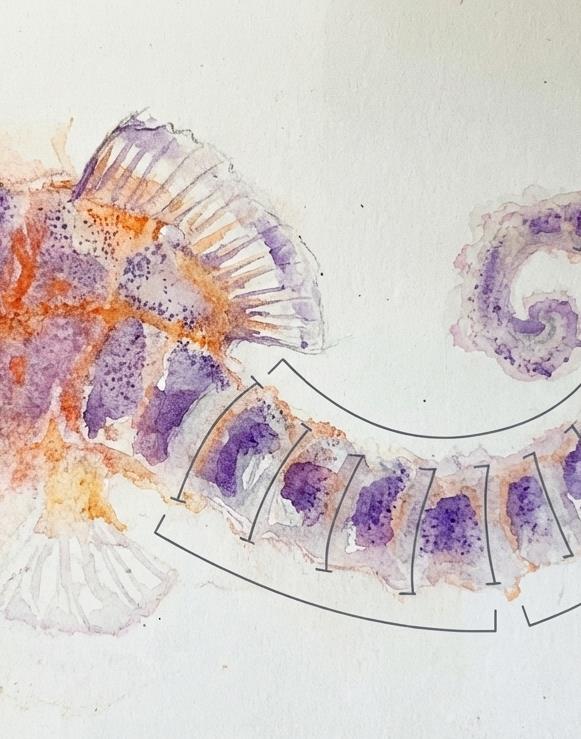
Special thanks to Ellen Gerdman, whose artwork brings the words and numbers to life.
Kährs Group +46 481 46000 / info@kahrs.se kahrsgroup.com / kahrs.com