the department of african and black diaspora studies
we are here. spring 2019 newsletter
A MESSAGE FROM THE DEPARTMENT CHAIR
cussion on race, labor, and mass incarceration; a film-screening and performance of the Afro-Puerto Rican music known as bomba. In two other events, the ABD and DePaul communities were fortunate to hear the perspective of elders who have long been active in the service of Black people. First, we brought Dr. Abdul Alkalimat to DePaul to speak about the relevance of personal Black histories. More recently, we were visited by Dr. Christopher Reed, noted historian and activist and the legendary Dr. Timuel Black who in his 100 years on the planet has tirelessly educated, organized, and trained generations of folks. Prof. Reed and Prof. Black were joined by ABD senior Michaela Clarke (whose Senior Reflection appears in this issue) as they all engaged in inspirational conversation on the legacy of Ida B. Wells-Barnett.
W
elcome to the Spring 2019 issue of We Are Here., the last African and Black Diaspora Studies newsletter of the 2018-19 academic year. It’s a glimpse into the thoughtfulness and the talent of ABD students and alumni. The artwork, poetry, essays, and reflections demonstrate how varied and talented ABD students are. In the words of the poet Amiri Baraka, “can you stand such beauty?” We’ve had a busy year. Since our last newsletter we hosted four major events, all of which were well received and attended by many people (when weather permitted!). We held a panel dis-
A big thank you to all who shared their work with us in this newsletter. Thanks are definitely due to graduating seniors Nyah Hoskins and Jenna Washington for their work on editing and art direction. Thanks also to ABD alum Raja’nee Redmond for coming back to ABD from the “real world” post-graduation to provide some thoughts and comments to our students. Congratulations to all our graduating seniors! Have a great summer, read some of the books suggested by ABD faculty in this newsletter. To our returning students, we look forward to seeing you in ABD classes in the fall. Take care!
TABLE OF CONTENTS 1. SENIOR REFLECTION: MICHAELA CLARKE 2. MASS INCARCERATION AND THE REPRODUCTIVE JUSTICE MOVEMENT 3. AMOZ OF ART 4. A REFLECTION... 5. BLACK THOUGHTS IN BLACK SKIN 6. ALUMNI PROFILE: RAJA’NEE REDMOND 7. MEMES, MAMMYS, AND MONA SCOTT-YOUNG 8. BLACK CLUBS ON CAMPUS
DI-AS-PO-RA / NOUN. A DISPERSION OF A PEOPLE, LANGUAGE, OR CULTURE THAT WAS NOT FORMERLY CONCENTRATED IN ONE PLACE, TO SCATTER, TO DISPLACE, TO LIVE IN SEPARATED COMMUNITIES.
10. SUMMER READING LIST 11. STUDY ABROAD JOURNAL 13. FALL 2019 COURSES
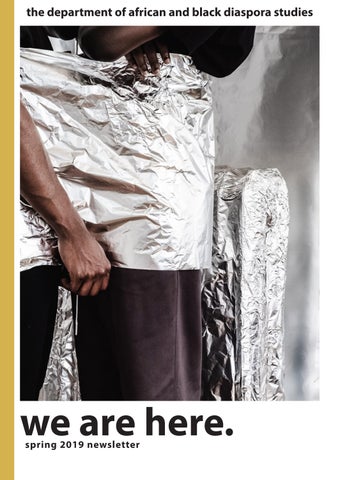
COVER PHOTO TAKEN BY JON BURNS NEWSLETTER EDITING BY NYAH HOSKINS NEWSLETTER ART DIRECTION BY JENNA WASHINGTON PRINTED BY CARY LOVETT
SENIOR REFLECTION:
A
MICHAELA CLARKE
defining moment during my time as an African and Black Diaspora Studies scholar happened my junior year, during one of the guest lectures the Department was hosting. Mariame Kaba, a prison abolitionist and healing scholar, built on ideas I was already forming about community care in an academic context. She asked, “Who’s holding you down? Who do you belong to?” These questions brought my entire academic career into perspective. As a first generation college student, from a low income upbringing, I fell into this idea that I was on my own, and that I had to do it all on my own. I was constantly trying to prove to myself and others that I belonged at this private institution. Mariame Kaba shook this narrative in a transformative way for me. Everything I had been learning about the diaspora, culture, liberation, theory and community came together and made this work personal for me during the lecture. I came to DePaul thinking I had everything figured out, with a desire to be around people and organizations working towards peace and nonviolence. Although these desires never changed, I was unsure of specific programs that would push my interests outside of my comfort zone. The first African and Black Diaspora Studies course I ever took was Black Feminist Thought with Dr. Moody-Freeman. This class was truly a transformative experience for me and set the framework for my approach to all of my classes since. I had never been in an academic setting where the focal point of study was the work of Black women across the diaspora. Exposure to the necessity of an intersectional framework in all things pushed me to add African and Black Diaspora Studies as a double major, and want to learn more. I found a sense of home and community in ABD. I was in classes with some friends, but mostly with people who challenged me to go deeper always. The sense of home I felt in ABD did not end with class times or meeting with professors. However, it shaped my desire to build community in all of the spaces I am in. The connection I have been able to make between a Peace Studies background combined with African and Black Diaspora Studies is transformative justice. Transformative justice centers the voices and stories of individuals and communities through healing and joy. I would not have found this real articulation of theory if it hadn’t been for the ABD community.
fluenced my perceptions of community care and healing that can only happen in the context of community work. I found belonging in the ABD community of scholars, and I hold this responsibility to continue striving for liberation both within and outside the classroom. Something that drew me to the city of Chicago initially was the incredible wealth of Black history and youth organizing. I chose to research and track Black liberation frameworks over time for my ABD Capstone. The project “A Case for Liberation: Cultural Institutions and Community Organizing on Chicago’s South Side,” discusses the influence of specific institutions established in the 1930’s-1960’s that have created a foundation for community organizing today. Communities are working within a larger cultural legacy, however, this is does not dismiss the need for more inclusion. The work of community organizing today holds these legacies and histories accountable while continuously working to reframe liberation to include more identities, falling outside of hegemonic, heteronormative masculinity. The African and Black Diaspora Studies Department has given me a foundation to continue building on in the work of decolonization and liberation. I can not imagine who I would be without the faculty, staff and students of the Department. I look forward to the work that comes beyond DePaul, including building upon this legacy that I now have the honor to be a part of.
This community was built with the inclusion of outside lecturers as well. During my time as an ABD student, guest lecturers invited by the department have broadened my scope of possibilities when building towards transformative, community based liberation. Christina Sharpe was one guest lecturer that I constantly refer back to. Even if excerpts from her book In the Wake: On Blackness and Being are not included in the class syllabus, I have always found a way to connect them. I was deeply moved by her work. Her emphasis on care work and reflection on the trauma of legacies in-
Photographs taken by Juelle Daley of Michaela Clarke moderating the Department of African and Black Diaspora Studies and Center for Black Diaspora event titled “Ida B. Wells Barnett: Where do we go from here?”
MASS INCARCERATION AND THE REPRODUCTIVE JUSTICE MOVEMENT BY SHELLYNN BEASLEY
A
ccording to a 2018 report released by the Prison Policy Initiative, about 219,000 women are incarcerated throughout the United States. Of those women, over 9000 are incarcerated in Cook County Jail. The first jail in the United States was built in 1790 in Philadelphia, Pennsylvania. Thirty years later the prison system, born out of racist systems and ideologies, became what we know it as today: dehumanizing, inhumane, and systematically oppressive. Incarceration in the United States dramatically increased in 1971 when President Richard Nixon raged a War on Drugs that was sustained by the Reagan Presidency. The government heavily criminalized drugs on a systematic level, leading to more Black and Brown bodies being incarcerated for nonviolent petty drug crimes from “50,000 people incarcerated in 1980 to 400,000 in 1997.” Incarceration poses numerous health risks for all individuals such as an increase in exposure to “violence, substance abuse, mental health issues, and infectious and chronic diseases.” Incarceration also subjects individuals to sexual assault and unsafe living conditions. These conditions are of extreme concern for incarcerated women because they report higher rates of STIs, as well as sexual and physical abuse. Further, trans women and non-binary individuals of color are not receiving the care they need due to hetero and cisnormativity, racial stigmatization, and ignorance. Reproductive justice (RJ) is a term originally coined in 1994 by a group of Black women in Chicago, but had been practiced years before by “indigenous women, women of color, and trans” individuals. This term, movement, and practice were created because the women’s rights movement did not speak to the experiences of marginalized women. RJ not only includes fighting for reproductive rights but also “analyzing forms of oppression and promoting human rights.” Simply put, RJ is the power and right to make a decision about one’s body and dismantle the systems that specifically keep women of color from being autonomous. RJ includes having economic, political, and social power, as well as resources to make important bodily decisions. This is central to the intersection of RJ and mass incarceration because incarcerated individuals do not have access to these rights. According to the Prison Birth Project, in 2010 “Black women were 2.8 and [Latina] women were 1.6 times more likely to be incarcerated than White women.” Taking away the context of prison, women of color face extreme health disparities compared to white women. For example, Black women are at the highest risk for HIV and are more likely to be subject to 2 “impoverished neighborhoods, food deserts, and a lack of access to healthcare.” Black mothers are three times more likely to die in childbirth and Black infants “are
more than 2.4 times more likely to die in their first year of life.” These statistics illustrate the immediate need for reproductive justice movements in communities of color. RJ grounds itself in the Audre Lorde quote “There is no such thing as a single issue struggle because we do not live single-issue lives.” Mass incarceration is a power system that works to control and limit an individual’s right to make informed decisions about their lives and bodies. Therefore, in order to provide reproductive care to people of color, we must first understand the systems in place that work to prevent them from accessing care and living healthy lives within the context of prison and without. Acknowledging the racialized, gendered, and sexualized power systems in the United States and centering work around the needs of people being oppressed by these systems is what the reproductive justice movement does and will continue to do. Sister Song, a organization created in 1997, continues to do this work. Centering Black women and their experiences with reproductive health they fight for women of color while teaching about RJ. References “Are Racism and Patriarchy Making Us Sick?” The African American Policy Reform “Brief History of the Drug War,” Drug Policy Alliance, http://www. drugpolicy.org/issues/brief-history-drug-war Diana Kasdan, “Abortion Access for Incarcerated Women: Are Correctional Health Practices in Conflict with Constitutional Standards?,” Perspectives on Sexual and Reproductive Health Vol. 41, No. 1 (2009): 59-62. Lauren Brinkley-Rubinstein, “Incarceration as a catalyst for worsening health,” BioMed Central & Springer Nature (2013) Peggy A. Montes, “Incarcerated Females: Breaking the Cycle,” The Cook County Commission on Women’s Issues (2012) “Reproductive Justice,” Sister Song, https://www.sistersong.net/ reproductive-justice “The Prison Birth Project,” Gaia Host Collective, http://theprisonbirthproject.org/about/ Valerio Ba´cak, “Incarceration as a Health Determinant for Sexual Orientation and Gender Minority Persons,” American Journal of Public Health Vol. 108, No. 8 (2018): 994-999
ARTIST PROFILE: AMOZ OF ART
Medium: Digital Painting, iPad Pro and Procreate. There is a light in women that most of the world doesn’t seem to respect. In the 21st century, there are too many standards, injustices, dangers, and hardships that Black women face on a day to day basis. All women have stories to tell from things they have endured and overcome. As men, we must find a way to aid women in a world that’s against them. Every day that we wake up to see another day, there are challenges that lie ahead and battles within ourselves that we are working out. This piece is titled “Meditated This Morning.” Meditation is a chance for us to deeply focus on learning something new about ourselves in order to heal and grow. The woman in my painting has a message that reads, “Meditated this morning, women are magic.” Through her meditation, she spoke an affirmation to all women, “Women are magic.” Her mediation has brought her to a peace of mind that started her day on a positive note. Women play a significant role in the advancement of community. As a Black man it is important for me to uplift women so that we can all become of greatness. There is so much out in the world that wants to destroy love and break apart communities. I understand that it is my job to create art that does the reverse. My art is made to heal, share stories, and inspire all people. We must stand together in positivity to grow. This work of art is meant to bring support to the everyday pursuit of happiness with women.
Prints of this piece are available on Amoz’s website.
Contact Info: www.amozofart.com @amoz_of_art amozofart@gmail.com
3
Photograph by Blake Bonaparte, 2019
A REFLECTION ... BY ARMAND RS BRYAN
4
As I mentally prepared to attend DePaul, one of my goals was to explore what it felt like to be me. The previous 18 years had seen me wear affectation after affectation in hopes that my white classmates would accept me. One of my first classes here at DePaul was an Introduction to African and Black Diaspora Studies, in which we discussed a number of transcendent ideas that depicted and analyzed diasporic experiences across the United States and beyond. Most of class time was discussion based, then we made our own analysis of how these ideas manifested within our daily lives. In these environments I was welcomed by an embrace I had not quite felt before. It was warm and accepting. Everyone in the classroom was linked by a common desire to expand their knowledge of the Diaspora. However, I quickly learned that why each of my classmates wanted to do so was unique to each one of them. As individuals we crossed at this point – in this class – but we would leave with different ideas, free to continue our journeys with minds clear of external influence. Each student was on their own path. One idea I would leave with, and had to confront was, the concept of individuality. In exploring the minds of others, I immediately encountered ideologies different to mine. Some believed our thoughts and motivations were meant to be our own as long as they did not subvert the goals of the broader group. To white people, we are Black first and students second. With time I learned this was not unique to DePaul. My sister was recently accepted into the University of California- Los Angeles Physiological Sciences program, and traveled down to Los Angeles to engage with other Black prospective students. Upon reconnecting with her after the experience, she expressed similar sentiments. There exists a prevalent and, in some cases, tacit belief that the will of the group is more important than our personal life pursuits. It is true that our oppression links us. Systematic racism and overt forms of social oppression along racial lines are alive and well today. When I walk down the street, I am invariably seen as Black first. But does this mean that we should perpetuate these same notions? Racism arrived before race did. It was a tool utilized to uphold Eurocentric systems of power. African-Americans did not become synonymous with slavery in America until the indentured servitude and labor markets dried up post-arrival. In a frenzied search for replacement workers, racist associations were ascribed to Blacks for the sake of justifying slavery. So we see how the system perpetuated division along racial lines for impure reasons. By participating in the politicization of the physical distinction that is skin color, we, in a sense, limit our future to an existence that does not escape the confines of that particular trait. We trade our individuality for the far less valuable will of the group. It is possible to do both, but the will of the group should not come at the expense of not exploring who we are at a base level – as human beings.
“Black and Black” I must concede there are two sides And despite common consensus, They are not black and white Nor is there a drop of grey. There is only black and black. The first is dim and unnerving. It is generations of bruised and scarred backs. It is denigration written behind all fronts. Relentless and cunning, Misinformed and abused. It was the beginning of the color; The creation of our hue.
BLACK THOUGHTS IN BLACK SKIN POETRY BY ISAIAH EASTER
The second is beauty and life. It is chocolate fists clenched to the sky. It is dread locks flowing to the ground. Both revival and creation, Innovative and strong. It is the embodiment of survival; Our hope pursued. And so we medicate daily Relieving the strain of first black. For the two are not yin and yang Nor duality or yoke Only sickness and remedy And eternal paradox. What is a vaccine But admission of disease? And yet I stay strapped to an IV Black warring black Chemo warring cancer Choosing the struggle Glistening in radiance of the second Never to let the first swallow me whole.
“Quarrel of Heart and Mind (Young Love’s Compromise)” I lay here with my cheek rested against your soft thigh, Gracing my hand across your brown skin, Studying every inch and curve, Curating a catalog of your design. Your pulse and my hand dance together, Where rose undertones outline the path of our engagement. And every hair bows in reverence to the occasion. Nirvana. But my hand halts as my musing for you is displaced, Superseded by a yearning for triumph and reason My head raises; What a stream of beauty at the foot of a mountain! Has the stream become the summit? Or has my longing for a mountain’s peak become preoccupied with petty ambition? My hands tremble, wedged in the valley between both sides. In one rests my promise and in the other my promised. I’m told holding onto my promised is how dreams die But isn’t death also division from the divine? I lie back onto your limb without hesitation. Not so out of frustration or duress, But in knowledge of the streams’ intention. Its waters to foster my journey, Its sustenance to breed new life, And its beauty to remind me my desire’s been realized, even when not. For what does it mean to reach the peak, When the body fails before relishing the feat? A hand’s dance resumes on your dark skin. Gentle study, connection Where ascent begins.
Photograph by Isaiah Easter, 2019.
5
ALUMNI PROFILE: CLASS OF 2016 What have you been up to since graduation?
RAJA’NEE REDMOND
After graduating, I went on to attend the Urban Teacher Education Masters Program at the University of Chicago. I spent my first year studying the histories and philosophies of education and tutoring CPS students around the city and I taught a cohort of students during a Summer enrichment program. This year, I’ve been in two different CPS schools completing my residency. Throughout my residencies, I’ve taught some really cool things. One unit that I’m most proud of was my unit on gentrification in Chicago. It was truly a sight to see 9-year-old students talking about ownership, developers, displacement, poverty, and urban development. I’ve really used my residencies to test just how much our young students can do and comprehend. I’ve really tried to develop a teaching practice that is both representative and relevant to the students in front of me. I’m always thinking about the ways in which I could bring in student’s life experiences into an academic setting - the same way ABD did it for me. Outside of teaching, I’ve grown a love for travel, fitness, museums, theatre, photography, and painting. When I’m not with students, you can probably find me doing any of those things.
What led you to declaring an ABD major in undergrad? I came into DePaul as a Psychology major with a focus on Human Development. I was, honestly, misinformed. I didn’t understand racism as structural but as an individual dislike for another individual. I went to an event that the Lambda Chapter of Delta Sigma Theta Sorority, Inc. hosted on campus where they screened a documentary called Hidden Colors. While I realize now that some things in the documentary aren’t completely true, I value it for what it did for me. It exposed me to the history of the Black Diaspora before and beyond slavery. I realized how much was missing from my education and I decided to be intentional about seeking out this information and learning more. I, then, changed my major to ABD. The more ABD classes I took, the more I was able to learn about oppressive structures and systems and more Truth. In addition to that, I was finally able to see myself in my coursework and amongst my peers. How has declaring a major in ABD helped you in your post-graduate life? When I still attended DePaul, I didn’t realize how much ABD would help me in the future. In my graduate program, a great majority of people in my cohort were not able to understand systems, oppression, and had never thought about race. Because I was wellread and had done a lot of that work in undergrad, it was an easy adjustment to be critical of history and other oppressive issues having to do with education in Chicago. I was able to critically think about and question in a way that other people were not used to at all. I also just knew a lot about the issues affecting Black people and in a program that prepares teachers to teach Black and Brown students in the city. For example, I was able to connect the mass racialized incarceration to the school-to-prison pipeline to the disproportionate discipline of Black boys and girls in schools to teacher bias. These connections were fairly easy for me. It absolutely made me a stand out student amongst everyone else in the Cohort.
6
What would you say to anyone deciding on declaring an ABD major? Do it. Even while I was still at DePaul being in Psych or Poli Sci classes, I had a frame of mind and a contextual understanding that other students just did not have. Whether you plan to continue on in your education or start your career, the rigorous curriculum and high expectations that are expected from you from faculty pay off in any context. The pride and confidence you get from knowing who you are and studying Blackness and the world is something that others cannot emulate.
What are your long term goals as it relates to ABD? I just accepted a job as a Middle Grades Social Studies Teacher. As it relates to African and Black Diaspora Studies, I plan to teach my students about history from a non-Eurocentric view. My class will be called ‘Social Studies’ however it’ll be a course about Race and a course about Identity and a course about freedom. My classroom will provide students with a culturally relevant and sustaining curriculum which means that students see themselves in the curriculum, their identities are affirmed in academic spaces, and their experiences in the world as children of color are valued and welcomed in my classroom. Most importantly, I will teach students about the systems that exist in the world, teach them to (1) navigate them because we must survive and (2) to use whatever their passion is to do their part in dismantling that system. I would not be able to do this well if I, myself, didn’t dedicate my time to studying history and social issues amongst the Black Diaspora.
MEMES, MAMMIES, AND MONA SCOTT-YOUNG: THE USE OF BLACK WOMEN’S IMAGERY ONLINE BY NYAH HOSKINS
From its inception in 2006, the social media app Twitter has created a community for groups to congregate online. Different fandoms and interests groups share information, spoilers, and most importantly, humor. The use of Graphic Interchange Format, or GIFs, has become popularized on Twitter to emphasize story lines or points the user is trying to make. After spending years in the app in multiple fandoms and cultures, there has been a religion. More often than not, white users are using GIFs of Black women to highlight certain situations. White users have recreated caricatures and harmful stereotypes of Black women to be emphasized online. Patricia Hill Collins’ chapter, “Mammies, Matriarchs, and Other Controlling Images” from her iconic book, Black Feminist Thought will be the historical framework used to give historical context to these images. To apply the historical to the contemporary, Safiya Umoja Noble’s book Algorithms of Oppression reveals the racialized nature of the internet, as well as the reflection of systematic oppression online. Stereotypical depictions of Black women developed from slavery to reinforce White domination. Collins states, “The dominant ideology of the slave era fostered the creation of several interrelated, socially constructed controlling images of Black womanhood, each reflecting the dominant group’s interest in maintaining Black women’s subordination” (72). These images vary, but ultimately they paint Black women as the opposite of white womanhood, further labeling them as the other and insignificant. It is a common misconception that technology and the Internet are neutral spaces. In the introduction of Algorithms of Oppression, Noble challenges the idea of neutrality in algorithms. “...Some of the very people who are developing search algorithms and architecture are willing to promote sexist and racist attitudes openly at work and beyond, while we are supposed to believe that these same employees are developing “neutral” or “objective” decision-making tools” (2). White users on Twitter have created their group identity around whiteness, which others Black womanhood. “Often, group identity development and recognition in the United States is guided, in part, by ongoing social experiences and interactions, typically organized around race, gender, and education, and other social factors that are also ideological in nature” (84).
Since the actual tool of the internet has been proven to be racialized, then the programming is as well. Twitter users have been using different depictions of Black women to emphasize certain points about their lives, while simultaneously reinforcing controlling images and stereotypes about Black women. The tweets using GIFs from The Real Housewives of Atlanta consist of anger, sass, or an overall emotional disconnection to others, which emphasizes aspects of the jezebel image. The women on Love and Hip-Hop are mostly involved with tweets about sexual promiscuity. The users use the personas depicted on the shows as validation of their use of the GIFs, but this furthers the modernized hoochie stereotype. Mona Scott-Young, one of the creators behind Love and Hip-Hop, is a Black woman. Her role in the perpetuation of different controlling images can be interpreted different ways. The success of these shows have created her a multi-million dollar empire. The drive of capitalism and an exploitative tool can be a reasoning behind Scott-Young’s depiction of Black women. Another reason can be that this is just how these women live their lives. Their life experiences are extremely valid, and may seem appealing to those who watch the show. However, there is not much that can be done to control white interpretations of their lives, along with their association with these prevalent controlling images. These Black women who live these lives in reality will automatically be associated with sexual pervasiveness and a lack of empathy for others. White Twitter users reinforce the controlling imagery of Black women that was created during slavery. Ultimately, these users are disconnected from Black issues, or are silent during moments of Black life that require active active allyship on Twitter. The reliance of controlling images of Black women has invaded television, film, and now, social media. The Internet and Twitter will be around for the foreseeable future, and the content will remain as archival information. People view the Internet as a place of fact-finding and the basis for the truth. To work out of these controlling images, there has to be a comprehensive understanding of the impact of our 7 depictions of others online.
FEATURED ORGANIZATION:
BLACK ARTIST NETWORK AT DEPAUL UNIVERSITY
We value the ideas that artists of color have to share with the world around them, and wish to provide a platform for them to explore their creativity to the fullest. To get involved with the club, attend critiques, visit museums, write about affiliated art and artists, or participate in group exhibitions please contact us. @DEPAUL_BAN BAN.DPU@GMAIL.COM
BLACK CLUBS THE BLACK STUDENT UNION
8
The Black Student Union believes in developing a strong sense of community for black students on campus. We want our members to enjoy being a part of our organization and feel that they are contributing to it in everything that we do. The Black Student Union is a resource here for students and we provide our members with the necessary materials to excel within DePaul University. @BSU_DPU BSUSECRETARY.DPU@GMAIL.COM
FIND MORE STUDENT ORGS AT WWW.ORGSYNC.COM
ON CAMPUS ROOTS to ENDS We seek to create a safe environment for individuals to celebrate and appreciate their roots and ends of their hair. This organization will provide a space for students of African descent, allowing them to have open dialouge and interactive learning about black hair. Through conversation around black hair, we can better combat discrimination and inequality while empowering the black diaspora. @R2E_DEPAUL PRESIDENT.OF.R2E@MAIL.DEPAUL.EDU
9
Professor Christina Rivers recommends If Beale Street Could Talk, by James Baldwin, 1974 Baldwin’s take on the intersections of race, gender, and the criminal justice system in the early 1970s is totally relevant today. It will make the reader angry, but is also very informative. This is also a really beautiful story of resilience, persistence, and love. Professor Poe Johnson recommends Victor LaValle’s Destroyer, by Victor LaValle, 2017 Victor LaValle’s Destroyer is about a mother who bends the laws of science, and the world itself, to her will when her son is murdered by the police. Lavalle’s graphic novel is less a re-telling of Mary Shelley’s Frankenstien, and more a sequel that simultaneously blends together themes of humanity’s relationship to existence in the face of increased technological evolution with the wrath of a black woman who forces the world to reckon with the endless perpetuation of black death. Lavalle’s writing is painfully evocative of so many recent tragedies, while never succumbing to fetishization and Dietrich Smith’s art merges the realistic, fantastic, and the psychological. Professor Amor Kohli recommends Lose Your Mother, by Saidiya Hartman, 2006 Lose Your Mother by Saidiya Hartman is a beautiful, wrenching book that combines history, memoir, travelogue, meditations on me_mory, kinship, and belonging. It speaks to loss and rebuilding in a way that is honest while somehow not surrendering totally to despair. Professor Lori Pierce recommends and Just mercy: A Story of Justice and Redemption, by Bryan Stevenson, 2014 Going to the Legacy Museum and Peace and Justice Memorial reminded me that everyone should read Bryan Stevenson’s Just Mercy. The book, part memoir, part legal history of slavery and mass incarceration, is pretty great. It’s widely available – from paperback to audiobook. Professor Mark DeLancey recommends The Bad-Ass Librarians of Timbuktu, by Joshua Hammer, 2016 Why read it? It engages with contemporary events – the militant incursions into Timbuktu in recent years – together with a tale concerning a very proud centuries-long history of scholarship in West Africa. And it’s a bit of a thriller too I understand.
SUMMER READING LIST
Professor Julie Moody-Freeman recommends Brown Girl in the Ring, by Nalo Hopkinson, 1998 Decompress from the stress of the quarter by reading a thrilling, fast paced, action packed novel that you will not be able to put down until completed :-). Hopkinson draws on a pantheon of African and Afro-Caribbean deities and deals with the serious topic of organ harvesting and inner city decay in Toronto. Professor Francesca Royster recommends Go Ahead in the Rain: Notes to a Tribe Called Quest, by Hanif Abdurraqib, 2019 Hanif is an eloquent writer, and this book is a great “love letter” to this group and the 1990’s era of hip-hop. He brings memoir, a deep knowledge of black culture and excellent hip-hop chops to the task. For me, the book brought alive music that I was only acquainted with; for fans of *Tribe*, I think they’ll feel a great sense of recognition. The book brings alive what music means to African American folks, how it helps us in the every day experiences of struggle and life-making.
10
Professor Shiera S. Malik recommends Known and Strange Things, by Teju Cole, 2016 A wondrous wordsmith wrote this collection of insightful short stories that narrate everyday life (experiences, sights, and feelings). Every essay packs a punch and introduces the reader to a wide variety of craftsmen and women, writers, photographers artists, etc. And, Cole does not stay in his lane. He blurs all kinds of witnessing. #mustread
STUDY ABROAD JOURNAL: EXPERIENCES AS A BLACK WOMAN IN JORDAN by Alex Herrera
D
uring the fall quarter of 2019 I spent four months studying Arabic language and working at a media company in Amman, Jordan. Given this was my first true experience living in a country I have no cultural relation or significant grasp of the language, I engaged a culture I believed had no relation to my heritage or background. Little did I know Jordan afforded me not only a broader understanding of Jordanian histories, but mine as well. My initial interest in Arabic came to me my freshman year of college. University was my chance to explore a history of the world I had no familiarity with, and Arabic was my entry point. The experience I had of visiting the once irrigation systems built by the Nabateans or running into murals of Mahmoud Darwish and Oum Kalthoum was unparalleled. I was afforded an unforgettable insight on someone else’s worldview. The day I arrived at my host family I was showing my host mom pictures of my family and where I come from. I immediately was trying to describe my life as simply a person from the United States of America. My initial description of where I’m from was, “Maryland, a state right outside of Washington D.C.”. My host mom was a bit shocked to hear I was originally from the United States. In that moment I quickly realized her perception of Americans did not fall in line with my appearance. My thick locs and dark skin tone was an association with African origin, which I am, but like many of us there are a lot of encompassing identities I hold outside of my African heritage. Then my roommate who is mixed race with a Black American mother and white father attempted to settle her misunderstanding with a quick history lesson on the Atlantic Slave Trade. In the midst of all the conversations I realized the history of the slave trade hadn’t been drilled in her like it has me. Black history is not a universally shared or studied history. Thus, peoples’ ignorance to what kind of person we are is a tough to determine. A common question and judge of good character are two simple questions in Jordan, min wayn ‘ant or where are you from? And shw aismak or what is your name? As an African American woman those two questions didn’t gain me any social status or recognition. It is difficult to navigate a society
BY LELA GAYE built on tribalism and ones judge of character based upon who your father’s father’s father was. In Jordan one of the only ways to gain citizenship is to have two people from your paternal lineage be Jordanian citizens. Not exactly easy to blend in to a society built on its lack of diversity, but rather its strength in their roots. While tribalism is an integral part of the Jordanian society, the country is becoming an access point for the whole of the Arab World. It offers Iraqi fish, Egyptian art, the common occurrence of hearing the Syrian accent, famous Yemeni restaurants, and of course the famous Jordanian dessert Khnafe. I saw a lot on my day to day driving from the capital city Amman to the more rural Governorate of Madaba where our school was located. Along with its offerings of many cultural traditions the mass migration of refugees challenges the structured fabrication of tribalism. Jordan has a large influx of Nigerians, Somalian refugees and Sudanese refugees. There was a skatepark down the hill from our language center in Amman where an organization Sawiyan would bus in kids from Sudanese and Somali refugee camps and for two hours every weekend kids would have a comfortable space to skate, gossip and run around with their friends At the skatepark is where I’d seen the only existing black culture, mind you these people were not Jordanian citizens. Often the intergenerational black culture in communities outside of the West are either hidden and inaccessible or simply nonexistent. My appearance as a dark skinned black girl with these long thick dreadlocs came as a shocker at first glance to many people. The height of the diversity in Amman is between Arabs ethnically. A Black American woman is a rarity, I found in Jordan. I learned so blatantly I represented the most otherworldly being to Arabs. For the first time my blackness took a back seat to my American identity. Blackness is so stark and shines so bright for me that having to embrace my privilege and misunderstandings of the world taught me although I’m proudly a black woman I equally exist outside of the United States as an American as much as a black woman. One night we went out to an outdoor market called
souk jara. It’s two or three streets blocked off full of vendors selling jewelry, books, clothing, smoothies, and so
11
many more crafty items. The first black woman I remember seeing was at this market. I remember she looked at me with the biggest smile and anytime we walked past each other she’d brush her hand along my shoulder. Our interaction reminded me of almost the nod black folk share among each other. She was the maid to one of the vendors. Most working-class people have maids and a large portion you’ll see on the street or when visiting people’s homes are from Eastern Africa and Eastern Asia, specifically the Philippines. Besides the many maids and small populations of African migrants I met from Nigeria, Senegal, and Kenya, the Middle East wasn’t overflowing with African descended peoples. Now that I’ve been back in the United States for the past five months I can reflect on Jordan and appreciate my expanded worldview. Just a few weeks ago a friend of mine told me an older white man asked her name and when she replied with her name his reaction was, “Wow that’s not normal”. His rude comment to her reminded me some people do not know beyond what is directly in front of them and sometimes it takes looking around and seeking beyond what is presented to you. Jordan taught me patience. Living in an Islamic state that is described by the West as a region solely filled with terrorism in actuality share more similarities than marketed to everyday Americans. And the most important lesson Jordan afforded me is like my community of friends and family those same exact people exist halfway across the world and want to exist in a society for the betterment of their community. Regardless of my lacking connection to the Jordanian culture we all are no more important than the other and deserve to be heard and respected.
12
13
Contact the Department of African & Black Diaspora Studies at abd@depaul.edu Follow us on Twitter @ABDdepaul