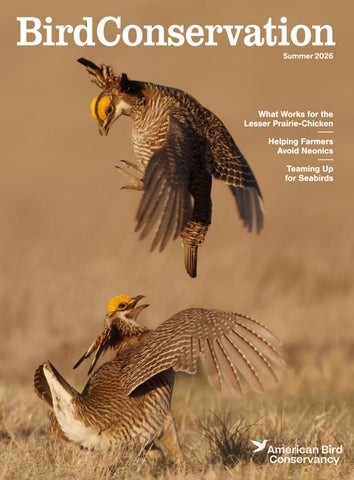
BirdConservation Summer 2026
What Works for the Lesser Prairie-Chicken Helping Farmers Avoid Neonics Teaming Up for Seabirds
Bold Action for Birds
SUMMER 2026, Volume 31, No. 2
American Bird Conservancy (ABC) takes bold action to conserve wild birds and their habitats throughout the Americas. Inspired by the wonder of birds, we achieve lasting results for the bird species most in need while also benefiting human communities, biodiversity, and the planet’s fragile climate. Our every action is underpinned by science, strengthened by partnerships, and rooted in the belief that diverse perspectives yield stronger results. Founded as a nonprofit organization in 1994, ABC remains committed to safeguarding birds for generations to come. Join us! Together, we can do more to ensure birds thrive. Bird Conservation (ISSN: 3067-2228) is the member magazine of American Bird Conservancy and is published three times annually. Nonprofit postage paid at San Diego, California. POSTMASTER: Send address changes to Bird Conservation, P.O. Box 249, The Plains, VA 20198. Send undeliverable copies to American Bird Conservancy, 8255 E. Main St., Suite D & E, Marshall, VA 20115. Return postage guaranteed. Copyright 2026 American Bird Conservancy
MAGAZINE STAFF Vice President of Communications and Marketing Clare Nielsen Director of Communications Jordan E. Rutter Managing Editor Matt Mendenhall Graphic Designer Maria de Lourdes Muñoz Senior Writer/Editor Molly Toth Director of Brand Strategy and Web Som Prasad Science and Policy Consultants Steve Holmer, Hardy Kern, Daniel Lebbin, George E. Wallace, David A. Wiedenfeld Contributors Andrés Anchondo, Ben Catcho, Sebastián Cruz, Kevin Ellison, Chris Farmer, James Giocomo, Steve Holmer, Brad Keitt, Hardy Kern, Bryan Lenz, Cedar Mathers-Winn, Sea McKeon, John C. Mittermeier, Jack Morrison, Grace Rau, Garrett Rhyne, Steve Riley, Holly Robertson, Naamal De Silva
COMMUNICATIONS AND MARKETING TEAM Director of Marketing Lara Long Multimedia Producer Erica Sánchez Vázquez Media Relations Specialist Agatha Szczepaniak Social Media Specialist Emily Williams
Join Us
Digital Marketing Specialist Noah Kauffman
If you’re not already an ABC member, we invite you to join us. Members at any of our five levels of commitment receive a one-year subscription to Bird Conservation, access to members-only events and webinars, a choice of premiums, and other offers. Give now at abcbirds.org/membership or see contact details below.
Writer/Editor Cedar Mathers-Winn
Connect
ABC SENIOR LEADERSHIP
Magazine feedback: We welcome letters to the editor and other feedback. Contact us at: magazine@abcbirds.org.
Vice Presidents of ABC Programs:
Digital Content Specialist Kathryn Stonich
MEMBERSHIP TEAM Membership Director Kelly Wood Membership Coordinator Jenna Chenoweth Database Quality Coordinator Jamie Harrelson Office Manager Cindy Elkins
President: Michael J. Parr
Membership or other inquiries: Contact us at American Bird Conservancy, P.O. Box 249, The Plains, VA 20198 | 540-253-5780 | info@abcbirds.org Sign up to receive emails from ABC: abcbirds.org/email Find and follow us on social media:
Advocacy and Threats – Brian Brooks Communications and Marketing – Clare Nielsen Development – Erin Chen Finance – Angela Modrick Operations – Kacy Ray Policy – Steve Holmer Threatened Species – Daniel Lebbin Together for Birds – Naamal De Silva U.S. and Canada – Shawn Graff
BOARD OF DIRECTORS
ABC is proud to be a BirdLife Partner Printed by Neyenesch Printers Inc. Bird Conservation is printed on paper sourced from sustainably managed forests and with recycled fibers.
You can read past issues of Bird Conservation and ABC’s Impact Reports at abcbirds.org/publications.
Please give this magazine a second life by passing it along or recycling!
Maribel Guevara, Chair Michael J. Parr, President Meg Caldwell Jonathan Franzen Annie Novak Jeff Peters Ravi Potharlanka
Carl Safina Amy Tan Stephen Tan Shoaib Tareen Walter Vergara Jessica Wilson
For a full staff list, see ABC’s website at abcbirds.org/staff.
Page 46
In Every Issue 4 Chirps Your latest feedback. 5 From the Perch All in for prairie-chickens. 6 In Focus Mauna Kea’s one-of-a-kind honeycreeper. 8 Bird Calls Recent rediscoveries, a new refuge in Brazil, Oregon’s investment in wildlife, a history-making condor, restoration of Minnesota grasslands, and more. 14 The Stopover Prairie potholes and their birds. 38 Together for Birds Prioritizing Indigenous perspectives in grassland restoration.
Hawai‘i ‘Amakihi
Inside
Features
Summer 2026
Finding a Home on the Range Innovative conservation strategies aid a pair of threatened species — the Lesser PrairieChicken and the Great Plains rancher. 18
Cover photo Lesser Prairie-Chickens spar on a Kansas lek. Photo by Michael J. Parr abcbirds.org/CoverBird Swapna Shepherd
40 Bird Hero An Alaska seabird expert’s inspiring story. 42 Action & Advocacy Insecticide-free seed program takes root. 43 Field Notes A garden that’s teeming with life.
Going the Distance for Seabirds From opposite sides of the ocean, Ecuadorians and New Zealanders team up to conserve their shared petrels, shearwaters, and albatrosses. 26
44 The Science of Birds Tracking of petrels and warblers highlights risks.
Blink, and the Birds Will Miss It It’s time for all communication towers to use only blinking lights. 34
48 The Cache New titles for your bookshelf.
46 The Art of Birds Swapna Shepherd, wildlife conservation artist.
49 Flock Talk Wear your support for ABC. 50 Field of View Birds and their names.
Acorn Woodpecker
Chirps What we’re hearing from ABC members and friends. What Really Matters Loved the personal story of the young female Baltimore Oriole by Melissa Groo (Spring 2026, page 50)! Such a beautiful, heartwarming story. Isn’t this the real reason ABC members support bird conservation and habitat? Each bird truly matters! — Cheryle J. Excellent and Engaging I wanted to say how much I enjoyed the Spring 2026 issue of Bird Conservation. You continue to produce excellent magazines following your recent redesign. In particular, I really enjoyed “Protecting a Rare Marvel.” Thank you for reminding me about the important role ABC has played in conserving the Marvelous Spatuletail. I'm so happy to know that my membership and donations go to support saving this amazing hummingbird. It really reinforces to me how important ABC is for helping our feathered friends. I’ll also mention how much I look forward to your “Steal the Look” social media posts on Instagram (and other platforms). Your social media people are extremely talented and these posts always bring a huge smile to my face. Great job on producing engaging and fun content in addition to rallying the troops to sign petitions, donate, and help save the birds! — Will K.
4
Bird Conservation
Socializing with Friends Here are a few recent responses to ABC social media posts. Reader Joe M. appreciated an ABC Action Alert on Facebook asking followers to advocate for a strong bird-friendly Farm Bill: Just acted on this and sent my communications to my U.S. senators from Florida. Thank you for providing this opportunity to act! In May, we posted about Senior Writer/ Editor Molly Toth who, along with volunteers from Bird Safe Harrisburg, the Appalachian Audubon Society, and several others, helped rescue a stunned Virginia Rail that had struck a window and needed help on a busy street. Regina P. reacted on LinkedIn: It takes a village... in this case, a world, to save birds from dying from glass collisions. Thank you for sharing this important story about the efforts to save this Virginia Rail, and for the reminder to us all to protect birds by using treatments to bird-proof windows. Thanks, American Bird Conservancy, for all you do to save birds. (And good news: After being treated by a wildlife rehabilitator, the rail recovered and was released!) Our friends at the Arbor Day Foundation noticed an Instagram Reel we posted about the importance of trees for birds and wrote: Trees and birds go hand-in-
hand! Thank you for supporting trees, people, and the planet alongside us. We are so grateful for the incredible impact you’re making on our shared mission. Happy Arbor Day! On YouTube, our Afrofuturism and Birds webinar inspired this note from Ellen D.: So so good. Each of you. I had heard of Afrofuturism (I think) through the meta-modern subculture but hadn’t heard anyone speak from specifically that framework before. This was such a wonderful introduction! And I am surprised yet so happy to come upon this from an American Bird Conservancy email!
Let’s hear from you! Share your thoughts about our magazine, emails, or online content at magazine@abcbirds.org. Please include your full name and location. Letters may be edited for length and clarity. (Note: Opinions expressed are those of the authors.)
Scott Carpenter (top); Gerald A. DeBoer/Shutterstock (right)
From the Perch
All In for Prairie-Chickens The dancing grouse of the Great Plains carry a special mystique and provide one of North America’s great birding spectacles. Several species gather each spring on breeding arenas known as leks, and then the strutting marathon begins: Male birds flutter, jump, stomp their feet, flick their tails, and spar, all while booming, cackling, and gobbling in an effort to woo a mate. This April, I had the chance to look for seven grouse species — Gunnison and Greater Sage-Grouse, Dusky Grouse, Sharp-tailed Grouse, Lesser and Greater Prairie-Chicken, and White-tailed Ptarmigan — on their breeding grounds. It was a classic “Chicken Run” and involved nine days of adventure across Colorado and Kansas with Dan Lebbin, ABC’s Vice President of Threatened Species, Board member Shoaib Tareen, and ABC supporter Raj Lingam. It was an epic trip, and we couldn’t have done it without the help of friends at Audubon of Kansas and Colorado Grouse Tours, as well as the camaraderie of other birders. In addition to the grouse extravaganza, we logged 125 other species. One highlight for me was photographing Lesser Prairie-Chickens on a lek in western Kansas, where I captured the shot on this issue’s cover. Like most other grassland birds of the Great Plains, the Lesser Prairie-Chicken is in a precarious situation after more than a century of habitat loss and other threats. Only about three percent of its original population remains. But there is hope: Landowners, government agencies, and ABC — along with other nonprofits — are working to ensure a future for this iconic bird. Our cover story (page 18) details much of that progress.
A Lesser Prairie-Chicken finds a momentary perch on a rock.
Over the years, ABC has advocated on behalf of the Lesser Prairie-Chicken and for protecting its habitat. Now, we’re ramping up conservation efforts still further. We are partnering with landowners to implement conservation practices for birds to guide habitat stewardship and direct federal support to improved management. Also, recognizing that birders provide significant economic benefits to ranches where the birds are found, helping to keep habitat on the landscape, we will also be supporting the Kansas Audubon Lek Treks Prairie-Chicken Festival in Hays, Kansas. Please consider joining us in April 2027 for the unforgettable dance of prairie-chickens at dawn! Thank you for your support of American Bird Conservancy. You make our work possible for Lesser Prairie-Chickens and thousands of other bird species, and we couldn’t be more grateful. Michael J. Parr President
Scan this code or visit the link below to let us know what you think of this issue. Thanks for reading Bird Conservation! abcbirds.org/MagSurvey
View the trip report from our April “Chicken Run,” including photos, notes, and sound recordings: ebird.org/tripreport/497439
Summer 2026
5
A male Palila perches in its habitat on Mauna Kea. In the inset, a female Palila feeds on a māmane seed.
6
Bird Conservation
Bryan Shirota (2)
In Focus
Mauna Kea’s One-of-a-Kind Honeycreeper The Palila is one of Hawaiʻi’s most iconic and imperiled native birds. Found only high on the southwestern slope of the Mauna Kea volcano on Hawaiʻi Island, this unique honeycreeper is the last remaining finch-billed honeycreeper in the main Hawaiian Islands. The unmistakable birds have a yellow head and breast, patches of gold in the wings and tail, a black mask between the bill and eyes, and shades of gray elsewhere. The Palila’s thick bill enables it to extract seeds of māmane trees — its primary food. The species heavily relies on māmane forests for food, shelter, and nesting habitat. ABC works with Mauna Kea Forest Restoration Project (MKFRP) and other partners to protect and restore habitat for the Palila. Over the past several years, MKFRP staff and dedicated community volunteers have worked tirelessly to restore native forests, using planting and habitat management to improve the health and resilience of the Palila’s māmane ecosystem. Conservation teams also regularly inspect and maintain protective fencing that safeguards critical habitat from introduced sheep and goats, helping native vegetation recover and thrive. Additional efforts focus on protecting Palila from non-native predators such as feral cats and mongooses, while regular population surveys provide valuable information that helps guide conservation strategies and measure recovery progress. Together, these actions support the long-term survival of one of Hawaiʻi’s most endangered forest birds. The Palila continues to face significant challenges from habitat degradation, invasive species, drought, wildfire risk, and the increasing impacts of climate change. With the species now restricted to a small portion of its historic range, protecting and expanding suitable habitat remains essential to its recovery.
Despite these challenges, conservation efforts are creating opportunities for the species to persist and recover. Collaborative work among land managers, conservation organizations, government agencies, researchers, volunteers, and local communities continues to strengthen protections for Palila habitat while increasing awareness of the bird’s importance to Hawaiʻi’s natural and cultural heritage. In fact, the decade-old Palila Forest Discovery Trail, a one-mile loop through Mauna Kea’s dry forest established by MKFRP and ABC, offers visitors the chance to glimpse the Palila. As one of the last remaining representatives of Hawaiʻi’s remarkable honeycreepers, the Palila serves as both a symbol of what has been lost and a reminder of what can still be protected. Through continued restoration, stewardship, and community support, there remains hope that future generations will continue to hear the calls and songs of this enthralling bird in the māmane forests of Mauna Kea.
Read more and enjoy a video about this species in our Bird Library. abcbirds.org/Palila
Palila Loxioides bailleui
Mauna Kea
Population: 412–970 IUCN Status: Critically Endangered Trend: Decreasing Habitat: Māmane forests at elevations from 6,800–9,800 feet Other Names: Palila de Hawái (Spanish)
Hawaiʻi Island
Resident
Summer 2026
7
Bird Calls
New Britain Sparrowhawk
New Ireland Friarbird
White-naped Lory
Six Birds Rediscovered in Asia, Africa, New Guinea
Blue-fronted Lorikeet
Ghana Cuckooshrike
Red Weaver
8
Bird Conservation
After years — and in some cases decades — without documented records, six “lost” bird species have been rediscovered in recent months: one on the Indonesian island of Buru; three on New Ireland, Papua New Guinea; and one each in the African nations of Kenya and Côte dʼIvoire (Ivory Coast). Only documented once in the past century, the Blue-fronted Lorikeet was spotted in April during a 14-day trek on the highland plateau of Mount Kapalatmada, Buru’s most unexplored and challenging landscape. Led by Indonesian mountaineering group Kanal Buru and expedition leader Handoko, a team that included staff of ABC, Birdtour Asia, and Yayasan Planet Indonesia witnessed and snapped the first photographs of the species since 2014, marking only the second record since the species was described more than 100 years ago. The lorikeet is a small endemic parrot found only on Buru that has lime-green plumage, an orange bill, a blue forecrown, and a pointed tail. After specimens were collected in the
1920s, the bird went undetected for nearly a century, disappearing from the scientific record. It remained lost until being photographed in 2014 but hadn’t been seen since. The Search for Lost Birds, a global initiative of ABC, Re:wild, and BirdLife International, recognized the lorikeet as a lost species in 2024, 10 years after it was last documented. When the April search team reached the plateau, about 8,858 feet above sea level, they encountered a handful of lorikeets, suggesting that the species is restricted to high-elevation habitats. On New Ireland, four young birders who received a grant from Ornis Birding Expeditions and the Search for Lost Birds located three lost species during a 17-day trip in April and May. Working closely with local communities and relying on the knowledge and support of local guides and porters, they traveled through a rugged mountain range and found the New Ireland Friarbird (last documented in 2012), the White-naped Lory (last documented in 2008), and
The Search for Lost Birds participated in or supported the quests that found five of the six most recently rediscovered species. Clockwise from lower left: James Apolloh Omenya; Stephanie Bartlett; James Eaton/Birdtour Asia; Joep Duijvestijn; Danny Bregman (2)
The Endangered Red-crowned Amazon and other birds will benefit from conservation projects in northeastern Mexico.
Toyota Grant to Protect Wetlands and Conserve Birds in Mexico Two Endangered parrot species and several other birds of conservation concern stand to benefit from a recent $1.25 million grant from Toyota Motor North America to ABC. The grant, which will be distributed over five years, will support Pronatura Noreste, ABC’s partner in northeast Mexico, as its team works to protect and restore more than 103,700
acres of riparian habitats and lagoon systems near Tampico, a coastal city in the northeastern state of Tamaulipas. The internationally important conservation site sits at the mouth of the Guayalejo-Tamesí Rivers and consists of mangrove habitats, tropical deciduous forest, cattail marsh, secondary vegetation (acahual), and coastal dune vegetation.
the New Britain Sparrowhawk (one of the least known raptors in the world and last documented in 1994). In June, Stephanie Bartlett and Paulo Ditzel of the International Bird Conservation Partnership located the Ghana Cuckooshrike, last observed in 2013, in Ivory Coast’s Taï National Park. The stunning bird is feared to be in significant decline due to defor-
Owen Deutsch/owendeutsch.com
The Endangered Redcrowned and Yellow-headed Amazons inhabit forests in the area and are a focus of the conservation work. Other species of concern in the area are the Reddish Egret, Short-billed Dowitcher, Black-bellied and Snowy Plovers, Sprague’s Pipit, and Painted Bunting, as well as numerous waterfowl species. The grant will support Pronatura Noreste’s ongoing work with the Mexican federal government and the Tamaulipas state govern-
estation. And in July, James Apolloh Omenya, a young birder from Kenya who received a grant from Ornis and the Search for Lost Birds, found the Red Weaver along Kenya’s northern coast. Last documented in 2014, the weaver had only ever been photographed once before. Omenya and his team encountered several individuals over the course of their expedition.
ment to have the lagoon system declared a Natural Protected Area, and it will enable the maintenance of spillway dikes, water control structures, and restoration of the banks of the Tamesí River, as well as other projects to improve the ecological functioning of the lagoons. “This grant from Toyota Motor North America will allow ABC and our partner Pronatura Noreste to conserve the wetlands that provide habitat to thousands of migratory birds and multiple ecosystem services, such as flood mitigation and water supply, to the more than 1 million people who live in the Tampico metropolitan area,” said Andrés Anchondo, Director of ABC’s Migratory Bird Habitats in Latin America and the Caribbean Program.
After the latest rediscoveries, the list of lost birds stands at 111 species, the lowest it has ever been. Acknowledgments Thanks to Kathleen Burger & Glen Gerada, The Constable Foundation, and Ornis Birding Expeditions for supporting the Search for Lost Birds.
Summer 2026
9
Bird Calls The rare São Paulo Marsh Antwren is the focus of a new reserve in southeastern Brazil.
have placed extraordinary pressures on biodiversity. “The creation of this refuge in Salesópolis marks a major milestone for the survival of Refuge Protects Rare Antwren the São Paulo A new wildlife refuge established Marsh Antwren, an endemic species in Brazil’s Atlantic Forest will help found only in Brazil and restricted protect critical habitat for threatened to the state of São Paulo,” said Alice species in one of the planet’s most Reisfeld, CEO of SAVE Brasil. By proimperiled ecosystems. Created by tecting one of the last remaining arthe Municipality of Salesópolis, with eas where the species can continue to technical support from SAVE Brasil, thrive safely, this initiative represents Rainforest Trust, and ABC, the Marsh a significant advance for bird conAntwren Wildlife Refuge represents a servation in the Atlantic Forest and major milestone in protecting one of reinforces the region’s commitment the last remaining areas essential for to safeguarding its unique biodiversithe Marsh Antwren’s survival, while ty for future generations. also contributing to the conservaThe refuge will protect tion of the Atlantic Forest, a globally over 14,000 acres of Atlantic Forest significant biome where decades and marsh habitat in São Paulo of deforestation and fragmentation state, safeguarding habitats criti-
cal to its namesake bird, as well as other threatened species such as the Buffy-fronted Seedeater and the Chaco Eagle (also known as Crowned Solitary Eagle). The refuge also strengthens ecological connectivity within one of the world’s most fragmented and threatened tropical forest ecosystems. “With a population size estimated at less than 700, the Marsh Antwren now has a brighter future ahead,” said Daniel Lebbin, Vice President of Threatened Species at ABC. “The creation of the Marsh Antwren Wildlife Refuge in southeastern Brazil will play a key role in ensuring this Critically Endangered species thrives. Thanks to years of partnership efforts, we reached a significant milestone in conserving habitat for some of the region’s quickest-vanishing birds.”
Acknowledgment Many generous ABC individual donors supported this project.
Memorializing a Lost Bird The tragic loss of the Slender-billed Curlew, a Eurasian shorebird that was declared extinct in 2025, inspired Sara Camnasio, a researcher, storyteller, and National Geographic Explorer, to create Echoes in the Land, an online memorial that chronicles the bird’s disappearance and explores what the loss of the species means both culturally and ecologically in her home country of Italy. Camnasio uses maps, archives, images, and other media to trace the 10
Bird Conservation
bird’s footprint in Italy through 200 years. The Search for Lost Birds, a program of ABC, BirdLife International, and Re:wild, funded the online memorial. Find Camnasio’s Echoes in the Land at abcbirds.org/Echoes and an interview with its creator at searchforlostbirds.org.
The extinct Slender-billed Curlew was found in parts of Asia, Europe, and northern Africa.
Mario Campagnoli (top); Elizabeth Gould & Edward Lear/ The Birds of Europe by John Gould/Wikimedia Commons (bottom)
Chicago’s bird-friendly Aqua Tower is featured in a new exhibit.
This art piece of a pair of Kirtland’s Warblers by Lilah, an eighth grader from Michigan, won first place.
Art Contest Celebrates Kirtland’s Warbler The 24th annual Kirtland’s Warbler Young Artists’ Contest drew submissions from 837 students in kindergarten through eighth grade from throughout North America. The contest sponsors, ABC, Kirtland’s Warbler Alliance, and Kirtland’s Warbler Festival, announced the winners in
June. Lilah, a Grand Rapids, Michigan eighth grader, won first place with the depiction above of a male-female pair of Kirtland’s Warblers nestled together in a tree. Lilah is the contest’s second-ever two-time winner. Winning entries are assembled into an annual calendar celebrating the Kirtland’s Warbler and the ecosystems it relies upon. The 15-month calendar (October 2026–December 2027) showcases the contest’s top 18 entries as well as Kirtland’s Warbler facts and conservation history, and thumbnails of honorable mention artwork. Proceeds from calendar sales support ongoing Kirtland’s Warbler-themed environmental education. Read more about the contest and learn how to order a calendar at abcbirds.org/KIWAContest. Acknowledgments Thanks to the Detroit Zoo, Kirtland Community College, and Weyerhaeuser for supporting this year’s contest.
Chicago Exhibits Spotlight Collisions, Habitat In the heart of downtown Chicago, the Chicago Architecture Center recently opened complementary exhibits that show the connection between urban design and natural spaces. “Flyway City: Architecture for a Flourishing Ecosystem” promotes the urgent need for bird-friendly design of buildings through displays of architectural models, building materials, illustrations, and other artifacts. World-renowned bird-friendly architect and avid birder Jeanne Gang co-curated the exhibit and displays a selection of her Studio Gang projects in the Windy City and their bird-safe design innovations. Bryan Lenz, Director of ABC’s Glass Collisions Program, consulted on “Flyway City” and helped shape its content. A companion exhibit, “Chicago’s Living Habitat,” tells the story of the greater Chicago region’s dunes, prairies, woodlands, and wetlands and their wildlife through immersive photography and accessible storytelling. “Flyway City is incredible,” Lenz said. “It is the first exhibit to tell the full story of the window collision crisis from the importance of birds, to the science, to the many solutions that keep birds from hitting glass. I highly recommend visiting if you’re able.” The exhibits run until early January 2027.
Seventh grader Annie of Orillia, Ontario, won second place (middle), and Jared, a third grader from North Palmetto Point, The Bahamas, earned third place (bottom). Steve Hall/Studio Gang
Summer 2026
11
Bird Calls A Bobolink takes wing at a western Minnesota refuge. It and other prairie birds now have more places to breed in the region.
Grassland Restoration Helps Birds in Minnesota Grasshopper Sparrows, Bobolinks, Western Meadowlarks, and other grassland birds that returned to western Minnesota and northern Iowa this spring found hundreds of acres of improved habitat thanks to a partnership between ABC, the Student Conservation Association, and the U.S. Fish and Wildlife Service. The partners coordinate a project dubbed the Invasive Species Strike Teams, which began in 2025 and will continue through 2029. Each summer, six interns led by Grace Rau, Invasive Species Coordinator for ABC at Big Stone National Wildlife Refuge, monitor and treat invasive plants on
federal lands in the region, especially on remnant prairies (grasslands that have never been plowed). In the first two years, the Strike Teams cleared invasive species, including Siberian elm, Russian olive, and common buckthorn, from more than 400 acres of prairies and grasslands. By removing invasive plants, native prairie grasses and flowers that grassland birds depend on regenerate, creating a win-win for plants and birds. Other species that benefit include the Greater Prairie-Chicken and LeConte’s Sparrow. A related project that Rau leads is helping restore habitat for the Minnesota state-endangered ball cactus, which grows in crevices of granite outcrops that are being shaded out by invasive shrubs and lost to granite quarrying in western Minnesota. The cactus produces pink flowers and is a popular plant for bees and other pollinators. Removing invasive plants from outcrops also helps the Common Nighthawk, which nests on the ground. “The Strike Teams are an amazing cohort of emerging conservation professionals who monitored over 2,000 acres of federal land in 2025, exceeding program goals,” Rau said. “Their passion and dedication to restoring grassland habitat is what continues to drive the program forward. We have been able to accomplish so much in two years, I am excited to see what we can do in the next three.”
ABC’s Larkin Receives Conservation Award This summer, the American Ornithological Society honored Jeffery L. Larkin, ABC’s Forest Birds Habitat Advisor, with its Ralph W. Schreiber Conservation Award, which recognizes “extraordinary conservation-related scientific contributions by an individual or small team.” In addition to his role with ABC, Larkin is a Distinguished Professor of Wildlife Ecology and Con-
12
Bird Conservation
servation at Indiana University of Pennsylvania and the Natural Resources Conservation Service’s Working Lands for Wildlife-Goldenwinged Warbler Science Advisor. His research combines his expertise in forestry, wildlife ecology, and conservation. Larkin, along with his students and collaborators, has assisted state and federal agencies and other conservation groups with understanding
the ecology and associated management implications for numerous wildlife species. Larkin’s current research and conservation efforts focus on Dynamic Forest Restoration, a comprehensive approach to recover eastern forest birds through the implementation of conservation practices that improve within-stand and landscape structural complexity
Jeffery L. Larkin
while addressing threats to forest resilience. Read more about his work in our Fall 2025 issue, page 44.
Michael Budd/USFWS
New Oregon Law to Benefit Murrelets, Other Birds Oregon will soon have a new, dedicated source of conservation funding to support the recovery of struggling bird and wildlife species across the state. Governor Tina Kotek signed the measure, dubbed the 1.25% for Wildlife Bill, into law in April. ABC strongly supported it because it’s expected to raise up to $30 million annually for wildlife conservation in the state. “This is monumental: Oregon has chosen to invest in its wildlife and
its future with the passage of this historic law,” said Hardy Kern, ABC’s Director of Government Relations, Birds and Pesticides Campaign. “Habitat restoration, recovery programs, and anti-poaching efforts are just a few of the programs that will be funded by this landmark legislation.” The 1.25% for Wildlife Act generates new revenue for wildlife conservation projects across Oregon by increasing the state’s transient lodging tax by 1.25 percent. The tax applies to
Wandering Condor Makes History A bird crossing a state line typically isn’t newsworthy — unless it’s a Critically Endangered species like the California Condor. Recently, a two-year-old female condor known by her wing tag B9
602 birds includes 215 in captivity and 387 in the wild. The Yurok Tribe and federal and state agencies manage the Northern California Condor Restoration Program. “This is incredible news
took a four-day flight across northern California and into southern Oregon, becoming the first free-flying condor in Oregon since 1904. B9 is tracked by a satellite transmitter and is one of 23 condors released at California’s Redwood National and State Parks since 2022. The goal is to repopulate the Pacific Northwest with the massive vultures after their brush with extinction in the 1980s. The current condor population of
that we’ve been waiting to hear since the Yurok Tribe began releasing condors in northern California a few years ago,” said Debbie Colbert, Director of the Oregon Department of Fish and Wildlife. “Condors will travel long distances to find new habitat and we knew they would make it into Oregon eventually. While this was just a brief visit from B9, we look forward to the day when California Condors again call Oregon home.”
Rich MacIntosh/USFWS (top); FRAYN/Shutterstock (bottom)
The Marbled Murrelet is a Pacific seabird that nests in Oregon and other western areas.
short-term lodging such as hotel and cabin rentals and will be paid primarily by out-of-state visitors. The modest increase is unlikely to affect tourism in the Beaver State, whose towering old-growth forests, lush temperate rainforests, and dramatic rocky coastlines draw thousands of visitors each year. ABC provided testimony in support of the bill and joined Oregon Wild, Oregon Department of Fish and Wildlife, Western Environmental Law Center, Bird Alliance Oregon, and other partners in urging its
passage. ABC members and supporters in Oregon also took action for birds, sending more than 600 messages to their representatives in favor of the measure throughout the legislative session. “Marbled Murrelets, Western Meadowlarks, and even California Condors will have more funding available, and efforts to conserve, study, and restore them across Oregon will benefit,” said Lindsay Adrean, ABC’s Northwest Program Officer. “ABC is elated to have played a small part in passing this major bill.”
California Condor
The Stopover
A Duck Factory and Much More Once covered by the last Ice Age’s massive Laurentide ice sheet, the iconic prairie pothole region of the Upper Midwest is a reflection of North America’s dramatic glacial history. Sculpted and molded by massive creeping sheets of ice, this landscape is one of rich soils, gentle hills, and open plains, dotted all over with innumerable shallow lakes and wetlands. These water bodies, often referred to as potholes, were created by the melting of giant blocks of ice left behind by the retreating glaciers. Now, thousands of years later, these potholes and the fertile grasslands 14
Bird Conservation
that surround them provide some of the most important habitat for North American birds. The prairie pothole region is often referred to as the core of North America’s “duck factory.” Researchers estimate that the ducks breeding here number around 10 million annually, accounting for more than half of the continent’s breeding migratory waterfowl. The potholes support other birds, too. While pintails and shovelers bob their heads at their mates, bitterns boom from the reeds and rushes. Virginia Rails cackle and
Soras wail. Rich glacial soils support a stunning assemblage of grasses and wildflowers, bringing a bounty of insects and seeds. All around, the prairies buzz with sparrows, pipits, longspurs, curlews, and everwatchful Burrowing Owls. With its productive soils and warm, wet climate, this region has a long history of cultivation. For at least 900 years before Europeans reached the Midwest, Indigenous farmers tended crops while stewarding the landscape with low-intensity burns. Colonial farming and fire suppression disrupted the processes Krista Lundgren/USFWS (landscape); Joshua Galicki (sparrow)
Prairie potholes extend to the horizon at the Kulm Wetland Management District in North Dakota. Birds of the region include the Baird’s Sparrow (left), Northern Pintail (above), and Gadwall (below).
that supported this ecosystem. Now, after only 200 years, more than half of these life-sustaining potholes have been filled, and almost 70 percent of the prairie has been replaced by intensive farming. The landscape is not gone, however. Large patches of potholes and prairie persist, although little is protected from further development. ABC’s Northern Great Plains team, along with our partners in the Prairie Pothole Joint Venture, work to maintain the vitality and continuity of this landscape. We support sustainable agricultural Tom Reichner/Shutterstock (pintail); Martin Macnarowski/Shutterstock (Gadwall)
practices, and create the tools and resources that land stewards need to keep this crucial biome of the Western Hemisphere rich in birds.
Learn more about prairie potholes and other imperiled landscapes. abcbirds.org/HabitatsWatchlist
8 Conservation-Dependent Birds of the Prairie Potholes Northern Pintail Yellow Rail American Golden-Plover Piping Plover
Hudsonian Godwit Sprague’s Pipit Chestnut-collared Longspur Baird’s Sparrow
Summer 2026
15
Eastern Whip-poor-will and chick Megan Gray
Celebrating the Birds of Summer Right now, in neighborhoods, parks, and wild places alike, birds are bringing a special joy to our lives — whether they’re backyard chickadees noisily calling their chicks or swifts turning and twittering on high. Summer is alive with birds both resident and migratory, sharing habitat with one another — and with us. They are the best of neighbors, starting each day with a song before busying themselves with pollination, pest control, and parenting… one of the best parts of summer’s bounty is even more birds to enjoy! Summer is a celebration of birds — and it’s also a time to celebrate the powerful results your support for American Bird Conservancy is making possible for bird conservation. Thanks to you, 2026 has already seen significant conservation results throughout the Western Hemisphere, including: • Establishment of the Campos de Aguapey Reserve in Argentina, with support from ABC and Aves Argentina, resulting in 3,200 acres of grassland and marsh habitat for the Endangered Saffron-cowled Blackbird and other globally threatened species. In Brazil, we supported our partner Instituto Marcos Daniel’s purchase of 301 acres to expand the Kaetés Reserve for the Critically Endangered Cherry-throated Tanager. • Leading the way with forest management for birds, implementing our Dynamic Forest Restoration framework in states throughout the Great Lakes and Northeast. So far in 2026, this includes optimizing early, mid, and late successional habitat for birds such as the Golden-winged Warbler and Eastern Whip-poor-will, and restoring oak habitat for the Red-headed Woodpecker. • Nearly 10,000 acres of neonicotinoid-free crops planted in 17 states, thanks to ABC’s Untreated Seed Pilot Program. ABC is developing resources to share information gained during the pilot with all U.S. farmers, further promoting the use of pesticide-free seed in agriculture. • Advancing bird conservation policy at both the state and federal levels, including helping to secure a new annual $30 million fund for birds and wildlife in Oregon and supporting strengthened endangered species legislation and Osprey conservation in Maryland. Your generosity makes these results possible. Thank you. Will you help us achieve even more for bird conservation in 2026 and beyond with a gift today?
Your support will ensure we can continue to celebrate the birds of summer — and every season. Make a gift using the enclosed envelope, scanning the code, or visiting
abcbirds.org/Summer
Noppadol Paothong
Finding a Home on the Range
Innovative conservation strategies aid a pair of threatened species — the Lesser Prairie-Chicken and the Great Plains rancher by Chris Madson
A Lesser Prairie-Chicken struts and calls along a frosty plain as the sun rises on a spring morning.
T
he four of them were headed west from town — Walt Colvin, his brother Ralph, and two friends, packed into Walt’s Model T with their gear, in search of the bird they called the “lesser prairie hen.” The hunt was a tradition in the Colvin clan. As he jolted along the rutted dirt roads toward the southwest corner of Kansas, Walt remembered other expeditions after Lesser Prairie-Chickens: the fall of 1905 when his brother saw “fifteen to twenty thousand chickens” around a single grain field in Seward County, Kansas, just over the border from the Oklahoma panhandle; the hunt a year later when they moved “3,500 to 4,000 chickens” out of another cornfield. But the years had gone by. It was the fall of 1913, and, as he drove west through the prairie into country he’d hunted for years, Walt noted “the absence of the chickens from their favorite haunts.” He kept driving until he saw a cornfield that looked promising. He stopped and the four of them grabbed their gear and walked the field. “Several hundred chickens arose,” he wrote later, most of them well out of range, but the hunters managed to take a few stragglers as the flocks escaped to a hilltop a mile or more away. As the evening came on, they collected their birds and loaded back into the T for the long drive home. As he drove, Walt “realized with a shudder that we were nearing the sunset life of the king of upland game birds.” He said as much to Ralph, who shook his head. “There will be plenty of chickens here ten years from now,” he said with a grin. Walt thought differently. “You’ll be lucky to find a few chickens to shoot five years from now,” he replied. And he was right.
Plowed Under What Walt Colvin recounted in a 1914 issue of Outing magazine was the result of decades of land conversion. In 1870, the U.S. Bureau of the Census reported just shy of two million “improved acres” in Kansas, the vast majority of which lay in well-watered areas of eastern Kansas, east of the Flint Hills. By 1910, nearly
20
Bird Conservation
30 million acres carried the designation. “The vast wilderness” of the High Plains had been cut to pieces. The bison were gone, as were the elk. Pronghorns held on by a thread. And the Lesser Prairie-Chicken, the native grouse of the southern grasslands, struggled as waves of farmers carved up the prairie with the plow, lured by a succession of federal inducements, beginning with the Homestead Act and the dream of Manifest Destiny. The impact of row-crop agriculture on the Great Plains deepened as technology opened access to the Ogallala Aquifer, a natural underground reservoir under parts of the plains states that held more water than Lake Erie. Improvement of pumps after World War II allowed farmers to reach down to the aquifer for the first time, and the advent of a radical new approach to irrigation — the center-pivot system — drove a revolution in farming on the prairie, beginning in the 1960s. These days, there are about 50,000 centerpivot irrigation systems in the five states of the central and southern plains — the Texas and Oklahoma panhandles, southeastern Colorado, eastern New Mexico, and western Kansas. Something like 2.8 million acres of what was
While a pump jack extracts oil in western Kansas, a male Lesser Prairie-Chicken displays in the direction of a female Greater PrairieChicken. Fossil fuel infrastructure and other development fragments the Lesser’s grassland habitat, and hybridization with its more common relative depletes its genetic diversity.
once native grassland lie under those pipes, raising corn, alfalfa, wheat, or sorghum instead of Lesser Prairie-Chickens. Add to that the impact of oil and gas development, extensive wind turbine installations, electrical transmission lines, fences, roads, and the encroachment of invasive trees like the eastern redcedar and mesquite, and, as Steve Riley, Chief Conservation Officer for American Bird Conservancy, notes, not much is left. Equipment, farms, and fields are larger; crops and livestock are less diverse; herbicides, insecticides, and crop hybrids make both farming and the harvest more efficient. These days, farming is more like big business and less like the family enterprises enshrined in the American imagination. That shift has had major effects on prairie-chickens. “We’ve lost, by some estimates, about 92 percent of their range,” Riley said. “And even within that collapsing range, there are fewer and fewer bits of habitat. Places like Texas or New Mexico, which once made up well over half the range, have hardly any birds left.” While it’s hard to determine precisely how many Lessers were on the plains before settlement, some scientists estimate that the population has dropped by as much as 97 percent. It’s
now believed to number fewer than 28,000. The long, sad decline of this spectacular bird hasn’t escaped the notice of generations of conservationists and wildlife managers. State wildlife agencies and universities in the region have been tracking the distribution and abundance of Lessers since the 1940s, and the pace of research on the ecology of the species has picked up drastically since the 1980s. In 1973, the U.S. Fish and Wildlife Service (FWS) identified the Lesser Prairie-Chicken as one of 70 bird species it considered to be “threatened,” a designation that carried no legal protections. After decades of conservation advocacy, beginning in 2012, the agency added the Lesser to the official federal list of threatened and endangered species, then removed it in response to a court order, then added and removed it a second time. Currently, the FWS is yet again determining whether or not the chicken qualifies for Endangered Species Act protections, a conclusion it has reached twice before. The most recently vacated listing decision expressly stated that voluntary programs were important but insufficient to protect the birds. The final status assessment was even delayed by a year so that the voluntary conservationist landowners could properly get their houses in order, exemplifying the deep trust developed between federal regulators and landowners. Despite this, the listing was vacated on a technicality. While debates over the status of the species have raged, efforts to stop the decline have been largely ineffective.
Money for Chickens Until recently, the lone exception to that litany of failure was the impact of the Conservation Reserve Program (CRP), a federally funded effort to retire farmland over 10 years or more with payments from the U.S. Department of Agriculture. Matt Bain, Director of Conservation for the Kansas chapter of The Nature Conservancy (TNC), and a key player in the effort to help Lesser Prairie-Chickens, points out that CRP gave chickens a boost in the 1990s. “We’ve had a lot of success with CRP, getting re-establishment of a couple of hundred thousand acres in Lesser Prairie-Chicken habitat with the
Raj Lingam
Summer 2026
21
A male Lesser Prairie-Chicken inflates its reddish air sac while vocalizing. On Greater Prairie-Chickens, air sacs are yellow-orange.
plow, an oil rig, or a giant wind turbine, none of which suit Lesser Prairie-Chickens. The success of CRP has demonstrated one important concept — on a privately owned landscape, conservation begins with landowners. The challenge for conservationists has been two-fold: to find more funding to help landowners preserve and restore habitat and, crucially, to focus that funding where it will do the most good. This depends on an understanding between a landowner and a conservationist, a one-on-one relationship that uses science, planning, and financial support to make conservation decisions more robust, durable, and sustainable. One approach to that challenge is the concept of a “conservation bank.” It takes many forms, but, essentially, it’s a system in which individuals or companies that have an environmental impact donate to an organization that will use the money to offset that impact. In 2014, businessman and rancher Wayne Walker approached the FWS for approval of a conservation bank to preserve and improve grasslands for Lesser Prairie-Chickens. Walker and his partners, John Preyer and 1985 Farm Bill,” he said. “That’s what caused the increase in Lesser Prairie-Chicken populations in Adam Riggsbee, called their nascent organizawestern Kansas. Now, in that area, we have about tion LPC Conservation. With the FWS agreement in hand, they set out to raise money from two-thirds of all Lesser Prairie-Chickens.” The fundamental challenge facing Lessers is the energy industry to help ranchers maintain habitat for the birds. With degrees in botany the ownership of the landscapes they occupy and environmental science, Dr. Riggsbee has — 84 percent of the bird’s range is owned helped channel investments toward ranches by farmers and ranchers. CRP worked well where the potential benefits are greatest. The because it paid landowners to sow a variety of plants, most of them native prairie species, and outfit’s message is simple: “When ranchers prosper, the prairie thrives.” Since its inception, LPC leave that cover for 10 years or more. Lessers Conservation has raised more than $40 million, and the vast majority of other wildlife on the which has protected 30,000 acres of rangeland plains have found CRP to be an acceptable and helped restore habitat on 12,500 acres. substitute for native grasslands. The problem As LPC Conservation hit its stride, Bain took with using CRP as a way to boost populations of prairie-chickens and other wildlife is that its over the management of The Nature Conservancy’s 19,000-acre prairie reserve, Smoky funding isn’t stable. In spite of the popularity Valley Ranch, along the Smoky Hill River south of of the program, the acreage cap has been cut Oakley, Kansas. The ranch supported a thriving almost in half since the program began, and population of Lesser Prairie-Chickens, but Bain the payments per acre have been similarly saw the need for a broader approach. In 2021, reduced. In addition, CRP does nothing to TNC and the Walmart Foundation gave him a protect existing prairie grasslands from the
22
Bird Conservation
Noppadol Paothong
grant to work full-time on a pilot project to add more habitat to the core area the ranch provided. He started with applications to the U.S. Department of Agriculture. “We had a $2,000,000 Regional Conservation Partnership Program grant [from the federal Natural Resources Conservation Service],” he said, “then a grant from CRP Grasslands [from the Farm Service Agency], an Environmental Quality Incentive Program grant [EQIP, also from the NRCS], then private, state funding. Stacking that all together, focusing it in that pilot area, adding technical assistance with more people on the ground. We want to support producers to find ways to achieve both our goals — the landowner’s goals and the habitat goals. We went from just Smoky Valley to an additional 30,000 acres of conservation easements. We’re about 50,000 acres now in that initial pilot area.” These days, Bain also oversees work in three other parts of the Lesser’s range in western Kansas. His goal is 200,000 acres of habitat in each of these projects, a total of 800,000 acres of “anchor properties” and surrounding conservation easements in Kansas alone. The progress is heartening, but the cost is staggering. “We’re going to continue to do our best using the tools we have — Farm Bill, estate programs,” he said. “It’s just complicated for us, for the landowners. How do we piece all this together? We need to build all those tools; we need to fund robust CRP, robust EQIP. All those things are important, but they’re not going to get us there at scale.”
Protecting Grasslands Ted Koch has been wrestling with the challenge of the Lesser Prairie-Chicken for more than 30 years, first as an endangered species
biologist with the FWS and, recently, as the Executive Director of the North American Grouse Partnership. He recognizes the gravity of the problem. “We lose 2,000,000 acres of grasslands each year across the Great Plains,” he said. “We’ve lost 50 percent of our grassland birds over the last 50 years.” And this trend isn’t simply ecological; it’s economic. “We’ve lost 40 percent of our livestock producers since late last century,” he continued. “The U.S. cattle herd is at its lowest point since 1951. Rural communities continue to decline. The southern Ogallala Aquifer continues to decline. Now, if anybody thinks that’s success, then let’s keep doing what we’re doing. But if that’s not being successful, then let’s do something else.” Like Bain, Koch sees the potential for a partnership between the farmers and ranchers who work the landscapes that support Lessers and the conservationists who want to preserve the wild ecosystems the bird represents. Past experience in Kansas shows that an aggressive CRP program can increase chicken populations, even where the native prairie has been plowed, but Koch sees an opportunity to protect remaining native grasslands as well. The key, he believes, is stepping back from the focus on a rare bird to consider the broader value of native prairie to the nation at large. Well-managed grasslands purify air and water and reduce flooding; they hold soil in place and replenish topsoil fertility over time. They’re one of the world’s most effective carbon sinks, absorbing carbon dioxide, converting it to organic compounds, and storing it deep underground. “In the southwestern Great Plains,” Koch said, “we get up to $629 per acre per year of ecosystem services from healthy rangelands. Because ranchers care. Some of them are desperate to avoid selling out. But, my God, they need something,” if they’re going to con-
Male Lesser Prairie-Chickens squabble on a lek. Shoaib Tareen
United States Colorado Kansas
New Mexico
Oklahoma
Texas
Mexico
Source: BirdLife International, 2018
tinue maintaining native prairie. In his view, the government needs to “establish a second income stream for ranchers willing to provide their valuable grassland and conservation services. The government should treat ranchers like business professionals and negotiate to buy measurable conservation services.” And it wouldn’t require anything like $629 an acre to encourage most ranchers to do just that. “Our experience shows that paying ranchers from 1.5 to 2.5 times more per acre than existing Farm Bill programs achieves the outcomes of this proposal,” he added. “It's not that much more to be competitive with alternative uses and add revenue streams.” He plans to use the societal value of ecosystem services to justify broader federal funding for 10 “ranching strongholds” measuring 200,000 acres each
in areas that still harbor populations of Lesser Prairie-Chickens. Koch doesn’t see a new funding stream as a replacement for traditional Farm Bill conservation funding. The new funding will be “the right tool for the job in landscapes where we have endangered species,” he said. Landscapes like the southern plains, species like the Lesser Prairie-Chicken. Finding the money to protect privately held grasslands at a landscape scale will be a challenge, but the ultimate key to success isn’t funding — it’s partnership. The most recent generations of programs on behalf of Lesser Prairie-Chickens have all started where they must, with conversations between conservationists who want to help the bird and landowners who face the hard day-to-day choices that affect their bottom lines, as well as the wildlife on their property. Such conversations can lead to the recognition that the two groups share a
The Vulnerable Sprague’s Pipit is endemic to North America’s grasslands and migrates through the prairie-chicken’s range in spring and fall. Jacob Spendelow
Prioritizing Birds of the Central Prairies Here are five ways that ABC works on behalf of the Lesser Prairie-Chicken and other grassland birds. • Habitat management: Our expert biologists and partners support grassland landowners with technical and financial assistance to improve bird habitats, ensuring that species of concern find more places to forage and nest. In the Great Plains alone, we’ve helped to apply conservation practices that benefit birds across more than 600,000 acres. • Advocacy: In Congress and state legislatures, ABC advocates for bird-friendly policies, including Endangered Species Act protections for birds that need it, expansion of Farm Bill programs that support wildlife, and more. We also provide opportunities for our growing network of supporters to contact elected officials and engage with federal and state agencies. • Pesticides: Our Pesticides and Birds Campaign promotes federal and state regulatory and legislative solutions to problems caused by pesticides and lead
common goal: the health of the land. Understanding is the beginning of cooperation. As Bain said, “All this moves at the speed of trust.” Chris Madson holds a master’s degree in wildlife ecology from the University of Wisconsin-Madison. He edited Kansas Wildlife magazine for six years and Wyoming Wildlife magazine for 30 years before retiring in 2014 to write full-time. He is a certified wildlife biologist with The Wildlife Society.
Learn more about the Lesser Prairie-Chicken in our Bird Library. abcbirds.org/LPC
Agami Photo Agency/Shutterstock (above); Vivek Khanzodé (right)
toxicity. We’ve published groundbreaking studies on the devastating impacts of neonicotinoids (“neonics”) on birds and worked with our partners to pass stronger state laws that reduce birds’ exposure to these deadly chemicals. Through our Untreated Seed Pilot Program, we’re helping producers source seeds that aren’t treated with neonics. (Read more on page 42.) • Wind power: ABC believes that the best available science should inform how we maximize wind turbines’ climate benefits while minimizing their harm to birds. Wind turbines in the U.S. are primarily located in the central grasslands states. They kill 700,000 to 1 million birds annually in the U.S. alone — but the risk can be dramatically reduced with proper siting. Our Wind Risk Assessment Map and consultation help developers avoid areas that are vital for birds. • Tracking: Through ABC’s leadership with the Motus Wildlife Tracking System, we’re tracking many grassland birds to improve scientific understanding of their movements to help target conservation efforts geographically. We also study feather samples with partners to assess genetic diversity among populations of grassland species.
Birds that rely on the central grasslands include year-round resident species like the Greater Sage-Grouse (below) and long-distance migrants such as the American Golden-Plover (above).
The Black Petrel (Tāiko) migrates between New Zealand and Ecuador.
Going the Distance for Seabirds From opposite sides of the ocean, Ecuadorians and New Zealanders team up to conserve their shared petrels, shearwaters, and albatrosses by Jesse Greenspan At first glance, Ecuador and New Zealand (Aotearoa) don’t seem to have much in common. Located in opposite hemispheres, with more than 7,000 miles of open ocean between them, the two countries share little in the way of language, food, history, or culture. Yet they do share a surprising number of birds, particularly albatrosses, petrels, and other seabirds that breed on New Zealand islands prior to crossing the Pacific Ocean to feast in Ecuador’s rich waters.
26
Bird Conservation
In fact, up to 70 percent of New Zealand’s large seabird species fly to South America after nesting, said Johannes Fischer, Senior Science Advisor at the New Zealand Department of Conservation, or DOC (pronounced dock). (A few, including Buller’s, Flesh-footed, and Sooty Shearwaters, similarly reach the U.S. West Coast.) New Zealand, which has the most endemic seabirds of any country and some of Earth’s largest remaining seabird colonies, has
David Larson/Flickr (Creative Commons BY-SA 4.0)
long been considered a leader in seabird conservation. New Zealanders pioneered the removal of rats and other invasive predators from the islands where seabirds nest, enacted strict fishing regulations to reduce the accidental bycatch of seabirds, and recently implemented the world’s largest seabird tracking program. New Zealand’s wildlife guardians realized, however, that they couldn’t do it alone. To protect seabirds over the course of their entire life cycles, they needed to engage with other countries and organizations. American Bird Conservancy has likewise habitually fostered cross-border conservation. It was therefore a natural fit when two ABC scientists from Ecuador, Sebastián Cruz and Giovanny “Gio” Suárez Espín, were invited to New Zealand this January and February on a nearly monthlong “secondment.” Working alongside scientists at DOC, the ecological consultancy Wildlife Management International Ltd., the nonprofit Seabird Trust, the New Zealand fishing industry, and others, Cruz and Suárez gained valuable knowledge for how to protect seabirds back in Ecuador, where, despite some notable successes, they are still snagged by fishing lines and hooks at an alarmingly high rate. At the same time, Cruz and Suárez shared their own hard-earned knowhow that could help New Zealand with its future conservation plans. “We want to make fishers into conservation champions for sea-
Sebastián Cruz
birds,” said Sea McKeon, ABC’s Marine Program Director. “Finding a way to do that is the trick. That’s really where Gio and Sebastián and their new Kiwi friends are making it all happen.” He added that “winning solutions” are needed for both people and birds and that seabirds can serve as winged “ambassadors” to bring people and countries closer together. Already, the governments of New Zealand and Ecuador have signed a cooperation arrangement to address threats to the Black Petrel (also
known as the Parkinson’s Petrel) and other seabirds that travel back and forth between the two nations. Moreover, New Zealand and Ecuador are both parties to the Agreement on the Conservation of Albatrosses and Petrels (ACAP), which coordinates international actions to mitigate harm to 31 listed seabird species. “Seabirds don’t recognize international borders, and to conserve them effectively, you can’t just protect them in your country,” said Brad Keitt, ABC’s Oceans and Islands
Giovanny Suárez Espín, ABC’s Ecuador Seabird Bycatch Reduction Program Leader, takes in the view on New Zealand’s Great Barrier Island, one of the only places where Black Petrels nest.
Summer 2026
27
Director. “You have to work together. Seabirds are the great connector across oceans and places.” And when residents of different countries bond over seabirds, they may join forces in other ways as well.
Ocean Fliers Extraordinaire Of the world’s roughly 350 seabird species, albatrosses, shearwaters, petrels, and storm-petrels — collectively known as the “tubenoses” for the shape of their nostrils — are the undisputed masters of the open ocean. Their appearance can vary greatly, from Wandering Albatrosses with 12-foot wingspans to sparrow-sized Least Storm-Petrels. Yet they all tend to breed on remote islands, lay only one egg per year (or less!), live long lives, and forage far out at sea.
The flying feats of tubenoses are legendary. Gray-headed Albatross circumnavigate the entire Southern Ocean in just a few weeks. Streaked Shearwaters in Japan fly straight into hurricanes — on purpose. And Sooty Shearwaters cover some 40,000 miles annually as they trace a figure-eightshaped path across the Pacific. Such epic flights are taxing. When Black Petrels, for example, depart from New Zealand, they’re “nice and chubby,” Suárez of ABC said in Spanish. But by the time he sees them in Ecuador, “they’ve lost a lot of weight.” By flying so far, however, they can access the best breeding grounds in New Zealand and the best fishing grounds off the western coast of South America, which is often described as the most productive marine ecosystem on Earth. “It’s like a safe bet for seabirds [coming]
from all over the place,” Cruz said. “There should be food there thanks to the upwelling of cool waters of the Humboldt Current.” In addition to Black Petrels, Buller’s Shearwaters and Salvin’s and Buller’s Albatrosses are among the seabirds that head over from New Zealand to forage off Ecuador’s coast. The International Union for Conservation of Nature’s Red List classifies the petrel, shearwater, and Salvin’s Albatross as Vulnerable and Buller’s Albatross as Near Threatened. Among these species, the Black Petrel has the smallest population, an estimated 5,500 breeding pairs. Great and Little Barrier Islands (Aotea and Hauturu-o-toi, respectively, in te reo Māori), off the coast of New Zealand’s North Island, are the petrel’s only breeding sites.
Seabirds in Trouble Unfortunately, seabirds face more threats than just about any other group of birds, threats that are compounded because these longdistance fliers reside out of sight and out of mind for most people, even most birders. “They’re invisible to most people, [which] makes for a rough conservation situation,” McKeon said. “We’re trying to establish the human connections that put these birds back into people’s field of view.” The seabird crash first began when early seafarers brought invasive predators to the islands where the birds nest. In Hawai‘i, for instance, Sebastián Cruz, ABC’s Marine Program Coordinator for South America, reaches into a Black Petrel burrow on New Zealand’s Great Barrier Island. A licensed bird handler, his goal was to check a petrel’s leg-band number.
28
Bird Conservation
Giovanny Suárez Espín
The Vulnerable Salvin’s Albatross (Toroa) breeds primarily on islands around New Zealand and ranges throughout the South Pacific during the nonbreeding season.
Polynesians released rats, pigs, and dogs, unwittingly driving dozens of seabird and forest bird species extinct. Europeans then unleashed cats, mongooses, and more rats, as well as malaria-infected mosquitoes that have decimated certain songbird species, turning the Aloha State into the bird extinction capital of the world. Non-native cats and rats also took a major toll on New Zealand’s seabirds, including the Black Petrel. Along with releasing predators, until the early 20th century people directly exploited seabirds without limit, be it the hunting of Great Auks and Short-tailed Albatross for meat and feathers or the mass collection of Common Murre eggs on the Farallon Islands of California. More recently, bycatch from commercial fishing has proved to be a significant factor in the worldwide decline of seabirds. These days, millions of fishing boats scour the world’s oceans, some with massive
© Michael Stubblefield
nets the length of several football fields or with roughly 30- to 60-milelong fishing lines containing thousands of hooks apiece. To a passing albatross or petrel, a baited hook looks like a free meal. “They are opportunistic predators,” Cruz said. “If they see a fish or squid, or pieces of fish or squid, on the water’s surface, they’re not going to let that opportunity go by.” When the birds bite down, however, they can get snagged and dragged underwater to their death. Studies estimate that tens of thousands of seabirds are killed annually by the longline fishing industry, and that the gillnet and trawl fisheries kill at least 400,000 and 44,000 additional seabirds, respectively, per year. Moreover, commercial fishing depletes seabirds’ prey. In addition to invasive species and fishing, modern threats to seabirds include avian flu, sea level rise, warming waters that reduce available prey,
oil spills, light pollution, plastic waste, and human recreation. The good news is that solutions exist. Brightly colored streamers can keep seabirds away from hooks and nets, while weights sink lines and hooks before birds can get to them. Another option is fishing at night, when seabirds aren’t typically foraging. The best thing to do, though, is to combine these different methods as each has their own shortcomings. ACAP produces the global “best practice advice” on seabird bycatch mitigation, which gets reviewed almost annually to make sure it’s based on the best possible science. Unlike New Zealand and Ecuador, the United States has so far refused to join ACAP. But the U.S. did mandate certain mitigation measures in federal waters around the turn of the millennium that succeeded in vastly reducing the incidental bycatch of albatrosses, Keitt said.
La Vida en Ecuador Like the U.S., Ecuador has its own troubles with seabird bycatch. Suárez grew up on the Santa Elena Peninsula of southwestern Ecuador, a
Summer 2026
29
hub for small-scale artisanal fishers. By around age 8, Suárez had become a fisher. But he soon found himself more interested in the seabirds that he watched overhead, and it bothered him to witness them get hooked or entangled. “I didn’t want to do the same thing as everyone else around me,” Suárez said. “I wanted to be different.” So he went to university and studied marine biology. In 2012, ABC hired Suárez to coordinate seabird bycatch reduction efforts in southwestern Ecuador. Along with Australian biologist Nigel Brothers and the late Ecuadorian biologist and Suárez’s father-in-law Andrés Rivera, he developed the NISURI system (named for the first letters of each of their names), which reduces seabird bycatch to almost zero by quickly sinking hooks and lines out of the reach of foraging seabirds. Suárez has since distributed the NISURI to anyone who expresses interest. He also conducts workshops in which he hands out raingear, rubber boots, rashguards, hats, crates, and other swag to more than 1,700 fishers in return for letting him teach them about seabirds, including how to safely remove hooks from their beaks. (Tip No. 1: Never just cut the line and let them fly off.) For another project, Suárez systematically patrols a Santa Elena beach with a metal detector to document the washed-up seabirds killed by hooks. When Suárez started at ABC,
30
Bird Conservation
Ecuadorian fishers in the Pacific use the NISURI system of PVC tubes to set fish hooks with cement weights that prevent seabirds from grabbing bait.
knowledge of seabirds among local fishers was low. Many referred to the Critically Endangered Waved Albatross, the world’s only tropical albatross, as “pato grande,” or “big duck,” for its superficial resemblance to Donald Duck. The species breeds almost exclusively in the Galápagos and comes offshore of the Santa Elena Peninsula to feed. But Suárez’s enthusiasm was contagious. Fishers started reporting their seabird sightings to him. Last year, for example, an Ecuadorian fisher found a juvenile Salvin’s Albatross that looked unwell. Recognizing it as a rare bird, the fisher contacted the proper authorities. After undergoing surgery to remove
four hooks and a tangle of fishing line from its stomach, the albatross was released back into the wild. Other fishers have agreed to carry tracking devices on board so that Suárez and his team can gather data on exactly where people are casting lines. Suárez noted that his network of collaborating fishers reports fewer dead Waved Albatross than they did several years ago. As of spring 2026, about 90 Ecuadorian fishers are using the NISURI system, still a tiny percentage of all artisanal fishers in the country. ABC has recently expanded its Ecuador operations, once restricted to Suárez’s home province of Santa
Ivonne Becilla
Enjoy recent ABC webinars about birds of the oceans: Stories of kinship with seabirds: abcbirds.org/ KinshipWebinar
Elena, to two neighboring provinces as well, and the goal now is to get at least 30 new fishers a year using the NISURI system, Cruz said. Cruz, a third-generation Galapagueño who joined ABC in 2024 as its Marine Program Coordinator for South America, said the NISURI system is more efficient and safer than what artisanal fishers typically employ. “It’s a win-win system that relies on trust,” Cruz said. “We need the fishermen to trust us, and we trust them… We know that they’re not catching seabirds trying to be mean or bad.” He recognized that artisanal fishers are just working to make a living and support their families, which has gotten harder of late. Industrial overfishing during the last several decades has reduced the amount of catch available. And more recently, drug traffickers have been charging extortion fees to Ecuadorian fishers, putting their lives and property in danger.
velop methods that fishers can use on the water to catch fish, not birds.” (No longer a one-man show, Suárez now has over a half-dozen ABC colleagues in Ecuador.) DOC subsequently invited Suárez and Cruz to participate in one of its seabird secondments, in which scientists from abroad — mostly from various South American countries — work in New Zealand on a temporary basis. Through these secondments, experts from New Zealand and elsewhere “share knowledge, stories, and skills” to
All about seabird conservation: abcbirds.org/ SeabirdsWebinar
The Vulnerable Buller’s Shearwater (Rako) breeds only on a few islands in New Zealand and spends the nonbreeding season throughout the Pacific Ocean, including in the Americas, from the coasts of Alaska to Chile.
The New ZealandEcuador Connection Over the course of his time at ABC, Suárez’s efforts caught the attention of the New Zealand DOC. “We’ve been engaging with Ecuador for a while, and that ultimately led us to Gio,” said Fischer, the senior science advisor at DOC. “To our knowledge, he was the only person in Ecuador working to de-
Agami Photo Agency/Shutterstock
Summer 2026
31
the benefit of everyone involved, said Olivia “Libby” Rowley, a seabird ecologist at DOC. After obtaining the necessary paperwork, Suárez and Cruz flew to New Zealand in January, essentially following the flight path of a Black Petrel returning to its nesting grounds. Almost immediately, they headed out on the water, where they learned how to use a compressed-air net gun to capture Black Petrels and to weigh and band them. In Auckland, New Zealand’s largest city, they gave a presentation on their conservation work. Through this and other information exchanges, they and their New Zealand colleagues shared how fisheries operate in their respective countries and the best techniques for mitigating bycatch. Later, Suárez and Cruz visited a nearby wildlife sanctuary, where Suárez saw fluffy tubenose chicks for the first time. (He’d previously only seen tubenoses flying at sea or dead.) They walked a beach looking for washed-up seabirds, much as Suárez does in Ecuador. They learned how to conduct seabird necropsies to determine the cause of death and how to affix seabirds with GPS transmitters and other tracking devices. And they caught such seabirds as Salvin’s Albatross and White-chinned Petrel with hand-thrown cast nets. Perhaps most exciting, Cruz and Suárez spent four days at a Black Petrel colony on Great Barrier Island. “I never thought I would experience
32
Bird Conservation
that,” said Suárez, who helped remove the baby petrels from their burrows to band them (and then carefully placed them back underground). “It was incredible, very beautiful.” The pair also split up for a few days. While Suárez met with fishing captains and government officials in the port of Tauranga, Cruz joined Rowley for what she described as “coding boot camp.” Their work resulted in a paper that was presented this May at an ACAP meeting in Namibia. It showed the “hotspots of overlap” between where Ecuador’s artisanal longline fishers set hooks —
only known because of the relationships Suárez has cultivated — and where Waved Albatross and Black Petrels forage. Using his newfound skills, Suárez hopes to capture Black Petrels this fall off the Ecuadorian coast and affix them with GPS trackers, thereby filling in some of the gaps in knowledge of where the birds go when not in New Zealand. Both Suárez and Fischer suspect that at least some of the petrels stay in South American waters year-round. “The dream is to get tracking devices on birds over there when the breeders are here in
Seabird scientist Edin Whitehead of The Seabird Trust (left) bands a young Fluttering Shearwater (Pakahā) while working with ABC’s Giovanny Suárez Espín on New Zealand’s Tāwharanui Peninsula. The site is home to a restoration project for the species, which breeds only in New Zealand.
Sebastián Cruz
Galápagos Petrel
Advocating for a Rare Petrel Even as they endeavor to protect the seabirds of mainland South America, Sebastián Cruz and his wife, fellow biologist Carolina Proaño, likewise labor on behalf of the seabirds of the Galápagos, where they live with their two children. “We love being part of conservation,” Proaño said. “We have been a team since early days” in this “amazing, vulnerable place,” and we “work hand-in-hand always.”
saying both are underappreciated, in the farmers’ case for bringing coffee, cocoa, and other products to market without tourists realizing where these tasty items come from, and in the petrels’ case for bringing marine nutrients to the farmers’ land and increasing yields. When landowners are willing, Proaño installs artificial burrows, camera traps, rodent controls, and fences to keep out stray dogs and cats (which have been known
Much of Proaño’s job involves the Critically Endangered Galápagos Petrel, which nests only in the highlands of five Galápagos islands, including Proaño and Cruz’s home island of Santa Cruz. Proaño noted that Galápagos Petrels are nocturnal burrow nesters so cryptic that she sometimes feels she’s “working with an invisible entity.” Most remaining petrels nest within Galápagos National Park. But a select few — the toughest of the tough, as she called them — nest on private farmland. “The birds that have survived on these farms, they have survived it all,” Proaño said. “The genetics of these resilient birds, for me, it’s gold.” (Read about a recent study Proaño and Cruz co-authored on the species on page 44.) Proaño engages with local farmers to let them know how special these birds are, much as Giovanny Suárez engages with the fishers of Santa Elena Peninsula. In workshops, she compares the farmers to the petrels,
to kill adult and baby petrels alike). She and Cruz also run a plastic reduction program, complete with a plastic recycling machine in their yard. (Proaño jokingly referred to herself as a “plastic trafficker.”) They educate students and tourists on how to help seabirds. And they rescue young petrels that crash land after becoming disoriented by artificial lights. It’s still unclear whether the Galápagos Petrel’s population is currently increasing, decreasing, or stable. As a result, Proaño said among her next goals is to get a better handle on the overall health of the species, which will require more effective nest monitoring. She would also like to see greater cooperation among the various Galápagos entities engaged in petrel conservation. Biologist Carolina Proaño holds a Galápagos Petrel alongside her husband, Sebastián Cruz. They’re trained to handle birds.
New Zealand,” Fischer said. “Then we’d know for sure.” No matter what the tracking study finds, the point of the cooperation between Ecuadorians and New Zealanders is to improve knowledge about seabirds to assist their recovery to healthier populations. Though the fates of multiple threatened species hang in the balance, the countries’ conservationists are undaunted.
Nick Athanas (top); courtesy Sebastián Cruz (middle)
“It’s going to be a long and beautiful relationship,” said Rowley, who added that with “shared birds comes shared responsibility.” Jesse Greenspan is a freelance journalist based in the San Francisco Bay Area who writes about history, science, and the environment. In our Spring 2026 issue, he wrote about landowners who enhance their properties for birds.
Acknowledgments ABC thanks Lynn and Stuart White, The David and Lucile Packard Foundation, the National Fish and Wildlife Foundation, and Marilyn and Eldon Ball for supporting our seabird conservation work in South America.
Summer 2026
33
Communication towers carry radio and TV signals — and danger for birds.
Blink, and the Birds Will Miss It
It’s time for all communications towers to use only blinking lights by Molly Toth Communication towers are fixtures on the landscape. Responsible for housing the antennae that transmit radio and television signals and keep us connected, these largerthan-life towers have been indispensable infrastructure for decades. Close to 14,000 communication towers measuring 350 feet or taller exist in the United States, their massive steel frames sometimes rising thousands of feet into the air, into the domain of birds and aircraft. At night, their bright lights alert pi-
34
Bird Conservation
lots to their presence, signaling them to keep their distance. But for birds, the unblinking red glow emanating from some towers can act as a beacon. Every year, as many as 6.8 million birds collide with communication towers in the United States and Canada. Many birds’ instincts draw them to consistent light sources, especially during migration. This may be a way to orient themselves while in flight or to best marshall their resources. As an unfortunate result, they
Sasin Paraksa/Shutterstock
are attracted to the steady-burning lights that have been used on many towers for decades. These ever-present lights can disorient birds, causing them to circle towers endlessly to the point of exhaustion, often leading to fatal collisions with the structure or its guy wires, a risk that only increases when skies are overcast. The solution, which can reduce collisions by
as much as 70 percent, is simply to turn off the steady-burning light and use only the blinking lights that usually are already installed. In 2015, following years of airline safety testing, the Federal Aviation Administration (FAA) adopted new guidelines for lighting proposed by the Federal Communications Commission (FCC) — the federal agency responsible for the siting of communication towers — and supported by American Bird Conservancy. The guidelines, which went into effect in 2016, recommend turning off the steady-burning lights and leaving on the flashing lights. The number of tower operators adopting these new standards grows each year, from a few hundred in 2016 to more than 4,500 by the fall of 2024. Using only flashing lights also benefits the tower industry, reducing costs and decreasing maintenance needs. Best of all, the use of flashing lights by the FCC, FAA, and tower industry is saving birds. The gap persists, though. The number of towers yet to make the switch hovers just shy of 9,500. With advocacy, ABC and partners hope to lower that number even further, building on a decade of grassroots action that has resulted in thousands of towers aligning with the FAA’s guidance — potentially saving tens of thousands of birds’ lives. The U.S. Fish and Wildlife Service has Migratory songbirds tend to comprise a majority of collisions with communication towers. The Blackpoll Warbler, listed as a “Common Bird in Steep Decline” by Partners in Flight, is among the most frequent colliders. Records show 586 Blackpoll Warblers died in a single day after colliding with towers in Florida.
Steady-burning lights on communication towers attract birds and lead to collisions. Using only flashing lights reduces collisions by up to 70 percent while ensuring aircraft safety. Hans Engbers/Shutterstock (tower); Joshua Galicki (warbler)
Summer 2026
35
Warning Signals Not all communications towers pose equal threats to birds. Those most in need of improvement include: • Towers with steady-burning nighttime lights, especially red lights. These lights attract and disorient birds, leading to collisions and bird fatalities. • Towers 350 feet and taller and those supported by guy wires. • Towers located in areas with high migratory bird concentrations. This is particularly important in areas used by rare birds. • Towers located in areas with frequent fog in the spring and fall. Foggy conditions tend to increase bird collisions.
been a vital partner in this work, providing a federal agency perspective as well as information to tower operators across the country. A toolkit to help community members be part of the change is available on ABC’s website, and a forthcoming online tool will make it even easier for members of the public to identify towers nearby and generate letters to encourage the use of blinking lights. Molly Toth is ABC’s Senior Writer/Editor. She has been writing about nature and conservation for a decade and holds a master’s in biology.
Learn more about birds and communication towers and find our toolkit for advocates. abcbirds.org/Towers
Across the United States, approximately 9,500 communication towers have yet to turn off the steady-burning lights deadly to birds. A majority of these towers are concentrated in the east, and many are situated along heavily traveled migration corridors.
Source: Federal Communications Commission’s Antenna Structure Registration (ASR) database
36
Bird Conservation
Map by Anna Matthews
Updates Required Communication towers in each U.S. state and territory that need to update their lighting to comply with 2016 FCC guidelines. Alabama Alaska American Samoa Arizona Arkansas California
286 10 0 34 179 108
Colorado 73 Connecticut 20 Delaware 23 District of Columbia 4 Florida 368 Georgia 420 Guam 0 Hawai‘i 10 Idaho 24 Illinois 324 Indiana 246 Iowa 227 Kansas 336 Kentucky 206 Louisiana 382 Maine 29 Maryland 121 Massachusetts 70 Michigan 375 Minnesota 329 Mississippi 414 Missouri 401 Montana 41 Nebraska 150 Nevada 13 New Hampshire 11 New Jersey 69
New Mexico New York North Carolina North Dakota Northern Mariana Islands Ohio
102 140 335 115 0 362
Oklahoma 321 Oregon 23 Pennsylvania 158 Puerto Rico 18 Rhode Island 8 South Carolina 293 South Dakota 135 Tennessee 149 Texas 1,438 U.S. Virgin Islands 0 Utah 13 Vermont 7 Virginia 166 Washington 41 West Virginia 87 Wisconsin 237 Wyoming 28 Total
9,469
Like other songbirds migrating at night, Red-eyed Vireos are often the victims of tower collisions. During migration, when songbirds are traveling in mixed-species flocks, dozens of species can be affected by tower strikes. The risk increases under certain weather conditions, including fog and rain.
Owen Deutsch/owendeutsch.com
Summer 2026
37
Together for Birds The Upland Sandpiper and Northern Bobwhite (opposite page) are among the many grassland wildlife species supported by the work of the Indigenous Kinship Circle.
Prioritizing Indigenous Perspectives in Grassland Restoration by Naamal De Silva The central grasslands of North America once covered nearly a tenth of the continent, an expanse created and sustained by the imprint of humans and ancient animals — roving camelops, mammoths, giant ground sloths, and bison. The paths they chose and the lives they led shaped tallgrass and shortgrass prairies, arid and alpine grass lands. Bison wallowed, creating ponds. Humans set fires, preventing trees from encroaching. Both actions increased bird diversity. The grasses formed rich soils, trapping more carbon than most forests within their deep networks of roots. In the past two centuries, we have lost nearly two-thirds of these ancient grasslands to the plow, to encroaching trees, to overgrazing, to suburbanization. As a consequence, grassland birds are declining rapidly. The Central Grasslands Roadmap, supported by ABC through our work with the Migratory Bird Joint Ventures, creates a path toward renewed abundance. The Indigenous Kinship Circle (IKC) ensures that Indigenous knowledge and approaches play a central role. Since 2022, it has been a pleasure to learn from and with Aimee Roberson and Katia Carranza, who have both supported the IKC. As I reflect on their stories, their paths and
those of their ancestors inspire me as much as their vibrant work of cultural and biological restoration. With roots in Mexico and the United States, Carranza works to benefit the well-being of humans and biodiversity across that border. And, as Roberson described so beautifully in the Winter 202223 issue of Bird Conservation, her ancestors were stewards of these lands and walked the Trail of Tears. She has worked on bird conservation and research, habitat restoration, and partnerships in several regions of the grasslands. Roberson, a citizen of the Choctaw Nation of Oklahoma and a descendant of the Chickasaw Nation, is the former Director of ABC’s Southwest Region. She is the Executive
Aimee Roberson (left) and Katia Carranza
38
Bird Conservation
Scott Carpenter
Director of the nonprofit Cultural Survival, which works in solidarity with Indigenous Peoples in support of their rights, self-determination, and cultural and political resilience. Carranza, a Mestiza sustainability researcher and community organizer, worked with Roberson as one of ABC’s first Together for Birds fellows between 2022 and 2024. Roberson spoke of co-creating the IKC: “It was an enriching and life-changing experience for me, finally allowing me to express my perspective as an Indigenous person within institutions and organizations that primarily approached conservation and science from a ‘Western’ framework. This feeling of straddling two different realities, of ‘walking in two worlds,’ is the lived reality of many Indigenous People whose homelands and territories have been heavily impacted by settler colonialism and are contending with the ongoing impacts of genocide and forced assimilation. Participating in Indigenous Kinship Circle discussions provided a breath of fresh air.” Carranza said the fellowship appealed to her because it was “an opportunity to better understand and advocate for holistic and multicultural approaches to grassland restoration, conservation, and resilience — to help rekindle ancestral kinship and Indigenous solutions for a just and sustainable biosphere.” During the fellowship, she conducted research driven by Indigenous and Western approaches and created technical reports, educational materials, and strategic recommendations. “I collaborated with Indigenous and Western leaders, researchers, and government officials,” she said. “I valued how our efforts focused on rebuilding kinship between Indigenous Peoples who have long faced disconnection because of language, income, and political barriers. They built relationships and secured sizable grants to support cultural revitalization, traditional agroecology, youth empowerment, and climate resilience of Indigenous Nations in Mexico and South Dakota.” Carranza also helped ensure that Indigenous Peoples in Mexico could participate in meetings and contribute to projects by investing in translation and interpretation. “Indigenous Peoples across cultures and borders have never stopped cultivating reciprocity and reconnection, having witnessed how their peoples, environments, and wildlife have suffered over time because of extractive relationships. They have led in caring for Nature as a valued relative who shapes traditions, well-being, and resilience. They have grown local and youth leadership in healing our communities and environments. Indigenous Swapna Shepherd
Peoples are investing in numerous parallel efforts, all grounded in cultural revitalization within agroecology, wildlife restoration, language preservation, and land rematriation across borders,” she said. Since 2019, the Mexican government has returned more than 113,000 acres to the Indigenous Yaqui people in the western state of Sonora, and another 19,500 acres are expected to be returned soon. Farther north, in South Dakota, the Rosebud Sioux Tribe and its partners have brought more than 1,000 bison over the last six years to a 28,000-acre native grassland. Bringing back the prairie’s largest animal to roam free is helping restore the habitat and the local Native cultural economy. No single grassland bird species is the focus of these efforts, but many birds benefit — sandpipers, bobwhites, meadowlarks, sparrows, and others. Roberson expects the IKC to remain an important part of grassland conservation in the years ahead. “Together,” she said, “we created a space where Indigenous People learn from and support each other, where we collectively advocate for our perspectives and too-oftenforgotten histories to be heard, respected, considered, and shared with conservation entities such as the Central Grasslands Roadmap.” Our connection to each other also continues. Since 2022, Aimee, Katia, and I have stayed connected regarding our own personal and professional paths. Work that explicitly illuminates and deepens ecological and cultural interconnections is both ancient and still outside of mainstream conservation. As such, we engage in wayfinding, co-creating diverse ways of understanding and serving birds, people, and wild lands. Naamal De Silva is ABC’s Vice President of Together for Birds. She serves on the management board and executive council for the Appalachian Mountains Joint Venture and the Advisory Board for DC Climate Week.
Bird Hero
Veronica Padula: An Ambassador for Seabirds by Matt Mendenhall, Managing Editor As a child in New Jersey, Veronica Padula never expected a life that would lead her to become a seabird biologist on St. Paul Island, 320 miles off the coast of mainland Alaska, and an advocate in the fight against plastic debris in the oceans. Padula was “not an outdoorsy kid” and thought she might train to become a medical doctor. When she entered Columbia University, she was drawn to the sciences and majored in ecology, evolution, and environmental Veronica Padula marvels at a Least Auklet.
biology. The summer after her freshman year, she took a five-week wildlife biology course in Arizona, where she learned about birds and other wildlife of the desert. “It was the first time I was surrounded by mountains and felt small,” she said. “I grew up in urban New Jersey. I didn’t know what it was like to feel small.” That change of perspective hooked Padula, and she realized she’d be happy working on behalf of wildlife and nature “for the rest of my life.” During an internship a few summers later, she studied a population of Black-crowned Night Herons in New York Harbor. “My ‘intro bird’ that opened up all the doors for me was the Black-crowned Night Heron. I’m very partial to them.” The next year, she was invited to join a project in Alaska tracking Marbled Murrelets near Juneau. “At first, I didn’t know how special they are in terms of endangered species, protecting forests, all of that,” she recalled. She soon learned
that seabirds are environmental indicators and play a critical role in their ecosystems. “I quickly realized, oh, seabirds are really awesome. I love them,” Padula said. “I love Alaska, and I just made the point to stay.” Within a few years, Padula began graduate school at the University of Alaska Fairbanks, where she earned her master’s in 2013 and PhD in 2022. Academically, she focused on the impacts of discarded plastics on birds and other wildlife, and as
she learned more about the topic, she started speaking to high school students around the state about it and how they can help. Meanwhile, she learned about the newly formed Seabird Youth Network, a program on the Pribilof Islands (St. Paul and St. George) that teaches young people about seabirds and engages them in monitoring efforts on the islands. One species that is of particular interest to researchers who study the impacts of plastic on birds is the Northern Fulmar, a seabird
Padula sets a Thick-billed Murre free over the ocean. She is a licensed expert in handling birds.
40
Bird Conservation
Courtesy Veronica Padula (2)
The Tufted Puffin is one of the many seabird species that breed on Alaska's St. Paul Island.
found throughout Earth’s northern oceans. It feeds by scavenging near the surface of the water, making it susceptible to ingesting microplastics, Padula said. Because of that, it’s a sentinel species for scientific understanding of the crisis around plastic debris. After completing her master’s, Padula was invited in 2014 to give a presentation on St. Paul, and she jumped at the opportunity. “St. Paul is one of those places that is literally life-changing,” she said. “It’s incredible, especially if you’re a bird nerd, and I just fell in love with it.” She got to know the people of the island and its Aleut Community of St. Paul Island Tribal Government, and over the next few years, she returned many times to work with local kids. Tribal leaders appreciated her commitment and hired her in 2017 to work in science education and communication. In the nine years since then, Padula completed her PhD, writing her dissertation about marine debris in the Bering Sea and its wide impacts on birds and other wildlife. Her role with the tribal government evolved to her current position as Chief Science Officer for the Bering Sea Research Center, which studies marine debris and many other issues. And she helps coordinate an every-other-year five-day island beach cleanup that removes 25,000 pounds of debris. In 2024, she also became an ABC Conservation and Justice Fellow, a role in which she worked alongside our Marine Program with five Together for Birds Storytellers who
Nadja-Katharina/Shutterstock
have connections to oceans and seabirds throughout the Americas. (We featured their work in our Summer 2025 issue, page 38.) Padula was attracted to the fellowship because “as my work on St. Paul has evolved, it became really clear that marine debris and pollution in general are environmental justice issues. The debris we collect off the shorelines is more often than not fishing line and giant trawl nets that come from commercial fisheries, not the halibut fishery that’s local.” When the tribe cleans beaches, she said, it’s removing debris “that the community did not create.” It’s comparable, she added, to environmental justice issues like cancer alleys or industrial dumping of pollutants in poor communities. These communities that suffer from environmental injustices are often on the margins — out of sight, out of mind. Seabirds suffer from the same problem: Most people don’t see them, but plastic waste travels far to marine environments, where the birds mistake it for food. Padula’s fellowship deepened her connection with St. Paul because “working for a community and understanding the
relationship between the community and the birds has really revealed a lot for me.” The human connections are similar to the connections she makes as a scientist studying birds. She noted that sometimes, researchers who study marine debris know immediately what’s affecting a bird due to its physical condition. But other times they have to look at feather and blood samples to understand what is happening with a bird. “It has been a defining thread throughout my career,” Padula said, “of really trying to connect the seen and the unseen by better understanding the health of wildlife.”
Read about our Together for Birds Marine Program Storytellers’ connections to seabirds. abcbirds.org/Kinship
Summer 2026
41
Action & Advocacy
Insecticide-free Seed Program Takes Root
Seed program farmer Michael Lynch harvests a neonic-free soybean field near Mankato, Minnesota.
by Hardy Kern For two decades, neonicotinoid insecticides, or neonics, have been applied to hundreds of thousands of acres of crops planted every year in the United States. However, study after study confirms that they offer little to no benefit for farmers while driving massive losses of biodiversity. The widely held belief is that without neonicotinoid-coated seeds, American farming would grind to a halt. ABC’s Untreated Seed Pilot Program (USPP) is challenging that assumption. Launched in 2025 with support from the One Hive Foundation and made possible by the Raines Family Fund, our new initiative provides financial incentives to growers who choose seed that has not been coated with neonicotinoids. We modeled USPP after a conservation incentive program offered through the U.S. Department of Agriculture, in search of answers to two questions: What would it take for farmers to switch from conventional practices to ones that are more beneficial for birds? And even if they did want to switch Western Meadowlark
42
Bird Conservation
their seed, where could they find it? The response was significant. Between last year and this year, our growers planted a total of nearly 10,000 acres of crops across 17 states without using neonicotinoid seed coatings. The participating farms represented a diverse cross-section of American agriculture. Conventional, organic, regenerative, small-scale, and larger operations all took part. Importantly, participating farmers reported no known crop losses, helping dispel concerns that using untreated seed lowers productivity. The high participation in the new program also revealed that many farmers are eager for more choice. Growers frequently reported difficulty finding untreated seed, particularly conventional corn hybrids, despite strong interest in using them. In response, ABC compiled one of the most comprehensive lists of neonicotinoid-free agriculturalcrop seed suppliers available and soon will make the resource freely accessible to farmers nationwide. Perhaps the program’s most significant contribution is the insight it provides policymakers. The data demonstrate that growers across the country are willing to adopt alternatives when practical options exist. Though we capped enrollment at
6,000 acres annually due to a fixed amount of incentive funds, growers had applied to enroll nearly 53,000 acres and 18 crop types total. This is not a niche issue for an activist farmer; this is something that is desperately desired by a huge swath of rural America. This evidence is already informing discussions with state legislators, federal agencies, and agricultural organizations exploring ways to reduce reliance on neonicotinoids. Rather than framing farmers as part of the problem, the USPP positions them as partners in the solution. By combining modest financial incentives, trusted local networks, and better access to untreated seed, we are showing that agricultural productivity and wildlife conservation do not have to be competing goals. In fact, as the program expands into its second year, it offers a promising model for how conservation can work alongside agriculture. Birds, farmers, pollinators, and the landscapes they support can coexist. Hardy Kern is ABC’s Director of Government Relations, Birds and Pesticides Campaign.
Learn more about the seed program. abcbirds.org/ UntreatedSeeds Michael Lynch, Scott Carpenter
Field Notes The author’s community garden includes dense blazing star in front of brown-eyed susans.
A Garden Teeming with Life by Garrett Rhyne Gardens often benefit their gardeners — for growing food, providing shade during hot summers, or improving the beauty of our homes. But gardens, when planned properly, also have an incredible ability to offer food and shelter to pollinators and insects, and of course, birds. One of the best ways we can care for both local and migrating birds is by creating an ecosystem, even a small one, with native plants. When I moved to a community outside of Athens, Georgia, I found a passion project that has grown exponentially (pun intended). The Winterville community garden was built on an old parking lot, crammed between a fire station and a recycling center. It had bare dirt and grassy areas surrounding the outer fence that was covered in noxious, invasive weeds that found their way into garden members’ vegetable beds. Not what most people consider a biodiversity hotspot! It was an eyesore, but I saw an opportunity to create habitat and beauty. So, I decided to lead the charge for turning this small forgotten area into a native pollinator garden. We began in 2024 by removing weeds, adding new soil and bed linings, and smothering undesirable grasses with cardboard. I started small when
selecting plants by thinning seedlings in people’s yards and growing a couple of species from seeds. Later that fall, I went throughout the region and collected seeds from various plants either in natural areas or in neighbors’ gardens (with permission!). It’s not a “requirement” to gather local seeds, but local genotypes are best suited for any area, and I personally enjoy knowing where my plants come from. It’s also not essential to grow your own plants, as plenty of small nurseries grow native plants alongside ornamentals. In December 2024, I cold-stratified the seeds that required a wet cold spell to germinate in my refrigerator for a few months, and then I sowed them indoors and watched them emerge under grow lights until they were ready to be put into the ground. This culminated in one spring morning, when a dozen volunteers planted over 300 plants of 25 species! With some early watering, sweaty summer weeding, and occasional new plantings, these small plants have grown into dense patches of all sizes, textures, and colors. But more importantly, the garden has become a natural birdfeeder. Brown Thrashers pick off soft cat-
erpillars from goldenrods and Georgia asters to feed their young in the spring; Ruby-throated Hummingbirds nectar on scarlet beebalm in the summer; American Goldfinches rip out seed heads of cutleaf and purple coneflowers in the fall; and White-throated Sparrows forage for woodland sunflower seeds in the winter. I have found myself counting dozens of pollinator species at once on big blooms of mountain mints, Joe-Pye weed, and evening primrose. This formerly small strip of dirt is now teeming with life, providing ecological services and pest control for our vegetable beds, soaking up rainwater runoff, and supporting biodiversity, all because we chose native plants. No matter the size of your yard or even apartment balcony, you can grow a native garden at any scale. Look for a local nursery that grows native plants in your area, or find your regional native plant society. They’ll help you connect with growers and inform you about plants that are native and best-suited for your area. Garrett Rhyne is ABC’s Southeastern Motus Coordinator.
Read about native plants that birds love. abcbirds.org/ BirdFriendlyPlants
A southern plains bumblebee visits a purple coneflower. Garrett Rhyne (2)
The Science of Birds Researcher and licensed bird handler Carolina Proaño returns a Galápagos Petrel chick to an artificial nest burrow.
Protection Lacking for Endangered Seabird The Galápagos Petrel, a seabird that breeds only in its namesake archipelago, makes frequent foraging trips to feed its young, spending 37 percent of its time in high-seas waters outside formally protected marine areas. The finding appears in an April paper in the journal Marine Ornithology about the Critically Endangered species, whose population numbers just 6,000–15,000. Adult petrels tracked by satellite telemetry foraged across 540,000 square miles of ocean, including the protected Galápagos Marine Reserve, as well as the territorial waters of Ecuador, Peru, Colombia, and Costa Rica, and international waters south and west of the Galápagos. The birds mostly stayed within Ecuadorian waters but also traveled as far as 640 miles away
44
Bird Conservation
new and increasing ecological data.” They also reported that a large and expanding squid fishery in equatorial waters, which sometimes operates near the southern boundary of the Galápagos territorial zone, represents a risk to the petrel, as it forages in the area. Massive amounts of light from the fishing vessels threaten the nocturnally active petrels and other seabirds, the authors note. And conservationists are challenged to fully evaluate the risks due to a lack of Adult petrels foraged independent observers of the fishery. The researchers added that despite across 540,000 some protection in waters near the square miles of ocean. Galápagos, “the far-ranging nature of The authors noted that the trackchick-provisioning petrels underscores ing data could help refine marine pro- the importance for this species of also having coordinated, multinational tected areas in the region “to cover important foraging grounds based on protection of the high seas.” from the Galápagos Islands. The researchers included Carolina Proaño, ABC’s consultant on the Galápagos Petrel and a biologist with Germany’s Max Planck Institute of Animal Behavior, and her husband, Sebastián Cruz, ABC’s Marine Program Coordinator for South America. (Read more about their work on behalf of the petrel, page 33.) The study was the first to track the petrels via satellite during their critical chick-rearing period.
Liza Laloba
Quails to Cinclodes: ABC Experts in Recent Publications ABC experts contributed to three recent authoritative publications about birds. In February, Texas A&M University Press published the second edition of Texas Quails: Ecology and Management, a 648-page comprehensive assessment of the Lone Star State’s four native quail species:
the Northern Bobwhite, and Scaled, Montezuma, and Gambel’s Quails. The 52 contributors included current or retired ABC personnel, including Robert Perez, Bill Bartush, Jesús Franco, Anne Mini, and James Giocomo. The book presents up-todate knowledge on quail management and conservation, including a deep dive into the five Migratory Bird Joint Ventures in Texas and their role in delivering conservation objectives. And in the last year, ABC experts have contributed to species accounts
Secretive Warbler’s Migration Routes Deciphered A cryptically colored songbird that is more commonly heard than seen in southeastern swamps and forests recently gave up a secret about its migratory behaviors. The Swainson’s Warbler, which breeds from eastern Texas to southeastern Virginia, takes two separate routes to and from its nonbreeding regions: Birds breeding in Appalachia and the Atlantic Coastal Plain migrate over land through Florida to Cuba and The Bahamas, while birds from the Mississippi Valley and Missouri Ozarks fly across the Gulf of Mexico to the Yucatán Peninsula. Garrett Rhyne, ABC’s Southeastern Motus Coordinator, led a study published this spring in the journal Ornithological Applications that reported on the warbler’s movements. Ashley Peele, Science Integration
Coordinator with the Appalachian Mountains Joint Venture, was among several co-authors. The researchers used lightweight tracking devices that measure barometric pressure, producing accurate location data for migrating birds after researchers recover the trackers. The scientists noted that the technology can assist conservationists by identifying important habitat for the warbler and other tracked species, as well as by “determining and potentially mitigating risks to migratory species, particularly with respect to infrastructure.” They noted that pressure data “also have the potential to address a wide range of questions central to bird movements and migration, including flight behavior, physiology, daily activity, and seasonal movements.”
for Birds of the World, the Cornell Lab of Ornithology’s collaborative ornithological platform of scholarly content at birdsoftheworld.org. ABC’s David Wiedenfeld and Carolina Proaño are among the authors of the Galápagos Petrel account. And ABC’s Daniel Lebbin, Annie Hawkinson, and emeritus staffer George Wallace contributed to the account for the Royal Cinclodes, an Endangered high-altitude species of Peru and Bolivia.
This research has since prompted further tracking of Swainson’s Warblers spearheaded by ABC. In 2025, Rhyne and Peele returned to a field site in southwestern Virginia to deploy a different device on the secretive warblers, this time using the Motus Wildlife Tracking Network. ABC continues to address important knowledge gaps for species of conservation concern by deploying new technologies.
The Swainson’s Warbler breeds in the southeastern U.S. and winters mostly in the Caribbean and on Mexico’s Yucatán Peninsula. Greg Lavaty/texastargetbirds.com
Summer 2026
45
The Art of Birds
Building Awareness through Art As ABC’s first Together for Birds Resident Artist, Swapna Shepherd explored the connections among birds, conservation, culture, and environmental justice through visual art. “Being selected as an ABC fellow was a tremendous honor,” she said. “The experience expanded my perspective as both an artist and conservation advocate, and the work reinforced my belief that art can be a meaningful tool for conservation communication.” Shepherd recently spoke with Managing Editor Matt Mendenhall about her work.
How did you learn to draw and paint birds and other wildlife? What kind of media do you use? My understanding of wildlife comes from a combination of academic study, field observation, travel, and many years of artistic practice. I have spent time exploring tropical rainforests in India as well as Central and South America, observing wildlife and ecosystems firsthand. These experiences have greatly influenced both the scientific accuracy and emotional content of my work.
Learning to draw and paint birds has been an ongoing process of observation. Birds are constantly moving, and capturing their form, behavior, and character requires careful study. Spending time in nature has taught me to pay attention not only to the animals themselves but also to the habitats they depend upon and the relationships that exist within an ecosystem. I work primarily in oils, although I also enjoy working in pencil and other traditional media, depending on the subject. Before beginning a painting, I spend a great deal of time researching species, habitats, and conservation issues. My goal is not only to create an aesthetically compelling
image but also to tell a story about the species and the ecosystem it inhabits.
What inspired the pieces you created for the fellowship? The artwork I created for the fellowship was inspired by the projects that the other Conservation and Justice fellows were leading. Through interviews with them and my own research, I learned about conservation efforts that ranged from habitat restoration and bird conservation to Indigenous knowledge and environmental justice. I worked with each fellow to select a bird that was significant within the landscapes, cultures, and threats most relevant to their projects and then worked independently to create a visual interpretation of those ideas. For example, I created a series of three Hawaiian honeycreeper paintings for the Pilina Project, through which Fellow Noah Gomes used oral histories to document relationships among birds,
Shepherd’s subjects include Hyacinth Macaws (left), a Chimney Swift (above), and a Kiwikiu, or Maui Parrotbill (right).
Swapna Shepherd
Wildlife Conservation Artist In 2022, Swapna Shepherd served as the first Together for Birds Resident Artist with American Bird Conservancy. Shepherd began creating art as a child in Pune, a vast city in western India. After earning degrees in zoology and environmental science, she started connecting her art to her passion for conservation. Today, as an artist based in Austin, Texas, Shepherd focuses on wildlife and conservation themes, using art to celebrate the beauty of the natural world and encourage greater awareness of the challenges facing it. During her ABC fellowship, she created several pieces featuring birds, and she also has a series of works focused on the wildlife of the Amazon rainforest. Shepherd sells her work on her website and participates in exhibitions, conservation events, and public outreach programs focused on biodiversity awareness. Visit her at myearthworld.com and on Instagram
culture, and conservation in Hawai‘i. I worked in a variety of media, allowing each piece to develop its own character while reflecting the story behind the project. What inspired me most was seeing how conservation is ultimately about relationships — between people and the places they call home, between cultural traditions and ecological knowledge, and between communities and the natural world. My goal was to create artwork that celebrated those connections while making the stories behind the projects accessible and engaging.
What led to your “Far into the Amazon” series? “Far into the Amazon” grew out of my fascination with the extraordinary wildlife and biodiversity of the Amazon rainforest and my concern about the threats facing this remarkable ecosystem. Even though many
Mark Shepherd
of us may never visit the Amazon, its health affects the biodiversity and ecological balance of our planet. The series features species such as the Amazon manatee, Hyacinth Macaw, and red-bellied piranha. Each painting became an opportunity to learn more about the species, its habitat, and its role within the rainforest. Through these paintings, I wanted to celebrate the beauty of Amazonian wildlife while drawing attention to the importance of protecting the habitats that sustain it. My hope is that the series inspires curiosity, wonder, and a greater appreciation for one of the most diverse ecosystems on Earth.
How do you define being a wildlife conservation artist? I define a wildlife conservation artist as someone who uses visual storytelling to build awareness, foster empathy, and inspire action on behalf of wildlife and the ecosys-
@swapnashepherd
tems they depend upon. My background in zoology and environmental science informs my work, while art allows me to communicate those ideas in a way that is accessible and engaging. Through painting, I hope to help people see not only the beauty of wildlife but also the challenges species face from habitat loss and other environmental pressures. I believe people are more likely to protect what they understand and value. By encouraging a closer connection with nature, conservation art can help inspire greater appreciation for the living world and our shared responsibility to care for it.
Summer 2026
47
The Cache
New for Your Bookshelf Atlas of Kinship: Stories of Connection between Seabirds, People and Place by Alice Hotopp, art by Coco Faber, Littoral Books, 2026, 90 pages, $22. We’re excited to report that Alice Hotopp and Coco Faber’s charming book Atlas of Kinship is now available. Hotopp’s essay “The Flute,” which included a painting by Faber, appeared in our Fall 2025 issue (page 26). Their new book reimagines traditional scientific atlases through essays and art. Its focus is the Gulf of Maine, its seabirds, and the people who care about both. Hotopp, who recently worked with ABC as a Together for Birds Storyteller, is a talented, thoughtful essayist, and Faber’s illustrations perfectly complement Hotopp’s words.
Read “The Flute” at abcbirds.org/Flute
Bald Eagle Featured on New Stamps The next time you mail a letter, you can celebrate birds, art, and a major milestone in bird conservation by using a new Bald Eagle postage stamp created by artist and field-guide author David Sibley. The stamps, which were released in May, depict the bird at five different life stages. “Showing the series of life stages in these stamps is a simple, visual way to emphasize that the familiar adult eagle has already lived for at least four years — through a series of transitional plumages — finding food, migrating, and surviving all of life’s challenges,” Sibley said. “I hope these stamps spark curiosity and a greater appreciation for the lives of eagles.” In 2007, the eagle was removed from the Endangered Species Act due to decades of conservation efforts that helped it recover from overuse of pesticides and poaching. The stamps are available in panes of 20 wherever stamps are sold.
48
Bird Conservation
The Return of the Oystercatcher: Saving Birds to Save the Planet by Scott Weidensaul, W.W. Norton, 2026, 368 pages, $32.99. Bird conservation works. And by saving birds, we can save other parts of nature. That’s the message of the new book from Scott Weidensaul, a best-selling author of multiple books about birds, nature, and history. Despite the title and cover photo, the book is not only about the American Oystercatcher population’s rebound. Weidensaul also covers other conservation successes, from the Canadian boreal forest to recovering duck populations to the return of nesting Ospreys in southern Britain. Throughout the book, Weidensaul introduces readers to ecologists, ranchers, and others who make the world better for birds. At a time when so many environmental stories feel bleak, it helps to be reminded of what’s working, especially for our feathered friends.
Flock Talk
Wear Your Support for ABC! Make a gift of $40 or more or a new monthly gift of $10 or more and receive an exclusive “Bold for Birds” ABC T-shirt — the perfect summer style for bird lovers! Wear it and tell the world that you’re making an impact for birds and their habitats. For you: abcbirds.org/shirt For a friend: abcbirds.org/shirtgift
Give through a Donor-Advised Fund If you have a Donor-Advised Fund, you can make a real difference for our bird conservation programs when you recommend a grant to ABC! Additionally, DAF Direct enables you to recommend grants to American Bird Conservancy, directly from your DAF (as long as your DAF’s sponsoring organization is participating). You can also name ABC as a beneficiary of your DAF. When you contact your Donor-Advised Fund’s charitable sponsor to recommend a grant to ABC, you may need the following information: American Bird Conservancy is a 501(c)(3) organization.
Scan to get started. abcbirds.org/DAF
ABC’s Tax ID/EIN: 52-1501259 Painted Bunting
My Legacy for Birds “I’ve chosen to make a legacy gift to American Bird Conservancy because I know that birds need help and I believe ABC is the best organization to help them. The multi-faceted approach ABC takes to addressing threats to birds is the one I feel can best serve them. I am confident my legacy gift to ABC can actually make a difference.” — Elizabeth R. Brill, a member of our Legacy Circle and Falcon Club Greg Homel/Natural Elements Productions (bunting) Owen Deutsch/owendeutsch.com (flycatcher)
If you are interested in more information on how to leave your own legacy for birds, or if you have already remembered ABC in your estate plans, please contact Jack Morrison, ABC Director of Major Gifts and Planned Giving, at jmorrison@abcbirds.org, 540-253-5780, or scan this code to email him. The Cinnamon Flycatcher lives in the Andes Mountains from Venezuela to Argentina.
Field of View This Cooper's Hawk and other birds named after people will benefit from the shift away from human monikers, writes guest columnist Christian Cooper.
Namesake by Christian Cooper
As I birded with old pals in New York City’s Central Park, the fall migration just getting started, we watched a Cooper’s Hawk blast through the forest on its rounded wings, long tail ruddering it expertly between the trees. The singing of crickets and the arrival of waterthrush and redstart signaled the shift in seasons, but other changes were in the air, and this familiar hawk sat at the center of them. For one thing, Cooper’s Hawk and its look-alike, the Sharp-shinned Hawk, aren’t sister species and actually belong to two different genera. Cooper’s has been moved to the genus Astur, so it’s not even an accipiter anymore! I know, I know — crazy talk. But it doesn’t end there. Soon, we won’t be calling this bird a Cooper’s Hawk. Over the next few years, North American birds whose English-language names include honorifics — the names of people — will be changed. No more birds named after people. More crazy talk. Or is it? 50
Bird Conservation
In the first instance, genetic studies back up the change. Blame convergent evolution for the Coop/Sharpie resemblance. It may be disorienting and counterintuitive to us longtime birders, but a shifting awareness of the world around us necessitates some adaptation on our part. In the second case, it’s not that the science has changed. But our awareness of the world has indeed shifted. Facts about the people behind those names have come to light, and some (but by no means all) are ugly. Rather than try to parse who’s “good” and who’s “bad” using subjective values that change over time, the smart move is to ditch all honorific names. The history is still there, for good and ill, for anybody who’s interested to learn; but the birds will be free of our human baggage. Moreover, context matters. Most of the honorific names come from the 19th century, an era of expansionist conquest when the only people deemed worthy were white and (almost exclusively) male, while everybody else got steamrolled under slavery, manifest destiny, gender
inequality…. There’s little reason to carry forward in perpetuity the legacies of old injustice. Especially not when the fix is rather easy, with a compelling motivation: It will help save our birds. With a third of North America’s bird populations gone just since I started birding as a kid, we need all hands on deck. We don’t have the luxury of leaving anybody in any community out, of having doors slammed closed because the bird we mentioned was named for the architect of the Trail of Tears that killed thousands of someone’s kin. Besides, we have a once-in-alifetime opportunity: binding the hordes of new pandemic birders to our cause, with bird names that are actually useful to them. The name Thick-billed Longspur (formerly McCown’s) at least gives an idea of what to look for! So will I be sorry to see “Cooper’s Hawk” go? As a Cooper, absolutely. But as I watch the bird fly, neither the name change nor the reclassification come to mind; it’s still the same skilled predator stalking our woods and bird feeders, a wonder untroubled by whatever name or genus it’s given. The challenge is on us, and having managed the switch from Baltimore Oriole to Northern Oriole and back again without much trouble, I have confidence we’ll navigate these changes as skillfully as that hawk flashes through the forest. Christian Cooper is the author of Better Living Through Birding: Notes from a Black Man in the Natural World, and a member of the NYC Bird Alliance Advisory Council.
Cameron Rutt; © National Geographic
Coming Soon:
BID FOR BIRDS American Bird Conservancy is excited to launch our inaugural online auction, Bid for Birds — a celebration of birds, conservation, and the incredible community that makes our work possible! This fall you can bid on: • Guided birding adventures • Exclusive behind-the-scenes tours • Premium optics and outdoor gear • Bird-themed art and artisan products • Bird-friendly coffee and specialty goods • And more! Join us at abcbirds.org/BidForBirds and turn your passion for all things related to birds into lasting conservation impact!
Female Hooded Warbler
Have an item or experience to donate? Each donated item will help us do more for birds, so please share your ideas at abcbirds.org/ AuctionDonation or email our auction team at bidforbirds@abcbirds.org Agami Photo Agency/Shutterstock
P.O. Box 249 The Plains, VA 20198 abcbirds.org 540-253-5780 • 888-247-3624
Keep Federal Agencies Working for Wildlife Birds don’t have a voice in government, but you do. Federal funding makes it possible for agencies, biologists, and conservation groups to protect birds and their habitats. Urge the U.S. Congress to fully fund endangered species recovery, science-based research, migratory bird management, and more. Act now: abcbirds.org/ConservationFunding
The Short-tailed Albatross, a Pacific Ocean seabird, is one of 90 U.S. bird species protected by the Endangered Species Act. Photo by Cameron Rutt
Printed on 30% recycled post-consumer waste paper sustainably sourced from the U.S. with non-VOC ink at a women-owned facility certified for its environmental management standards.