Bold Action for Birds
American Bird Conservancy (ABC) takes bold action to conserve wild birds and their habitats throughout the Americas. Inspired by the wonder of birds, we achieve lasting results for the bird species most in need while also benefiting human communities, biodiversity, and the planet’s fragile climate. Our every action is underpinned by science, strengthened by partnerships, and rooted in the belief that diverse perspectives yield stronger results. Founded as a nonprofit organization in 1994, ABC remains committed to safeguarding birds for generations to come. Join us! Together, we can do more to ensure birds thrive.
Bird Conservation (ISSN: 3067-2228) is the member magazine of American Bird Conservancy and is published three times annually. Nonprofit postage paid at San Diego, California.
POSTMASTER: Send address changes to Bird Conservation, P.O. Box 249, The Plains, VA 20198. Send undeliverable copies to American Bird Conservancy, 8255 E. Main St., Suite D & E, Marshall, VA 20115. Return postage guaranteed.
Copyright 2026 American Bird Conservancy
Join Us
If you’re not already an ABC member, we invite you to join us. Members at any of our five levels of commitment receive a one-year subscription to Bird Conservation, access to members-only events and webinars, a choice of premiums, and other offers. Give now at abcbirds.org/membership or see contact details below.
Connect
Magazine feedback: We welcome letters to the editor and other feedback. Contact us at: magazine@abcbirds.org.
Membership or other inquiries: Contact us at American Bird Conservancy, P.O. Box 249, The Plains, VA 20198 | 540-253-5780 | info@abcbirds.org
Sign up to receive emails from ABC: abcbirds.org/email
Find and follow us on social media:
Bird Conservation is printed on paper sourced from sustainably managed forests and with recycled fibers.

You can read past issues of Bird Conservation and ABC’s Impact Reports at abcbirds.org/publications. ABC is proud to be a BirdLife Partner
Please give this magazine a second life by passing it along or recycling!
SPRING 2026, Volume 31, No. 1
MAGAZINE STAFF
Vice President of Communications and Marketing Clare Nielsen
Director of Communications Jordan E. Rutter
Managing Editor Matt Mendenhall
Graphic Designer Maria de Lourdes Muñoz
Senior Writer/Editor Molly Toth
Director of Brand Strategy and Web Som Prasad
Science and Policy Consultants
Steve Holmer, Hardy Kern, Daniel Lebbin, George E. Wallace, David A. Wiedenfeld
Contributors Kyle Brazil, Annie Chester, Binta Dixon, Joanna Eckles, Daniel Greene, Tommy Gunn, Annie Hawkinson, Bennett Hennessey, Brad Keitt, Austin Klais, Sea McKeon, John C. Mittermeier, Jack Morrison, Michael Paling, Kaitlyn Parkins, Naamal De Silva, Grant Sizemore, Jayme Strange, Marcelo Tognelli, Amy Upgren, Dolores Wesson
COMMUNICATIONS AND MARKETING TEAM
Director of Marketing Lara Long
Multimedia Producer Erica Sánchez Vázquez
Media Relations Specialist Agatha Szczepaniak
Social Media Specialist Emily Williams
Digital Marketing Specialist Noah Kauffman
Digital Content Specialist Kathryn Stonich
Writer/Editor Cedar Mathers-Winn
MEMBERSHIP TEAM
Membership Director Kelly Wood
Membership Coordinator Jenna Chenoweth
Database Quality Coordinator Jamie Harrelson
Office Manager Cindy Elkins
ABC SENIOR LEADERSHIP
President Michael J. Parr
Vice President of Advocacy and Threats
Programs Brian Brooks
Vice President of Communications and Marketing Clare Nielsen
Vice President of Development Erin Chen
Vice President of Finance Angela Modrick
Vice President of Operations Kacy Ray
Vice President of Policy Steve Holmer
Vice President of Threatened Species Daniel Lebbin
Vice President of Together for Birds Naamal De Silva
Vice President of U.S. and Canada Shawn Graff
BOARD OF DIRECTORS
Maribel Guevara, Chair
Michael J. Parr, President
Meg Caldwell
Mike Doss
Jonathan Franzen
Annie Novak
Jeff Peters
Ravi Potharlanka
Carl Safina
Amy Tan
Stephen Tan
Shoaib Tareen
Walter Vergara
Jessica Wilson
Printed by Neyenesch Printers Inc.
In Every Issue
4 Chirps
What wonder means to our readers.
5 From the Perch
Improving habitat, stirring hearts.
6 In Focus
Protecting a rare marvel.
8 Bird Calls
New bird reserves, Red List updates, Mojave Desert birds, expanding Bird City Network, two rediscovered species, and more news.
14 The Stopover Pine savannas of the southeastern U.S. and their birds.
38 Together for Birds Inviting abundance into conservation.
40 Bird Hero
How Binta Dixon centers care in her work.
42 Action & Advocacy Tips for keeping cats and birds safe.
Spring 2026
Forest Assist
Landowners who enhance their properties for birds and other wildlife explain what drives them.
Tides are Turning
A recent federal policy change and a new state law hold promise for horseshoe crabs and Red Knots.
Bird Flu in the Wild
The ongoing epidemic continues to take a toll on wild birds, highlighting the need for healthy habitats to keep bird populations strong.
43 Field Notes
Celebrating the Bird City Network.
44 The Science of Birds
Critical natural areas, a new Bolivian bird, and more.
46 The Art of Birds
Alex Beard’s abstract naturalism.
48 The Cache New books to treasure.
49 Flock Talk
How to receive an exclusive Amy Tan art print.
50 Field of View
One bird’s biography.
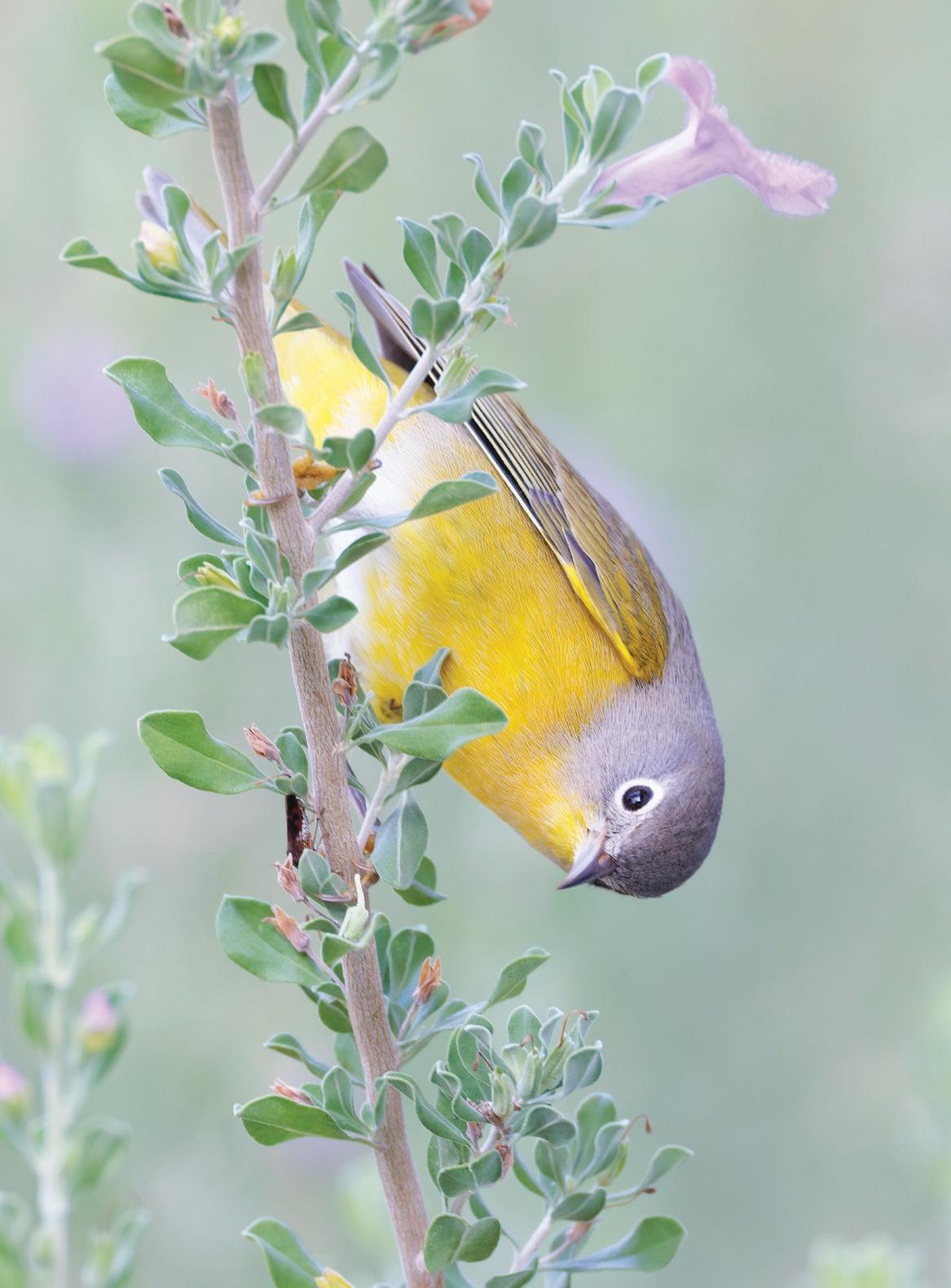
Cover photo Nashville Warbler on Texas sage in Spring Branch, Texas, by Grace Scalzo abcbirds.org/CoverBird
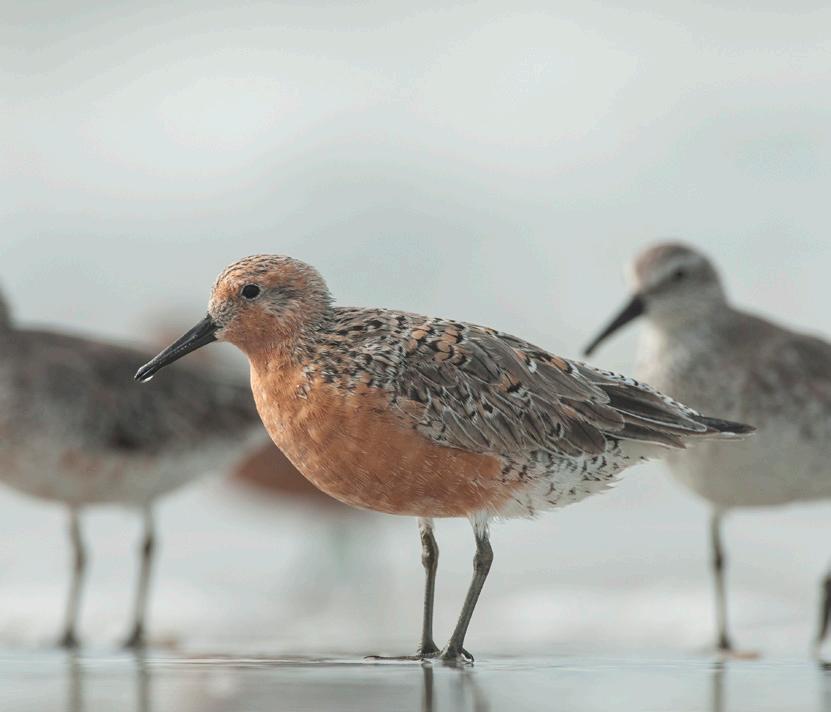
Red Knot
Walker Golder
Chirps
What we’re hearing from ABC members and friends.
Better Choices for Gardens
In the summer 2025 issue in “Tips for Gardening without Harsh Pesticides” (page 42), you recommended using dish soap mixed with water to kill pests. Dish soap is not a soap; it is a detergent. It is not a benign product and can harm plants by stripping oils from their leaves. You can get liquid soaps such as Dr. Bronner’s, which would be a better choice. An even better choice might just be a strong stream of water to dislodge the pests. The best choice of all is to tolerate insects and make the garden hospitable to predatory insects that can help control the pest insects. Thanks for continuing to advocate for the wild ones. — Susan H.
The Wonder of Birds
From the editor: In our fall 2025 issue, we asked, “What does ‘wonder’ mean to you when it comes to birds and birding?” Here are a few of the 100+ lovely comments that poured in.
I have been a birder for 43 years, and growing up in a nature-conscious family, I was always noticing birds, well before I called myself a birder. As a former scientist, now retired, I find myself musing about the mysteries of migration, the process of speciation, mate selection, and other things that birds do. Just
today, in my rather barren retirement community, I had four Vesper Sparrows, an Orange-crowned Warbler, and eight American Pipits in my small yard. I shared them with my wife, daughter, son-in-law, and granddaughter. It was kind of magical. — Bruce A. “Wonder” is when birds elicit an involuntary reaction in us. It can be a smile, a laugh, holding your breath, or shaking your head. It can be caused by their courage, dexterity, beauty, or wisdom, yet they never cease to amaze and delight us. — Jonathan M.
Each day I’m out birding, I’m always amazed at what I see. It doesn’t matter if it’s the same species I see most days or a unique one. The birds are always doing something wonderful and significant. — Virginia D.
Wondering about birds tells me I live in a world so extraordinary that I could never comprehend its variety and vastness. In that, I see purpose, beauty, hope, happiness, and joy. And through birding, I grasp the meaning of human consciousness. — Nancy B.
Almost nothing incites wonder like birds: their many colors, sizes, their flight with many individual styles. Most of all, their songs. What can be more pleasant in the morning than their
chirping, peeping conversations?! It is such a treat to hear a mockingbird with their whole repertoire of calls. — Anita B.
The fact that new ideas for conservation continue to be invented makes me feel we have a chance to turn things around. — Jerry B.
Wonder equals love. The wonder of birds makes me feel happy and privileged to witness and share it. Wonder is why I’ve been obsessed with birds for more than 50 years and a bird bander (owls, diurnal raptors, and songbirds) for nearly 45 years. — Katharine D.
I often wonder where the dang little thing went when it was in the scope just a (wonderous) brief moment before! — Steve R.
Let’s hear from you!
Share your thoughts about our magazine, emails, or online content at magazine@abcbirds.org
Please include your full name and location. Letters may be edited for length and clarity. (Note: Opinions expressed are those of the authors.)
© Michael Stubblefield
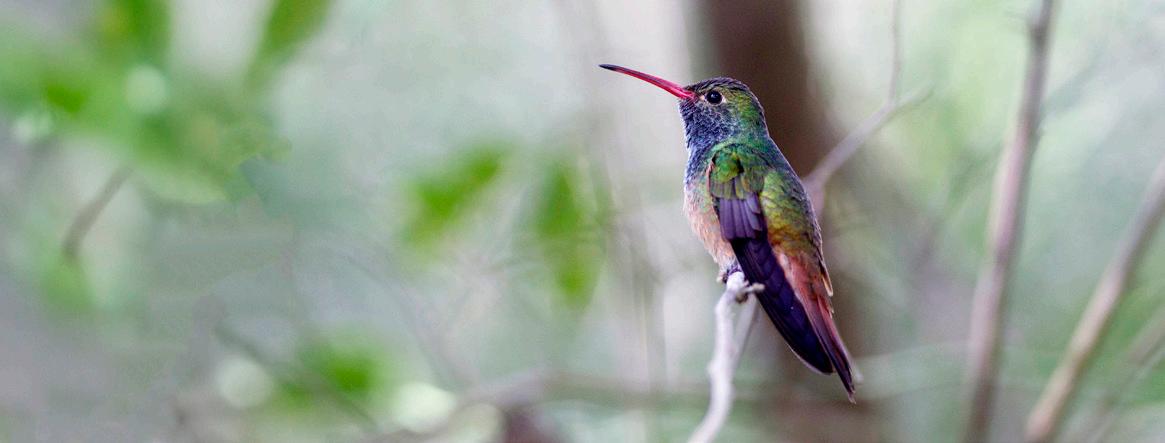
Buff-bellied Hummingbird
Improving Habitat, Stirring Hearts
Welcome to the spring 2026 edition of Bird Conservation magazine. Thank you very much for your support of American Bird Conservancy.
I just returned from a visit with ABC supporters to Alaska, where on first look the land still seemed to be in the icy grip of winter. Even there though, the earliest signs of spring were already in the air. A few freshwater streams were beginning to open, welcoming dippers to forage among the rocks. McKay’s Buntings — one of our most northerly breeding birds — were beginning to sing and frolic in the snow-covered streets of Nome, and ravens were starting their aerial courtship rituals. We saw a young Gyrfalcon, hatched last spring, tracking flocks of Willow Ptarmigan along the snowy Beam Road outside of Nome, and even the majestic flocks of Emperor Geese on Kodiak Island were starting to experience zugunruhe, the migratory restlessness that comes as spring begins to stir their hormones.
I arrived back home to Washington, D.C., to find the trees beginning to leaf out, leaving me one last chance to catch up with a Rusty Blackbird or two before they head north to their nesting grounds among the boreal bogs of Canada.
These experiences continue to reinforce my love for birds and wild places, and fuel my concern for their future, sparking the one recurring question about bird conservation that follows me wherever I go. “How do we know we are making a difference?” This issue of the magazine helps to answer that question, show casing examples of how ABC is managing and restoring habitat for birds on the ground across the Americas, acre by acre, and at a scale that is changing the trajectory of bird population declines for the better.
For example, a host of private landowners from across the Midwest and Great Lakes region are managing their properties with
Golden-winged and Cerulean Warblers and American Woodcock at top of mind (page 18). And in the Southeast, a tremendous $21 million grant will promote bird-friendly habitat work in open pine forests for the next five years (page 14).
Conservation also involves stirring hearts as much as it does improving habitat. With that in mind, I’m grateful for people like Binta Dixon, Coordinator of our Afrofuturism Collective (page 40) and Joanna Eckles, Coordinator of Bird City Network (page 43). Their work inspires countless others to care for birds and nature around the world. What could be more hopeful than that?
Michael J. Parr President


Scan this code or visit the link below to let us know what you think of this issue. Thanks for reading Bird Conservation! abcbirds.org/MagSurvey
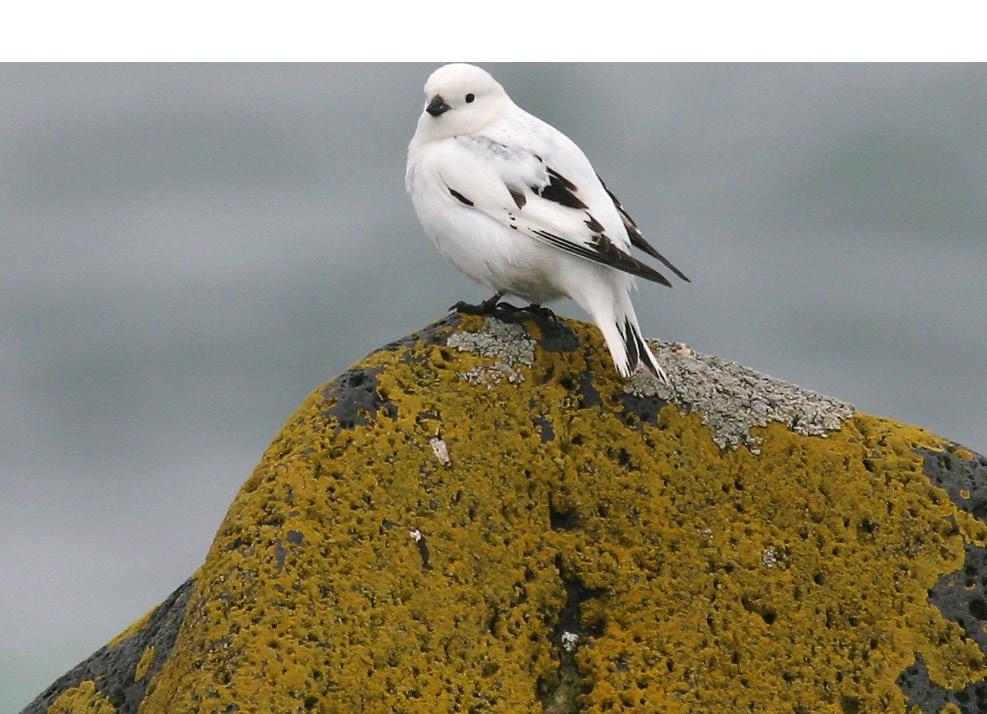
McKayʼs Bunting
Anthony Lujan; Jason Vassallo (inset)
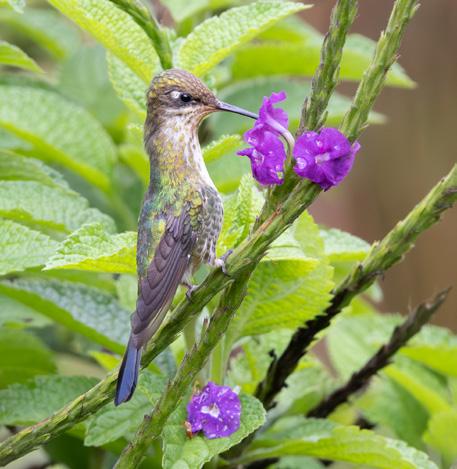
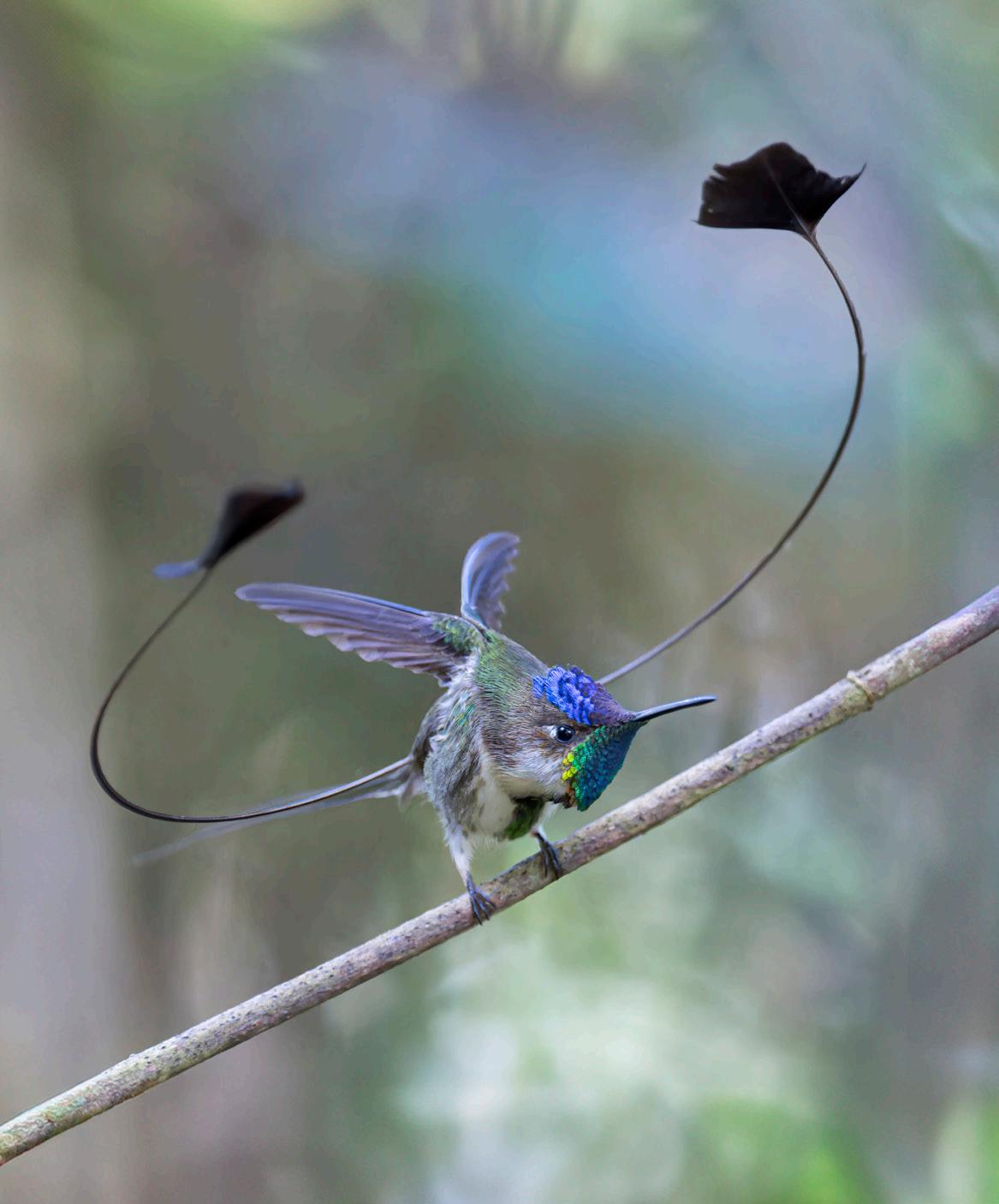
A male Marvelous Spatuletail flutters his wings and waves his racquet-tipped tail feathers in an attempt to attract a mate. The bird’s breeding display is one of the most remarkable in the avian world. In the inset, a female Marvelous Spatuletail feeds from a purple verbena flower in the Peruvian Andes. Females have shorter tails and lack the crown and throat colors found on males.
Protecting a Rare Marvel
The only bird species in the world to bear the word marvelous in its English name is a rare Peruvian hummingbird in which the male’s tail is three to four times longer than its body. Spatula-shaped racquets at the end of the tail help complete the bird’s evocative moniker: Marvelous Spatuletail.
An adult male’s roughly 4- to 5-inch tail accounts for about 75 percent of its body length. He also sports two central tail feathers that are about 3 inches long, which may help improve his aerodynamic abilities. The female is much smaller, under 4 inches in length, including her 2-2.8-inch racquetless tail. The male’s purplish blue racquets are used to woo females during the mating season. When a female approaches, the male hovers and holds the racquet-ended feathers in a U shape high over his body; he also flies around the female with tail feathers frequently crossing behind his body in an extraordinary display.
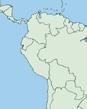
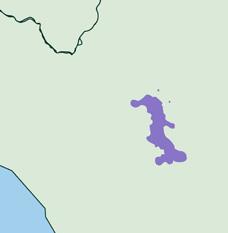
The species is found only in the Andes of northern Peru, between 6,900 and 9,500 feet of elevation, primarily in the Utcubamba River valley.
As one of the world’s rarest hummingbirds, the spatuletail has been the focus of conservation efforts for more than 20 years. In 2006, Peruvian conservation organization Asociación Ecosistemas Andinos (ECOAN) and ABC established the world’s first protected area for
the Marvelous Spatuletail, the 77-acre Huembo Reserve, with the local Pomacochas community. Between 2013 and 2021, the partners supported the creation of additional communitymanaged conservation areas that expanded the reserve to 93.9 acres.
With the support of ABC, ECOAN created a tree nursery and planted hundreds of thousands of trees and shrubs within and around the reserve, including many of the spatuletail’s favored food plants.
ABC and ECOAN built an ecolodge at Huembo with hummingbird feeders that consistently attract the star bird. ECOAN also monitors breeding activity to inform habitat restoration and works with the community to prevent and fight fires in the area.
This year, ABC and ECOAN are partnering with the Inter-American Development Bank to strengthen a premier birding and nature-tourism corridor, the Northern Peru Birding Route. The project will also help boost similar, ongoing efforts in other parts of the route, led by ECOAN and the Conserva Aves initiative through support from Bezos Earth Fund and the Government of Canada. Globally recognized for its ecological uniqueness and vulnerability, the route is packed with endemic and restricted-range threatened species, including this small hummingbird with its mesmerizing tail.
Acknowledgments
ABC is grateful to the International Hummingbird Society, Patricia Davidson, and J. William Akers for supporting the Huembo Reserve.
Read more and enjoy a video about this species in our Bird Library. abcbirds.org/Marvelous
Population: 1,000–2,500
IUCN Status: Near Threatened
Trend: Decreasing
Habitat: Edges of forest, second growth, thorny thickets
Other Names: Colibrí Cola de Espátula, Colibrí Maravilloso (Spanish)

Marvelous Spatuletail Loddigesia mirabilis
More Evidence of Bird Declines — and Rays of Hope
The latest comprehensive assessment of threats to birds reports that 61 percent of species worldwide have declining populations — an increase from 44 percent in 2016.
The BirdLife International evaluation, which involved thousands of experts over nine years, was released in fall 2025 as part of the most recent update to the International Union for Conservation of Nature’s Red List of Threatened Species. Around the globe, 1,256 bird species are threatened, representing 11.5 percent of the 11,185 recognized species.
BirdLife pointed to habitat loss and degradation, “driven especially by agricultural expansion and intensification and by logging,” as the primary drivers of population declines and extinction risk.
“That three in five of the world’s bird species have declining populations shows how deep the biodiversity crisis has become and how urgent it is that governments take the actions they have committed to under multiple conventions and agreements,” said Ian Burfield, BirdLife’s Global Science Coordinator and Bird Red List Authority Coordinator. “The restoration of native forest habitat on Rodrigues Island, facilitating the successful recovery of the endemic Rodrigues Warbler from Critically Endangered in 1996 to Least Concern today, shows what is possible through partnership and perseverance.”
The Red List update — the eighth comprehensive assessment by BirdLife — reassessed 1,360 bird species overall. In the Americas, experts evaluated the Red List statuses of
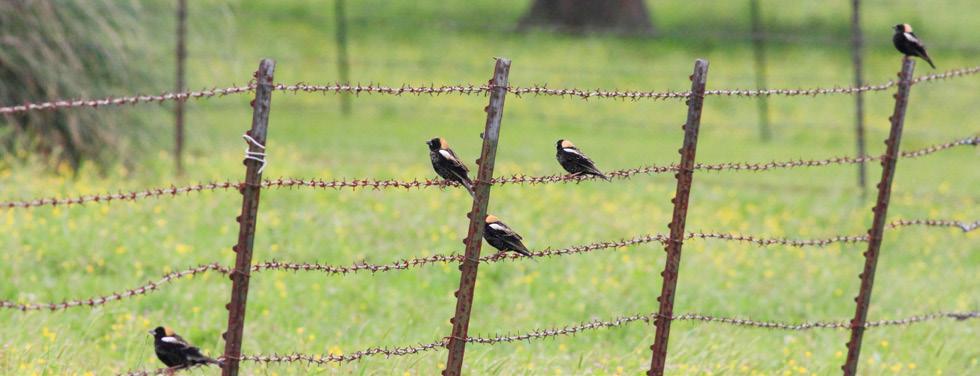
484 species and changed the statuses of 45 species. While some of the birds’ statuses changed due to improved data or scientific understanding, the threat levels for seven species were adjusted because of changing conditions on the ground. Four were uplisted from Least Concern to Near Threatened: the White-bearded Helmetcrest, a hummingbird endemic to Venezuela; the Streak-crowned Antvireo and Northern Nightingalewren, both found in Central American forests; and the Bobolink, a grassland bird that breeds across the United States and Canada and spends the nonbreeding season in Bolivia, Paraguay, and Argentina.
Revealing hope in an otherwise gloomy report, three American bird species were downlisted. The Bluewinged Macaw of Brazil and
Paraguay and the widespread migratory Olivesided Flycatcher shifted from Near Threatened to Least Concern. And the Guadalupe Junco, an endemic species of Guadalupe Island west of Mexico’s Baja California, moved from Endangered to Vulnerable. It’s the second downlisting for the species; in 2016, it went from Critically Endangered to Endangered.
The junco, now estimated to number 330 to 800 birds, was once common and among the island’s most abundant birds. “It declined greatly and became largely restricted to the cypress and pine groves in the north of the island due to the impacts of introduced goats,” the Red List reported. Since the eradication of the goats in 2007, juncos are recovering across at least the northern two-thirds of the island.
Bruce Beehler
Bobolinks gather on a barbed wire fence. The species is now listed as Near Threatened on the international Red List.
Permanent Home Proposed for Virginia Seabirds
An island slated for construction in 2027 is intended to become the home of Virginia’s largest seabird colony. The island, to be located in the bay between the cities of Hampton and Norfolk and west of the Hampton Roads Bridge-Tunnel, would provide a permanent breeding area for the seabird colony relocated in 2020 due to expansion of the Hampton Roads tunnel.
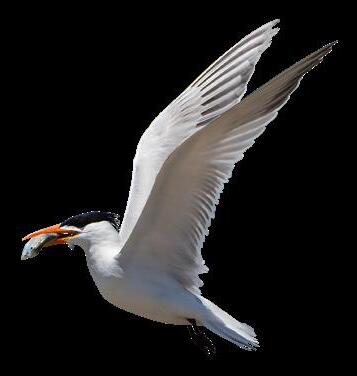
When the 2020 construction threatened their survival, ABC and other groups advocated for alternative breeding habitat for the birds, including Royal, Gull-billed, and Common Terns, Black Skimmers, and Laughing Gulls. State officials agreed to lure the colony to nearby Rip Raps Island (also known as Fort Wool) and adjacent floating barges.
The effort worked, and more than 6,000 pairs of birds nested at the new site that year.
The birds have returned annually, but the move wasn’t intended to be permanent. In the time since, the state’s Department of Wildlife Resources and the Army Corps of Engineers worked on finding an alternative site. In 2024, they released a proposal to create a new 9.7-acre horseshoe-shaped island with 5 acres of seabird nesting habitat in the bay.
If the plan is approved, the island will be built next year with more than 518,000 cubic yards of dredged materials, as well as geotubes and various stones for constructing shorelines. Biologists would then attract birds using decoys and broadcast calls to the new site in 2028 and would monitor
Six States Joining Bird City Network
This year, Bird City Network (BCN), an initiative of ABC and Environment for the Americas, is welcoming six new state programs into the fold. BCN leaders are guiding teams from Alabama,
Idaho, Kentucky, New Jersey, Ohio, and Tennessee through program design and integration. They will join existing programs in 13 other states and three Latin American countries.

the colony for up to 10 years. Officials say they’re also planning to establish rules keeping boats away from the island and preventing trespassers from reaching the colony.
A constructed island in South Carolina serves as a template of sorts for the work in Virginia. The 7-acre Tomkins Island, completed in 2005 as mitigation for the loss of nesting areas to development, is now a sanctuary for terns, gulls, skim mers, and other seabirds.
BCN recently celebrated St. Louis as the first community in Bird City Missouri and the first in the network with dual recognition from the U.S. Fish and Wildlife Service’s Urban Bird Treaty program, BCN’s partner program in the federal government. The Urban Bird Treaty recognizes more than 25 cities nationwide for their bird conservation and habitat improvement strategies in urban and suburban areas.
Another recent first: The small coastal city of Yachats, Oregon, became the first
Bird City on the Pacific coast and in the state. The program’s projects include banding migratory Purple Martins and supporting efforts to convert streetlights to Dark Sky standards, as well as hosting speakers and conducting birding events.
In 2025, more than 275 communities participated in BCN within its 16 programs. They completed more than 3,500 actions to improve habitat, reduce threats, engage people, and promote sustainability. Read more about BCN in “Field Notes,” page 43.
Royal Tern
St. Louis is Missouri's first Bird City.
ABC Supports New Reserves for Rare Birds
ABC and partners in Latin America continue to add and expand bird reserves, especially to benefit threatened and endangered species. Here’s a look at the latest properties in our reserve network.
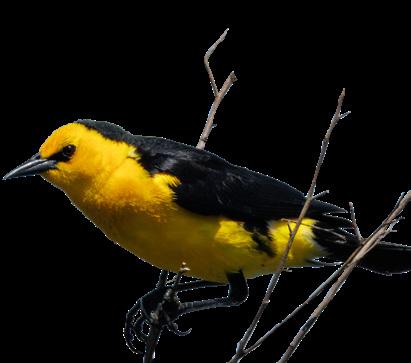
Estancia La Rosita in northeastern Argentina is a vital sanctuary for the Endangered Saffron-cowled Blackbird, Near Threatened Iberá Seedeater, and other imperiled species. The newly protected area, which spans nearly 3,200 acres, was established by Aves Argentina with support from ABC and BirdLife International. Securing the land for conservation marks a significant milestone in the preservation of one of the most threatened and least protected grassland and wetland ecosystems in Argentina.
The Critically Endangered Cherry-throated Tanager is the focus of a new state park in southeastern Brazil. The roughly 580-acre Cherry-throated Tanager State Park connects other protected areas in the remaining Atlantic Forest, including the Kaetes Reserve, into a landscape of nearly 2,000 acres. ABC partner Instituto Marcos Daniel manages Kaetes on behalf of the tanager, which numbers at most 20 individuals.
And in central Peru, ABC partner Asociación Ecosistemas Andinos (ECOAN) and the Aquia community led the creation of the new Rimay Cóndor Environmental Conservation Area. Across more than 42,400 acres of habitat, the reserve is home to more than 90 bird species, including the Vulnerable Ash-breasted Tit-Tyrant and Andean Condor. The project is part of the Conserva Aves initiative, which ABC co-leads with National Audubon Society, BirdLife International, Birds Canada, and RedLAC.
Acknowledgments
Thanks to the Richard and Anna Marie Rosen Fund, Randall T. Cox, the March Conservation Fund, the Marshall-Reynolds Foundation, and the Weeden Foundation for their support of the Estancia La Rosita project. And we’re grateful to Bezos Earth Fund for supporting the Rimay Cóndor ACA.
Two Lost Birds Rediscovered
A long-lost bird from the African nation of Chad and a poorly known species from the Philippines’ Sulu Archipelago have been located in recent months.
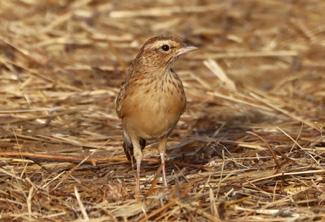
On February 2, birders Pierre Defos du Rau, Idriss Dapsia, and Julien Birard found and photographed a Rusty Lark in south-central Chad. It was the first
definitive sighting of the species since 1931, and their images were the first photos ever taken of the bird, which is also known as Rusty Bush Lark.
A few months prior, on November 15, 2025, wildlife photographer and former forest ranger Shareef Khaddafi Hairal photographed a Sulu Cuckooshrike while conducting biodiversity
surveys in the mountains of Tawi-Tawi in the southern Philippines. The species was last documented in 2008. Since the photograph was made public, the bird has appeared on several bird checklists originating in Tawi-Tawi in 2026 — a hopeful sign that it may still persist in the region’s remaining forests.
The exciting rediscovery also brings renewed momentum to search for other missing species from the Sulu Archipelago, including the Sulu Jungle Flycatcher and the Sulu Bleeding-heart
The rediscoveries mark more highlights for the Search for Lost Birds, a partnership of ABC, BirdLife International, and Re:wild aimed at relocating bird species with no confirmed observations in at least 10 years. Last year, organizers teamed up with Ornis Birding
© John Hannan (blackbird); Shareef Khaddafi Hairal (cuckooshrike); © J.Birard/I.Dapsia/P.Defos du Rau/TdV/DFAP/OFB (lark)
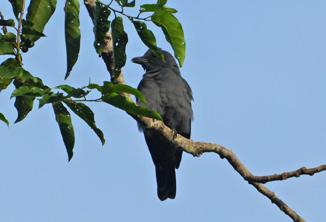
The recently rediscovered Sulu Cuckooshrike (left) and Rusty Lark (right).
Saffron-cowled Blackbird

Saving the Galápagos of the Mojave
An area of eastern California and western Nevada that is often called the “Galápagos of the desert” will benefit from an ambitious new restoration project of approximately
1,000 acres in the Amargosa River Basin.
The basin, located in the Northern Mojave Desert, is marked by summer temperatures above 120 degrees and below freez-
Expeditions to offer grants to young birders who want to search for lost species, and five winners were recently announced. Among the young birders’ target species are Mexico’s Guadalupe Storm-Petrel, Colombia’s Sinú Parakeet, Kenya’s Tana River Cisticola and Red Weaver, western Africa’s Ghana Cuckooshrike, and four lost birds of New Ireland, an island in Papua New Guinea. For interested applicants, the next round of grants will open in July.

Thanks to Kathleen Burger & Glen Gerada and The Constable Foundation for supporting the Search for Lost Birds. Learn more at searchforlostbirds.org.
ing in winter. Water is scarce, and annual rainfall barely tops 4 inches. The water that does exist in the basin comes from springs and seeps that support the 185-mile-long Amargosa River, which nurtures riparian (riverside) habitats that allow unique and rare species to flourish. The habitat, however, is threatened by environmental and climate extremes as well as exploratory drilling and mining operations.
ABC and a team that includes Amargosa Conservancy and River Partners are now in the planning stages of the Amargosa River Riparian Restoration project, which is funded by the California Wildlife Conservation Board.
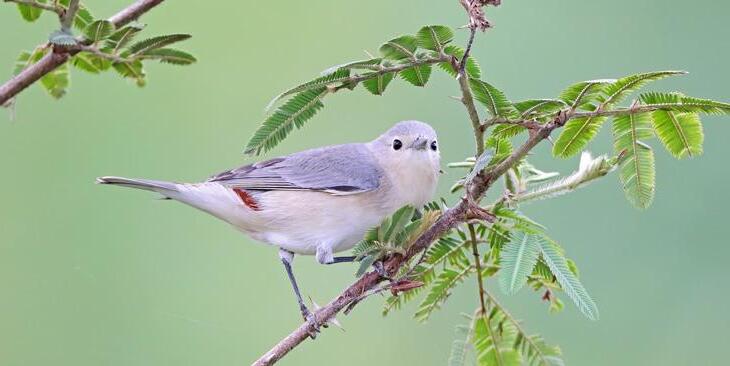
The basin is extremely productive for breeding birds like the federally Endangered Least Bell’s Vireo. The Southwestern Willow Flycatcher and Western Yellow-billed Cuckoo are
Lucy’s Warbler
birds the project prioritizes in its restoration plans.
Other species more closely tied to the Sonoran Desert, such as the Lucy’s Warbler, Black-tailed Gnatcatcher, and Crissal Thrasher, and a host of other wildlife, will also benefit from the improved habitat.
“This is a site with some of the most ecologically significant riparian habitat regionally, with the capacity to help many populations or subpopulations of bird species improve their status in the Mojave Desert,” said Chris McCreedy, ABC’s Southwest Riparian Bird Recovery Coordinator.
“‘Miracle’ may be too strong of a word, but it’s exceptional that riparian habitat exists along the Amargosa River in the first place.”
A final restoration plan will be submitted to the Wildlife Conservation Board in 2028, detailing how the partners will re-create native plant communities, improve soil, remove invasive plants, expand habitat, and conduct other restoration efforts to enhance the region’s riparian and marsh habitats. Once approved for funding, subsequent implementation will begin in 2028.
Acknowledgment
ABC thanks the California Wildlife Conservation Board for supporting this project.
Greg Homel/Natural Elements Productions
Wins for Bird-Friendly Glass
The cities of Dallas, Texas, and Jersey City, New Jersey, will soon be safer for birds.
In Dallas, the Kay Bailey Hutchison Convention Center recently unveiled its plans to adopt bird-friendly glass during its current $3.7 billion renovation. The changes come in response to advocacy by local groups including the Texas Conservation Alliance, Environment Texas, and Audubon Texas, together with partners including ABC, and over 1,000 community members who voiced concerns to the Dallas City Council about the building’s existing structure. The convention center has a skybridge and a facade of high, reflective glass known to cause harm to hundreds of birds journeying along one of North America’s busiest migration corridors each spring and fall.
The newly redesigned convention center is
expected to reopen in 2029 and will incorporate bird-safety features tested and advocated for by ABC. This renovation comes as part of a larger ongoing effort to modernize downtown Dallas’s event and tourism infrastructure, while also contributing to conservation goals to support its status as a Bird City.
Since 2021, environmental volunteers with Lights Out Dallas! have monitored bird-building collisions across multiple downtown locations. About 30 percent of documented collisions were found to occur at the convention center, caused by the building’s large, reflective glass surfaces and its artificial lighting at night.
In Jersey City, the city council unanimously passed and the mayor signed a new ordinance that will help make new buildings safer for the millions of birds that migrate through the city each year.
The law applies to all new buildings that require a site plan, as well as installations like awnings, railings, skyways, atriums, and other structures that can be hazardous to birds.
Local nonprofit Jersey City Birds advocated for the new law, along with the local chapter of the Feminist Bird Club and other volunteers. ABC, NYC Bird Alliance, and New Jersey Audubon also assisted.

“Dallas and Jersey City are showing how cities can protect migratory birds while continuing to grow and develop,” said Kaitlyn Parkins, ABC’s Glass Collisions Program Coordinator. “Simple design measures can prevent countless bird collisions, and we were glad to work alongside city leaders and advocates to help make these policies a reality.”
Acknowledgments
ABC is grateful to the Leon Levy Foundation, Dudley T. Dougherty Foundation, and David Walsh for their support of our Glass Collisions Program.

Keep up with the flock by signing up for ABC’s emails and text alerts! abcbirds.org/Email

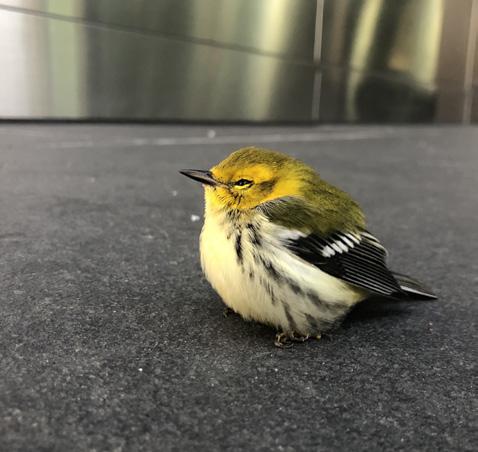
A Black-throated Green Warbler rests on pavement in a stunned state after colliding with a window.
The Kay Bailey Hutchison Convention Center in Dallas.
ABC Works to Solve Ongoing Bird Declines
by Hardy Kern
When ABC contributed to the landmark 2019 paper “Decline of the North American Avifauna,” we helped establish that birds in the United States and Canada are disappearing at staggering rates; as that study found, we are nearly 3 billion birds short of population levels in 1970. A new paper published in March found that the losses for many species are accelerating and that this pattern is not uniform across the continent.
use, fertilizer application, and crop production. Lead researcher François Leroy and his colleagues also report that places that are losing birds are also warming more rapidly due to climate change. Increasing temperatures make it harder for birds to reproduce, can decrease available prey, and may even drive birds to leave their usual hangouts and seek cooler temperatures.
There is no doubt that agriculture affects birdlife. In the previous paper showing the loss of 3 billion birds, grassland birds and aerial insectivores were two groups shown to be in the greatest overall decline. This tracks closely with what maps depict in the new paper; Midwestern grasslands and Mid-Atlantic insectivore habitats are shown to have higher rates of bird decline.
ABC’s conservation and policy work is focused on reversing these population losses. Our Central California Coast Joint Venture is identifying innovative conservation measures for the Golden State’s most imperiled bird species. The Appalachian Mountains Joint Venture is studying and restoring birds and bird habitat across vast swaths of the Mid-Atlantic, while the Oaks and Prairies Joint Venture is hard at work on America’s grasslands. This is only a small sample of the work being done across all of ABC’s regional programs.
“Midwestern grasslands and MidAtlantic insectivore habitats are shown to have higher rates of bird decline.”
The research, from scientists at the Czech University of Life Sciences Prague and Ohio State University, shows birds are declining much faster in the Mid-Atlantic, Midwest, and California, and in areas with higher levels of farming and grazing than in other parts of the country.
The study looked at 261 bird species along 1,033 survey routes from the North American Breeding Bird Survey and found an average population decline of about 15 percent. The data were gathered between 1987 and 2021, providing a comprehensive picture.
It is important to recognize that the paper shows correlation, not causation. Rather, these increasing drops in bird abundance are seen in areas with high levels of pesticide
Our Policy and Threats teams focus on reducing pesticide use on farms, advocate for more conservation funding in the Farm Bill, and support state and federal legislation to create safe and healthy bird habitat in these bird decline hotspots. Adding to the substantial work we already do with ranchers to improve grassland habitat, we’re developing a new program to encourage more prairie restoration while maintaining ranch profitability.
ABC believes that working lands — farms, ranches, and private forests — are a critical part of conserving North American birds. The findings in the latest paper are concerning, no doubt about it, and they serve to redouble ABC’s commitment to slow down bird declines, restore habitat, and take the bold actions birds need across the Americas.
Hardy
Kern is ABC’s Director of Government Relations, Birds and Pesticides Campaign.
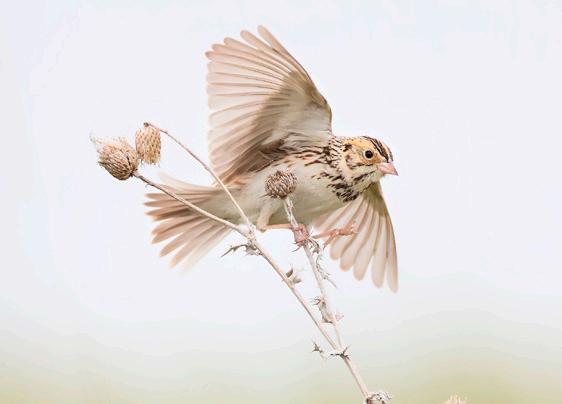
Bairdʼs Sparrow
The Stopover
hope abound. In the last few years, the Lower Mississippi Valley Joint Venture, which ABC supports and staffs, and other partners in Arkansas, Louisiana, and Texas have been investing in habitat restoration work that is making significant strides.
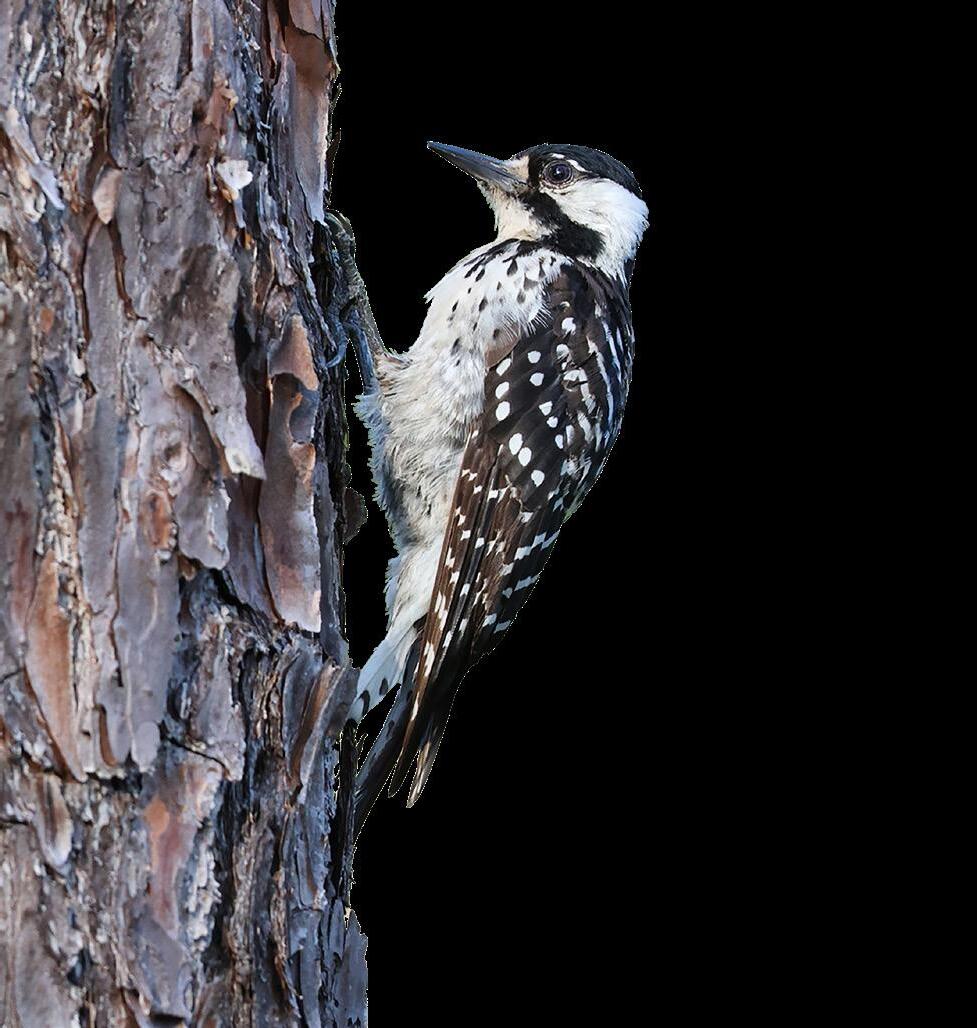
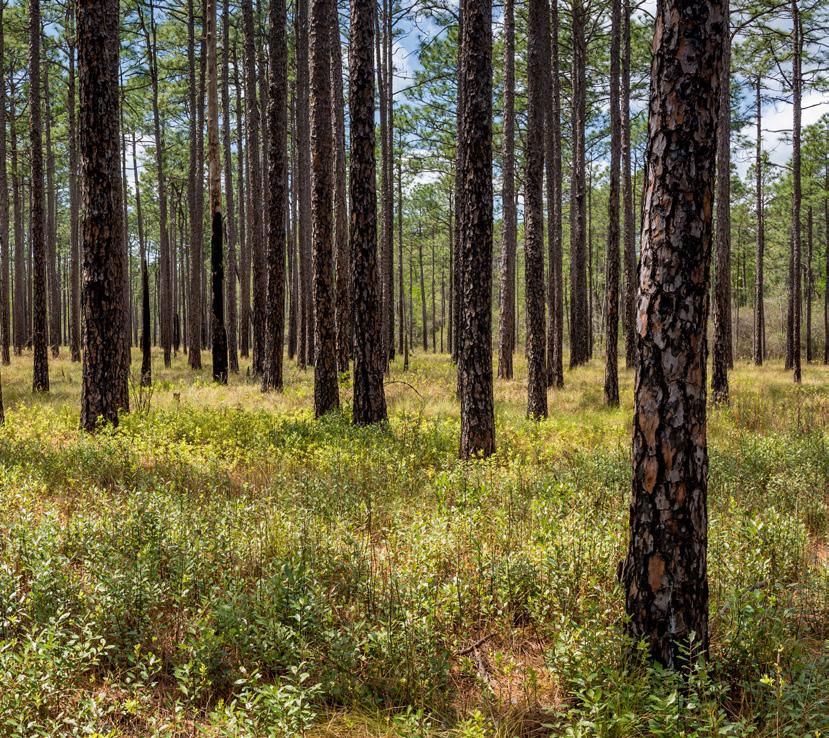
From 2022 through 2025, in the West Gulf Coastal Plain of Arkansas and Louisiana, partners improved open pine woodlands on more than 126,000 acres thanks to more than $15.2 million in investments. Monitoring of the properties shows that five of seven priority bird species (Northern Bobwhite, Wild Turkey,
Jean Blom/Shutterstock (woodpecker); Gerry Bishop/Shutterstock (landscape)
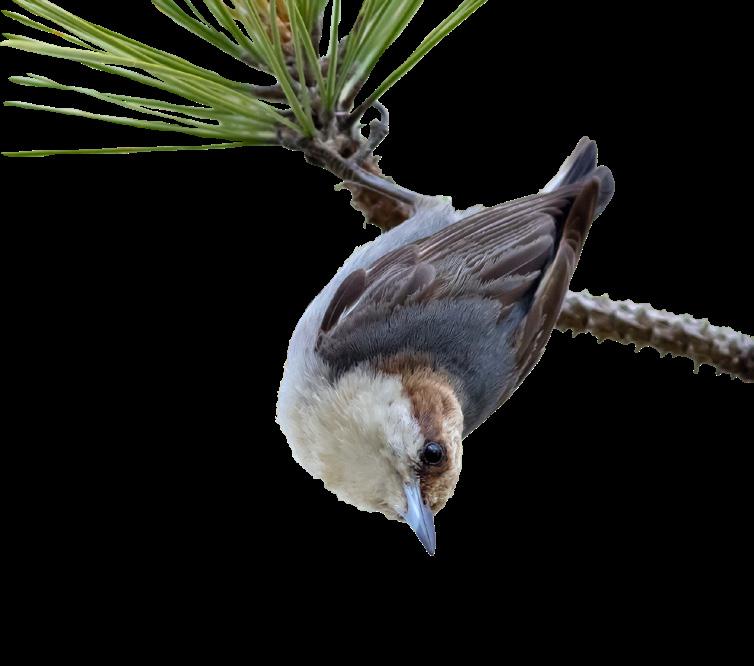
Prairie Warbler, Brown-headed Nuthatch, and Red-headed Woodpecker) are becoming increasingly common during the breeding season thanks to prescribed burns and other management practices.
Recently, the Joint Venture secured five more years of funding with a budget of $21.2 million, with ABC as lead partner on the program. This will enable conservationists to work with landowners on at least 70,000 acres in 27 counties of Arkansas and 20 parishes of Louisiana to benefit species from the Northern Bobwhite to the imperiled Bachman’s Sparrow
and the federally Threatened Red-cockaded Woodpecker.
In addition, a new National Fish and Wildlife Foundation grant of $975,000 to ABC (matched by more than $400,000 in partner funds) will provide incentives for private lands habitat work, support key species and habitat monitoring needs, and bolster the new Bachman’s Sparrow Working Group, among other goals.
These developments are music to the ears of anyone who cares about this imperiled ecosystem and its unique wildlife. Learn more at openpine.org.
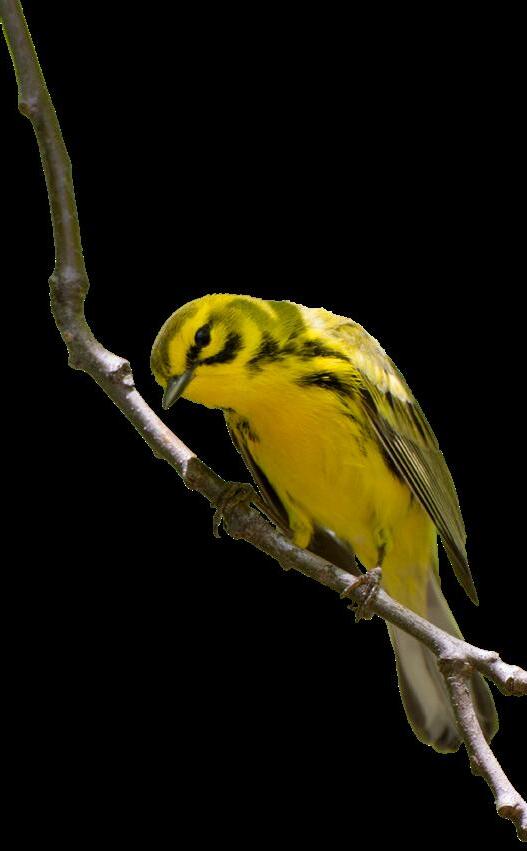
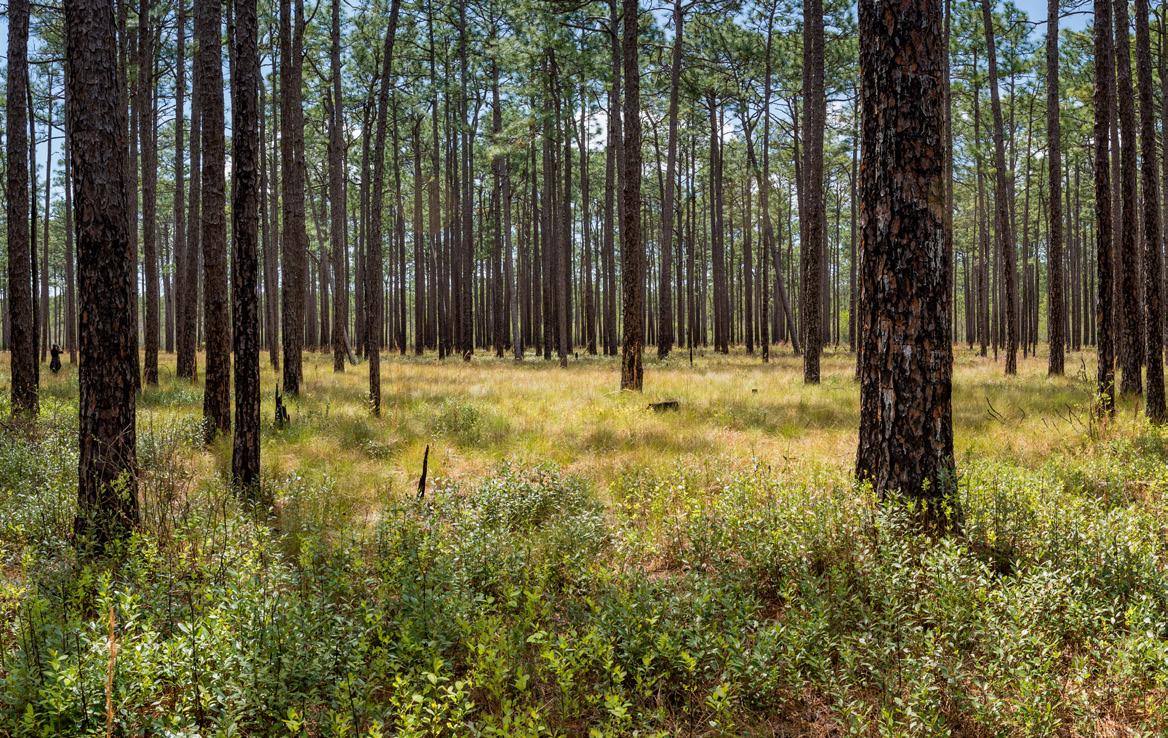
Open pine forests like this one in North Carolina support many bird species, including the Brown-headed Nuthatch (above), Prairie Warbler (below), and Red-cockaded Woodpecker (left).
Frode Jacobsen/Shutterstock (top); © Michael Stubblefield (bottom)
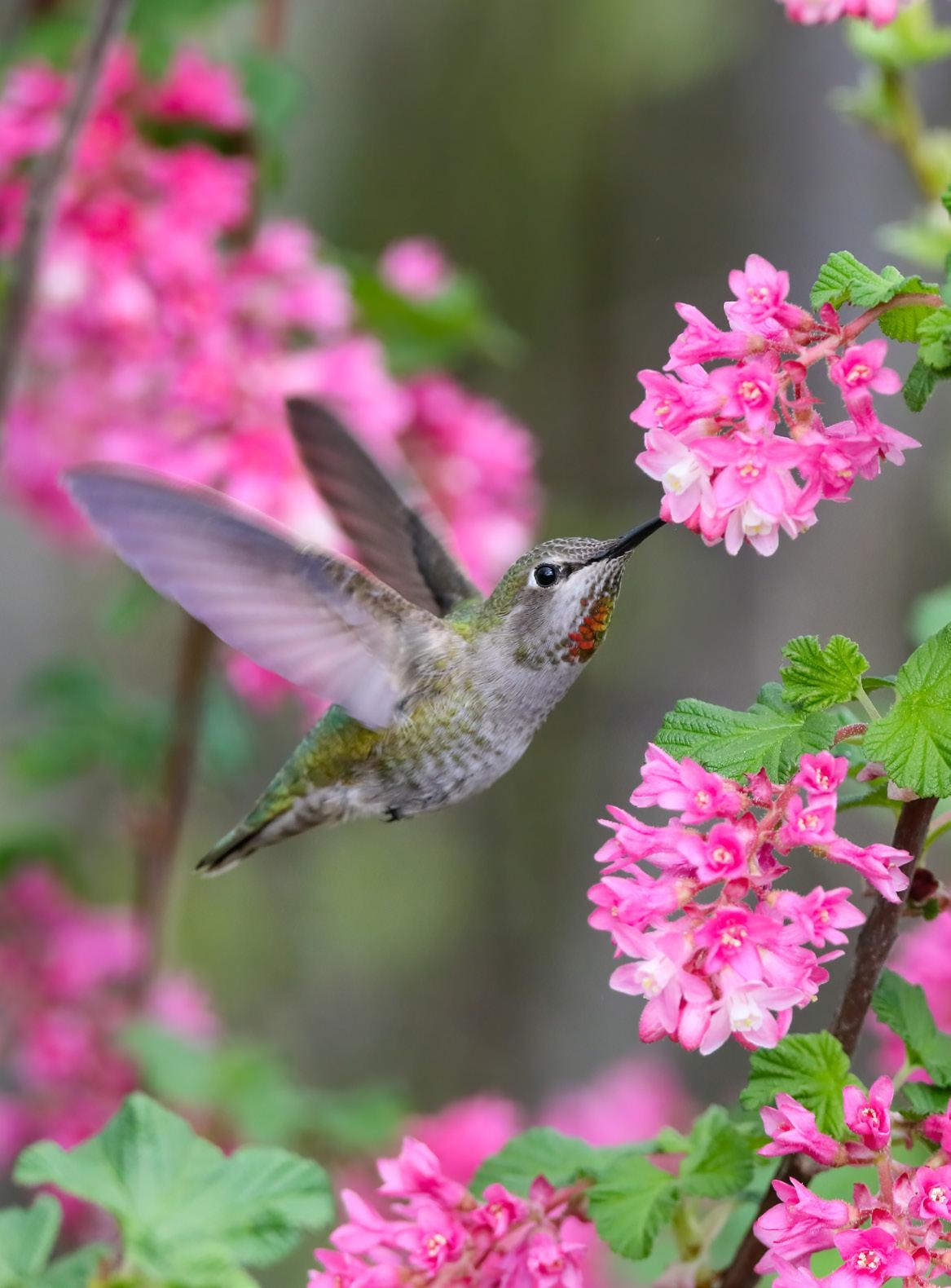
Annaʼs Hummingbird Scott Carpenter

Save a Place for Birds
Birds bring places to life with their beauty, behavior, and songs, and help create lasting memories of space and time: the ethereal flute of a Wood Thrush’s song during an early morning walk; the brilliant flash of a jewel-colored hummingbird zipping between spring flowers; the hurried march of busy shorebirds playing tag with the tide.
We share our spaces and places with birds — and as habitat loss is the leading threat to wild birds across the Americas, it is vital that we continue our work to conserve, restore, and protect the places birds need to thrive.
Working with partners across the Western Hemisphere, and thanks to your generous support, we accomplished more for birds in 2025 than in any other year on record, including:
• Supporting the protection of more than 171,000 acres of habitat in new and expanded protected areas, including a 38-acre reserve in the Chaca Valley for the Critically Endangered Chilean Woodstar, one of the world’s most range-restricted birds, with a population of only about 200.
• Stewarding more than 23,500 acres in Pennsylvania to improve forest health and structural complexity — creating the mosaic of habitats needed to support diverse forest bird communities that include Wood Thrush, Golden-winged and Cerulean Warblers, and Eastern Whip-poor-will
• Monitoring Least Tern and Snowy and Wilson’s Plover nests along 395 acres of the Texas coast and conserving an additional 1,275 acres as part of our ongoing work to ensure these sensitive beach-nesters can raise young safely.
Thanks to a dedicated group of supporters, ABC has launched a special Save a Place for Birds 1:1 Match Campaign, with a goal of raising $1.5 million for bird conservation by June 30.
Will you help us continue to conserve wild birds and their habitats across the Americas by making your most generous gift for bird conservation — and help us reach our most ambitious spring fundraising goal yet?
Thank you for saving a place for birds in your life, in your heart, and in the world we share with these wondrous creatures.


Give now by using the enclosed envelope, scanning the code, or visiting abcbirds.org/SaveAPlace

Barb Carstens
Forest Assist
Landowners who enhance their properties for birds and other wildlife explain what drives them
by Jesse Greenspan
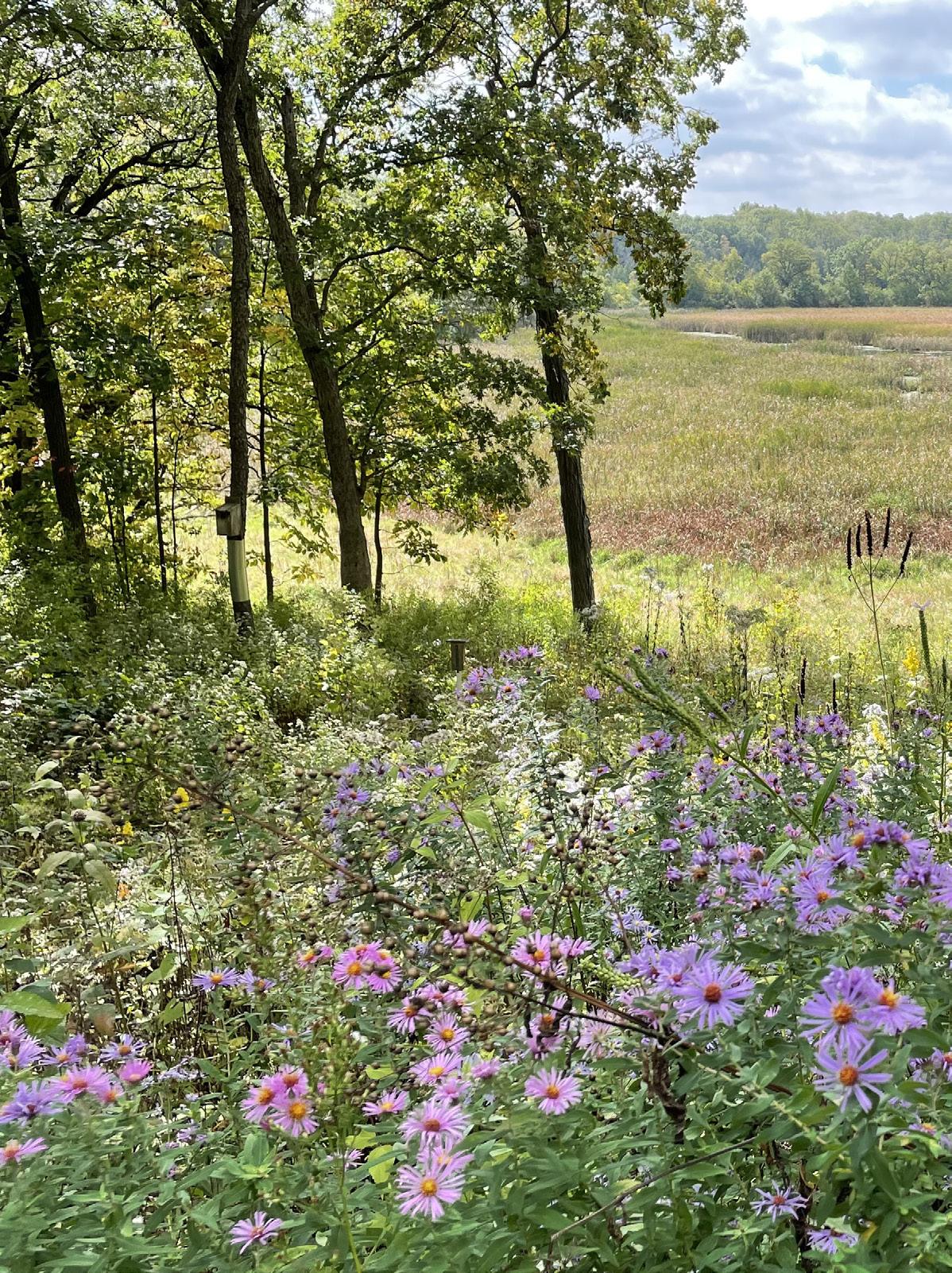
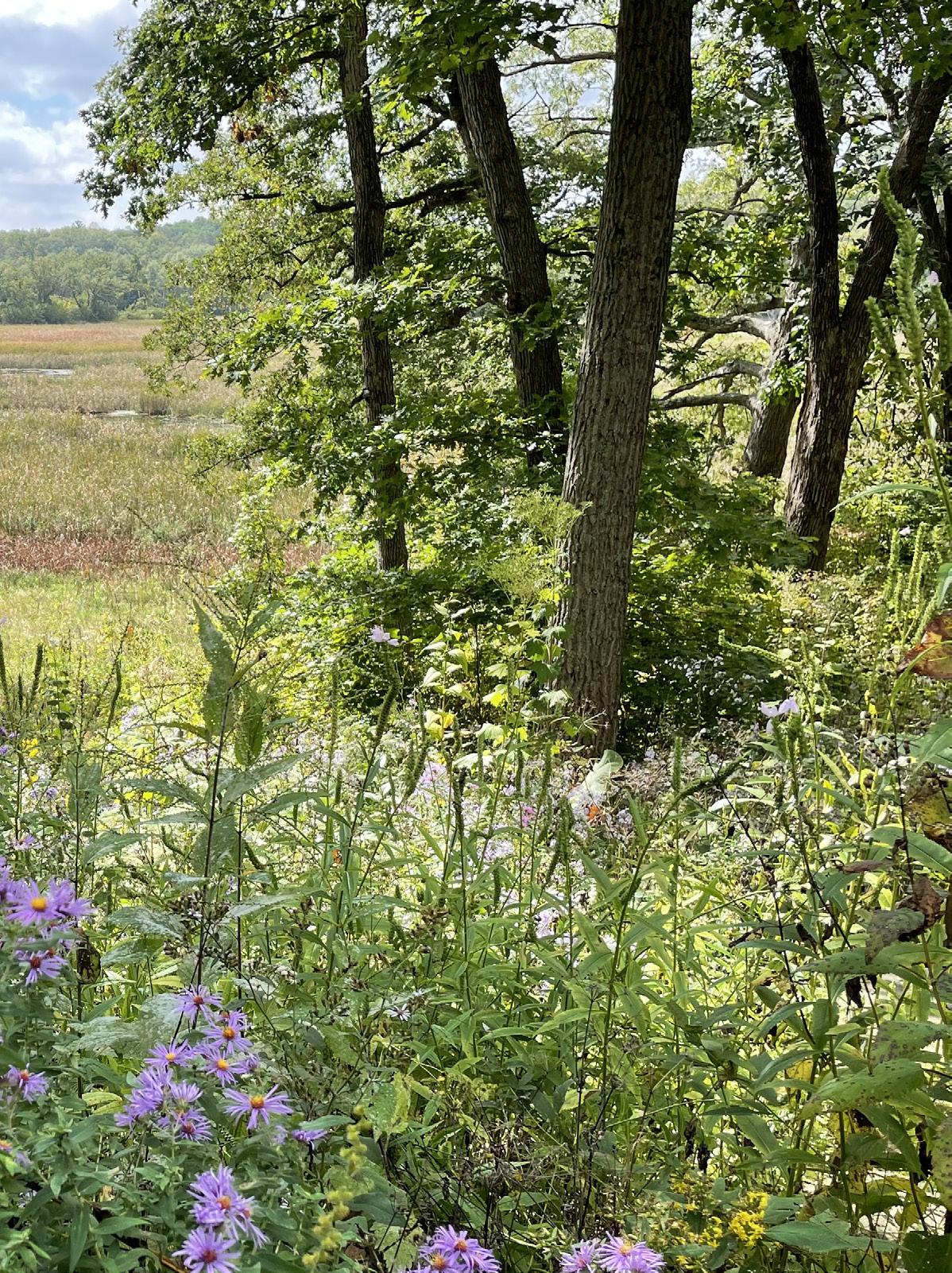
An open oak savanna planted with purple asters and other native blooms attracts birds year-round in southeastern Wisconsin. ABC supporters Barb Carstens and Jim Marrari have restored the property over the last 20 years.
Public lands cover nearly 40 percent of the United States, and these roughly 830 million acres are essential for birds. On their own, however, they’re not enough to maintain healthy avian populations — especially east of the Rockies, where national parks, forests, and the like are in much shorter supply than out west.
That’s where private lands come in. Working in concert with a diverse array of partners that includes American Bird Conservancy, many landowners nationwide are turning their properties into de facto wildlife sanctuaries. One such property here or there might not make much difference on an ecosystem-wide scale. But taken together, the hope is that they’ll help stem the huge bird declines seen in recent decades, including an estimated loss of more than 1 billion breeding birds from North American forests since 1970.
“Private landowners have really risen to the call,” said Austin Klais, an ABC Partnership Coordinator with the Lower Mississippi Valley Joint Venture who manages habitat restoration projects in Louisiana, Arkansas, Texas, and Oklahoma. Though the landowners he works with all have different goals and motivations, he said, most care about their legacy and “leaving the land better than how they found it.”
Often, private lands habitat projects involve putting in trees and shrubs. (ABC alone has supported the planting of more than 8 million trees across the Western Hemisphere, from Michigan to Peru.) Just as often, however, and perhaps surprisingly to those new to forest management, these successful habitat projects involve removing trees — selectively. They also sometimes involve other practices that might seem counterintuitive but which can be necessary in certain situations, such as applying herbicides where invasive plants are especially abundant, using prescribed fire to restore ecosystem health, and even hunting. Without hunting, for instance, deer would overwhelm forests and other habitats and cause significant problems for wildlife and native plants in areas where their natural predators have been extirpated.
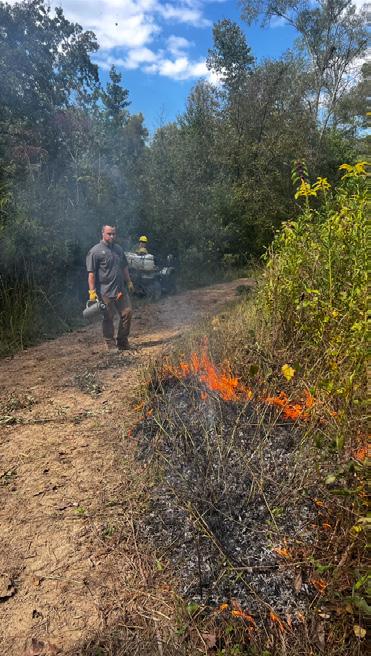
Fire, meanwhile, was used by Indigenous peoples for millennia to manage land for crops and game. It was then suppressed during the Smokey Bear era, only for researchers to eventually realize how much ecosystems depend on it. Among other things, prescribed burns control invasive plants, reduce tick populations, aid pollinators, and prevent excessive leaf litter and downed branches from piling up. Plus, some plant species are adapted specifically to fire and can’t germinate without it.
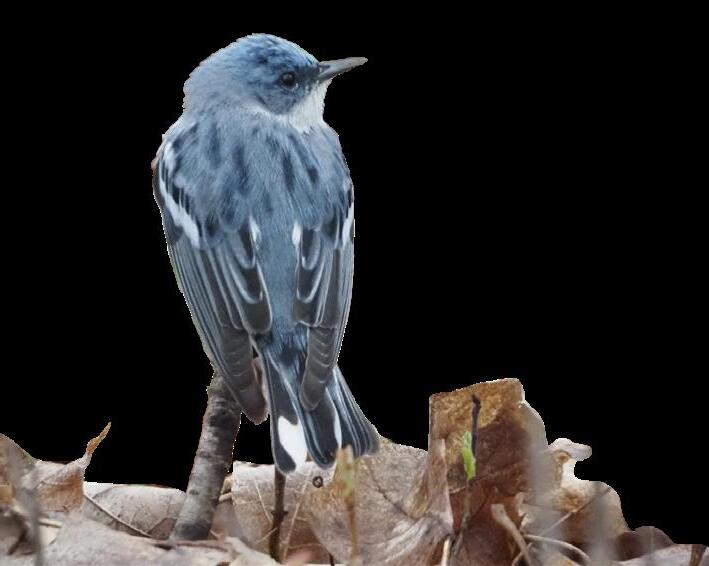
Cerulean Warbler
Some landowners are intimidated by the idea of fire on their properties. Or they falsely believe all fires to be damaging, perhaps envisioning the scene from Bambi or the climate change-fueled megafires that have increasingly swept through California and other western states. Prescribed burns are nothing like that.
“My six-year-old grandson can step over the fire line,” said David Ray, an Indiana landowner, who adds that his neighbors, coworkers, customers, friends, and relatives help out with prescribed burns, turning them into a kind of community event.
U.S. forest birds face many threats, from cats to windows to habitat fragmentation. Fortunately, especially in the East, a lack of trees on their breeding grounds is not usually one of them. Unfortunately, they can’t always find the right trees. “We have a lot of middle-aged forest that’s between 30 and 100 years old,” said Michael Paling, a Michigan-based ABC Forester. “We have very little young forest and very little old-growth forest.” Because so many natural processes have been interrupted by human activity, including fire suppression in fire-adapted ecosystems and introduction of non-native species, many modern-day forests require management to provide suitable habitat for birds ranging from Golden-winged Warblers to Red-headed Woodpeckers.
Farm Bill-funded federal programs, which generally receive bipartisan support, and other income streams are available to encourage landowners to enhance their properties for wildlife. In Arkansas and Louisiana, conservation nonprofits, timber companies, utilities, universities, and state and federal agencies have teamed up to restore thousands of acres of open pine woodlands for such species as Northern Bobwhite, Wild Turkey, Brown-headed Nuthatch, and Bachman’s Sparrow. Similar coalitions have formed elsewhere. “It takes everybody working together to make it happen,” Klais said.
But although outside support certainly helps, restoration-minded landowners still tend to invest significant personal funds and put in countless hours of manual labor. “The work never ends,” said Barb Carstens, a Wisconsin landowner. “Once you get into it, it’s hard to let it go. It’s like an addiction.” She observed that she can hardly walk past an invasive plant without pulling it. But she’s buoyed by the amazing wildlife she sees, as well as by the support and interest of her neighbors. “It’s heartwarming to at least not feel like you’re in this battle alone,” Carstens said.
Here are seven private properties, all east of the Rockies, with owners who have worked directly or indirectly with ABC to make their woodlands bird friendly. (Though this article focuses on forests, similar projects are in place for grasslands and wetlands in places across the U.S.)
An Oak and Hickory Haven
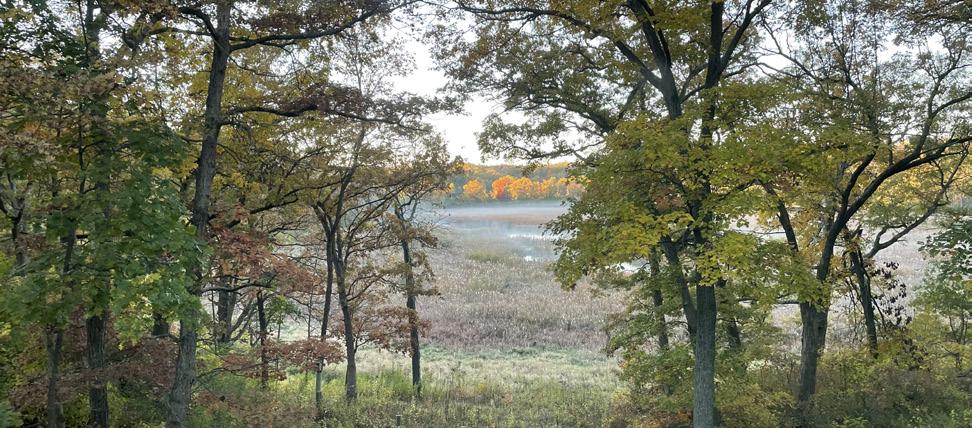
U.S. forests have plenty of mature oak trees. But decades of fire exclusion and overabundant deer populations have led to forests that lack young oaks. “Oaks need sunlight to grow,” said Kyle Brazil, Director of the Central Hardwoods Joint Venture (CHJV) at ABC. “Lacking fire to keep shade-loving trees such as beech and maples in check, sufficient sunlight can’t reach the forest floor to grow young oaks. Additionally, herbaceous plant and insect biodiversity suffer when sunlight is restricted.” Brazil added that when we lose oaks and biodiverse herbaceous plant communities, we also lose once-common songbirds.
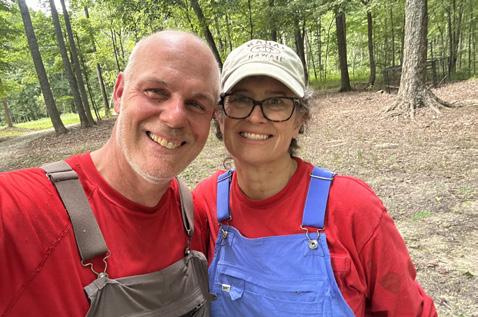
David Ray has dedicated much of his life to nurturing oaks. The keystone trees, he said, host hundreds of species of caterpillars, perfect nourishment for nestling birds. Ray and his wife, Mary, purchased their 310-acre plot in southern Indiana in 1995 after seeing a newspaper ad for it the day after their daughter’s birth. It
David Ray
David and Mary Ray care for a 310-acre oak forest in southern Indiana.
was a “little crazy,” Ray acknowledged. “But we are so thankful we did.”
Ray and his family spent much time there hunting the abundant deer and turkey, picking berries and mushrooms, and producing maple syrup. As the years passed, he also became more interested in how forests and birds were declining and how to be a good steward of the land. So, with the help of Farm Bill-funded grants, he got to work removing invasives, like tree of heaven (Ailanthus altissima) and Japanese stiltgrass, and promoting oaks, hickories, and other plant species with value to wildlife.
In addition to selective logging, always done outside of nesting season, Ray initiates prescribed burns, and he plants wildflowers and an assortment of berry- and seed-producing greenery. “Dave is kind of the Superman of forest management for wildlife,” said Jeff Powelson, CHJV Conservation Delivery Coordinator at ABC.
The work has paid off in droves. On Ray’s once partly degraded property, he has now recorded 28 warbler species, seven woodpeckers, four vireos, and three owls, along with what he calls a “crazy number of whippoor-wills.” A visiting friend once remarked to him, “I haven’t heard those since I was a kid.” Yet Ray still hopes to attract even more birds. “The Cerulean Warbler,” he said, “is kind of my white whale.”
170 Species and Counting
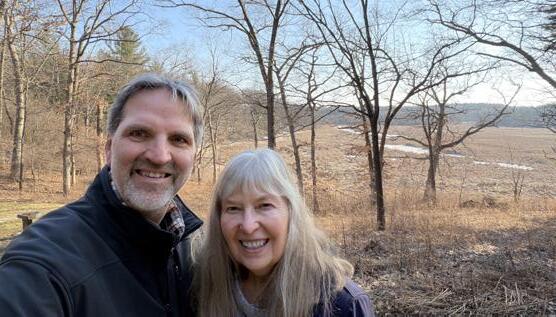
Twenty years ago, long-time ABC supporters Barb Carstens and Jim Marrari bought a 5-acre tract near the headwaters of the Mukwonago River southwest of Milwaukee, Wisconsin. Bordering a pair of preserves owned by The Nature Conservancy, they quickly found that the birding was excellent, a particular boon for Marrari, who served as his county’s coordinator for Wisconsin’s most recent Breeding Bird Atlas.
Nonetheless, upon obtaining aerial photos from the 1940s, the couple realized just how much the landscape had shifted over the decades from open oak savanna to dense understory. In what turned out to be a much bigger job than anticipated, they went to war against the buckthorn, non-native honeysuckle, Asian
Barb Carstens and Jim Marrari (above) own 5 acres near the headwaters of Wisconsin’s Mukwonago River (top).
bittersweet, garlic mustard, and other tenacious invasive plants that had made inroads, fighting them with everything from prescribed burns to carefully applied herbicides (and receiving a small amount of state and federal funding to do so).
They also collected native seeds and scattered them, installed a wildlife trail camera, and hosted bird-related educational tours. “Jim and Barb are shining examples of awesome landowners that are totally bought in,” said Tommy Gunn, an ABC Forester who provides technical assistance to landowners in southeastern Wisconsin and northeastern Illinois. He pointed out that his region has lost upwards of 80 percent of its historically oak-covered lands.
So far, Carstens and Marrari have recorded 170 bird species on their property, including Sandhill Cranes with colts, nesting Great Horned Owls, Hooded Mergansers, and Wood Ducks, and an array of nesting and migrating songbirds. Tennessee Warblers, in particular, flock to their water feature when passing through in fall; the bubbling water also lures Golden-winged, Nashville, and Black-throated Green Warblers. Ideally, Marrari said, they’ll eventually attract a nesting pair of Red-headed Woodpeckers, a poster child (and ABC priority species) for oak ecosystems.
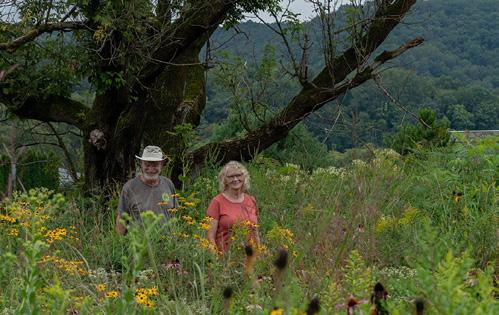
A Converted Farm
Ever since Tom Lukens purchased 87 acres in 2003 on the West Fork of the Kickapoo River
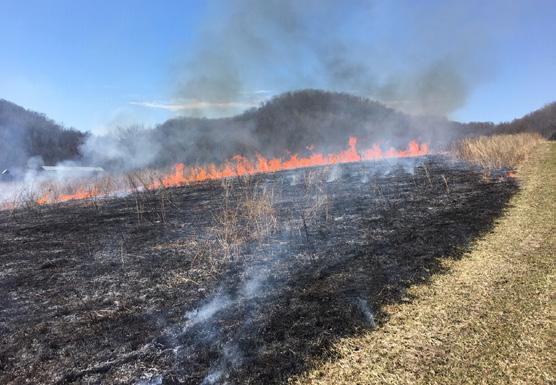
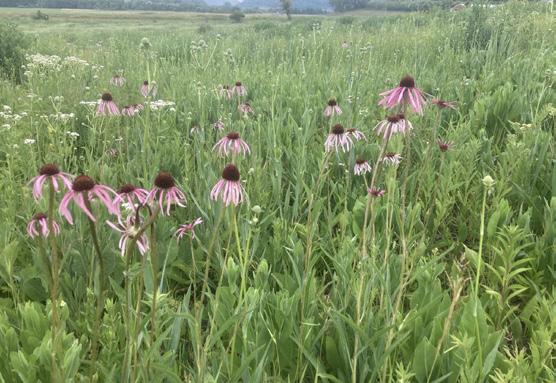
in western Wisconsin, he has labored on behalf of both wildlife and wildlife watchers. Initially, he converted what was once organically farmed corn and soybean fields into native prairie. He’s also improved streamside habitat, created wetlands, planted hundreds of oaks and native shrubs, and installed turtle basking logs and a snake hibernaculum (essentially a big pit filled with rocks and wrapped in weed cloth).
When an Indigo Bunting smacked into one of his windows, he affixed collision-deterrent tape and hanging cords to prevent future collisions. He’s had bat surveys done. And he selects many of his plantings based on their usefulness to Neotropical migratory birds and butterflies. “I need to have a goal, something to keep me on the straight and narrow,” said Lukens, who co-manages the property with his
Tom Lukens and Pam Saunders (below left) have transformed a former farm in western Wisconsin with prescribed burns (top) and native plants like purple coneflowers (above).
partner, Pam Saunders. “Anything that feeds the diversity and supports the most, that’s what I’ve tried to do.”
Lukens estimated that he’s spent $100,000 on habitat work, about half of which was covered by federal grants. He and Saunders also rent out cabins to the public. Guests of their Nature Nooks Retreat can birdwatch, hike, fish (catch-and-release only), play yard games such as croquet, and cruise the river on tubes and kayaks. To protect the wildlife, no pets are allowed. Lukens especially enjoys exposing visiting children to nature. “It’s fun to share what you love,” he said, “and what you love is enhanced by sharing it.”
The property, which is 100 percent solar powered, has been placed into a conservation easement with a local land trust. “That just makes sure my efforts here can’t get destroyed when I kick the bucket,” Lukens said.
Restoring an Oak Savanna
Nonprofit landowners also work to restore woodlands, including at Michigan Audubon’s Phyllis Haehnle Memorial Sanctuary west of Ann Arbor. Totaling more than 1,000 acres, the mostly marsh-covered sanctuary is a well-
Michigan Audubon, called a “real nightmare to deal with.” Some excess native trees, like black cherries, are also being felled or left as snags to create a more open forest intended to benefit Red-headed Woodpecker, Bluewinged and Golden-winged Warblers, Eastern Whip-poor-will, and American Woodcock. “It always feels a little like sacrilege to take out some of those native things that maybe on another site you’d be trying to promote,” Machinski said. But it can be an important part of the plan when you’re managing for specific habitats.
This spring, Michigan Audubon plans to administer prescribed burns on 8 of the 14 acres and then sow native seeds. Bird-wise, Machinski isn’t sure what to expect from the restored forest, noting that it’s a relatively small area adjacent to a road. Last June, in an auspicious sign, he came across a singing Cerulean Warbler, the first ever recorded at the sanctuary. “It’s going to be a while before I feel truly satisfied about the site, [but] we’re certainly on the right track,” he said.
A Great Lakes Escape
In other areas farther north in Michigan, landowners have less pressure from invasive species and are able to focus on improving habitat in other ways. Around 2022, the year
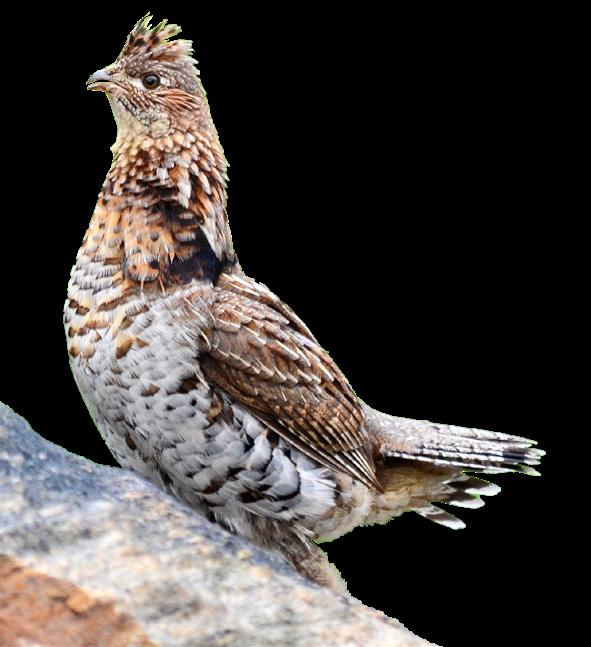
Ruffed Grouse
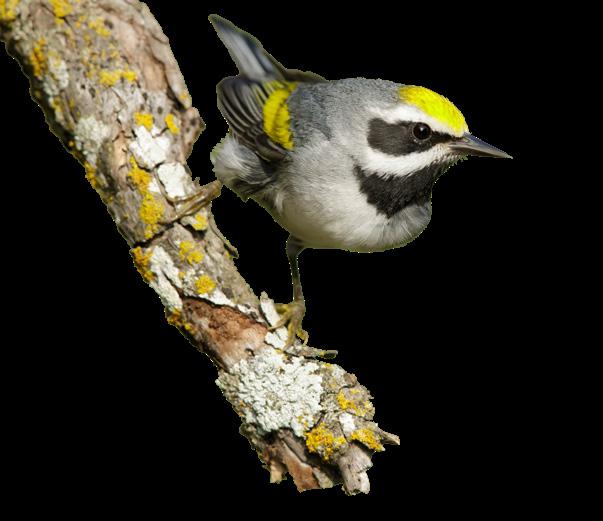
Golden-winged Warbler
after purchasing 560 acres near where Lakes Superior, Huron, and Michigan converge, Sue Garrett and her husband, Dale, began working with ABC to make their property more wildlife friendly. This has required letting more sunshine reach the forest floor in evenly aged, mature forest that’s lacking in diversity. They contracted loggers to cut down some stands of mature aspens, with the idea that new aspen shoots would pop up and attract Ruffed Grouse (and Golden-winged Warblers, which, as ABC’s Michael Paling notes, need clumps of grass, brush, and a “dynamic forest system of various age classes”). The Garretts also mowed down thick stands of tag alder and planted hazelnuts, apple trees, serviceberries, raspberries, and other wildlife-attracting delicacies.
These days, Sue Garrett said she regularly sees and hears goshawks, turkeys, grouse, grosbeaks, and owls, not to mention bears and wolves. Once, a Scissor-tailed Flycatcher showed up, which brought in birders from far and wide. “It’s just a great place to be,” Sue said, adding that she’s learned a lot from the habitat enhancements. “It’s kept us busy, and our property is better for it.”
Golden-wings Everywhere
After a bout with cancer in the mid-2000s, Jerry Havel decided, “the hell with it, let’s start a hunting lodge” on a family-owned parcel in northern Minnesota. From 2007 to 2017, he and his wife, Brenda, then conducted three timber harvests of aspen and other hardwoods. Havel’s main goal with what they eventually named Pineridge Grouse Camp was to attract American Woodcocks and Ruffed Grouse; to do so, he needed the young forest that’s necessary for those birds. But what’s good for woodcocks and grouse is
also good for Golden-winged Warblers, which along with the woodcock and other birds of young forests, have experienced steep population declines. When scientists surveyed Havel’s property after the second timber harvest, they detected Golden-wings everywhere they checked — 10 individual birds in total.
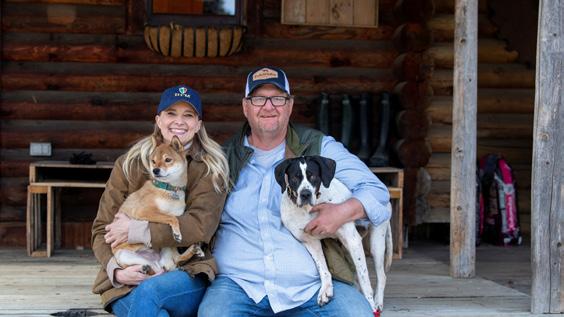
In addition to his restoration work, Havel hosts habitat workshops and woodcock banding clinics. Researchers regularly trek out to, say, survey for Pileated Woodpeckers or put transmitters on Wood Ducks. Havel called his 160-acre property a hub for “bird nerds, for lack of a better word, to hang out and do bird research.” He also trains pointing dogs and educates visiting hunters — no shooting of woodcocks or grouse allowed onsite — on how to be better environmental stewards. “It’s a place where we can really teach people the right way to do things,” Havel said, adding that “birders sometimes forget that the hunters are the number-one conservationists [in terms of who] supplies the most money.” In fact, hunting licenses, federal Duck Stamp sales, and taxes on hunting equipment have raised billions of dollars for federal and state conservation agencies since the 1930s. Havel said that though
Brenda and Jerry Havel with their dogs Mika and Miss Kit at their warbler-rich property in northern Minnesota.
birders and hunters come from “two different worlds,” they essentially have the “same goal.” His lodge, he added, provides a rare “avenue for the two groups to talk.”
Bringing Back Bobwhites
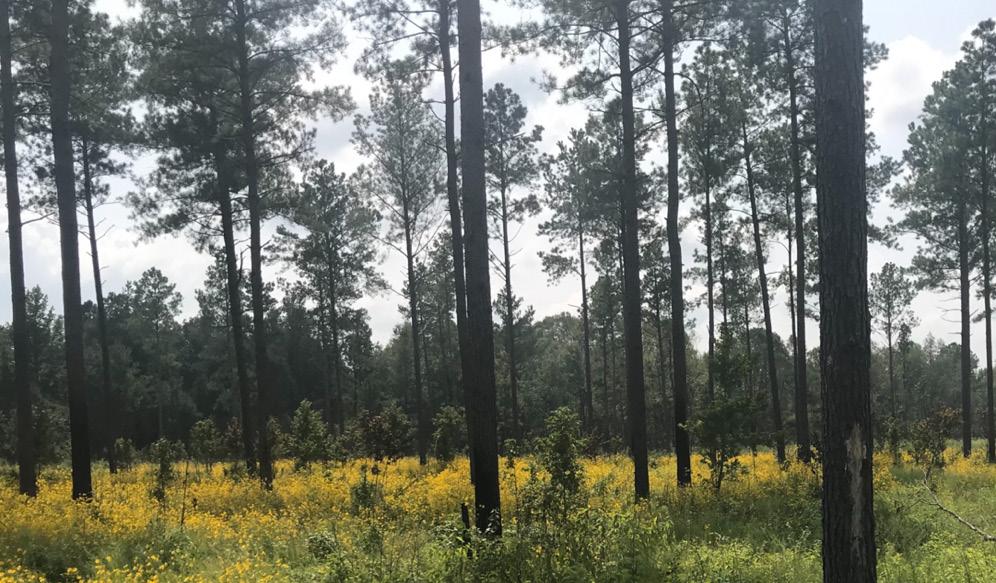
As a kid, Miles Goggans was thrilled when his grandfather took him hunting on a patch of southern Arkansas land that had been in his family since before the Civil War. At the time, Northern Bobwhite were common there. But around 1980, the bobwhites completely disappeared, likely the result, Goggans believes, of misapplied herbicides and a prolonged drought. It didn’t help that bobwhite populations were crashing everywhere across their southeastern range.
Goggans, now a trustee of the property along with his sister and nephew, wondered if he could lure bobwhites back despite their decades-long absence. Since 2017, he has linked up with nonprofits and secured state and federal funding to create the kind of habitat
Miles Goggans (2)
Miles Goggans and his family have restored an open pine woodland (top) in southern Arkansas with prescribed burns (left) and by growing plants for pollinators and other wildlife.
bobwhite require. That has meant they do prescribed burns, thin out trees, take out row crops, and plant pollinator patches, shrubs, saplings, and wildlife “food plots” — providing the mix of open woodlands and food sources that attract the birds. He’s also hosted tours for university students and policymakers alike. Klais at ABC credited Goggans for doing “something different from what other people were doing at the time. There were some really great examples [of open pine management] on public lands, but not many on private lands.”
The magic moment finally occurred in 2020, over Memorial Day weekend, when Goggans was with his brother-in-law. “Sure enough, out of the blue, we heard quail whistling out in those pine trees,” Goggans recalled. “I was beside myself. It was like a dream. It was just so exciting.” Since then, he has continued seeing and hearing bobwhites on his 510 acres, as have wildlife biologists who have come out to survey for them.
Goggans has no plans to quit now. In the near term, he wants to build a pond, do a little more logging to create more open space, sow wildflowers, and plant shortleaf pines on ele vated sections of the property (which has most ly loblolly pines). He said landowners who don’t practice active forest management are missing out. “For me,” Goggans said, “it’s really cool how it connects the past, present, and future.”
Jesse Greenspan is a freelance journalist based in the San Francisco Bay area who writes about history, science, and the environment.

Find answers to “treequently” asked questions about ABC’s decades of work in woodland habitats. abcbirds.org/Treequently
ABC is grateful for state and local govern ments and other nongovernmental organi zations that enable us to utilize Farm Bill funding that supports private landowners.
Resources for Landowners
Owners of private forests who want to make their properties more bird-friendly should start by contacting their state natural resources or forestry agency. Most have foresters, wildlife biologists, or conservationists on staff who work with landowners and help answer questions about forest management with bird-friendly objectives. ABC’s staff foresters also work with landowners; please reach out at abcbirds.org/contact. Additionally, the U.S. Department of Agriculture’s Natural Resources Conservation Service offers assistance to landowners. It administers various federal programs that can help landowners create high-quality bird habitat on their properties. Visit nrcs.usda.gov/contact/ find-a-service-center to locate USDA Service Centers in your county.
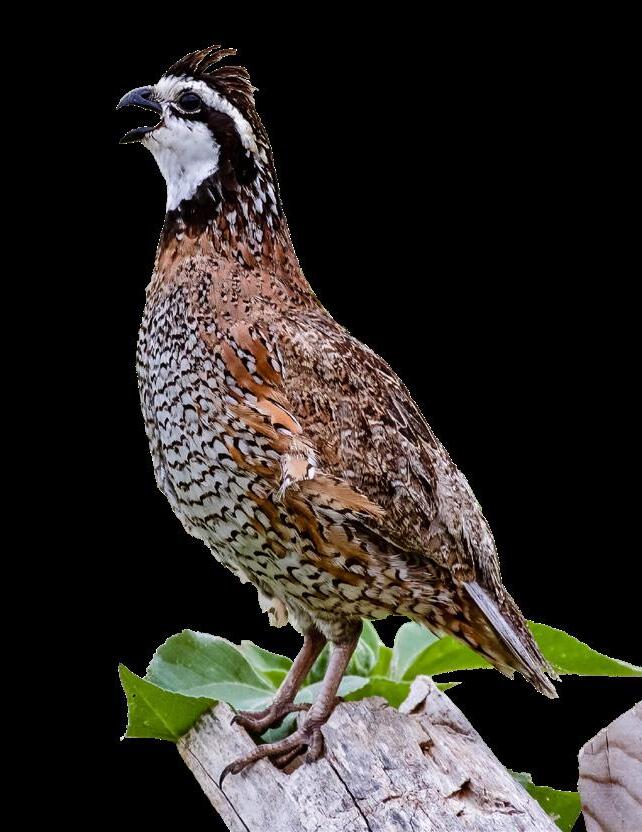
Northern Bobwhite
Tides are Turning
A recent
federal policy change and a new state law
hold promise for horseshoe crabs and Red Knots
by Matt Mendenhall
Photos by Walker Golder
This spring, millions of horseshoe crabs will crawl out of the seas onto beaches scattered from Maine to Mexico’s Yucatán Peninsula, just as their species has for millions of years. The “living fossils,” as they’re often called, predate the dinosaurs and have survived the five major mass extinctions in Earth’s history. Now, whether or not these beach-dependent creatures hang on into the future is largely up to us.
At high tide around a new or full moon, female horseshoe crabs will burrow into the sand to lay thousands of small eggs while males fertilize them. If all goes well, the adults will make it back to their intertidal flats and sandy
ocean bottoms, and the eggs that aren’t eaten by shorebirds will produce young that make their way into the water, too.
Sadly, all is not well for horseshoe crabs and the shorebirds, especially Red Knots, that fuel their migrations by feasting on the crabs’ eggs. ABC and other conservation groups have advocated for decades on behalf of preserving these animals and their intertwined relationship. Indeed, the knot makes an astonishing 9,000-mile spring migration that has been fodder for nature documentaries, books, and countless articles. The trip — from southern Argentina to the Canadian arctic — only works because the birds stop
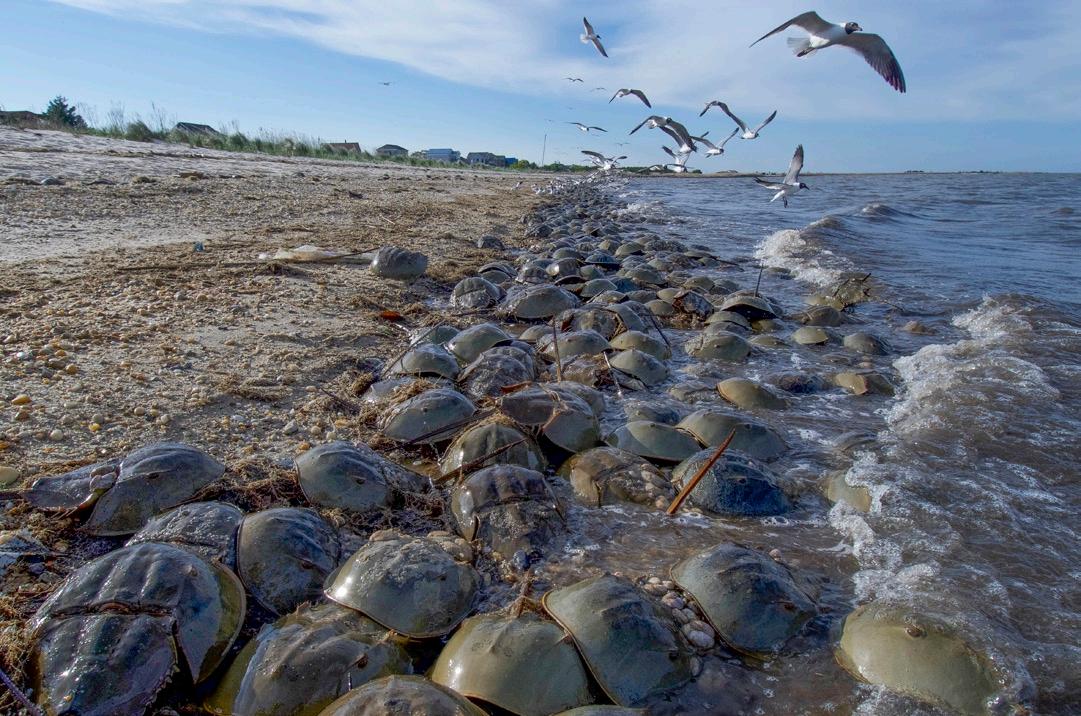
Horseshoe crabs swarm the shoreline at Slaughter Beach, Delaware, on Delaware Bay, while Laughing Gulls cruise overhead.
on Delaware Bay and other beaches to scarf down crab eggs.
Other species that rely on horseshoe crab eggs include the Ruddy Turnstone, Dunlin, Semipalmated and Least Sandpipers, Sanderling, Blackbellied and Semipalmated Plovers, and Laughing Gull.
The good news is that the proverbi-
What’s in a Name?
Let’s face it. This story’s main characters have unusual names.
Horseshoe crabs may resemble actual crabs, but in fact, they are not crabs or even crustaceans. They’re more closely related to sea spiders and scorpions. Their U-shaped exoskeleton or carapace that resembles a horse’s hoof inspired their common name.
The name of the Red Knot, a sandpiper which is found in the Americas
al tides are starting to turn, even in the last several months. Before we get to the latest developments, let’s look at how we got here.
The Exploitation Era
Centuries ago, Indigenous peoples used dead horseshoe crabs as crop fertilizer. European settlers likely learned of this practice from the native residents, and by the mid1800s, they were collecting millions of live horseshoe crabs a year from shorelines and sending them to be ground up for fertilizer. This continued until the advent of modern fertilizers in the 1960s.
In the 1970s, the pharmaceutical industry discovered that horseshoe crabs’ blue blood contains the protein Limulus amoebocyte
as well as Europe, Africa, Asia, and Australia (and its Eurasian cousin, the Great Knot), is believed to derive from King Canute or Knut, ruler of England, Denmark, and Norway about a thousand years ago. The story goes that after dining on the birds, he was so pleased with the flavor that loyal courtiers named the birds after him. Not surprisingly, “Red” comes from the robin-red underparts of their breeding plumage.
lysate (LAL), which could be used to look for potentially deadly endotoxins in vaccines, medicines, and medical devices, like heart valves and pacemakers. In 1977, the Food and Drug Administration (FDA) approved a testing protocol using LAL, and the procedure soon became an indispensable part of medical safety testing. While the procedure has surely improved human health in the decades since, it has also required that blood be drawn from hundreds of thousands of horseshoe crabs each year. The process, which draws blood from their hearts, results in the deaths of 15 to 30 percent of bled crabs. The crabs that survive the process are released back to the sea. However, not all crabs thrive when released, and some exhibit behavior changes, such as decreased movement and activity. These effects do not result in direct mortality but impact the overall population health of the species.
As harvesting horseshoe crabs for the LAL process ramped up, the fishing community in the 1980s and ’90s increased its collection of the animals for eel and whelk bait. The harvest peaked at 2.6 million horseshoe crabs in 1999. A year earlier, the Atlantic States Marine Fisheries Commission (ASMFC) began to regulate the bait harvest, introducing quotas, seasonal closures, and recently, a two-year ban on harvesting egg-laying females in Delaware Bay. (Now, the coastwide bait quota is about 1.5 million, but fewer crabs are caught for bait. In 2022, for example, 573,633
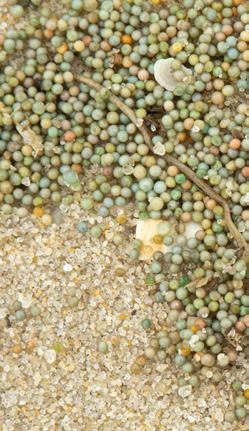
Horseshoe crab eggs lie on the sand at Fortescue Beach, New Jersey.
horseshoe crabs were harvested.)
The 1990s spike in harvests led to an immediate drop in the number of horseshoe crab eggs available for hungry shorebirds. The population of the Red Knot subspecies that migrates along the Atlantic coast (Calidris canutus rufa) followed suit, falling from an estimate of 100,000–150,000 in the 1980s to 18,000–33,000 by 2007.
Time to Act
Since then, policymakers, often spurred by public sentiment, began to act. New Jersey banned horseshoe crab bait harvests in 2008. Six years later, the U.S. Fish and Wildlife Service declared the rufa Red Knot Threatened under the Endangered Species Act. Shortages of crab eggs was a threat cited in the listing decision. In 2023, Connecticut banned bait harvests of horseshoe crabs in its waters.
Meanwhile, researchers developed synthetic testing processes that could replace LAL. Later, pharmaceutical companies commercialized these synthetic methods. The manufacturer Eli Lilly began converting to non-LAL tests in 2016, and other companies have followed. (The Sustainability Scorecard for Endotoxin Testing, operated by three conservation groups, keeps tabs on the industry’s progress at pharmascore.org.)
In July 2024, experts with US Pharmacopeia, a nonprofit, nongovernmental organization that sets standards for medical manufacturers, approved adding a new chapter to its compendium approving the use of non-animal-derived reagents for en-
dotoxin testing. The chapter became official in May 2025, representing progress in acceptance of synthetic testing methods that do not require the harvest of horseshoe crabs. A main hurdle to ending the demand for horseshoe crab blood in the U.S. is a 2012 FDA endotoxin testing guidance that designates LAL as the preferred testing method. Wildlife advocates, including Annie Chester, Policy Director at ABC, worked with members of Congress to address the challenge. A federal funding bill that passed in late 2025 and covered the FDA’s work in 2026 included language instructing the agency to update its 2012 endotoxin testing guidance to accept synthetic methods.
“Securing this language in the federal funding process involved close collaboration with partners and Congressional offices,” Chester said. “ABC and partners worked together to educate Congressional offices about the issue. This direct advocacy effort
led to increased awareness and interest from members of Congress along the East Coast — the horseshoe crabs’ native range. Those members of Congress were instrumental in securing the inclusion of the new directive.”
Massive Grassroots Effort
Another major win took place just before Christmas 2025. New York Governor Kathy Hochul signed into law a ban on horseshoe crab harvests in state waters — a significant holiday gift for the imperiled population in Long Island Sound. The legislation requires bait and biomedical harvests to be phased out over the next three years, and the full ban will take effect in 2029.
Hochul had vetoed a similar ban in 2024. After the legislature passed a revised bill in 2025, Adrienne Esposito, Executive Director of the New Yorkbased Citizens Campaign for the Environment, said “a massive grassroots
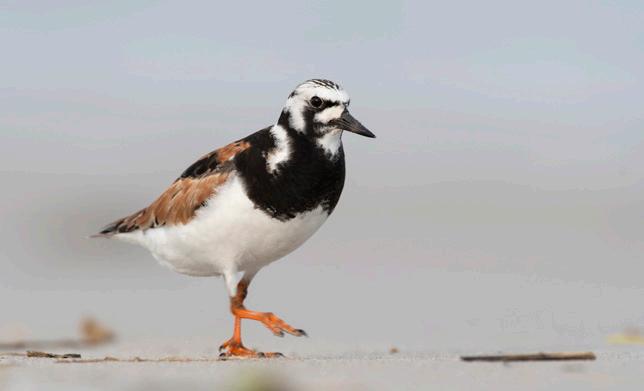
A Ruddy Turnstone forages on Delaware Bay. Itʼs among several shorebird species that feed on horseshoe crab eggs.
effort” helped get the bill signed. Another push, Esposito said, came from two studies published in September 2025 by the Maritime Aquarium in Connecticut. They showed a loss of the Long Island Sound horseshoe crab population of 2 to 9 percent per year for the last five years.
“This was essential information that demanded a preservation effort be implemented,” she said. “We are extremely hopeful that with New Jersey, Connecticut, and New York all banning harvesting, the populations will recover and the species will be able to flourish.”
Jason Patlis, President and CEO of the Maritime Aquarium, added: “This law represents a major victory for science-based conservation. Our research has documented severe declines in horseshoe crab populations, and this decisive step by New York will help reverse that trend.”
Building Momentum
While the recent wins are great news, momentum continues to
build. Legislators in Massachusetts recently introduced a bill that would ban horseshoe crab harvest. ABC and advocates in other states, including Delaware, are also working with their representatives to pass harvest bans.
Conserving horseshoe crabs is a key strategy to recovering Red Knots, which are still federally Threatened and have not seen a population increase since being listed in 2014. New Jersey, Delaware, and the U.S. Fish and Wildlife Service jointly monitor the Delaware Bay stopover annually, and in 2024, they estimated that just over 46,100 knots visited that year. Indeed, since 2019, numbers have fluctuated between about 39,000 and 46,000, which
are notably higher than the 2007 estimate. Today’s numbers are nowhere near the late 1990s estimate of 77,000 or the 1989 estimate of about 153,000.
The lesson is simple. If we can help horseshoe crabs flourish, the populations of the Red Knot and other
shorebirds will rise — eventually.
In a 2024 essay for the Southern Environmental Law Center, author J. Drew Lanham, the cultural ornithologist, academic, and MacArthur Fellow, mused about the “timeevolved, moon-mediated agreement” that shorebirds have with horseshoe crabs. “We must be ever vigilant to protect those who can’t protect themselves,” he wrote, as he recalled giving a helping hand to a horseshoe crab he found lying upside down on a beach. He flipped it over so it could return to the sea and pondered about a migrating Red Knot overhead seeing him do so.
“I cannot know what the knot knows, but the bird-lover within knows that helping this ancient uncle return to the sea might mean more eggs spawned on future moonlit nights that will feed shorebirds to give them better chances at surviving and making more of themselves. That means more birds and crabs for us to wonder over and watch. The cause of kinship among us all demands no less.”
Matt Mendenhall, ABC’s Managing Editor, has been writing about birds and conservation for 25 years.

Enjoy a recent ABC webinar about protecting horseshoe crabs and shorebirds. abcbirds.org/RedKnotWebinar Learn more about the Red Knot. abcbirds.org/RedKnot
Visit the Horseshoe Crab Recovery Coalition. hscrabrecovery.org
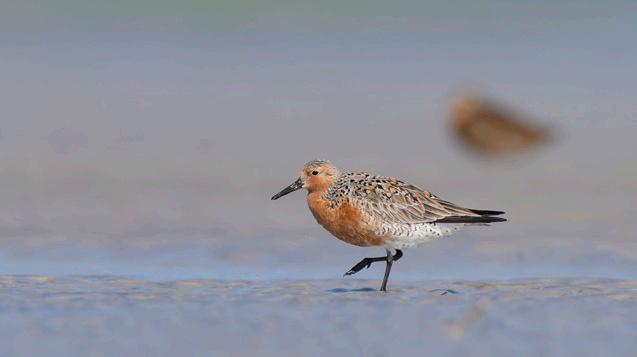
A Red Knot walks along the shallows of Delaware Bay.
Bird Flu in the Wild
The ongoing epidemic continues to take a toll on wild birds, highlighting the need for robust ecosystems
by Deanna Altomara
Sometime in spring 2020, when humanity was deep in the grip of its own pandemic, a bird got sick.
It was somewhere in central Europe, maybe Poland or the Czech Republic, Hungary or Germany. It could have been a chicken in a crowded coop, or it may have been a wild bird flying free. It may have suffered hemorrhage, tremors, or disorientation; walked in circles; collapsed mid-flight; or stretched a twisted neck upward in a “stargazing” posture. Or it may simply have dropped dead.
What is certain is this: It would be the first of over 300 million birds to die in a global wave of a new, unusually destructive form of avian influenza, better known as bird flu.
A Bad Case of the Flu
Like the seasonal flu that infects millions of people annually, bird flu is constantly changing. Its genetic material mutates frequently, leading to new variants of the virus each year. And just like some years have a bad flu season
Joshua Galicki

for humans, bird flu is worse some years than others for wildlife.
Since this new strain of avian flu, also known as H5N1, emerged around 2020, birds have died in staggering numbers, both from the virus itself, which can kill 75 to 100 percent of infected individuals in some species, and from the mass culling that follows outbreaks in commercial poultry. The disease has been detected in about 400 bird species and has spilled into mammals ranging from squirrels to bears. In the United States, it has sickened about 70 people, two of whom died. (It’s currently considered to be a low threat to humans.)
But the virus isn’t just deadly. Like the birds that carry it, it is always on the move.
Migration season is an especially dangerous time for outbreaks. Migratory journeys are taxing, and food can be scarce, especially during colder months. That stress weakens birds’ immune systems, leaving them vulnerable to infection. Migration also brings thousands of birds together — sometimes from opposite ends of the planet. As humans destroy habitats, birds’ options for stopovers become more limited. The remaining patches of habitat become overcrowded, creating ripe conditions for the spread of infection.
Meanwhile, infected birds shed virus particles into lakes and ponds, where the pathogen can survive for days or even weeks in cold water. Then, when other birds drop in for a swim, they can get sick.
“Shorebirds can pick it up because they’re feeding right along that water edge,” said Krysten Schuler, a Wildlife Disease Ecologist at Cornell University and Director of its Wildlife Health Lab. “Another thing shorebirds might do, and this is kind of gross, is pick out maggots from dead carcasses.
So if you have a goose that dies and is decomposing, the shorebird might come along and think that’s a good meal.”
In other words, birds link ecosystems across continents — and sometimes carry disease with them.
Endangering Species
Not long after the virus broke out in Europe, outbreaks occurred across Asia and Africa, likely spread by migratory birds like the Eurasian Wigeon, Common Buzzard, and Barnacle Goose.
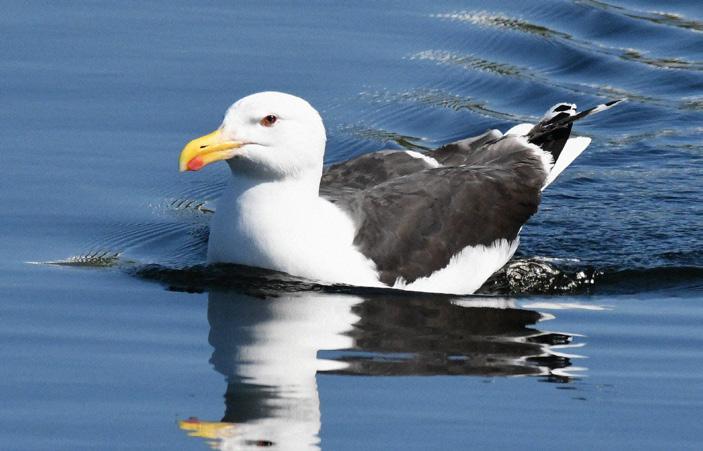
In fall 2021, bird flu crossed the Atlantic, probably after North American and Eurasian waterfowl jockeyed for mates in the Arctic over the summer. The first case of bird flu in North America was documented in a Great Black-backed Gull in Newfoundland. Other affected species included the Barnacle Goose, Eurasian Wigeon, Black-headed Gull, and Great Skua. Any of these species could have been responsible for carrying the virus to the hemisphere, but without more surveillance data, scientists still can’t say for sure.
From there, the disease cascaded south through the Atlantic Flyway into the United
David O. Hill
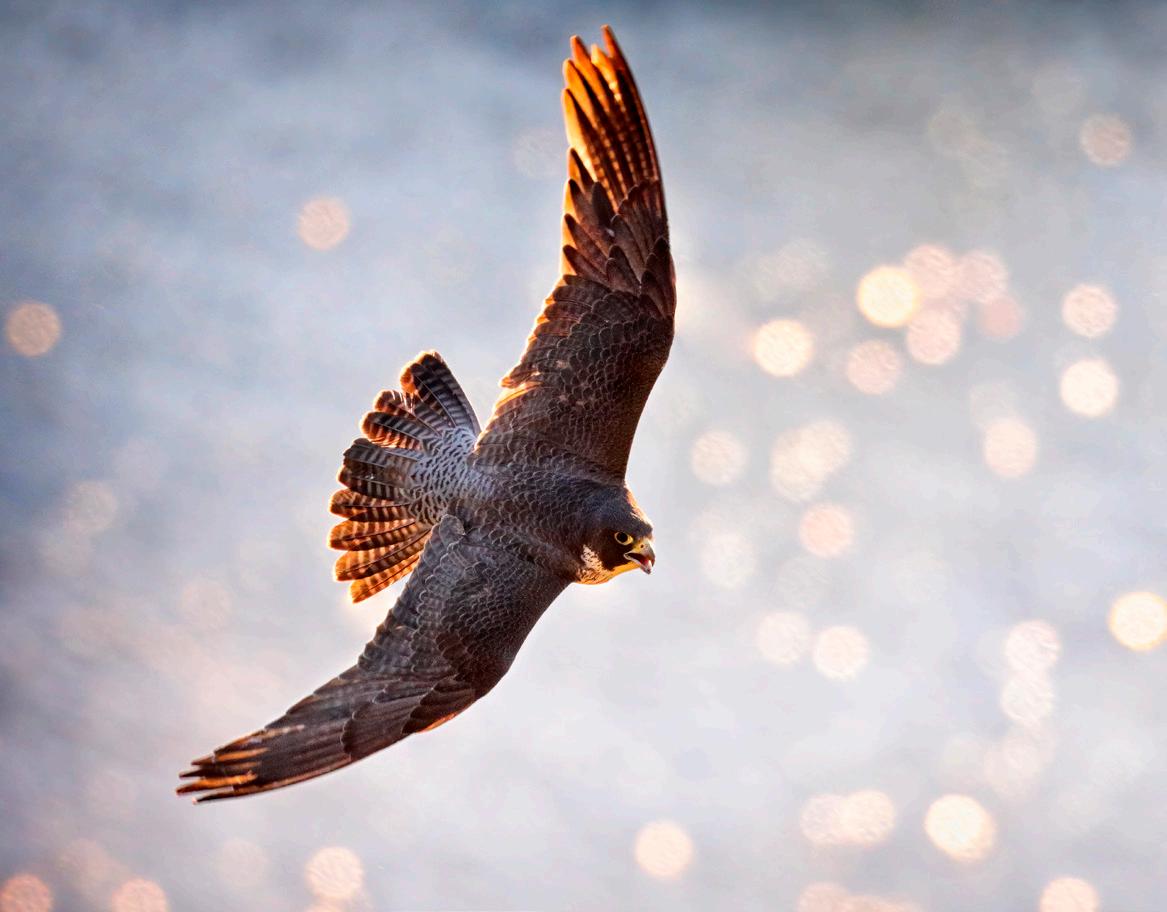
Left Birds of prey like the Peregrine Falcon have been among the most impacted species of the current avian flu epidemic. Bottom The first documented case of avian flu in North America was in a Great Black-backed Gull in Newfoundland.
States, where it has taken a toll on some of the country’s largest and most iconic species. Coastal populations of the Peregrine Falcon have plummeted for the first time since the 1960s and ’70s, when the bird was nearly wiped out by use of the pesticide DDT. A recent study of San Francisco Bay’s Peregrine population found that of the 47 nesting sites known prior to 2022, only about one-third were occupied in 2025. Falcons frequently prey on waterfowl and shorebirds. A sick duck is an easy target for a falcon — and a potential death sentence. Across the country, more than 130 dead falcons have tested positive for the disease since 2022. But that number is almost certainly an underestimate, as many ill raptors seek out secluded cliffs where their bodies cannot be easily recovered.
Other birds of prey have also been hard hit. Around Europe and North America, researchers have documented relatively high detection rates of the virus in species such as the White-tailed and Bald Eagles, Great Horned Owl, Red-tailed and Rough-legged Hawks, and Gyrfalcon.
Not even the sun-baked canyons of the Arizona desert are safe. In 2023, the virus struck the Endangered California Condor, killing about 20 out of an estimated 560 birds. Desperate scientists tested a vaccine in Black Vultures, which revealed that it was safe and effective for condors. Since then, over 200 free-flying and captive birds have been successfully vaccinated.
Despite this spark of hope, the overall situation remained bleak. After making significant impacts on North
American birds, the disease continued to spread. Across South America’s Pacific coast, the virus swept through seabird colonies, littering beaches with the bodies of Peruvian Pelicans, Guanay Cormorants, and Peruvian Boobies. It also decimated populations of sea lions and seals, leaving behind scenes where biologists in white hazmat suits navigated through tens of thousands of salt-slicked, rotting corpses.
Reaching the Unreachable
In the Galápagos Islands, seabirds swoop along crystal-blue water and soar above towering lava cliffs. Until humans arrived, the idyllic islands had been isolated for millions of years. As a result, many of their unique species had never been exposed to diseases like bird flu. “It’s the same as when Europeans first arrived in the Americas, bringing these new diseases,” explained Sebastian Cruz, ABC’s Marine Program Coordinator in South America. “The native people succumbed to them in severe ways.” Ecologists feared that an outbreak in the Galápagos could be similarly disastrous.
Then the worst-case scenario happened: Bird flu reached the islands. “H5N1 has pretty much reached every corner of the planet,” said Cruz. “As far as we know, this was the first time that it had ever reached Galápagos.”
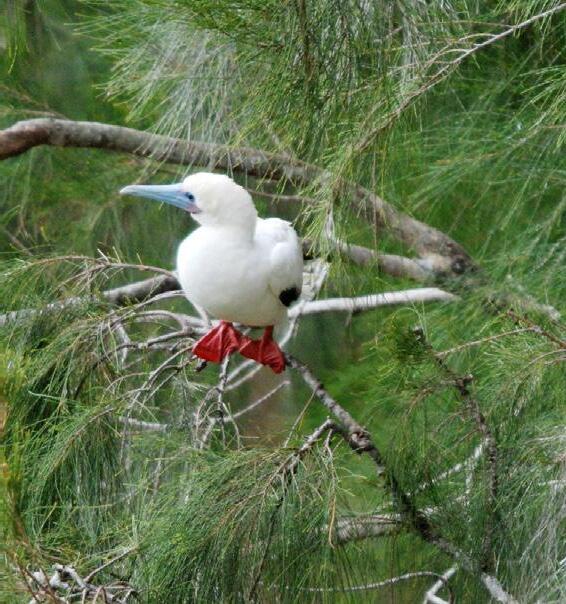
The long-feared outbreak started in the northern winter of 2023, when migratory birds like Franklin’s Gulls, Whimbrels, and godwits overwintered in the sunny island chain. Not long after their arrival, passengers aboard diving cruises began spotting resident Red-footed Boobies floating on the water. Some birds were already dead. Others were still alive but struggling — wings limp, bodies twitching, unable to fly, crimson feet sticking above the waves.
When scientists tested the carcasses, the results confirmed bird flu as the cause.
Daniel J. Lebbin
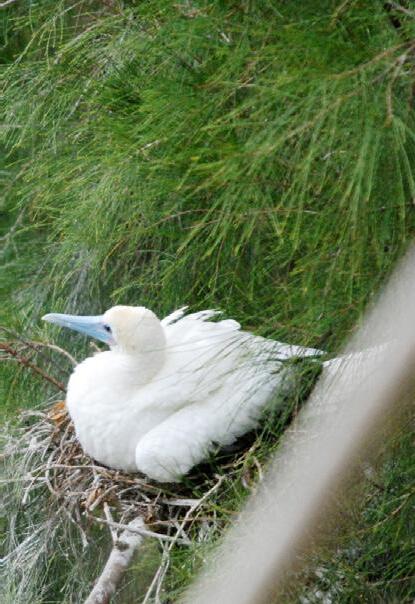
Experts worried about the island of Genovesa, home to the largest colony of Red-footed Boobies in the world, as well as Nazca Boobies, Great Frigatebirds, and storm-petrels. “It’s one of the most important islands for seabirds in the Galápagos,” Cruz explained. Authorities closed several islands to tourism, hoping to reduce the risk to visitors. The closures remained in place for six months.
In the end, a few hundred Red-footed Boobies died, as well as several Nazca Boobies and a frigatebird. Luckily, the Endangered Galápagos Penguin and Vulnerable Flightless Cormorant were spared, possibly because their colonies aren’t as dense.
Cruz theorizes that a migratory bird carrying the virus may have landed in a tree in which Red-footeds nest or that a booby picked up the
Left
Red-footed Boobies were among the species hit by the flu in the Galápagos.
Bottom Northern Gannets that survive the flu develop dark eyes. Here, a dark-eyed gannet displays with one with normal eyes.
virus while foraging for food.
Even as the islands escaped the worst-case scenario, the virus continued pushing into new territory. On September 17, 2023, British researchers found a Southern Giant-Petrel — an Antarctic seabird that wanders widely in the southern portions of the world’s oceans — dying on the rocky shores of South Georgia Island. The lone petrel twitched and veered off-balance, wobbling along slowly. Seeing its struggles, other predatory petrels and several Brown Skuas attacked and began eating the sick bird. Less than a month later, the same researchers found a group of skuas with similar symptoms. Ultimately, more than 50 skuas perished in the outbreak, the first documented incursion of bird flu into the Antarctic region.
A Changing Climate
How a virus that once circulated mostly among poultry managed to reach ecosystems around the globe is still under investigation. Scientists suspect that broader environmental changes may be playing a role. Because of climate change, birds are traveling to places they rarely reached before — and arriving weeks earlier than they once did.
Extreme weather can also disrupt journeys. “Birds may have to stop their migration” during storms, Schuler said. “So they kind of stack up and hang around longer than they might otherwise.” That crowding brings different species into closer contact, creating more opportunities
for a virus to jump between them.
“It’s a big unknown,” said Sea McKeon, ABC’s Marine Program Director. “But we do know that everything is shifting.”
At this point, the virus has been circulating for several years. Now conservationists are wondering if birds are adapting to the disease. If so, how many animals survive?
It’s easier to test survivorship in some bird species than others. In Northern Gannets, survivors of bird flu carry a striking marker: a black iris. When scientists visit colonies, the dark-eyed survivors stand out starkly among their blue-eyed cousins. “They’re identifiable when you see them in the field,” said McKeon. “For most species, we can’t pick out survivors in the same way.”
Notably, a recent study published in the journal Biological Conservation found that black eyes “were not associated with detectable differences in the foraging behaviour and habitat
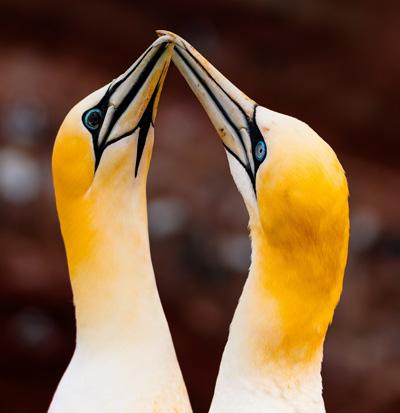
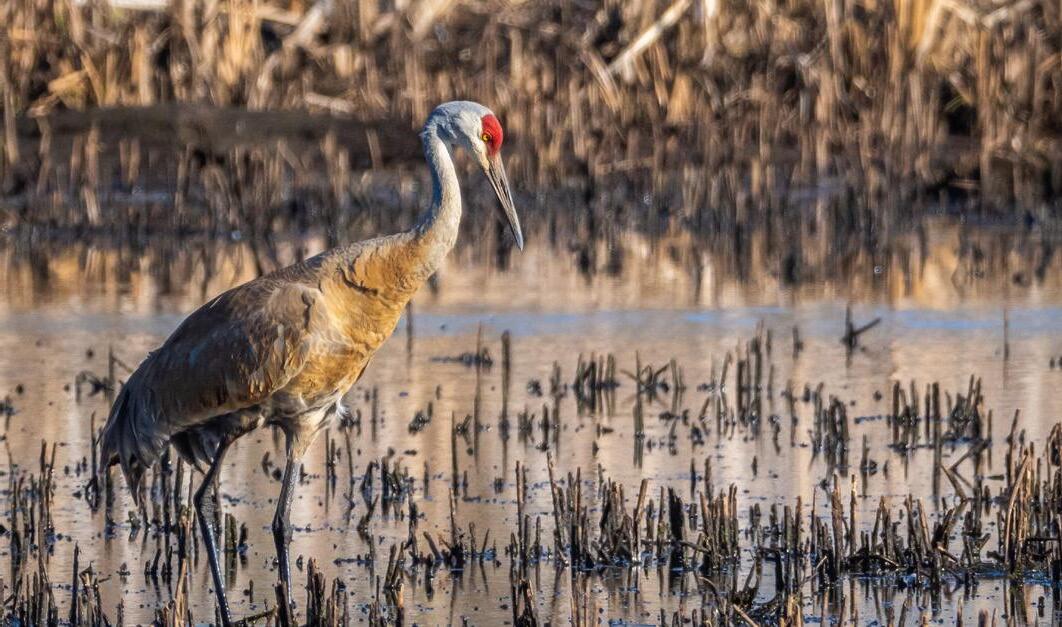
use of surviving breeding gannets.”
Last year, Schuler took blood samples from seemingly healthy banded ducks and tested them for the virus. Only five out of 72 birds tested positive for the deadly strain of bird flu. While that’s just one project, it’s a clue that some birds carry the virus without showing obvious signs of illness.
Now that the virus has been around for a while, immunity to it appears to be building among certain species. In the Chesapeake Bay, for example, researchers found that some Double-crested Cormorants carried antibodies to the virus, suggesting that the birds survived past infections. Other studies have found Mallards, Lesser Scaup, and other waterfowl showing substantial immunity.
Die-offs, unfortunately, are still occurring. In 2025, federal and state wildlife agencies reported the virus claimed more than 67,000 geese at a wildlife refuge in Kansas, 50,000 Eared Grebes at Utah’s Great Salt Lake, about 1,500 Sandhill Cranes in Indiana, and a juvenile Endangered Whooping Crane in Wisconsin. Late in the year,
Western Gulls and Brown Pelicans tested positive at the Farallon Islands National Wildlife Refuge (about 30 miles west of San Francisco), the site of the largest seabird colony in the continental United States, making the detection a worrying concern. And early this year, more than 16,000 Canada Geese died from the bird flu across New Jersey.
Ongoing Surveillance
Understanding which birds survive — and how the virus is spreading — requires data. The current outbreak is tracked by the U.S. Geological Survey’s National Wildlife Health Center and U.S. Department of Agriculture’s Animal and Plant Health Inspection Service, as well as by state and tribal wildlife agencies and universities.
Researchers at the Cornell Wildlife Health Lab, for example, set up a website to collect reports on dead birds in New York state. The lab can’t investigate every incident, but the site helps keep track of suspicious
Sandhill Cranes in Indiana were impacted by avian flu.
bird deaths. If a new species or a large number of birds are affected — more than, say, 20 — the lab sends biologists to investigate.
After years of commercial outbreaks among poultry and cattle, farms are taking measures to prevent the spread of bird flu. But for wildlife, that’s a lot harder. Other than special cases like vaccinating condors, it would be impossible to do the same for wild birds generally. “There’s not really anything we can do to help them other than make sure that we conserve wild spaces and appreciate wildlife and what they do for our natural world,” Schuler said.
Prevention often comes down to protecting habitats. When wetlands disappear, birds are forced into smaller areas where disease can spread more easily. As Schuler puts it, people need to think: “Hey, by getting rid of that wetland, that may be forcing birds to congregate in a tighter area than they would otherwise.”
Tracking bird flu in the wild isn’t just about protecting birds: It’s about
understanding how diseases move through entire ecosystems. Animal, human, and environmental health are deeply interconnected, and because of this, many experts advocate for a “One Health” approach, an interdisciplinary strategy that emphasizes collaboration across different fields. In this approach, which institutions like the World Health Organization and United Nations Environment Programme support, scientists first consider how disease spreads between nature and humans. They identify the pathways a disease can travel — for example, when infected wild birds stop to rest near poultry farms. Then they design interventions to block those pathways.
For example, in 1997, scientists in Hong Kong used the approach to understand how bird flu was spreading between the wild, poultry farms, and marketplaces. They tested wild birds and chickens for disease, improved hygiene on farms, and updated laws governing how chickens were
Keeping Backyard Birds Safe
The ongoing spread of avian flu has largely spared species usually found in urban and suburban neighborhoods, but homeowners and others who feed birds should be aware of basic precautions. Since few songbirds have tested positive, it’s okay to leave bird feeders up. The exception is if you also have chickens, in which case you don’t want to be inviting more bird species into your backyard. If you find a sick or dead animal, don’t touch it. It might have died from a disease, and handling it could put you at risk. Keep pets away, too. Instead, call your local wildlife agency. However, if you have to remove a dead animal, wear gloves, a mask, and a face shield or goggles. Use an inside-out plastic bag to pick it up, “kind of
like you’re picking up dog poo,” said Krysten Schuler, Director of the Cornell Wildlife Health Lab. Then double-bag it and place it in your trash, and wash your hands well with soap and warm water. Take down your feeders and wash them thoroughly, and finally, report the sighting to a state or local wildlife agency. Such reports can help researchers keep track of bird flu’s spread. A single report may not seem like much, but to scientists tracking a fast-moving virus, even one dead bird can help reveal where the disease is headed next. transported from farms to markets. Together, the measures helped contain the outbreak. Since then, One Health has become a key part of Hong Kong’s approach to controlling bird flu.
Ultimately, McKeon says that conserving wild bird populations comes down to research and habitat protection. “It’s simply a question of monitoring, of making sure that safe places exist for birds to recover,” he said. “They have a chance for survivorship if you have multiple breeding areas. If you have singular breeding areas for species, that’s when we start running into problems. It’s literally putting all of your eggs in one basket.
“By avoiding habitat loss, we can make sure that we won’t lose entire populations, or even entire species, to a disease outbreak like this.”
Deanna Altomara studied creative writing and public health at Emory University. She writes about infectious disease and climate health.
Tufted Titmouse
Together for Birds
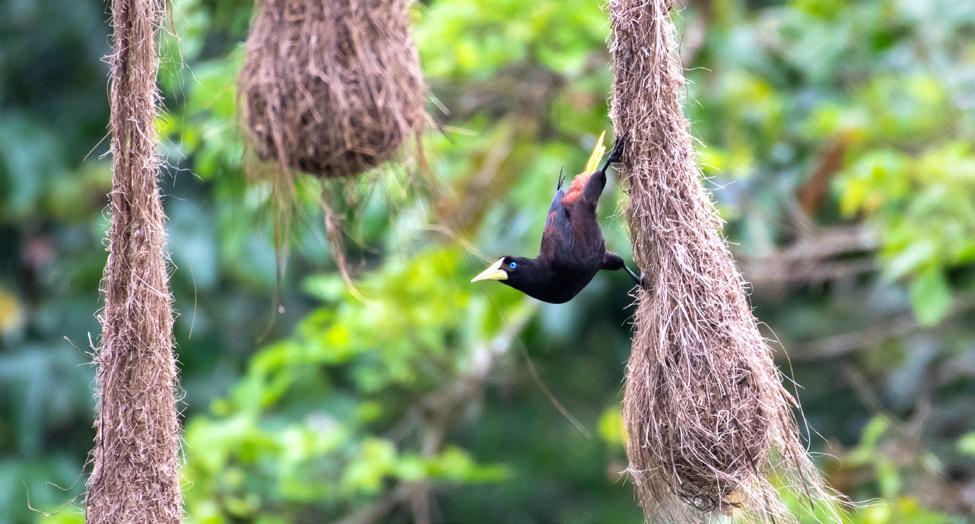
Inviting Abundance into Conservation
by Naamal De Silva
My mother always told me that she did not believe in astrology. At the same time, she spoke of my horoscope whenever she told the story of my birth. In Sri Lanka, astrologers traditionally play an important role in marriages and births. For example, they read the stars to predict whether two people would be compatible in marriage and decide what syllables would shape a baby’s name. In a drawer somewhere, my mother has an ola leaf scroll with symbols and numbers documenting the positions of the stars at the moment of my birth. She tells me that when I was born, an astrologer predicted that my destiny would be “to boil milk for the four corners.” We allow a pot of milk to boil over during auspicious moments to invite abundance, so this phrase means that I am supposed to bring abundance to people from different geographies or backgrounds.
I believe our destinies are shaped by the stories that shape us — those we accept as well as those we resist or reject. As a child, I took both my mother’s skepticism and this prediction to heart, eventually shaping my aspirations to align with the stars. Over the past five years, it has been an honor to work with the wider ABC community to bring together people from different geographies
and backgrounds to celebrate and care for birds.
My work with ABC began with a consulting project. In 2019, ABC President Mike Parr shared that he and others at the organization worried that too few people noticed and cared for the birds around them, birds whose wellbeing is intertwined with their own. At the same time, many young people remained unaware of career paths related to habitat conservation and birding. I gathered the perspectives of ABC staff, Board members, former interns, and partners about these challenges and provided recommendations about ways forward. In 2021, I started a full-time role with ABC that initially focused internally on expanding recruitment and retention and other workplace concerns. Over time, my work has become more external, centering ethical approaches to conservation and partnerships and envisioning a brighter future for birds and people.
We decided that part-time fellowships could help us expand this work and bring in new perspectives. In the middle of 2022, we welcomed our first fellows, who worked with us on documenting stories and relationships with vanishing Hawaiian birds, fostering Indigenous women’s participation in conservation, considering the interconnected impacts of pesticides on the fertility of birds and migrant
farmworkers, and more. In 2023, we created seed grants for small independent projects. In 2024, we welcomed a second cohort of 14 fellows. With support from Re:wild, we also launched the Afrofuturism Collective with an inaugural cohort of nine. By the end of 2025, we had given out over $380,000 in fellowships and seed grants to 38 individuals from seven countries across three continents.
Our work on Together for Birds has always rested on the belief that illuminating connections between human wellbeing and bird conservation will help us support existing partners and bring together an ever-expanding community of people who care for birds. Together for Birds currently involves three interconnected areas of work: Belonging and Balance, Ethical Conservation, and Birds for All. We seek to create a culture at ABC where our staff can thrive; to nurture the strong partnerships that are at the heart of successful and meaningful conservation; and to encourage curiosity and engagement with birds, habitat conservation, and conservationists.
The theme for our work in 2026 is Weaving Together. To us, weaving together provides a means of imbuing something with greater strength. Many birds use instinct, experience, and artistry to weave together available materials into nests strong enough to shelter their chicks from storms, predators, and numerous other threats. Hummingbirds create cups out of spider silk, moss, and lichen. Oropendolas nest in groups, building large hanging baskets that sway with the wind. We humans can weave together existing research, stories, technologies, networks, and partnerships to ensure that our conservation work is more durable, sustaining, welcoming, expansive, and beautiful.
We celebrate ethical and creative approaches to conservation and recognize the importance of supporting the individuals pursuing such work. In 2026, our focus on seed grants over fellowships is inspired by the idea of seed saving — nurturing ideas, holding onto institutional knowledge, and sparking creativity, with
Swapna Shepherd
Making Connections
Our 2026 seed grant awards will support projects associated with 10 interconnected strands of work. Each strand is woven out of the experiences and perspectives of past award recipients and the wider ABC community. A few seed grant projects will grow into fellowships in 2027. The strands are:
• Wellbeing and the Wild (mindfulness, navigating burnout, inclusive birding)
• Understanding Loss (extinction, ecological grief, sustaining hope)
• Mutual Flourishing (Indigenous lifeways, interconnectedness, reciprocity)
• Sankofa (the Afrofuturism Collective)
• A Charm of Cognition (neurodiversity)
• Beyond Binaries (queer ecologies, questioning, curiosity)
• Our Relatives (multispecies kinship)
• Stewardship and the Sacred (honoring place, acknowledging change)
• La Frontera (migration stories, wayfinding)
• Wonder and Joy (the arts and environmental education)
the goal of growing these efforts into larger projects and initiatives in the future. Seed grants are available globally to anyone over the age of 18 to work on projects that consider the interconnected wellbeing of birds and people. We will accept applications and nominations for seed grants through the end of September, and we look forward to welcoming grant recipients into this inspiring and joyful community.
Naamal De Silva is ABC’s Vice President of Together for Birds. She serves on the management board and executive council for the Appalachian Mountains Joint Venture and the Advisory Board for DC Climate Week.
Acknowledgment
ABC thanks Re:wild for supporting projects in our Together for Birds Program.

Learn more about our Together for Birds Program and find the seed grant application and nomination forms. abcbirds.org/SeedGrants
Left A Crested Oropendola clings to a nest. The woven basketlike nests of oropendolas inspired the 2026 theme Weaving Together.
Bottom Swapna Shepherd, the 2022 Together for Birds Resident Artist, created this painting of a Blue Jay carrying a seed.
Bird Hero

“A large portion of our days were spent outside or engaging with the natural sciences,” she said. “Whether I was in the city with my mom studying how beetles move things twice their size, or in the country with my dad picking muscadines from the lush vines, I felt held by the natural world.”
After high school, Dixon earned a bachelor’s in social anthropology from East Carolina University and a master’s in public administration, along with a graduate certificate in African and African diaspora studies, from Florida International University. A few years ago, she joined ABC as Advocacy Coordinator for our Pesticides and Birds Campaign.
In that position, Dixon worked with farmers, law groups, community organizations, and coalitions in the Southwest on strategies to reduce harms caused by overuse of pesticides. “I had the opportunity to learn from the incredible ingenuity, resilience, and knowledge of communities in the Southwest,” she said. “From that shared learning, I worked with the team at ABC to create educational ma-
Binta Dixon: Centering Care in Conservation
by Matt Mendenhall, Managing Editor
Binta Dixon serves in a role she seems to have been destined for: Coordinator of the Afrofuturism Collective. The project, launched in late 2024 by ABC and generously funded by our friends at Re:wild, is aimed at examining bird conservation issues through art, literature, technologies, and other cultural contributions of the African diaspora.
Dixon grew up in rural North Carolina, in an area rich in the African American and Native American traditions of the families who founded a lovely coastal town and who still live there. Her mother built a Montessori school for young children and prioritized cultural wealth and wonder in nature.
terials and host webinars that advocate for the reduction of harmful pesticides in agriculture and in communities.”
At the same time, Dixon attended several Together for Birds webinars.
“I always left those events with my heart soaring with possibility and hope for our future with birds,” she said. “When Naamal De Silva (ABC’s Vice President of Together for Birds) reached out with her idea to extend the Together for Birds work into Afrofuturism, I was immediately interested. It seemed that all the strands of my own work and learning so far were coming together through
this work of rooting conservation in cultural wisdom and future-building.”
Afrofuturism is a cultural movement that the National Museum of African American History and Culture defines as expressing “notions of Black identity, agency and freedom through art, creative works, and activism that envision liberated futures for Black life.” The Collective’s nine members hail from backgrounds in clean water and climate activism, marine conservation, environmental justice, art, poetry, and other fields. Each received a small stipend to carry out an independent project
Binta Dixon
L-R: Dan Lebbin, Naamal De Silva, Marcelo Tognelli, Erica Sánchez Vázquez, and Binta Dixon represented ABC at the recent Naturally Latinos Conference in Washington, D.C.
connecting Afrofuturism to biodiversity and the environment.
“The organic expansion of the community around the Collective has been one of the most delightful and consistent aspects of its work,” Dixon said. “We hosted four public community events, and each time, educators, small business owners, authors, scientists, and artists would share their personal experiences with birds, and I would see that spark light. The one that lit for me when we began this project is this realization that, ‘Oh, I do belong in this conversation. I do have wisdom to share and so much to learn. I have engaged with birds all my life, and now I can deepen that relationship.’”
The Collective has also connected with many educators and children’s book authors, including partners at the National Black Child Development Institute. It engages in Afrofuturism from a child-development perspective, and, Dixon said, “We were able to collaborate on a webinar that wove together children’s needs
for nature-based play with environmental justice and conservation. This conversation is ongoing and continuously growing to include more perspectives from climate scientists, caregivers, and bird enthusiasts.”
In addition to her work with ABC, Dixon is a certified health and wellbeing coach, a role in which she supports individuals and groups to increase their physical health and wellbeing using nature-based approaches.
“I have come to consider myself a care advocate and use this as an umbrella term for all the work I do. Care is the center of everything that I do, and I see it as a vital aspect of Afrofuturism and conservation work. ‘Care’ is often seen as a feeling word, yet I think it is important to honor and clarify care as a complex, skill-based discipline that requires continuous learning and critique. Scholars like Audre Lorde, bell hooks, Donna Haraway, and Carol Garboden Murray add to the discourse on care, and it is my intention to continue to uplift care work in all its forms as crucial to conserving, preserving, and returning to harmony with the Earth.”
Dixon points out that prioritizing wonder and joy in Afrofuturism does not mean ignoring the hard, painful realities of bird declines and environmental injustices faced in communities. “On the contrary, it is the knowledge of all we have inherited from the past, all we must face
now, and what we strive to change that helps to fuel our commitment to joy and care as practices that we hope to pass on to the future. My hope for everyone reading this is that you take five minutes to go outside and look up. Let us marvel at the sky, even in times of grief, and let the natural world remind us that as long as we can see the birds flying — miraculous, natural, effortless — we can find our own way forward, with care, community, cultural wisdom, and reciprocity.”
Enjoy ABC’s February webinar about Afrofuturism and birds, which features Binta Dixon and other members of the Afrofuturism Collective. abcbirds.org/AfrofuturismWebinar


Read Dixon’s essay about observing and advocating for birds in Arizona.
abcbirds.org/SouthwestBirds
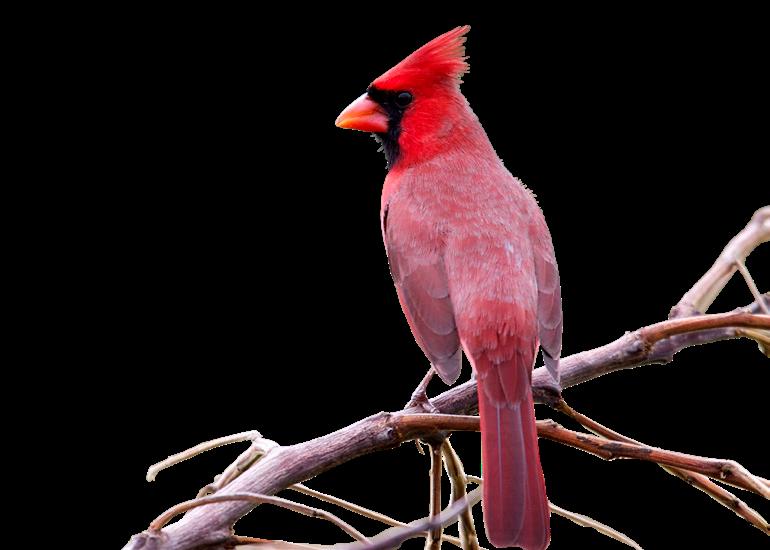
Dixon enjoys an outing at South Mountains State Park in western North Carolina.
Juana Pineda Reyes (top); © Michael Stubblefield (right)
The Northern Cardinal was Dixon’s spark bird — the species that inspired her interest in birds — and it remains her favorite species.
Tips for Keeping Cats and Birds Safe
Without fail, readers of this magazine are interested in the wellbeing of wild birds, and like millions of others, many readers also have pet cats. (Even if you don’t have a feline friend, you almost certainly know family, friends, and neighbors who do.) As a person concerned about birds, you likely know that domestic cats aren’t native to the Americas and take a serious toll on wildlife when they’re allowed to roam outdoors. In the United States alone, cats kill an estimated 2.4 billion birds each year, making cats the top source of direct, human-caused bird mortality in the country.
ABC’s Cats Indoors Program is all about keeping cats, well, indoors, or contained when outdoors, but for cats that have free access to the outdoors, transitioning them to an indoor life can present challenges. It’s absolutely possible, though. And it’s so important in the spring and summer, when birds are breeding and vulnerable chicks are in our yards, parks, and other green spaces.
Many cat owners want options to help enrich their cats’ lives while preventing them from harming birds and other wildlife. Here are three solutions to help you — or a friend, colleague, or loved one — keep pet cats and wild birds safe.
Catios and Outdoor Enclosures
Want the best of outdoor access while keeping your cat safe at home? Outdoor enclosures like catios can give your cat the chance to move around freely outside within a sheltered and safe space. Whether you and your cat
prefer a perch, a patio, or the entire backyard, enclosures can be modified to suit all situations. A portable or permanent catio enclosure dedicates a safe and fun space for your cat to smell the fresh air and enjoy the sunshine. You can also turn your existing fence into a cat-safe fence. These straightforward options modify existing structures to create an escape-proof kingdom for your cat to explore.
Harnesses, Strollers, & Backpacks
Many strategies exist to safely enjoy the outdoors with your cat, including comfortable restraints that keep you and your pet connected. These options are an excellent choice for joint adventures around town or exploring the great outdoors.
Leash training isn’t just for dogs. Using a harness, and a generous supply of time and patience, you can safely hike your local park, walk the neighborhood, or explore the backyard with your cat at your side. Or you can transport your cat in style in a comfortable backpack or stroller.
Indoor Enrichment
A fun and stimulating environment is critical for your cat’s mental and physical health. To brighten your cat’s day, engage its senses, and give it some exercise, consider a cat climbing tower, cat perches that mount to walls or windows, an exercise wheel designed for cats, or similar products intended for enrichment and play. For more advice, visit abcbirds.org/HappyCats to learn how members of ABC’s staff keep their indoor cats happy and content.

Read more about the enrichment options shared here, including catios, harnesses, and other products, at abcbirds.org/CatSolutions
Emily Williams (top); Molly Toth (middle)
Beanie (foreground) and Alfie, the cats of Emily Williams, our Social Media Specialist, enjoy outside time in their enclosed catio.
Senior Writer/Editor Molly Toth's cat Murray wears a harness on a sunny afternoon while his canine friend Teagan explores their yard.
Bird City Valley
by Joanna Eckles
What a rewarding experience I had visiting Colombia last October, celebrating a recent expansion of Bird City Network (BCN) — a project of ABC and Environment for the Americas (EFTA) that guides cities across the Americas in local bird conservation action. Ciudad de las Aves Colombia is our fastest-growing international program. In our visit, we traveled well off the tourist path, visiting the people, places, and projects that bring Bird City to life. Everywhere we went, the connection to and through birds — a core Bird City tenet — was on full display.
We first began hearing about Santander de Quilichao in 2021, just as BCN was beginning to take shape. At the time, we were connecting the nine U.S. Bird City programs and exploring how to work collectively while inspiring more programs to launch in more locations. At ABC, we coordinate the network and expand U.S. efforts, while EFTA leads the growth of Bird City in Latin America and the Caribbean.
Through EFTA, we heard stories about the remarkable bird conservation and community engagement happening in Santander. Though little known internationally, this small community has become a powerhouse of inventive and contagious action. After years of participating in EFTA’s signature program, World Migratory Bird Day (WMBD), local leadership was strong. As soon as designation became possible, they jumped at the chance to become Colombia’s first Bird City — not knowing their efforts would inspire a wave of communities to follow.
Our delegation, coordinated by EFTA, began in Santander, where we spent most of our time. Upon
arrival, the mayor and his staff welcomed us warmly, ushering us into city offices where local press had already gathered. Over coffee and bilingual introductions, we began to understand the depth of appreciation for our visit.
The week in Santander was nonstop. We visited a reserve the community is protecting and expanding, spent an afternoon with educators sharing ideas, and toured a primary school on the lush grounds of a historic hacienda. We strolled through town viewing vibrant bird murals, joined a Bird City 7K run in potoo-themed shirts, and experienced an unforgettable WMBD parade.
That parade left many of us in tears. School groups had spent months researching a focal bird species, designing elaborate costumes and giant bedazzled puppets, and practicing choreographed skits — all under the direction of a renowned local theater artist. The result was enchanting.
We left Santander amazed and inspired by their whole-of-community approach to Bird City. Then we visited three other communities in the Valle del Cauca Department — Palmira, Caloto, and Calima — before ending in the capital city of Cali, also a Bird City community. There, a grand celebration marked the renewal of Santander de Quilichao and Cali and welcomed 12 new communities into the program. The shared vision was clear: connect their work across the valley to build birding tourism, infrastructure, and their conservation reputation.
Listening through an interpreter as enthusiastic leaders shared their accomplishments and plans, I was struck by the realization that this momentum was made possible by Bird City Network. By drawing on lessons of the founding programs and building a replicable model, we’ve created a tool that communities anywhere can use to champion birds in their own way. In Colombia, that tool has ignited creativity, pride, and collaboration across an entire region — reminding us that the most tenacious advocates for birds are the people who live alongside them.

Left Celebrants carry a bedazzled Common Gallinule puppet in Santander de Quilichao, Colombia.
Bottom ABC's Joanna Eckles sports a potoo-themed shirt before a Bird City run.
Joanna Eckles is ABCʼs Bird City Network Coordinator.
Joanna Eckles (top); Pamela Kellett (right)
The Science of Birds
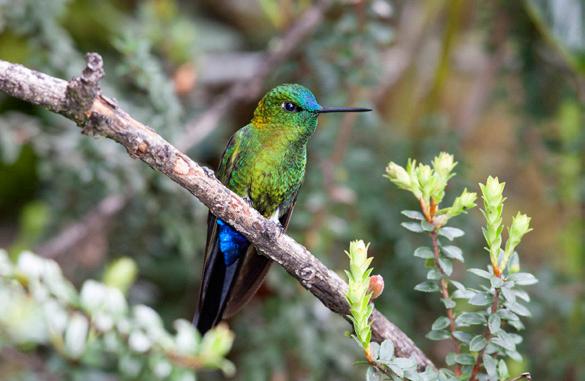
Global Network Critical for Biodiversity
A new paper coauthored by staff members from ABC and published in Biological Reviews reveals that the Key Biodiversity Areas (KBA) network has grown to be the most comprehensive global map of critical biodiversity sites since the framework was formalized in 2016. Currently, 16,602 KBAs cover more than 8.6 million square miles. KBAs represent the most significant places for biodiversity on the planet, which collectively support more than 18,000 species. ABC is a member of the KBA Partnership.
After several decades of different organizations using different approaches for identifying important sites for nature, the International Union for Conservation of Nature (IUCN) unified these by publishing the Global Standard for the Identification of Key Biodiversity Areas in 2016. This landmark document provides a standardized set of criteria for identifying “sites of significance for the global persistence of biodiversity.” Now, a newly published paper by over 50 authors from 19 countries provides the first global audit of the KBA approach. It synthesizes the lessons learned and outcomes of applying the global standard, documenting the scale and characteristics of KBAs, their use by governments, intergovernmental bodies, and the private sector, as well as future priorities for the KBA approach.
The origins of KBAs can be traced back to the 1970s, when the concept of Important Bird Areas was defined and the approach was used to map key places for birds. Over time, similar initiatives emerged for plants, freshwater systems, butterflies, and other species groups.
However, to respond to the increasing need for a globally unified standard, KBAs were born. With them, the KBA Partnership was formed with the goal of ensuring the correct application of the standard, the identification of a comprehensive KBA network, and the protection and safeguarding of these sites.
“These KBAs range from tropical rainforests to coral reefs, spanning terrestrial, freshwater, marine, and even subterranean systems,” said Stuart Butchart, Chief Scientist at BirdLife International and lead author of the paper. “Based on the KBA criteria, most sites (63%) qualify because they support globally threatened species, and nearly half (48%) are important for biological processes such as large congregations or migration.”
KBAs have been identified as significant for 18,649 species — from plants and birds to mammals, amphibians, reptiles, fishes, invertebrates, and fungi. These locations are also crucial for human persistence. The array of ecosystems within them provides important contributions to people: climate mitigation, freshwater provision and purification, flood mitigation, coastal protection, tourism, and cultural identity.

Learn more at abcbirds.org/KBAs and keybiodiversityareas.org
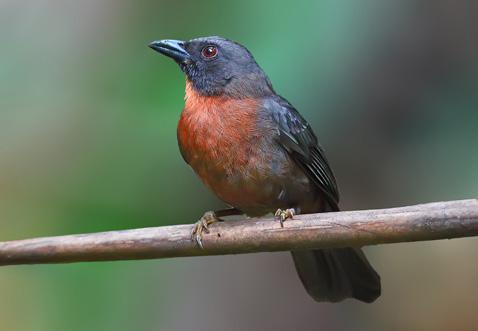
The Sapphire-vented Puffleg (left) of Ecuador and the Black-cheeked Ant-Tanager (below) of Costa Rica are among the thousands of species found in Key Biodiversity Areas.
© Michael Stubblefield (top); Greg Homel/Natural Elements Productions (bottom)
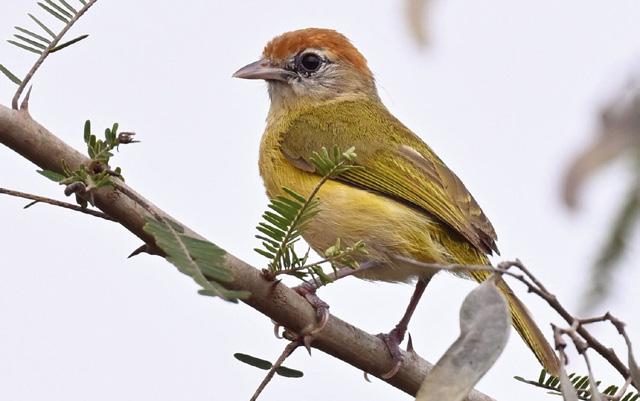
New Songbird Species Described in Bolivia
An olive-green songbird found only in Bolivia’s vast Beni savannas has been described as a new species — more than six decades after being considered a separate population of related species.
Researchers led by Paul van Els, an ornithologist at the Sovon Dutch Centre for Field Ornithology, reported earlier this year in the journal Avian Systematics that the Beni Greenlet (Hylophilus moxensis) is not a variant of Brazil’s similar Rufous-crowned and Gray-eyed Greenlets, as past ornithologists classified it at various points since 1960. Rather, it’s a unique species that lives year-round in the Beni department, about 1,240 miles from the other greenlets.
By studying the birds’ mitochondrial and nuclear genes, the team found that the Beni Greenlet diverged from its relatives around 6.6 million years ago, while the Rufous-crowned and Gray-eyed Greenlets separated from each other about 3.5 million years ago. The Beni Greenlet also has uniformly dark eyes and distinctive song pat-
terns, and it lacks its cousins’ black or brown markings near its ear coverts.
ABC has supported conservation work for decades in Beni’s grasslands, especially with Bolivian partner Asociación Armonía. Bennett Hennessey, ABC’s Brazil Conservation Program Coordinator and Private Reserves Director for Armonía, said the Beni Greenlet may have been overlooked due to its habitat.
“Grasslands are notorious for receiving less research because too frequently people assume it is the relic of a disturbed habitat,” he said. “Instead, some areas have several endemic species that have adapted to the habitat for hundreds of thousands of years.”
Van Els and his team wrote that they aren’t able to estimate the new greenlet’s population, but “we do not believe it to be currently threatened, because suitable habitat is still widespread in the region. However, the relatively few records of the species may point toward other factors than a lack of observers and may reflect a truly localized occurrence.”
Petrels Going Separate Ways?
A tracking study of the Endangered Black-capped Petrel provides further evidence that the distinct light and dark forms (or morphs) of the species breed on different schedules and maybe in different parts of the island of Hispaniola. These findings support the theory that the forms are distinct populations and may be in the process of species divergence or already two species.
The researchers, including Brad Keitt, ABC’s Oceans and Islands Director, attached 10 satellite transmitters to petrels off Cape Hatteras, North Carolina, in 2019. A previous paper showed the two forms used different areas of the ocean during the nonbreeding season. This study focused on two males, one of each form, whose transmitters functioned into the breeding season. The birds migrated to Hispaniola, but they took different routes, went to different forests on the island, and visited likely breeding sites more than a month apart.
The white-morph bird went to a national park in central Dominican Republic in early October, while the darkmorph individual flew to southeastern Haiti around six weeks later. The study, published recently in the Journal of Caribbean Ornithology, implies that with separate breeding sites and schedules, the forms face differing threats and likely have unique management needs. If these two forms are indeed discrete genetically, it also suggests the conservation requirements to protect both forms are much more significant.
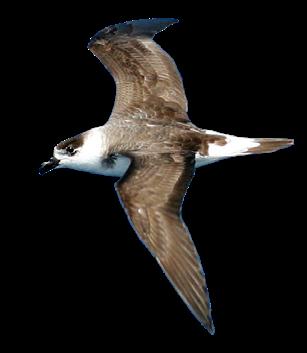
Beni Greenlet
Tini Wijpkema (left); Brian Patteson (right)
Capturing Birds’ Whimsy and Fluidity
Wildlife artist Alex Beard’s latest book, For the Birds: An Artist’s Aviary, is a stunning 224-page hardcover monograph measuring 8.5x11 inches. Its large size allows the 100-plus new paintings in Beard’s distinctive and delightful style to fill the pages, giving readers up-close views of his subjects, which run the gamut from hummingbirds to owls to Africa’s Secretarybird. Beard recently spoke with Managing Editor Matt Mendenhall about his art and the new book.
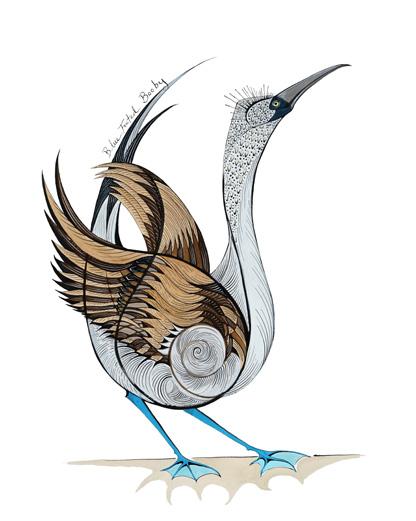
You describe your style as abstract naturalism. What does that mean?
The very simple answer is that I combine what I see in nature, and I abstract it. The actual answer, though, is it’s sort of an amalgamation of the observable universe through combinations of visual compositional mathematics. If you think about the intrinsic way in nature that things move, you start to see it. The most obvious example is that the spiral in a seashell is also the spiral of the entire arms of a galaxy.
As somebody who spends a lot of time in places where there are more animals than people, you see not just what animals look like, but how they behave in relation to the world around them. Birds in particular are conducive to this style. First, they’re ubiquitous. Wherever you go — urban
areas, deep jungle, desert, way out in the ocean, right on the coastline — there are birds. Then there’s their vast diversity, their incredible plumage, and the beaks and legs. And, they’re whimsical, if you watch the way that their necks bob, for example. In terms of the work that I make, birds are the perfect window into the conversation of fluidity, which then carries forth into a conversation of interconnectedness in the way that birds move and behave.
What’s your process for making art?
When I was younger, I thought I wanted to be a photographer. But in trying to photograph animals, my timing wasn’t very good. Let’s say that the eagle that I’d been watching for the last hour at the top of a tree
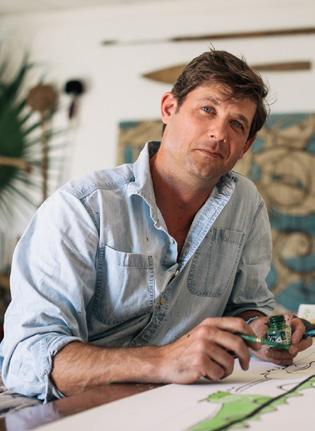
Alex Beard Abstract
naturalist
Alex Beard is an American painter and illustrator who describes his style as “abstract naturalism.” He grew up in New York City and has been based in New Orleans for the last 30 years. He studied art at Boston’s School of the Museum of Fine Arts, at the New York Studio School, and at the New Orleans Academy of Fine Arts. Beard’s art is in public and private collections, has been exhibited in cities from New York to Hong Kong, and is in the permanent collections of two New Orleans museums. Beard is the author of nine books, including a series of children’s books called Tales from the Watering Hole. His latest book, For the Birds: An Artist’s Aviary, features his original art and poetry. Beard is also a conservationist; in 2012, he established the Watering Hole Foundation (a nonprofit protecting endangered species), and he’s a board member of the Lewa Wildlife Conservancy in Kenya. Visit him at alexbeardstudio.com and on Instagram @alexbeardstudio
takes off. I take a picture and all I get is its tail. So then I’m angry that I missed the picture. I didn’t experience the thing itself because I was trying to capture it. So I don’t even
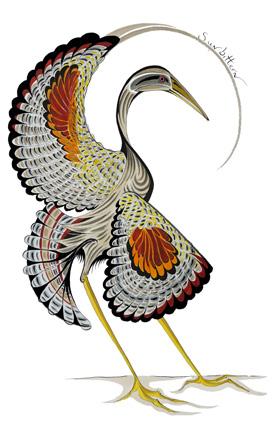
bring a camera in the field anymore. And now how many birds have I seen taking off from trees where I haven’t been distracted? A lot. You start to see commonalities in the ways that birds launch themselves. Or if you’re talking about birds that don’t fly very much, you start to get a sense of the posture in a way that then makes it so that I can then render the thing that I want to paint.
What inspired your new book?
I like doing books. It’s a form that I enjoy. I lay the whole thing out and put everything exactly where I want. I view the book itself as an individual artwork, not a folio of a collection of other artworks. It has to work by itself, so the poems have to go with the paintings, and the way that chapters are structured has to make sense. So if the intention is to create
a book as an individual artwork, then that sets you on a fascinating journey. If you’re talking about a singular subject as voluminous as birds, well, what does that actually mean? What do you include and not include? And what is suggestive of things that are entirely imaginary, but still recognizable? It’s pretty straightforward and also not. And that’s a ton of fun to make.
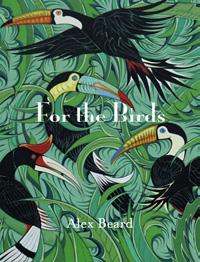
For the Birds: An Artist's Aviary by Alex Beard, G Editions, 2025, 224 pages, $65.
Art by Alex Beard: Sunbittern (above), Blue-footed Booby (top left), and Daisies and Hummingbirds (left).
Bryan Tarnowski
Finding Joy and Wonder in Birds
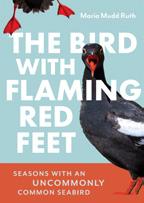
The Bird with Flaming Red Feet: Seasons with an Uncommonly Common Seabird by Maria Mudd Ruth, Skipstone, 2026, 208 pages, $24.95. For more than 20 years, a spotlight has shone on the Pigeon Guillemot in Washington state, where a volunteer network tracks the charismatic seabird’s colonies. Maria Mudd Ruth had little knowledge of the red-footed bird
when she joined the project in 2013, but she soon recognized its star power. In her new book, she shares stories from the Puget Sound beach where she and other “Guillemoteers” observe the birds at their burrows, keeping tabs on the population. The book is a lovely celebration of not just the bird but also of the value of community science and the camaraderie, fun, and joy Ruth shares with her fellow observers. Illustrated with incredible photos and works of art, Ruth's book invites readers to slow down, observe,
A Tropical Treasure
Thank you for supporting American Bird Conservancy! Make a friend or loved one feel special by giving a gift membership to ABC along with our hardcover coffee-table book Birds of the Tropical Andes! In it, ABC President Michael J. Parr and photographer Owen Deutsch present more than 200 breathtaking photos and stories about Andean birdlife. Order a copy for yourself with a gift of $50 or more or a new monthly gift of $10 or more, or give a friend an ABC membership and we’ll send them the book.

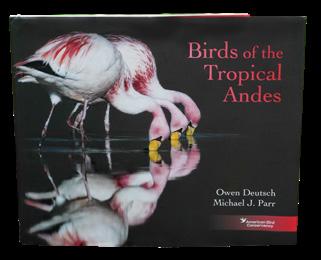

and reconnect with wild places and birds in their own regions.
Endangered Hummingbirds:
Seeing the Crisis Through My Lens by Anthony Lujan, 2025, 166 pages, $40 plus shipping.
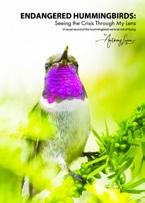
“I created this book to document the hummingbirds we are at risk of losing,” photographer and conservationist Anthony Lujan writes. “Not as a field guide and not as a personal memoir, but as a visual and factual record of species whose survival has become increasingly uncertain.” In the self-published book, Lujan introduces readers to threatened hummingbird species from Chile, Colombia, and Peru, among other countries, and covers the primary reasons for their declines: climate change, pollution, pesticides, invasive species, and non-native predators. He also writes about rediscovered species that were feared extinct and conservation work that is helping populations recover. The book is illustrated by dozens of Lujan’s incredible hummingbird photos that showcase the birds in all their wonder. Proceeds from sales of the book at anthony-lujan.com/ books will go toward conservation of one of the most endangered species, the Chilean Woodstar (shown on the cover). ABC and the International Hummingbird Society are partners in conserving the woodstar.
Receive an Amy Tan Print!
Help birds thrive — and receive a beautiful thank you from artist, bestselling author, and ABC Board member Amy Tan! Make a new monthly gift to ABC of $10 or more per month and receive a signed 5x7-inch print of Tan’s lovely illustration of a female Anna’s Hummingbird. This portrait — featured in her number-one New York Times bestseller The Backyard Bird Chronicles — comes in an envelope, perfect for gifting or safekeeping. A limited number of prints are available. Become a monthly donor today and claim
Many thanks to the readers of our fall 2025 issue who shared their finished art from our ‘I‘iwi coloring page, including Jon C. of New Jersey, who shared his page and said, “It was so much fun to color like a kid again.” To download the page for yourself, visit abcbirds.org/ColoringPage this special keepsake for yourself or for a friend!
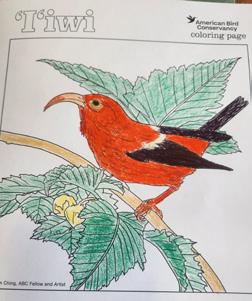

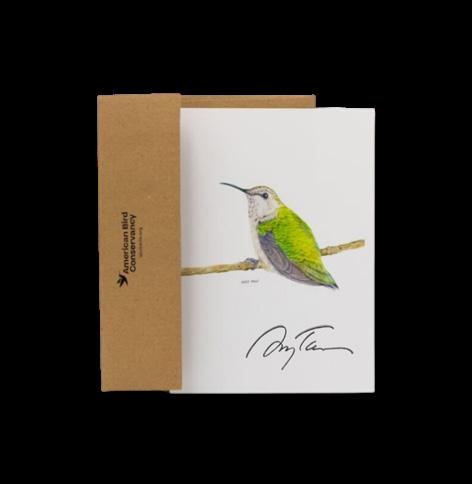
For you: abcbirds.org/Print For a friend: abcbirds.org/GiftPrint
Celebrate Bird Art

Employee Matching Gifts
Many companies generously match their employees’ charitable contributions, making your gift go even further at no additional cost to you. If you find out that your organization matches donations and would like to ensure your gift is matched to ABC, you may need the following information: American Bird Conservancy is a 501(c)(3) organization. ABC’s Tax ID/EIN: 52-1501259
Read more and use our search tool to learn if your employer will match your donation at abcbirds.org/MatchingGifts. If you have any questions, feel free to contact Jenna Chenoweth at jchenoweth@abcbirds.org or call us at 540-253-5780

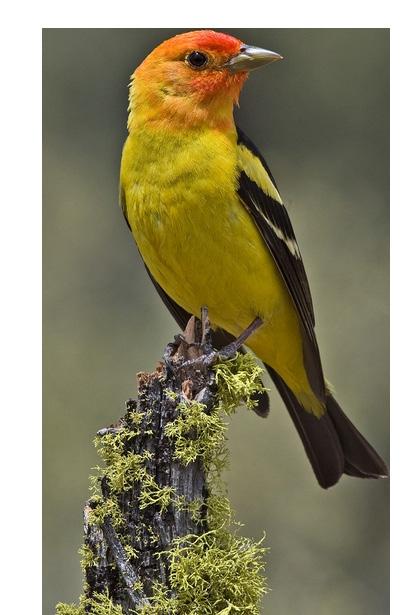
Alan Wilson
Western Tanager
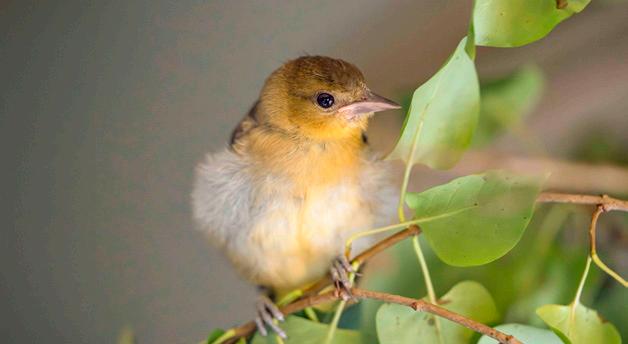
One Bird’s Biography
by Melissa Groo
One early May, I watched a pair of Baltimore Orioles courting in my backyard. Before long, the female was weaving an intricate nest in the sugar maple outside my bedroom window. Three weeks later, the begging calls of chicks emanated from within.
As a self-professed “wildlife biographer,” I sought to photograph every stage of their story. I learned each oriole’s unique traits: the father’s dulcet chirrups as he patrolled his territory and the specific flight paths he took to the nest, the mother’s burnt-orange plumage as she moved surreptitiously through the trees, and her cryptic, leaf-like flutter down to the jelly feeder. I marveled at their tireless vigilance against marauding Blue Jays and squirrels and the dozens of daily forays they made to find insects for their nestlings.
One day, hearing a great ruckus, I rushed outside to find the parents flitting about a chick on the ground. She was injured and squawking piteously, likely captured by a predator and then released in the ensuing fray.
I scooped her up, pleading uselessly with the parents for for-
giveness, and raced her to Cornell University’s wildlife hospital, not far from my home. She’d suffered puncture wounds and a ruptured air sac. After a stint in the hospital and then with a rehabilitator, she was transferred to me (a subpermittee under a wildlife rehabilitator’s license) in hopes of a release. But first, we needed to prove she could fly.
I named this tiny, spunky bird Sparky. My bedroom, so close to where she’d been conceived and hatched, became her home for five weeks. I oriented my life around her. Every day I brought in leafy maple branches for her to explore, securing them to the window so she could look out. I offered a diverse array of foods: fresh fruit, scrambled eggs, jelly, and softened kitten kibble. Her preference was mealworms fed by hand. Sparky did not suffer me gladly. When I approached, she’d hide in the leaves. When I offered my finger for her to perch, she’d peck furiously before latching on. But if I sat quietly on the bed, she would come to me to explore the vast terrain of the blanket and my prone figure.
She was intensely curious, probing her beak between the keys on my laptop, playing with my hair, and endlessly rearranging bits of string and wire. Was she practicing for nestbuilding?
Eventually, we took her to the barn to test her flight. We’d launch her with a gentle toss, but though she flapped madly, she couldn’t gain altitude. The vets cited a possible coracoid injury or congenital malformation. She’d never be able to migrate or build a nest. She was unreleasable.
Heartbroken, I turned my focus to finding the best possible aviary to place her in. With bird artist and author (and ABC member) Julie Zickefoose’s help, we found one in Ohio, and I drove Sparky to her new life. I often think back and wonder: How did such a scrappy little bird break my heart wide open? I believe it was this deeply intimate confirmation that each individual bird is utterly unique, with its own personality and spirit.
Can we go beyond identifying birds to identifying with them? Can we shift from a language of separation and otherness to one of kinship and shared experience? As the animal behaviorist Jonathan Balcombe wrote, “Next time you are outside ... notice the first bird you see … you are beholding a unique individual with personality traits, an emotional profile, and a library of knowledge built on experience … what you are witnessing is not just biology, but a biography.”
Melissa Groo is a Sony Artisan of Imagery, an assignment photographer for Audubon and Smithsonian magazines, and a Fellow with the International League of Conservation Photographers.
Melissa Groo
Close observation of this young female Baltimore Oriole sparked new insights about birds for writer and photographer Melissa Groo.
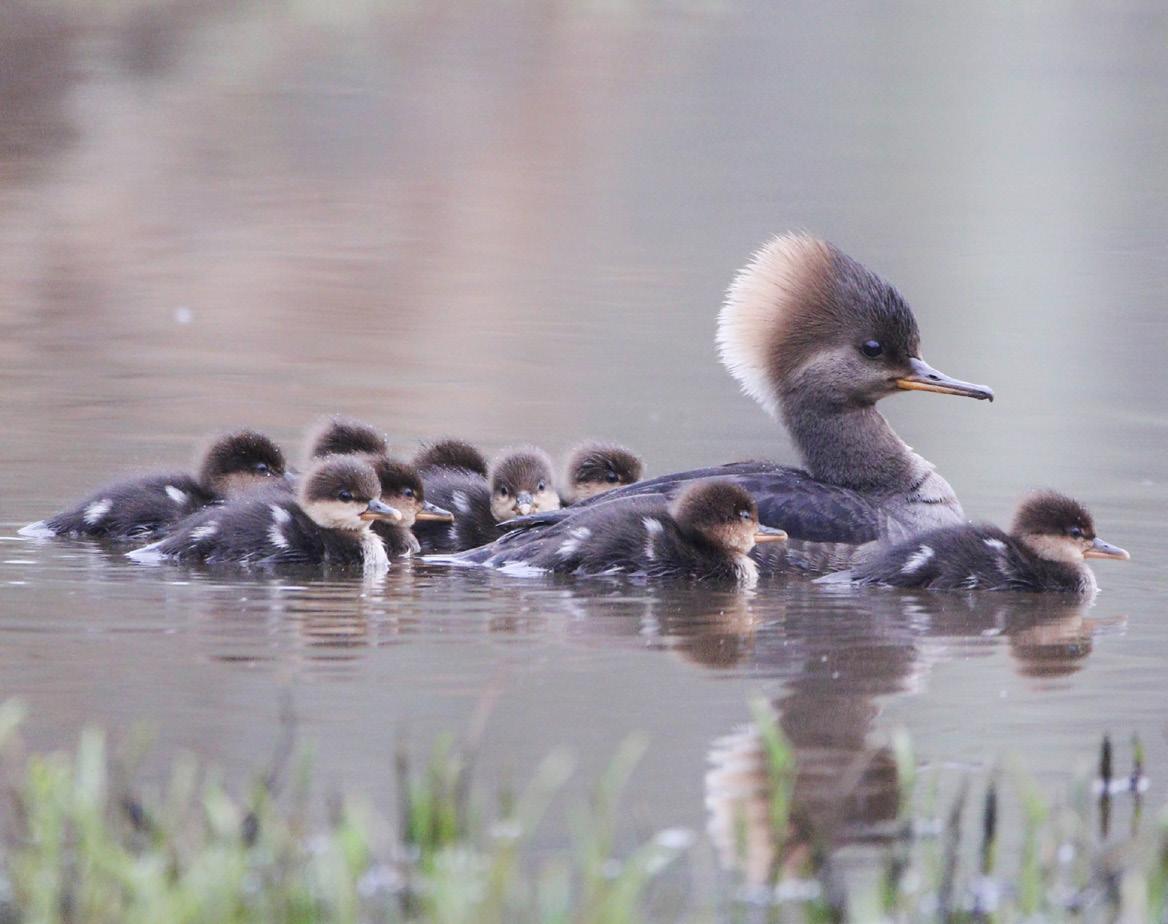
Save a Place for Birds for Future Generations
When you include American Bird Conservancy in your estate plans, you will help ensure birds have a place for breeding, migration, and nonbreeding seasons for years to come. A place where they can thrive. A place where future generations will also be able to marvel at their beauty and splendor.
Save a place in your estate.
Save a place for birds.
If you are interested in more information on how to leave your own legacy for birds, or if you have already remembered ABC in your estate plans, please contact Jack Morrison, ABC Director of Major Gifts and Planned Giving, at jmorrison@abcbirds.org, 540-253-5780, or scan this code to email him.

Learn more about joining ABC’s Legacy Circle. abcbirds.org/LegacyCircle
Hooded Merganser hen and chicks
Melissa Ludwig
P.O. Box 249
The Plains, VA 20198
abcbirds.org
540-253-5780 • 888-247-3624

As we welcome the return of migratory birds (like the Yellow-breasted Chat, below), it is vital that we continue our work to conserve the places birds need to thrive. Join us to Save a Place for Birds with our special 1:1 match. Give now: abcbirds.org/SaveAPlace
Yellow-breasted Chat in a West Virginia nature reserve.
Photo by Tessa Nickels