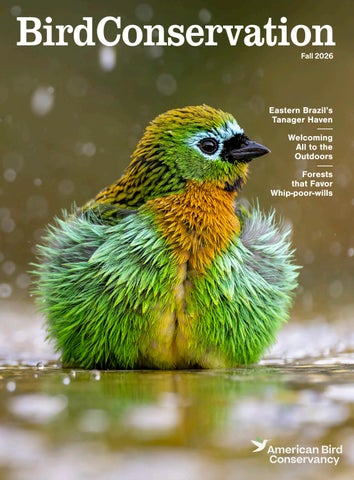
BirdConservation Fall 2026
Eastern Brazil’s Tanager Haven Welcoming All to the Outdoors Forests that Favor Whip-poor-wills
Bold Action for Birds
FALL 2026, Volume 31, No. 3
American Bird Conservancy (ABC) takes bold action to conserve wild birds and their habitats throughout the Americas. Inspired by the wonder of birds, we achieve lasting results for the bird species most in need while also benefiting human communities, biodiversity, and the planet’s fragile climate. Our every action is underpinned by science, strengthened by partnerships, and rooted in the belief that diverse perspectives yield stronger results. Founded as a nonprofit organization in 1994, ABC remains committed to safeguarding birds for generations to come. Join us! Together, we can do more to ensure birds thrive. Bird Conservation (ISSN: 3067-2228) is the member magazine of American Bird Conservancy and is published three times annually. Nonprofit postage paid at San Diego, California. POSTMASTER: Send address changes to Bird Conservation, P.O. Box 249, The Plains, VA 20198. Send undeliverable copies to American Bird Conservancy, 8255 E. Main St., Suite D & E, Marshall, VA 20115. Return postage guaranteed. Copyright 2026 American Bird Conservancy
MAGAZINE STAFF Vice President of Communications and Marketing Clare Nielsen Director of Communications Jordan E. Rutter Managing Editor Matt Mendenhall Graphic Designer Maria de Lourdes Muñoz Senior Writer/Editor Molly Toth Writer/Editors Clarissa Casper, Cedar Mathers-Winn Director of Brand Strategy and Web Som Prasad Science and Policy Consultants Hardy Kern, Daniel Lebbin, George E. Wallace, David A. Wiedenfeld Contributors Andrés Anchondo, Brian Brooks, Ben Catcho, Serena Chenery, Sebastián Cruz, Joanna Eckles, Kevin Ellison, James Giocomo, Bennett Hennessey, Connor Jandreau, Brad Keitt, Jeff Larkin, Bryan Lenz, Sea McKeon, John C. Mittermeier, Jack Morrison, Amy Upgren, Liz Virgl
COMMUNICATIONS AND MARKETING TEAM Director of Marketing Lara Long Multimedia Producer Erica Sánchez Vázquez Media Relations Specialist Agatha Szczepaniak Social Media Specialist Emily Williams
Join Us
Production Specialist Archana Sriram
If you’re not already an ABC member, we invite you to join us. Members at any of our five levels of commitment receive a one-year subscription to Bird Conservation, access to members-only events and webinars, a choice of premiums, and other offers. Give now at abcbirds.org/membership or see contact details below.
Digital Content Specialist Kathryn Stonich
Digital Marketing Specialist Noah Kauffman Digital Engagement Specialist Avary Sassaman
MEMBERSHIP TEAM Membership Director Kelly Wood Membership Coordinator Jenna Chenoweth Database Quality Coordinator Jamie Harrelson
Connect
Office Manager Cindy Elkins
Magazine feedback: We welcome letters to the editor and other feedback. Contact us at: magazine@abcbirds.org.
ABC SENIOR LEADERSHIP President: Michael J. Parr Vice Presidents of ABC Programs:
Membership or other inquiries: Contact us at American Bird Conservancy, P.O. Box 249, The Plains, VA 20198 | 540-253-5780 | info@abcbirds.org
Advocacy and Threats – Brian Brooks
Sign up to receive emails from ABC: abcbirds.org/email
Operations – Kacy Ray
Communications and Marketing – Clare Nielsen Development – Erin Chen Finance – Angela Modrick Threatened Species – Daniel Lebbin
Find and follow us on social media:
Together for Birds – Naamal De Silva U.S. and Canada – Shawn Graff
BOARD OF DIRECTORS
ABC is proud to be a BirdLife Partner Printed by Neyenesch Printers Inc. Bird Conservation is printed on paper sourced from sustainably managed forests and with recycled fibers.
You can read past issues of Bird Conservation and ABC’s Impact Reports at abcbirds.org/publications.
Please give this magazine a second life by passing it along or recycling!
Maribel Guevara, Chair Michael J. Parr, President Meg Caldwell Jonathan Franzen Annie Novak Jeff Peters Ravi Potharlanka
Carl Safina Amy Tan Stephen Tan Shoaib Tareen Walter Vergara Jessica Wilson
For a full staff list, see ABC’s website at abcbirds.org/staff.
Page 18
In Every Issue 4 Chirps What we’re hearing. 5 From the Perch A time traveler’s memo. 6 In Focus A striking singer of the western prairies. 8 Bird Calls A big boost for grasslands, progress for rare hummingbirds, three rediscovered species, seabirds hit hard by El Niño, and more. 14 The Stopover Critical salt marshes of the Atlantic Coast. 38 Together for Birds Welcoming all to the outdoors. 40 Bird Hero Inspiring kids about Hawai‘i’s birds.
The Cherry-throated Tanager is one of the rarest birds in the world.
Inside
Features
Fall 2026
Patching the Wounds of the Stabbed Tanager Conservationists are working to protect and understand eastern Brazil’s elusive Cherrythroated Tanager and other threatened residents of its Atlantic Forest home. 18 Cultivating Chaos Forests managed for variety are the places to be for Eastern Whip-poor-wills and other woodland birds — a report from the wilds of Pennsylvania. 26
Cover photo Brassy-breasted Tanager in eastern Brazil by Owen Deutsch, owendeutsch.com abcbirds.org/CoverBird Caio Brito
The Making of a Bird City How birders, tourism officials, and others in a Great Lakes migration hotspot forged their community’s formal commitment to birds (and how you can, too). 32
42 Action & Advocacy Pitching in to reduce litter. 43 Field Notes A worldwide partnership for birds. 44 The Science of Birds An elusive seabird’s secrets, new penguin species, and more. 46 The Art of Birds Connor Jandreau’s dual roles: scientist and artist. 48 The Cache Give the gift of ABC. 49 Flock Talk Sharing recent bird science at the American Ornithological Society meeting. 50 Field of View License plates that give back.
Sandhill Cranes
Chirps What we’re hearing from ABC members and friends. Giving Me Hope I appreciate the mix of information in your Summer 2026 issue sharing the successes of ABC and its partners as well as the importance of continued and additional work. The insecticidefree seed program (page 42) gave me hope, and the list of communication towers needing updates by state was eye-opening (page 34). Enjoyed Christian Cooper’s piece at the end of the issue (page 50). — Kathy C.
some of us older generations, too! I’m a perfect example. Mine started with a moment of eye contact with a fledgling Eastern Bluebird, and it hasn’t stopped since. Thank you for all you do to protect these amazing creatures and the places they need to thrive. — Denise B.
Thinking Globally Thank you for showcasing the continued efforts to protect birds and how these efforts are interconnected all over the globe while enlightening us on what we can do to realistically assist along the way. — Denise B.
A video we shared of a calling and strutting Sandhill Crane drew this reply from Bruce S.: Absolutely beautiful. It’s why I’m so focused on supporting American Bird Conservancy. Keep up the amazing work to conserve what we cannot lose.
View the post at abcbirds.org/HeronPoem
Connecting with Friends
A video post of Mexico’s Short-crested Coquette on Instagram prompted photographer/videographer Anthony Lujan to share this note: Conservation as a dedicated hummingbird photographer starts with photography and video footage. When I set out, no known content was available of this species. So honored to have my work representing this Critically Endangered species and to partner with @americanbirdconservancy on several projects to save these rare declining hummingbirds.
Let’s hear from you!
Here’s a selection of recent comments from our social media followers. A LinkedIn post about the popularity of birding prompted these comments: I absolutely love what you’re doing to introduce younger generations to birding. They’re not only discovering the wonder of birds — they’re becoming the people who will want to protect their habitats so they’re still here for generations to come. But I wanted you to know you’re grabbing
4
Bird Conservation
Birding has brought me so much joy and connection with wildlife. A hobby I’ll continue anywhere and everywhere I go! — Samantha B.
A recent ABC webinar featured Dr. Mel Michelle Lewis, a transdisciplinary artist whose work is deeply rooted in the nature and culture of the Gulf South. On Instagram, we shared a clip of Lewis reading an original poem of hers about the Great Blue Heron. Sophia R. reacted: This is brilliant, and this is where the future of the sciences should be headed. More artistic, nuanced understandings of the natural world and our relationality to it.
Share your thoughts about our magazine, emails, or online content at magazine@abcbirds.org. Please include your full name and location. Letters may be edited for length and clarity. (Note: Opinions expressed are those of the authors.)
Sarah Jessup/Shutterstock
From the Perch
A Time Traveler’s Tale of Hope I am a time traveler — or at least, that’s how I feel when I take my annual trips to the United Kingdom, where I was born (and where my mother still lives). Visiting briefly but regularly over several decades, I’m able to notice things that most people going about their daily lives there do not. And this past summer, my trip to England brought some worrisome insights. Song Thrushes have largely disappeared. I did not see a single one there during a threeweek trip. As a child, I saw these birds in every garden, feeding on the snails that English gardeners have since widely controlled with pesticides. Eurasian Blackbirds, too, have declined dramatically in many areas, affected by a mosquito-borne virus spread by climate change-related flooding. These are just two examples of the changes I’ve noticed since I was growing up there in the 1960s. As you all know, it is not just Britain. Birds are vanishing in North America, too. Nighthawks and bobwhites are two obvious examples of bird declines, but the bigger story is that there are simply far fewer birds overall. Research by ABC and partners shows that North America is home to 3 billion fewer breeding birds today than 50 years ago. So, what to do? Here at American Bird Conservancy, I’m immensely proud of what we’ve accomplished. We have conserved millions of acres of land, created dozens of protected bird reserves, and successfully advocated for birds on pesticides, collisions with buildings, feral cats, and much more. But we need to 10x our efforts — or even 100x them — if we are going to turn these declines around. I’m optimistic that we’ve hit on a way to do this. ABC will soon be launching a new program to develop and promote “conservation practices” for every major North American habitat — with an aim to create vastly more places where declining birds can thrive. The idea is that these practices can be put to work by landowners everywhere, from
suburban yards to large tracts of corporateowned forests. Once we’ve turned these practices into easy-to-follow templates for habitat management, we’ll work to implement them at a huge scale, working with partners from federal and state agencies to land trusts and fellow nonprofits. And we’ll need the support of people like you. Our goal is to create the largest contribution to positive change for birds in world history over the next 10 years. Because we’re determined that the “time travelers” of the future see something different as they evaluate our progress: not the disappearance of birds, but their recovery. Thank you for your support of American Bird Conservancy. Michael J. Parr President
Scan this code or visit the link below to let us know what you think of this issue. Thanks for reading Bird Conservation! abcbirds.org/MagSurvey
Northern Bobwhite Greg Lavaty/texastargetbirds.com
A male Chestnut-collared Longspur perches on sagebrush in a Montana grassland. A female longspur (inset) crouches low among grasses in southeastern Alberta.
6
Bird Conservation
Donald M. Jones (male); David Bell (female)
In Focus
The Striking Singer of Our Western Prairies For well over one million years, the Chestnutcollared Longspur has graced North American plains and prairies with its striking plumage and beautiful, intricate songs. One of 12 bird species endemic to North American grasslands, it occurs nowhere else in the world. Throughout time, the colorful songbird found its place in dynamic landscapes defined by disturbance. In the Ice Ages of the Pleistocene, glaciers and mammoths and mastodons shaped the grasslands. After the ancient megafauna disappeared, the longspurs adapted, relying on vast herds of grazers, including American bison and pronghorn, to maintain short- and mixed-grass prairie lands. Indigenous peoples used fire to manage the land and grazers, amplifying ecological patterns that the birds fit into. Today, the Chestnut-collared Longspur remains an iconic species of the American prairies. On its breeding grounds in the Northern Great Plains, naturalists compare the male’s song to that of the Western Meadowlark. The longspur’s song, however, is distinctly more complex. Though equally musical, the longspur also incorporates a range of chirps and trills well beyond the abilities of the meadowlark. And, like many songbirds of treeless landscapes, he often sings on the wing in a conspicuous flight display, flaunting his pitch-black belly and crisp white tail against the blue of the wide-open prairie sky. Unfortunately, the grasslands the species relies on are quickly disappearing. The Chestnutcollared Longspur has declined by at least 85 percent since the 1960s as grasslands have been lost to industrial agriculture and exotic wheatgrass. While the species can use grasslands that have been mowed or otherwise altered, they’re not ideal for breeding.
ABC is working to preserve and restore North America’s native grasslands to ensure that the Chestnut-collared Longspur, Longbilled Curlew, and other grassland species can thrive on their northern breeding grounds. Since 2019, our Northern Great Plains Program has worked with landowners to improve more than 1 million acres of private lands to ensure that they support people and birds together. In the longspur’s nonbreeding range, Pronatura Noreste, ABC, and other partners have restored and protected more than 150,000 acres in Mexico’s Valles Centrales BirdScape, a haven for grassland birds in the Chihuahuan Desert. And, with the Oaks and Prairies and Rio Grande Joint Ventures, we work to restore and conserve grasslands through brush management from Oklahoma to Mexico, ensuring the longevity of the habitats to support the longspur through its full annual cycle. With a little help, longspurs will continue to brighten the prairies with their songs and displays for millennia to come.
Learn more about the Chestnut-collared Longspur in our Bird Library. abcbirds.org/CCLO
Chestnut-collared Longspur Calcarius ornatus
Canada
Population: 3.1 million IUCN Status: Vulnerable Trend: Decreasing Habitat: Short- and mixed-grass prairies (breeding), shortgrass prairies and desert grasslands (nonbreeding) Other Names: Escribano Collar Castaño (Spanish), Plectrophane à ventre noir (French)
United States
Breeding Nonbreeding Migration
Mexico
Fall 2026
7
Bird Calls
The Eastern Meadowlark is among the many grassland bird species that will benefit from recent expansions of conservation programs, including in the rolling grassy landscapes of Nebraska (background photo).
ABC Expanding Grassland Conservation Programs ABC is evolving into a region-wide force for grassland conservation, thanks to recent program expansions that will enable us to optimize hundreds of thousands of acres for grassland birds. The expansion started earlier this year, when the National Fish and Wildlife Foundation (NFWF) announced ABC as a grantee under its new $200 million Grassland Resilience and Conservation Initiative. ABC will receive $10 million through 2031 to fund conservation planning and implementation, including six new staff positions, to enhance grazing and grassland management practices on 422,500 acres of working grasslands from Montana to Texas. The goal of the project, titled Grazing for Birds (G4B), is to 8
Bird Conservation
promote grazing land management practices that enhance bird habitats, meet landowner management objectives, and provide ecosystem services like carbon sequestration and clean water and air. NFWF’s other initial grantees are American Farmland Trust, Mule Deer Foundation, National Audubon Society, Sand County Foundation, and the University of Missouri. In other positive news for grasslands, additional partnerships are providing more than $4 million to ABC, raising the total to over $14 million. A recent partnership with the Nebraska Game and Parks Commission, for example, established ABC’s new Central Great Plains Program. The program centers on Nebraska and establishes ABC’s
presence in a state that hosts the largest remaining intact grasslands in the country. Through agreements with partners, ABC brought on an eight-person team of professionals who add considerably to efforts to conserve rapidly declining grassland birds like the Bobolink, Dickcissel, Eastern Meadowlark, Henslow’s and Grasshopper Sparrows, and Greater Prairie-Chicken. In addition, ABC’s Northern Great Plains Program added a staff member in North Dakota in cooperation with the North Dakota Game and Fish Department to help implement the state’s Meadowlark Initiative. Named after North Dakota’s state bird, the Western Meadowlark, the initiative aims to restore and sustain native grasslands in the state for wildlife, ranchers, and communities.
Acknowledgments ABC’s work to conserve grassland habitats is generously supported by the U.S. Fish and Wildlife Service, the U.S. Department of Agriculture, Natural Resources Conservation Service, National Fish and Wildlife Foundation, Pheasants Forever, the Chickasaw Nation, the states of North Dakota, Montana, South Dakota, Kansas, Iowa, Nebraska, the Pacific Flyway Council, and many others.
Gualberto Becerra/Shutterstock (meadowlark); TheFantasyPilot/Shutterstock (grassland)
Hope for Rare Hummingbirds in Chile, Ecuador Recent developments offer hope for two Critically Endangered South American hummingbird species. Chilean Woodstar: In northern Chile, the nonprofit Red de Observadores de Aves y Vida Silvestre de Chile (ROC), with the support of ABC, recently began expanding a network of micro-reserves for the Chilean Woodstar by 37 acres (15 hectares). A 2024 census estimated the bird’s population at 434 individuals. The historical stronghold for the species had been the Azapa Valley, but habitat loss has resulted in its local extinction there. It’s known from two remaining sites: the Vítor and Camarones valleys. In the Vítor micro-reserve, named Axaca Luli in the local Aymara language, ROC is working to conserve and restore habitat, including by collaborating with the local community to plant more than 2,000 native plants, as it moves toward coordinated management of the site. As part of the effort to support the expansion of the micro-reserve network, two Key Biodiversity Areas
Recent habitat protections hold promise for the Chilean Woodstar.
(KBAs) have been updated to reflect the Chilean Woodstar’s habitat use based on several years of monitoring data. KBAs are sites of global significance for conservation, home to important populations of unique species and ecosystems. ABC is a partner in the global KBA Partnership, which has mapped more than 16,000 sites to date. Updating the KBAs brings the entire network of Chilean Woodstar micro-reserves within the KBAs’ boundaries, clarifying the protection needs of the species that has relied on a shrinking and increasingly fragmented territory. Blue-throated Hillstar: The population of Ecuador’s Blue-throated Hillstar increased from an estimated 80–110 individuals in 2023 to at least 133 in 2025, according to Fundación Jocotoco, the ABC partner that manages the bird’s primary reserve. The striking hummingbird was
The population of Ecuador’s Blue-throated Hillstar is rising.
discovered in 2017 in the Andes Mountains of southern Ecuador. It exists only in the páramo ecosystem, which consists of alpine grasses and shrubs, and is found at elevations of about 10,000 to 16,000 feet. Jocotoco’s 1,520-acre Cerro de Arcos Reserve, created with ABC support, protects patches of chuquiragua, an evergreen shrub with spiky leaves and small pine-cone-like orange flowers that are the hillstar’s main food source. Working with local communities, Jocotoco has also preserved an additional 2,686 acres for the bird. Learn about other rare hummingbirds, including the Glow-throated Hummingbird of Panama, in our recent webinar “Extinction Stops Here: Saving the World’s Most Threatened Hummingbirds.” abcbirds.org/ESH Acknowledgments ABC thanks George Ledec and the International Hummingbird Society for supporting the expansion of Chilean Woodstar reserves.
Rich Lindie/Shutterstock (top); James Muchmore (bottom)
Fall 2026
9
Bird Calls Seabird Losses Represent a ‘Titanic Change for the Ocean’ For the last several months, researchers along the Pacific coasts of the Americas have been finding alarming numbers of dead and starving seabirds on shorelines and beaches. Unusually warm water conditions caused by El Niño, which are disrupting food sources that seabirds depend on, are believed to be the reason thousands of birds are washing up dead on eastern Pacific coasts. In June, July, and August, surveys by ABC’s Ecuadorian Seabird Bycatch Reduction Program tallied more than 2,160 dead seabirds, including hundreds of Sooty Shearwaters that recently migrated from New Zealand, Peruvian and Blue-footed Boobies, cormorants, penguins, petrels, Critically Endangered Waved Albatross, Vulnerable Pink-footed Shearwaters, and a Ringed Storm-Petrel, a bird that nests in Chilean deserts. Necropsies are showing that the birds are dying of starvation and have no traces of avian influenza. And in California, researchers have found dead and dying Common Murres, Brown Pelicans, cormorants, loons, and grebes. By late September, at least 125 Common Murres were being cared for by the nonprofit International Bird Rescue. Sebástian Cruz, ABC’s Marine Program Coordinator for South America, said the numbers of dead and stranded seabirds “started to explode in June, with birds also showing up on beaches that had no previous detections. It showcases the magnitude of this El Niño over such a large expanse of the Pacific.”
“We’re finding an overwhelming number of seabirds with hooks and fishing lines attached,” added Giovanny Suárez Espín, Ecuador Seabird Bycatch Reduction Program Leader for ABC. “We think the birds are so hungry and desperate that they are taking more risks than usual near fisheries and getting hooked in the process.” Sea McKeon, ABC’s Marine Program Director, notes that seabirds are naturally hardy due to the extreme environments they exist in. Sooty Shearwaters, for example, can live for more than 40 years and crisscross the Pacific every year. The ongoing El Niño’s impact on large numbers of birds across multiple seabird families, he said, “represents an enormous shakeup of marine predators that is a titanic change for the ocean.” Another reason for concern: Seabirds are the world’s most endangered group of birds, having
declined by 70 percent in the last 60 years. Seabirds are essential to terrestrial environments and human economies because their droppings nourish entire coastal, island, and ocean ecosystems across the globe. Many seabird species reproduce slowly, raising only one chick every one or two years, making it difficult for populations to recover quickly after declines. “Ocean habitat is irreplaceable for seabirds,” McKeon said. “With the birds already challenged by many threats, this El Niño occurrence is another reason why our efforts to keep seabird populations healthy are so important.” Acknowledgments ABC thanks Lynn and Stuart White, The David and Lucile Packard Foundation, the National Fish and Wildlife Foundation, and Marilyn and Eldon Ball for supporting our seabird conservation work in South America.
Seabirds such as the Critically Endangered Waved Albatross are being found dead on shores in Ecuador.
10
Bird Conservation
Sebastián Cruz
ABC Opposes Night-Lighting Proposal
Banning paraquat will help raptors like the Swainson’s Hawk.
California Phasing Out Toxic Pesticide In August, California’s Department of Pesticide Regulation announced that it canceled the state’s remaining paraquat pesticide registration and that the chemical will be phased out over two years. This makes California the second U.S. state to ban paraquat, after Vermont. Paraquat, which is used primarily to treat fields prior to planting corn, strawberries, cotton, nuts, and many other crops, is already banned in more than 70 countries, including the United Kingdom, European Union, and China. Paraquat has been linked to serious health risks for people, including Parkinson’s disease, cancer, and more. For birds, paraquat is extremely toxic: Exposure has been shown to lead to lower reproductive success, nestling deaths, and high mortality; birds from hawks to
songbirds are affected. “California’s decision to phase out paraquat is a major victory not only for public health, but for wild birds and the habitats they rely on,” said Serena Chenery, ABC’s Advocacy Coordinator. “Paraquat is one of the most dangerous pesticides in use today, posing acute risks to species like the Swainson’s Hawk and other raptors that forage in agricultural lands. Because this chemical persists in soil and water for long periods, its impacts ripple up through the food chain, threatening bird populations across California’s Central Valley and beyond.” Acknowledgments ABC is grateful to the One Hive Foundation, Carroll Petrie Foundation, and The Raines Family Fund for supporting our Pesticides and Birds Campaign.
Scott Carpenter (left); Matt Mendenhall (right)
The Federal Communications Commission (FCC) recently greenlit the launch and operation of a test satellite for a company called Reflect Orbital. The longterm vision for Reflect Orbital is anything but small: 50,000 satellites reflecting sunlight back to Earth at night. According to Reflect Orbital, just one satellite will cast a 5-kilometer-wide beam to the ground. That would have major consequences for wildlife — especially birds that rely on the night sky to navigate during migration. Artificial light can draw them off course, disrupt their behavior, and increase the risks they face along the way. Owls and other nocturnal birds could also be at risk. “A single test satellite seems like a local issue. But the company’s plan to launch 50,000 satellites to reflect sunlight back to Earth at night will undoubtedly harm birds, along with multitudes of other species around the planet,” said Brian Brooks, ABC’s Vice President of Advocacy and Threats Programs. “It may even have unforeseen impacts on us.” The night sky is bird habitat, too. ABC recently joined DarkSky International, Environment America, and Public Employees for Environmental Responsibility to request that the FCC reverse its approval of Reflect Orbital’s satellite test, which was approved without environmental review.
Nocturnal birds like the Great Horned Owl could be impacted by sunlight-reflecting satellites. Fall 2026
11
Bird Calls The Canvasback is one of many waterfowl species that rely on prairie potholes.
Public Outcry Protects Potholes In late July, the Department of the Interior proposed a rule change that said drain tiles (large underground drainage pipes) could be installed near protected wetlands in the Prairie Pothole region of Iowa, Minnesota, Montana, North Dakota, and South Dakota — a move that could have led to major habitat loss across a large swath of North America’s critical waterfowl breeding grounds. The agency abandoned the idea within a few weeks after legislators, hunters, and conservationists across the country spoke up against it. Nearly 6,000 ABC supporters took action on the issue, submitting comments from all 50 states and Puerto Rico in support of wetland conservation and the 300 bird species that depend on the Prairie Potholes. The proposal would have affected longstanding voluntary conservation easements in the region that the government purchases with funds generated by the federal Duck Stamp program. Private landowners who sell the easements agree to keep wetlands in their natural state, and the easements continue in perpetuity, meaning they aren’t affected when properties change ownership.
“Prairie Potholes and the birds they support are some of our most important natural treasures,” said Brian Brooks, ABC’s Vice President for Advocacy and Threats Programs. “Americans have made it clear that this is something they deeply care about, and the response to halt this process proves the power of your voice.”
You can take action for birds via the ABC Action Center: abcbirds.org/TakeAction
Conserva Aves by the Numbers
The Conserva Aves initiative, which creates protected areas for birds and their habitats by working with communities throughout Latin America, turned five years old this year! Here’s a look at the numbers behind the initiative’s impact so far.
Birds featured on the fifth anniversary poster for Conserva Aves are (clockwise from top): Hudsonian Godwit, Blackburnian Warbler, Spotted Sandpiper, and Antioquia Brushfinch.
12
Bird Conservation
1,842
bird species benefiting
184
endemic
9 82 98 355 82
countries involved
(Mexico, Honduras, Costa Rica, Panama, Colombia, Ecuador, Peru, Bolivia, Chile)
local partners engaged
projects
migratory
globally threatened
Scott Carpenter (top); David Chanchi/AMUBOC (left)
A Mindoro Bleeding-heart (in circle) was captured on a camera trap.
Three Island Bird Species Rediscovered On New Guinea, researchers operating camera traps in the northeastern Cyclops Mountains in 2023 captured an image of a Mayr’s Forest Rail, a species that had not been documented since 2007. A paper in the journal Birds reported the finding earlier this year. It was the first scientific report of the species in the Cyclops Mountains since evolutionary biologist Ernst million acres Mayr first protected described the species in 1928. conservation In August, a areas established camera trap on the Philippine island of MindABC co-leads Conserva Aves oro took photos with National Audubon Society, of a Mindoro BirdLife International, Birds Bleeding-heart, Canada, and the Latin American Three bird species found only on islands in Asia and the South Pacific have been rediscovered — the latest successes in the Search for Lost Birds, a global initiative of ABC, Re:wild, and BirdLife International that works to find missing birds so they can be documented and conserved.
a beautiful and Critically Endangered species of ground-dwelling pigeon found only on Mindoro. The camera trap was part of a project led by the Center for Conservation Innovations in collaboration with Indigenous Iraya Mangyan communities on Mindoro. The species had been last documented by photos in December 2005, and many conservationists were losing hope for the bird. As the rediscovery team describes, protecting and restoring the forest where the bird was found is the main priority. The bleeding-heart is only the third Critically Endangered lost bird to be rediscovered since the Search for Lost Birds initiative
began in 2022 (the others are New Guinea’s Blacknaped Pheasant-Pigeon and Colombia’s Santa Marta Sabrewing) — a fact that highlights the importance of this recent rediscovery. Also in August, Danish birders who were visiting Savaiʻi, the largest island in the South Pacific nation of Samoa, found and photographed a pair of Samoan White-eyes. The last documented report of the species was a 2015 recording of its sounds. Until the early 2010s, the species had been fairly common in the island’s interior, and it is unclear why the number of records has suddenly dropped off.
7.9 189
and Caribbean Environmental Funds Network (RedLAC). We thank the Bezos Earth Fund and the Government of Canada for their generous financial support. Learn more: conserva-aves.org
John Bibar and Joshua Manila/CCIPH (top); Anton Liebermann (bottom)
The Samoan White-eye was rediscovered in August.
Visit searchforlostbirds.org for more details about the rediscoveries.
Acknowledgments Thanks to Kathleen Burger and Glen Gerada, Craig Harrison, The Constable Foundation, the Lingam Foundation, and Ornis Birding Expeditions for supporting the Search for Lost Birds.
Fall 2026
13
The Stopover
Supporting Birds Where the Land Meets the Sea Between the wide expanse of the Atlantic Ocean and wooded uplands lies the Atlantic Coast salt marsh, an ecosystem that is part land and part sea, governed by ever-shifting tides. The dual nature of the marsh manifests in the life that passes through it. Sea turtles find inland refuges in saltwater channels. Meanwhile, marine periwinkle snails ascend the stalks of grasses and rushes, plants usually found in freshwater and upland environments. The marsh floods and empties with the ebb and flow of the tide. Change is constant. Few plants can live here: Cordgrass, glasswort, 14
Bird Conservation
and sea lavender are among the distinctive species that have evolved to live in this rich but challenging environment. These plants are so specialized that most thrive only under very specific conditions, creating distinct “zones” of vegetation determined by the cyclical tides. Salt marshes are surprisingly productive, supporting a robust food web that feeds life in every one of these habitat zones. Such coastal marshes are especially crucial to shorebirds, which stop in by the hundreds of thousands on their annual journeys. The salt marsh also hosts rare and declining species, including
the Black Rail, American Black Duck, and a suite of tidal marsh songbirds such as the Saltmarsh Sparrow. However, this habitat is in danger. Much of the coastal marsh has been drained, filled, or otherwise altered to meet the needs of humans: agriculture, shoreline development, even mosquito control. We’ve lost much of what was once here, and what remains is imperiled by another threat: climate change. As the climate warms, sea levels rise, and more and more of the varied microhabitats — determined by slight differences in tidal flooding regimes — are completely washed over when © Michael Stubblefield (sparrow)
Atlantic Coast salt marshes, like this one at Maryland’s Assateague Island National Seashore, are home to birds like the Saltmarsh Sparrow (left), Great Egret (center), Tricolored Heron (above), and historically, the extremely elusive Black Rail (below).
the tide comes in. Exceptionally high tides, known as “king tides,” are becoming more frequent, flooding even the high marsh habitats where Saltmarsh Sparrows and Black Rails nest, drowning eggs and nestlings. ABC supports these vulnerable birds by working with the Atlantic Coast Joint Venture, a coalition of agencies and nonprofits that support coastal habitats in the eastern United States. First and foremost, this means restoring marshes. By repairing marsh hydrology and supporting native plants, conservationists are helping marshes recover. Land managers also attempt to create
habitat specifically to support the Saltmarsh Sparrow and Black Rail. With ongoing research, field work, and collaboration across many government agencies and conservation organizations including ABC, we are determined to bring back this vital ecosystem that bridges the land and the sea. Learn more about Atlantic Coast salt marshes and other imperiled landscapes. abcbirds.org/HabitatsWatchlist
Mary Swift/Shutterstock (landscape); Larry Master, masterimages.org (heron); Agami Photo Agency/Shutterstock (rail)
Yellow-rumped Warbler Janis Tong/Shutterstock
Habitat Bound: Every Acre Counts All birds are heading somewhere, whether that’s a Cedar Waxwing flitting from its roost in one yard to a shrub bursting with berries down the street, or a Red Knot traveling over thousands of miles from the tundra to Tierra del Fuego. Birds are bound to their habitats — without a place to live that meets their needs, birds can’t survive. Think of a Yellow-rumped Warbler setting off from its breeding grounds in Canada for its nonbreeding grounds in the U.S., Mexico, or Central America. Will the habitat itʼs bound for still be as it was when the bird left in the spring? Will it find what it needs to continue its journey — food, water, safety — at the places it stops to rest along the way (even in backyards or neighborhood parks)? Birds are always habitat bound — and, whether it’s 1 acre or 1,000, wellmanaged habitat can make the difference for birds and help them get where they need to go. Your support of American Bird Conservancy makes that difference a reality: Working with partners, we’ve conserved more than 11 million acres of habitat for birds across the Americas, including working with hundreds of landowners to apply conservation practices across thousands of acres; safeguarding more than 1.3 million acres through protected bird reserves; and planting more than 8.7 million trees and shrubs to restore vital habitats. You make it possible for Yellow-rumped Warblers and other Neotropical migratory birds like Kentucky Warblers and Bicknell’s Thrushes to make their way to a verdant shade coffee farm, and for cardinals, chickadees, and other feathered residents to brighten our days all year long by reducing threats like collisions with glass, free-roaming cats, and toxic pesticides. Will you help us continue to make Every Acre Count for bird conservation with your most generous gift yet to ABC? Thanks to a dedicated group of supporters, ABC has launched a special Habitat Bound: Every Acre Counts 1:1 Match Campaign, with a goal of raising $3 million for bird conservation by December 31. Itʼs our most ambitious goal ever — one that equals our determination to make every acre count for bird conservation. Together, weʼll make sure that birds across the Americas are truly bound for something better.
Give now by using the enclosed envelope, scanning the code, or visiting
abcbirds.org/EveryAcreCounts
Patching the Wounds of the Stabbed Tanager
Conservationists are working to protect and understand eastern Brazil’s elusive Cherry-throated Tanager and other threatened residents of its forest home by Fernanda Ezabella
IMD Archive (landscape); Renan Betzel (inset)
A 121-foot observation tower rises through the trees of Brazil’s Kaetés Reserve, one of two sites where the Critically Endangered Cherry-throated Tanager (inset) still occurs.
A mural on the side of the Kaetés Reserve’s research station features threatened species found at the site, including Cherry-throated Tanagers, buffy-headed marmosets, orange toadlets, a local catfish species, and a rare plant.
up four days this week,” said Matheus Henrique Clemente, a long-haired agronomer-turned-guide and educator. For a bird whose global population numbers fewer than 20 individuals, it is important to keep expectations in check. Its local name also adds to the drama and has nothing rosy about it. Here we call it saíra-apunhalada, or “stabbed tanager,” a nod to the striking red feathers trickling down its white neck, like blood after a blow. At the reserve, biologists and researchers have spent the past six years working to patch the wounds surrounding the species. The conservation program is run by the local nonprofit Instituto Marcos Daniel (IMD) and is supported by international organizations, including American Bird Conservancy (ABC).
A Needle in a Haystack
H
idden in the canopy of Brazil’s Atlantic Forest, the Cherry-throated Tanager has a dedicated team of researchers on its tail, trying to unravel its habits and mysteries. On a sunny Saturday in March, I joined them to help out and try my luck at spotting this exceptionally elusive bird. I headed to the Kaetés Reserve, the heart of the conservation program aimed at saving the Critically Endangered species, in the mountainous region of Espírito Santo state, in southeastern Brazil. And just a few minutes out of the car, still taking in the fresh, cold breeze of the morning, I grasped the bird’s tricky rarity. “We saw it four times,” biology student Leticia Maia told me as she was exiting the reserve. “We stayed here for 30 days,” she continued, crushing my brief enthusiasm. “It was unforgettable.” The local guide cheered me up: “It showed
To arrive at the Kaetés Reserve, I left the pristine beaches of Espírito Santo and drove up a two-lane winding road into the mountains. During the three-hour journey, signs of deforestation were everywhere: eucalyptus plantations growing on the horizon and heavy machinery digging land for new condos. The last 7.5 miles is a muddy road leading to the reserve’s main building, a two-story research station. Its front wall is covered by a massive mural depicting two Cherry-throated Tanagers. They’re draped with shiny necklaces, hinting at their status as elusive figures protecting all the hidden treasures in the forest. Indeed, the reserve is home to 16 other threatened species, some of which are also shown on the mural: the buffy-headed marmoset, the plant Philodendron spiritus-sancti, a bright orange toadlet no bigger than a couple of centimeters called pingo-de-ouro (or “drop of gold”), and the Kaetés catfish. So although the Cherry-throated Tanager is a needle in a haystack, the mere creation of the reserve in its name helps protect a highly diverse habitat with 370 bird species, including other colorful tanagers such as Gilt-edged, Rufous-headed, Brassy-breasted, and Azure-shouldered. The site’s
Fernanda Ezabella
iNaturalist project has recorded nearly 1,660 species — from birds to plants to insects and more. “No one ever leaves empty-handed,” said Marcelo Renan de Deus Santos, IMD’s former President and the General Coordinator of the Cherry-throated Tanager Conservation Program. “There is an increasing number of people seeking out the reserve to carry out their research projects on different endangered species.” The IMD is named after Santos’ father, Marcos Daniel Santos, a famous Brazilian hematologist who presided over the nonprofit until his death in 2006. He never learned about the saíra-apunhalada, and his son only became aware of it in 2016, when he took part in a survey to confirm the existence of the bird in the Kaetés forest. Santos comes from the turtle world, the focus of his master’s and doctoral work; IMD also has conservation programs benefiting Brazilian sea turtles and broad-snouted caimans. In 2021, IMD acquired 704 acres of land to create the Kaetés Reserve with the help of ABC, Rainforest Trust, and World Land Trust. The site has already expanded twice, to 1,920 acres, and includes a 121foot observation tower, the highlight of any visit. Kaetés comes from an Indigenous word meaning “true forest.” The area is believed to consist mostly of mature secondary Atlantic Forest, following decades of natural regeneration after charcoal production ended in the 1970s. Bennett Hennessey, who coordinates ABC’s conservation programs in Brazil, said the Cherry-throated Tanager is a high priority for the organization, as part of its mission to prevent bird extinctions and protect critical habitats across the Americas. Finding a strong local partner such as IMD was a crucial step. “The knowledge they have of the species is phenomenal compared to just a few years ago,” said Hennessey, a Canadian who has lived in South America for 32 years. “If everything they are doing can be continued, in the next 10 years the species can be saved from extinction. This is all happening right now.” A vast area of Brazil’s coast was once covered by the Atlantic Forest biome, one of the world’s most biodiverse regions. Less than a quarter of
Caio Brito
it remains, and a 2025 study reported that tens of thousands of its forest acres continue to be lost annually. The tanager largely depends on old-growth cloud forest for nesting. Still, Hennessey’s belief in the species’ recovery comes from the fact that enough old-growth forest remains to support the bird. Rising temperatures, however, are worrisome. “It’s a conflicting situation,” he said. “We have forest areas developing into the ideal old-growth habitat needed, but, at the same time, we have increased dryness in old-growth forests from climate change.” Hennessey is also a member of the reserve’s advisory board, as well as a “godfather” of the program, according to Santos. “It’s a true partnership built on trust,” he said. “Bennett helps us think things through. It’s almost like mentorship.” Only on his third visit to Kaetés was Hennessey able to spot Cherry-throated Tanagers, when a group of eight individuals moved through the trees along the forested road for 10 minutes. “It was astounding to see this behavior for such a long period,” Hennessey said. “The loose flock leap-frogged around each other searching for insects just below the forest canopy.”
The Gilt-edged Tanager is one of several other tanager species found at the reserve. The species is sometimes spotted in mixed flocks with Cherry-throated Tanagers.
Fall 2026
21
Two Populations Remain The Cherry-throated Tanager has always been rare. It was first described by a German ornithologist in 1870, from a single specimen collected in Brazil. While a few unconfirmed sightings occurred over the next 125-plus years, most ornithologists presumed the species was extinct. Then, in February 1998, biologist Cláudia Bauer had the good fortune of rediscovering the bird. She had been conducting a bird census of various sites in southern Espírito Santo as part of her master’s dissertation with a team of five colleagues. While visiting a fazenda, or plantation, during Carnaval, Brazil’s national annual festival, Bauer spotted a tanager, and immediately knew it was the Cherry-throated. Her group saw at least three individuals for about 20 minutes that day and returned a few days later, when they encountered four individuals in a mixed flock. They studied the species for the next several months and determined that the local population held about 10 birds. The rediscovery prompted a race to find more populations and secure the tanager’s habitat. Despite the overall fragmentation of the Atlantic Forest, the Kaetés Reserve is part of a
Feathered Treasures While the Critically Endangered Cherrythroated Tanager is the focal bird of Brazil’s Kaetés Reserve, these 11 other threatened species can also be found at the site. They’re listed by their status on the International Union for Conservation of Nature Red List: Vulnerable Golden-tailed Parrotlet White-bearded Antshrike Buffy-fronted Seedeater Temminck’s Seedeater Near Threatened White-necked Hawk Saffron Toucanet Orange-breasted Falcon Brown-backed Parrotlet Salvadori’s Antwren Bare-throated Bellbird Brown Tanager
green corridor encompassing three state parks and two other reserves, making up 12,355 acres of connected forests. Within those green spaces are about 2,820 acres of protected forest that are critical for the tanager, including the Kaetés. At the end of 2025, a 580-acre state park was added, fittingly named Saíra-Apunhalada State Park, after the bird’s Portuguese name. It is just next door to Kaetés, following years of advocacy by IMD. And this year, IMD, working with ABC, Rainforest Trust, and World Land Trust, purchased the 301acre Veneto Farm adjacent to Kaetés. The purchase means that nearly 95 percent of the bird’s known habitat is under long-term protection. In addition to the tanager, the area shelters the Endangered southern maned sloth and rare endemic amphibians and fish. Today, the only two known populations of Cherry-throated Tanager are found between 2,800 and 4,100 feet in elevation. Kaetés is home to one population. The second site, the 8,768-acre Augusto Ruschi Biological Reserve, which is administered by the federal Chico Mendes Institute for Biodiversity Conservation, is about 50 miles northeast of Kaetés. The highest ever unofficial tally of Cherry-throats — 22 individuals — occurred in 2022. Although experts assume 20 individuals are left today, nest monitors during the 2024 and 2025 breeding seasons counted just four individuals total: two in each location. “Since its discovery, the bird has disappeared from specific locations several times, which suggests groups can radically change their foraging areas,” Hennessey said. He added that researchers do not have permission to enter all private lands where the species might be found.
Monitoring Is Vital A critical step for the conservation program has been to flood the forest with eyes and ears — scientists, volunteers, birders, and autonomous audio recorders — to find the bird and better understand its behavior and biology, in order to prioritize conservation actions. For several years, a team of four field researchers has monitored the two populations every week. Between 2020 and 2023, they observed 10 nests and witnessed 18 fledglings. Then, in 2025, outside of the official census period, they also found a group of six individuals, including three recently fledged immature birds,
The stunning Saffron Toucanet inhabits parts of the Atlantic Forest in eastern Brazil, Paraguay, and far northern Argentina.
relatively close to the research station in the Kaetés Reserve. The biologist who found them described the encounter as one of the best moments of his career. “It was a great relief,” said Victor Vale, the program’s supervisor. “I was deeply concerned about the scarcity of sightings. Yet, on our very first trip back into the field in 2025, we encountered this group, large chicks being fed by their parents,” said Vale. “It was a real boost of hope.” In 2024 and 2025, no nests were found. The reason might be related to record droughts in the area, as the birds depend on beard lichen to build nests, and the beard lichen relies on a humid environment to be flexible; if it’s too dry, it breaks. Nonetheless, the nest architecture is simple: The birds bind the lichen with spider silk, forming a cup in the fork of tall trees. “The lack of nests could also be linked to lower bird fitness, which in turn impacts reproductive success,” said Santos. All the monitoring efforts are paying off, and the team has learned a lot, filling gaps in understanding of the species. For example, adults and juveniles help to bring food to a single brood of nestlings — a behavior known as cooperative breeding. The breeding strategy occurs in a few hundred bird species worldwide, yet it’s uncommon among tanagers. Cherry-throats feed primarily on insects and can be remarkably selective. “It’s not an easy bird to please,” Santos said, explaining that his team tried to feed the tanagers mealworms with no success. “We offered them on a log near a nest. They landed Dubi Shapiro
on it, looked at the larvae, decided they didn’t trust them, and flew away.” A reliance on insects is uncommon for tanagers, which typically feed heavily on fruit, Hennessey added. “This shows the high specialization of this species,” he said. “But we also know that insect populations in fragmented forests are declining, most likely from climate change,” which may contribute to the tanager’s rarity. “By having nest helpers as well, this species has separated from the typical tanager life history.” Now, researchers are studying whether the tanagers disperse outside the breeding season and rejoin breeding flocks in the spring.
Keeping Watch To expand the eyes in the forest, the conservation program started a 30-day volunteer program in November 2025. As of July 2026, it had received 19 volunteers, mostly biology students from around Brazil, as well as a few occasional artists and people from the tourism industry. In the first week, the volunteers receive training, and in the second week they start following the field researchers. They collect information not only on the tanager but on a range of other birds, animals, and flora. “The volunteers maintain a positive attitude and a sense of wonder about everything they see. It renews our own motivation,” said Santos. Maia, the biology student I encountered when I arrived at Kaetés, was a volunteer and is already planning to return. The 24-year-old, who had arrived skeptical that she would ever see a Cherry-throated Fall 2026
23
The jararaca pit viper is one of about two dozen reptile species found at Kaetés.
Visitors normally stay for up to three days in the research building. In the coming months, they will have a new lodging option, Kaetés Lodge, housed in a renovated dairy farmhouse at the recently acquired Veneto Farm. The plan is to also transform the property’s old cattle corral into a school of forest restoration. IMD wants to teach rural landowners how to restore native vegetation, or hire trained local workers, to meet environmental regulations and create jobs. The school will expand an educational program IMD has provided for six years, which has already reached more than 1,500 students from 15 schools. Tanager, spotted it in her first week. After spending the morning searching the trails, she climbed the observation tower with a couple of tourists, and there it was. Like so much about the tanager, it was a dramatic encounter. “We heard it calling nearby. And when it perched on a blooming quaresmeira tree, at that very moment, lightning struck close to the tower,” she recalled. “We had to climb down. A big summer storm was rolling in.” Maia specializes in botany and spent a lot of time in the reserve nursery, which functions as a plant hospital. She collected epiphytic plants — species that grow on trees rather than in the soil — that had fallen along the trails and nursed them back to health. She was captivated by the area’s rare plants, such as the climbing aroid Philodendron spiritus-sancti, regarded by many collectors as the “holy grail” of houseplants. (Plant poaching, especially of palm trees, disturbs the local ecology throughout the region but is not a direct threat to the Cherry-throated Tanager.) The reserve is also home to the vibrant orange orchid Cattleya neokautskyi, endemic to Espírito Santo, and groves of endangered tree ferns (Dicksonia sellowiana). Along with researchers and volunteers, the reserve also enlists tourists and birders to help in the monitoring. In 2025, the reserve welcomed 95 visitors from 17 countries. About 30 percent managed to see or hear the Cherry-throated Tanager. “We say tourists here are scientific tourists,” said Clemente, a 30-year-old local guide, who noted that using playback to attract the bird is not allowed.
24
Bird Conservation
Sounds of the Forest Clearly, much is happening at the Kaetés Reserve, and visiting the site is an immersive experience. To reach the reserve’s 121-foot observation tower, we walked along a flat shaded trail. We sampled the purple fruit of the juçara palm, which has long been targeted by illegal palm heart harvesting. Its fruit feeds more than 70 species of wildlife and is often described as the Atlantic Forest’s equivalent of the Amazonian açaí berry. We also encountered a venomous jararaca pit viper and one of its young sunbathing by the trail, unbothered by the chatty group of humans passing by. From the top of the tower, as I was catching my breath after climbing the stairs, I spotted a solitary Gilt-edged Tanager jumping branches. A rush of hope went through me. The blue-and-yellow bird is number one on a list of birds that are sometimes seen with the Cherry-throated Tanager. I scanned the trees with my binoculars but found no saíra-apunhalada. Yet there was no time for whining with a sea of green canopy spread out below me. Far away, the bare granite peak of Forno Grande stuck out above the trees, the second-highest point in Espírito Santo. In some ways, I felt lucky just to be here. The Gilt-edged Tanager continued to access the flowers and leaves a few meters away. The bird showed up in a recent study — sponsored by ABC and Germany’s Zoological Society for the Conservation of Species and Populations — that analyzed 40 audio recordings of Cherry-throated Tanagers collected between 1998 and 2026.
Tacio Philip Sansonovski/Shutterstock (top); Fernanda Ezabella (right)
“We found 30 species vocalizing at the same time as the Cherry-throated Tanagers, but we know not all were in the mixed flock,” said IMD biologist Gabriel Falquetto. The recordings came from the monitoring efforts and from the website WikiAves, Brazil’s largest community science platform for birds. Three additional audio files have been collected from 15 recorders that were installed in the forest last February and donated by Idea Wild, a Colorado-based nonprofit. Other common birds in the mixed flocks were the Rufous-headed Tanager and Sibilant Sirystes, a large grayish flycatcher. “We use these birds as bioindicators of the saíra-apunhalada,” said Falquetto. “The data provides invaluable information for advancing the search for the saíra and potentially running models to locate new populations.” Hennessey noted that outside of the breeding season, many of the area’s common songbird species always move in mixed flocks while the
Cherry-throated only does so occasionally. “If they are foraging in an area where there is another foraging flock, they will join in — for better security and perhaps to take advantage of a good foraging location — but they also have no problem going off on their own,” he said. Banding the Cherry-throat and other traditional ways of monitoring birds have proved difficult. So far, only four have been fitted with bands. Since it’s a canopy-dwelling bird, a net has to be placed at treetop level, and the birds learned fast to avoid the apparatus. Of the four banded, only one stayed in the reserve. A second one made an appearance after two years, along with the tagged bird that stayed. It was a surprise Santos remembers well. “They had three offspring,” said Santos. “The bird returned to reproduce and then disappeared again.” The Brazilian knows his team is working against the clock to keep the Cherry-throated Tanager from vanishing completely. But meeting all these people committed to conservation and supporting their work has been a great way to fuel his optimism. “They believe that all our efforts are not in vain,” said Santos. “And that together we can dream, plan, and make things happen.” Fernanda Ezabella is a Los Angeles-based journalist who writes about arts, entertainment, and nature for Folha de S.Paulo, one of Brazil’s largest newspapers. She has also written for Living Bird magazine and is the former editor of The Wrentit, the newsletter of the Pasadena Audubon Society.
Learn more about the Cherrythroated Tanager, and view a video featuring experts from IMD and ABC, in our Bird Library. abcbirds.org/cherry Acknowledgments ABC thanks March Conservation Fund, Randall T. Cox, C. David Cook, Robert Campbell, Shearwater Foundation, and the Lenton PARKS Fund for supporting the Kaetés Reserve. ABC also collaborated with funders Rainforest Trust and World Land Trust to make the recent reserve expansion possible.
A thick forest covers the Kaetés Reserve while 6,690-foot Forno Grande Peak towers in the distance. No fewer than 1,660 species of plants, insects, and other wildlife have been documented at the reserve.
Cultivating Chaos
Forests managed for variety are the places to be for Eastern Whip-poor-wills and other woodland birds by Molly Toth Somewhere in the middle of Pennsylvania, a couple dozen yards from a dusty, rocky dirt road, the stillness of early summer at dusk is suddenly interrupted by a steady, rhythmic round of whip-poor-WILL, whip-poor-WILL, whip-poor-WILL. The call begins suddenly — as though its source, the Eastern Whip-poor-will, has always been broadcasting, but the listener has only just tuned the dial to its station. With a round, stout body, deceptively tiny bill, and a long, thin tail, an Eastern Whip-poor-will at rest and in profile almost resembles a comma, suggesting something left hanging — not unlike its insistent, chanted song that ends as abruptly as it begins. That feeling of incompleteness extends to
26
Bird Conservation
our knowledge of this cryptic species, and it’s one of the reasons Jeff Larkin and a crew of young researchers are deep in central Pennsylvania’s forests at night, attempting to lure elusive whip-poor-wills to waiting mist nets so they can be studied. Though most people in the eastern half of the United States and Canada have never seen an Eastern Whip-poor-will, many have surely heard them. Their crepuscular song evokes summer evenings in the forests east of the Rockies, but it has gone quiet in many places where forests have been felled and replaced with acres of uniform trees. Larkin has long had a hunch that that sameness is precisely what’s silencing the
whip-poor-will and many other species. That’s the second reason he and his team are out at night: Larkin, a professor of Wildlife Ecology and Conservation at Indiana University of Pennsylvania and American Bird Conservancy’s Forest Birds Habitat Advisor, hypothesizes that infusing a little chaos into a landscape of likeness will bring back whip-poor-wills and other birds, and they’re putting that idea — formally called Dynamic Forest Restoration — to the test.
Cryptic and Nocturnal The Eastern Whip-poor-will, like most nightjars, is an odd and poorly
Andrew Marden
The Eastern Whip-poor-will (left) is one of several bird species that are benefiting from a new approach to forest management in Pennsylvania. Wildlife ecologist and licensed bird bander Jeff Larkin (below) holds a Cerulean Warbler that is being tracked as part of a research project he leads.
understood bird. During the day, its mottled gray and brown plumage provides excellent camouflage — even an earnest observer could be forgiven for mistaking this bird for a bump on a branch. What appears to be a small bill is actually more of a gaping maw, which the whip opens in flight to inhale its flying insect prey. Bristle-like rictal feathers fan out around the bill — their function is debated, but they act, much like a cat’s whiskers, as a kind of sensing device for locating insects, or as eye protection. Its enormous, inky black eyes, equipped with specialized retinal structures for low-light conditions, can spy insects silhouetted against the night sky. While a Great Horned Owl might call sporadically throughout the night, whips begin their steady, repetitive calls about 10 minutes after sundown and keep going for about an hour, but often less. Their activity is driven by the lunar cycle and increases around the full moon. The window for hearing — and catching — whips narrows as the moon wanes. Nesting, too, is synchronized to the lunar cycle. Eggs hatch as the moon is waxing, about 10 days before its apex, when conditions for foraging are at their best. But much of the Eastern Whip-poor-will’s biology is a black box: Its cryptic coloring, nocturnal nature, and expansive breeding territories in the woodlands of eastern North America make it difficult to study. “Our first week of the first field season in May 2023, we were coming out here way too late. We weren’t hearing a single bird. But now we’ve got it down to a science,” said Nicole Notarianni, a recent graduate of the Forest and Natural Resource DJ McNeil
Sciences master’s program at the University of Kentucky. She studied under Darin “DJ” McNeil, a former graduate student of Larkin’s and a partner in the whip-poor-will research, which is also being carried out at field sites in Kentucky. The ABC-led Appalachian Mountains Joint Venture is also conducting research on whips. “The work in Pennsylvania has served as a springboard for further work in other states — places like eastern Kentucky, where forests also increasingly lack appropriate structure and diversity, are likewise losing their whip-poor-wills,” said McNeil. “Thankfully, our ongoing work in Kentucky to understand birds in that region has benefited enormously from the lessons learned during Pennsylvania fieldwork.” The project has tagged some 100 whip-poor-wills with lightweight GPS tags over the course of a few field seasons. The GPS tags, which fit over the birds’ hind legs and are so small and light they don’t interfere with their movements, allow the researchers to get a decent approximation of their habitat selection on the breeding grounds in Pennsylvania and Kentucky. The tracking devices have the added benefit of providing insight into the birds’ journeys from their breeding grounds to stopover habitats and nonbreeding areas — migration is just one of many aspects of whip-poor-will life history that is murky at best. The whips don’t give up their mysteries easily
— they have to be recaptured for the team to extract data from the GPS tags the birds were outfitted with the previous breeding season. Thankfully, Larkin noted, the birds are faithful to their breeding grounds. “We go to the GPS coordinates where we first captured the bird last year. They come back to virtually the same territory each year.” The trick, then, is catching them a second time.
A Bird in the Bag On a given night in April and May when the birds arrive on the breeding grounds, the research team disperses to several locations covering an expanse of central Pennsylvania’s vast forests. Many of the dozens of survey sites are tucked away within State Game Lands and State Forests and are accessed from a dizzying network of old logging roads. At each site, a mix of managed and unmanaged forest stands, the team sets up just before sundown, running lengths of fine mesh netting between poles extending about 7 feet high within sparse
Fall 2026
27
stands of trees and along roads and powerline cuts. With the nets assembled and a narrow window for capturing the birds after sundown, the crew presses play, and the enchanting repetitive call of whip-poor-WILL bursts forth from a speaker. On a good night, the whips get curious about the interloper singing so boldly on their territory and fly in to investigate. On a really good night, they fly toward the mist nets and bounce into its folded pockets, where they’ll stay for only a moment or two. The researchers and field crew gently extract the birds and place them in breathable cotton bags before heading back to a centralized meeting point a couple of miles up the bumpy roads. Here, in the hands of trained and permitted professionals donning headlamps, each bird is banded with a uniquely numbered aluminum band, weighed, measured, checked
for parasites such as ticks, and either fitted with or freed from a GPS tag before being released back into the night. That is how it goes for the field season, though the sites visited by the crew vary from one night to the next. “It’s important for us to understand their space use and habitat selection on the breeding grounds, especially in areas that have been managed to increase structural diversity,” Larkin said. “And we’re really excited to understand more about where they’re going. Stopover habitats are critical, and this can provide some insight into important areas for these birds. And ABC, of course, has an interest in the nonbreeding grounds,” which range along several Gulf Coast states and through eastern portions of Mexico south to Nicaragua. By gathering GPS data about the whip-poor-wills’ locations throughout the full annual cycle, the research team is filling gaps in our body of knowledge about the birds. “We know relatively little, especially about their nonbreeding grounds,” Notarianni said. “We know so little about the female’s life history, where the juveniles go. It’s a very understudied species.” What is known in no uncertain terms is that the Eastern Whip-poor-will is in steep decline and has lost approximately 69 percent of its total population over the last 50 years. The species is now considered Near Threatened by the International Union for Conservation of Nature. Conservationists also know the main culprit:
habitat degradation. Larkin gets even more specific: “We know that we are losing these birds like crazy, that these bird populations have been plummeting in the face of our forests getting older around the same time because they were cleared at the same time.”
Odd Bird, Even-Aged Forest Forests are naturally messy, and in that messiness is the story of succession and disturbance: Across the landscape, storms, landslides, tornadoes, periodic wildfires resulting from lightning strikes or set intentionally by Indigenous peoples, and even animals knock down trees, clear understories, and open canopies, creating space for sunlight to reach the forest floor. A natural forest is a mosaic of trees of different species and different ages, of openings and gaps offset by dense stands where little light filters in, of transitional zones, always in flux and ever changing. Many forests have lost that dynamism, however. The processes that would naturally drive disturbances, such as wildfire in fire-adapted forests, and even floods caused by beavers, have been suppressed, and humans have changed the character of some forests so completely through the landscape-scale clearcutting that took place well into the early 20th century. Many places have a lot more forest than they did several decades ago, but not all forests are created equal. It is common across eastern North America to see thousands of acres of trees all of the same age, mostly of the same species, with canopies of
This Pennsylvania forest, in the early stages of restoration, provides nesting habitat for birds like Golden-winged and Chestnut-sided Warblers.
28
Bird Conservation
Jeffery L. Larkin
The Scarlet Tanager, which migrates between northwestern South America and eastern North America, relies on dynamic forests for its breeding habitat.
uniform height. The variations in tree species, canopy height and density, and mid- and understory compositions now skew toward sameness. Most of Pennsylvania’s forests are between 90 and 120 years old, and these millions of acres grown in the wake of clearcutting look very different from what stood there a couple hundred years ago. They sound very different, too. Quieter. The Keystone State’s forests once rang with the songs of Goldenwinged Warblers, Wood Thrushes, and Eastern Whip-poor-wills, but they’re scarcer today. The Goldenwinged Warbler nests in the shrubs, grasses, and wildflowers of open areas, such as regenerating clearcuts with scattered residual trees, and it ushers freshly fledged young into the safety of proximal older forests with dense understories. Wood Thrushes prefer mature forests with ample leaf litter for foraging, lots of canopy cover, and complex midstories dense with smaller trees and larger shrubs for nesting, but are known to use younger forests once their young fledge. And Eastern Whip-poor-wills rely on a variety of successional conditions: forest edges and open areas for foraging in the moonlight and mature edge habitats with sparse groundcover and mottled shade to complement their camouflage while nesting. Even-aged forests can serve some, but not all, of the needs for these species throughout their annual cycles. The shrubby openings within forests that are such a boon to foraging whips and nesting Golden-wings are hard to come by these days. These
© Michael Stubblefield
early successional communities rarely have a chance to occur naturally in even-aged forests: The natural attrition of random trees nearing the limits of their lifespans toppling over in a storm and cracking open the canopy, for example, just doesn’t occur as it once did, and fire suppression has largely eliminated one of the chief means of introducing disturbance — and thus, regeneration — to the landscape. The research team surveys plenty of such sites for whip-poor-wills in Pennsylvania. In these cookie-cutter forests, they expect the density of birds to be low, and it almost always is. Other sites, where foresters and conservationists have come together to break up the monotony of evenaged forests with prescribed burns and sustainable timber harvests (among other forestry practices), are much more fruitful.
Block by Block “The Golden-winged Warbler rescued me from med school back in 1993,” Larkin joked. Larkin, who has
worked with ABC since 2013, turned away from a potential career in medicine and instead pursued a master of science in forestry and a PhD in animal sciences from the University of Kentucky. “The niche I have carved for myself is based on a fairly quick realization that these two disciplines of forestry and wildlife ecology, despite being so important to each other, often have a disconnect in communication,” Larkin said. “I think I act like a bridge between the two disciplines. I’m not a practicing forester — I’m an ornithologist — but I sometimes feel more like a forester who does a lot of work with birds.” Having a foot in both worlds has paid off as Larkin and his colleagues continue to nurture a multi-decade vision-turned-strategy for bird conservation at a landscape scale in eastern forests. Dynamic Forest Restoration, the approach developed by ABC and Larkin, is a marriage of conservation science — decades of research and study pointing to potential causes of bird declines and their potential solutions — and the practice of forest
Fall 2026
29
Dynamic Forest Restoration Blocks in Pennsylvania
management or stewardship. “Dynamic Forest Restoration is taking what we know of the ecology of these species that we study and synthesizing it so it can be implemented in our forests,” said Larkin. Many of the Pennsylvania study sites for the Eastern Whip-poor-will research are located within Dynamic Forest Restoration Blocks (DFRBs). Each of these units, ranging in size from 3,000 to 30,000 acres and comprising a mix of privately owned and public lands, has its own management plan, and no two DFRBs are the same. The blocks are small enough to be manageable and the effects of conservation actions on them measurable, yet large enough to be ecologically meaningful for species that require different habitat conditions throughout their entire reproductive cycle. Forested landscapes must be dynamic in structure and composition to meet the dynamic habitat needs of forest birds. So many species show dynamic habitat use patterns when their nesting and post-fledging habitat needs are considered: Wood Thrushes, Ovenbirds, Cerulean and Golden-winged Warblers, and Scarlet 30
Bird Conservation
Tanagers (to name only a few) seek out conditions in the post-fledging period that differ from where they establish nesting territories. The first few weeks after fledging are a vulnerable time for young birds — their flight feathers are still coming in, and their ability to move is limited — and Dynamic Forest Restoration makes sure the different habitat components they need are in close proximity. The management activities, or conservation practices, carried out in each unit depend on the conservation needs of the bird species in the area, the condition of the forest, and the wishes of the landowner. One section of a DFRB might be strategically harvested to allow more light to reach the midstory or understory and allow desired tree species such as oaks to regenerate, while elsewhere in the block, prescribed fire might be used to reduce competition and allow for the flourishing of desirable fire-adapted communities, such as pitch pine-scrub oak. Removing invasive or competing plants in the understory of a late-successional stand can give native vegetation a chance to regenerate on the forest floor. Harvesting can create the open, shrubby
conditions birds like the Eastern Whip-poor-will and Golden-winged Warbler rely on. Every management action is deliberate and carried out in the service of creating healthy, resilient, and balanced age classes of forests within a given conservation area. Work within the DFRBs is an opportunity to pool resources and to do more on the ground. The work bridges the gap Larkin observed early in his career — bringing the people studying birds and the people stewarding forests together on the shared goals of healthy forests and ecosystems. The dynamic forest management approach has been used since 2013 in the Great Lakes region, where ABC has been improving habitat for Golden-winged and Kirtland’s Warblers and other species of conservation concern. Roughly 425,000 acres within 53 individual DFRBs dot the landscape, and each has its own plan and its own partners, ranging from public lands managed by state agencies to private hunting clubs, a water authority, a Boy Scout camp, and conservation foundations. These conservation partners were already doing good work to improve forest health and balance age classes within forests. Still, by collaborating on DFRBs, they can secure more funding, including $8 million in competitive funding from the National Fish and Wildlife Foundation (NFWF). NFWF’s support has been critical to the scaling up of Dynamic Forest Restoration throughout Pennsylvania. Larkin has found an enthusiastic partner in the Commonwealth Map source: Jeffery L. Larkin
of Pennsylvania. The state’s Game Commission, which funded the whippoor-will research, and its Department of Conservation and Natural Resources’ Bureau of State Parks have supported significant conservation activities carried out by agency foresters, land managers, and biologists in DFRBs across the state. “The DFRB approach has helped us concentrate staff attention and resources on priority landscapes where we know these species are declining,” said Dan Heggenstaller, North Central Regional Forester with the Pennsylvania Game Commission. “Early on, we realized the habitat diversity and arrangement needed by species like whip-poor-will or Wood Thrush would benefit many of the game species pursued by our Game Land users. From Ruffed Grouse and Wild Turkey to elk and black bear, a forested landscape of diverse stand ages and structural conditions meets a lot of habitat needs.”
What Whips Want “Dynamic” here can take on multiple meanings. The conservation practices are intended to restore dynamism in homogeneous forests, but the DFR plan itself is dynamic. These forests and the wildlife they host will benefit from continual and changing management for decades. Driving that change is ongoing monitoring to understand how birds are responding to conservation practices within DFRBs. Avian point counts conducted by qualified field technicians during the breeding season in the first two years of a DFRB’s entry into the program, before most conservation practices have been implemented, provide the baseline. Then the work on the ground starts. The goal is for each DFRB to © Michael Stubblefield
The Near Threatened Golden-winged Warbler is thriving in forests managed as Dynamic Forest Restoration Blocks.
be periodically monitored over a period of 10 to 15 years, and in fact, the researchers collect data from thousands of sites. Ongoing avian point counts are supplemented by the deployment of thousands of autonomous recording units (ARUs), which can each record thousands of hours of sound. Aided by computer programs, researchers analyze ARU data to identify bird calls and songs at each monitoring location and across an entire DFRB. Though the monitoring of avian communities within DFRBs is ongoing, the data thus far indicate that more diverse forests, especially in terms of variation in canopy height, have higher conservation value to avian communities. In other words, the more a forest resembles a mosaic, the messier it looks, the better it is for a broader range of bird species, especially those most in need of conservation action. The birds themselves testify to the benefits of a diversified forest landscape. “What we’re seeing is that the density of whip-poor-wills is so high in managed sites that have had some removal of the tree canopy, where there’s low understory regeneration with small shrubs and very young trees, and one or two mature trees intermixed — the birds just love it so much,” Notarianni said. “They want young forests.” Changing the character of a forest for the better takes time. Land managers think not just in years and decades, but in centuries. But birds can respond to habitat management quickly, and the stewardship activities we implement today will shape
forest structure and composition long into the future. “Four or five years ago after a fresh harvest here, you might have said, ‘Oh my gosh, what have they done to this forest?’” Larkin said. “But now, we’re mass-producing the trees of the future, and they’re wonderful caterpillar-producing, bird food machines. We’re standing among chest-high, head-high white oak regeneration, and it’s terrific! I hear Prairie Warblers singing their heads off, and Scarlet Tanagers, and Blackburnian Warblers. And yes, we’re hearing whip-poorwills calling at night.” Molly Toth is ABC’s Senior Writer/Editor. She has been writing about nature and conservation for a decade and holds a master’s in biology.
Learn more about the Eastern Whip-poor-will in our Bird Library. abcbirds.org/EWPW
Enjoy recent ABC webinars about conserving nightjars and the value of dynamic forests. abcbirds.org/ForestWebinars Fall 2026
31
The Making of a Bird City
How birders, tourism officials, and others in a Great Lakes migration hotspot forged their community’s formal commitment to birds by Heather Physioc When spring reaches Michigan’s Upper Peninsula, winter’s silence gives way to a world of sound. “The snow disappears, and this long period of isolation just suddenly breaks because of all the birdsong occurring throughout all the varying habitats,” said Tom Oliver of the Copper Country Bird Club, a 50-year-old organization focused on birds and bird conservation in the western Upper Peninsula. Birds are beloved in the peninsula’s western Copper Country region, and the club and its partners are deeply committed to their conservation. When they heard about a new Michigan Audubon program, Bird City Michigan, they mobilized to apply to get the community of Houghton recognized for its conservation achieve32
Bird Conservation
ments. They realized that being designated as a “Bird City” would elevate their reputation statewide and, more broadly, as part of the hemisphere-wide Bird City Network. Houghton’s application was successful, earning them Bird City Michigan’s highest honor — High Flyer status.
A Safe Place to Land Houghton (population about 8,500) sits in the northwestern part of the Upper Peninsula, one of the Great Lakes region’s most important migration corridors. Songbirds, waterbirds, raptors, and other migrants concentrate along the narrow Keweenaw Peninsula, where Gary R. Ennis Photos/Shutterstock
Sunrise from atop Michigan’s Brockway Mountain illuminates Lake Superior, Copper Harbor, and the Keweenaw Peninsula, a vital landscape for birds in the Upper Midwest.
Lake Superior — the world’s largest freshwater lake by surface area — presents a formidable barrier on their journey north. “It functionally serves as an inland ocean,” said Jared Wolfe, an avian ecologist at Michigan Technological University. As bird habitat disappears across North America, stopover refuges like the Keweenaw become increasingly critical. The continent has lost around 2.9 billion birds since 1970, and human-made obstacles like window collisions, invasive plants, and habitat degradation add danger to migrations, increasing bird fatalities. Predation by free-roaming cats, the biggest direct human-caused threat to birds, is another key factor in bird population declines. At least 300 species — seasonal migrants like the Indigo Bunting and Mourning Warbler and yearround residents like the Pileated Woodpecker and Pine Siskin — have been documented across the Keweenaw. At its broadest, the peninsula spans about 50 miles, and it projects roughly 65 miles northeast into Lake Superior. Its geography compresses migration into concentrated corridors, and researchers document extremely high densities of warblers, thrushes, and other songbirds at several sites. Along the peninsula, coastal forests, beavercreated wetlands, inland lakes, brushy forest edges, and mature forest stands provide food, shelter, and habitat for many kinds of migrants. Exceptionally dark night skies offer another increasingly rare advantage for birds undertaking migratory journeys at night. This geographic funnel serves as a daytime highway for 18 raptor species riding 1,320-foot Brockway Mountain’s updrafts, while also functioning as a nationally significant spring corridor for the nocturnal, declining Long-eared Owl. For the nearly 100 songbird species arriving alongside the birds of prey, the Keweenaw represents the final, high-stakes jumping-off point of a multithousand-mile journey that, for many of them, began with a nonstop flight across the Gulf of Mexico. While birds are able to rest and replenish their fat reserves on the relatively intact Keweenaw, they still face human-made hazards that necessitate protections. Artificial light can draw night migrants
toward developed areas, where glass reflections and predatory outdoor cats await. Pesticides and lead found in discarded tackle or bullets can kill birds directly. Invasive plants and degraded habitat can reduce the native insects, fruit, and shelter migrants need. “No bugs, no birds; that’s the connection,” said Marcia Goodrich, a native plant advocate and President of Wild Ones Keweenaw Chapter.
No Time to Waste There’s a lot worth conserving in the Houghton, Michigan, area and across the hemisphere. And as bird populations decline, there’s no time to waste. On-the-ground action is imperative. Bird City Network (BCN) provides a structure to help facilitate this essential conservation action in communities like Houghton. Through statewide BCN programs like Bird City Michigan, led by Michigan Audubon, communities can receive support, guidance, and recognition for their ongoing conservation work. Their efforts are celebrated and inspire other communities. That inspiration has helped make Bird City available in more and more locations. Bird City Network evolved from Bird City Wisconsin, which launched in 2009. It was inspired by Tree City USA and recognized its first communities in 2010. As the movement grew to include 10 separate programs, American Bird Conservancy (ABC) and Environment for the Americas partnered to establish the unified Bird City Network in 2021, with support from the U.S. Fish and Wildlife Service. BCN now unites 21 programs, coordinates collaboration, and guides the design and launch of new programs. (See timeline, page 34.) Today, more than 325 officially recognized Bird City communities can be found from Maryland to Brazil, and states, countries, and communities continue to join the network. Bird City defines “community” broadly. Municipalities, counties, and campuses of all sizes can pursue designation by forming a local team, securing formal support, holding a World Migratory Bird Day event, and documenting their bird-friendly actions — which collectively are expanding conservation for birds across a vast amount of habitat. Fall 2026
33
Lessons from Houghton Houghton’s Bird City journey offers lessons for communities of any size that want to do more for birds. It all began when Michigan Tech conservation biologist and avian ecologist David Flaspohler, Dean and Professor in the College of Forest Resources and Environmental Science, introduced the idea of applying for Bird City Michigan designation to the local tourism body, Visit Keweenaw. Soon, many organizations already working across research, habitat, wildlife rehabilitation, and public engagement decided to join the burgeoning Bird City effort. Brad Barnett,
Bird City Network’s Origin Story Here’s how Bird City evolved from a one-state conservation initiative into a hemispheric network: 2003: The Idea. Inspired by Tree City USA, the Urban Habitat Committee of the Wisconsin Bird Conservation Initiative conceived a community-recognition program focused on bird conservation. 2009: The Launch. Initiative members secured a TogetherGreen planning grant through the National Audubon Society and Toyota. Milwaukee Audubon Society served as fiscal agent, Schlitz Audubon Nature Center provided the initial home base, and longtime birder Carl Schwartz was hired as the program’s founding coordinator. 2010: The First Bird City Communities. Wisconsin recognized its inaugural class of 15 Bird City communities, establishing a model that combined conservation standards, public recognition and continued participation. 2011-2021: Beyond Wisconsin. The idea resonated, word spread, and organic growth led to programs in eight other states. Bird City Wisconsinʼs second director, Bryan Lenz, sought to unite programs, improve coordination, and expand across the hemisphere. In 2018, he joined ABC and forged a partnership with Environment for the Americas (EFTA) to continue Bird Cityʼs expansion.
Executive Director of Visit Keweenaw, said organizers “didn’t have to twist anybody’s arms” when inviting organizations to join. Houghton’s Bird City coalition brings together representatives from Copper Country Bird Club, Keweenaw Invasive Species Management Area (KISMA), Keweenaw Land Trust (KLT), Keweenaw Outdoor Recreation Coalition, wildlife rehabilitator Keweenaw Wild Bird REC, Wild Ones Keweenaw Chapter, Michigan Technological University, and The Nature Conservancy. Each contributor adds a different perspective and skillsets to fuel a powerful collective effort for birds. Birders bring conservation priorities and a focus on action. City leaders see quality of life. Visit Keweenaw notes tourism and civic identity. “What’s good for birds is also good for people and for the economy,” said Linda Smith, Bird City Michigan Coordinator. Bird City Michigan-Houghton had the support of municipal officials from the beginning, and because local groups had been active in bird conservation for some time, the application process became less about inventing new programs and more about taking stock. The team got to work documenting existing efforts, identifying gaps, and deciding what the partners could accomplish together. The organizations, and some of the efforts, predated Houghton’s application, but the process gave them the opportunity to connect their work, identify shared priorities, and increase their collective conservation commitments. For example, The Nature Conservancy protects habitat by managing 3,000 acres of preserves and stewarding the 32,500-acre
2021: A Growing Collaborative. With major support from the U.S. Fish and Wildlife Service, ABC began convening leaders from 10 independent Bird City programs and coordinating the collaborative as Bird City Network. With input from all, ABC built the birdcity.org website as the public face and administrative portal for all member programs. EFTA piloted programs in Mexico and Colombia to inform strategic growth through Latin America and the Caribbean. Joanna Eckles joined ABC as the network’s Coordinator.
Keweenaw Heartlands Reserve. “These important landscapes all sit under the flyways of many thousands of migratory birds that use the Keweenaw Peninsula as a resting spot in spring before making the journey across Lake Superior,” said Julia Petersen, Keweenaw Peninsula Project Manager for The Nature Conservancy. KISMA and its partners regularly remove invasive shrubs like glossy buckthorn and Japanese barberry at key sites. Where natural regeneration is insufficient, they restore native understory plants such as wild cherries, elderberries, and mountain ash to improve precious habitat that feeds nesting birds and their chicks. “You have to keep removing the invasive plants until that native community can get itself reestablished,” said Sigrid Resh, a Michigan Tech Research Assistant Professor and KISMA Coordinator. Wild Ones Keweenaw also designed and installed native gardens in highly visible locations around the community. Additionally, the Copper Country Bird Club’s new Keweenaw Bird Observatory is combining nighttime acoustic monitoring with daytime counts at hotspots Bête Grise, Eagle Harbor, and Manitou Island to document migration through the peninsula. To complement these counts, the Copper Country Bird Club operates two Motus tracking stations in the Keweenaw that pick up signals from migrating songbirds, shorebirds, and other species tagged with radio transmitters. This spring, a Lesser Yellowlegs that left southern Chile in March passed one of the Keweenaw Motus towers in mid-May on its way to a Minnesota wildlife refuge. (ABC guides Motus work in the U.S. while Birds Canada
2023: The Unified Network. ABC and EFTA formally launched Bird City Network with 11 inaugural programs (in nine U.S. states, Mexico, and Colombia).
leads the overall project.) Meanwhile, Michigan Tech researchers are studying building collisions and stopover habitat quality while exploring acoustic signal technology intended to steer migrants away from hazardous airspace. Keweenaw Wild Bird REC also treats birds harmed by window and vehicle collisions, cats, lead, and pesticides, all while promoting prevention and educating the community. “I would say 90 to 95 percent of what we get is caused by people, unfortunately,” said Michelle Anderson, Director and licensed migratory bird rehabilitator at Keweenaw Wild Bird REC.
A Galvanizing Force “These groups work every day to protect habitat, educate community members, and make Houghton — and the greater Keweenaw — a bird-friendly community,” said Visit Keweenaw’s Barnett. “The Bird City Program overlays on top of this existing work, giving us a structure to intentionally collaborate.” The process of becoming a Bird City prompted a formal city resolution and the formation of an active Bird City team. It also helped catalyze Spring on the Wing, an annual migratory bird
The Pine Siskin is one of many year-round resident birds on the Keweenaw Peninsula.
Tim Zurowski/ Shutterstock
2025: Expansion and Action. The network grew to 16 independent programs across four countries — with new programs in Brazil, Colombia, Michigan, Georgia,
2026: Continued Growth. By October, the network united 21 programs after new
Oregon, and Missouri — while the number of communities grew from 209 to more than 275. Participating communities reported 3,532 completed actions, from habitat and threatreduction projects to education and engagement work.
programs in Alabama, Idaho, Kentucky, New Jersey, and Tennessee joined the roster. Programs in Ohio, Panama, and the Caribbean remain in development. If you think your state or country is ready to join the network, please reach out to Joanna Eckles (jeckles@abcbirds.org) to get started.
celebration the team hopes to grow. The inaugural event included guided walks, a Bird Jeopardy! game, and public banding demonstrations. Houghton documented the community’s achievement of 30 of Bird City Michigan’s 90 potential bird-friendly actions, tripling the standard 10-action minimum. It also qualified for High Flyer status by demonstrating that the city does not authorize, subsidize, or condone feral cat Trap-Neuter-Release programs, which have been shown to be largely unsuccessful in reducing the populations of feral cats. Municipal participation “makes all the difference in the world,” Barnett said. Partners hope the new coalition will continue to tackle harder shared problems, especially lighting, window collisions, improvements to city-recommended vegetation lists, and other threats that individual conservation organizations cannot address as effectively alone. “There’s so much good conservation work already happening in communities,” said Joanna Eckles, Bird City Network Coordinator at ABC. “Bird City provides a way to put that work all together in a validated way while also introducing new ideas. The recognition is a galvanizing force that also tends to increase political will and introduce more people to birds and conservation.” In addition to protecting birds, the city aims to position Houghton and the greater Keweenaw as “a premier destination for sustainable nature-based tourism,” while signaling that the community values its environment and offers accessible birding, according to its Bird City application. “The more people take pride in Houghton as a Bird City, the more likely they are to mitigate threats in their own backyard or at their place of business,” said The Nature Conservancy’s Petersen.
‘It Takes a Flock’ Equally important to earning the designation is keeping up momentum afterward to ensure that commitments translate into lasting action. Bird City communities renew annually, creating a formal checkpoint for maintaining and deepening their commitments. Bird City teams benefit from meeting regularly, giving everyone concrete roles, and spreading owner36
Bird Conservation
A boardwalk at Boston Pond Nature Area north of Houghton provides access to a habitat that is home to American Bittern (inset), Trumpeter Swan, and many other bird species.
ship beyond one champion alone. They also encourage planning for succession and replacing vacated roles promptly. “You need someone who’s going to wrangle everyone together,” and enough partners and champions to spread the work around, said Chloe Crumley, Engagement Manager at Audubon Texas, which co-leads Bird City Texas with the Texas Parks and Wildlife Department. “It takes a flock.” Ambitious policies like native plant ordinances, bird-friendly building guidelines, and other municipal commitments often take ongoing education and trust-building over time. Communities may need to continually secure buy-in and “reeducate their new elected officials every few years on why this program matters,” said Anna Buckardt Thomas, State Avian Ecologist with the Iowa Department of Natural Resources and a Bird Friendly Iowa steering committee member. Continuous growth for a Bird City community effort can mean adding more completed actions to a renewal application, or it can mean deepening the work already underway. One public education talk at a library may turn into six. A neighborhood bird Visit Keweenaw (landscape); Matt Knoth/Shutterstock (bittern)
walk could turn into a recurring series. An annual tradition like a migration festival can keep Bird City publicly relevant, recruit new participants, and create a time-bound milestone that keeps people engaged. Houghton’s coalition hopes to expand coordinated threat reduction with locals and businesses. Demonstrating value with programming, civic pride, tourism growth, healthier public spaces, and measurable conservation actions can give residents, officials, and partners reasons to remain invested in the movement beyond the initial designation. “We hope this doesn’t just dissipate,” Barnett said. “Those social networks are built, and now people are really jazzed to say, ‘Okay, what comes next?’”
Building Local Pride Eric Waara, City Manager of Houghton, points to several benefits of being a Bird City from the perspective of a government official. The designation, he said, can help a local economy by drawing birders to visit and spend money on lodging, restaurants, and other tourist necessities. Bird City recognition also can spur municipal planners to consider environmental issues more thoroughly. “Municipalities are so heavily involved in how things are developed, how your community is maintained, and recognizing the importance of the natural environment where it intersects the built environment in the city,” Waara said. “It provides another perspective when you’re planning and makes you think about things a little differently than you normally would.” And Bird City “gives people in the community something else to be proud of,” Waara added, noting the value of recent habitat improvements along the city’s shoreline. “Go and look at the 2015 Google Street View of Houghton’s waterfront. You would never see a hummingbird on our waterfront — or anything but a gull and a pigeon. This summer, I saw hummingbirds right off of downtown. It makes me feel like we’re on the right track.” Houghton’s experience is emblematic of what can happen in any Bird City community. And it’s far from the only place in Michigan where bird-friendly attitudes are taking hold. In 2025, Michigan Audubon and Ford Motor Company announced that Ford would be the Founding Sponsor of the Bird City Michigan initiative, providing funding to support Michigan Audubon’s efforts to rapidly expand the program’s reach into cities, townships, and communities. To
date, Bird City Michigan has recognized 12 communities statewide, and more are in the works. “Ford’s foundational support gives us the momentum to scale the Bird City movement across nearly every corner of Michigan,” said Kathleen Mennillo, Michigan Audubon’s CEO. “We aren’t just encouraging participation; we’re directly empowering local leaders to create tangible, lasting habitats that showcase the sustainable life both birds and residents deserve.”
A Southbound Refuge Come fall, many southbound migrants arrive in the Keweenaw from the north. The northern temperate zones are “flooded with young birds in the fall,” Wolfe said. Many are undertaking their first migration; these first-year birds face especially high mortality. After crossing Lake Superior, the peninsula offers birds a convenient landfall, where its dark skies and extensive forest cover can help them recover for the next leg of their journey. While spring migrants relied heavily on emerging insects, many songbirds in fall shift toward a mixed diet of fleshy fruits and berries since insect numbers are naturally lower. Every migration will offer another real-world test of whether Houghton’s coalition successfully sustains the darkness, food, and shelter avian travelers need. The program’s lasting value in the region depends on what awaits birds when they reach the peninsula: a chain of hazards or a place to rest and regain their energy, so they can continue their journeys. Thankfully, the leaders of Bird City MichiganHoughton are committed to doing their part to keep warblers, thrushes, tanagers, and other avian gems on the move. Heather Physioc is a freelance journalist and photographer covering conservation, human-wildlife interaction, and outdoor exploration. Find more of her work at hpconservation.com.
Learn more about Bird City Network, the states and countries with Bird City programs, actions that communities can take to earn Bird City designations, how to donate, and more. birdcity.org
Fall 2026
37
Together for Birds The Autism Nature Trail at Letchworth State Park in New York includes a sensory station where visitors can interact with nuts, pinecones, bark, and other items commonly found in forests.
ways. The mantra “get outside — it’s good for you” is quite common. But for some people, not knowing where to go, what to expect, or what to do in a natural area can create enough anxiety that they avoid going outside altogether. Others may be put off by unfamiliar sounds, smells, or textures. And then, cultural etiquette “rules” about talking and moving quietly in nature may alienate people who have a hard time regulating their volume and bodily movement. All of this and more can keep a neurodiverse person from getting outside.
A Milestone Trail
Welcoming All to the Outdoors by Molly Bergen and Jim Giocomo For many, birding and the outdoors offer a welcome respite. But for others, just getting into nature can be surprisingly challenging, especially for the estimated one in five Americans who are neurodiverse and navigate a world rarely designed with them in mind. The term “neurodiverse” refers to people who have different ways of processing information, communicating, learning, and experiencing the world, including people with autism, attention-deficit/hyperactivity disorder, obsessive-compulsive disorder, and other developmental or intellectual disabilities. For some individuals, but certainly not all, just going outside can be overwhelming and even anxiety-provoking, full of new sensory experiences and unexpected challenges that can prevent them from walking a trail or exploring a beach. Given the wide range of conditions categorized under “neurodiversity,” as well as variability between individuals, barriers to exploring nature can manifest in many 38
Bird Conservation
Every U.S. state and Canadian province has programs focused on public wildlife education, yet few programs dedicate specific resources to make parks more accessible to the neurodiverse population. This misses a huge opportunity to teach and share the joy of nature with millions of people. The good news is, administrators of parks, reserves, and other greenspaces can do many things to respect a range of sensory needs, be flexible, and be inclusive. And there are many good reasons to do so. Spending time outdoors reduces anxiety, lowers blood pressure, and can help lessen eyestrain at a time when most people look at screens for hours each day. Outdoor time also has been found to be critical for children’s physical and mental well-being.
On an ABC Charm of Cognition pop-up trail, a Northern Cardinal-shaped trail marker guides visitors along a path. The top opens to reveal more information about the species.
New York State Parks (top left); Matt Mendenhall (bottom)
The American Goldfinch inspired the name of ABC’s Charm of Cognition project.
In 2021, the first-of-its-kind Autism Nature Trail in upstate New York’s Letchworth State Park opened for visitors. This one-mile loop trail, designed in consultation with educators, therapists, and members of the autism community including world-renowned autism advocate Temple Grandin, is a model for what accommodating neurodiverse people can look like, including features such as a sensory station where visitors can touch various natural objects, designated areas for running and jumping, and “alone zones” where people can rest and reset. While this trail is a huge milestone for inclusive outdoor spaces, its $3.7 million price tag (for construction, maintenance, programming, and other costs) is out of reach for many communities. This is where the Charm of Cognition project comes in. Part of ABC’s Together for Birds initiative, its goal is to build a “pop-up” system where wildlife education groups, nature centers, bird clubs, and other outdoor organizations can put together a trailer full of supplies to host neurodiverse-friendly bird outings. The project takes its name from a “charm” of goldfinches — a traditional collective noun for these bright, social birds — and from the idea of charm as something that captures attention, creates connection, and changes how we experience the world. Birds can be an excellent gateway for anyone looking to spend more time outdoors. Birds are everywhere, you don’t need a lot of equipment to go birding, and with apps like eBird and Merlin, it’s easier than ever to teach yourself. And as you start observing birds, you may begin noticing other parts of nature — butterflies, plants, or rocks — that could spark a new passion.
Stocking Up
tents to allow safe places for visitors to take a break; and various adaptations for optics, from binocular harnesses for those who don’t like the feeling of straps around their neck to monoculars designed for people who aren’t comfortable covering both eyes at once. ABC has presented the pop-up nature trail concept to several state wildlife agencies and hosted test-run birding experiences in northern Illinois. These early experiments are helping explore a simple question: Can relatively low-cost, flexible approaches make nature experiences more welcoming to neurodiverse visitors? In addition, state agencies, parks, nature centers, and local conservation organizations are experimenting with more accessible experiences using the trails and resources they already have. In Iowa, for example, the Greater Des Moines Botanical Garden allows visitors to borrow “sensory backpacks” containing fidget toys, headphones, and other tools to help them navigate and enjoy the garden. The most important lesson from these efforts may be that there is no single recipe for a neurodiversity-friendly nature experience. Wildlife educators and, most importantly, neurodiverse people themselves should help shape what is offered and how it works. Organizations can start small, try different approaches, listen to participants, and adapt based on what they learn. At ABC, we’re happy to be part of the conversation.
Many organizations already use trailers Molly Bergen is a freelance writer and editor who covers climate, to haul equipment between parks for habitat wildlife, and community-based conservation. Jim Giocomo is the management and other activities, so the “popDirector of ABC’s Central Region. up” concept leverages an existing transportation system. A Charm of Cognition trailer Learn more about ABC’s Charm of would include equipment that could be set up Cognition project and find tips on and taken down within a day without permacreating a pop-up neurodiversity nently altering trails, including bird-shaped nature experience. If you find this trail markers with QR codes for more informaproject worthwhile, please share tion about particular species; headphones to this link with your favorite park or other outdoor space. abcbirds.org/Charm reduce auditory overstimulation; hammocks or Tim Zurowski/Shutterstock
Fall 2026
39
Bird Hero
Ben Catcho: Inspiring Kids about Hawai‘i’s Birds by Matt Mendenhall, Managing Editor A field trip in sixth grade to the Keauhou Bird Conservation Center on Hawai‘i Island was Ben Catcho’s introduction to the world of birds, especially the rare species in his home state. At age 12, he never would have guessed that 20 years later he’d have a career focused on educating young people about birds and conservation. After high school, Catcho worked at a Hawaiian-language preschool, where he learned that he loved teaching. And for the next decade, he taught at public, private, and charter schools around Hawai‘i Island, and he frequently advocated taking students on outings to experience nature. “I’ve always been a strong advocate to get kids outdoors, to get kids more immersed in their environment, because you can’t just read about it,” he said. “You also have to experience it. And that’s what I felt very strongly about from the start of working in education.” While administrators and other colleagues acknowledged the value of nature education, they couldn’t always say yes to Catcho’s suggestions. In 2023, after 10 years in teaching, he started to consider other options and learned that ABC was hiring a Communications Specialist for the Birds, Not Mosquitoes partnership. It works to reduce non-native mosquito popula-
tions in Hawai‘i. He landed the role and began educating the public about how mosquitoes spread avian malaria and have devastated populations of the islands’ native honeycreepers. While working on Birds, Not Mosquitoes, he realized that many people in Hawai‘i “don’t know about our native birds. I can’t ask people to advocate and save birds if they don’t even know the birds we are trying to save.” That recognition sparked Catcho to want to do more for birds and people, and he soon approached Chris Farmer, the Director of ABC’s Hawai‘i Program, about redefining his position as the Indigenous Communications and Outreach Specialist.
Ben Catcho, ABC's Indigenous Communications and Outreach Specialist
As an Indigenous person himself, Catcho wanted to broaden the conversation beyond birds (manu in Hawaiian) to recognize Indigenous knowledge about the wider environment. While visiting Hakalau Forest National Wildlife Refuge with Farmer, “he was telling me all the birds, and I’m like, that’s cool. But I’m looking at the tree branches over there, and I’m looking over here because I see the wind, and I know the names of the winds and the rain. And so I’m looking at the whole environment, whereas often in the science world, you’re looking at the one individual. But there’s so much more.” With a firm desire to spread such Indigenous knowledge, Catcho found himself again looking for opportunities to help young people get outside. In the last two years, he has teamed up with teachers in local schools to develop a native bird-focused curriculum. This also led to the creation of Nā Leo Nahele, meaning “The Voices of the Forest,” a youth-led conservation and Students in the Nā Leo Nahele group, their ‘ohana (families), and ABC’s Ben Catcho (center, back) gather for an annual birding hike on the Pu‘u ‘Ō‘ō Trail on Hawai‘i Island. Kauila Niheu/Kanu ‘o ka ‘Āina PCS (above); Courtesy Ben Catcho (left)
Catcho (right) and one of his students, Lehiwa, observe a Hawai‘i ‘Elepaio on the slopes of Mauna Kea.
advocacy group where students build connections with Hawaiʻi’s native birds and forests. Catcho also represented ABC at a meeting in Tahiti hosted by The Nature Conservancy. “The exchange allowed us to learn about scientific advancements in mosquito suppression, understand how Hawaiʻi and Tahiti are addressing mosquito-borne threats to native birds, and build relationships with the Indigenous people of Tahiti,” he said. The connections Catcho has made have led to some extraordinary moments. Recently, during a field trip at the Keauhou Bird Conservation Center, a group of fourth graders was told about a captive Palila that was on its last day of life. (The Critically Endangered species lives only in a small area of Hawai‘i Island.) Catcho recalled that a girl in the group addressed the bird: “She looked at it and said, ‘Thank you, for I know you wanted to be out in the wild, but we needed to learn about your species. I’m sorry that it came to this,’ and she just said, ‘Aloha,’ which in Hawai‘i means ‘I love you.’” Catcho has high hopes for a group of students at Kanu ʻo ka ʻĀina Public Charter School in Waimea, Hawaiʻi Island, who have been particularly interested in learning about birds for the last few years. They’re the heart of Nā Leo Nahele and often teach other children about native birds at outreach events. “They’re passionate,” Catcho said. “They love what they’re talking about. They know the
An ‘I‘iwi feeds from a māmane flower. The bird is one of Hawai‘i’s most iconic native honeycreepers. Yoko Lindsey (above); Kendall Collett/Shutterstock (right)
science, they know how to make it understandable. This is what we always needed to spread the word more.” He wants to continue nurturing the students’ commitment to birds when they’re in high school — a time that can be challenging to keep young people engaged with nature. But, he’s optimistic. “At the beginning of this school year, one of the parents sent me a picture of her daughter Lehiwa, the student manager of Nā Leo Nahele, holding a sign saying she changed her career focus and wrote ‘conservationist’ as her goal,” he said. “That was the first time I’ve ever seen a kid have that as a career goal. It was a rewarding moment that after all these years of investing in this individual, she decided that this is what she wants to do. This reminded me not only that I hope to inspire kids like Lehiwa, but that kids like her inspire me.”
Acknowledgment ABC is grateful for the many generous supporters of our Hawai‘i Program. Enjoy a recent ABC webinar about thrushes, including a segment featuring Ben Catcho discussing Hawaiian thrushes. abcbirds.org/ThrushWebinar
Action & Advocacy
Let’s Trash Litter — for Good by Matt Mendenhall, Managing Editor For the last several years, I’ve been cognizant (okay, obsessive) about not littering and picking up trash anywhere I see it — on walks with my dog, while birding, or anywhere, really. If that plastic bottle or candy wrapper is within reach of my trash grabber, it’s going in the bag. I’m not sure if I started picking up litter because of the old slogan “think globally, act locally.” Certainly, the headline-grabbing images by photographer Chris Jordan of dead Laysan Albatrosses with stomachs full of plastic, first published in 2009, were a call to action for whoknows-how-many people, including me, to do something… anything… about the plastic pollution crisis. The problem is vast, especially in the oceans. A World Wildlife Fund report a few years ago said that scientists have observed negative effects of plastic pollution in nearly 90 percent of marine species. A 2019 review of scientific studies found that at least 258 bird species worldwide are impacted by litter, either through ingesting it, getting tangled, adding
it to their nests, or all of the above. And in 2023, a team of researchers described a new plastic-induced disease in seabirds — plasticosis. In other words, plastic has been around for only about 120 years, and now it causes an illness in wild birds. While that last paragraph could make me curl up in a corner and disassociate, I’d rather share some hopeful news. According to Keep America Beautiful’s 2026 National Litter Study, 94 percent of Americans recognize that litter is a problem. If that many of us agree, then surely, we’re making progress, right? The study reported that from 2020 to 2025, litter along roadways declined 22 percent and on surface waterways, it decreased 45 percent. Moreover, the major categories of litter — glass, plastic, metal, cigarette butts, and others — all declined significantly over the past five years. That’s all great news for people, the environment in general, and birds especially. “There is broad interest in participating in community-based cleanup SPLASh staff and volunteers after a successful litter cleanup at the Texas City Dike in 2024.
and beautification efforts and a consensus that these efforts should be used to bring Americans together,” the authors report. “Nearly all Americans agree that, regardless of politics, ‘cleaning and greening America should be a top priority for everyone.’” As a birder, it gives me great pride knowing that the birding and conservation community is at the forefront of taking action on litter. Local and regional bird clubs around the country — from California to Colorado to Massachusetts — regularly hold cleanup events. And my friend Ray Brown, host of the wonderful “Talkin’ Birds” radio show and podcast, asks birders everywhere to go “plirding” — picking up litter while birding. Learn all about it at talkinbirds.com/plirding. Here at ABC, we’ve worked since 2020 with partners Black Cat GIS and Gulf Coast Bird Observatory on a program called SPLASh: Stopping Plastics and Litter Along Shorelines. Its seven-person crew has engaged thousands of volunteers and students and in community partnerships to remove tens of thousands of pounds of trash along the coast of Texas, all in the name of improving habitats for coastal birds and other wildlife. If you’re in the Houston/Galveston region, you can pitch in with SPLASh, and if not, find bird clubs or other organizations near you that host cleanups. Or head into your neighborhood with a trash grabber and a sense of purpose. You’ll never know what heron, fox, or turtle you helped by picking up litter, and that’s exactly the point.
Learn more about SPLASh: splashtx.org
42
Bird Conservation
C. Snyder
Field Notes Delegates from conservation partners across the Americas, including ABC’s Daniel J. Lebbin (bottom row, third from left), gather at the Global Flyways Summit.
ABC Joins Global Flyways Declaration Migratory birds weren’t the only ones on the move in September. Bird conservation groups from around the globe sent representatives to the Global Flyways Summit, organized by BirdLife International and hosted by Nature Kenya, in Nairobi. More than 120 of BirdLife’s partner groups gathered to sign the Nairobi Flyways Declaration, which calls for increased action worldwide on behalf of birds and nature. They recognized migratory birds in particular as indicators of planetary health and flyways as the connective tissue that no single nation can protect alone. In conjunction with the summit, BirdLife issued its latest State of the World’s Birds Report. Among its findings: 45 percent of migratory species are in decline; one of every nine species is threatened with extinction; and seabirds and shorebirds are among the most threatened. The report is available at sowb.birdlife.org. Among the summit’s speakers were Nature Kenya Executive Director Dr. Paul Matiku; the Republic of Daniel J. Lebbin (top, middle); Jacob Spendelow (bottom)
Kenya’s Cabinet Secretary for Tourism and Wildlife Rebecca Miano; and several of BirdLife’s leaders, including CEO Martin Harper, Chairman Dr. Mike Rands, and Her Imperial Highness Princess Takamado of Japan, Honorary President. Despite the many challenges facing birds around the world, BirdLife’s Harper noted that bird conservation is no longer viewed solely as an environmental concern. Instead, financial institutions like the World Bank and regional development banks are beginning to incorporate birds and biodiversity into larger economic decisions. BirdLife reports that three multilateral development banks are integrating flyway conservation into their lending frameworks, bringing commitments made since 2021 to more than $6 billion. These include plans to protect wetlands, landscapes, and seascapes in the Americas, Africa, Europe, and Asia.
“Migratory birds do not recognize borders,” said Princess Takamodo. “They connect Asia to Africa, the Arctic to the tropics. The Nairobi Flyways Declaration acknowledges this reality — that it needs international cooperation and coordination to keep migratory birds safe. I am excited and proud to see that the scientific community, conservation organizations, and the financial sector are uniting to make this happen. At last! We stand at an important turning point. We have been waiting for this moment for a long time.” Lebbin signs the Nairobi Flyways Declaration on behalf of ABC, which is one of two BirdLife partners in the U.S.
Enjoy two videos that ABC presented about our work at the Global Flyways Summit. abcbirds.org/GlobalFlyways The migratory Kirtland’s Warbler is one of ABC’s focal species.
The Science of Birds
The São Tomé Storm-Petrel is found only on and around its namesake island off the Atlantic coast of Africa.
Unlocking the Secrets of an Elusive Storm-Petrel The island nation of São Tomé and Príncipe off the west coast of Central Africa, which is home to at least 25 bird species found nowhere else on Earth, can add one more name to its list of endemics. A research study supported by ABC recently reported that the São Tomé Storm-Petrel, which breeds only on the island of São Tomé, represents a unique subspecies of the Cape Verde Storm-Petrel, which breeds 2,300 miles to the northwest on Cape Verde Island. The scientists, led by South African seabird expert Robert Flood, write that “biometrics, plumage, breeding ecology, and, to a lesser extent, genetics, show sufficient distinctiveness” of the São Tomé birds from the Cape Verde birds. 44
Bird Conservation
The two subspecies once had been considered forms of the wide-ranging Band-rumped Storm-Petrel, but the new study suggests that Band-rumped may represent a diverse group of subspecies or full species. “We are now working on ‘Akē‘akē (Hawaiian ‘Band-rumped’ Storm-Petrel), Galápagos ‘Bandrumped’ Storm-Petrel, and several others,” said Sea McKeon, ABC’s Marine Program Director, adding that despite their similar plumages, they have several differences like size and breeding behaviors. While a nest of the São Tomé Storm-Petrel has yet to be found, the birds are presumed to breed “deep inside tropical forest” on the island, the authors write in the
journal Ostrich. If confirmed, it would be a unique behavior among stormpetrels. The birds, they added, have “intrigued researchers for nearly a century, remaining elusive, even after dedicated search efforts,” which “strongly contributes to the mythical aura surrounding this taxon.” The conservation status of the subspecies is difficult to assess, they note, largely due to the lack of knowledge about where and when it breeds, which hampers any effort to estimate the population size. While the bird “appears to be quite common in the forest and at sea,” it also faces threats such as habitat loss, light pollution, nest predation, garbage, and oil spills. The authors advocate for more protection at a local park and for raising awareness about light pollution and the negative impact it has on nocturnal wildlife, including the storm-petrel. The recognition of the São Tomé Storm-Petrel as distinct is a critical step in helping improve its conservation in the long term.
Lessons Learned from a Viral Rediscovery The 2022 rediscovery of Papua New Guinea’s Black-naped Pheasant-Pigeon provides “an example of successful research bridging Indigenous and local
Kirk Zufelt (top); Doka Nason (bottom)
Penguins like this one on the Kerguelen Islands in the Indian Ocean represent the newly described Southeastern Gentoo Penguin species.
Penguin Study Finds Four Species in One On the International Union for Conservation of Nature’s Red List of Threatened Species, the Gentoo Penguin is listed as Least Concern, a status that, in practice, means that few conservationists and wildlife agencies would prioritize it since threats are greater for so many other species.
This 2022 photo of a Black-naped Pheasant-Pigeon taken by a camera trap confirmed that the species still exists.
knowledge with standard avian surveying techniques, which may be an effective strategy for surveying other cryptic, rare, or data-deficient species,” according to a recent paper in the journal Ornithological Applications. The ground-dwelling pigeon had not been documented by scientists since 1896, only a few years after it was first described. Local hunters on Fergusson Island, however, recognized the bird, known locally as Auwo, and a team including ABC’s John Mittermeier, Director of the Search for Lost Birds, set out to
Cartier Aurelie/Shutterstock
A recent study by more than 20 penguin experts, however, has reset our understanding of the bird, which will likely affect its conservation status. The researchers found genetic evidence that the Gentoo Penguin is not one widely dispersed species around the Southern Ocean but four species, each inhabiting a unique area.
search for it in September 2022. After a monthlong search, a camera trap snapped an image of the bird walking on the forest floor. A celebratory video of two search team members, Doka Nason and Jordan Boersma, viewing the photo went viral, and media around the world reported the story. The paper explains that local ecological knowledge was vital for the search and is often invaluable in locating rare and cryptic species anywhere in the world. The team also details interviews with hunters, camera traps, and daily bird surveys that were part of the search. The authors conclude by suggesting other places on Fergusson and nearby islands
The scientists, writing in the journal Communications Biology, named the species Northern Gentoo Penguin, Southern Gentoo Penguin, Eastern Gentoo Penguin, and Southeastern Gentoo Penguin. The first three were previously considered subspecies, while the Southeastern had gone unnoticed as distinct due to only slight differences in size, vocalization, and plumage. The genetics on all four, however, show that they’re unique and deserve full species status, the researchers reported. Using a “moderate future climate change scenario” for 2050, the team projected that the Northern, Eastern, and Southeastern species “may experience a severe contraction of predicted suitable habitat.” The Southern Gentoo, by contrast, may find more habitat in its range in Antarctica. The authors called for monitoring programs, population counts, and separate Red List assessments for better understanding of the threats each species faces.
that should be searched in hopes of further documenting the pheasant-pigeon. Hopefully the methods used to rediscover the pheasant-pigeon can be applied to searches for several other currently lost bird species. Acknowledgments Supporters of the Search for Lost Birds, a global initiative of ABC, Re:wild, and BirdLife International, include Kathleen Burger and Glen Gerada, Craig Harrison, The Constable Foundation, the Lingam Foundation, and Ornis Birding Expeditions. The pheasant-pigeon project was supported by Cosmo Le Breton and the RIDGES Foundation.
Fall 2026
45
The Art of Birds “Steppe Dancers.” Lesser Prairie-Chickens, watercolor and ink on paper
Playing with Light and Color For the last six years, Connor Jandreau has served as the Director and Partnership Coordinator for the California Central Coast Joint Venture (C3JV), a cooperative, regional partnership led by ABC that focuses on supporting healthy populations of birds and other wildlife along the Golden State’s central coast. In addition to working to improve conservation outcomes, Jandreau is also an artist who creates paintings, murals, and other creative works. He recently spoke with Managing Editor Matt Mendenhall about what inspires him.
What subjects are most interesting to you as an artist? I really enjoy the struggle of figurative work, but my go-to subject and majority of my work is impressionist landscapes. The subject matter of birds has been a persistent interest over the years. As an avid birder by age 10, I wore out the Sibley Guide! Birds have always been a source of inspiration. There’s a level of overlap of interests as well. It’s so easy to explore birds as a subject when that’s what your professional work is too. And they just lend themselves so well to artistic expression. But, yes, I admit, my creative interests extend beyond the bird world.
Does your professional job overlap your art life? Yes, it shows up in many ways, subtle and not. It sure helped when
we were designing a logo for the Joint Venture. And when we published our conservation implementation plan, I found ways to weave design into every page, and there’s a fair amount of my artwork in there, too. Recently, one of our JV board members was retiring from the board after many years of service, and I gave him an original charcoal piece as a way of saying thank you. So there are formal and informal ways that it surfaces. I also do commissions. I have been humbled by requests from various organizations looking for a thank-you gift for a long-standing member or other occasion, and will prepare
“San Luis Spectacular.” Greater Sandhill Cranes, watercolor and ink on paper
46
Bird Conservation
a commissioned piece in honor of that person’s contributions to the field of stewardship and conservation. An exciting collaboration has emerged recently with my uncle, Dr. Pat Magee. Pat is a professor and ornithologist at Western Colorado University in Gunnison and is writing a book on Colorado birds. It’s a mix of natural history meets conservation plea meets storytelling across his colorful
Connor Jandreau
Landscape and Wildlife Impressionist Connor Jandreau grew up in western Colorado and became interested in birds at a young age. That interest was sparked in part by his family: His dad worked as a bear biologist, his mom as a soil scientist and entomologist, and his uncle an ornithologist, among many other extended family members in wildlife and natural science fields. As a young birder, he entered a contest for wildlife art and won first place. When Jandreau enrolled at Colorado State University, he pursued both art and science, earning bachelor’s degrees in studio art and conservation biology. He also earned a master’s in natural resource management from the University of Manitoba. Today, he lives near the California coast, working for ABC on the nexus between working lands and conservation, and as an artist in a variety of mediums largely focused on landscape and wildlife impressionism. Visit him at connorjandreau.com
career in ornithology. He generously asked that I do the artwork and illustrations for the book, and I was thrilled with the honor.
moment, along with charcoal and pastels, so that’s what I’ve been working with.
How would you describe your style?
What inspires you in creating art, and can you describe your process?
I like to play with light and color as much as I can. With watercolor and especially in my more recent bird paintings, I have been exploring the mix of color washes and line work, using pen and ink to add another visual element to the washes and kind of play with the spontaneity of watercolor. I would say I’m still finding my way in watercolor. While I trained in oils, watercolor is such a freeing medium to work in and doesn’t require the same studio space and infrastructure (read: “mess”) that oil does. I find watercolor is just a little bit more accessible in my current
In general what I love to represent and express in art, whether a bird, the human form, or a bucolic landscape, is the interplay of light and color and its desire to abstract. I want my work to sort of tease reality while remaining rooted in it. I am always pushing myself toward abstraction, but tethered by the truth of light and color and the way they shape what we see and feel. My work, in many ways, is a search in translation. How to render light in color, how color can speak to our emotions, and how a landscape or figure can be rendered not
exactly as it appeared, but as it was experienced. I adore watercolor for its breezy elegance, its willingness to forgive, and its unpredictability. In a nutshell, I’d say my approach seeks to incorporate romanticism, atmosphere, and feeling into impressions of reality.
“Cattail Confidential.” Eastern Black Rail, watercolor and ink on paper Connor Jandreau
Fall 2026
47
The Cache
Bookworm and ABC fan Rosella, a niece of Jordan E. Rutter, our Director of Communications, sports an ABC cap and holds our 2019 book Bringing Back the Birds.
Give a Gift, Support Birds! As a member of American Bird Conservancy, you are helping birds throughout the Americas by supporting our work. This holiday season, you can do even more by giving the gift of bird conservation — to friends, family members, you name it!
Give an ABC gift membership and you can select any of these premiums that we’ll send to your recipient as a bonus: an ABC hummingbird baseball cap, an ABC T-shirt, a print featuring bird art by author and Board member Amy Tan, or one of our spectacular hardcover coffee-table books, Bringing Back the Birds or Birds of the Tropical Andes. Bird lovers are sure to treasure these special items! Order for yourself or give a friend an ABC membership with a gift of $40 or more and we’ll send them the premium of your choice. Visit abcbirds.org/gifts to get started! All orders must be received by December 3, 2026, to ensure delivery by December 25 in the continental U.S.
Join ABC Today! For more than 30 years, American Bird Conservancy has helped conserve bird habitat, advocated for bird-friendly policies, and worked to reduce threats like pesticides, invasive species, and glass windows. When you join ABC with a gift of $40+ per year, your support will help us do even more! Your membership includes a one-year subscription to Bird Conservation magazine, book and coffee discounts, and other benefits! Join today and take bold action for birds across the Americas! abcbirds.org/member
American Redstart
48
Bird Conservation
Jordan E. Rutter (top); Joshua Galicki (bottom)
Flock Talk
Making Connections ABC was well represented at this summer’s American Ornithological Society annual meeting in Amherst, Massachusetts, where scientists, conservationists, and bird advocates came together to share the latest bird research and ideas. From left are Shawn Graff (Vice President, U.S. and Canada), Jesús Franco (Rio Grande Joint Venture Assistant Coordinator), Sheela Turbek (Central Hardwoods Joint Venture Science Coordinator), Eliot Miller (BirdsPlus Index Director), Sarah Macha (Black-capped Vireo Field Crew Lead), Jeff Larkin (Eastern Forest Bird Habitat Advisor), Anna Matthews (GIS Coordinator), and Jim Giocomo (Central Regional Director). This year’s theme, “Hope is the Thing with Feathers,” was inspired by the poem by poet Emily Dickinson, who
spent her life in the Bay State. As hope and science are both at the heart of ABC’s work, it was a meaningful and inspiring opportunity to connect with so many people dedicated to advancing bird conservation.
Bid for Birds in 2027 ABC’s inaugural online auction, Bid for Birds, which we announced in our Summer 2026 issue, has been postponed and will kick off in early 2027. Stay tuned for your chance to bid on guided birding adventures, bird-themed art, and more! All proceeds will benefit ABC’s work. Learn more at abcbirds.org/BidForBirds Hooded Warbler
Employee Matching Gifts Many companies generously match their employees’ charitable contributions, making your gift go even further at no additional cost to you. If you find out that your organization matches donations and would like to ensure your gift is matched to ABC, you may need the following information: American Bird Conservancy is a 501(c)(3) organization. ABC’s Tax ID/EIN: 52-1501259
Agami Photo Agency/Shutterstock
Read more and use our search tool to learn if your employer will match your donation at abcbirds.org/MatchingGifts. If you have any questions, feel free to contact Jenna Chenoweth at jchenoweth@abcbirds.org or call us at 540-253-5780. Fall 2026
49
Field of View Captive Tufted Puffins at the Oregon Coast Aquarium stand beside a license plate featuring a Tufted Puffin illustration that is now available to Oregon drivers. Similar conservationthemed plates are available in many states and countries.
License to Give by Noah Strycker
As the one-time owner of Oregon’s BRD BOY license plate, I’ve seen firsthand how a fun plate can attract public attention to birds and birding. So I was thrilled this year when the state’s Department of Motor Vehicles announced a new, special license plate design featuring a colorful Tufted Puffin. For the first time, birders in my home state can have a bird on their plate! What an elegant way to promote our birding paradise. Even better, every time these plate holders renew their registrations, they pay a little more to subsidize wildlife rehabilitation at the Oregon Coast Aquarium — not just for puffins, but also for murres, guillemots, auklets, sea otters, sharks, and more. Nationwide, special-interest license plates have become increasingly popular. Florida invented the concept in 1987 with a plate honoring the Space Shuttle Challenger crew, attaching an extra registration fee for the Astronauts Memorial Fund. It raised millions of dollars, paving the way for organizations everywhere to strike deals for custom plates. By 2023, a journalist counted more than 50
Bird Conservation
8,000 license plate designs across the U.S., benefiting a dizzying array of universities, professions, sports teams, causes, and groups. Some plates focus on birds. For instance, drivers in Delaware can plate their vehicles with a beautiful Red Knot, in aid of the Delaware Ornithological Society. To benefit Montana Audubon’s work protecting native bird and wildlife habitat, that state offers an artistic plate spotlighting an American Avocet, Lewis’s Woodpecker, Ruddy Duck, and several Black-billed Magpies. In Texas, Birds Houston and the Texas Parks and Wildlife Department designed a plate of an Eastern Meadowlark standing tall, funding bird and habitat conservation. Who doesn’t want a puffin (or a knot or a meadowlark) on their car? Conservation-focused plates are available in most U.S. states and Canadian provinces, and groups continue to jump on this fundraising bandwagon. Getting into production takes time and effort. In Oregon, for example, a nonprofit organization applies with a proposed design, then sells 3,000 vouchers at $40 each. At that point, the Department of Motor Vehicles
makes the plates and stocks them in offices statewide. Year after year, the nonprofit group receives money from every purchase and renewal. Some plates, like Oregon’s salmonthemed plate for habitat restoration, have generated millions of dollars for conservation. In Florida, a sea turtle-themed plate raises more than $1 million annually. The Arkansas Game and Fish Commission releases a new special plate each year; since the program began in 2000, it has raised more than $20 million for conservation education projects. Savvy nonprofit groups may boost special license revenue by catering to collectors, who pay top dollar for lownumbered plates. In 2025, the Oregon Zoo held a VIP auction to introduce its special plates depicting an Asian elephant with pink roses. The interest in specialty plates is driving even more designs, in Oregon and other places. People who especially care about birds represent a strong, growing, and motivated audience, and around North America, their choices for bird-themed plates continue to grow. With a pang of nostalgia, I gave up my BRD BOY vanity plate a few years ago. My new puffin plate more than compensates, for it not only proclaims my passion for birds, but it also invests in their future. Noah Strycker is a Eugene, Oregon-based bird-tour guide, artist, and author. His books include Birding Without Borders, The Thing with Feathers, and National Geographic Birder’s Atlas of the World.
Jeremy Burke (top); Bob Keefer (bottom)
caption
Make Every Acre Count with Your Legacy for Birds When you include American Bird Conservancy in your estate plans, you will help protect bird habitats for generations to come. Because for birds, every acre counts.
If you are interested in more information on how to leave your own legacy for birds, or if you have already remembered ABC in your estate plans, please contact Jack Morrison, ABC Director of Major Gifts and Planned Giving, at jmorrison@abcbirds.org, 540-253-5780, or scan this code to email him. ZHChen/Shutterstock (top); Wirestock Creators/Shutterstock (right)
Your legacy gift will ensure birds like this Snowy Plover have healthy habitats, not degraded landscapes (inset).
Learn more about joining ABC’s Legacy Circle.
abcbirds.org/LegacyCircle
P.O. Box 249 The Plains, VA 20198 abcbirds.org 540-253-5780 • 888-247-3624
Every Acre Counts
From mountains to mudflats, home is where the habitat is. Help us conserve the places birds need to thrive — and reach our most ambitious fundraising goal ever — with a gift to our special 1:1 match. Give now: abcbirds.org/EveryAcreCounts
A Reddish Egret hunts for a meal in a marsh in San Diego, California. The bird is listed as Near Threatened on the international Red List of Threatened Species. Photo by Mick Thompson
Printed on 30% recycled post-consumer waste paper sustainably sourced from North America with non-VOC ink at a women-owned facility certified for its environmental management standards.