BULK MATERIALS HANDLING • POWDER HANDLING • QUARRYING • RECYCLING & WASTE MANAGEMENT
BULK MATERIALS HANDLING • SENSORS & LEVEL MEASUREMENT • PACKAGING • RECYCLING
FEBRUARY JUNE 2026 2017
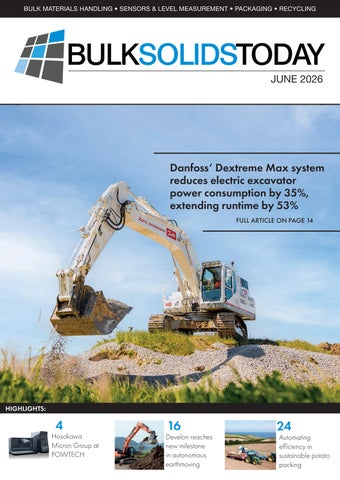
Danfoss’ Dextreme Max system reduces electric excavator power consumption by 35%, extending runtime by 53% FULL ARTICLE ON PAGE 14
HIGHLIGHTS:
4
Hosokawa Micron Group at POWTECH
16
Develon reaches new milestone in autonomous earthmoving
24
Automating efficiency in sustainable potato packing
SOLUTIONS that Power Success TM
BULKBUSTER BULK BAG UNLOADER
CONVEYING LINE
SWITCH RECEIVER
STORAGE SILO
BULK BAG
MODU-KLEEN® BIN VENT FILTER
STORAGE SILO
VIBRA-JET ® BIN DISCHARGE SYSTEM WEIGH HOPPER
BLENDCON® SILO BLENDER STORAGE SILO
DYNA-SLIDE TM HIGH PRECISION AIR-ACTIVATED FEEDER
BAGBUSTER ® BAG BREAKER
BELLA® FLUIDIZED ZONE MIXER AUTOMATIC 15 DEGREE SWITCH
Who We Are
We are a leading provider of custom solutions for the handling of bulk materials for processing businesses across various industries. Dynamic Air has over five decades of expertise in designing and manufacturing pneumatic conveying systems and equipment for handling dry bulk solids.
HDP 4000 FULL LINE CONCEPT ® DENSE PHASE CONVEYING SYSTEM
Our Approach
We never take a cookie-cutter approach just to cut costs up front; we know that the right solution will save you money in the many years to come. Our tailored solutions involve thoughtful planning, meticulous engineering and precise manufacturing that optimize efficiency and productivity.
Dynamic Difference
At Dynamic Air, we set the standard for excellence in bulk solids handling. With a relentless focus on quality, reliability, and customer satisfaction, we deliver reliable, high-quality pneumatic conveying systems, equipment, and custom solutions that exceed expectations.
www.dynamicair.com
Issue 179
BST TEAM Sales Director: James Scrivens Production: Sarah Daviner Accounts Manager: Avery Hudson Office Manager: Katie Brehm BULK SOLIDS TODAY is published 6 times a year by Abbey Publishing Ltd ADVERTISING & EDITORIAL
Please contact us at: Email: editorial@bulksolidstoday.co.uk advertising@bulksolidstoday.co.uk Web: www.bulksolidstoday.co.uk X: www.x.com/BulkSolidsToday
CIRCULATION
To receive a copy free of charge, please send your details to subs@bulksolidstoday.co.uk
No part of this publication may be reproduced by any means without prior permission from the publishers. The publishers do not accept any responsibility for, or necessarily agree with, any views expressed in articles, letters or supplied advertisements.
CONTENTS 4
NEWS
12
BULK MATERIALS HANDLING
18
CONTROLS, SENSORS & LEVEL MEASUREMENT
22
PACKAGING
26
RECYCLING & WASTE MANAGEMENT
30 BUYERS GUIDE
ISSN: 1365/7119 All contents © Abbey Publishing Ltd 2026
www.bulksolidstoday.co.uk Bulk Solids Today
3
COMPANY NEWS
HOSOKAWA MICRON GROUP AT POWTECH 2026:
TURNKEY SOLUTIONS FOR POWDER AND BULK MATERIAL PROCESSING The Hosokawa Micron Group will be presenting its 360-degree service portfolio for powder and bulk material processing at Powtech TechnoPharm 2026, taking place from 29 September to 1 October at the Nuremberg Exhibition Centre, Hall 7a, Stand 530. Headquartered in Osaka, Japan, the Group brings together several engineering companies specialising in the processing of powders and bulk materials. Customers thus benefit from the provider’s high level of turnkey expertise in complete systems. Whether in the food, chemical, pharmaceutical, recycling, minerals or metals sectors – the Group offers complete turnkey systems for a wide range of industries. MACHINERY ON DISPLAY FOR VARIOUS APPLICATIONS At Powtech, visitors to the stand will be able to see the group’s expertise for themselves through a range of machinery solutions. On display will be the Picoline laboratory mill, which Hosokawa has developed for scale-up from the laboratory to production, enhanced with containment solutions to protect process personnel from toxic products. Also on display is a mini model of the MS-75 compactor, which can be used, amongst other things,
in the chemical industry for lignin and fertiliser production; in the minerals and metallurgical industries for briquetting and compacting sponge iron, coal, metal dust, limestone or talc; and in the food industry for compacting protein concentrate. The Vitomix batch mixer rounds off the range of machinery solutions on display. The low- and midshear ribbon screw mixer has a throughput up to eight times higher than conventional screw mixers due to its extremely short cycle times. SOLUTIONS FOR THE PROCESSING OF RUBBER, FIBRES, CERAMICS, GLASS AND RECOVERED CARBON BLACK In addition to the machines on display, visitors can also find out about efficient solutions for rubber grinding and fibre processing, bespoke processes for the ultrafine grinding and classification of ceramics and glass, and processing systems for recovered carbon black. The Hosokawa Micron Group’s trade fair presence is rounded off by a series of webinars in the run-up to the event, covering the topics of compaction, powder and bulk material handling, and laboratory solutions.
At POWTECH 2026, the Hosokawa Micron Group will present its comprehensive 360-degree range of solutions for the processing of powders and bulk materials.
4
Bulk Solids Today
Exhibit at POWTECH 2026: the Picoline laboratory mill from Hosokawa Alpine. The flexible platform, in combination with various process modules, enables rapid and tailored process development.
CONCENTRATED EXPERTISE FROM FOUR COMPANIES The exhibition presence highlights the diverse expertise of the Hosokawa Micron Group. The Group’s international experts work hand in hand on their projects. All process steps are integrated and supplied from a single source. This ensures smooth process flows with a high level of efficiency. “With our turnkey solutions, our customers receive perfectly coordinated technologies, a single point of contact from planning through to service, and maximum process reliability. This saves them time, reduces interface risks and enables them to benefit from the highest levels of efficiency, quality and future-proofing,” says Markus Eggenmüller, Vice President Sales Powder & Particle Processing at Hosokawa Alpine. With their in-depth understanding of processes and state-of-theart technologies, the companies develop systems that combine the highest product quality, energy efficiency and operational reliability, and support customers from laboratory-scale plants right through to large-scale industrial plants – from planning through to commissioning and beyond. www.hosokawa-alpine.com
POWDER METERING MADE SIMPLE
Reliable screw feeding for powders, granules & pellets every time The NEW Trantec True-flow screw feeder range offers simpler, proven, and cost-effective solutions for accurate material handling. No unnecessary bells and whistles, just reliable, proven technology designed to deliver consistent performance you can trust.
ACCURATE & CONSISTENT FEEDING Precise material flow for reliable, uniform dosing.
VERSATILE MATERIAL HANDLING Handles powders, pellets, granules, and challenging materials with minimal blockages and bridging.
COST-EFFECTIVE SOLUTION Reliable performance with low maintenance and reduced downtime. OPTION AVAILABLE
HYGIENIC VERSIONS
Celebrating 30 years of engineering excellence
www.trantec.net
Take advantage of our
FREE
MATERIAL TESTING
To optimise your process
01282 777 566
Tool-less dismantling, crevice-free design
Scan me
sales@trantec.net
EC / FDA Food compliant
COMPANY NEWS
GKD AT FILTECH COLOGNE 2026: MESH, COMPONENTS, AND PROCESS RELIABILITY FROM ONE SINGLE SOURCE Gebr. Kufferath AG will be presenting technical metal mesh, filter media, process belts, and furtherprocessed mesh components for reliable processes in demanding industrial applications at FILTECH Cologne 2026. With Mesh-in-Mesh, GKD is offering an exclusive preview of a new mesh technology ahead of its official product announcement. GKD can be found in Hall 8, Stand B19, from 30 June to 2 July 2026. KEY FACTS AT A GLANCE: The focus is on applications where process reliability, reproducible quality, and secure integration into existing systems are crucial. • Mesh-in-Mesh combines coarse and fine mesh structures for greater energy efficiency in electrolysis. • A video production insight into the Automotive Room concept shows the manufacturing of technical metal mesh components under nearseries industrial conditions. • In the Process Belts segment, the focus is on VACUBELT for horizontal vacuum belt filters. EXCLUSIVE INSIGHT: WEAVING TECHNOLOGY HOLDS THE PROMISE OF HIGHER EFFICIENCY With Mesh-in-Mesh, GKD is providing an early preview of a new mesh technology at FILTECH Cologne 2026, ahead of the official product announcement. This approach was developed on the basis of many years of experience in water electrolysis. GKD has translated specific customer requirements into a new mesh structure that aligns material, geometry, permeability, surface, and further processing. Initial scientific tests show that Mesh-in-Mesh is capable of increasing the energy efficiency of industrial electrolyzers. 6
Bulk Solids Today
SERIES QUALITY FOR PROCESS-RELIABLE MESH COMPONENTS In addition to solutions for specific applications, GKD will present its expertise as a provider that develops technical mesh into series-produced components for demanding industrial applications at its trade fair booth. As an example, a video at the booth provides an insight into the Automotive Rooms in GKD’s production facilities worldwide, where GKD develops customer requirements into prototypes and produces them in series quality. The Automotive Rooms demonstrate how defined mesh properties and stable geometries are combined with reliable further-processing methods on the basis of many years of experience in industries and applications — ultimately resulting in automated manufacturing processes with reproducible, very high quality. PROCESS EXPERTISE ACROSS NUMEROUS APPLICATIONS One of the many components manufactured in the Automotive Rooms is the spark arrestor, which serves as a flame arrester in battery modules. In addition to mesh selection, process expertise in sealing, joining, component geometry, differential pressure, and verification is incorporated into series production. In many other industries as well — including chemicals, medical technology, aerospace, and technical protection applications — GKD combines its market experience with individual customer requirements to create seriesready production processes. “For many customers, the mesh alone is not the decisive factor, but
rather the question of how it can be turned into a reliably manufacturable component,” says Markus Knefel, Product Developer at GKD. “It is precisely at this interface between mesh, component design, and manufacturing process that our expertise and experience pay off.” VACUBELT FOR HORIZONTAL VACUUM BELT FILTERS With the VACUBELT belt model, GKD will also demonstrate the role of filter belts in continuous filtration and dewatering. The focus is specifically on horizontal vacuum belt filters, where the belt has a significant influence on process stability, dewatering performance, and filtrate clarity. Typical applications range from the dewatering of phosphogypsum and FGD gypsum to potash, salt, and soda, as well as the dewatering of concentrates from processing operations for various ores. VACUBELT filter belts are designed exclusively to match the application and the properties of the suspension. “With our VACUBELT filter belts, the application determines the choice of mesh and the correct belt design,” says Philipp Wolff, Sales and Applications Manager at GKD. “Our task is to translate the requirements of diverse dewatering processes into robust, efficient, and high-performance belt solutions.” gkd-group.com
Challenges with noise and dust? For us it’s no problem.
From large stones to the smallest grains: Bulk solids come in all types, shapes and sizes, but choosing the right measurement technology is surprisingly easy. With our level and pressure sensors, you can effortlessly keep an eye on all your important process values – and still have time to crack the really hard rocks. Everything is possible. With VEGA.
vega.com
COMPANY NEWS
UK DEBUTS FOR BOBCAT R-SERIES AND T650 LOADERS AT HILLHEAD PART OF A WIDE-RANGING DISPLAY OF NEW BOBCAT EQUIPMENT With their prominent positions on the Bobcat stand, the new enhanced S76-2 R-Series skid-steer and T650 compact track loaders made their grand entrance on the UK market at the Hillhead 2026 Exhibition from 23-25 June 2026. Held biennially, Hillhead is the biggest construction equipment show in the UK this year and featured an impressive lineup of 627 exhibitors, the largest ever in its history. The new S76-2 and T650 loaders were part of the static display on the Bobcat stand and E16 and E19 models from the new R2-Series 1-2 tonne mini excavator range were performing continuously in the demonstration area of the stand. The new generation R2-Series was also making its first appearance at Hillhead alongside some of the latest models in the Bobcat telehandler, mini excavator, loader, light compaction and attachment ranges. ELEVATED OPERATOR EXPERIENCE AND GREATER AGILITY The next generation R-Series skid-steer and compact track loaders introduce significant enhancements in operator experience, performance and reliability. The new R-Series is the next evolution of the Bobcat compact loader range, delivering more choice; more control and more operator-ready technology across the industry’s most expansive compact loader portfolio. The next evolution R-Series models include: Skid-Steer Loaders: S66-2, S76-2, S86-2 Compact Track Loaders: T66-2, T76-2, T86-2 THE NEW T650 ENHANCES BOBCAT LEADERSHIP OF THE UK LOADER MARKET The new T650 Stage V compact track loader expands the Bobcat portfolio of loaders and has been engineered for highly regulated markets across Europe including the UK and other Stage V regions. Built at the Bobcat plant in the Czech Republic, the T650 combines the proven performance of this 600-frame M-Series loader with full Stage V emissions compliance – without the need for AdBlue. Powered by a reliable 2.4-litre Bobcat engine delivering 55 kW (74 HP), the machine offers strong, efficient performance for demanding applications. Despite its compact footprint, the new T650 delivers impressive work capacity with a vertical lift path and 1192 kg rated operating capacity, 8
Bulk Solids Today
making it ideal for truck loading, pallet handling and earthmoving in confined or sensitive job sites. Katinka Kincses, Bobcat Product Manager for loaders, commented: “The compact track loader sector is very important in the UK with the high demand for road maintenance and repair, utilities and infrastructure construction or the laying of fibre optic networks. Bobcat is very well positioned thanks to its range of models, including the new R2-Series range and the new enhanced version of the T650.” NEW SMARTFLOW HYDRAULIC SYSTEM FOR MAXIMUM PRODUCTIVITY The groundbreaking R2-Series 1-2 tonne mini excavators comprise the E16, E17z, E19 and E20z models. They offer a fresh look, signifying new levels of performance and features, including a high-
COMPANY NEWS performance SmartFlow load-sensing hydraulic system with a closed-centre, flow-sharing pump powered by an upgraded engine, providing a sophisticated engineering set up that is unique in smaller machines like these. This combination essentially provides the power on demand seen in larger excavators. The E17z is a Zero Housing Swing (ZHS) mini excavator which, with an operating weight of 1712 kg, is optimized for transport/operation in confined areas in historic towns and urban environments. The new E19 is a conventional model and has an operating weight of 1905 kg. It is an ideal machine for customers looking for maximum performance in a compact machine. E88 MINI EXCAVATOR WITH NEW LT120 TRENCHER Other mini excavators on the stand included the popular E27z, E50z and E88 conventional models. The E88 was equipped with the LT120 trencher attachment, part of new ranges of auger and trencher attachments from Bobcat, compatible with a wide selection of the company’s mini excavator, loader and telehandler models. The stand also featured the E19e electric mini excavator, offering zero emissions, low-noise operation and comparable levels of performance to its diesel-powered counterpart. The 1.9 t E19e model features a 3.5-hour battery capacity and can be recharged quickly using a super-fast charger. BOBCAT TELEHANDLERS Complementing the company’s successful construction and agricultural products represented on the stand by the smallest TL25.60 model, Bobcat also showed the TL43.80HF from the Bobcat Waste Expert range of telehandlers providing a dedicated material handling solution for the waste and recycling markets. LIGHT COMPACTION No construction site is complete without a soil and asphalt compactor. To meet this demand, Bobcat showed the company‘s Light Compaction Product Line at Hillhead. Altogether, the Bobcat light compaction range comprises seven different product families and offers 37 models, from vibratory rammers weighing 29 kg up to 2.6 tonne tandem rollers. On the Bobcat stand, visitors could see the R68 vibratory rammer and an HP65.85 hydrostatic plate. ABOUT BOBCAT Since 1958, Bobcat has been empowering people to accomplish more. As a leading global manufacturer of compact equipment, Bobcat has built a proud legacy of innovation and a reputation for delivering smart solutions to customers’ toughest challenges. Backed by the support of a worldwide network of independent dealers and distributors, Bobcat now offers extensive line-ups of compact machinery (including loaders, excavators, telehandlers, compact tractors and mowers) and material handling equipment (including forklifts and warehouse solutions), plus a broad range of attachments, parts and services. The Bobcat brand is owned by Doosan Bobcat.
ABOUT DOOSAN BOBCAT Doosan Bobcat is a company within the Doosan Group. Doosan Group is a top-tier global enterprise that has proudly served customers and communities for more than a century. Doosan Bobcat is based in Bundang, South Korea. To learn more about Bobcat’s products, attachments and services, visit www.bobcat.com
Other Valves Fight Friction, We Designed it Out Unlike other valves that seal with friction, Posi-flate’s unique butterfly valve uses an inflatable seat to seal with air pressure. Thus it requires less torque and a smaller actuator, resulting in lower cost. Plus, the seat automatically compensates for wear, providing longer life. Some users have reported over six million cycles and the valves are still going strong. • • • • • •
Less friction Low torque Low maintenance Lower actuator costs Longer valve life More reliable Tel: +44 (0) 1908 622366
www.posiflate.com
Bulk Solids Today
9
COMPANY NEWS
PLAST 2026: AN EDITION BEYOND EXPECTATIONS The twentieth edition of PLAST, the international exhibition dedicated to the plastics and rubber industry, successfully ended on June 12th at Fiera Milano, Rho. Four intense days of exhibition confirmed the event’s role as a benchmark for the sector, decisively overcoming the cautious outlook of the eve in a global geopolitical and macroeconomic context marked by severe uncertainties, trade tensions, and instability in international markets. The final figures certify the success of the event: 35,000 attendees – with a significant share of foreign visitors equal to 25%, coming from 110 countries – and over 1,000 exhibiting companies, 44% of which were international. The entire event spanned an exhibition area of 40,000 square meters: an impactful result for a market undergoing a phase of profound transformation. A COMPLETE SUPPLY CHAIN: FROM SPECIALIZED HALLS TO STARTUP INNOVATION The strength of PLAST 2026 certainly lay in its ability to capture a snapshot of the entire supply chain. Great interest was generated by the satellite shows and thematic areas: RUBBER, the meeting point for the elastomer industry, organized in collaboration with Assogomma; 3D PLAST LAB, developed with Indexlab – Politecnico di Milano, focusing on the frontiers of additive manufacturing; and PLAST MAT, the showcase dedicated to polymeric materials. A fundamental added value in terms of new content was brought by the innovation ecosystem, thanks to the presence of around twenty Italian startups that presented cutting-edge solutions ready to be integrated into the manufacturing fabric to visitors. A QUALIFIED AUDIENCE AND INTERNATIONALIZATION Among the most encouraging signs, the extremely high professional profile of the visitors stands out. Thanks to the enhancement of the 10
Bulk Solids Today
strategic incoming project developed in collaboration with ICE Agency, among the approximately 9,000 international operators visiting, the presence of over 350 selected foreign delegates must be highlighted, who confirmed the strong attractiveness and commercial centrality of the fair. Drawing the balance of this edition is Mario Maggiani, Managing Director of Promaplast: “We do not hide that our forecasts on the eve were marked by the utmost prudence. We feared far heavier repercussions of the global geopolitical situation on PLAST, which instead confirmed itself as a European point of reference for the plastics and rubber industry, restoring confidence to many of the exhibitors we met. The reality is that today the exhibition world, more than other sectors, is suffering the backlash of a diversification in ways of doing business, especially in the B2B field; this is why we are diversifying the format of PLAST, not only through the addition of satellite shows but also by providing a conference program capable of covering all facets of the supply chain and responding to the updating needs of a rapidly evolving sector.” He is echoed by Alessio Fineo, Head of the Exhibition Department at Promaplast: “From the opinions gathered at the fair, many have noted the quality of the visitors and the delegations of foreign companies that showed interest in the products on display. The efforts of the entire team to promote PLAST generated results that went beyond expectations.”
A TOP-TIER PROGRAM OF CONFERENCES AND SEMINARS Confirming the dynamism of the event was the success of the program of seminars and institutional conferences, which in some cases registered a full house. The rich educational and debate palimpsest was made possible thanks to the fundamental synergy with the main stakeholders and industrial partners of the sector. Meetings saw the close collaboration of leading trade associations and research entities – including Corepla, IPPR Plastica Seconda Vita, PlasticsEurope Italia-Federchimica, Unionplast, The European House Ambrosetti, TMP, Assorimap, Assogomma, Ipack-Ima, Largo Consumo, PVC Forum/VinylPlus Italia, and Made Competence Center I4.0 – who chaired the discussion tables, offering concrete answers to the regulatory and technological challenges of the future. https://plastonline.org/en/
COMPANY NEWS
PARKER INTRODUCES THE GLFTROLLEY, ENGINEERED TO REMOVE FREE WATER AND CONTAMINANTS FROM HYDRAULIC FLUID Using Parker’s portable trolley is one of the most economical ways to protect against system damage caused by contamination. Parker Hannifin, a global leader in motion and control technologies, today announces the launch of its new portable GLFTrolley, engineered to remove free water and contaminants from hydraulic fluids used in gas, marine, mining, forestry, and in-plant applications. Effective filtration of hydraulic fluids prior to use is critical, as fluids can contain high levels of contaminants that, if not properly removed, may significantly reduce system performance and cause damage to critical components. Developed as a versatile solution for a broad range of offline filtration applications, the compact, robust GLFTrolley supports preventive maintenance programs by purifying existing hydraulic and lubrication oil systems, as well as during oil transfer operations. The GLFTrolley incorporates high-quality components, making it suitable for rapid purification of small and medium-sized systems and for permanent offline filtration on larger hydraulic systems. The GLFTrolley range offers nominal flow rates of 20 l/min (5.2 US gpm) and 40 l/min (10.6 US gpm), enabled by high-quality gear pumps and an energy-efficient, high-performance single-phase motor suitable for continuous duty. Designed for maximum flexibility, the units can be deployed as either mobile or stationary offline filtration solution Sanna Tefke, Product Manager, Hydraulic & Industrial Process Filtration Division, Parker Hannifin, says, “Machines operate in a range of environments such as mining, marine and forestry where dirt, dust, water and various particles are unavoidable. Using a Parker portable GLFTrolley is an economical way to protect your hydraulic system from harm that can be caused by contamination.” The portable GLFTrolley provides additional system cleanliness and helps to keep engines running by extending component life and reducing unplanned downtime. The user friendly, compact design makes it easy to transport the machine directly to the field to shorten the service time. Investing in a GLFTrolley portable filtration system is a proactive step to ensure efficiency and lifetime of
your hydraulic equipment, maintaining oil quality and reducing unplanned downtime, component wear Parker’s and operating costs. GLFTrolley For more information about the GLFTrolley, please visit: https://ph.parker.com/gb/en/ product-list/portable-filtration-unit-glftrolley
Tuf-Lok ring grip pipe and tube couplings are rugged, heavy duty, self-aligning and self-grounded couplings with a high end pull. They can be used for almost any application where pipe or tube ends need to be connected. The Tuf-Lok self-aligning couplings install quickly and easily with little effort. Features • Self-aligning • Self-grounding • High pressure rated • Full vacuum rated • Stainless or mild steel • Usable on thin or thick wall pipe or tube • Low cost • Reusable • Absorbs vibration • Externally leakproof
Tuf-Lok (UK) Tel: +44 (0) 1706 822512 Email: sales@tuflok.co.uk • www.tuflok.com
Bulk Solids Today
11
BULK MATERIALS HANDLING
IMPROVING SCREW FEEDER PERFORMANCE WITH FINE LOAM DUST Fine particulate materials do not always behave as expected once introduced into a dosing or screw feeding system. Following a customer enquiry involving the handling of fine loam dust, Trantec Solids Handling carried out material testing to optimise screw feeder performance for the application. Although the material initially appeared relatively free-flowing, testing identified compaction and binding within the feeder during operation under continuous feeding and agitation. Testing quickly highlighted build-up around the outlet tube and feed section, where the fine particulate content began binding to internal surfaces under compacted feeding conditions. This increased resistance within the feed area, generating grinding behaviour and high-pitched operational noise as compacted material passed through the system. As material accumulation increased, screw loading became inconsistent, affecting feed stability and overall dosing performance. The testing process proved critical in identifying how the material behaved under continuous compression,
12
Bulk Solids Today
shear, and agitation within the feeder. While the loam dust remained relatively free-flowing in bulk form, conditions inside the feeder introduced localised compaction and surface adhesion that would not necessarily have been identified outside of operational testing. To address the issue, several targeted refinements were implemented to improve material flow and feeding consistency within the system. IMPROVING FLOW THROUGH AUGER AND SURFACE REFINEMENT The screw auger was reworked with a bevelled edge profile and polished to a high surface finish to reduce friction and minimise material retention during transfer. The bevelled geometry improved material movement through the feed path while reducing the likelihood of compacted product forming along the auger flights. In parallel, the internal feed tube was polished to create a smoother conveying surface, lowering the coefficient of friction and reducing fine particle adhesion within the outlet section.
BULK MATERIALS HANDLING These refinements significantly improved product flow through the feeder while reducing material accumulation and resistance within the feed area. PREVENTING BRIDGING AND IMPROVING FEED CONSISTENCY To further improve feeding stability, the feeder incorporated a contra-rotating agitator blade designed to maintain a continuous and even fill of the auger. The agitator helped break material bridges and disrupt compacted powder formations before they entered the screw, reducing the risk of rat-holing and inconsistent screw loading during operation. Combined with the polished surfaces and bevelled auger geometry, the agitation system delivered a more stable and consistent material flow performance throughout the application. THE IMPORTANCE OF MATERIAL TESTING Material testing is considered a key element of successful screw feeder design and long-term material handling performance. Trantec Solids Handling understands that even materials which appear relatively free-flowing in bulk form can behave very differently once subjected to continuous feeding conditions inside a screw feeder system. To support customers during the equipment selection and development process, Trantec Solids Handling
provides material testing free of charge to all customers to help ensure feeder performance is properly matched to the material and application requirements. Fine powders and difficult bulk solids can exhibit flow characteristics that only become apparent during operational testing. Particle size distribution, moisture content, bulk density variation, and compaction behaviour can all significantly influence screw feeder performance once material is exposed to compression, shear, and agitation during operation. In this application, material testing proved critical in identifying localised compaction and surface adhesion within the feeder, allowing auger geometry, surface finish, and agitation systems to be refined to improve long-term feeding stability and consistency. Regular cleaning and preventative maintenance were also recommended to minimise future material build-up and maintain consistent feeder performance over time. CONTACT TRANTEC SOLIDS HANDLING If you are experiencing material-flow challenges with fine powders or difficult-to-handle bulk solids, Trantec Solids Handling can provide tailored feeder solutions designed to your specific application requirements. To discuss your material handling project or learn more about Trantec feeder ranges, visit www.trantec.net or contact the team directly at sales@trantec.net
Bulk Solids Today
13
BULK MATERIALS HANDLING
DANFOSS’ DEXTREME MAX SYSTEM REDUCES ELECTRIC EXCAVATOR POWER CONSUMPTION BY 35%, EXTENDING RUNTIME BY 53% Project funded with a grant from UK Government’s Red Diesel Replacement Phase 2 Competition Danfoss Scotland, part of global hydraulics and electric powertrain systems supplier Danfoss Power Solutions, has announced the results of its Dextreme Max system validation in a 30-tonne batteryelectric excavator. Undertaken with a £4.29 million grant from the UK Government, Danfoss demonstrated that its Dextreme digital hydraulic architecture reduced excavator power consumption by 35% across a representative duty cycle mix, corresponding to 53% longer runtime on a single charge. The results confirm the potential of the Dextreme Max system to significantly increase energy efficiency and accelerate the electrification of large excavators. Danfoss’ Dextreme Max system aims to cut excavator energy consumption by up to 50% by reducing energy losses and recovering energy that would otherwise be wasted. The system’s integral component is the DDP1X0D, a Digital Displacement® hydraulic pump/motor with multiple independently controlled outlets. The Dextreme Max system provides independent actuator supply, eliminates flow-sharing losses, and enables energy recovery from excavator motions such as boom lowering. In 2023, Danfoss received a grant from the Red Diesel Replacement Phase 2 Competition, a program funded through the Department for Energy Security & Net Zero’s £1 billion Net Zero Innovation Portfolio, to develop and validate the Dextreme Max system. The program provided funding for projects developing lowcarbon alternatives to red diesel for the construction, mining, and quarrying sectors. Danfoss used the funding to procure a battery-electric excavator and integrate its Dextreme Max system into the machine. The grant represented approximately 65% of the eligible project costs, with Danfoss funding the remaining portion. Danfoss selected a Develon DX300LC‑7 crawler excavator for the project. Originally diesel powered, the excavator was supplied in an electric configuration by Staad B.V., which replaced the engine with an electric drivetrain consisting of a 14
Bulk Solids Today
Danfoss Editron EM-PMI375 permanent magnet synchronous motor, EC-C1200 inverter, and MC050 motor controller, plus three 140-kWh batteries. Danfoss engineers replaced the excavator’s conventional swashplate hydraulic pump with the DDP180D pump/motor. The excavator’s four primary services — boom, arm, bucket, and swing — are supplied through ten individually controllable outlets on the pump. These outlets are dynamically grouped through a ganging block, a digital distributor that reallocates capacity to the service requiring it. A dedicated valve operating as a hydraulic H-bridge was developed and applied to the boom function to allow independent metering, providing anti-cavitation, pressure amplification, and energy recovery during overrunning motions. Finally, the control system architecture was developed to provide real-time control of the hydraulic system, electric powertrain, and auxiliary subsystems.
BULK MATERIALS HANDLING
To compare system performance before and after conversion, multiple tests were carried out, including JCMAS air grading and JCMAS air dig and dump (equivalent to ISO/AWI TS 11152-2). Compared to the baseline electric excavator, the Dextreme Max system reduced battery energy use by 49.2% in air grading and 31% in air dig and dump, with negligible impact on cycle time. Assuming a duty cycle of 30% grading and 70% digging, Dextreme Max would reduce battery power consumption by 35% without significantly impacting work rate. This would result in 53% longer operating hours with the same battery capacity as the baseline machine, or similar runtime as the baseline with two battery packs instead of three. “The results of this testing highlight the potential of digital hydraulic architectures to overcome the obstacles in heavy-duty machinery electrification. Electric excavators offer excellent responsiveness, smooth control, a quiet cab environment, and zeroemission operation. With Dextreme Max, they can also deliver the runtime, productivity, and total cost of ownership advantages required for wider adoption, thereby accelerating the decarbonization of heavy-duty machinery,” said Alasdair Robertson, Senior Director, Digital Displacement, Danfoss Power Solutions. “We are extremely encouraged by these results, but there is more work to do. Further gains are possible, and we will continue optimizing the system to maximize the energy savings and value for our customers.” Danfoss Dextreme systems offer an incremental approach to implementation through three levels: Swap, Flex, and Max. Dextreme Swap involves a simple pump replacement, offering improved system control and more efficient operation. Dextreme Flex introduces flexible allocation of the Digital Displacement pump outlets, reducing flow distribution losses and further improving efficiency. The Dextreme Swap and Flex systems are commercially available, and this project has advanced the path to commercialization for Dextreme Max. To learn more, visit https://www.danfoss.com/en/products/ dps/pumps/mobile-pumps/mobile-piston-pumps/ digital-displacement-pumps/dextreme-systems
Bulk Solids Today is the bimonthly digital journal covering the storage, processing and handling of materials ranging from fine powders to the heaviest raw materials. To subscribe to Bulk Solids Today magazine or for more information, please feel free to visit www.bulksolidstoday.co.uk
High Efficiency Drying or Cooling of Bulk Solids The Bella dryer/cooler offers thermal efficiencies to 80 percent or better because air flows around material while it is suspended in the weightless zone. The result is a more consistent material.
Dynamic Air Ltd. • +44 (0)1908 622344
www.dynamicair.com Bulk Solids Today
15
BULK MATERIALS HANDLING
DEVELON REACHES NEW MILESTONE IN AUTONOMOUS EARTHMOVING ‘REAL-X’ EXCAVATOR BRINGS THE CONSTRUCTION SITE OF THE FUTURE TO LIFE History has been made in Tuggen, in the canton of Schwyz in Switzerland. KIBAG, one of Switzerland’s leading companies in the building materials and construction sector, has become the first company in the world to put an autonomous Develon ‘Real-X’ crawler excavator – a joint development with Gravis Robotics – into practical use. It may have been surprising to onlookers to see executives from leading companies in Switzerland, France, Germany and South Korea travelling to Tuggen for the handover of a crawler excavator and to watch it digging. However, a closer look would have revealed that there was no operator in the cab and that the machine was not being operated by remote control.
16
Bulk Solids Today
Urs Helbling, CEO of AG für Baumaschinen Schmerikon (AGFBS), the Develon dealer in Switzerland, explained that this moment had been preceded by two years of preparatory work. The key players here are the AI-powered Real-X system on a Develon DX225LC-7X excavator and a company that is open to the use of new technologies. “Today is a special day for all of us. This is no ordinary machine handover, but a step into the future of construction,” says Christoph Duijts, CEO of KIBAG. OPEN TO NEW TECHNOLOGY Founded in 1926, KIBAG is a family-run business, which employs more than 2000 people and operates primarily in three business areas: building materials, construction services and the environment and waste management. It operates 14 gravel pits, three quarries, 25 concrete plants and 17 construction companies specialising in road construction, civil engineering and specialist sectors. In addition, there are recycling and waste management companies as well as service providers in the leisure sector that form part of the business. KIBAG CPO, Urs Kordeuter, explains that the company’s fleet comprises 2000 construction machines of all sizes. To ensure the fleet remains at the cutting edge
BULK MATERIALS HANDLING of technology, 200 of these are replaced annually. In the interests of sustainability, the company is currently investing particularly in electric-powered equipment and is collaborating with various construction machinery manufacturers – though not with Develon until now. The reason this has now changed is that Develon is further ahead than other manufacturers in the field of autonomous machinery, according to Urs Kordeuter. As a pioneer in autonomous machine technology, Develon, formerly known as Doosan Construction Equipment, unveiled its Concept-X system in 2019 and used this to showcase the unmanned construction site, where safety and efficiency are enhanced through the use of 5G networks, drone surveying and autonomous machine control. The aim – as with the Concept-X2 extension unveiled in 2023 – was to achieve full autonomy by 2030. At bauma 2025, Develon took the next step with Real-X, creating a new intelligent crawler excavator capable of autonomously carrying out trench excavation, earthworks and truck loading. Real-X is the result of an agreement between HD XiteSolution (HDX), the holding company of Develon, and Gravis Robotics AG. Founded in October 2022, Gravis Robotics is a spin-off from the Swiss Federal Institute of Technology Zurich (ETH). The company’s core expertise lies in developing learning-based control systems as retrofit kits and software that transform machines into fully autonomous robots capable of performing complex tasks. Dominic Jud, CTO and co-founder of Gravis Robotics, explained that the company has gained experience through the use of autonomous machines in pipeline construction. “We were able to build on that, yet every project presents new challenges – be it the depth of the trench or the ground conditions,” said Dominic Jud. Just how mature this technology has become was recently demonstrated for 900 dealers, customers and trade journalists at the Develon Demo Days in the Czech Republic in April. Many were fascinated by the precision offered by this autonomous excavator solution. EXCELLENT RESULTS The new machine in Switzerland is being used on the site of a former KIBAG quarry, which is now being restored to its natural state. The backfilling has already been completed, terraces have been created, and a road is also planned for the site in the future. Whilst the operation of autonomous construction machinery in public spaces is not yet clearly regulated, the machine can be operated autonomously on KIBAG’s private land, supervised by a technical supervisor. Site Manager, Gabriel Hasler, has tasked the new Develon DX225LC-7X excavator with digging a trench 300 metres long, six metres wide and three metres deep. This is to be filled mainly with rocky material to prevent the foot of the hill from slipping. “We are replacing poor-quality material with significantly better material,” explained Gabriel Hasler. “The machine is doing an exceptional job,” he said, much to the delight of Panyoung Kim and Gye-Bong Jang, Senior Vice President and Head of Robotics AI at HD XiteSolution, respectively, who watched the operation with pride. All parties involved
particularly emphasise how smooth and trusting the collaboration has been at every stage of the project. “The idea for this project was conceived in 2024 based on a prototype from Develon,” Urs Helbling, CEO of AGFBS, added. “We then made the necessary contacts at bauma 2025, and in the summer of 2025, KIBAG decided to use the DX225LC-7X in this configuration,” he continued. It is precisely the shortage of skilled workers that makes a machine promising a 30% improvement in performance for trench excavation, earthworks and truck loading, along with a profitability of 100% or more, an attractive investment. Not to be overlooked here is the Gravis rack, which is so simply designed that site teams can quickly learn how to operate it. “We will continue to enhance safety and efficiency on construction sites with our innovations,” said Gilles Bendaoud, Vice President Key Accounts/Remarketing Europe at Develon, noting that, in addition to Real-X, the company has also developed E-Stop and the transparent wheel loader bucket to increase site safety. “Even though there are still a few legal hurdles to overcome, we have taken another significant step towards the vision of the autonomous construction site today,” said Martin Gering, Key Account Manager GSA & EE at Develon, at the conclusion of the event marking the symbolic handover of the DX225LC-7X to KIBAG. For more on Develon, please visit the website: https://eu.develon-ce.com/en/ Bulk Solids Today
17
CONTROLS, SENSORS & LEVEL MEASUREMENT
MARTIN ENGINEERING LAUNCHES WORLD FIRST N2® AIR CANNON INTELLIGENCE SYSTEM The global leader in bulk material handling solutions, Martin Engineering, has launched a transformative digital system that unlocks opportunities to maximise the efficiency, reliability and performance of industrial air cannons. The N2® Air Cannon Intelligence (ACI) System gives operators of cement plants and other large-scale, high-temperature facilities unprecedented insight into how their air cannons are performing – enabling entire installations to be optimised like never before. Part of Martin’s N2® Enhanced remote monitoring portfolio, ACI represents the biggest technological Martin’s N2® ACI sensor measures air cannon firing characteristics. Image © 2026 Martin Engineering
18
Bulk Solids Today
advancement since air cannons were first introduced by Martin Engineering over half a century ago to improve material flow through raw mills, preheaters, kiln feeds, coolers, silos, chutes and other process vessels. Developed at Martin’s Center for Innovation in Neponset, Illinois, N2® ACI has been refined during two years of real-world trials with leading cement producers in the USA as well as Brazil, France, Turkey and the UK. These test installations The N2® ACI system is easily retrofitted to Martin® air have helped Martin’s cannons (Hurricane, Typhoon, Tornado, XHV, and Passport R&D team to fine-tune valve cannons). Image © 2026 Martin Engineering the platform’s monitoring algorithms, ensuring continuous monitoring and detailed useability and demonstrable performance analytics through a operational benefits in the most secure web-based dashboard and demanding industrial settings. mobile interface. Fitted to each air In major bulk processing cannon on a plant, the ACI sensor plants, arrays of air cannons measures firing characteristics provide carefully sequenced blasts from which underlying problems of compressed air to dislodge can be diagnosed. That means material clinging to the inner walls maintenance issues can be fixed of process vessels – especially before they result in unscheduled important for fine, sticky, moisturedowntime and, crucially, air rich feedstocks and fuels. Industrial cannon arrays can be modified operations like cement plants can for optimum performance. have well over a hundred cannons Brad Pronschinske, Global throughout the process. But the Air Cannon Product Manager for enclosed nature of such vessels Martin Engineering said: means that in the past it has been “Air cannons have been around for virtually impossible to know if more than 50 years, but until now air cannons are performing as there has been no reliable way expected to keep the inner walls for plant operators to understand clear of buildups – unless each how effectively they are actually is inspected manually during performing as a sequence. a full plant shutdown. “With ACI we’re not just trying Now, with N2® ACI to tell plant operators whether a operators have access to
CONTROLS, SENSORS & LEVEL MEASUREMENT
Martin’s N2® Air Cannon Intelligence System provides detailed performance data enabling operators to make smart decisions to optimise the flow of materials. Image © 2026 Martin Engineering
cannon fired or not. We’re helping them operate more efficiently by interpreting data from the sensors so they can improve system performance, for example by adjusting firing sequences and improving installation positioning, as well as better manage preventive maintenance. Potential problems can be identified earlier, reducing unnecessary downtime and helping maintenance teams make smart decisions to optimise their systems.” Traditional air cannon inspection methods often require maintenance personnel to manually trigger systems while visually observing pressure gauges. However, partial nozzle blockages and performance degradation can go unnoticed for long periods, resulting in reduced effectiveness, excessive compressed air and energy consumption, and increased risk of production interruptions. Customer trials have also demonstrated important safety benefits. By reducing the need for manual inspections and emergency cleanout procedures, the system helps minimise worker exposure to hazardous environments, confined spaces and high-temperature process areas. Reports from customer evaluations also highlighted
reductions in manual water jetting, fewer emergency interventions and improved understanding of when maintenance is genuinely required. The system operates through wireless battery-powered nodes mounted directly to air cannons, communicating via long-range radio frequency to a single cellular gateway capable of supporting more than 1,000 sensors across a site. Because ACI operates independently of plant wi-fi or control networks, installation can typically be completed without requiring a plant shutdown. Martin says the platform is also designed to support longterm reliability and optimisation strategies by maintaining detailed historical records for every monitored cannon, including service events, firing trends and component performance data. Pronschinske added: “Many customers simply don’t have the time or resources to continuously monitor air cannon performance. ACI gives them actionable information automatically, helping maintenance teams focus attention where it’s actually needed to keep critical material flow systems operating reliably. By turning traditional air cannons into intelligent, connected assets, plants can move from
reactive maintenance to proactive performance management. “ACI also gives maintenance teams early visibility into cannon performance, allowing them to identify inefficiencies, improve firing sequences and address possible problems before they impact production. The technology helps facilities operate more reliably and efficiently, while reducing wasted labour, compressed air consumption and unnecessary wear on critical equipment across demanding bulk material handling applications. Ultimately ACI helps optimise process flow, reduce costly unplanned downtime and improve workplace safety by limiting the need for manual inspections. The N2® ACI System will be introduced throughout the Martin network over the coming months and years, with further installations already underway. Find out more at www.martin-eng.com/ content/product/22097/n2-aircannon-intelligence-system. Visitors to Hillhead 2026, the UK’s largest quarrying, construction and recycling equipment exhibition, were able to meet the team from Martin Engineering and see the N2® ACI System close-up on Stand H10 (Wright Engineering).
Bulk Solids Today
19
CONTROLS, SENSORS & LEVEL MEASUREMENT
LEVEL MEASUREMENT IN HOT STONE BINS: AN APPLICATION GUIDE Hot stone bins are a critical component of any asphalt production plant, serving as the primary storage and separation point for heated aggregate prior to mixing. Consistent asphalt quality depends on every stage of the production process performing reliably, and that includes the level control on your hot stone bins. When level instruments fail or give inaccurate readings, the wrong proportions of aggregate reach the mixer, and the consequences show up in every batch. PURPOSE OF HOT STONE BINS Aggregates, including gravel, sand, and crushed rock, must meet two essential conditions before they can be incorporated into an asphalt mix: • Heated to remove residual moisture and reach the required process temperature. • Sorted by size for precise mixing formulas. The hot stone bin is where this heated, and sorted material is temporarily stored before moving on to the next stage in the process. HOW A HOT STONE BIN WORKS 1. Heating the aggregates – Raw stone from the quarry is dried and heated in a rotating drum, commonly referred to as a dryer. 2. Screening by size – The hot material is elevated and passed over vibrating screens that separate it into distinct size fractions (e.g. fine sand, medium aggregate, coarse stone). This stage is also known as the screen house. 3. Storage in bins – Each size fraction drops into its own compartment within the hot stone bin, where materials are kept both separated and at temperature. 4. Controlled release – During asphalt production, precise quantities of each aggregate size are released from the bins into a weigh hopper. This ensures that every batch of asphalt meets the exact specification required for its intended application. Think of hot stone bins as a bank of heated storage compartments, each holding a different aggregate size fraction and always ready to be mixed in exactly the right proportions for road building and repair. BENEFITS OF A RELIABLE HOT STONE BIN INSTALLATION • Accurate mix control – Stores different aggregate sizes separately to enable precise, repeatable batching. • Consistent quality – Every asphalt batch is produced to the same specification. 20
Bulk Solids Today
• Temperature retention – Aggregates are maintained at the correct temperature for effective bitumen coating. • Efficient operation – The bin acts as a buffer between continuous drying and batch mixing, smoothing out production flow. • Process automation – Works with level instruments for reliable, fully automated control. • Flexibility – Enables rapid changeover between different asphalt mix designs. • Reduced waste and downtime – Minimises off-specification material and unplanned production interruptions. CHALLENGES OF WORKING WITH HOT STONE BINS • Segregation risk – Uneven material distribution can adversely affect mix quality. • Instrument reliability and installation – Level instruments that are incorrectly installed or configured will produce inaccurate readings, undermining process control. • Wear and abrasion – Bins, liners, and gates are exposed to constant high-temperature wear. • Blockages and bridging – Hot aggregate can compact or arch, disrupting material flow. • Heat loss – Inadequate insulation reduces thermal efficiency and can compromise mix quality. • Maintenance access – Internal components can be difficult and hazardous to service safely. • Calibration errors – Incorrect weighing or level readings will result in off-specification asphalt.
VEGACAL 67 Capacitive high temperature probe for level measurement of bulk solids available with threaded and flange options
CONTROLS, SENSORS & LEVEL MEASUREMENT WHY CAPACITANCE PROBES FOR LEVEL CONTROL? Capacitance probes are a widely used and proven technology for level measurement and level detection in hot stone bins. Although radar has been successfully applied in many aggregate storage applications, hot stone bins often present challenges as bin shapes, restricted mounting positions etc, making capacitance measurement an attractive alternative. The VEGACAL 67 capacitance level transmitter excels in these demanding conditions, delivering reliable level measurement with repeatable performance at process temperatures up to 400°C. It is available with both threaded and flanged process connections, offering flexible installation to suit any plant configuration. For maximum convenience and safety, the instrument can be fitted with a head-mounted Bluetooth PLICSCOM display and adjustment module. This enables wireless access for configuration, diagnostics, and monitoring — allowing operators to manage the system efficiently without direct contact with the process. With the VEGACAL 67 and PLICSCOM combination, you get a robust, high-precision solution designed for performance, safety, and operational efficiency. The instrument can be mounted at either the top or bottom of each hot stone bin. Each sensor is
fitted with an isolation tube of a specified length to maintain the required clearance from the external bin wall. A flexible stainless steel cable connects the instrument to an electrode that follows the contour of the bin from top to bottom, forming an integral part of the capacitance probe assembly. The electrode can be fabricated in various forms, such as angle iron or steel rod, depending on the application. It is secured to the bin wall using isolation brackets, typically manufactured from ceramic to provide the necessary durability and high-temperature resistance. A range of isolation bracket types is available, and these can be supplied specifically tailored to the application for optimum performance and longevity. At VEGA they understand that no two hot stone bin applications are identical. Contact them to organise a site visit and let one of their dedicated team of engineers assess your installation and discuss the right solution for your plant. You can get in touch with your local sales engineer here: https://www.vega.com/en-uk/company/ vega-united-kingdom/vega-uk-staff/areasales-engineers or fill in the online contact form: https://www.vega.com/en-uk/contact.
Register now to receive your digital issue of Bulk Solids Today
bulksolidstoday.co.uk/subscribe BST half page.indd 1
01/07/2026 13:30:55 Bulk Solids Today
21
PACKAGING
HAVER & BOECKER CELEBRATES 20 YEARS OF ADAMS® TECHNOLOGY WITH THE ROTO-PACKER® RS Packing facilities in the cement, building materials, food and chemical industries have benefitted from HAVER & BOECKER’s ADAMS® technology for more than two decades. First introduced in 2005, ADAMS® machines use Form-Fill-Seal (FFS) technology and offer significant advantages in product protection, cleanliness and energy consumption with up to 50% less per bag compared to traditional systems. Equipped with ADAMS® technology, the ROTOPACKER® RS is the industry’s first and only rotary packing machine to offer a fully enclosed FFS packing process, resulting in minimized product loss, increased weight accuracy, optimized transport and a highly palletizable final product. “We knew some industries — cement, building materials and pigment packing plants especially — needed a new packing option to keep their product safe and uncontaminated throughout the shipping and storage process. The development of ADAMS technology didn’t just give packing operations a highly efficient machine, it also increased the protection of their product once packing is completed. FFS bags help ensure our customers’ product is protected and uncontaminated throughout the packing and shipping process,” said Mark Wehling, head of sales group minerals at HAVER & BOECKER. “We’re excited to introduce the ROTO-PACKER® RST featuring ADAMS® technology in light of the 20th anniversary of this advanced product.” Many operations ship their products worldwide or go through lengthy logistics processes leading to the risk of product spills or contamination due to improperly sealed bags. The ROTO-PACKER® RS solves these challenges by cutting and welding each bag shut, which results in a fully sealed, weatherproof bag. This process reduces film consumption, further minimizing material use, and leads to the ability to ship bags further and store them longer while minimizing product loss and maximizing profits and customer satisfaction. The fully enclosed, compact ROTO-PACKER® RS rotary packing machine produces between 400 to 1,200 bags per hour (7-20 bags per minute) with up to 22
Bulk Solids Today
The enclosed housing of the packing machine contains dust during the filling process, maintaining cleanliness in powder-packing applications.
10 filling spouts. The compact footprint allows for easier positioning of the machine and less wasted space on the packing line. The enclosed housing of the packing machine maintains cleanliness during the filling process in powder-packing applications. For ease of interior cleaning, the cabin features large openings and doors. Easier accessibility simplifies maintenance and reduces
PACKAGING
wear, resulting in increased weight accuracy and a longer machine life. Specialized dosing units and a vibration plate to provide proper deaeration and compaction create a highly efficient packing process with more product filled into a smaller bag. For fine powder applications, the ROTO-PACKER® comes in the RST version, which is equipped with the T-Module (Turbine), a vertical impellerbased system. This system is optimized with vibrating bottles or vacuum rods to increase efficiency and provide proper deaeration throughout the packing process. The ROTO-PACKER® also comes in the RSL, which is an air filling module that conveys product into the packaging via air pressure. The L-module is available with a fully ventilated base plate in the pressure chamber. Overall, both filling module options from HAVER & BOECKER result in over 50% less energy use than traditional filling modules. Thanks to the redesigned, preinstalled platform, the RS features faster commissioning and shorter assembly times, leading to faster delivery. On the delivery day, HAVER & BOECKER’s service team visits the packing facility to install the ROTO-PACKER® RS and provide operator training. Adjustments can be made to meet each facility’s individual needs through the HMI, which is controlled by MEC 4.0. Multiple customization options are available to upgrade technology on the system. New motors enhance data-driven reporting and ensure issues can be identified more precisely before they can lead to stoppages. Updated technological options include compaction detection, patented fill-level detection during bag filling, smart ventilation and even glue edge detection for bags. Boasting a global service footprint, HAVER & BOECKER’s team serves as an ongoing consultant to the operation to ensure that filling goals are met. The RS series integrates QUAT²RO® AI products, which use a high-definition camera and a selfprogrammed algorithm to create added user benefits. QUAT²RO® Bag Check — ends the problem of packing the right products into the wrong bag, which is a common mistake that leads to millions of dollars in credits. The system scans the empty bag to ensure it matches the product specifications defined by the operator. If the bag that is placed onto the spout is not correct, the packer will not begin the filling process. QUAT²RO® MatEx Check — minimizes the risks involved with bursting bags thereby increasing operator safety and eliminating countless hours of cleaning. The MATEX system uses a high-definition camera to monitor the bag as it is being filled triggering an immediate stop if a bag bursts. Unlike the standard monitoring system based on weight increase which can take several minutes to stop, this trigger shuts in down in mere seconds.
The fully enclosed ROTO-PACKER® RS rotary packing machine produces between 400 to 1,200 bags per hour (7-20 bags per minute) with up to 10 filling spouts.
The sealing process is completed with ultrasonic sealing technology, which results in a fully sealed, weather resistant and 100% recyclable bag.
Through BESPOKE, HAVER & BOECKER consults on bag selection to find the most compatible option for the operation. Their team considers the equipment and the product to create a harmonized filling process. They can also design custom packaging for their customers. By helping to choose and design the FFS bags with specialized features — like a deaeration channel with a UFP-Perforation to help air escape the bag without losing additional product — HAVER & BOECKER helps customers present their bag as their business card, protecting the product from the elements and creating more visually appealing bags and pallets. To learn more about ADAMS® technology and how tubular film and Form-Fill-Seal (FFS) technology can be integrated into a packing line for more efficiency and cleaner packing, visit www.haverboecker.com/ en/product-solutions/machines/roto-packer/ Bulk Solids Today
23
PACKAGING Pengelly Farms manages 1,200 acres of potato production in Cornwall, supplying approximately 16,500 tonnes of premium salad potatoes annually to UK and European customers.
AUTOMATING EFFICIENCY IN SUSTAINABLE POTATO PACKING Pengelly Farms, a long-standing Cornish potato producer, has significantly enhanced operational efficiency by integrating automated case assembly and sealing technology from Endoline Automation. In the coastal landscape of Helston, West Cornwall, Pengelly Farms has spent over half a century perfecting its potato harvest. Established in 1967, this familyrun operation has evolved from a local grower into a premier UK producer of premium salad potatoes. Managing 1,200 acres, they supply approximately 16,500 tonnes of produce annually to UK and European supermarkets, wholesalers and high-end restauranteurs. However, as the Red Tractor and LEAF-accredited farm scaled its infrastructure, it encountered a classic industrial friction point: the high-speed potato packing bottleneck. Following the recent modernisation of its processing line with a high-speed Newtec chute loader, Pengelly Farms identified an opportunity to optimise its downstream packing operations. The manual assembly and sealing of heavy 10kg boxes presented a significant operational challenge as this consistently struggled to keep pace with the upgraded system. The traditional manual processes were no longer aligned with the performance of advanced grading and sorting technology. As a seasonal operation, Pengelly Farms recognised that increasing labour alone would not deliver the long-term efficiency gains required. Instead, they partnered with UK end-ofline packaging specialist Endoline Automation. 24
Bulk Solids Today
DUAL VACUUM SOLVES BOX ASSEMBLY ISSUES To transport potatoes across the UK, Ireland and mainland Europe, Pengelly Farms utilises heavy, twinwalled cardboard cases. Although these provide the structural integrity for a 10kg potato payload, they can be notoriously difficult to automate. Stiff, heavy-duty cardboard often resists opening. In a standard automated system, this can lead to bridging, tearing or recurrent machine jams. The solution lies in the ‘dual opposing vacuum technology’ unique to Endoline. Rather than attempting to pull the box open from a single direction, the system applies force symmetrically. “The dual opposing vacuum technology is especially beneficial when forming heavy-duty boxes. It works by clamping each side of the case during the forming process applying the same amount of pressure to simultaneously open it from both sides,” explains UK Sales Manager James Saywell. From a technical standpoint, this is a masterclass in using physics to bypass mechanical resistance. Neutralising the inherent stiffness of the twinwalled card by applying equalised pressure, the compact Endoline machine eliminates the physical strain of manual manipulation. This significantly reduces packaging waste, which supports sustainability and maintains the continuous production flow, notes Pengelly Technical Manager Ben Cavill.
PACKAGING WORKING WITH EXISTING INVESTMENTS Rather than taking a ‘scorched earth’ approach to existing infrastructure, Endoline instead treated the farm’s existing equipment as a modular tech stack. This included maintaining brand interoperability between several equipment suppliers. The Endoline 221 Case Erector and 613 Case Sealer were integrated into the existing packing area that already featured heavy-duty Haith multi-size graders and Tomra 3A optical sorters. The Case Erector was specifically selected for its compact footprint, allowing it to be slotted into the existing packing shed without requiring a costly facility expansion. By feeding the bottom-sealed cases directly into the Newtec chute loader using an existing conveyor, Pengelly’s achieved a seamless flow from potato grading to case filling. “Endoline Automation was extremely accommodating. Labour shortages meant we needed to automate this aspect of our potato packing line. But replacing our high end sorting and grading equipment was non-negotiable. Endoline worked around this. As a result, we are already exploring automating labelling and palletising with them,” comments Ben. CONSISTENT CASE SEALS Transitioning from manual assembly to the Endoline 613 Fully Automatic Case Sealer ensures that every potato case arrives with the customer in the same condition it left the Helston packing shed. Automation provides mechanical consistency. “Handling 10kg boxes can be an arduous task. Manual sealing is often the first place where quality control on fresh produce packing lines slips, particularly at the end of a long shift,” highlights James. Precision sensing governs the entire Pengelly packing process. Once the potatoes are washed and graded, they are dropped into a loading chamber.
A signal triggers when the weight is exact, and each potato case is then vibrated. This vibration is critical as it settles the product below the scoreline, ensuring the top flaps can be closed and sealed by the Endoline 613 machine without obstruction. THE FUTURE PROOF FARM The strategic investment in automation, combined with a 2022 expansion of an 1,800-tonne cold store, has brought Pengelly Farms’ total chilled storage capacity to 10,000 tonnes. This allows the farm to manage its 16,500-tonne annual yield with unprecedented control, keeping potatoes in peak condition to ensure year-round availability. By simplifying once-laborious tasks by automating case erection and sealing, the farm continues to shield itself from labour shortages while increasing its production capacity. “Through automation, Pengelly is ensuring we preserve our Cornish farming heritage for years to come,” concludes Ben.
For further information on any of Endoline’s extensive range of machines, please contact Endoline on Tel: + 44 (0) 1767 316422, email: sales@endoline-automation.com or visit the website at www.endoline-automation.com
Integrated into Pengelly Farms’ existing packing line, the Endoline 613 Fully Automatic Case Sealer delivers consistent case sealing while supporting increased packing throughput.
The Endoline 221 Case Erector uses dual opposing vacuum technology to reliably form heavyduty twin-walled cases, helping Pengelly Farms automate the handling of 10kg potato boxes.
Bulk Solids Today
25
RECYCLING & WASTE MANAGEMENT
CUSTOMISED SYSTEM SOLUTIONS FROM UNTHA ONE SOLUTION, MANY MATERIAL STREAMS UNTHA system solutions are designed for waste management companies and recyclers dealing with varying material streams and increasing quality requirements. Materials such as waste wood, cables, composite materials and mixed waste can be processed in a single line. The UNTHA team takes care of planning the entire system solution and integrating all components: shredders, discharge and conveyor belts, separation and sorting technology, fire protection systems and much more. Top-quality output material, flexibility and economically predictable costs are among the key benefits of UNTHA system solutions. The complete solution is individually tailored to the customer’s requirements, with all components optimally coordinated. In addition to the machinery, this also includes steel constructions, service access points and comprehensive fire protection measures. FLEXIBLE, SINGLE-STAGE PROCESSING LINES The Austrian premium manufacturer is known worldwide for its innovative shredding solutions. Integrating these technologies into holistic system solutions is a logical next step. UNTHA handles all project phases: from planning and manufacturing 26
Bulk Solids Today
through to delivery and installation, right up to commissioning and staff training. Regulatory requirements, approval procedures and environmental regulations are also taken into account at an early stage. “We offer prospective clients a free engineering consultation, during which we discuss all requirements in detail and analyse material flows and on-site conditions. Based on this, we draft an initial concept for the system
RECYCLING & WASTE MANAGEMENT
solution and also provide a cost-benefit analysis,” explains Markus Fraubaum, Customer Solution Engineer at UNTHA. CUSTOMER BENEFITS: • Everything from a single source: A single point of contact for electrical systems, control systems, steel construction, conveyor technology, installation and service. • One solution instead of multiple lines: Significantly lower investment, maintenance and operating costs, as well as reduced staffing requirements. • High productivity: Up to 40 t/h throughput with a homogeneous particle size and single-fraction output. • Maximum flexibility: Quick screen changes for custom particle sizes, high throughput with low maintenance requirements, and the processing of a wide variety of materials. • System-optimised: Electrically driven shredders, in stationary or semi-mobile versions, ensure low dust and noise emissions and facilitate regulatory approvals. • CE marking: Compliance with relevant standards and certification processes. SYSTEM SOLUTION FOR WASTE WOOD PROCESSING IN GERMANY “At our heating plant in Dingolfing, we utilise packaging waste wood (waste wood of classes A1 and A2) from the BMW Group plant to generate process energy. This is fed back into the plant and used there to heat the production halls. This creates an efficient cycle in which waste materials are utilised sustainably,” says Robert Heider, Managing Director of UP Energiewerke and Stadtwerke Dingolfing, regarding the UNTHA system solution. Large quantities of waste wood are generated
daily at the BMW Group plant in Dingolfing. UP Energiewerke GmbH was seeking a high-performance and reliable solution for its utilisation. eta Energieberatung GmbH took charge of the conceptual design and technical consultancy and ultimately recommended UNTHA as the general contractor. “UNTHA took on the planning of this turnkey complete solution for us. All components were perfectly adapted to our requirements and optimally coordinated with one another. The collaboration was very positive and characterised by flexibility and professionalism. We can wholeheartedly recommend UNTHA.” − Stefan Hoppe, Head of District Heating and Operations Manager at the Industriestraße Heating Plant. The centrepiece of the delivered system solution is an XR2000 with an RC cutting system. The singleshaft shredder processes waste wood efficiently and is resistant to contaminants such as nails, screws or staples. Through the combination of the RC cutting system and a 70 mm perforated screen, around 6–7 tonnes per hour are shredded into a fraction suitable for thermal recycling (P63). Following shredding, automatic metal separation takes place via a magnetic separator, and the material is then transported via enclosed conveyor belts to the outdoor area. There, the material is temporarily stored in bunkers and fed into the waste wood boiler. To reduce dust emissions, the shredder’s hopper has been fitted with a water spray system. An automatic fire protection system detects sparks and heat build-up and triggers extinguishing measures if necessary. A preassembled technical container with integrated control and cooling technology also significantly reduces the installation effort on site. https://www.untha.com/ Bulk Solids Today
27
RECYCLING & WASTE MANAGEMENT
FDA CONFIRMS: FOOD-GRADE RHDPE AND RPP USING COPERION RECYCLING TECHNOLOGY Coperion has received a Letter of No Objection (LNO) from the U.S. Food and Drug Administration (FDA) for its high-density polyethylene (HDPE) and polypropylene (PP) recycling technology. The letter confirms that the combination of Coperion twin screw extruders and EcoFresh silo degassing used in the manufacture of rHDPE and rPP fulfills the requirements for direct contact with food. Coperion is the first provider of complete decontamination systems featuring twin screw extruders and EcoFresh silo degassing to offer the market a highly efficient solution for the production of food-grade recyclates, covering capacities from small throughputs up to 6,000kg/h. Coperion achieves the level of decontamination of rHDPE and rPP required for the LNO through the interplay of these two proven technologies. The quality of this solution was validated in a challenge test and confirmed by the FDA. This opens up new possibilities for the recycling of food packaging: For example, food-grade regranulate can be produced from HDPE milk jugs or fruit juice bottles and then reused to manufacture similar bottles or related products. Food containers, cups, bowls and trays made of PP can be recycled into new packaging for direct contact with food. MANUFACTURING FOOD-GRADE RHDPE AND RPP Manufacturing food-safe recyclates is one of the greatest challenges in plastics recycling. Such regranulates must be certified as suitable for direct contact with food, fulfilling the highest requirements for purity and safety. “The FDA’s LNO means that rHDPE and rPP manufactured with our technologies can be used for new food packaging in proportions up to 100 percent”, said Stefan Lachenmayer, Global Commercial Director Recycling at Coperion. “As a result, we provide recyclers the assurance that our energy-efficient mechanical recycling process manufactures high-quality recyclate for use cases A-H. These include, for example, packaging for hightemperature, heat-sterilized, pasteurized or frozen products.” PROCESS STEPS FOR FOOD SAFETY Significant for this Coperion system’s high decontamination performance are the co-rotating twin screw extruder’s high degassing performance and the efficient EcoFresh silo degassing system, where even low residence times are enough to reliably remove low-volatility migratory substances. Raw material for the Coperion food-safe rHDPE recyclate process consists of used HDPE beverage bottles or their caps. The material stream for rPP compounds consists of vegetable trays, packaging, yogurt containers, and the like. The material is fed into the extruder via Coperion K-Tron gravimetric feeders, where it is first melted, intensively mixed, homogenized and degassed using twin screws. Coperion profits from its many years of 28
Bulk Solids Today
Photo: Coperion, Stuttgart Germany
experience in melt and solid devolatilization when designing process parameters and has configured both the process and the screw configuration to optimally meet the requirements of the respective recycling application. Plastic is purified of solid foreign materials via a melt filter and then pelletized. Next the recompounds pass a second decontamination step in the newly developed and standardized EcoFresh silo degassing unit. FOOD-GRADE TESTS AT COPERION RECYCLING INNOVATION CENTER Recyclers can test the decontamination performance of the Coperion extruder and EcoFresh at the Coperion Recycling Innovation Center where both technologies are available for extensive trails using original material streams. Together with Herbold Meckesheim’s Test Center, where grinding and cleaning of raw materials takes place, Coperion can reproduce the entire recycling process in its test centers. “The basis for the suitability of our HDPE and PP recycling solutions for manufacturing food-contact materials lies in our integrated approach as a system provider. We look at the entire process and apply our decontamination technologies precisely at specific points in the process chain. It is their optimal interplay that makes the efficient achievement of the necessary level of decontamination possible”, says Stefan Lachenmayer. https://www.coperion.com/
RECYCLING & WASTE MANAGEMENT
EUROPEAN MANUFACTURERS FACE AUGUST 2026 PACKAGING COMPLIANCE DEADLINE AS EPR REGULATIONS TIGHTEN GLOBALLY Trioworld’s Policy to Practice webinar series highlights the near-term documentation requirements companies need to be preparing for now. THE AUGUST 2026 DEADLINE European manufacturers have until August 2026 to complete a formal compliance assessment and hold documentation of compliance under the Packaging and Packaging Waste Regulation (PPWR). Suppliers into those manufacturers are also required to provide supporting information to enable compliance assessments to be completed. ABOUT THE SESSION This deadline was highlighted as one of the most immediately actionable requirements facing European businesses during Trioworld’s second Policy to Practice webinar, held on 10 June 2026. The session, titled Understanding Packaging EPR Across Markets: Europe and North America, brought together Lena Lundberg, Public Affairs and Regulatory Director at Trioworld; Crystal Bayliss, Interim Executive Director of the U.S. Plastics Pact; and Drew White, Technical Product and Training Specialist at Trioworld. PPWR AND THE CHANGING EUROPEAN LANDSCAPE Lena Lundberg outlined how PPWR is reshaping producer responsibility across the EU, including a harmonized definition of producer that will affect how companies participate in national EPR schemes, and the introduction of modulated fees based on recyclability performance and potentially recycled content inclusion. The harmonization of the producer definition is a significant change for companies operating across multiple EU member states. Where previously a company might carry different responsibilities depending on the national system it was operating in, PPWR creates a single shared framework as the baseline. Fee modulation under PPWR links what companies pay into EPR schemes to the recyclability grade of their packaging. In practice, several member states are already ahead of the PPWR framework on this point. Belgium offers a fee discount for plastics containing a minimum of 10% post-consumer recycled (PCR) content for non-contact applications, or 20% PCR for contact-sensitive applications. France is introducing a bonus of between 450 and 550 EUR per ton for the use of recycled plastics in wholesale packaging from 2026, rising to 1,000 EUR per ton after 2027.
NORTH AMERICA: SEVEN STATES, NO SINGLE RULEBOOK The webinar also addressed the North American regulatory landscape, where EPR legislation has now passed in seven US states, with a further three states in study or needs-assessment phases. Crystal Bayliss, Interim Executive Director of the U.S. Plastics Pact, highlighted California’s 2032 targets as the most consequential nearterm benchmark for companies operating in the US market. California’s legislation requires 100% recyclable or compostable plastic packaging, a 25% source reduction target for plastic packaging, and a 65% recycling rate for single-use plastic packaging, all by 2032. Transport packaging, including stretch film, is within scope. THE PCR DEMAND GAP Bayliss raised a structural challenge facing the industry on both sides of the Atlantic. EPR legislation is driving investment in collection and sorting infrastructure, but collected material still has to be purchased and turned back into products. Several plastic film reclaimers closed in 2025 amid insufficient demand for recycled content, raising questions about whether current incentive structures are generating enough pull from manufacturers and brand owners to keep the recycling system economically viable. California’s 65% recycling rate target cannot be met through collection alone. It requires active procurement of PCR material by the companies placing packaging on market. TRIOWORLD’S RESPONSE Trioworld’s Loop product range contains a minimum of 30% independently verified PCR, offering customers a direct route to reducing virgin plastic content and contributing to the demand side of the recycling system. The company’s Triocircular closed-loop service collects used stretch film from customers, processes it, and returns it as new product with verified recycled content, creating a closed loop for flexible packaging in the supply chain. The full recording of the webinar is available on demand at trioworld.com/epr0626 Bulk Solids Today
29
BUYERS GUIDE Aero Mechanical Conveyors
Conveyors & Elevators
Powder Handling Systems
“Often copied NEVER matched”
Suppliers of the Original Entecon® Aero Mechanical Conveyors Other Products: • Sack Openers • FIBC Fill / Discharge Tip or Automatic • Pneumatic Conveyors
Sales office for UK & ROI: SGH Equipment - Entecon® Agent
Tel / Fax: 01270 651611
E: sales@sghequipment.co.uk • www.sghequipment.co.uk
Bulk Storage & Handling
MANUFACTURERS OF SILOS, TANKS AND CONVEYING SYSTEMS Redbrook, Barnsley S75 1HR Tel: 01226 730037 Fax: 01226 730066 Email: info@eb-equipment.com Web: www.eb-equipment.com
6SHFLDOLVWV VLQFH LQ GHYHORSLQJ EXON PDWHULDOV SURFHVVLQJ DQG KDQGOLQJ SURMHFWV ZLWKLQ WXUQNH\ GHVLJQ DQG SODQW VROXWLRQV 'HVLJQ (QJLQHHULQJ 3URMHFW 0DQDJHPHQW %HVSRNH 0DFKLQHU\ 0DQXIDFWXUH 6LWH ,QVWDOODWLRQ &RPPLVVLRQLQJ 7XUQNH\ 6ROXWLRQV &$' $QLPDO )HHG 3HW )RRG *UDLQ 6HHG %LRPDVV +DQGOLQJ )XHO *HQHUDWLRQ :DVWH 5HF\FOLQJ +XPDQ )RRG
Bulk handling with complete confidence Designers and UK manufacturers of: • Bucket elevators • Chain & flight conveyors • Screw conveyors & bin dischargers • Belt conveyors
Remote Silo Monitoring
www.perryengineering.com Tel: 01404 891400 Fax: 01404 891402
Tuf-Lok (UK) +44 (0) 1706 822512 www.tuflok.com
*$0( (QJLQHHULQJ /WG 7HO (PDLO VDOHV#JDPH HQJLQHHULQJ FRP ZZZ JDPH HQJLQHHULQJ FRP
Cleaning
Mixers & Blenders
Dynamic Air Ltd. Milton Keynes England
+44 (0) 1908 622344 www.dynamicair.com
30
Bulk Solids Today
If you would like your company to be featured here, please get in touch using the details below : 01933 316931 bst@abbeypublishing.co.uk www.bulksolidstoday.co.uk
BUYERS GUIDE Sieves & Sifters Cont’d
Sack Filling
*OREDO 6LHYLQJ DQG )LOWUDWLRQ 6SHFLDOLVWV
Manufacturers of semi/fully automatic weighing and filling machines into valve/open mouth sacks.
7\YP[` [OYV\NO PUUV]H[PVU
T: +44 (0)1487 711114
E: enquiries@atsackfillers.co.uk www.atsackfillers.co.uk manufactured in the UK
&DOO XV RQ
ATEX
W-0729a CLASSIFIED.qxd
5/15/08
1:33 PM
Page 1
Screeners
6:(&2 (XURSH Vibratory & centrifugal Solids/solids or liquid/solids separations Standard and custom designs Industrial, food, pharm. designs
:RUOGZLGH OHDGHUV LQ YLEUDWRU\ VFUHHQLQJ DQG VHSDUDWLRQ HTXLSPHQW &RPSOLDQFH ZLWK )RRG (& 5HJXODWLRQ &RPSOLDQFH ZLWK $7(; 'LUHFWLYH (&
www.kasoneurope.co.uk
ISO 9001: 2000
W-0729a
Tel: +44 (0)1782 597540 Fax: +44 (0)1782 597549 sales@kasoneurope.co.uk
Screw Feeders, Mixers & IBC Systems
,QQRYDWLYH GHVLJQ WR JXDUDQWHH DQ HIILFLHQW UHOLDEOH DQG VDIH SURFHVV 7HO )D[ (PDLO XNVDOHV#VZHFR FRP ZZZ VZHFR FRP
Vacuum Cleaning
AJAX
Screw Feeders, Mixers & IBC Systems Ajax Equipment Ltd Tel: 01204 386723 Fax: 01204 363706 www.ajax.co.uk email: solids@ajax.co.uk
Valves
ntitled-2 1
22/10/2013 14:56:57
Posi-flate Milton Keynes England +44 (0) 1908 622366
www.posiflate.com
Intermodal dry bulk logistics for polymers, chemicals & minerals Cost effective Environmental savings Reduced C02 emissions
www.InterBulkGroup.com
InterBulk GROUP
Bulk Solids Today
31