

![]()


We are a leading provider of custom solutions for the handling of bulk materials for processing businesses across various industries. Dynamic Air has over five decades of expertise in designing and manufacturing pneumatic conveying systems and equipment for handling dry bulk solids.
We never take a cookie-cutter approach just to cut costs up front; we know that the right solution will save you money in the many years to come. Our tailored solutions involve thoughtful planning, meticulous engineering and precise manufacturing that optimize efficiency and productivity.
At Dynamic Air, we set the standard for excellence in bulk solids handling. With a relentless focus on quality, reliability, and customer satisfaction, we deliver reliable, high-quality pneumatic conveying systems, equipment, and custom solutions that exceed expectations.


Sales Director: James Scrivens
Production: Sarah Daviner
Accounts Manager: Avery Hudson
Office Manager: Katie Brehm
BULK SOLIDS TODAY is published 6 times a year by Abbey Publishing Ltd
ADVERTISING & EDITORIAL
Please contact us at: Tel: 01933 316931
Email: editorial@bulksolidstoday.co.uk advertising@bulksolidstoday.co.uk Web: www.bulksolidstoday.co.uk Twitter: www.twitter.com/ BulkSolidsToday
CIRCULATION
To receive a copy free of charge, please send your details to subs@bulksolidstoday.co.uk
No part of this publication may be reproduced by any means without prior permission from the publishers. The publishers do not accept any responsibility for, or necessarily agree with, any views expressed in articles, letters or supplied advertisements.
ISSN: 1365/7119


Ciner Glass has reaffirmed its commitment to sustainable glass production by supporting ResponsibleGlass, the first global sustainability certification programme for the entire glass value chain, at its developing next‑generation container glass plant in Lommel.
Ciner Glass is currently building a multimillion pound, state of the art glass manufacturing facility in Lommel, Belgium, which represents a major investment in the future of glass manufacturing.
Designed as a highly efficient, next‑generation container glass plant, the site is being developed with a strong focus on reducing environmental impact,
maximising resource efficiency and embedding circularity at the heart of operations. This includes optimised furnace design, increased use of recycled glass (cullet), advanced emission‑reduction technologies and a long‑term pathway aligned with the sector’s decarbonisation goals.
Against this backdrop, Ciner Glass is proud to support ResponsibleGlass — an independent, multi‑stakeholder initiative aimed at creating clear, credible and auditable sustainability standards across the entire glass value chain, from raw material sourcing and production to recycling and end use.
The leadership of ResponsibleGlass recently visited the Lommel site to engage with Ciner Glass as construction progresses, highlighting Belgium’s role in shaping the next chapter of sustainable glass production in Europe.
Following the launch of the ResponsibleGlass initiative last year, a multi‑stakeholder Council has now been established, bringing together manufacturers, suppliers and major glass users across sectors ranging from automotive to soda ash production. This Council is already progressing the development of the ResponsibleGlass standard, Version 1.0 of which will be


published later this year and will provide the industry with a clear, practical blueprint for responsible glass production and a pathway toward a globally recognised and trusted standard.
Despite being an essential material across packaging, construction, automotive and renewable energy applications, glass production remains energy‑intensive and is responsible for an estimated 95 million tonnes of CO₂ emissions globally each year. Unlike sectors such as steel or forestry, glass has until now lacked a globally recognised sustainability certification framework.
ResponsibleGlass aims to change this by developing an independent and auditable certification system that covers emissions reduction, circularity, worker health and safety, and responsible sourcing of raw materials across flat, container and speciality glass.
Francis Sullivan, Chair of ResponsibleGlass, said: “Launched at a time when collaboration is key, ResponsibleGlass is built on
a multi‑stakeholder approach where industry insight meets environmental accountability,” This model has already proven effective in other hard‑to‑abate sectors. By working with committed manufacturers such as Ciner Glass, we can build a transparent, credible framework that drives meaningful change across the entire glass value chain.”
Jeroen Bloemen, Corporate Affairs Manager at Ciner Glass Belgium, said: “Ciner Glass is committed to building glass manufacturing capacity that meets the expectations of the future — not just in terms of efficiency and scale, but also transparency and responsibility,” said “Glass is inherently a circular material, but sustainability cannot be taken for granted. Clear standards, accountability and continuous improvement are essential, which is why ResponsibleGlass is so important for our industry.”
For Ciner Glass, supporting ResponsibleGlass complements the company’s broader approach in Belgium. Combining investment in modern, efficient
production with a willingness to engage openly on sustainability performance and sector‑wide improvement. As customers, regulators and investors increasingly demand clarity on environmental and social impact, initiatives like ResponsibleGlass offer a common language and benchmark for progress.
ResponsibleGlass brings together founding members and partners from across the world and operating in a range of industries which glass is integral toward. Members include ARUP, Belron, Glass Futures, Jaguar, Climate Group, IRMA, NSG Group, Stara Glass, WE Soda and Ciner Glass, alongside a growing group of supporting partners from across the global glass ecosystem.
The full membership list is available here: Members and Supporters – ResponsibleGlass If widely adopted, ResponsibleGlass could represent a turning point for the sector — providing the transparency, consistency and collaboration needed to accelerate the transition to more sustainable glass production worldwide

Continuing growth, an expanding and customer focused product line, expansion internationally, as well as the increasing use of its pile croppers on major infrastructure and housing projects in Scotland, will see National Pile Croppers (NPC) exhibiting once again at Scotplant 2026. The NPC team look forward to exhibiting some of the company’s market leading pile cropping solutions at the Edinburgh show.
Held on Friday 24 and Saturday 25 April 2026 at the Royal Highland Centre, Edinburgh, over 5,000 high quality trade visitors are expected to attend Scotland’s leading construction equipment exhibition. The show, which has grown from strength to strength, has attracted a host of exhibitors, including NPC, which aims to support its service and operations in Scotland through exhibiting a range of customer focused pile cropping solutions from its extensive range.
“The decision to attend Scotplant was based on the increasingly warm reception our pile cropping solutions have received in Scotland and the UK. Given that Scotplant is such a well targeted show, with its visitor base being high quality ‘trade’, we have decided to exhibit a cross section of our offering,” explained National Pile Croppers UK sales director, Scott Fitchett. “Hydraulic pile croppers are becoming the ‘must‑have’ equipment on sites and projects throughout the world and that includes Scotland. The equipment we aim to exhibit is bound to generate a great deal of attention and we look forward to discussing how we can help companies throughout Scotland.”


One of the reasons National Pile Croppers has chosen Scotplant to exhibit is to help familiarise Scottish construction businesses with the pile cropping technology in general, and the company’s offering in particular. A pile cropper (also known as a pile cutter or pile breaker) is a very precise hydraulic shear with defined angles of deflection and points of contact ensuring a clean cut of the excess that does not interfere with the efficacy of the remaining pile. There are a breadth of different types and sizes of available, depending on the task at hand. For example, augured, bearing, contiguous, secant, CFA, trench and helical displacement with croppers are available from NPCs in varying sizes ranging normally from 300mm to 1,200mm in diameter.
Mounted on a 360O excavator via quick release fittings, pile croppers have proved their versatility and effectiveness in all sectors of the construction industry, from housing to commercial, public to private, utilities, road and rail. When lowered onto the concrete pile, the hydraulic system operates the jaw(s) which allows the pile cropper to cut a de bonded pile and cause the concrete to break away leaving a horizontal finish as a result. In doing this the chisels penetrate in a precise direction up to the rebar to make the fracture. On bonded piles, the chisels will penetrate further, and due to the shape of the chisels and the reaction forces of the rebar, the concrete will break in pieces and can easily be lifted off the pile enabling recycling of the cut away concrete.
In recent years precast concrete piles have been and are used for various civil engineering and construction structures, with common applications ranging
from small housing developments to major inner city renovation, construction and infrastructure projects, such as HS2. These mass produced piles are customisable length wise and are suitable for a huge range of applications and ground conditions, thereby offering a cost effective precision piling solution once reduced.
The NPC team looks forward to welcoming all visitors to its stand at Scotplant. A selection of pile cropping specialists will be at hand throughout the two day show in order to demonstrate to customers why the company’s offering is considered to be the UKs, and increasingly the world’s, leading concrete pile cropping range.
The National Pile Cropper stand at Scotplant 2026 will be located at:
D5 in the Lowland Hall Exhibition Centre.

Unlike other valves that seal with friction, Posi-flate’s unique butterfly valve uses an inflatable seat to seal with air pressure. Thus it requires less torque and a smaller actuator, resulting in lower cost. Plus, the seat automatically compensates for wear, providing longer life. Some users have reported over six million cycles and the valves are still going strong.
• Less friction
• Low torque
• Low maintenance
• Lower actuator costs
• Longer valve life
• More reliable


Advanced analytics solution will be unveiled at LogiMAT 2026 and showcased at MODEX 2026.
Dematic, a global leader in intelligent automation solutions and part of KION, introduces Dematic Command Center, a vendor agnostic, centralized intelligence platform for warehouse operations. The solution unifies real time monitoring, AI enhanced decision support, and operational analytics into a single interface to help distribution and fulfillment centers better understand and manage complex operations.
“Warehouse operators have more data at their fingertips than ever before, but data alone doesn’t drive performance,” said Chris Steiner, senior vice president, product management, Dematic. “Dematic Command Center brings together information from automation, software systems, and manual processes to create a unified layer of operational intelligence for confident decision making. With the ability to quickly understand not just what happened but why, teams can resolve issues faster and keep their operations running at peak performance.”

• Optimize resources and workflows through better understanding of operational patterns
• Maintain throughput and service levels with real time monitoring and operational insights
• Connect existing systems and automation technologies to create a unified operational view without replacing current technology investments
Modern warehouse environments generate large volumes of data from automation equipment, warehouse software, and enterprise systems. However, this information is often fragmented across multiple vendors and monitoring tools, making it difficult for operators to quickly diagnose issues and understand what is driving performance changes.
The platform helps distribution and fulfillment operations:
• Make more confident decisions with centralized analytics and performance visibility
• Detect emerging issues early to strengthen operational resilience and protect productivity.
• Resolve issues faster by identifying the root causes behind performance disruptions
• Scale operations with confidence through cloud based infrastructure designed for enterprise reliability
Dematic Command Center incorporates operational insights derived from the company’s experience across more than 9,000 automation projects worldwide. This helps the system recognize patterns in warehouse performance and guide operators toward the most effective responses.
The initial release delivers unified operational visibility and insights across warehouse environments. Future releases will expand on this foundation with enhanced AI decision support, advanced orchestration, and warehouse data twin modeling with what if analysis, giving single and multi site operations the tools to translate insights into coordinated decisions.
Dematic will showcase its Command Center at upcoming trade conferences, LogiMAT (Hall 1/H61) and MODEX (Booth B11919), where attendees can experience live demonstrations of the platform.


The NEW Trantec True-Flow Screw Feeder range offers simple, proven, and cost-effective solutions for accurate material handling. No unnecessary bells and whistles, just reliable, proven technology designed to deliver consistent performance you can trust.
Cost-Effective Solution
Value-engineered performance
Low Maintenance & Easy Operation
Fewer moving parts, easier to maintain
Versatile Material Handling
Handles powders, pellets, granules, & challenging
Materials, minimises blockages, bridging, and rat-holing
Precise material flow for uniform dosing
Durable & Robust
Stainless steel construction, built to last
Hygienic Versions
Tool-less dismantling, crevice-free, EC/ FDA Food compliant


Delivering effective heat transfer while maintaining high electrical isolation
The Chomerics Division of Parker Hannifin, the global leader in motion and control technologies, announce the launch of its CHO THERM™ HV Series, a new line of thermally conductive interface pads offering enhanced levels of electrical insulation. This advanced range of materials combines high thermal dissipation performance and electrical isolation with inherent vibration damping properties. Thermal conductivity spans 1.1 to 3.3 W/m K with breakdown voltages of up to 20 kV under DC load.
To improve electrical insulation between high power components, the CHO THERM HV Series incorporates robust dielectric layers. Alongside impressive thermal performance, these properties are designed to meet the stringent engineering demands of modern automotive and industrial systems. The materials exhibit dielectric constant as low as 0.05 at 1 MHz (ASTM D150 test method) and dissipation factor down to 2.8 at 1 MHz
(Chomerics CHO TM TP13).
“CHO THERM HV marks an important addition to our technology portfolio, meeting the thermal management needs of systems where enhanced electrical insulation is paramount,” says Keith McDonald, International Director of Sales, Parker Chomerics. “The materials offer superior performance across a broad spread of applications that include automotive electronics and on vehicle power systems, lighting assemblies, high voltage sensors and actuators, and electric vehicle charging stations.”
CHO THERM HV is also suited to alternative energy power conversion/inversion systems, heavy duty industrial equipment and industrial motor controllers. Parker Chomerics engineered the materials to provide effective thermal transfer from heat generating components such as CPUs, GPUs and high power busbars to heat dissipating components like cold plates, heatsinks, cooling pipes and vapour chambers.
Additional benefits extend to minimal outgassing, V 0 flammability compliance under the globally recognised UL94 standard and ultra low compression force characteristics that simplify installation. With Shore 00 hardness ratings of 30–35, CHO THERM® HV solutions conform readily to uneven or textured mating surfaces, eliminating air gaps and improving thermal contact. Customers can now specify the pads in standard sheet formats for high volume processing or select custom die cut configurations tailored to complex geometries. Four RoHS compliant material variants are available, with specialists from Parker Chomerics ready to assist with the optimal selection. PSA (pressure sensitive adhesive) bonding options are available where added adhesion strength is necessary.
Learn more about CHO THERM HV at Thermally Conductive Pads | ParkerGB


If you would like to subscribe to receive a regular copy of the digital edition of Bulk Solids Today magazine, you can subscribe on our website ‑ www.bulksolidstoday.co.uk
If you are interested in advertising within Bulk Solids Today magazine or supplying editorial content, please feel free to get in touch using the details on our website or below.
Bulk Solids Today is sent to our digital readership of over 9,000 Chief Engineers, Operations Managers and Technical Managers from within sectors including Chemicals, Food & Drink, Mining, Quarrying, Transport/Distribution, Recycling & Waste Management and more.
www.bulksolidstoday.co.uk bst@abbeypublishing.co.uk

Tuf-Lok ring grip pipe and tube couplings are rugged, heavy duty, self-aligning and self-grounded couplings with a high end pull. They can be used for almost any application where pipe or tube ends need to be connected. The Tuf-Lok self-aligning couplings install quickly and easily with little effort.
Features
• Self-aligning
• Self-grounding
• High pressure rated
• Full vacuum rated
• Stainless or mild steel
• Usable on thin or thick wall pipe or tube
• Low cost
• Reusable
• Absorbs vibration

• Externally leakproof

Worksop Galvanizing Ltd, based in Nottinghamshire, has been recognised as the most sustainable plant within Wedge Group Galvanizing Ltd’s 14 UK wide plants, achieving an overall sustainability performance score of 94%.
Based on internal tracking of its entire network of 15 plants, the milestone is a huge step towards achieving the objectives set out in Wedge Group Galvanizing’s Sustainability Commitment, which boasts a triple bottom line focused on People, Planet, Profits (referred to as its 3Ps).
Each plant is assessed against strategic sustainability priorities, with sites implementing a range of initiatives and investments designed to reduce environmental impact and improve operational efficiency. These include the introduction of smart flux regeneration systems, rainwater harvesting, low flume fluxes, electric vehicle charging infrastructure, electric fleet vehicles, and the use of Hydrotreated Vegetable Oil (HVO) as an alternative to diesel.
David Nobes, Technical Services Director at Wedge Group Galvanizing Ltd, who also leads on the company’s sustainability direction, explained: “We’re making huge improvements, not just at Worksop Galvanizing but across the whole

Group.
“New investments and developments are ongoing to ensure each continues to make improvements across all of our categories. These include our overall environmental responsibility such as energy efficiency, supply chain, emissions, and waste management, as well as social equity covering employee wellbeing, community engagement and social responsibility.”
Some of the specific aims have already been fully achieved at all plants, including the complete removal of chrome and lead from the galvanizing process, installation of LED lighting, EV charging facilities, and rainwater harvesting systems.

“We’ve still got a way to go of course but the fact that we embarked on this journey years ago means that we’ve already marked off some huge improvements that have not only benefitted our people and the planet, but our customers and community too.
“As such a large group it’s often challenging to ensure the ‘buy in’ of an idea and strategy from the entire workforce and at plant level, but we’ve made progress and have the support and backing, as well as the great strategic direction of the management and board, to help continue to drive forward our goals.”
www.wedge galv.co.uk.
Bulk Solids Today is the bi-monthly digital journal covering the storage, processing and handling of materials ranging from fine powders to the heaviest raw materials. To subscribe to Bulk Solids Today magazine or for more information, please feel free to visit www.bulksolidstoday.co.uk

Sunbelt Rentals, the UK and Ireland’s largest equipment rental provider, has made a further €1 million investment in utility equipment for its Irish business. This significant reinvestment in its established utilities business supports Ireland’s National Development Plan and expands the next generation utility solutions available across the island.
The investment centres on a carefully selected fleet of new generation machinery designed to meet the evolving demands of modern utility projects. Adding to its established utility fleet, Sunbelt Rentals Ireland is expanding with the new generation Tracstar 618i and T900 Tractar, market leading cable laying and ground engagement machines, alongside new 3 tonne and 4 tonne winches, capstan winches and cable drum trailers.
Together, these assets provide utility contractors with a comprehensive, end to end equipment solution from cable fusion through to excavation and reinstatement.
Paul Tumilty, Managing Director, Sunbelt Rentals Ireland said:
“This investment showcases Sunbelt Rentals long term commitment to Ireland’s growing utilities
sector and our ambition to be the partner of choice for infrastructure and utility contractors across the island of Ireland. This latest fleet expansion reflects our ongoing commitment to investing in the most advanced technology available, ensuring our customers have access to equipment that improves productivity, enhances safety and reduces project timelines.
With our depots in Dublin and Belfast providing ease of delivery across the island and our team of experienced specialists who can provide technical guidance, we are uniquely placed to support contractors working on large scale NDP projects, offering rapid mobilisation and a full spectrum of support services.”
As investment in utilities continues to accelerate, Sunbelt Rentals Ireland remains focused on expanding its fleet, enhancing technical expertise and supporting the delivery of essential national infrastructure. This commitment reflects their 4.0 strategy, Equipped for Success, which prioritises growth, performance, sustainability, investment and technology, underpinned by our focus on their people and customers, ensuring they continue to deliver long term value.


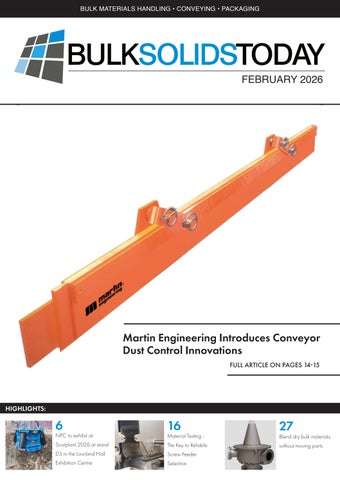
The global leader in belt conveyor technology, Martin Engineering, introduced the next generation of safe and effective transfer point dust control equipment. After rigorous testing across many applications, the Martin® ApronSeal™ Urethane Skirting, GravitySeal™ Self Adjusting Urethane Skirting, and the A.I.R. Control™ Dust Curtain outperformed similar products in tackling fugitive dust and spillage. Retrofitted onto existing transfer points, the system uses no energy to control airborne dust. With safety features for fast external servicing, the designs deliver greater performance at a lower operating cost.
“When designing these, our focus was safety, performance, and longevity,” said Bert Erdmann, Global Engineering Manager of Conveyor Products at Martin Engineering. “Compliance and ease of maintenance are top of mind for our customers. We’ve discovered that passive dust and spillage control at the point of emission with
safe maintenance built in is the most effective and economical method of containment.”
Extending along the length of the skirtboard, this skirting’s unique design provides multiple “pieces” of reliable containment for material fines. A primary strip is shaped to match the trough angle, creating a tight seal. The optional self adjusting secondary outer flap covers slight variations in the belt’s profile, trapping air and dust.
The ApronSeal™ Urethane Skirting requires only two inches (50 mm) of free belt area, and the self adjusting secondary seal can be easily trimmed to match the available free belt area. Supplied in 60 in. (1524 mm) strips, it features convenient T‑slot end connections for longer chutes. It is designed for external maintenance, improving safety and minimizing service time.


Made for belt speeds up to 900 fpm (4.5 m/s), the 90‑durometer urethane is chemical‑resistant and low abrasion also available in a high‑temperature option. With less friction than standard skirting, the ApronSeal™ offers a longer wear life.
Using torsion arms that allow the low‑friction urethane skirting to smoothly ride the vertical fluctuations in the belt, GravitySeal™ delivers a reliable skirtboard seal that prevents spillage and reduces dust emissions. The automatic corrections eliminate the need for downtime to adjust the skirting level due to wear.
Featuring a seal and clamp assembly, GravitySeal™ is designed for conveyor speeds up to 1300 fpm (6.5 m/s) with minimal free edge space, providing an effective seal with as little as 1.25 inches (32 mm) of free area on each side of the belt.
The unit’s urethane sealing strip is available in continuous lengths up to 300 feet (91.4 m) and provides 2 inches (51 mm) of wear life. Replacement involves quickly and easily removing the linchpins and installing the new pre punched strip.
Engineered for enclosed conveyor transfer points, these dust‑control solutions are modular urethane curtains with handles that allow a single worker to safely adjust or replace them from outside the
enclosure. The safety features eliminate the need for confined‑space entry and reduce service time to just minutes.
Each unit is a slide in cartridge with individual urethane flaps that can be machine cut to match the load’s angle of surcharge. Positioning the curtains close to the material load allows the A.I.R. Control™ Dust Curtain to create controlled recirculation zones. This allows dust particles to agglomerate and settle out, enhancing overall transfer‑point performance, significantly reducing respirable and nuisance dust emissions compared to conventional slit‑rubber curtains.
When installed on an existing transfer point, ApronSeal™ Urethane Skirting, GravitySeal™ Self Adjusting Urethane Skirting, and A.I.R. Control™ Dust Curtains provide a highly effective passive dust control solution. They enhance compliance with air quality and workplace safety regulations without relying on expensive, high maintenance, power consuming dust capture systems like HVAC filtration or air cleaners.
“We’ve found urethane to be a versatile and lasting material that can withstand the rigorous demands of the bulk handling industry,” Erdmann concluded. “Martin has risen to the challenge of stringent dust standards by innovating more efficient and safer solutions.”
www.martin eng.com


Ensuring consistent and efficient material flow starts with a thorough understanding of your material’s properties. At Trantec Solids Handling, they provide comprehensive material testing to all customers. These tests help identify the optimal screw feeder configuration for your specific application, accounting for factors such as particle size, density, and flow characteristics.

All materials behave differently, and these variations can affect a screw feeder’s performance and dosing accuracy. Testing materials in advance identifies potential issues before the design phase and enables Trantec to develop feeders of optimal configuration, ensuring smooth operation, precise dosing and avoiding costly downtime.
Key properties evaluated during testing include particle shape and size, bulk and tapped density, moisture content, cohesiveness, flowability, friability, abrasiveness, and stickiness. Understanding these characteristics predicts material behaviour in real conditions and helps fine tune feeders to the customer’s application.
Testing also highlights specific challenges and their effects, for example, irregular particles can cause bridging, low or variable density can lead to inconsistent volumetric feeding, and high moisture or sticky materials can clump or adhere to surfaces. For unique or unusual materials, testing provides deeper insight, helping engineers understand potential issues and develop customised feeding solutions. This knowledge ensures reliable and efficient performance, even with materials that behave unpredictably in standard systems.
To overcome challenges such as bridging, rat holing, and inconsistent flow, Trantec offers a versatile range of agitators designed to match specific material behaviours. Fragile powders receive gentle, low impact agitation to prevent
degradation, while dense, cohesive, or sticky materials require robust designs to maintain continuous movement.
Each agitator is engineered using hands on testing and material handling expertise, ensuring uniform flow and reliable long term operation, even with difficult to handle materials.
Through their specialist division, Augers UK, Trantec manufactures bespoke augers in endless configurations to suit different materials and throughput requirements. Options may include single start and twin start designs, variable or constant pitch augers, precision micro augers for ultra low dosing, segmented cores, and variable flight patterns with custom diameters and lengths. Every auger is designed to achieve uniform flow, minimal material degradation, and accurate dosing, also guided by comprehensive material testing.
Trantec’s state of the art testing facility houses a wide range of screw feeders, augers, and agitators, enabling rapid trials with your material. These hands on trials fine tune feeders specifically to the customer’s material, providing insight into how it behaves under real operating conditions.
For more information on Trantec’s equipment and to discover how they can optimise your application, visit www.trantec.net or contact their team directly at sales@trantec.net to discuss your processing needs.

The Gericke GUC C Conveying Controller delivers precise, reliable control for pneumatic dense phase conveying systems. It combines industrial grade reliability with the connectivity and flexibility required by modern bulk material handling applications.
The GUC C Pneumatic Conveying Controller from the Swiss Gericke Group sets a new benchmark for process control in pneumatic conveying. Designed for industries where efficiency, safety, and integration are critical, the GUC C streamlines the operation of dense phase conveying systems across the food, chemical, pharmaceutical, mineral and specialty sectors. Its modular architecture and user friendly interface make it the perfect choice for both new installations and upgrades to
existing conveying lines.
A key advantage of the GUC C Controller is its versatility and scalability. One unit can manage multiple conveying lines, supporting various process modes and configurations. This reduces equipment costs and simplifies automation setup, while its flexible design allows users to expand their system as needed. The controller supports a wide range of sensors and actuators, ensuring optimal performance and safety for every application.
The GUC C features high speed signal processing and advanced control algorithms, achieving maximum efficiency and reliability even under demanding process conditions. Its intuitive HMI offers multiple language options and standard/ expert modes, accessible via local display, tablet, remote
browser, or integration with higher‑level automation systems. With full support for IoT connectivity and predictive maintenance, the GUC C is ready for tomorrow’s automation challenges.
Data integrity and process safety are built in. The controller’s configurable user access system, secure logging, and direct signal processing ensure compliance and traceability. Software can be updated, making the GUC C a future proof investment.
Gericke’s GUC C Controller is designed for seamless integration with all state of the art automation networks, supporting rapid changeovers, remote access, and advanced diagnostics. Its robust, industrial grade design ensures reliable operation.


When constructing a modern high speed flour mill, efficient installation and long term maintenance of plant equipment demand a carefully planned lifting solution. For a recent project, the main contractor turned to Hoist & Winch Ltd, one of the UK’s leading lifting equipment companies. Hoist & Winch specified, supplied and installed a two phase hoisting solution capable of supporting both the plant installation phase and ongoing maintenance activities once the facility became operational.
The project required a flexible approach. During installation, contractors required a high capacity hoist capable of lifting heavy process equipment through a dedicated lift shaft. Upon completion of plant installation and commissioning, however, the requirement shifted to a permanent, high speed lifting solution to support routine maintenance of the mill’s processing equipment.
Following site meetings and consultations with plant designers and project managers from the main contractor, Hoist & Winch proposed a turnkey lifting package that could meet both requirements.

For the short term installation phase, Hoist & Winch supplied a 10t safe working load (SWL) JDN air powered chain hoist offering 30m of lifting height. Mounted in an air motor powered trolley, the hoist was complemented by a portable diesel powered air compressor and air hoses. Hoist & Winch also undertook installation and commissioning of the hoist, along with load testing and LOLER certification of the customer’s pre installed hoist runway beam. Operator handover training was subsequently provided for plant
installation contractors.
Installing the temporary hoist system formed phase 1 of the project. To facilitate this work, the site scaffolding contractor constructed a platform over the lift shaft in accordance with Hoist & Winch specifications. The 10t air powered hoist unit was raised to installation level using a temporarily mounted 2t SWL JDN air powered chain hoist fixed to the underside of the runway beam.
Once positioned beneath the beam, installation of the 10t hoist took place using a dedicated


lifting arrangement comprising a pair of T shaped lifting frames and four 1t SWL manual chain blocks. This configuration enabled engineers to mount the hoist trolley safely to the runway beam by initially opening and then closing the trolley width around the beam section.
Following installation checks and connecting the air supply, Hoist & Winch performed dynamic load testing of both the hoist and runway beam using a 10t test load over the full 30m lifting height. This process was followed by a 125% static proof load test at low level. With testing successfully complete, Hoist & Winch delivered operator handover training to the installation contractors responsible for lifting the mill’s process plant equipment into position.
Phase 2 of the project involved removing the temporary air powered hoist and installing the permanent lifting solution: a 3.2t SWL Stahl electric wire rope hoist with 30m lifting height. Mounted on a motor powered trolley and operating with a single rope fall, the hoist unit delivers a very high main lifting speed of 16 m/min to minimise plant downtime during maintenance lifts through the access shaft and 2.6 m/min slow lifting speed for precise load laydown at the load landing level.

Hoist & Winch conducted installation, commissioning, load testing and LOLER certification of the permanent hoist system, before providing handover training for the mill’s maintenance personnel.
“Projects like this demonstrate the value of careful planning and technical collaboration to deliver safe, efficient lifting solutions that support
both the construction and long term operation of complex industrial facilities,” says Hoist & Winch Director Andy Allen. “We subsequently secured the contract for annual hoist inspection and maintenance.”
Visit www.hoistandwinch.co.uk for further information and to view recent case studies.

Danfoss Power Solutions today announced the launch of its Vickers by Danfoss Variable Speed Drive (VSD) solutions in Europe, the Middle East, and Africa. The Vickers by Danfoss portfolio features induction motor and servo motor VSD solutions, offering a broad range of power, dynamics, and control options. The VSDs save energy, cut costs, reduce heat and noise, and simplify configuration and commissioning. The modular offering fits most industrial hydraulic application needs and machine types, with particular relevance in discrete and process manufacturing.
Comprising a hydraulic pump, electric motor, and frequency drive with control logic, Vickers by Danfoss VSD systems improve the energy efficiency and performance of hydraulic machines by intelligently varying the speed of the electric motor and pump to precisely match the demands of the duty cycle. This smart control technology eliminates the energy waste associated with traditional constant speed systems, resulting in energy savings of up to 60%, depending on the machine’s duty cycle. Lowering
energy consumption reduces operating costs while helping machine owners meet energy efficiency and/ or sustainability targets.
The Vickers by Danfoss induction motor VSD solution features the PVM Code B axial piston pump, Danfoss VLT® AutomationDrive FC 302, and an asynchronous induction motor. Designed for systems with low dynamic and control requirements, the solution is suitable for 3 to 250 kilowatt applications (higher than 90 kW engineered to order). It offers speed and flow on demand with open loop control. In comparison to traditional constant speed architectures, the induction motor VSD system can reduce energy consumption by 20 to 40%, depending on duty cycle.
The Vickers by Danfoss servo motor VSD solution features the VGPS internal gear pump or PVMX axial piston pump (the latter currently engineered to order), a PMSM (servo) motor, and a Danfoss iC7 Automation drive, including proprietary p/Q control software for closed loop pressure/flow control. Designed for systems with high dynamic and control


requirements, the solution is suitable for 3 to 100 kW applications. It offers pressure and flow on demand with closed loop control. The easily configurable p/Q control logic offers simple setup and integration, shortening design, installation, and commissioning time. The servo motor system can reduce energy consumption by 30 to 60%, depending on duty cycle. It can also simplify machine architecture and complexity, as the precise and highly dynamic pump speed control enables the elimination of separate pressure and flow control valves.
Both the induction and servo motor VSD solutions lower heat generation and reduce overall noise exposure. By improving energy efficiency, VSDs minimize heat generation, enabling downsizing or elimination of oil coolers and delivering lower total installed costs. Reducing heat also extends the life of seals and oil. When the motor and pump operate at lower speeds, the machine operator and those working nearby are exposed to less noise. Quieter operation enhances workplace safety and operator comfort, offers greater design flexibility in terms of power unit placement, and may reduce secondary noise reduction measures.
Vickers by Danfoss VSDs enable the downsizing of pumps and motors to cut costs and reduce space requirements. Because the system can utilize the full motor speed range rather than running at a fixed speed, pump displacement can be significantly smaller without changing the maximum available oil flow. A pump with smaller displacement requires less torque to deliver the same pressure, and because the high overload capability of electric motors can be used to deal with the short high torque portions of the duty cycle, a smaller motor size can be selected. The smaller motor and pump shrinks the machine’s footprint and installed power while improving the total cost of ownership.
“The superior performance of Vickers by Danfoss Variable Speed Drive solutions is rooted in seamless integration. Danfoss drives are a perfect fit for hydraulic VSD systems, resulting in a harmonized system that is easy to commission and operate,” said Juraj Bittner, Product Manager, Industrial Solutions, Danfoss Power Solutions. “By combining the durability and reliability of Vickers by Danfoss pumps with the intelligent control of Danfoss drives, our VSD systems deliver a powerful, efficient, and cost effective solution for modern hydraulic applications.”
Vickers by Danfoss VSDs are an ideal solution for a wide range of industrial hydraulic applications. They are especially suited to discrete and process manufacturing applications with intermittent duty cycles in which peak power is not required most of the time, such as injection molding, rubber molding, machine tools, presses, die casting, metal forming, and food processing.
Visit Danfoss.com for more information about Vickers by Danfoss Variable Speed Drive solutions.

Bulk Solids Today is the bimonthly digital journal covering the storage, processing and handling of materials ranging from fine powders to the heaviest raw materials.
To subscribe to Bulk Solids Today magazine or for more information, please feel free to visit www.bulksolidstoday.co.uk

The Bella dryer/cooler offers thermal efficiencies to 80 percent or better because air flows around material while it is suspended in the weightless zone. The result is a more consistent material.

Efficiency is a key driver of profitability in the large format food processing sector. Any form of waste caused by contamination in wholesale boxes, damaged bags on production conveyors, or excessive product giveaway can create significant operational challenges. These challenges are further compounded by slow recall responses caused by outdated traceability systems.
When these invisible issues are not addressed promptly, they can soon have a direct and detrimental effect on the financial stability of food processing companies. Phil Brown, Sales Director at Fortress Technology Europe explores how one of the most powerful strategies to address inefficiencies is to strengthen inline and end of line food safety inspection processes.
Combining metal detection and checkweighing equipment on case inspection lines allows processors to directly resolve issues relating to waste, food loss and labour challenges. This integrated strategy assists food companies to maintain a high level of detection sensitivity and enables rigorous quality control throughout the entire manufacturing process.
On top of the trends
The market for large packages of food ingredients is steadily expanding as manufacturers and foodservice providers seek out cost effective and high quality food
ingredients for use in large scale food manufacturing. Concurrently, caseweighing inspection advancements at Fortress Technology centre on the development of intelligent, connected and hygienic systems that improve efficiency and reduce waste at scale in ingredient and heavy food applications.
Combination metal detector and checkweighing systems are essential for industries aiming to reduce food waste and meet strict quality control standards, regulatory compliance and automated production efficiency. New research indicates that the global inspection and weighing machine market is projected to reach USD 4.1 billion by 2035, almost double the value of USD 2.3 billion in 2025.i
These specific factors directly influenced the development of Fortress Technology’s Raptor BBK Combination System. Purpose built for applications such as pet food, grain bags and large case formats weighing between 8 25 kilograms, this combination system delivers several advantages to users operating at scale.
The user friendly design ensures that production staff can easily interact with and manage the equipment. Maintenance routines are straightforward, minimising downtime and supporting consistent productivity. Additionally, the system features an easy to clean design, helping processors maintain the


highest hygiene standards required in boxed or heavy bag production environments.
Uniquely, the Fortress Technology Combination Systems have a CRO (conveyor run only) option that ensures food safety and HACCP compliance is prioritised. This means that the metal detector can always run for products that do not require a weight check.
“Consolidation of these technologies not only streamlines processes but also supports processors in maintaining compliance with food safety standards and industry regulations. The result is improved operational efficiency, reduced product giveaway and enhanced reliability. These factors all contribute to the long term financial stability of food processing companies,” clarifies Phil Brown.
The time for waste is over
Rising environmental concerns and economic pressures demand more efficient use of resources, minimal waste and improved sustainability practices across all food production lines. In high volume operations, even minor process deviations can quickly escalate. The scale of losses in wholesale and larger cased products is often more visible and are amplified due to the high volume of output involved.
Non conforming or contaminated product caught after packaging represents a significant irrecoverable cost. Additionally, isolating contaminants and salvaging unaffected product at this final stage is often more time consuming and impractical, impacting productivity.
These risks can be reduced by strategically placing inspection systems at high risk critical control points throughout the production process.

Fortress Technology advises processors distributing food packaged in cases or large bags to intercept physical contaminants at their largest and most detectable form, prior to fragmentation and dispersal during processing. If identified post packaging, large volumes of finished product may need to be discarded. A recommended strategy can involve implementing dual or multi stage inspections. This may include screening incoming ingredients before processing using gravity and/or large format metal detectors, followed by final metal detection and weighing safeguards at the end of the production line.
Enhancing footprint efficiency
Large scale production rarely equals more floor space. By expanding vertically and positioning gravity metal detectors on mezzanine floors, or optimising floor layouts and incorporating automated solutions, bulk processors can increase their output and profitability per square metre.
The new Raptor BBK Combination metal detector and caseweigher answers this call for more compact combination systems that conserve floor space and lower operational costs without compromising performance. Measuring less than 2.5 metres in
length, reject conveyors can be customised to suit the product application. The system also enhances user safety by preventing heavy lifting and hazardous pinch points.
Its robust and hygienic construction ensures long‑ term reliability and performance in demanding processing and packaging environments. The modular plastic chain conveyor belting and AC induction motor supports efficient cleaning and maintenance.
Real time data logging and connectivity provides extra assurance that food processors are experienced and ready to adhere to food traceability rules as they roll out globally.
Given that 70% of all products globally rely on bulk solids handling at some point in their lifecycle, the reliance on inspection and quality control cannot be underestimated, reaffirms Phil. The answer lies in prioritising precision inspection, data integration and in line and end of line weighing of packaged ingredients and larger format foods.
For more information, download the free Fortress Technology whitepaper The True Cost of Waste in Large Format Foods.

HAVER & BOECKER OHG will exhibit its latest packaging and filling solutions as well as pioneering advancements in AI based processes and performance optimization under the theme AIR (Artificial Intelligence & Robotics) at interpack 2026 in Düsseldorf. At Booth A27 in Hall 12, the HAVER & BOECKER Machinery Division and its technology brands, BEHN + BATES, Feige FILLING, NEWTEC Bag, AVENTUS and QUAT2RO® will present how their solutions make bagging, filling and palletizing more efficient, precise and safe while unlocking new potential with digital tools.
The booth will feature live demonstrations of revolutionary empty bag logistics, modern robotics applications and intelligent camera recognition. A special focus will lie on the AI powered analysis tool QUAT2RO® Connect. For further process optimization, it now offers a cloud based dashboard showing machine performance, downtime and bottlenecks. In addition to in booth consultations, visitors will have the opportunity to discuss retrofit concepts, new line designs and service tools with brand specialists across all showcased technologies.
HAVER & BOECKER MACHINERY DIVISION
The HAVER & BOECKER Machinery Division provides manufacturers with future oriented packing and logistics solutions for bulk materials with a comprehensive service portfolio driving sustainability and efficiency. At interpack 2026, visitors will be able to examine the latest innovations in AI optimized processes, creating safer, resource efficient and more reliable packing lines.
A central highlight will be a ROTO PACKER® combined with a RADIMAT‑PATHFINDER®, a revolutionary system which enables manufacturers to fully automate their empty bag logistics. The PATHFINDER transports empty bags through the plant on a flexible route to cover larger distances despite space constraints. For complete automation of the bag logistics, the AMICUS® DEPAL robot depalletizes empty bags and feeds them to the RADIMAT bag applicator.
Another highlight will be the prototype of the AMICUS® SEAL robot, which can easily be integrated at the conveyor belt of an existing packing line to ensure a safe, fast and reliable sealing process using AI technology. HAVER & BOECKER experts will be available for consultations on BESPOKE — a service for finding the suitable bag type and material that meets individual material and customer requirements.
QUAT2RO®
At the Mission Control booth, visitors will discover powerful AI based performance tools from HAVER & BOECKER’s QUAT2RO® product suite. HAVER & BOECKER will present its new AIR (Artificial Intelligence and Robotics) developments that enable manufacturers to ensure continuous process and performance optimization thanks to real time monitoring and machine learning.
The AI powered BAGcheck, for instance, automatically detects whether the correct bag type is being used for the material. VALVEcheck monitors the correct opening of the valve bag and its attachment


to the filling nozzle while MATEXCheck detects unwanted material leakage during the filling process in real time. The SEALcheck system automatically detects incorrectly sealed bags and ejects them before palletizing. For manufacturers, this means continuous, AI supported quality control along the entire bagging line for greater process reliability, less product loss and consistently high packaging quality.
BEHN + BATES, HAVER & BOECKER’s food industry brand, will showcase its newest INTEGRA® IVx packing machine, which combines energy efficiency with a high level of cleanliness, even offering options for AI tools. The ADAMS CARE LINE® edition will be of particular interest to the sensitive food sector, as it works with airtight PE bags and combines tried and tested components in a new system that aligns with the highest standards of sensitive food production supporting stable processes and confident quality in daily operation.
Feige FILLING, a leader in efficient and safe filling equipment, will showcase its new semi automatic ELEMENTRA® 26, a flexible pallet filling machine designed for the precise filling of highly viscous products. Visitors can also experience the mobile version of the ELEMENTRA® 26, featuring with surface filling mode. The highly effective design works without the use of costly compressed air and ensures safe filling without air pockets. For easy control and maintenance, all Feige ELEMENTRA® and INTEGRA® machines are now equipped with a new HMI that enables features such as electric and pneumatic circuit diagrams and extensive recipe management. The web based interface is designed for intuitive operation with modern multi touch functionality, supporting faster orientation for operators.
For filling granulates from the chemical, agriculture and animal food industries into FFS bags, AVENTUS

will present the TOPAS M machine equipped with the live analysis and maintenance tool QUAT2RO® Connect. The AVENTUS team will demonstrate remote control options with real time machine status, production data and error messages. Visitors can learn more about QUAT2RO® Connect at the QUAT2RO® Mission Control section. In addition, AVENTUS experts will be available throughout the show to discuss the full TOPAS machine family including TOPAS XL (2,600 b/h), TOPAS L (2,200 b/h) and TOPAS M (2,000 b/h) and how each configuration can be tailored to different products, bag types and performance targets.
Packing specialist NEWTEC Bag will demonstrate its high capacity palletizing machine AURUM for granules and flake products packed in different bag types and sizes. The palletizer runs on a new motor that enables intelligent energy recovery and thus decreases operational costs. Visitors will also be able to experience the user friendly touchscreen interface, which enables easy bag positioning control and maintenance. AURUM is designed for bags from 5 to 50 kg and supports common bag types including FFS, open mouth and valve bags. The line is available in three capacities: AURUM Blu (1,900 bags/hour), AURUM Bianco (2,300 bags/hour) and AURUM Rosso (up to 2,800 bags/hour) and is built for easy maintenance access and enhanced safety features such as presence detection during service work.

Eriez ® has released an animation that demonstrates how advanced magnetic separation, metal detection, and vibratory equipment work together to deliver comprehensive contamination control and boost productivity at every stage of plastics and rubber processing.
The detailed 3D animation takes viewers inside a virtual plastics plant, showing how Eriez technologies integrate seamlessly throughout raw material handling, extrusion, moulding, packaging, and regrind cleaning to maintain product purity and consistent uptime.
“Contamination threats exist at every step of the process, but with the right equipment, processors can take decisive action to protect quality and throughput,” said Craig Lorei, Eriez Global Market Manager Light Industry. “This animation presents real world solutions for turning potential risks into areas of strength.”
Across the plant, Eriez RF Cartridge, Rare Earth Grate in Housing Magnets, and Hump Magnets remove ferrous contaminants before they reach downstream machinery. During moulding and extrusion, Rare Earth PM Grate in Housing Magnets and Choke Fed Metal Detectors safeguard tooling and prevent costly stoppages, while Tunnel and Gravity Fed Metal Detectors ensure manufactured goods meet the highest purity standards. Drum and Plate Magnets help maintain cleanliness in recycled
material streams.
Eriez electromagnetic vibratory feeders and conveyors further enhance efficiency by delivering consistent material flow, reducing waste, and supporting uninterrupted production.
“As industry standards tighten, plastics and rubber processors need end to end solutions they can trust to meet quality, environmental, and economic goals,” Lorei explained. “Our virtual plant animation allows manufacturers to see how state of the art material handling and contamination control equipment operate in conjunction to protect valuable machinery and improve the process.”
Watch the animation and explore the full portfolio of Eriez plastics solutions at eriez.com/plastics.
Established in 1942, Eriez is a global leader in separation technologies. Our commitment to innovation has positioned us as a driving market force in several key technology areas, including magnetic separation, flotation, metal detection, and material handling equipment. The company’s 1,000+ employees are dedicated to providing trusted technical solutions to the mining, food, recycling, packaging, aggregate, and other processing industries. Headquartered in Erie, Pennsylvania, USA, Eriez designs, manufactures, and markets on six continents through 12 wholly owned international subsidiaries and an extensive sales representative network. For more information, visit eriez.com.


The Blendcon® air blender by Dynamic Air is a fast, efficient blender for mixing batches from 5 cubic feet to over 4000 cubic feet of dry bulk materials. The blender is unique in that it lacks moving parts required to displace the material in the mixing process. Instead of shafts, paddles, or agitators, compressed air is pulsed into the material in an upward circular pattern to lift, turn, and tumble dry materials. This makes the Blendcon air blender especially effective for abrasive blends such as glass batch, tile grout, and concrete mixes. Since the process area is a cone bottomed vessel, the Blendcon air blender empties nearly 100%, making cleanup easy. Plus, the Blendcon air
blender’s blending method is so effective, the ratio of horsepower to blended material is very low, resulting in high energy efficiency.
https://www.dynamicair.com/product/ blendcon-air-blender/
Dynamic Air Ltd.
Milton Keynes, United Kingdom
+44 1908 622344
e mail: sales@dynamicair.co.uk
www.dynamicair.com


Feeders, Mixers & IBC Systems

Equipment Ltd Tel: 01204 386723 Fax: 01204 363706 www.ajax.co.uk email: solids@ajax.co.uk


