OCTOBER 2026 www.bfmmagazine.co.uk building & facilities management
BUILDING & REFURBISHMENT | CLEANING & HYGIENE | HVAC
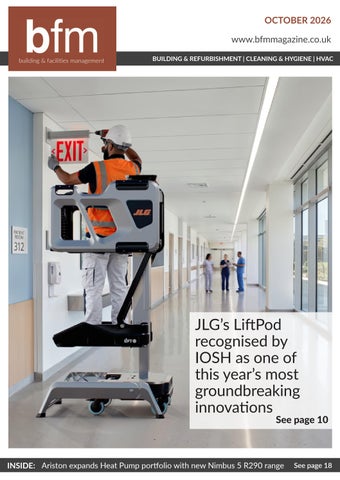
JLG’s LiftPod recognised by IOSH as one of this year’s most groundbreaking innovations
See page 10
INSIDE: Ariston expands Heat Pump portfolio with new Nimbus 5 R290 range
See page 18
Are you recycling WEEE
E
M
P
S
C
LA
IR IA L ES
R
EL E CO C VE T
BA TT ER
S IE
MS ITREEGS L E CAY WEE I R DB
&
ER M M NA O C MI
LU
£0
FREE LAMP RECYCLING
EXPERT SUPPORT, ALWAYS
ENVIRONMENTAL IMPACT
FREE container, collection and recycling for sites collecting 1000+ lamps each quarter.
Our WEEE specialists are on hand to help you with setup, queries, and paperwork
We help you monitor carbon footprint of your recycling – so you can see the difference you're making
Recolight operate the UK's largest collection network for fluorescent and LED lamps.
Sign up on the Recolight website:
info@recolight.co.uk | 020 8253 9750
On the cover: JLG’s LiftPod recognised by IOSH as one of this year’s most groundbreaking innovations
See page 10
October 2026
BFM Team
Contents
Business Development Director
James Scrivens
james@abbeypublishing.co.uk Production
Sarah Daviner
sarah@bfmmagazine.co.uk Accounts Manager
Katie Brehm
accounts@abbeypublishing.co.uk
x.com/BFM_Magazine www.linkedin.com/company/ bfm-magazine
BFM is published digitally 10 times a year b y Abbey Publishing Ltd. To receive a copy free of charge, contact our offices.
4
News
16
HVAC
22
Building & Refurbishment
28
Cleaning & Hygiene
34
Security & Access Control
Email: bfm@abbeypublishing.co.uk www.bfmmagazine.co.uk www.abbeypublishing.co.uk Subscriptions are available via www.bfmmagazine.co.uk/subscribe No part of this publication may be reproduced by any means without prior permission from the publishers. The publishers do not accept any responsibility for, or necessarily agree with, any views expressed in articles, letters or supplied advertisements. Some manufacturers and suppliers have made a contribution toward the cost of reproducing some photographs in this magazine.
All contents © Abbey Publishing Ltd 2026 ISSN: 1470-5281
Building & Facilities Management
3
News
Priva launches Cybersecurity Drop-in at Smart Buildings Show 2026 A team of experts from leading building automation company Priva will be on hand at the Smart Buildings Show at ExCeL London on 14–15 October 2026, offering visitors the opportunity to discuss questions and concerns about BMS cybersecurity at a dedicated Cybersecurity Drop-in.
Priva’s Cybersecurity Drop-in offers visitors a simple Cyber Consultation designed to support anyone who is unsure about which cybersecurity responsibilities affect their organisation, which legislation and standards may be relevant to them, or whether their existing BMS hardware and systems are adequately prepared for current and emerging requirements. The Drop-in welcomes conversations with anyone concerned about cybersecurity, including building owners, operators, facilities managers, BMS professionals and integrators who are unsure: • Which cybersecurity responsibilities impact their organisation • Which legislation and standards may be relevant to their systems • Whether their existing BMS hardware and configuration are adequately prepared for current and emerging cybersecurity requirements
Tighter legislation & standards Priva’s Cybersecurity Drop-in responds to increased demand for information and answers about new and stricter requirements relating to the security of building networks and devices. Legislation and standards including NIS2, IEC 62443 and the Cyber Resilience Act (CRA) are changing expectations around the security of connected systems. These changes sit alongside increased emphasis from organisations on the resilience of the operational technology and systems on which their buildings depend. The Drop-in will clarify responsibilities and provide a practical reference for customers and partners as they assess their own cybersecurity requirements. It will be of value to those responsible for BMS systems in critical sectors, including data centres, hospitals, energy facilities, water infrastructure and transport infrastructure, where organisations may be within the scope of the NIS2 Directive. 4
News
Visitors will be able to discuss their specific situation with Priva’s cybersecurity specialists and gain a clearer understanding of the questions they should be asking about their systems, responsibilities and routes to compliance. “There is a lot of discussion about cybersecurity and compliance, but it can be difficult for people responsible for buildings to translate that into practical action, particularly when they have legacy BMS hardware or systems that have evolved over many years,” adds Jens Fiig, Managing Director, Priva Building Automation. “The Priva Cybersecurity Drop-in will provide clarity and practical guidance for any organisation that is concerned about its responsibilities. Our simple Cyber Consultation opens up the conversation so that we can support BMS professionals by better understanding what they are responsible for, what questions they should be asking their BMS provider, and where their current system sits against emerging requirements.”
Registration & more information For more information about Priva’s approach to cybersecurity, a new publication is available for download in advance of the Smart Buildings Show: A Guide to Cybersecurity, Quality & Compliance. Smart Buildings Show is also an opportunity to explore the wider Priva portfolio, including Priva Nuro, our next-generation intelligent building solution our suite of Priva Digital Services. The Priva team will also be joined by colleagues from its partner company bGrid. Register for the show and for more information on the Priva CyberDrop-in. Visit Priva at Stand A28, Smart Buildings Show, ExCeL London, 14–15 October 2026, to speak to the cybersecurity team and visit the Cybersecurity Drop-in. Building & Facilities Management
protect | maintain | improve
WINTER COMES SOONER THAN YOU THINK. ARE YOU PREPARED? The best way to avoid winter disruption is to prepare before the temperatures drop. Summer is the time to give priority to reactive repairs, from potholes and drainage to fencing and surface defects. Then focus can move to putting a winter maintenance plan in place with site-specific professional weather forecasts, proactive gritting, and rapid response support. Stay safe, compliant, and operational through summer into winter.
0800 0432 911 | enquiries@outco.co.uk | OUTCO.CO.UK
News
New Industry Guides address growing Lithium Battery fire risks Practical Safety Guidance Published for Key Sectors Lithium battery guides written for specific industries are now available to download from hazardous material storage experts asecos Ltd. Lithium-ion batteries are used across an increasing range of sectors and equipment; the risks and practical challenges can vary significantly between industries. With UK fire brigades now tackling an average of 4.8 lithium battery fires a day1, the guides help organisations to assess risk, consider operating procedures and support meeting compliance requirements. Downloads are available for: • Aviation • Construction • Data centres • Defence • Facilities and manufacturing • Golf • Greenkeeping • Healthcare • Logistics • Marine • Police • Railways • Universities The guides have been developed following strong interest in asecos’ defence and healthcare guidance, with organisations increasingly looking for advice that reflects the particular risks they encounter. Les Day, Commercial Director at asecos, said: “Lithium batteries are part of everyday operations across an enormous range of industries, but the 1 Source: Business Insurer QBE
8
News
Image: asecos GmbH (image generated by and labelled as AI)
way they are used – and the consequences if something goes wrong – can be very different.” “Fires from lithium-ion batteries can develop extremely quickly, release toxic gases and potentially lead to explosions. That makes appropriate charging, storage and operating procedures vital.” “The popularity of our initial lithium battery guides for defence and healthcare showed us that people want practical information that relates directly to their own working environment rather than a ‘one size fits all’ approach. We have therefore
expanded the series so that more organisations can access guidance tailored to the equipment, situations and operational challenges they encounter.” “Each guide is designed to help those responsible for fire, health and safety consider their lithium battery risks and put sensible measures in place to protect people, property and continuity of operations.” Download the asecos Lithium Battery Guides. For further information, please visit: www.asecos.co.uk
Building & Facilities Management
SWEDISH BRILLIANCE FOR FACILITIES ''After completing a series of tests, Wexiodisk's WD-6 Duplus came in with around 40% less energy consumption than the closest competitor. W hat's more, water and chemical savings were significant too with water consumption being nearly 50% less than the closest competitor! Projected across Butcombe's entire estate and looking at the life cycle of the appliance made the decision very simple. The figures speak for themselves especially when over a million pounds is projected to be saved over 10 years. ,, -Ed Barlow, M and E Manager, Hi-Tee
Ifyou want to get up to speed with some ofthe latest, most sustainable warewashing options, please contact david.glover@wexiodisk.com or visit www.wexiodisk.com/en
News
JLG’s LiftPod recognised by IOSH as one of this year’s most groundbreaking innovations
Ladder alternative for working at height makes prestigious safety and health awards shortlist
JLG Industries, Inc., an Oshkosh Corporation business and a leading global manufacturer of mobile elevating work platforms (MEWPs) and telehandlers has confirmed that LiftPod, the JLG® Quick Fold Lift, has been recognised by the Institute of Occupational Safety & Health (IOSH) as one of this year’s most significant workplace safety innovations. Designed and manufactured in the UK by JLG to improve the way people work at height, LiftPod has been shortlisted for a prestigious IOSH Award (Supplier Innovation) in recognition of its pioneering method of improving occupational safety and health (OSH). An ingenious workplace alternative to ladders, steps and podiums, LiftPod addresses the everyday risks workers face during routine access tasks in indoor, public-facing environments – schools, hospitals, offices, transport hubs - where safety, speed and efficiency are at a premium, and where the risk of falls and injury are often underestimated. Launched in 2025 as the latest addition to JLG’s industry-leading range of access equipment, LiftPod delivers new levels of safety, stability and support to staff in these settings, so they can work at height in comfort and with the utmost confidence – regardless of age or ability.
A winning collaboration with Mitie JLG worked closely with Facilities Management leader Mitie for two years to understand unsafe behaviours and the every-day risks its staff faced when working at height across the company’s public and private sector network. Their shared aim was to tackle the human impacts: the devastation of a fall and the injuries and absences caused by common musculoskeletal disorders (MSD), which result from repetitive straining and over-reaching on a ladder during certain overhead maintenance tasks particularly those which exceed 15 minutes duration. Following a period of worker observation and task analysis at Mitie, JLG developed LiftPod as the solution to drive positive change: an innovative, safe and robust way to perform access tasks in these indoor, public-facing and often busy environments. 10
News
Meticulously engineered and rigorously tested, LiftPod has many advantages for users: • Innovative design: compact, ergonomic and featuring a patented folding mechanism that one person can manoeuvre into place and operate easily and safely; • Safe and secure: an adjustable platform and safety gate that are light but robust, enclosing the user for safety, security and protection from falls; • Flexible: an adjustable platform, allowing staff to work at the correct and most comfortable height for the job with good posture, avoiding repetitive straining and over-reaching at awkward angles; • Promoting productivity: enables operators to work hands-free and to work comfortably over longer durations ; • Sustainable: no batteries or mains power, LiftPod is operated manually using sustainable, non-powered lifting technology; • Made for public spaces: a stylish aesthetic and compact size that can be used in operational environments, blending seamlessly into modern interiors and public spaces across a wide range of sectors; • Practical: LiftPod’s two models – offering a maximum working height of either 3.2 metres or 3.5 metres – are easy to transport and store. A programme to promote positive cultural change was also developed, with JLG’s Path to Competency training and the encouragement of discussion around task duration and risk to establish clear criteria for LiftPod use. www.jlg.com/liftpod ®, ™ All brand names referred to in this news release are trademarks of Oshkosh Corporation or its subsidiary companies.
Building & Facilities Management
Discover more about the Nilfisk CS7010
Nilfisk CS7010
Greener. Cleaner. Smarter. CS7010 reinvents an entire class of equipment by reducing total cost of ownership, including operation, labour and maintenance, while effectively increasing fuel economy and runtime efficiency. Now the most economical solution is also the most ecological. Sweep, scrub and dry in a single pass – a combination machine designed to maximise cleaning productivity while reducing labour time. High-capacity 285-litre debris hopper with high-lift system for extended cleaning time and efficient waste disposal. Patented DustGuard™ technology helps suppress airborne dust, improving cleanliness and operator comfort. SmartFlow™ system automatically adjusts water usage to machine speed, reducing water and chemical consumption. Enhanced operator safety and ease of use with ClearView™ sightlines, automatic speed reduction in turns, and intuitive OneTouch™ controls.
Nilfisk Ltd Nilfisk House • Bowerbank Way • Gilwilly Industrial Estate Penrith • Cumbria • CA11 9BQ Tel: 01768 868995 • Email: sales.uk@nilfisk.com
www.nilfisk.co.uk
News
Styles Façade Solutions® relaunches to reflect expanded role as a commercial and heritage cleaning and restoration partner Styles Façade Solutions®, formerly known as ThomannHanry®, has officially rebranded to better reflect its evolution from a specialist façade-cleaning contractor to an end-to-end partner for the surveying, cleaning and restoration of the UK’s most prestigious commercial and heritage buildings. The strategic shift marks a new chapter for the firm, which celebrated its 20th anniversary last year. The new identity centres on the name of Founder and Managing Director, Mark Styles, and underscores the company’s broader, comprehensive expertise in the surveying, cleaning, repair, restoration and redecoration of building exteriors across the UK and internationally.
The strategy behind the rebrand While the firm built its reputation on its unique scaffold-free cleaning technology, the leadership team identified an opportunity to better communicate the full breadth of its capabilities. “Following over two decades of growth, it became clear that our previous identity was too synonymous with just one part of our story,” said Mark Styles, Managing Director, Styles Façade Solutions®. “Our clients increasingly rely on us for a full
12
News
suite of services – everything from masonry repairs and bird deterrent works to bronze repatination and eye-bolt testing.” The firm’s expanded remit includes: • Specialist surveying & cleaning: Maintaining the core scaffold-free expertise and specialist cleaning solutions that defined the business. • Structural restoration: Including masonry repairs and metalcladding restoration. • Technical maintenance: Bird-deterrent systems, eyebolt testing and specialist painting and redecorating. These services are delivered by an in-house team of over 35 professionals, including heritage stonemasons, specialist cleaners, craft metalworkers and expert painters and decorators. “Styles Façade Solutions® perfectly captures our role as a 360-degree partner for the commercial and heritage sectors,” Mark Styles added. “We are sharpening our proposition to
ensure we are recognised as long-term stewards of building performance, while maintaining our core commitment to ‘Restoring Excellence.’”
A brand evolution Since 2005, the company has operated under a successful partnership with the French family team behind the Thomann-Hanry® brand. As the UK business grew to encompass a wider range of façade solutions, the new identity was adopted to reflect this holistic approach to building exteriors. Ownership and leadership remain unchanged; the same specialist team and exacting standards continue under the new name.
New visual identity The new logo features a four segmented circle, representing the company’s integrated core sectors: Surveys, Cleaning, Restoration and Decorating. At its centre, a star symbolises the “point of excellence” where these disciplines meet. Marketing Manager Paul Maxwell explained: “Our rebrand Building & Facilities Management
News
includes a refreshed palette of heritage greens and structural greys. This moves us away from an industrial look toward a refined, advisory-led aesthetic that reflects our commitment to environmental stewardship and architectural integrity.” The identity is supported by a redesigned website that offers tailored content for the commercial, hospitality, education and public sectors, ensuring easier navigation for asset managers and developers.
A proven track record Over 21 years, the company has delivered more than 7,200 projects, cleaning over 1,500,000m² of façade, removing over 34,000kg of loose and damaged masonry and completing more than 1,800 façade surveys. Flagship projects now transitioning to the Styles Façade Solutions® portfolio include: • Bank of England (Grade I listed) – Cleaning and repair of 13,000m³ of Portland stone. Completed in 23 days without scaffolding, the project was managed around city protests and high-profile film shoots. • The Ritz, London (Grade II listed) – An intensive 16-day clean and restoration of Portland stone and Cornish Grey granite. The scaffold-free approach allowed the hotel to maintain full occupancy and avoid significant revenue loss. • Somerset House, London (Grade I listed) – A landmark 12-week winter restoration of the riverside façade. Despite severe storms, the nonscaffold system proved its worth and decades of grime were gently removed from 1,650m² of Portland stone, when traditional methods would have been hindered by the weather. “While our name has changed, our dedication to the preservation of the built environment has not,” concluded Mark Styles. “We remain the same specialist team, using the same advanced techniques, ready to help our clients protect the value and beauty of their assets.” To learn more about Styles Façade Solutions®’ services or to discuss a project, please visit www.stylesfacadesolutions.com, email info@stylesfacadesolutions.com, or call the firm’s London headquarters on +44 (0) 20 8453 1494. www.bfmmagazine.co.uk
News
The CHSA launches the Chairman’s Lunch
The Cleaning & Hygiene Suppliers Association is delighted to introduce its Chairman’s Lunch. Taking place at Lord’s Cricket Ground on Thursday 29 October, this exclusive event will deliver real value, bringing together manufacturers and distributors of cleaning and hygiene products and organisations from across the facilities management sector. It offers a unique opportunity to build strategic relationships, exchange ideas and explore new business opportunities in one of the world’s most iconic sporting venues.
Attendees will also receive valuable market intelligence. Liz Kentish, co-founder of Kentish and Co will deliver the keynote address titled What Buyers Wish Suppliers Knew – the view from the other side of the FM buying table. For those who wish, their day will begin with a behind-the-scenes tour of Lord’s Cricket Ground. Guests on the tour will be able to step inside the iconic and exclusive areas of the Ground including
the Long Room, the England Dressing Room, the Media Centre and the MCC Museum. The tour will be followed by the keynote address and then a three-course lunch. • Date: Thursday 29 October • Time: 10am – 4pm • Venue: Lord’s Cricket Ground • Tickets: £165 per person The event is sponsored by Bunzl Cleaning & Hygiene Suppliers, Cromwell Polythene, Greyland, Harrisons Wipes and SC Johnson. https://chsa.co.uk/
TWO Services secures strategic growth investment from YFM Equity Partners
A new investment partnership for the 40 year old, family run cleaning and maintenance specialist, with its family values and culture staying exactly as they are.
TWO Services, the family-run commercial kitchen cleaning and maintenance specialist celebrating its 40th year in business, announced a strategic growth investment from YFM Equity Partners, the independent UK private equity firm. The investment gives TWO Services additional resources to invest in its operations and pursue its next stage of growth, while the family values and culture that have underpinned its success remain unchanged. Founded in 1986 by Alan Osborn, and still led by the next generation of the Osborn family today, TWO Services has grown from its Essex roots into a trusted national partner for cleaning, maintenance and equipment supply across the contract catering and facilities management sectors, with operational centres in London and Leeds and a team 14
News
of around 100 people. Many have been with the business for between 25 and 35 years, a tenure that reflects the closeknit, family culture at its heart. As part of the partnership, TWO Services will expand its engineering and cleaning teams, upgrade its equipment and grow its coverage across the UK, supporting ambitious growth targets across all three of its service lines. It is growth built on the same hands-on, relationshipled approach that has defined the business for 40 years. Barry Osborn, Managing Director for TWO Services, said “This is a hugely exciting moment for TWO Services. This partnership gives us a real opportunity to strengthen our operations, accelerate our growth and build an even brighter future for the business. But I want to be clear about what
won’t change: the family values and culture that have made us successful for 40 years remain at the heart of everything we do, for our people and for our clients.” Zach Francis, Investment Director at YFM Equity Partners, who led the deal alongside Srikar Karri, said: “Over 40 years, the Osborn family and the wider team have built TWO Services into a trusted specialist, with longstanding client relationships and a culture reflected in the loyalty of its people. The opportunity to grow across each of its service lines and extend its national coverage, while preserving the values behind its success, made this a compelling investment. We’re looking forward to working with Barry and the team on the next stage of the business’s growth.” Find out more at two-services.com and yfmep.com. Building & Facilities Management
Scan for more information or to order your FREE sample of Aqua Fend*
ONE OF THESE PANELS IS NOT LIKE THE OTHERS... This picture was taken 24 months after all the panels had been professionally cleaned, but only one had been treated with Aqua Fend® F after cleaning. This real-life result shows that Aqua Fend® has been developed to PROTECT your building’s façade and flooring, PREVENT longterm damage caused by water ingress and urban pollution, and PRESERVE the original structure and colour for as long as possible after cleaning. The Aqua Fend® range helps you to reduce cleaning and maintenance costs while keeping your walls and floors clean.
CLEAR PROTECTION, DOES NOT CHANGE COLOUR NON FILM FORMING: LETS THE SURFACE BREATHE IDEAL FOR NATURAL STONE, CONCRETE, BRICK, & TERRACOTTA INTERIOR/EXTERIOR
For more information or to purchase Aqua Fend® products, visit aquafend.co.uk *One sample bottle per business address, UK only. Aqua Fend® reserve the right to alter, amend, or withdraw the free sample offer without prior written warning.
ECONOMICAL UP TO 16M2/LTR* • WATER BASED; SILICONE FREE • NON-HAZARDOUS, ODOURLESS • 0.0% VOC
HVAC
Condair Vita: New high-pressure humidifier Condair is launching the Condair Vita, its next-generation directroom spray humidifier. This adiabatic system combines a highpressure pump station with water treatment options and a wide choice of spray heads. Its flexible configuration allows it to perfectly meet the varied needs of medium to large direct-room humidification projects.
At the heart of the Condair Vita is a high-pressure pump and water treatment station available in capacities of 100, 300 and 500kg/h. It can be configured with integrated reverse osmosis, UV water sterilisation, deionisation and CO2 water conditioning technologies. These options ensure reliable germfree, demineralised water supply, and can be tailored to meet project-specific requirements. Condair Vita spray heads can be wall or ceiling-mounted, are very quiet in operation and incorporate a fan to rapidly disperse the aerosol. Five spray head models offer a range of output capacities from 1.5 to 52kg/h. The smallest is an attractively compact unit, ideal for offices spaces, and the largest distribution system is suited to factories and warehouses. An additional Condair Vita Line distribution system offers a series of high-pressure nozzles mounted along a pipeline, each 16
HVAC
operating without a fan or electrical connection. The number of nozzles is unlimited, so the Vita Line is ideal for very large industrial spaces, agricultural or greenhouse applications. It provides even humidity distribution across wide spaces and is ideal where electrical connections for individual spray heads are not practical. As the Condair Vita operates independently of an air handling unit, it is ideal for both new installations and retrofit projects. High-pressure spray humidifiers use a fraction of the energy consumed by steam humidifiers, with a 100kg/h system needing less 2kW of electricity. The energy needed to evaporate the water comes from the air, which results in an evaporative cooling effect. This “free” cooling can be very beneficial in production environments and equates to around 68kW of cooling for every 100kg of humidity. “Humidity has a direct impact on product quality, employee wellbeing and process efficiency,”
said Jordan Stevens, Sales Manager at Condair. “With Condair Vita, we have combined our expertise in humidification, water treatment and controls to deliver an efficient, hygienic and flexible solution. Its configurable options make its suitable for a huge range of applications; from offices to warehouses, or concert halls to outdoor cooling. The Condair Vita provides reliable humidity, with the required water quality, exactly how and where it is needed. Jordan continues, “Condair Vita also offers the latest IoT and BMS connectivity, enabling remote monitoring and control by in-house facilities teams or Condair. This new generation of manufacturer-connected humidifier gives customers confidence that their system is performing correctly and supports maintenance only when required, improving both performance and operating costs.” You can find out more by visiting the company’s website at www.condair.co.uk. Building & Facilities Management
HVAC
Protect Monitor Control
Environmental monitoring experts and the AKCP partner for the UK & Eire.
Save Energy with AKCP Sensors Contact us for a FREE site survey or online demo to learn more about our industry leading environmental monitoring solutions and how they can help to reduce your energy costs. Scalable, with Ethernet and WiFi connectivity, over 20 sensor options for temperature, humidity, water leakage, airflow, AC and DC power, a 5 year warranty and automated email and SMS text alerts.
0800 030 6838 hello@serverroomenvironments.co.uk
www.bfmmagazine.co.uk
Cooling | Power | Fire | Racks | Monitoring
HVAC
17
HVAC
Ariston expands Heat Pump portfolio with new Nimbus 5 R290 range The new range has been developed to suit a variety of installation requirements, offering a choice of streamlined all-in-one systems, flexible configurations with a separate domestic hot water (DHW) cylinder, and compact solutions for installations where space is limited. Delivering a coefficient of performance (COP) of up to 5.1, the range combines high efficiency with the sustainability benefits of natural R290 refrigerant. It comprises three outdoor unit sizes with five different outputs ranging from 3kW-15kW, alongside four indoor unit options. To make product selection simpler, indoor and outdoor units are now available as convenient pre-configured bundles. 18
HVAC
Ariston has expanded its heat pump offering with the launch of the new Nimbus 5 R290 range, designed to deliver greater installation flexibility, smarter connectivity and easier maintenance for heating professionals. Across the entire range, the highly compact outdoor unit offers a footprint up to 40% smaller than many alternative solutions, making it ideal for space-constrained installations. When domestic hot water is required, the pre-plumbed cylinder option simplifies installation thanks to its factory-integrated pipework and connections, while built-in Wi-Fi, 4G and LAN connectivity ensures seamless control. The system can also manage up to two heating zones, delivering enhanced comfort
and flexibility for homeowners. Slimline 150L and 180L cylinder options are also available where space is limited, alongside a standard 210L cylinder option. The redesigned outdoor units feature rounded edges and a contemporary aesthetic allowing Nimbus 5 to integrate seamlessly into a wide range of settings, from urban developments to residential properties, while minimising visual impact. The new design has already been recognised with an iF Design Award. Building & Facilities Management
HVAC Thanks to its cascade capability, Nimbus 5 adapts to projects of any size, from small single homes to complex, high-demand systems. Designed for reliable operation in ambient temperatures as low as -25°C, the range utilises the refrigerant properties of R290 to efficiently achieve water temperatures up to 75°C. James Hodgson, National Training Manager at Ariston, commented: “Heating professionals are at the centre of the transition to heat pumps, so new products need to deliver more than efficiency alone. They need to be straightforward to specify, practical to install and backed by the training and technical support installers need. “Our new Nimbus 5 R290 range has been developed with those requirements in mind. By expanding the choice available to installers and simplifying
more of the installation and maintenance process, we want to make it easier for heating professionals to confidently offer heat pumps to more customers.” Maintenance has also been simplified through the inclusion of an L-shaped access panel, providing improved access to both refrigerant and hydraulic components from the front and right-hand side of the outdoor unit, as well as grip recesses for easier transportation and SET+ for seamless commissioning and optimal parameter selection. Additional features include an integrated anti-freeze system, drain pan, cone filter and Y strainer water filter kit as standard. The outdoor units offer three noise reduction levels, supported by a dynamic grid movement system that reduces vibrations by evenly distributing stress throughout the structure. This
Low-Carbon Electric Water Heating
increases stability, optimises airflow and helps minimise both operational noise and vibrations. Every Nimbus 5 system includes the Sensys NET HD interface and remote management functionality through the Ariston NET app. The range is also equipped with the new Energy Manager 3.0 system. This enables seamless integration with boilers, photovoltaic (PV) systems, solar thermal installations, storage tanks and a wide variety of heat emitters. The Nimbus 5 range is backed by warranties of up to 10 years and is A+++ Energy rated. For further information on the Ariston Nimbus 5 R290 heat pump range, visit Nimbus 5 Pocket R290 | Air Source Heat Pump | Ariston UK Energy savings may vary depending on system configuration, property characteristics and user behaviour.
Offset up to 70% of direct energy demands for DHW Reduce carbon by 48% compared to direct electric commercial equivalent applications
Award Winning | Low Carbon | Cost Effective
- HEAT PUMPS - SOLAR THERMAL - ELECTRIC BOILERS - CYLINDERS - HYBRID PLANT ROOMS -
01252 551 540 adveco.co
www.bfmmagazine.co.uk
HVAC
19
HVAC
Heat pumps deliver year-round comfort to historic community sports club Retrofit project provides energy-efficient heating and cooling to Liverpool clubhouse
Mitsubishi Electric airto-air heat pumps are now providing heating and cooling to The Northern Club, helping its historic clubhouse remain comfortable throughout the year. Located in Sefton, North Liverpool and dating back to 1859, The Northern Club occupies a privately run sports venue built in the early 1900s and offers facilities for cricket, crown green bowling, squash and hockey. Around 2,000 schoolchildren also use the club’s facilities each year, providing opportunities for young people to participate in sport. The historic building presented a significant heating challenge, with its age, limited insulation, large viewing windows and raised flooring all contributing to heat loss. The large windows also left little space for additional radiators, making both heating and cooling difficult. The club worked closely with installer partner TDC and Mitsubishi Electric to develop a heat pump system suited to the age and construction of the building. This involved the installation of three Mitsubishi Electric MUZ-AP71/MSZ-AP71 air-to-air heat pump systems which provide rapid heating during the winter and cooling throughout the summer. These are also Wi-Fi enabled via the MELCloud app, allowing the club to manage temperatures, operating modes and schedules remotely. 20
HVAC
“Before the installation, I would arrive at the club at 6am and switch on one of the gas boilers, but by 3pm the room would only have reached around 15°C,” said Wendy McDowall, President of The Northern Club. “Now I can switch the heat pumps on and within ten minutes the room reaches a comfortable temperature, and they automatically maintain it throughout the day. I only wish we had installed them years ago.” The partnership has seen the club enter a planned preventative maintenance contract with TDC, a Mitsubishi Electric Diamond Quality Partner, with the equipment also covered by a 10-year manufacturer’s warranty. “The Northern Club needed a heating and cooling solution that would allow its rooms to maintain
a comfortable temperature throughout the year, while working around the challenges of retrofitting an ageing building,” said Jo Lambert, Air Conditioning Expert at Mitsubishi Electric. “By providing a system that aligns with the clubhouse’s specific requirements, the Northern Club can now benefit from energy-efficient heating during the colder months and the relief of cooling when temperatures rise, creating comfortable spaces for members and guests to enjoy whatever the season.” https:// gb.mitsubishielectric.com/en/ Building & Facilities Management
Clivet presents VERSATEMP FLOOR and VERSATEMP DUCT
HVAC
To ensure thermal and hygrometric comfort for occupants of large multi-zone spaces such as shopping centres, offices and hotels, WLHP (Water Loop Heat Pump) systems play a key role, a closed hydraulic circuit in which water at a neutral temperature acts as a heat transfer medium between the various zones, served by stand-alone heat pumps that use the water in the loop as their heat source. The new generation of VERSATEMP air conditioning units for water loop systems, using R290 and R454C refrigerants, introduces new features that improve their efficiency, environmental impact and manageability. Clivet launches VERSATEMP, the new generation of standalone air-conditioning units for water-loop systems, which heat and cool rooms all year-round using water as the heat source. “The main advantage of WLHP water-loop systems is that they allow different areas of the same building to be heated and cooled simultaneously,’ explains Damiano Rossi, product manager at Clivet, “For example, if a south-facing office requires cooling and a north-facing one requires heating, the energy and heat dissipated by the units in cooling mode are transferred directly to the water loop and reused by the units in heating mode. This automatically balances the temperature of the loop and minimises the need for the outdoor units to operate, thereby reducing overall energy consumption.” “The new generation of VERSATEMP units comprises two extremely compact and selfcontained versions, ideal for both new builds and the replacement of old systems thanks to their perfect compatibility with existing hydraulic, aeraulic and electrical connections: VERSATEMP FLOOR (1 to 3 kW), a vertical model available in either cased or uncased versions with an elegant finish that blends seamlessly into any interior, and VERSATEMP DUCT (2 to 28 kW), a ceilingwww.bfmmagazine.co.uk
mounted ducted solution designed for horizontal installations in small and medium-sized spaces. “As it is a decentralised and modular system, each unit manages its own space completely independently, which is why it is the ideal solution for renovations or refurbishments carried out in phases (e.g. hotels, office complexes or shopping centres),” continues Rossi. “It is possible to install or upgrade the system floor by floor or in individual areas without having to halt operations throughout the entire building, whilst spreading the financial investment over time. Furthermore, any maintenance carried out on an individual unit does not affect the operation of the rest of the system.” Thanks to the wide range of sizes available (from 320 to 650 m³/h nominal air flow rate for FLOOR, and from 320 to 7000 m³/h for DUCT), the new range is the ideal solution for air conditioning in shopping centres, offices, hotels and, more generally, in all large, multi-zone buildings characterised by frequent opposite thermal demands. All units can be controlled locally via an advanced user interface with integrated Wi-Fi, which also
VERSATEMP DUCT: A ducted ceiling-mounted unit for WLHP water-loop systems (capacity from 2 to 28 kW, air flow rate from 320 to 7000 m³/h), for horizontal installations in multi-zone environments. It uses R454C refrigerant (GWP < 150) and allows the system to be replaced in stages without disrupting the building’s operations.
allows control via smartphone and PC using the CLIVET EYE app. With CONTROL4 NRG, the entire system can be managed from a single point, with access to information either via a dedicated interface or remotely via smartphone or web interface. “Thanks to the use of the refrigerants R290 (VERSATEMP FLOOR) and R454C (VERSATEMP DUCT), the entire VERSATEMP series already complies with the first stage of the F-Gas Regulation due in January ’27, which stipulates that for units under 50 kW – such as WLHPs – only systems using refrigerants with a GWP below 150 may be placed on the market,” concludes Rossi. www.clivetgroup.co.uk
HVAC
21
Building & Refurbishment
Illustrative image created for this article; it does not show a real site or incident.
A clearer record when facilities equipment changes hands
Satyajeet Singh, Director, AuditIt Facilities equipment often changes hands at a busy point in the day. A contractor finishes a shift, a store receives a machine, or maintenance takes over from building operations. The note may be only one sentence: “Machine damaged, battery fault, keep out of service.” It sounds clear, yet the next reader cannot tell what anyone saw, who suggested the cause, or who made the decision. Different teams use that note for different jobs. Maintenance needs a starting point for examination. The facilities manager needs to know what was authorised. A contract manager may need the original account of the return. When those statements are blended, an early guess can look like a confirmed finding.
Four kinds of statement A useful handover keeps four kinds of statement separate. An observation records what a named person directly saw, heard or found at a stated time, without adding an explanation. A report preserves what somebody else said and identifies the source. A suspected explanation is marked as unconfirmed. An authorised decision records the action, who approved it and any limit on it. These distinctions do not require long prose. Labels such as Observation, Reported by, Possible cause and Decision by can make the source of each sentence visible. A final field for Next action should name an owner and a useful review time.
A fictional example
Consider a fictional example involving a portable floor scrubber returned by a maintenance contractor after an evening shift. The original note reads: “Scrubber returned damaged. Battery fault. Keep out of service.” A clearer record might say: • At 21:40, the receiving storekeeper turned the key once and the 22
Building & Refurbishment
display did not illuminate. A fresh scrape was visible on the left side panel. No casing was opened and no electrical test was performed. • The contractor supervisor reported that the machine stopped at about 21:10 while cleaning the second floor. • The contractor supervisor suggested a loose battery connection as a possible cause. This had not been checked. • The duty facilities manager directed the store to mark the machine unavailable pending examination. That instruction did not determine the cause or allocate repair cost. • The maintenance coordinator owns the next action: arrange an examination and update the record by 10:00 the following working day. Each sentence in the revised version has a job. The scrape and blank display remain observations. The stopping time has an identified source. The battery connection remains a hypothesis. The temporary availability decision has a named authority and boundary. The open action has an owner.
Fit the method into existing systems Most teams can use this structure without another system or process. A paper form, spreadsheet or computerised maintenance management system can add a statement-type label, source, time, decision authority and next-action owner. Short prompts are more useful than one large free-text box. Required fields should match the purpose of the record. An asset identifier, site and handover time are basic anchors. Source and time should travel with each important statement. A suspected cause should never be the default value for an observation. A decision field should identify the approving role, while the action field should remain open until its owner records an outcome. Teams should preserve corrections. If later examination shows that the battery was sound, the contractor’s original report should remain visible, followed by the dated technical finding. Replacing it would erase how the work progressed.
Write only what the source supports
A record that supports the next decision
The person completing the handover should resist the urge to improve another person’s wording. If a contractor says that a machine “lost power,” the record should not silently convert that report into “battery failed.” The first phrase describes an account of what happened. The second presents a technical conclusion that may require examination. Times deserve the same care. The reported event, observation and decision may happen at different times, especially when equipment moves through a work area, loading point and store before the final note is written.
A clear handover does not inspect equipment, diagnose a fault, decide liability or approve a return to service. Those responsibilities remain with the competent people and procedures assigned to them. The record supports that work by showing what information was available, where it came from, what remained uncertain and who owned the next step. When facilities equipment passes between organisations, that small amount of structure makes the note easier to use. The next team can begin with the evidence it actually has instead of first untangling observation, hearsay, hypothesis and instruction. www.auditit.app Building & Facilities Management
SPECIFY CFA MEMBERS
for sustainability support and advice on your flooring projects Specifying CFA members for your flooring projects means you’ll be gaining a wealth of experience from vetted contractors with the knowledge and products to fulfil your specification with a sustainability criteria. CFA members are part of a supply chain that includes specialist contract flooring contractors, manufacturers and distributors, all of whom promote the highest standards and expertise.
PLUS! Get the very latest contract flooring news @ floorscape.org.uk Clockwise from left: Mapei UK Ltd, Flooring Matters SW Ltd, Loughton Contracts plc
cfa.org.uk
T: 0115 941 1126
E: info@cfa.org.uk
FIND OUT MORE
Download the "Why Choose a CFA Member" leaflet from cfa.org.uk
Building & Refurbishment
The UK’s ever-changing climate: We must build to meet it For those of us not fortunate enough to have air conditioning, this summer’s high temperatures have made even the simplest of activities – such as sleeping – a challenge. According to the latest reports from scientists and climatologists, these heatwaves are set to be a frequent occurrence. Alex Hill, Managing Director at Whitecode Consulting asks what can the construction industry do to combat these rising temperatures through building design? Ultimately, as members of the built environment, we need to act now. According to the Met Office, temperatures in the UK are now 1.33°C warmer on average than they were between 1961 and 1990. Even more concerningly, the very hottest days have warmed three times quicker than this, with records suggesting a rise by 4.5°C in London. But what exactly can we do? The traditional UK climate has driven construction of homes that are designed to keep the heat in, especially during the colder, winter months. However, this poses a problem – if they’re designed to keep heat in, what happens when the temperatures rise during the summer and there isn’t enough ventilation to lower internal temperatures? To help reduce the risk of overheating within residential new builds, the Approved Document Part O updates were introduced in 2022. While modern house design and construction is increasingly focusing on retaining heat during the winter and simultaneously attempting to passively limit and remove excess heat in the summer months, many of the solutions being suggested are based around the provision of additional cooling via mechanical means rather than passive. However, this can often put significant mechanical and electrical (M&E) demands on the 24
Building & Refurbishment
building façade. For example, more ventilation means more louvres – which can complicate matters given façade space is typically finite, especially when planning permissions impose strict aesthetic and acoustic conditions or demand large glazed areas. Furthermore, with architects, clients and developers not wanting to see bulky equipment on rooftops and preferring to utilise PV panels, roof terraces or landscaped green roofs, plant is often being pushed out of view. Consequently, air source heat pumps are pushed into basements or internal plant areas. This is not what they’re designed for. They’re suited for installation in open air, with free discharge and clean airflow. When squeezed into enclosed spaces, such as basements, they heighten the need for forced ventilation and risk compromising performance and lifespan. The prevention of overheating requires a passive cooling and ‘fabric first’ approach, whether that’s the limiting of solar gain through external shading and optimal window sizing, adhering to the aforementioned Part O regulations, or enhancing natural cross-ventilation for secure nightpurging and daytime cooling. Modern homes are typically heavily insulated and incredibly airtight to retain winter heat, meaning west- and south-facing
windows receiving excessive sunlight can quickly make these properties uncomfortable for occupants. External shading, such as vertical louvres, folding awnings or shutters should therefore be incorporated into the building design to block solar radiation before it is able to strike the glass. Furthermore, architects and designers should look to utilise brise-soleils or deep eaves and ensure glazing limits comply with Approved Document O. With average temperatures rising across the UK, allowing hot air to escape and cooler air to enter domestic properties is paramount – especially at night. Wherever possible, building layouts should be oriented to capture prevailing winds, with windows positioned on opposite sides of rooms to enable a breeze to pass through. For ground-floor properties, lockable grilles, window shutters or secure restrictors should be incorporated into the design to enable windows to be left safely open overnight without security risks. However, perhaps we should also look abroad for inspiration. Those countries more used to the hotter summer months, such Building & Facilities Management
Building & Refurbishment as Spain, take a traditional, masonry-heavy approach to building construction. As a result, they find it much easier to keep interiors cool during the hot Mediterranean summers. Most homes in Spain are built with a primary structure of reinforced concrete, floor slabs and steel pillars. With the exterior walls typically constructed using hollow concrete blocks or clay bricks that are then covered with thick stucco, these properties are far more effective at keeping interiors cool. The concrete absorbs the heat during the hottest parts of the day, keeping internal spaces much cooler. At night, as the air cools down, the concrete radiates that heat back into the rooms. This has the added benefit of flattening the temperature curve, meaning developers and subsequently tenants and occupants can substantially reduce the peak loads on air
www.bfmmagazine.co.uk
conditioning and heating units. However, while the idea of such buildings can work in theory, high thermal mass must be managed correctly. For instance, the ‘oven effect’ can occur if the concrete absorbs heat all day and then cannot shed it at night – meaning the building stays permanently hot. To combat this, mechanical ventilation or automated windows can be used to flush the building with cool air during the night. Structural overhangs can also be added to block direct summer sun. Concrete can also react slowly, meaning if someone was to turn on the heating in a cold concrete building, it can take hours or days to feel warm because the walls absorb the heat first. With that in mind, insulation should wrap around the outside of the concrete to keep the thermal mass inside the building’s thermal envelope and prevent cold outside air from chilling the core.
There’s also the consideration of acoustics. While concrete offers significant cooling benefits, these large exposed surfaces can create harsh acoustic reflections and echoey rooms. To absorb this sound without covering up the thermal mass entirely, designers and architects should specify acoustic ceiling baffles, rugs, fabric wall panels and soft furnishings. Ultimately, the UK built environment stands at a fascinating crossroads. With the UK’s average temperatures regularly rising and the climate ever-changing, designers, architects and developers have a decision to make; do they continue designing buildings aligned with the climate and temperatures of old and then have to implement significant passive and mechanical cooling strategies? Or do they follow the example set by building designers across Europe and utilise masonry-heavy approaches to building construction?
Building & Refurbishment
25
Building & Refurbishment
The most valuable asset data housing providers already own David Webb, Managing Director for Housing, Totalmobile. Every repair reveals something about the home. The real opportunity is to make sure that insight does not disappear when the job is closed. Housing providers are already sitting on one of the richest sources of asset intelligence available to them. It isn’t another stock condition survey. It’s the information gathered through every repair completed across their homes. A repair is usually viewed as an operational job. Something has failed, the resident needs help, and the organisation needs to put it right. That will always be the immediate priority. But every repair is also a moment of truth about the property. It tells us what has failed, how the component is performing, whether the same issue has happened before and whether there may be a wider pattern developing. The operative may also see surrounding conditions that cannot be understood from the original report or a desktop asset record. The question is what happens to that insight after the work is complete. Too often, the repair is closed, and much of its wider value is lost.
Repairs are no longer always simple jobs The nature of responsive maintenance is changing. Many repairs now involve several visits, different trades and closer coordination between internal teams, surveyors and contractors. They can start as a relatively straightforward resident report 26
Building & Refurbishment
and develop into something far more complex. The resident remains in the home while that work is being diagnosed and delivered. Appointments need to be coordinated around their life. Communication needs to be maintained. Evidence needs to be gathered. And somebody needs to retain ownership of the case from the original report through to its final resolution. That complexity matters. The Housing Ombudsman’s recent Repairing Trust report found that repairs and maintenance accounted for 45% of the complaints it considered in 2024–25. It also described maintenance as becoming more complex and costly. That does not mean the sector lacks commitment. From what I see, housing providers are putting an enormous amount of effort and investment into existing homes. But hard work on its own cannot remove the underlying complexity. Organisations also need to become better at learning from the work they are already doing.
A closed job should not be the end of the information Think about what can be observed during a single visit. An operative might find that a component is in worse condition than the asset record suggests. They may identify signs of a previous repair, poor ventilation, water ingress or deterioration in
a related part of the property. They may also discover that the reported fault is not the real issue at all. It is a symptom of something wider. That knowledge has value beyond the immediate job. It could change how the next repair is diagnosed. It could identify the need for a survey. It might influence whether a component is repaired again or brought forward for replacement. Across several homes, it could reveal a wider pattern that needs to be considered within an investment programme. But that only happens if the information is captured in a structured way and connected back to the property and its assets. Recording that a job has been completed tells us about activity. Recording what was found tells us something about condition. That distinction is important. Building & Facilities Management
Building & Refurbishment
Stock surveys give us a picture. Repairs show us what is changing Stock condition surveys remain a critical part of asset planning. But by their nature, they take place periodically. Repairs data is different. It arrives continuously and reflects what is happening in individual homes in real time. It is based on actual failure, not just an expected component lifecycle. Neither source replaces the other. The opportunity lies in bringing them together. A survey may tell an organisation that a component is expected to last for another five years. Repair history may show that it has already failed several times. Condition information captured in the field may suggest that the surrounding environment is accelerating its decline. Taken separately, each piece of information gives only part of the picture. Taken together, they support a far better decision. This is where asset management becomes more than a register of components and replacement dates. It becomes a live understanding of condition, risk and investment need.
Wider regulation makes connected insight more important This becomes more pressing as housing hazard responsibilities expand. Phase 1 of Awaab’s Law introduced fixed requirements around emergency hazards and www.bfmmagazine.co.uk
significant damp and mould hazards. Official Phase 2 guidance confirms that, from 30 November 2026 in England, the law will extend to a broader range of significant hazards, including excess cold and heat, falls, fire, electrical hazards and structural concerns. At the same time, the updated Housing Health and Safety Rating System (HHSRS) now covers 21 potential hazards and continues to assess the risk of harm to people living in the home. Operationally, this means cases will increasingly cut across traditional service boundaries. A single issue may involve responsive repairs, compliance, an asset team, a specialist contractor and planned followon work. Information gathered by one team may be critical to the decisions made by another. If that information remains inside an individual job record or separate system, the wider organisation cannot use it effectively. The challenge is not simply to collect more data. Most housing providers already hold a vast amount. The challenge is to make what they capture usable.
Better prediction starts with better learning There is a great deal of interest in predictive maintenance, and rightly so. Being able to identify which properties or assets are moving towards risk could help providers intervene earlier, reduce repeat failures and make better use of limited investment. But prediction does not begin with an algorithm. It begins with learning consistently from what is already happening in the field. Before an organisation can anticipate failure, it needs to understand previous failures properly. It needs consistent condition information, reliable repair histories and a clear
link between work completed and the asset affected. It also needs human judgement. Housing repairs are nuanced. A pattern in the data may point somebody towards a potential problem, but an experienced person still needs to consider the property, the repair history, the resident’s circumstances and the practical options available. Technology can help surface context and draw attention to risk. It should make good judgement easier, not attempt to remove it.
Treat every visit as an opportunity The sector does not need to wait for a major transformation programme before improving the value it gets from repairs data. It can begin with a much simpler principle: Every relevant visit should leave the organisation knowing more about the home than it did before. That might mean capturing component condition as part of the repair. Making previous jobs visible to the operative or adviser. Identifying repeat failures at property level. Or ensuring that field observations can influence planned investment. These may sound like small changes, but their value builds over time. A clearer asset record improves the next diagnosis. A better diagnosis improves the response. A stronger repair history makes patterns easier to see. And those patterns support earlier, more informed intervention. Housing providers already own much of the information they need to make better asset decisions. The opportunity now is to stop treating repairs data as something that ends with the job because every repair tells us something about the asset. We simply need to make sure the organisation remembers it. Building & Refurbishment
27
Cleaning & Hygiene
Bradshaw EV Appointed Official UK Distributor for Tenax Cleaning Machines Bradshaw EV is pleased to announce that it has been appointed the official UK distributor for Tenax cleaning machines, strengthening its position as a leading supplier of specialist electric vehicles and sustainable streetcleaning solutions across the UK.
The new partnership will see Bradshaw EV represent Tenax’s innovative range of 100% electric road sweepers and street washers, bringing together two organisations with a shared commitment to electrification, sustainability and proven technology. The appointment comes during a particularly significant year for Bradshaw, as the company celebrates its 50th anniversary in 2026. Over five decades, Bradshaw has built a strong reputation for supplying dependable specialist vehicles and developing long-term relationships with established manufacturers, making the addition of Tenax a fitting milestone in the company’s continued growth. The Tenax portfolio available through Bradshaw EV includes the Eccar, MaxWind, MaxWind Hydro, SmartWind and Electra 2.0 Evos, providing a broad 28
Cleaning & Hygiene
selection of cleaning solutions suitable for applications ranging from pedestrian areas and town centres to larger public spaces and street-cleaning operations. Tenax is recognised as the first manufacturer in the world with a range dedicated specifically to the design and production of low-voltage, genuinely 100% electric road sweepers and street washers. Its focus on electric technology makes the brand a natural addition to the Bradshaw EV portfolio. With more than 35 years of experience and a presence supported across more than 42 countries, Tenax has established a strong international reputation within the professional cleaning sector. Its combination of experience, specialist engineering and commitment to electric power closely matches Bradshaw EV’s own ethos of working with well-established manufacturers and supplying vehicles that provide practical alternatives to conventional internal-combustion equipment.
The appointment builds on Bradshaw EV’s long-standing commitment to electric vehicles. The company has extensive experience supplying batterypowered vehicles for a wide variety of applications and works closely with customers looking to reduce emissions, lower noise levels and introduce more sustainable equipment into their fleets. Adding Tenax to the Bradshaw portfolio significantly expands the company’s offering within the street-cleaning sector. The range complements Bradshaw’s own electric vehicles as well as the Goupil and Glutton brands already offered by the company, enabling Bradshaw EV to provide customers with a comprehensive selection of vehicles and equipment for cleansing, waste collection, grounds maintenance and urban operations. This broader portfolio means local authorities, contractors, facilities management organisations and other fleet operators can work with a Building & Facilities Management
Cleaning & Hygiene single experienced supplier to identify electric solutions for multiple applications. Ramsy Labassi, Marketing Manager at Bradshaw EV said: “Tenax is an excellent fit for Bradshaw EV. We have always focused on supplying proven electric vehicles from established manufacturers, and Tenax shares that same commitment to developing practical, highquality electric solutions. “The addition of Tenax gives us an even more comprehensive street-cleaning portfolio. Alongside Bradshaw vehicles, Goupil and Glutton, we can now offer customers an extensive choice of equipment designed for different environments and operational requirements. “This is also a particularly exciting announcement for us as Bradshaw celebrates its 50th anniversary. It is a great
example of how we continue to build on five decades of experience while expanding our portfolio with innovative electric solutions for the future. “As organisations continue to look for ways to reduce their environmental impact and move away from fossil-fuel-powered equipment, having access to genuinely 100% electric cleaning machines is increasingly important. We are delighted to be representing Tenax in the UK and look forward to introducing the range to both existing and new customers at RWM.” The Tenax machines have been developed specifically around electric power rather than adapting conventional diesel equipment to electric operation. This dedicated approach enables the range to meet the requirements of organisations seeking practical zero-tailpipe-
emission solutions for cleaning busy public spaces, streets and pedestrian environments. Electric cleaning equipment can also offer important benefits in areas where noise and emissions are a particular concern, including town and city centres, campuses, business parks, hospitals, transport environments, leisure destinations and residential areas. The Tenax partnership represents another important step in Bradshaw EV’s continued development of a comprehensive portfolio of specialist electric vehicles. In its 50th anniversary year, the appointment underlines Bradshaw’s commitment to combining decades of industry experience with established brands and innovative technology to meet the changing demands of modern, sustainable fleet operations. www.bradshawev.com
Our Standards. Your Guarantee. CHSA Certification Marks guarantee ‘what’s on the box is what’s in the box’. Independent inspection assures Scheme conformance.
Every CHSA member has signed our Code of Practice, which includes the Competition & Markets Authority’s Green Claims Code.
For more information: 0800 243919 www.chsa.co.uk
www.bfmmagazine.co.uk
Cleaning & Hygiene
29
Cleaning & Hygiene
Truvox International launches the Valet Backpack PRO in partnership with Pacvac Truvox International has extended its OEM partnership with Pacvac Australia and expanded its popular dry vacuum range with the introduction of the Valet Backpack PRO – a corded backpack vacuum that gives the freedom to move effortlessly while delivering powerful performance, boosting productivity and ensuring a thorough clean in large spaces. This follows the launch of the Valet Backpack PRO Battery at Interclean Amsterdam 2026. Ideal for use in education, retail, leisure and facilities management, the easy-to-use Valet Backpack PRO is lightweight – weighing just 5.2kg – and is designed for all day comfort, therefore reducing fatigue. The built-in adjustable ‘Ecoharness’ delivers a personalised, supportive and comfortable fit. Plus, the harness is made with 50% recycled materials, reducing environmental impact without compromising durability. “We’re proud to continue our partnership with Pacvac Australia, a global leader in vacuum innovation, and we’re excited to continue growing our businesses together with new products,” says Gordon McVean, Executive Director, Truvox International. “Across any environment, the Valet Backpack PRO delivers versatility as users can easily switch surfaces seamlessly with the onboard tools including dusting brush, crevice and upholstery tools. “We have now introduced a total of six new floorcare solutions this year, including the Valet Aqua range, our Hydromist® 40 carpet cleaners and the Valet Backpack PRO Battery. These exciting new products join other wellestablished solutions such as the popular Multiwash™ PRO range.” The user-friendly Valet Backpack 30
Cleaning & Hygiene
PRO features an easy to reach on/off switch and the lid can be rotated to suit left or righthanded users. Effective on both carpets and hard flooring, the Valet Backpack PRO features four stage filtration for cleaner air quality. The Valet Backpack PRO is supplied with a full accessory tool kit, including: hose; two-piece wand; and all-purpose floor tool. “Pacvac is proud to extend its strategic OEM partnership with Truvox International. Seeing the
Valet Backpack PRO and Valet Backpack PRO Battery come to life in the Truvox branding is a testament to our shared commitment to innovation and excellence in the floorcare industry. We are excited to support the Truvox team as they bring this latest cleaning solution to their extensive network across the UK, Europe, and EMEA,” says Donna Rothwell, Executive Director, Pacvac. https://www.truvox.com/ Building & Facilities Management
Cleaning & Hygiene
Moving towards a cleaner, more sustainable future
NOV 2025
At Nilfisk, sustainability is both a shared responsibility and a strategic priority integrated throughout our business. It guides how we operate, serve our customers, and invest, demonstrating our efforts to address real-world cleaning challenges while reducing our impact on people and the planet.
Use the Nilfisk CO2 calculator to estimate the carbon footprint of your Nilfisk machine while in use, to support your ESG reporting and sustainable procurement of cleaning machines.
Nilfisk Ltd Nilfisk House • Bowerbank Way • Gilwilly Industrial Estate Penrith • Cumbria • CA11 9BQ Tel: 01768 868995 • Email: sales.uk@nilfisk.com
www.nilfisk.co.uk www.bfmmagazine.co.uk
Cleaning & Hygiene
31
Cleaning & Hygiene
AGS One Builds Growth & Service Improvements with AI Customer Engagement Platform
Specialist cleaning services provider AGS One, is using a new AI-powered customer engagement and automation platform to reduce administration and improve customer service. Using Build Concierge, which includes an automated workflow builder and business support services, AGS One is maintaining 40 per cent growth without additional back-office resources. The Brighton-based company is saving around 25 hours a day by automating manual tasks and workflows, and is improving the accuracy, timeliness, and documentation of business-critical processes, including invoicing and customer communications. AGS One has been providing specialist cleaning, coatings, pest control, vegetation management, and safety critical labour, in partnership with local authorities, public transport organisations, and an array of private sector businesses, for close to 25 years. With operational headquarters in Canary Wharf, and contracts across London, the South, and Wales, AGS One is experiencing significant growth - 40 per cent year on year – and now employs around 200 people across its two operational bases. Having already embraced technology with a job management solution from BigChange, AGS One was keen to explore how automation of manual, repetitive, and resource-intensive tasks could impact the business. “As our volume of work increased, we obviously needed more people to do the work, but we also needed more people to support the work, and that just wasn’t sustainable,” commented 32
Cleaning & Hygiene
David McMillan, General Manager at AGS One. “Having worked with the Build Concierge team before, we were lucky to be one of the first people to take a look at the new offering and I knew immediately it was something we needed. The ability for a customer to communicate with us across multiple channels and have a solution that can populate our entire platform, in seconds, without errors and without volume limitations was a game changer.” AGS One was originally attracted to Build Concierge by its AI-powered receptionist. Replacing an existing out-of-hours service, Concierge Receptionist not only answers calls and messages, it uses customisable workflows to capture new enquiries, answer routine queries like one of the AGS team, and action requests automatically. “The receptionist service offered by Build Concierge was an instant win – we replaced our existing service with one that was immeasurably superior, and was just a fraction of what the solution could offer, all for the same cost,” McMillan continued. Since implementing Build Concierge, AGS One has created more than 50 business, operational, or client-specific workflows. Primarily focused on processing inbound customer contacts, these also include automating quote generation, creating new jobs, answering routine enquiries and providing updates, and raising purchase orders and issuing invoices. Build Concierge also provides
total visibility of all interactions for KPI and SLA reporting and management oversight. “Every day we discover something else that Build Concierge can do – from simple work arounds to total automation of complex and resource-intensive processes,” McMillan concluded, “and the impact on business is tangible – we are saving around 25 hours of routine admin every day, and we have identified £21k in missed revenue. We are also improving the customer experience - our customers, and their customers, are never on hold, they are never waiting for information, and, as a result, we are winning and maintaining more business. “Our team is also more engaged and more enthused – each day is different, they aren’t bogged down with manual tasks, which means they are more productive and more focused. They can see that the work they are doing is having an impact, and this is good for them, good for the customer, and good for the business.” www.agsone.co.uk Building & Facilities Management
Cleaning & Hygiene
14forty secures new cleaning and waste management contract at the Kia Oval Integrated FM provider 14forty has secured a contract with London’s Kia Oval cricket stadium, home to Surrey County Cricket Club, to provide cleaning and waste management services. The contract involves major match day cleaning, pre-match and post-match cleaning and waste segregation ready for removal. The stadium in Kennington, which has capacity for 27,500 people and hosts regular international cricket matches, requires a unique strategy to deliver FM services in a live, high-pressure environment. Matchday cleaning requires adaptability to the tempo of the game, the crowd, and the weather. In response, 14forty has implemented a flexible staffing model involving a 120-strong team to ensure cricket fans enjoy a great experience. James Horton, Key Account Director at 14forty, said: “What makes this site unique is the need to respond to the unpredictable rhythm of matchdays. Through our people-led model the team has adapted quickly to a demanding brief – successfully delivering the quality of service that the client was looking for.” 14forty was awarded the contract following a competitive tender process, with its bespoke www.bfmmagazine.co.uk
and quality-led proposal standing out against competitors. This win reinforces 14forty’s proven capability in cricket stadia and offers a springboard for future client growth. The FM provider is also helping the Kia Oval to improve its recycling performance and waste removal. Matthew Lockton, Sales Director at 14forty, said: “We are delighted to partner with an iconic stadium like The Kia Oval and to have been entrusted with providing FM services for matchdays – an integral part of the fan experience. “It’s been a strong start, which is testament to the leadership we’ve installed on-site and the partnership approach we’ve developed. We look forward to building on this throughout the tenure and to making a significant impact on the local community.”
Zac Halliday, Head of Facilities & Development at The Kia Oval, said: “14forty has already made an undeniable impact at the Kia Oval – providing a best-in-class standard of delivery throughout the busy summer schedule. We’ve been impressed with how quickly they’ve risen to the challenge of understanding the needs of the site, and by their collaborative approach to continuously seek improvements to the matchday experience for everyone.” Part of Compass Group UK & Ireland, 14forty specialises in delivering integrated FM services, working in partnership with businesses to enhance employee wellbeing, performance and sustainability through improved workplaces. For more information, please visit: www.14forty.co.uk
Cleaning & Hygiene
33
Security & Access Control
Why compliance does not guarantee cyber resilience Cyber security has become one of the most audited and regulated areas of enterprise technology. However, simply passing an audit or achieving certification is not the same as proving that systems, people and processes can withstand a genuine outage or cyber incident. Here, Nathan Charles, head of customer experience at cyber resilience specialist OryxAlign, explains why organisations need to look beyond compliance to build genuine operational resilience. Facilities management businesses invest significant time and resource into achieving certifications such as ISO 27001 and Cyber Essentials, while also manging increasingly connected building systems and services. These frameworks provide valuable structure and demonstrate a credible Photo by Jeffrey Zhang on Unsplash baseline 34
Security & Access Control
of security maturity. However, compliance alone does not prove that the systems, people and suppliers responsible for keeping buildings operational can withstand a genuine disruption. Compliance frameworks like these set a recognised baseline, create accountability and give boards and customers a way to benchmark security maturity. The risk lies in what happens post-certification. For many organisations, passing an audit becomes the objective in itself, rather than a step towards genuine resilience. Certification and self-assessment exercises capture a snapshot of security controls at a single point in time, under conditions that are largely predictable. They rarely test what happens when those controls are placed under real pressure, such as a
ransomware attack that spreads faster than the incident response plan anticipated, a misconfigured update that takes building management systems offline, or a supplier outage with knock-on effects nobody had mapped.
When the paperwork doesn’t match reality The gap between documented compliance and operational reality is well evidenced. The UK Government’s Cyber Security Breaches Survey 2025/2026 found that 43 per cent of UK businesses reported experiencing a cyber security breach or attack in the past twelve months. This is despite most organisations already having basic technical measures, such as malware protection, firewalls and access controls, in place. For facilities management businesses, the gap between Building & Facilities Management
Security & Access Control documented compliance and operational reality can have consequences beyond IT. Building management systems (BMS), access control, CCTV, heating, ventilation and air conditioning (HVAC), lighting and other connected systems can all play a role in keeping buildings secure and operational. A business may therefore have the required controls and documentation in place, but still be unable to demonstrate that these systems and the teams responsible for them can continue to operate during a severe but plausible disruption.
Regulators are recognising the gap too Encouragingly, this is not a case of compliance frameworks being wrong; it reflects how regulators and standard-setters are actively evolving what they expect organisations to demonstrate. The National Cyber Security Centre (NCSC) has developed its Principles Based Assurance approach specifically to move away from assessment
against fixed, compliancedriven control sets, in favour of a risk-based approach. This means looking beyond whether individual building systems and processes meet documented requirements, towards whether they can be relied upon when conditions are no longer predictable. This is particularly important where responsibility is shared between facilities teams, building owners, technology providers, contractors and other third parties. Across sectors and geographies, there is a consistent direction of travel where demonstrated resilience, not paperwork, is the real measure of readiness.
From checklist to stress test For organisations that want to close this gap, the starting point is treating resilience as something that is tested and proven, not assumed because a framework has been satisfied. That means running scenariobased exercises that simulate severe but plausible disruption,
such as a ransomware attach affecting building management systems, the loss of a critical facilities contractor or technology provider, a failure of access control or other connected building systems, or a major cloud outage, and observing how systems, teams and decision-making actually hold up under pressure. Compliance frameworks and regulatory obligations remain an essential part of managing cyber risk, and organisations should not disregard them. But they represent a floor, not a ceiling. Genuine operational resilience is proven under pressure, not certified on paper. Organisations that build a culture of continuous testing, honest assumptionchallenging and cross-functional ownership will be far better placed to keep critical services running when, not if, disruption occurs. To learn how OryxAlign helps organisations map digital dependencies and strengthen operational resilience, visit www.oryxalign.com.
SUBSCRIBE www.bfmmagazine.co.uk
www.bfmmagazine.co.uk
Security & Access Control
35
Security & Access Control
New HID Signo Décor reader combines secure access and design aesthetic
The flush-mount reader brings Signo’s trusted security architecture to high-design, hightraffic spaces, giving architects and specifiers a reader that complements the spaces it protects HID, a worldwide leader in trusted identity and physical access control solutions, has launched HID Signo Décor in response to a request that architects, specifiers and integrators have repeatedly raised: a Signo-grade reader built for high-design spaces, without a compromise on the security behind it. The Signo Décor Reader 30 model mounts flush on European- and China-style back boxes and sits behind a robust glass face, rated IK10 for impact resistance and IP65 for indoor and outdoor use, fitting naturally into design-led lobbies, hotels, transport hubs and mixed-use developments while standing up to demanding daily use. “Security should not force a choice between how a space looks and how well it is protected,” said Jos Beernink, Vice President Europe for HID’s Physical Access Control (PACS) business area. “This belief is what drives HID’s product development: to give customers choice without asking them to trade away the trust they have placed in our Signo line.” Décor runs on the same architecture as the rest of the Signo family, so specifiers and integrators can bring it into a design-led project with the same confidence as any other Signo reader. It uses EAL5+ certified secure element hardware and supports SIO data model for trusted authentication, and it communicates with control 36
Security & Access Control
panels over Open Supervised Device Protocol for encrypted two-way monitoring. Native Bluetooth and NFC support means end users can present a phone as easily as a card, using HID® Mobile Access® and digital wallet credentials alongside existing access cards. For teams managing readers across a portfolio of buildings, that consistency extends to operations. Signo Décor can be updated and monitored through HID Reader Manager, or remotely using HID Linq , so firmware and configuration stay current without a technician visiting every door. It is also available as a module for integration into intercoms, elevators, turnstiles and other access hardware, giving OEM partners a consistent design language across their product lines.
The Signo Décor Reader 30 model, available in black or white in a 90x90 mm form, is available to order now in Europe, China, Hong Kong, Singapore and the UAE. Additional Signo Décor model variants will become available in other regions later this year. For more information, visit the website.
Building & Facilities Management
We deal with utility networks so you don’t need to Utility Infrastructure Management
“
Connectus Utilities provides us with real value for money, in terms of the effort involved in sorting out utility connections, saving us a great deal of time and hassle Steve Juson, Managing Director, Kind & Co
”
100% independent, we take the pain away from a process that can be a massive drain on resources
For your utility review, contact us today: WhatsApp us on 07939 155199 info@connectus-utilities.co.uk www.connectus-utilities.co.uk
Music in the workplace Put the power of music at the heart of your workplace with TheMusicLicence.
0808 134 8364 8am – 6pm, Monday – Thursday, 8am - 3pm, Friday
pplprs.co.uk/get-themusiclicence