NOVEMBER/DECEMBER 2026 www.bfmmagazine.co.uk building & facilities management
FIRE & HAZARD PROTECTION | HVAC | OUTDOOR MAINTENANCE
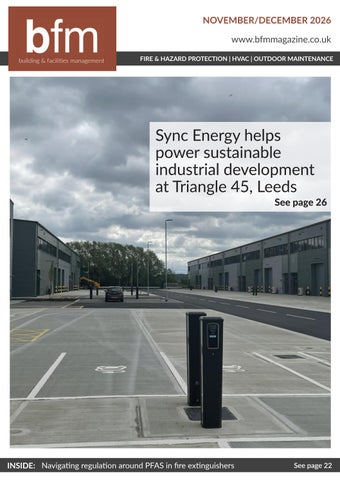
Sync Energy helps power sustainable industrial development at Triangle 45, Leeds
See page 26
INSIDE: Navigating regulation around PFAS in fire extinguishers
See page 22
Are you recycling WEEE
E
M
P
S
C
LA
IR IA L ES
R
EL E CO C VE T
BA TT ER
S IE
MS ITREEGS L E CAY WEE I R DB
&
ER M M NA O C MI
LU
£0
FREE LAMP RECYCLING
EXPERT SUPPORT, ALWAYS
ENVIRONMENTAL IMPACT
FREE container, collection and recycling for sites collecting 1000+ lamps each quarter.
Our WEEE specialists are on hand to help you with setup, queries, and paperwork
We help you monitor carbon footprint of your recycling – so you can see the difference you're making
Recolight operate the UK's largest collection network for fluorescent and LED lamps.
Sign up on the Recolight website:
info@recolight.co.uk | 020 8253 9750
On the cover: Sync Energy helps power sustainable industrial development at Triangle 45, Leeds
See page 26
Nov/Dec 2026
BFM Team
Contents
Business Development Director
James Scrivens
james@abbeypublishing.co.uk Production
Sarah Daviner
sarah@bfmmagazine.co.uk Accounts Manager
Katie Brehm
accounts@abbeypublishing.co.uk
x.com/BFM_Magazine www.linkedin.com/company/ bfm-magazine
BFM is published digitally 10 times a year b y Abbey Publishing Ltd. To receive a copy free of charge, contact our offices.
4
News
14
HVAC
20
Fire & Hazard Protection
26
Sustainability
34
Outdoor Maintenance
Email: bfm@abbeypublishing.co.uk www.bfmmagazine.co.uk www.abbeypublishing.co.uk Subscriptions are available via www.bfmmagazine.co.uk/subscribe No part of this publication may be reproduced by any means without prior permission from the publishers. The publishers do not accept any responsibility for, or necessarily agree with, any views expressed in articles, letters or supplied advertisements. Some manufacturers and suppliers have made a contribution toward the cost of reproducing some photographs in this magazine.
All contents © Abbey Publishing Ltd 2026 ISSN: 1470-5281
Building & Facilities Management
3
News
Mechline Developments challenges the industry to benchmark passive grease trap retention performance against BioCeptor UK catering equipment manufacturer Mechline Developments is inviting specifiers and distributors to benchmark the retention rates of passive grease traps against its BioCeptor tank. Recent independent recertification of BioCeptor demonstrates that trap volume should not be the primary consideration when specifying a product. BioCeptor’s tank has been certified to the ASME A112.14.3 and CSA B481.1 international standards, achieving 97.6% retention at maximum grease capacity, equivalent to more than 38.9 kg. Research by Mechline Developments following recertification also found that several competitor traps with stated capacities of 100 litres or more achieved lower retention rates than BioCeptor. In one case, a competitor trap with a stated capacity of 119 litres recorded a FOG (fats, oils and grease) retention rate more than 50% lower than BioCeptor in a like-for-like size comparison. Nick Falco, Technical Director at Mechline Developments, explains the significance of the findings: “A common assumption is that a larger grease trap will retain FOGS more effectively. However, size alone does not determine performance. Capacity is only one consideration; flow rate, retention efficiency and the technology used to manage FOGS within the system should also inform product selection. Our recent grease-retention testing demonstrates that tank size does not directly correlate with retention efficiency.” To support informed product selection, Mechline is making the results of the independent certification testing available to specifiers, distributors and end users. The testing was conducted at a globally recognised certification facility and provides performance-based evidence beyond the stated volume of a grease trap. Mechline also plans to raise awareness across the commercial foodservice sector of the importance of both trapping and treating FOGS (fats, oils, grease and starches). The complete BioCeptor system combines its ASME and CSA certified tank, with GreasePak 4
News
biological dosing1. The tank traps FOGS, while the biological dosing breaks them down. This combined solution can reduce the volume of contaminated FOGS requiring disposal and the frequency of licensed waste collections, helping operators lower maintenance costs. In fact, field trials showed that the presence of a BioCeptor tank with GreasePak fluid (versus without) extended the time between FOGS collections from 28 days to 12 weeks2 To learn more about BioCeptor, GreasePak and other Mechline Developments products, visit www.mechline.com. 1 GreasePak is Mechline’s multi-strain, naturally occurring bacterial fluid. It can be used as a standalone solution, or as part of BioCeptor as a multi-technology system. 2 For more information on BioCeptor’s Field Trials, with and without GreasePak biological dosing: https://www.mechline.com/wp-content/uploads/2020/03/BioCeptorSuccess-Story_-Testing-Field-Trials.pdf
Building & Facilities Management
protect | maintain | improve
WINTER COMES SOONER THAN YOU THINK. ARE YOU PREPARED? The best way to avoid winter disruption is to prepare before the temperatures drop. Summer is the time to give priority to reactive repairs, from potholes and drainage to fencing and surface defects. Then focus can move to putting a winter maintenance plan in place with site-specific professional weather forecasts, proactive gritting, and rapid response support. Stay safe, compliant, and operational through summer into winter.
0800 0432 911 | enquiries@outco.co.uk | OUTCO.CO.UK
News
GW Power triumphs at the Construction News Specialists Awards 2026
GW Power has been announced as the winner of the MEP Specialist of the Year at the Construction News Specialists Awards 2026. The Construction News Specialists Awards recognise the outstanding achievements of specialist contractors, suppliers and project teams that are setting new standards across the industry. This year’s finalists demonstrated exceptional innovation, technical excellence and a commitment to delivering high-quality outcomes across the built environment. Following an extensive judging process conducted by an independent panel of more than 100 industry experts, the winners were revealed on 3 September 2026 at the London Hilton on Park Lane. The event brought together leading organisations 8
News
and professionals from across the specialist construction sector to celebrate excellence and recognise those making a significant impact on the industry. GW Power received the MEP Specialist of the Year award in recognition of their outstanding achievement and contribution to specialist construction. Construction News editor Colin Marrs said: “Every entry pored over by our judges this year showed how much rides on the specialist contractor getting it right. The standard was exceptionally high, and the winners distinguished themselves through genuine
expertise, sharp problemsolving and a willingness to push beyond the obvious solution. “It is specialist contractors who turn ambitious designs into buildings that stand up, work properly and last. Congratulations to everyone shortlisted: this is recognition well earned.” Discover more about the CN Specialist Awards 2026 at: https://specialistsawards. constructionnews.co.uk/ cnsp2026/en/page/home Discover all the 2026 winners at: https://specialistsawards. constructionnews. co.uk/cnsp2026/en/ page/2026-winners Building & Facilities Management
Protect Monitor Control
Environmental monitoring experts and the AKCP partner for the UK & Eire.
Save Energy with AKCP Sensors Contact us for a FREE site survey or online demo to learn more about our industry leading environmental monitoring solutions and how they can help to reduce your energy costs. Scalable, with Ethernet and WiFi connectivity, over 20 sensor options for temperature, humidity, water leakage, airflow, AC and DC power, a 5 year warranty and automated email and SMS text alerts.
0800 030 6838 hello@serverroomenvironments.co.uk
Eradicate viruses
Cooling | Power | Fire | Racks | Monitoring
bacteria and IMPROVE HYGIENE
ACROSS HOSPITALITY with HyGenikx air and surface sanitiser.
SCAN the QR code to find out more about HyGenikx, or visit www.mechline.com www.bfmmagazine.co.uk
News
9
News
Codelocks launches ConnectShare locks for easy access and app-enabled management
Codelocks International Ltd, the global access control specialist, has launched ConnectShare, a new range of smart locks that use mobile phones to make access and management easy. Part of the Connect by Codelocks solutions, these latest locks build on the success of Codelocks’ existing range of connected locks, adding several new features and enhanced connectivity. ConnectShare locks have three access modes – user code, RFID card and mobile phone. They are managed through the easy-to-use Codelocks Connect App, which allows complete remote management of the locks from a mobile device. “One of the standout features of this release is the mobile phone access sharing,” said Joanne Milne-Rowe, Managing Director at Codelocks International Ltd. “Administrators can send a timebound credential directly to a user’s phone, give them access to a lock, and revoke it at any time. The process is entirely device-todevice, with no hidden subscription fees like other products often have, and with no reliance on an internet connection at the lock itself. Users simply download the free app, and admins can remotely give them access with a few simple clicks. “The Codelocks Connect App is central to the products too. Deep down, this is a simple standalone lock that’s easy to install and maintain. But paired with our app, it becomes the flexible and powerful solution that modern shared spaces need.” Key features that can be enabled using the app include 10
News
Codelocks NetCode® Technology for generating date and time-sensitive codes, GuestCode functionality that lets guests and temporary users set their own access code for the duration of their stay, and Do Not Disturb mode, which gives occupants privacy control – ideal for private spaces and changing rooms. The new features also include MultiAdmin functionality, which allows operators to assign shared management of individual locks, and Dual Authorisation, which adds an extra layer of protection for higher-security applications by requiring two valid credentials to be presented to unlock. ConnectShare locks introduce an activity log, a first for the Connect by Codelocks range of products. Unlike many other standalone locks, ConnectShare can log who has accessed a door and when, making it well suited to regulated environments in which sensitive materials or data may be present. “We spent a lot of time listening to customers during the development of ConnectShare, and making sure what we built reflected what they actually asked for”, said Joanne Milne-Rowe. “It’s backed by the same awardwinning customer and technical
support Codelocks is known for, so people aren’t just getting a product; they’re getting a service too.” ConnectShare locks are available now: the CL4500CC, a medium-duty option with latch and mortice configurations, and the CL5500CC, a heavy-duty option supporting latch, lock and panic access. Both are available in Brushed Steel, with Solid Black also offered on the CL5500CC. ConnectShare locks have completed independent fire testing to BS EN 1634-1 for 30-minute and 60-minute timber door sets when installed with a Codelocks FireKit and performance testing to BS EN 12209. Visit www.codelocks. co.uk/connectsharesmart-locks for more. Building & Facilities Management
Discover more about the Nilfisk CS7010
Nilfisk CS7010
Greener. Cleaner. Smarter. CS7010 reinvents an entire class of equipment by reducing total cost of ownership, including operation, labour and maintenance, while effectively increasing fuel economy and runtime efficiency. Now the most economical solution is also the most ecological. Sweep, scrub and dry in a single pass – a combination machine designed to maximise cleaning productivity while reducing labour time. High-capacity 285-litre debris hopper with high-lift system for extended cleaning time and efficient waste disposal. Patented DustGuard™ technology helps suppress airborne dust, improving cleanliness and operator comfort. SmartFlow™ system automatically adjusts water usage to machine speed, reducing water and chemical consumption. Enhanced operator safety and ease of use with ClearView™ sightlines, automatic speed reduction in turns, and intuitive OneTouch™ controls.
Nilfisk Ltd Nilfisk House • Bowerbank Way • Gilwilly Industrial Estate Penrith • Cumbria • CA11 9BQ Tel: 01768 868995 • Email: sales.uk@nilfisk.com
www.nilfisk.co.uk
News
Skanska and HID Bring Poland’s First Fully Digital-Wallet Access System to Warsaw The Warsaw deployment shows European commercial buildings can simplify access without sacrificing security Skanska CDE, a leading developer of modern office buildings across Central and Eastern Europe, has implemented a digital wallet access control system at its Studio A office building in Warsaw, as part of a growing shift among commercial buildings toward wallet-based credentials as the default. Aimed at removing the friction of separate access apps for employees, tenants and guests, the deployment is built on the company’s proprietary StudioApp web application and HID Origo Web Provisioning, a cloud-based credential management platform from HID, a global leader in trusted identity solutions. Located in Wola, the burgeoning business district in the Polish capital, Studio A is one of the first large-scale deployments in Europe built entirely on web provisioning rather than a dedicated mobile app. Employees and building staff receive an email invitation and can add their credentials to Apple Wallet or Google Wallet within seconds. Skanska CDE occupies a dual role in the project, as both the
12
News
developer behind the StudioApp integration and the system’s first end user, having deployed it across its Warsaw office before extending it to tenants and guests. The company is evaluating similar deployments across its other offices around the globe. Traditional mobile access card systems require users to download separate building apps, register accounts and go through activation processes, a barrier in corporate environments where security policies limit additional software installs. The Skanska-HID system at Studio A removes that step: users receive and activate their credentials directly within the wallet already installed on their phone. “Our intention was to create an intuitive, secure solution built to scale that responds to the real needs of tenants. The solution not only simplifies access but also meets high requirements in terms of data protection and operational security,” says Rafał Kot, Technical Quality Expert at Skanska Commercial Development Europe. “Moving away from physical badges toward fully digital and integrated solutions sets a new standard in designing and managing the access lifecycle process of a building or office space. In practice, the solution shows that the future of access control lies in systems that are invisible to the user, but highly effective and secure,” adds Mateusz Gluz, Senior Project Leader at Skanska Commercial Development Europe. Building & Facilities Management
News
Technology invisible at first glance The system is powered by HID Origo Web Provisioning for Wallet credentials. To issue a digital credential, an administrator needs only a user’s first name, last name and email address. The credential is delivered directly to the user’s Apple Wallet or Google Wallet through a secure link, with no app to download or install. Users simply tap their phone at the reader to gain access, using NFC technology. At the heart of the solution is the proprietary StudioApp web application, which serves as a central integration point between the access control system, the parking system and the HID Origo cloud back-end via a local server installed on site. “Web provisioning is a modern way to distribute digital Apple Wallet and Google Wallet credentials. It enables users to receive and install access cards directly via a web interface, without needing a mobile application, while maintaining full, real-time integration with the access control system. The Studio A project is one of the first in Europe where web provisioning serves as the default standard for all employees, tenants and guests using the Skanska property. It provides simple and fully automated onboarding,” comments Kamil Targalski, HID Business Development Manager for mobile access. This deployment demonstrates a faster, lowerfriction model for managing access across large office portfolios, without the ongoing cost of maintaining a dedicated mobile app. www.skanska.pl/oferta/Biura/ www.hidglobal.com www.bfmmagazine.co.uk
HVAC
Daikin publishes HVAC playbook for UK retail estates following record summer heat Daikin UK has published The modern retail systems playbook, a guide developed for retail decision-makers that shows how better HVAC planning can reduce energy use, operating costs and commercial risk without disrupting trade. The move comes amidst a growing trend towards climate change mitigation within the built environment, with many retailers recognising the need to invest in the thermal resilience of their estates. As shown by the recent extreme temperatures this summer, sustained heat places greater demand on in-store cooling and exposes the risks of running ageing equipment. Treating HVAC as a commercial issue, the playbook explores its influence on customer comfort, dwell time, energy spend and carbon performance. For teams managing multi-site retail estates, the guide sets out practical ways to control energy costs, improve consistency across sites and plan future investment without requiring an immediate estate-wide overhaul. It explains how to identify sites that are no longer performing as intended and where controls, maintenance or system changes could improve performance. The guide also considers how system selection can reflect the needs of different store formats, alongside ways to improve the operation of existing equipment. Martin Passingham, Commercial Business Manager at Daikin UK, said: “The past two summers have seen record-breaking temperatures and have underlined that protecting customer comfort is a key commercial priority. Uncomfortably hot stores can 14
HVAC
affect the customer experience, dwell time and revenue. Waiting until ageing HVAC equipment fails can also increase costs and cause avoidable disruption. Most estates are running a mix of equipment across very different store formats, so there’s rarely a single answer. The playbook is designed to help estate and sustainability teams find the quick wins on energy and plan replacements on their own timeline rather than waiting for a failure to force the decision.” The playbook was launched at Daikin UK’s first Retail & Leisure Summit, held at the Barbican in London. The event brought together estates, facilities and procurement professionals, developers and industry specialists from across the retail, leisure and hospitality sectors. With a keynote
talk from Katie Clemence-Jackson, CEO of the UK Net Zero Carbon Buildings Standard, sessions covered customer comfort, cost control, energy security and supply chain resilience, illustrated by case studies and practical experience. The playbook is available to download at https://bit.ly/ DaikinUK-Retail-Playbook Building & Facilities Management
HVAC
From 10 -110 kW Units Modular Linking Up To 1,760 kW Hot Water Output Up 65°C Effective Down To -25°C Ambient A+ to A+++ ErP efficiency rating
ADV-W Air Source Heat Pumps For Commercial Water Heating
Award-Winning, Cost-Effective, Carbon Reduction
- HEAT PUMPS - SOLAR THERMAL - ELECTRIC BOILERS - CYLINDERS - HYBRID PLANT ROOMS -
01252 551 540 adveco.co
www.bfmmagazine.co.uk
HVAC
15
HVAC
Industry Backs Call for Better Insulation Standards on Commercial Heat Pumps A campaign calling for an end to the use of non-UV resistant flexible foam insulation on externally located services has gained the backing of major industry bodies representing manufacturers, building engineering and refrigeration. The ‘Proof is on the Roof’ campaign, launched in 2025 by refrigeration efficiency expert Lawrence Leask FInstR and Chris Ridge of the Thermal Insulation Contractors Association (TICA), is now backed by CEFEP, the European association representing FEF and PEF insulation manufacturers, the Building Engineering Services Association (BESA) and the Institute of Refrigeration (IOR). Leask and Ridge launched the campaign after Leask witnessed degraded refrigeration pipe insulation on nearly all of his TM44 inspections. Lawrence Leask said: “Over several years of external pipework inspections, I’ve witnessed the environmental impact of using non-UV resistant pipe insulation materials on heat pumps. The energy losses we are incurring through incorrectly specified and installed thermal insulation is equivalent to that of a large power station.” Chris Ridge, TICA’s Technical Director, added: “Thermal insulation of pipework is a genuine low hanging fruit for decarbonisation, but it is often no more than an afterthought. The sheer scale of energy losses resulting from poorly insulated pipework should not be ignored by our policymakers.” While the majority of pipe insulation installations require a thermal insulation specialist, 16
HVAC
commercial air-to-air heat pump installations are usually insulated by the refrigeration contractor. With competence frameworks for the refrigeration, air conditioning and heat pump trades currently being developed, campaigners believe there is now an opportunity to address the knowledge gap around correctly specifying and installing thermal insulation. Kevin Morrissey, Technical Director of BESA, said: “This is another excellent example of an easily rectified, widespread problem that would make a significant contribution to improving performance and reducing environmental harm. “The solutions are there and the financial case is persuasive; we just need to work harder on raising awareness – and the best way to do that is for industry bodies to collaborate and support TICA with this timely campaign. The IOR also supports the campaign, stating: “The growth in heat pump installations presents a significant opportunity, but it also
An example of degraded refrigeration pipe insulation
highlights the importance of getting installations right. The ‘Proof is on the Roof’ campaign has brought attention to an issue that can be easily resolved, and we are delighted to support the campaign in helping spread awareness of this simple and effective solution.” Tom Merton, Technical Manager at CEFEP member Armacell, added: “The choice of insulation for external applications requires a greater focus on long-term exposure to sunlight, rain, frost and temperature cycling. UV and weather-resistant insulation help maintain thermal performance, condensation control and energy efficiency while reducing the risk of cracking, moisture ingress and premature replacement.” The supporting associations are united in calling for better awareness across the market and say improvements can be made immediately using products and solutions that already exist. https://tica-acad.co.uk/ticahome/ Building & Facilities Management
Scan for more information or to order your FREE sample of Aqua Fend*
ONE OF THESE PANELS IS NOT LIKE THE OTHERS... This picture was taken 24 months after all the panels had been professionally cleaned, but only one had been treated with Aqua Fend® F after cleaning. This real-life result shows that Aqua Fend® has been developed to PROTECT your building’s façade and flooring, PREVENT longterm damage caused by water ingress and urban pollution, and PRESERVE the original structure and colour for as long as possible after cleaning. The Aqua Fend® range helps you to reduce cleaning and maintenance costs while keeping your walls and floors clean.
CLEAR PROTECTION, DOES NOT CHANGE COLOUR NON FILM FORMING: LETS THE SURFACE BREATHE IDEAL FOR NATURAL STONE, CONCRETE, BRICK, & TERRACOTTA INTERIOR/EXTERIOR
For more information or to purchase Aqua Fend® products, visit aquafend.co.uk *One sample bottle per business address, UK only. Aqua Fend® reserve the right to alter, amend, or withdraw the free sample offer without prior written warning.
ECONOMICAL UP TO 16M2/LTR* • WATER BASED; SILICONE FREE • NON-HAZARDOUS, ODOURLESS • 0.0% VOC
HVAC
Precise, high-spec thermoregulators support product quality and consistency at Unilever’s Magnum ice cream facility in Gloucester Unilever, one of the world’s leading consumer goods companies, operates a worldclass ice cream manufacturing facility in Gloucester, home to the production of the Magnum ice cream brand. The facility relies on state-of-the-art automation and highly precise process control to maintain the premium quality and consistent finish that consumers expect from the brand’s signature thick chocolate shell. To support the critical chocolate dipping stage of the Magnum production line, Unilever collaborated with its long-term partner, ICS Cool Energy, to deploy high-specification, food-safe temperature control technology. ICS Cool Energy supplied thermoregulator units, helping Unilever ensure precise temperature stability, maximising production uptime and process efficiency on the high-speed line.
Challenge In food manufacturing, process temperature control is often critical to both product quality and production stability. Even small temperature fluctuations can affect consistency, cycle times and repeatability, particularly in applications where products move through tightly controlled thermal stages. The chocolate dipping process is one of the sensitive phases of Magnum ice cream production. To achieve the uniform thickness of the outer chocolate shell, the liquid chocolate must be maintained at a stable and precise temperature just before and during the dipping stage. If the temperature deviates, the viscosity of the chocolate changes. 18
HVAC
Given the high-throughput nature of the Gloucester line, temperature fluctuations can affect batch production, dragging down cycle times and impacting overall factory output. Unilever recognised that the line required a process-dedicated, highly reliable temperature control solution designed to the highest hygienic standards. Because the equipment operates directly within a food manufacturing environment,
the units had to be constructed to withstand strict washdown regimes and comply with stringent food safety regulations.
Solution As a trusted, long-term partner of Unilever, ICS Cool Energy was engaged to supply the temperature control solution specified to the demands of the Magnum production line. Building & Facilities Management
HVAC Following a detailed technical assessment, ICS Cool Energy recommended the i-Temp compact 18kW temperature control units (TCU) specified to match the previously supplied equipment already in operation at the site. Constructed with highgrade stainless-steel bodies, internal pipework, and fittings, the units prevent any risk of corrosion and simplify clean-inplace washdown procedures. The new thermoregulators have been integrated directly into the chocolate supply loop of the dipping line. They work by precisely regulating the temperature of the heat transfer fluid circulating through the jacketed pipes and vessels holding the liquid chocolate. By continuously monitoring and adjusting the thermal energy delivered to the chocolate jackets, the TCUs maintain the chocolate within a tight tolerance window. The units allow specific application and recipe data to be stored and saved. This built-in intelligence automatically adjusts for changes in the ambient air and central factory cooling water temperatures. As a result, a
batch of chocolate produced during hot ambient conditions in August will deliver the exact same quality and consistency as one made in January.
Results The installation of the highspecification stainless steel TCUs has reinforced the reliability of the production line, delivering the thermal precision needed to guarantee a consistent, highquality product. The sanitary stainless-steel construction has seamlessly integrated into Unilever’s stringent hygiene protocols at Gloucester, ensuring long-term durability and trouble-free operation. Wojciech Worobec at Unilever, said: “This is a process-critical application for us, where stable chocolate temperature is essential to the Magnum dipping line. ICS Cool Energy understood the requirement and supplied a solution that aligned with the needs of the process and the standards of the site. Having worked with them over a number of years, we value their responsiveness and their understanding of what reliable temperature control means in a
manufacturing environment.” Will Coles, Regional Sales Manager at ICS Cool Energy, commented: “In food and beverage manufacturing, temperature control is directly tied to product quality, batch consistency, and food safety. In many food processing plants, operators accept production downtime of up to 20% or more as a “necessary evil” caused by temperature instability and batch failures. By investing in dedicated, high-specification TCUs, Unilever has insulated its process from these vulnerabilities, ensuring continuous, highefficiency throughput.” While the current thermoregulator configuration operates as a heat-only system, ICS Cool Energy and Unilever are already planning the next phase of operational optimisation involving adding dedicated, process-grade ICS Cool Energy chiller to the units. By linking a process chiller to the TCUs, the system will become a fully dynamic heating and cooling circuit. For more information, visit www.icscoolenergy.com or www.tranetechnologies.com.
SUBSCRIBE www.bfmmagazine.co.uk
www.bfmmagazine.co.uk
HVAC
19
Fire & Hazard Protection
Medway NHS Foundation Trust digitises fire risk management Medway NHS Foundation Trust, which operates Medway Maritime Hospital, has introduced a new digital system to manage fire safety information and improve its understanding of fire risks across the hospital estate. By taking data from multiple sources, the BIS Lens system created by data experts BIS Consult, provides the Trust’s Fire Safety Group with a new strategic tool designed to bring together and analyse fire risk assessment information centrally. In one example, using the tool to examine fire assessments collectively revealed how a single, estate-wide approach to cabling issues would be more cost effective than several individual repairs. Medway NHS Foundation Trust is a single-site hospital Trust based in Gillingham, Kent serving more than 427,000 people across Medway and Swale. Neil McElduff, Director of Estates and Facilities for the Trust, said: “The new system is a significant step in our shift towards digital. It underpins the strategic direction of fire safety management and will help maintain a safe environment across our hospital. The work to date shows the system’s potential to drive similar insights for other critical areas of risk and compliance across the Trust.” New insights generated from interactive dashboards will support fire safety review meetings and help guide the Trust’s investment decisions by making it easier to identify priority risks, outstanding actions and recurring themes across the whole estate, such as further fire risk assessments, fire door replacement or new evacuation plans. 20
Fire & Hazard Protection
Like many NHS estates, the Trust’s fire safety information was previously held across numerous separate records and documents, making it difficult to analyse information collectively. Jason Brittin, Capital Projects/ Programme Manager for the Trust, who led the project, said: “The BIS Consult solution has demonstrated how we can transform the way we manage fire safety information across our hospital estate. The improved visibility of risk will help our fire safety and estates teams prioritise action, support regulatory compliance and make more efficient investment decisions.” BIS Consult has previously developed similar risk management systems for Manchester University NHS Foundation Trust and Airedale General Hospital, tackling asset condition, asbestos and RAAC. Nick Campbell-Voegt, Managing Director of BIS Consult, said: “The digital tool enables Medway NHS Foundation Trust to take a more connected, data-driven approach to risk reduction. By developing a single source of truth, it gives teams clearer priorities and ultimately helps create safer hospitals. Other areas of NHS
estate risk can benefit from the same method, including water safety and structural condition of buildings or other assets.” The new structured digital approach supports NHS guidance for managing fire safety, including HTM 05-03, which explains how NHS organisations should assess fire risk and HTM 0501, which provides the wider framework for managing fire safety across healthcare buildings. It also supports the ‘Golden thread’ principle of keeping accurate and accessible fire safety information available throughout the life of a building. www.bisconsult.co.uk www.medway.nhs.uk/about-us/ Building & Facilities Management
We’re now six years into our contract with Britannia Fire and are really pleased with the service, the convenience and the cost-savings we’ve experienced so far.
Ten years on, it is now time to refurbish our P50 extinguishers. With the impending PFAS ban, we have decided to get ahead of the game and switch to the P50-ECO.
Bob Bantock
Nick Greenwood
Operational Risk Business Partner
+44 (0)1508 488416
Fire Safety Manager
sales@britannia-fire.co.uk
On average we are installing half the number of P50 extinguishers compared to the old metal ones in our new sites or existing sites going through renewals of extinguishers. Malcolm Shevlin
PureGym’s Head of Risk
www.britannia-fire.co.uk
Fire & Hazard Protection
Navigating regulation around PFAS in fire extinguishers Andy Spence, Managing Director of Britannia Fire, discusses the anticipated ban on PFAS in firefighting foams and provides advice for managing the transition to PFAS-free fire extinguishers. PFAS or ‘forever chemicals’ are currently under scrutiny due to emerging concerns around their environmental impact and health risks. These substances can be found in many consumer goods and industrial processes and are commonly used in firefighting foams. The UK Government is considering whether to ban PFAS in firefighting foam and extinguishers, which has led to misinformation circulating that fire extinguishers containing PFAS are illegal and must be changed immediately. It’s important to stress that for now, they remain legal and there is time to phase them out in an orderly and cost-effective way.
Anticipated legislation Across the European Union, regulation to restrict PFAS in firefighting foams came into force in October last year. PFAS is slowly being phased out and will be banned in most scenarios from October 2030. From late 2026, PFAS warning labels must be put on EU products and users must have a detailed plan for foam management, disposal, and transition. The UK is yet to announce a ban of PFAS in firefighting foam, but it is expected to follow Europe’s lead. In February, the Department for the Environment, Food and Rural Affairs published a PFAS plan, which outlines key steps the government will take to understand, manage and reduce exposure to PFAS. 22
Fire & Hazard Protection
The Health and Safety Executive (HSE), the agency which regulates chemicals placed on the market in Great Britain, has been investigating PFAS, with a focus on environmental contamination and the potential consequences on human health. In 2025, it presented its scientific analysis and evidence for the potential restriction of PFAS in firefighting foams. In terms of timescales for a potential ban, the HSE is suggesting a similar staggered approach to the EU. For fire extinguishers, it suggests a ban on sales within six months of legislation being passed, and a five-year transition period to phase out existing equipment. It’s also suggesting a transition period of 18 months for sale and use in fire training and 10 years for high-risk industrial sites and oil and gas installations. A consultation has been conducted, allowing interested parties to comment, and feedback will now help inform potential UK regulatory steps. The HSE is expected to publish its final opinion in the coming months, with a decision on UK-wide restrictions to follow soon after.
The challenges As the UK’s leading fire extinguisher manufacturer, Britannia Fire was invited to address the Environmental Audit Committee in the House of Commons in June last year,
sharing our own experience of phasing out PFAS from our products with the aim of helping policymakers understand the practical realities of a transition. I told the committee that a successful phaseout of PFAS fire extinguishers will be dependent on several limiting factors: • Disposal bottlenecks. With only two UKapproved facilities able to incinerate PFAS foam waste, backlogs are already growing and will only get worse. Units contaminated with PFAS cannot be reused or recycled, further compounding the issue. • Increasing costs. As demand for compliant disposal grows, so too will the associated costs. • Customer confusion. Many end-users remain unclear on timescales and steps they should be taking now. There is also some confusion around an existing ban on certain PFAS, such as PFOA and PFOS, which were once widely used in firefighting foam. They have now been phased out but have been replaced with other PFAS. I called for urgent action to streamline disposal methods and for a review of existing servicing requirements which could enable a more flexible and realistic phaseout timeline. Building & Facilities Management
Fire & Hazard Protection Top tips In the meantime, to prepare for a potential UK ban, my first piece of advice would be not to panic! There will be a staggered approach to phasing out PFAS and if we look at the proposed timescales, it’s unlikely fire extinguishers containing PFAS will be phased out before 2031. Any organisation with fire extinguishers should start by reviewing their stock to establish what will need replacing and put in place an action plan as part of their usual fire risk assessment. In the following circumstances, we’d recommend making the switch now to avoid the need for premature replacements in the future: • If existing stock is at the end of life and due for replacement. • If existing units are discharged and need replacing or have failed an inspection. • If new extinguisher requirements become apparent after routine fire risk assessments.
Find a reputable supplier When making the switch, allow plenty of time for transition. It’s best to find a reputable UK supplier that will support you through the whole process and provide comprehensive aftercare. It’s also important to look at all the options on the market and make an informed choice. Customers tend to want fire extinguishers that are longer lasting, easily maintained, more cost-effective and eco-friendly. Traditionally, steel fire extinguishers have been the go-to solution for facilities managers and fire safety professionals, but they are prone to corrosion and therefore need servicing every year and replacing every five years. They are also difficult to recycle. Composite fire extinguishers such as our P50 range, are helping organisations meet stringent waste and carbon reduction targets and simplifying fire safety. They’re made from a unique combination of durable plastic and aramid fibres, meaning they are strong, don’t corrode and therefore last 20 years, with a full service required only after 10 years. Crucially, we recognised the detrimental effects of PFAS some time ago and www.bfmmagazine.co.uk
removed them from all Britannia Fire products in 2024. Our composite, PFAS-free P50s are used worldwide and conform to all required regulations and standards. They have passed BS EN3-7 tests, demonstrating safety across various fire types, including Class A and B fires, as well as electrical fires, meaning often only one is required at a fire point rather than two.
Sensible planning for a smooth transition The proposed PFAS ban does not need to be disruptive or costly for UK businesses, provided action is taken early and thoughtfully.
While legislation is still under consultation, the direction of travel is clear: PFAS-free firefighting equipment will become the standard. By integrating PFAS considerations into existing fire risk assessments, replacing units at natural end-of-life points and working with a trusted UK manufacturer, organisations can spread costs, avoid future disposal challenges and remain compliant without unnecessary upheaval. The key message is simple: don’t panic, but don’t delay. Sensible planning now will ensure a smooth, future-proof transition. For further information visit: www.britannia-fire.co.uk Fire & Hazard Protection
23
Fire & Hazard Protection
Fire safety rules reshape drainage specification at White City Brymec has supplied the cast iron drainage package for White City Living Phase 4, a 28-storey residential development in west London. Amendments to Approved Document B, coming into force this September, are prompting a wider reassessment of material selection on high-rise residential schemes. Noncombustible performance is now a specification requirement at every stage of design, including drainage. At 28 storeys, White City Living Phase 4 falls within scope. The project is being developed by St. James Group, part of Berkeley Group. The scheme comprises 503 apartments across three residential blocks, with completion expected in December 2027. Berkeley Group PLC is the main contractor and A&J Ryan Mechanical Services Ltd is the MEP contractor. Cast iron drainage was specified for its fire performance, durability, acoustic properties and long operational lifespan. Brymec’s system is rated noncombustible and achieved an A1 fire classification when tested to BS EN 13501-1 as a system. Brymec was subsequently appointed to manufacture, supply, and deliver the cast-iron drainage package, following a technical submittal process. Installation began in December
24
Fire & Hazard Protection
2025, with Brymec supplying 642 metres of cast iron pipe to site across more than 30 deliveries to date. Once installation was complete, Brymec’s Specification Director inspected the work on site and provided A&J Ryan with a formal quality assurance report for Berkeley Group. Jeremy Douglas, Specification Director at Brymec, said: “On a building of this height, the drainage system has to perform as one certified system, not a collection of individually tested components. Cast iron’s A1 fire rating and its acoustic and durability credentials made it the right specification for White City Living. We documented the technical case from the design stage, so the project team had the assurance they needed throughout.”
Gary Thorp, Projects Manager, A&J Ryan Mechanical Services Ltd, said: “Berkeley Group’s standards on this development are exceptionally high, which demands the same standard from every supply chain partner involved. Brymec provided a well-supported technical solution from the outset and has delivered consistently throughout the project.” For more information, please visit Brymec.
Building & Facilities Management
Offset 30% Of Annual Hot Water Energy Demands Low Maintenance Flat Plate Collectors With Drain Back Integrate With Gas, Electric & Heat Pumps Smaller Roof- or Wall-Mounted Footprint Alongside Solar PV New System or Existing Refurbishment Designs
Solar Thermal For Commercial Water Heating
Award-Winning, Cost-Effective, Carbon Reduction
- HEAT PUMPS - SOLAR THERMAL - ELECTRIC BOILERS - CYLINDERS - HYBRID PLANT ROOMS -
01252 551 540 adveco.co
Our Standards. Your Guarantee. CHSA Certification Marks guarantee ‘what’s on the box is what’s in the box’. Independent inspection assures Scheme conformance.
Every CHSA member has signed our Code of Practice, which includes the Competition & Markets Authority’s Green Claims Code.
For more information: 0800 243919 www.chsa.co.uk
www.bfmmagazine.co.uk
Fire & Hazard Protection
25
Sustainability
Sync Energy helps power sustainable industrial development at Triangle 45, Leeds
Sync Energy has supplied and supported the installation of 26 dual EV chargers at Triangle 45 (T45), a brand-new industrial and trade counter development in Leeds, helping deliver future-ready charging infrastructure that complements the site’s strong sustainability credentials. Developed as a high-specification industrial estate comprising 23 flexible commercial units, T45 has been designed with sustainability at its core. Alongside solar PV panels and LED lighting, the development features on-site EV charging facilities, ensuring occupiers and visitors have access to reliable electric vehicle charging from day one.
Reliable performance Sync Energy, working with engineering consultancy Cudd Bentley and installation contractor Ivegate, provided an EV charging solution that combined ease of installation, technical performance and long-term reliability. The close collaboration between the project team ensured the charging infrastructure met the practical needs of the development while supporting its environmental ambitions. The project features 26 of Sync Energy’s 7kW Dual Floor Pro Chargers, selected for their innovative design and installation efficiencies. Requiring just a single electrical supply to each dual charger and arriving ready for installation, the units helped reduce installation time and labour requirements, delivering a cost-effective solution for the development.
Balancing the load
Maximising the site’s available electrical capacity, Sync Energy also supplied 15 CT Clamps to enable dynamic load 26
Sustainability
balancing across the installation. This intelligent technology allows the chargers to monitor and manage available power, ensuring efficient operation while protecting the site’s electrical infrastructure as demand changes. Throughout the project, Sync Energy worked closely with Cudd Bentley, providing technical expertise and ongoing support from specification through to installation. This collaborative approach helped ensure the EV charging infrastructure aligned with the wider sustainability objectives of the development, creating a future-ready solution for occupiers and visitors alike. Tom O’Gara of Cudd Bentley said: “Triangle 45 was designed with sustainability and future occupier needs firmly in mind, so it was important that the EV charging infrastructure reflected those ambitions. Working with Sync Energy gave us confidence that we were specifying a solution that was straightforward to install, technically
robust and backed by excellent support throughout the project.” Karmvir Hundal, Business Development Manager at Sync Energy, said, “Triangle 45 is a fantastic example of how collaboration between consultants, contractors and manufacturers can deliver the best outcome for a project. By working closely with Cudd Bentley and the installation team, we were able to provide an EV charging solution that offers installation efficiencies, intelligent load management and a reliable charging experience for future occupiers. We’re delighted to have played a part in such a forward-thinking development.” For more information about the Sync Energy EV charging range, visit sync.energy. Sync Energy is part of the Luceco Group, an internationally recognised market leader across key electrical categories. Building & Facilities Management
Beautifully Intelligent
Cleaning & Hygiene
EV Charging Designed for your buildings, engineered for your energy demands. Discover a more intelligent approach to fleet and commercial EV charging.
Dynamic load management Balance EV charging with your buildingʼs available electrical capacity.
Intelligent energy optimisation Coordinate charging with energy demand, tariffs and on-site solar generation.
Scalable charging infrastructure Flexible AC and rapid DC charging solutions for commercial buildings, estates and fleets.
Your UK Smappee supplier www.bfmmagazine.co.uk
www.elcomponent.co.uk Cleaning & Hygiene
27
Sustainability
Heat Pumps, Hot Water And A Sustainable Public Sector Air source heat pumps (ASHPs) have rapidly moved from a niche sustainability technology to a central consideration for domestic hot water (DHW) at commercial scale. As UK public sector organisations seek to reduce carbon emissions and strengthen ESG performance, increasingly stringent building regulations are positioning heat pumps as one of the most viable routes, particularly in new builds, to low-carbon hot water. Unlike conventional boilers, ASHPs do not generate heat through combustion. They use electricity and a refrigerant circuit to extract thermal energy from ambient air and transfer it into a DHW system. Under favourable conditions, modern systems can achieve high coefficients of performance (COP), delivering three to four units of heat for every unit of electricity consumed. This efficiency provides significant carbon-saving potential compared with direct electric or gas heating alone. Policy is also accelerating adoption. Building decarbonisation across the public sector remains central to the UK’s net-zero strategy, with electrification of heat expected to play an increasingly important role. As a result, lowcarbon heating is moving from an optional sustainability measure towards an important consideration for future building compliance. However, commercial DHW presents challenges often overlooked in general discussions about heat pumps. Hotels, student accommodation, care homes, healthcare facilities, leisure centres and educational establishments can require large volumes of hot water during concentrated peak periods. They must also manage 28
Sustainability
legionella risk, typically requiring stored water temperatures of at least 60°C. Heat pumps achieve their highest efficiencies at lower temperatures. This creates a key challenge. An ASHP can efficiently raise incoming water temperatures to around 55°C, but consistently achieving higher temperatures can reduce efficiency and increase electricity consumption. Higher-temperature ASHPs can also be more expensive, larger and heavier, adding installation complexity. Refrigerant choice further complicates specification. The European Union’s F-Gas Regulation 2024/573 has accelerated the move towards lower-GWP alternatives to traditional HFC refrigerants. Natural refrigerants such as carbon dioxide (CO₂) and propane (R290), capable of supporting higher-temperature production, are consequently attracting attention. Refrigerant selection, however, cannot be based solely on environmental or heat-generating credentials. CO₂ systems can present operational challenges in some DHW applications, while propane’s high flammability requires careful consideration of system design, installation and maintenance. At Adveco, we have chosen not to carry large propane ASHPs, favouring more compact, lightweight and costeffective R32 systems through our ADV-W range. We believe propane units are currently better suited to smaller-scale applications while safety considerations continue to be addressed. Successful commercial DHW design is therefore less about maximising heat pump output and more about intelligent system integration. Hybrid systems offer
a pragmatic response. Heat pumps can provide most annual energy input while operating within their most efficient range, with a secondary heat source, preferably an electric boiler, providing temperature uplift and supporting peak demand. Appropriately sized thermal storage is equally important. Traditional gas-fired systems often combined high heat input with relatively small storage volumes. Heat pump systems benefit from reversing this principle. Larger cylinders allow water to be heated gradually, enabling the heat pump to operate steadily and efficiently while maintaining sufficient reserves for periods of peak demand. For building owners and estates managers, the priority should therefore be demand rather than technology. Robust metering, consumption analysis and accurate assessment of peak loads should precede equipment selection. A well-designed hybrid solution, such as Adveco’s awardwinning FUSION, can offer better efficiency and lifecycle value than simply specifying a larger standalone heat pump. Ultimately, ASHPs are a proven option for well-designed commercial DHW applications, but they are neither a universal boiler replacement nor a silver bullet for decarbonisation. Their greatest value comes from combining heat pumps, appropriate storage and intelligent system integration. A pragmatic, demand-led approach can reduce emissions and operating costs while delivering resilient hot water systems fit for a low-carbon future. https://adveco.co/ Building & Facilities Management
SPECIFY CFA MEMBERS
for sustainability support and advice on your flooring projects Specifying CFA members for your flooring projects means you’ll be gaining a wealth of experience from vetted contractors with the knowledge and products to fulfil your specification with a sustainability criteria. CFA members are part of a supply chain that includes specialist contract flooring contractors, manufacturers and distributors, all of whom promote the highest standards and expertise.
PLUS! Get the very latest contract flooring news @ floorscape.org.uk Clockwise from left: Mapei UK Ltd, Flooring Matters SW Ltd, Loughton Contracts plc
cfa.org.uk
T: 0115 941 1126
E: info@cfa.org.uk
FIND OUT MORE
Download the "Why Choose a CFA Member" leaflet from cfa.org.uk
Sustainability
Understanding Solar Thermal For Strategic Decarbonisation
Decarbonising the UK’s public sector estate requires more than replacing fossil fuel plant with electrical alternatives. Schools, universities, healthcare facilities, leisure centres, offices and other public buildings need renewable strategies that consider how energy is consumed, particularly where domestic hot water (DHW) represents a significant and predictable load. Solar thermal offers a proven way to address this demand directly. Rather than generating electricity, collectors capture solar 30
Sustainability
energy as heat and transfer it to stored water. Used as preheat, solar thermal reduces the energy subsequently required from gas, electric or heat-pump water heating. For buildings with consistent hot-water demand, a well-designed system can typically offset at least 30% of annual water-heating energy demand, with greater contributions possible by location and during summer. Public buildings can be particularly well suited to solar thermal because many combine available roof space with regular
hot-water demand. Schools and colleges require DHW for washrooms, kitchens and, where provided, showers and changing areas. Healthcare and leisure facilities can present even greater year-round requirements. The technology also supports both new-build and retrofit strategies. Existing gas-fired systems can use solar thermal preheat to reduce fossil fuel consumption, while buildings transitioning to electric water heating can use the same principle to reduce electrical demand and operational costs. Building & Facilities Management
Sustainability around 3,400 kWh annually requires approximately 20 m² of PV compared with around 5 m² of solar thermal. A further comparison illustrates the implications for constrained rooftops. A typical 4 kW PV installation can require around 16 panels occupying 25 m², while three flat-plate solar thermal collectors occupy just 6.6 m² for equivalent hot water output. This supports a simple strategic principle: use PV to address electrical demand and solar thermal to address thermal hot water demand. Rather than oversizing PV to generate electricity that is then converted back into heat, roof space can be allocated according to a building’s electrical and thermal requirements. A “Best in Class” approach therefore sizes PV against a building’s base electrical load while using solar thermal to meet part of its thermal load. For public estates with constrained roof space, this can maximise the useful renewable contribution available from each square metre.
Why Solar Thermal Should Be Planned Alongside Solar PV Solar PV is an important technology for generating renewable electricity, but allocating all available roof space to PV may not deliver the most efficient overall renewable strategy where a building also has substantial hot water demand. Solar thermal can provide approximately 770 W/m² peak output and 650 kWh/m² annual contribution, compared with approximately 200 W/m² and 160 kWh/m² respectively for PV when addressing thermal demand. On this basis, producing
www.bfmmagazine.co.uk
Hybrid Systems for Long-Term Reliability Solar thermal need not replace existing water heating plant. Its value lies in reducing how much work that plant must perform. With gas-fired water heating, preheat reduces gas consumption. With direct electric systems, useful solar heat reduces purchased electricity. Solar thermal can therefore be combined with packaged electric water heating to support the transition towards lower-carbon, all-electric DHW. For larger public buildings, solar thermal can also complement heat pumps. One approach uses an air source heat pump for initial low temperature preheat, solar
thermal for a further renewable temperature lift, and electric heating to achieve final operating temperatures and meet peak demand. This allows each technology to operate where it provides greatest benefit. Modern flat-plate solar thermal systems can incorporate Drain Back technology to protect against stagnation and overheating. When heat is not required, solar fluid drains from the collectors, protecting the glycol from prolonged high temperatures. This can reduce maintenance requirements and removes the need to dump unwanted solar heat into large storage systems. It also creates an opportunity to reconsider older public sector solar installations that have fallen out of service. Modern collectors, controls and Drain Back protection can potentially restore renewable hot water generation rather than abandoning existing solar infrastructure.
A More Effective Renewable Strategy Public sector renewable planning should ultimately seek the greatest practical energy and carbon benefit from the whole building. For buildings with substantial DHW demand, that means considering PV for electricity, solar thermal for hot water, and efficient electric or heat pump technologies for remaining demand. Rather than competing for space within a decarbonisation strategy, solar PV and solar thermal can be more effective when specified together, with each technology doing the job it does best. https://adveco.co/
Sustainability
31
Sustainability
The growing role of architects in sustainable construction: why material choices define the sustainability of new homes Achieving meaningful progress will depend on collaboration. Architects bring the vision and expertise to create homes that meet the needs of future generations, while manufacturers provide the technical knowledge, product innovation and supporting data needed to turn sustainability ambitions into reality. Together, they could reshape how homes are designed and built. The housing sector is entering a new phase in the sustainability journey. For years, the conversation centred on operational performance, with developers focused on improving insulation, reducing energy consumption, and incorporating renewable technologies into new homes. While these measures remain essential, the industry’s understanding of sustainability is now far more sophisticated. Increasingly, attention is turning to embodied carbon and the environmental impact of the materials used to construct buildings in the first place. As a result, the role of the architect is evolving. No longer solely responsible for creating buildings that are functional, attractive and compliant, 32
Sustainability
architects are becoming key decision-makers in determining the whole-life sustainability of residential developments. The choices made during the design phase will have a lasting influence on a home’s environmental footprint, making architects critical contributors to the UK’s net-zero ambitions. At the heart of this shift lies material selection. As operational emissions are reduced through tighter regulations and cleaner energy systems, embodied carbon is accounting for a greater proportion of a building’s overall environmental impact. The materials specified for walls, floors, roofs, and interiors will increasingly determine how sustainable a home ultimately is. This means architects are being asked to evaluate materials differently. Traditional considerations such as performance, durability, safety and cost remain important, but they are now accompanied by a growing need to understand
the environmental credentials of products. Questions around resource efficiency, carbon storage, lifecycle performance and responsible sourcing are becoming central to specification decisions. With these expectations growing, architects are relying more heavily on manufacturers for support. The most effective manufacturers are no longer simply product suppliers. They are becoming technical partners that help project teams navigate increasingly complex sustainability requirements and make informed decisions at the earliest stages of design. This early engagement is particularly valuable because the greatest opportunities to improve a building’s sustainability are often established before specifications are finalised. Decisions regarding structural systems, construction methods and material strategies can have a significant impact on embodied carbon and overall Building & Facilities Management
Sustainability environmental performance. Bringing manufacturers into these conversations allows architects to evaluate options earlier, helping them align design ambitions with practical and environmental objectives. West Fraser has recognised the importance of supporting architects throughout this process. Through its dedicated Architects’ Support Hub, the company provides resources designed to assist with specification and design decisions, including RIBAapproved CPD materials, BIM objects, product datasheets, lifecycle assessment information, case studies and product samples. These resources are intended to help architects better understand product performance and sustainability considerations as projects develop. The importance of reliable data cannot be overstated. As clients, planners and regulators seek greater transparency around sustainability performance, architects increasingly need evidence to support material choices. Access to robust technical information and lifecycle assessment data allows design teams to compare solutions and understand the environmental implications of different specifications. Manufacturers that provide clear, transparent information can help architects make more informed decisions and demonstrate how their choices contribute to wider sustainability objectives. This growing focus on materials is one of the reasons timber-based construction continues to gain momentum. Timber is a renewable resource that stores carbon during its growth and generally requires less energy to produce than many traditional construction materials. It also offers the potential for faster construction programmes, particularly when www.bfmmagazine.co.uk
used within modern timber-frame systems. These characteristics are making engineered wood products an increasingly attractive option for architects seeking to reduce embodied carbon while maintaining performance and buildability. West Fraser’s product portfolio demonstrates how material choices can support these objectives across a building’s structure and interior. SterlingOSB Zero is widely used in structural applications including wall sheathing, roofing and flooring, while CaberFloor has become a trusted flooring panel solution for housebuilders seeking durability and performance. For interior applications, CaberMDF provides a versatile option for joinery, cabinetry and decorative finishes. Together, these engineered wood products enable architects to specify materials that contribute to structural performance while supporting sustainability goals. The company’s sustainability credentials are increasingly relevant as embodied carbon becomes a more important consideration in specification decisions. West Fraser’s net carbon negative certification reflects one of timber’s most significant sustainability advantages. While emissions are generated during manufacturing, the carbon captured and stored by the trees used to produce SterlingOSB Zero, CaberFloor and CaberMDF exceeds those emissions. The result is a product that effectively locks away more carbon than is released during its manufacture, helping architects reduce the embodied carbon impact of their projects. This ability to store carbon is becoming increasingly valuable as the industry seeks practical pathways towards net-zero construction. Rather than viewing materials purely through the
lens of performance and cost, architects are now considering how products can contribute positively to carbon reduction strategies. Timber-based solutions offer a compelling example of how material choices can support both environmental objectives and construction performance. Ultimately, the future of sustainable housebuilding will be determined long before construction begins. The decisions made during design, particularly around materials, will increasingly shape the environmental performance of buildings throughout their lifecycle. Architects are therefore becoming some of the most influential players in the transition to lower-carbon construction. However, achieving meaningful progress will depend on collaboration. Architects bring the vision and expertise to create homes that meet the needs of future generations, while manufacturers provide the technical knowledge, product innovation and supporting data needed to turn sustainability ambitions into reality. Together, they could reshape how homes are designed and built. As the industry moves closer to its net-zero goals, one thing is becoming clear: the sustainability of new homes will be defined not only by how they perform once occupied, but by the materials from which they are made. In that future, architects will play a leading role, supported by manufacturers such as West Fraser that provide products like SterlingOSB Zero, CaberFloor and CaberMDF, alongside the technical resources and sustainability information needed to make better decisions from the very beginning of the design process. For further information, call 01786 812 921 or visit uk.westfraser.com Sustainability
33
Outdoor Maintenance
Not the ‘average’ winter: managing multi-hazard winter risks on commercial estates Outdoor FM has traditionally relied on a relatively predictable seasonal rhythm. However, climate volatility is increasing extreme events like droughts and flash flooding, and winter 2026 may be even more unpredictable thanks to El Niño. Although its impacts will be chiefly felt in the global south, this major weather pattern is likely to have knock on effects on the UK – and this year El Niño is predicted to be one of the strongest on record. A report by the Government Office of Science suggests the end of 2026 may see effects including more lowpressure patterns and stronger westerly winds “associated with increased storminess and an 34
Outdoor Management
increased risk of heavy rainfall and flooding”. Conversely, 2027 will kick off with “a slightly increased risk of easterlies and northerlies… and ‘cold snaps’, characterised by a sudden drop in temperatures”. As a result, FMs must now plan for a volatile mix of intense downpours, severe autumn and winter storms, prolonged rainfall on saturated ground. While it may be warmer on average, the sudden, severe temperature drops may still bring dangerous freezes. A warm, wet winter doesn’t diminish estate risk but creates conditions in which flooding, storm damage, slippery paths and repeated freezing and thawing can combine. Making an estate more resilient to severe weather
requires facilities managers to abandon rigid calendar-based routines and plan a proactive, strategy that looks at six key areas of external estate management.
Proactive action on flood risks and blocked drainage Rainfall across the UK escalates sharply heading into winter, jumping from a national monthly average of 91mm in September to around 120mm per month between October and January. When intense downpours hit ground that’s already saturated, existing drainage systems can be quickly overwhelmed. Blocked or Building & Facilities Management
Outdoor Maintenance neglected gullies result in standing surface water, car park flooding, and lets water get into sub-bases that will degrade the surface faster while creating slip hazards. Facilities managers must consider how drainage, roads, paths and other parts of the estate work together, with a “prevention rather than cure” mindset. Consider proactive inspections and cleaning of drainage infrastructure at least twice annually: a major service in September removes accumulated summer silt and early autumn leaves before heavy rains arrive; a follow-up in March clears winter debris. Effective management relies on targeted inspection and clearing methods including highpressure water jetting, CCTV drain surveys and clearing of gullies and silt traps to prevent ponding. It’s also worth integrating Sustainable Drainage Systems (SuDS) - such as permeable paving, swales, and attenuation basins – to manage stormwater close to where it falls and reducing pressure on drainage systems.
Storm mitigation, arboriculture safety, and boundary integrity
before severe winter weather arrives. Structural pruning and hedge reduction is ideally carried out between August and November - outside the active bird nesting season. With storms in mind, it’s also worth looking at to perimeter boundaries and fences that might fail under high winds. Inspecting, repairing, and reinforcing boundary fencing prevents structural failure, maintains site security, and preserves kerb appeal.
Surface preservation and freeze/thaw damage prevention Unpredictable winter weather subjects access roads, loading bays, service yards, and car parks - to severe stress. In an El Niño year, we may see prolonged heavy rain followed by rapid, sub-zero temperature drops and extreme freeze/thaw cycles that will turn minor surface cracks into potholes. Ninety per cent of minor potholes can be repaired quickly and cost-effectively before colder weather expands them into costly structural failures.
Crack sealing and patch repairs prevents water from penetrating to the underlying layers, while repairs to surface depressions can help prevent pooling or further degradation of the surface. Early proactive maintenance of this type can really pay for itself.
Take on slippery leaves – earlier and later in the year Data from the Health and Safety Executive (HSE) shows that slips, trips, and falls account for approximately thirty per cent of all non-fatal workplace injuries annually and it’s not just ice that you need to worry about. Left too long, wet leaves and moss become a dense, slick slipping hazard and this year’s unpredictable weather has increased this challenge: Just as the past summer’s drought brought earlier leaf fall, a mild, wet winter can also alter this cycle, extending leaf fall well into December. Damp conditions also create the ideal environment for moss and algae to spread across shaded pathways and access ramps. Continued on page 36...
While average wind speeds remain relatively constant throughout the year, severe, high-impact storm events in the UK peak during autumn and winter. The threat posed by galeforce winds is increased when combined with waterlogged soil that destabilises tree root systems and increases the likelihood of large limbs breaking . To reduce storm liabilities, facilities managers should consider professional tree surveys and tree safety risk assessments. Identifying dead, diseased or weakened branches allows riskreduction works to be prioritised www.bfmmagazine.co.uk
Outdoor Management
35
Outdoor Maintenance
Managing pedestrian safety requires a dynamic approach that reflects the conditions in a given year, planning leaf clearance often enough to ensure the safety of high-risk pedestrian zones.
Data-driven snow and ice clearance A misconception in a warm, wet winter is that winter gritting and ice clearance can be scaled back. In reality, a volatile climate means that mild, rainy weather can instantly give way to sharp polar conditions and overnight frosts. For snow and ice clearance, best practice demands predictive, data-driven operational planning to ensure a flexible, just-in-time response. In a more changeable climate this matters even more. Effectively managing winter risk requires real-time weather intelligence and automated service delivery: Top-tier providers integrate sitespecific meteorological forecasts - including Met Office Road Surface Temperature (RST) data - to trigger gritting services even when conditions change fast, helping ensure proactive treatment before frost or ice can form.
36
Outdoor Management
When looking at potential winter contractors, it’s worth considering not just how data and technology can improve responsiveness but also how it can provide FMs with greater peace of mind. Snow and ice clearance is an area where detailed, record keeping – including timestamped, GPS logs of operator visits - can be a vital defence if legal claims for slips occur.
Get grit bins freeze-ready When a sudden cold snap hits saturated surfaces, rainwater freezes rapidly into dangerous black ice, creating hazardous conditions with little advance warning. Even when the winter seems mild, facilities managers should take precautions e.g. by ensuring on-site grit bins are inspected, maintained, and fully resupplied well before winter arrives. Grit bins give on site teams a source of dry salt to address specific freeze points and ice patches that form before their gritting contractor arrives. Best practice includes inspecting grit bins for cracks or broken lids that could let rain ruin the salt stock
and making sure to replenish salt stocks early in autumn. This avoids peak-season supply chain bottlenecks and unexpected price surges. Also make sure to position grit bins near known high-risk zones like steep access ramps or shaded walkways.
Building estate resilience in an unpredictable climate Whether its long-term climate change or this year’s El Niño, volatile and extreme weather is now the baseline operating context for UK commercial estates. Facilities managers can no longer treat winter maintenance as a seasonal afterthought or a simple car park gritting routine. By implementing a comprehensive strategy that addresses drainage capacity, tree safety, surface resilience, slip and trip hazards and by using a smarter data driven approach to respond quickly, facilities leaders can keep sites safe and compliant in any weather. For more information contact 0800 0432 911 email enquiries@outco.co.uk or visit www.outco.co.uk
Building & Facilities Management
We deal with utility networks so you don’t need to Utility Infrastructure Management
“
Connectus Utilities provides us with real value for money, in terms of the effort involved in sorting out utility connections, saving us a great deal of time and hassle Steve Juson, Managing Director, Kind & Co
”
100% independent, we take the pain away from a process that can be a massive drain on resources
For your utility review, contact us today: WhatsApp us on 07939 155199 info@connectus-utilities.co.uk www.connectus-utilities.co.uk
Music in the workplace Put the power of music at the heart of your workplace with TheMusicLicence.
0808 134 8364 8am – 6pm, Monday – Thursday, 8am - 3pm, Friday
pplprs.co.uk/get-themusiclicence